

Pollinator Post 5/4/23 (3)
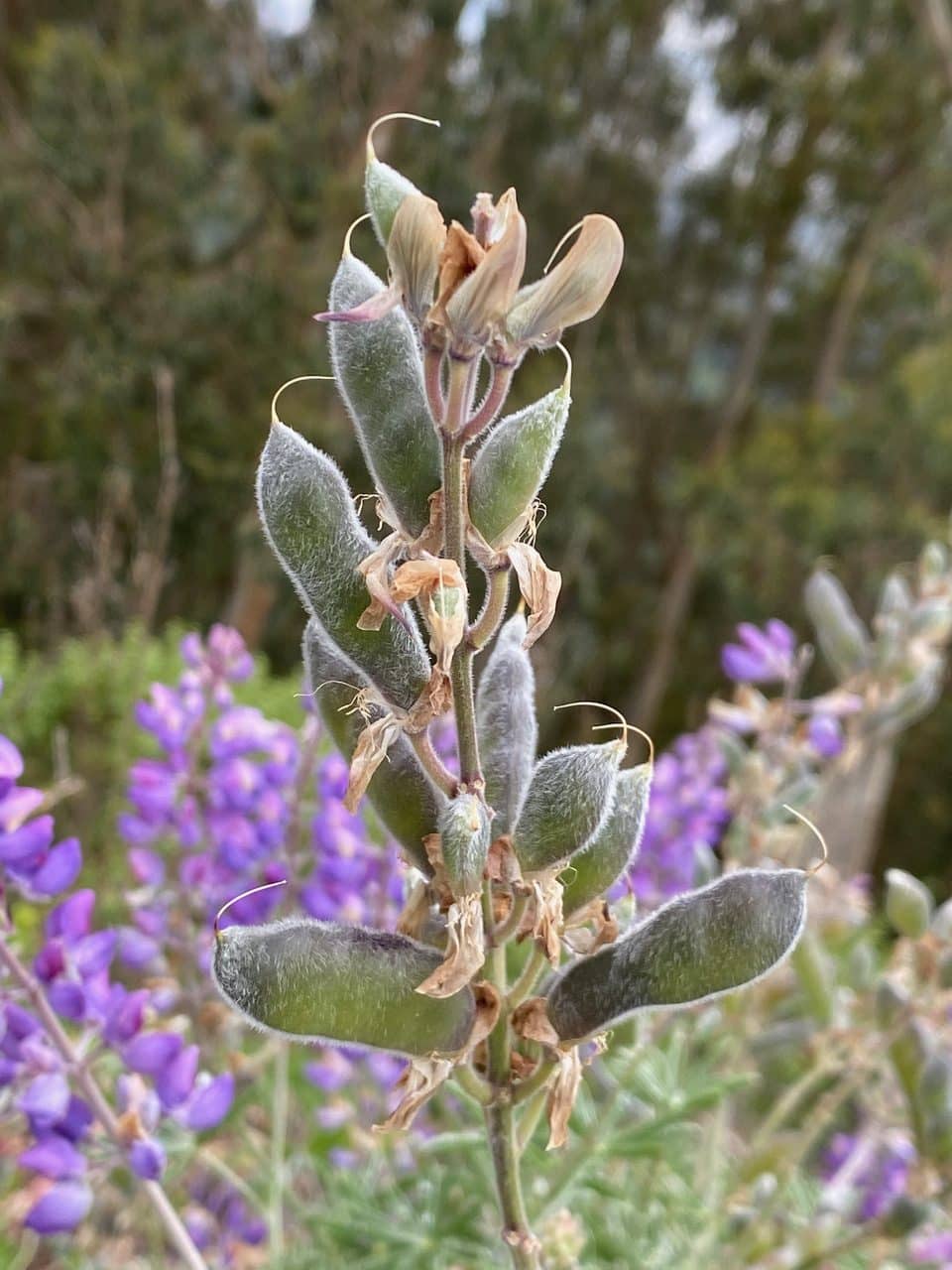
Despite the scarcity of Bumble Bees pollinating the Silverleaf Lupine, Lupinus albifrons this year, I am relieved to see that the fruit set is quite normal. Pea pods are appearing where the flowers have dropped off on the spikes.
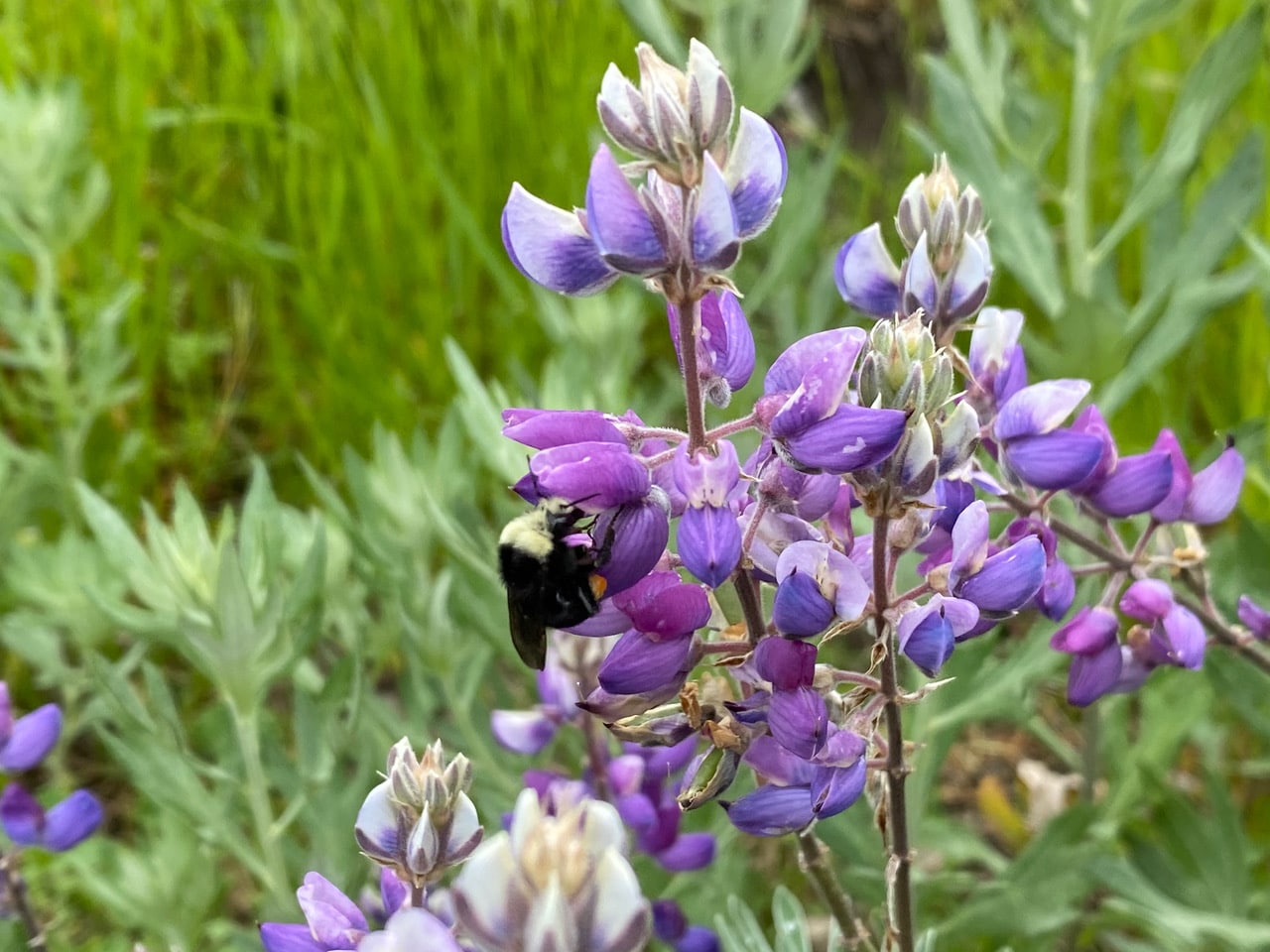
Even more encouraging, an occasional Yellow-faced Bumble Bees, Bombus vosnesenskii can be seen visiting the lupine flowers. This species of Bumble Bees has not made a strong presence this year, compared to last year. The slack has been taken up mostly by the formerly overshadowed Black-tailed Bumble Bees, Bombus melanopygus.
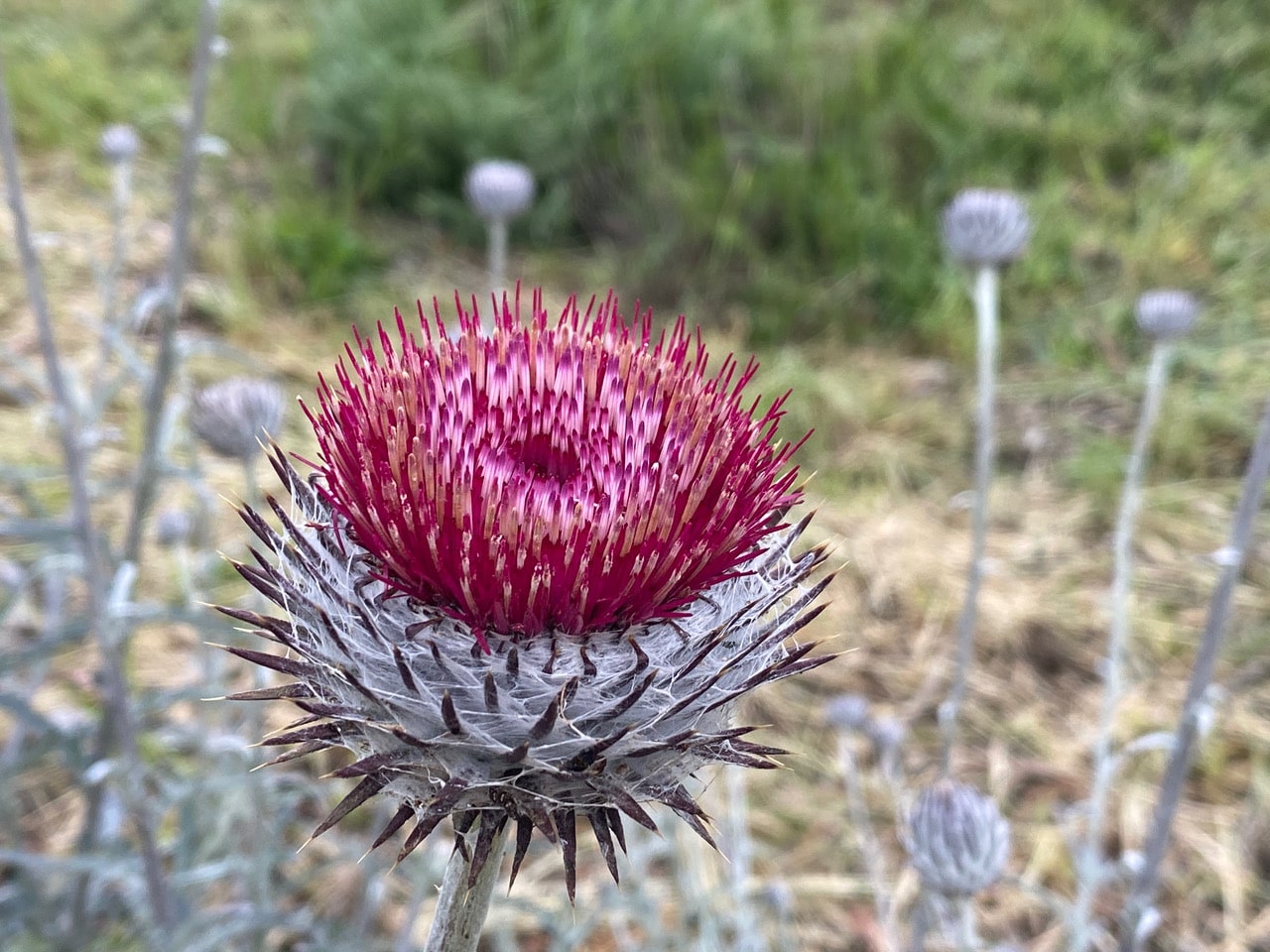
Near the entrance to the Water Tank, I check in on the enormous Cobweb Thistle, Cirsium occidentale. Red flowers now adorn the top of some of the cobwebby flowerheads.
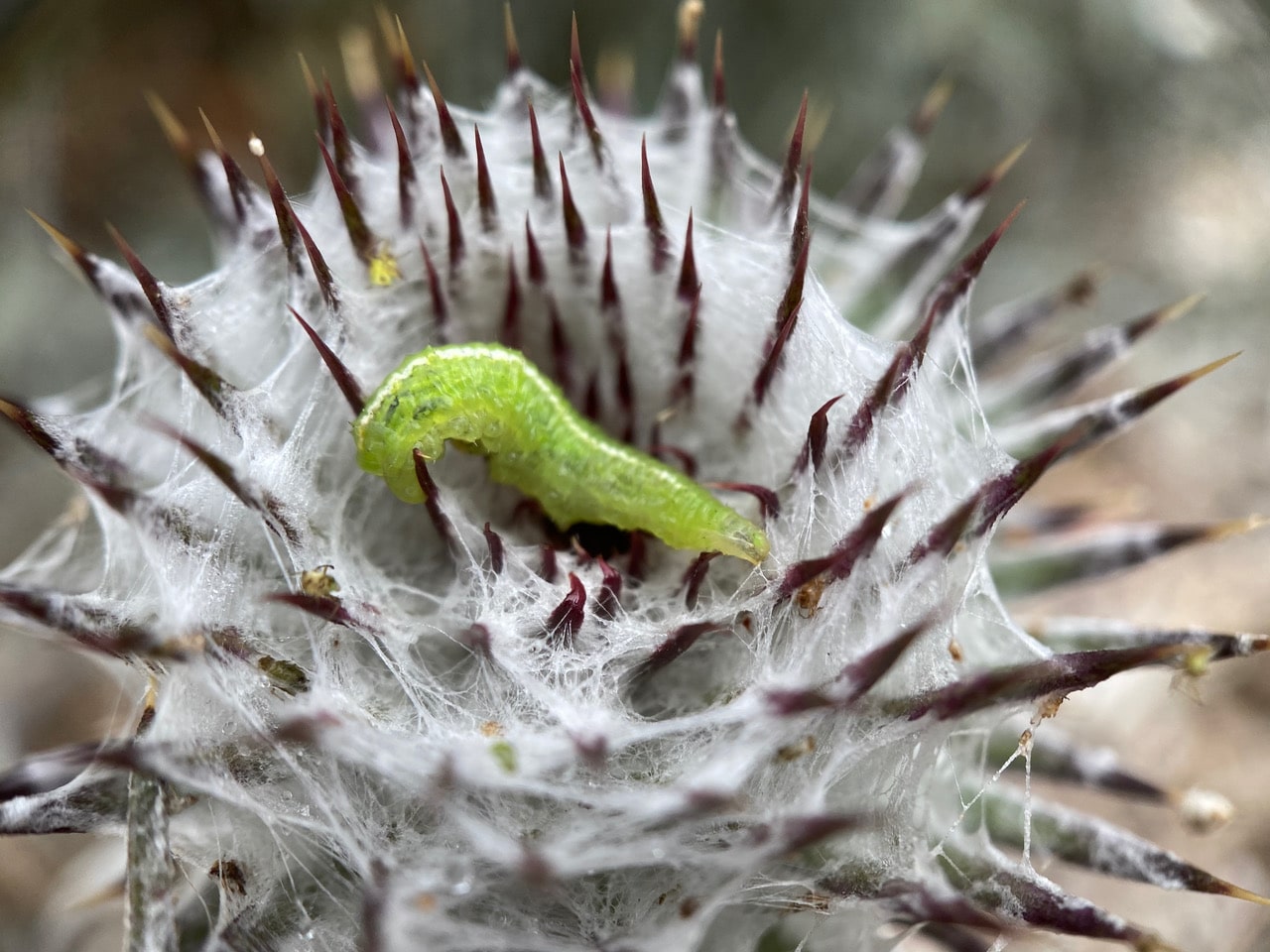

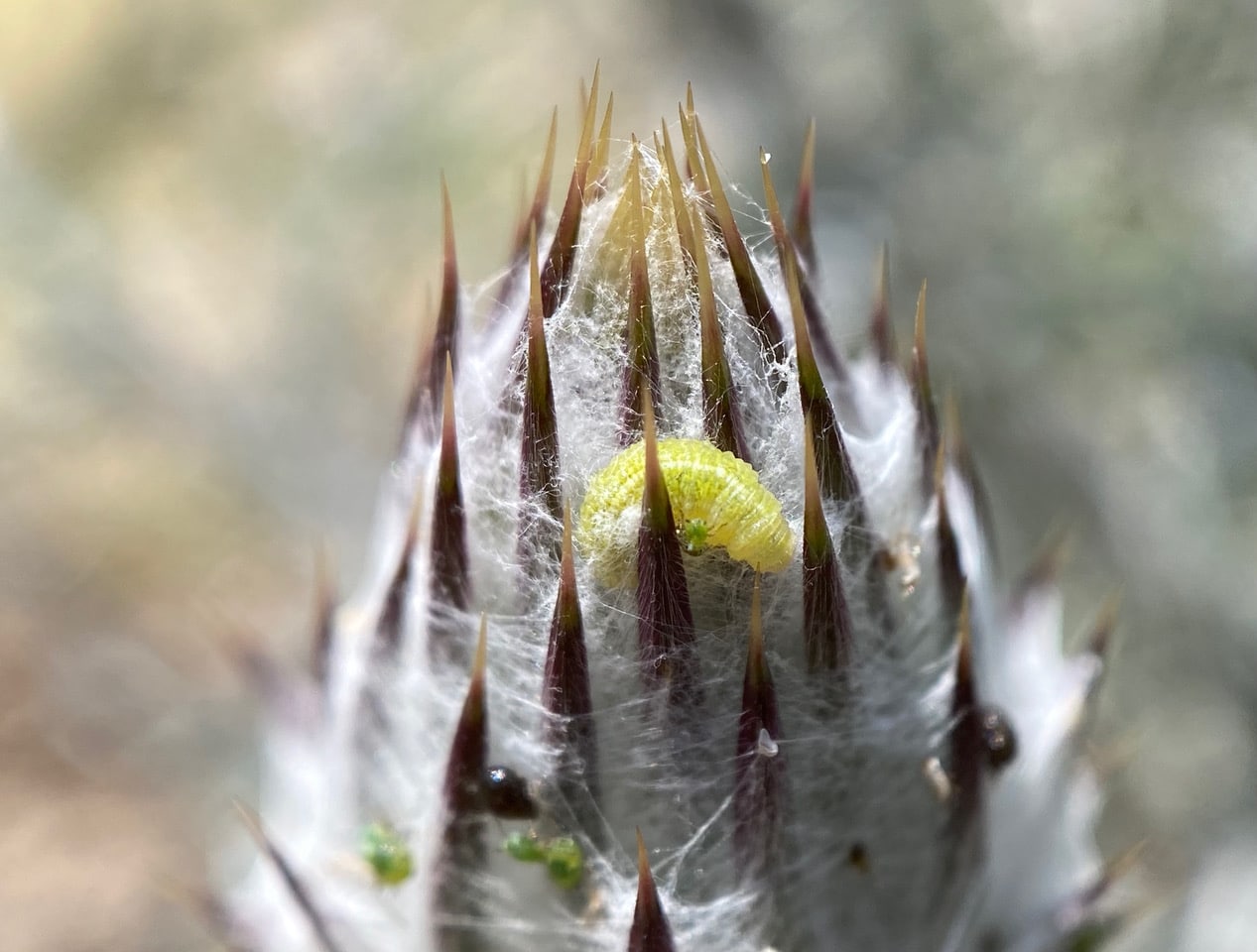

Looking like a splatter of neon green gel, a Hoverfly larva (family Syrphidae) is actively hunting aphids on an immature flowerhead. The tapered end is the front end. Hoverfly larvae are legless and blind. They hunt solely by their tactile sense, sweeping their front end from side to side, and grabbing with their mouthparts whatever it touches.
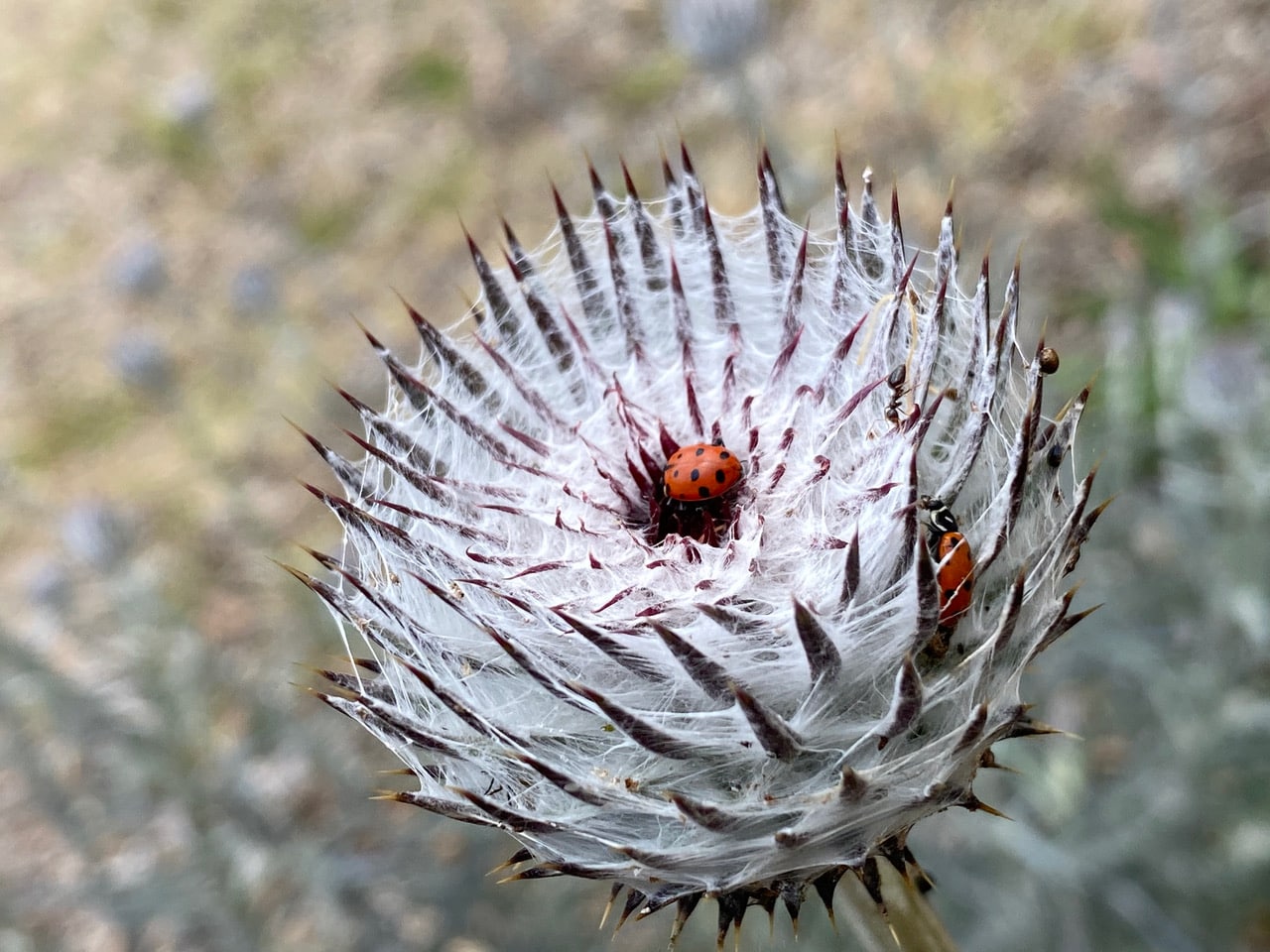
Compared to my last observations on 4/29, much fewer aphid predators are on the plant today. I have to look hard to find them. These two Convergent Ladybeetles are dwarfed by the huge flowerhead.
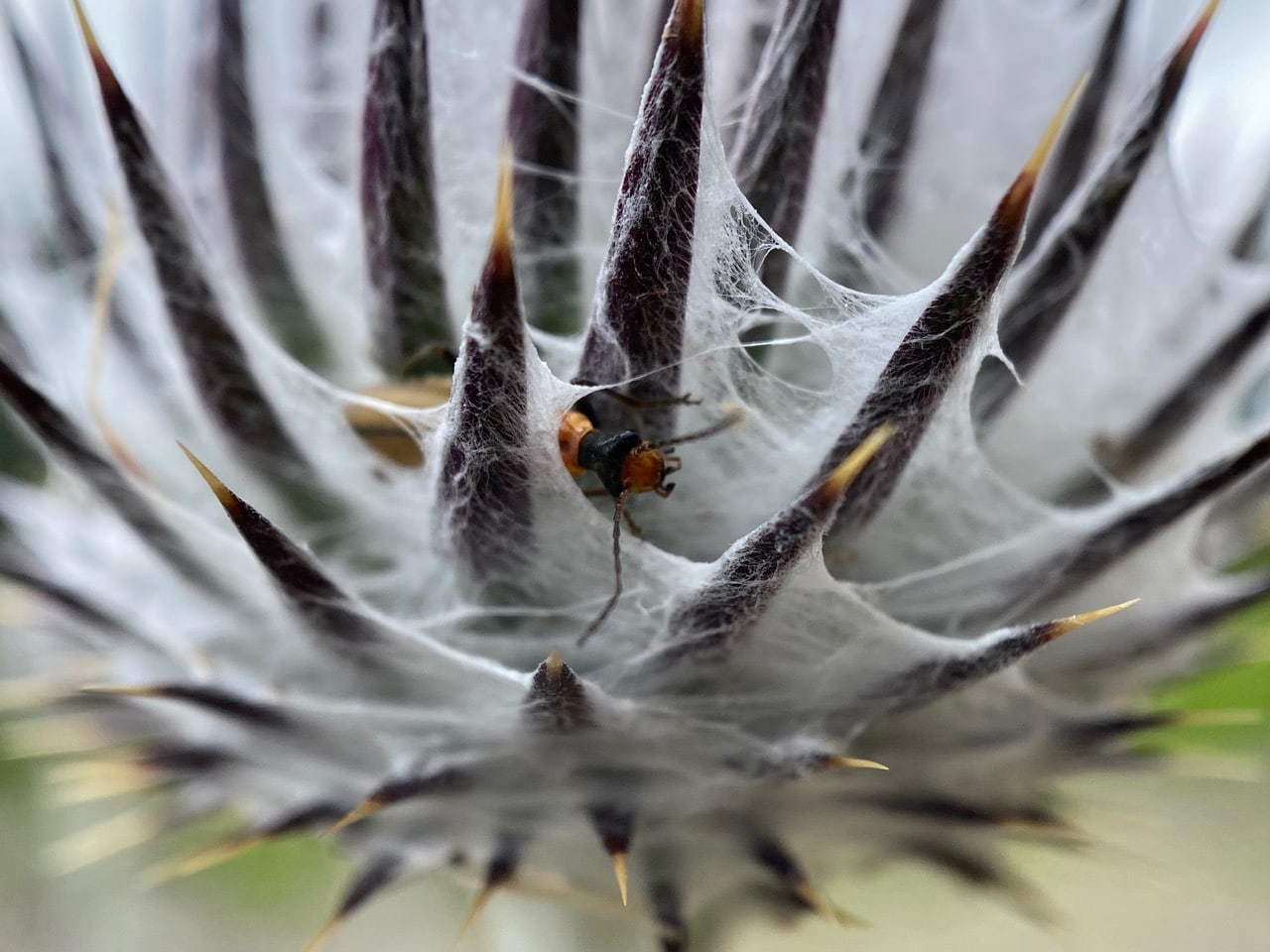
Lurking among the webby strands and sharp bracts, a Soldier Beetle, Podabrus cavicollis (family Cantharidae) is hunting aphids in the dark recesses of the thistle flowerhead.
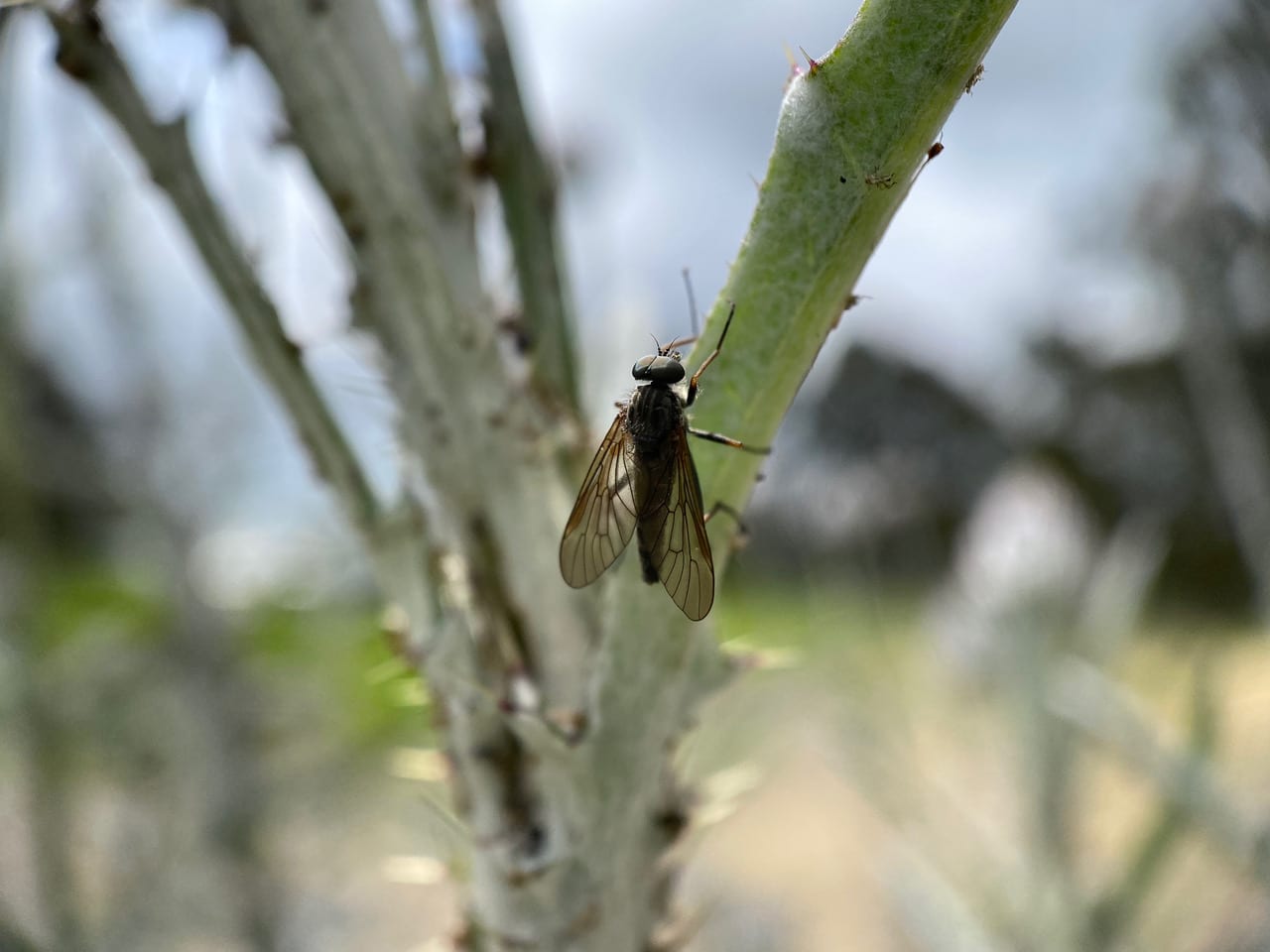
Various flies, and even a Yellowjacket wasp visit the plant to feed on honeydew. Honeydew is a sugar-rich sticky liquid, secreted by aphids and scale insects as they feed on plant sap. When their mouthpart penetrates the phloem, the sugary, high-pressure liquid is forced out of the anus of the aphid.
Another aphid-hunting Hoverfly larva (family Syrphidae) skillfully navigates around the cobweb strands of the thistle flowerhead.
A very young Syrphid larva is finding an abundance of food on this flowerhead.
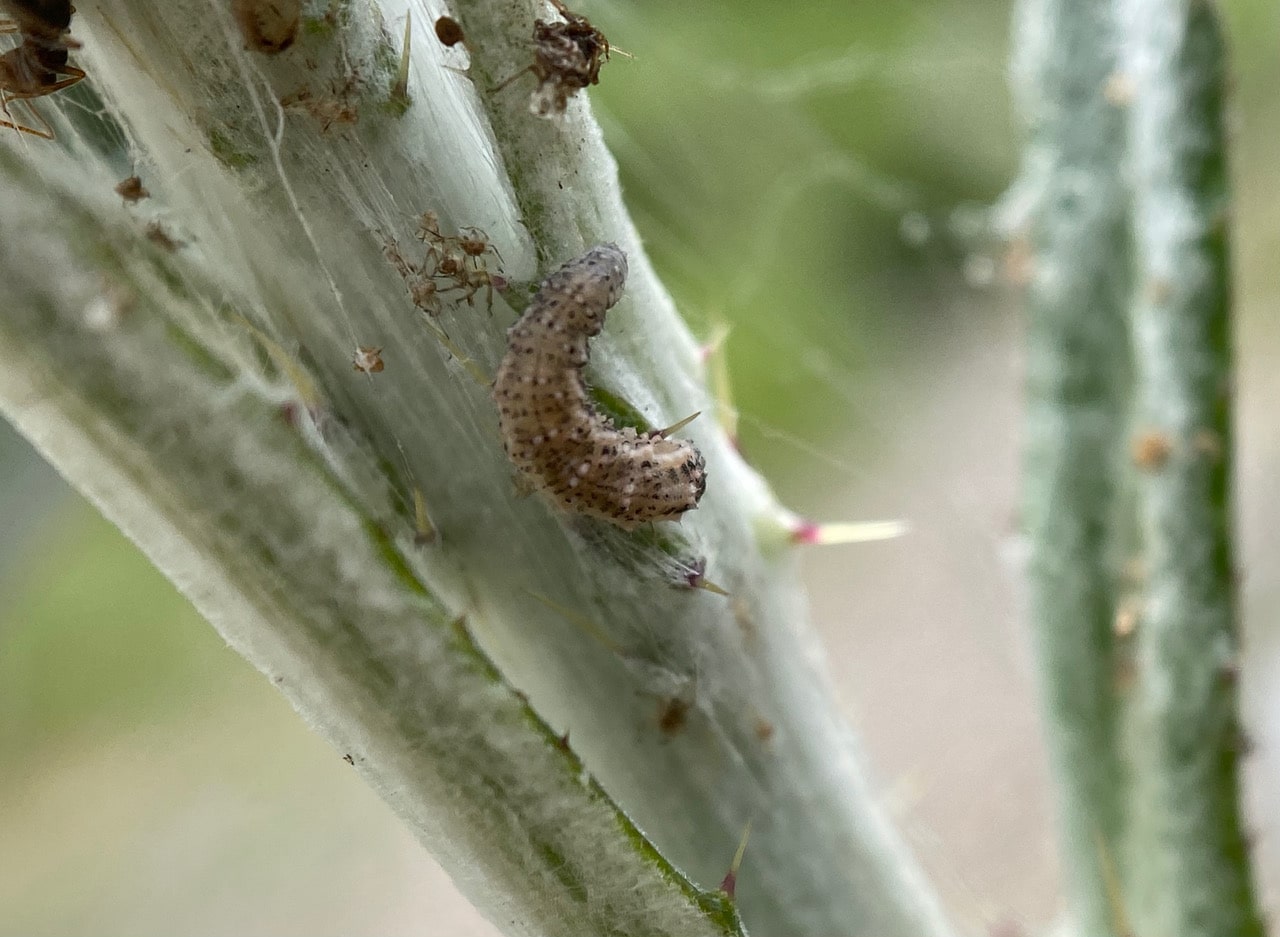
This brown, spotted larva belongs to a different species of Syrphidae.
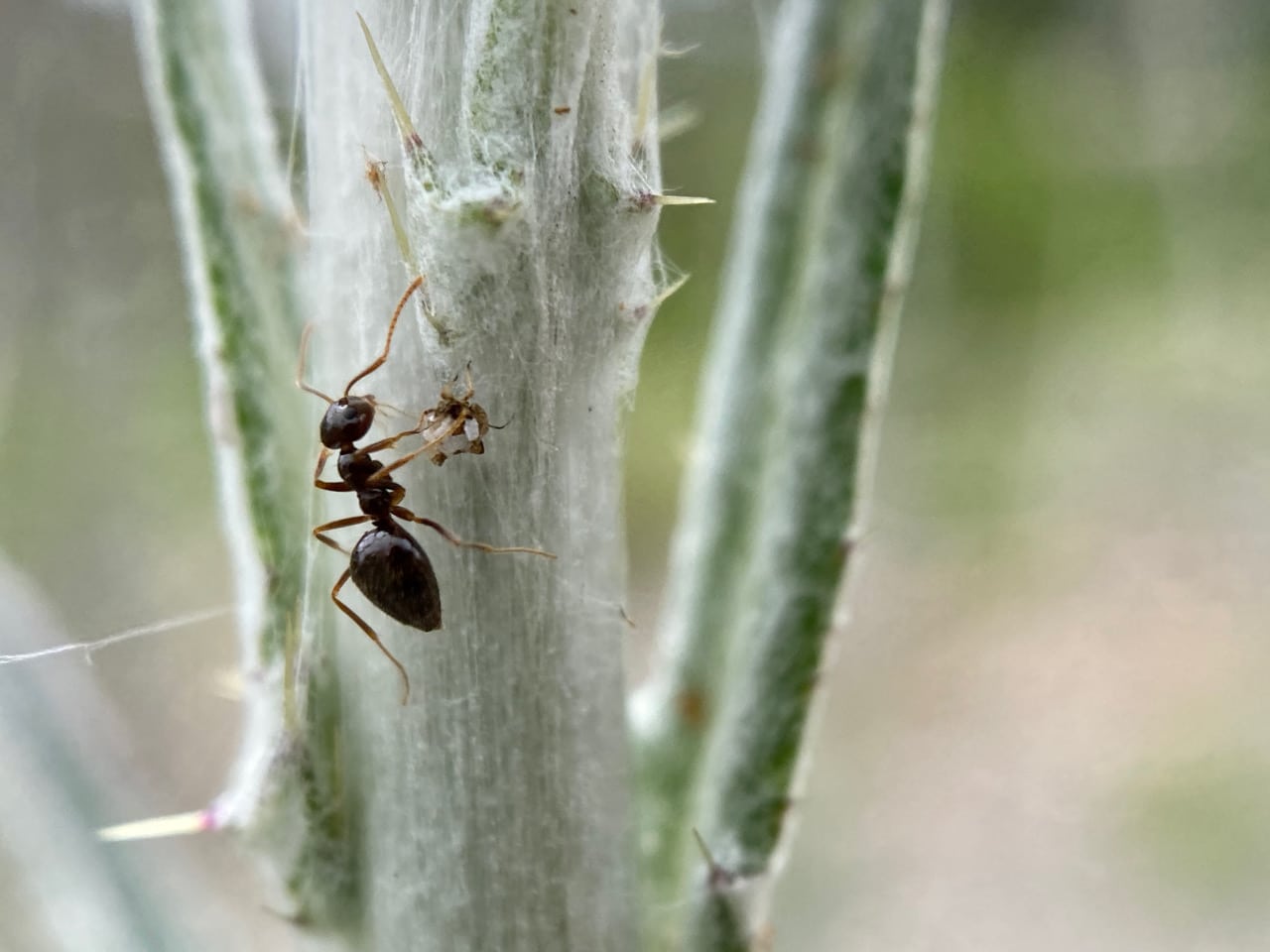
Hey, there are American Winter Ants crawling around on the thistle today! The aphids have finally summoned their protectors. Maybe that’s why there are fewer of the aphid predators around now.
Ants and aphids share a well-known mutualistic relationship. The aphids produce honeydew, a sugary food for the ants; in exchange, the ants care for and protect the aphids from predators and parasites. Some ants will “milk” the aphids to make them excrete the sugary substance. The ants stroke the aphids with their antennae, stimulating them to release the honeydew. Aphid-herding ants make sure the aphids are well-fed and safe. When the host plant is depleted of nutrients, the ants carry their aphids to a new food source. If predatory insects or parasites attempt to harm the aphids, the ants will defend them aggressively. Some species of ants continue to care for aphids during winter. The ants carry the aphids to their nest for the winter months, and transport them to a host plant to feed the following spring.
The American Ant, Prenolepis imparis is a widespread North American ant. A dominant woodland species, it is most active during cool weather, when most other ant species are less likely to forage. This species is one of a few native ants capable of tolerating competition with the invasive Argentine Ant, Linepithema humile. They are also aggressive toward other ants and produce abdominal secretions that are lethal to Argentine Ants. Prenolepis imparis is a generalist omnivore. Foragers are known for tending to aphids or scale insects from which they consume excreted honeydew, aggregating on rotting fruit, and exploiting protein-rich sources such as dead worms. The colony enters estivation (a hibernation-like state) and becomes inactive above ground for the warmer months, during which time eggs are laid and brood are reared. Reproductives overwinter and emerge on the first warm day of spring for their nuptial flight.
The ants seem a step behind the aphid predators on the Cobweb Thistle. Perhaps this is due to the ants’ flightlessness (except for the winged reproductives). The allies have to travel by foot while the enemies have arrived on the wing.
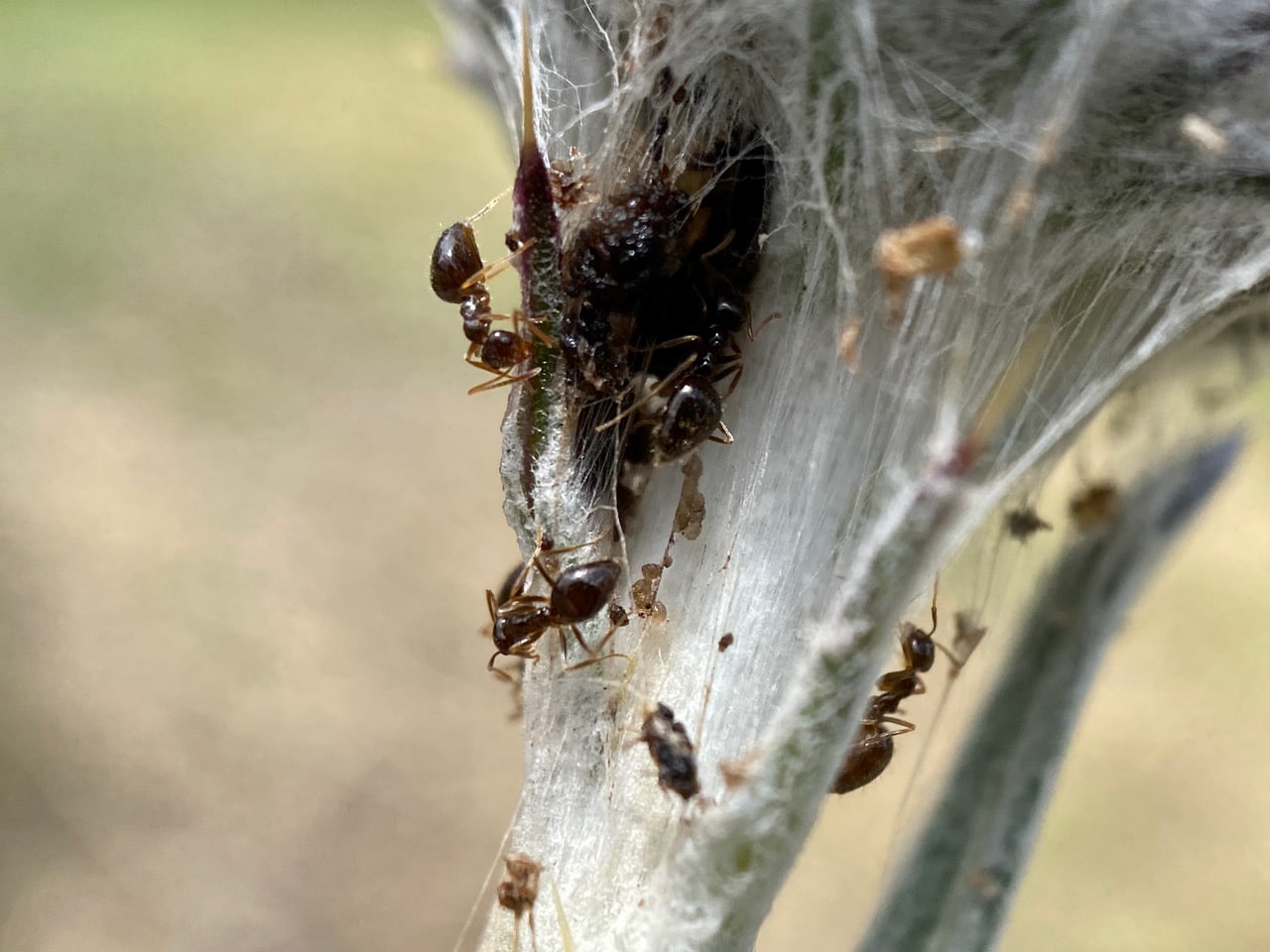
Most of the ants seem to be milling around, exploring the plant. There is, however, an excited aggregation of them around what looks like a blackened wound at the base of a thistle flowerhead. Is this where a colony of aphids might be hiding?
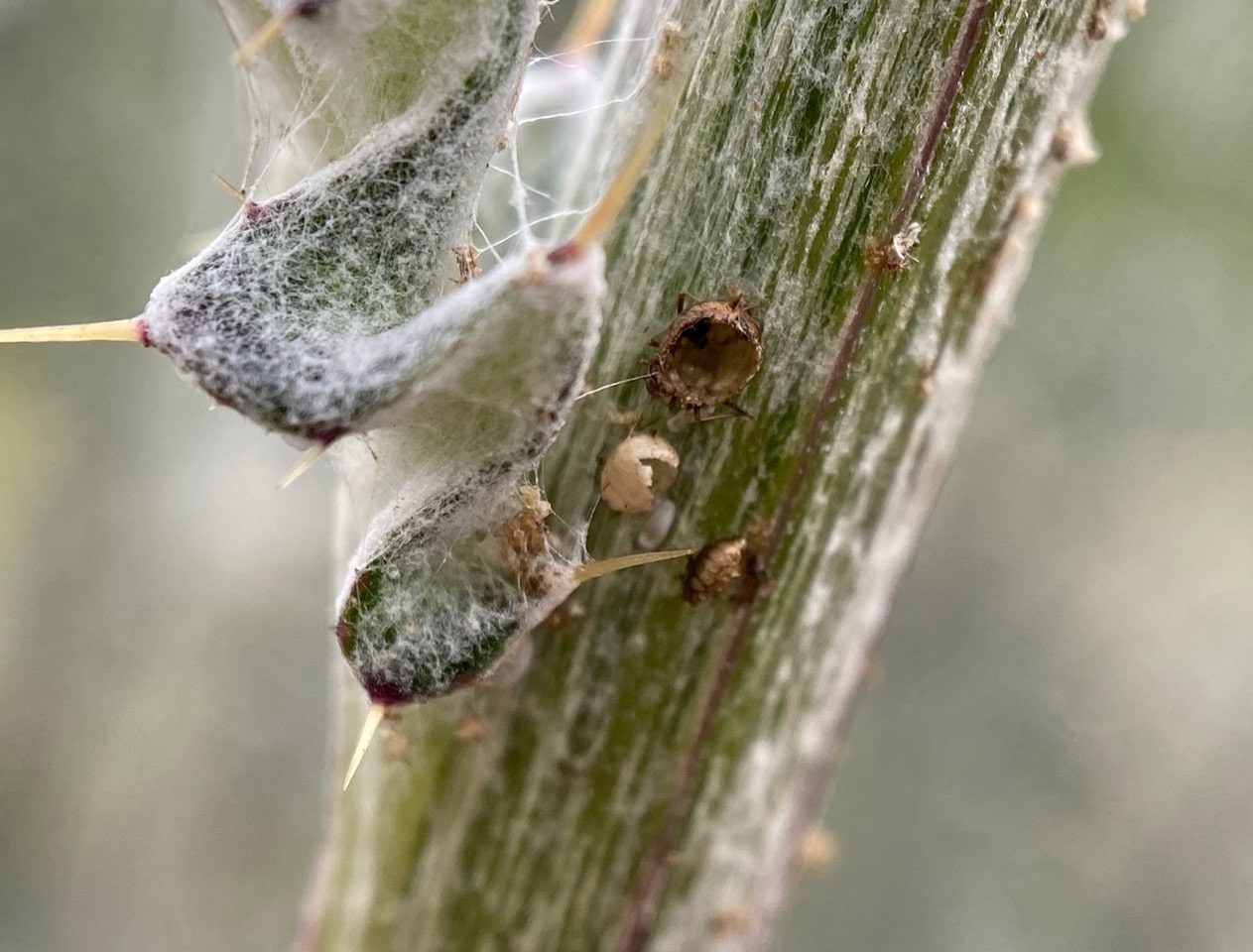
Wow, this looks like an immminent emergence of a parasitoid wasp from an aphid mummy. See the cleanly cut circular hole near the back of the aphid?
Aphids are often attacked by a tiny parasitoid wasp, Aphidius sp. (family Broconidae). The female wasp lays an egg in the aphid. When the egg hatches, the wasp larva feeds on the inside of the aphid. As the larva matures, the host dies and becomes slightly enlarged or mummified, often turning browner yellow. Complete metamorphosis occurs within the host. The adult parasite chews its way out of the mummy, leaving a round hole. The Aphidius wasps are often used for biological pest control of aphids on agricultural crops and home gardens.
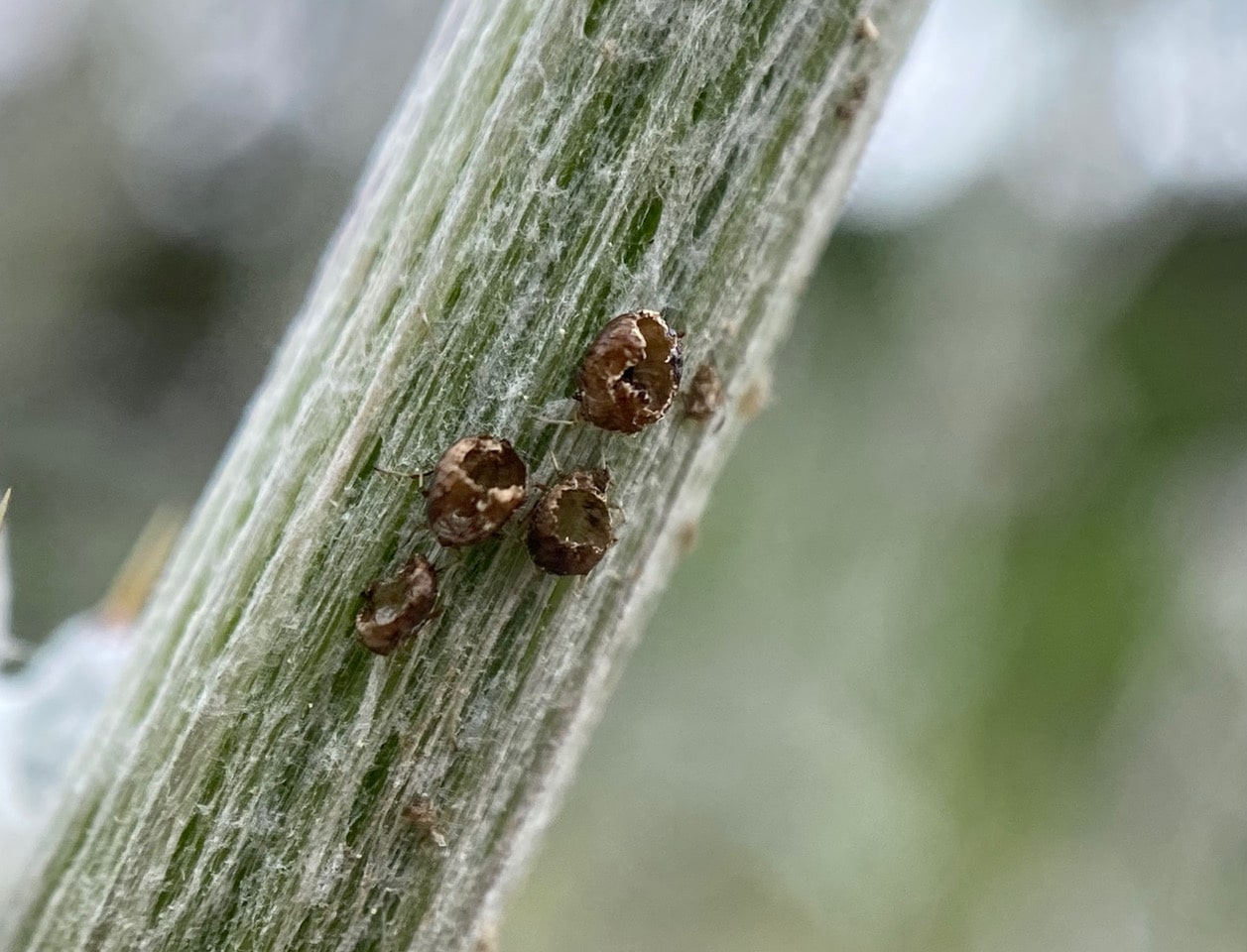
What are these?? They look like aphid mummies, but the holes are not perfect. They look like random act of predation or vandalism.
There are many more of the badly chewed aphid mummies on the plant. This is not the typical appearance of the exit holes made by the Aphidius wasps (family Braconidae) that parasitize the aphids. At emergence, Aphidius wasps cut perfect round holes on the exoskeleton of their hosts. I wonder if these jagged holes were made by the ants to destroy the parasitoids in order to protect the rest of the aphid colony. Perhaps the ants are capable of detecting the parasitoid wasps that are still living within the aphids.
Alternatively, this could be an inside job by hyperparasites. A hyperparasite is a parasite of a parasite, often another wasp. The hyperparasites might have devoured their hosts, the Aphidius wasps within the aphids, and made their escape by chewing these not-so-perfect holes through the aphids. The field of parasitology is rife with such incredible, complicated dramas.
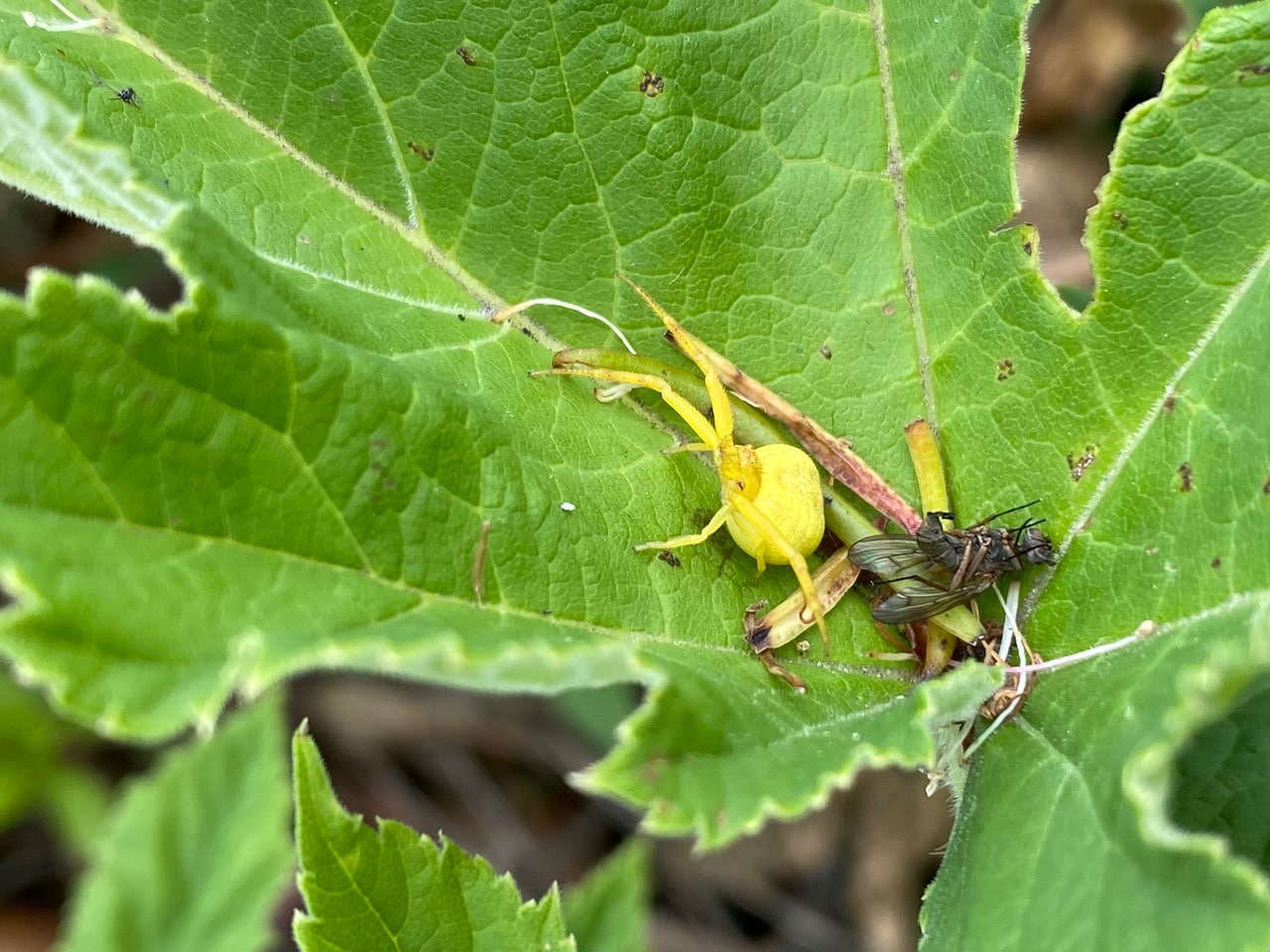
Hey, the yellow Crab Spider that I photographed on the Cow Parsnip on 4/29 is still on the same leaf. Among the accumulation of debris behind her are the two flies she has previously caught. Has she remained here through the rains we just had? Is this a particularly good spot for ambushing prey? Or is she trapped here? It is not easy for her to run away from this sloping corner if approached by a predator such as a bird. I trust that the spider knows what’s best for herself. Even without flowers, she’s probably capable of attracting insects by her body’s reflectance of ultraviolet light. And maybe the accumulation of the prey carcasses and the odor they give off serve to attract more flies?
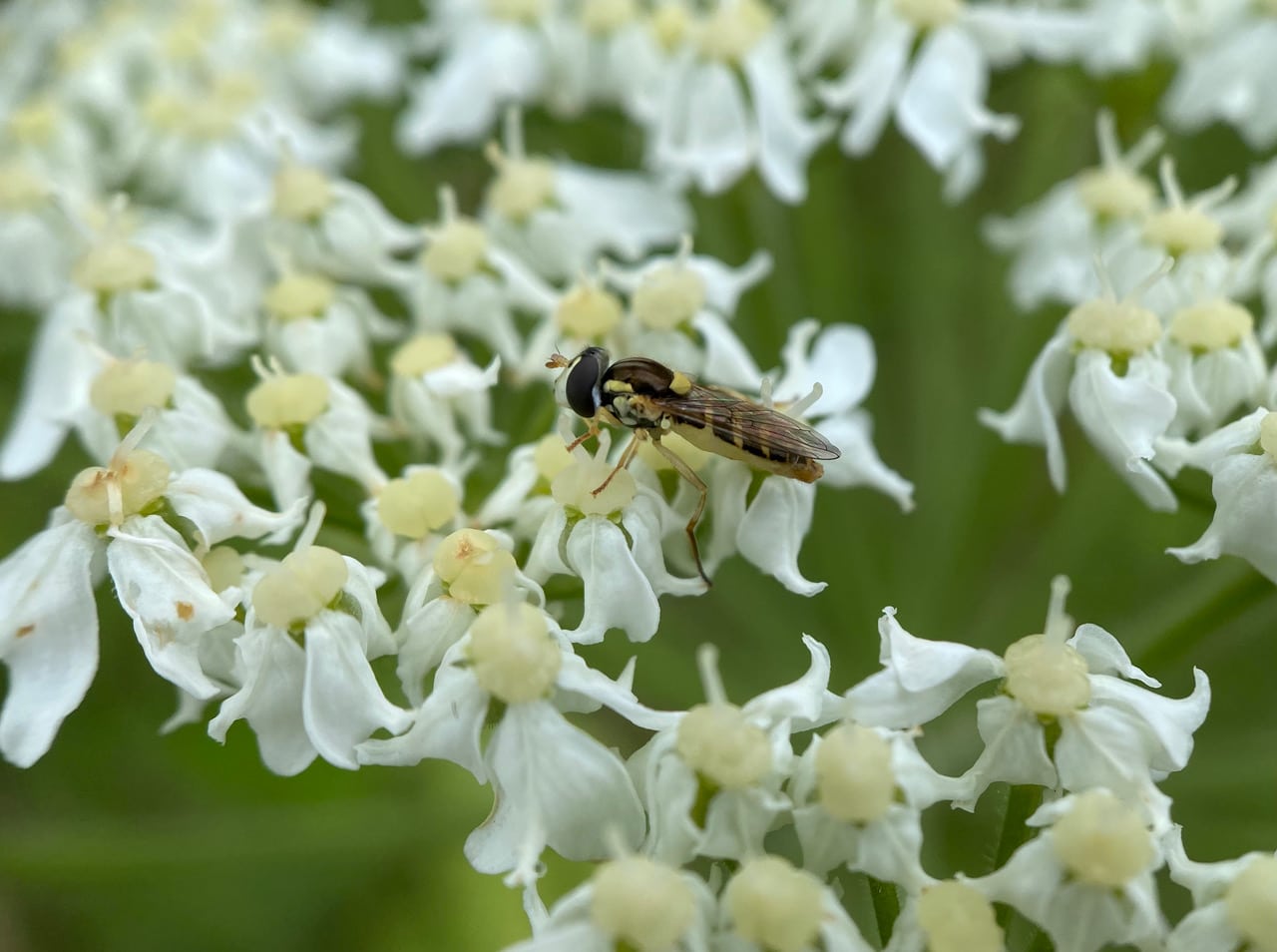
A Hoverfly lands to feed on the flowers of Cow Parsnip. Its wings are folded over its body concealing the black/yellow patterns on the abdomen, and making it difficult to identify the insect. It appears to be a gravid female with a bulging abdomen. Female Tufted Globetail? Female Diamond Spottail?
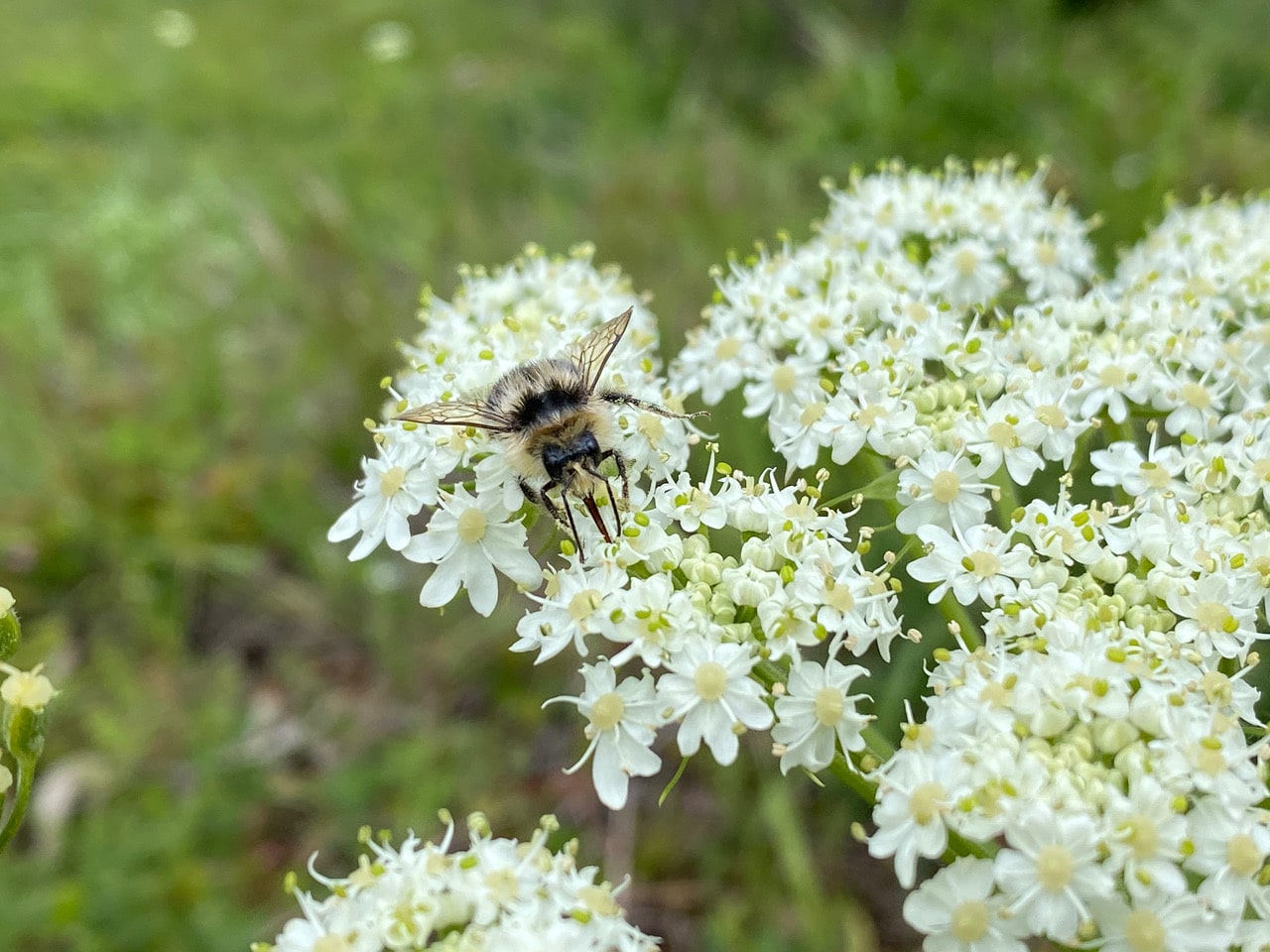
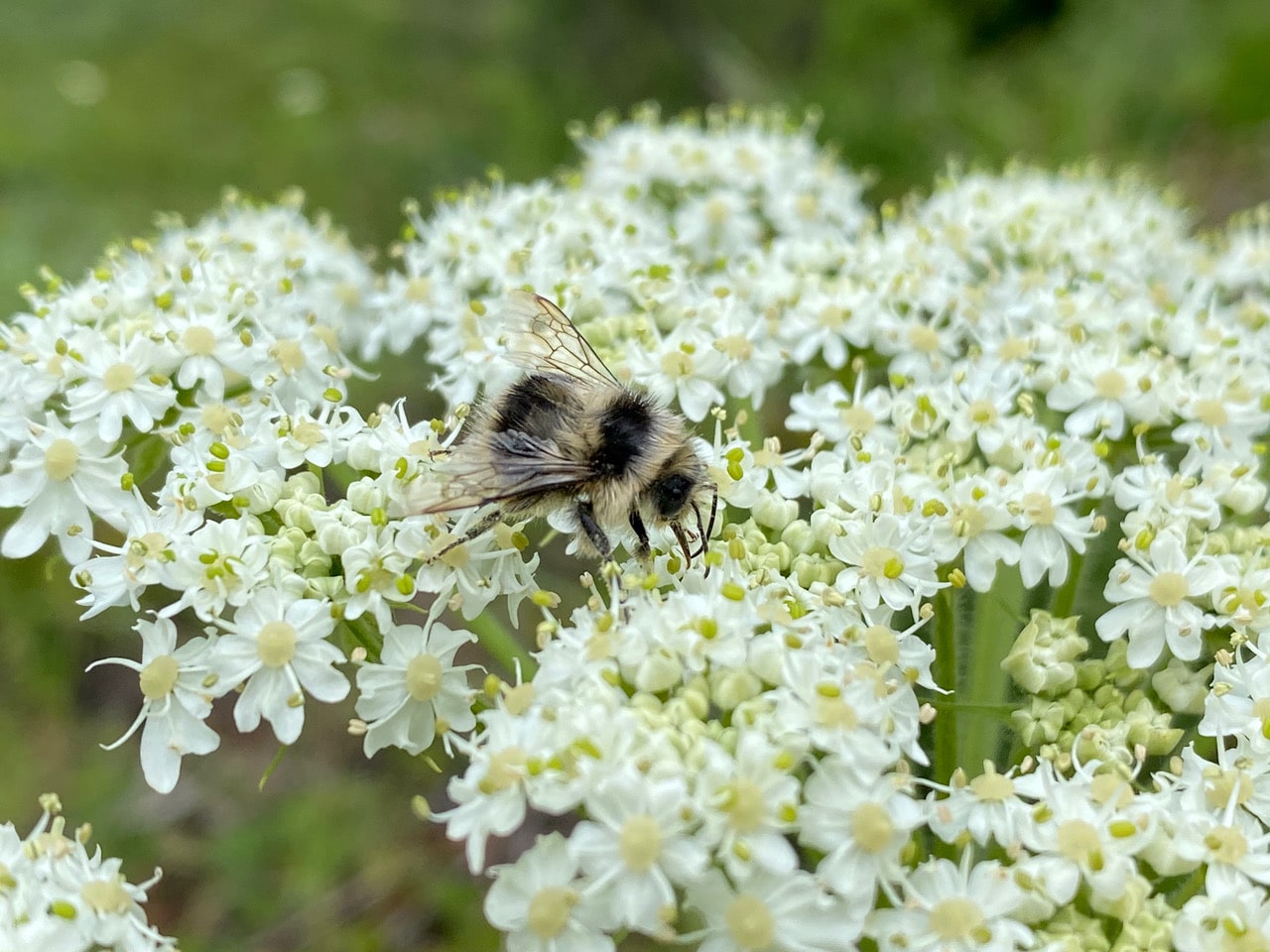
A Black-tailed Bumble Bee, Bombus melanopygus arrives to take nectar from the Cow Parsnip flowers. Her hairs are so frazzled she looks like she’s just been electrocuted. The pale colors of her hairs indicate that she’s probably an older bee close to the end of her life. The yellow hairs on her body have turned a dirty white.
The old bee is not collecting pollen. She’s focusing on taking nectar, hardly lifting her head. Note that the edges of her wings are tattered.
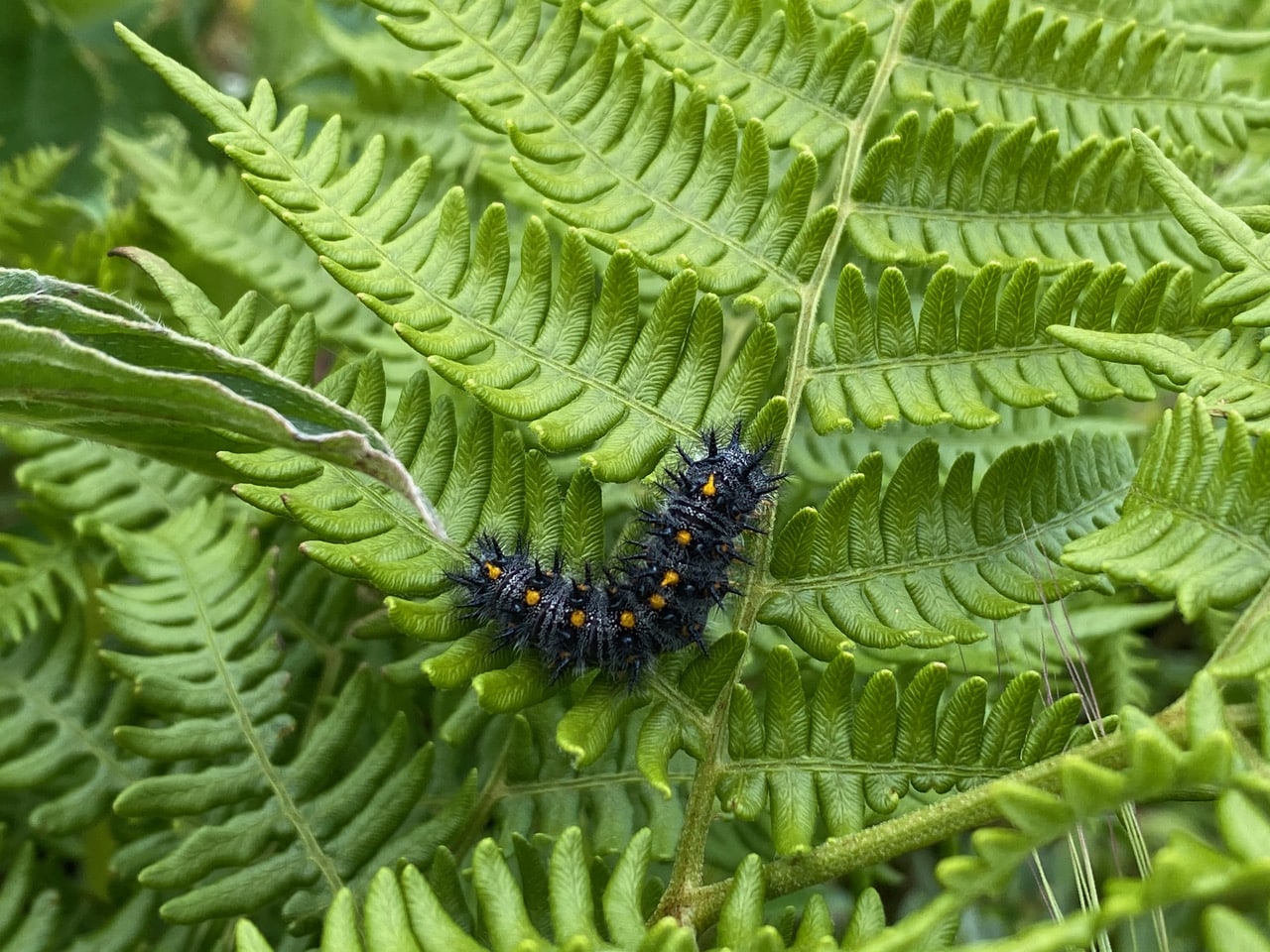
Returning to the spot where I found the Variable Checkerspot caterpillar on the California Phacelia, I discover that it has crawled onto an adjacent leaf of a Bracken Fern. Maybe it is trying to bask in the sun, or maybe it is ready to pupate and is doing a “walk about” to find the right spot for the transformation. Many caterpillars do not pupate on their larval food plants; they usually prefer a substrate/structure that is more stiff and woody on which to hang their chrysalids. I sure hope that the caterpillar is not going to feed on the Bracken Fern.
Fossil evidence suggests that Bracken Fern, Pteridium aquilinum has had at least 55 million years to evolve and perfect anti-disease and anti-herbivore chemicals. Bracken Fern is chemist extraordinaire. It produces bitter tasting sesquiterpenes and tannins, cyanogenic glycosides that yield hydrogen cyanide when munched by herbivores. It also produces two insect molting hormones, the ecdysones that cause uncontrollable, repeated molting in insects ingesting the fronds, leading to rapid death. It generates simple phenolic acids that reduce grazing, may act as fungicides, and are implicated in bracken’s allelopathic activity in suppressing neighboring plants.
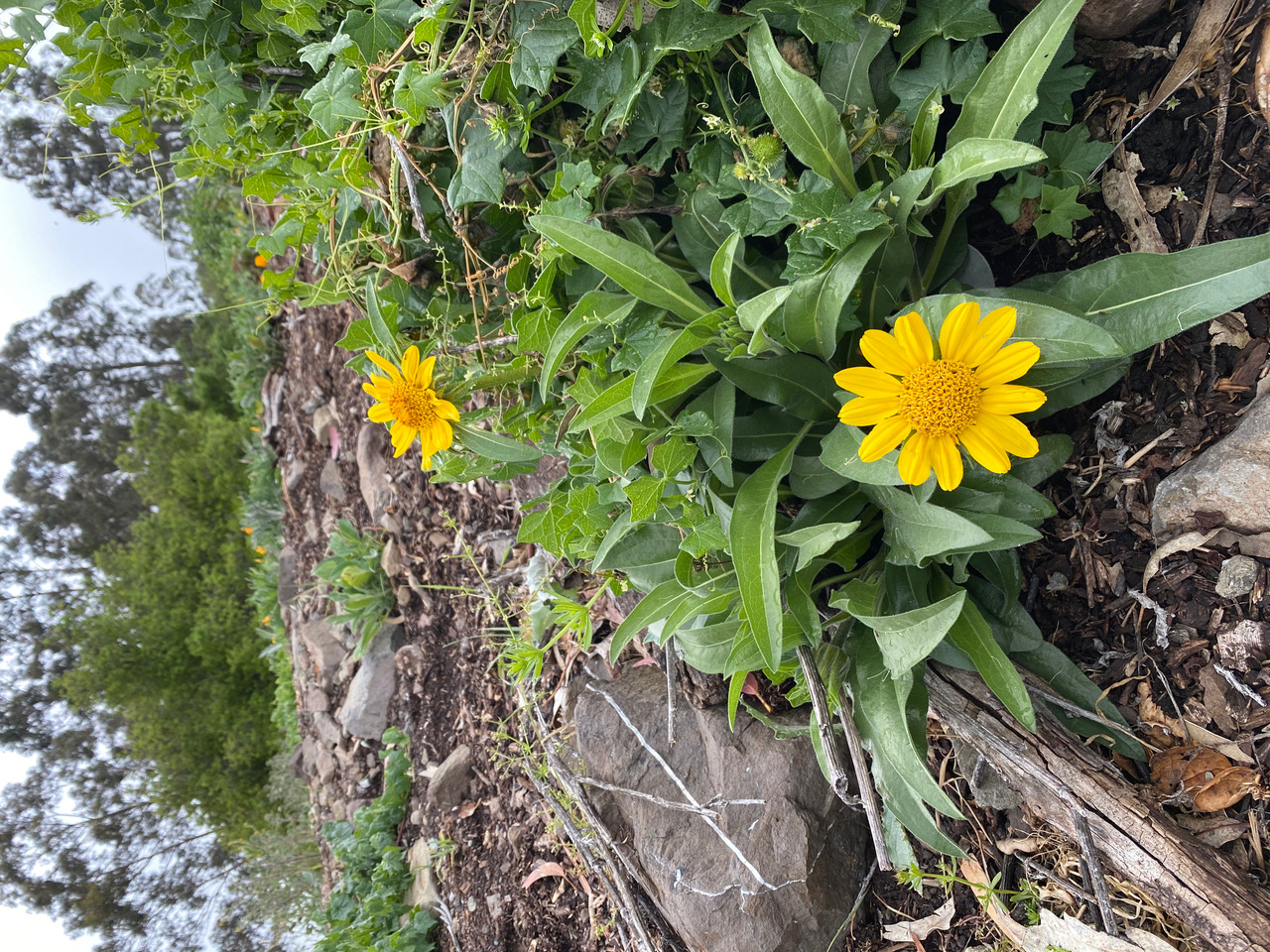
A correction: Glen informed me that this plant is not the Narrowleaf Mule’s Ears as I have reported in the previous post, but is instead the Mt. Diablo Sunflower, Helianthella castanea. The key character on this species is a more “regular” and flat-petaled flower with leafy bracts that extend out beyond the reach of the ray flowers. The leaves are more “regular” and shiny than Wyethia angustifolia, and usually not wavy. While the plant is quite common on Mt. Diablo proper, it is a rare and local East Bay endemic perennial.