

Pollinator Post 5/12/23 (2)
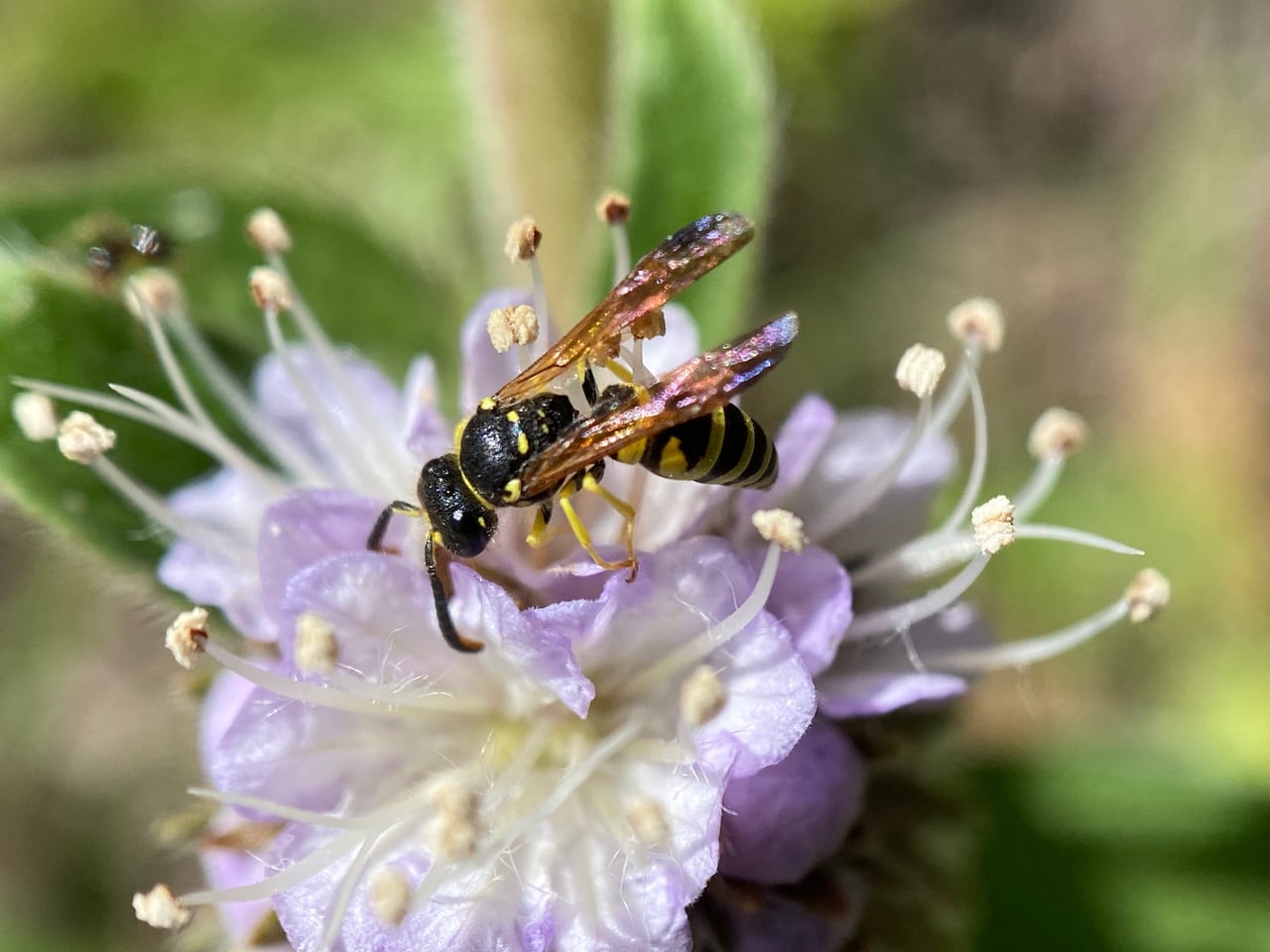
A Mason Wasp, Stenodynerus sp. (family Vespidae) forages among the flowers of California Phacelia, Phacelia californica.
“Mason wasps” refers to a group of closely related wasps belonging to the Eumeninae subfamily of the Vespidae family. The subfamily contains both mason wasps and potter wasps. Mason wasps are larger and mostly black, ranging from slightly over 1/2 inch to almost 3/4 inch. long for the larger females. Like all wasps, mason wasps have little or no hair. Mason wasps are solitary. They use cracks and holes in wood and abandoned beetle burrows for their nests. Larval mason wasps consume living but paralyzed caterpillars provisioned by their mother. Prior to the hunt for caterpillars, the female mason wasp deposits her egg in the chamber where caterpillars will be stored. She then hunts for prey on flowers and foliage, using a potent venom to paralyze the caterpillars. Once a sufficient number of prey have been captured, the chamber is sealed with a plug of mud or sand particles. The female wasp is able to control the gender of its offspring, laying either a male or a female egg. Due to the shorter developmental time of the male offspring, male eggs are usually placed near the opening of the gallery while the female eggs are placed deeper within. As adults, mason wasps provide the important ecosystem service of pollinators as they seek nectar and pollen as food sources.
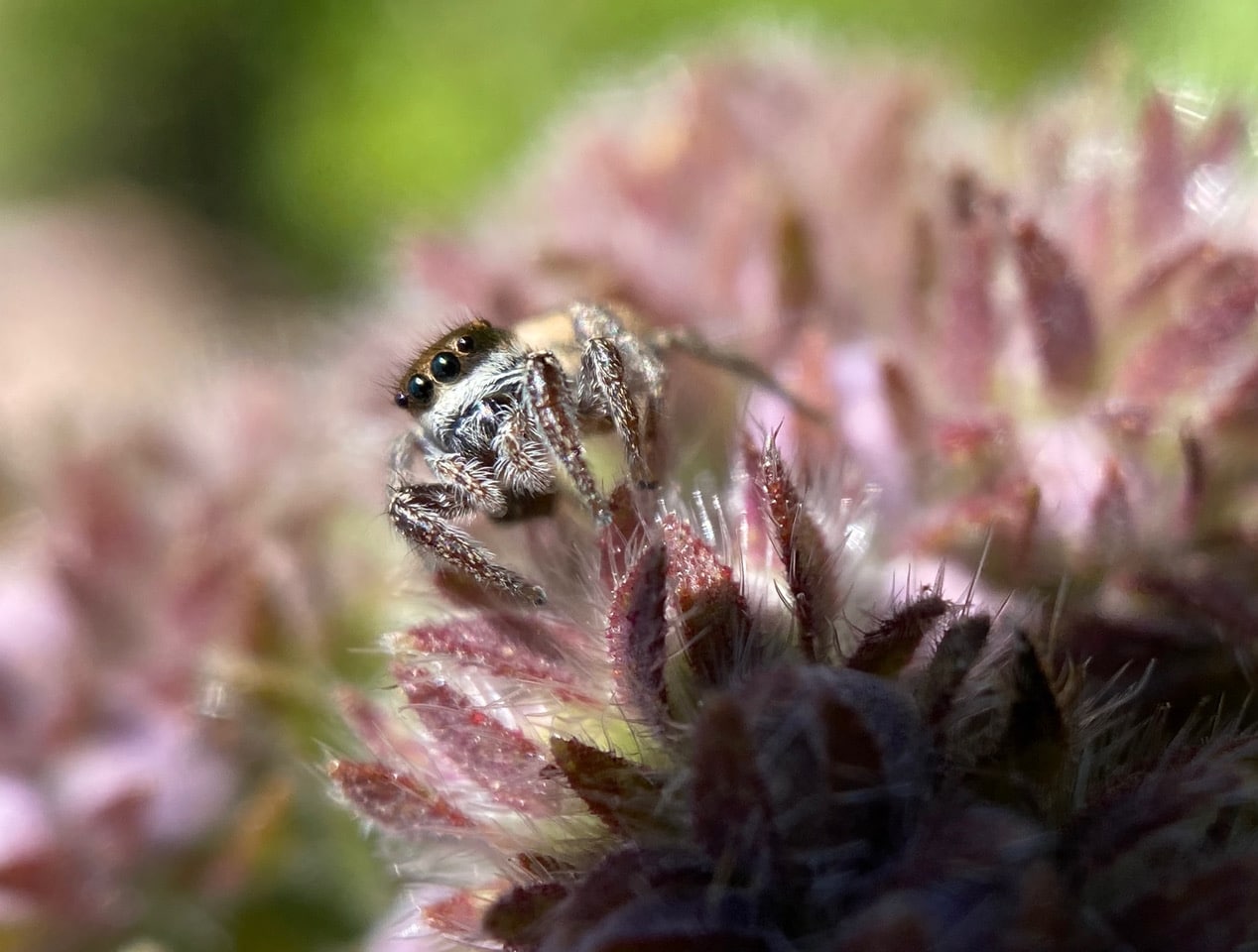
Spotting a little Jumping Spider (family Salticidae) on a cluster of California Phacelia flower buds I put on my macro lens for a closer look. The spider spins around to face me, an endearing behavior typical of these bold and intelligent spiders. I once kept a female as a pet for a few weeks, watching her pounce with incredible precision on the live flies I caught for her. I finally had to let her go when she began to display nesting behavior, ready to lay eggs. My love affair with Salticids persists to this day, and the spiders have always been easy to photograph.
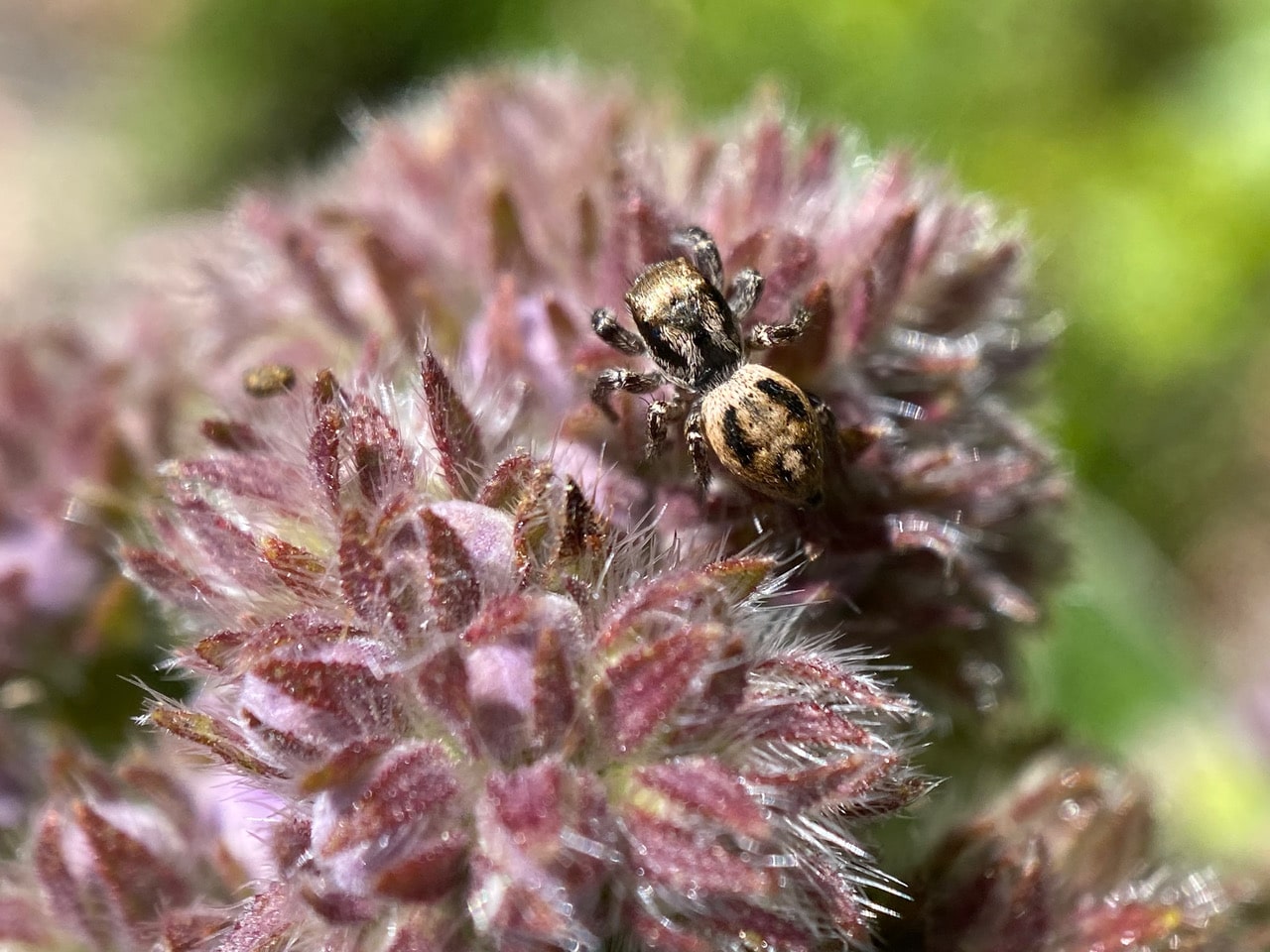
iNaturalist has helped identify the spider as a female Paradise Jumping Spider, Habronattus pyrrithrix (family Salticidae).
Salticids are free-roaming hunting spiders. They do not weave a web to catch prey. They stalk, then pounce on their prey. Just before jumping, the spider fastens a safety line to the substrate. It can leap 10-20 times their body length to capture prey. Their movement is achieved by rapid changes in hydraulic pressure of the blood. Muscular contractions force fluids into the hind legs, which cause them to extend extremely quickly.
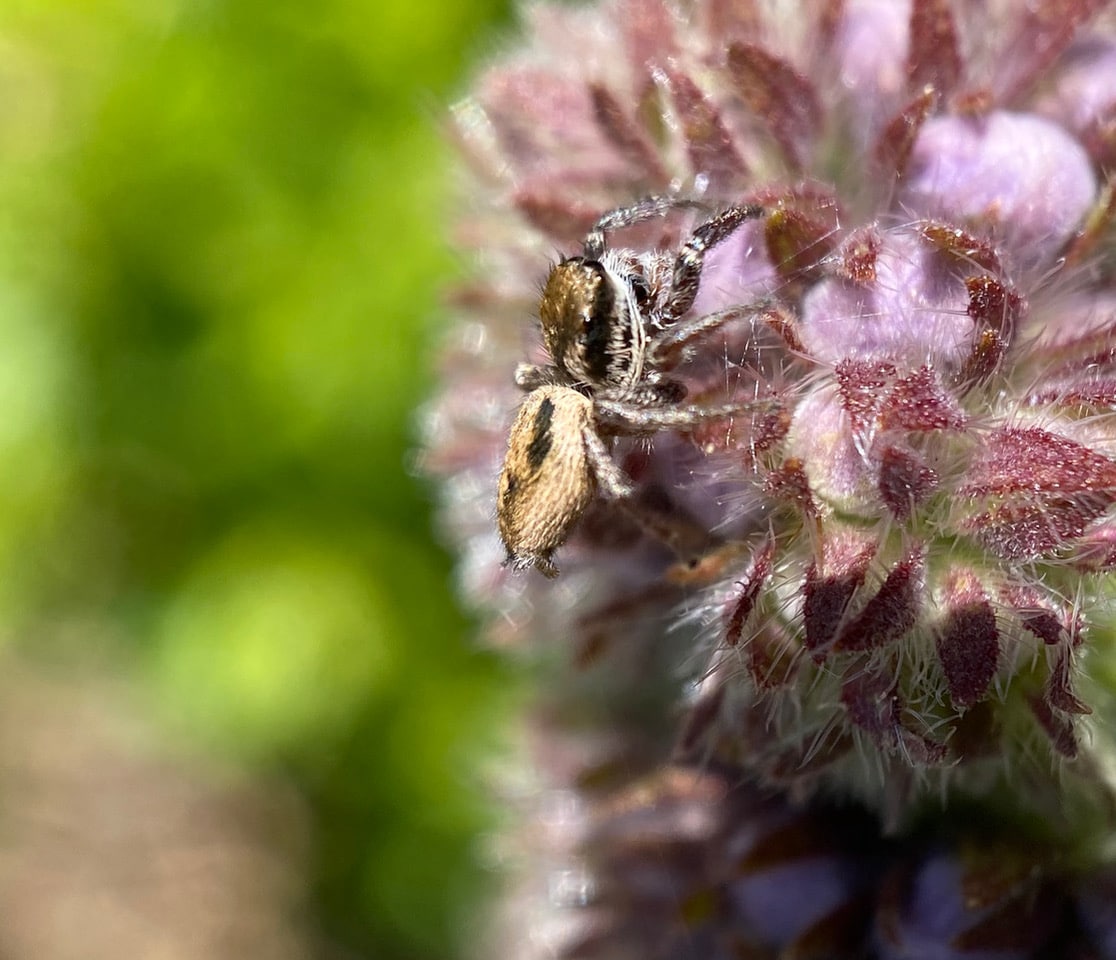
Side view of the Paradise Jumping Spider.
Jumping Spiders (family Salticidae) are easily distinguished by the shape of the cephalothorax and their eye patterns. They have faces that are roughly rectangular surfaces perpendicular to their direction of motion. In effect this means that their forward-looking, anterior eyes are on “flat faces”.
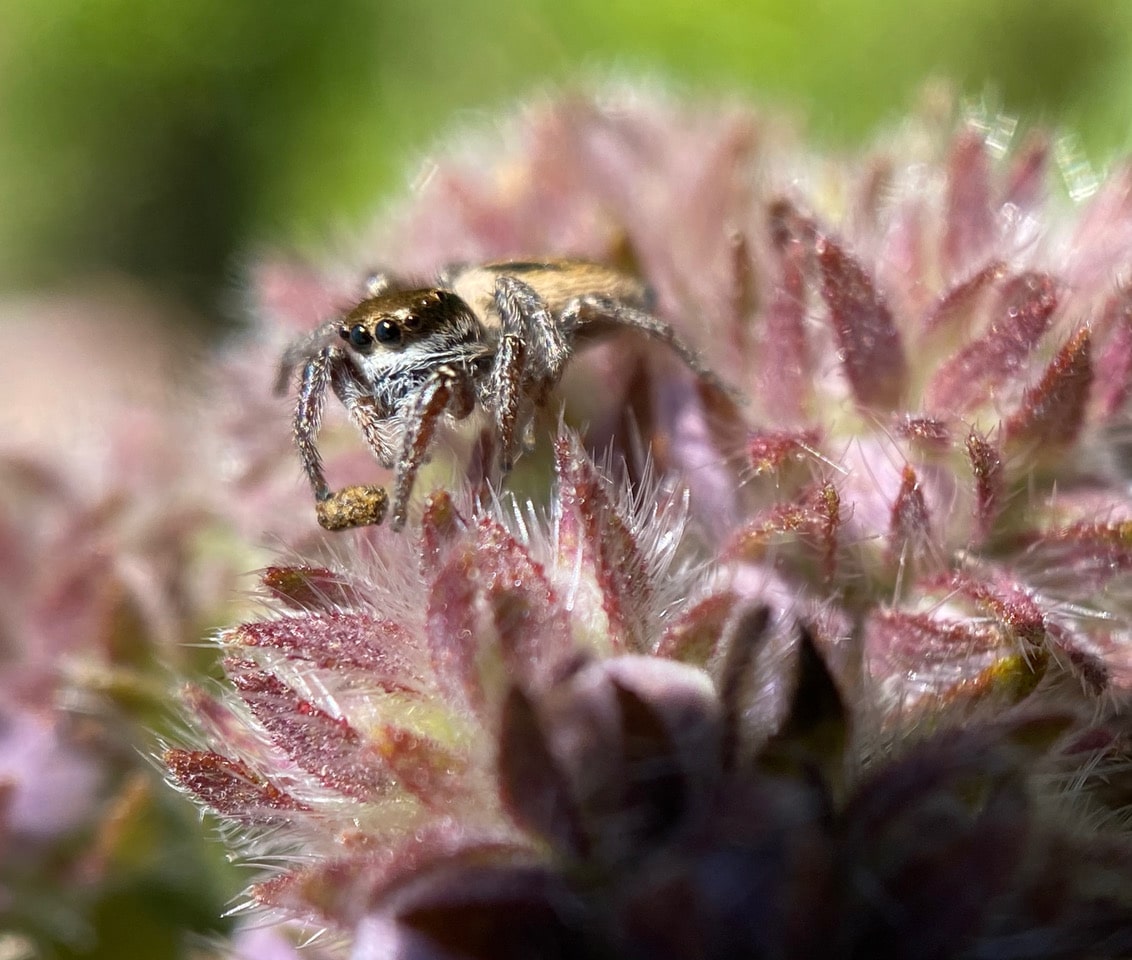
This view of the Paradise Jumping Spider shows most of its eight eyes.
Jumping spiders have excellent vision, with among the highest acuities in invertebrates. The 8 eyes are grouped four on the face (the two big Anterior Median Eyes in the middle, and two smaller Anterior Lateral eyes to the side), and four on top of the carapace. The anterior median eyes provide high acuity but small field of view, while the other six eyes act like our peripheral vision, with lower resolution but broad field of view. Since all eight eyes are fixed in place and can’t pivot independently from the body like human eyes can, jumping spiders must turn to face whatever they want to see well. This includes moving their cephalothorax up and down, an endearing behavior.


A pair of Convergent Ladybeetles, Hippodamia convergens (family Coccinellidae) is mating among the flowers of California Phacelia. How sweet!
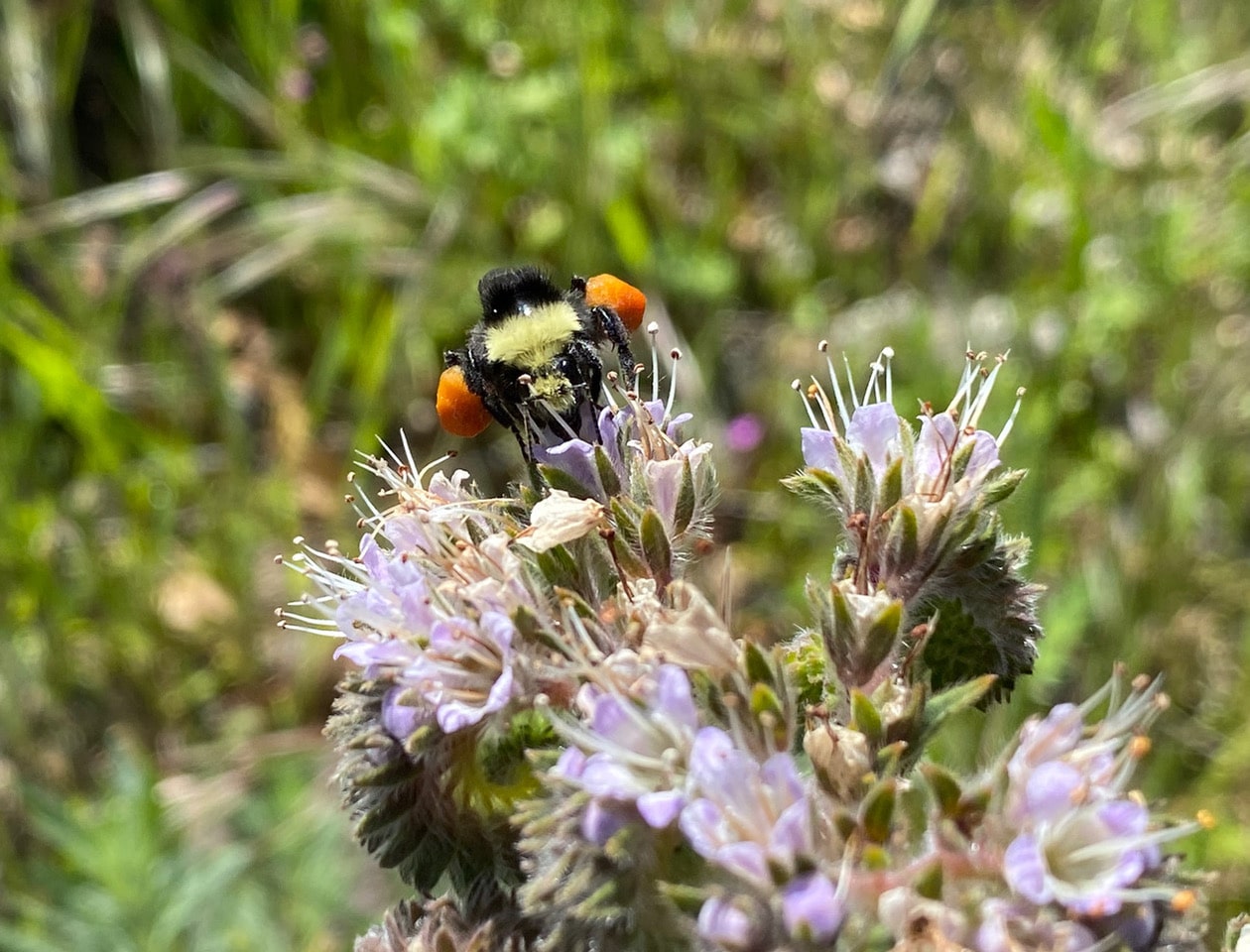
A Yellow-faced Bumble Bee, Bombus vosnesenskii lands on an inflorescence of California Phacelia with a startling load of pollen on her hind legs. Her pollen baskets look like saddle bags from the front. The bee has probably gathered the orange pollen from California Poppies that are blooming nearby.
The pollen collecting apparatus in Apidae bees, which include honey bees and bumble bees, is commonly called a “pollen basket” or corbicula. This region is located on the tibia of the hind legs and consists of hairs surrounding a concave region. After the bee visits a flower, she begins to groom herself and brushes the pollen down toward her hind legs and packs the pollen into her pollen basket. A little nectar mixed with the pollen keeps it all together like putty, and the stiff hairs surrounding the pollen basket hold it in place. A honey bee can fly with a full pollen load that weighs as much as a third of her body weight.
.jpg)
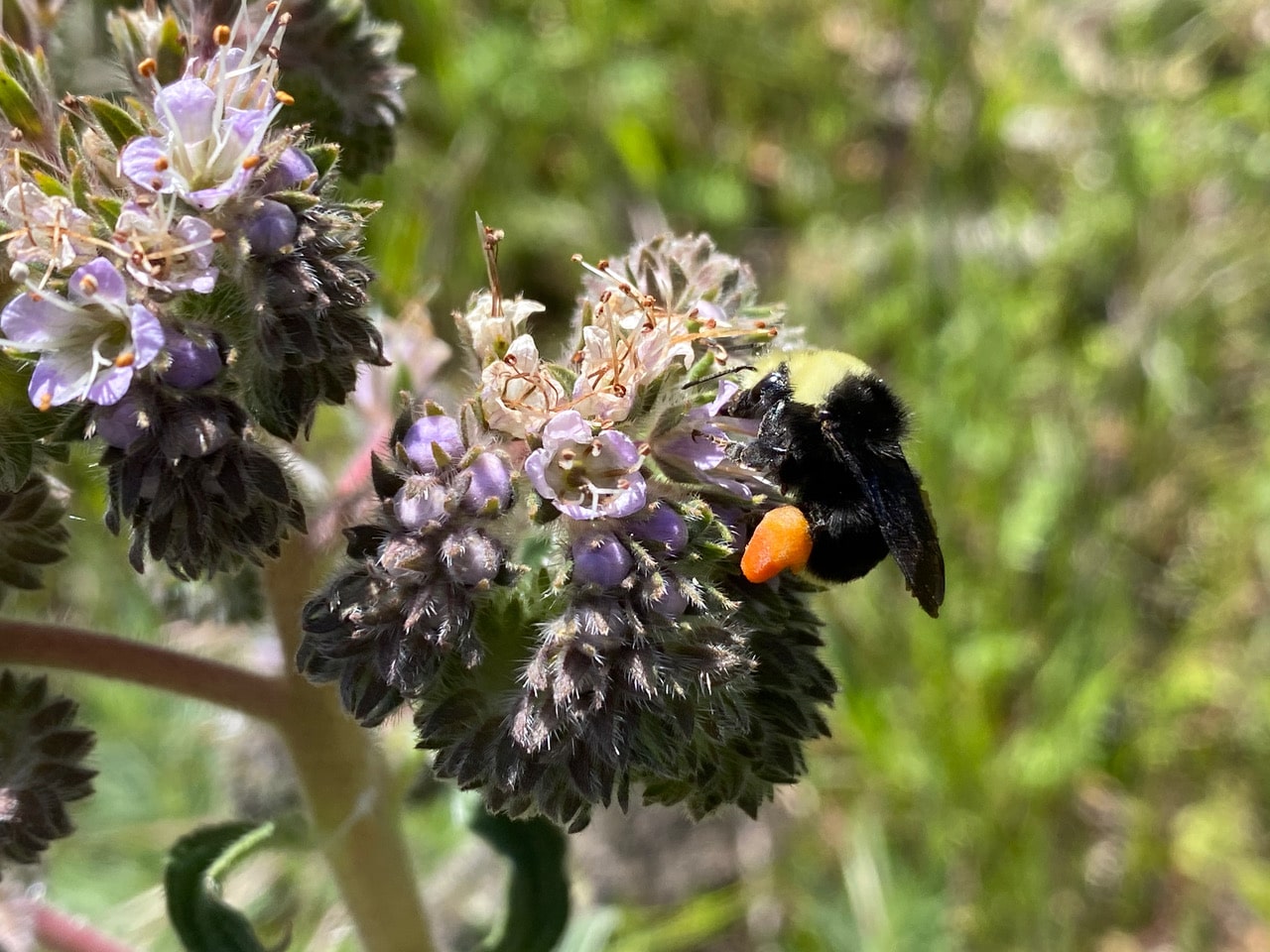
Side view of the Bumble Bee. She is taking only nectar from the Phacelia flowers.

A Cellophane Bee, Colletes sp.(family Colletidae) is foraging on an inflorescence of California Phacelia. This female has scopae on her hind legs for collecting pollen. Some Colletes species lack the scopae, and instead transport pollen in their crop, part of their digestive tract.
The bee family Colletidae includes generalists and specialists, and they are likely important pollinators of many wildflowers. All Colletidae in North America are solitary ground nesters, but some species nest in large groups, called aggregations. There are two major genera of Colletidae in North America: the Masked Bees (genus Hylaeus) and Cellophane Bees (genus Colletes). The most obvious shared characteristics of Colletidae is also the hardest to see: their short tongue. The eyes of Colletes are angled (rather than being parallel), making the face slightly heart-shaped.
The genus name Colletes means “one who glues”, referring to their habit of applying a glue- or cellophane-like lining to the walls of nest cells, using their specialized tongues. This lining gives rise to their common names: cellophane bees, polyester bees, and plasterer bees. Colletes tongue is unique: short, flat, and forked at the tip. Colletes line their nests with a distinctive cellophane-like substance made from saliva and secretions from the Dufour’s gland on the abdomen. Using their specialized tongue, they paint the walls with saliva, then with secretions from the Dufour’s gland, they add a coat of varnish. This creates a clear covering that is strong, durable, and resistant to mold and water.

With a short tongue, the Cellophane Bee, Colletes sp. has to reach down deep to access the nectar at the base of the Phacelia flower.

Now she is collecting pollen by manipulating the stamens with her whole body.

A Yellow-faced Bumble Bee, Bombus vosnesenskii visits an inflorescence of Woodland Phacelia, Phacelia imbricata.
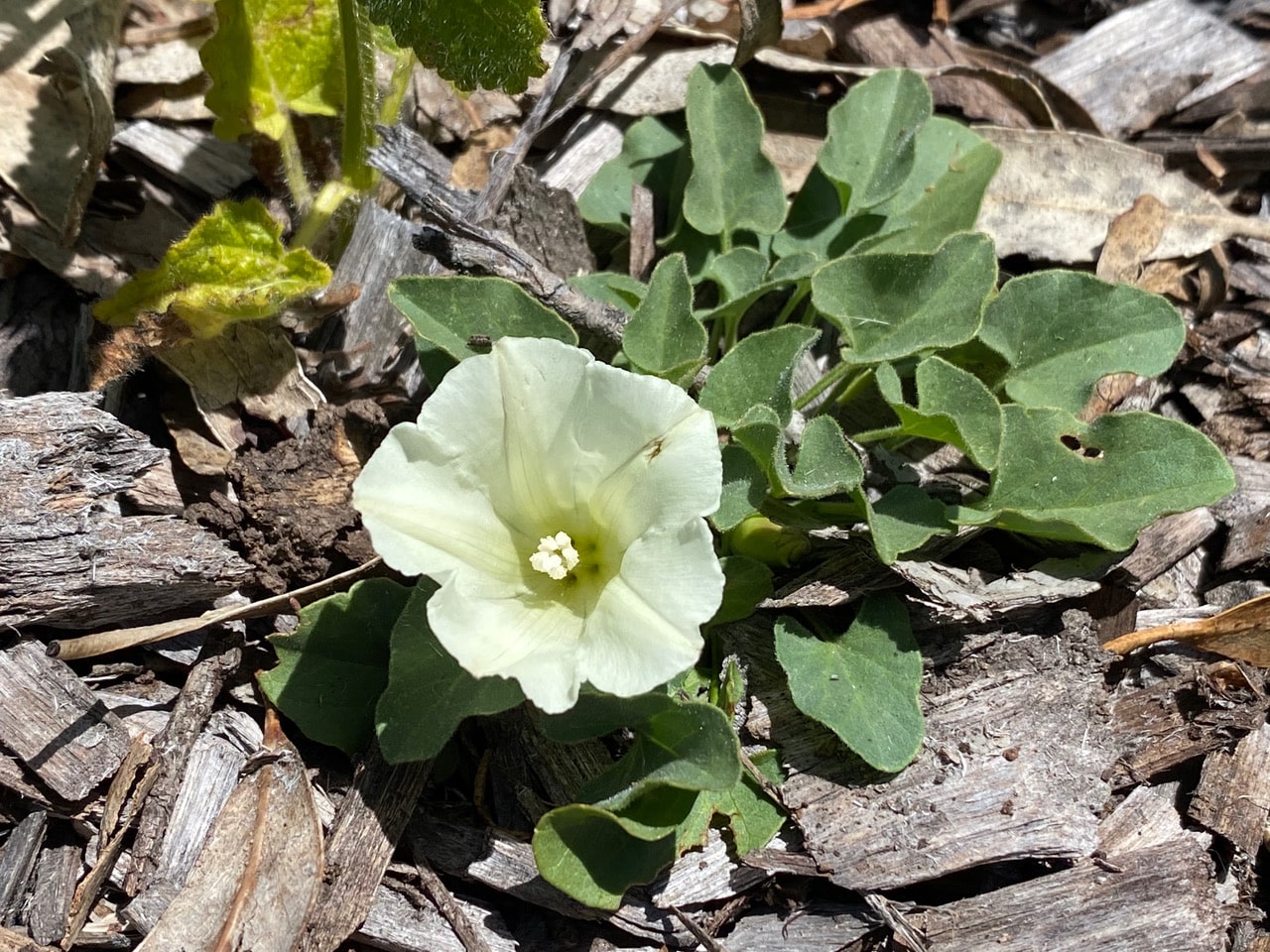
Ooh, the Hill Morning Glory, Calystegia subacaulis has started to bloom!
The species is endemic (limited) to California, where it grows in the North and Central California Coast Ranges and the San Francisco Bay Area, in woodland and chaparral scrub habitat. It is a hairy perennial herb growing from a woody caudex or a rhizome and extending stems no longer than about 20 cm. The flowers have short peduncles, seeming to pop straight out of the ground.

Some large mushrooms have appeared on the leaf litter, each almost the size of my hand, with very short stipes and a satiny shine on the flat yellowish caps. I think these are Spring Fieldcaps, Agrocybe praecox. In spring and early summer these very variable fungi emerge in woods and gardens, often carpeting paths and flowerbeds that have been spread with wood chips. The fungus is saprobic on woody debris.

A Honey Bee, Apis mellifera is foraging on the flower of a male California Blackberry, Rubus ursinus. While she is probing for nectar, she is also picking up pollen from the stamens.
California Blackberry is dioecious, with male and female flowers borne on separate plants. Female flowers have smaller petals and a central cluster of many pistils. Male flowers have larger petals and a central cluster of many stamens.
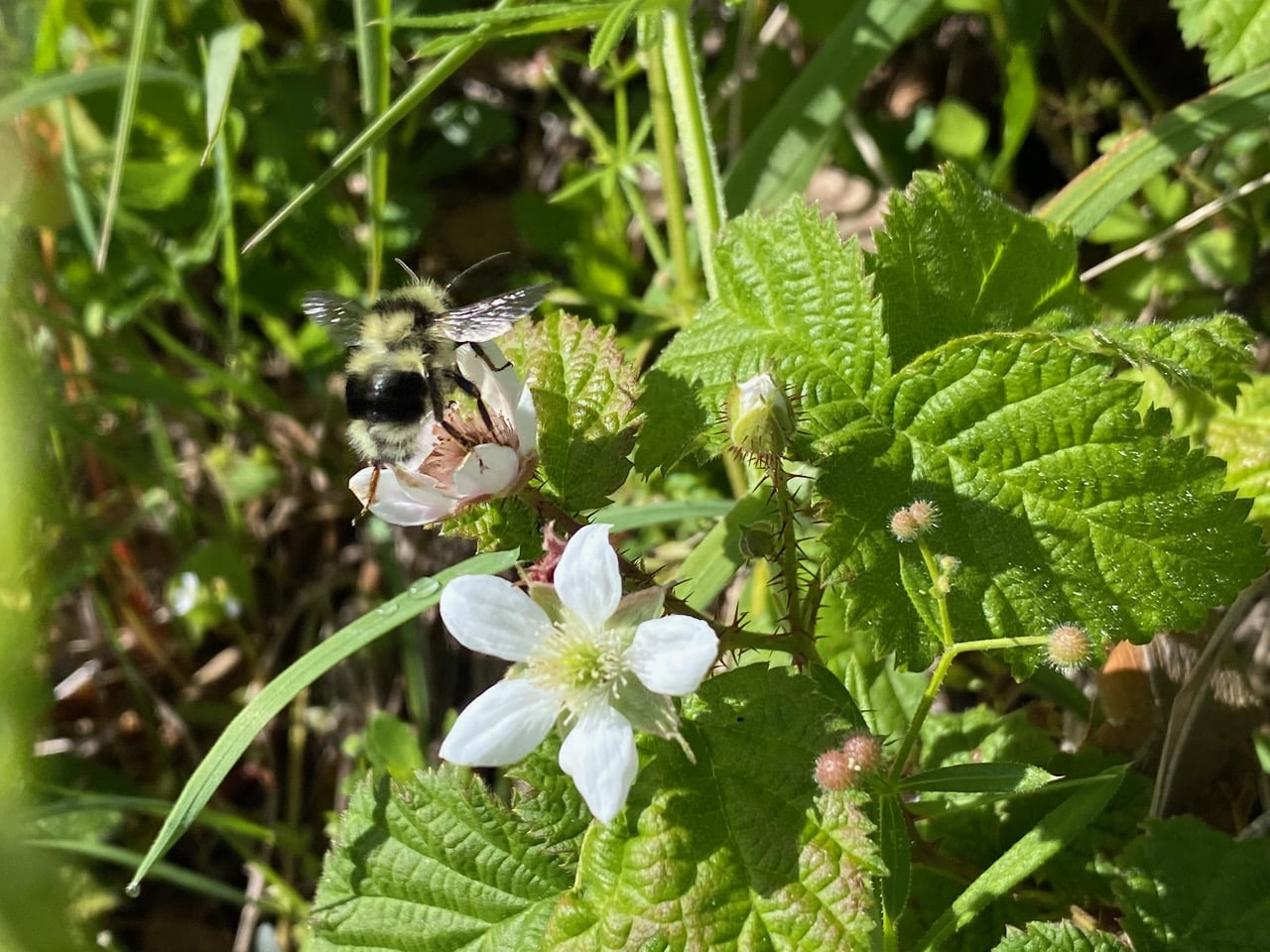
A Black-tailed Bumble Bee, Bombus melanopygus lifts off from a female flower of California Blackberry, Rubus ursinus. In the foreground is a fresher flower of the same plant, with clustered pistils in the center. Pollinators visit the female flowers for only the nectar, as no pollen is produced. The pollinated female flowers will develop into the blackberries that are much sought after by wildlife.

A Ladybeetle larva (family Coccinelidae) is walking on the hairy stem of a Common Fiddleneck, Amsinckia intermedia. Like the adults, Ladybeetle larvae are voracious predators of aphids. They have been likened to six-legged alligators.
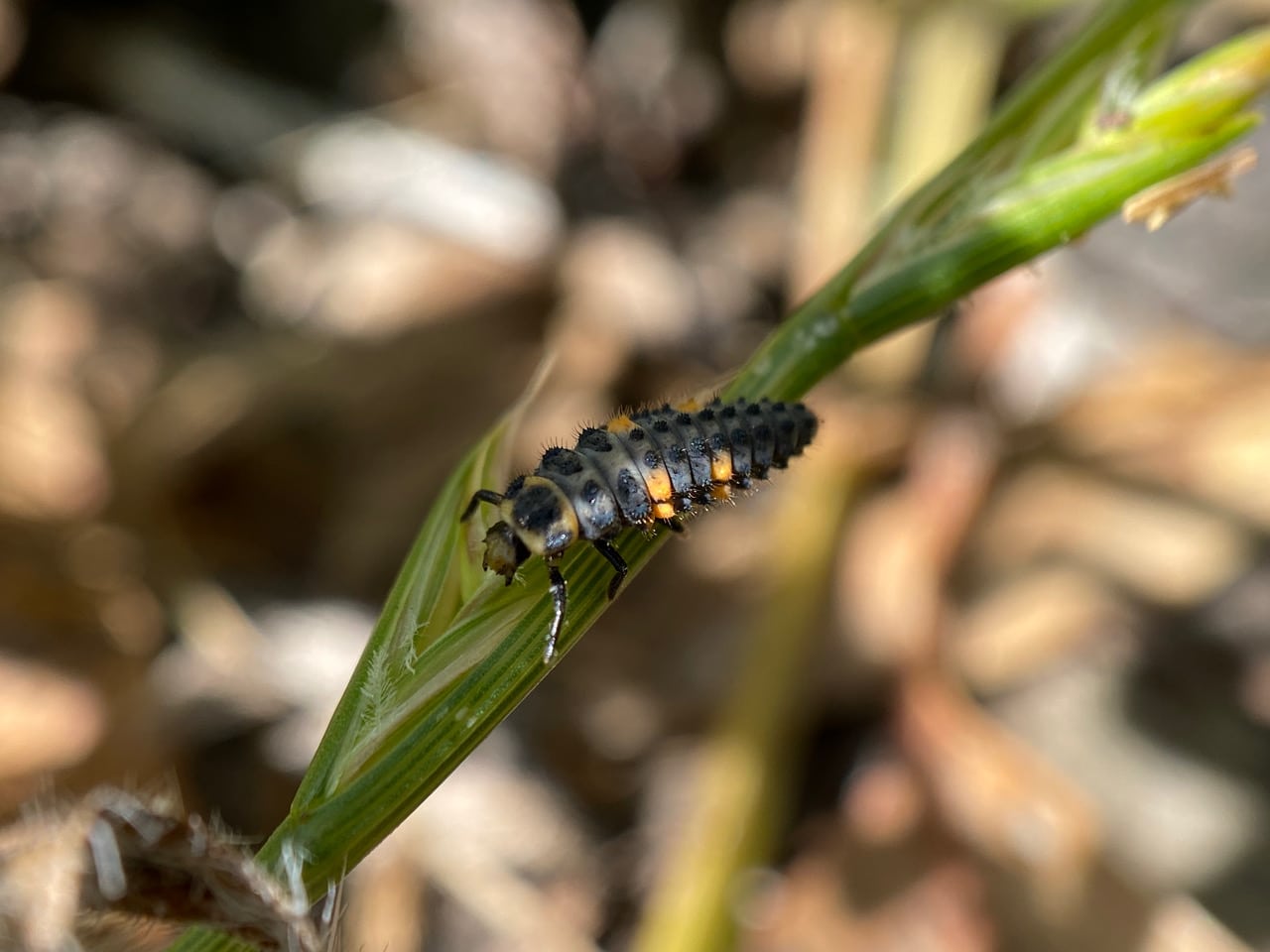
Here’s another Ladybeetle larva, probably of a different species. It is difficult to distinguish the species by their larval stages.
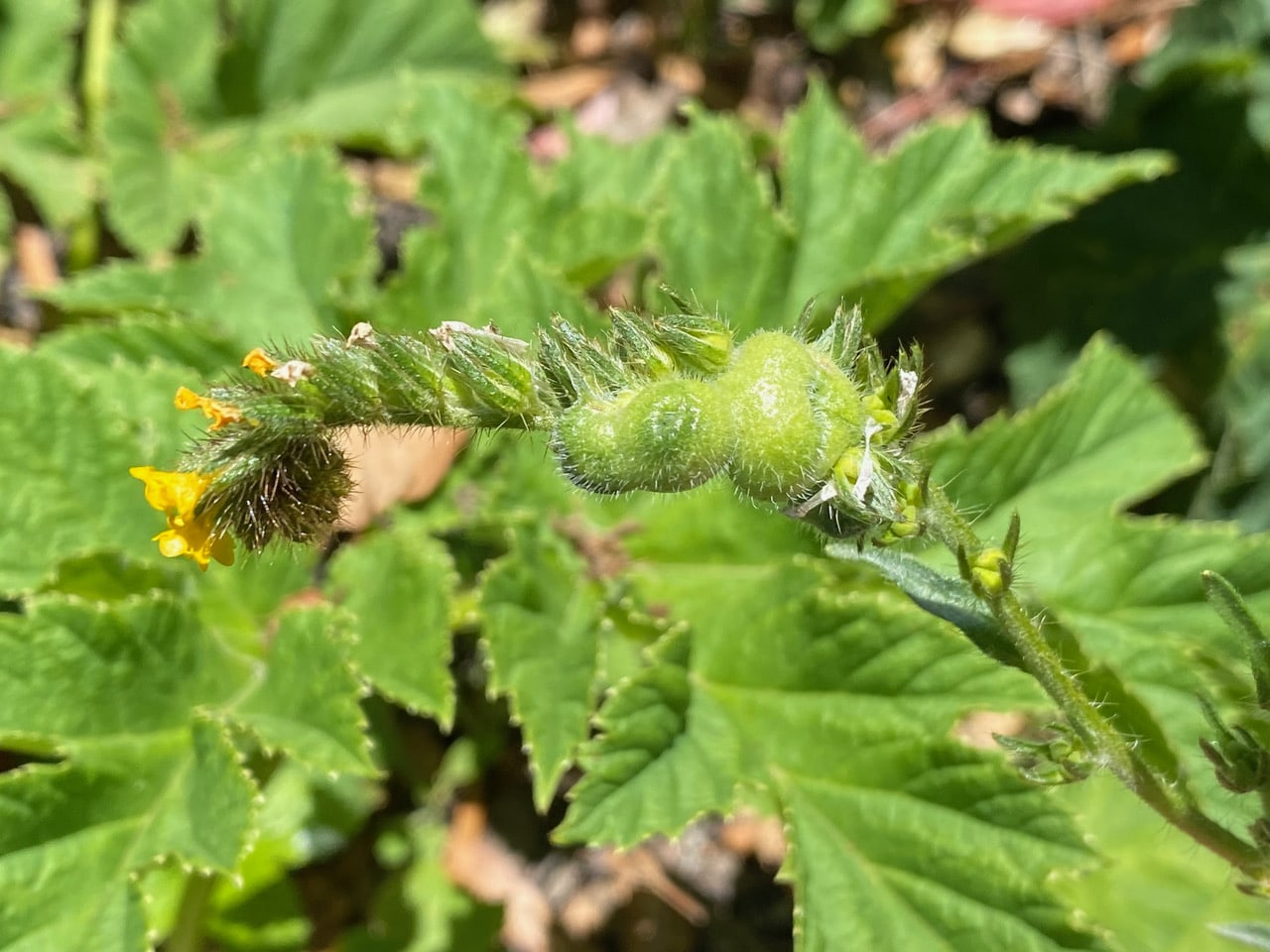
What is this lumpy swelling on the fruiting stem of a Common Fiddleneck, Amsinckia intermedia? These are galls induced by the larvae of the Fiddleneck Gall Midge, Schizomyia macrofila (family Cecidomyiidae). The galls contain one or more orange-colored larvae.
Galls are abnormal growths that occur on leaves, twigs, roots, or flowers of many plants. Most galls are caused by irritation and/or stimulation of plant cells due to feeding or egg-laying by insects such as aphids, midges, wasps, or mites. Other galls are the result of infections by bacteria, fungi, or nematodes. In general, galls provide a home for the insect, where it can feed, lay eggs, and develop. Each type of gall-producer is specific to a particular kind of plant. Plant gall damage is usually an aesthetic problem and is not a threat to the health and survival of the plant.