

Pollinator Post 5/22/23 (2)

Preferring a more shady habitat, the Broadleaf Lupine, Lupinus latifolius blooms later than the Silverleaf Lupines, Lupinus albifrons. A Black-tailed Bumble Bee, Bombus melanopygus is foraging on a spike of flowers of Broadleaf Lupine.
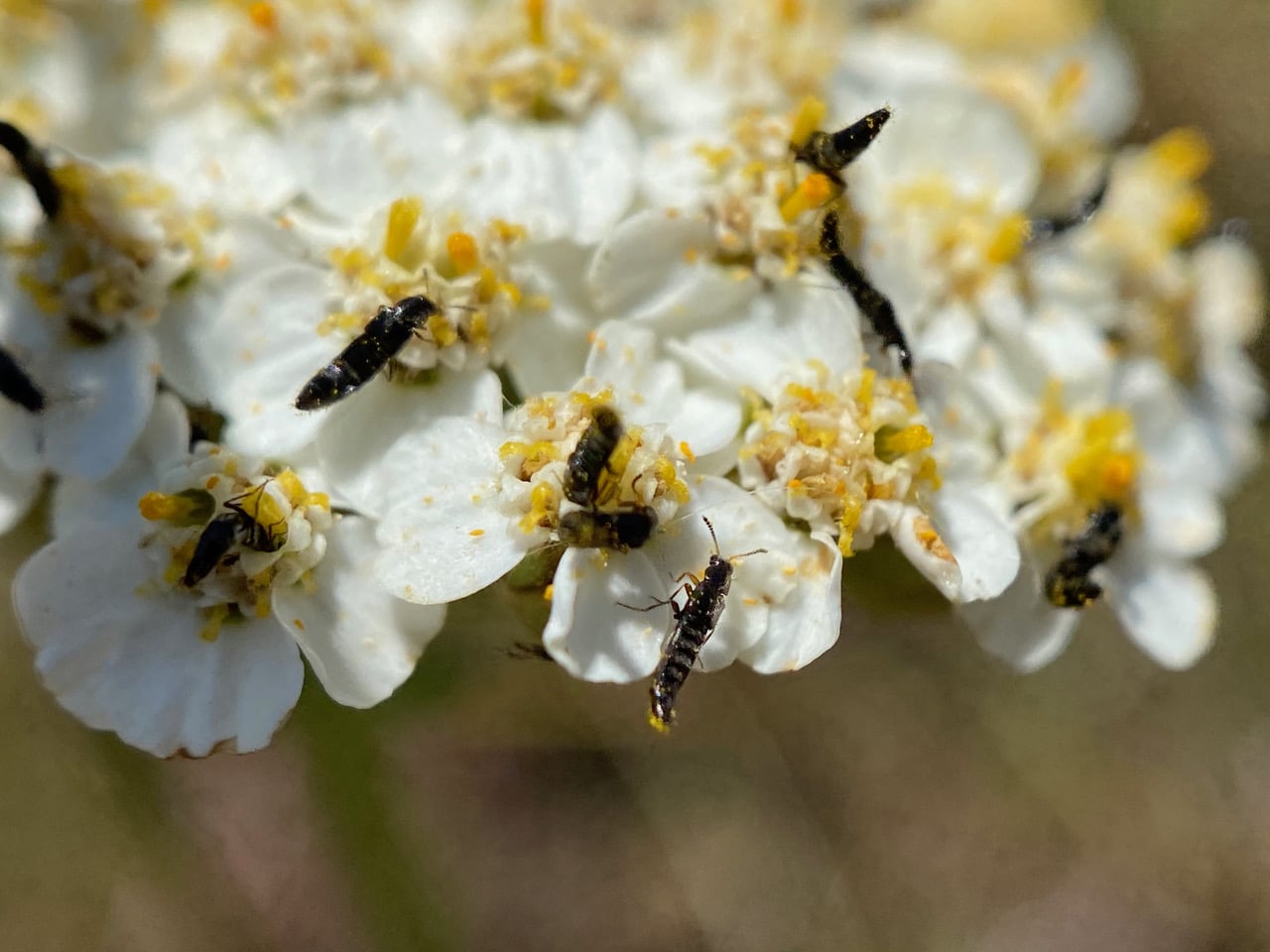
The tiny black Rove Beetles (family Staphylinidae) are still on the Yarrow inflorescences in large numbers. They appear to be feeding on pollen.
The family Staphylinidae is the largest family of North American beetles, with about 4000 species. Most are small and of cryptic habits and although common, the group as a whole is not well studied. Most rove beetles are predators of insects and other invertebrates, living in forest leaf litter and similar decaying plant matter. Some species are predaceous as both adults and larvae; the larvae of some species are parasitoids; many others are probably scavengers.
Rove Beetles are easily recognized by their slender, usually black or brown body, shortened front wings (elytra) that may look like pads on the abdomen, and behavior of curling the tip of the abdomen upwards when disturbed or running. Adults are usually strong flyers. Most species are nocturnal, but a few are active during the day.

A Flower Moth, Rhamphura ochristriata (family Scythrididae) is taking nectar from the flowers of Yarrow, Achillea millefolium.
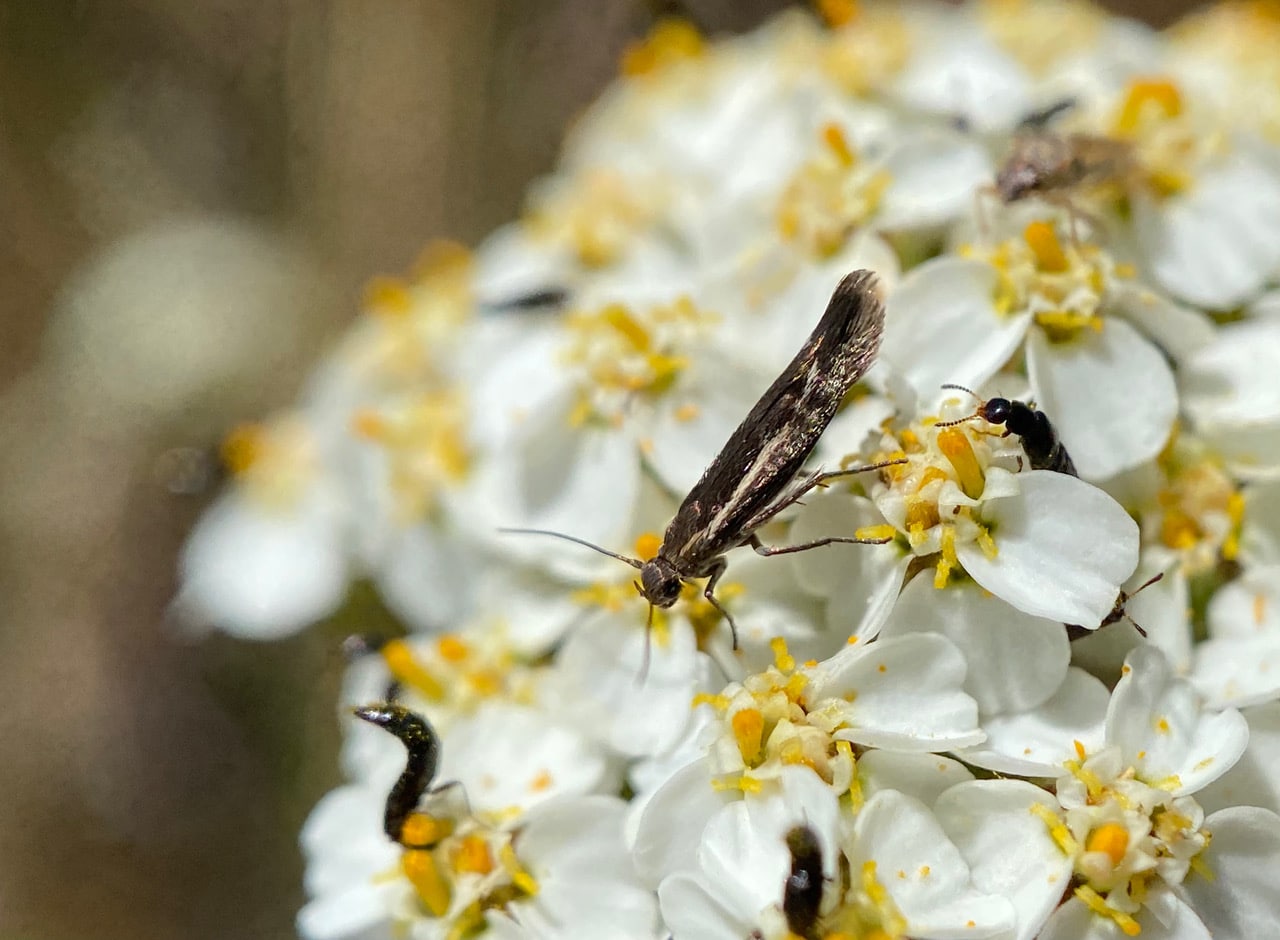
Side view of the same Flower Moth. Around it on the same Yarrow inflorescence are the hyperactive, riotous Rove Beetles.
Adult Scythridids are small brown moths; some species are so dark as to appear black or blackish to the unaided eye, and some species have one or more whitish patches on the forewing. Adult Scythridids are diurnal, commonly found nectaring on flowers. Larvae of the relatively few Scythridid species for which life histories are known show a preference for feeding (usually internally as leaf miners) on composites (Asteraceae).

The wing scales of the Flower Moth, Rhamphura ochristriata (family Scythrididae) flash an iridescent silver in the sunlight, accentuating the white lateral line.
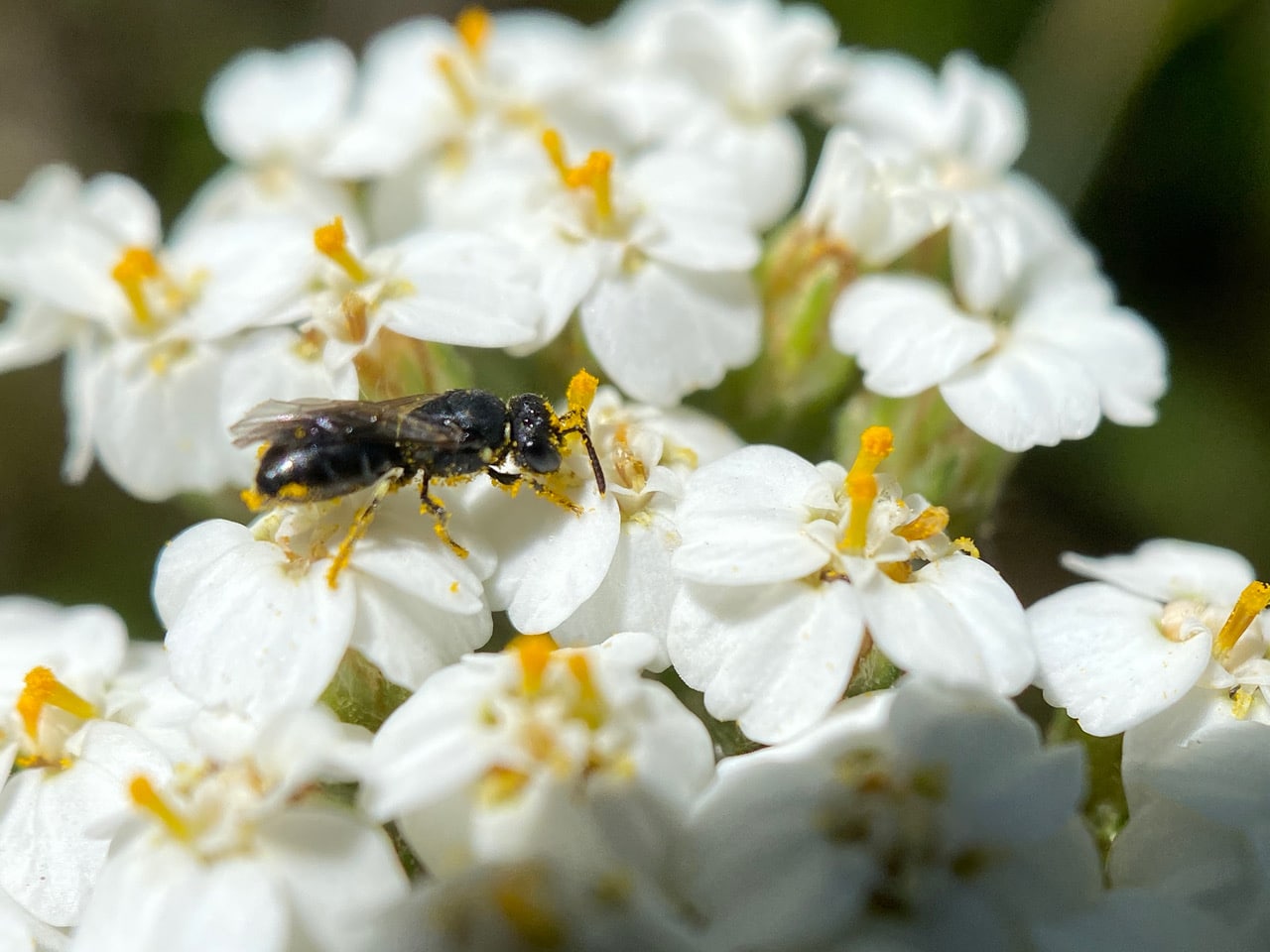
A small bee is foraging among the Yarrow flowers. I think it is a Masked Bee, Hylaeus sp. (family Colletidae). Note that it does not have a scopa on the hind legs. Hylaeus does not have any external apparatus for transporting pollen to the nest. The gathered floral resources are carried in the crop (part of the digestive system), and regurgitated back at the nest to provision for the young.
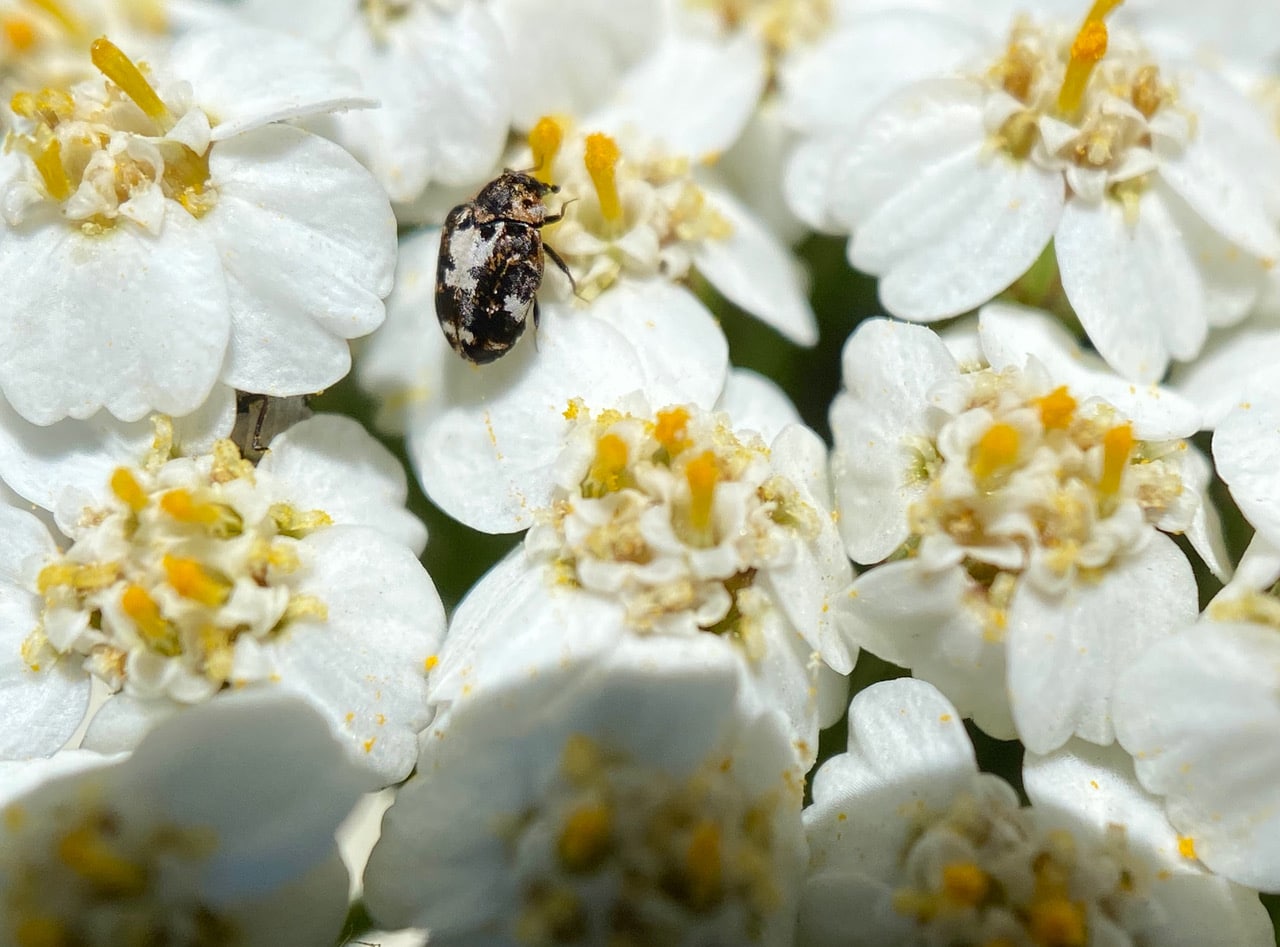
Here’s a tiny pollen lover, a Skin Beetle, Anthrenus lepidus (family Dermestidae).
Dermestidae are a family of Coleoptera (beetles) that are commonly referred to as skin of carpet beetles. Ranging in size from 1 to 2 mm, the beetles typically have clubbed antennae that fit into deep grooves. Most Dermestids are scavengers that feed on dry animal or plant materials, such as skin or pollen, animal hair, feathers, dead insects and natural fibers. The larvae are used in taxidermy and by natural history museums to clean animal skeletons.
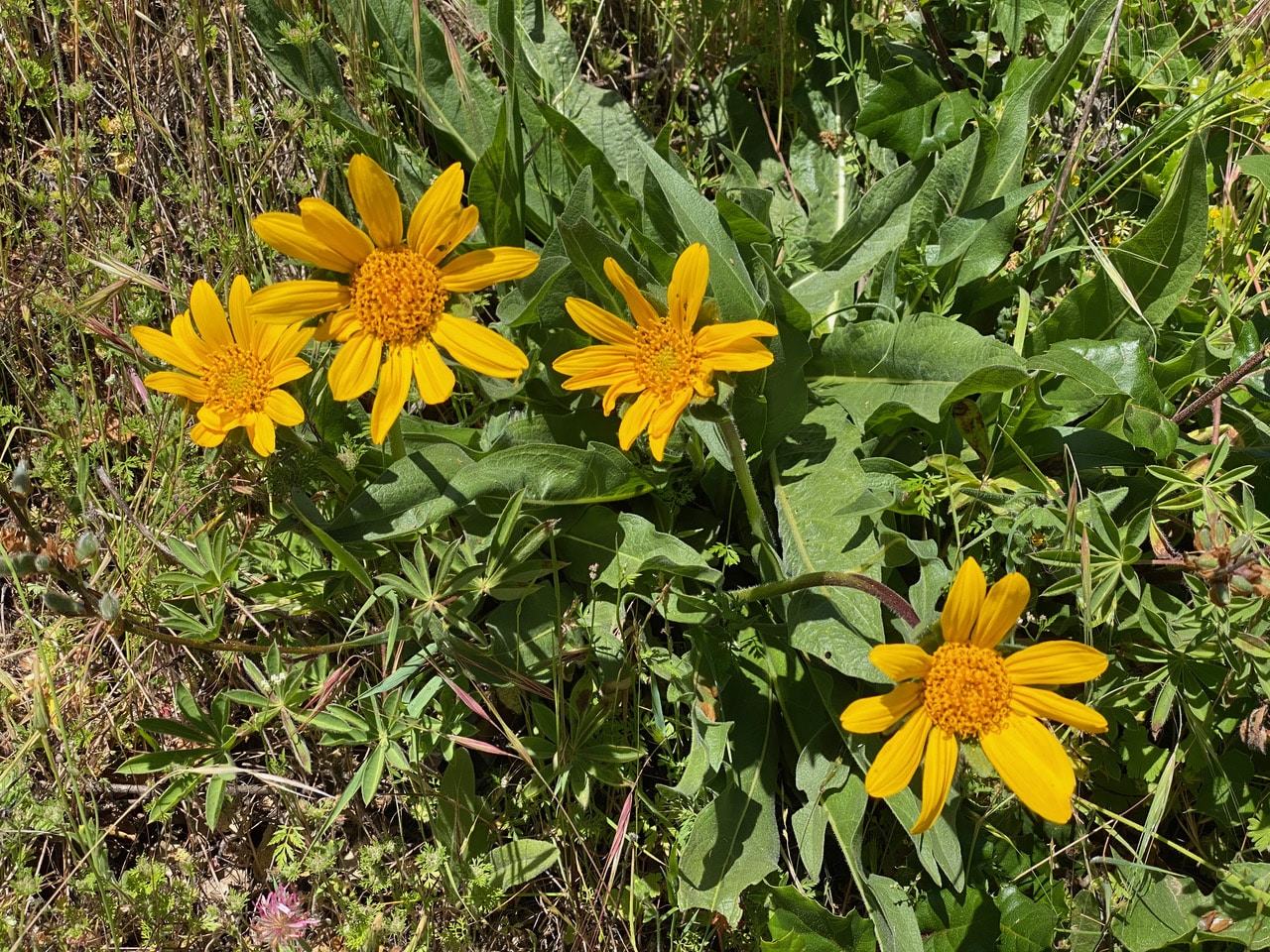
More flowerheads have opened up on the Narrowleaf Mule Ears, Wyethia angustifolia (family Asteraceae). Each flowerhead is a composite made of numerous florets. The ones on the outside are ray florets that bear the petal-like ligules. The ones in the middle are all disc florets, each made up of five fused petals to form a bell-shaped tube.
Why Composite Flowers? One advantage is probably to increase the visual display to pollinating insects without developing large expensive flowers. A single visiting insect can even pollinate several flowers in a single visit, so the plant is economizing on resources while maximizing fruit-set.

Close-up view of the disc florets of Narrowleaf Mule Ears. A striped anther tube emerges from the center of each disc floret. Eventually pollen within the anther tube is pushed out by the piston-like action of the lengthening style within the tube, in a process called “secondary pollen presentation”.
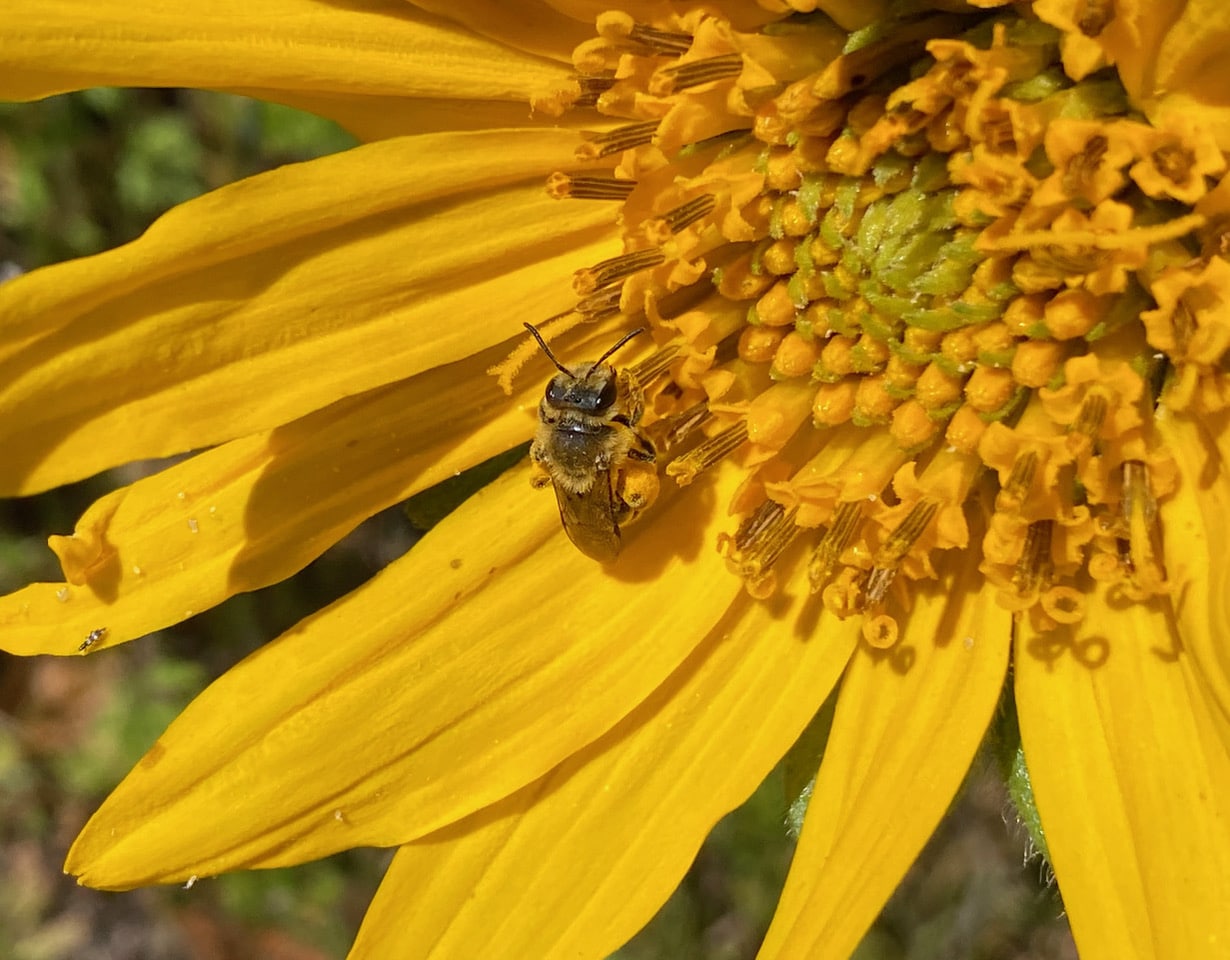
A little Mining Bee, Andrena sp. (family Andrenidae) is collecting pollen on a Mule Ears flowerhead, going from one anther tube to the next.

Recall that the Asteraceae flowerhead is composed of numerous disc florets, each with five petals fused into a star-shaped tubular flower. The flowers are protandrous, meaning the male parts mature before the female parts. Early in anthesis, a candle-like striped column arises in the center of the flower. This is the anther tube composed of fused stamens; it also houses the female parts – the stigma and style. Pollen is produced within the anther tube. In an unusual phenomenon called “secondary pollen presentation”, pollen is pushed out of the anther tube by the piston-like action of the lengthening style as the flower enters its female phase. Further more, another amazing mechanism ensures that pollen is not wasted when no pollinator is around. When stimulated by insect movements, the anther tube contracts sleeve-like to briefly expose the pollen on the tip of the style, essentially making the pollen more available to the visitor. It is amazing that the flowers respond to the presence of pollinators. It has been observed that electrical stimulation can induce the movement, suggesting that it is an electrochemical phenomenon, perhaps involving the flower’s neuroid system in which ion currents may be passed from cell to cell.
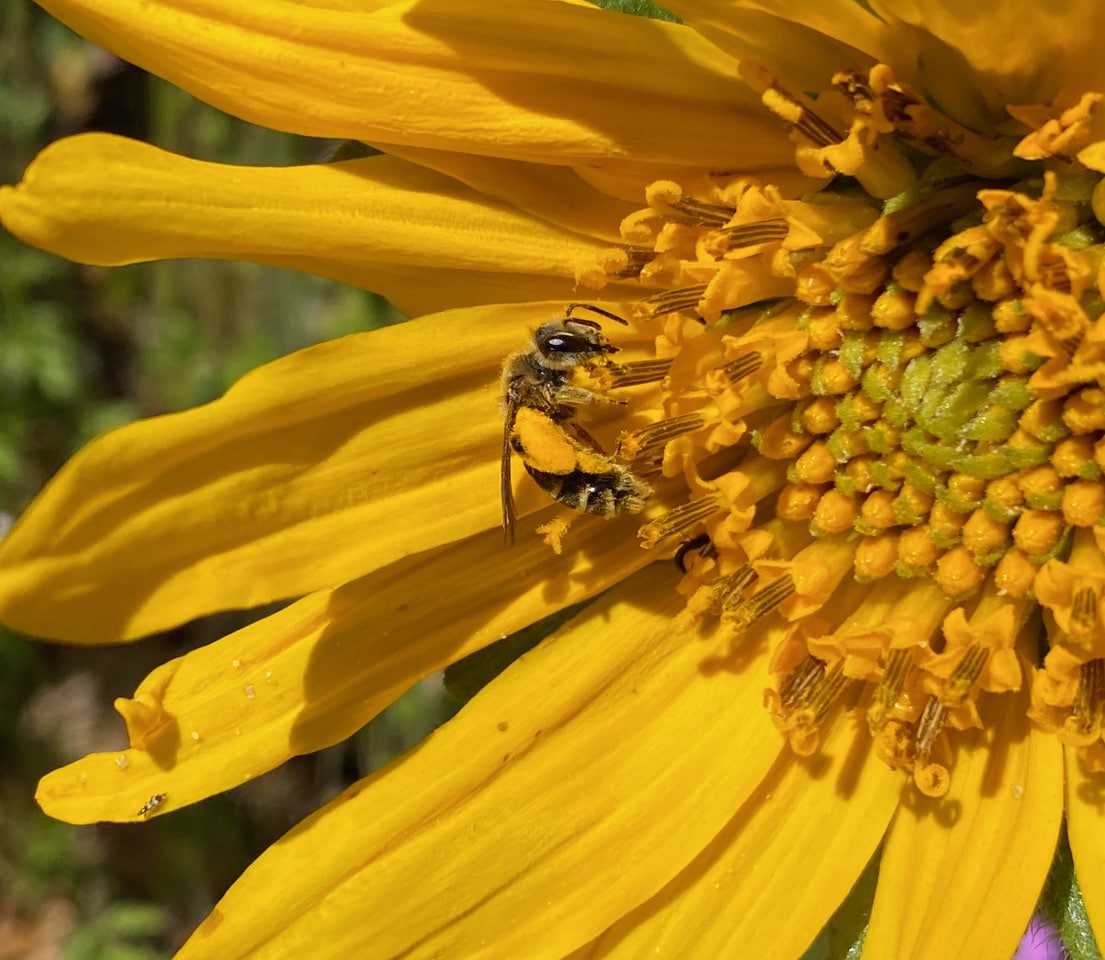
The little bee has an extensive scopa spanning most of the length of her hind leg, even extending to her “arm pit”. This is typical of female Mining Bees in the genus Andrena (family Andrenidae).

At the patch of blooming Blue-eyed Grass, Sisyrinchium bellum at Siesta Gate, a large Yellow-faced Bumble Bee, Bombus vosnesenskii is flying from flower to flower seeking nectar.