

Pollinator Post 5/22/23 (1)
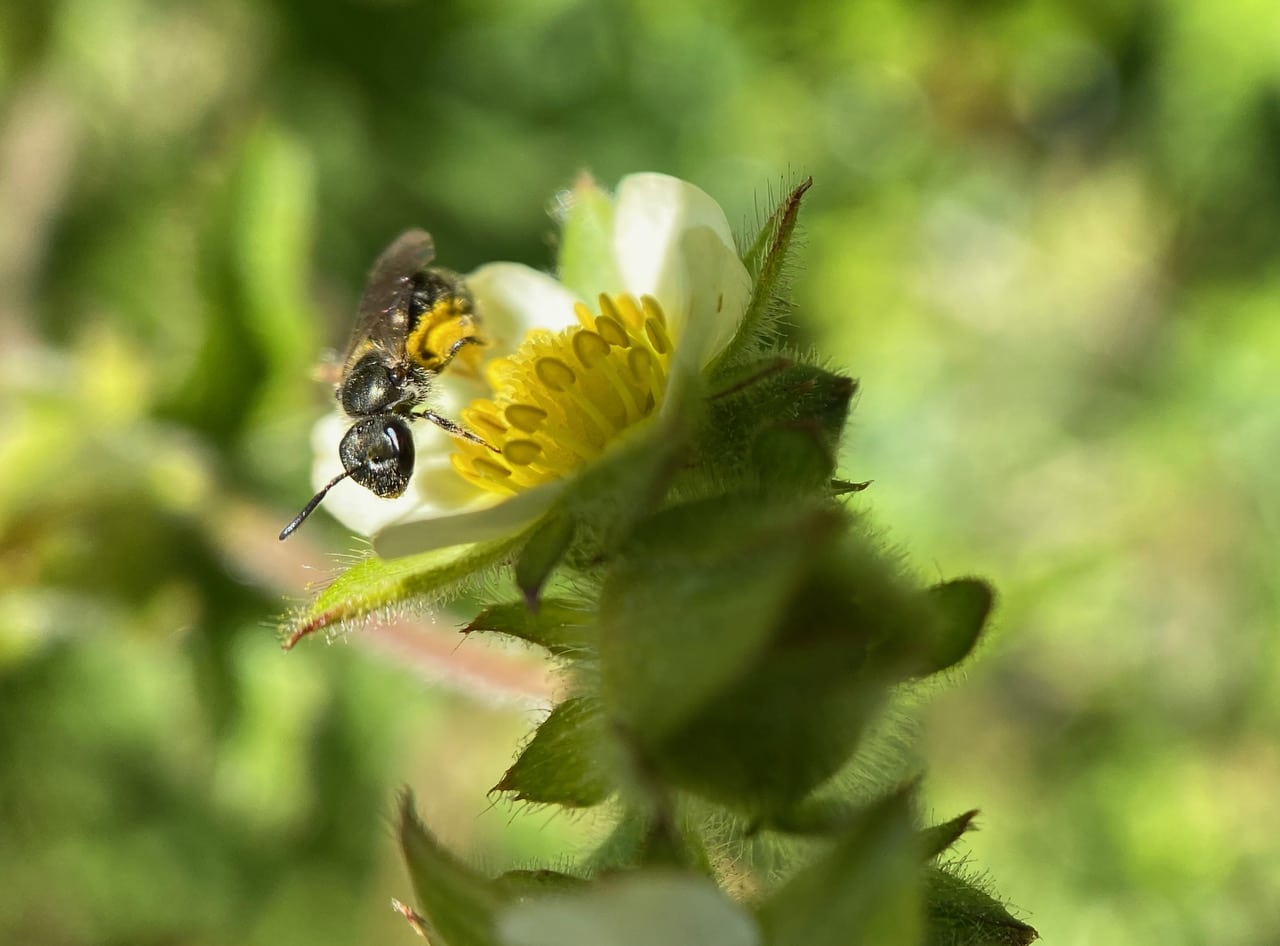
A Metallic Sweat Bee, Lasioglossum (Dialictus) sp. (family Halictidae) is collecting pollen from a flower of Sticky Cinquefoil, Drymocallis glandulosa.
Dialictus is a subgenus of sweat bees belonging to the genus Lasioglossum (family Halictidae). Most of the members of this subgenus have a metallic appearance, while some are non-metallic. Dialictus are small, about 3.4-8.1 mm in size. They are commonly found in the northern hemisphere, and are abundant in North America. Members of this subgenus have very diverse forms of social structure making them model organisms for studying the social behavior of bees.
The sweat bee genus Lasioglossum is the largest of all bee genera, containing over 1700 species worldwide. They are highly variable in size, color, and sculpture; among the more unusual variants, some are kleptoparasites, some are nocturnal, and some are oligolectic. Most Lasioglossum species nest in the ground, but some nest in rotten logs. Social behavior among species of Lasioglossum is extraordinarily variable; species are known to exhibit solitary nesting, primitive eusociality, and social parasitism. Colony sizes vary widely, from small colonies of a single queen and four or fewer workers to large colonies of over 400 workers and perennial life cycles.
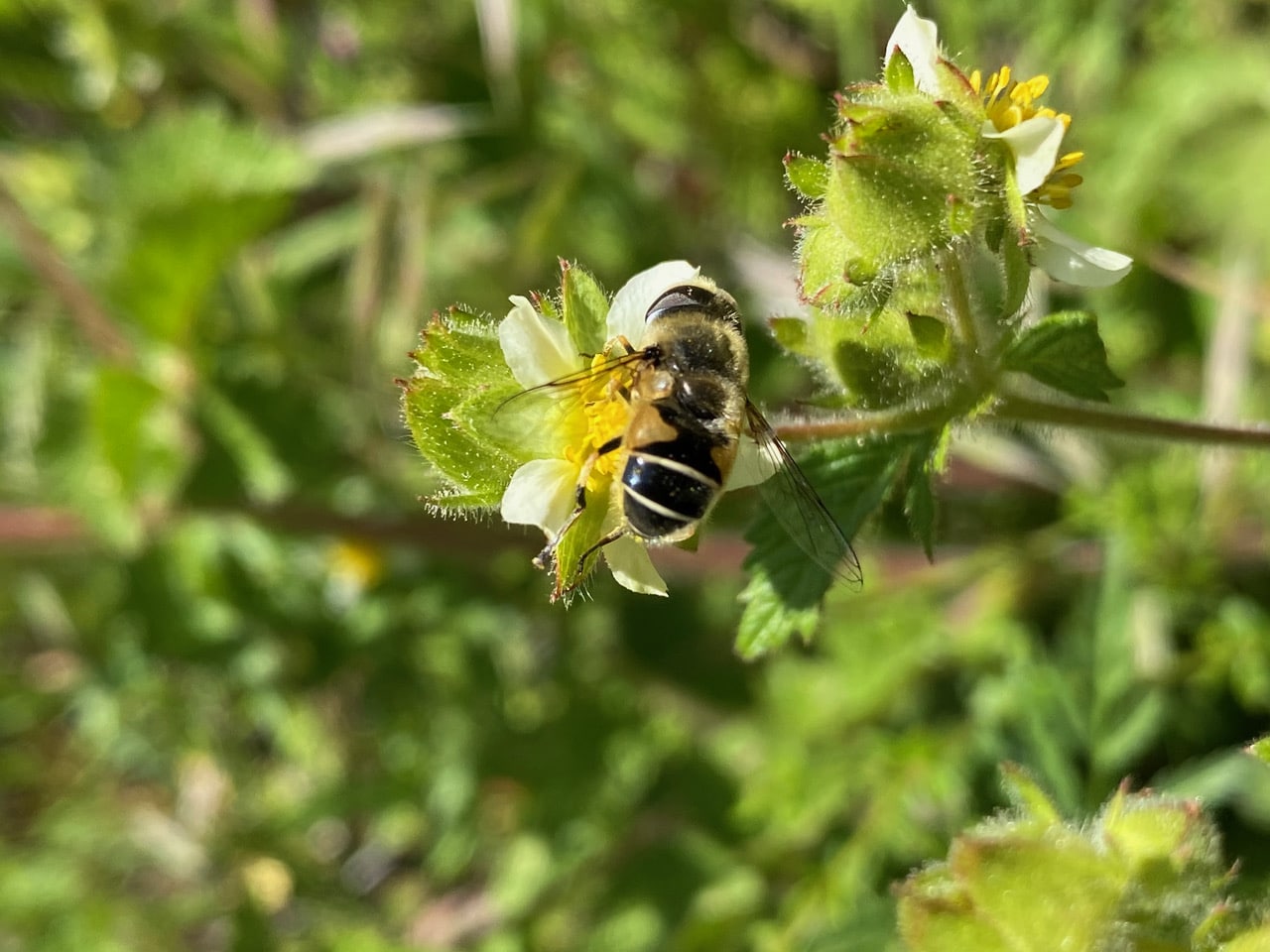
Hey, this is rather surprising! I have never seen this hoverfly visit the Sticky Cinquefoil flowers before. The black-footed Drone Fly, Eristalis hirta (family Syrphidae) is almost too large to get a perch on the Cinquefoil flower.
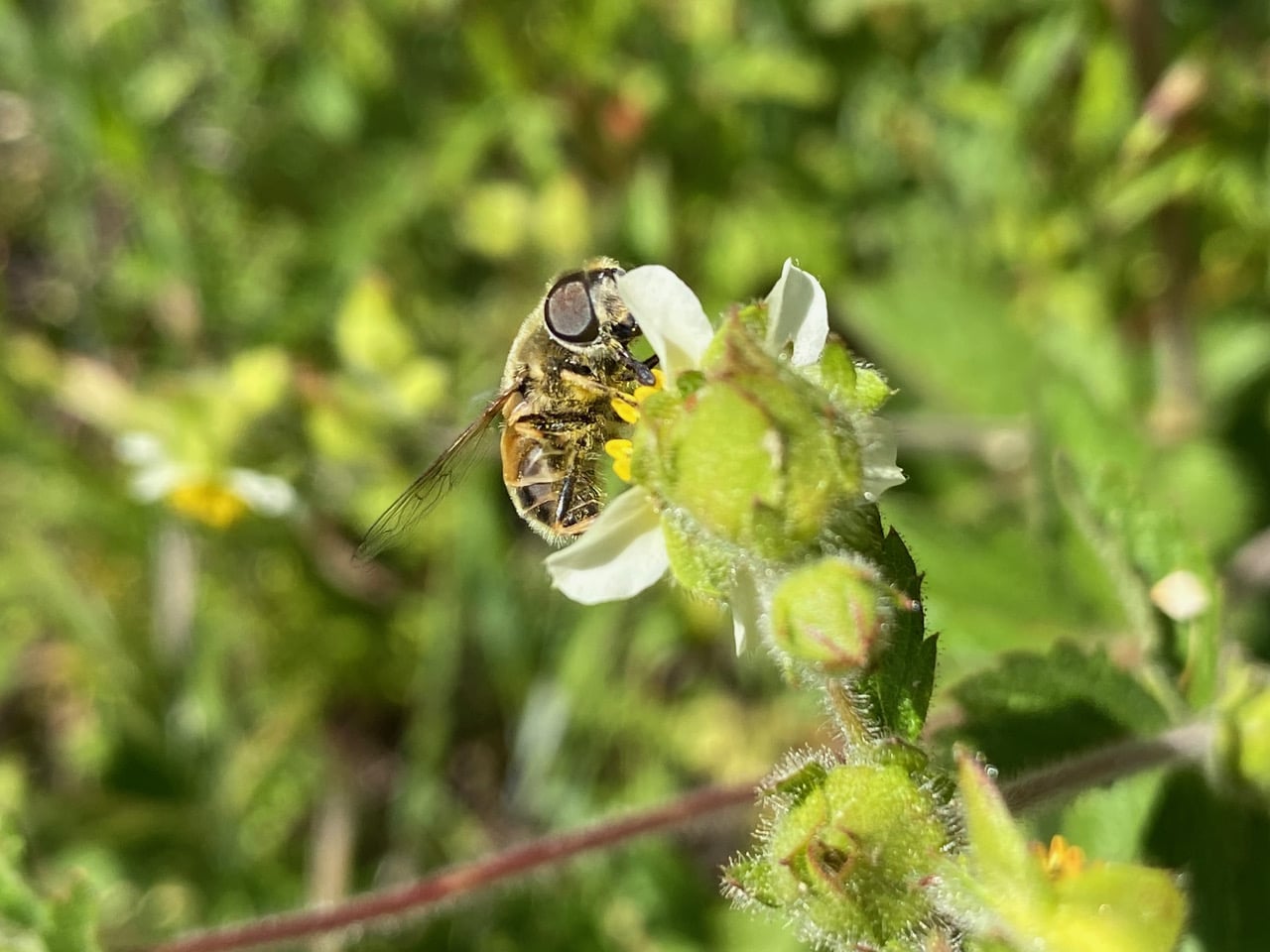
Tongue extended, the Black-footed Drone Fly is feeding on the pollen of Sticky Cinquefoil.
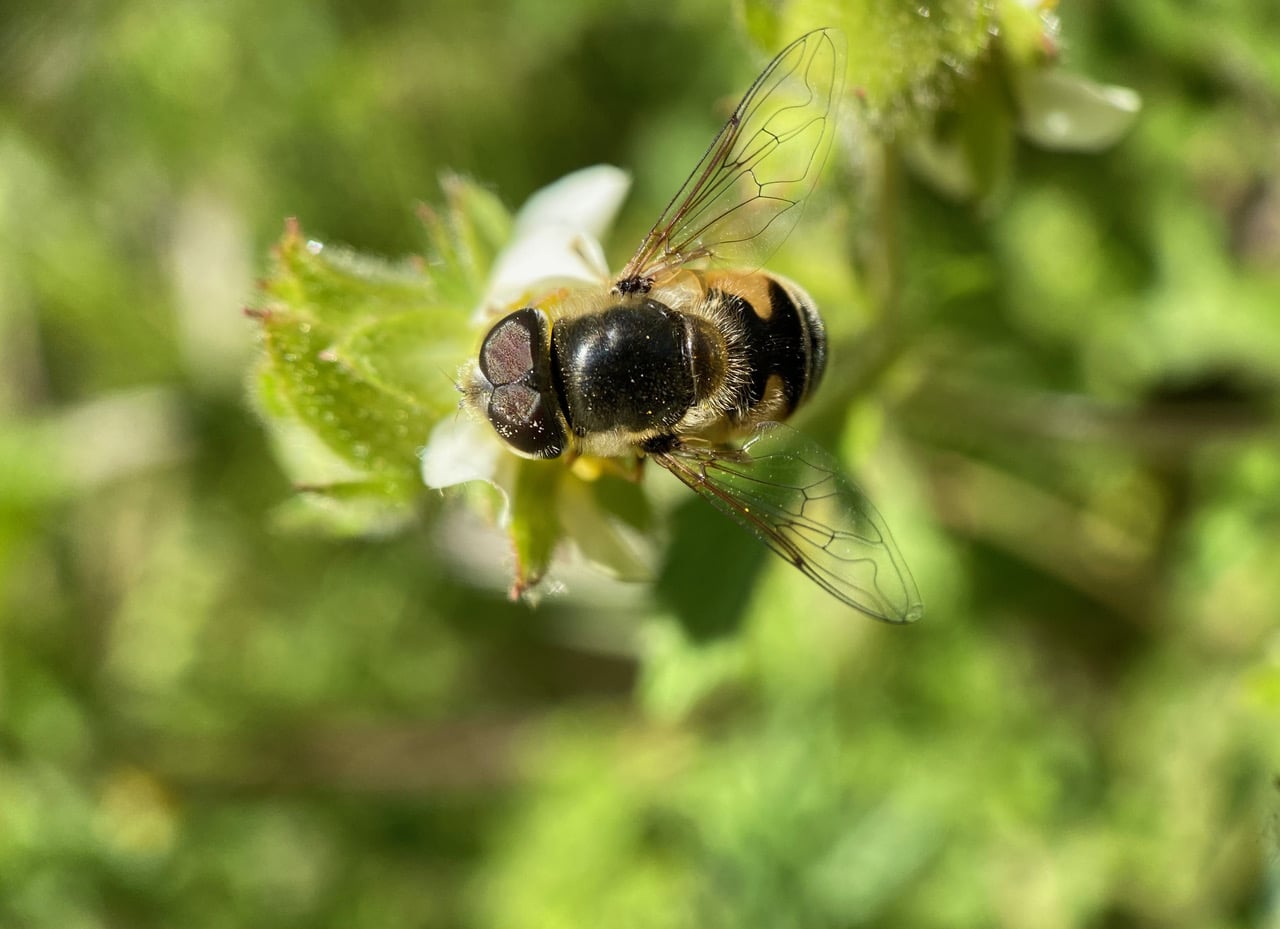
Close-up, the fly reveals itself to be rather hairy/bristly, hence the species name hirta. The lucky shot also shows the “spurious vein” on the wing of the hoverfly. Diagnostic feature of Syrphidae, the spurious vein is actually just a thickening of the wing rather than a true vein. It runs through the middle of the wing and is open (not attached to another vein) on both ends.
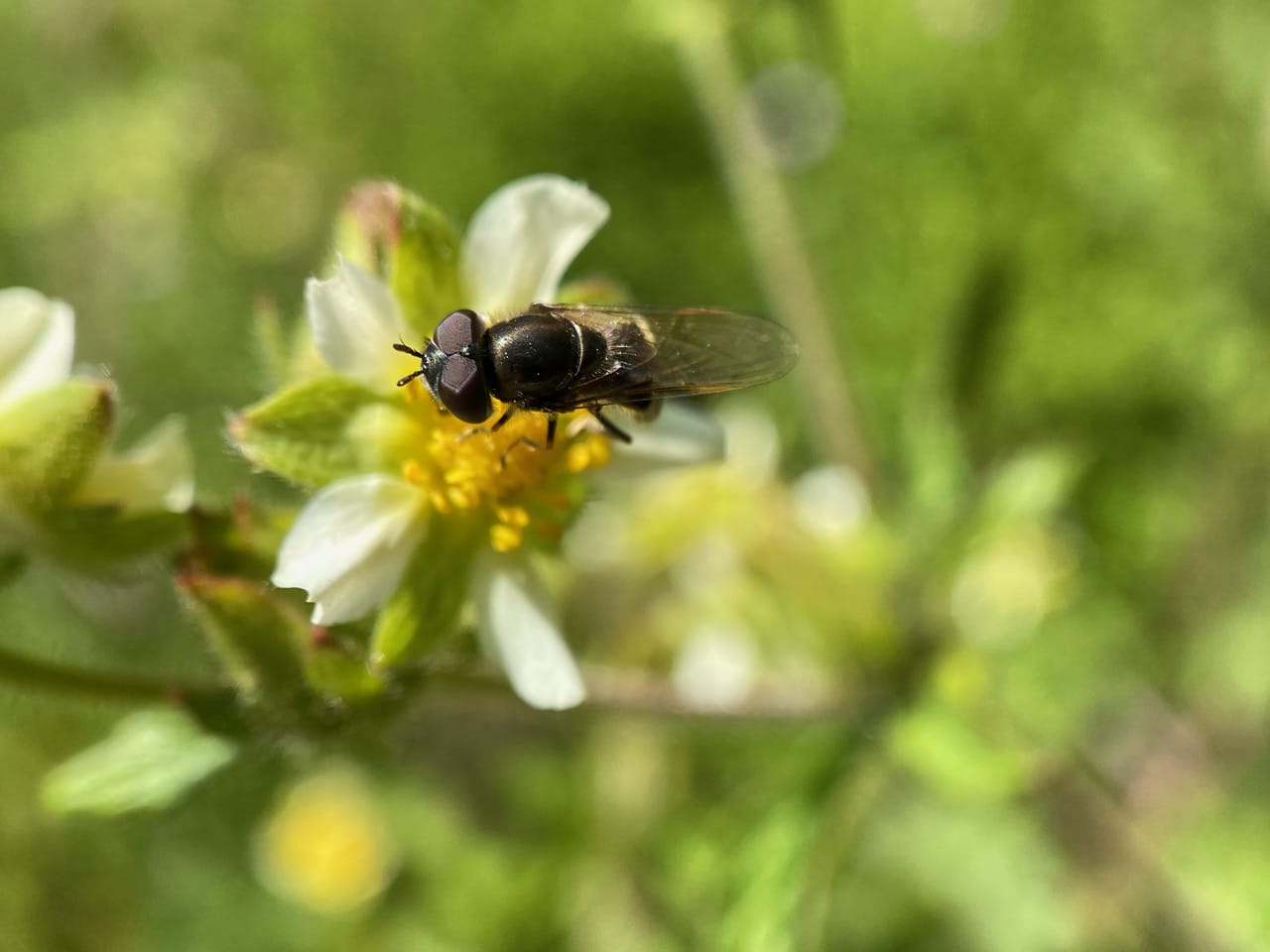
A Metallic Hoverfly, also known as the Sedgesitter, Platycheirus sp. (family Syrphidae) visits the flowers of Sticky Cinquefoil, Drymocallus glandulosa.
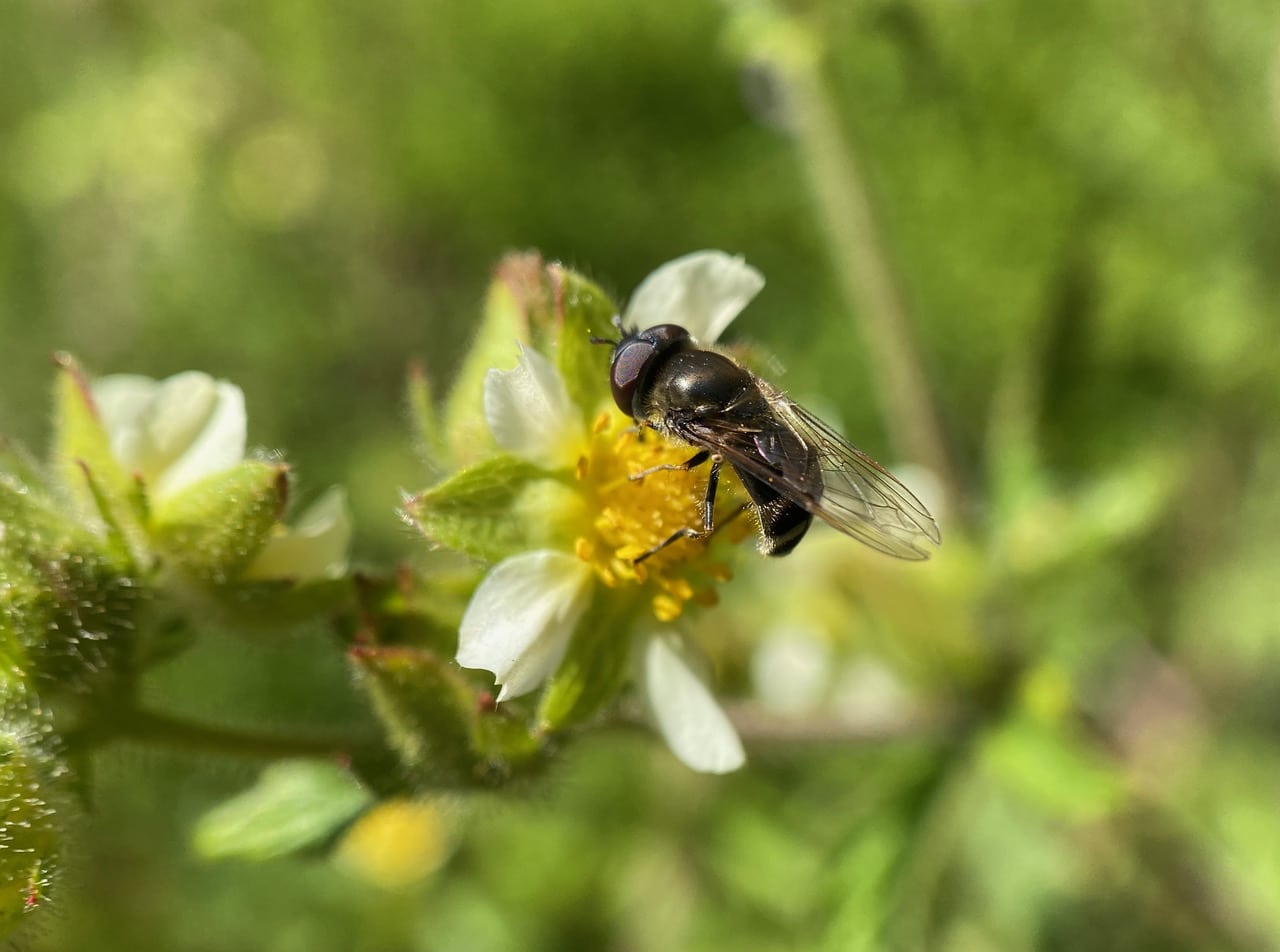
Platycheirus is found in grass and herb vegetation. They are sometimes referred to as Sedgesitters. Adults of many species feed on pollen of wind-pollinated plants, such as Salix, Plantago, Poaceae, Cyperaceae, but they visit other flowers also. Many stay active during cold and rainy weather. Larvae feed on aphids.

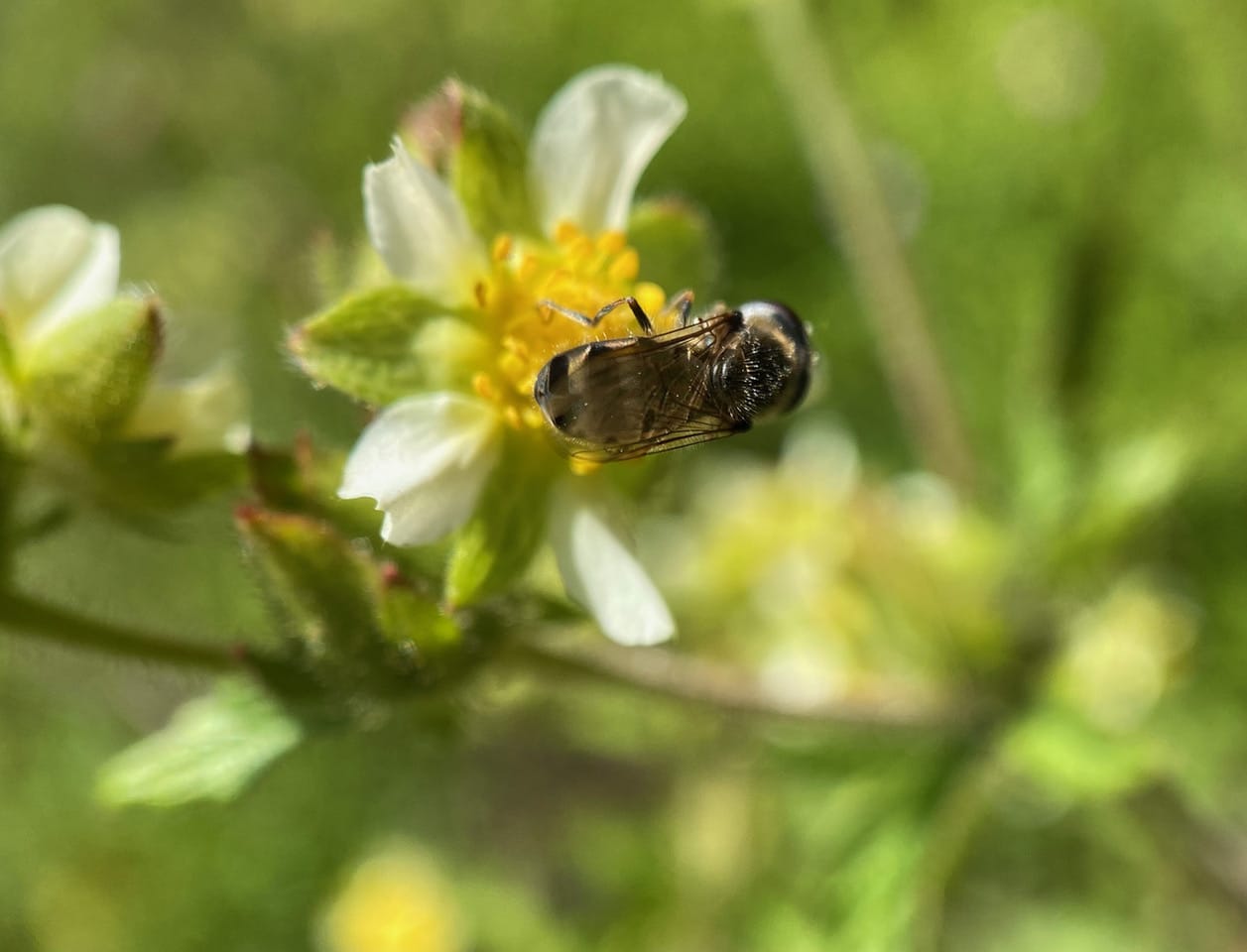
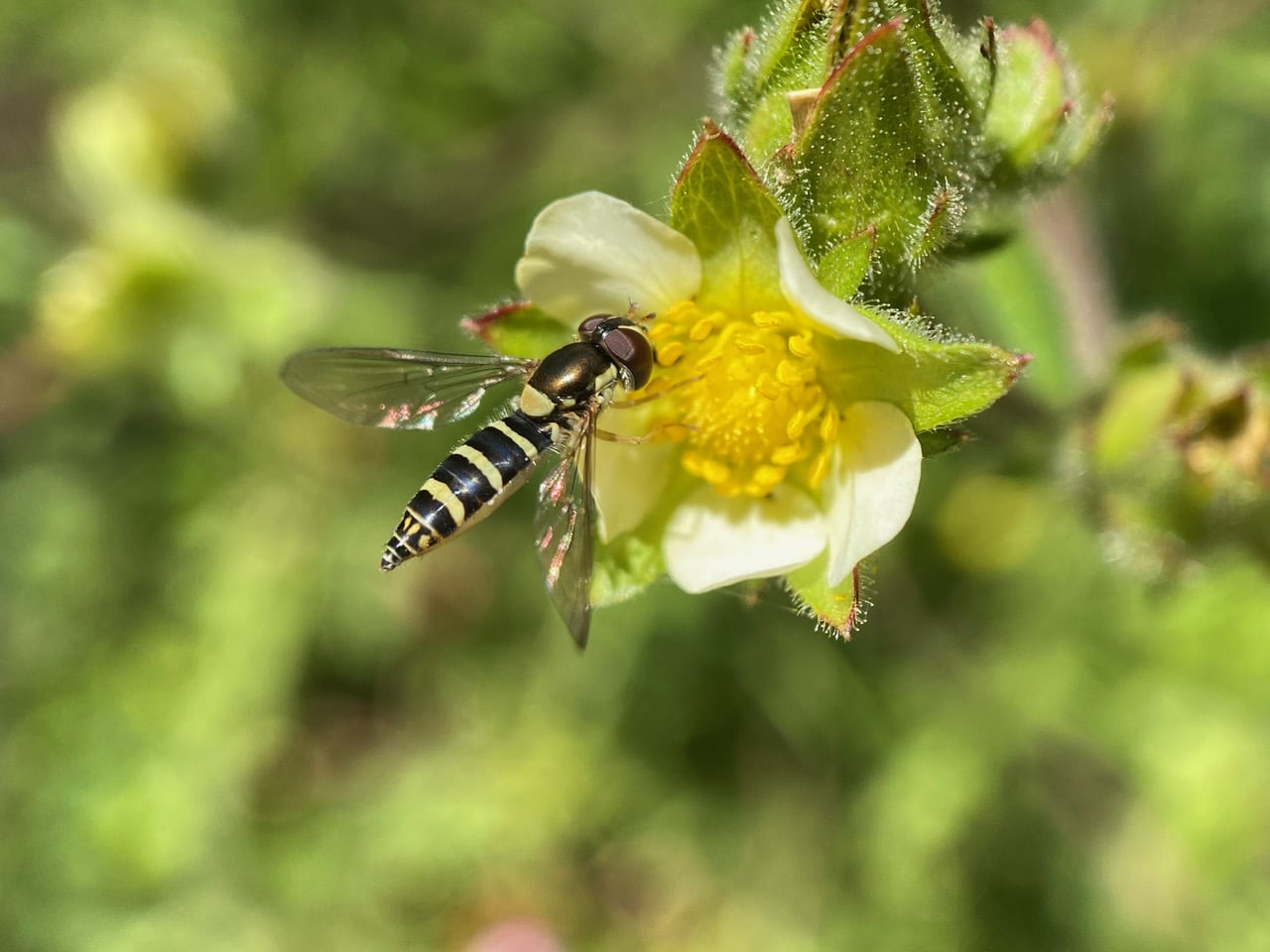
The Sticky Cinquefoil is sure popular with the hoverflies today! Here’s another one, the Diamond Spottail, Fazia micrura (family Syrphidae). There are four diamond-shaped yellow markings near the tip of the abdomen. It is a female as its eyes do not meet on top of the head.
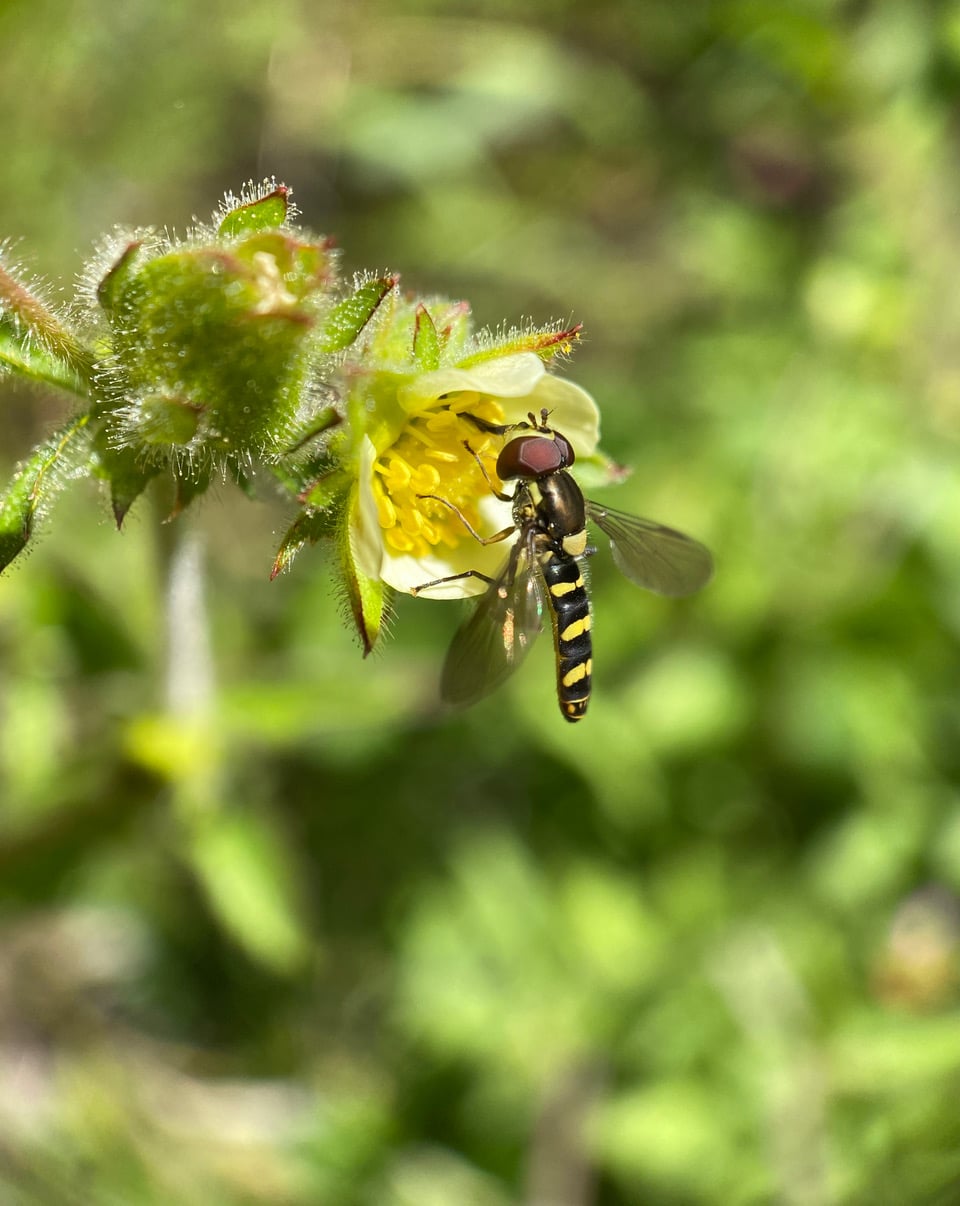
Here’s a male Diamond Spottail, Fazia micrura (family Syrphidae). Note his holoptic eyes that meet along a central line on top of his head. This feature is useful in distinguishing the sexes in most hoverflies.
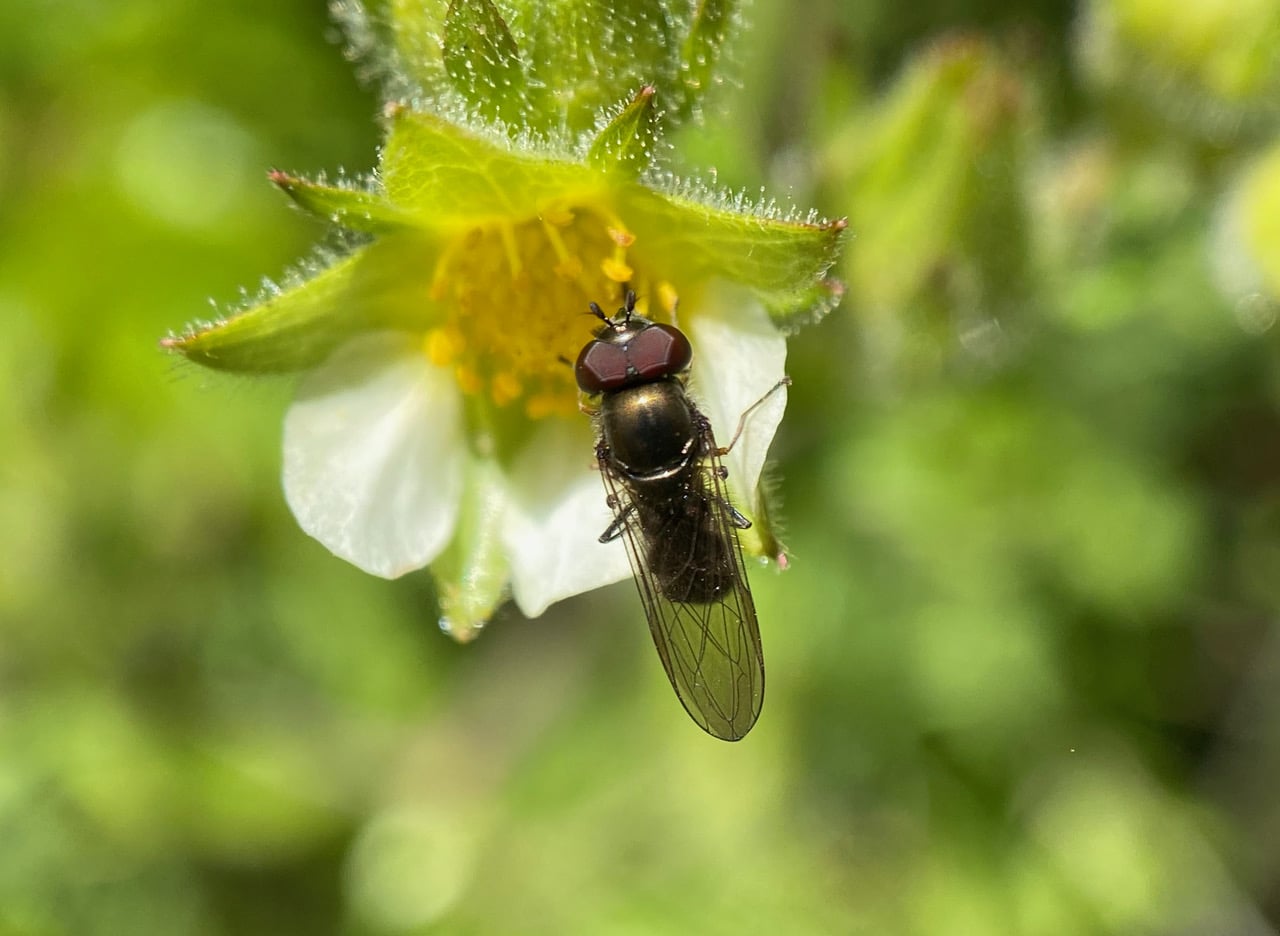
Ooh, another Sedgesitter, Platycheirus sp. (family Syrphidae)! Male or female?

Many hoverflies have a flattened profile with concave abdomen when viewed sideways. Why? There’s hardly any mention of this morphological oddity in the scientific literature.
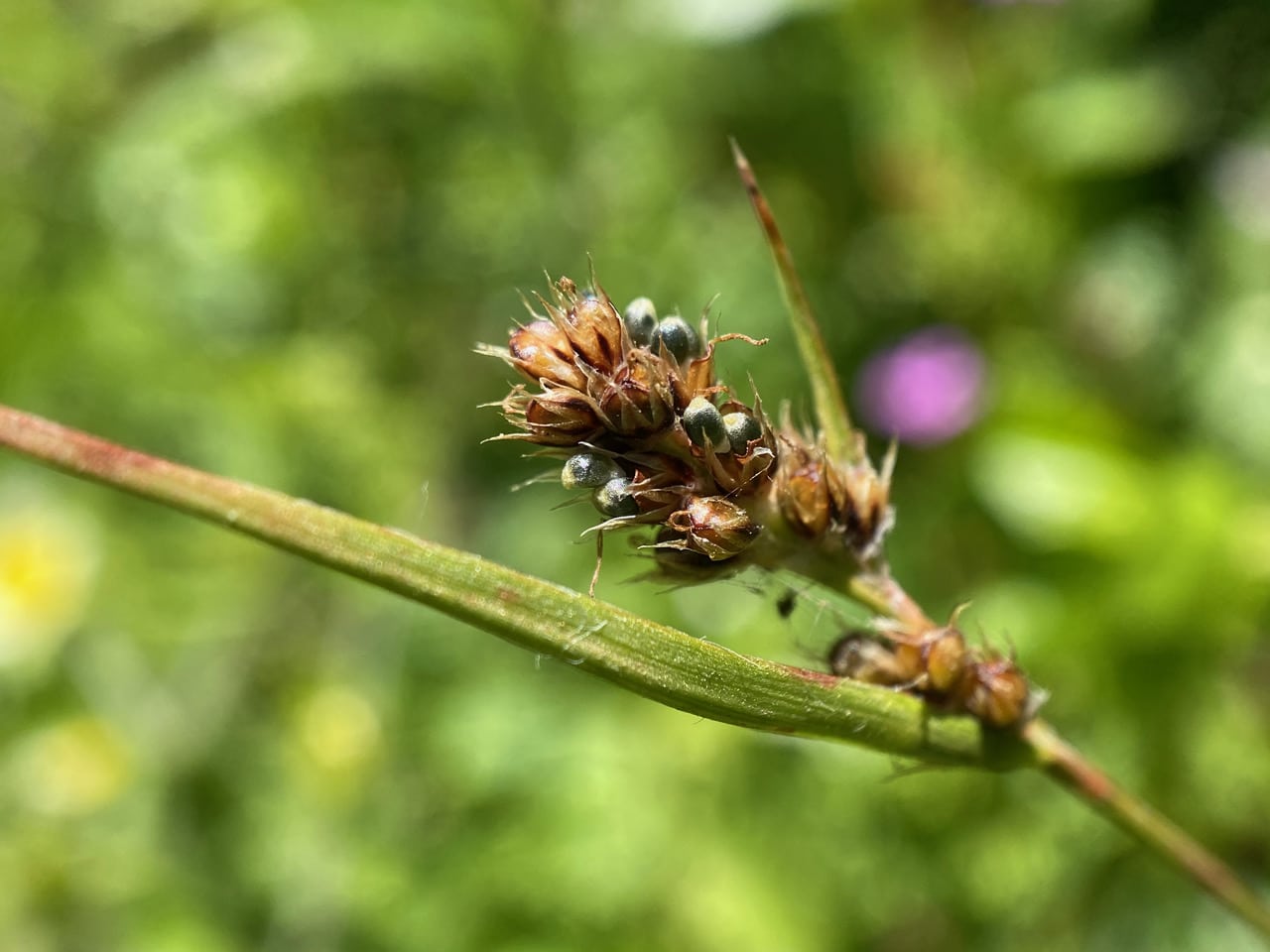
When I first spotted the grayish seeds on this seed head of Pacific Woodrush, Luzula comosa (family Juncaceae) I thought they were beetles.
Native to western North America, the perennial herb is found in moist spots in forests, meadows, open areas, and woodlands. The plant grows to about 1 foot tall, and has small, grasslike tufts of flat green leaves, and brown flower clusters. The fruit is a 3-lobed, oval to round capsule, ripening to brown, each with 3 seeds. Pacific Woodrush goes dormant during the summer dry season.
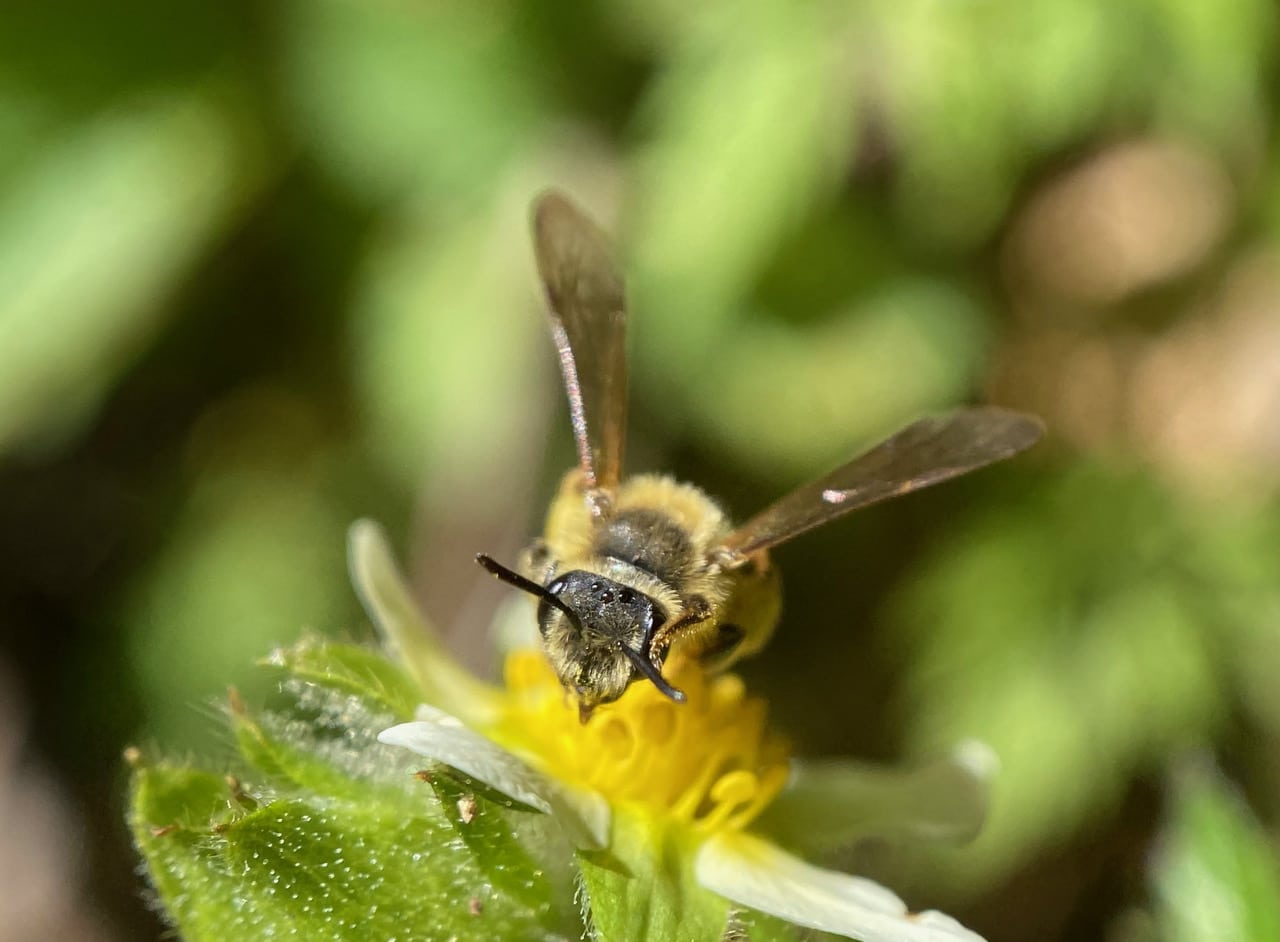
A small bee lands to take nectar from a Sticky Cinquefoil flower. This frontal head shot alone is enough to identify it as a Mining Bee in the genus Andrena (family Andrenidae).
Andrena is likely the largest and most species-diverse bee genus in California. Andrena bees have what are called facial foveae: hair-lined depressions between their eyes and antennae.
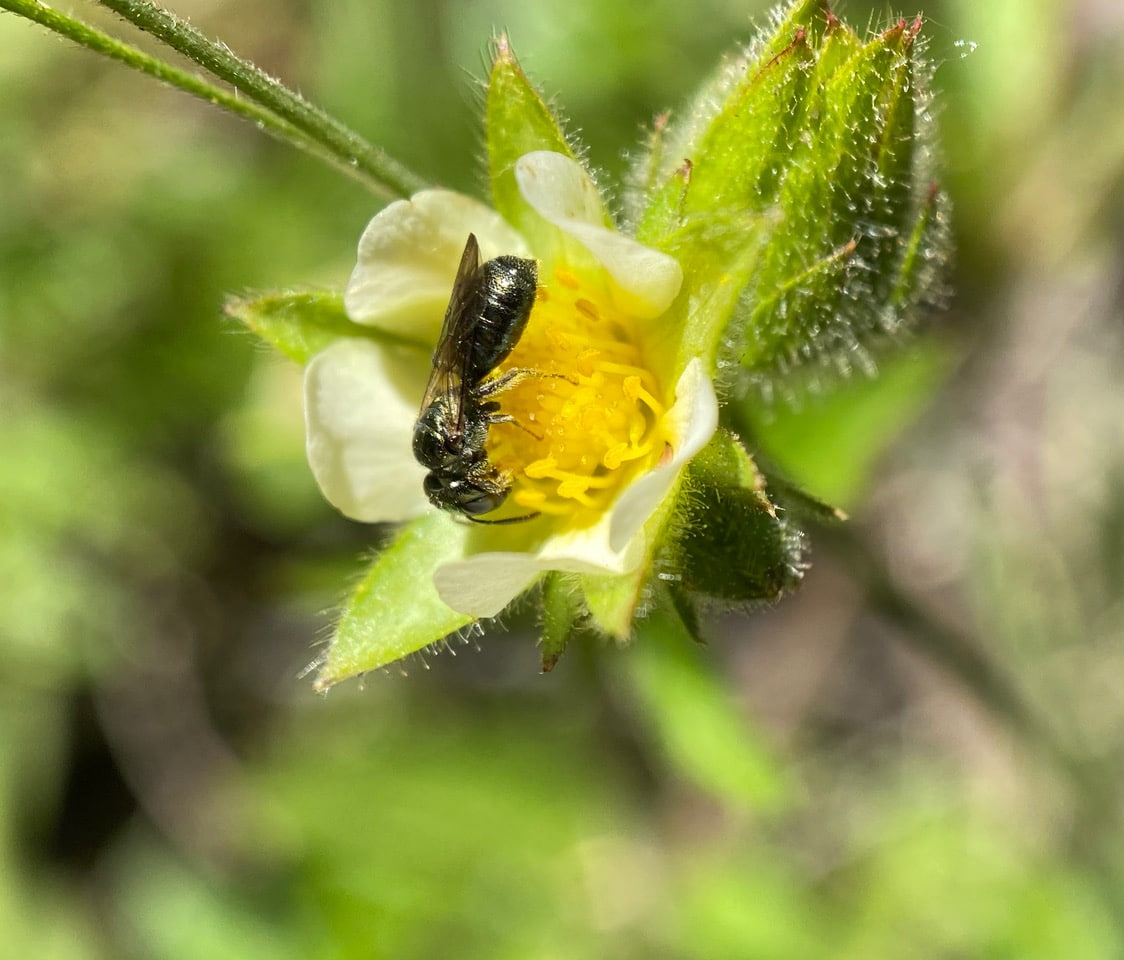
The most commonly seen bee visiting the Sticky Cinquefoil flowers lately are the Small Carpenter Bees, Ceratina sp. (family Apidae).
The Small Carpenter Bee genus Ceratina is closely related to the more familiar, and much larger Carpenter Bees (genus Xylocopa). Ceratina are typically dark, shiny, even metallic bees, with fairly sparse body hairs and a weak scopa on the hind leg. The shield-shaped abdomen comes to a point at the tip. Some species have yellow markings, often on the face.
Females excavate nests with their mandibles in the pith of broken or burned plant twigs and stems. While many species are solitary, a number are subsocial. Both male and female carpenter bees overwinter as adults within their old nest tunnels, emerging in the spring to mate. In the spring, this resting place (hibernaculum) is modified into a brood nest by further excavation. The female collects pollen and nectar, places this mixture (called bee bread) inside the cavity, lays an egg on the provision, and then caps off the cell with chewed plant material. Several cells are constructed end to end in each plant stem.

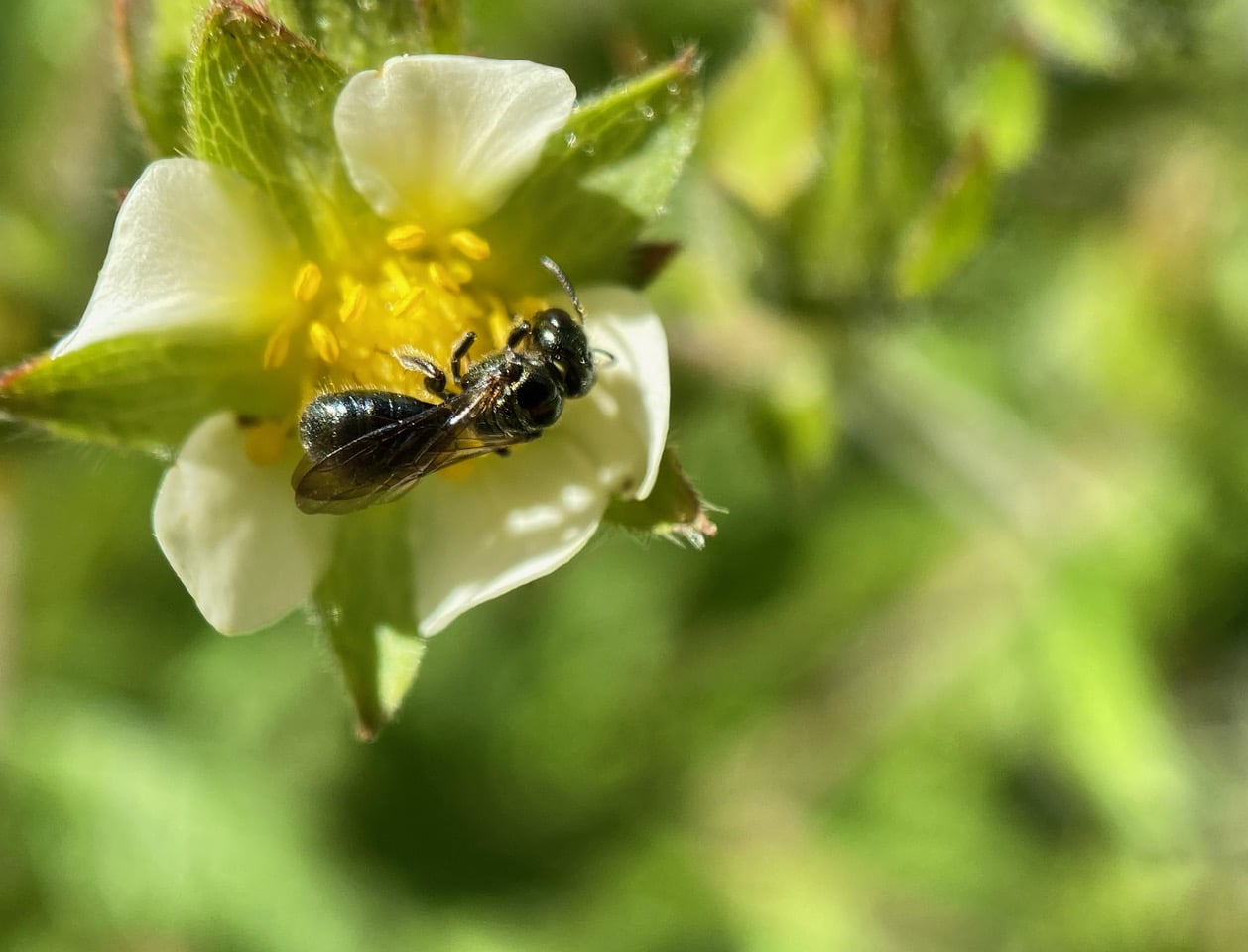
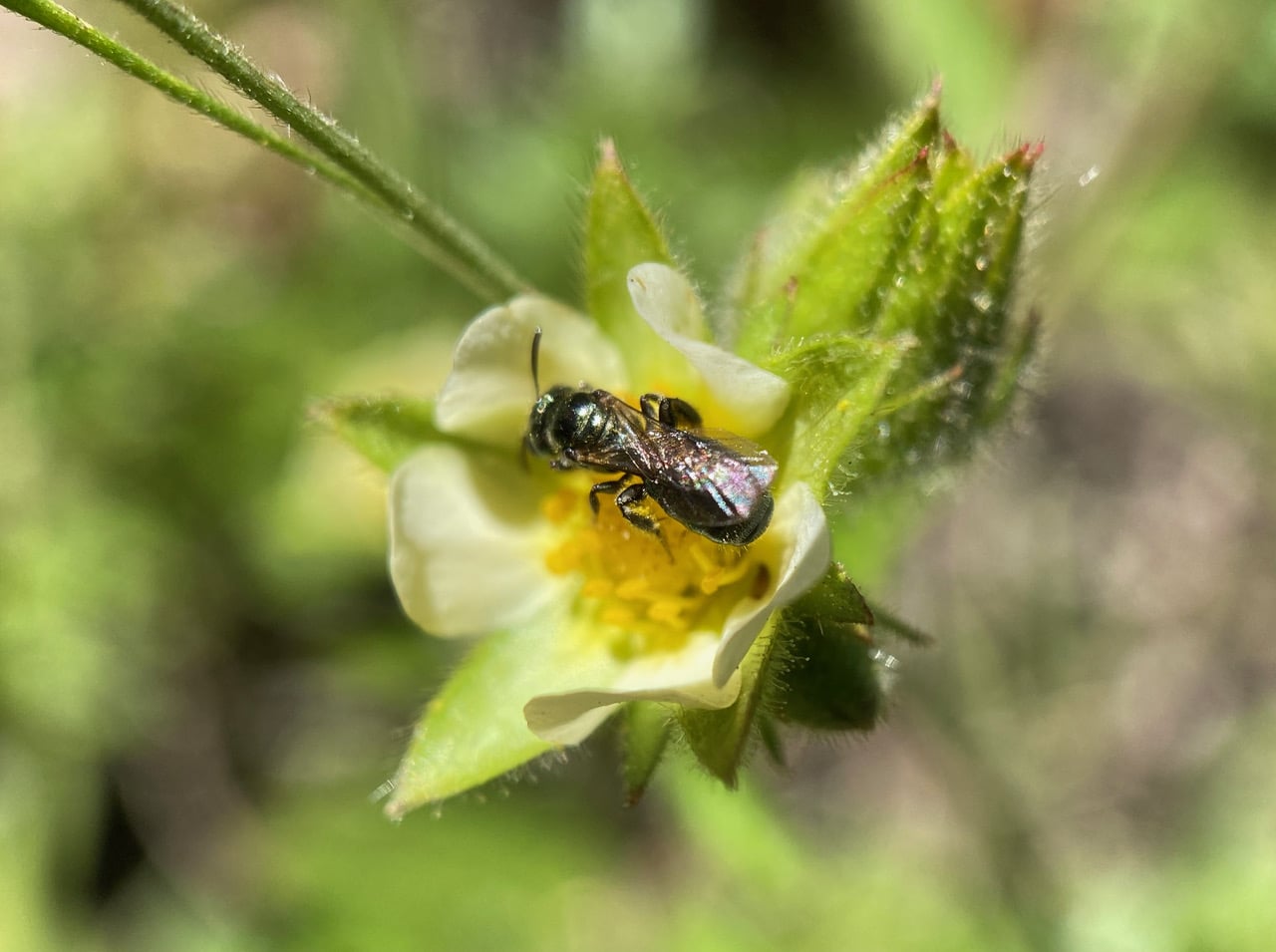
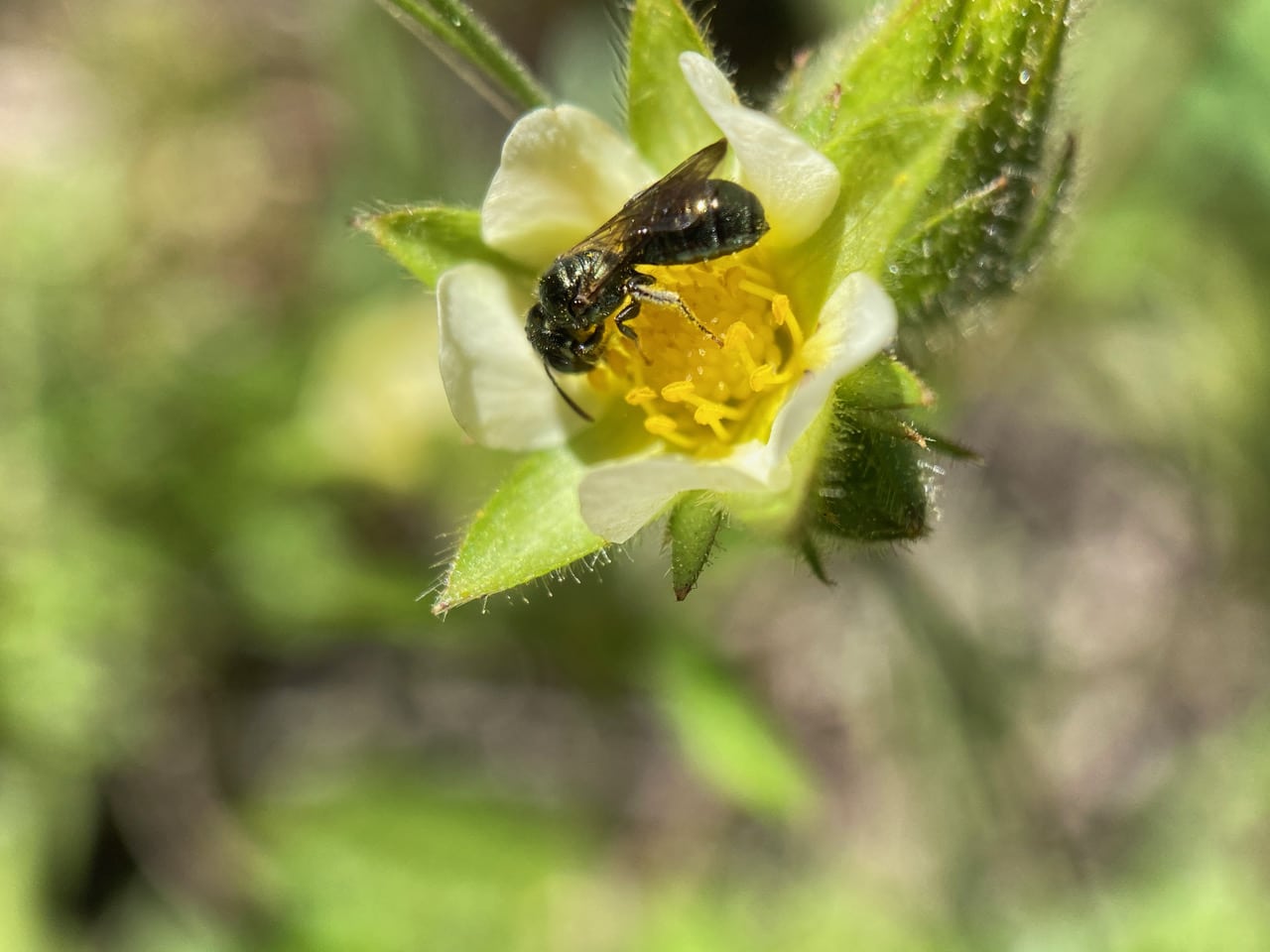
The pollen collecting hairs (scopae) on the hind legs of Ceratina are very short.
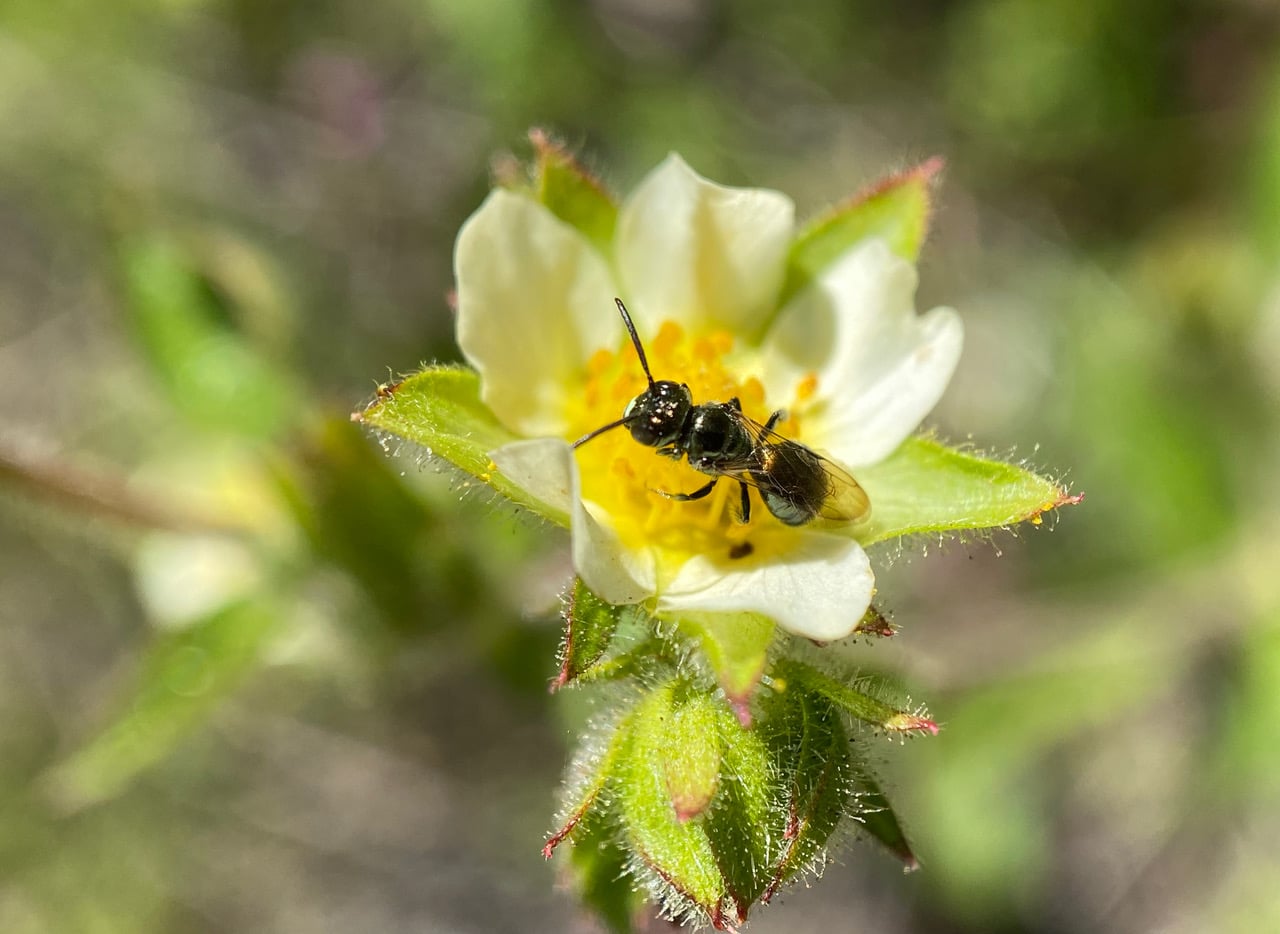
Hey, I think this is a male Small Carpenter Bee, Ceratina sp. Note the long antennae, and the yellow marking on the face.
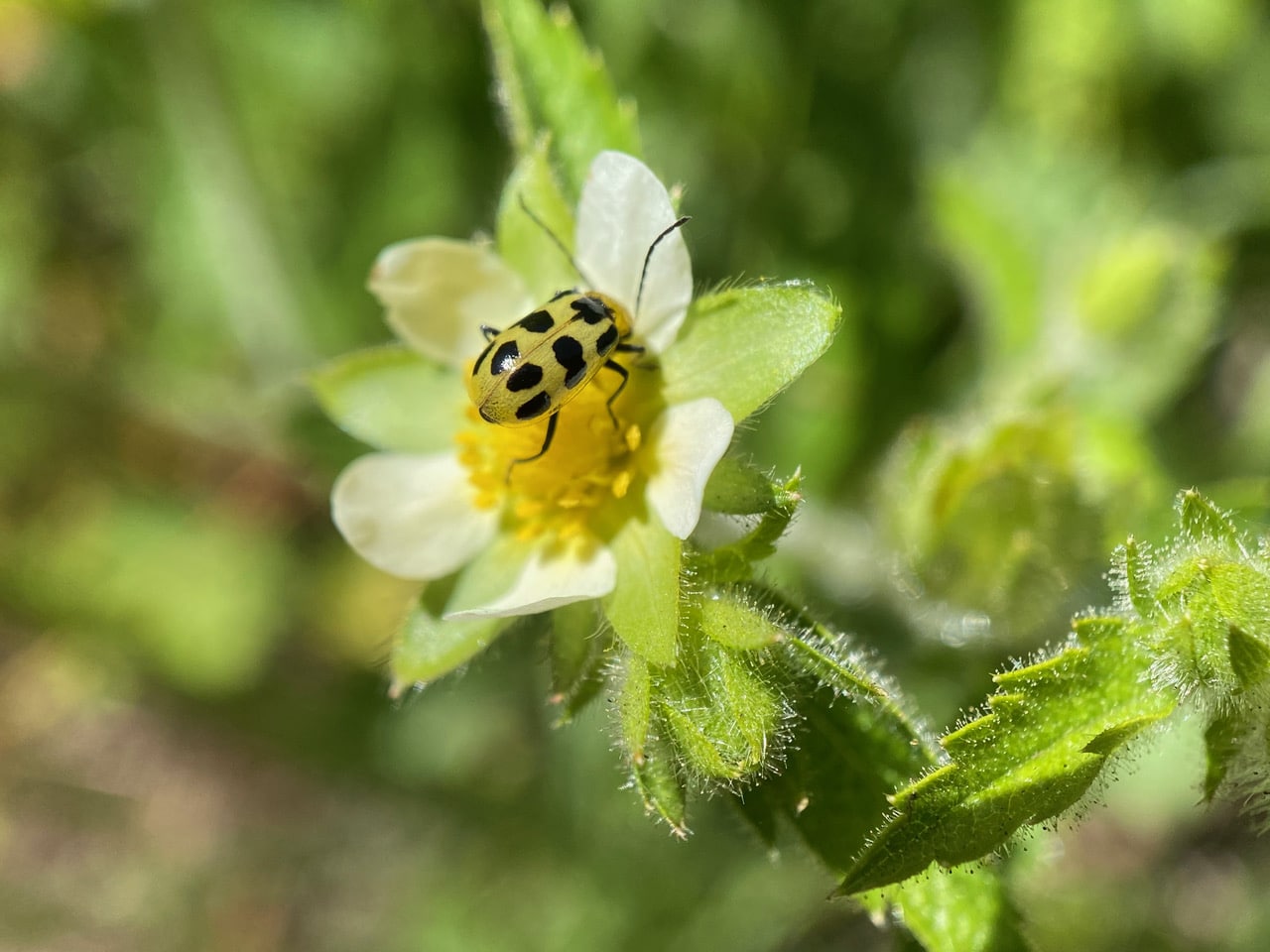
It’s hardly surprising to find a Spotted Cucumber Beetle, Diabrotica undecimpunctata (family Chrysomelidae) on the flower of Sticky Cinquefoil. The species feeds on a wide variety of plants.
Members of the family Chrysomelidae are commonly known as Leaf Beetles. Adults and larvae feed on all sorts of plant tissues, and all species are fully herbivorous. Many are serious pests of cultivated plants, including food crops. Others are beneficial due to their use in biocontrol of invasive weeds. Chrysomelids are popular among insect collectors, as many are conspicuously colored, typically in glossy yellow to red or metallic blue-green hues, and some have spectacularly bizarre shapes. Photos of Leaf Beetles (Family Chrysomelidae) · iNaturalist
Native to North America, the Spotted Cucumber Beetle can be a major agricultural pest, causing damage to crops in the larval as well as adult stages of their life cycle. Larvae, sometimes known as rootworms feed on the roots of emerging plants. In the adult stage the beetles cause damage by eating the flowers, leaves, stems and fruits of the plant.

A tiny black Skin Beetle, Cryptorhopalum sp. (family Dermestidae) is feeding on the pollen of a Sticky Cinquefoil flower.
Dermestidae are a family of Coleoptera (beetles) that are commonly referred to as skin of carpet beetles. Ranging in size from 1 to 2 mm, the beetles typically have clubbed antennae that fit into deep grooves. Most Dermestids are scavengers that feed on dry animal or plant materials, such as skin or pollen, animal hair, feathers, dead insects and natural fibers. The larvae are used in taxidermy and by natural history museums to clean animal skeletons.
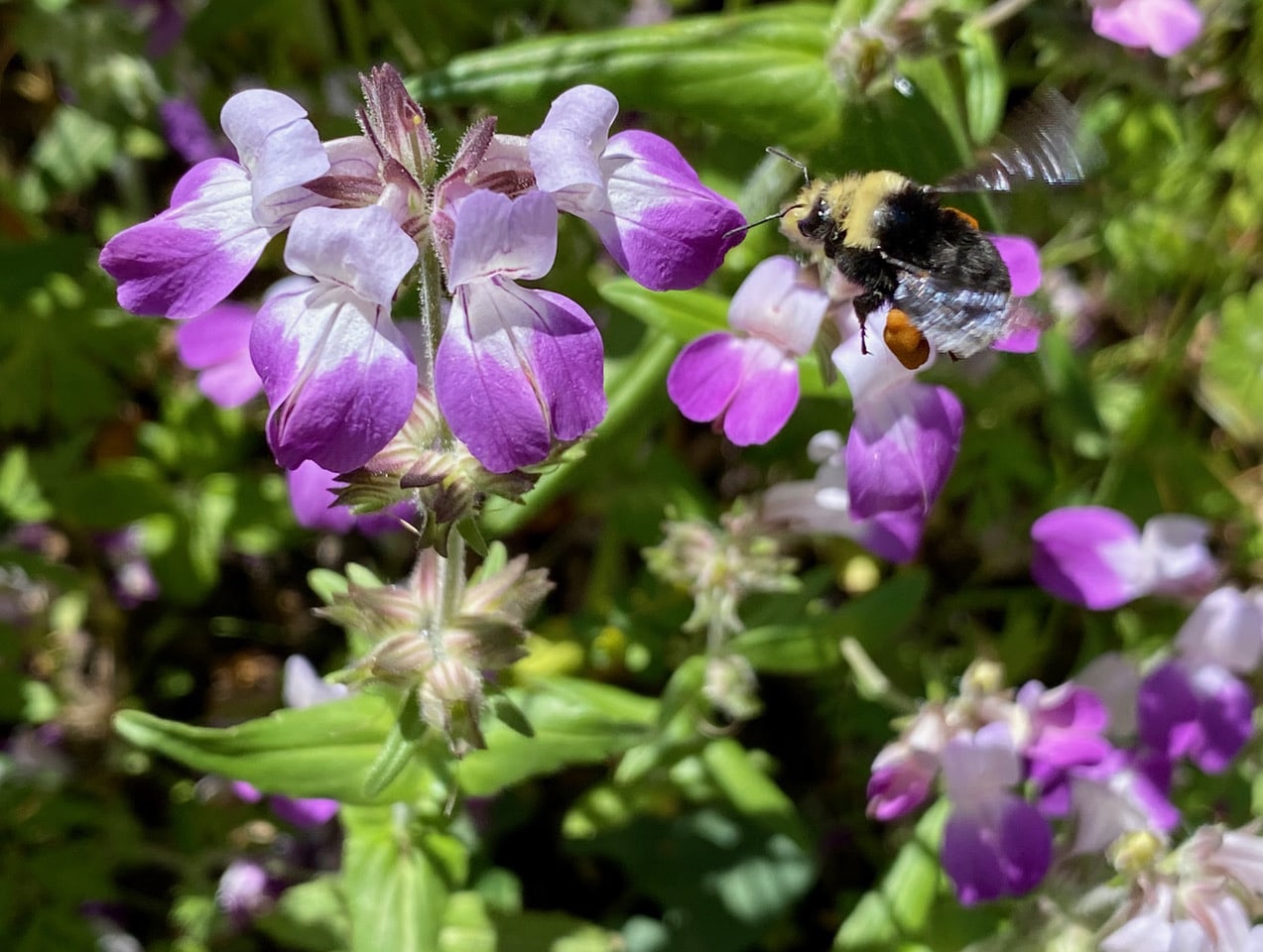
Several Yellow-faced Bumble Bees, Bombus vosnesenskii are flying over the patch of blooming Chinese Houses, Collinsia heterophylla, occasionally landing on the flowers for nectar and pollen.
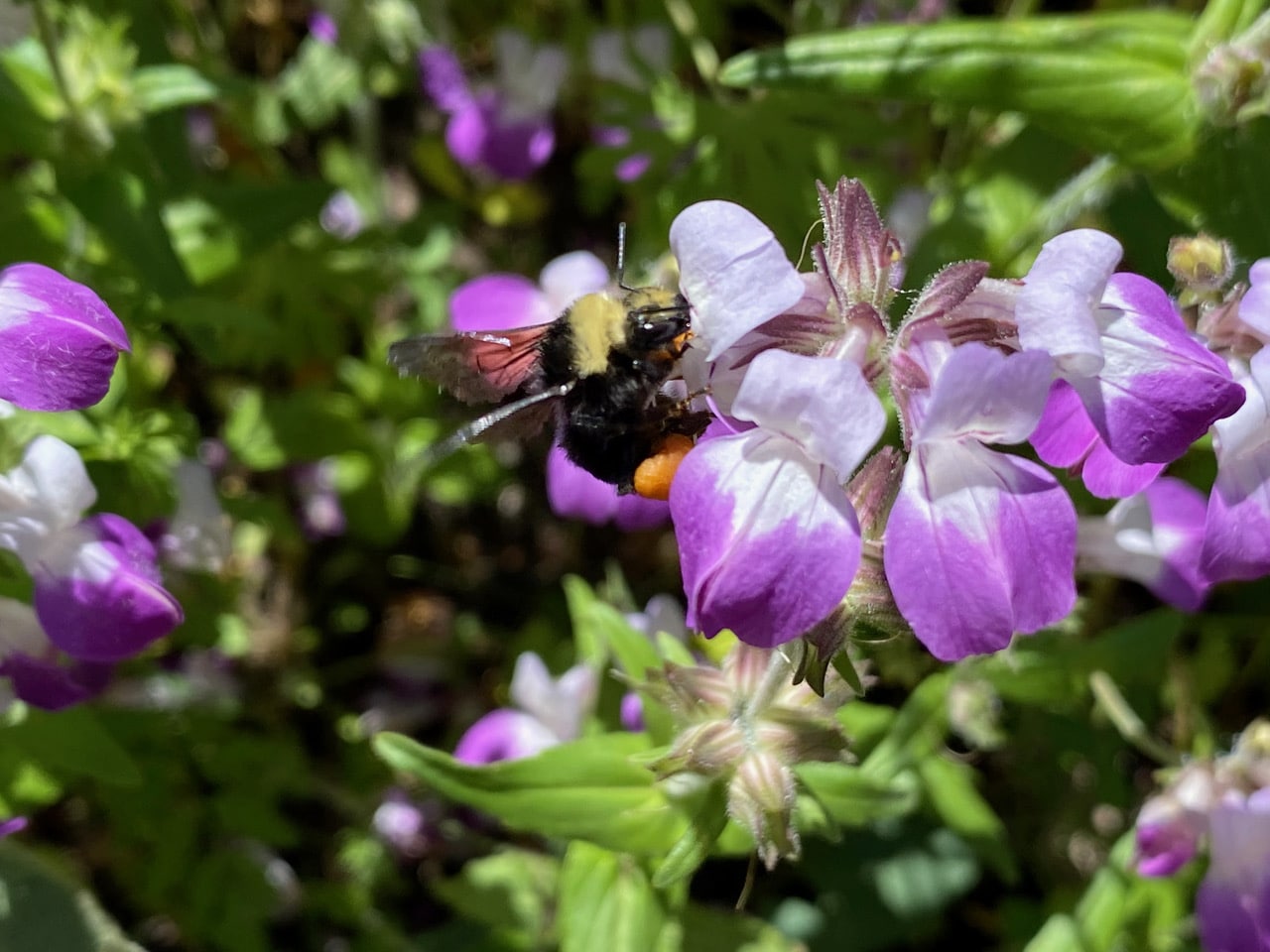
The large bee lands on the the horizontal platform offered by the wing petals. The weight of the bee lowers and spreads the wing petals apart. This opens up the keel underneath, letting the reproductive structures to pop up and hit the bee on the belly.
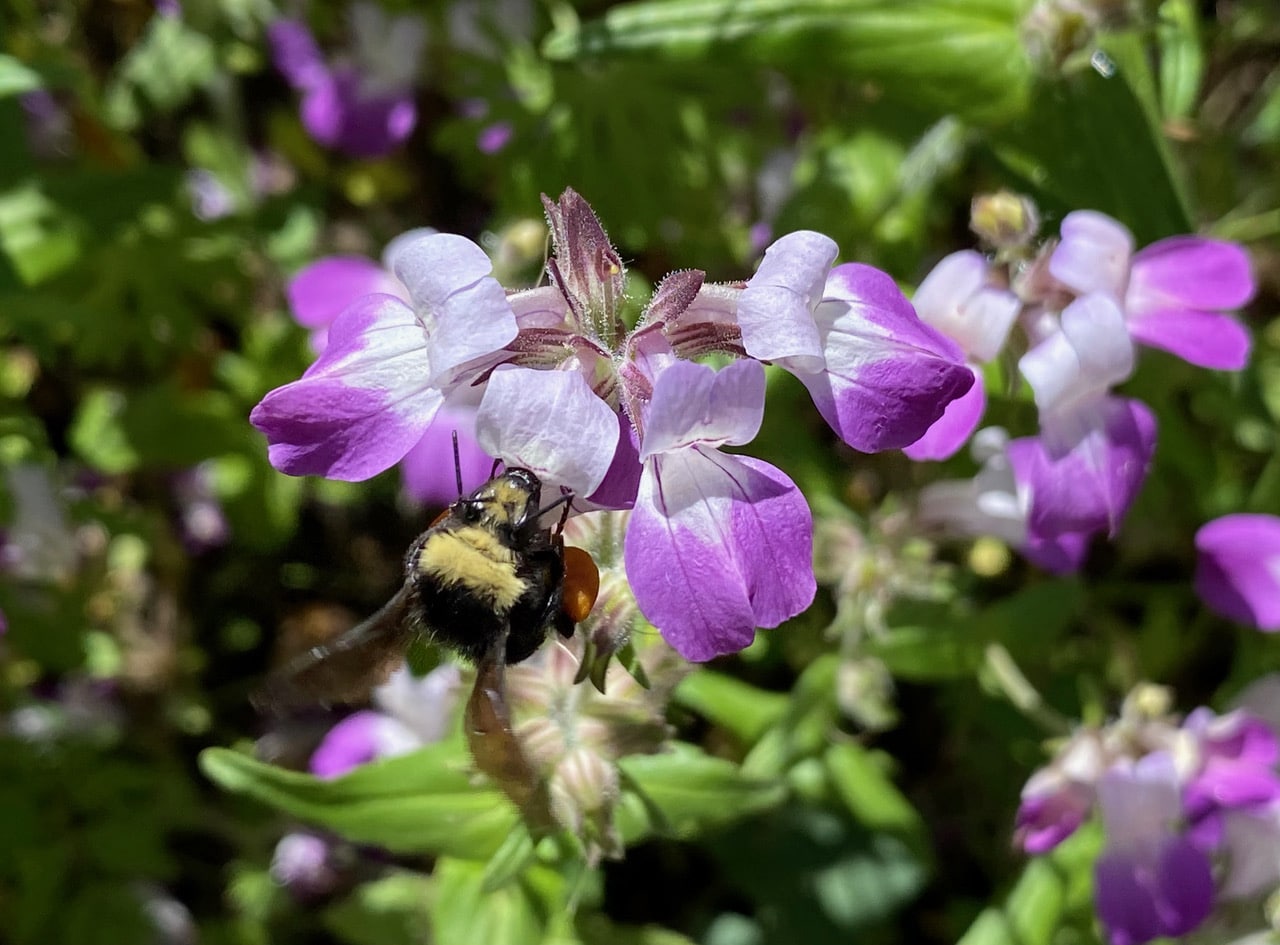
On to the next flower…. More often than not, the wing petals bounce back to their original position after the bee gets off, concealing the keel and the enclosed reproductive structures again. The same dance can be observed on the lupines with uncanny similarities in floral structures. Although the two plants belong to entirely different families, they share similar pollination mechanisms – an amazing case of convergent evolution.