

Pollinator Post 5/23/23 (1)
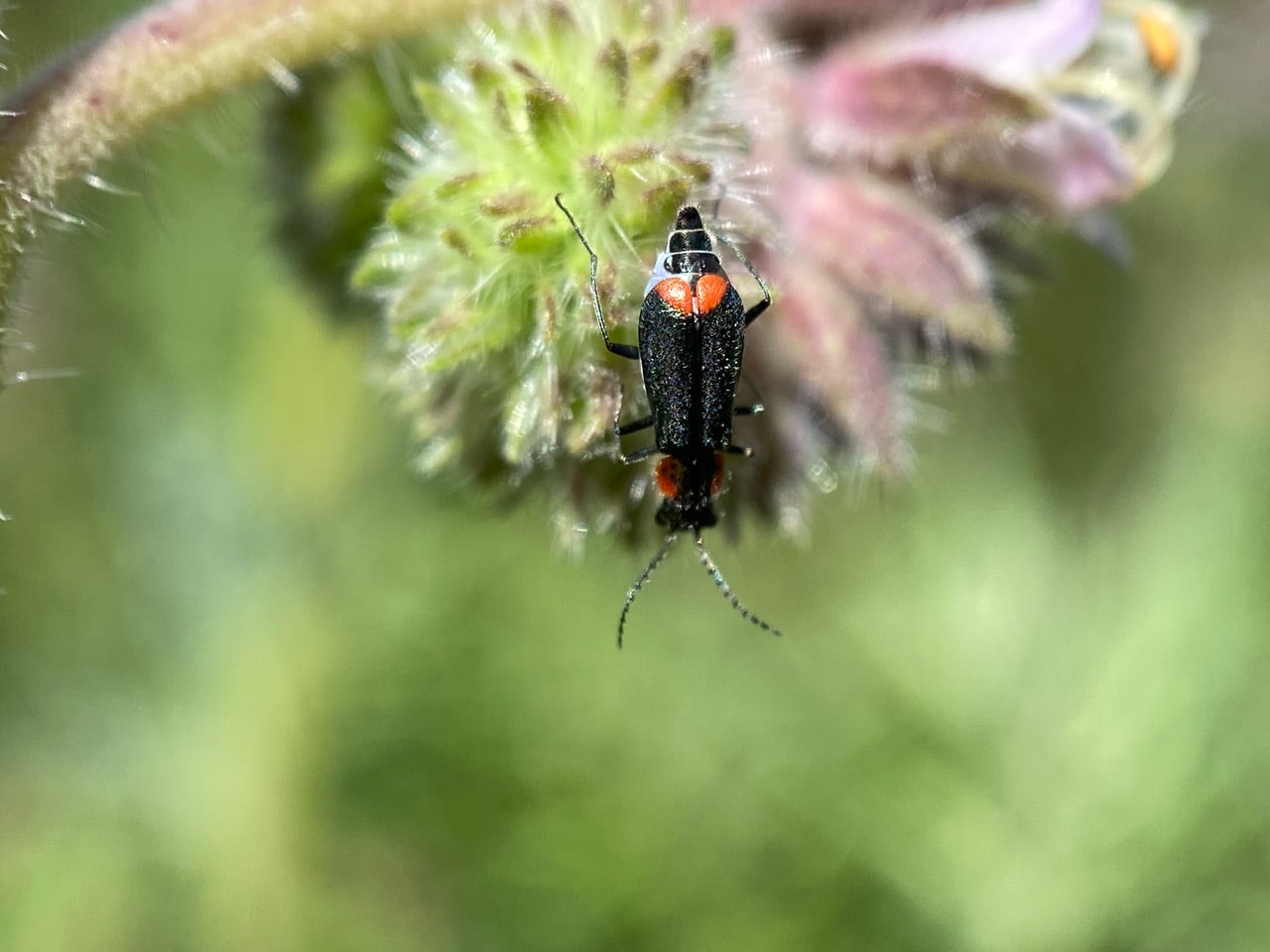
What a pretty rear end!
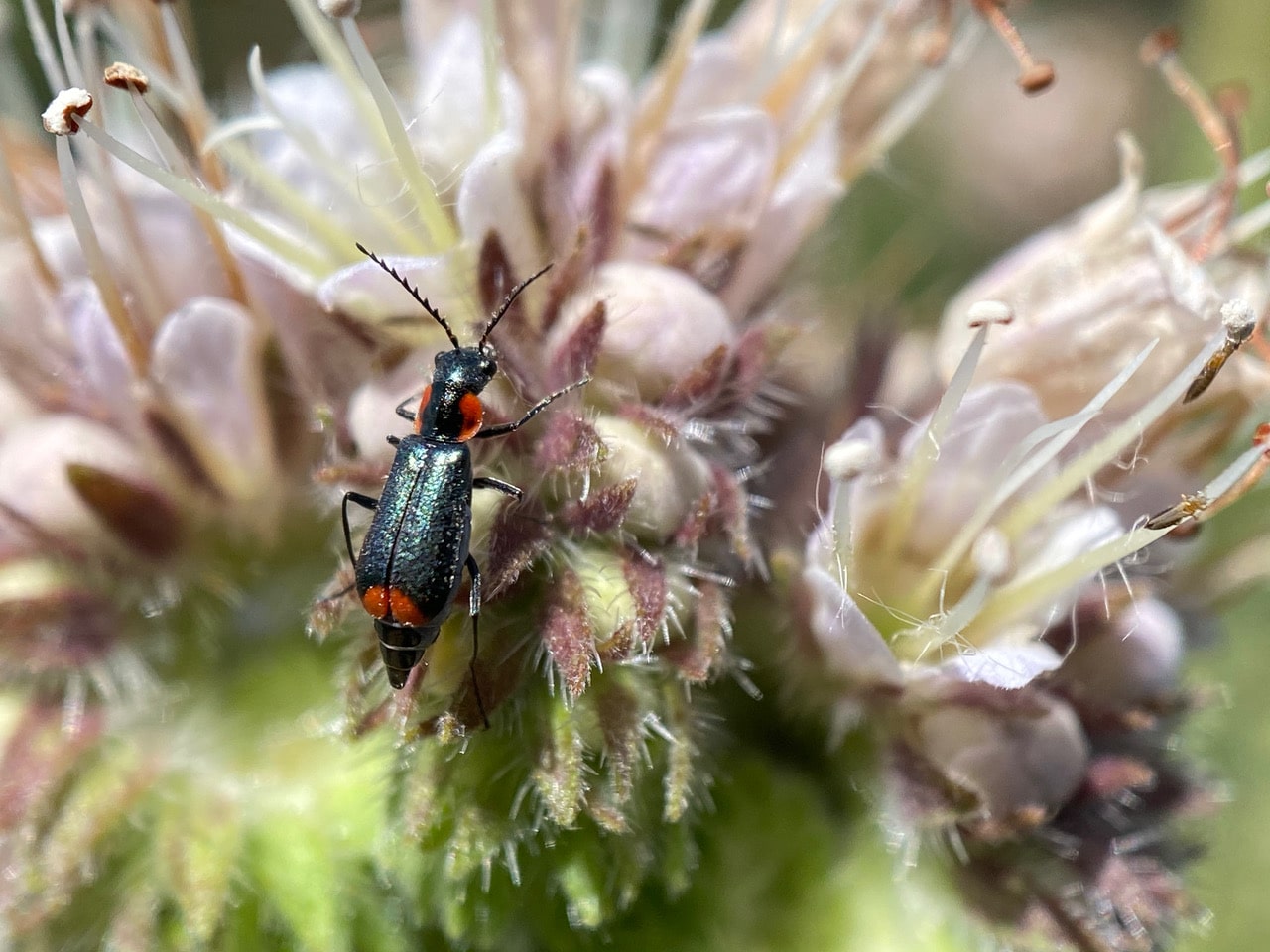
A Malachite Beetle, Malachius auritus (family Melyridae, subfamily Malachiinae) is exploring an inflorescence of California Phacelia, Phacelia californica.
The Malachite Beetle (subfamily Melachiinae) is a member of the family of Soft-winged Flower Beetles (family Melyridae). Most Melyrids are elongate-oval, soft-bodies beetles 10 mm or less in length. Members of the subfamily Malachiinae have peculiar orange structures along the sides of the abdomen which can be everted, but usually kept hidden. Most adults and larvae are predaceous. Omnivorous adult Melyrids are often found on flowers out in the open, where they feed on pollen, insect eggs, and flower-loving insects that land within their grasp. The larvae generally stay concealed under tree bark or leaf litter or soil, where they prey on other invertebrates.
Note the beetle’s pectinate antennae. The segments of pectinate antennae are longer on one side, giving the antenna a comb-like appearance. The term pectinate derives from the Latin pectin, meaning comb. Pectinate antennae are found in some beetles and sawflies. Insect antenna forms – BugGuide.Net
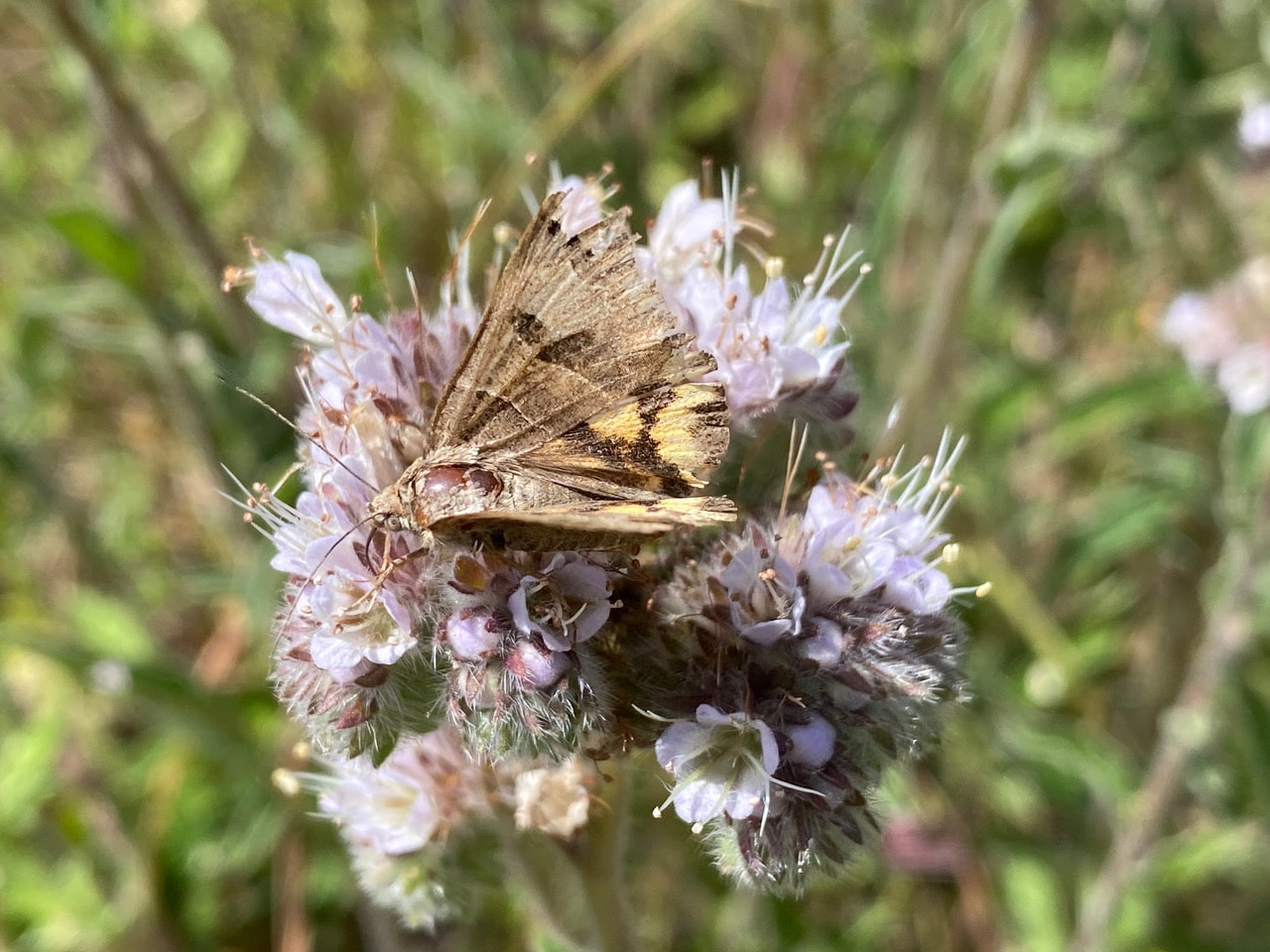
A worn, tattered Graphic Owlet (family Noctuidae) is sipping nectar from California Phacelia flowers. The moth has seen better days – the edges of its wings are frayed, and it has lost a lot of scales from its wings and thorax.
Euclidia ardita is strictly diurnal, flying from March to early June. The species is found in coastal Oregon and California west of the Cascade-Sierra Nevada divide. Larval host plant is deerweed (Acmispon sp., Fabaceae)
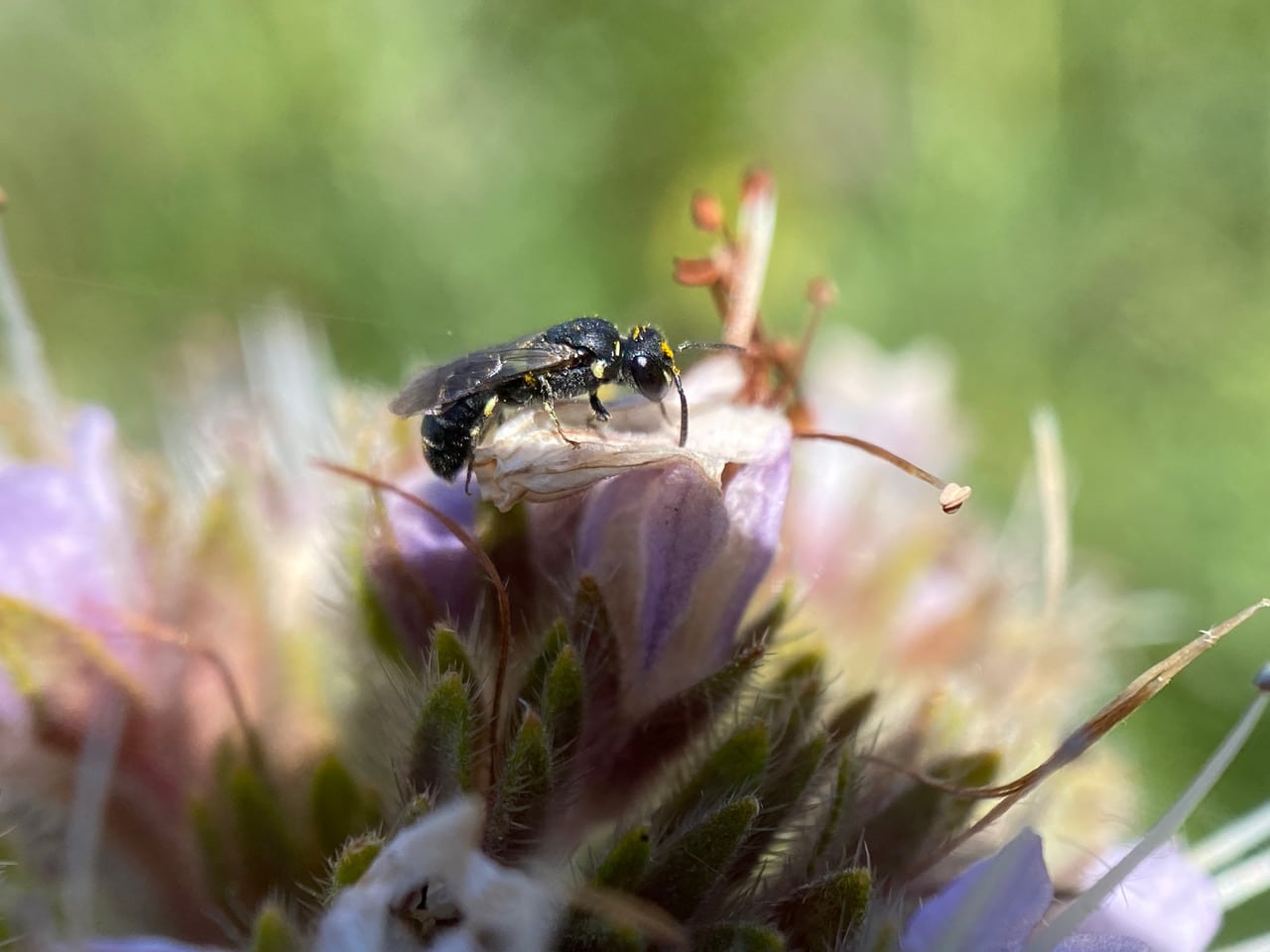
To a tiny bee the size of a grain of rice, navigating the terrain of a California Phacelia inflorescence is hard work.
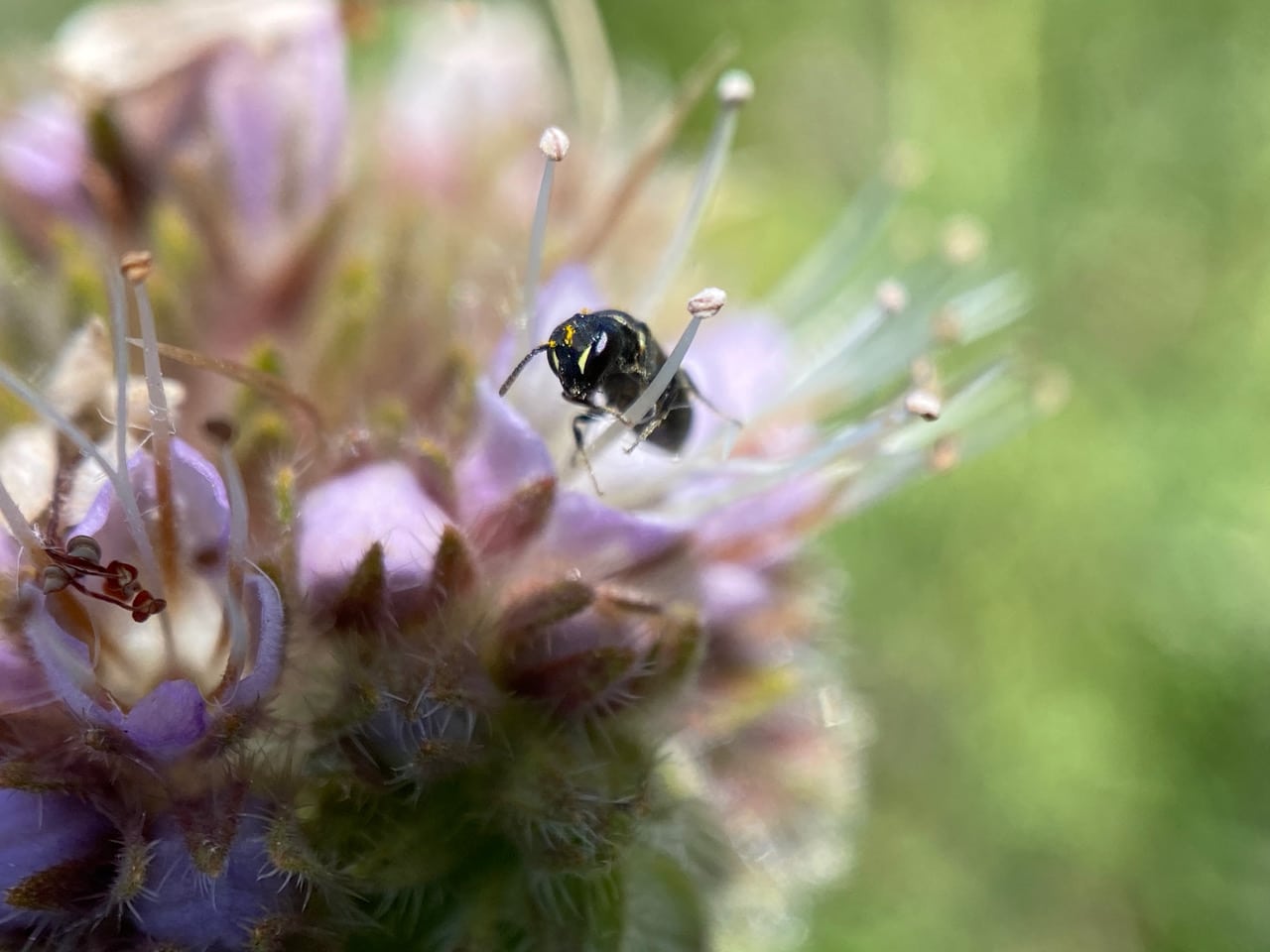
The bee has finally found what it’s looking for – a fresh flower offering lots of pollen! Note the pair of small yellow markings on the face between the eyes. It is a female Masked Bee, Hylaeus sp. (family Colletidae). The markings are more prominent on the males.
Hylaeus (family Colletidae) are shiny, slender, hairless, and superficially wasp-like bees. They are small, 5 to 7 mm long, usually black with bright yellow or white markings on their face and legs. These markings are more pronounced on the males. Hylaeus do not carry pollen and nectar externally, they instead store their food in the crop and regurgitate it upon returning to their nests. They are primarily generalist foragers. Hylaeus are short-tongued, but their small body size enables them to access deep flowers. Hylaeus nest in stems and twigs, lining their brood cells with self-secreted cellophane-like material. They lack strong mandibles and other adaptations for digging, using instead pre-existing cavities made by other insects.

A female March Fly, Dilophus sp. (family Bibionidae) appears to be seeking nectar from the Phacelia flowers.
March Flies in the genus Dilophus are distinguished by rings of spines on the fore tibia and two rows of spines anteriorly on the thorax. The genus has a worldwide distribution, with highest diversity in the Neotropics. In some species the sexes are quite different in form and color, the female often brownish or red, the males black.
March Flies (family Bibionidae) generally live in wooded areas and are often found on flowers – adults of some species feed on nectar, pollen, and honeydew, while adults of other species don’t feed at all; and in either case, they are very short-lived. They are considered important pollinators. They are also important food for other insects and spiders. The larvae feed en masse on rotting organic materials like leaves, wood, compost, and rich soil.
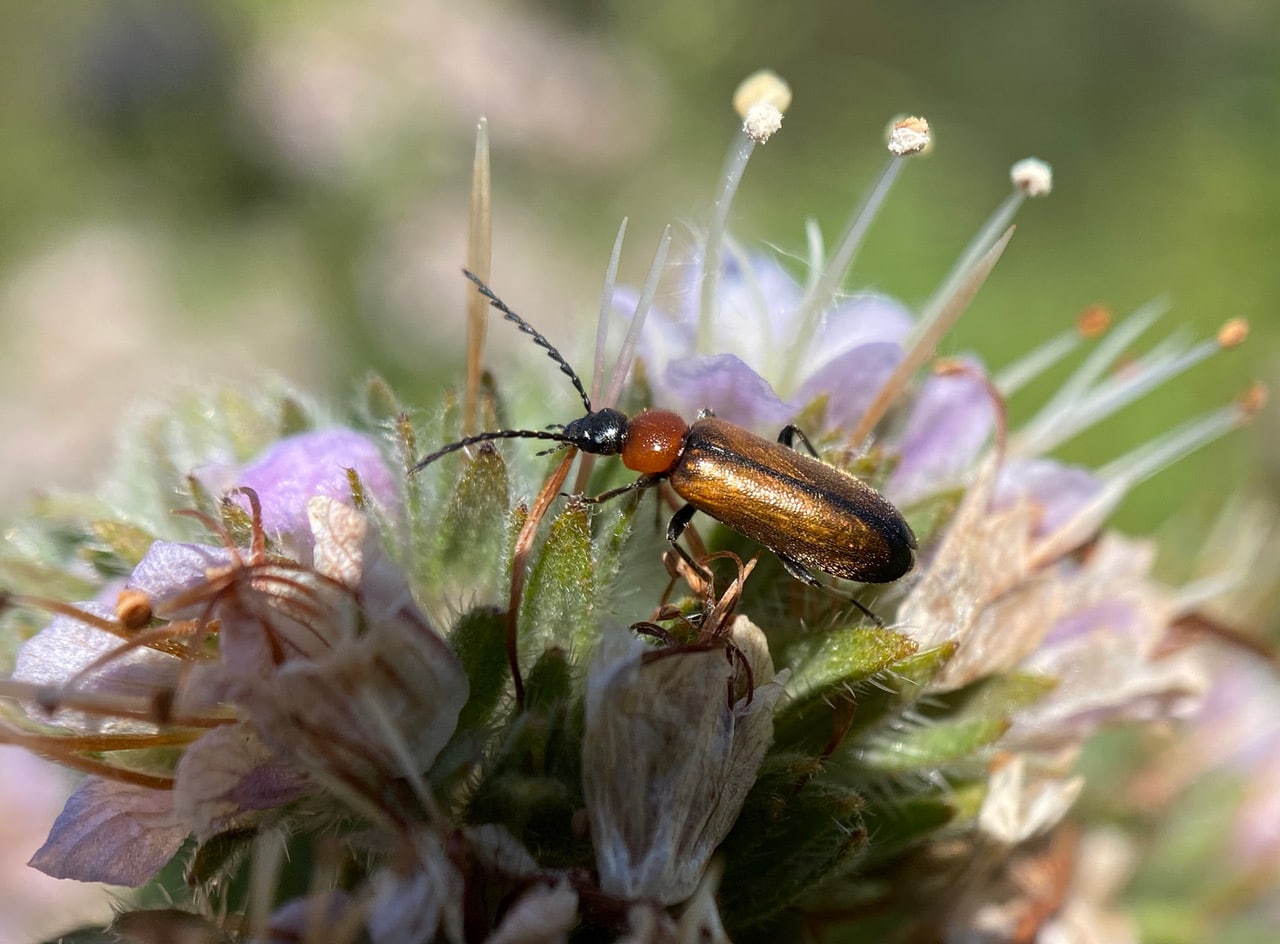
A Fire-colored Beetle, Pedilus sp. (family Pyrochroidae) is walking on a California Phacelia inflorescence.
Like all beetles, Fire-colored Beetles have chewing mouthparts and hardened front wings (elytra) that meet in a straight line down the back of the abdomen when closed. Most Pyrochroidae have dark elytra and many are marked with orange or red on the head, legs, or thorax. Some species are orange all over their bodies, hence the common name for the family. Both the head and thorax are narrower than the elytra, and there’s a neck-like constriction behind the head. Many males have pectinate (comb-like) or antler-like antennae. Adult Pedilus are found on vegetation or flowers, feeding on nectar and pollen. Larvae live under loose bark and in rotting wood, where they feed on fungi.
The most notable thing about Pedilus is their affinity for cantharidin, a caustic defense chemical produced by Blister Beetles (family Meloidae). Adult Pedilus seek out Blister Beetles, climb onto them and lick off the cantharidin the Blister Beetles exude. The male Pedilus uses the blistering agent to court females. Upon mating, most of the cantharidin is transferred to the female in the form of a sperm packet. The cantharidin-coated eggs that the female subsequently lays are protected from egg predators.
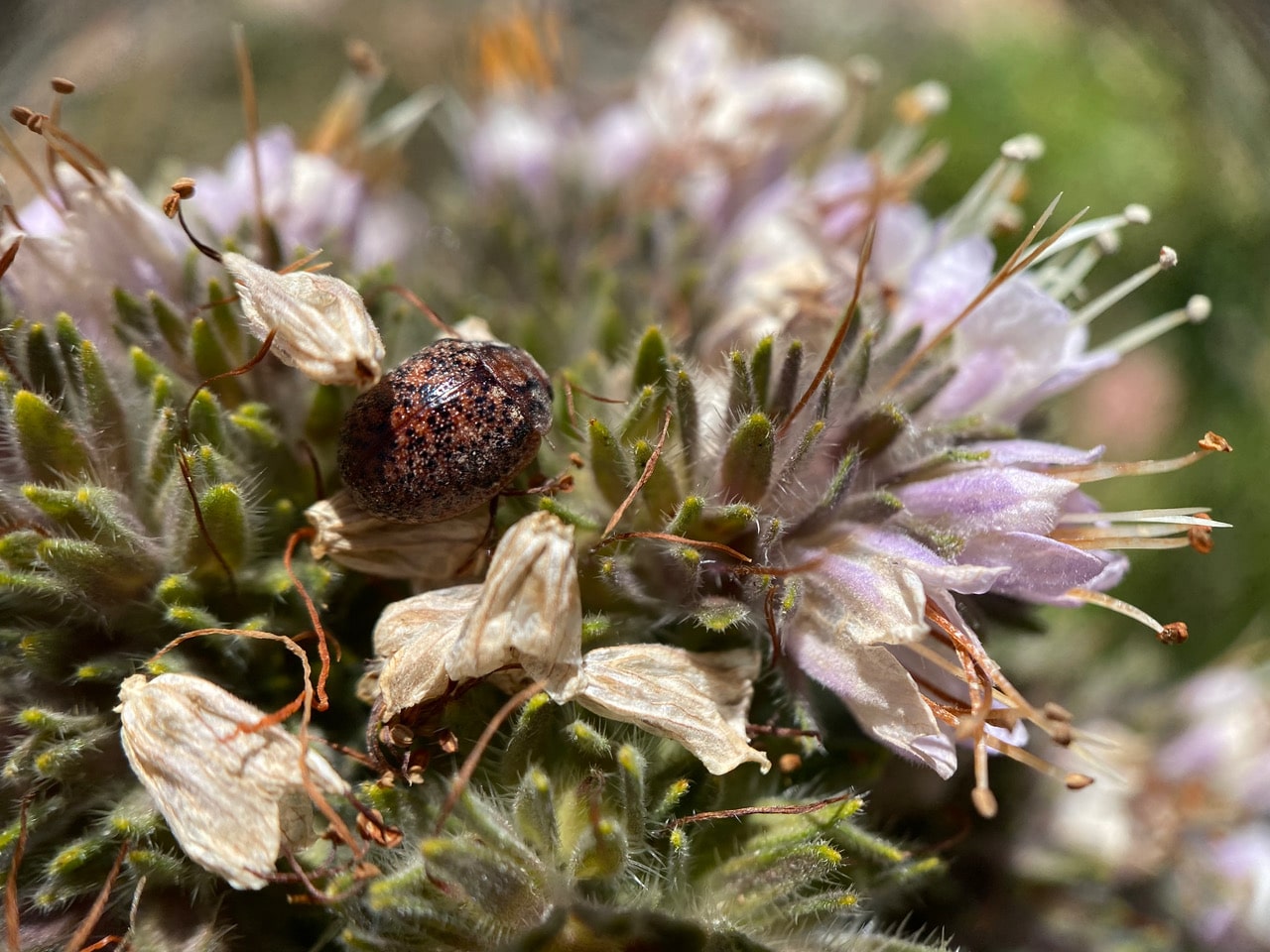
An Australian Tortoise Beetle, Trachymela sloanei (family Chrysomelidae) is almost concealed among the Phacelia flowers. I look up, and sure enough, there are Eucalyptus trees close by.
The beetle is native to Australia, but is now widespread in much of California. Their host plants include several species of Eucalyptus. Eggs are laid in crevices in or under bark. Both adults and the caterpillar-like larvae feed on foliage during the night, resulting in semicircular holes or irregular notches along edges of Eucalyptus leaves. The unsightly feeding scars do not appear to threaten Eucalyptus survival or health.

A Snakefly is perched on a floral umbel of Cow Parsnip, Heracleum maximum.
Snakeflies are a group of predatory insects comprising the order Raphidioptera. They are a relict group, having reached their apex of diversity during the Cretaceous before undergoing substantial decline. Adult Snakefly has a notably elongated thorax which, together with the mobile head, gives the group their common name of snakily. The body is long and slender and the two pairs of long membranous wings are prominently veined. The head is long and flattened and heavily sclerotized. The mouthparts are strong and relatively unspecialized, being modified for biting. The large compound eyes are at the sides of the head. Females have a large and sturdy ovipositor which is used to deposit eggs into crevices or under bark. Snakeflies are holometabolous insects with four-stage life cycle consisting of eggs, larvae, pupae and adults. Both adults and larvae are predators of soft-bodied arthropods such as aphids and mites.
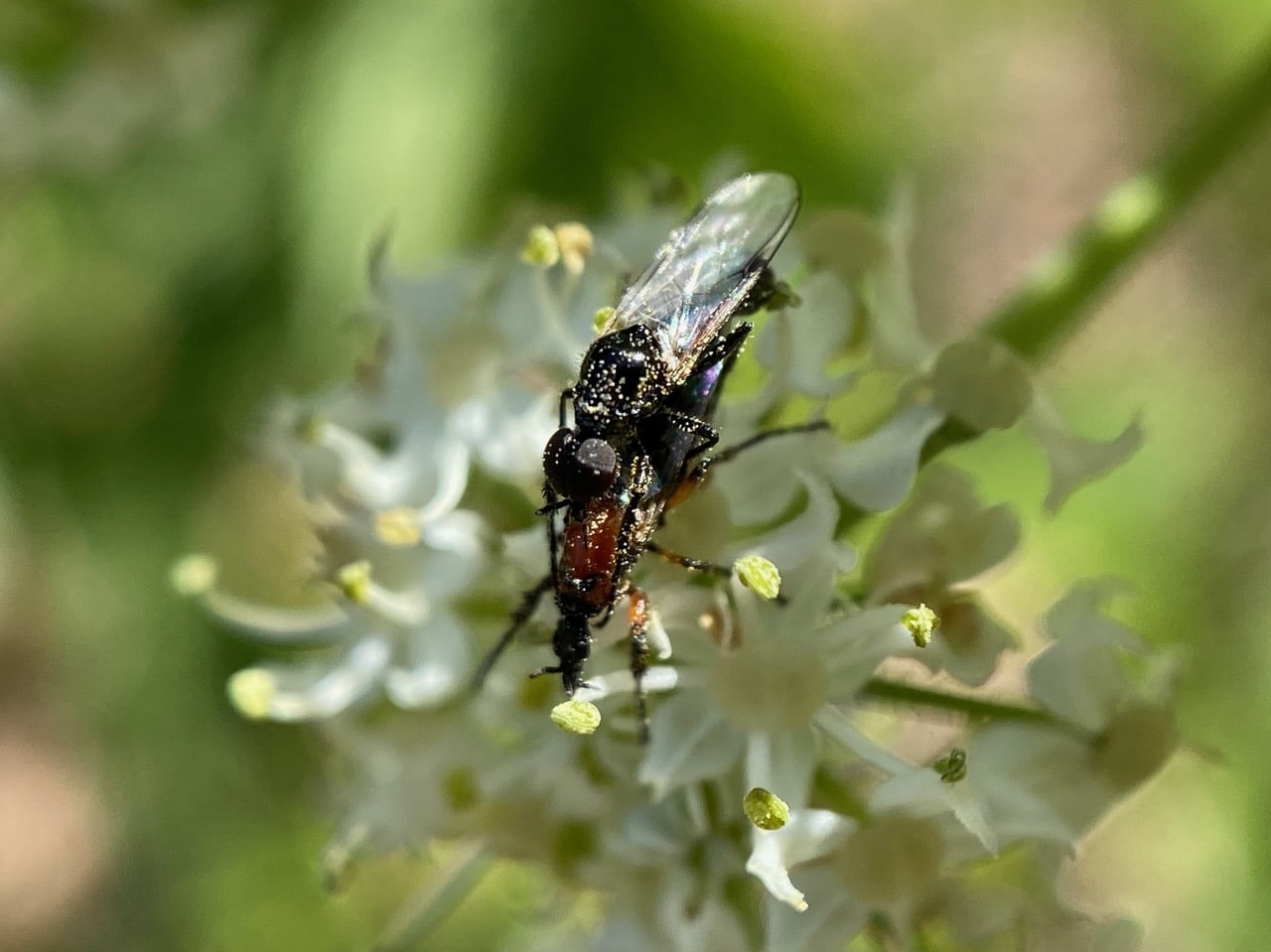
Dusted with pollen, a pair of March Flies, Dilophus sp. (family Bibionidae) is mating on an inflorescence of Cow Parsnip, Heracleum maximum.
March flies exhibit extreme sexual dimorphism – the sexes are morphologically distinct. The female is usually more colorful, has small eyes on the sides of long, narrow head, while the all-black males have huge eyes that touch in the middle and are split in half horizontally. Scientists speculate that the split makes it easier for them to see the other males that are above and below them in a mating swarm. Males gather in swarms that can blanket the ground and low vegetation. Female are attracted to the party and select mates in the frenzy of fly bodies.
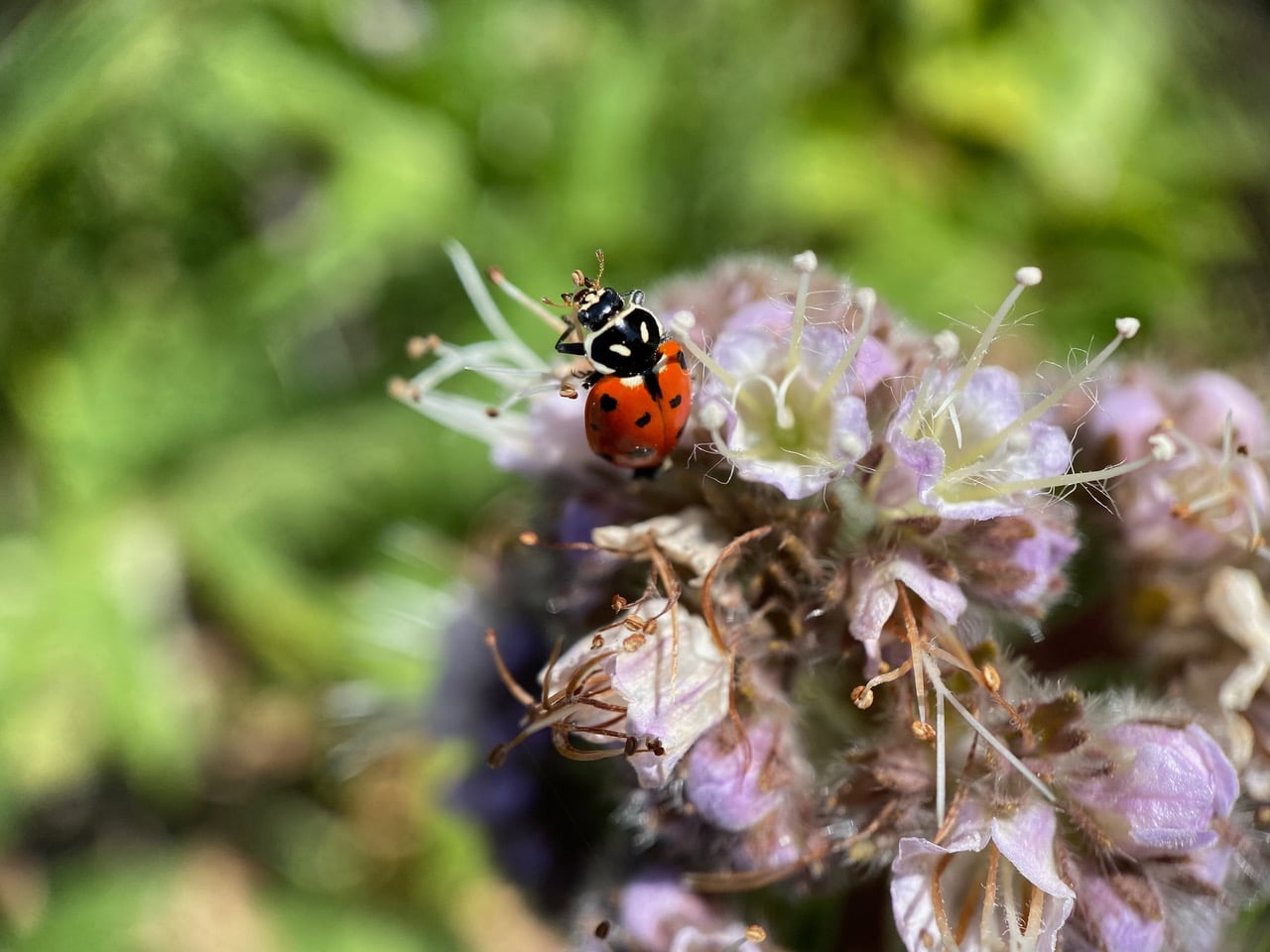
A Convergent Ladybeetle, Hippodamia convergens (family Coccinelidae) is feeding on pollen of Phacelia flowers.
Although Ladybeetles are commonly known as predators of aphids and other soft-bodied insects, they also feed on pollen and nectar when prey is scarce.
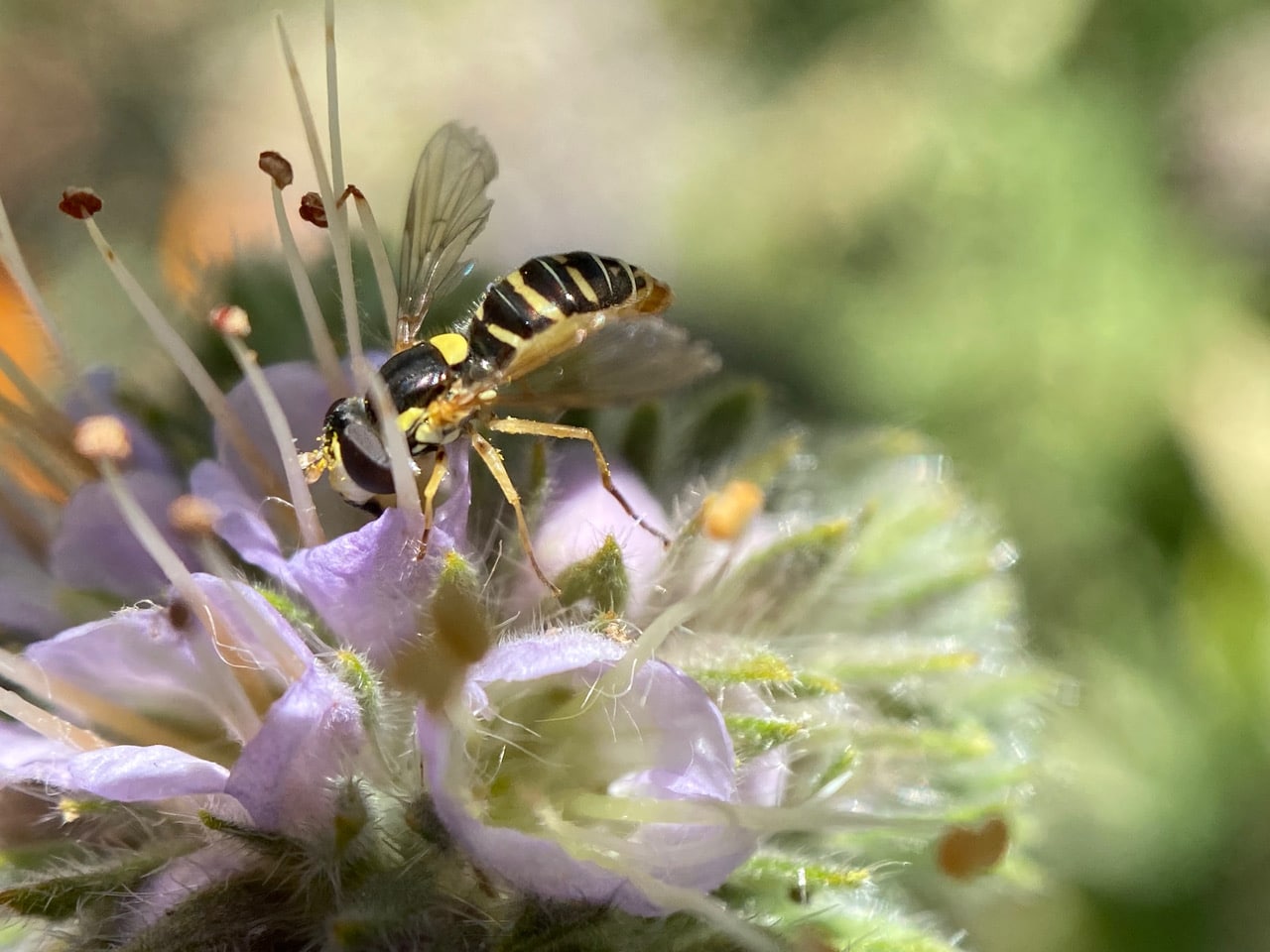
This tiny hoverfly, the Diamond Spottail, Fazia micrura (family Syrphidae) sure had me fooled. As it came in for landing on the Phacelia flowers, it had its wings spread and lifted high, just like a wasp would. With the yellow-and-black banding on its abdomen, the resemblance to a potter wasp is uncanny. Eager for a photo of a potter wasp, I am disappointed to find a hoverfly instead at the other end of the macro lens.
Hoverflies are excellent examples of Batesian mimicry (named after H.W. Bates who first described it in 1862). They generally mimic bees and wasps – insects that sting and also taste unpleasant, so are avoided by predators. Hoverflies are completely harmless; adults generally visit flowers for nectar and pollen, and are effective pollinators.
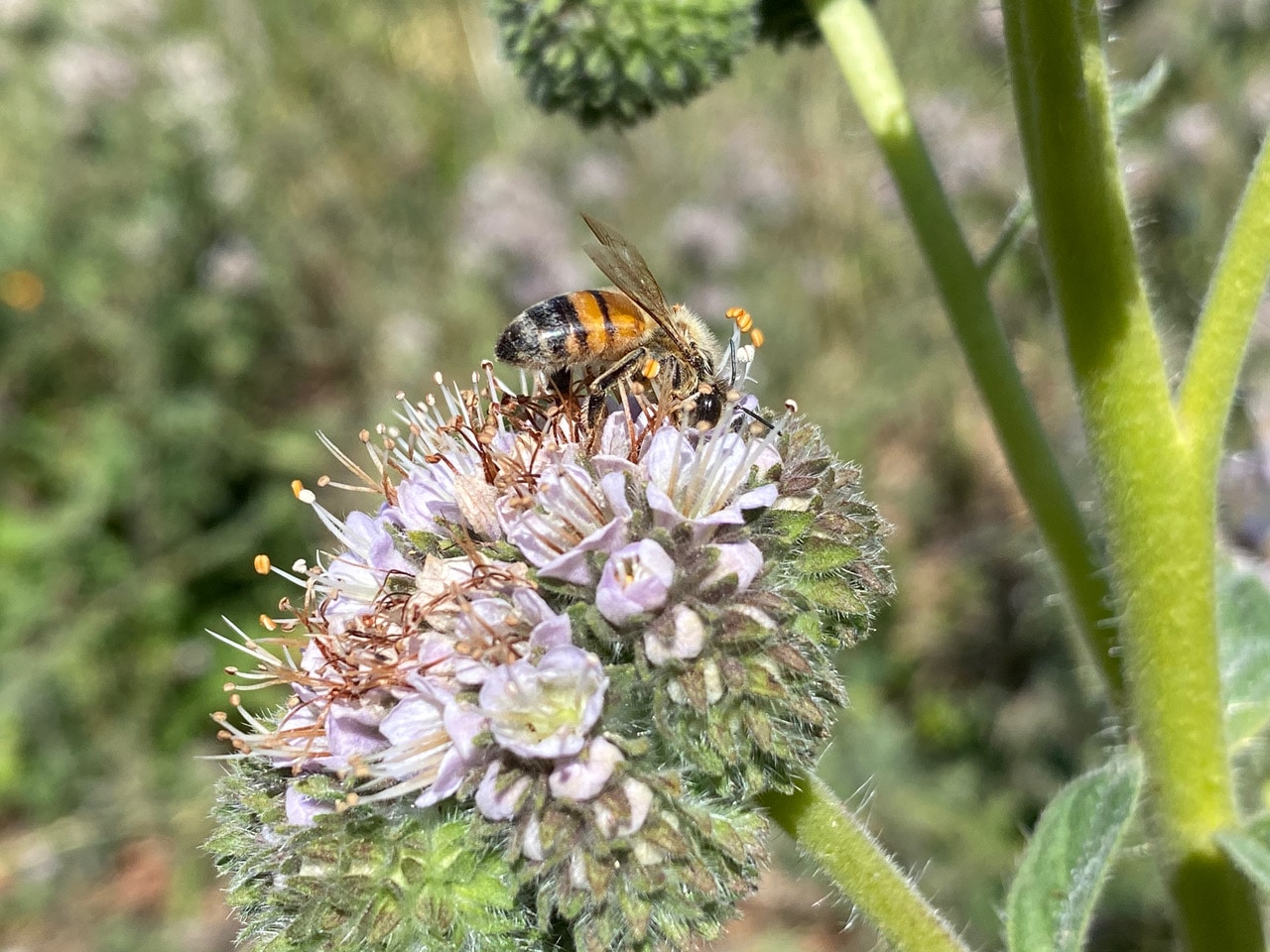
A Honey Bee, Apis mellifera (family Apidae) is taking nectar from Phacelia flowers. While slow in appearing this spring, their numbers are increasing nicely.
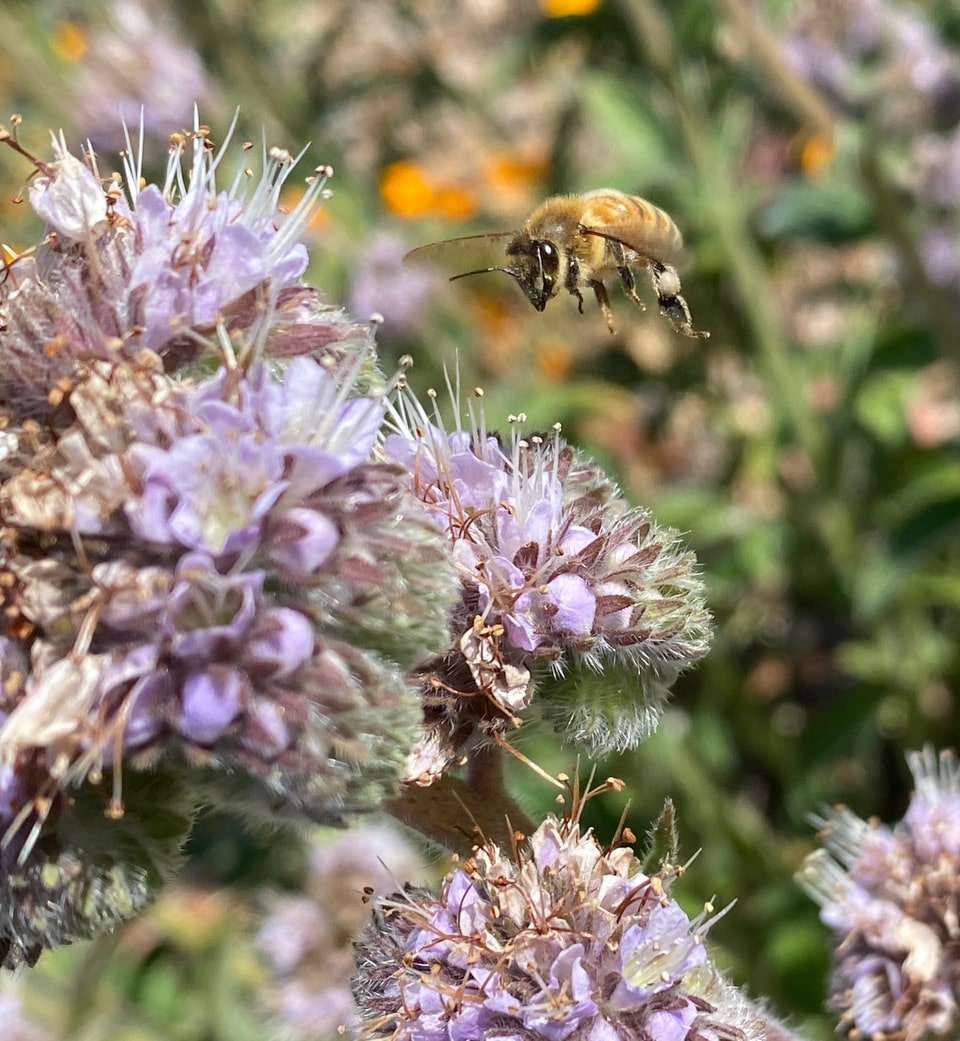
This Honey Bee has been collecting Phacelia pollen. Note the dirty white-colored pollen in her pollen basket.

While California Poppy, Eschscholzia californica is blooming in masses now, few insects seem to be visiting the flowers. I am happy to see a Yellow-faced Bumble Bee, Bombus vosnesenskii land on a poppy flower. The only reason for her visit is to gather pollen. Poppy flowers do not produce nectar.
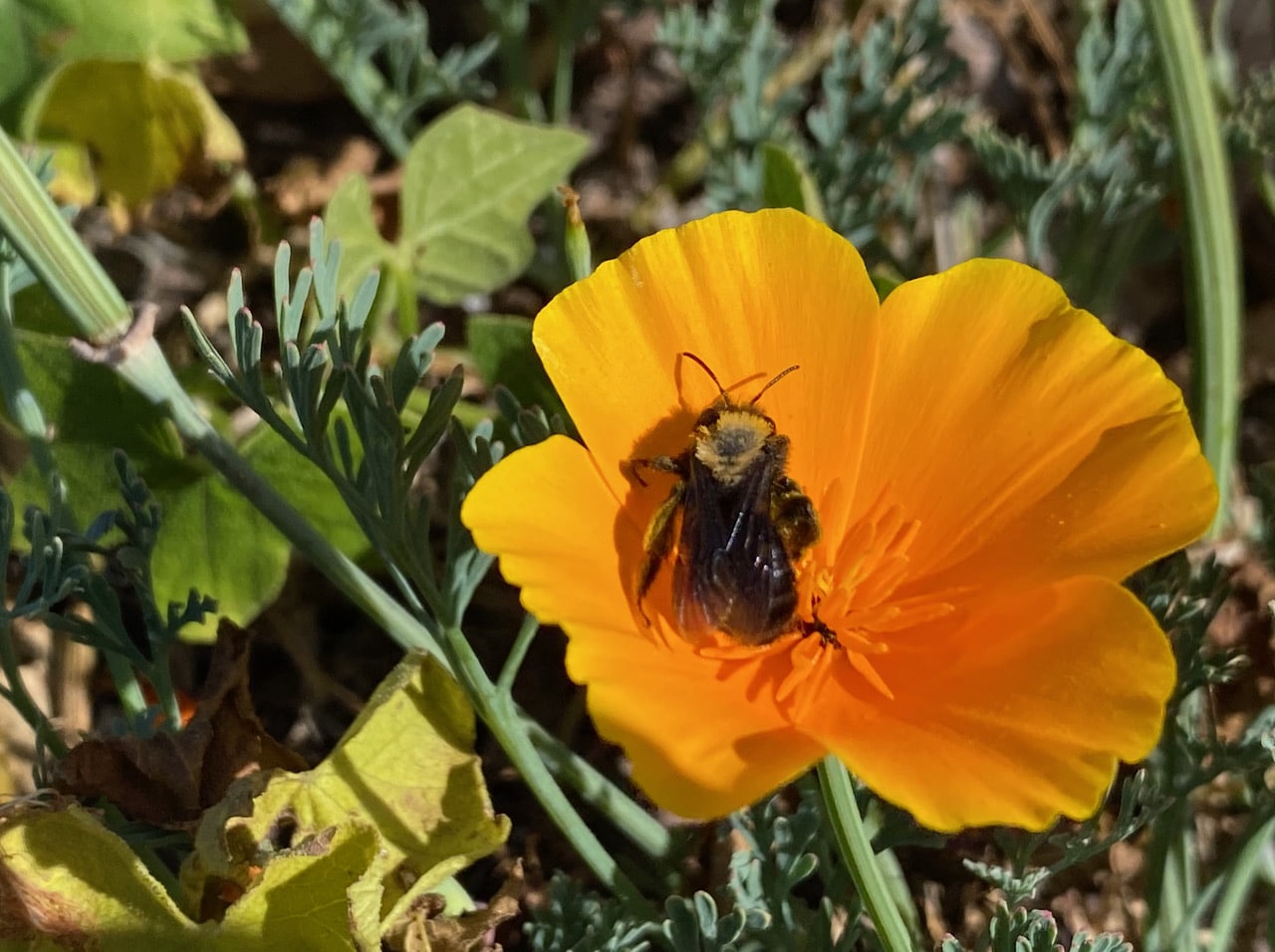
Another, smaller bee is visiting the California Poppy flowers. It has a black abdomen, and beige-colored hairs on its thorax.
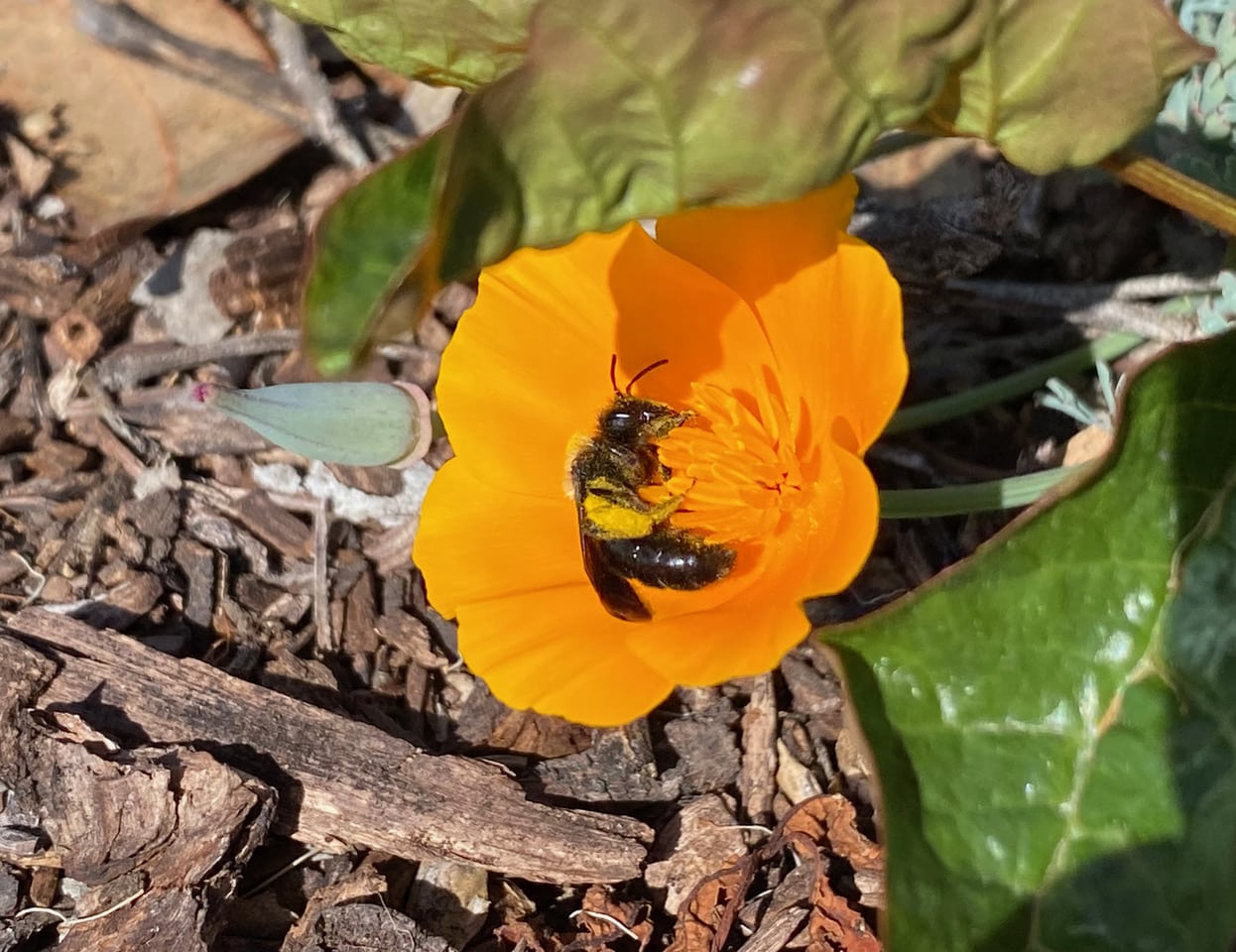
It is a Mining Bee in the genus Andrena (family Andrenidae).
Andrenidae is the largest of all bee families, with more than 4500 species in more than 40 genera. These bees are found worldwide, mostly in the western hemisphere. Sometimes called mining bees, Andrenidae nest in the ground. All Andrenidae line their nests with a waterproof substance secreted by the famale to protect her young from soil moisture and soil bacteria.
Andrena is one of the largest bee genera in the world. The floral preferences of Andrena species span the range of bee diets; some are broad generalists, and a number are strict specialists. Andrena are among the first bees to fly in the spring; their ability to withstand the chill is still a puzzle to scientists. The bees can’t fly until their body temperatures reach 50-60 F. They rely on the warmth of the sun to get them to speed, and it is not uncommon to see them warming up on leaves or rocks. This cold-hardiness makes Andrena excellent pollinators of early spring wildflowers and cultivated crops.

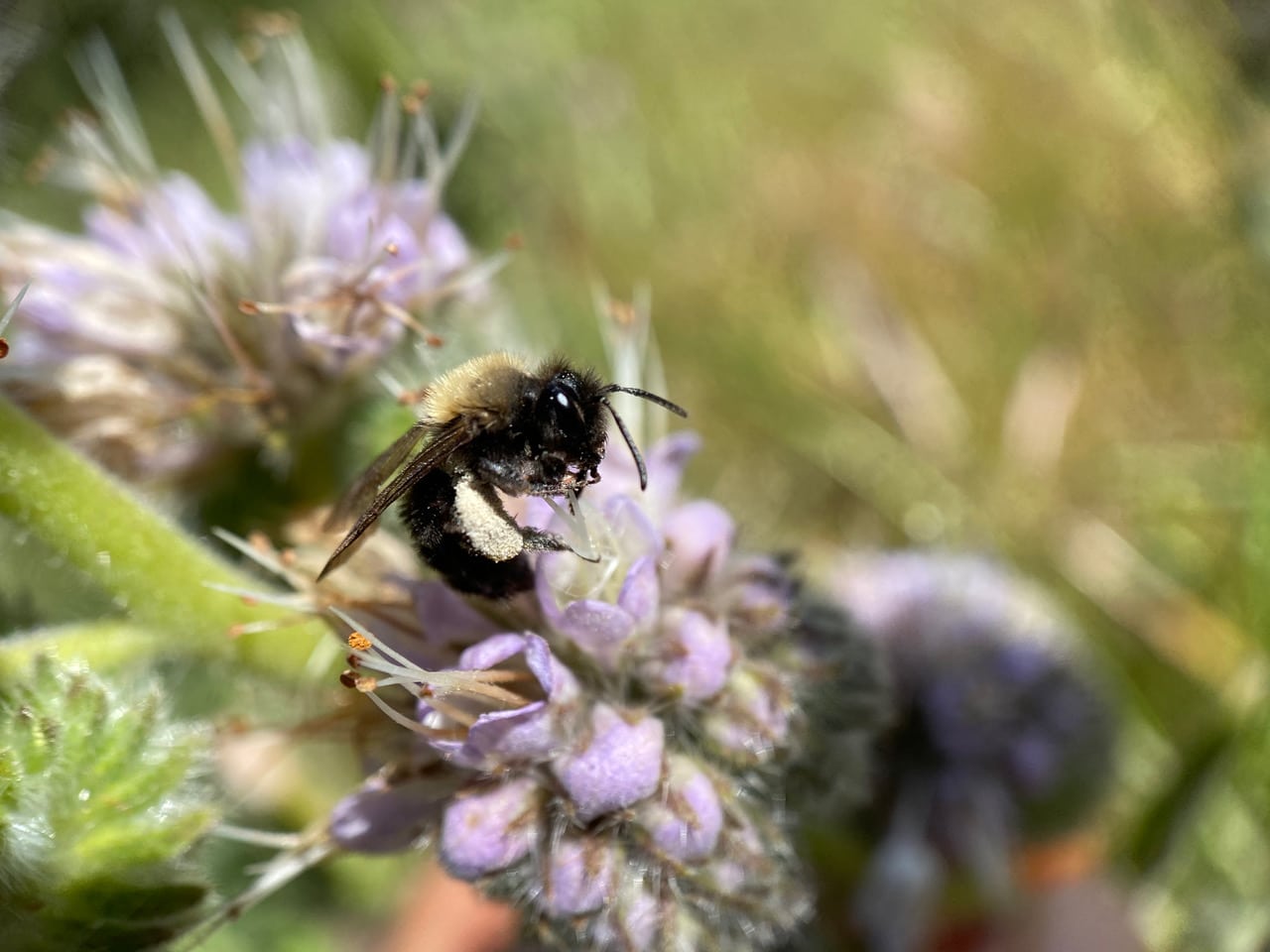
This smaller bee is another Andrena. She is patiently gathering pollen from California Phacelia flowers, one anther at a time.
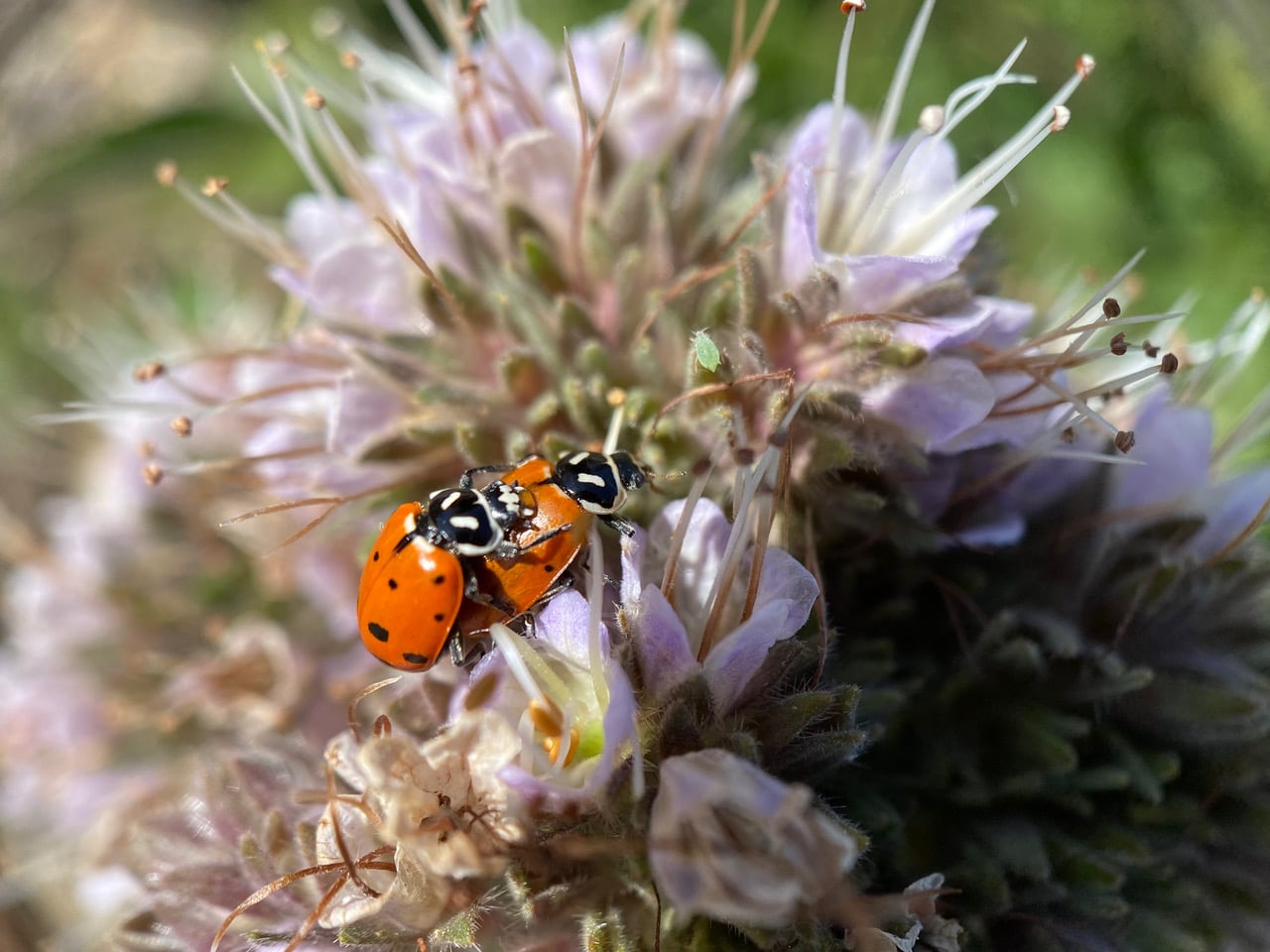
Aww, a pair of Convergent Ladybeetles, Hippodamia convergens (family Coccinelidae) is mating on an inflorescence of California Phacelia. When I took this picture, I didn’t even notice the green aphid. A good place for the ladybeetles – they are voracious predators of aphids.

A Variable Checkerspot butterfly, Euphydryas chalcedona (family Nymphalidae) stops for a sip of nectar from California Phacelia.
The Variable Checkerspot is found across western North America. The butterfly occupies a wide range of habitats, including sagebrush flats, desert hills, prairies, open forests and alpine tundra. Males perch or patrol around larval host plants to encounter females. Eggs are laid in large groups on underside of leaves of host plants. Host plants include California Bee Plant, Scrophularia californica, and Sticky Monkeyflower, Diplacus aurantiacus. These plants provide the caterpillars with iridoid glycoside, a chemical that imparts unpalatable taste to birds, protecting the caterpillars from predators. Larvae feed in large, loose groups on the host plants. They enter diapause (hibernation) in sheltered sites under bark or dead branches, in hollow stems and in rock crevices. Pupation begins in early to mid April and the adult flight season begins between mid-April and May and continues into June. The adults feed exclusively on nectar, and have a life span of about 15 days.

A white foamy mass has appeared below an inflorescence of California Phacelia. Aah, its Spittlebug season again!
The foam mass is made by a nymph of a bug called the Froghopper (family Cercopidae). Like the adults, the nymphs use their piercing, sucking mouthparts to feed on plant juices. The nymph produces a cover of foamed-up plant sap reminiscent of saliva, hence the common name of spittlebug. Whereas most insects that feed on sap feed on the nutrient-rich fluid from the phloem, Cercopidae tap into the much more dilute sap flowing upward via the xylem. The large amount of excess water that must be excreted and the evolution of special breathing tubes allow the young spittlebug nymphs to grow in the relatively protective environment of the spittle. Symbiotic bacteria in the insects’ digestive system provides them with the essential amino acids that their diet lacks. The foam serves a number of purposes. It hides the nymph from the view of predators and parasites, and it insulates against heat and cold, and protects the delicate nymphs from desiccation. Moreover, the foam has an acrid taste that deters predators.