

Pollinator Post 5/24/23
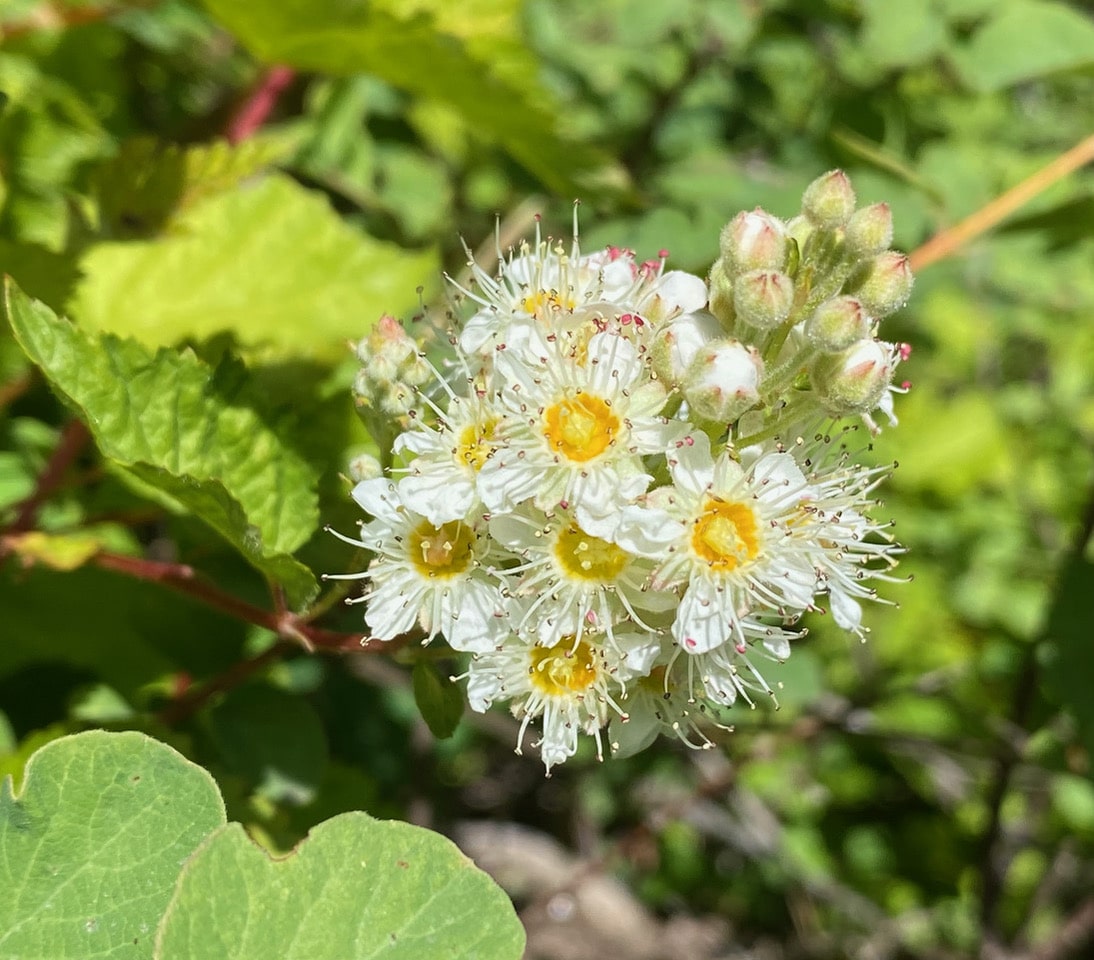
In shady, moist locations along Skyline Trail near the Siesta Gate, the Pacific Ninebark, Physocarpus capitatus has started to bloom. The dense deciduous shrub in the rose family is native to western North America. The plant produces ball-like clusters of small white flowers with five petals and numerous red-tipped stamens.
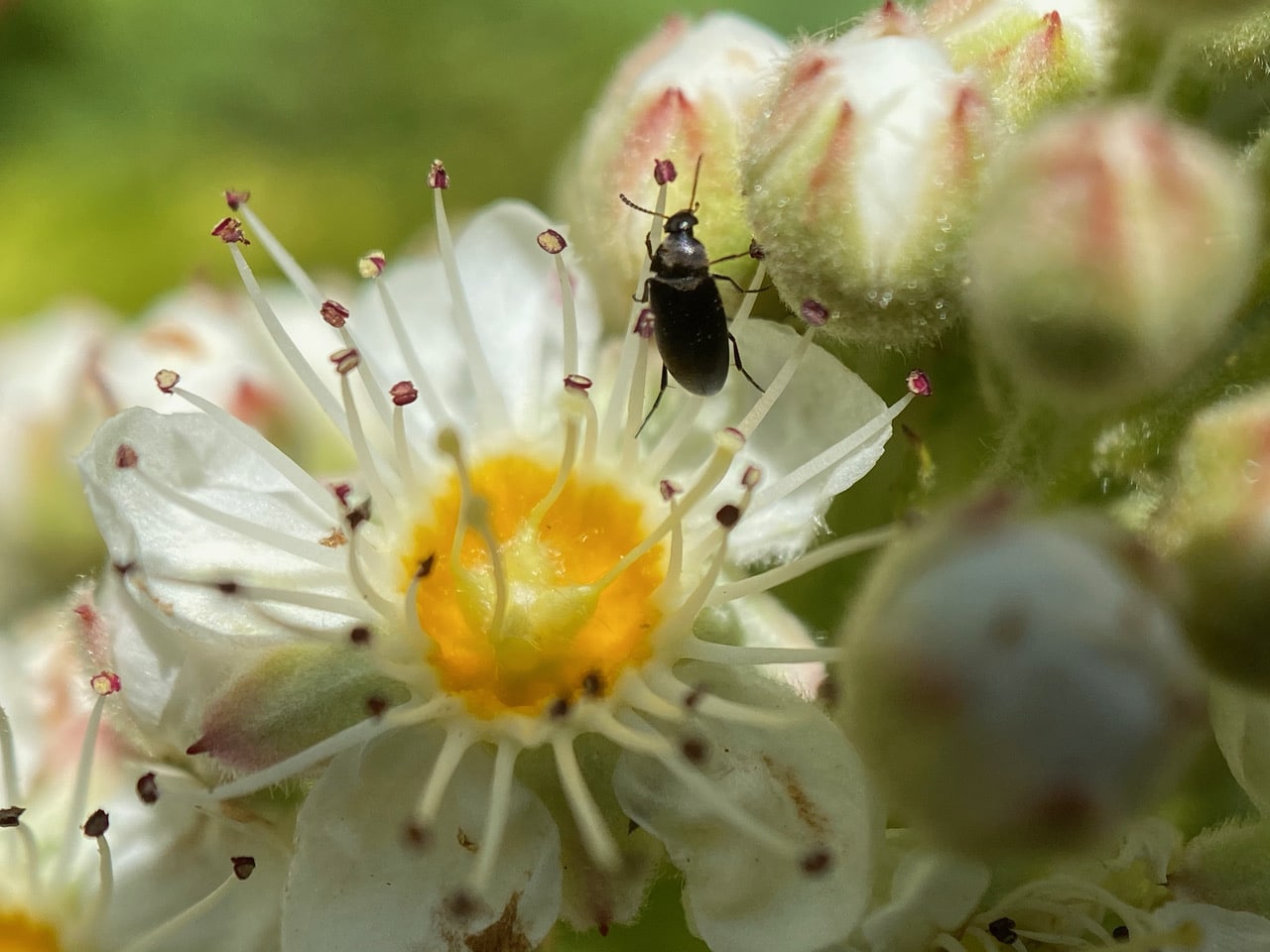
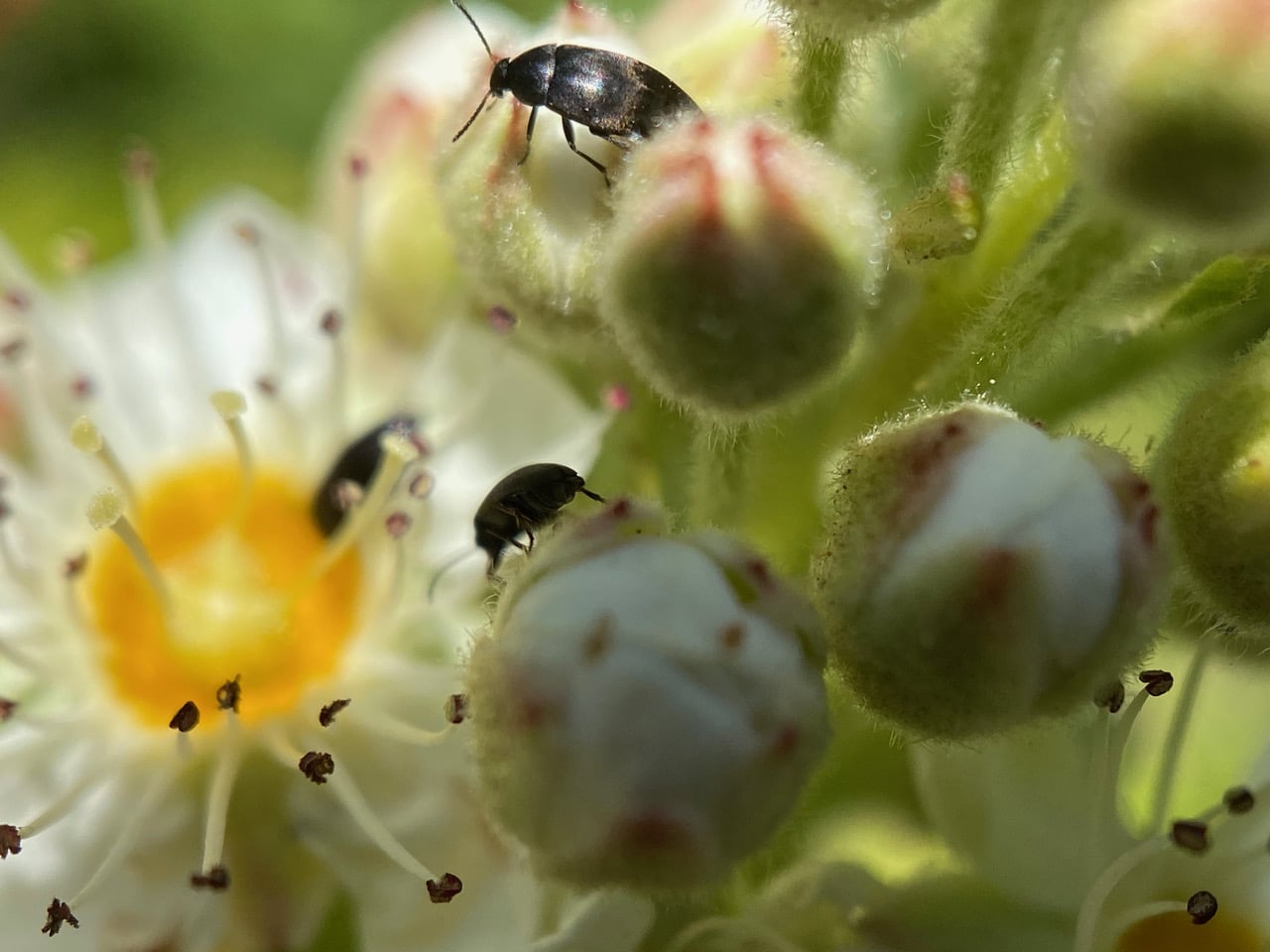
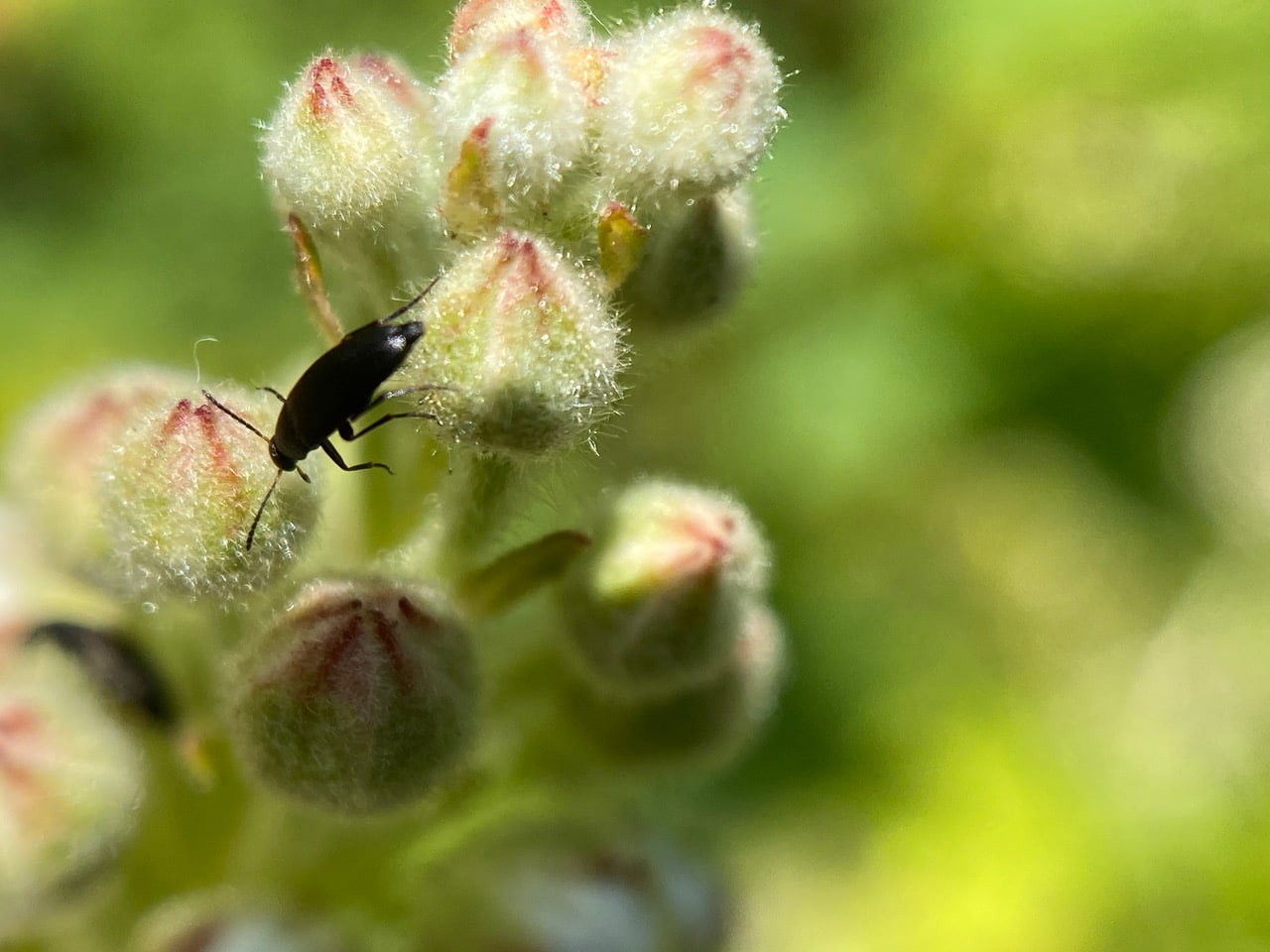
There are small black beetles crawling over the flowers, feeding on pollen. These are False Flower Beetles, Anaspis atrata (family Scraptiidae), commonly found in western North America. The adults are found on flowers, sometimes in large numbers, but are also found on foliage. The larvae are typically found under the bark of dead trees.
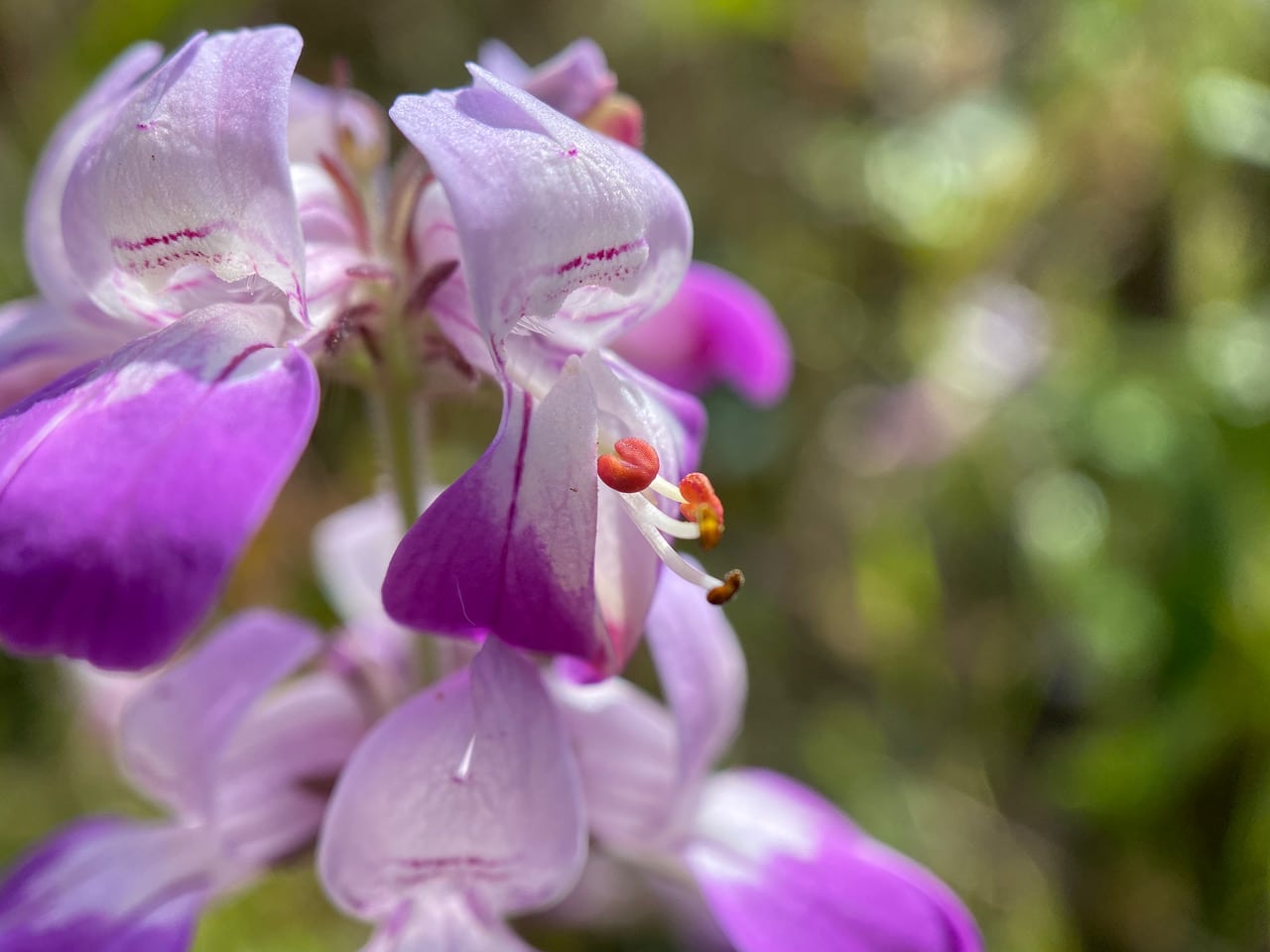

I am delighted to come across several “tripped” flowers on the Chinese Houses, Collinsia heterophylla. Thanks to the visiting bumble bees, some of the flowers are eviscerated, with the reproductive structures extruded from the keel and visible between the wing petals. Note that two of the anthers shown here, the red ones, have not even dehisced to release their pollen.
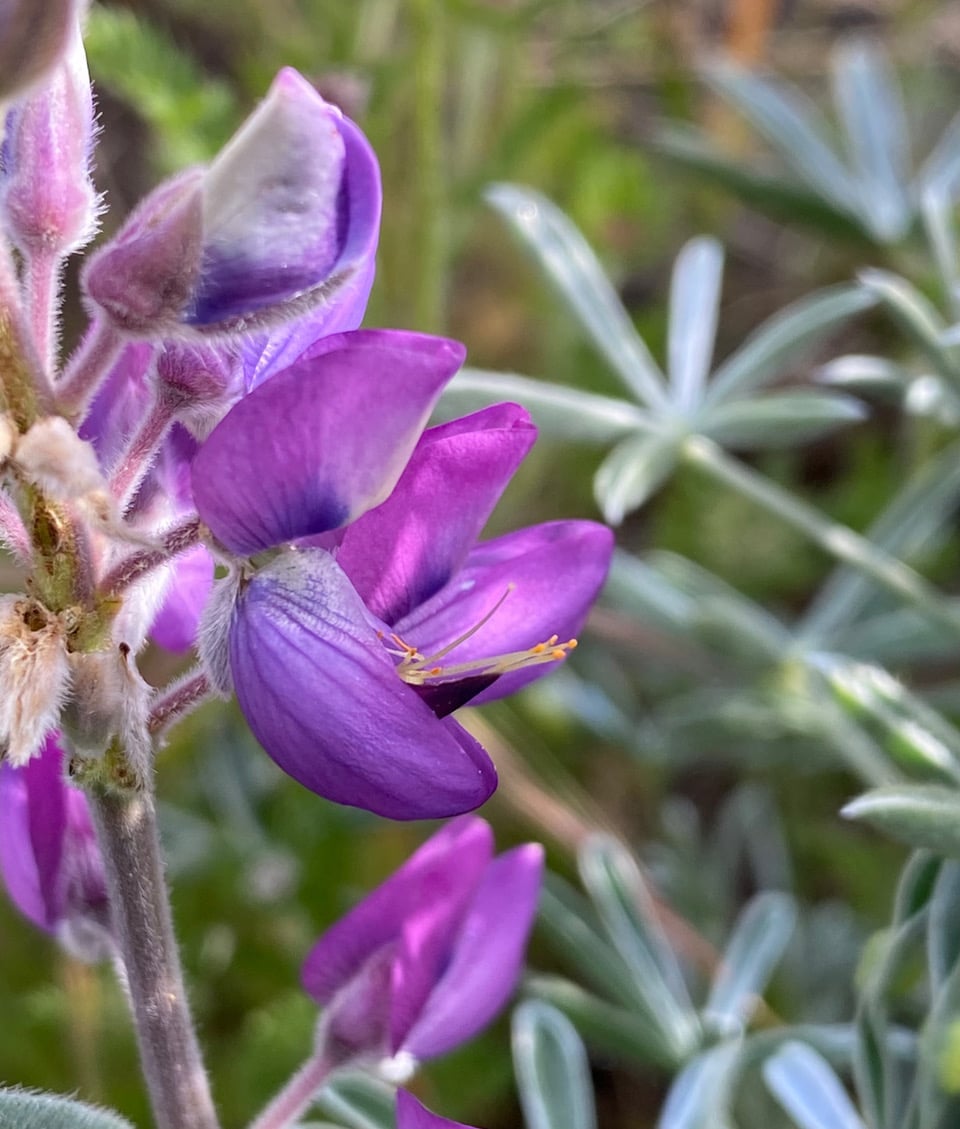
Further along Skyline Trail, I meet the familiar Silverleaf Lupine, Lupinus albifrons coming to the end of their bloom. Many of their flowers are also “tripped”, mainly by bumble bees. Shown here is a flower with the dark-tipped keel, pollen-tipped stamens and single stigma extruded. Happily, pollination has occurred, to be followed soon by the appearance of a pea pod.
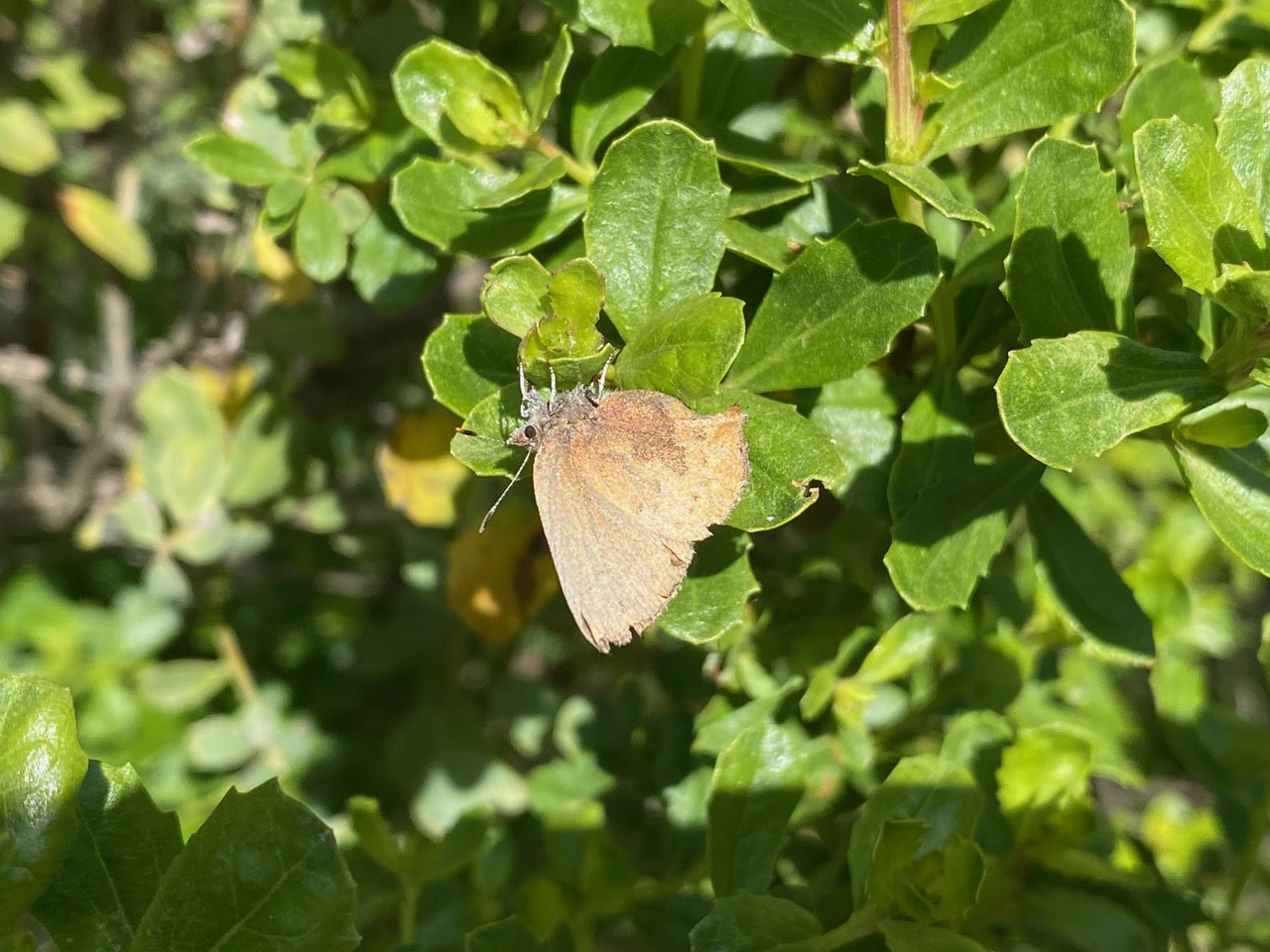
A Brown Elfin, Callophrys augustinus (family Lycaenidae) lands upside-down on Coyote Brush foliage.
Males perch on shrubs in open areas to watch for females. Eggs are laid singly on flower buds of host plants – members of the Ericaceae family such as madrone, manzanita and huckleberry. Caterpillars will also feed on dodder. Caterpillars feed on flowers and fruits. Pupation takes place in litter at the base of host plants. Chrysalids hibernate. Adults are on wing early April to mid June.
For some unknown reason, the Brown Elfin turns around to face the opposite direction. This is when I realize that its left hind wing has been damaged. It appears a bird might have taken a bite out of the corner of that wing. The butterfly is lucky to have escaped with its life!
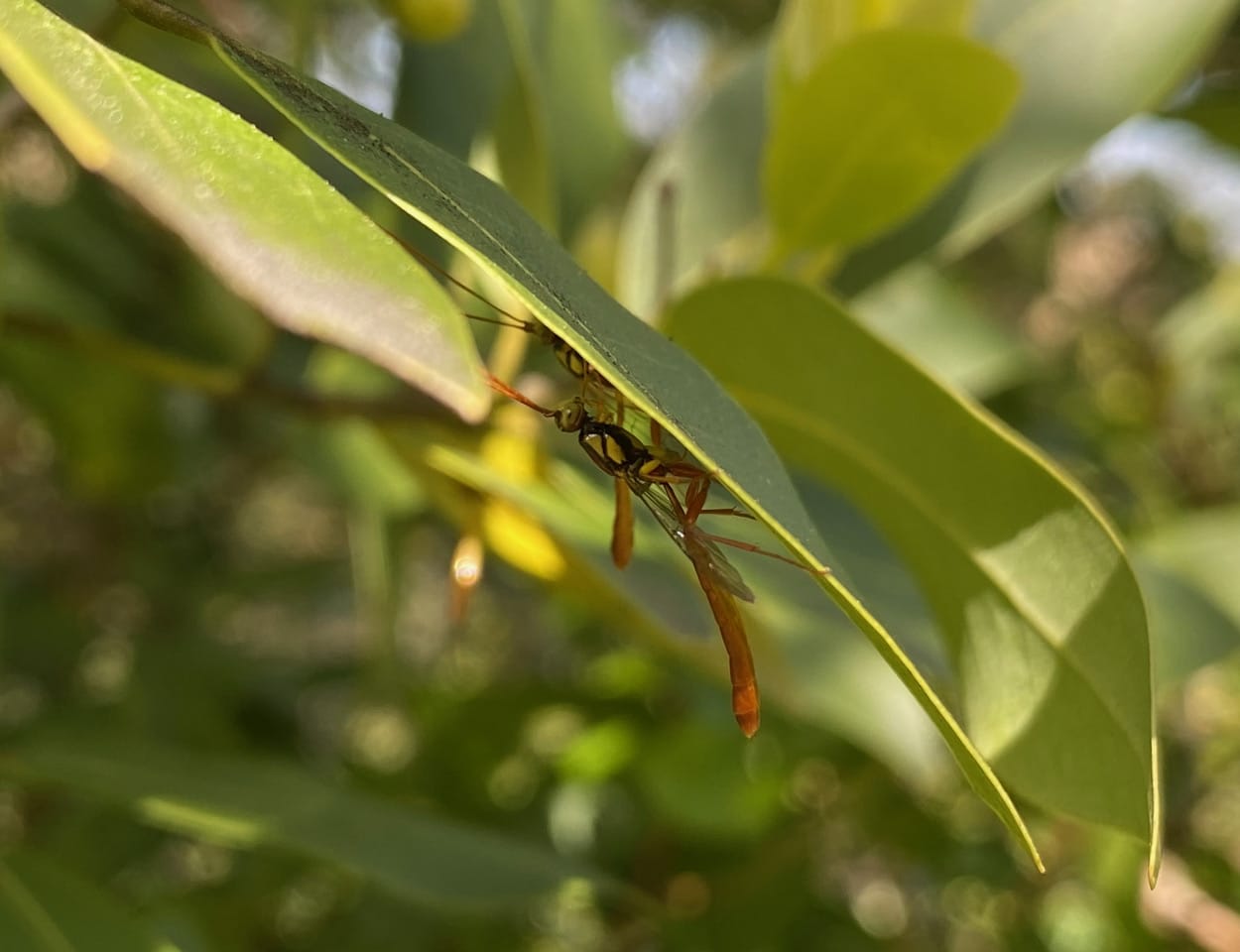
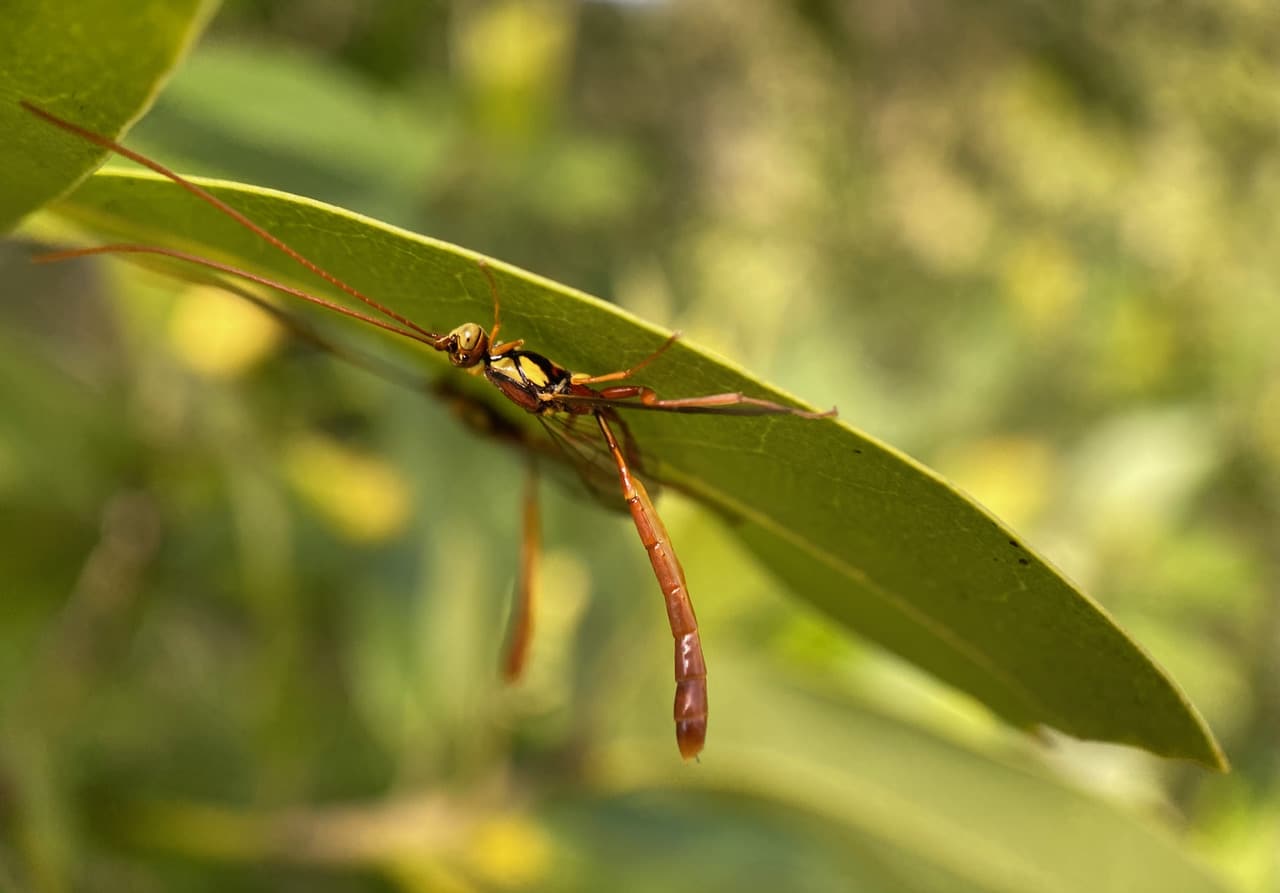
A slender orange insect with very long legs flies in a slow, bobbing manner around the foliage along Skyline Trail. It finally disappears into a Bay Tree. I look for it where it has disappeared and miraculously locate it in the shadows, perched upside-down under a Bay leaf. Behind it is an identical insect, similarly perched. What is going on? A romantic rendezvous?
Desperate for a better look, I lift the branch and angle it into the light, and just manage to take one quick picture before both wasps fly away. Wow, everything about the wasp is elongated – the antennae, the abdomen and the legs. iNaturalist has helped to identify the wasp as an Ichneumon Wasp, Grotea californica (family Ichneumonidae).
The Ichneumonidae, also known as the Ichneumon Wasps, or Ichneumonids, are a family of parasitoid wasps. They are one of the most diverse groups within the Hymenoptera (the order that includes the ants, wasps and bees) with about 25,000 species and counting. Ichneumon Wasps attack the immature stages of insects and spiders, eventually killing their hosts. They play an important role in the ecosystem as regulators of insect populations.
The Ichneumon Wasps have longer antennae than typical wasps, with 16 segments or more as opposed to 13 or fewer. Ichneumonid females have an unmodified ovipositor for laying eggs. They generally inject eggs either directly into their host’s body or onto its surface, and the process may require penetration of wood. After hatching, the Ichneumonid larva consumes its still living host. The most common hosts are larvae or pupae of Lepidoptera (butterflies and moths), Coleoptera (beetles) and Hymenoptera. Adult Ichneumonids feed on plant sap and nectar. Females spend much of their active time searching for hosts while the males are constantly on the look out for females. Many Ichneumonids are associated with specific prey, and Ichneumonids are considered effective biological controls of some pest species.
OK, here’s what we are all waiting to find out: Whom does this wasp parasitize? The larvae of Grotea californica are known to parasitize bees in the genus Ceratina (Small Carpenter Bees)!
It is noteworthy that I encountered the Grotea on the same stretch of Skyline Trail where I have been photographing numerous Ceratina bees yesterday on the flowers of Sticky Cinquefoil. The plot thickens!
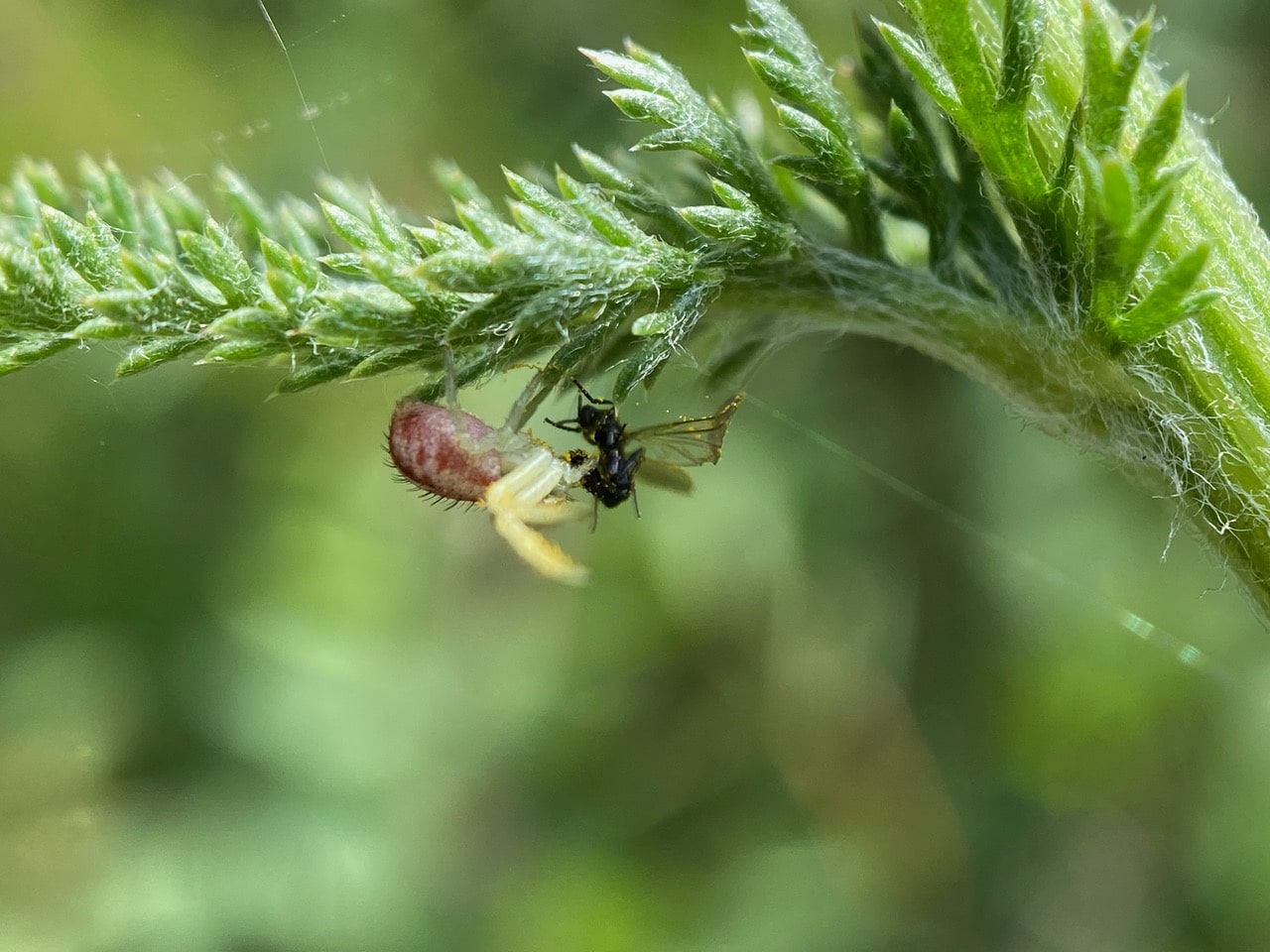
A tiny Crab Spider, Mecaphesa sp. (family Thomisidae) is feeding on a black insect on an inflorescence of Yarrow, Achillea millefolium. When I approach with the camera, the spider quickly runs to the edge of the inflorescence and rappels down on a strand of silk, its prey firmly held in its jaws. It lands on the stem and quickly finds shelter under a leaf to continue feeding on its prey. Although Crab Spiders do not build webs for catching prey, they do have other uses for silk. Females also wrap their eggs in silken sacs.
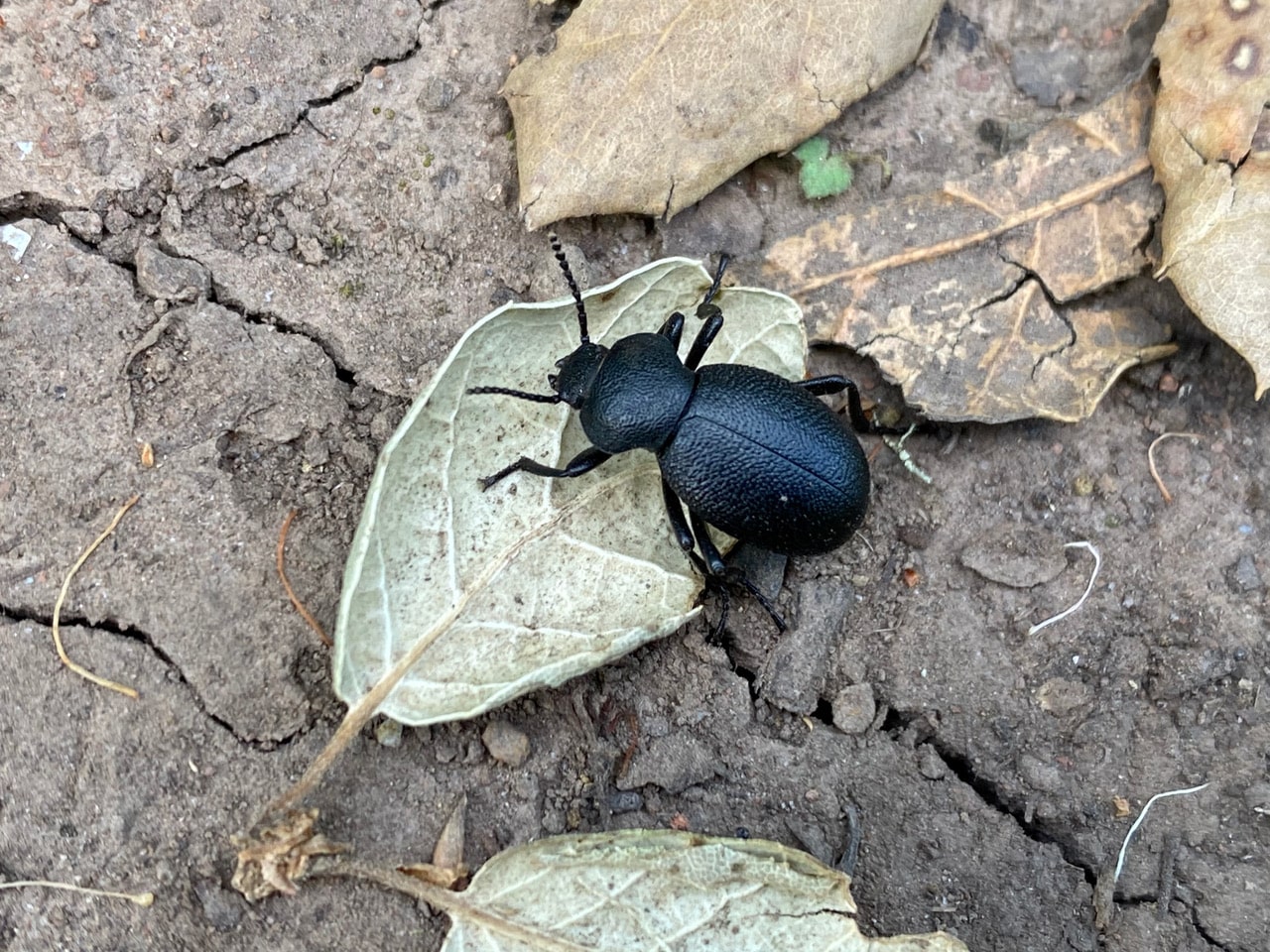
Ooh, a big black beetle is trundling across the trail! It is a Darkling Beetle, Eleodes cordata (family Tenebrionidae).
Darkling Beetles are abundant in both diversity and numbers in the western United States, especially in the deserts. The beetles are often found under logs and in other detritus. They primarily feed on detritus of grasses and forbs. They are best known for their comical, yet effective defense tactics. When alarmed, they lift their rear ends skyward by bending their front legs and extending their rear legs. They spray a reddish brown exudate, an oily, stinky secretion. Most animals know to avoid contact with the Darkling Beetles. The larger species can spray a distance of 10-20 inches, and some can spray multiple times if necessary.
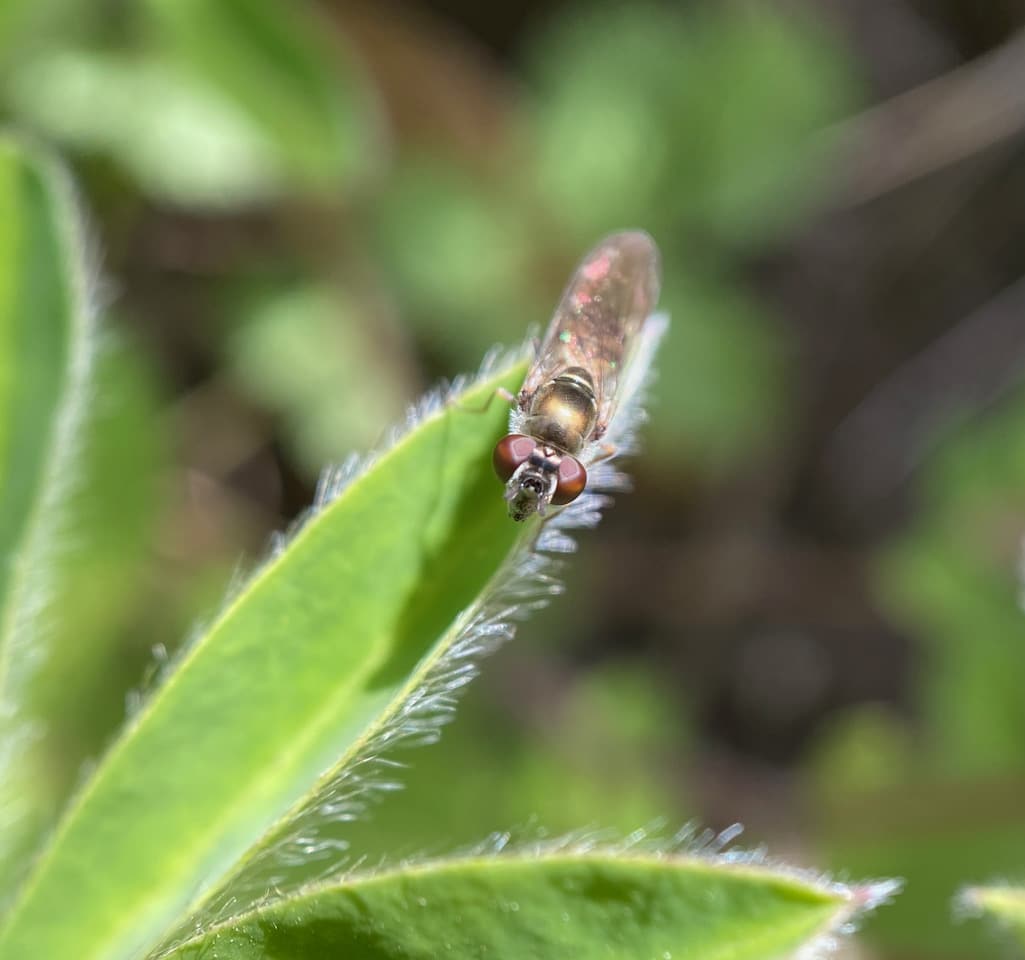
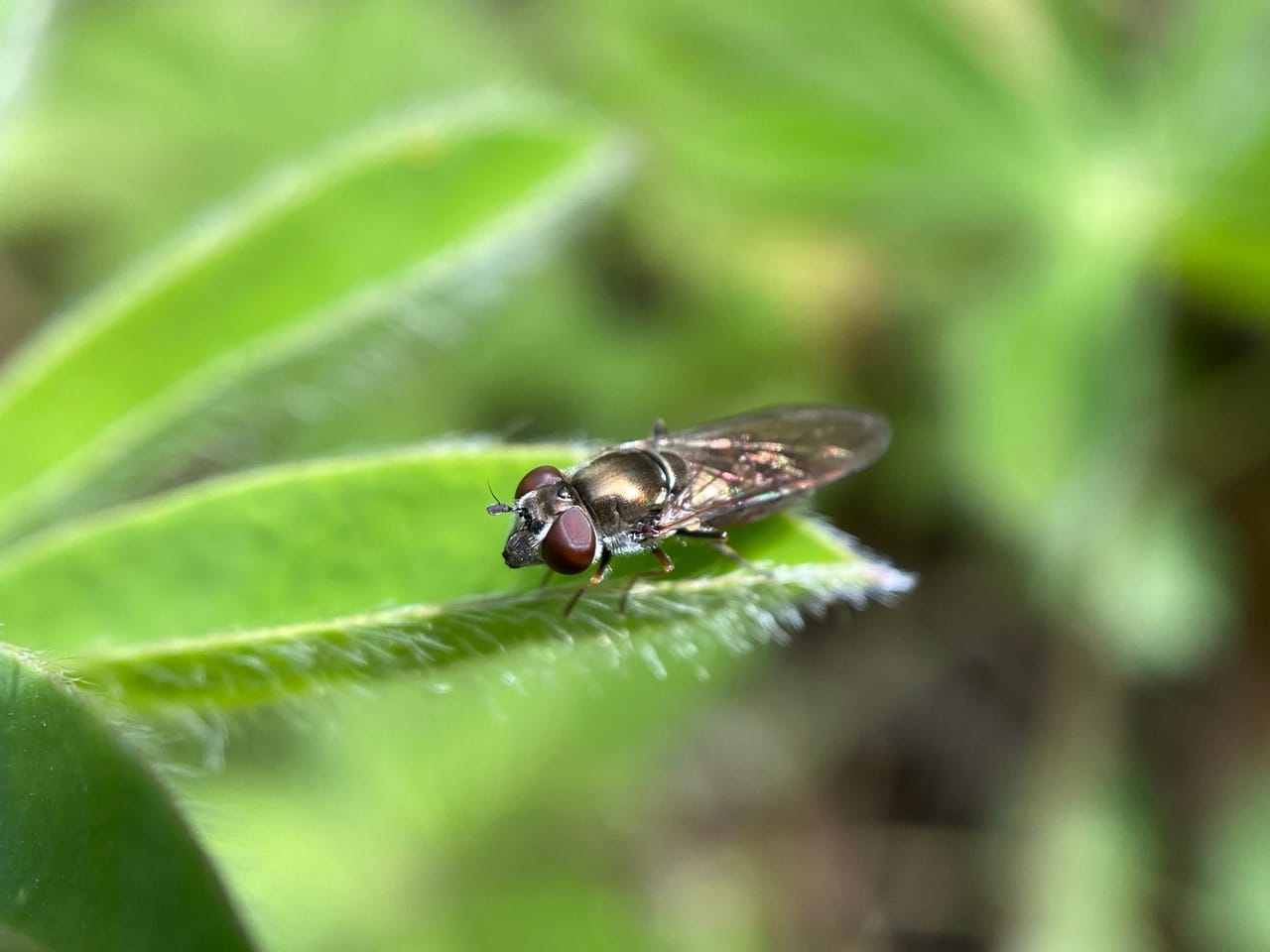
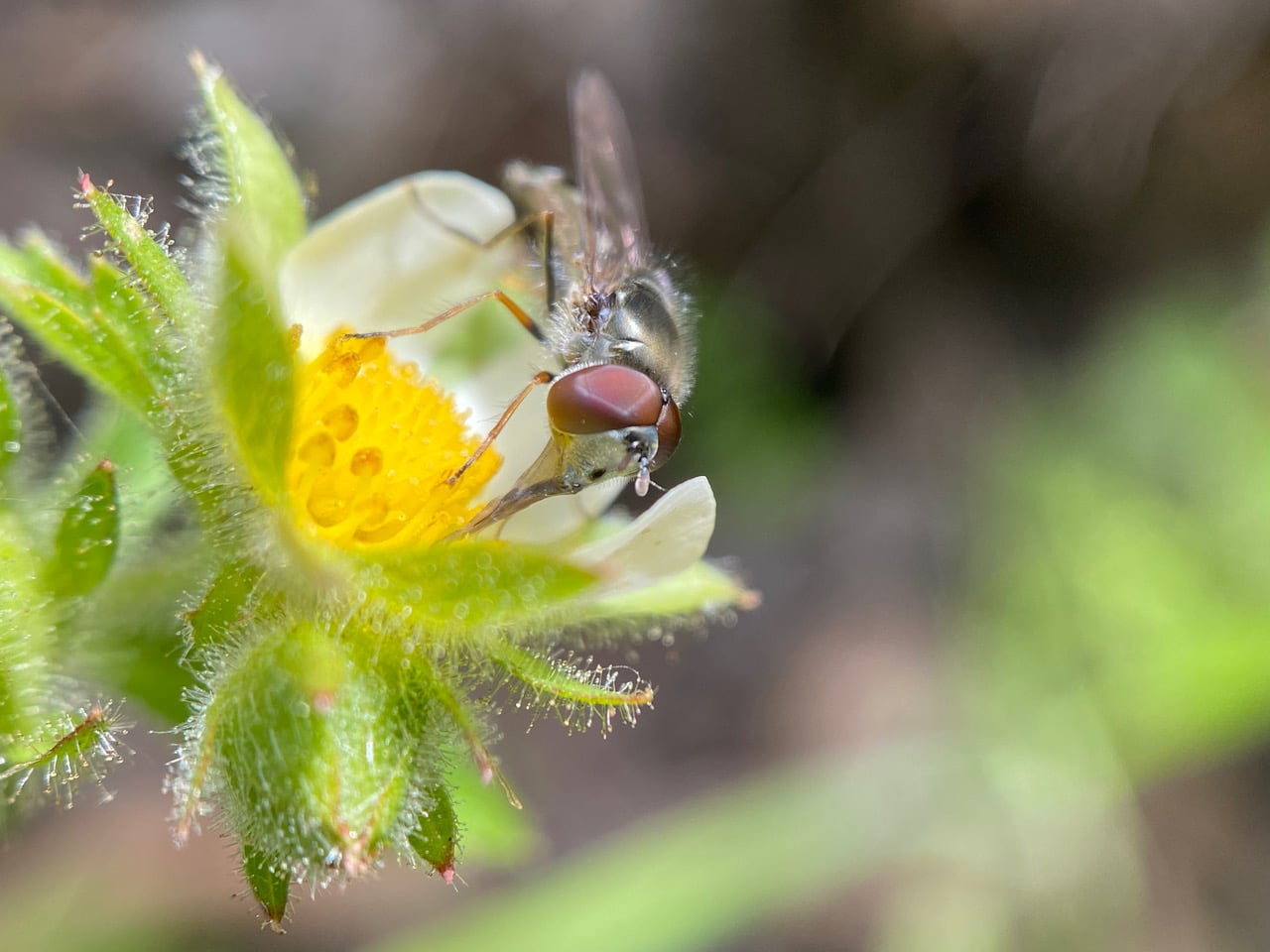
The hoverfly called the Sedgesitter, Platycheirus sp. (family Syrphidae) is one of the most difficult insects to photograph because of its metallic reflectiveness. For me, the insect often appears as a dark smudge in the photo. Strangely the low angle light this afternoon offers unexpected advantage. This female Sedgesitter is also very cooperative, sitting quietly on a leaf of Broadleaf Lupine,
I am delighted to see her ocelli, three little bumps in a triangle on top of her head between her large compound eyes!
Many insects have two kinds of eyes – simple and compound. Simple eyes – ocelli (singular – “ocellus”) are “stand-alone” eyes made up of a single lens. They detect motion and light (including UV light) but do not form images. Ocelli help the insect orient in flight, enabling it to find the direction they want to go, relative to the sun.
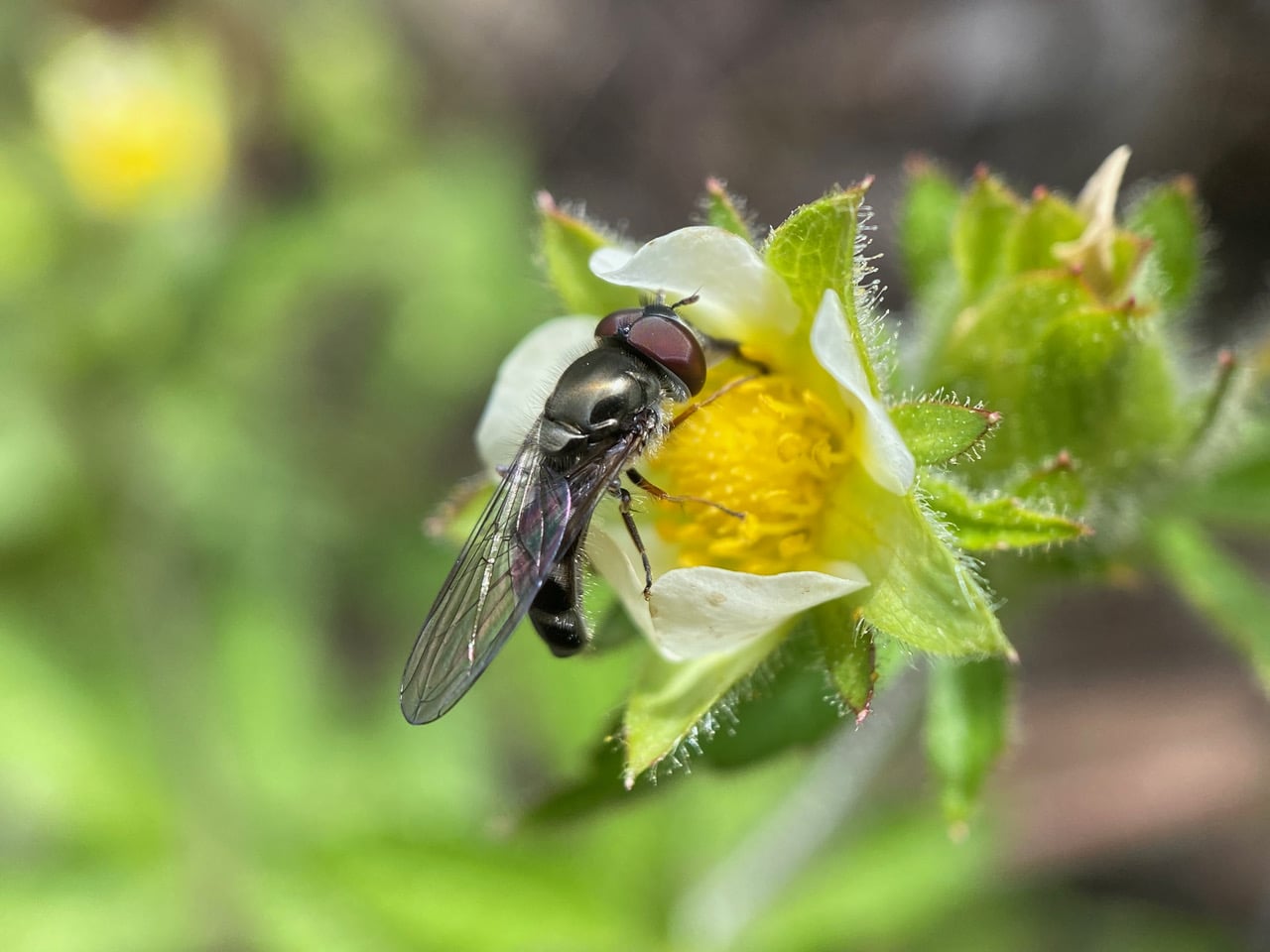
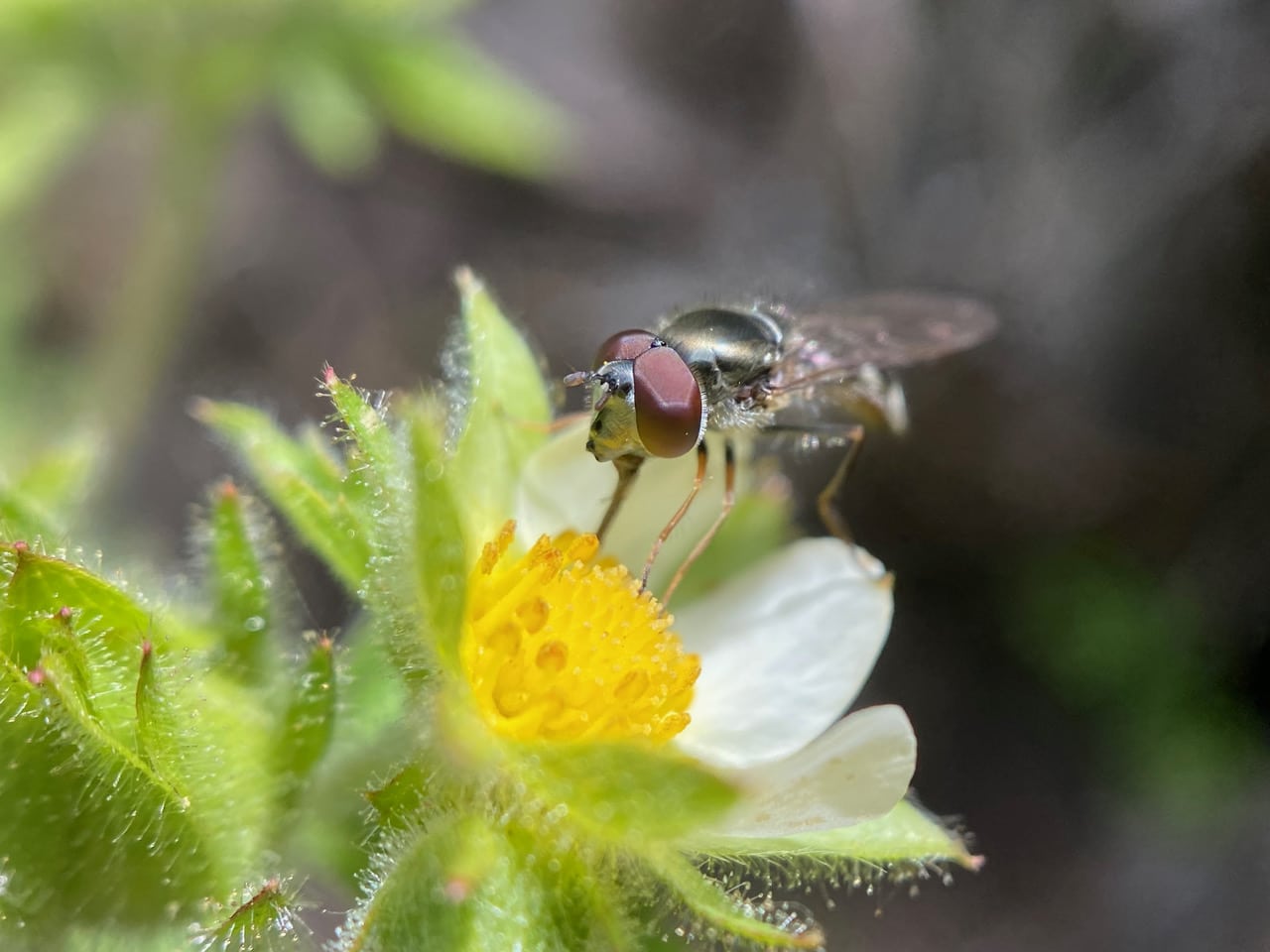
No more than two feet away, a male Sedgesitter, Platycheirus sp. is foraging on a flower of Sticky Cinquefoil, Drymocallis glandulosa. His ocelli are also visible, in the tight space between his large compound eyes that meet along a central line on top of his head. These holoptic compound eyes allow “wrap-around” vision for the males of many hoverflies.
Compound eyes are essentially a bundle of narrow, wedge-shaped tubes called ommatidia (seen on the surface as facets), each with a lens/cornea and photoreceptors. As with human eyes, information from each eye is resolved into a single image in the brain.
Wow, the Sedgesitter appears silvery in this light. What strange optical properties its exoskeleton has!
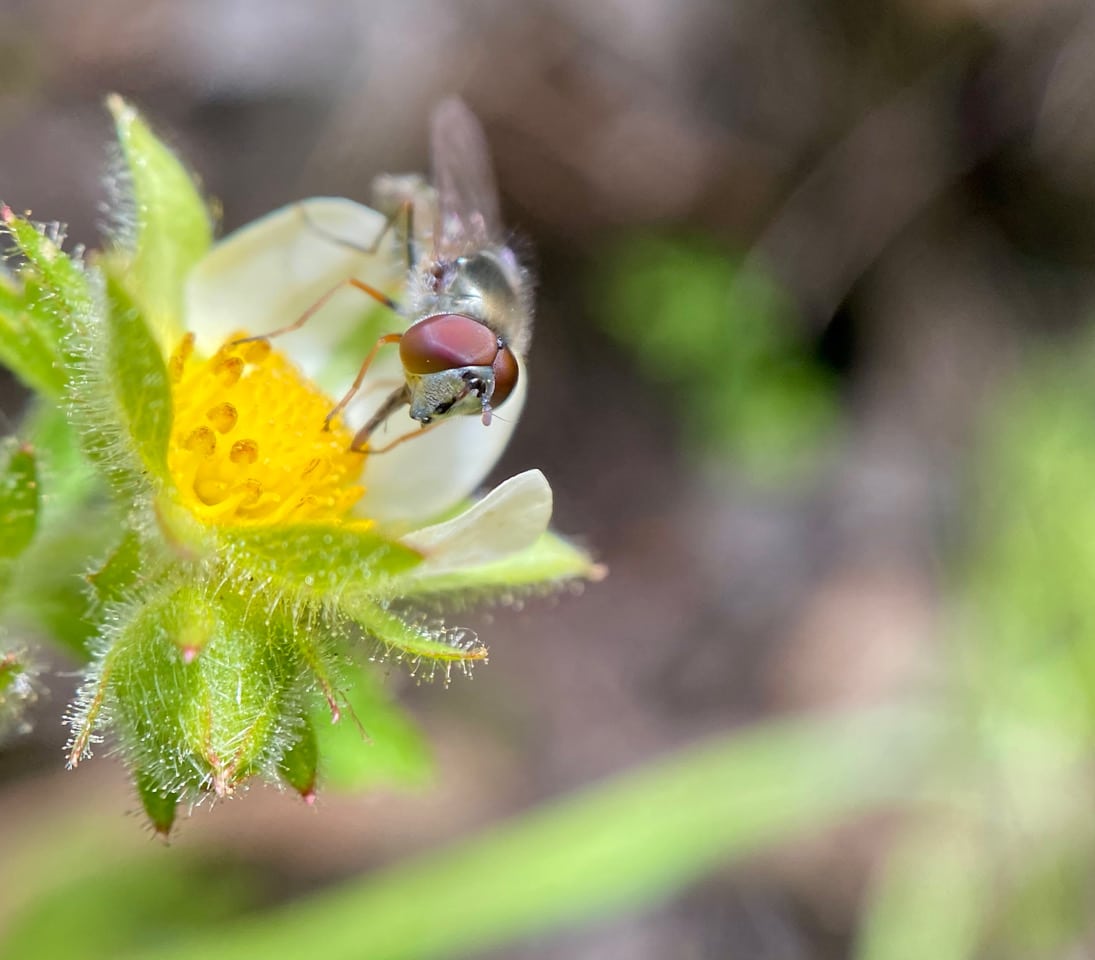
It is fascinating to watch the hoverfly feed in extremely close range. The fly seems to extend and move its proboscis back and forth within a thin, translucent membrane under its head.
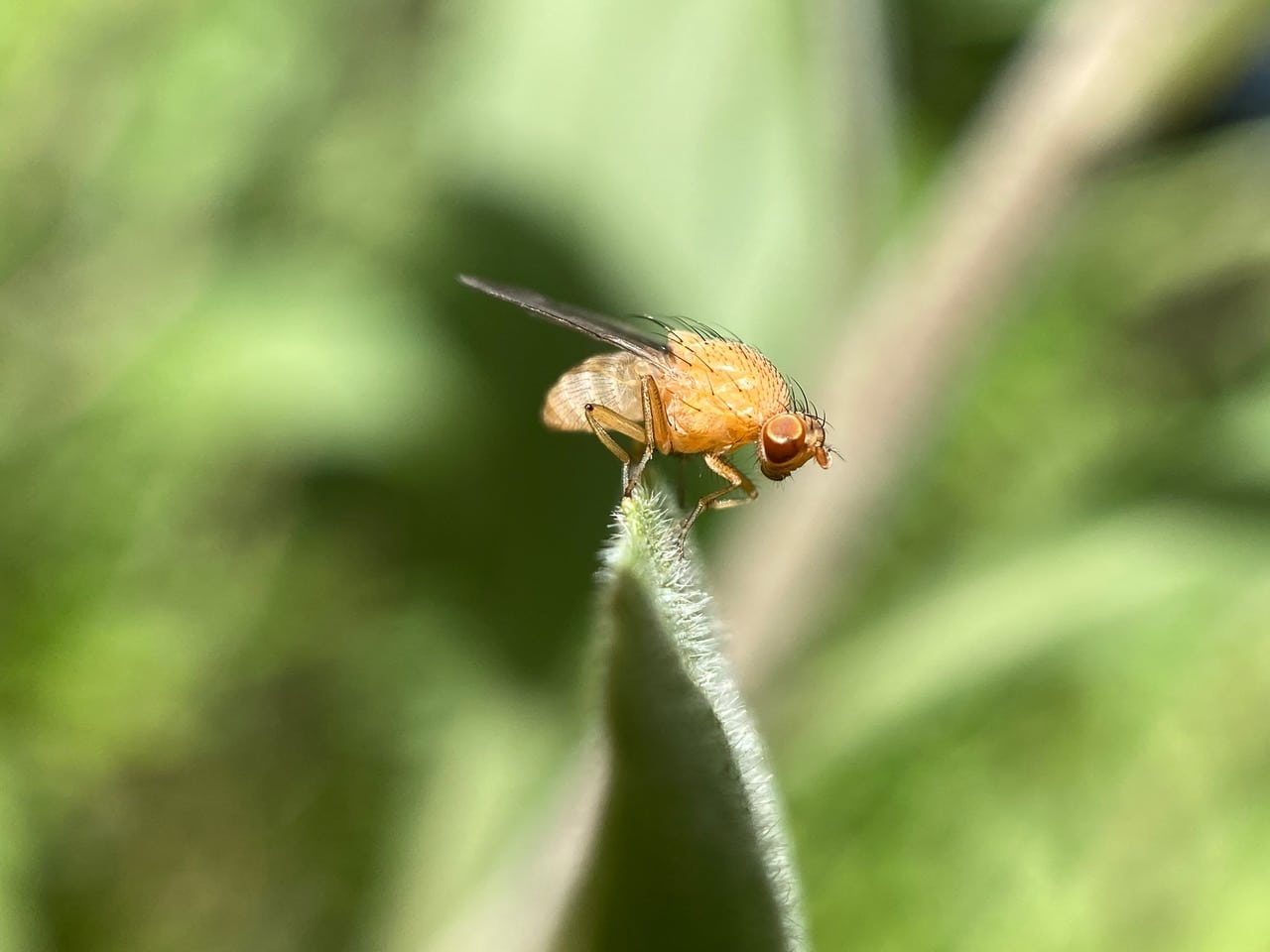
A small fly, Homoneura sp. (family Lauxaniidae) is perched on the tip of an erect Goldenrod leaf.
Lauxaniidae are small flies (2-7 mm in length). They are often rather plump and dull, the body color varying from yellow-brown to black, or with a combination of these colors. They are characterized by strong, backward pointing bristles on the front (top of the head right above the eyes). The larvae are mostly saprophages, feeding in leaf litter, soil, bird nests, etc. Larvae of some mine fallen leaves, others live in rotten wood. They are our unsung heroes, the decomposers and recyclers of organic matter.
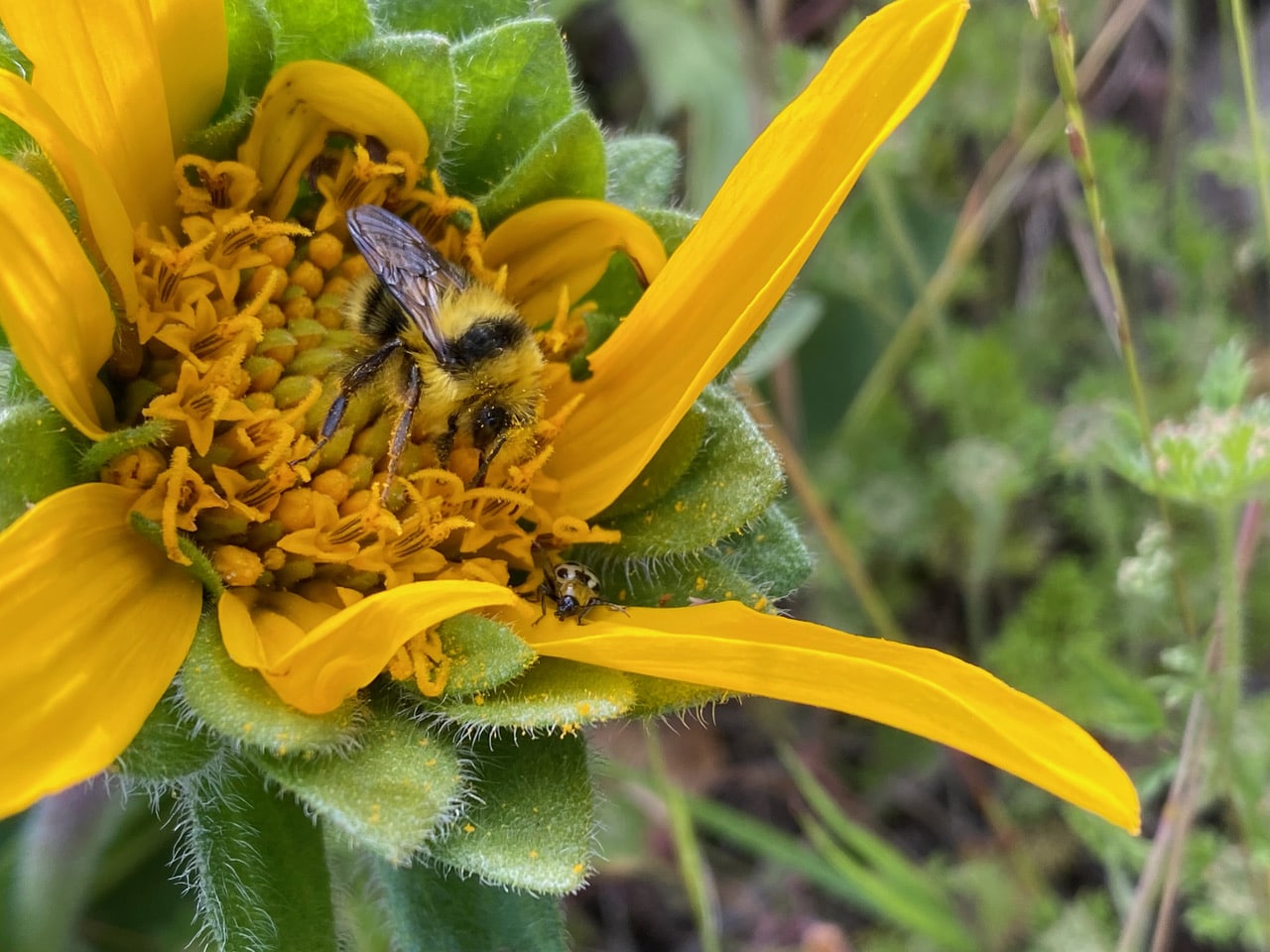
Her hair dusted with pollen, a Black-tailed Bumble Bee, Bombus melanopygus is taking nectar on a flowerhead of Narrowleaf Mule Ears, Wyethia angustifolia. Note the pollen scattered on the green phyllaries – the flowerhead has probably seen quite a bit of pollinator action all day.
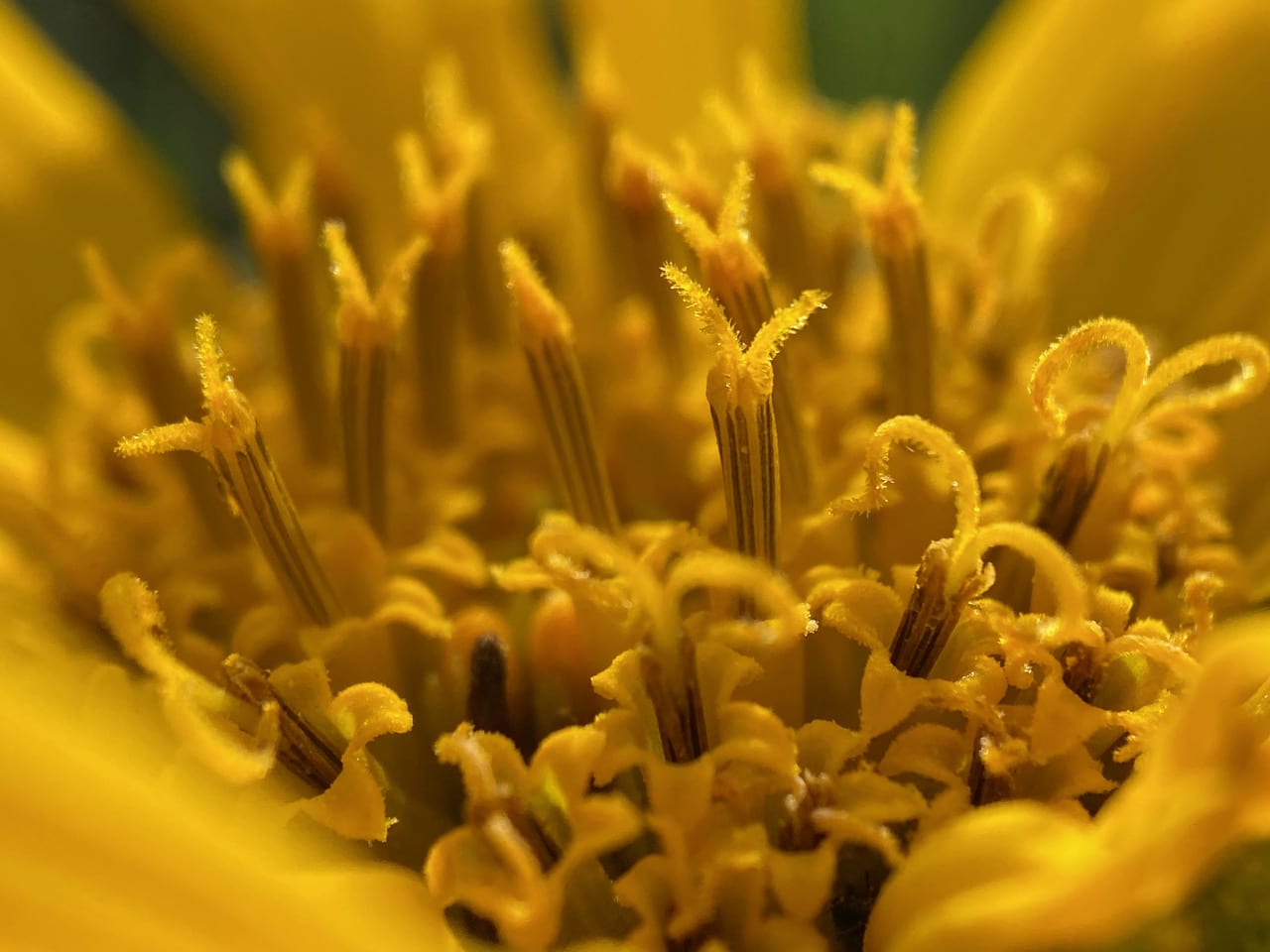
Whether or not the Wyethia florets have been pollinated by visiting insects, they are equipped to set seeds anyway.
As the style pushes through the anther tube, it pushes pollen ahead of it to the outside world for insects to pick up. After the pollen is gone, the two stigma lobes begin to curl apart to present their sticky inner surface for receiving pollen from visiting insects. Even if the flower isn’t visited by an insect, the two stigma lobes continue to curl downwards, perchance to touch their own anther tube and pick up leftover pollen grains – self pollination is better than no pollination. The Asteraceae has all its bases covered. No wonder that it is one of the most successful plant families on earth!