

Pollinator Post 5/31/23 (1)

It’s still cold (temperatures in the high 50s) and foggy when I arrive at Siesta Gate at 10 am.
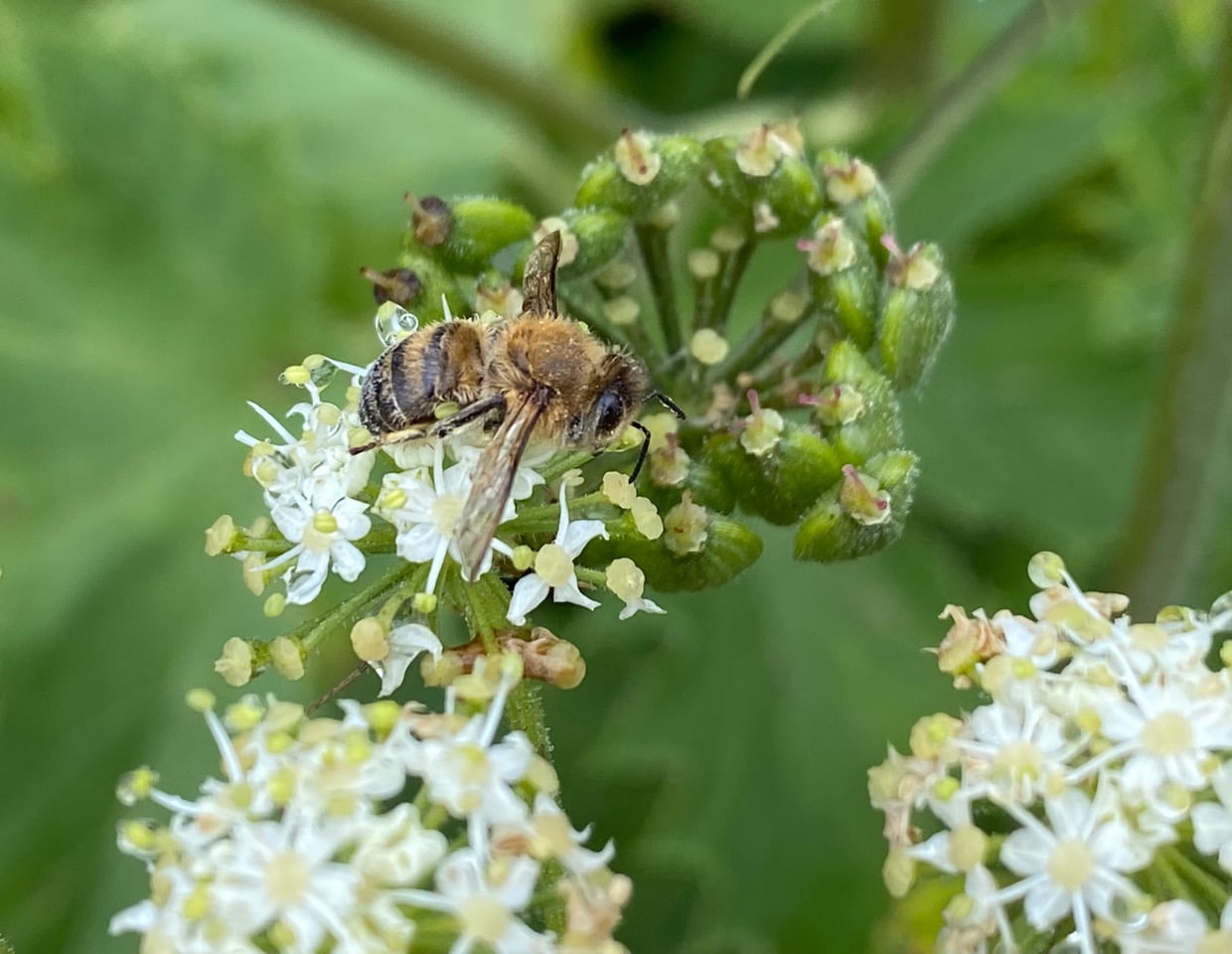
A wet Honey Bee, Apis mellifera lies motionless on a cluster of Cow Parsnip flower, Heracleum maximum. Why didn’t she return to the hive? I wonder if she is dead?
Honey Bee workers that work outside the hive are the oldest members of the colony. Foraging is the most dangerous and arguably the most important. It’s only done by older bees who are closer to death. As the worker bee approaches her fourth week of nonstop work, she senses her end of days, and removes herself from the hive, so as not to become a burden to the colony. If she dies in the hive, her hive mates would have to remove her corpse. The altruism and loyalty shown by social insects are truly impressive.

Nothing stirs on this chilly morning. Then I notice a movement among the flower buds of California Phacelia, Phacelia californica. An American Winter Ant, Prenolepis imparis is out foraging! I shouldn’t be surprised, as these ants are cold-tolerant.
The American Ant, Prenolepis imparis is a widespread North American ant. A dominant woodland species, it is most active during cool weather, when most other ant species are less likely to forage. This species is one of a few native ants capable of tolerating competition with the invasive Argentine Ant, Linepithema humile. They are also aggressive toward other ants and produce abdominal secretions that are lethal to Argentine Ants. Prenolepis imparis is a generalist omnivore. Foragers are known for tending to aphids or scale insects from which they consume excreted honeydew, aggregating on rotting fruit, and exploiting protein-rich sources such as dead worms. The colony enters estivation (a hibernation-like state) and becomes inactive above ground for the warmer months, during which time eggs are laid and brood are reared. Reproductives overwinter and emerge on the first warm day of spring for their nuptial flight.
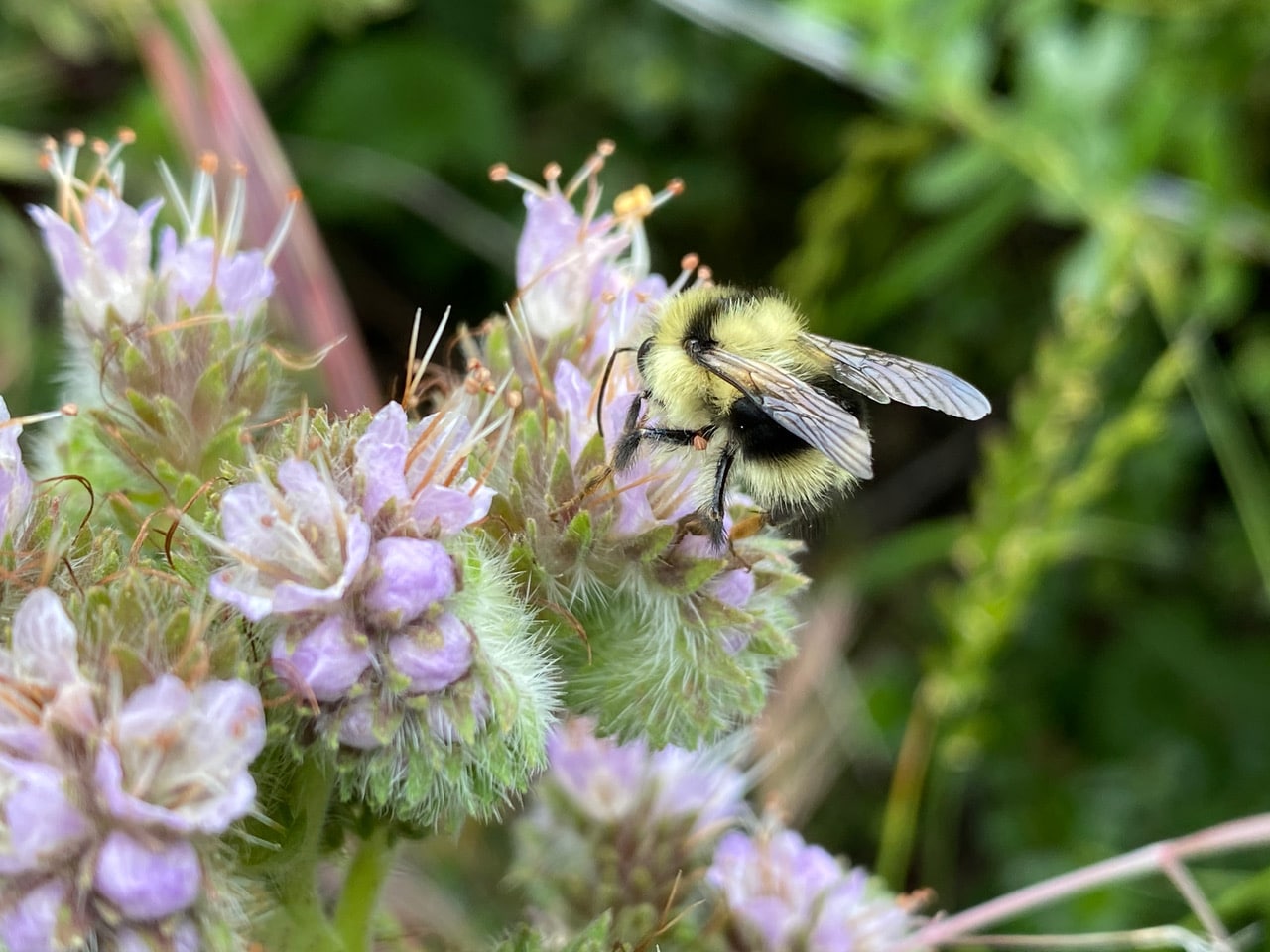
A spritely Black-tailed Bumble Bee, Bombus melanopygus lands to take nectar from the flowers of California Phacelia. Able to thermoregulate and warm themselves up when necessary, bumble bees are cold-tolerant, capable of foraging in low temperatures.
Bumble Bees are capable of physiological thermoregulation. Their flight muscles can only function within a narrow temperature range, between 30 C and about 44 C. On cold days, bumble bees shiver their flight muscles to produce heat. The flight muscles are in the thorax, and this is the body segment that bumble bees warm up with their shivering. The circulatory system of a bumble bee is an open one, consisting of one blood vessel (the “heart”) running from the head to the abdomen.
As blood is pumped through the heart from the thorax into the abdomen, it passes through a narrow “waist” or petiole that connects the two body segments. In cold conditions, the warm thoracic blood is pumped in a slow, steady flow through the petiole. As it passes through the petiole, it passes cooler blood flowing outside of the heart from the abdomen back to the thorax. As the cooler blood passes the warmer blood, it picks up heat from the blood being pumped through the heart. Then it carries the heat back into the thorax. This elegant physiological mechanism is called countercurrent heat exchange. The mechanism allows the bumble bee’s flight muscles to be warmed up quickly, and it prevents unnecessary loss of heat from the abdomen when the bee is foraging on cold days.
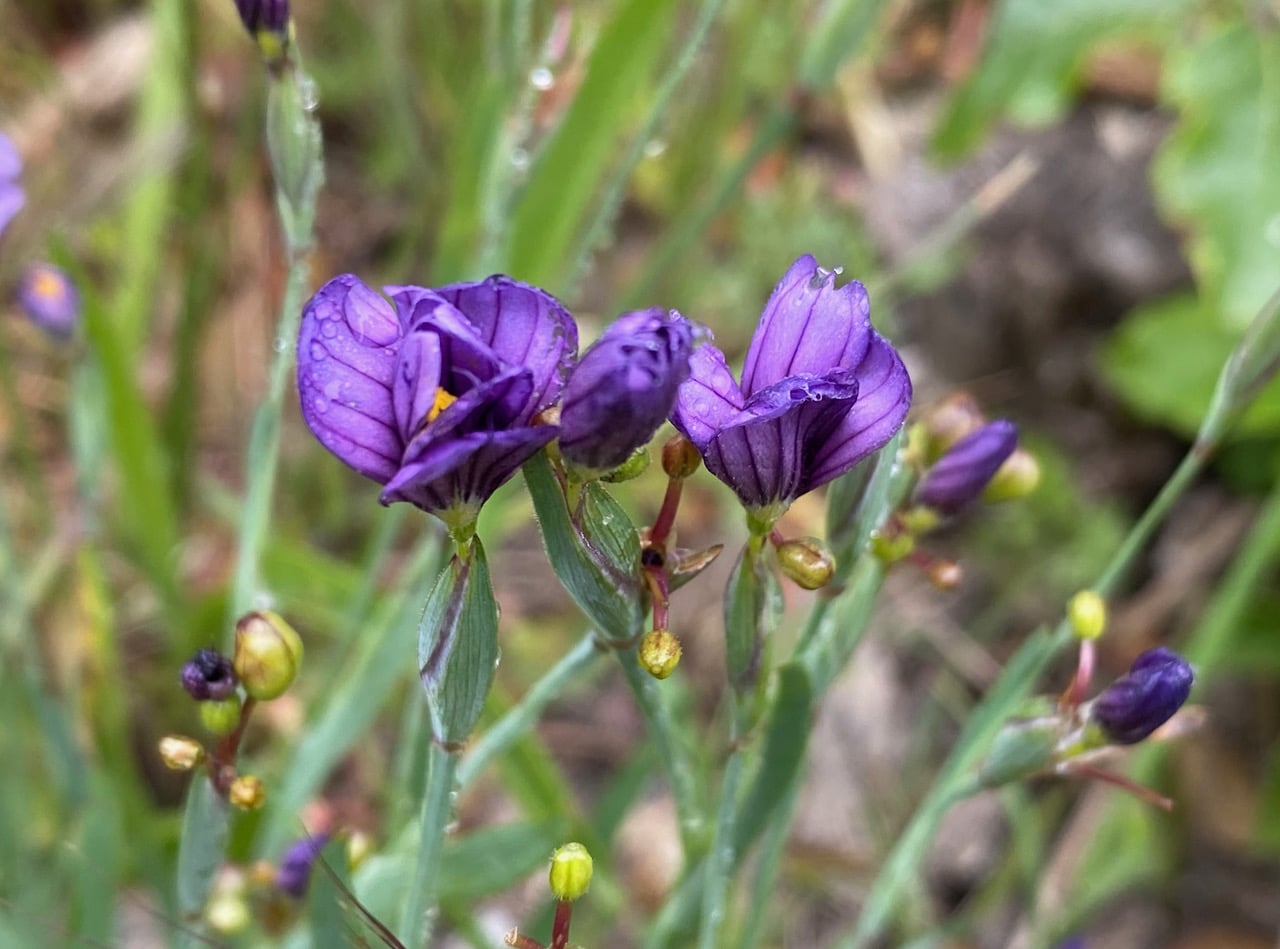
It will be a while before these Blue-eyed Grass, Sisyrinchium bellum open up their flowers. The flowers close in the afternoon or evening and open up again in the morning. I’m not sure if the mechanism is dependent on temperature or sun light.
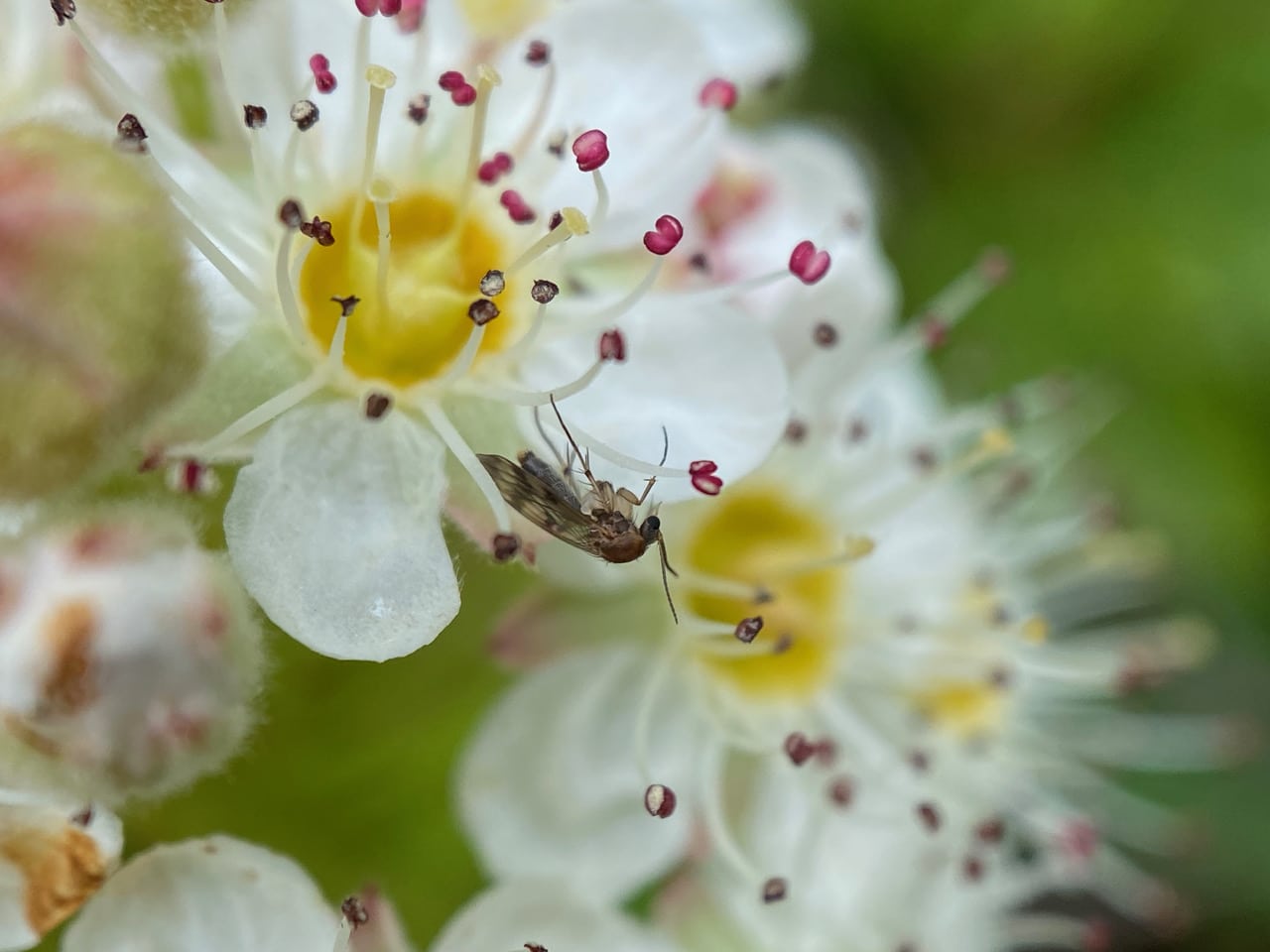
A tiny mosquito-like fly visits the flowers of Pacific Ninebark, Physocarpus capitatus. The long antennae, small head, humped back, elongated coxae, and spinose tibia are suggestive of a Fungus Gnat (family Mycetophilidae).
The Mycetophilidae are a family of small flies, often known by their common name of Fungus Gnats. They are generally found in the damp habitats favored by their host fungi and sometimes form dense swarms. The delicate-looking flies are similar in appearance to mosquitoes. Adults have slender legs with segmented antennae that are longer than their head. Adult fungus gnats do not damage plants or bite people. Larvae, however, when present in larger numbers, can damage roots and stunt plant growth. Females lay tiny eggs in soil or moist organic debris. Most of the fungus gnat’s life is spent as a larva and pupa in organic matter or soil. There may be many overlapping generations each year. They are most common during winter and spring in California when water is more available and cooler temperatures prevail.
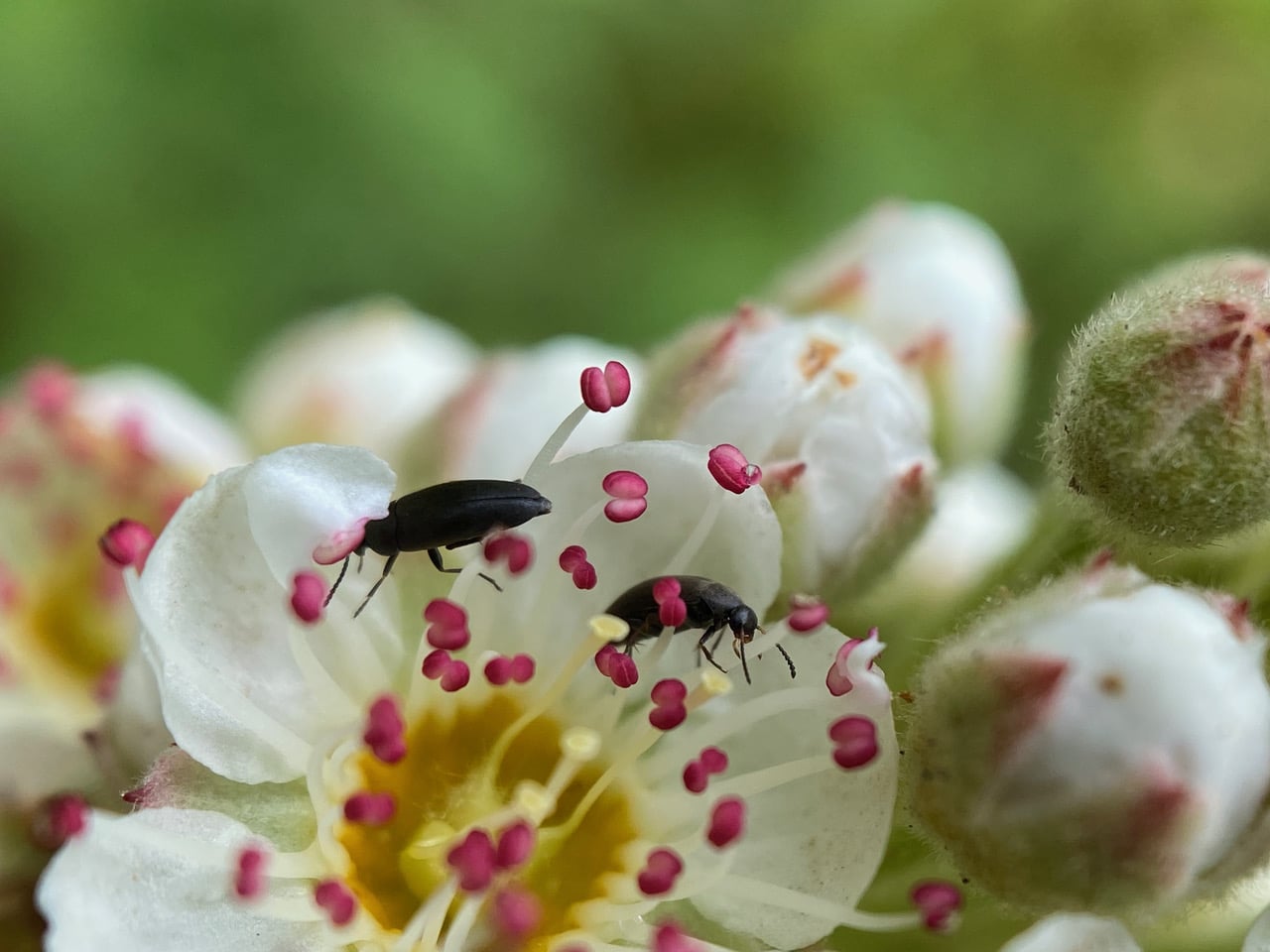
Several False Flower Beetles, Anaspis atrata (family Scaptiidae) are foraging for pollen on the Pacific Ninebark flowers.
False Flower Beetles, Anaspis atrata (family Scraptiidae) are commonly found in western North America. The adults are found on flowers, sometimes in large numbers, but are also found on foliage. The larvae are typically found under the bark of dead trees.
 That looks like another Fungus Gnat (family Mycetophilidae).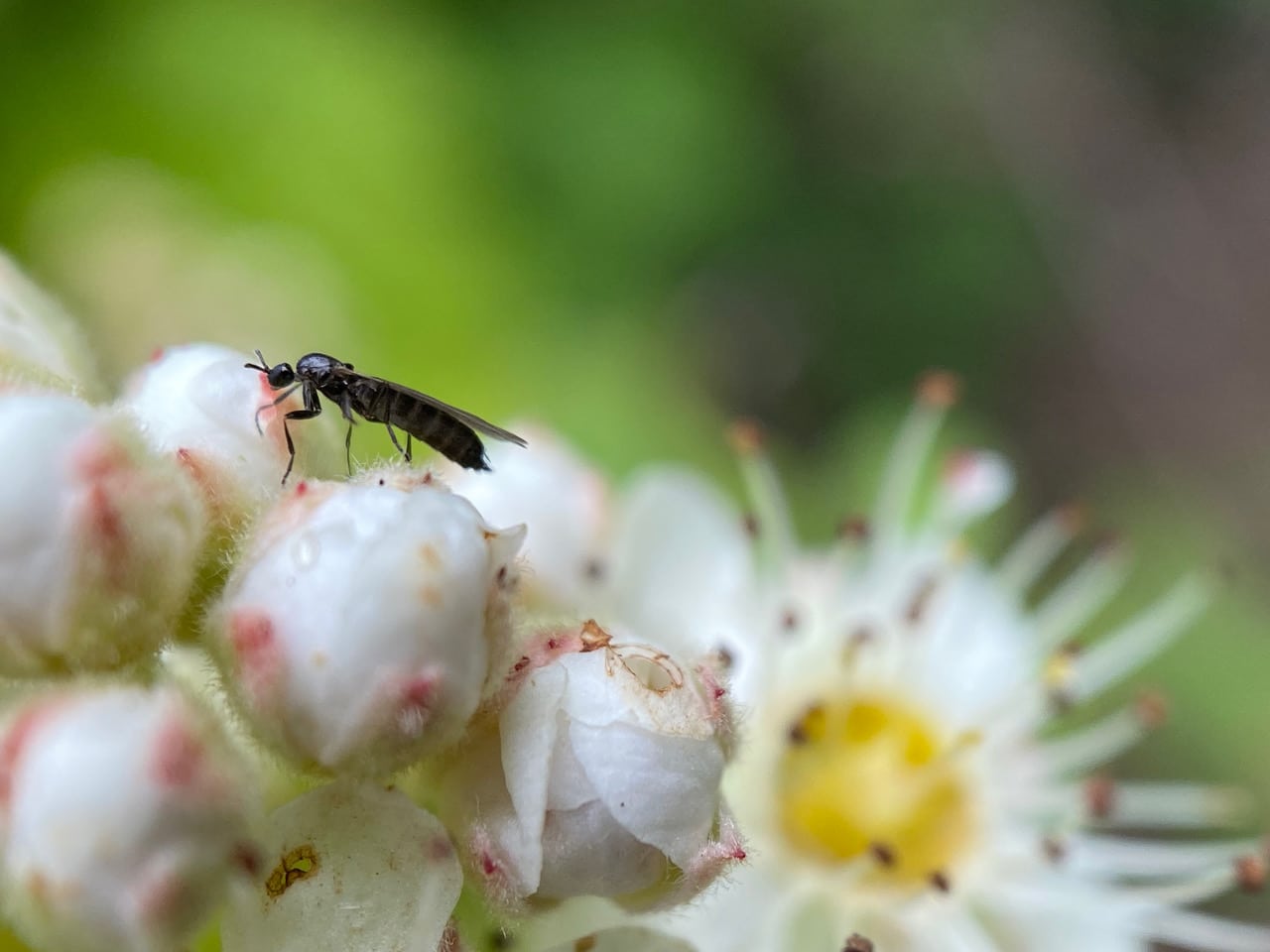
A Minute Black Scavenger Fly (family Scatopsidae) is roaming the flowers of Pacific Ninebark.
As implied by the family name, these flies are also called “dung midges”. They are generally small, sometimes minute, dark flies (from 0.6 to 5 mm) with short antennae. Adults are often found on flowers. The larvae of most species are unknown, but the few that have been studied have a rather flattened shaped and are terrestrial and saprophagous, feeding on decaying plant and animal matter.
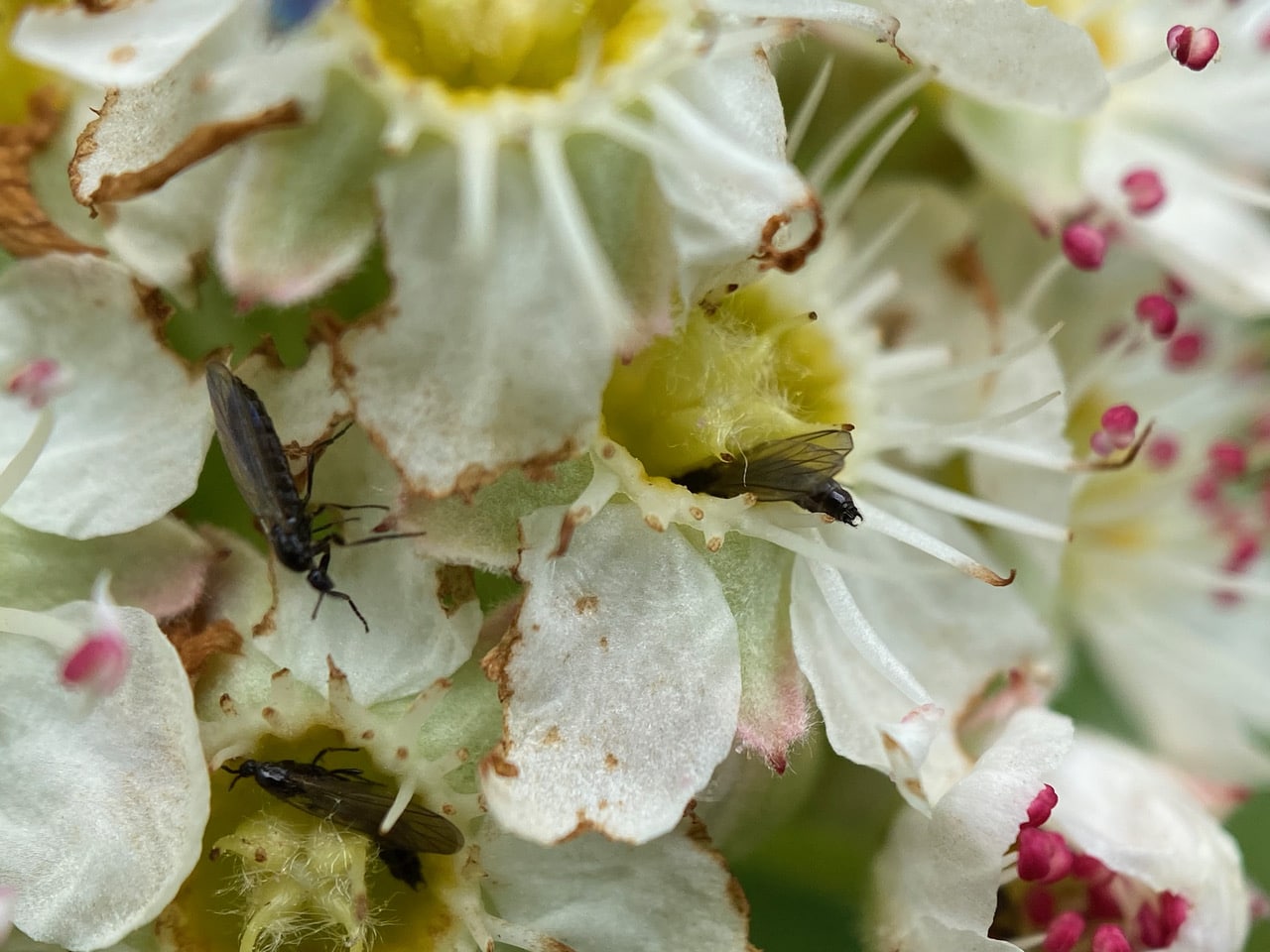
Many more Minute Black Scavenger Flies (family Scatopsidae) are going in and out of the flowers of Pacific Ninebark, seeking nectar. It seems the flowers are a great source of nectar for small insects.

A perfect seed head or puffball of California Dandelion, Agoseris grandiflora.
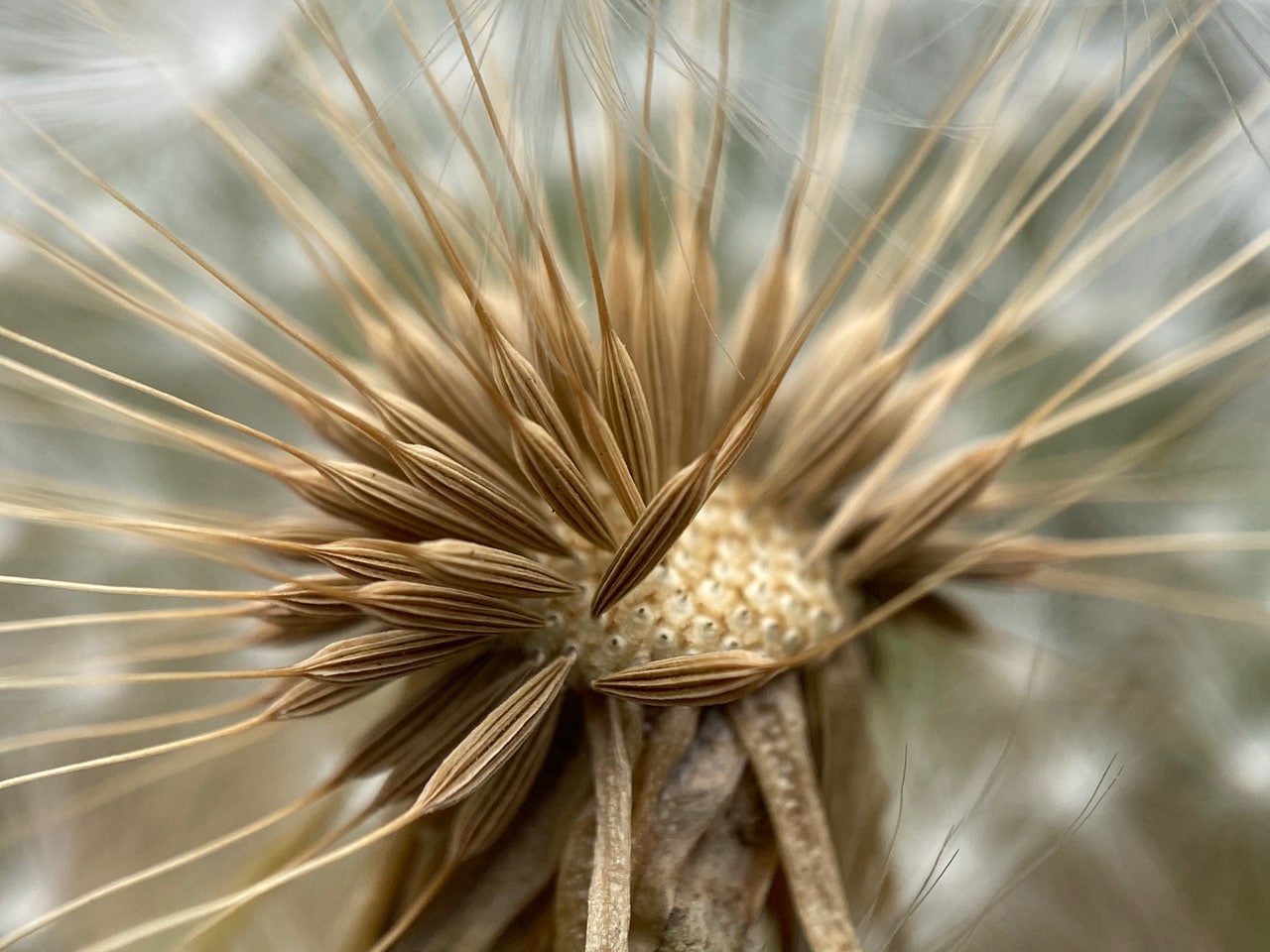
A seed head of California Dandelion is composed of numerous sharp-tipped, ribbed seeds each attached to a parachute-like structure called a pappus. The pappus, with a white cotton-like appearance, aids in wind dispersal of the seeds as they detach from the seed head.

Look who is questing on the pappus of a California Dandelion puff ball- a Western Blacklegged Tick, Ixodes pacificus !
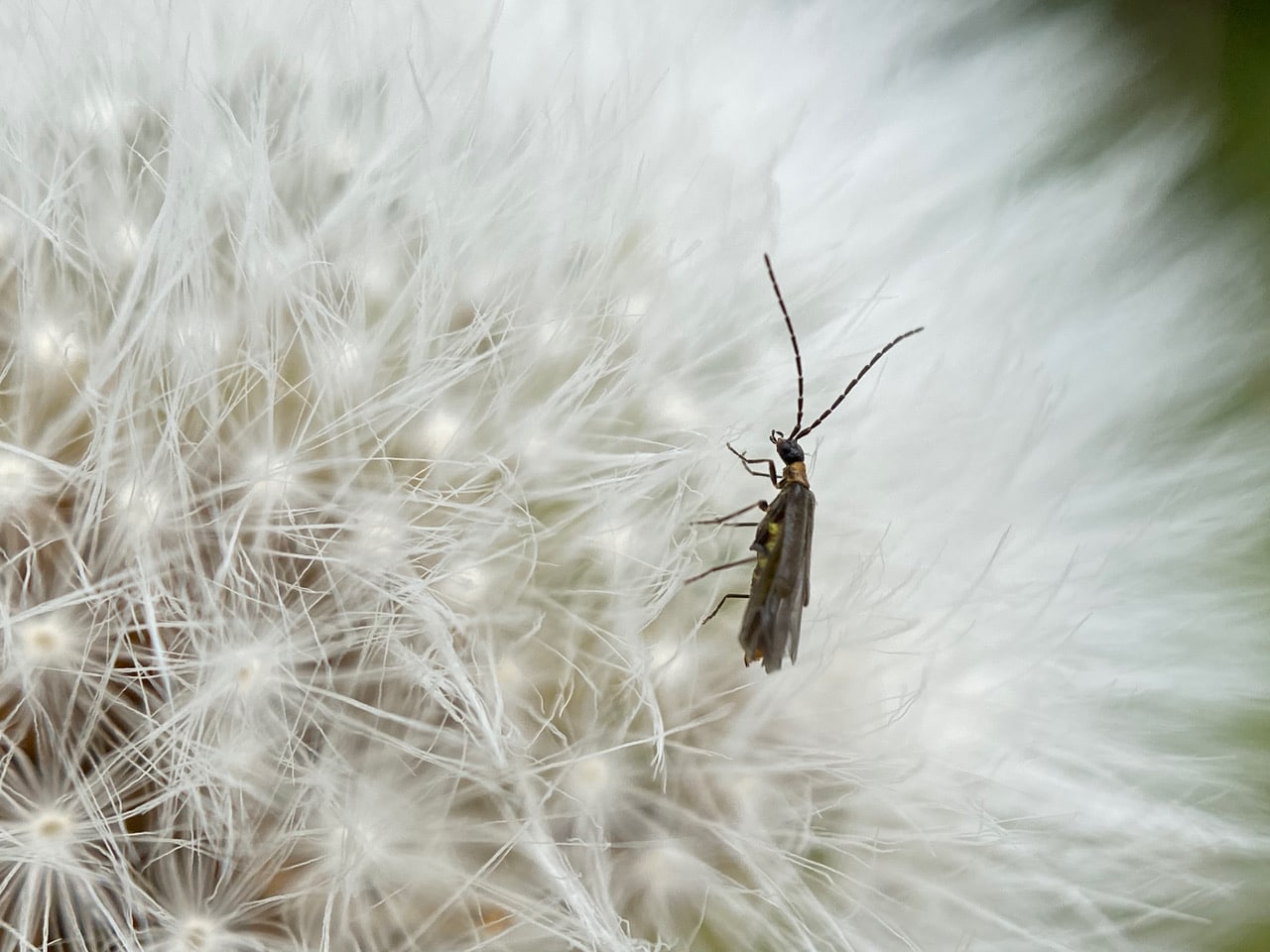
Ooh, here’s someone else on the pappus! It is a Soldier Beetle in the genus Malthodes (family Cantharidae).
The Soldier Beetles, family Cantharidae are relatively soft-bodied, straight-sided beetles. One of the first described species has a color pattern reminiscent of the red coats of early British soldiers, hence the common name. They are also known commonly as Leatherwings because of their soft elytra.
Soldier beetles often feed on both nectar and pollen as well as predating on other small insects. The larvae are often active, and feed on the ground, hunting snails and other small creatures. Soldier beetles are generally considered beneficial insects by gardeners.
Malthodes is the most speciose Cantharidae genus, with about 130 ssp. in our area. It is distinguished by small size (1-4 mm) and having short elytra which leave the inner wings partly exposed and folded along the dorsal surface of the abdomen.
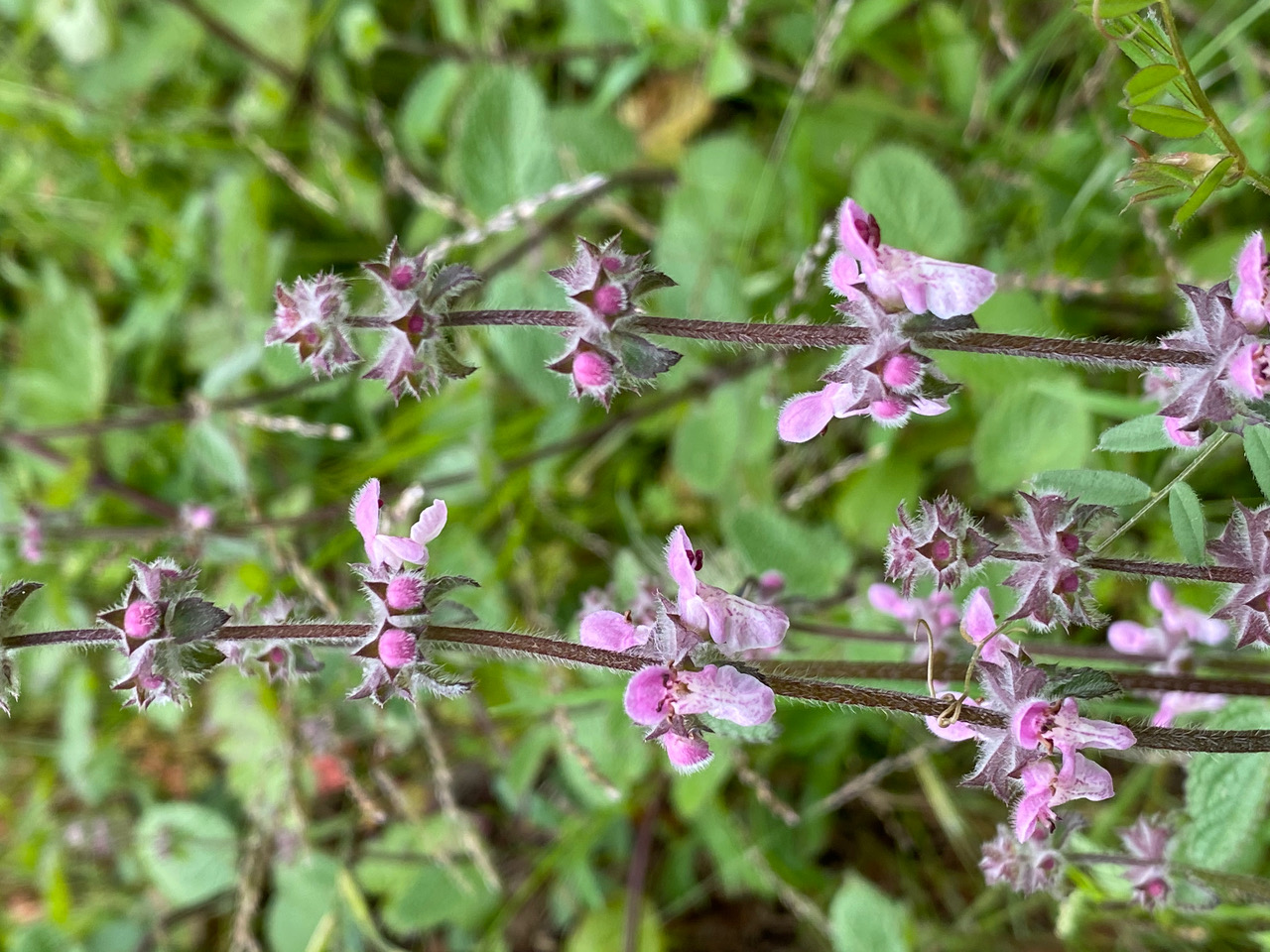
The Wood Mint, Stachys ajugoides is blooming beautifully along with the California Bee Plant on a moist bank on Skyline Trail..
Native to western North America, Stachys ajugoides is found in many types of habitats, especially moist areas. It is an aromatic herb with serrate leaves. The inflorescence is a spike of interrupted clusters of flowers, often in shades of pink.

I am thrilled to see a Yellow-faced Bumble Bee, Bombus vosnesenskii visit the flowers of Stachys ajigoides for nectar. She lands on the lower lip of the flower, and sticks her tongue down the throat of the flower. I can see that in this position, her head invariably comes in contact with the overhanging stamens under the hood (upper lip of the flower).
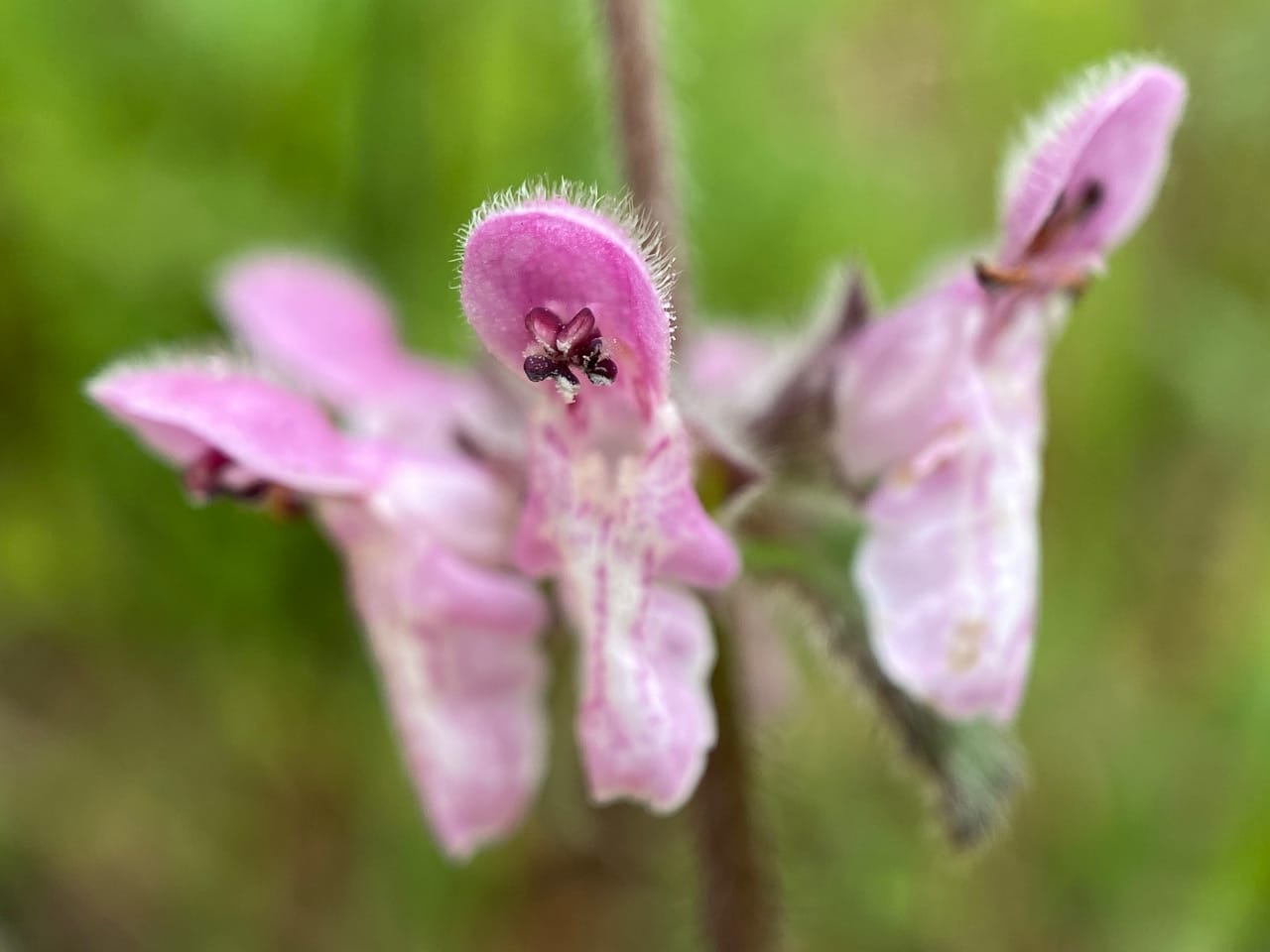
Stachys species are markedly protandrous, the male parts maturing before the female parts. This close-up shows a flower in the male phase, with four stamens beginning to release pollen.
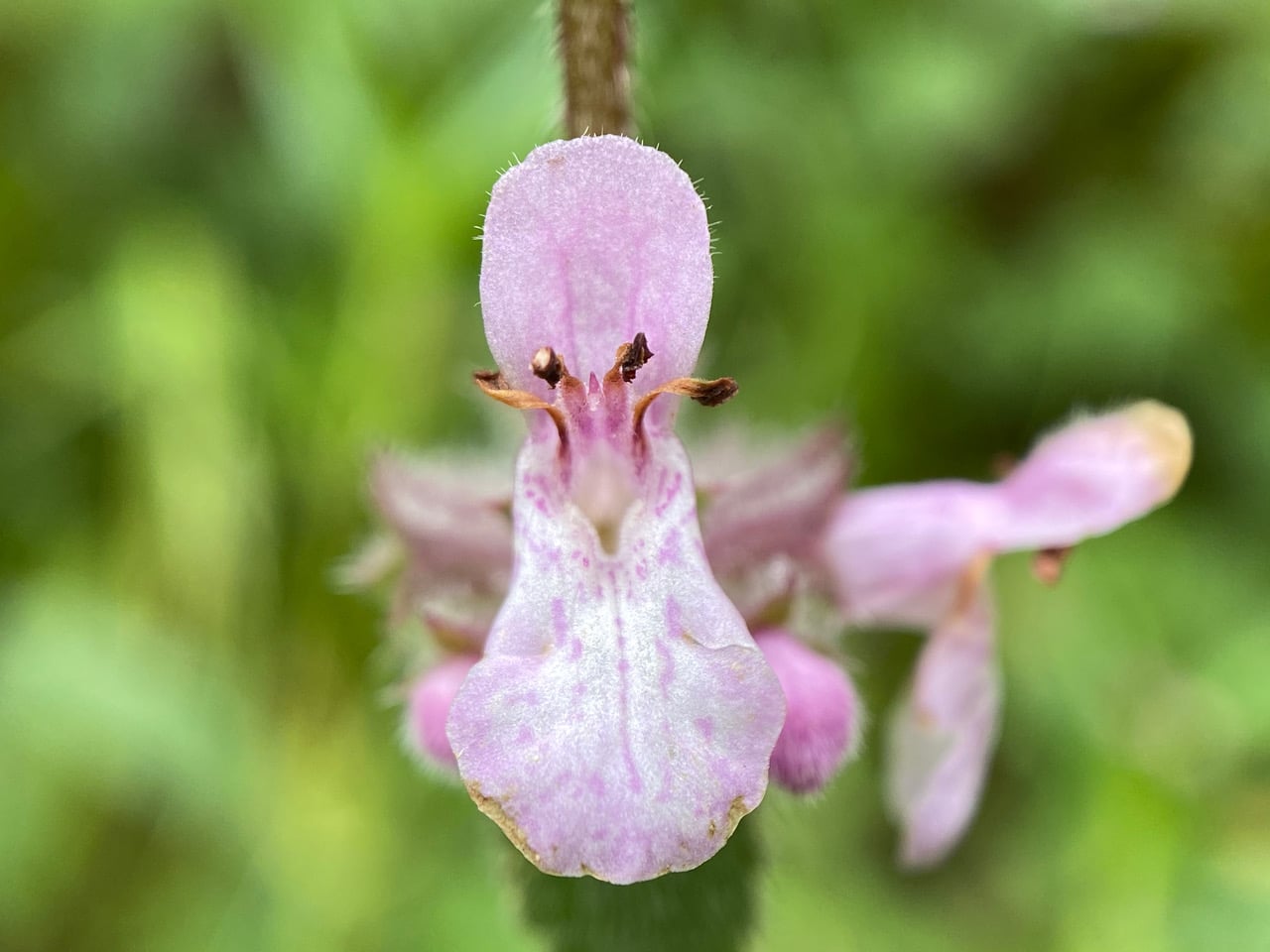
As the flower ages, the stamens wither and twist to the side, giving room to a long, forked style that arches forward to receive incoming pollen. The forked style is visible here between the two stamens in the back.

The style is a little more visible here arching out between the stamens. As it is the same color as the corolla, the style is hardly ever noticed.
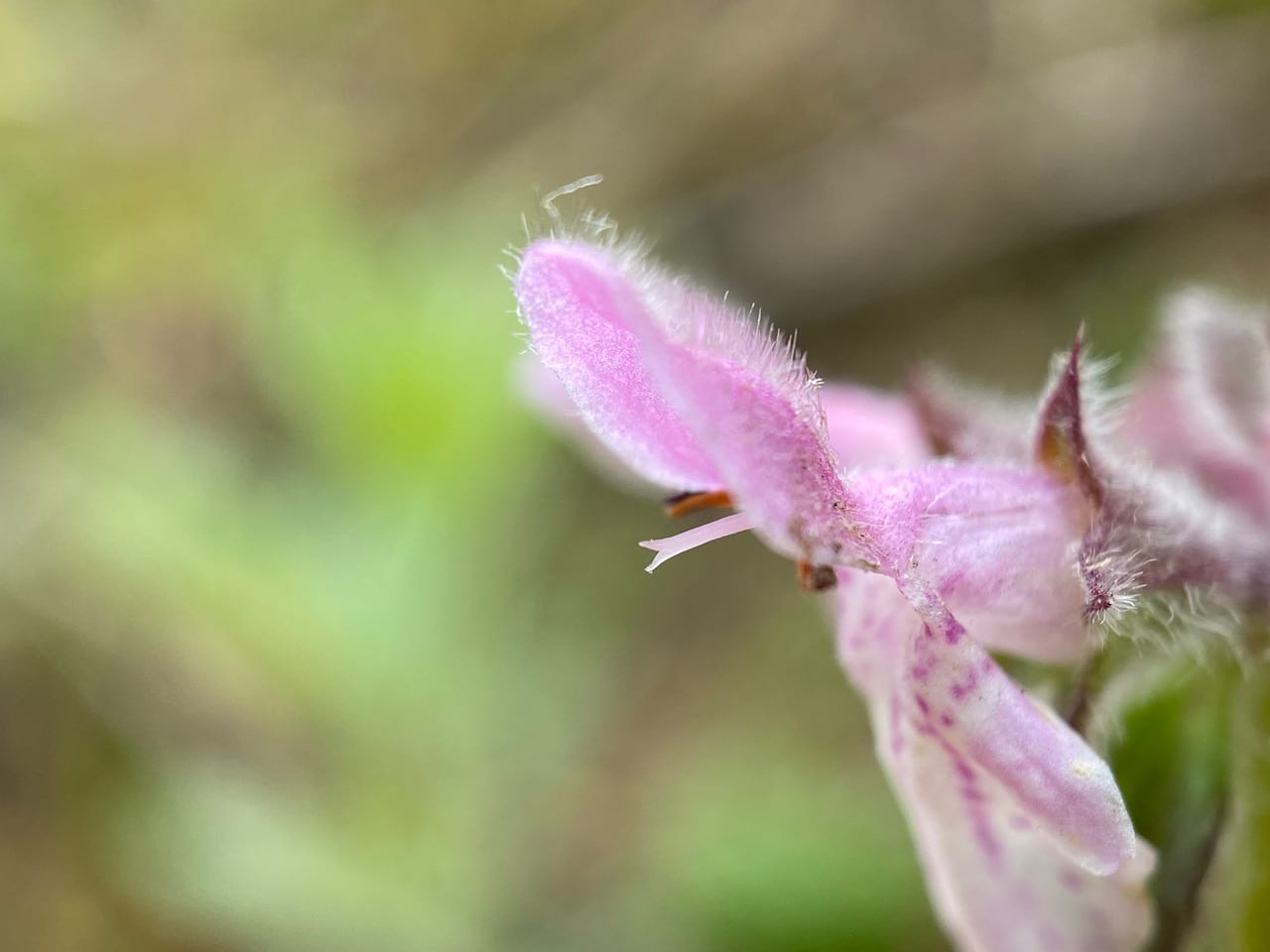 The forked style is inconspicuous, the same color as the flower. You can sometimes see it protruding beyond the corolla in older flowers.
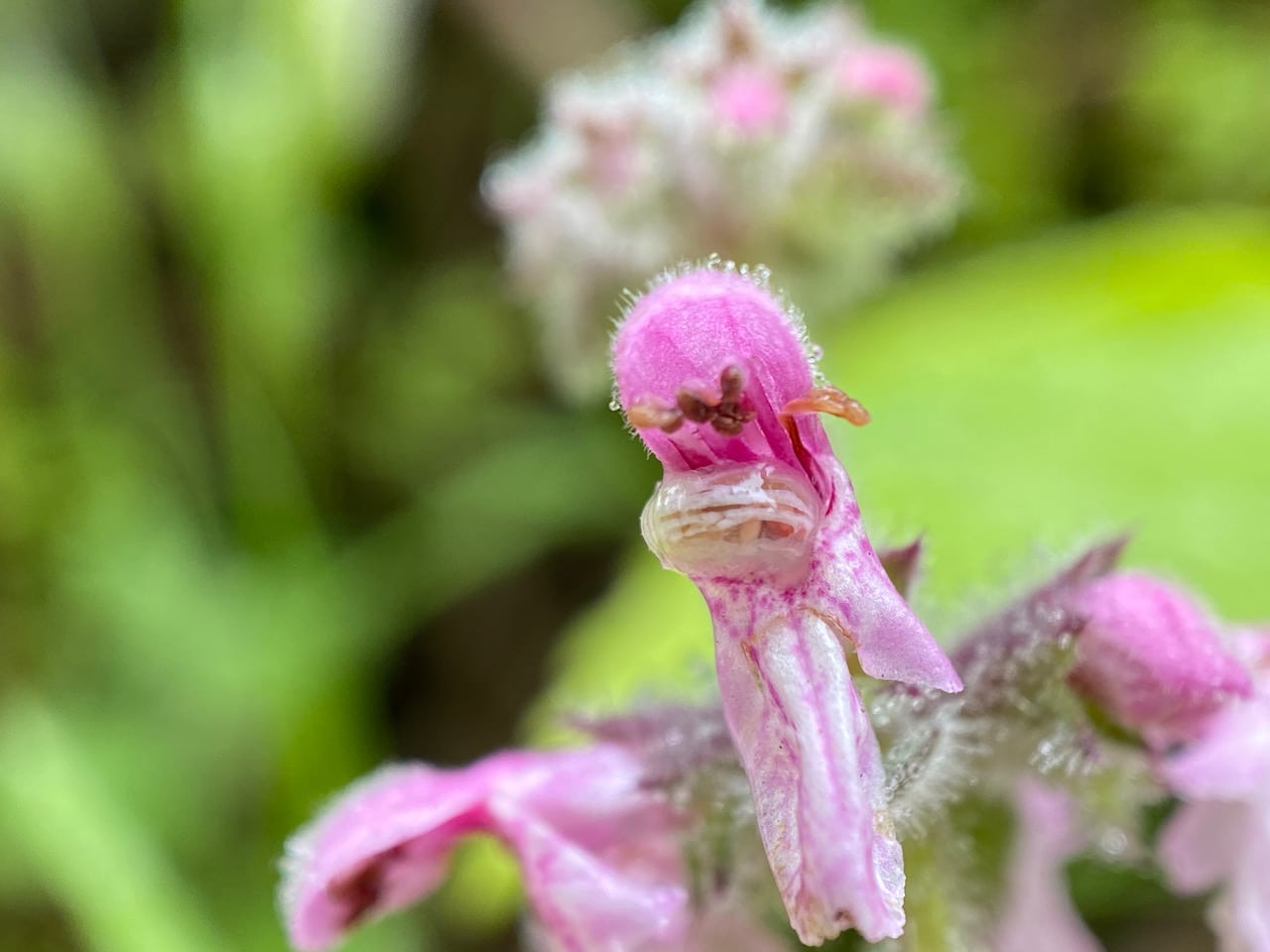
The forked style is inconspicuous, the same color as the flower. You can sometimes see it protruding beyond the corolla in older flowers. If a bee visits a flower in the female phase after visiting a flower in the male phase, the pollen already on its head is very likely to be deposited on the stigmatic surface of the forked style, effectively pollinating the flower. Dichogamy, or the temporal separation of the sexes, ensures that the flower is not self-pollinated.
Whoa, what on earth is on the Wood Mint flower? A tiny translucent Syrphid larva?
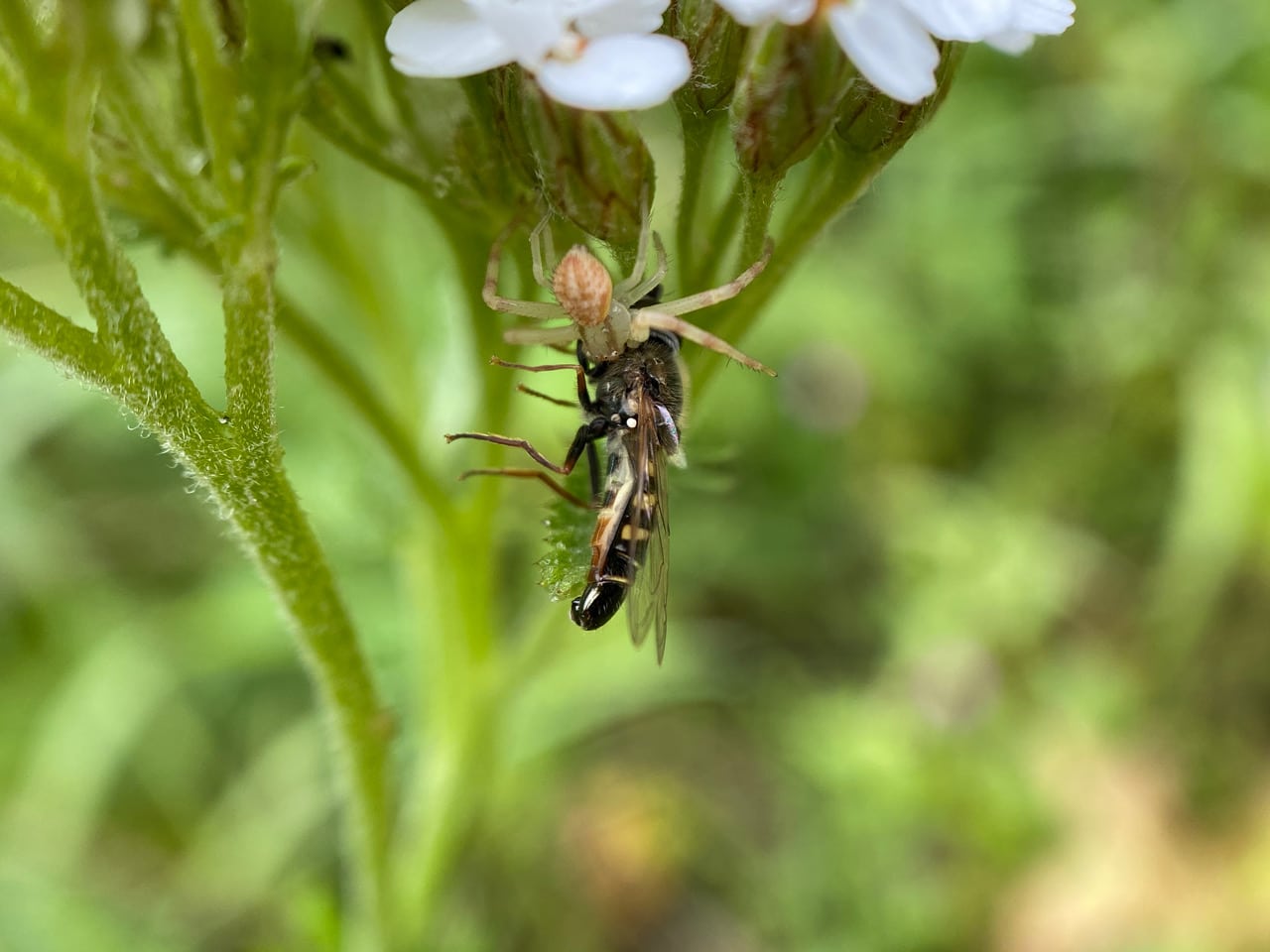
Under a cluster of Yarrow flowers, Achillea millefolium, a young Crab Spider, Mecaphesa sp. (family Thomisidae) is holding a male Large-tailed Aphideater, Eupeodes volucris (family Syrphidae) in its jaws. The spider has probably captured the hoverfly on the top of the inflorescence when it came in to feed on nectar and pollen. Crab spiders like to haul their prey under an inflorescence to feed in safety. The prey is no longer struggling. That’s an impressive feat and a humungous meal for the little spider!
Crab spiders (family Thomisidae) do not build webs. They are ambush predators that sit and wait to grab insects that visit flowers. After a bite, their potent venom immobilizes the prey very quickly, so little struggle is necessary. The digestive juices that is injected together with the venom break down the tissues of the prey. The spider sucks up the resulting slurry through the fangs, often leaving the exoskeleton of the prey remarkably whole except for the pair of fang marks. Crab spiders are capable of tackling prey much larger than themselves.