

Pollinator Post 6/1/23 (2)

The fruits of Wood Strawberry, Fragaria californica are ripening in the undergrowth along the road.
When a strawberry flower is pollinated, the fruit doesn’t swell. The fertilized ovaries in the flower form separate, small, dry fruits. Those “seeds” on the outside of a strawberry are actually the fruits, each of which contains a single seed. The ripe, red, fleshy part that we think of as the strawberry “fruit” is actually swollen receptacle tissue – the part of the plant that connects the flower to the stem. When a strawberry flower is pollinated, it triggers the receptacle tissue to grow.
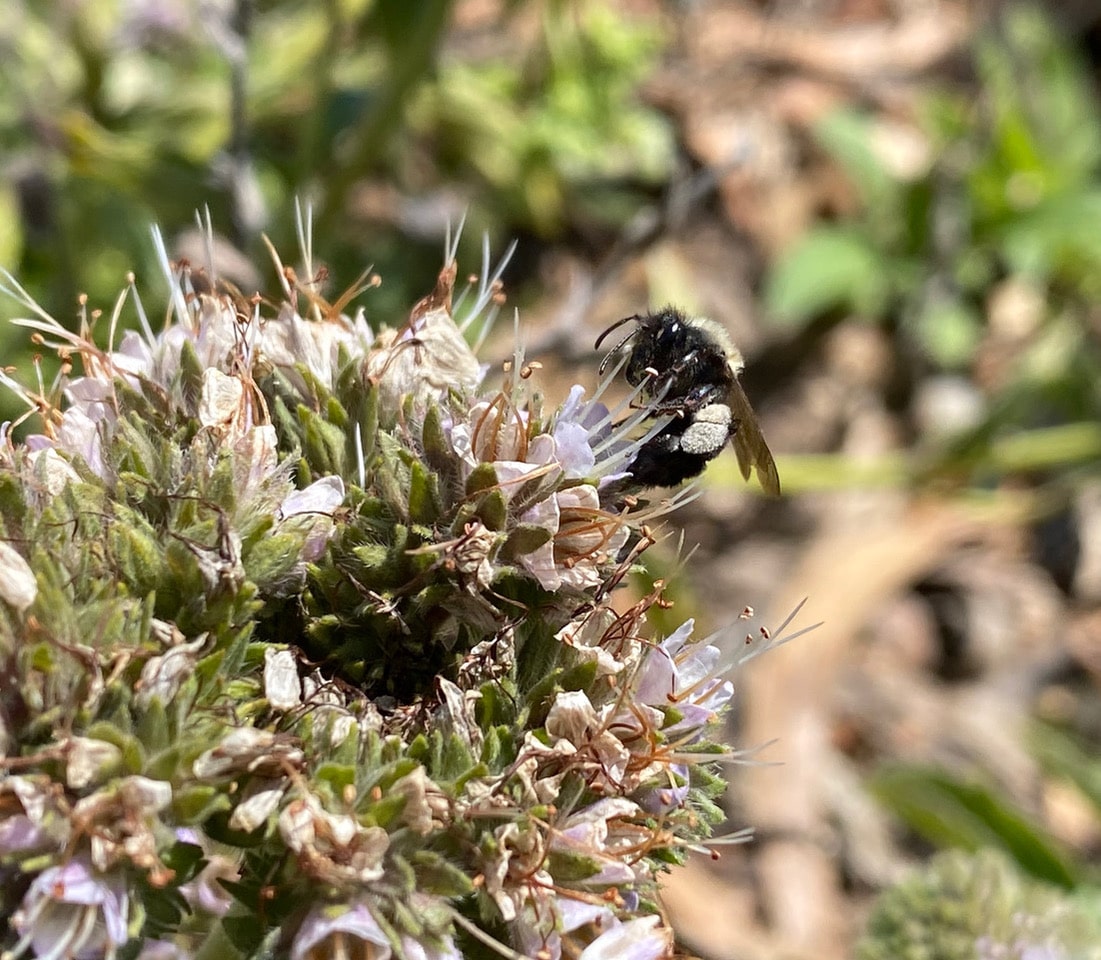
Although I can’t get close enough to this little bee on the California Phacelia flowers to see details, I can surmise from the way pollen is packed in her scopae that she is most likely a Mining Bee in the genus Andrena (family Andrenidae).
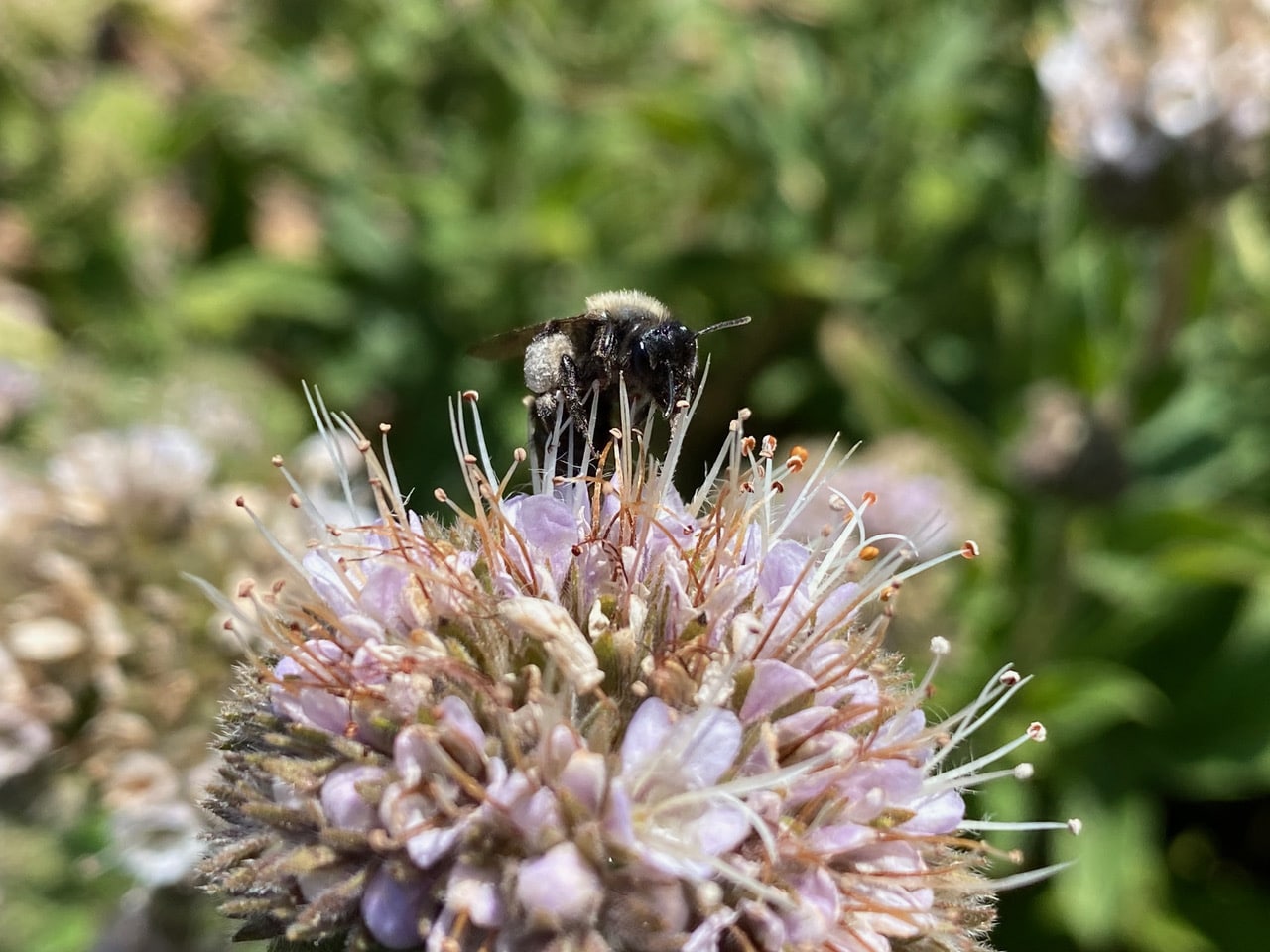
Another reasonably good look at the bee’s full scopa. It spans the length of her hind leg – including the tibia, femur and trochanter, extending into the female’s ‘armpits’.
A scopa (plural scopae; Latin for “broom”) is any of a number of different modifications on the body of a bee that form a pollen-carrying apparatus. It is a dense mass of elongated, often branched, hairs (or setae) on the hind leg. When present, it covers the tibia at a minimum, but some bees, depending on the species also have the hairs on the other segments of their leg. The leaf-cutter bees in the family Megachilidae have an extensive scopa on the underside of the abdomen. In the Sweat Bees (family Halictidae), the entire hind leg and abdomen carry pollen. Bumble Bees and Honey Bees have a more highly-developed structure than the scopa: the corbicula, or pollen basket. Some other bees, such as the Masked Bees (family Colletidae), transport pollen internally in the crop, and they lack a scopa. Parasitic bees do not collect pollen; they do not have a scopa.
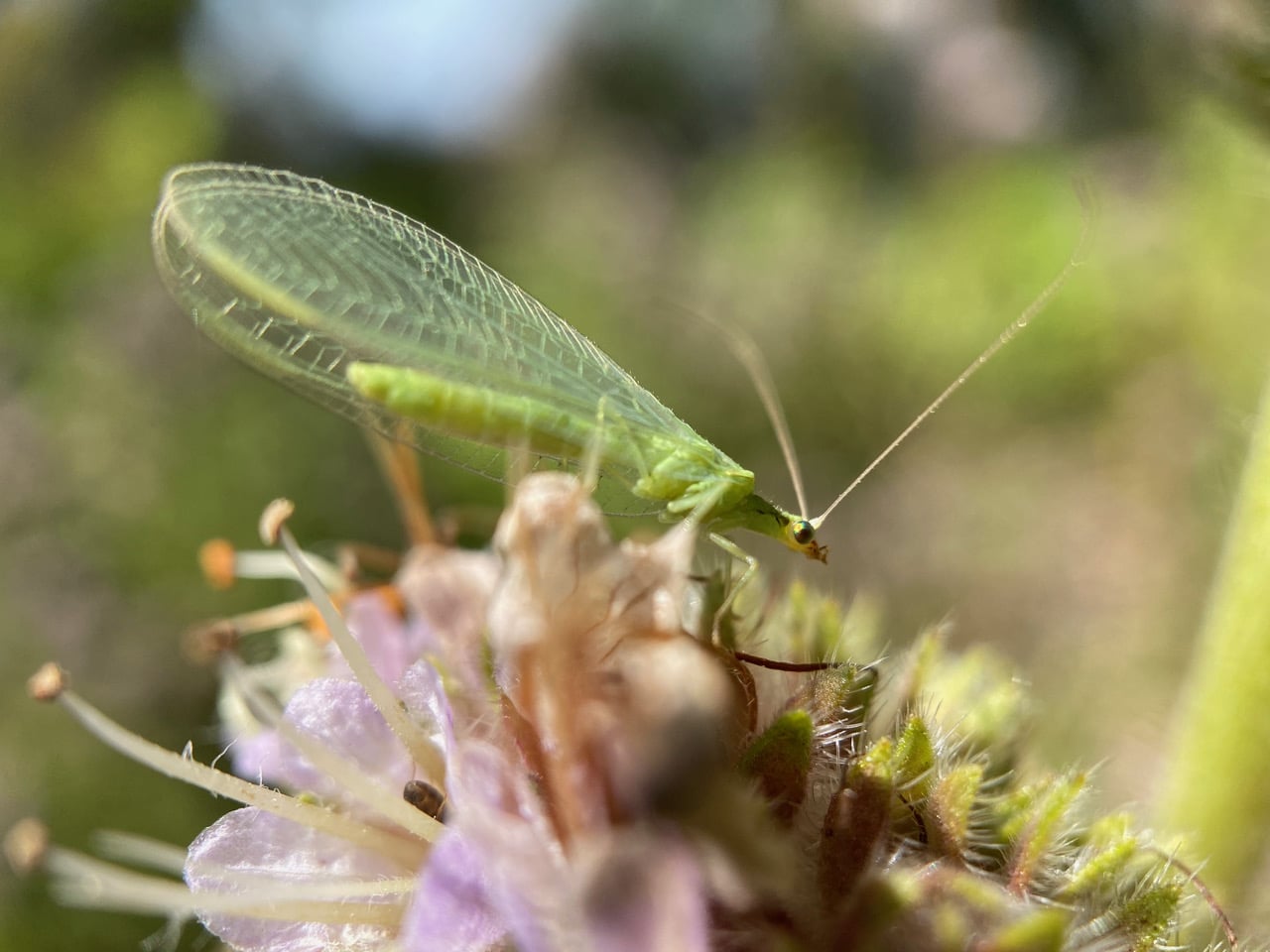
A Lacewing (family Chrysopidae) is browsing on an inflorescence of California Phacelia.
Lacewings are insects in the large family Chrysopidae of the order Neuroptera. Adults are crepuscular or nocturnal. They feed on pollen, nectar and honeydew supplemented with mites, aphids and other small arthropods. Eggs are deposited at night, hung on a slender stalk of silk usually on the underside of a leaf. Immediately after hatching, the larvae molt, then descend the egg stalk to feed. They are voracious predators, attacking most insects of suitable size, especially soft-bodied ones (aphids, caterpillars and other insect larvae, insect eggs). Their maxillae are hollow, allowing a digestive secretion to be injected in the prey. Lacewing larvae are commonly known as “aphid lions” or “aphid wolves”. In some countries, Lacewings are reared for sale as biological control agents of insect and mite pests in agriculture and gardens.
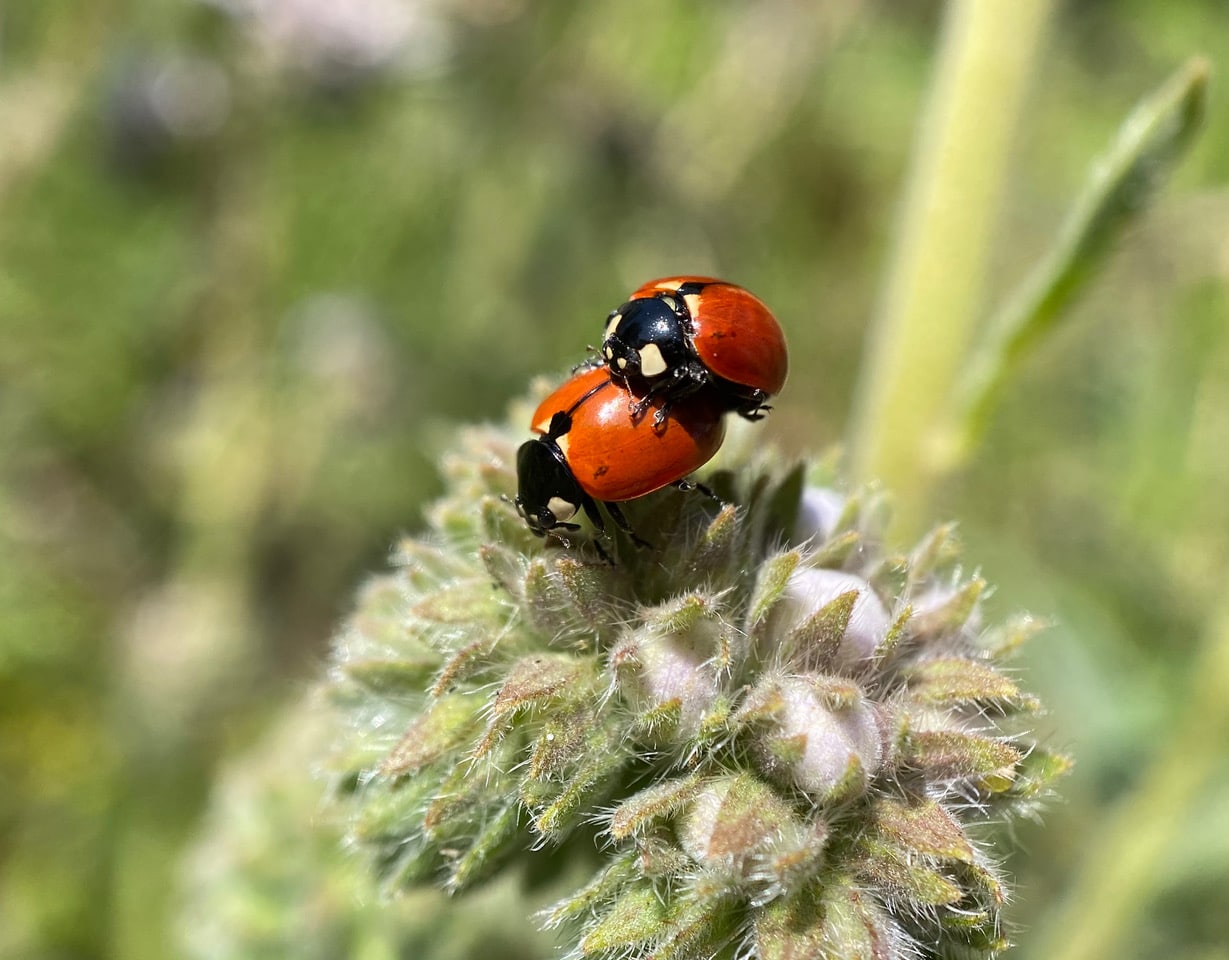
Aww, a pair of California Ladybeetles, Coccinella californica (family Coccinellidae) is mating on a cluster of phacelia flowerbuds.
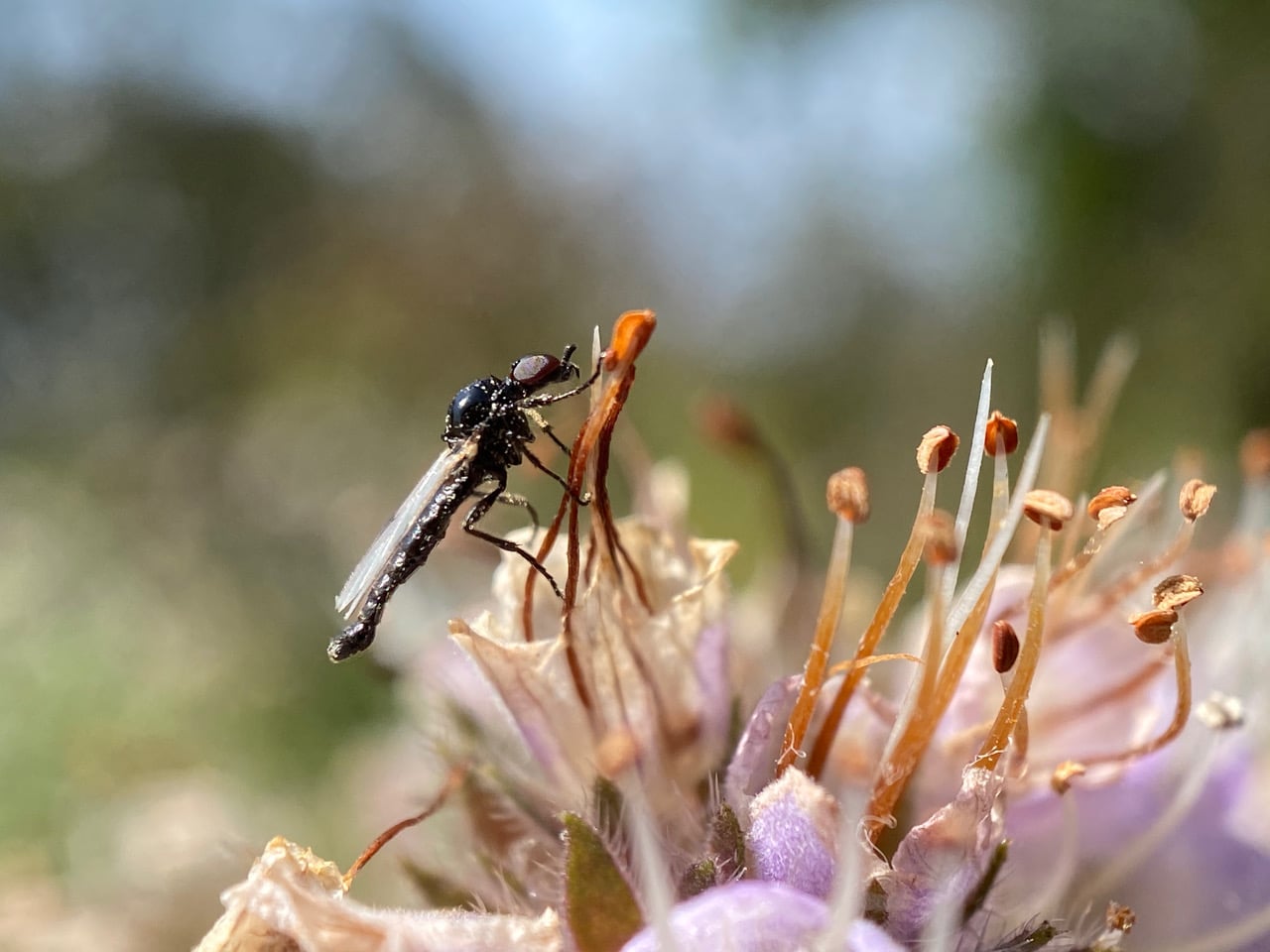
The March Flies (family Bibionidae) are sure enjoying an extended season this year! Here a male Dilophus sp. is perched on the withered stamens of a phacelia flower, probably scanning for females.
March Flies (family Bibionidae) generally live in wooded areas and are often found on flowers – adults of some species feed on nectar, pollen, and honeydew, while adults of other species don’t feed at all; and in either case, they are very short-lived. They are considered important pollinators in orchards. They are also important food for other insects and spiders. The larvae feed en masse on rotting organic material like leaves, wood, compost, and rich soil.
March flies exhibit extreme sexual dimorphism – the sexes are morphologically distinct. The female is usually more colorful, has small eyes on the sides of long, narrow head, while the all-black males have huge eyes that touch in the middle and are split in half horizontally. Scientists speculate that the split makes it easier for them to see the other males that are above and below them in a mating swarm. Males gather in swarms that can blanket the ground and low vegetation. Female are attracted to the party and select mates in the frenzy of fly bodies.

A Yellow-faced Bumble Bee, Bombus vosnesenskii is taking nectar from the flowers of California Phacelia. She’s carrying a huge load of orange pollen in her pollen baskets. We know where she’s been collecting the pollen – the California Poppies that dot the vicinity. Pollen and nectar aplenty – it’s a good life for a bee!
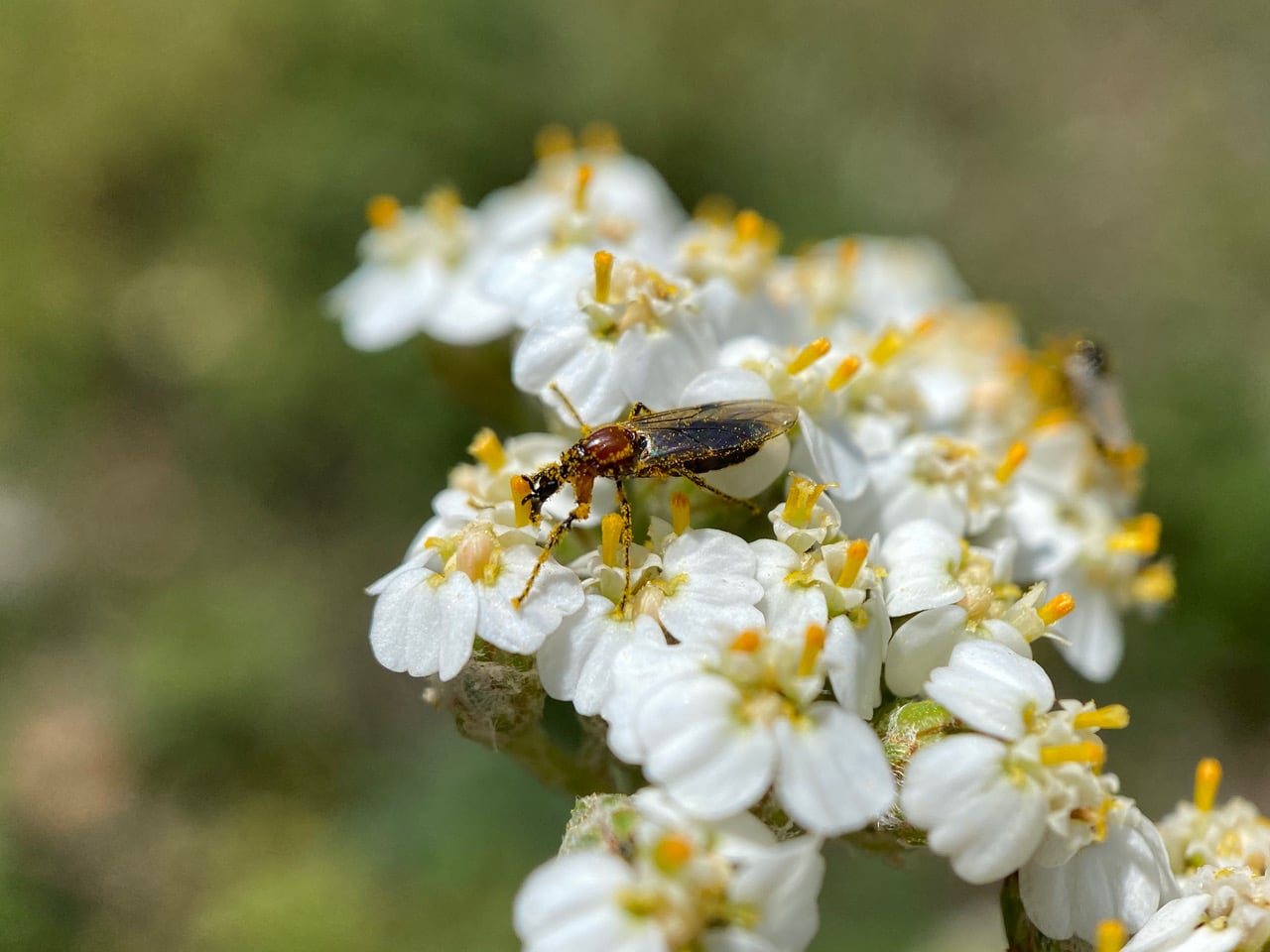
Here’s a female March Fly, Dilophus sp. (family Bibionidae) on an inflorescence of Yarrow, Achillea millefolium (family Asteraceae), covered with orange pollen.

Members of the sunflower or Asteraceae family tend to have rather sticky, clumpy pollen.
Pollenkitt is a sticky covering found on the surface of pollen grains. It is also sometimes called “pollen coat”. It is found in some plant families more often than others, but it is especially common in plants that are pollinated by insects. Because of this scientists believe that one of the major functions of pollenkitt is to help the pollen stick to the insect pollinators. The pollen from many wind-pollinated plants, such as grass, is much drier and not nearly so sticky. The insects benefit from lots of pollen that is easy to carry home. What’s more, pollenkitt contains lipids, proteins, and phenolic compounds that are important to bee health. For the plant, pollenkitt may prevent the pollen from blowing away or drying out, or it may protect the pollen from ultra-violet radiation and certain pathogens.
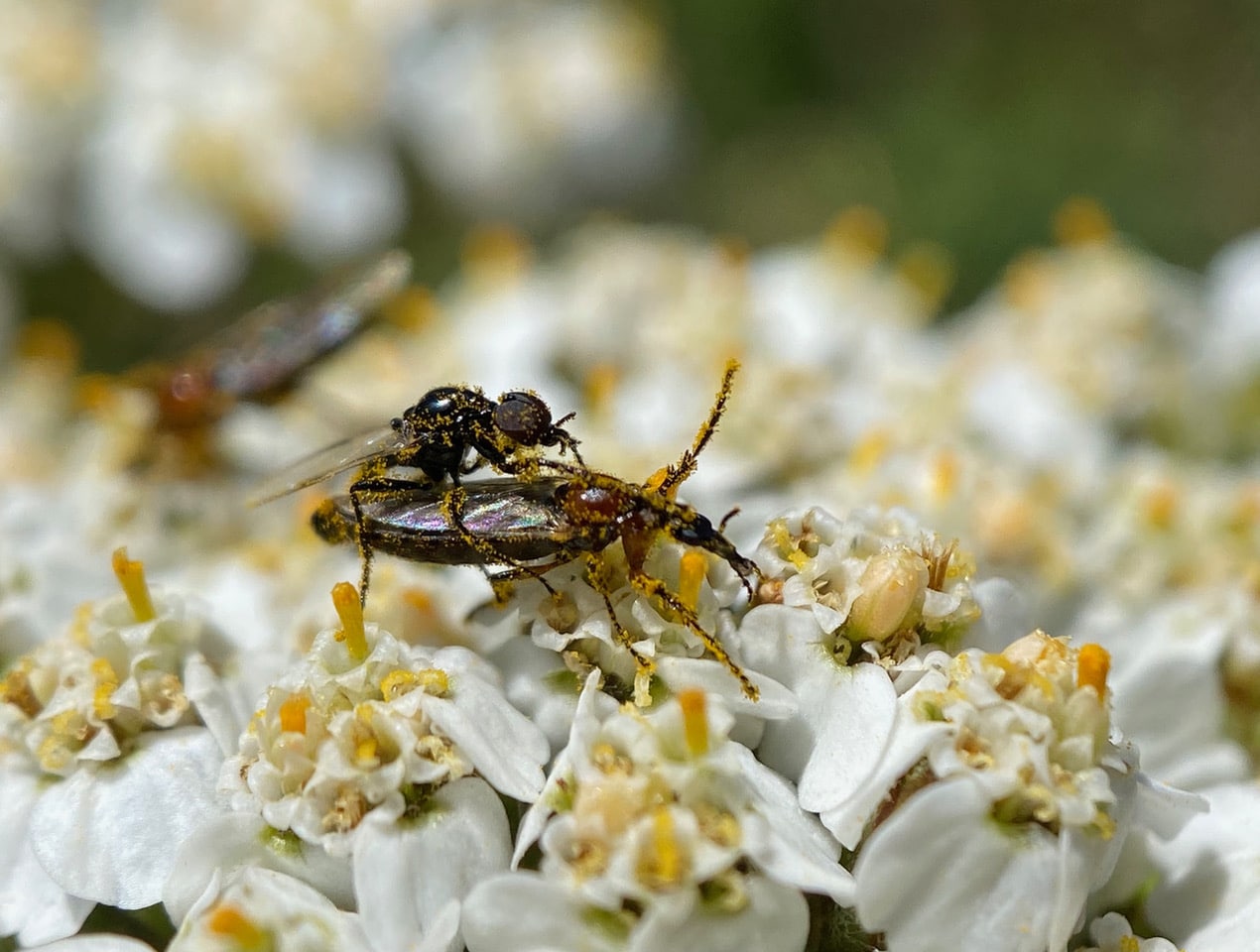
Covered with sticky pollen, a pair of March Flies,Dilophus sp. (family Bibionidae) is mating on the flowers of Yarrow. Although small, these flies are able to disperse a long distance, probably good as pollinators for the flowers they visit.
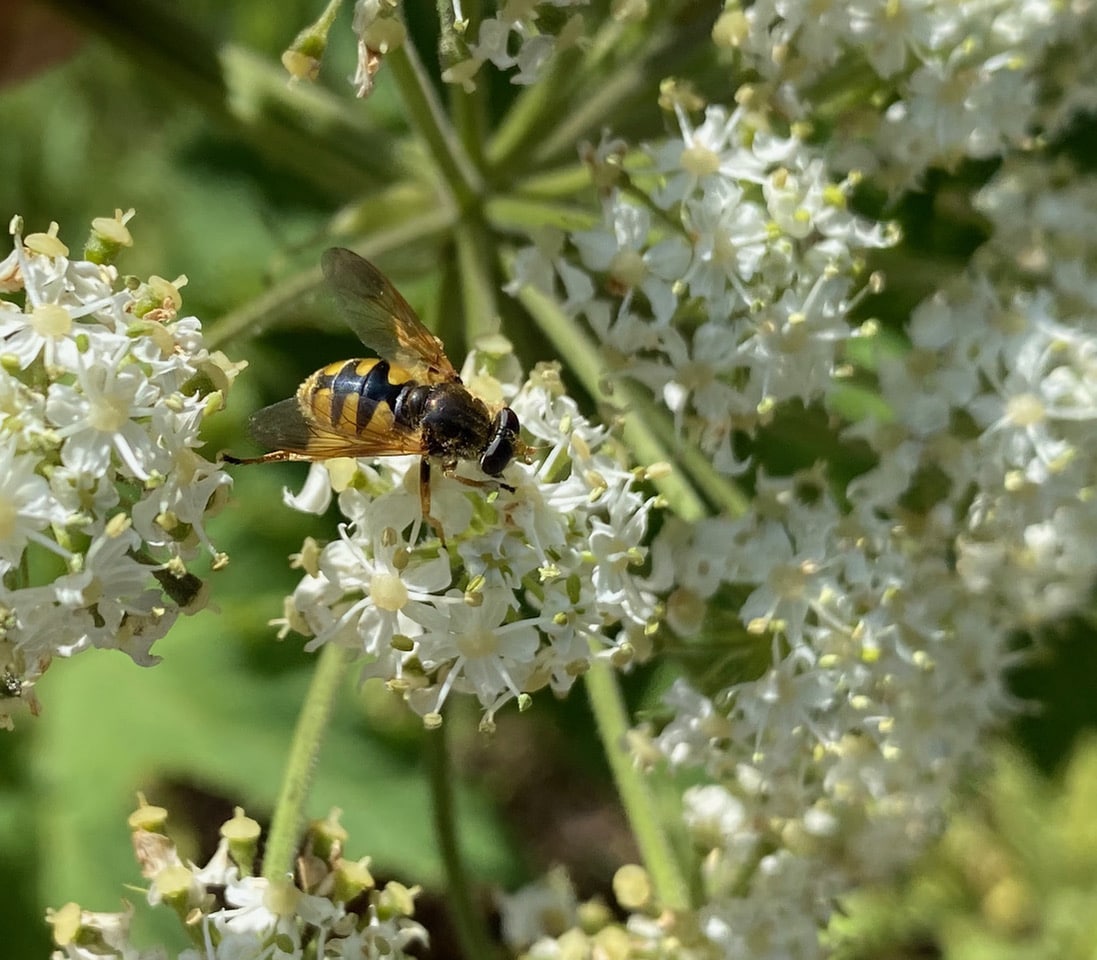
From a distance, this insect on the flowers of Cow Parsnip, Heracleum maximum can easily be mistaken for a Yellowjacket wasp. On closer inspection, it reveals itself to be a typical Hover Fly (family Syrphidae).
Hover Flies are the quintessential example of Batesian mimicry. Many are brightly colored, with spots, stripes and bands of yellow; due to this coloring, they are often mistaken for wasps or bees. The resemblance to stinging insects gives the hover flies some protection from predators.
Hover Flies, also called Syrphid Flies make up the insect family Syrphidae. They are often seen hovering or nectaring at flowers; the adults of many species feed mainly on nectar and pollen, while the larvae eat a wide range of foods. In many species, the larvae feed on aphids, thrips, and other plant-sucking insects. In some species, the larvae are saprotrophs, eating decaying plant and animal matter in the soil or in ponds and streams.
Hover Flies are considered the second-most important groups of pollinators after wild bees. Most are generalists that visit a wide range of plant species. The feeding habits of Syrphid larvae further endear them to the gardeners, serving as pest control agents and recyclers of organic matter.

I have never seen this Hover Fly before. A new Syrpid species for me! I try to take as many pictures of the insect as possible from different angles for identification purposes.
iNaturalist suggested the subtribe Blerina. With some further online research on BugGuide I manage to get it down to the species – Blera humeralis, the Yellow-legged Wood Fly.

Blera humeralis, the Yellow-legged Wood Fly, is an uncommon species of Syrphid Fly. Little information is available on the species except that it is distributed along the coast in western North America, and that its larvae are of the rat-tailed type, feeding on exuding sap or in the rot holes of trees.


That inflorescence of the California Everlasting, Pseudognaphalium californicum looks suspiciously untidy. Some parts are just a jumble of loose phyllaries (bracts that surround the actual tiny flowers). Who’s responsible for the rearrangement of the flower parts? I bet it’s a caterpillar of the American Lady butterfly, Vanessa virginiensis!
American Lady caterpillars are solitary feeders and construct nests from various parts of their host plant. Tiny larvae use leaf hairs to construct tiny nests; larger caterpillars arrange leaves, flower heads, and detritus to form tight shelters. Several structures are typically built during the caterpillar’s development.

Several inflorescences of the same plant have been similarly rearranged. The loose bracts are bound together with silk, and there is frass (insect poop) visible at the bottom of these silken nests.

It’s hard to believe that a larva is capable of constructing such an elaborate shelter for itself.
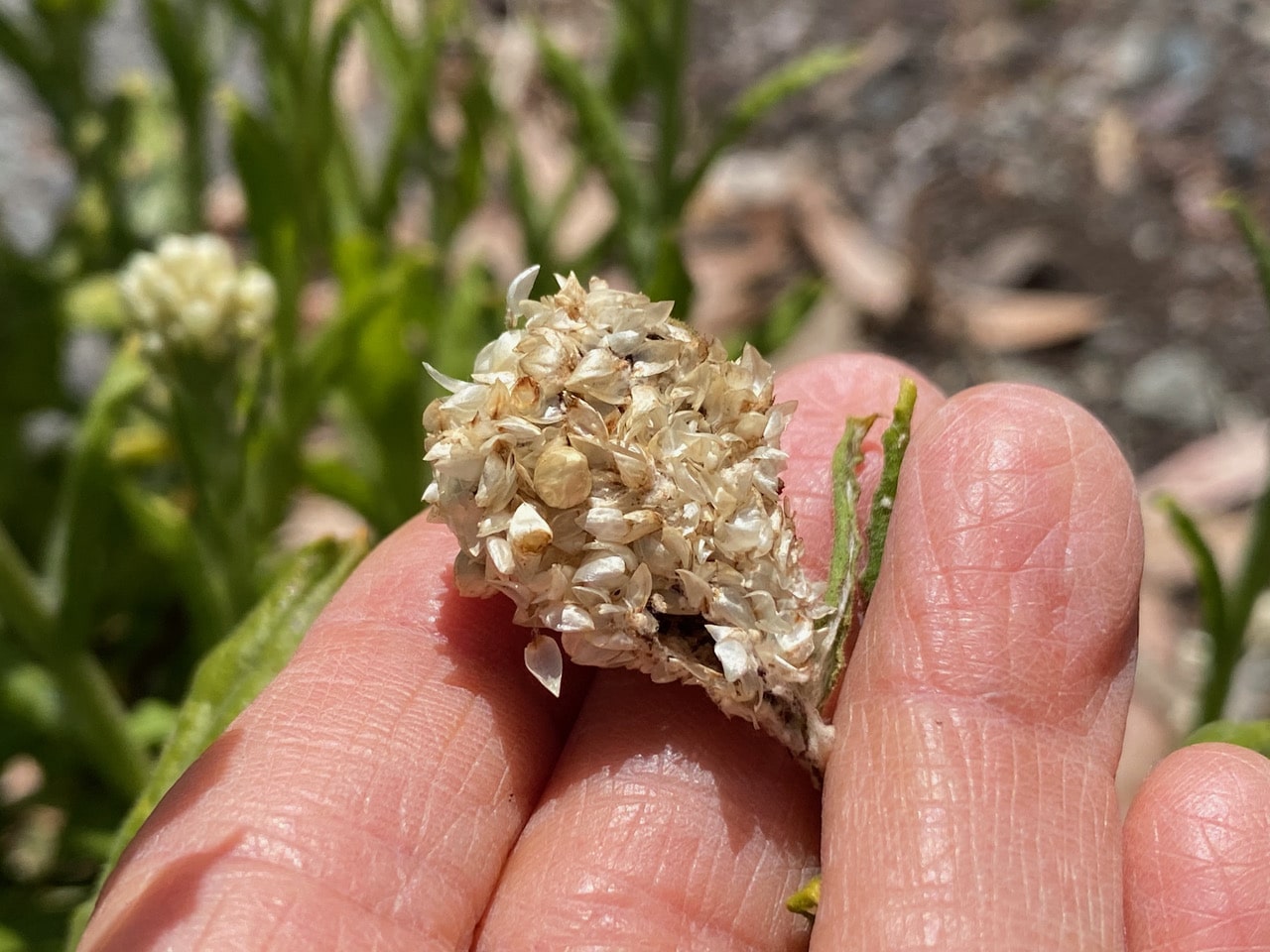
One of these nests is partially broken off, barely hanging from the stem. I remove it for examination. It feels soft and cushy between my fingers.
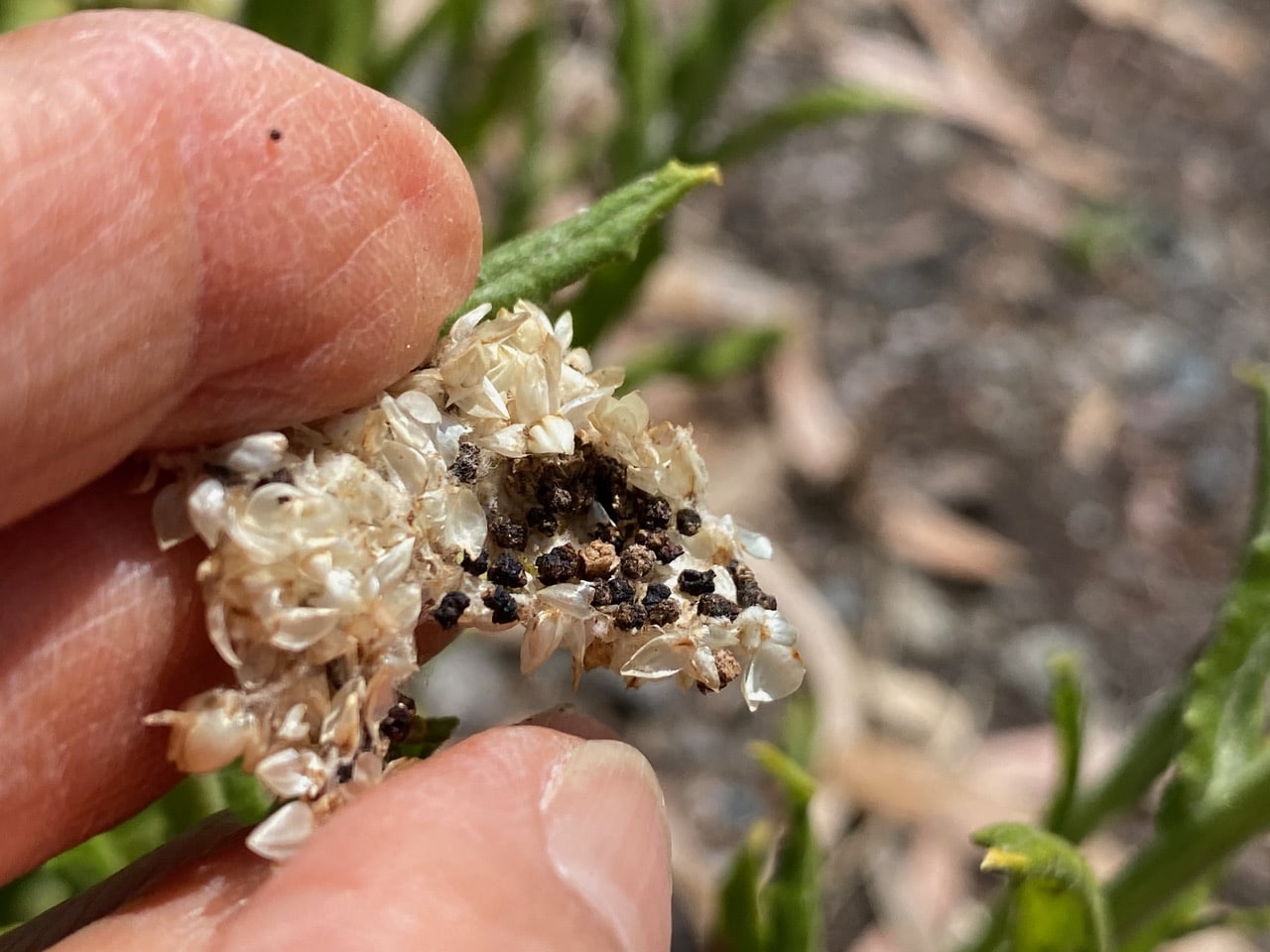
I carefully tear open the nest. There’s no caterpillar in there, just a bunch of caterpillar poop. Maybe the larva has gone off to pupate?