

Pollinator Post 6/4/23 (2)
 The golden flowers of the Sticky Monkeyflowers greet the morning sun along the paved road to the Radio Tower. The white, two-lobed stigmas are very visible on these flowers, located right at the entrance to the floral tube. The stigmas usually hide the orange stamens behind them, on the ceiling of the floral tube.
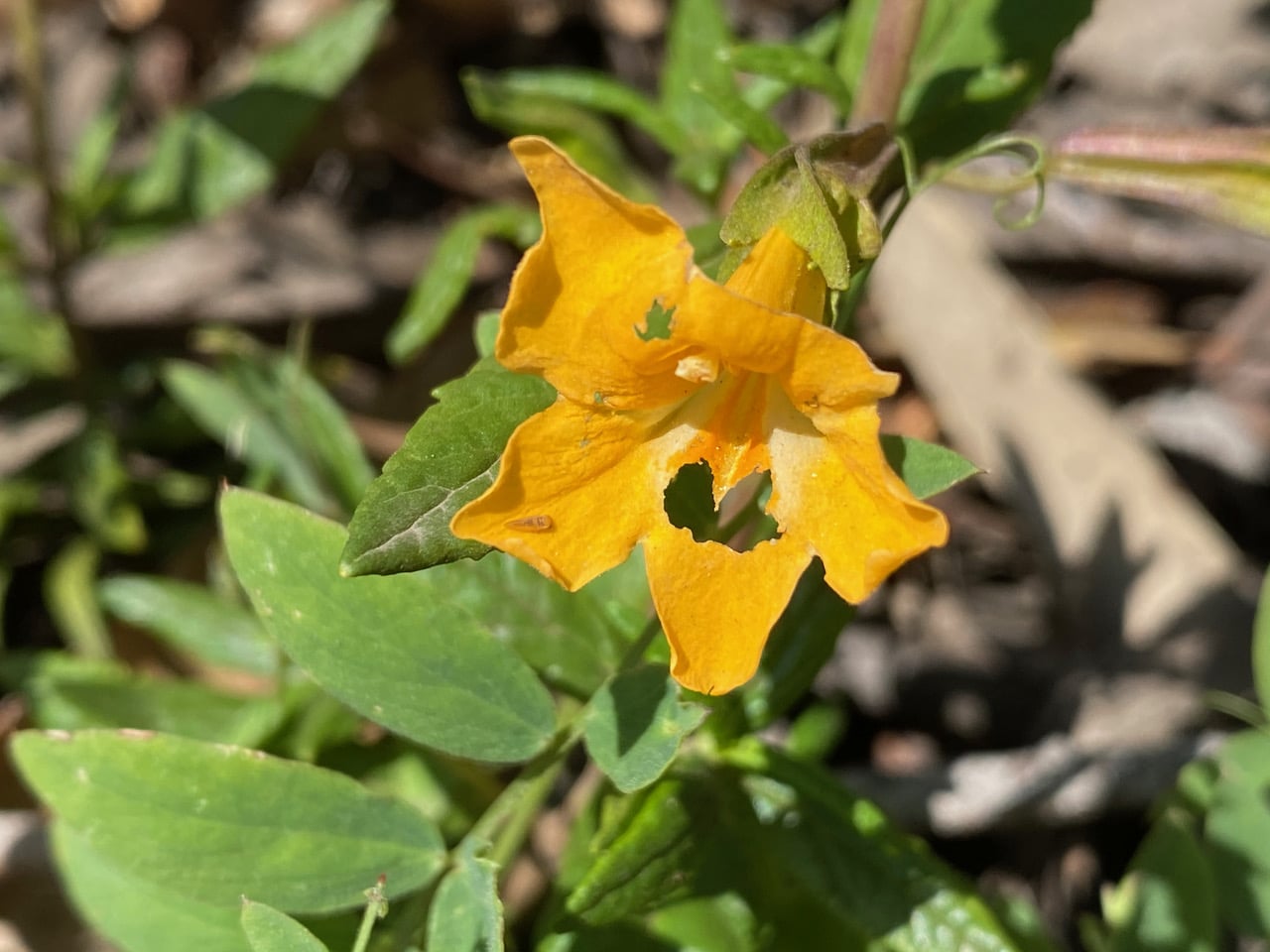
Wow, someone has inflicted some serious damage to the petals of this Sticky Monkeyflower.
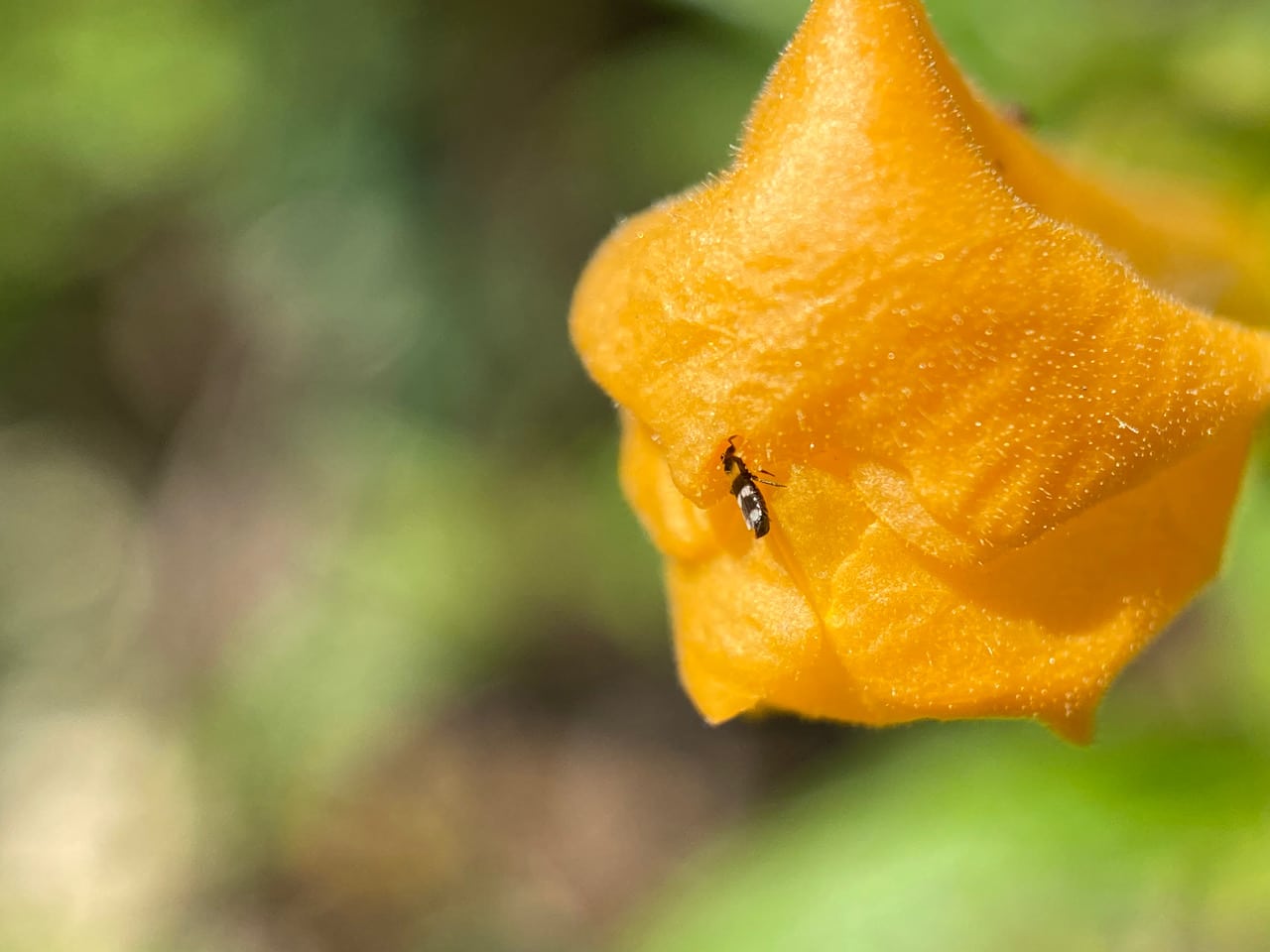
Trying to figure out the oddly shaped flower bud of a Sticky Monkeyflower, I am just in time to see a minuscule black-and-white Thrips slip through the still tightly closed petal lobes at the tip. It is an Aeolothrips Predatory Thrips (order Thysanoptera). BTW, there’s no mistake there – it’s always “thrips”, singular or plural!
Thrips (order Thysanoptera) are minute (mostly 1 mm long or less), slender insects with fringed wings and unique asymmetrical mouthparts. They feed mostly on plants by puncturing and sucking up the contents, although a few are predators. Some flower-feeding thrips pollinate the flowers they are feeding on, and some scientists believe that they may have been among the first insects to evolve a pollinating relationship with their host plants. A genus is notable for being the specialist pollinator of cycads. Thrips are likewise the primary pollinators of heathers in the family Ericaceae, and play a significant role in the pollination of pointleaf manzanita. Electron microscopy has shown thrips carrying pollen grains adhering to their backs, and their fringed wings are perfectly capable of allowing them to fly from plant to plant.
The predatory thrips are generally larger than the herbivorous thrips, about 1.5-2.5 mm long. Aeolothrips can be found whenever their prey occur. They are thought to be predaceous on small arthropods, such as plant-feeding thrips and spider mites. At least some species also feed on pollen and other arthropods, such as aphids and whiteflies.
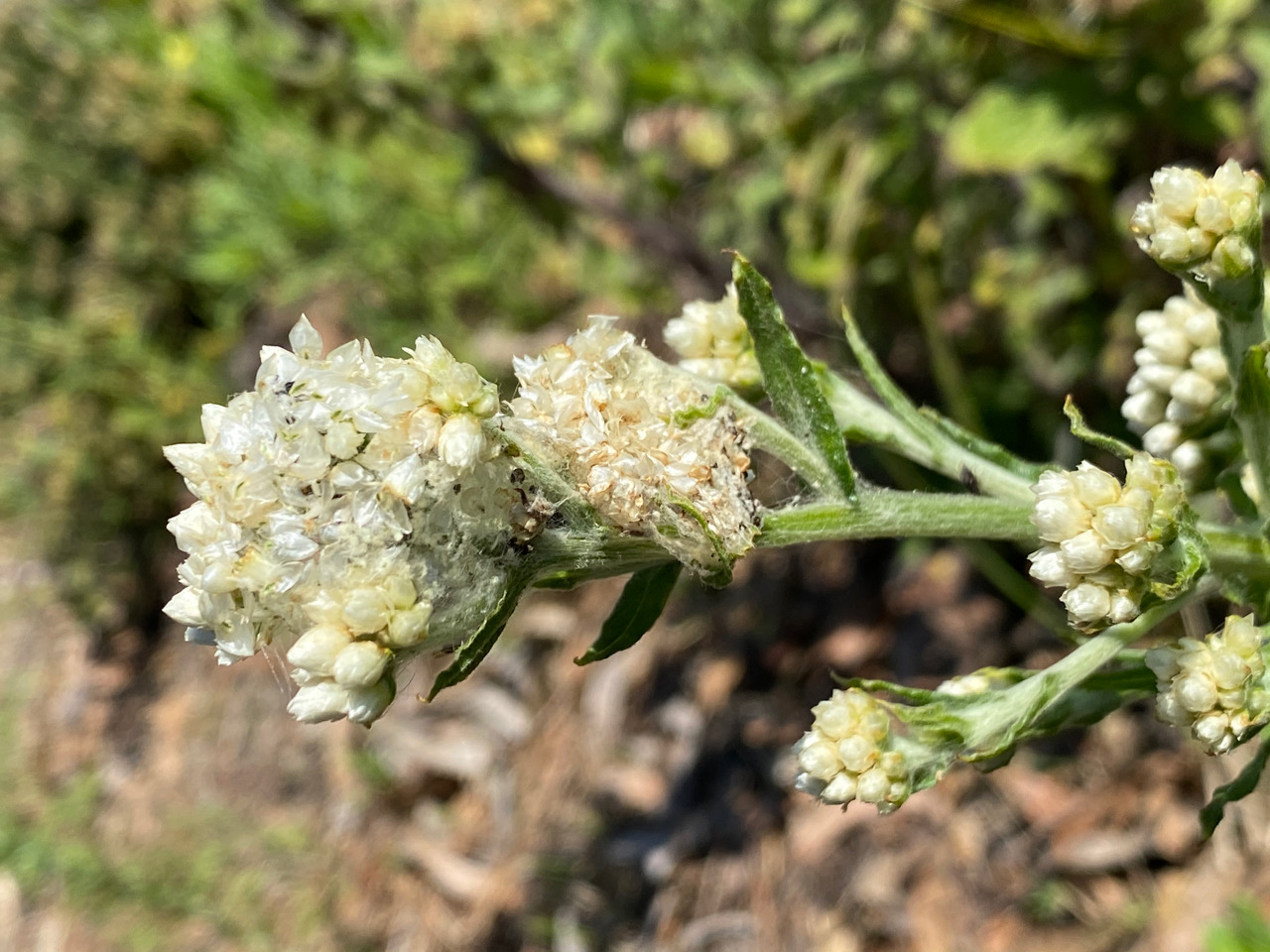
It is fun to look for the well-concealed nests or retreats of the American Lady caterpillars among the flowerheads of the California Everlasting, Pseudognaphalium californicum. There are two nests here, silken structures decorated with bits of the detached phyllaries. They could be constructed by the same caterpillar; the larvae build larger shelters as they grow and move on to feed on other parts of the plant.
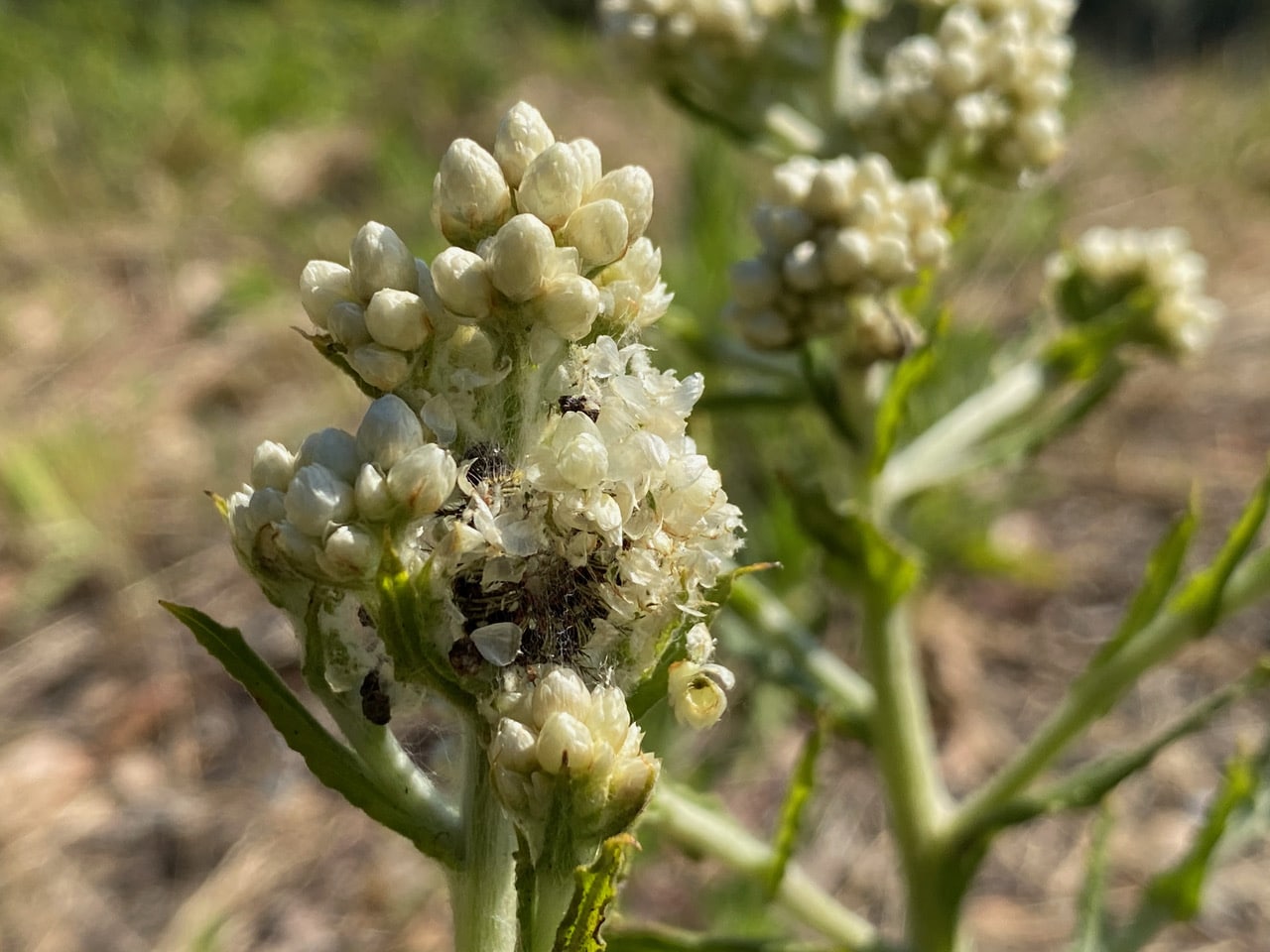
The light is not good on this caterpillar nest with a big gap, but I think I can see hints of a dark caterpillar of American Lady inside. Is the caterpillar in the process of completing its new nest?
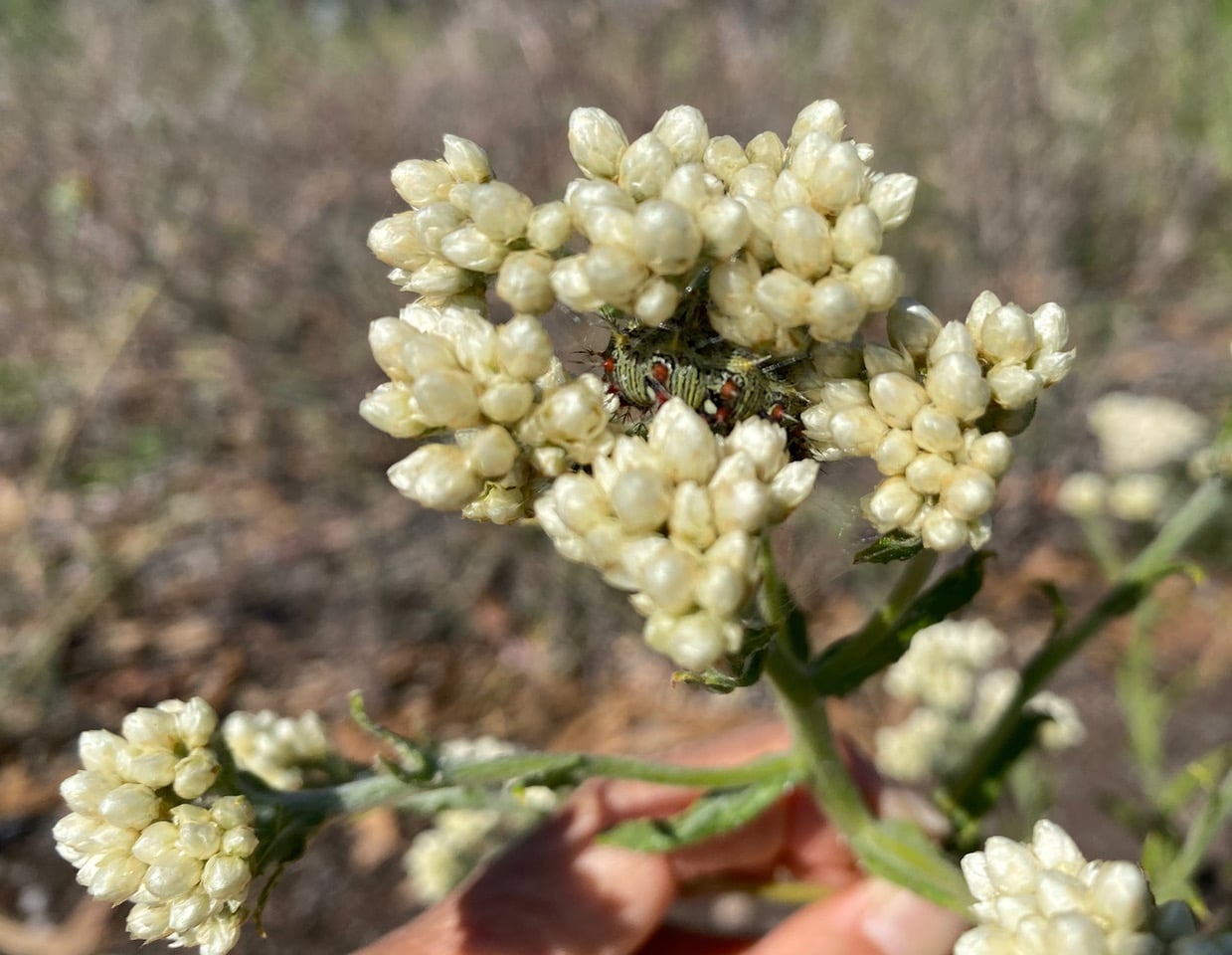
Wait, I can actually see an American Lady caterpillar in the gap between the clusters of flowerheads! It is quite large and colorful!

With the macro lens, I can see the colorful caterpillar and the silk scaffoldings of its nest under construction.
The American Lady, Vanessa virginiensis (family Nymphalidae) occurs from southern Canada throughout the US and southward to South America. The preferred host plants for the larvae are the “everlastings” or “cudweed” herbs and their close relatives in the sunflower family, Asteraceae. American Lady caterpillars are solitary feeders and construct nests from various parts of their host plant. Tiny larvae use leaf hairs to construct tiny nests; larger caterpillars arrange leaves, flower heads, and detritus to form tight shelters. Several structures are typically built during the caterpillar’s development.
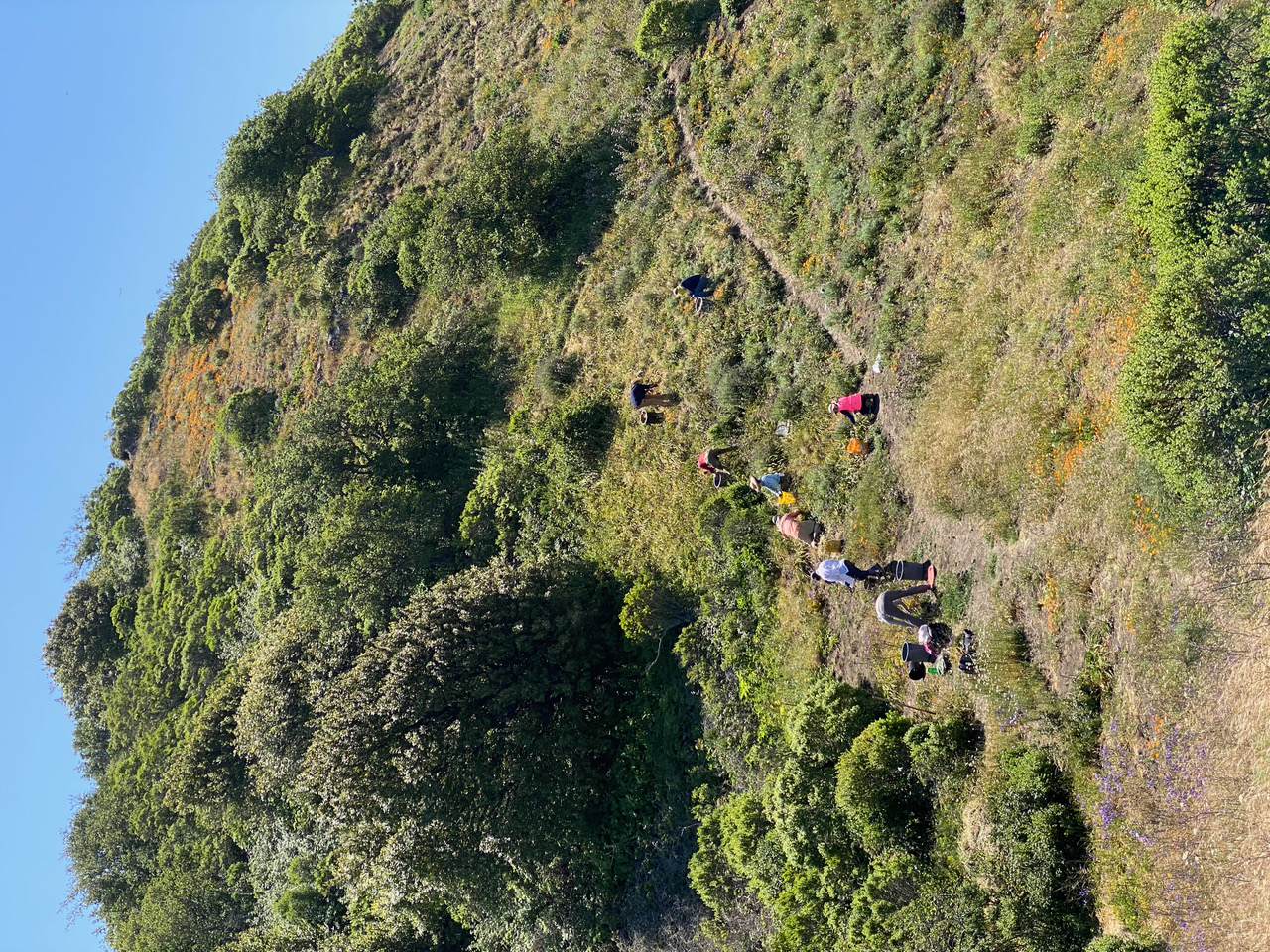
Several volunteers are hard at work pulling weeds above the Swale area when I arrive. Such a beautifully wild spot on the ridge, and oh so steep!
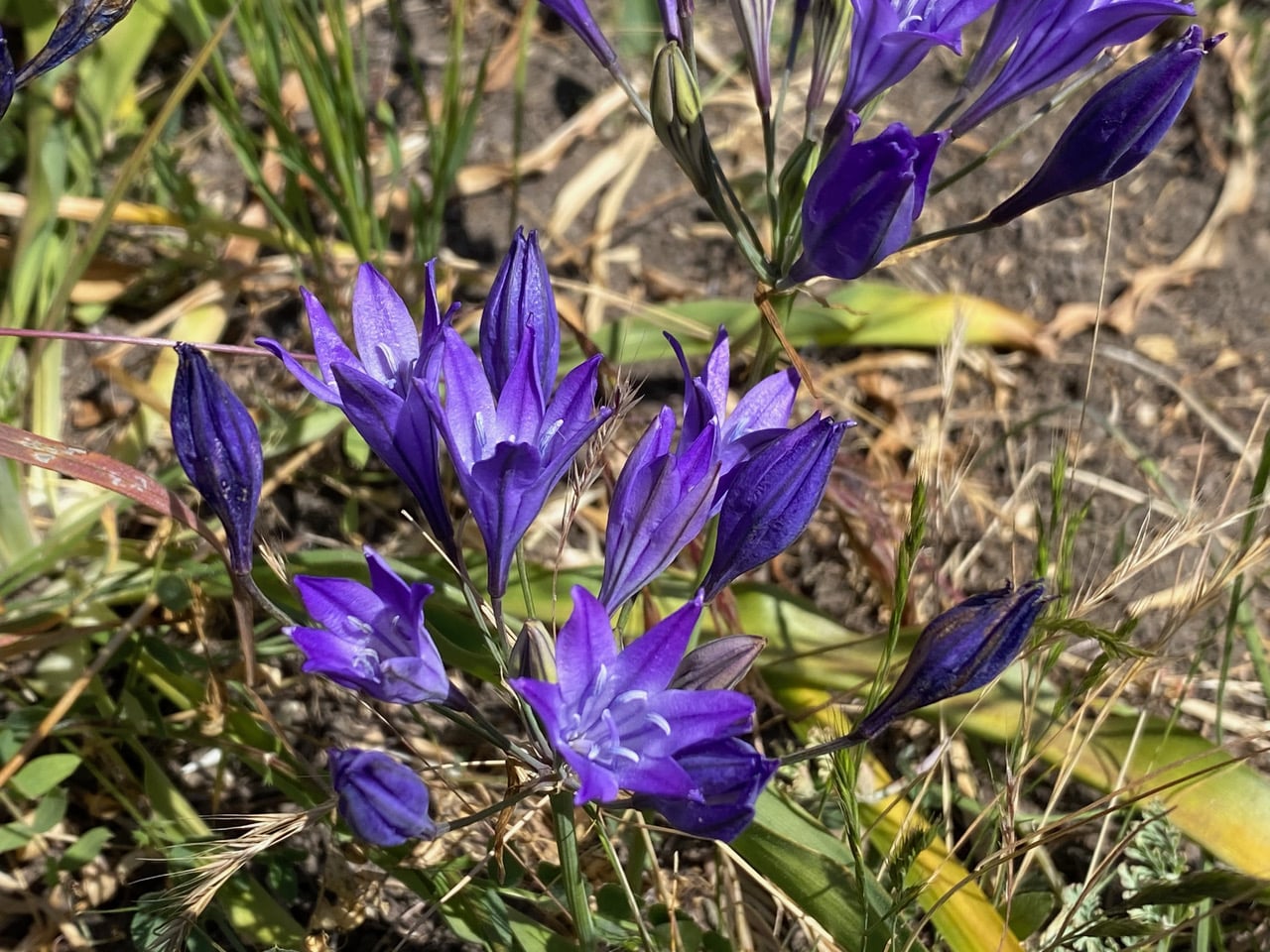
I am elated by the sight of the Ithuriel’s Spear, Triteleia laxa blooming in profusion at the Backbone area.
Ithuriel’s Spear, Triteleia laxa is a common native perennial herb in the Themidaceae (Lily) family that is found primarily in northern and central California, growing in the grasslands or sunny, open woodlands. It is a neophyte related to lilies and onions, growing from an edible corm. In spring it sends up one or a few slender grass-like leaves. In late spring or early summer, after the leaves have already withered, a slender stem will hold up an umbel-like inflorescence. The flowers are conical and consists of 6 tepals (fused at the base), 6 stamens, and a “weakly 3-lobed” stigma atop a single 3-chambered ovary. These repetitive multiples of three give rise to the generic name Triteleia, which means in Greek “perfect three”.
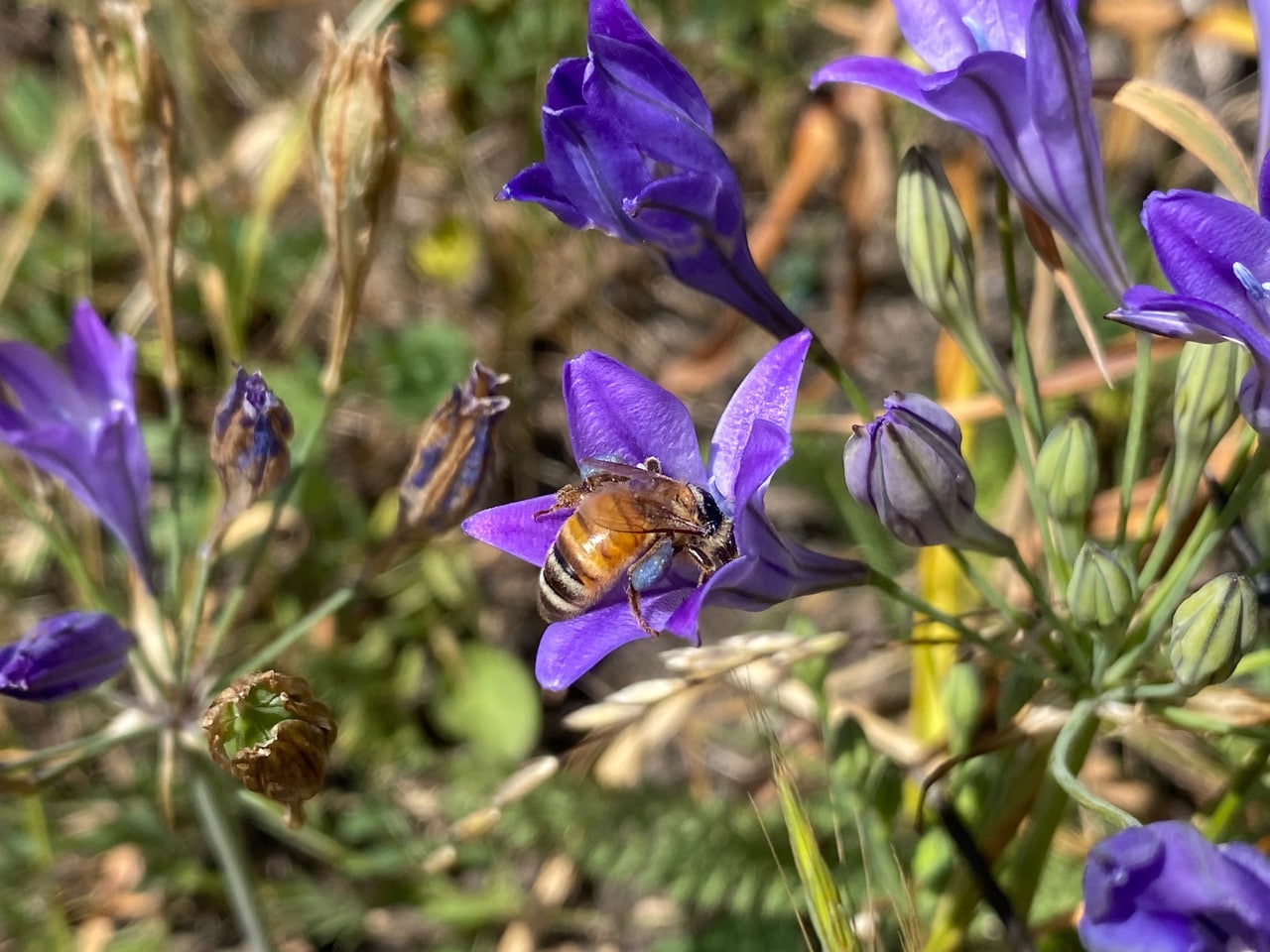
Several Bumble Bees and Honey Bees are noisily visiting the Ithuriel’s Spear flowers. Both species belong to the family Apidae, most of which have long tongues that enable them to access the nectar at the base of the tubular flowers. I am particularly taken by this Honey Bee. She is carrying blue pollen in her pollen baskets, obviously gathered from the Ithuriel’s Spear flowers.
The pollen collecting apparatus in Apidae bees, which include honey bees (genus Apis )and bumble bees (genus Bombus), is commonly called a “pollen basket” or corbicula. This region is located on the tibia of the hind legs and consists of hairs surrounding a concave region. After the bee visits a flower, she begins to groom herself and brushes the pollen down toward her hind legs and packs the pollen into her pollen basket. A little nectar mixed with the pollen keeps it all together like putty, and the stiff hairs surrounding the pollen basket hold it in place.
.jpg)
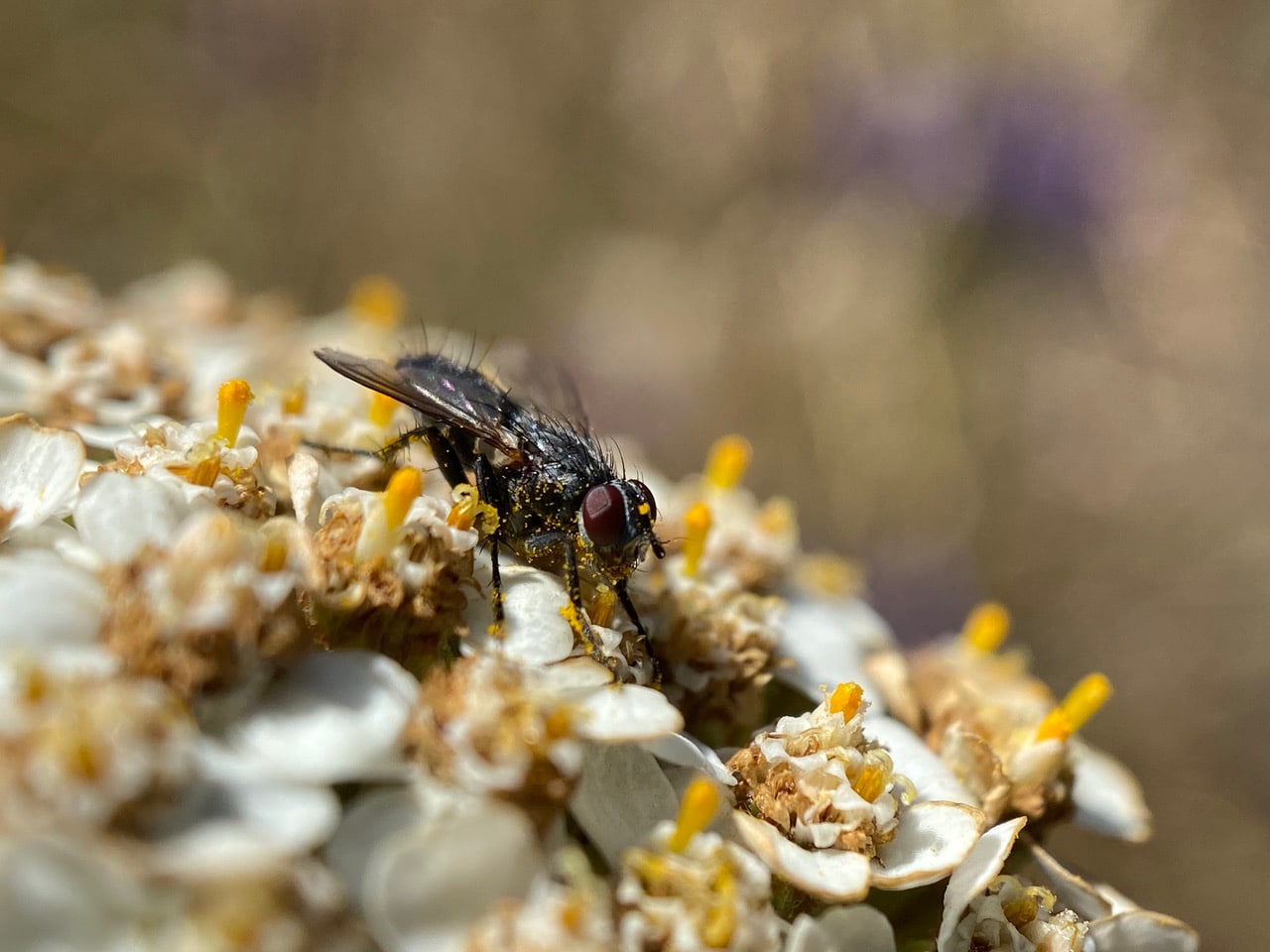
A Blow Fly, Bellardia sp. (family Calliphoridae) is foraging on the flowers of Yarrow, Achillea millefolium.
The Calliphoridae are variously known as blow flies, carrion flies, greenbottles, and bluebottles. Adults are usually brilliant with metallic sheen, often with blue, green, or black thoraces and abdomens. There are three cross-grooves on the thorax; calypters are well developed. Females visit carrion both for proteins and egg laying. The larvae that hatch feed on dead or necrotic tissue, passing through three instars before pupation. After the third instar, the larva leaves the corpse and burrows into the ground to pupate. Adult blow flies are occasional pollinators, being attracted to flowers with strong odors resembling rotting meat. The flies use nectar as a source of carbohydrates to fuel flight.
The larvae of Bellardia species are parasites of earthworms. The females are viviparous (giving birth to live young, instead of laying eggs) and deposit the larvae on earthworms.
While their dietary habits might seem revolting to humans, Blow Flies play an important role in the larger ecosystem – as decomposers/recyclers, and occasionally as pollinators as well.
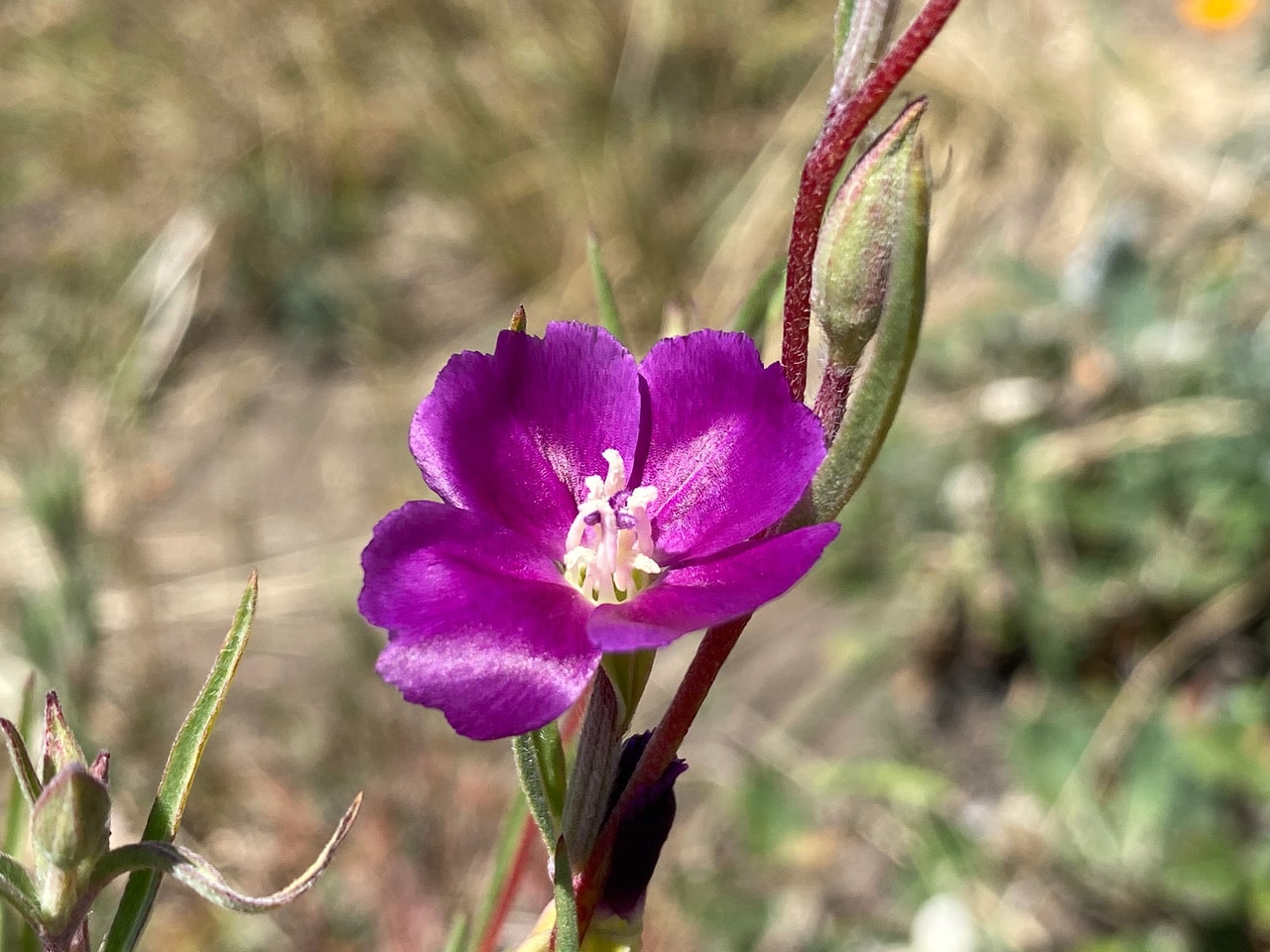
Clarkia in bloom! Are we to say farewell to spring already?
Clarkias are typically annual herbs, and almost all are native to western North America. The plants bloom in late spring into summer, when most other flowers have withered and the plants gone dormant. Winecup Clarkia, Clarkia purpurea (family Onagraceae) is one of the most common local Clarkia species. The plant erects a thin reddish stem up to a meter tall and has lance-shaped leaves. The bowl-shaped flowers have four petals 1-2 cm long and in shades of pink, purple, or deep wine red.
Clarkia species play important roles in their local ecosystems, as they provide habitat for native pollinators. Some pollinators even rely on Clarkia exclusively, such as the “Clarkia bee”. They are also used as host plants by some species as caterpillars, such as Sphingidae moths.
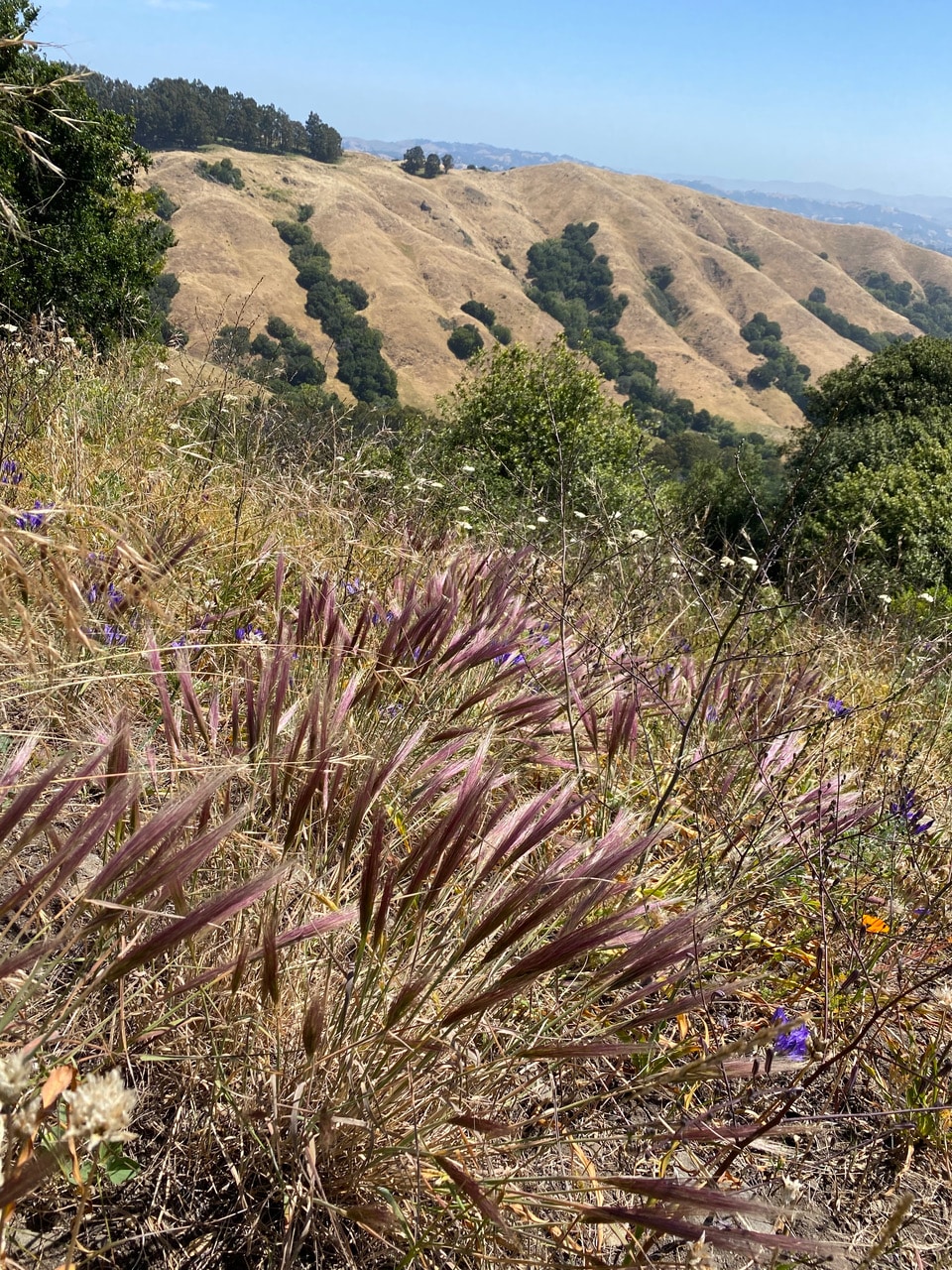
Thanks to Mary, my attention is drawn to this small patch of a beautiful native perennial grass on the steep slope of the Backbone. These are the Big Squirreltail Grass, Elymus multisetus. According to Glen:
“These grow in the driest, rocky noses of ridges and they are native in quite a few places along the ridge. On the Backbone, these are native to site, and have greatly expanded their numbers since we began removing the invasive competition.
In another two weeks, each of these flower spikes will open up into a very bushy ‘squirrel tail’ and a few weeks later will shatter and roll and blow all over the landscape.”
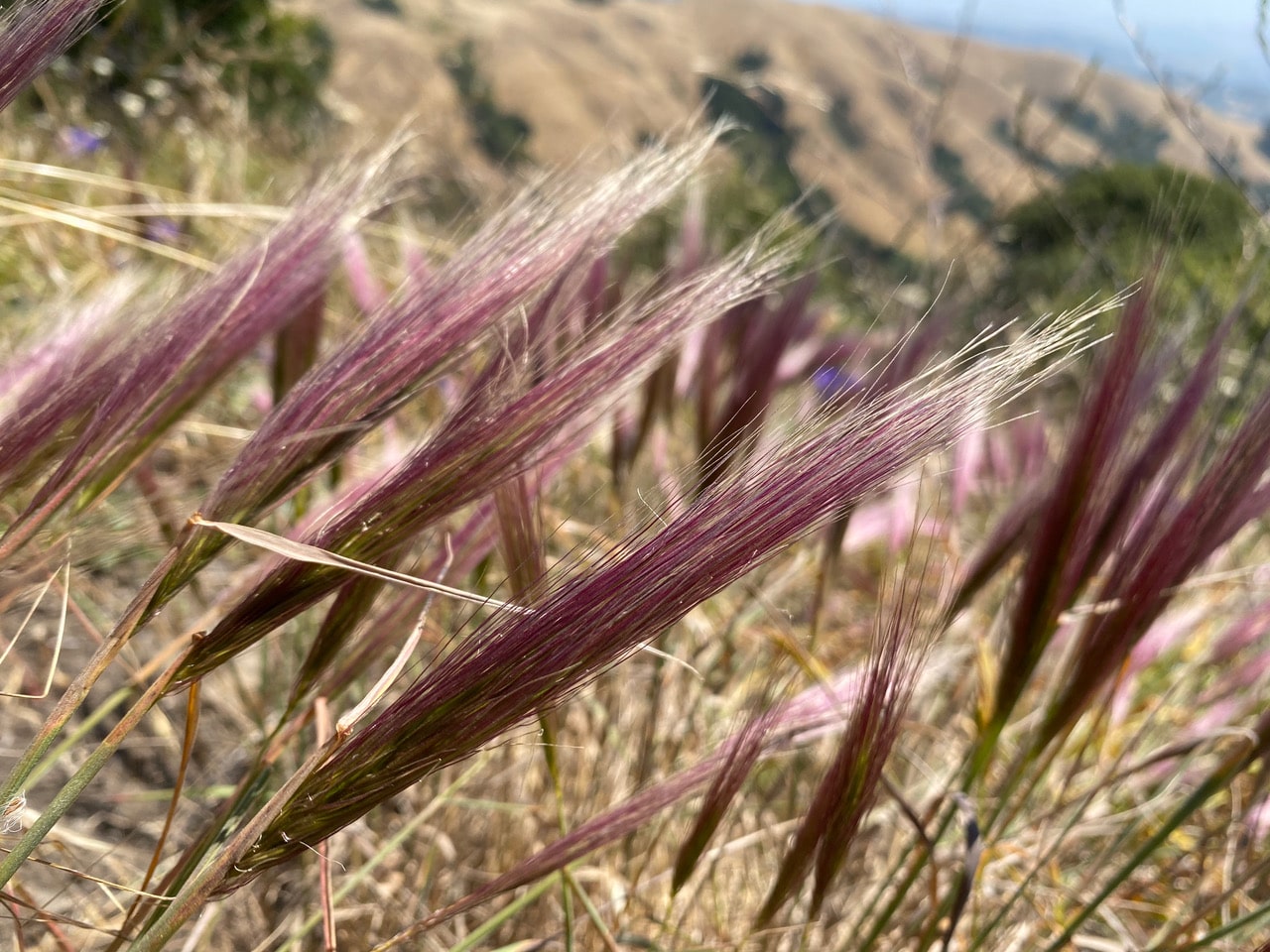
The long hair-like awns of the Big Squirreltail Grass are up to 20 cm long, silky and purplish red. It’s a treat to watch the spikelets shimmer and shine as they blow in the wind.
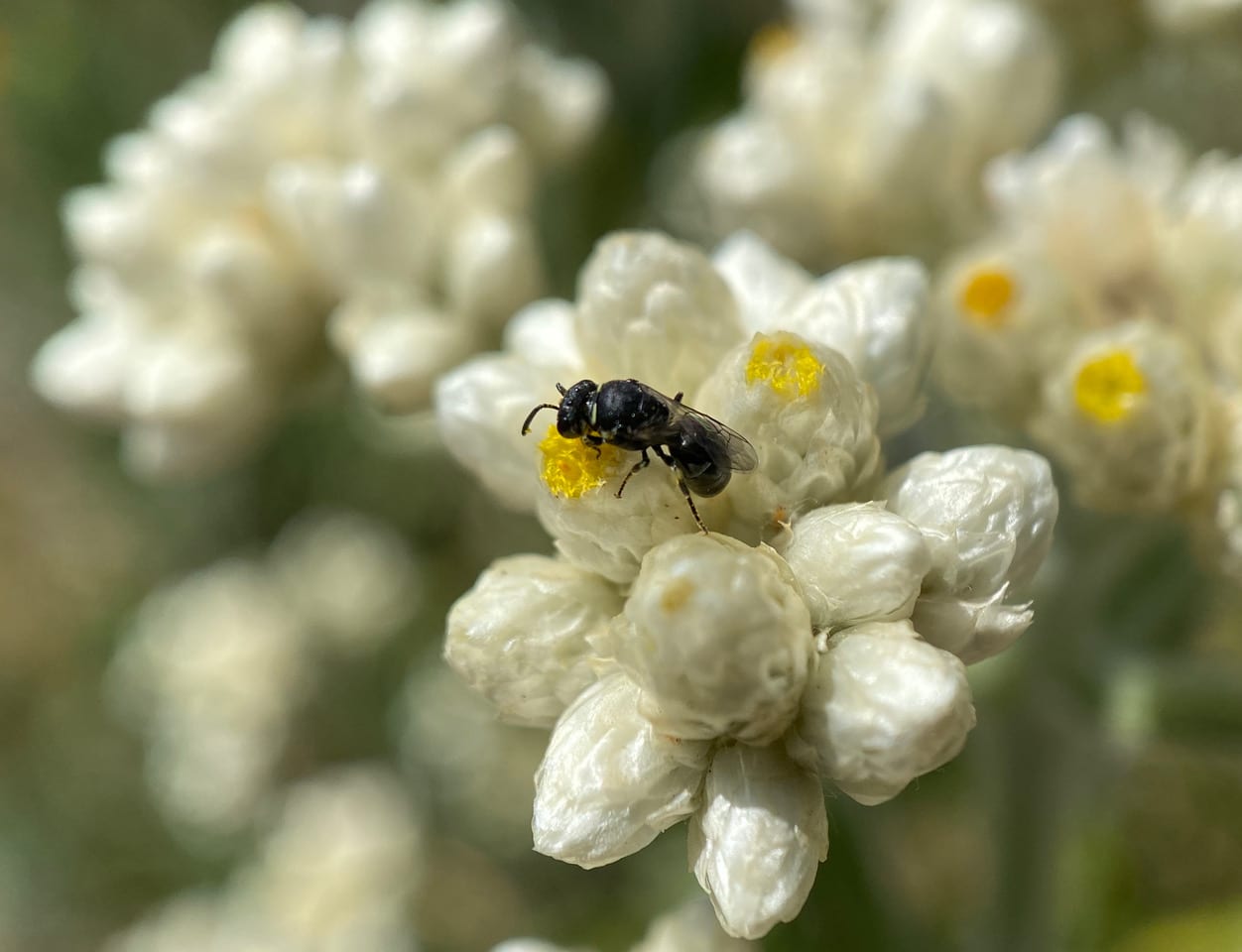
A female Masked Bee, Hylaeus sp. (family Colletidae) takes her sweet time foraging on the freshly opened flowers of the California Everlasting, Pseudognaphalium californicum relatively free from disturbance.
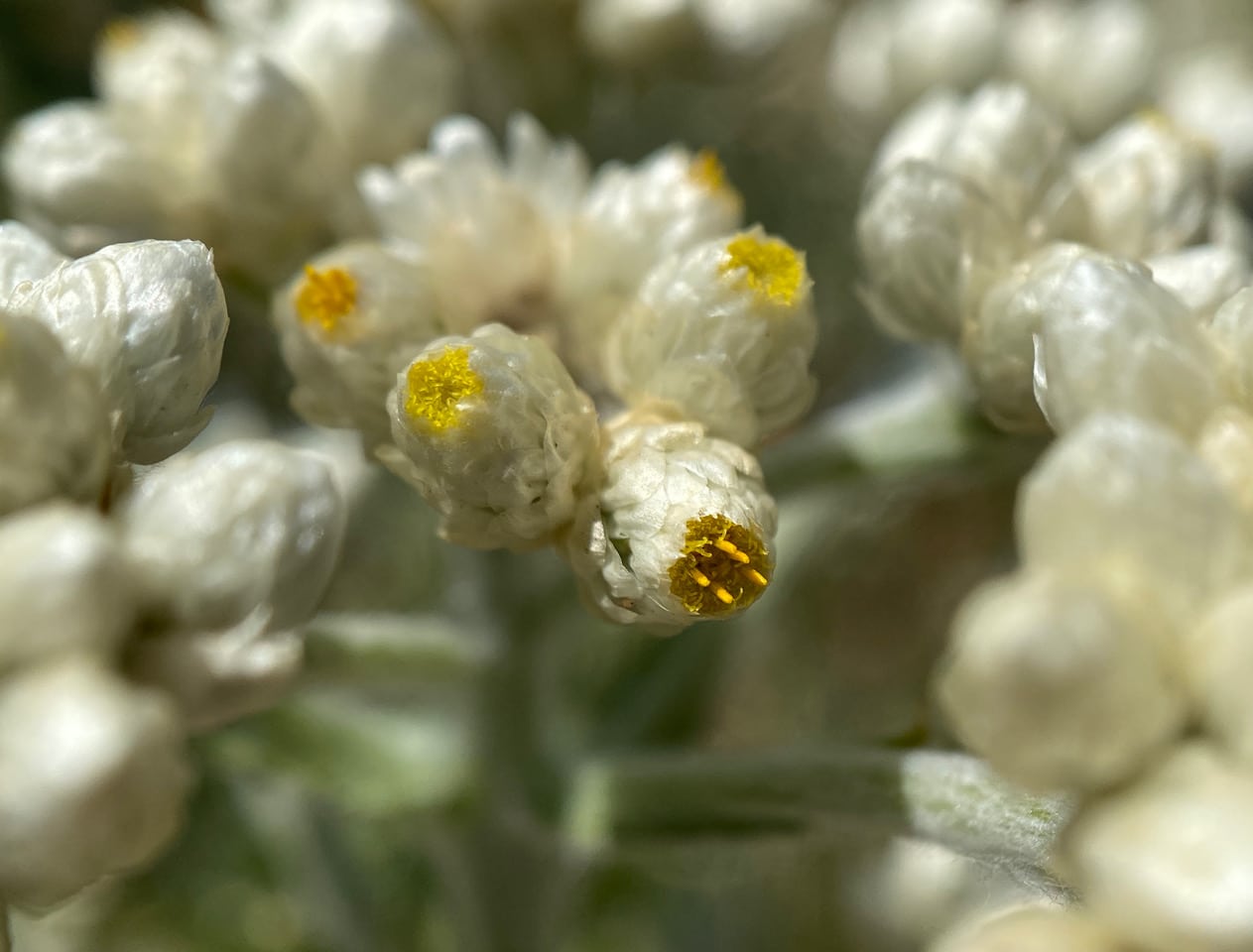
The California Everlasting inflorescence is a wide cluster of egg-shaped flowerheads, each enveloped in an involucre of rows of overlapping, papery, shiny white phyllaries. Nestled within the phyllaries are numerous, very small individual florets. The flower parts are indistinct, seen at the tip and are yellow to brownish. On maturity, the phyllaries spread apart to release small seeds which are wind-dispersed by means of pappus.
In the everlastings, the phyllaries closely enclose the tiny florets. This would seem to deter many pollinators. According to one authority, many species of everlasting are probably self-pollinated, although the small openings may be visited by small flies, bees and wasps.

There are a few seriously small shiny, dark ants (no more than 2 mm long) on the flowerheads of California Everlasting, Pseudognaphalium californicum. My only previous experience with ants of this stature is the Ergatogyne Trailing Ants, Monomorium ergatogyna. I am taking a bunch of pictures of these ants in hopes that they could be identified. Not an easy task on this windy ridge!
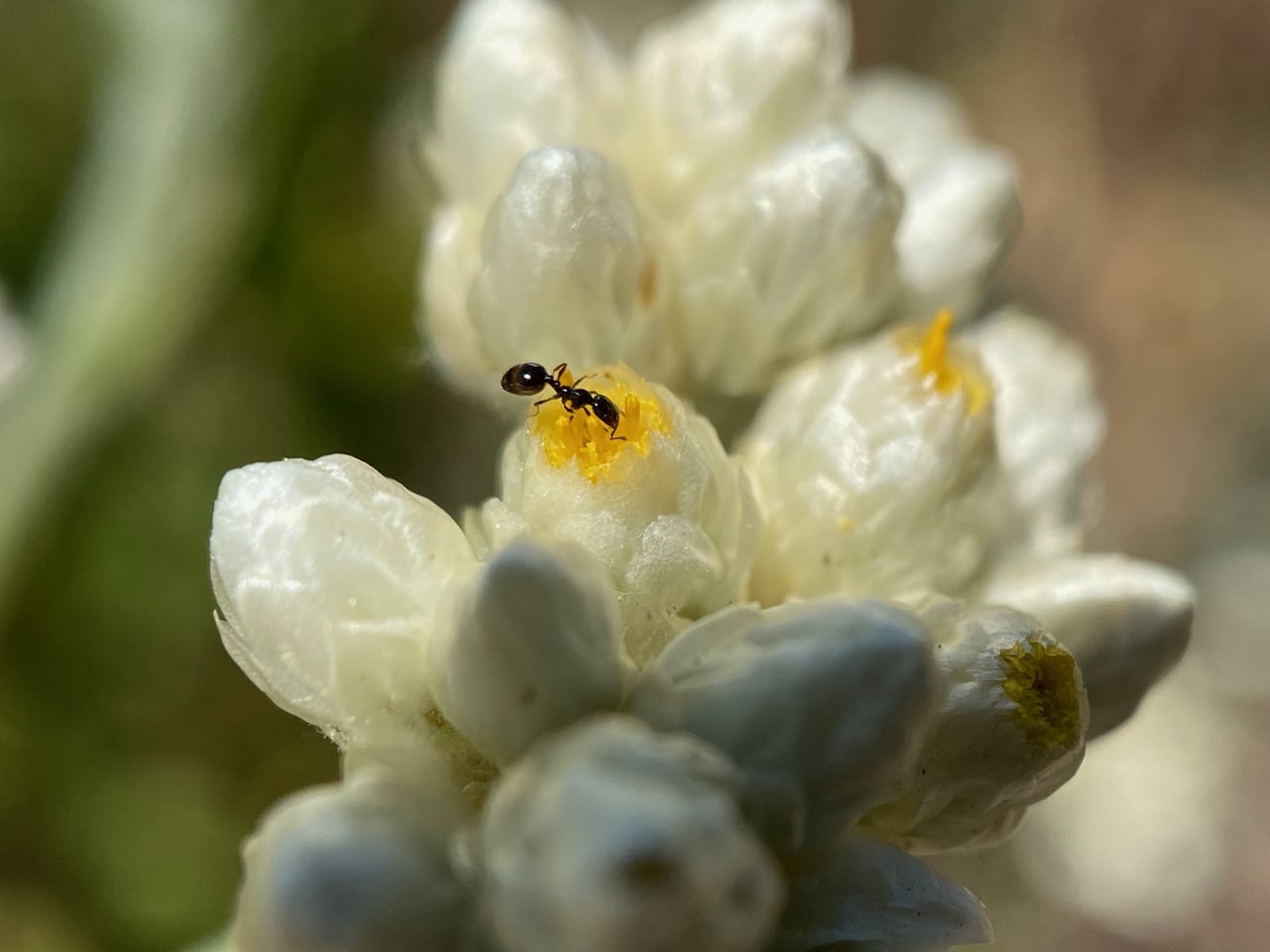
Much to my delight, my newfound ant mentors on iNaturalist have responded within 24 hours, to confirm the identity of these ants. They are indeed the Ergatogyne Trailing Ants!

The Ergatogyne Trailing Ant, Monomorium ergatogyna (family Formicidae) is native to California, Nevada, and Utah and are usually found in cities or on the coast. The ant is a shiny black color and contains only a single worker caste, making them a monomorphic species. It is also polygyne, meaning a colony contains multiple fertile queens living together. The workers are only 1.5 – 2mm long. The ants are scavengers that consume anything from bird droppings, dead insects to aphid honeydew. Sadly, Argentine Ants have been discovered to be actively pushing this species out of its original territory.
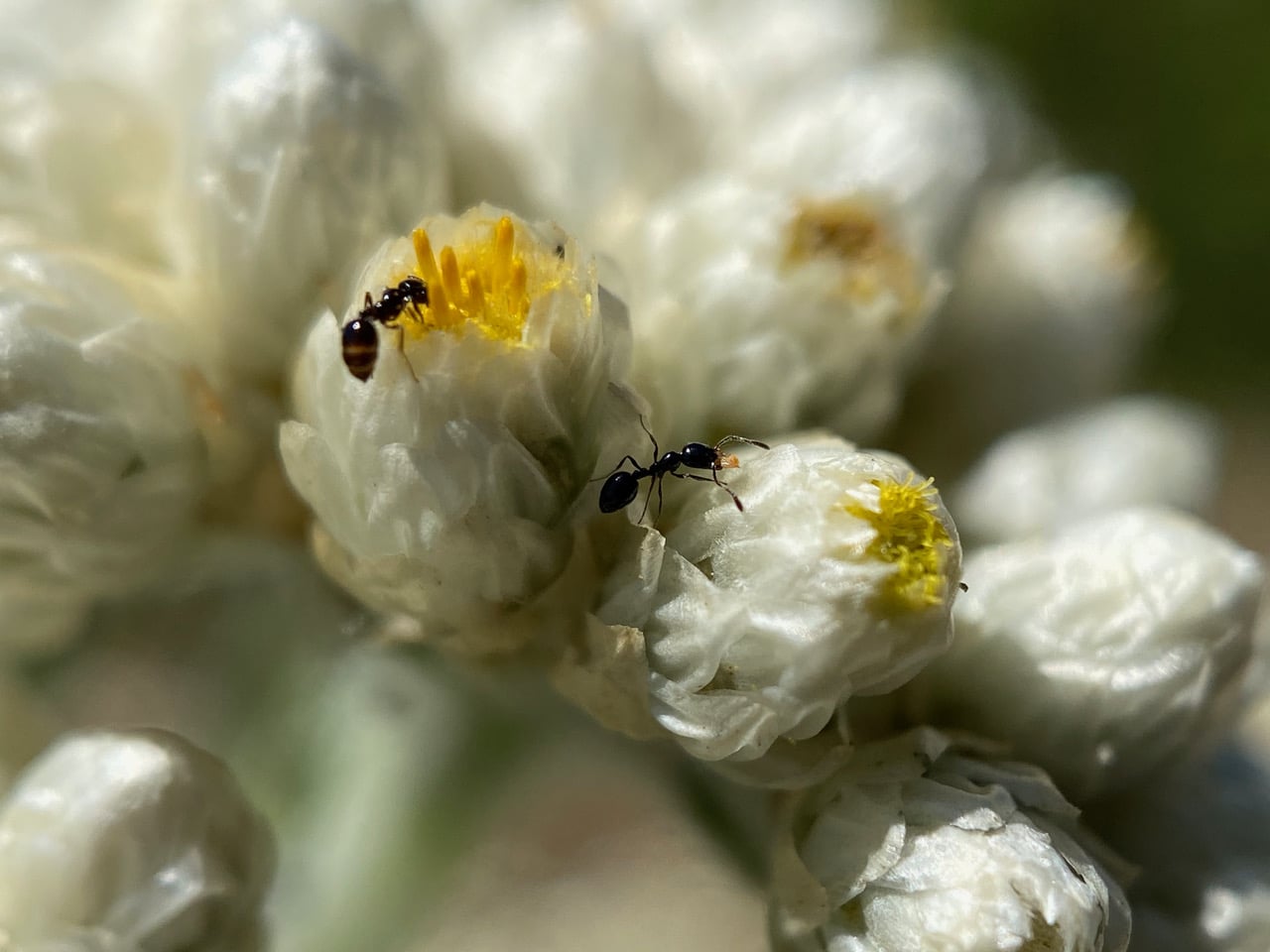
Invariably, the ants’ focus is on the exposed reproductive structures of the everlasting flowers. One ant is seen carrying away a bit of pollen in its jaws.