

Pollinator Post 7/3/23 (1)
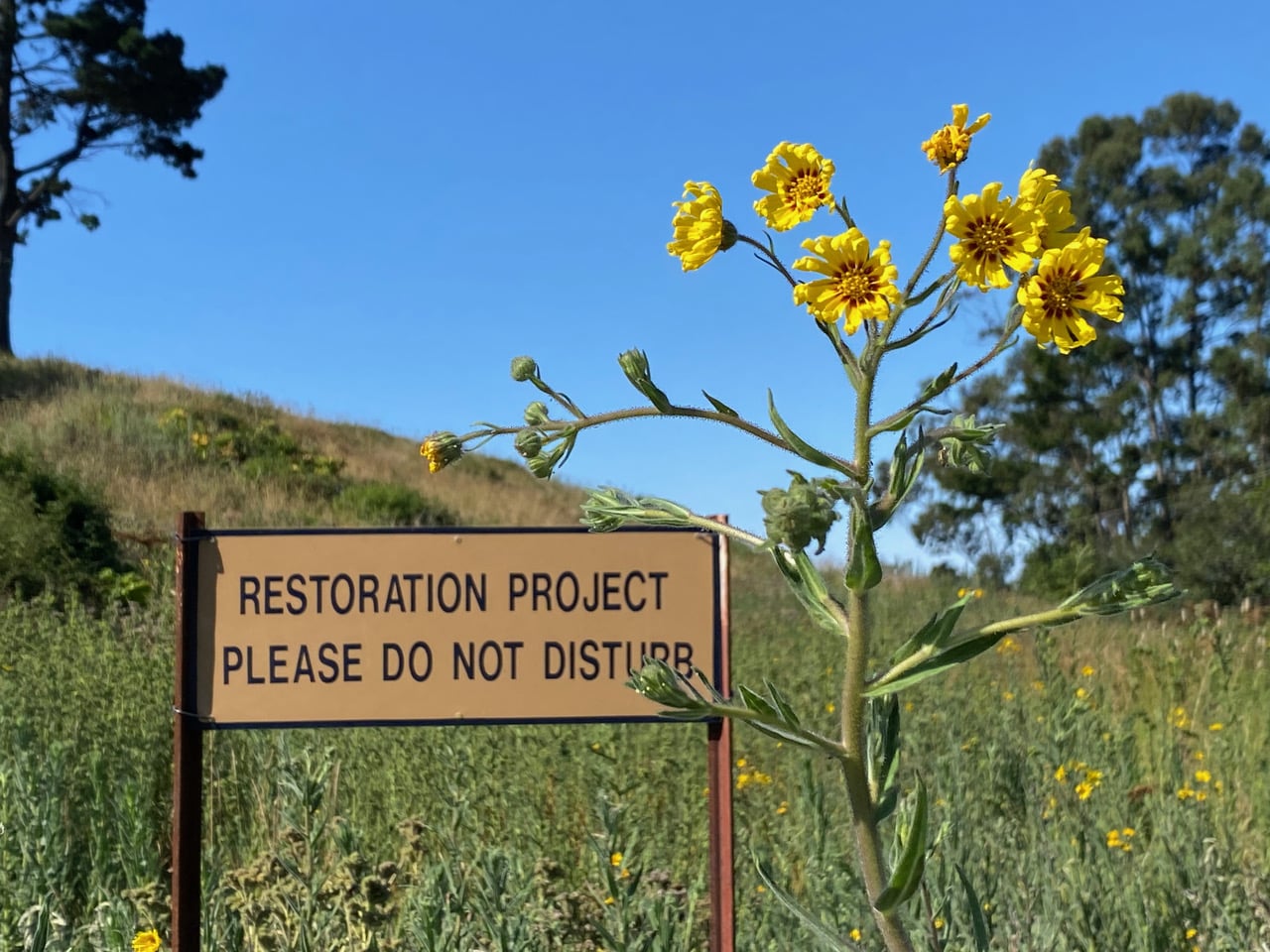 I arrive early at Siesta Gate, just as the fog has lifted and the Elegant Tarweed, Madia elegans flowerheads are still open. The species has apparently held its own in this little patch that it shares with a more aggressive relative, the Coast Tarweed, Madia sativa. Both are in bloom now, and I am excited to find what insects there are.
 Unusual among plants, Madia starts to close its flowerheads at mid-morning when the day heats up. The flowerheads open up again in the cool of the evening through the next morning. Why does Madia do this?
The Madia flowerhead closes on hot days because it lacks a way to prevent moisture loss. While the closing seems to happen by the clock, it’s really because the drought stress is worse at about the same time each day. The leaves and stems have a very efficient way to avoid wilting – they contain a mucilage (gel-like substance) that holds water tightly. But this material is lacking in the flowers. Closing the flowerheads reduces the surface from which water can evaporate, preventing desiccation. From my own observation, each Madia flowerhead can go through the opening/closing cycles for about 5 days before senescing.
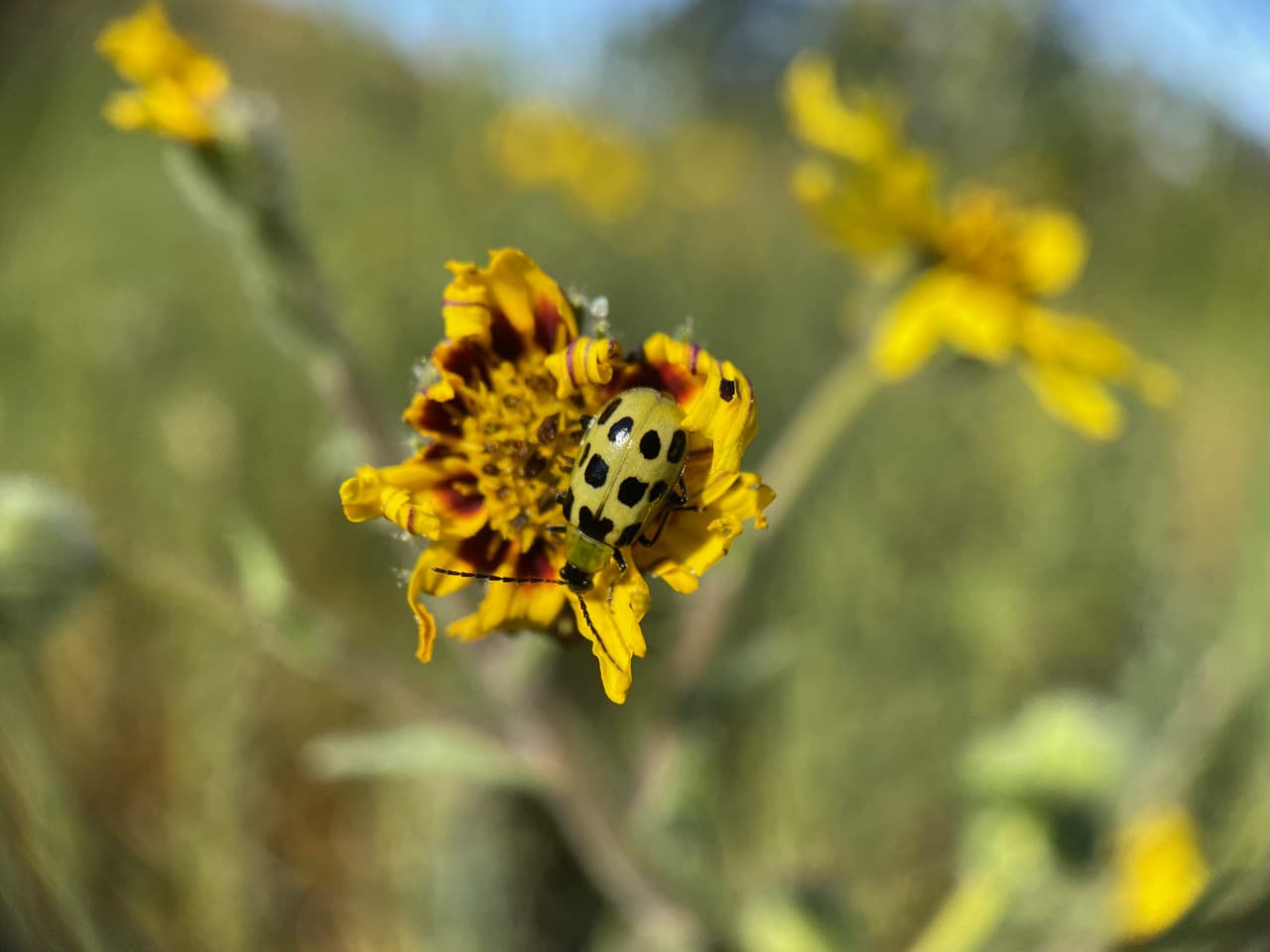
It’s not surprising to see the ubiquitous Spotted Cucumber Beetle, Diabrotica undecimpunctata (family Chrysomelidae). In fact, many of the Elegant Tarweeds have lost all of their ligules (petal-like parts of the ray florets) to the beetle’s chewing.
Members of the family Chrysomelidae are commonly known as Leaf Beetles. Adults and larvae feed on all sorts of plant tissues, and all species are fully herbivorous. Many are serious pests of cultivated plants, including food crops. Others are beneficial due to their use in biocontrol of invasive weeds. Chrysomelids are popular among insect collectors, as many are conspicuously colored, typically in glossy yellow to red or metallic blue-green hues, and some have spectacularly bizarre shapes. Photos of Leaf Beetles (Family Chrysomelidae) · iNaturalist
Native to North America, the Spotted Cucumber Beetle can be a major agricultural pest, causing damage to crops in the larval as well as adult stages of their life cycle. Larvae, sometimes known as rootworms feed on the roots of emerging plants. In the adult stage the beetles cause damage by eating the flowers, leaves, stems and fruits of the plant.

A male Diamond Spottail, Fazia micrura (family Syrphidae) visits a flowerhead of Elegant Tarweed, Madia elegans.
Hover Flies, also called Syrphid Flies make up the insect family Syrphidae. They are often seen hovering or nectaring at flowers; the adults of many species feed mainly on nectar and pollen, while the larvae eat a wide range of foods. In many species, the larvae feed on aphids, thrips, and other plant-sucking insects. In some species, the larvae are saprotrophs, eating decaying plant and animal matter in the soil or in ponds and streams. Many Hover Flies are brightly colored, with spots, stripes and bands of yellow; due to this coloring, they are often mistaken for wasps or bees. They exhibit Batesian mimicry – the resemblance to stinging insects gives the hover flies some protection from predators.
Hover Flies are considered the second-most important groups of pollinators after wild bees. Most are generalists that visit a wide range of plant species. The feeding habits of Syrphid larvae further endear them to the gardeners, serving as pest control agents and recyclers of organic matter.
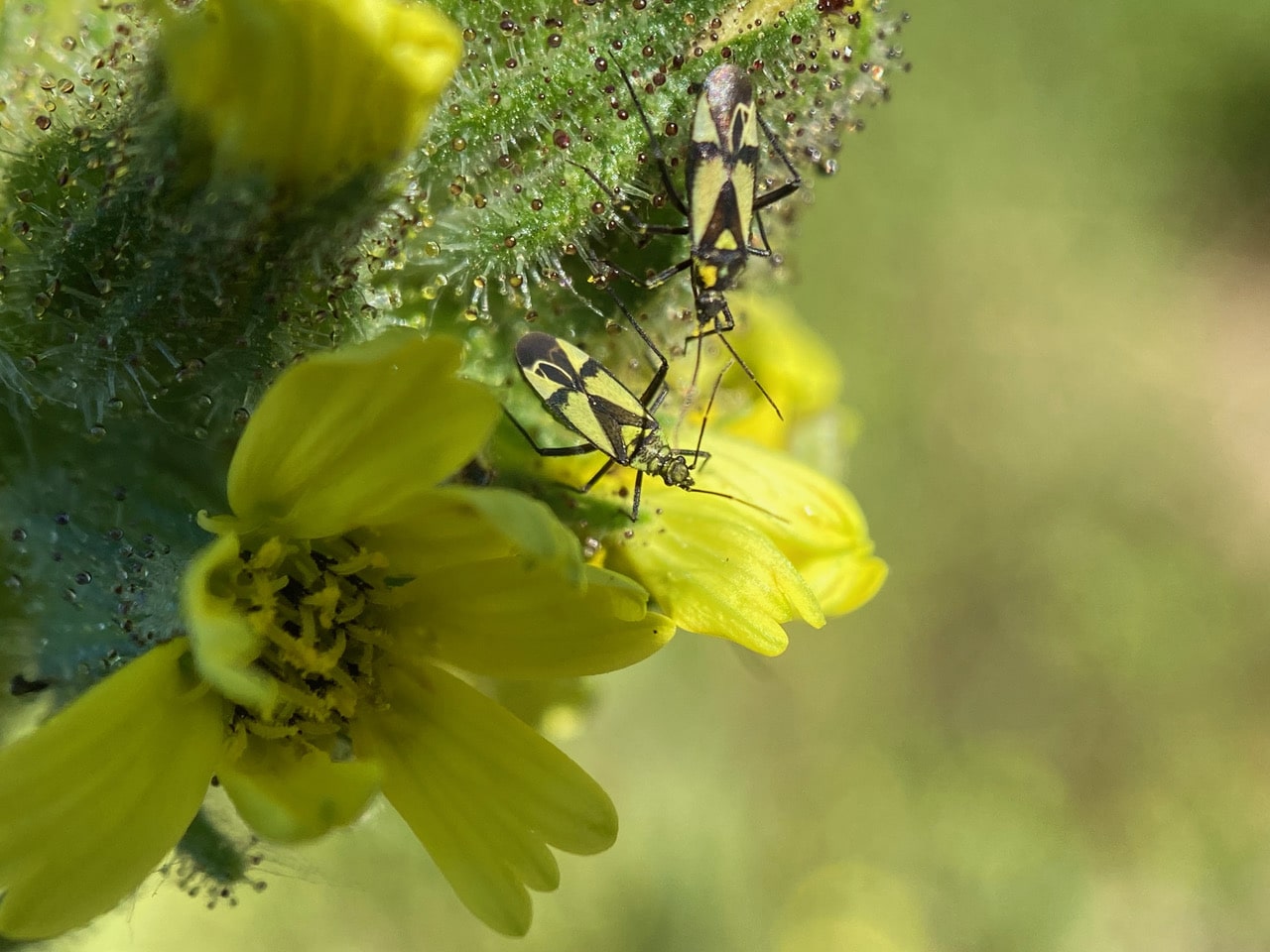
A couple of small Plant Bugs, Macrotylus essigi (family Miridae) are frolicking on a flowerhead of Coast Tarweed, Madia sativa.
Mirid bugs are also referred to as plant bugs or leaf bugs. Miridae is one of the largest family of true bugs in the order Hemiptera. Like other Hemipterans, Mirids have piercing, sucking mouthparts to extract plant sap. Some species are predatory. One useful feature in identifying members of the family is the presence of a cuneus; it is the triangular tip of the corium, the firm, horny part of the forewing, the hemielytron. The cuneus is visible in nearly all Miridae.

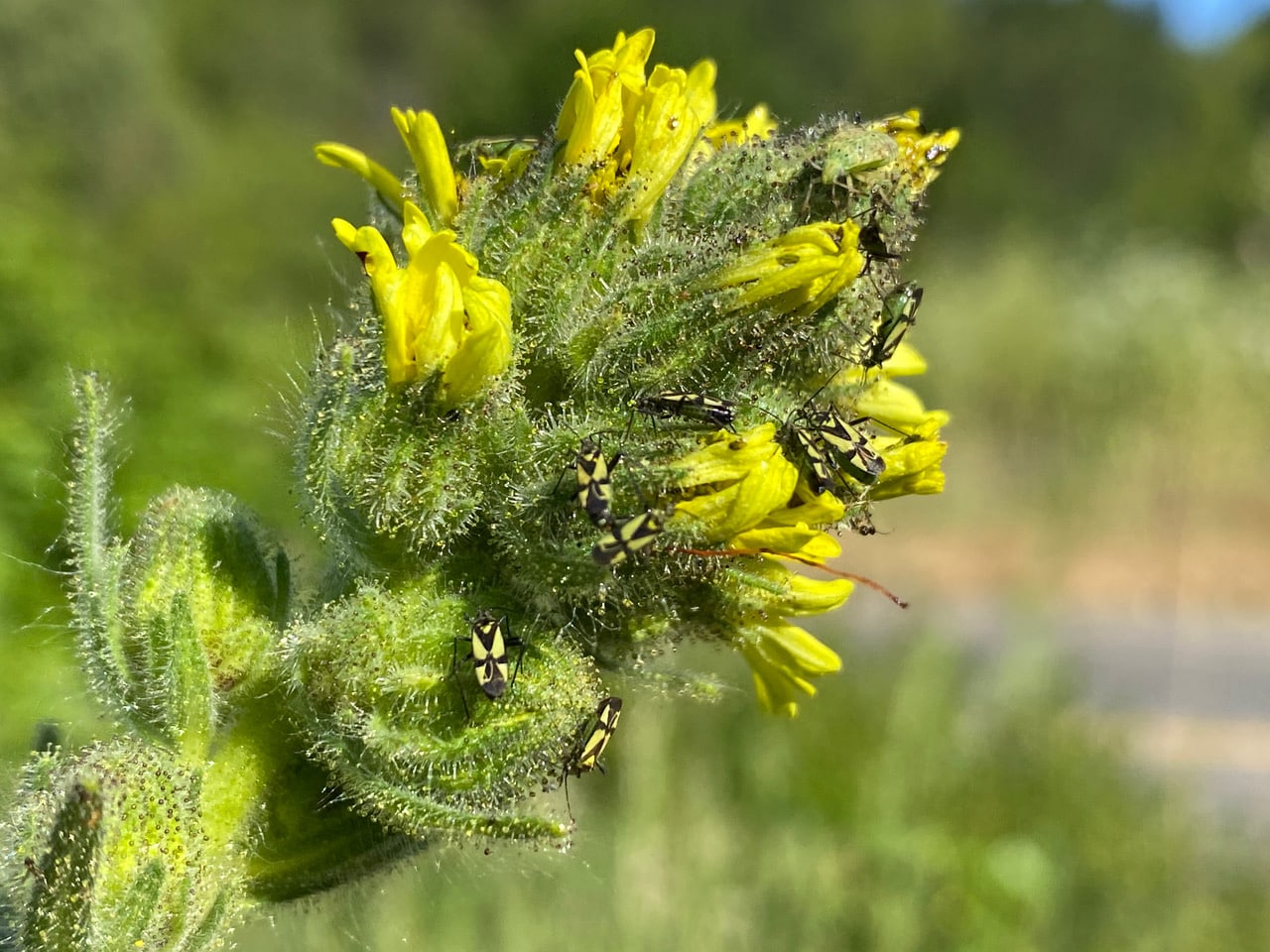
Wow, apparently there’s a major outbreak of the Plant Bug, Macrotylus essigi on the Coast Tarweed. There’s at least a dozen of them on this flowerhead. I have never seen such a large number of them gathered in one place!
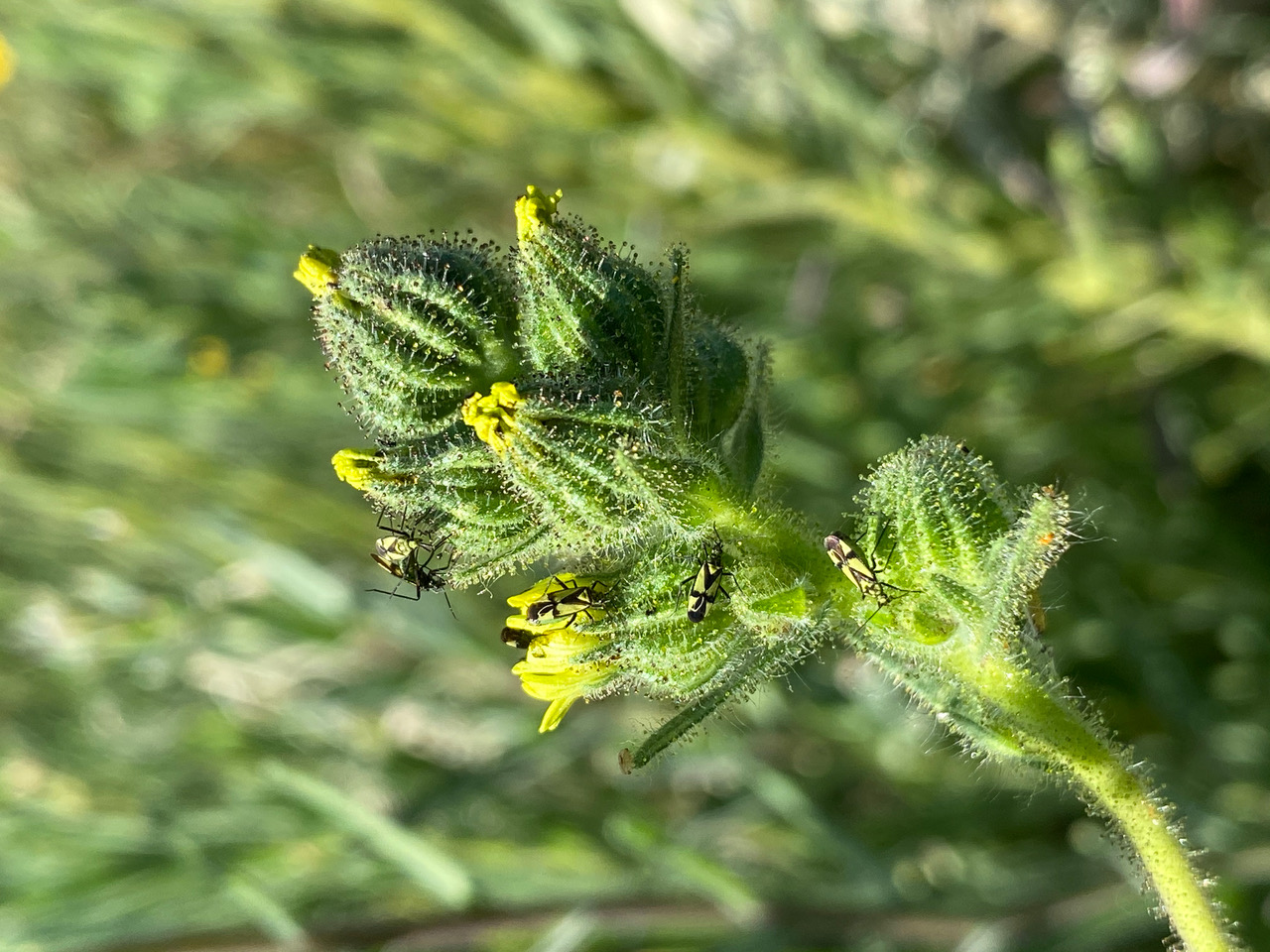
As I look around, getting totally smeared with the sticky exudates of Coast Tarweed, I find many more of Macrotylus essigi on the flowerheads. Unlike me, these bugs obviously have special adaptations for getting around the sticky plant with impunity.
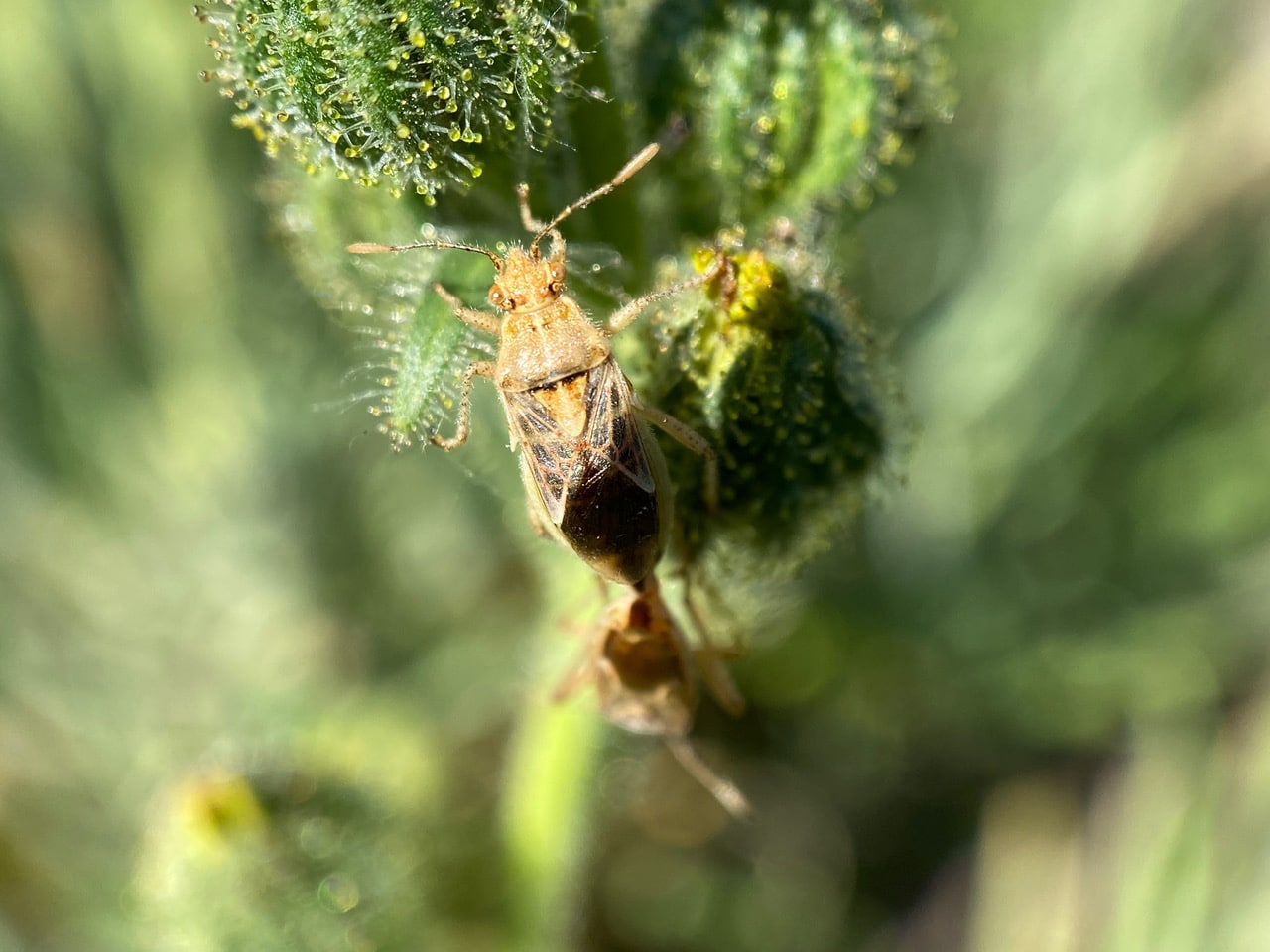
Oh, here’s another bug that is a sticky plant specialist. It belongs to the family Rhopalidae of Scentless Plant Bugs.
Rhopalidae are a family of true bugs in the order Hemiptera. They differ from the related Coreids in lacking well-developed scent glands. All are plant feeders, using their piercing-sucking mouthparts. They live for the most part on weeds, and are not considered economically important.
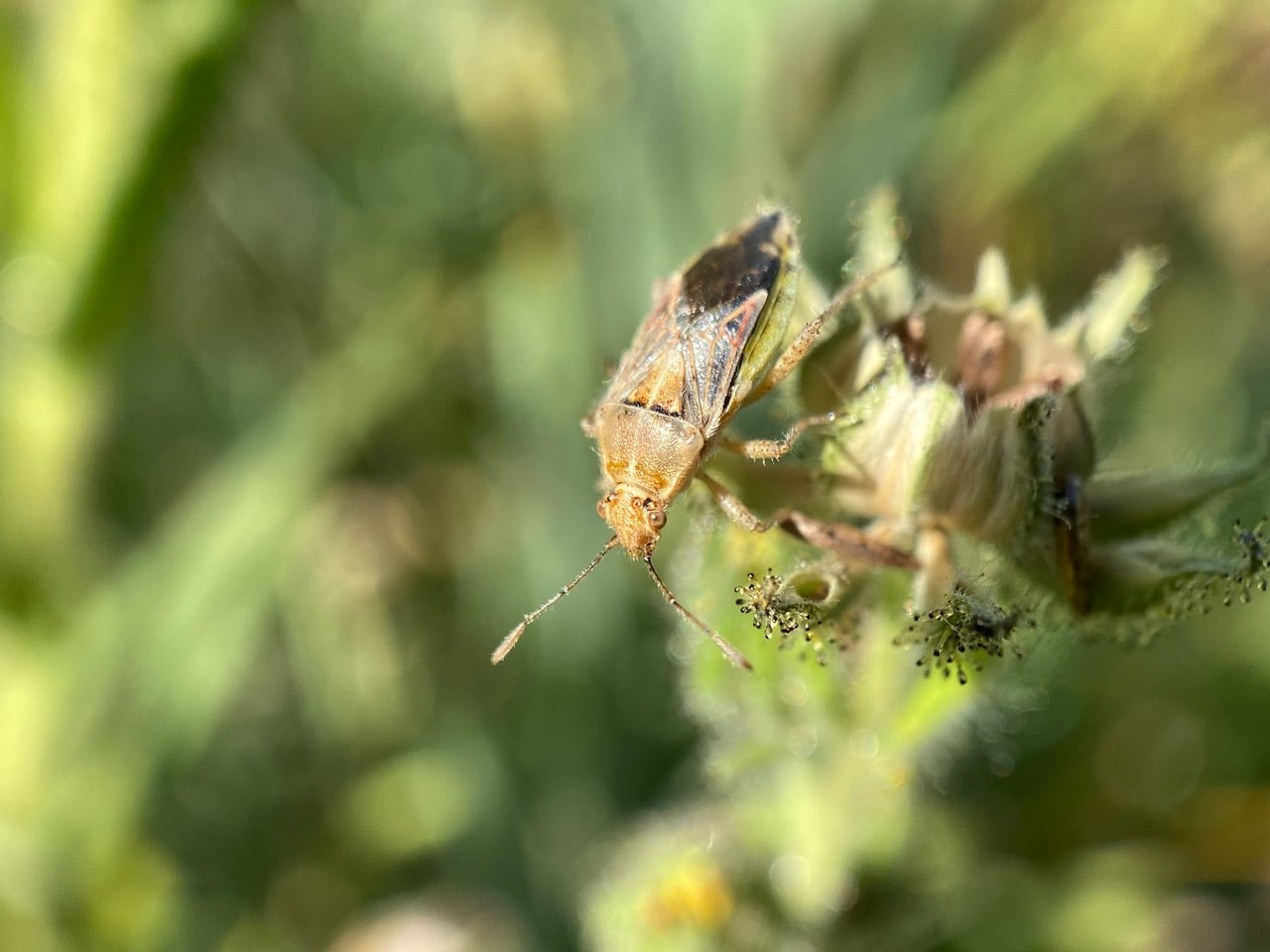
I find it difficult to photograph Rhopalids – they are skittish, and their body reflects light in an odd way. Maybe it’s their pubescence – the short hairs that cover their body?
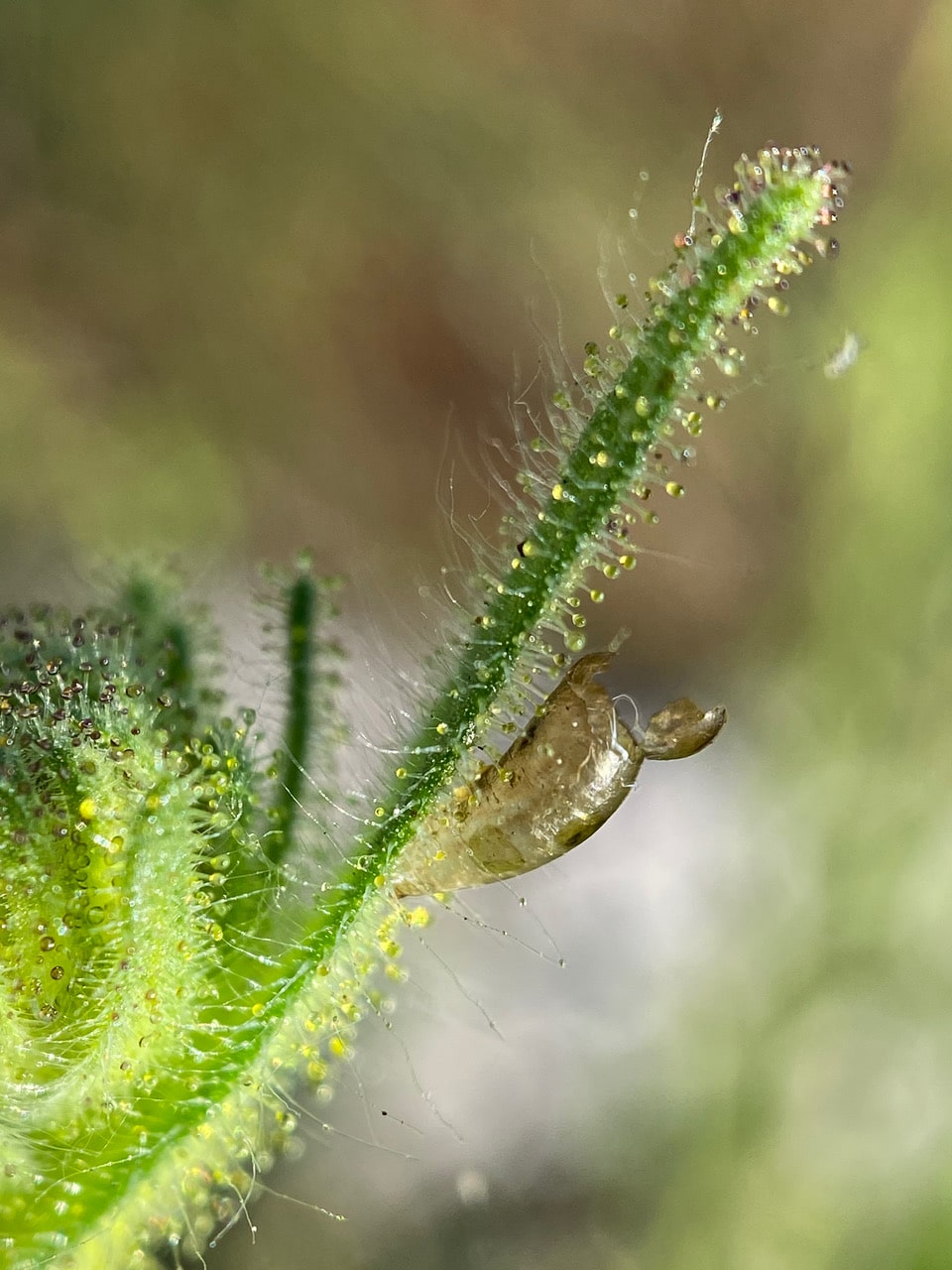
Wow, that’s a pupa case from which a hover fly has emerged! If I look hard enough, I’d probably find aphids on this Coast Tarweed. Hover fly larvae are voracious predators of aphids.
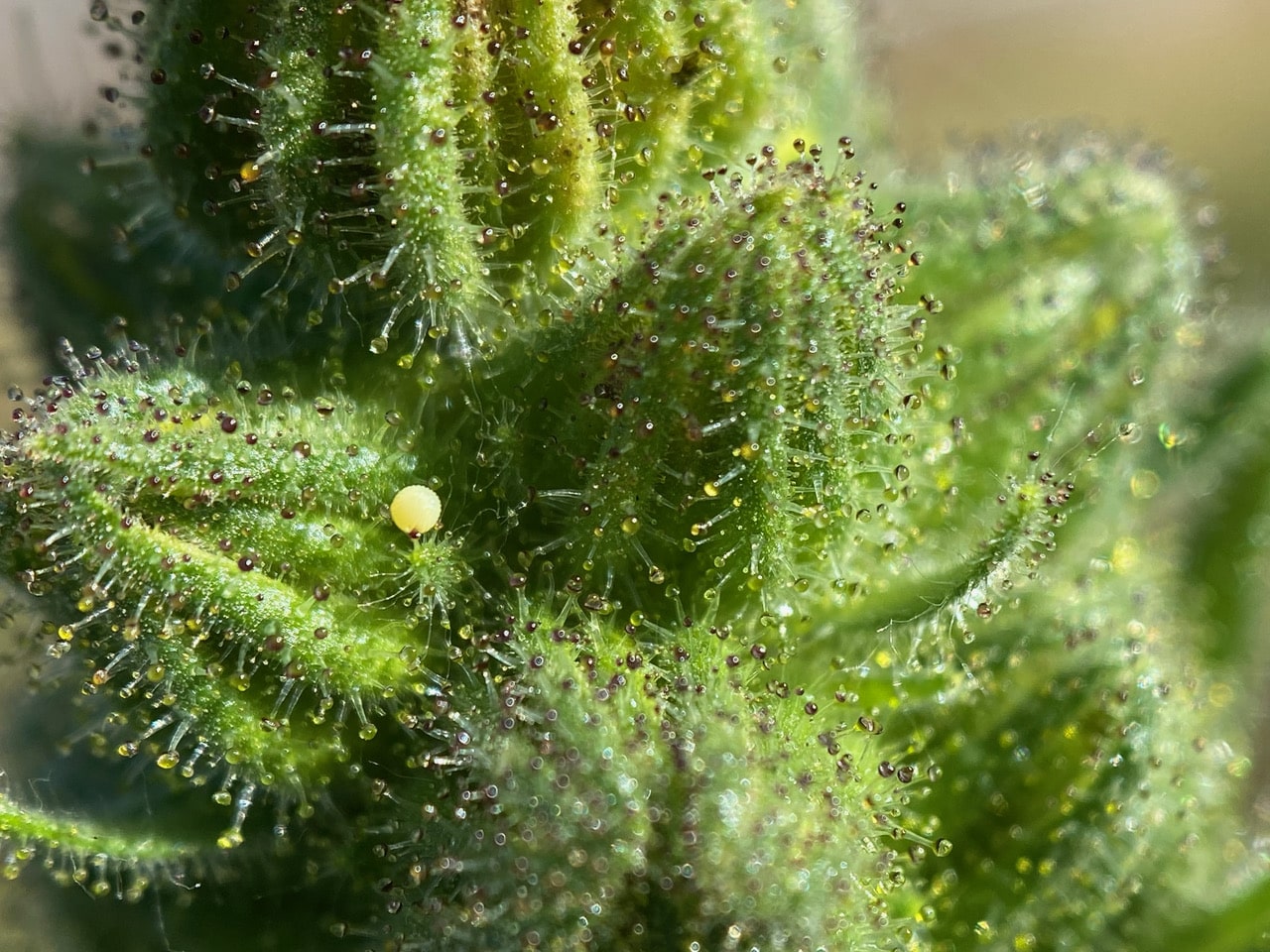
An egg laid amidst the glandular hairs of a Coast Tarweed flowerhead. Based on my observations last summer, I am willing to bet that it is a Heliothis moth (family Noctuidae)!
The Darker-spotted Straw Moth is a medium-sized tan moth with darker markings. The species is found across the US and southern Canada. They frequent wooded edges, meadows, and other open areas. They are active from March through October. Adults are both nocturnal and diurnal in activity, and are often found feeding and ovipositing during the day. Like other Heliothis species, the larvae feed on the flowering parts and seeds of the host plant.
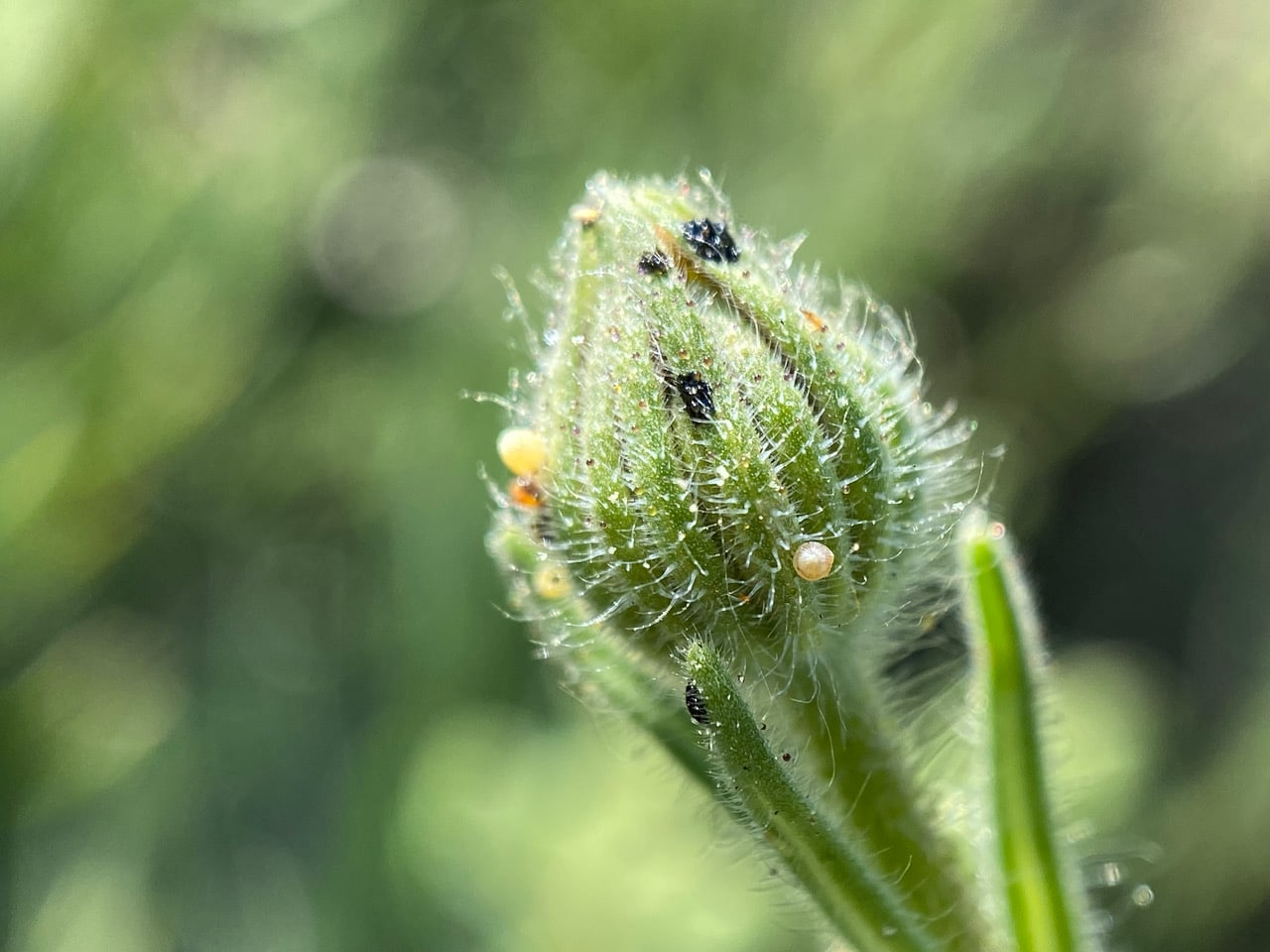
These smaller eggs are on a bud of Elegant Tarweed flowerhead. The plant is not as glandular as the Coast Tarweed. Those tiny black splotches are probably newly hatched caterpillars of the Small Owlet Moth, Heliothodes diminutiva (family Noctuidae).
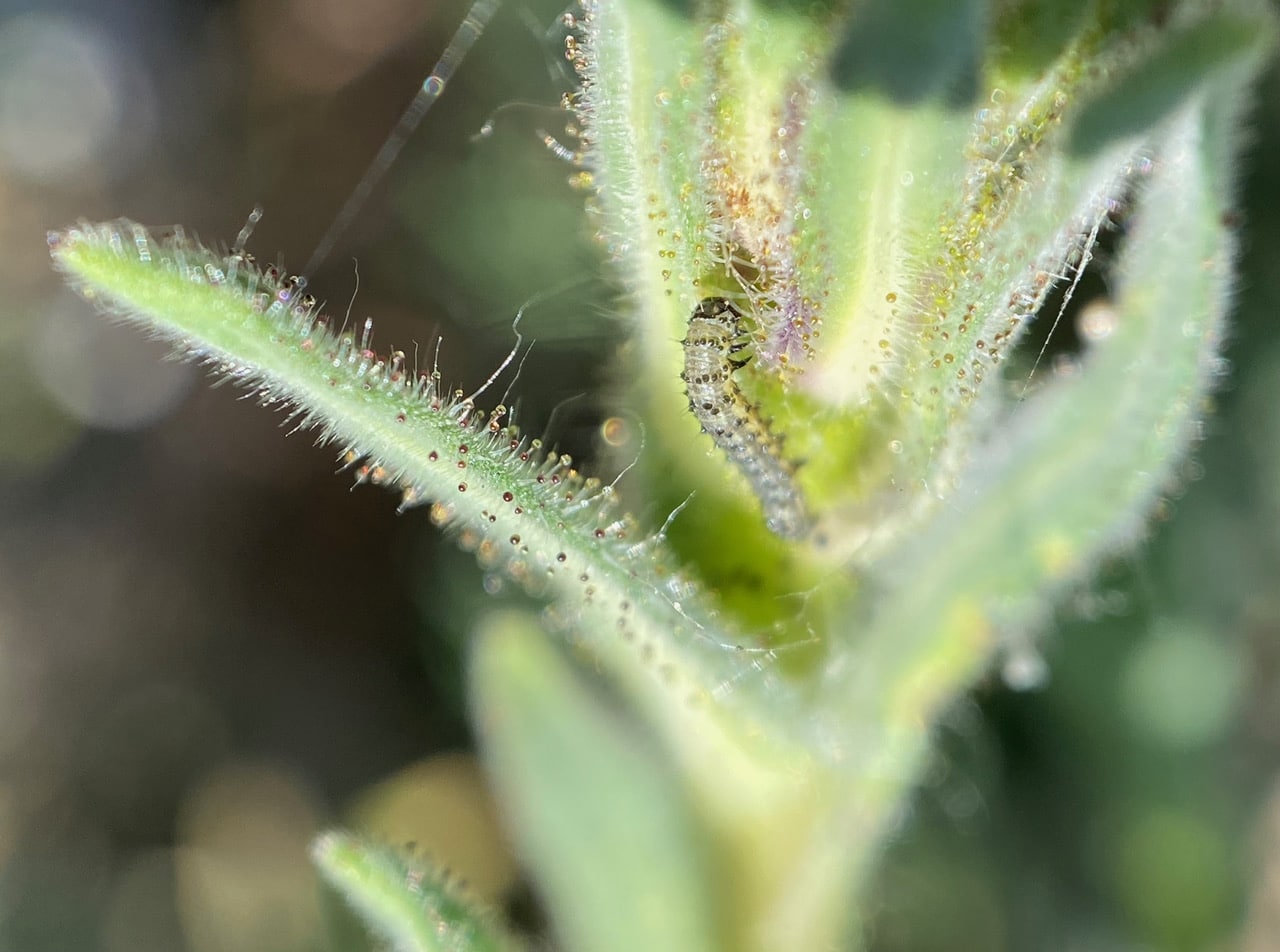
Ooh, speaking of the devil, here’s a tiny caterpillar of the Small Owlet Moth. It is chewing its way into the base of an immature flowerhead of Elegant Tarweed.
Like the smell of tarweeds, memories of last summer flood back to me. It seems the tarweed insect community has survived intact, and every familiar character is already in place doing its thing!
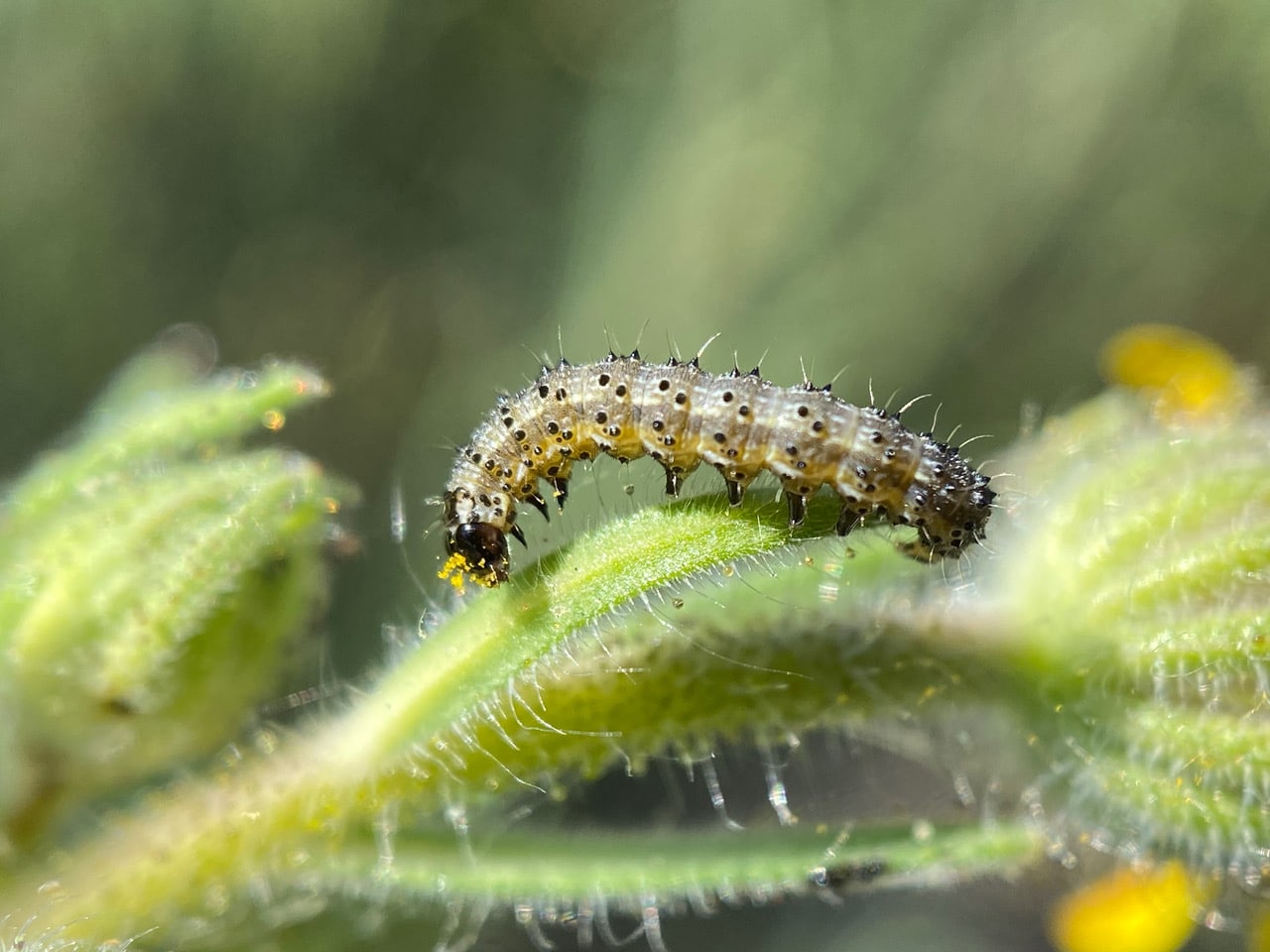
Its head covered with sticky pollen, an older Small Owlet Moth caterpillar emerges from feeding in the flowerhead of an Elegant Tarweed.
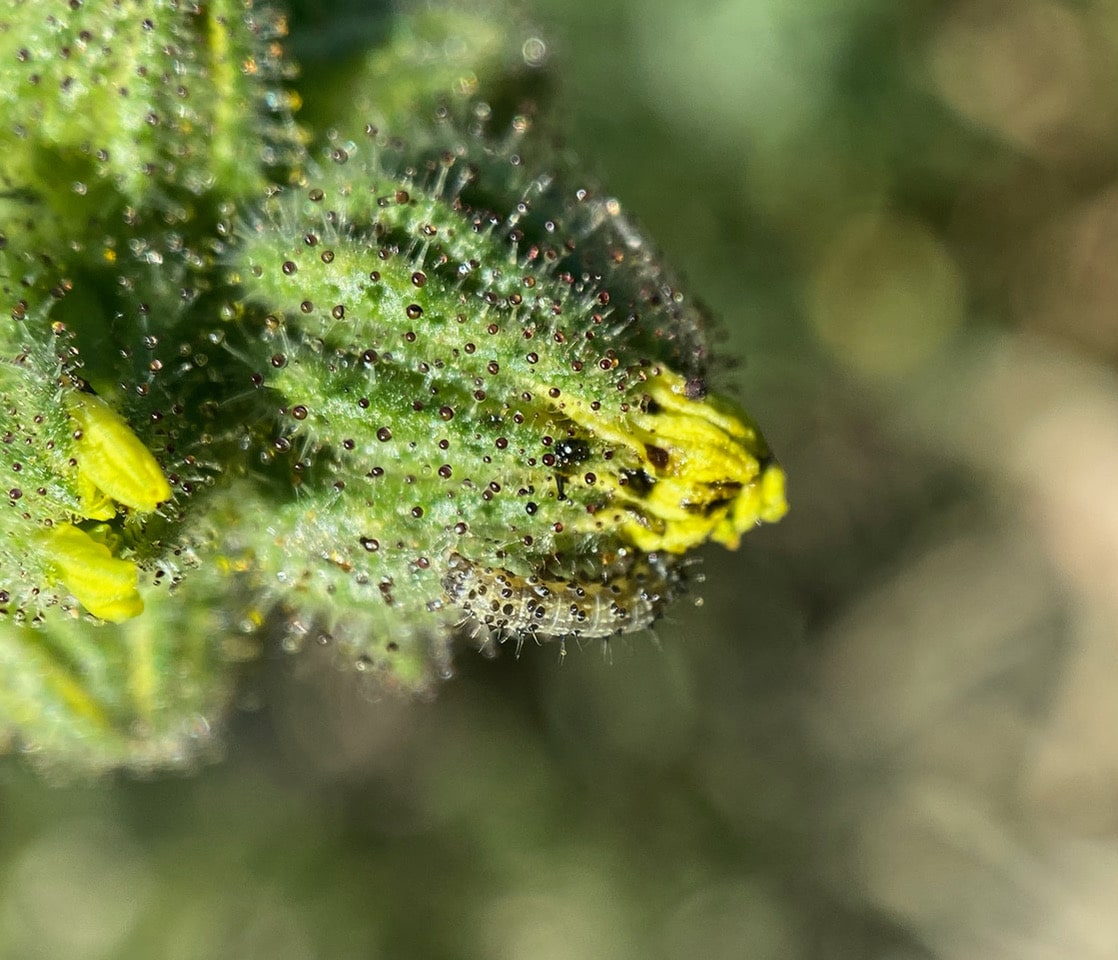
Can you find a caterpillar here? It is amazingly well camouflaged against its host plant, complete with fake tar spots and hairs.

Aah, the most conspicuous member of the tarweed insect community – the adult Small Owlet Moth, Heliothodes diminutiva!
The Small Heliothodes Moth, Heliothodes diminutiva (family Noctuidae) is day-active. It is found from California, through Oregon to Washington, most often on plants in the family Asteraceae, especially tarweeds.
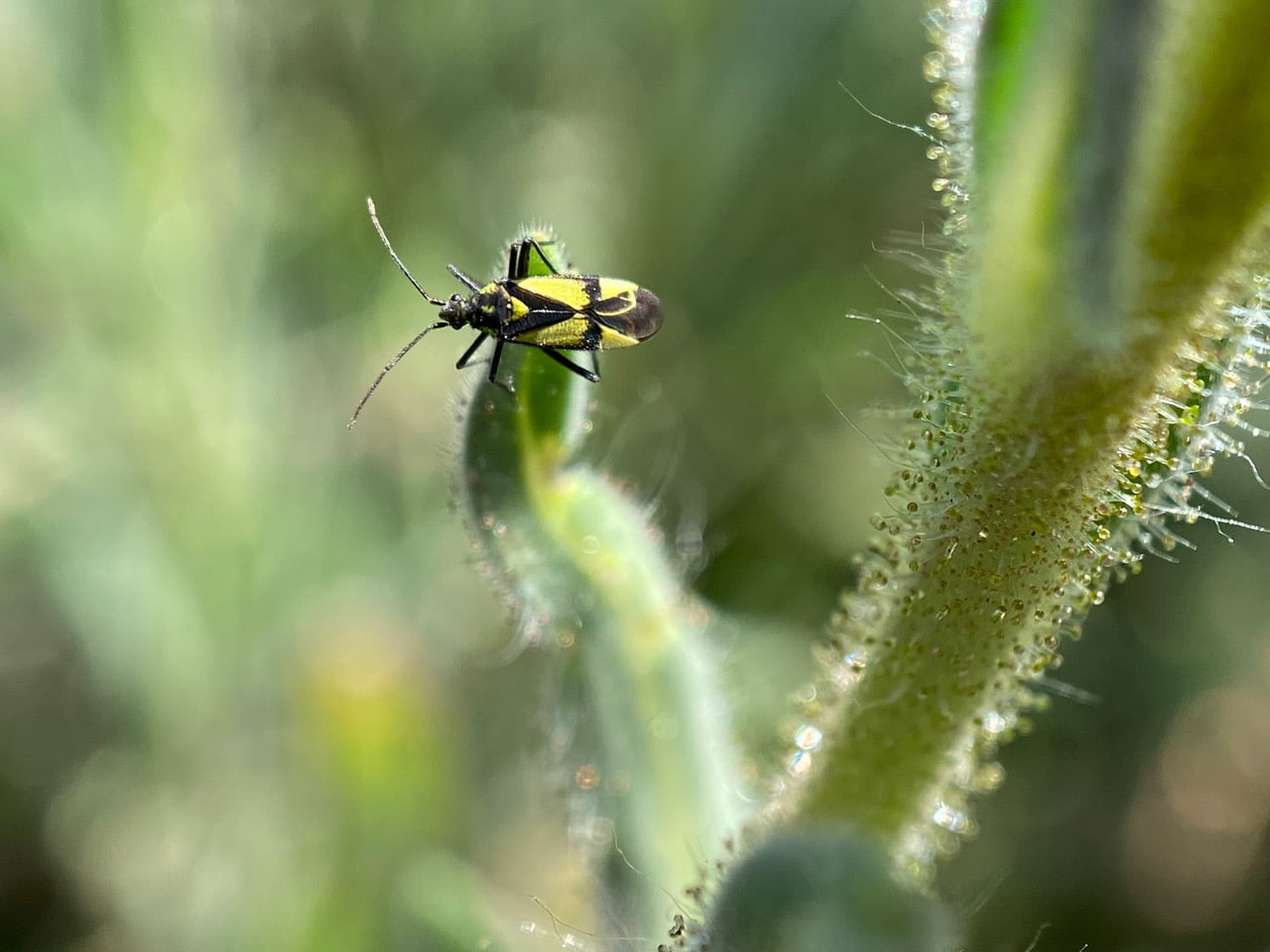
While the Plant Bug, Macrotylus essigi (family Miridae) is found on both the Tarweed species at Siesta Gate, they are less numerous on the Elegant Tarweed.
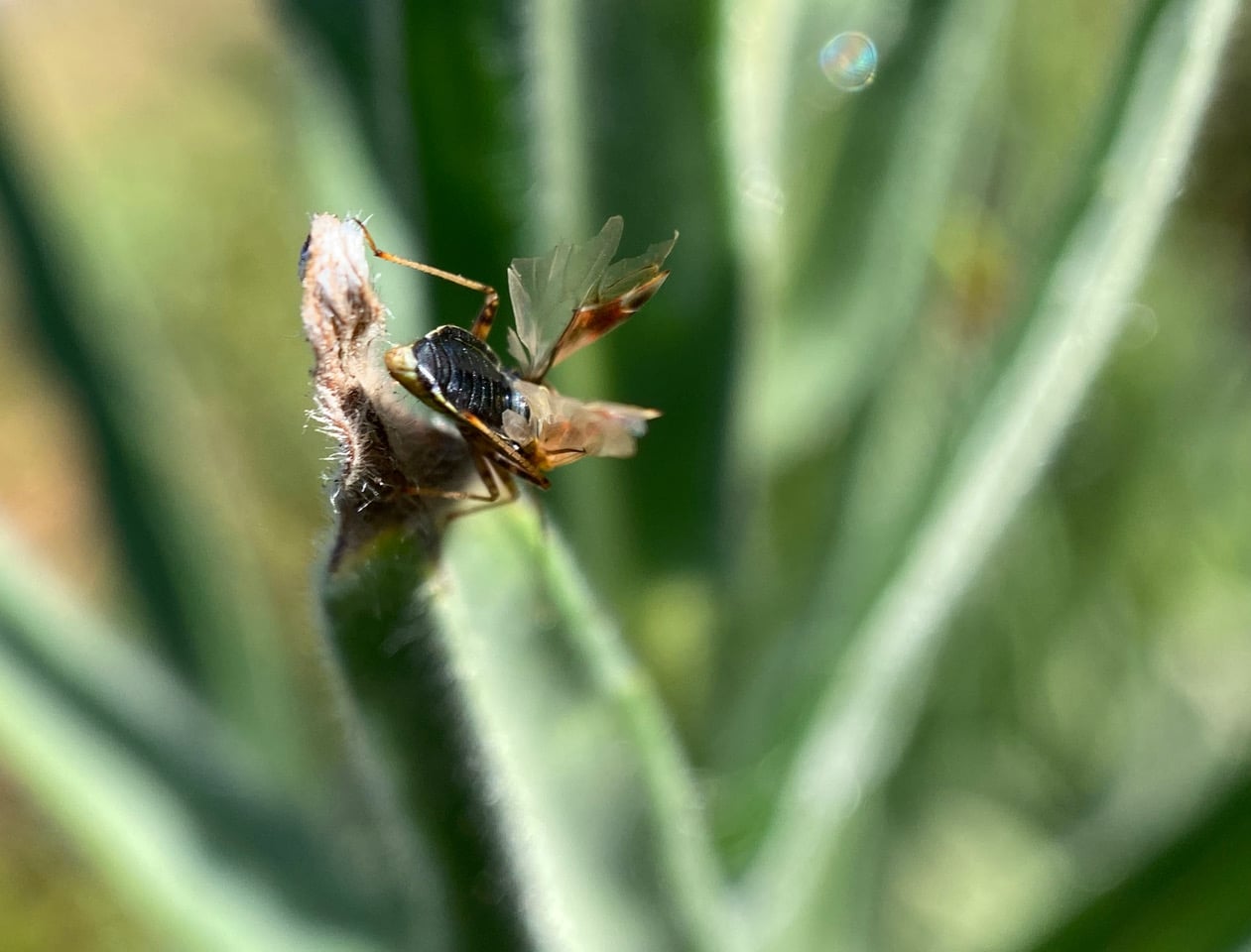
A Lygus Bug (family Miridae) opening its wings offers us a rare glimpse into its wing structure, characteristic of the order Hemiptera. You can see the membranous hind wing, and the hemelytra of the forewing.
The Miridae are a family in the order Hemiptera (true bugs). Hemiptera means “half-wing”, referring to the unique front pair of wings, which are leathery near their base and membranous towards the tips. Most species hold their wings flat over their backs with the two membranous portions overlapping. This combined with a triangular structure called a scutellum (located between the attachment sites of the two front wings) creates an X-shaped pattern on the back of many species of Hemiptera.
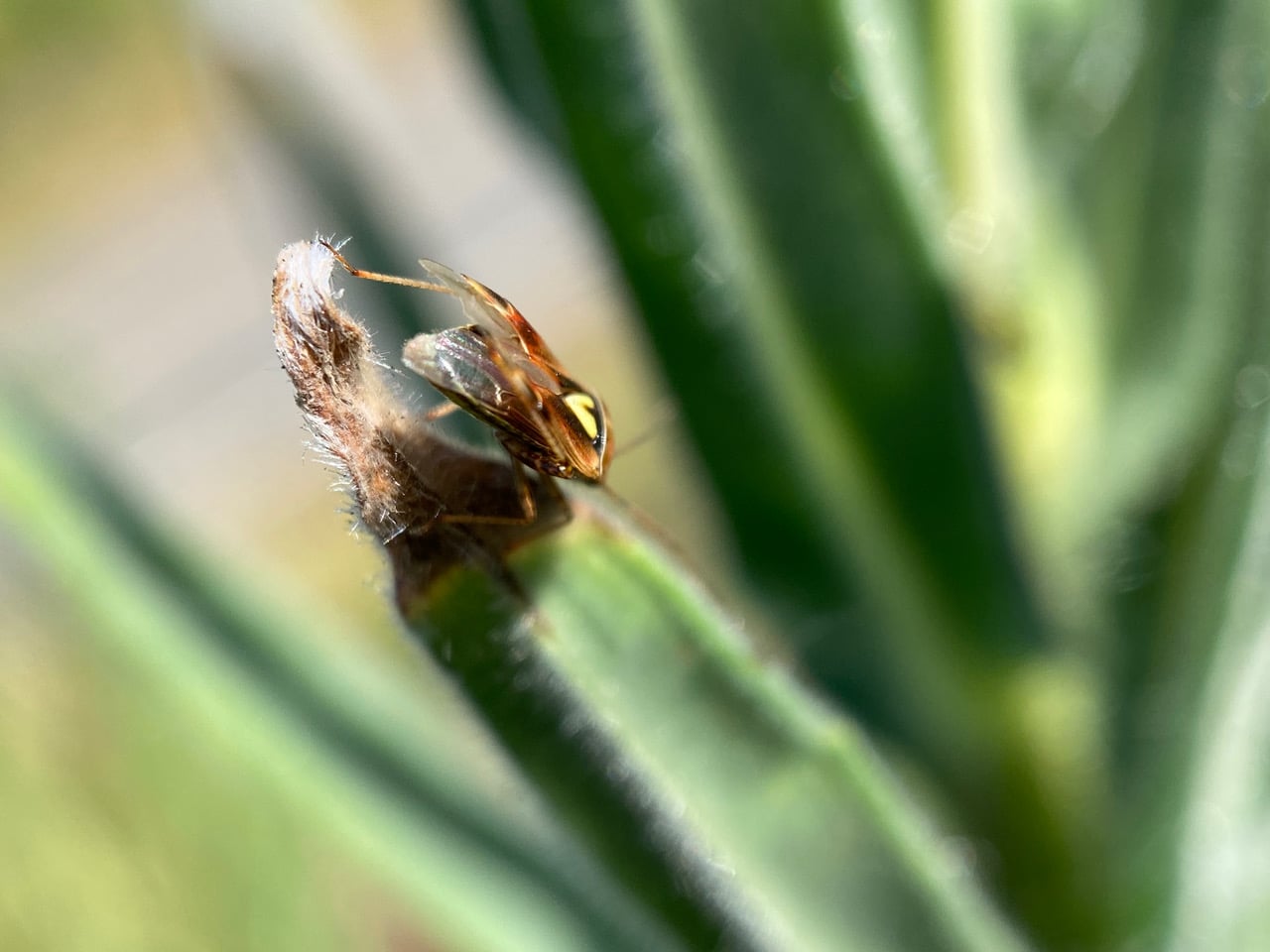
As the bug stops fluttering its wings, the membranous hind wings lower to cover the black abdomen, followed by the hemelytra (fore wings), the tips of which are membranous.
The term lygus bug is used for any member of the genus Lygus, in the family of plant bugs, Miridae. Adult lygus are approximately 3 mm wide and 6 mm long, colored from pale green to reddish brown or black. They have a distinctive triangle or V-shape on their backs. Lygus bugs are known for their destructive feeding habits – they puncture plant tissues with their piercing mouthparts, and feed by sucking sap. Both the physical injury and the plant’s own reaction to the bug’s saliva cause damage to the plant. Many lygus bugs are well-known agricultural pests.
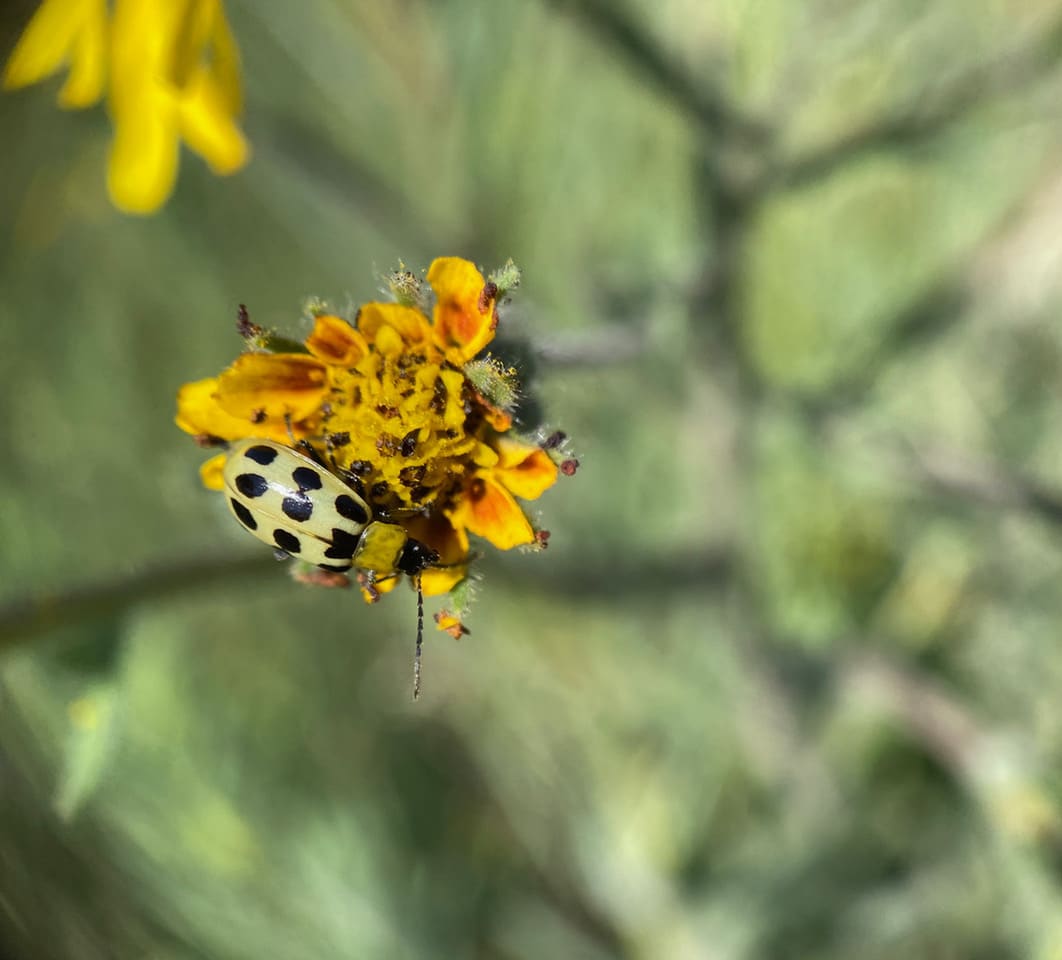
A Spotted Cucumber Beetle, Diabrotica undecimpunctata (family Chrysomelidae) is finishing up yet another flowerhead of Elegant Tarweed. The beetles will eat until there’s no more standing room for themselves on the flowerhead.
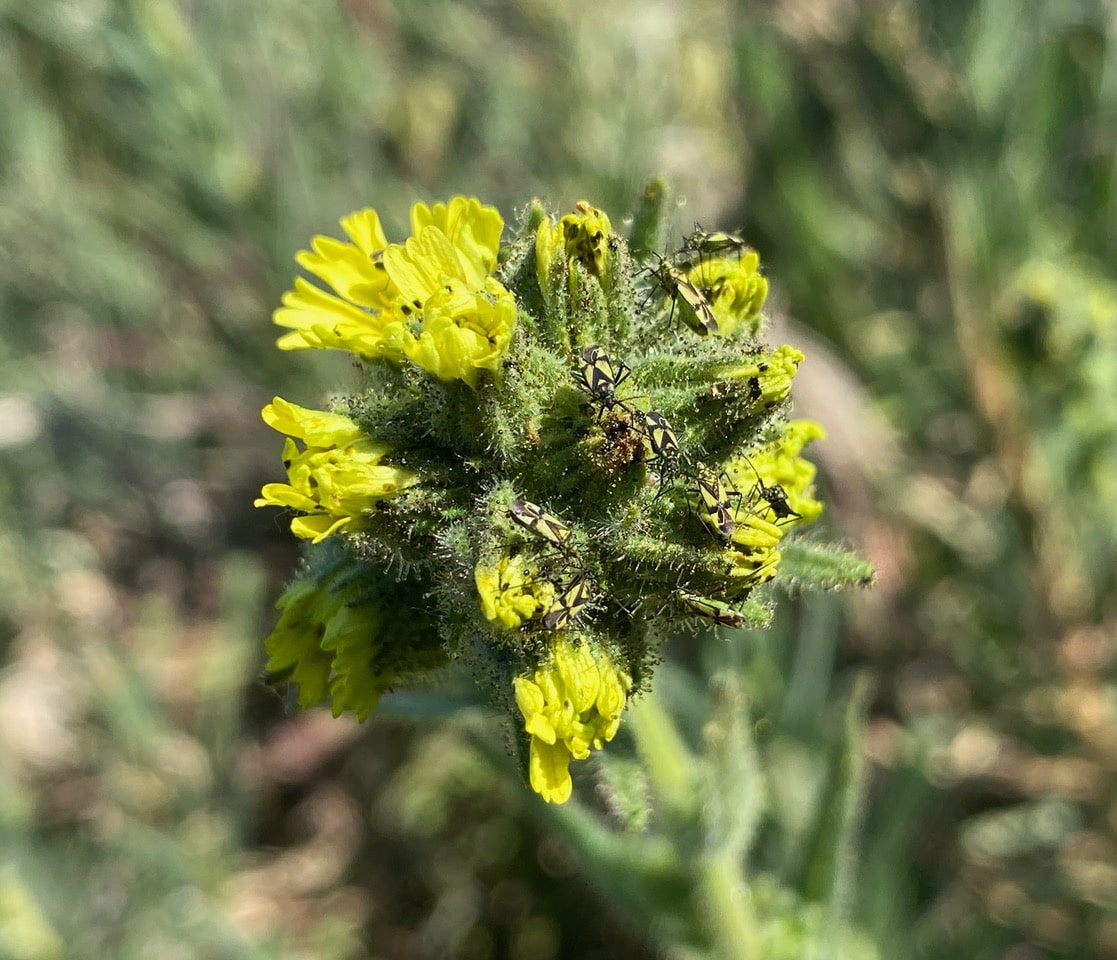
Ooh, more Plant Bugs, Macrotylus essigi on an flowerhead of Coast Tarweed! I wonder if the infestation would affect the plant’s eventual seed set?