

Pollinator Post 7/6/23 (2)
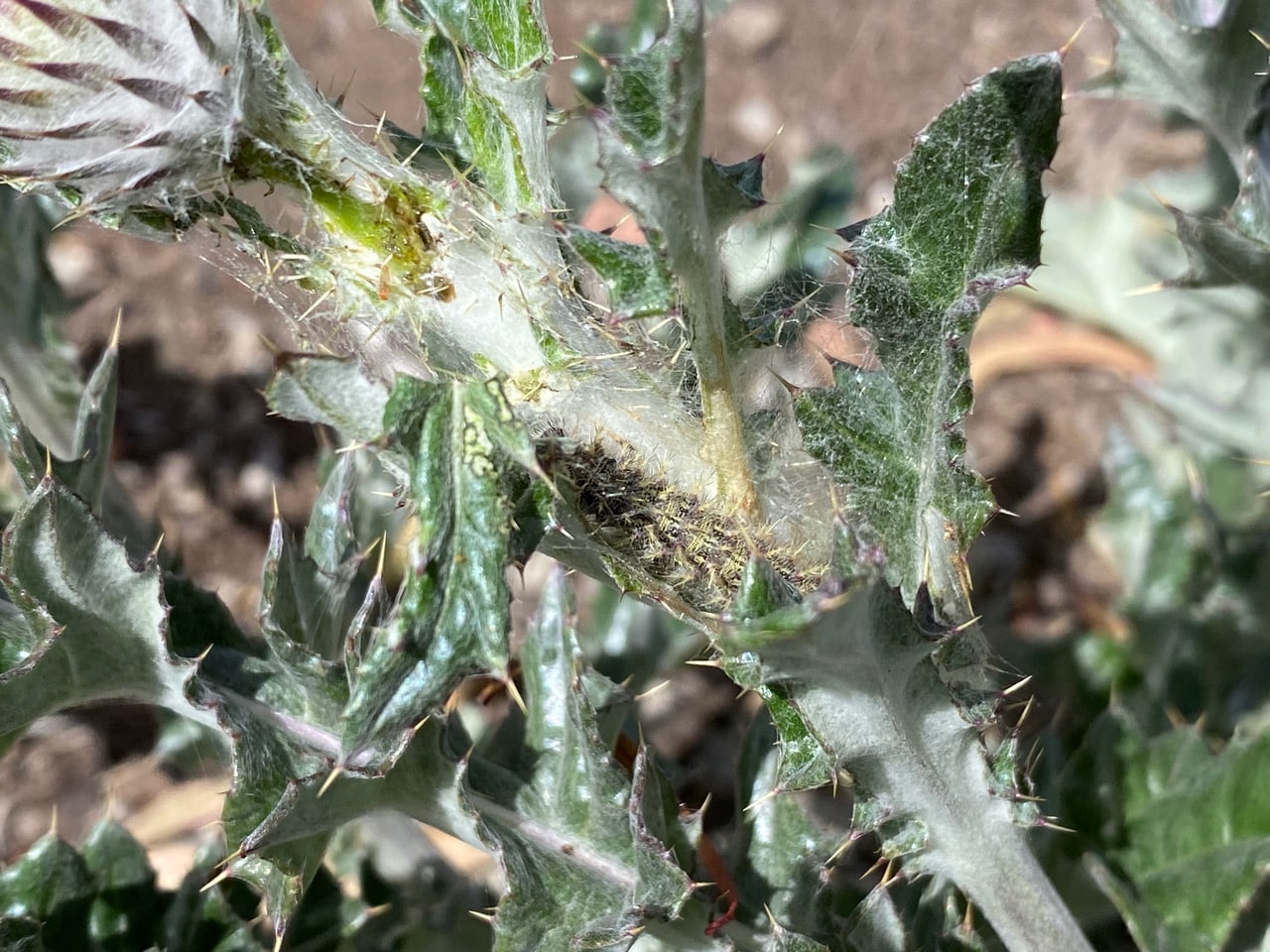
Ooh, I can actually see a Painted Lady caterpillar, Vanessa cardui (family Nymphalidae) in its wispy silk nest on this Cobweb Thistle, Cirsium occidentale. Several older nests on this plant have been previously predated. This one somehow survived. It already looks like a fourth instar. Pupation will occur soon!
The Painted Lady, Vanessa cardui (family Nymphalidae) is the most widespread of all butterflies. They are found on every continent except Antarctica and Australia. The butterfly also goes by the name thistle butterfly; its scientific name Vanessa cardui means “butterfly of thistle”. Although more than 100 host plants have been recorded for the species, the caterpillars’ favorites include thistles (Asteraceae), hollyhock and mallow (Malvaceae), and various legumes (Fabaceae).
Female Painted Lady butterflies lay eggs singly on the upper side of host plant leaves, sometimes on the thistle flowerheads. When small the caterpillars live for most of the time within a tent of leaves loosely spun together with silk. Only when larger are the larvae more likely to be found feeding outside a leaf tent on the food plant.

Hey, there’s another Painted Lady caterpillar on another branch of the same plant, about the same age as the first one! Note the pile of caterpillar poop at the bottom of the silk nest, and the feeding scar on the stem right above it. You can actually see the cream-colored spines on the caterpillar through the wispy silk.
Painted Lady butterflies are known for their distinct migratory behavior. They are an irruptive migrant, meaning that they migrate independently of any seasonal or geographical pattern. The populations that migrate from North Africa to Europe may include millions of butterflies. The distance covered rivals that of the better known Monarch butterflies. The butterflies can cover up to 100 miles per day during their migration; the round trip may take up to 6 successive generations.
In California, the butterflies are usually seen flying from north to north-west. These migrations appear to be partially initiated by heavy winter rains in the desert where rainfall controls the growth of larval food plants. In the spring of 2019, the butterflies migrated by the millions across the state.
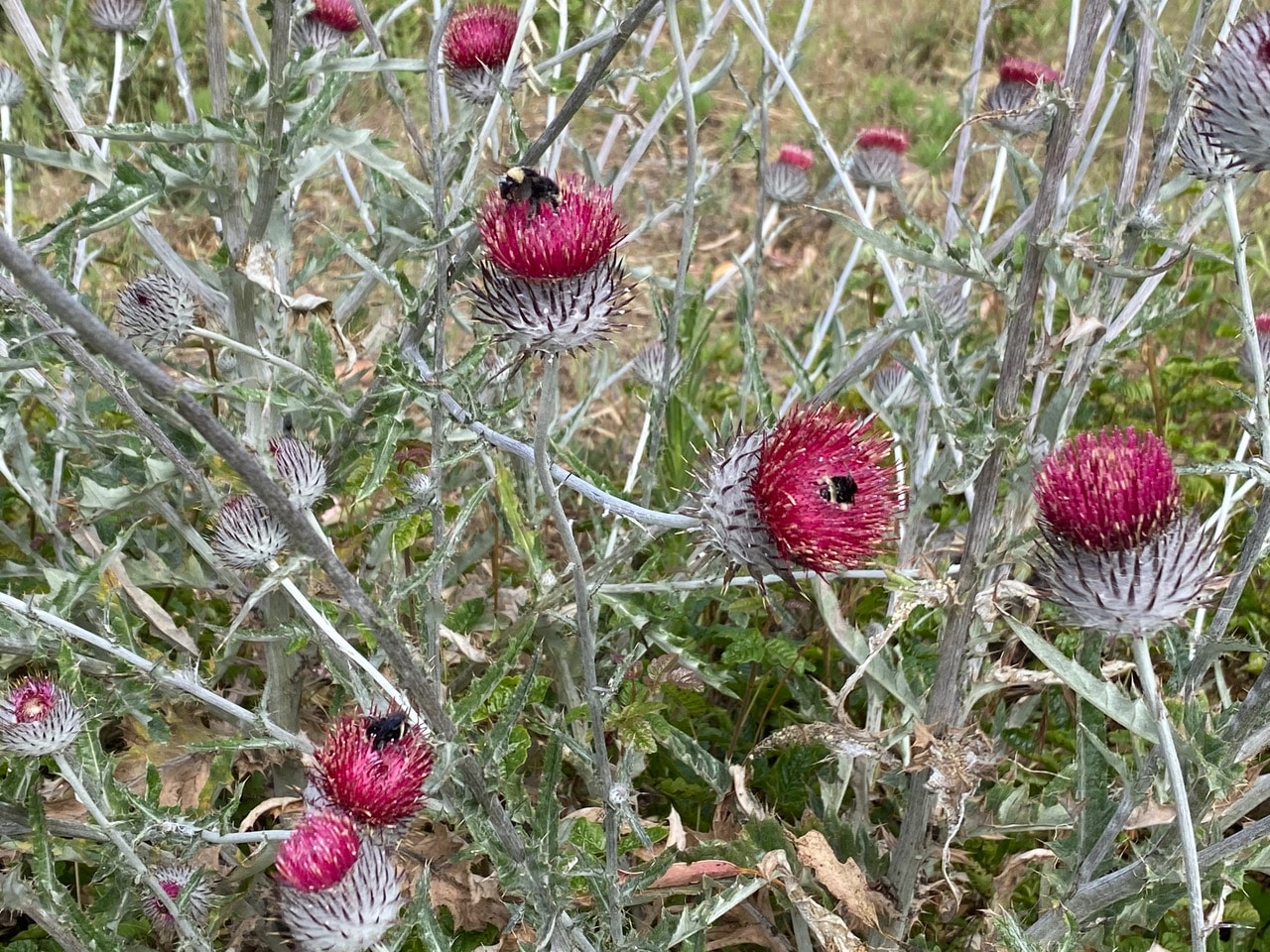
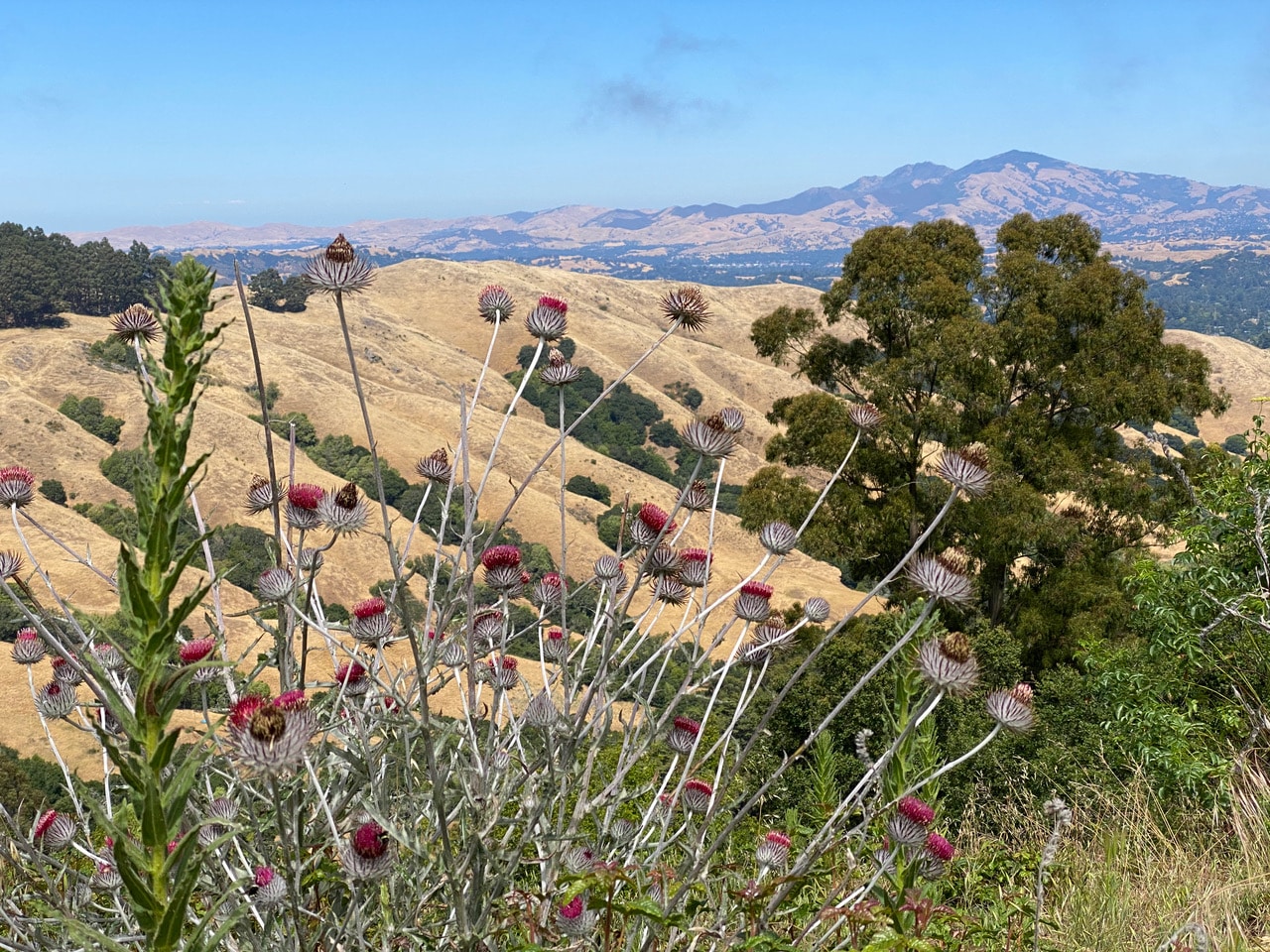
Looking at the large Cobweb Thistle blooming at the edge of the steep east-facing slope, I find several bumble bees foraging on the flowerheads. There are three visible in this view.

This large female bumble bee has her head buried deep among the crowded florets, probably sipping nectar. Judging from the orange load in her pollen baskets, she has been collecting pollen from the California Poppy blooming in the vicinity. I have to wait a while for the bee to lift her head to ascertain that she is a Yellow-faced Bumble Bee, Bombus vosnesenskii.
The pollen collecting apparatus in Apidae bees, which include honey bees and bumble bees, is commonly called a “pollen basket” or corbicula. This region is located on the tibia of the hind legs and consists of hairs surrounding a concave region. After the bee visits a flower, she begins to groom herself and brushes the pollen down toward her hind legs and packs the pollen into her pollen basket. A little nectar mixed with the pollen keeps it all together like putty, and the stiff hairs surrounding the pollen basket hold it in place.
.jpg)

The bee is joined by another large Yellow-faced Bumble Bee.
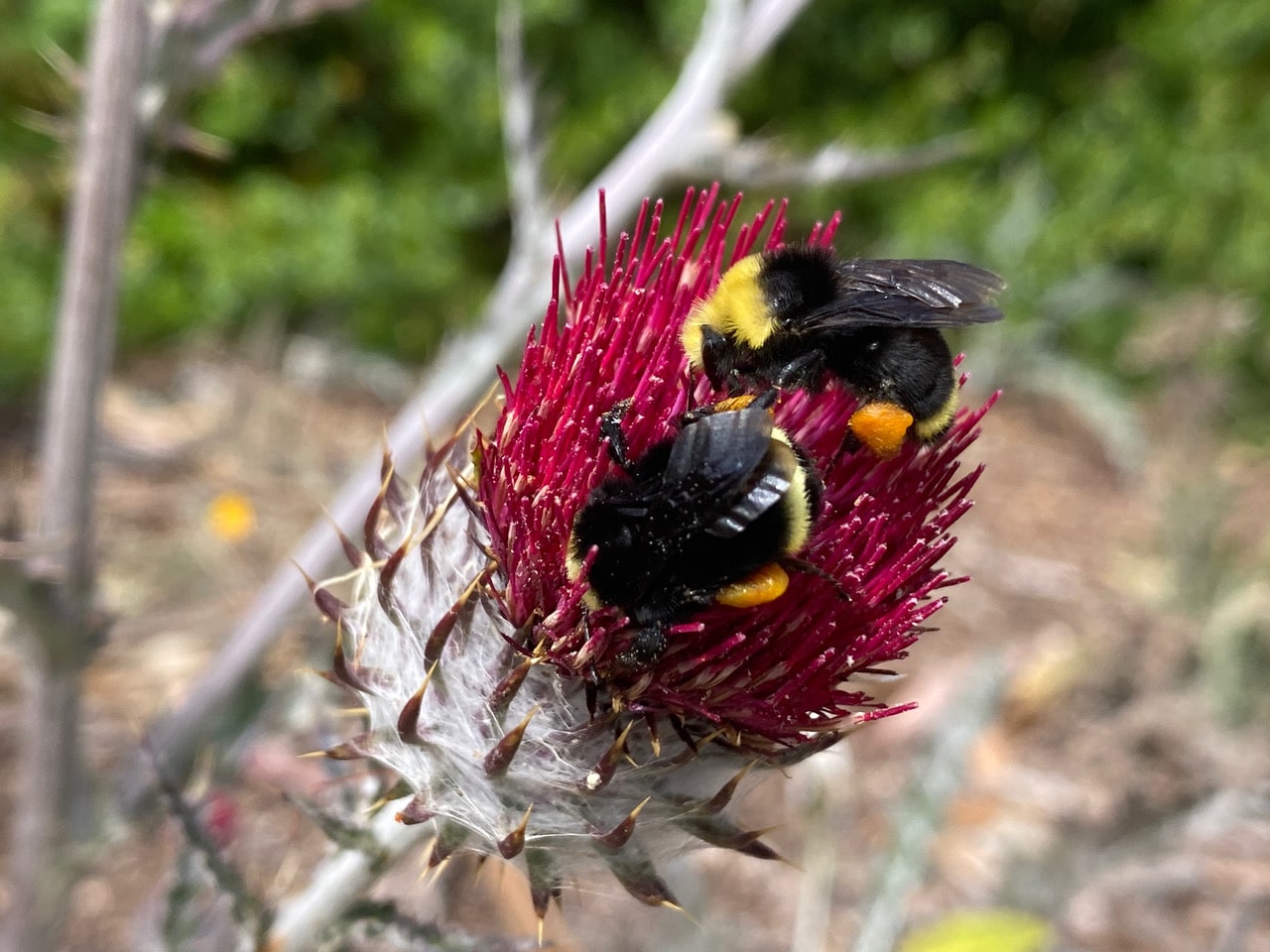
Both the bees look fresh and robust, not a hair out of place. Are they freshly produced new queens? If they are, they would be the only ones in their colony to overwinter, while all others die at the end of the season. The mated queens will wake up from hibernation in early spring next year to start their own colonies. Nourish yourselves well, Princesses – you have quite a job ahead of you!
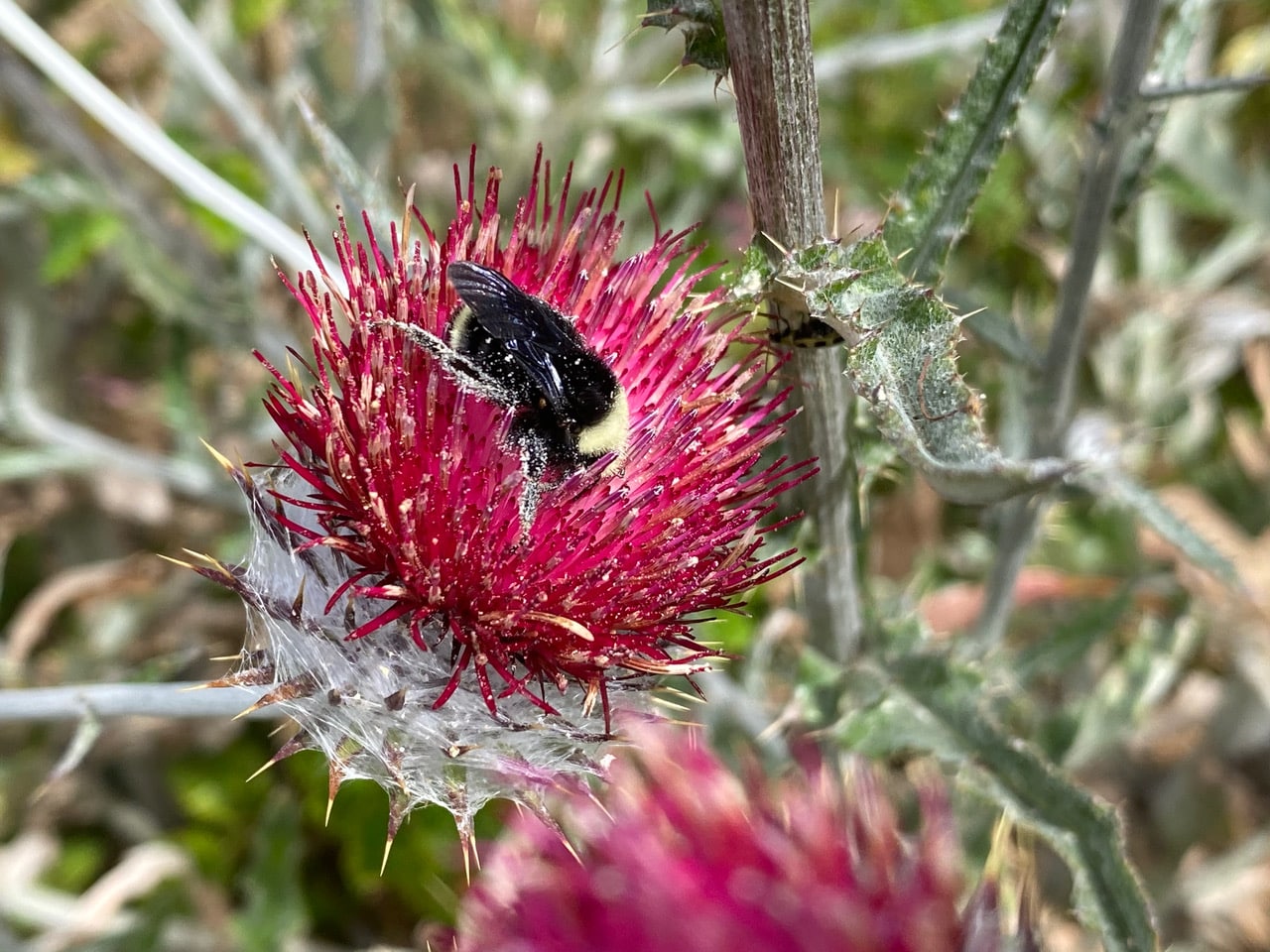
Here’s another Yellow-faced Bumble Bee taking nectar on another Cirsium flowerhead. I can’t tell if it has a corbicula (pollen basket) on its hind leg. But it is not collecting pollen. Could be a male. Male bumble bees are produced only later in the season, with the express purpose of inseminating the new queens.
At 4 pm. I head downhill to meet with Andy and Jim at Siesta Gate for an evening jaunt . Andy has wanted to see the night-blooming Soap Plant.
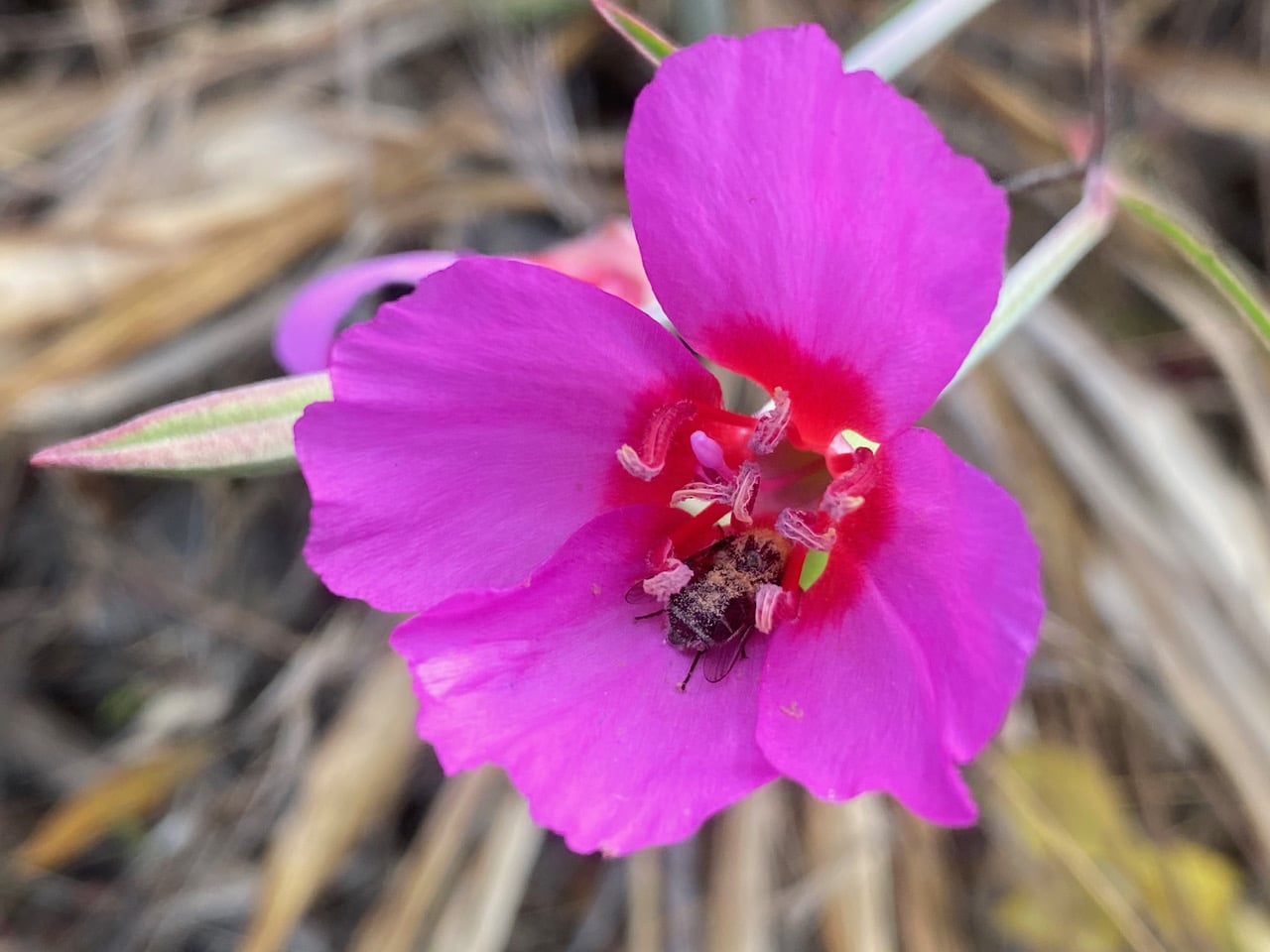 We take the Skyline Trail heading south, passing the nice patch of blooming Farewell-to-Spring, Clarkia rubicunda. Looks like a Small-headed Fly is roosting in a Clarkia flower. Its back is covered with pollen, whose color I can’t discern in this light. But I’m willing to bet that it is cream-colored, from Sticky Monkeyflower. The Small-headed Flies, Eulonchus sp. (family Acroceridae) spend most of the day around the Sticky Monkeyflowers, feeding, courting, and mating. I am surprised this individual is roosting in a Clarkia flower. Most often they tuck into the Sticky Monkeyflower for the night.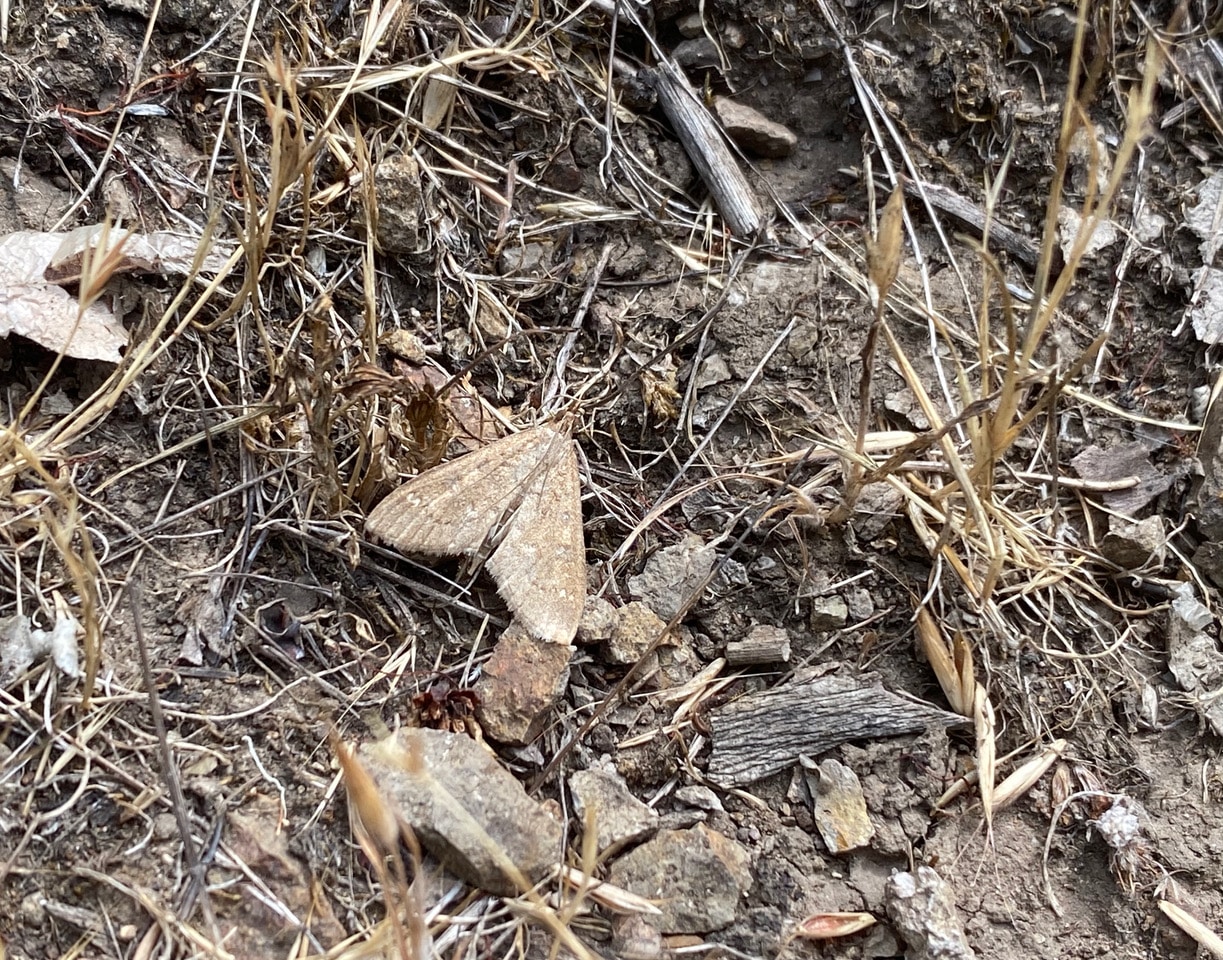
The moths are out flying in the fading light. Landing in the leaf litter, this straw-colored little moth almost disappears from sight.
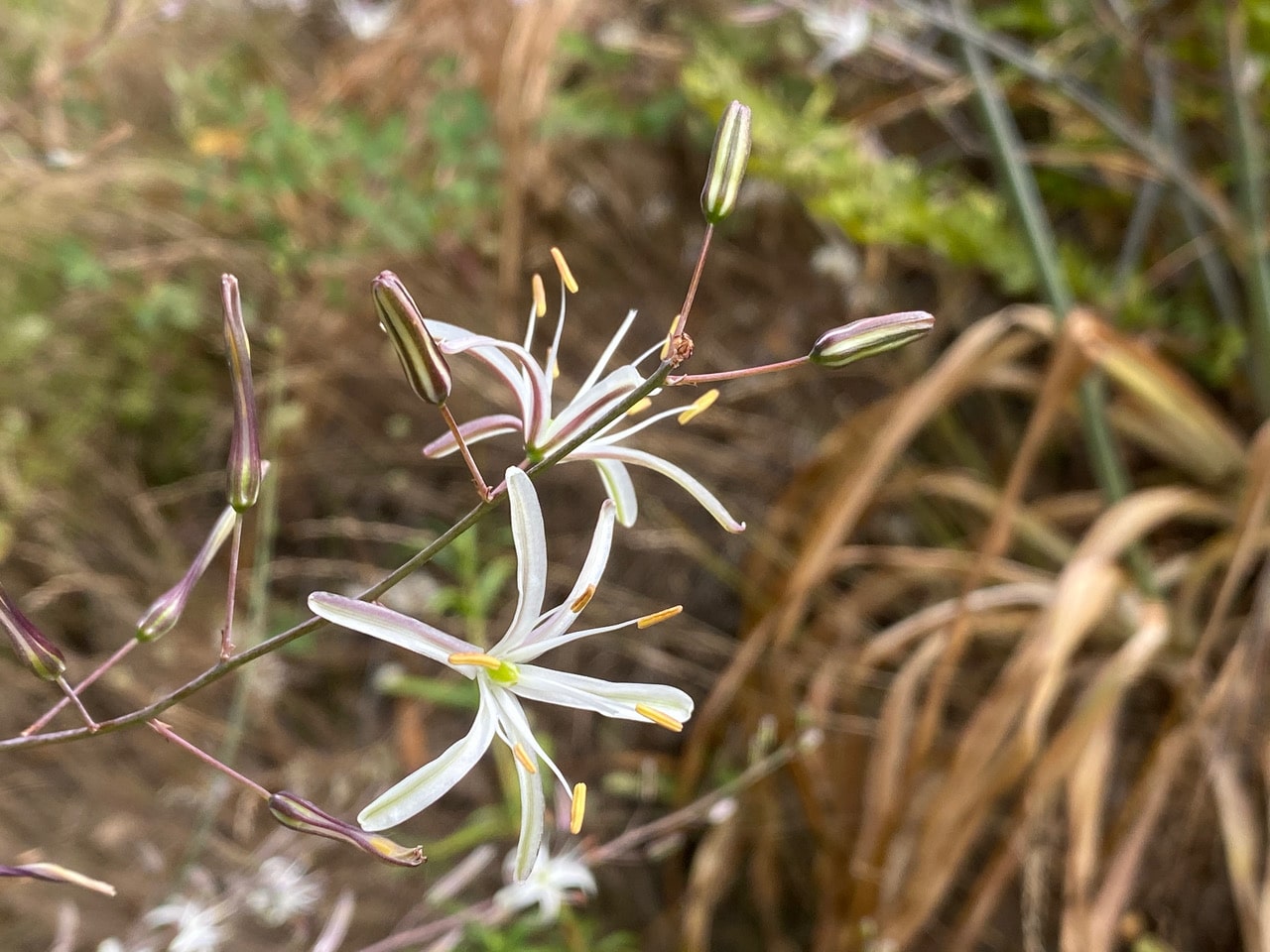
The new Soap Plant flowers are starting to open up along the trail!
Soap Plant, Chlorogalum pomeridianum is a perennial that grows from a bulb. The plant is easily recognized by its linear, wavy-edged leaves. The generic name Chlorogalum means “green milk”, referring to the green juice exuded by a broken leaf. The specific epithet pomeridianum, or “past mid-day”, is the Latin phrase which gave rise to our abbreviation “p.m.” This refers to the plant’s trait of opening its flowers late in the day.
The white star-like flowers have a very short life – in the late afternoon one row of buds opens, starting from the bottom of the long stalk. Each flower remains open through the night, but twists closed (the wilted tepals twist around the fertilized ovary) by the morning and never opens again.
The flowers are pollinated during the afternoon by large bees (honey bees, carpenter bees, and bumble bees), and, after dark, by sphingid moths.
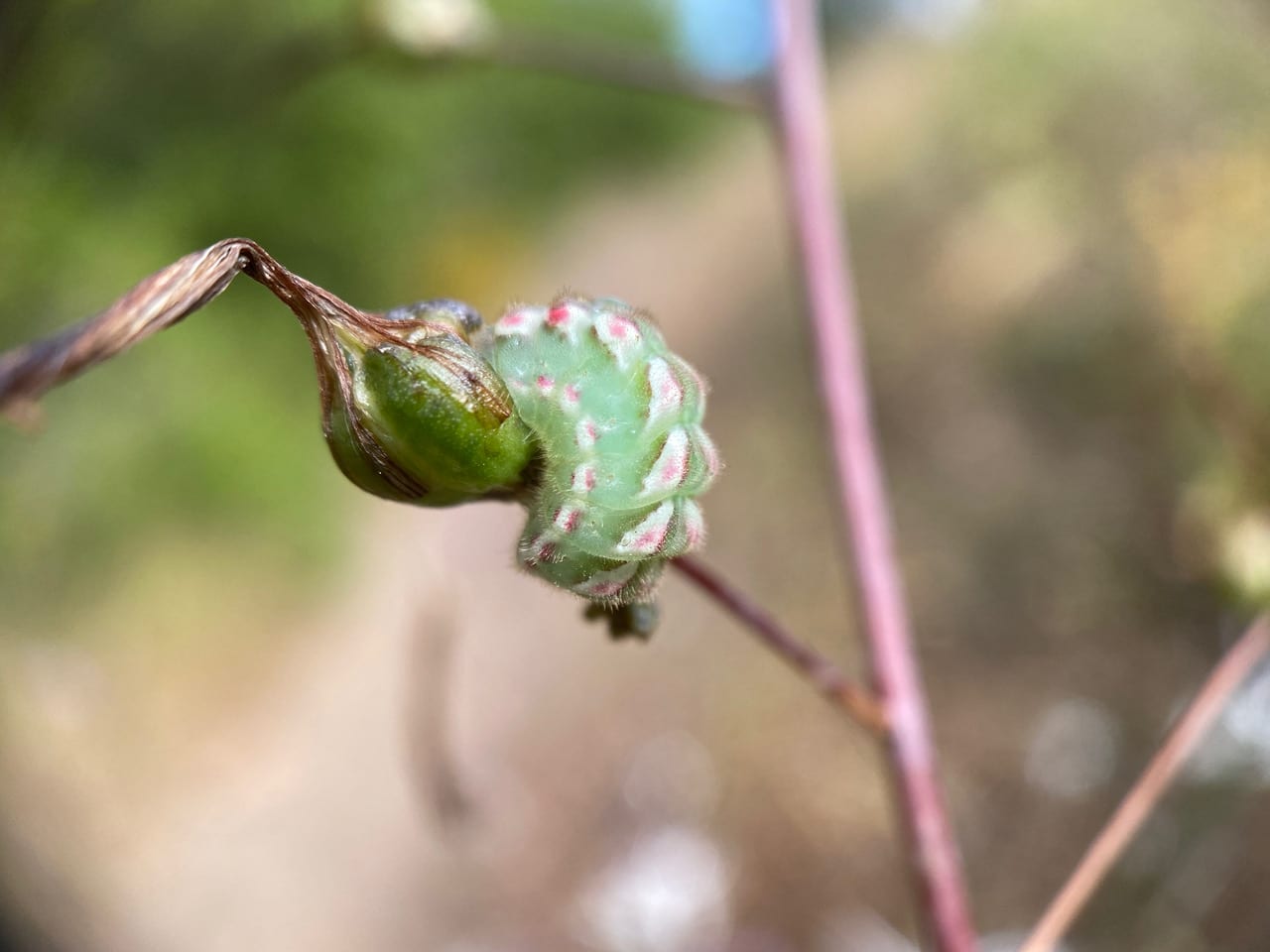
I am happy to find the little Brown Elfin caterpillar, Callophrys augustinus (family Lycaenidae) still on the Soap Plant I have tagged yesterday. It is feeding on a new developing fruit, while defecating at the same time.
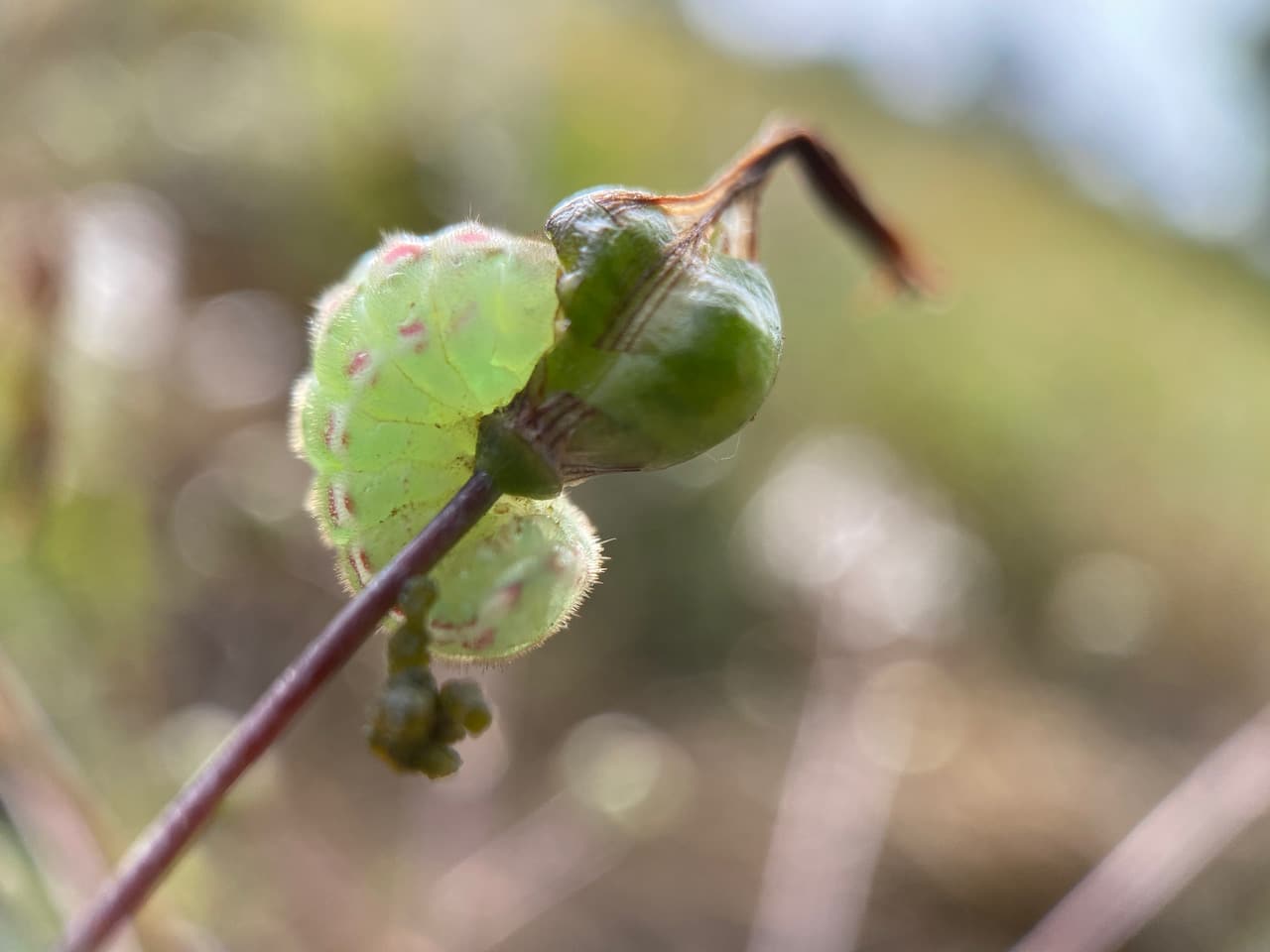
Backlit by the low sun, the caterpillar takes on a translucent, gell-like appearance.
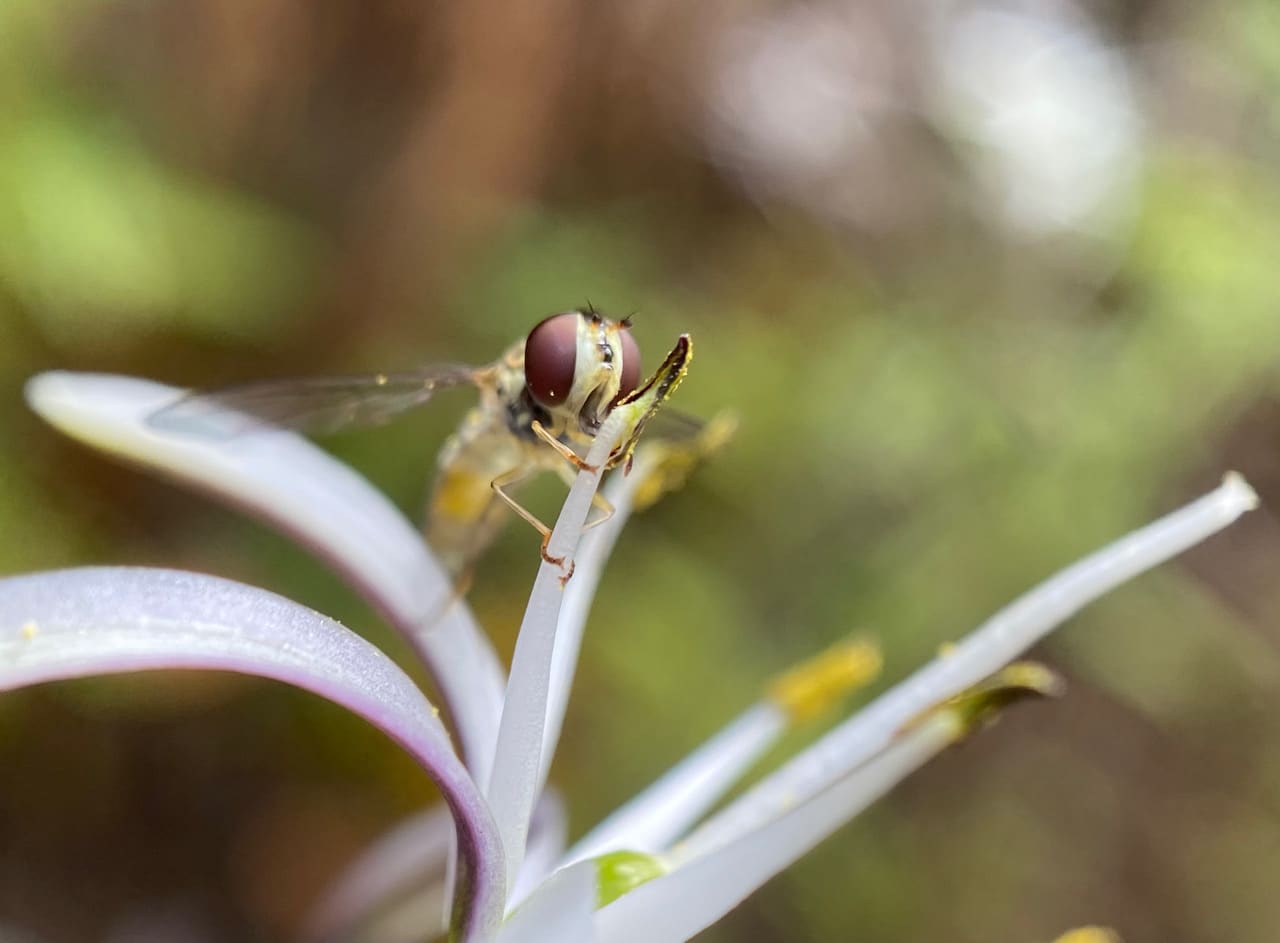
Grasping the filament, a female hover fly (family Syrphidae) is feeding on Soap Plant pollen from a ripe anther. I do not have a chance to see its back, so I’m not sure of the fly’s identity.
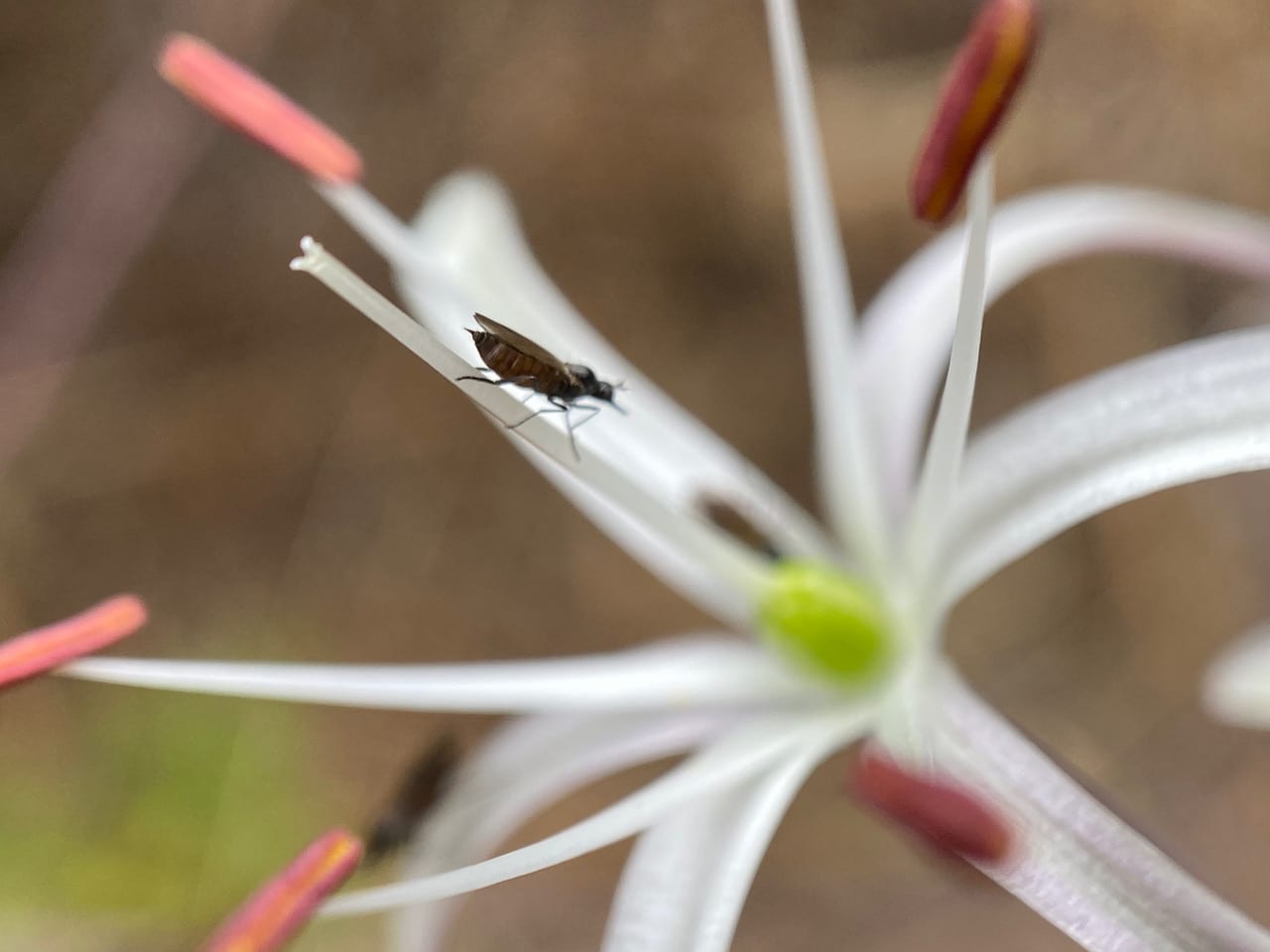
I am excited to see a Dance Fly standing on the three-pronged stigma of the Soap Plant flower, but she’s already running down the style when I take this picture. I have earlier ruminated that the Dance Flies can’t possibly be effective pollinators for the Soap Plant unless they also make contact with the stigmas. They obvious do, but not as often as they visit the anthers for pollen.
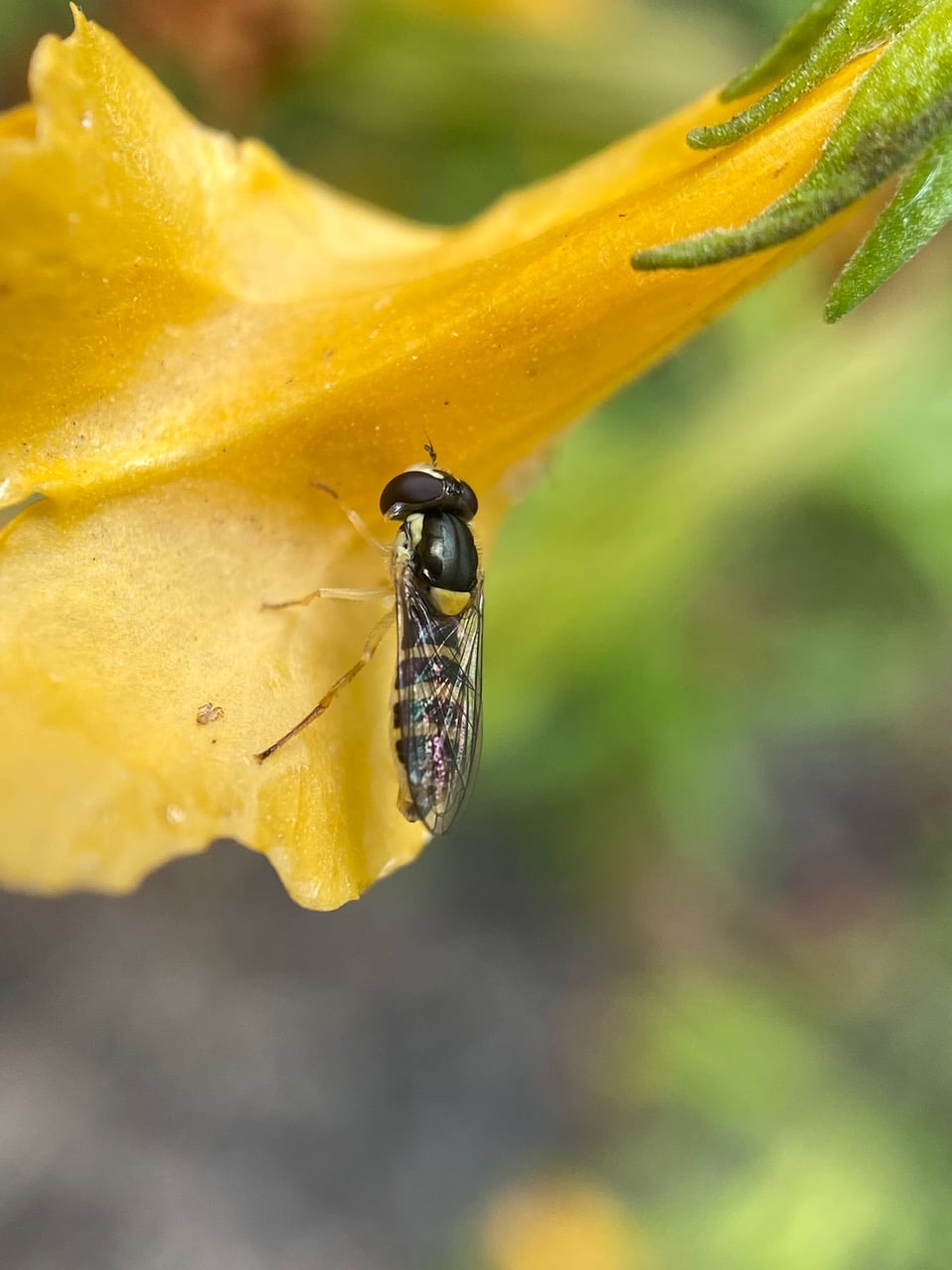
A female Globetail Hover Fly, Sphaerophoria sp. (family Syrphidae) lands on a Sticky Monkeyflower.
Hover Flies, also called flower flies or Syrphidae flies, make up the insect family Syrphidae. The adults of many species feed mainly on nectar and pollen, and are often seen hovering and nectaring at flowers. They are important pollinators of flowering plants in many ecosystems worldwide. The larvae feed on a wide range of foods. In many species, the larvae are insectivores and prey on aphids, thrips, and other plant-sucking insects. In other species, the larvae are saprotrophs, eating decaying plant and animal matter in the soil or in ponds and streams.
Many species of Hover Flies exhibit Batesian mimicry; they are brightly colored, with bands of yellow resembling the bees and wasps. The mimicry provides the fly with some measure of protection from potential predators, although the flies are harmless and lack a sting.