

Pollinator Post 7/10/23 (1)

The Elegant Tarweed, Madia elegans rejoices in the fog and adorns herself with sparkling droplets.
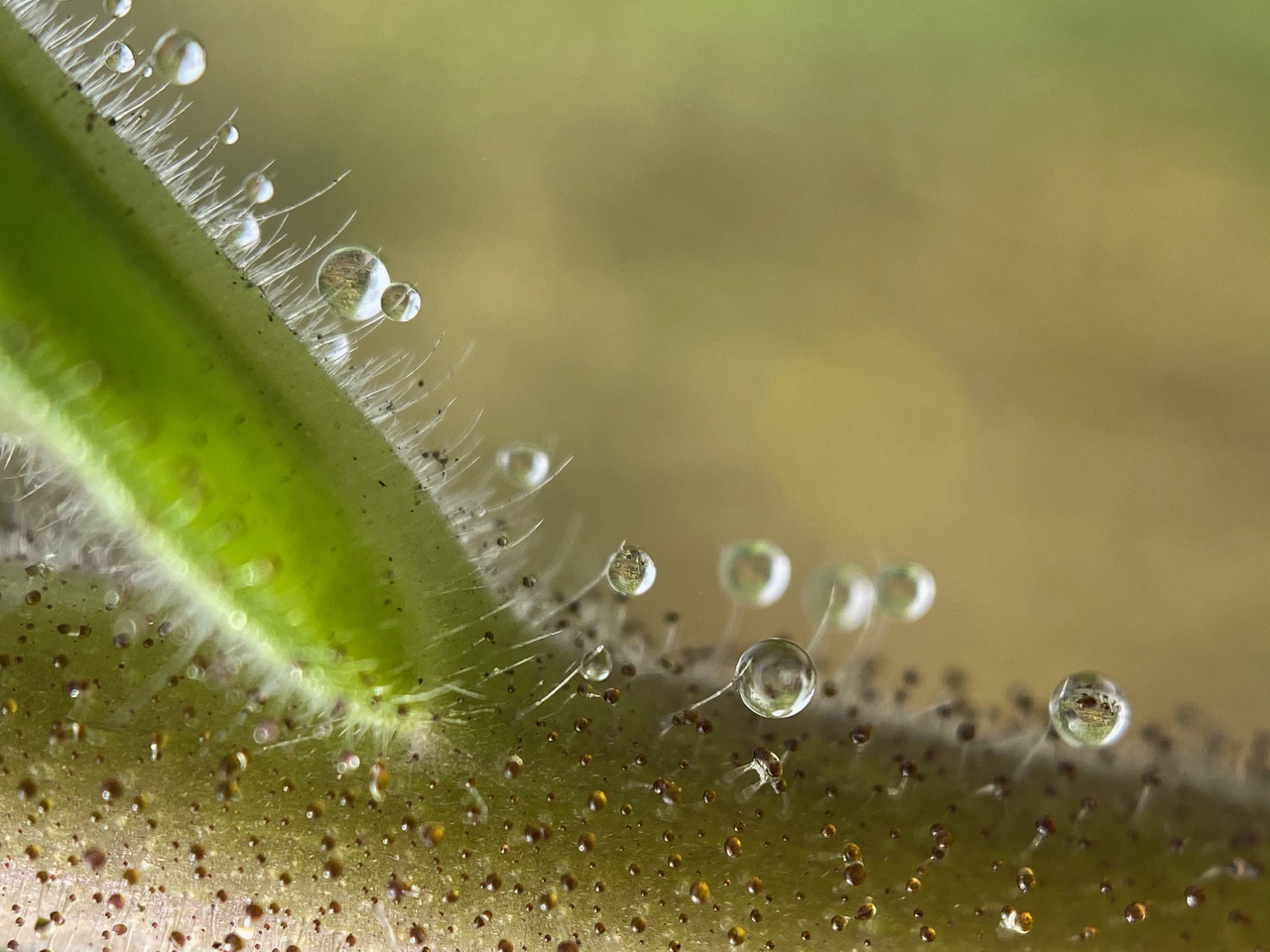








The tarweeds are covered with short, glandular hairs topped with globules of dark, sticky, tar-like exudates. Moisture in the air is often trapped on the longer hairs on the stems and leaves. Can the plants make use of this water?
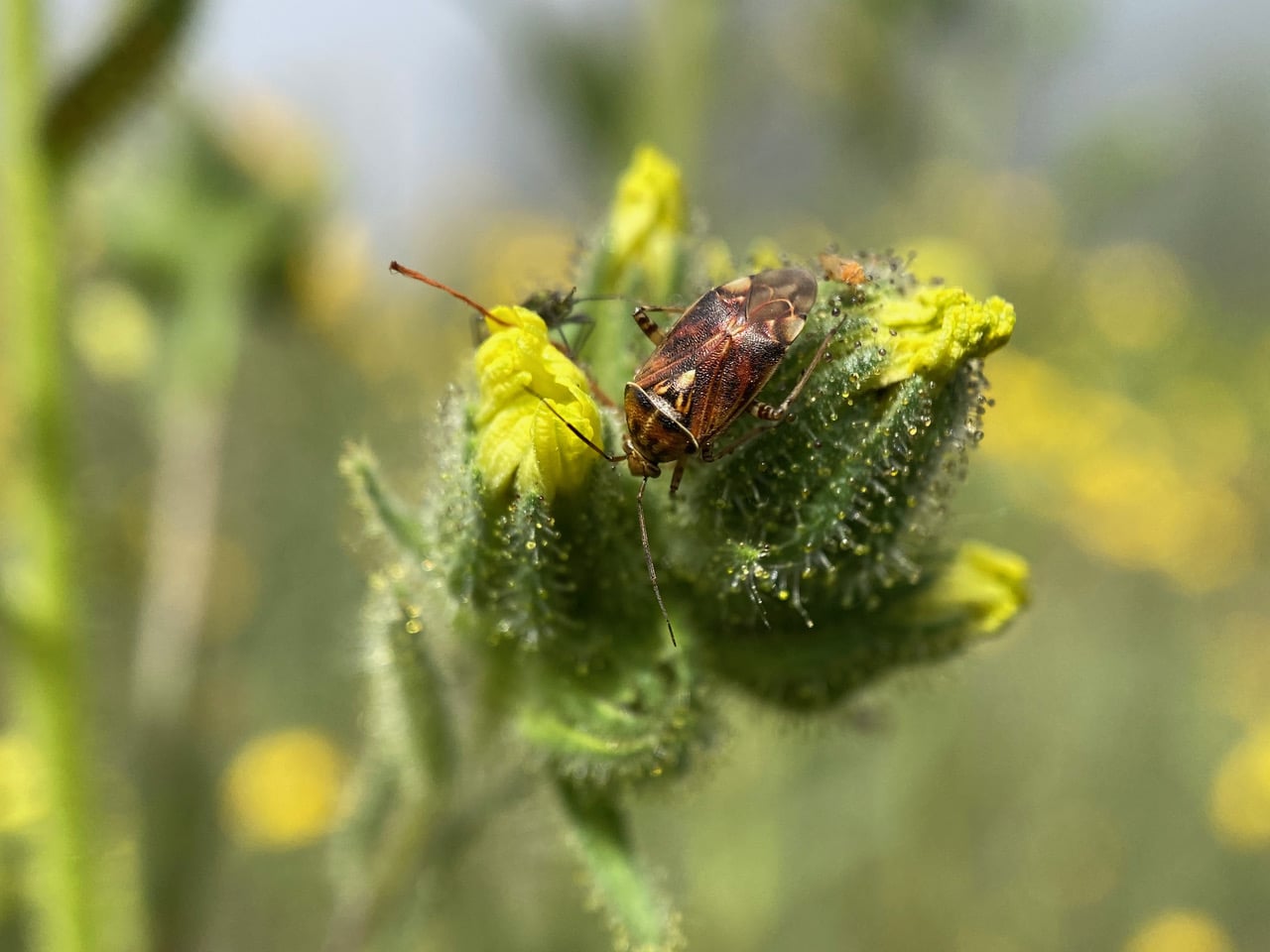
A Scentless Plant Bug (family Rhopalidae) greets the morning sun on a flowerhead of Coast Tarweed, Madia sativa.
Sunlight catches the iridescent scales on the wings of the Small Owlet Moth, Heliothodes diminutiva (family Noctuidae). The moth shimmers in various hues of pink, mauve and dark purple with every movement it makes while nectaring on the Elegant Tarweed.
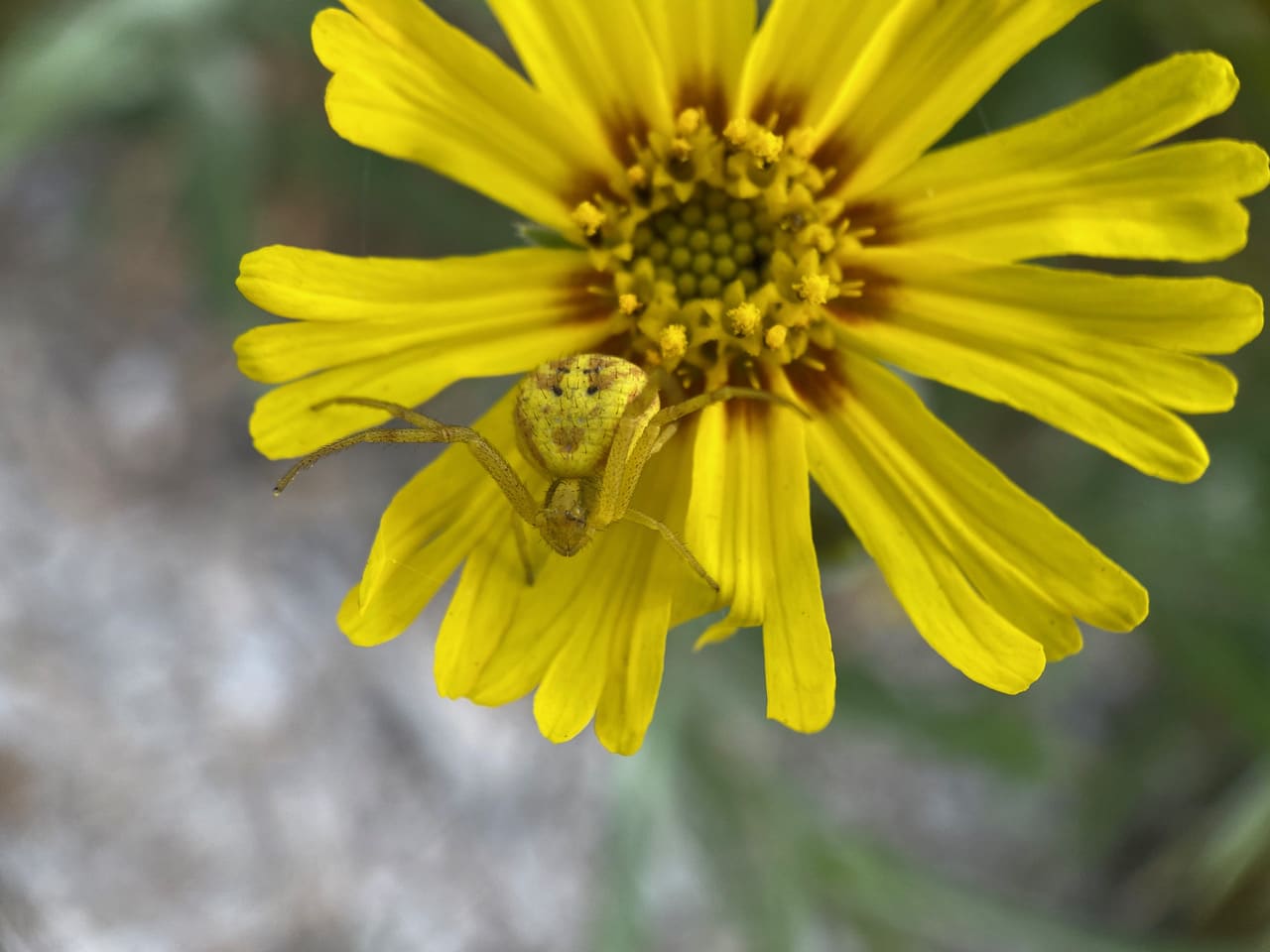
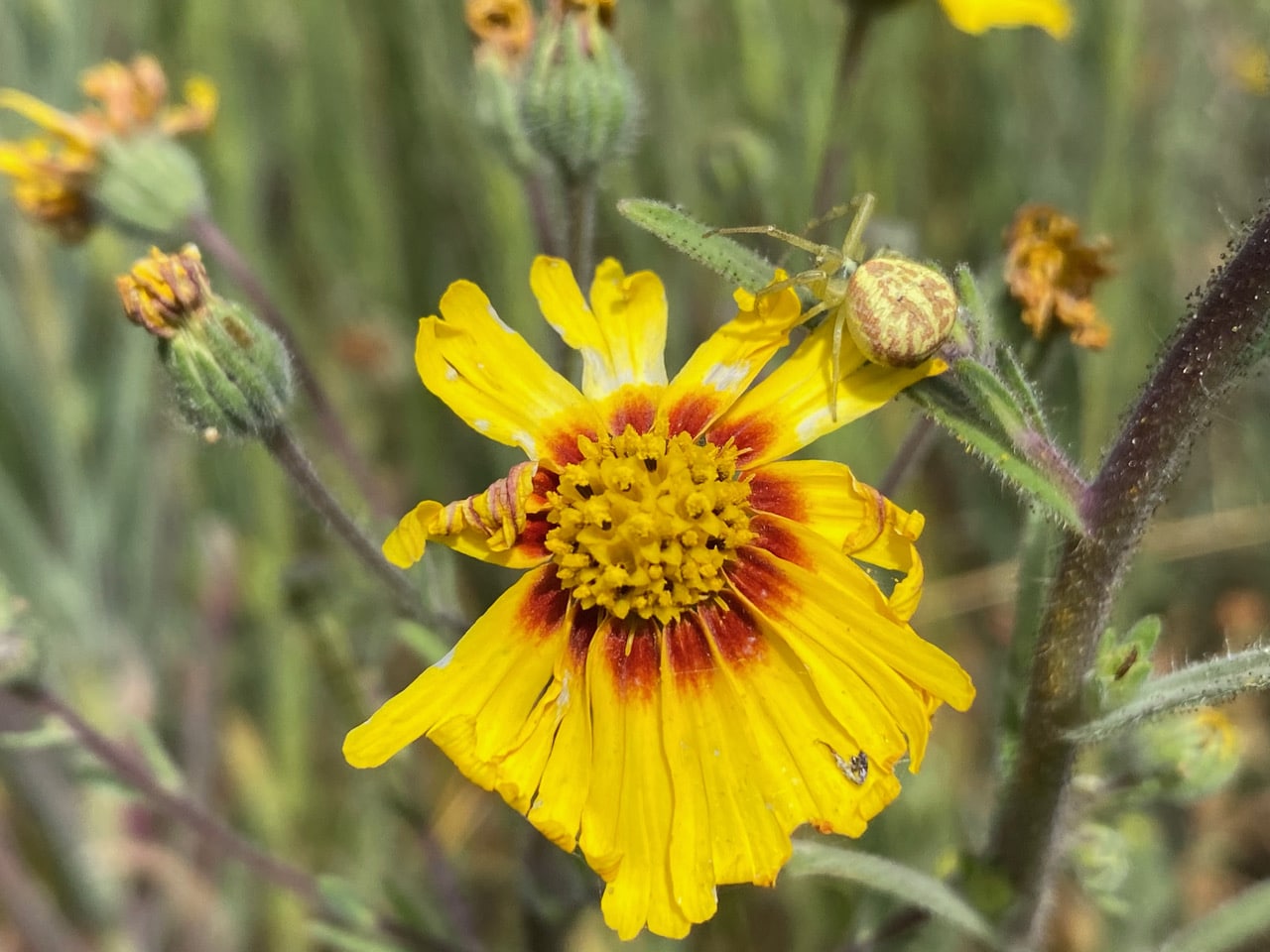
I almost miss this well-camouflaged Crab Spider, Mecaphesa sp. (family Thomisidae) as I pass the Elegant Tarweed flowerhead it is sitting on.
Crab Spiders are usually yellow or white. This ultimately depends on the flower on which they are hunting (active camouflage). They have the ability to change between these colors based on their surroundings, using visual cues. The color-changing process is not instant and can take up to 25 days to complete. Depending on the color of flower they see around them, the spiders can secrete a liquid yellow pigment into the body’s outer cell layer. The baseline color of the spider is white. In its white state, the yellow pigment is sequestered beneath the outer cell layer so that the inner glands which are filled with white guanine are visible. While the spider is residing on a white flower, it tends to excrete the yellow pigment instead of storing it in its glands. In order to change back to yellow, the spider must first produce enough of the yellow pigment. For this reason it takes these spiders much longer to turn from white to yellow than it does the reverse. The color change from white to yellow can take between 10-25 days while the opposite color change takes only about 6 days.
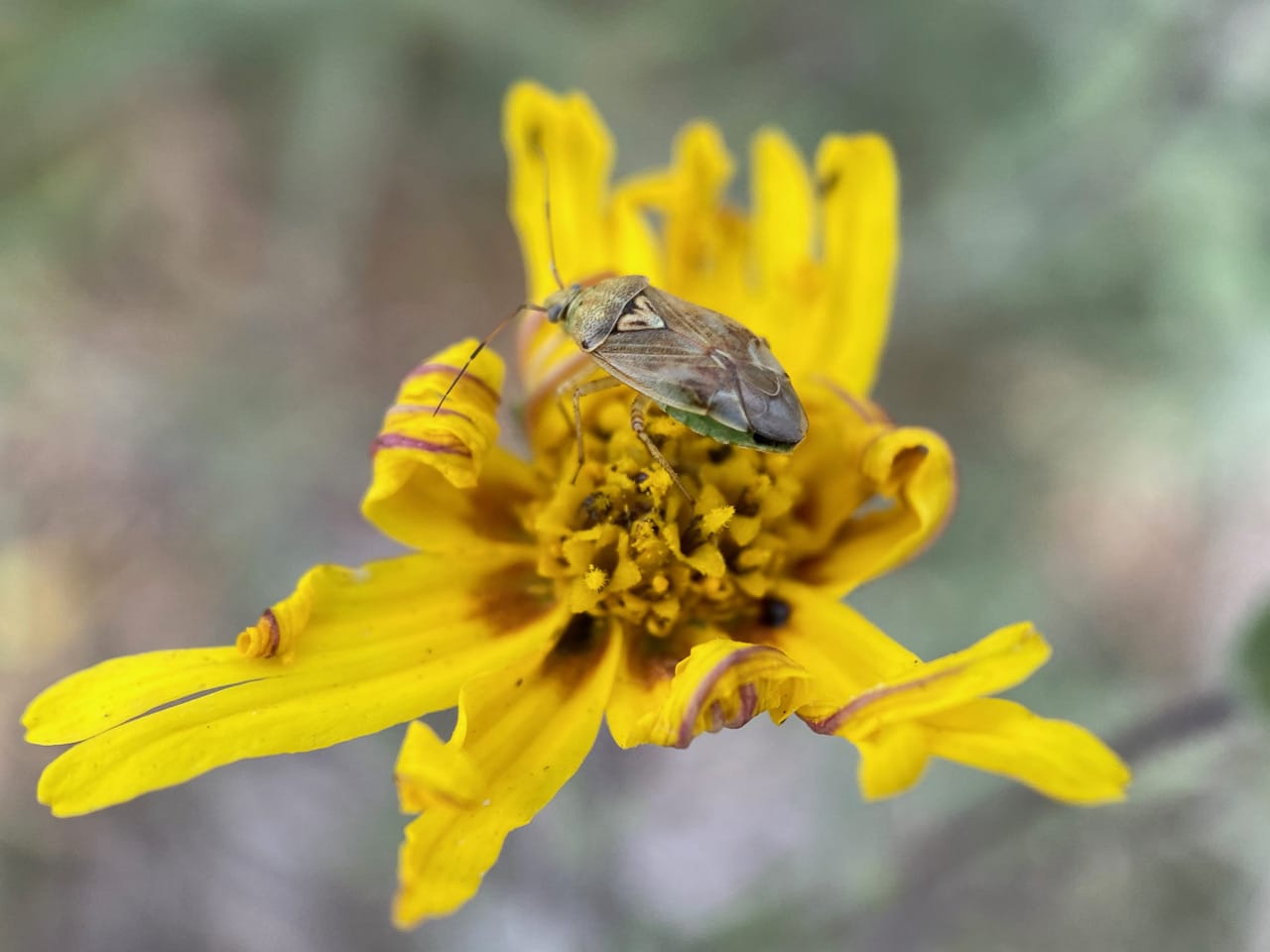
A Western Tarnished Plant Bug, Lygus hesperus (family Miridae) is roaming an Elegant Tarweed flowerhead.
Commonly referred to a Lygus Bug, the species is a serious pest on strawberry in the Central Coast of California. Adults are about 6 mm long, oval and rather flattened. They are greenish or brownish and have reddish-brown markings on their wings. In the center of their back is a distinct, but small, yellow or pale green triangle that helps distinguish them from other insects. The cunei (singular cuneus), triangular-shaped areas near the end of the forewings are translucent, blending with the coloration of surrounding body parts. The immature forms are pale green and resemble aphids. They can be distinguished from aphids by their more rapid movements.
In general the Lygus Bug’s abundance is highest after winters of higher rainfall. This causes more lush grows of vegetation such as mustards and other weeds that support a higher abundance and survival of the bugs during the winter and spring. Damage to crops and garden plants are caused by the bugs’ piercing-sucking mouthparts that extract fluids from the plant tissues.
One useful feature in identifying members of the family Miridae or plant bugs is the presence of a cuneus; it is the triangular tip of the corium, the firm, horny part of the forewing, the hemielytron. The cuneus is visible in nearly all Miridae.

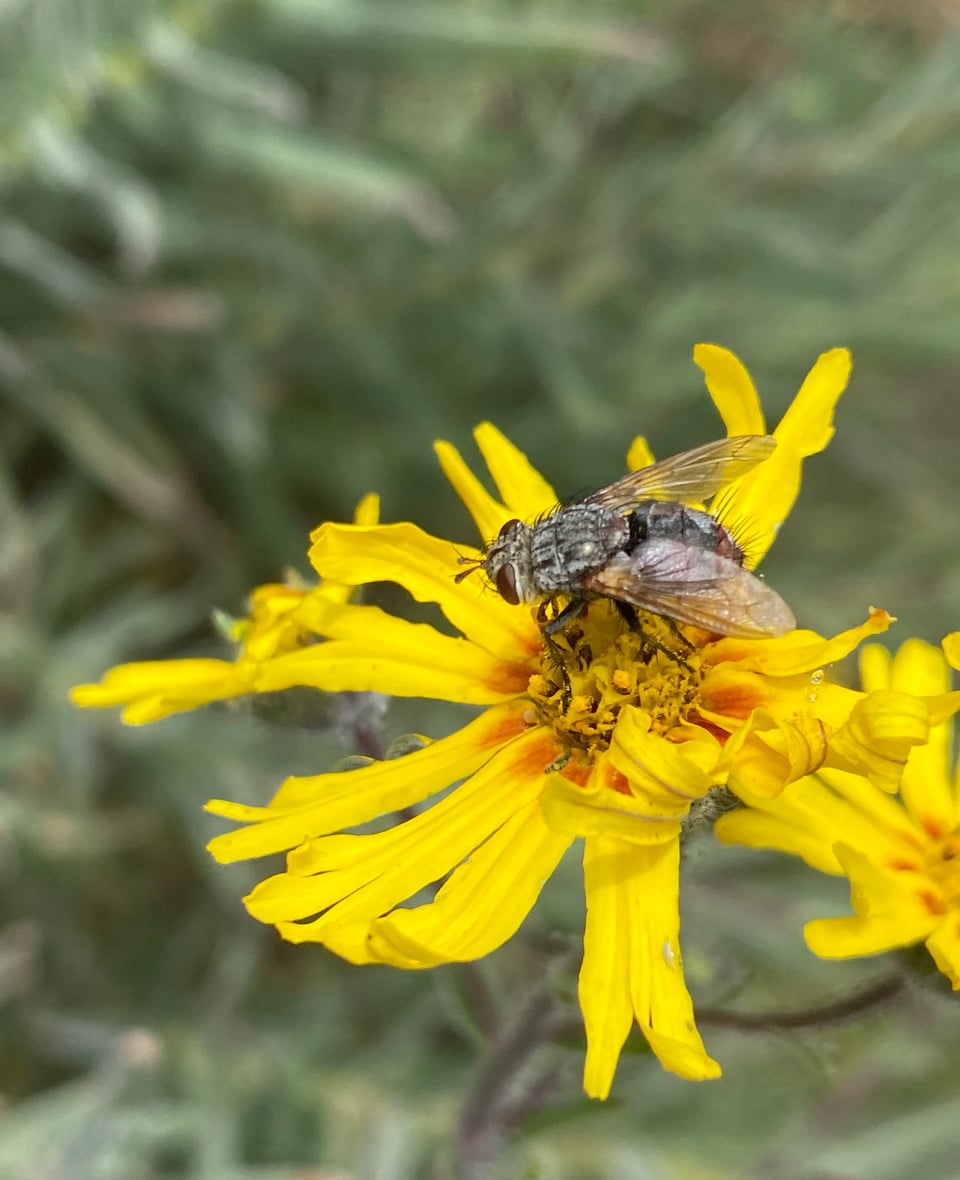
A Bristle Fly, Linnaemya sp. (family Tachinidae) is taking nectar from the flowers of Elegant Tarweed.
The family Tachinidae is by far the largest and most important group of parasitoid flies. All species are parasitic in the larval stage. Most adults have distinct abdominal bristles, hence the common name. Adults feed on liquids such as nectar and honeydew. They can be found resting on foliage, feeding at flowers or searching for hosts.
Most tachinids attack caterpillars, adult and larval beetles, true bugs, grasshoppers, and other insects. Females lay eggs in or on the host. Tachinid larvae live as internal parasites, consuming their hosts’ less essential tissues first and not finishing off the vital organs until they are ready to pupate. The larvae leave the host and pupate on the ground. Tachinids are very important in natural control of many pests, and many have been used in biological control programs.
Hosts of Linnaemya may vary from beetles to butterflies and moths. Some species are ovoviviparous, bearing larvae instead of eggs, or lay fully incubated eggs (oviparous). The first instar larvae then either actively search for a host or wait for one to pass by before latching on.
A young caterpillar of the Small Owlet Moth, Heliothodes diminutiva (family Noctuidae) is feeding on the florets of Elegant Tarweed.
The young nymphs of Lygus Bugs (family Miridae) are often found around the base of Elegant Tarweed flowerheads, where they blend in with the green phyllaries perfectly.
Who is that dark insect hidden between the lower leaves of an Elegant Tarweed?
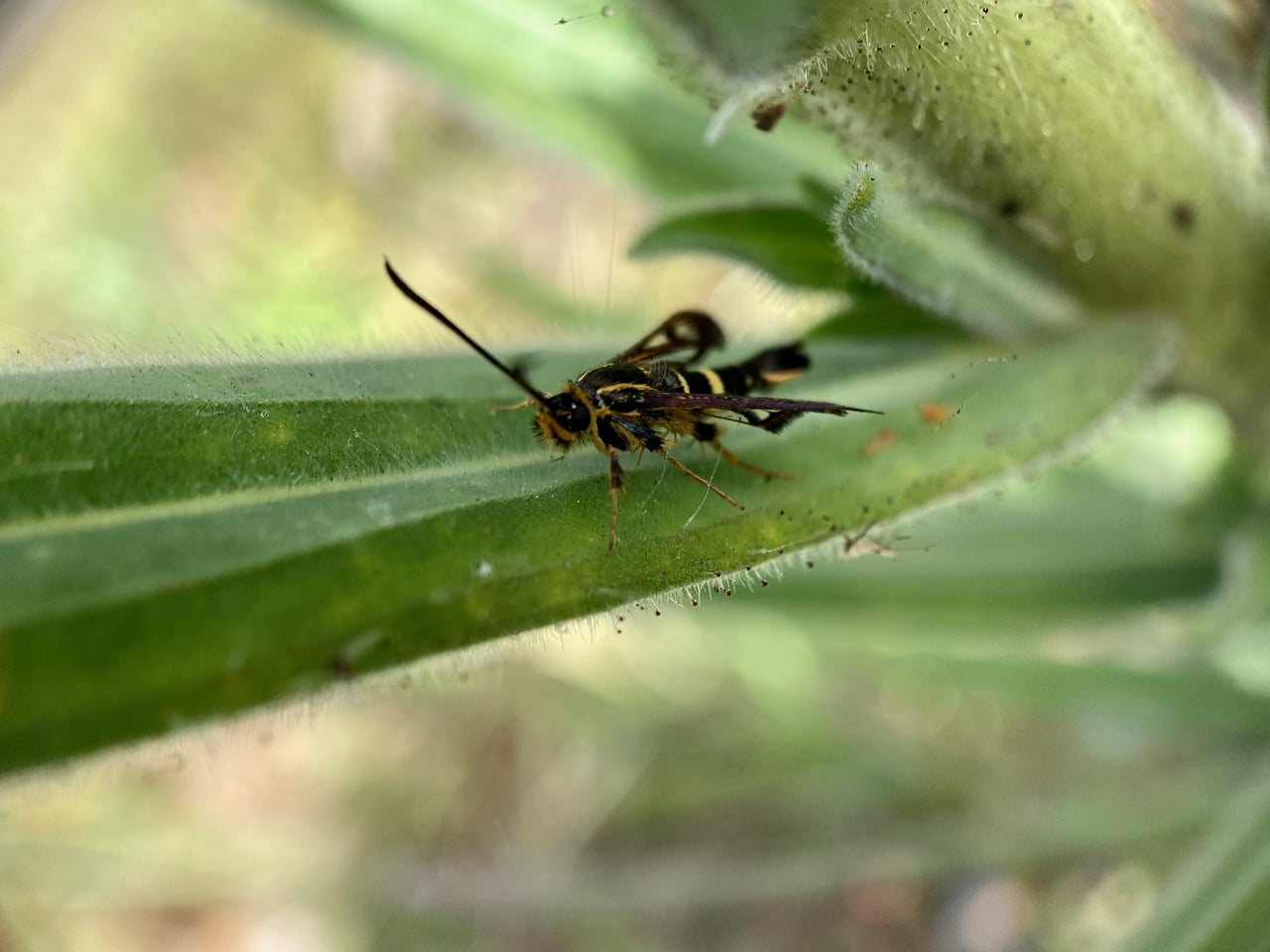
I part the adjacent leaves to allow light to fall on the insect. It is a Strawberry Crown Moth, Synanthedon bibionipennis (family Sesiidae).
The Strawberry Crown Moth, Synanthedon bibionipennis is a member of the family Sesiidae. Bibionipennis is Latin for “insect wing”. The wingspan is about 20 mm. Adults are on wing from April to August, taking nectar from many different flowers. There is one generation per year. The larvae bore in the roots near the crown or in the stem near the base of various species in the Rose family, including Fragaria, Rosa, Rubus and Potentilla.
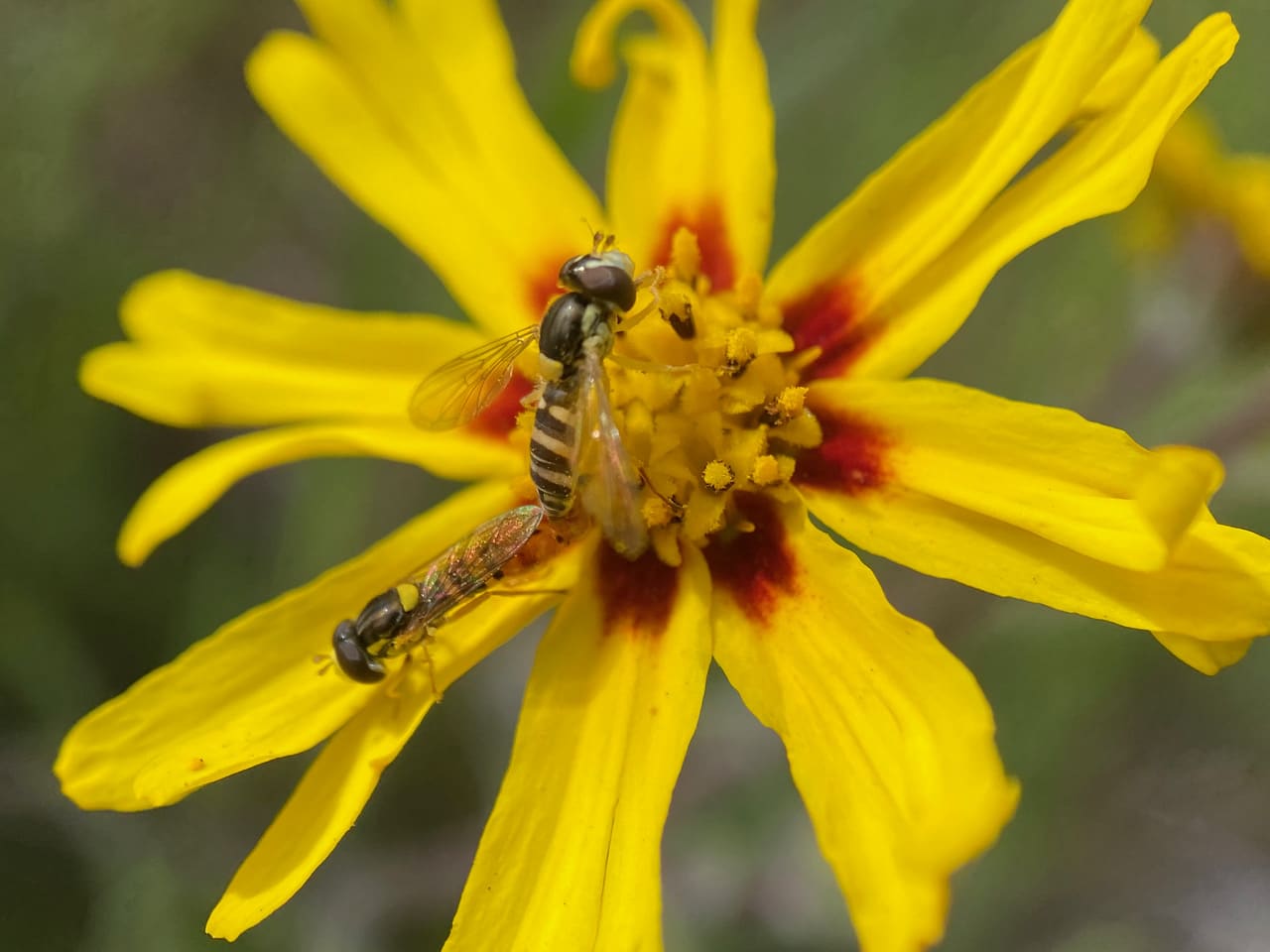
A pair of Forked Globetail Hover Flies, Spaerophoria sulphuripes (family Syrphidae) is mating on a flowerhead of Elegant Tarweed. The female is the bigger one on top. Note the difference in eye placement. The male has holoptic eyes that meet in a central line above the head.
Out of nowhere a second male appears on the scene, glomps onto the female and tries to displace the first male. There is a big tussle that ends with the interloper giving up and leaving.
Peace restored, the female hover fly returns to feeding on pollen while still in copula.
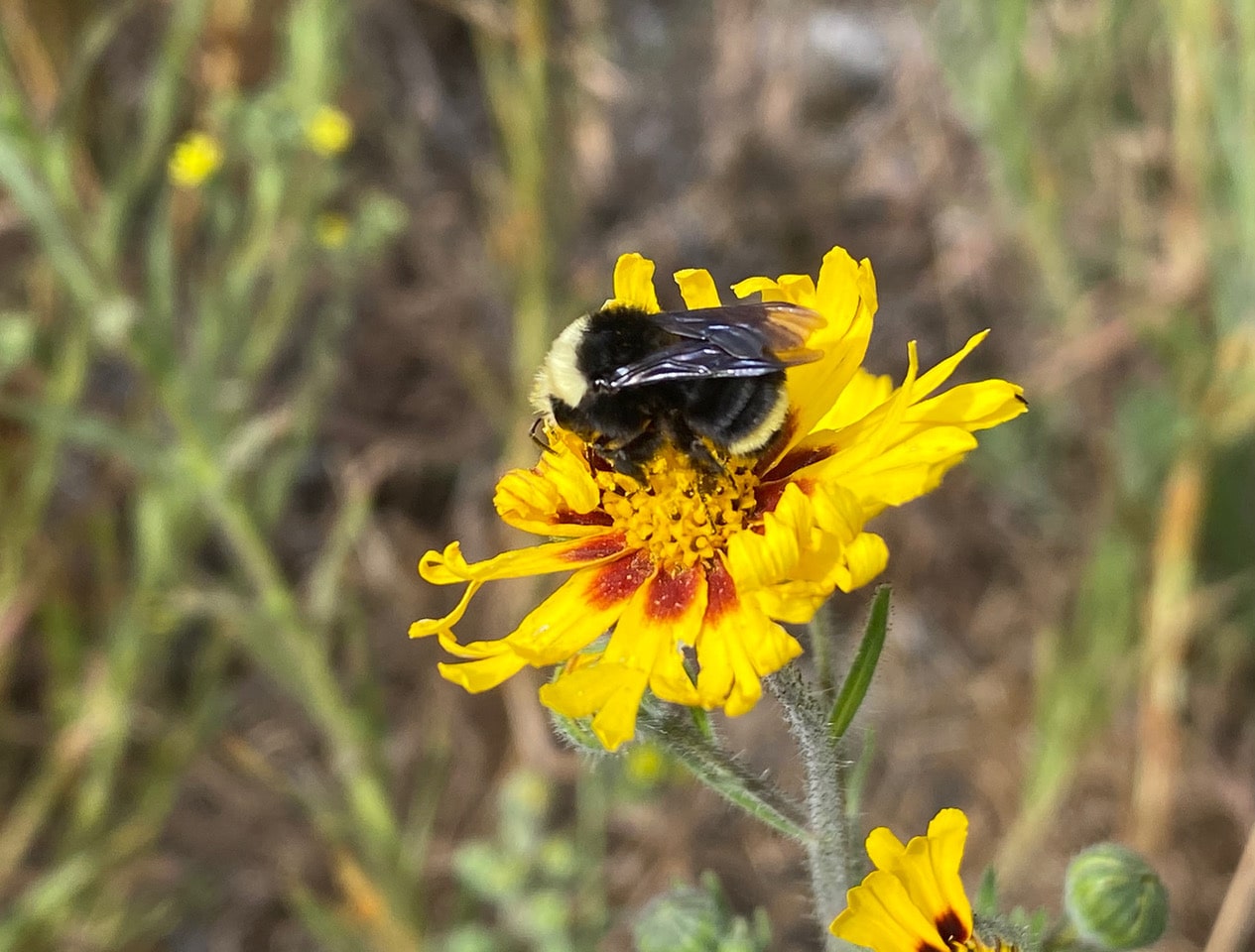
A Yellow-faced Bumble Bee, Bombus vosnesenskii buzzes through the tarweed patch in a hurry, stopping on several Elegant Tarweed flowerheads to take nectar.
A Black-margined Flower Fly, Syrphus opinator (family Syrphidae) is foraging on a flowerhead of Elegant Tarweed.
Hover Flies, also called flower flies or Syrphid flies, make up the insect family Syrphidae. The adults of many species feed mainly on nectar and pollen, and are often seen hovering and nectaring at flowers. They are important pollinators of flowering plants in many ecosystems worldwide. The larvae feed on a wide range of foods. In many species, the larvae are insectivores and prey on aphids, thrips, and other plant-sucking insects. In other species, the larvae are saprotrophs, eating decaying plant and animal matter in the soil or in ponds and streams.
Many species of Hover Flies exhibit Batesian mimicry; they are brightly colored, with bands of yellow resembling the bees and wasps. The mimicry provides the fly with some measure of protection from potential predators, although the flies are harmless and lack a sting.
Syrphus opinator is a common hover fly species in central California and has the abdominal fasciae restricted to the sides and isolated from the margins.
Lygus Bugs (family Miridae) come in a variety of colors, ranging from the lightest green to dark brown. The cuneus of the wings are especially visible on this brown individual. The cuneus is a useful feature for identifying members of the family Miridae.
Lygus Bug adults are about 6 mm long, oval and rather flattened. They are greenish or brownish and have reddish-brown markings on their wings. In the center of their back is a distinct, bur small, yellow or pale green triangle that helps distinguish them from other insects. The cunei (singular cuneus), triangular-shaped areas near the end of the forewings are translucent, blending with the coloration of surrounding body parts. The immature forms are pale green and resemble aphids. They can be distinguished from aphids by their more rapid movements.
In general the Lygus Bug’s abundance is highest after winters of higher rainfall. This causes more lush grows of vegetation such as mustards and other weeds that support a higher abundance and survival of the bugs during the winter and spring. Damage to crops and garden plants are caused by the bugs’ piercing-sucking mouthparts that extract fluids from the plant tissues.
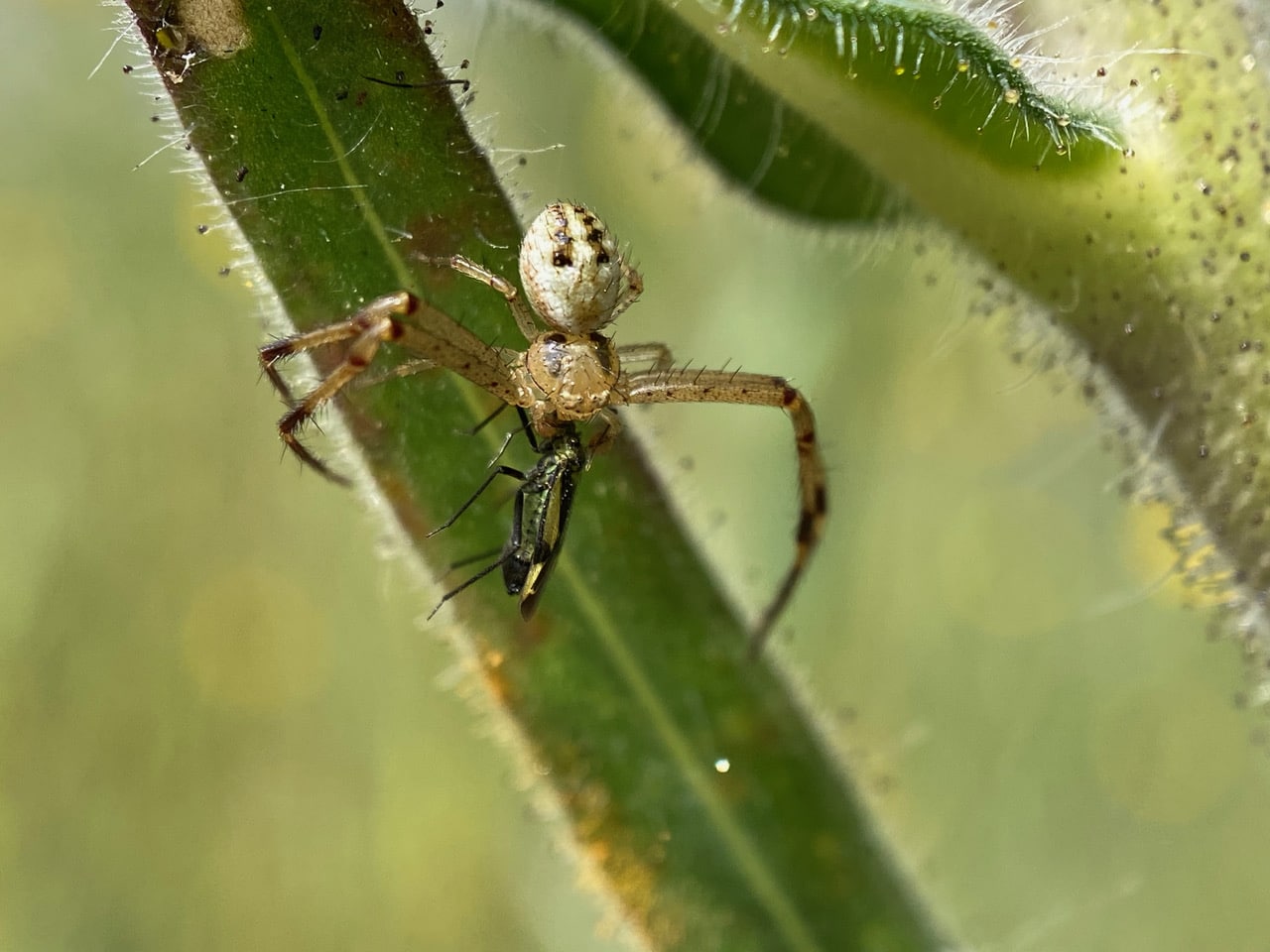
Wow, a male Crab Spider, Mecaphesa sp. (family Thomisidae) has captured a Plant Bug, Macrotylus essigi (family Miridae). Males are smaller and more slender, and have very long legs relative to their body.
Members of the family Thomisidae do not spin webs, and are ambush predators. The two front legs are usually long and more robust than the rest of the legs. Their common name derives from their ability to move sideways or backwards like crabs. Most Crab Spiders sit on or beside flowers, where they grab visiting insects. Some species are able to change color over a period of some days, to match the flower on which they are sitting.
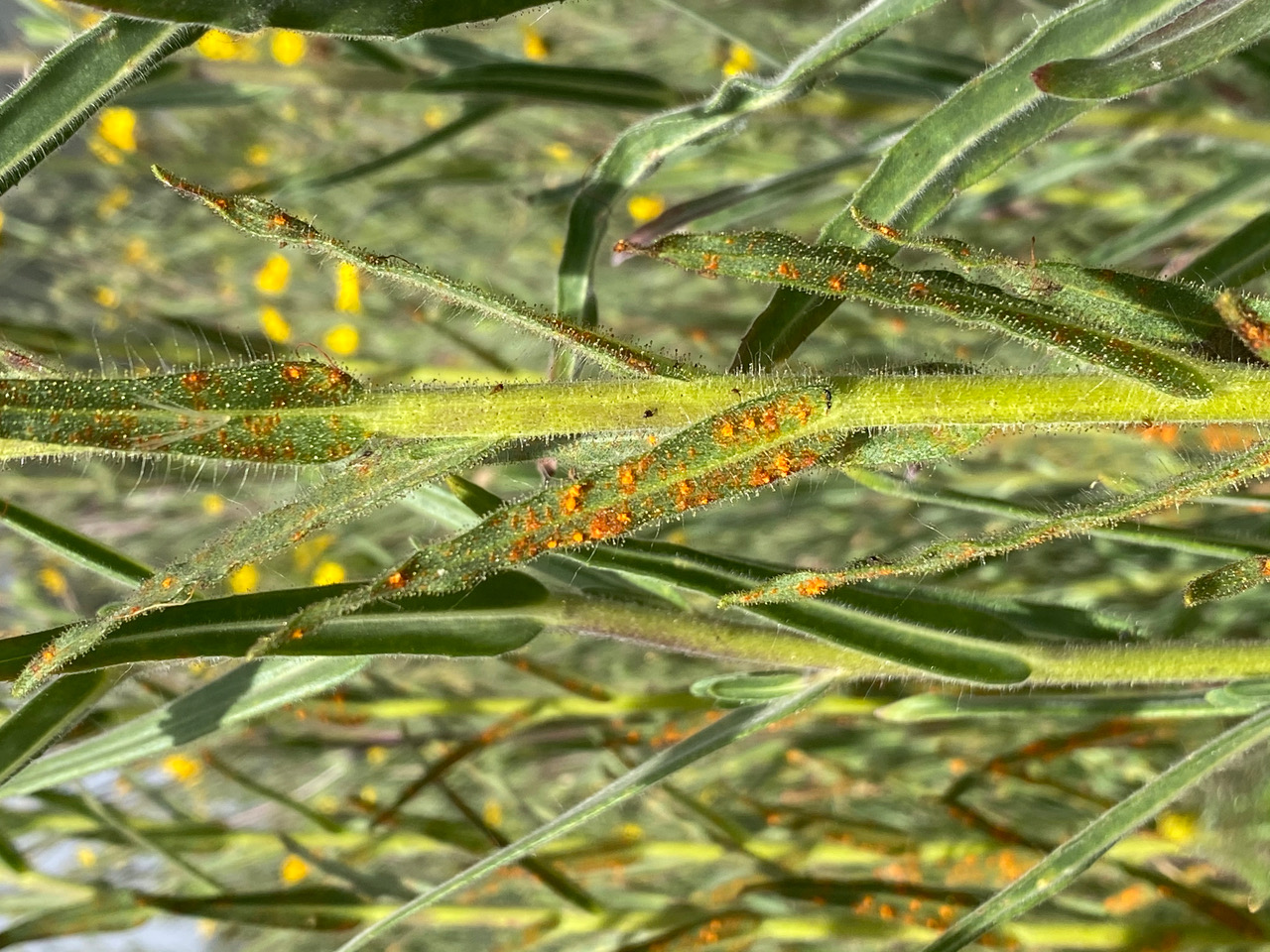
Many of the Elegant Tarweed at Siesta Gate are showing powdery orange spots characteristic of rust fungus on the underside of their leaves.
Rusts are plant diseases caused by pathogenic fungi of the order Pucciniales. They get their name for the deposits of powdery rust-colored spores on plant surfaces. Rust fungi are highly specialized pathogens that affect many kinds of plants. Each species has a very narrow range of hosts and cannot be transmitted to non-host plants. Many rust fungi produce up to five spore types from morphologically and cytologically distinct spore-producing structures during their life cycle. The spores of rust fungi may be dispersed by wind, water or insect vectors. Rust generally do not kill the host plant, but can severely reduce growth and yield.
A Secondary Screwworm, Cochliomyia macellaria (family Calliphoridae) is foraging on the flowers of Elegant Tarweed.
The Secondary Screwworm, Cochliomyia macellaria (family Calliphoridae, commonly known as blow flies) ranges throughout the United States and the American tropics. The body is metallic greenish-blue and characterized by three black longitudinal stripes on the dorsal thorax. Females are attracted to carrion where they lay their eggs. These screwworms are referred to as “secondary” because they typically infest wounds after invasion by primary myiasis-causing flies. While the flies carry various types of Salmonella and viruses, C. macellaria can also serve as important decomposers in the ecosystem. In a lifetime, a female may lay up to 1000 or more eggs. Females may also lay their eggs with other females, leading to an accumulation of thousands of eggs.
The larval stage of C. macellaria is referred to by the common name of secondary screwworms; this is due to the presence of small spines on each body segment that resemble parts of a screw. The larvae feed on the decaying flesh of the animal that they have been laid on until they reach maturity. Eventually the larvae fall off the food source to pupate in the top layer of the soil. Adult females will continue to feed on tissues of animals; however, now they preferentially feed off of live tissues and tissue plasma. Adult males will no longer consume tissue, but instead will eat nearby vegetation and take nourishment from floral nectar.
Hey, that’s the same female Crab Spider, Mecaphesa sp. (family Thomisidae) that I saw two days ago. She’s still on the same, but now fading Elegant Tarweed flowerhead.
Crab Spiders (family Thomisidae) do not make webs to catch prey. They are ambush predators that silently wait in the flowers until the prey appears. The spider grabs the prey with the long front legs and delivers a deadly dose of venom using its slender fangs. Females are generally larger than males, sometimes many times larger. Males have more slender body and longer legs. They are darker in color and have brown markings on the abdomen. Females are more sedentary, while the males tend to wander in search of mating opportunities by following the silk threads laid down by the females.