

Pollinator Post 8/5/23

A small insect lands on the underside of a leaf of Coyote Brush, Baccharis pilularis. Tilting the stem, I see that the insect has ornately patterned picture wings. It is a Fruit Fly in the family Tephritidae.
Tephritids are small to medium-sized flies that are often colorful, and usually with picture wings. The larvae of almost all Tephritidae are phytophagous. Females deposit eggs in living, healthy plant tissues using their telescopic ovipositors, sometimes forming galls. Here the larvae find their food upon emerging. The larvae develop in leaves, stems, flowers, seeds, fruits, and roots of the host plant, depending on the species. Adults are often found on the host plant and feeding on pollen, nectar, rotting plant debris, or honeydew. Tephritid flies are of major economic importance as they can cause damage to fruit and other plant crops. On the other hand, some Tephritids are used as agents of biological control of noxious weeds.
Many species of Tephritidae perform an elaborate courtship display using their picture wings.

I will probably be seeing more of these Fruit Flies as the season transitions into fall. I have been observing this species, Tephritis californica last year on Coyote Brush. The flies court and mate on the plant, and the females lay eggs in the immature flower heads.

A dark insect, about 3/4 in. long, lands on an adjacent Coyote Brush. On close approach, I notice that it has caught a small insect. A Robber Fly!

The Robber Fly manipulates its prey with its forelegs.
Robber Flies (family Asilidae) have three simple eyes (ocelli) in a characteristic depression on the tops of their head between their two large compound eyes. This feature is clearly visible in the front view and is a morphological peculiarity of Asilidae. The face also has a characteristic dense bundle of mustache-like bristles, called a “mystax”. Apparently the mystax helps protect the head and face of the fly from its struggling prey bent on defense.
The name “robber flies” reflects their notoriously aggressive predatory habits; they feed mainly or exclusively on other insects and, as a rule, they wait in ambush and catch their prey in flight. Asilids have long, stout, spiny legs for capturing prey. The fly attacks its prey by stabbing it with its short, strong proboscis, injecting the victim with saliva containing neurotoxic and proteolytic enzymes which very rapidly paralyze the victim and digest the insides; the fly then sucks the liquefied material through the proboscis. In general, Asilids attack a very wide range of prey, including other flies, beetles, butterflies and moths, various bees, ants, wasps, dragonflies, damselflies, grasshoppers, and some spiders. Larvae of robberflies live in soil, rotting wood, leaf mold, and similar materials, some being predatory and others detritivorous.

Note the mystax, the mustache-like bristles on the face of the Robber Fly.
iNaturalist has helped identify the fly as Eudioctria sackeni (family Asilidae). The species is found in western North America from British Columbia to California.
This is the third species of robber fly documented for the Skyline Gardens – all found along the short stretch of Skyline Trail north of Siesta Nose. Yay!

Many plants along Skyline Trail near the Steam Train entrance are covered with black insects. On closer inspection, I discover they are dead winged aphids. These are on a Bee Plant.

Most of the dead winged aphids are stuck on the sticky hairs of the young Coast Tarweed along the trail. Did the aphids get accidentally blown onto the plants? Where did they originate?
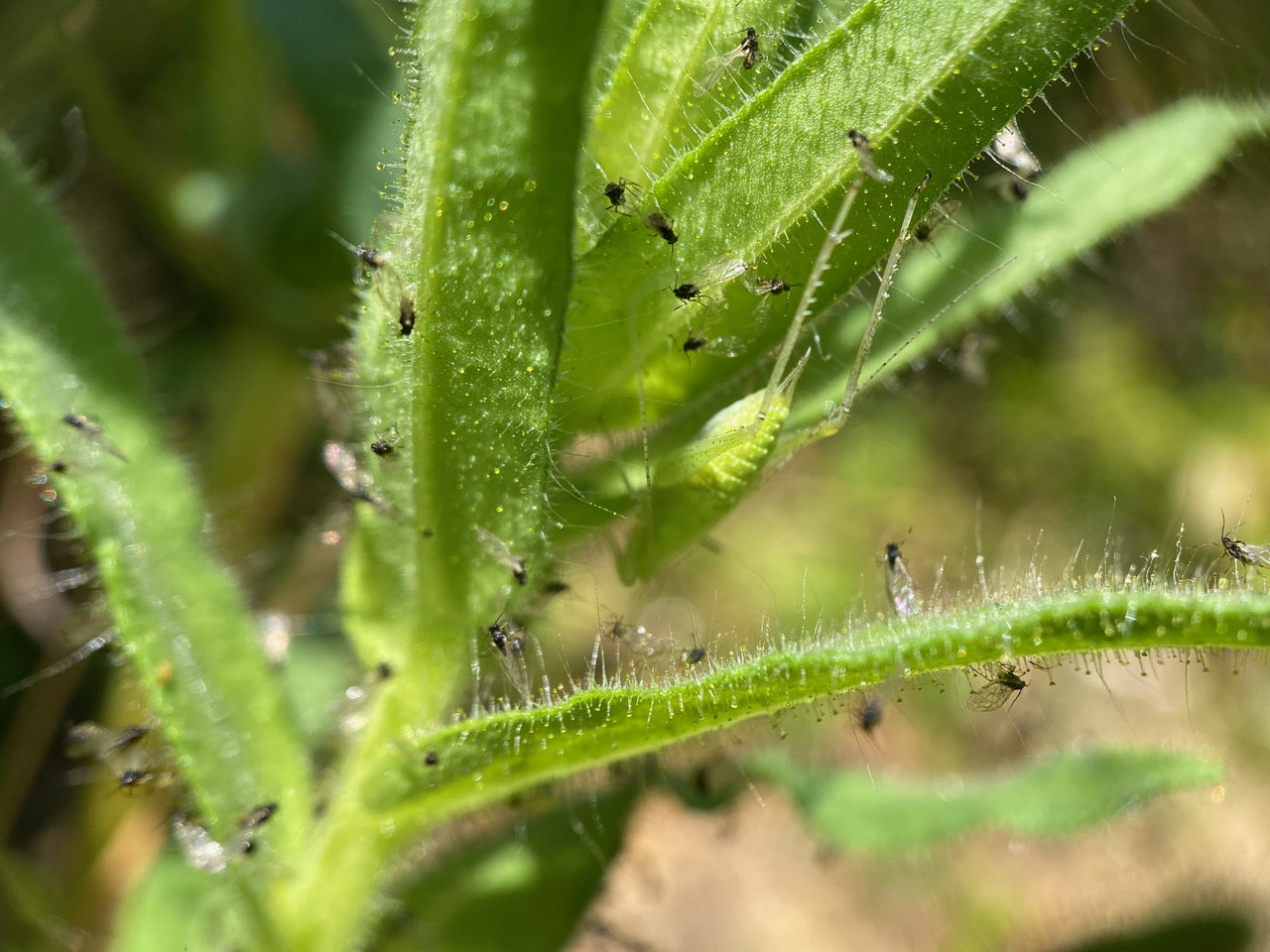
Hey, I think that’s a Tree Cricket among the foliage of the Coast Tarweed! This young Coast Tarweed is only about a foot tall. Is the insect here to feed on the abundant aphids?
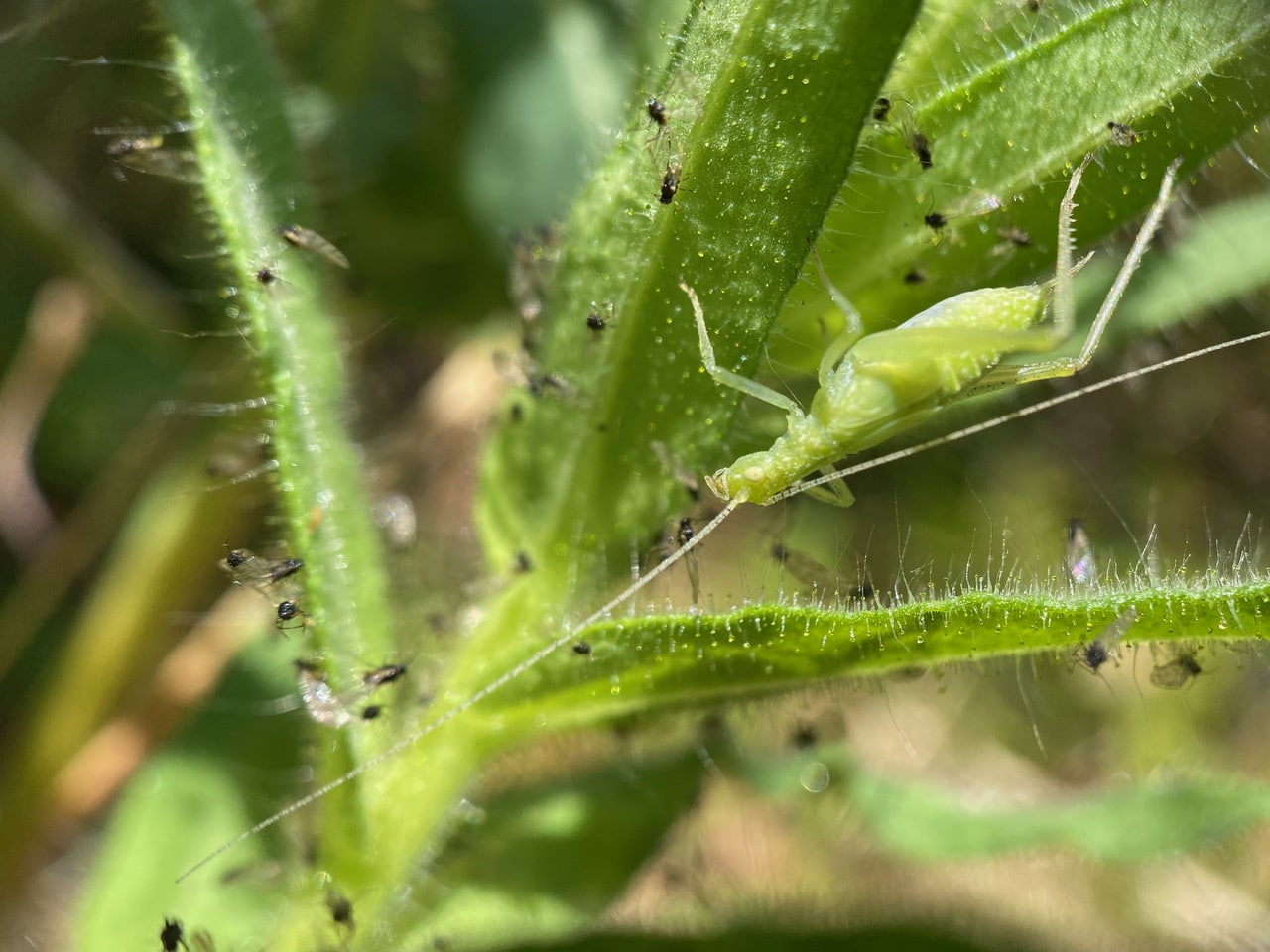 It’s a nymphal (juvenile) Common Tree Cricket, Oecanthus sp. (family Gryllidae).
 Common Tree Crickets, Oecanthus sp. are delicate whitish or pale green insects with slender bodies, long antennae and transparent forewings. They are in the order Orthoptera (crickets, katydids, grasshoppers, etc.) and in the “true cricket” family Gryllidae. The tree crickets undergo a paurometabolous development (gradual metamorphosis). Nymphs resemble small adults and gradually develop external wing buds. They live in the same habitat as adults, and typically take the same food. Tree Crickets inhabit trees, shrubs and tall weeds, feeding on plant parts, some insects (e.g., aphids, scales) and other materials (e.g., fungi, pollen). Egg laying activities can affect plant health by injuring growth on twigs and branches or introducing plant pathogens.
More often heard than seen, tree crickets are active at dusk and at night. In late summer, males produce a high-pitched whine or “song”, a prelude to courtship and mating. Sound is produced by stridulation; the basal edge of one forewing (scraper) is rubbed along a filelike ridge (file) on the ventral side of the other forewing. Other members of the Orthoptera, including katydids and horned grasshoppers also produce sound by the file and scraper method.

A Skipper (family Hesperiidae) lands on a Poison Oak leaf, the part that is covered with brown punctate feeding scars. I notice that insects tend to land where they blend in their background and are less conspicuous. Do they have a sense of self and know what they themselves look like?
Skippers are a family, the Hesperiidae, of the order Lepidoptera (butterflies and moths). They are named for their quick, darting flight habits. Most have the antenna clubs hooked backwards like a crochet hook. They also have generally stockier bodies and larger compound eyes than the other butterflies. Their wings are usually small in proportion to their bodies. When at rest, skippers keep their wings usually angled upwards or spread out, and only rarely fold them up completely.
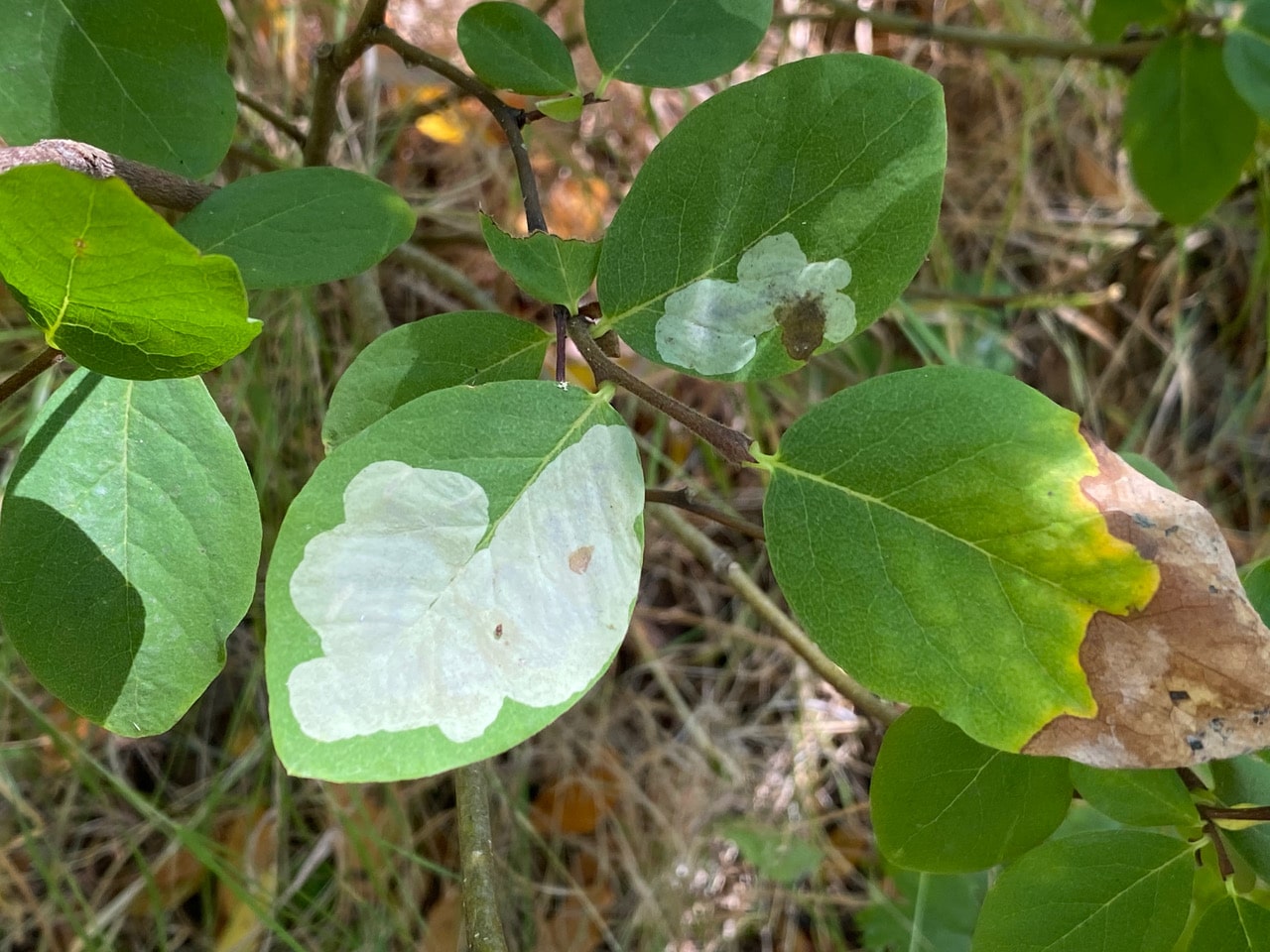
Some of the leaves of Western Leatherwood, Dirca occidentalis have large pale areas made by leaf-mining insects.
A leaf miner is any one of numerous species of insects in which the larval stage lives in, and eats, the leaf tissue of plants. The vast majority of leaf-mining insects are moths (Lepidoptera), sawflies (Symphyta), and flies (Diptera). Some beetles also exhibit this behavior. Leaf miners are protected from many predators and plant defenses by feeding within the tissues of the leaves, selectively eating only the layers that have the least amount of cellulose, and lowest levels of defensive chemicals.
The Eastern Leatherwood, Dirca palustris has similar leaf mines made by the Leaf Blotch Miner Moth, Leucanthiza dircelia (family Gracillariidae). Our Western Leatherwood is probably mined by a similar moth in the family Gracillariidae.

Squiggly leaf mines are commonly found on the leaves of Sticky Monkeyflower, Diplacus aurantiacus. Might these be made by the Leaf-miner Flies (family Agromyzidae) I have photographed on several occasions, always on Sticky Monkeyflower? (See picture below.)
The Agromyzidae are a family commonly referred to as the Leaf-miner Flies, for the feeding habits of their larvae, most of which are leaf miners on various plants. They are small flies, most species in the range of 2-3 mm. Agromyzidae larvae are phytophagous, feeding as leaf miners, less frequently as stem miners or stem borers. A few live on developing seeds, or produce galls. There is a high degree of host specificity. A number of species attack plants of agricultural or ornamental value, so are considered pests. The shape of the mine is often characteristic of the species and therefore useful for identification. Adults occur in a variety of habitats, depending on the larval host plants.
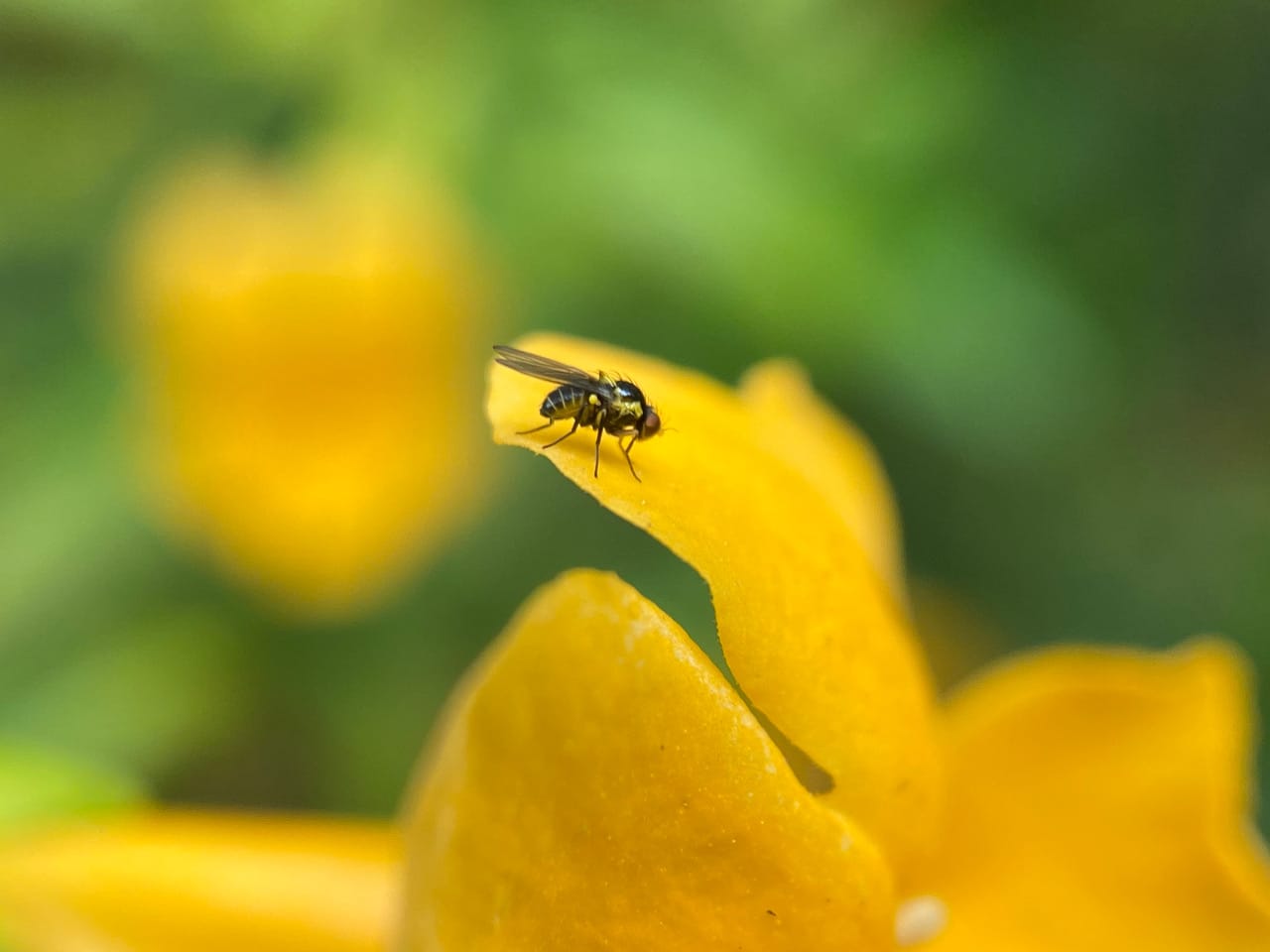
A Leaf-miner Fly (family Agromyzidae) photographed on Sticky Monkeyflower on 8/3/23. It is about 2 mm long.

Wow, all the young flower buds of this Sticky Monkeyflower have been broken into! Obviously by some insects with strong chewing mouthparts. Are they after the pollen, or insects that are developing in the flower buds?

Here’s another Sticky Monkeyflower bud with a gaping hole.

Yet another robbed flower bud.
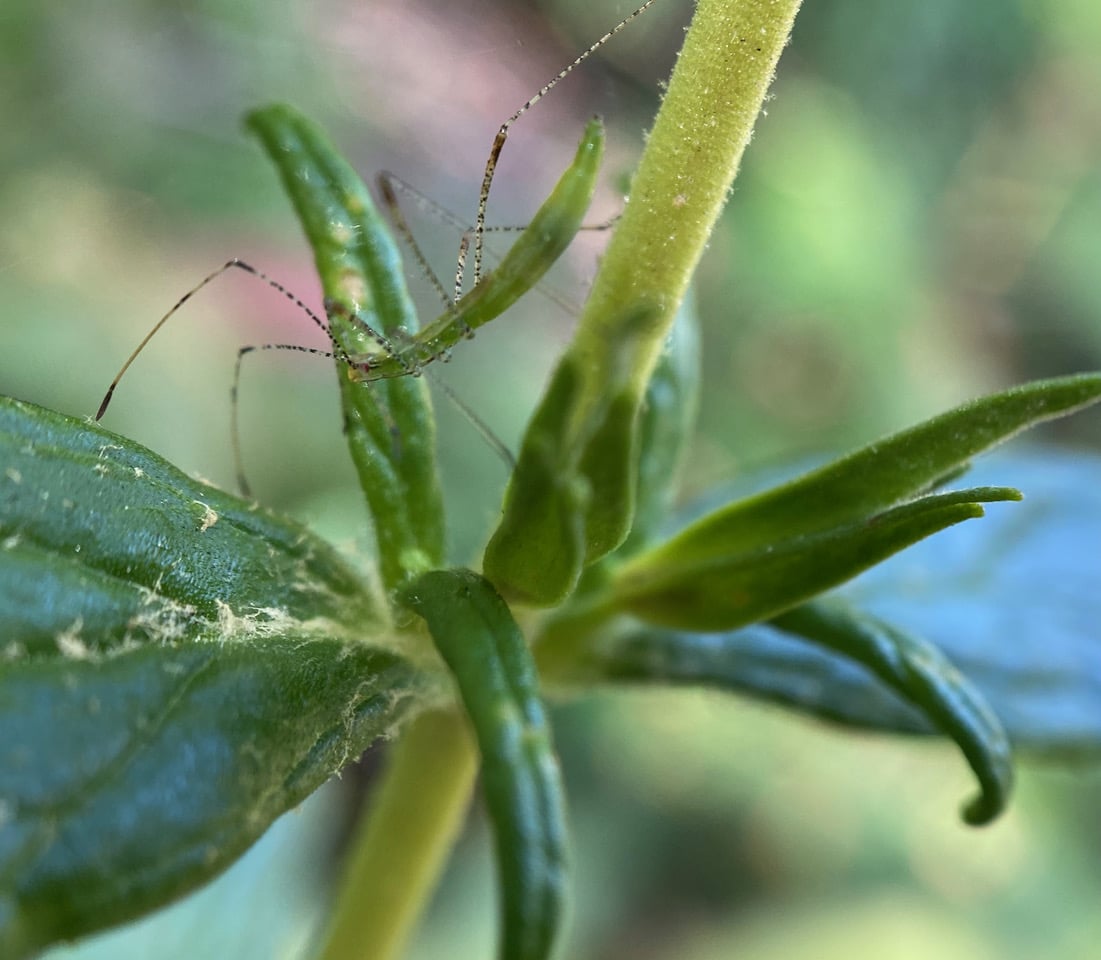
A nymphal Stilt Bug (family Berytidae) is walking among the leaves of Sticky Monkeyflower.
The Berytidae are extremely gracile insects with legs so long and slender as to suggest common names such as “thread bugs” and “stilt bugs”. They resemble some Assassin Bugs, but lack the raptorial forelegs of the predators. Antennae have 4 segments, the fourth enlarged, appearing as a swelling at the tip.
Stilt Bugs occur worldwide and throughout North America. Most are phytophagous (plant-feeders); many may be host-specific, often associated with plants with glandular hairs in Geraniaceae, Onagraceae, Scrophulariaceae, and Solanaceae. Some are occasionally omnivorous, feeding opportunistically on insects entrapped in plant exudates or on lepidopteran eggs or aphids.
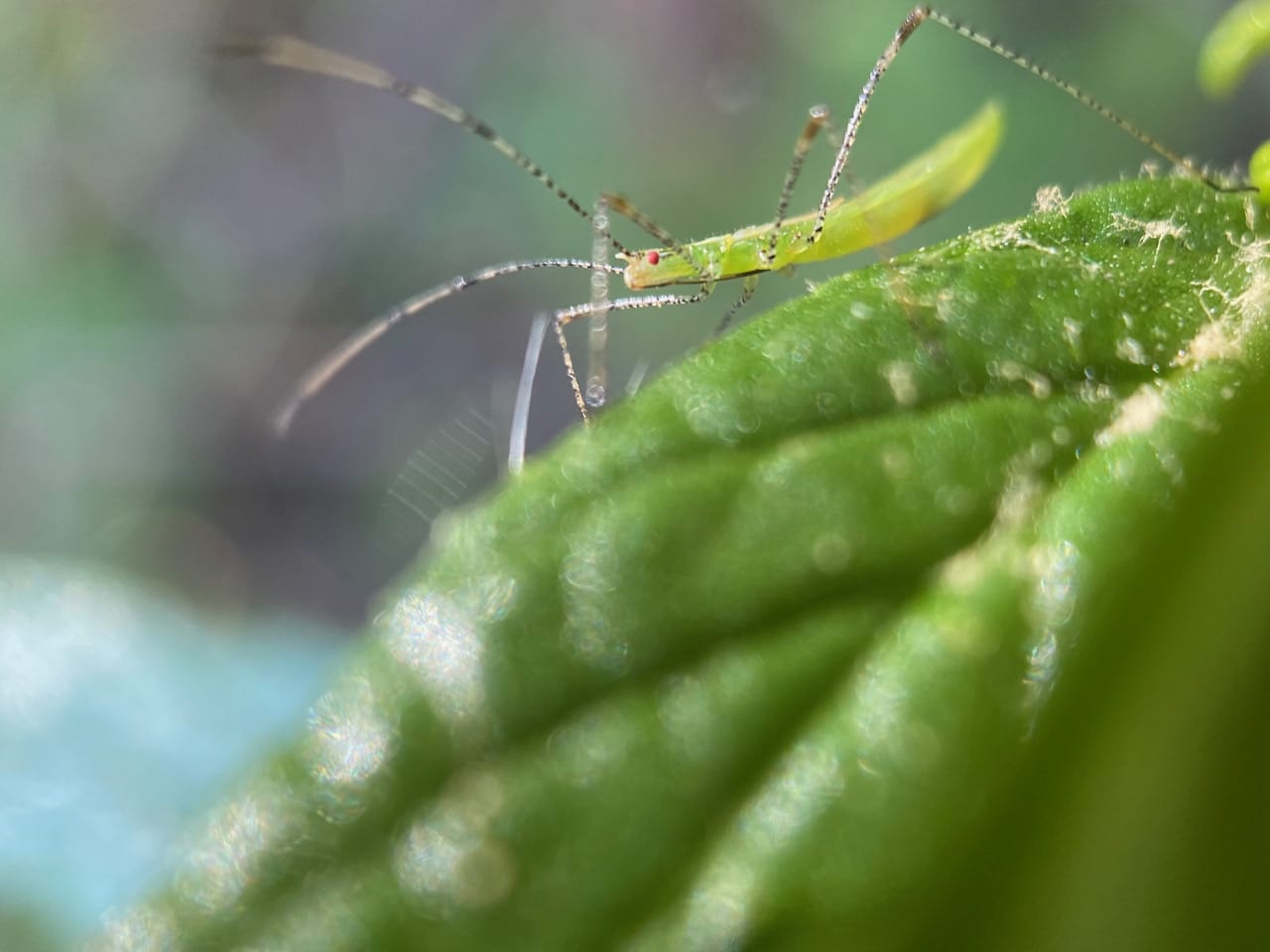
As a member of the order Hemiptera (“true bugs”), Stilt Bugs have piercing-sucking mouthpart that is folded under the body when not in use.
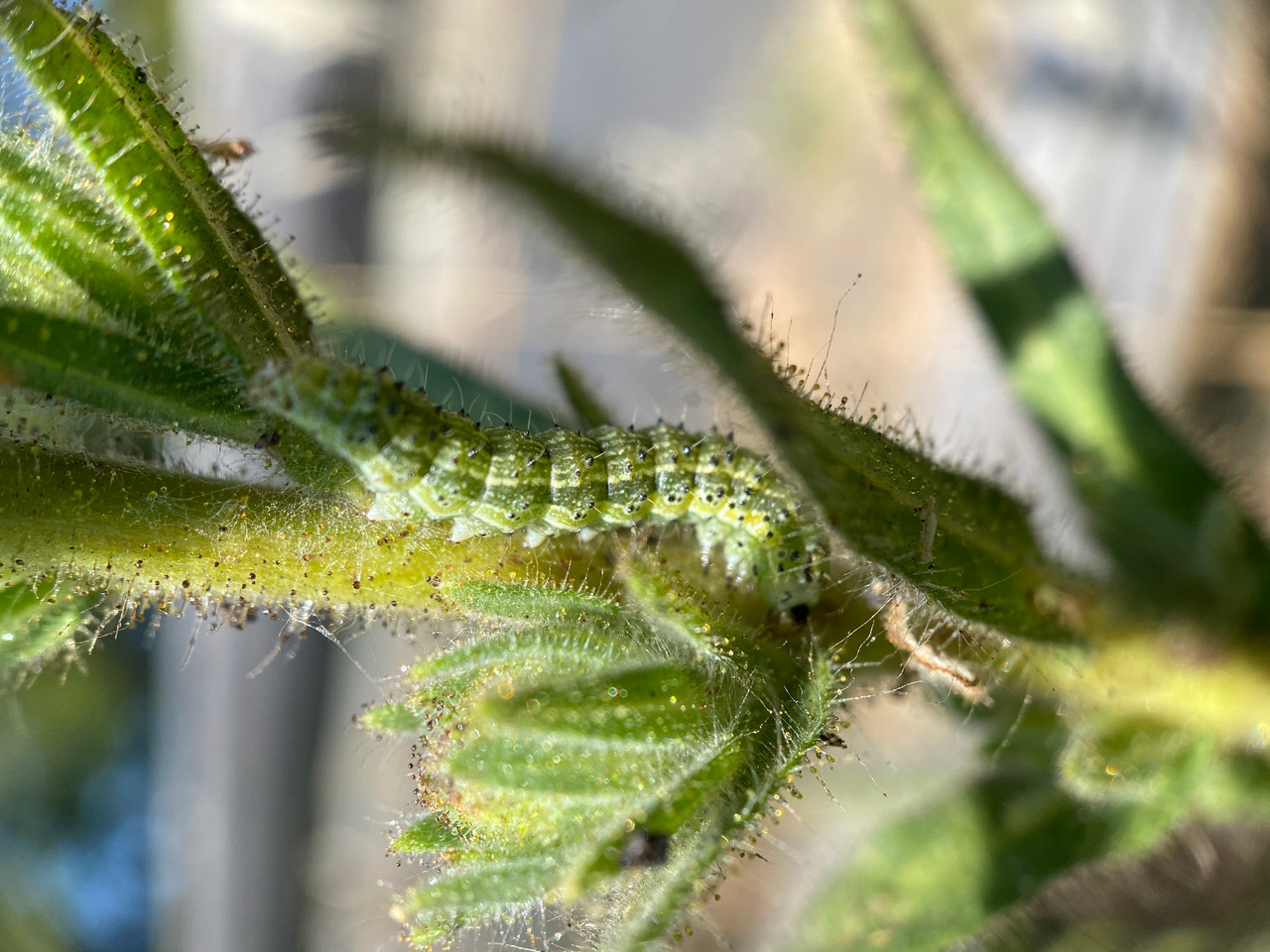
Near the Steam Train entrance, a Small Owlet Moth caterpillar, Heliothodes sp. (family Noctuidae) is feeding on the immature flowerhead of a young Coast Tarweed, Madia sativa.
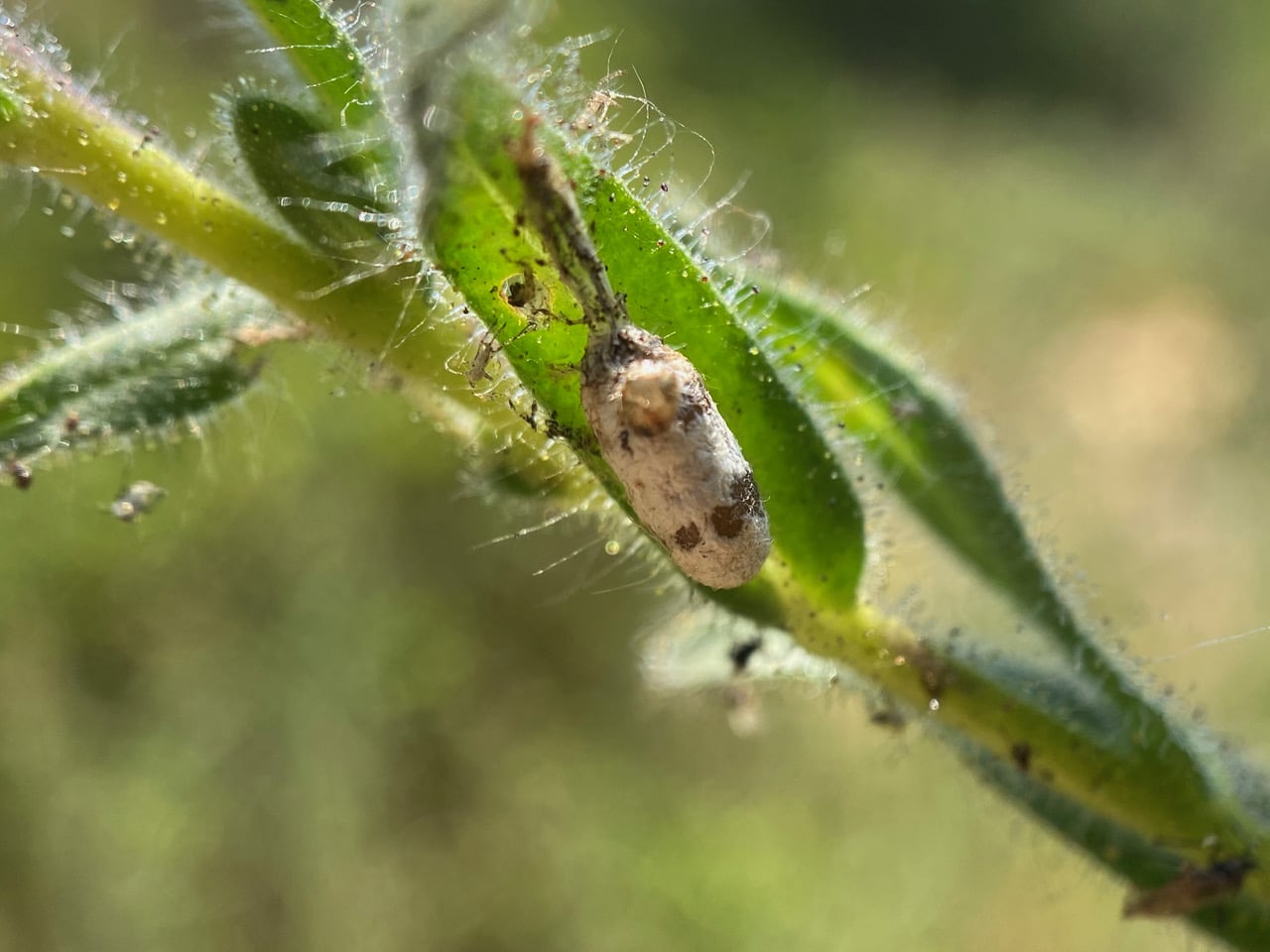
Just a few feet away, on another Coast Tarweed, I find a black-and-white pupa of a parasitoid wasp, Hyposoter sp. (family Ichneumonidae) with a withered Heliothodes caterpillar draped over it.
Hyposoter is a large cosmopolitan genus of parasitoid wasps belonging to the family Ichneumonidae. Obvious evidence that Hyposoter is present is its black-and-white pupal cocoon. These commonly occur on foliage attached to the shriveled skin of the caterpillar in which the parasitoid fed during its larval stage.
Hyposoter undergoes complete metamorphosis. The adult wasp lays its egg in the caterpillar. After hatching, the larva feeds inside on the caterpillar’s hemolymph (blood) while developing through three, increasingly larger instars. The wasp larva then feeds on the caterpillar’s tissues consuming the entire body except for the skin and head capsule. The host caterpillar shrinks and becomes a hard and brittle, shriveled skin. The parasitoid emerges from the host skin as a mature third instar (prepupa). The wasp then spins a silken cocoon commonly attached to the dead caterpillar’s skin. The cocoon is about 1/4 in. long, oblong with dense white silk and blackish patches. Parasite development time from oviposition until adult emergence is about one month. There may be several generations per year. Hyposoter is used in the biological control of caterpillars in many crops.