

Pollinator Post 8/22/23
I visit the garden in the late afternoon today after the worst of the heat has dissipated.
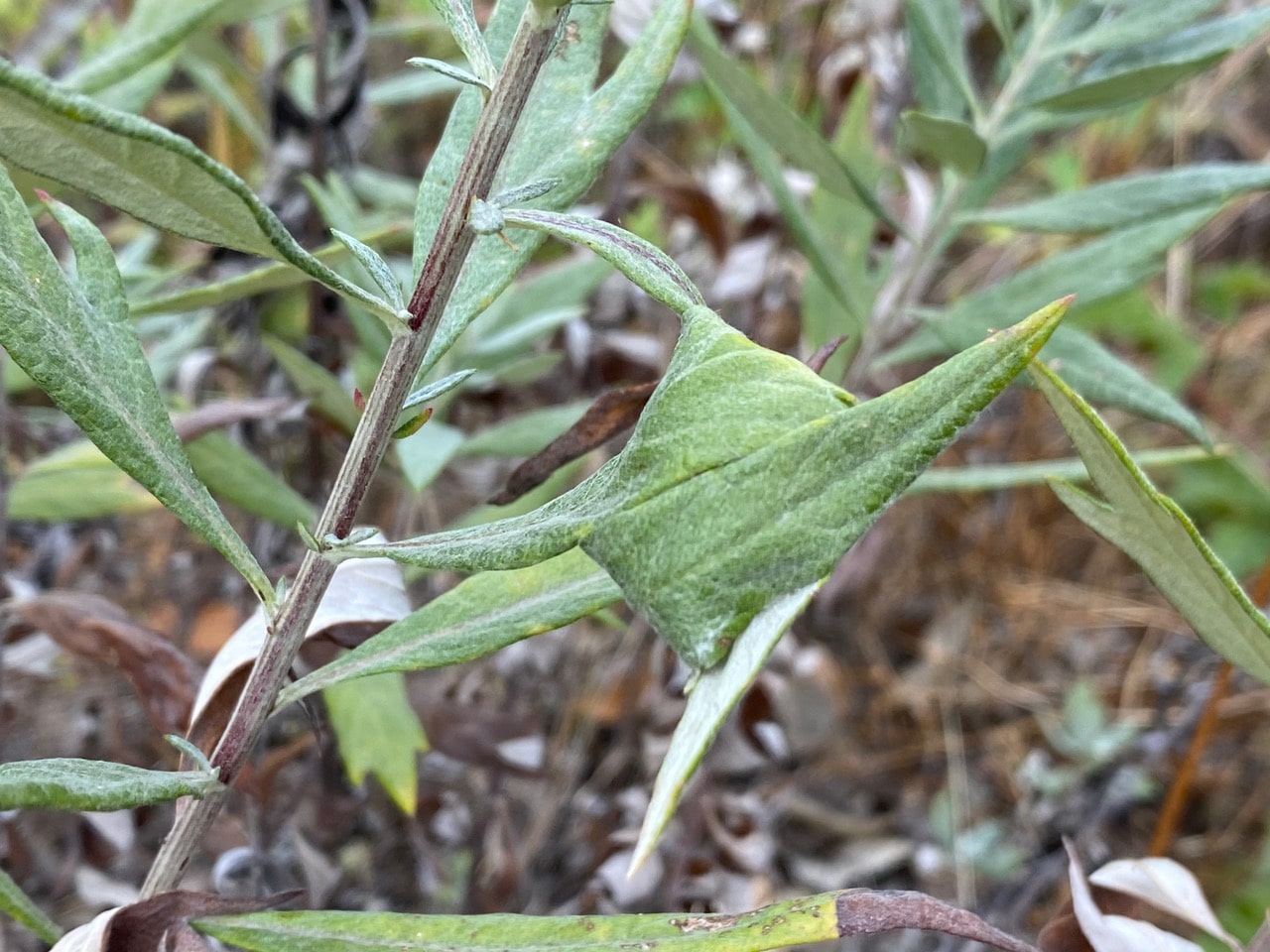
Near Siesta Gate, two adjacent leaves on the same California Mugwort, Artemisia douglasiana have been artfully webbed together, their undersides clasping each other as if in a handshake.





 Not far from where I found the first bound leaves of California Mugwort, I come across something similar. Two adjacent leaves on the same plant have been bound together.
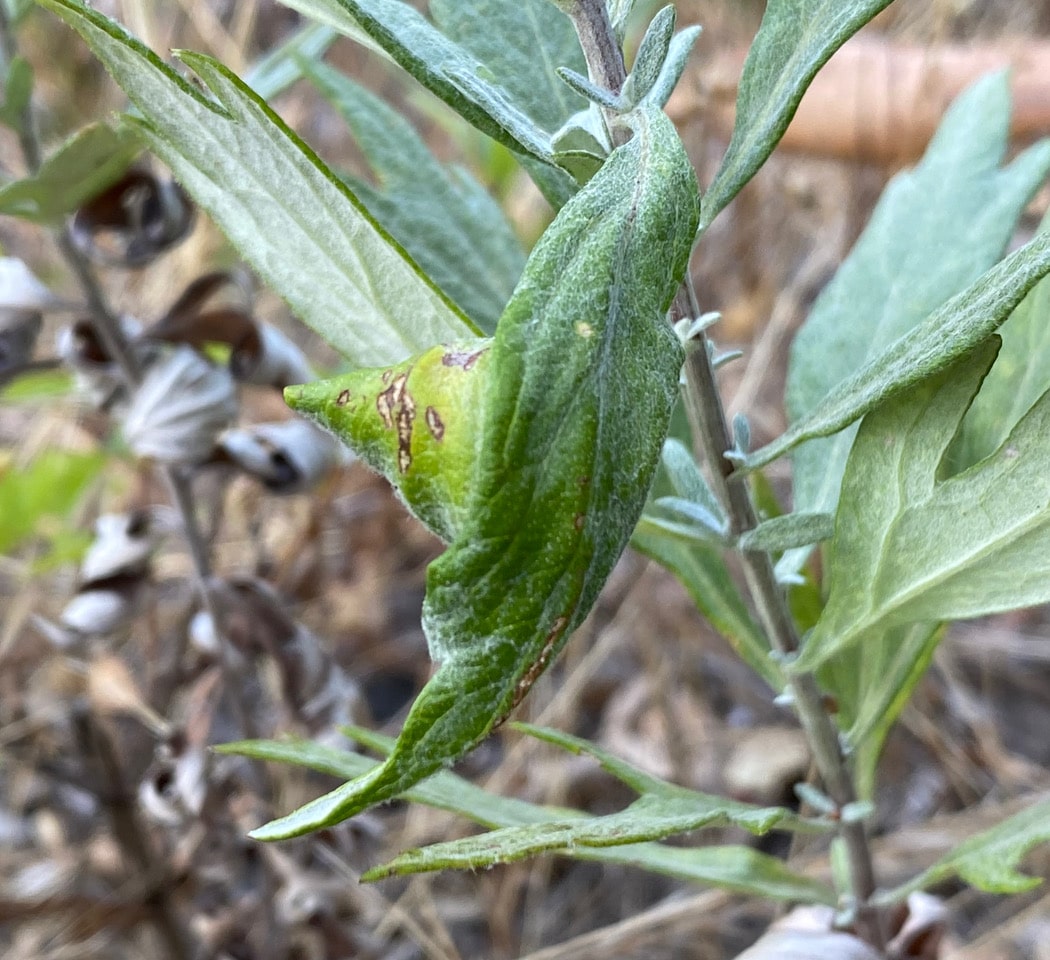


This is the other side of the webbed leaves. The structure looks quite fresh, and I don’t have the heart to pull it apart in case the occupant is still inside.
The colors on the Two-tubercled Orbweaver, Gibbaranea bituberculata (family Araneidae) appear more vivid in the afternoon sun. The spider is doing well hunting from her regular perch – a split seed capsule of Soap Plant, Chlorogalum pomeridianum. She has strung a web stretching to the next Soap Plant to catch passing insects.
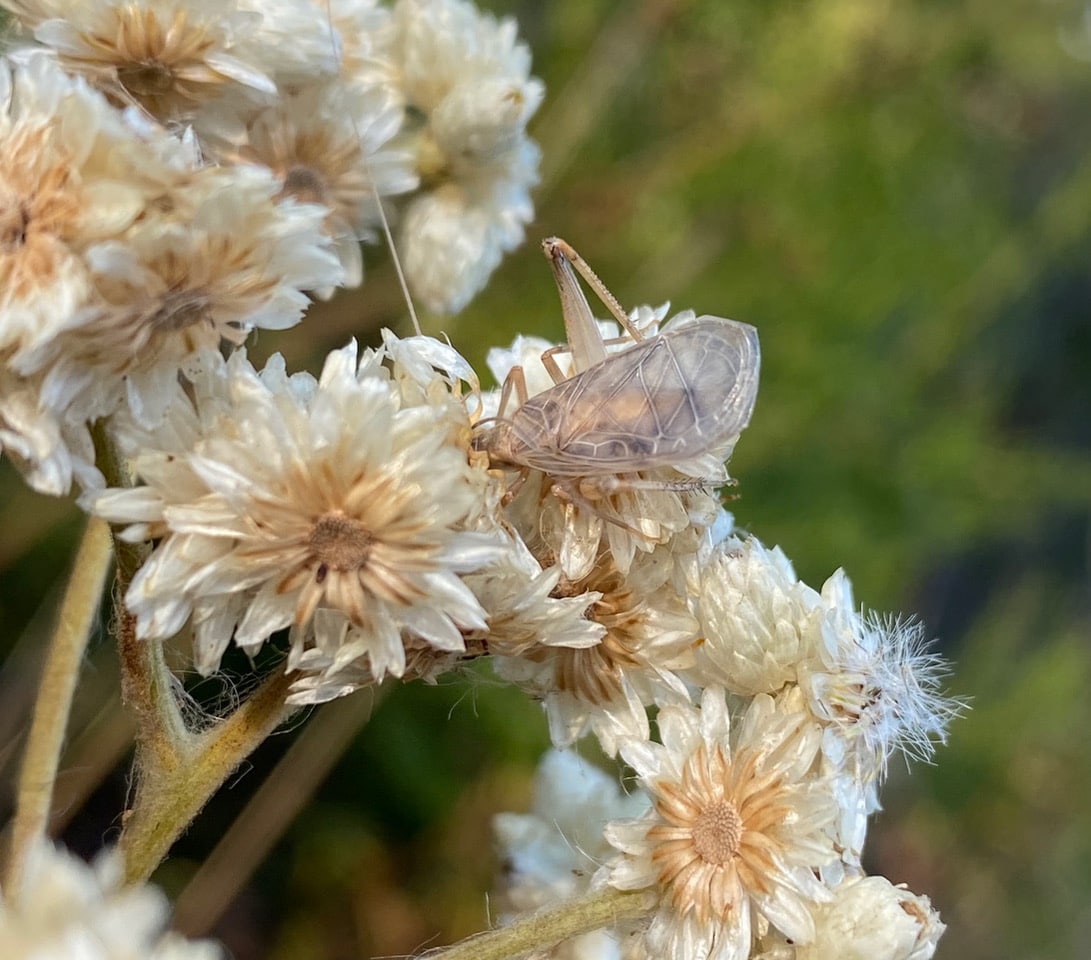
Hello, who’s there!? Note the long antennae that extend beyond the inflorescence of California Everlasting, Pseudognaphalium californicum.
It’s a male Western Tree Cricket, Oecanthus californicus (family Gryllidae).
Just about 100 yards further on Skyline Trail, I find another male Western Tree Cricket, Oecanthus californicus (family Gryllidae) on the spent inflorescence of California Everlasting. As I close in with the camera, the cricket ducks between the flowerheads.
Common Tree Crickets, Oecanthus sp. are delicate whitish or pale green insects with slender bodies, long antennae and transparent forewings. They are in the order Orthoptera (crickets, katydids, grasshoppers, etc.) and in the “true cricket” family Gryllidae. The tree crickets undergo a paurometabolous development (gradual metamorphosis). Nymphs resemble small adults and gradually develop external wing buds. They live in the same habitat as adults, and typically take the same food. Tree Crickets inhabit trees, shrubs and tall weeds, feeding on plant parts, some insects (e.g., aphids, scales) and other materials (e.g., fungi, pollen). Egg laying activities can affect plant health by injuring growth on twigs and branches or introducing plant pathogens.
Love those wings! There’s going to be a concert here tonight!
More often heard than seen, tree crickets are active at dusk and at night. In late summer, males produce a high-pitched whine or “song”, a prelude to courtship and mating. Sound is produced by stridulation; the basal edge of one forewing (scraper) is rubbed along a filelike ridge (file) on the ventral side of the other forewing. Other members of the Orthoptera, including katydids and horned grasshoppers also produce sound by the file and scraper method.
The afternoon light is fading. I reach over with the macro lens to check on a black insect on an inflorescence of California Goldenrod, Solidago velutina ssp. californica. It turns out to be a bee poised as if in a frozen death throe. Then I realize that it is held in the jaws of a Crab Spider, Mecaphesa sp. (family Thomisidae).
Members of the family Thomisidae do not spin webs, and are ambush predators. The two front legs are usually long and more robust than the rest of the legs. Their common name derives from their ability to move sideways or backwards like crabs. Most Crab Spiders sit on or beside flowers, where they grab visiting insects. Some species are able to change color over a period of some days, to match the flower on which they are sitting.
Mecaphesa is distinguished from the other genera of Crab Spider by the size and arrangement of the eight eyes (in two curved rows of four). Mecaphesa is also often hairy, with tiny hairs protruding from the head, legs, and body.
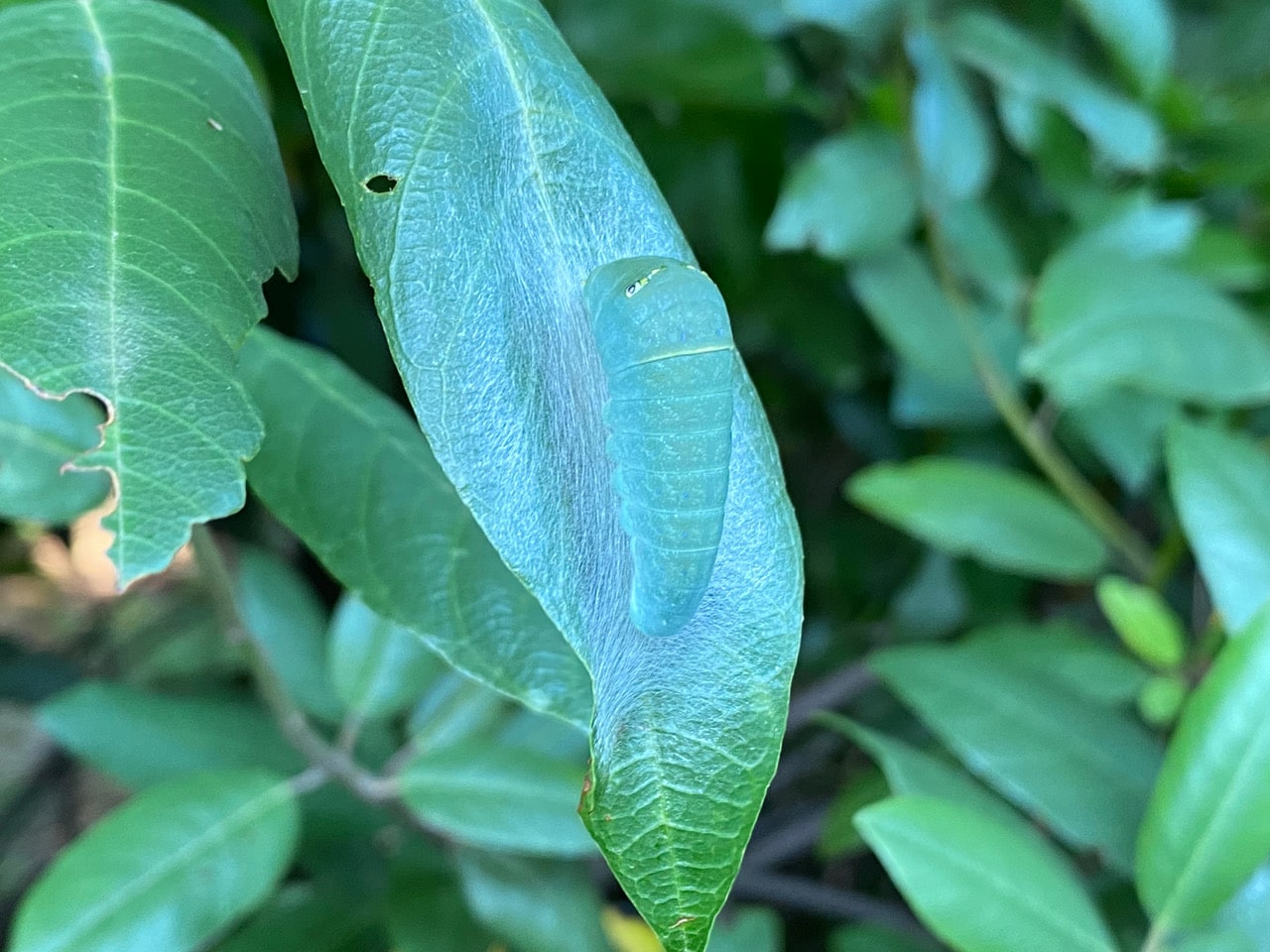
Since it is seldom active during the day, I was hoping to see Blue, the Pale Swallowtail caterpillar up and about feeding on the Coffeeberry in the evening. Nope, Blue is still on its silk pad, like a yogi in deep meditation. Take your sweet time, Blue!
Since the Naked Buckwheat is not doing well this year, we are seeing fewer of the Flea Beetles, Altica sp.(family Chrysomelidae) that seem to feed exclusively on the plant.
Flea Beetles are in the largest subfamily (Alticinae) of the family Chrysomelidae, or Leaf Beetles. The name Altica is derived from the Greek word haltikos, meaning good jumpers. The beetles have strong hind legs allowing them to jump long distances like true fleas. Altica flea beetles are 3-9 mm in length, and females are typically larger then males. Most Altica beetles have hard outer wings elytra that are metallic blue to green in color that protect similarly colored metallic bodies that reflect purple and bronze colors and are elongate oval in shape. Antennae have 11 segments and are filiform (threadlike).
I collect a couple more of the spent leaf-roller caterpillar retreats from the Bay trees. I will open them up very slow at home and try to figure out how the leaves are rolled and folded to form such a curious shape. I also collect a couple of fresh Bay leaves to practice on. Fun homework!
I pass the first Tree Cricket I saw earlier, and find that he has not moved at all, except for his antennae. I wonder when he will start to serenade the girls?
Not far from where I found the first bound leaves of California Mugwort, I come across something similar. Two adjacent leaves on the same plant have been bound together.But instead of shaking hands, these leaves…
… are playing rock paper scissors! Will figure this out some other time. It’s getting late and I need to get out of here before it’s dark.
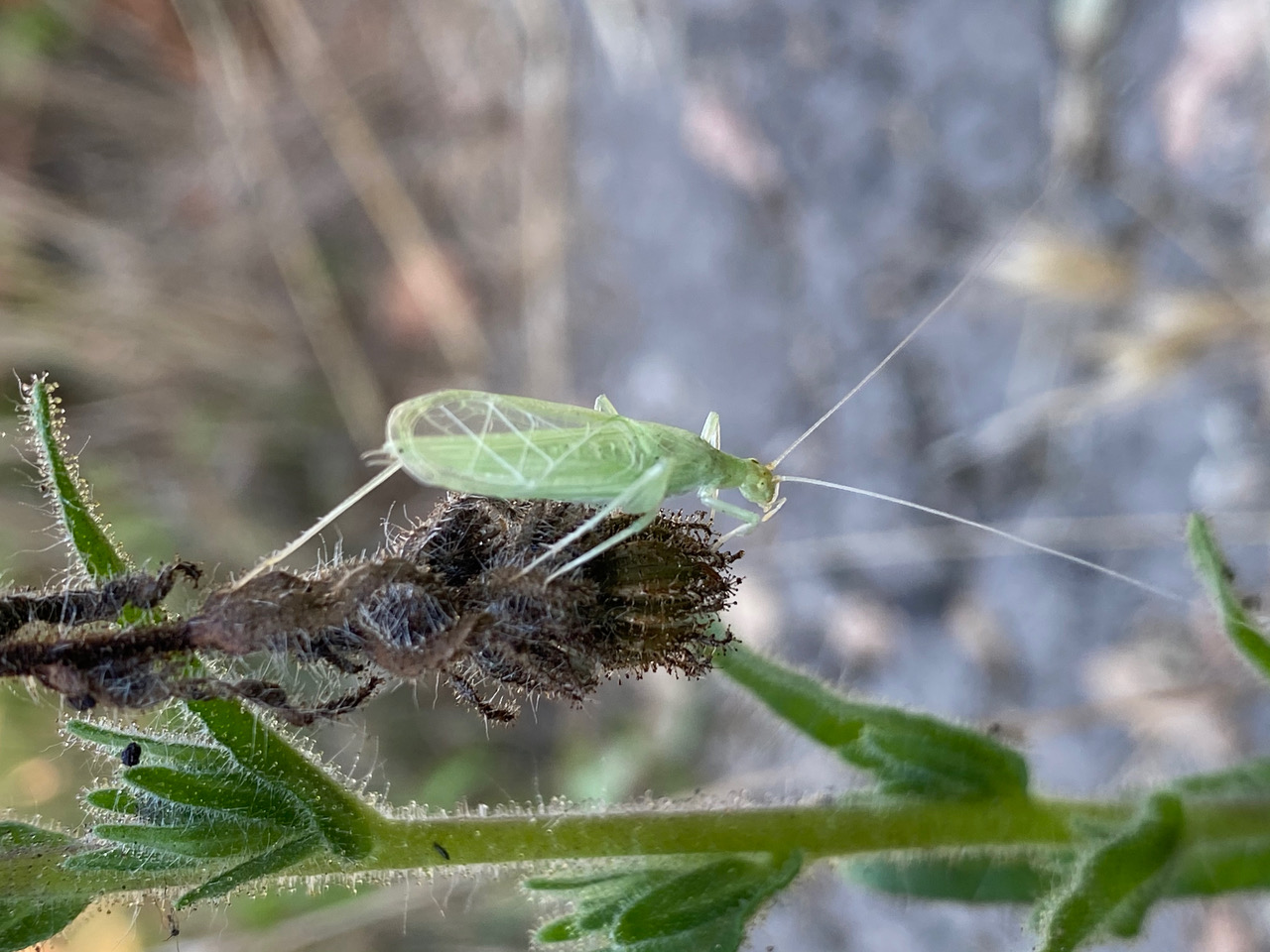
Hey, another Tree Cricket! This one is on a Coast Tarweed, Madia sativa along the little path to Siesta Gate. It is pale green – a different species?
And it’s another male! I wish I had brought a flash light so I could stay to hear these tree crickets sing!