

Pollinator Post 8/23/23 (2)
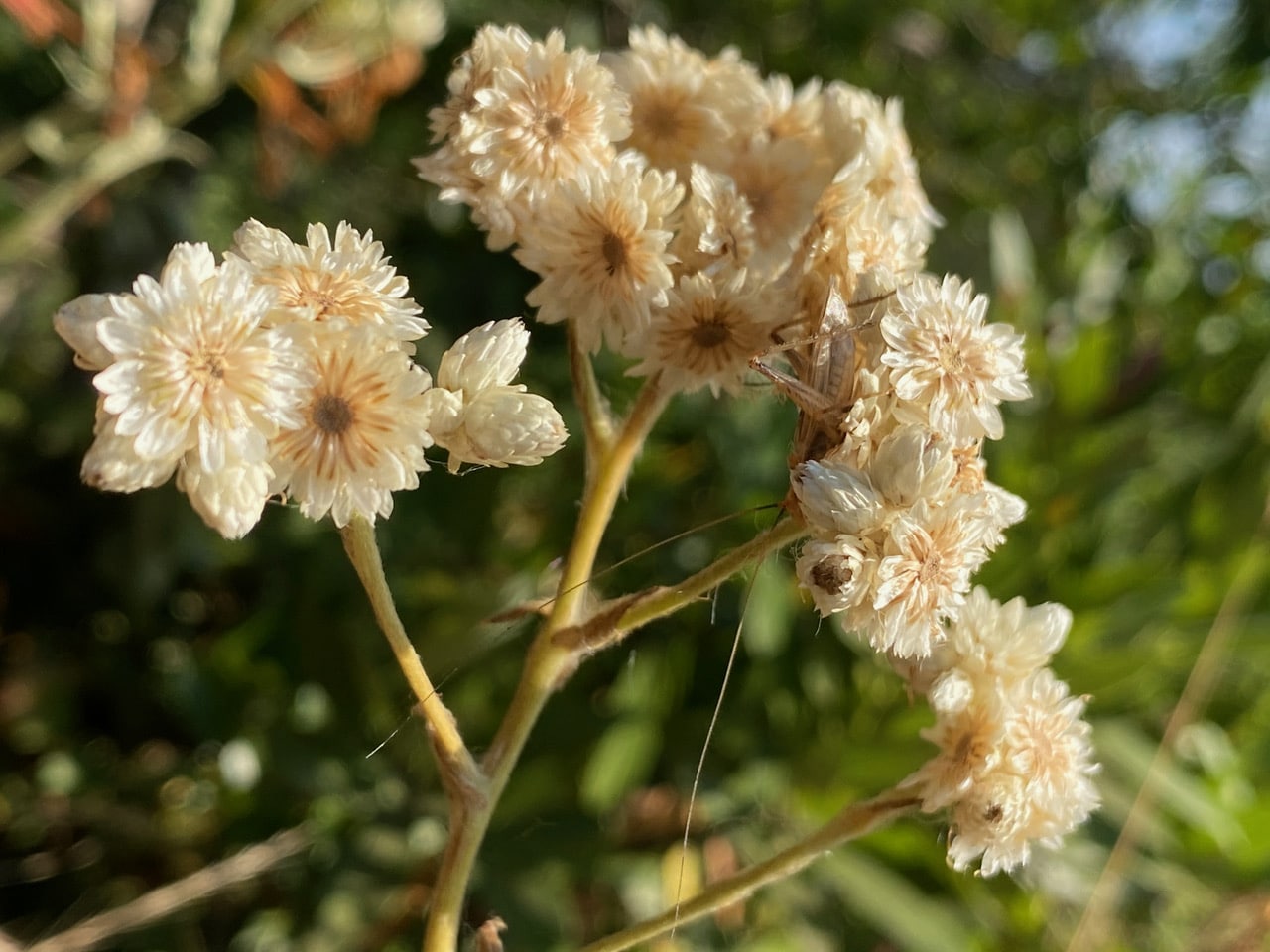 Hey, that looks like the profile of a Common Tree Cricket, Oecanthus sp. (family Gryllidae) partially hidden behind a fading inflorescence of California Everlasting, Pseudognaphalium californicum. The insects are often given away by their long, waving antennae.
 Tree Crickets are so called because many species hang out in trees. They are in the order Orthoptera (crickets, katydids, grasshoppers, etc.) and in the “true cricket” family Gryllidae. The Common Tree Crickets are in the genus Oecanthus (the “O” is silent and the “E” is long). Of the nocturnal songsters, tree crickets are considered the most melodic; Nathaniel Hawthorne once said about tree cricket trills that “if moonlight could be heard, it would sound like that.”

It is a male! Interesting that most of the Tree Crickets I have been finding lately are males. And the straw-colored ones are mostly found on the inflorescences of everlastings which provide them good camouflage.
Tree Crickets have two sets of wings; a female’s forewings hug her body, and males’ forewings are flat and wide. Males produce sound by rubbing together rough areas (called the “rasp” and “file”) at the base of the forewings, a method of sound production called stridulation. During sound production, the males hold their wings straight up at right angle to the body. Each species of tree cricket has its signature calls, and the tempo of the call is affected by the temperature of the ambient air. Females do not call, but they do listen with auditory organs located on the forelegs. Females prefer males who sing bass (a lower call indicates a larger caller).
The singing male attracts the gal of his dreams, and courtship ensues, a dance that lasts for as long as half hour, involving much antenna waving. The position of his raised wings reveals to her a “honey pot” – a small trough located between his wings. In it, the metanotal gland produces a fluid for the female to feed on that will boost her reproductive success. In reaching for the prize, she places herself in a position that allows the male to deliver a spermatophore into her genital opening.
Female lay eggs in late summer or fall in whatever substrate they exist on – they drill into the bark of woody twigs or into herbaceous plants, and deposit one or more eggs in the bark or pith. Tree crickets undergo incomplete metamorphosis, resembling adults when they hatch and adding parts as they grow and molt (five times). Contrary to common belief, many crickets and katydids are not strictly herbivorous. They enjoy an omnivorous lifestyle, consuming aphids and other small insects as well as plant material.
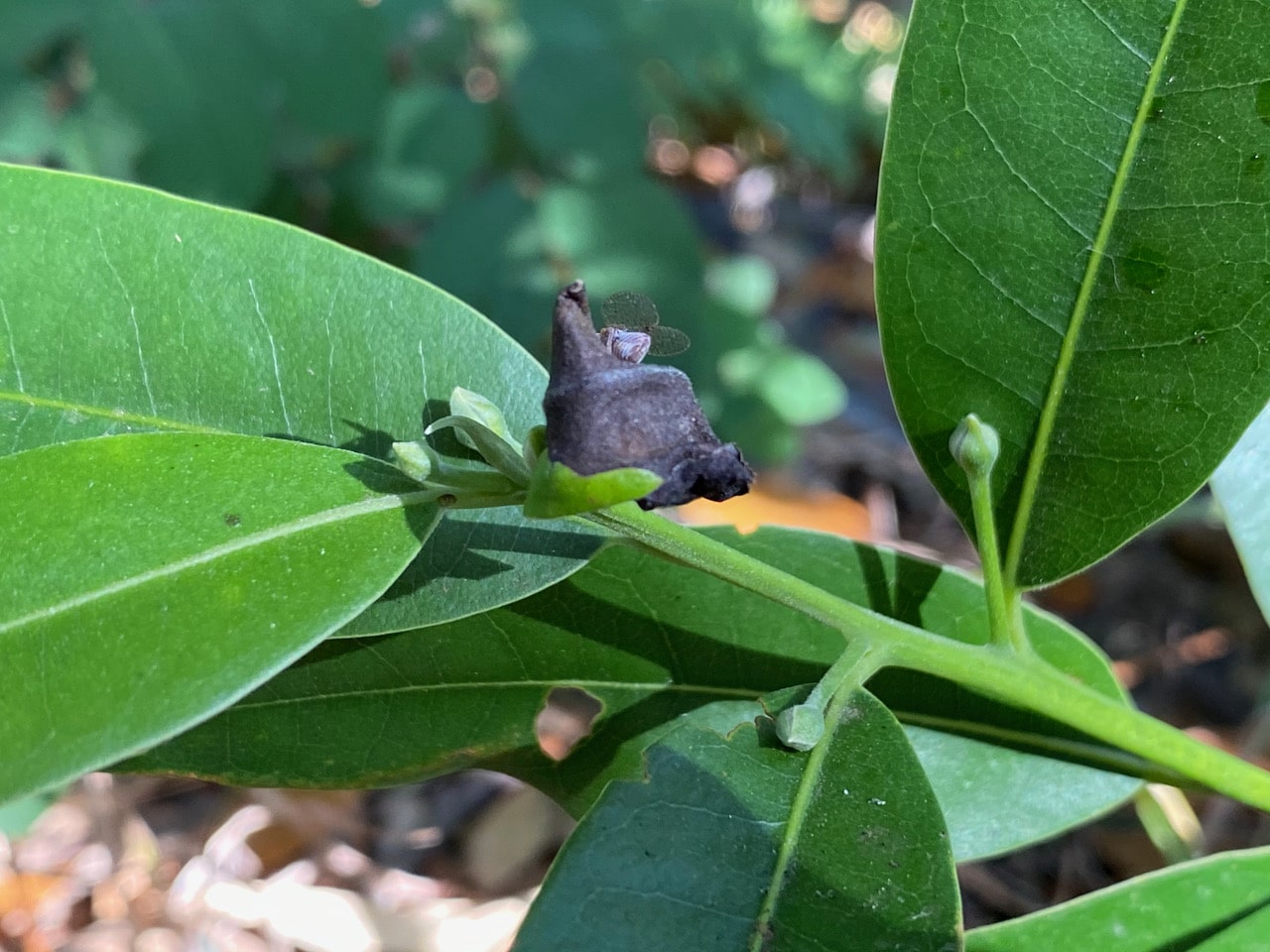
I check on a Bay leaf that has been folded by a Leaf-roller caterpillar. Most of of the retreat has turned black since I tagged it a few days ago. Hey, who’s that insect on the retreat?
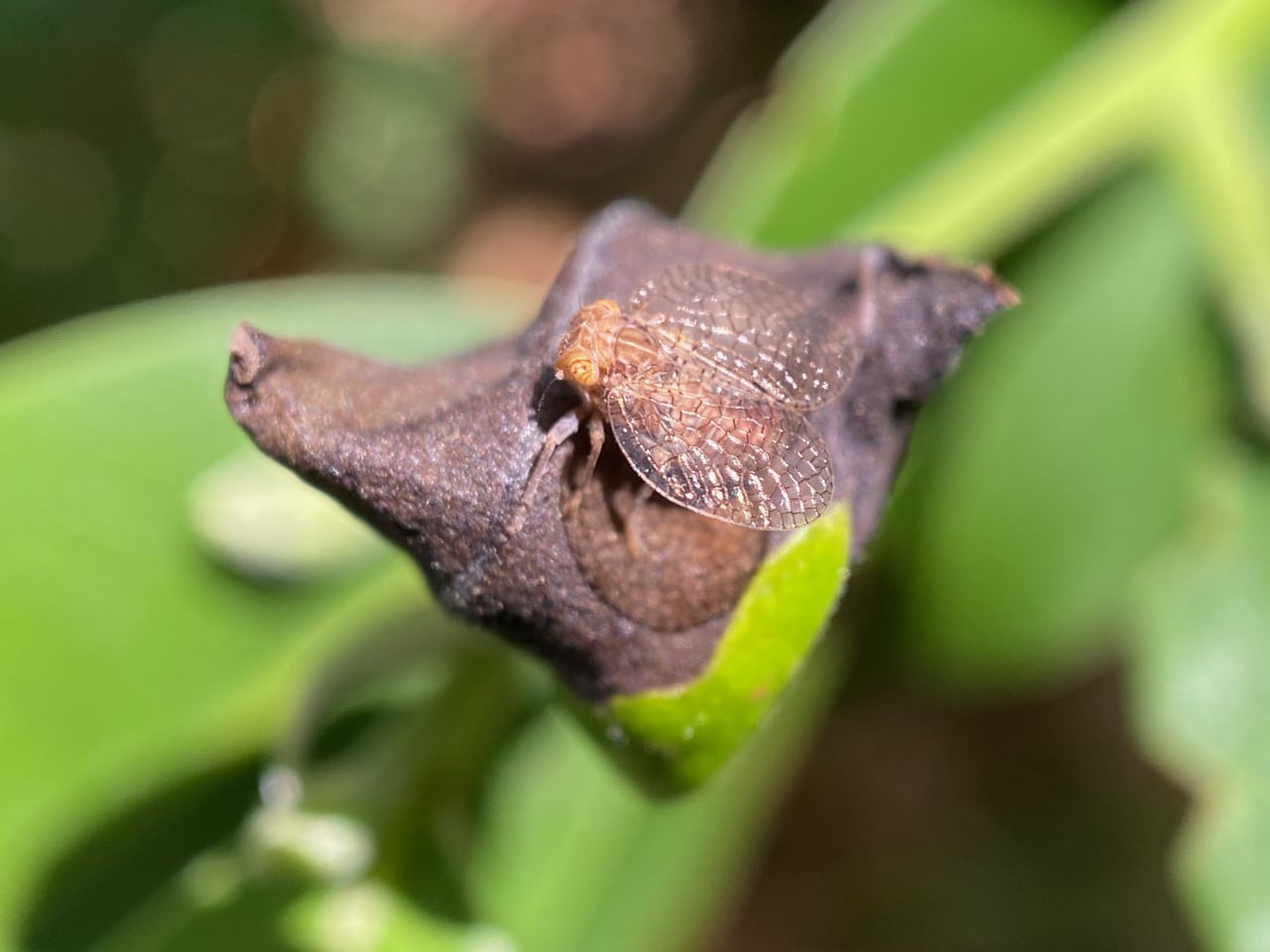
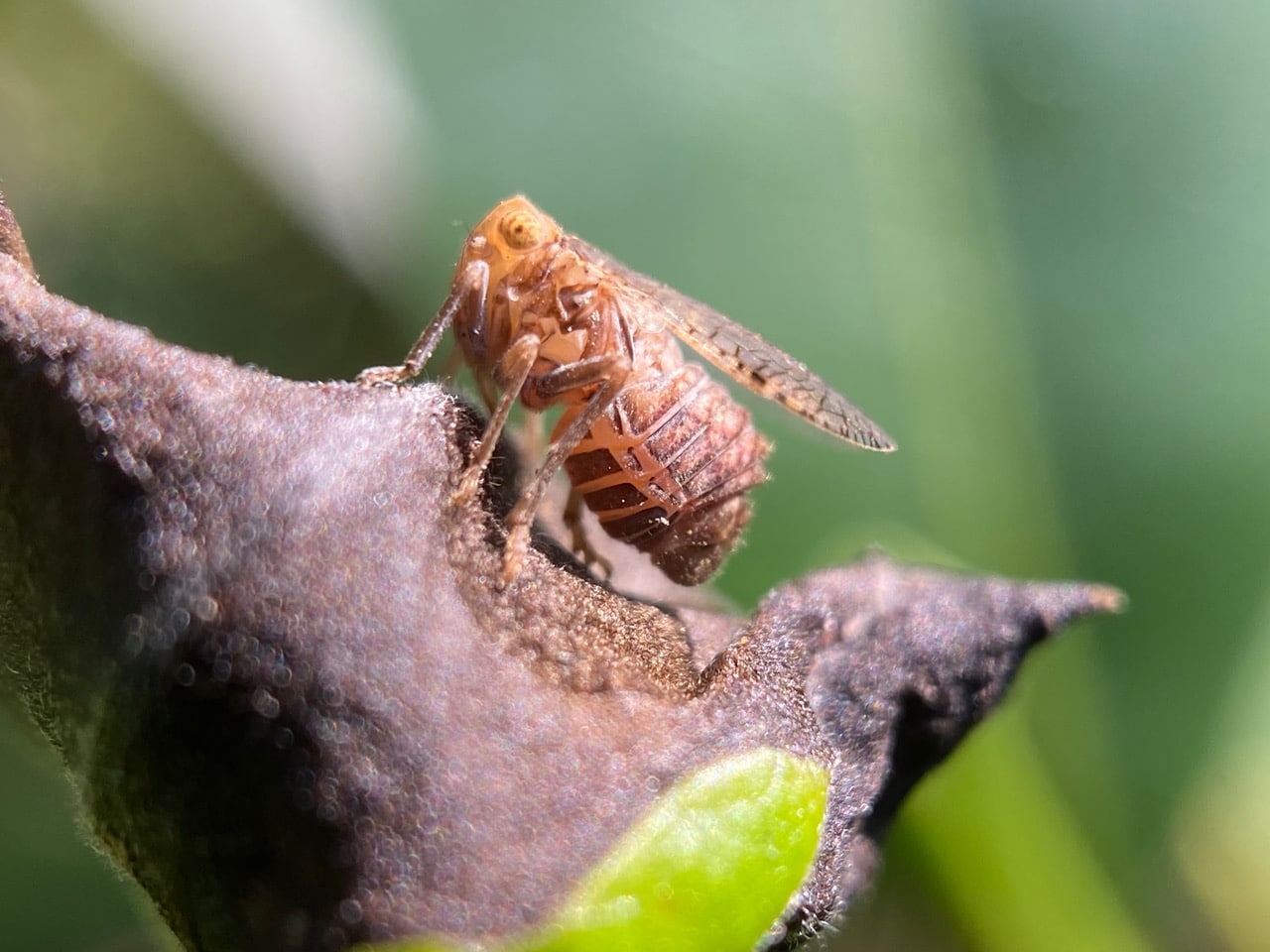
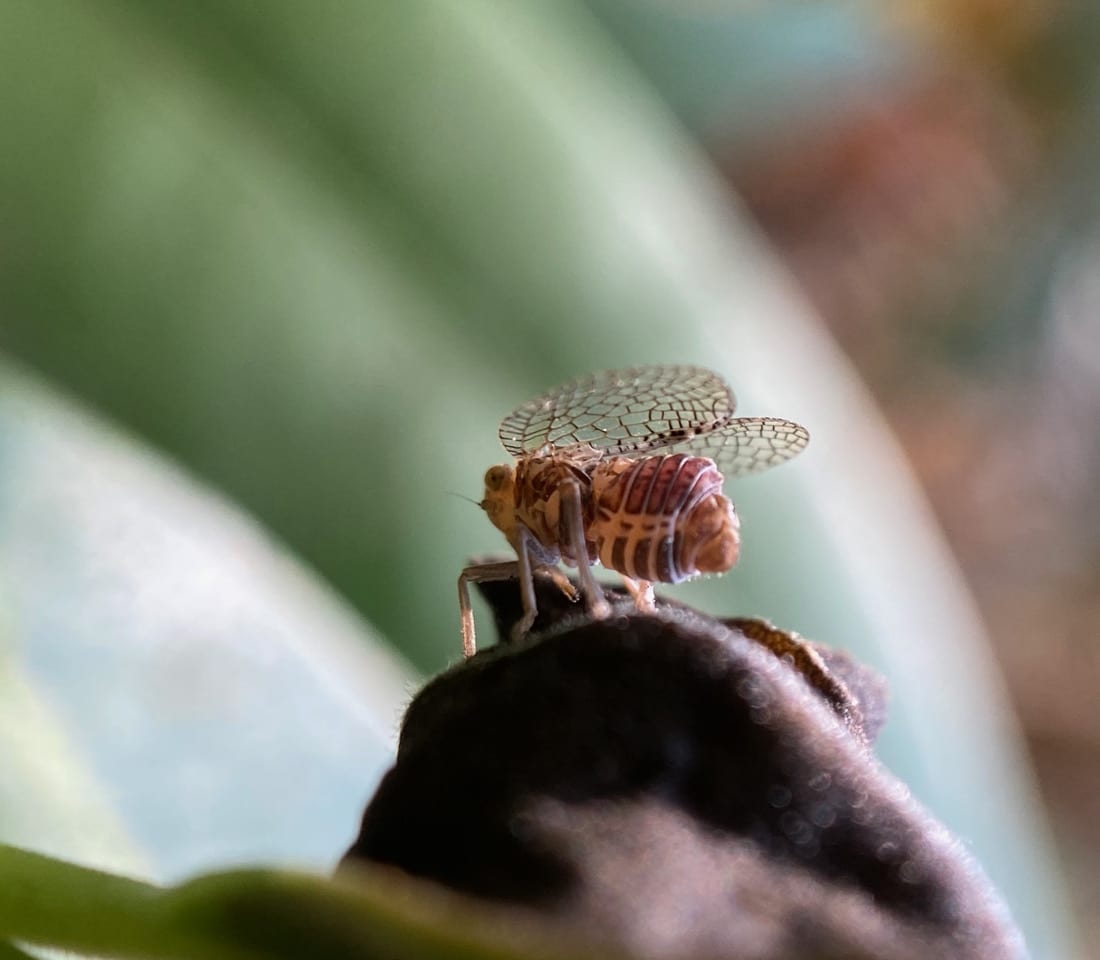





It’s a Planthoppper, Neaethus sp. (family Tropiduchidae).
Members of the genus Neaethus are distinguished by their broadly rounded transparent to translucent wings, with prominent veins. Most are associated with oak species. Neaethus has a limited distribution, and are mostly found in California and Arizona.
The Planthoppers have the first mechanical gear system ever observed in nature. The tiny bug uses mechanical gears on its joints to precisely synchronize the kicks of its hind legs as it jumps forward.
Planthoppers may be small, but they attract mates from afar by sending vibrational calls along plant stems and leaves using fast, rhythmic motions of their abdomen.
A Typical Potter Wasp, Eumenes sp. (family Vespidae, subfamily Eumeninae) lands to take nectar from the flowers of California Goldenrod, Solidago velutina ssp. californica.
Potter Wasps (or Mason Wasps), the Eumeninae, are a subfamily of Vespidae. Most eumenine species are black or brown, and commonly marked with strikingly contrasting patterns of yellow, white, orange, or red. Like most vespids, their wings are folded longitudinally at rest.
Eumenine wasps are diverse in nest building. The different species may either use existing cavities (such as beetle tunnels in wood, abandoned nest of other Hymenoptera, or even man-made holes like old nail holes) that they modify, or they construct their own either underground or exposed nests. The nest may have one or several individual brood cells. The most widely used building material is mud made of a mixture of soil and regurgitated water.
All known eumenine species are predators, most of them solitary mass provisioners. When a cell is completed, the adult wasp typically collects beetle larvae, spiders, or caterpillars and, paralyzing them, places them in the cell to serve as food for a single wasp larva. As a normal rule, the adult wasp lays a single egg in the empty cell before provisioning it. The complete lifecycle may last from a few weeks to more than a year from the egg until the adult emerges. Adult potter wasps feed on floral nectar.
Eumenes is a large and widespread genus, mostly occurring in the temperate regions of the Northern Hemisphere. The first metasomal segment is narrow and elongated, creating a “bulbous” appearance to the abdomen.
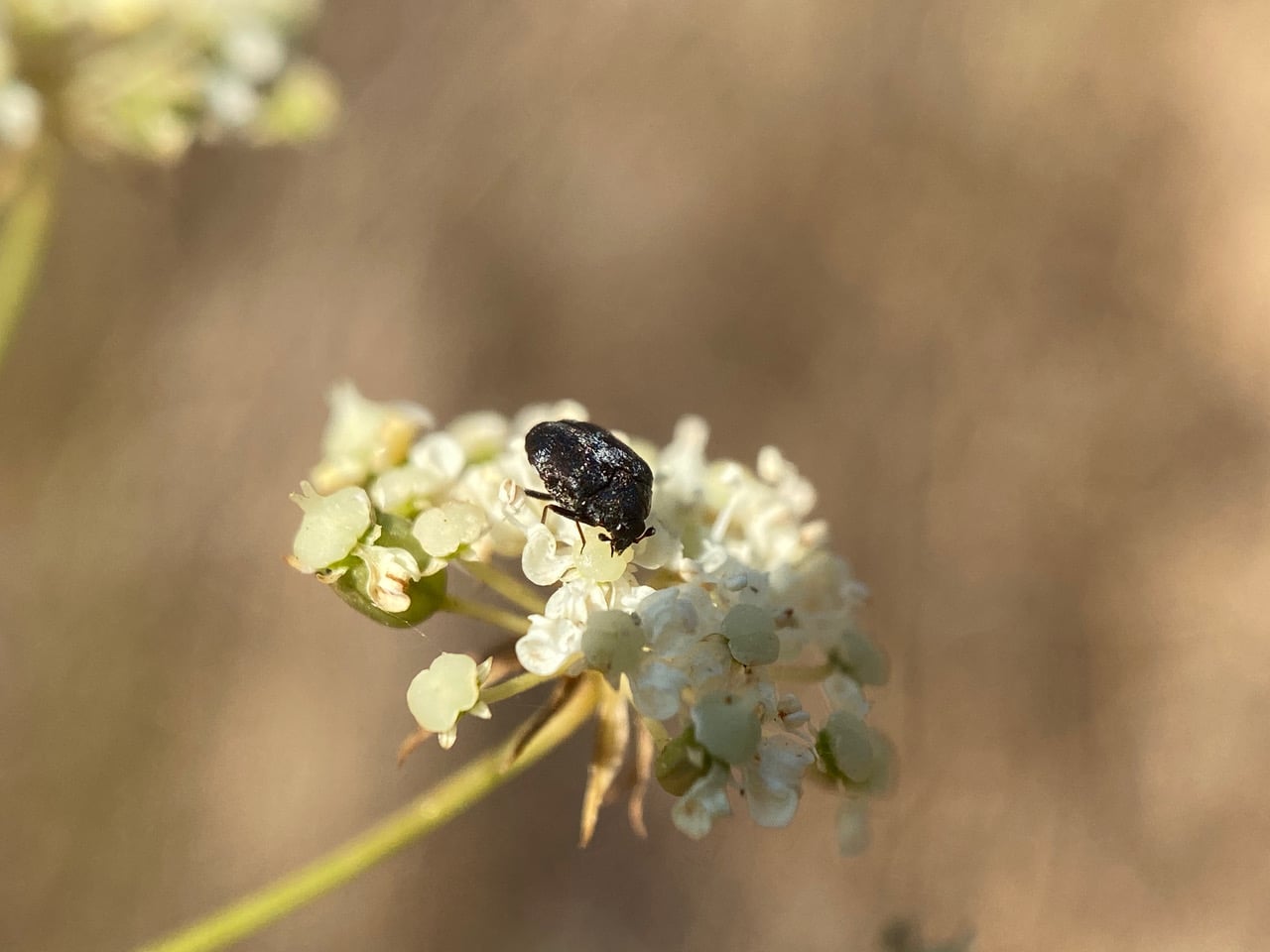
A Skin Beetle, Anthrenus lepidus (family Dermestidae) is foraging on an inflorescence of Kellogg’s Yampah, Perideridia kelloggii.
Dermestidae are a family of Coleoptera (beetles) that are commonly referred to as skin of carpet beetles. Ranging in size from 1 to 2 mm, the beetles typically have clubbed antennae that fit into deep grooves. Most Dermestids are scavengers that feed on dry animal or plant materials, such as skin or pollen, animal hair, feathers, dead insects and natural fibers. The larvae are used in taxidermy and by natural history museums to clean animal skeletons.
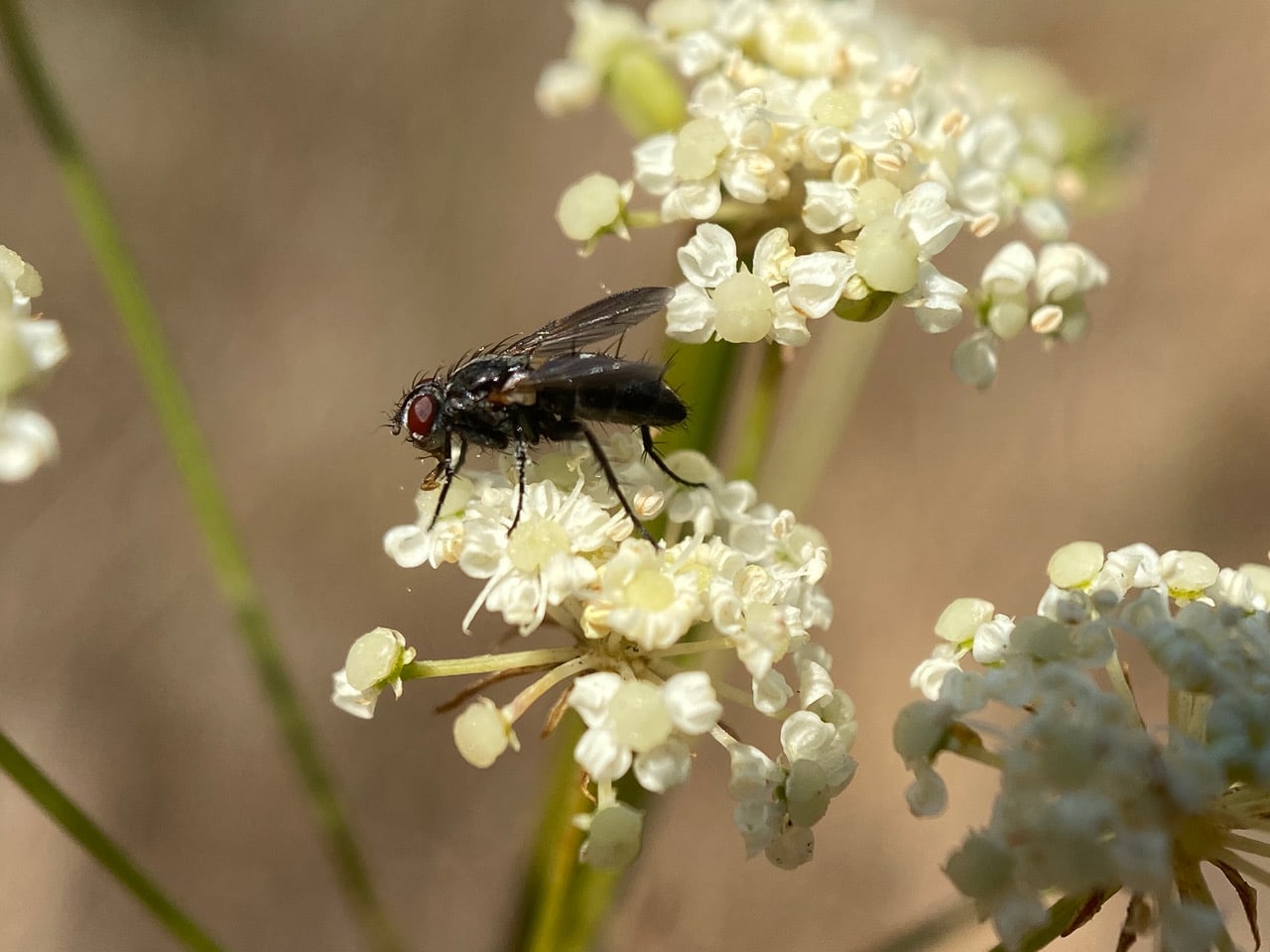
That looks like the rear end of the Woodlouse Fly, Stevenia deceptoria (family Rhinophoridae).
These small, slender, black, bristly flies are somewhat related to the Tachinidae. The larvae are mostly parasitoids of woodlice (pill bugs), beetles, spiders and other arthropods, and occasionally snails.

Native to Europe, Stevenia deceptoria is now widespread in the US. The flies are parasitoids of terrestrial woodlice (roly polies) of the order Isopoda (Oniscoidea).
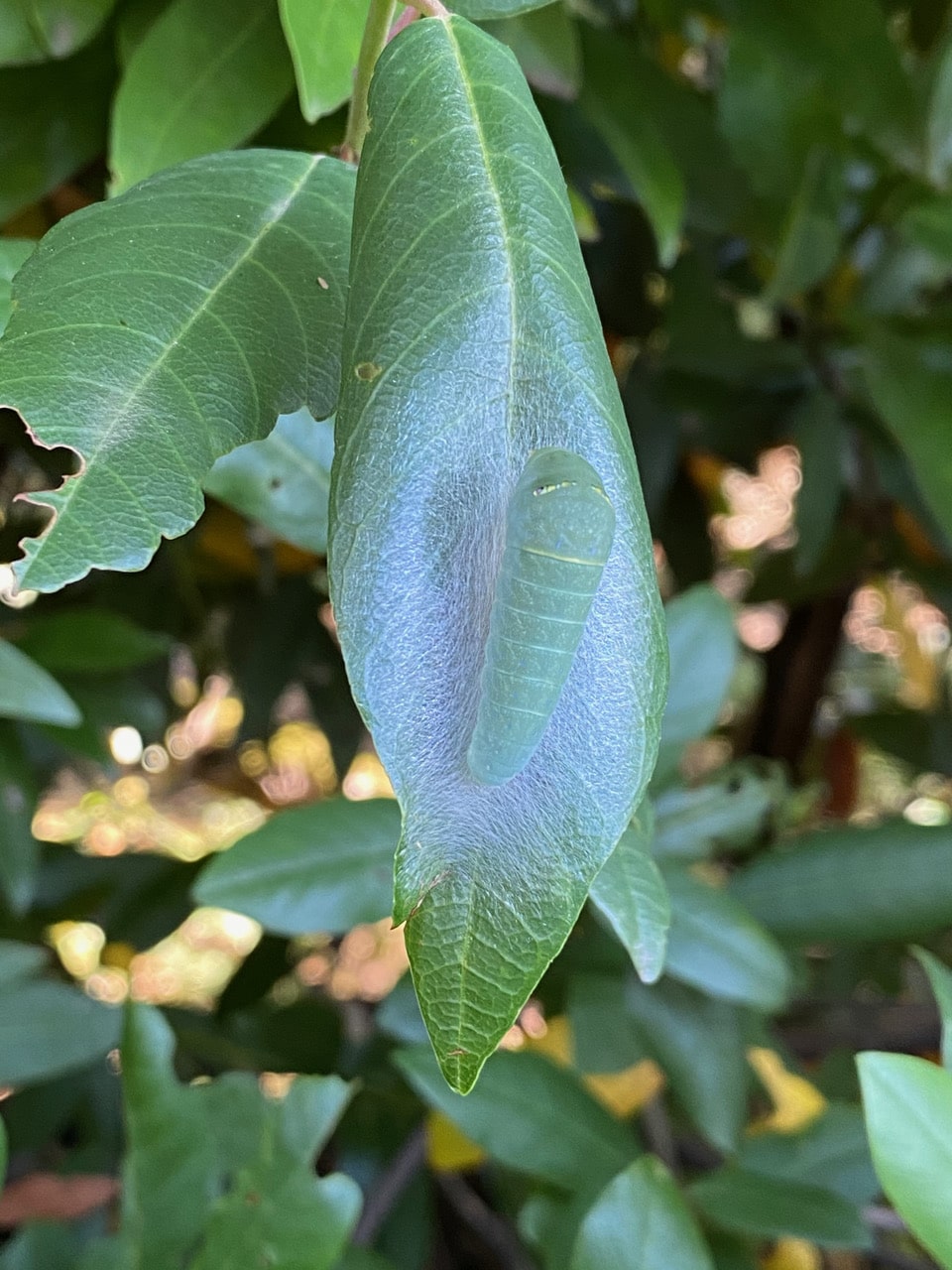
Blue, the Pale Swallowtail caterpillar looks resplendent on its silk pad on the Coffeeberry leaf.
Something about Blue is different today. Its head capsule, normally hidden under the thorax, has shifted and has turned clear! Blue is getting ready to molt!
It is fairly obvious when a caterpillar is preparing to molt. It withdraws its head from its head capsule, causing a larger bulge than normal behind the head capsule. The old head capsule sits on the face of the caterpillar, much like a face mask ready to fall off. The head capsule is the first part of the old skin to come off during the molting process. In some cases, the caterpillar has to rub it off. Then the old skin peels back from the front of the caterpillar. The caterpillar wriggles out of its old cuticle, lifting its prolegs out one at a time. Caterpillars will molt four or five times as they grow. Each different growth stage is called an instar.
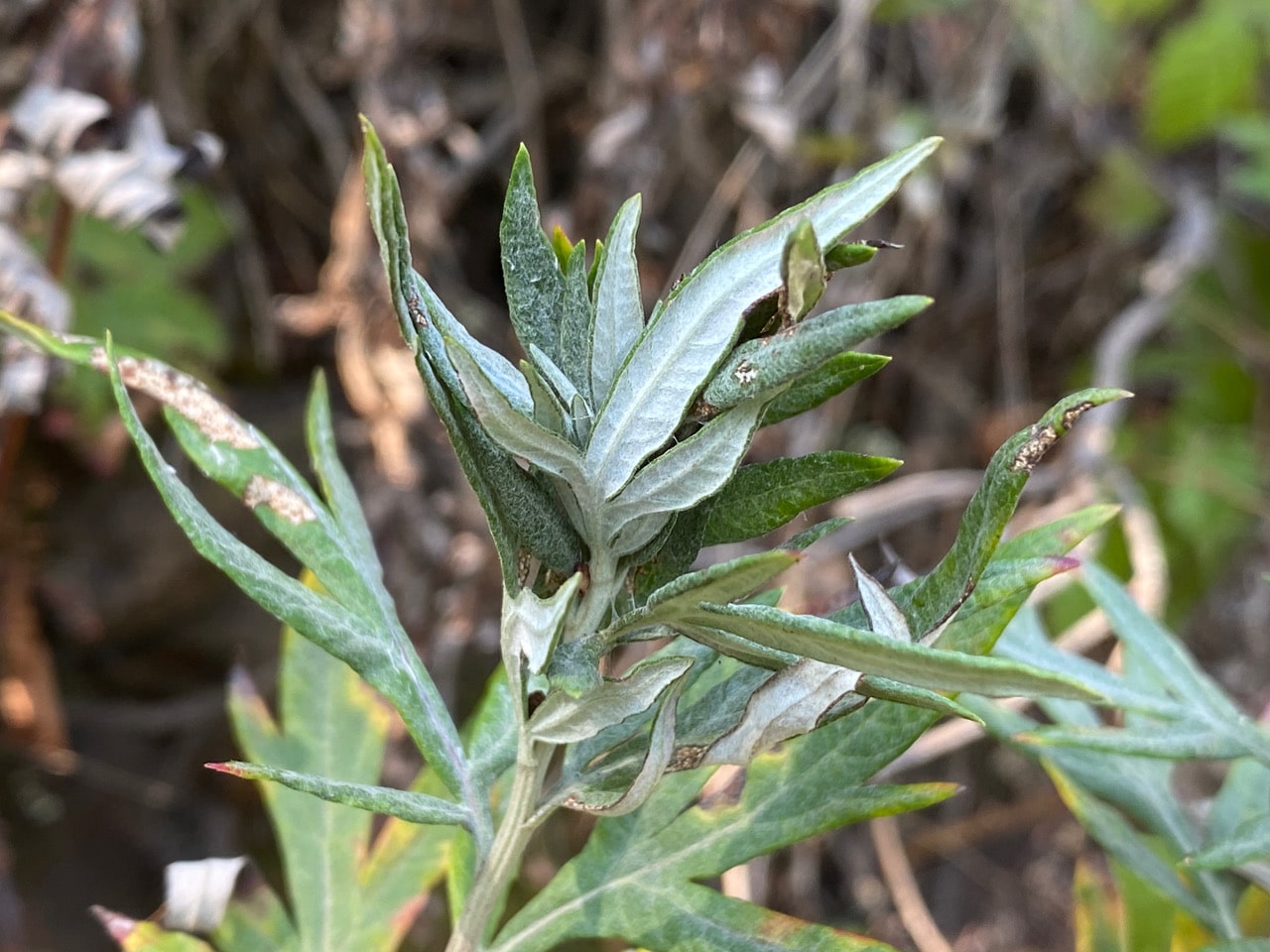
The terminal leaves of this California Mugwort, Artemisia douglasiana have been webbed together vertically. Caterpillar? Spider? I am more inclined to think it’s the retreat of a spider. On 5/12/21, I have video-recorded a Yellow Sac Spider constructing a similar retreat on Mugwort at the Bridgeview Pollinator Garden. Yellow Sac Spiders, Cheiracanthium inclusum are nocturnal hunters and sleep in these silk nests during the day. A new retreat is built every day.
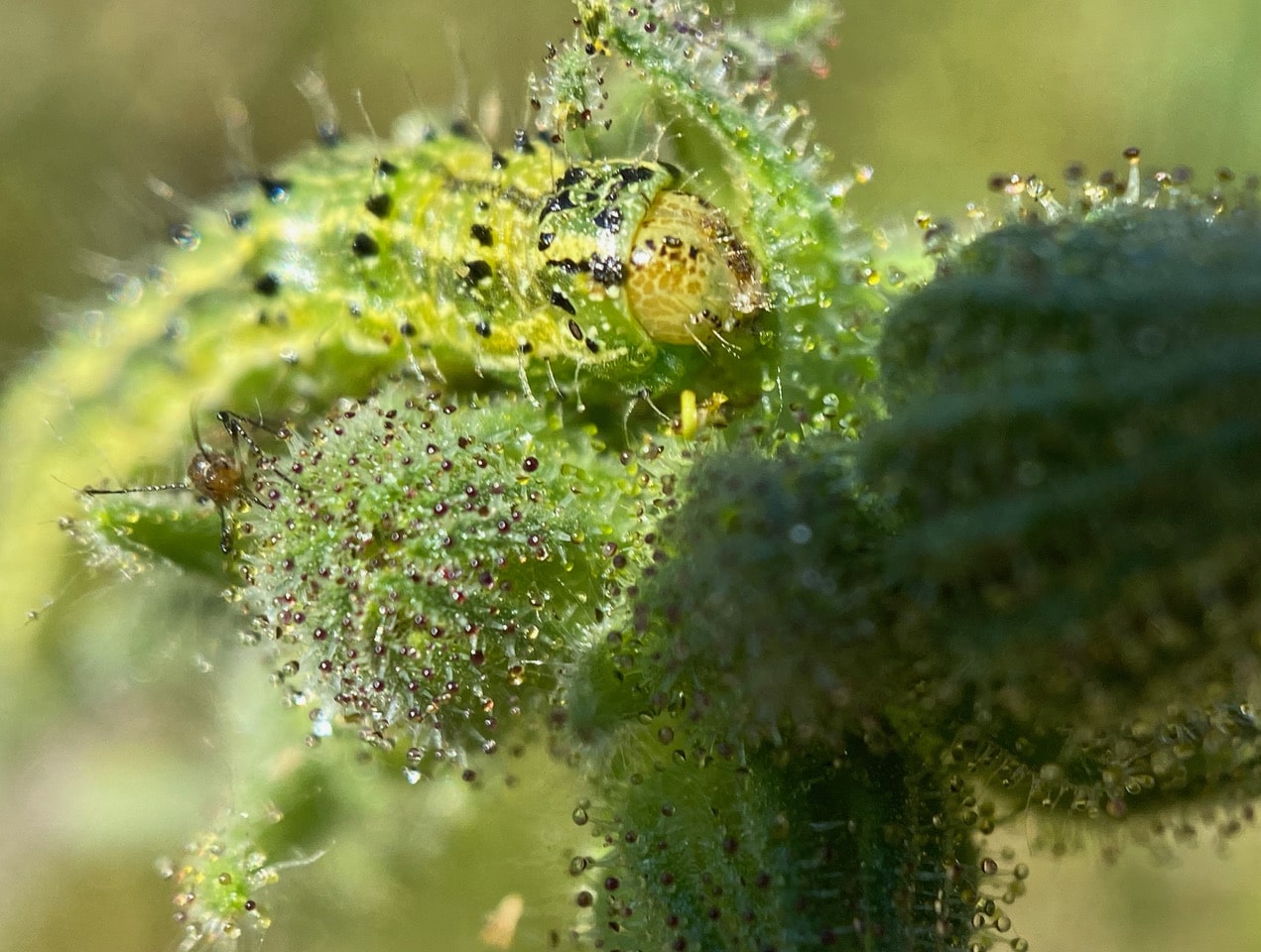
A caterpillar of the Darker-spotted Straw Moth, Heliothis phloxiphaga (family Noctuidae) is feeding on a terminal cluster of immature flowerheads of Coast Tarweed, Madia sativa.
I am thrilled to get a good look at the caterpillar’s extruded head capsule while it is feeding. The capsule is covered with brown speckling and short hairs.
Most caterpillars have six very small eyes on each side of the head (making 12 in all). These light sensitive structures are called ocelli; they are simple eyes each with a singe lens. These eyes probably only sense light and dark, and do not distinguish shapes or color.