

Pollinator Post 9/2/23 (2)

I make my way slowly to the Water Tank, checking on the plants along the road. These slender, long-legged aphids, Uroleucon sp. (family Aphididae) like to feed on the stem of Coast Tarweed, Madia sativa while standing on their heads. Maybe this is how they minimize contact with the sticky exudates?



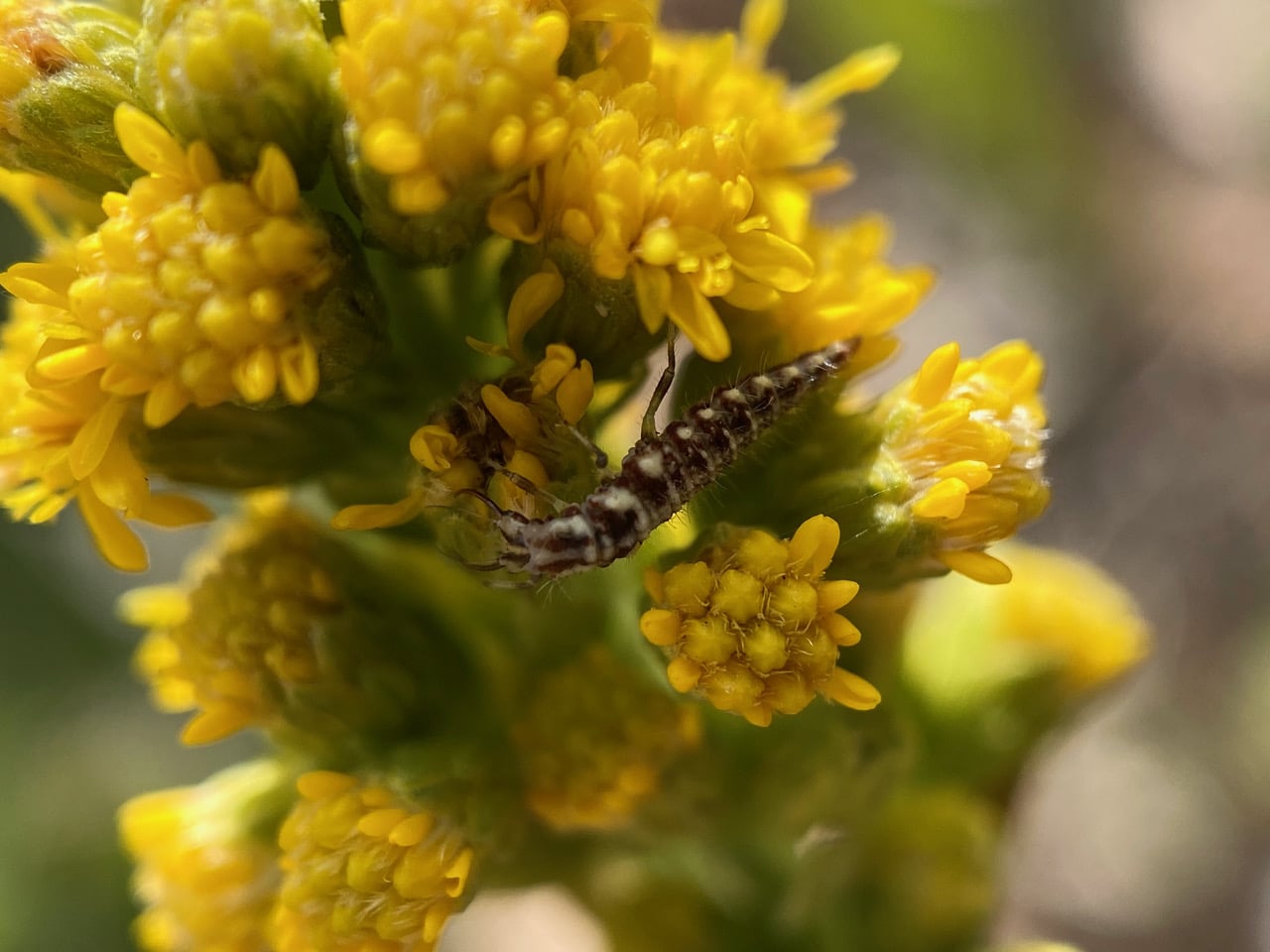
 A glimpse of the tapered rear of the Lacewing larva as it disappears into the dark recesses of the inflorescence.
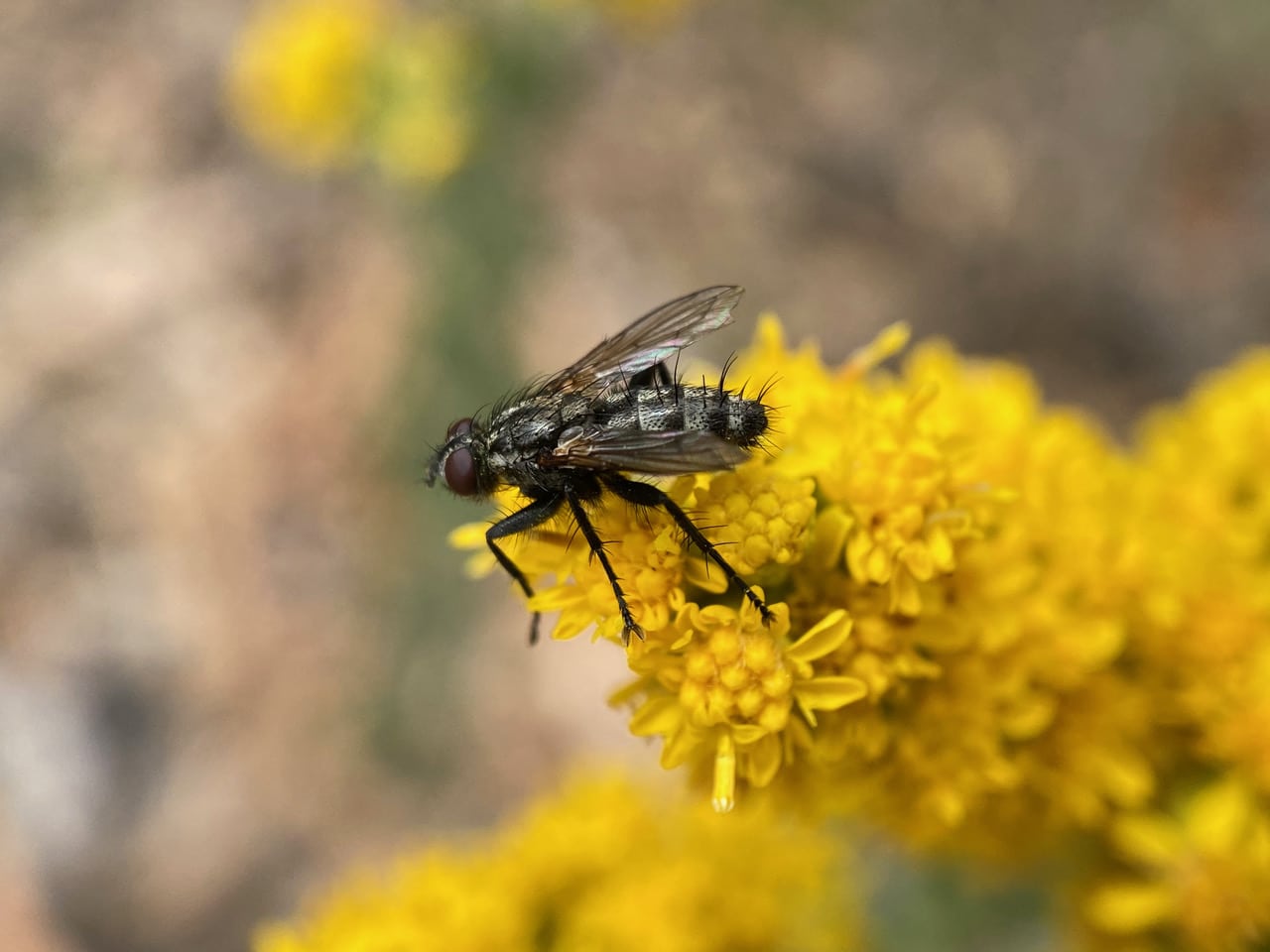
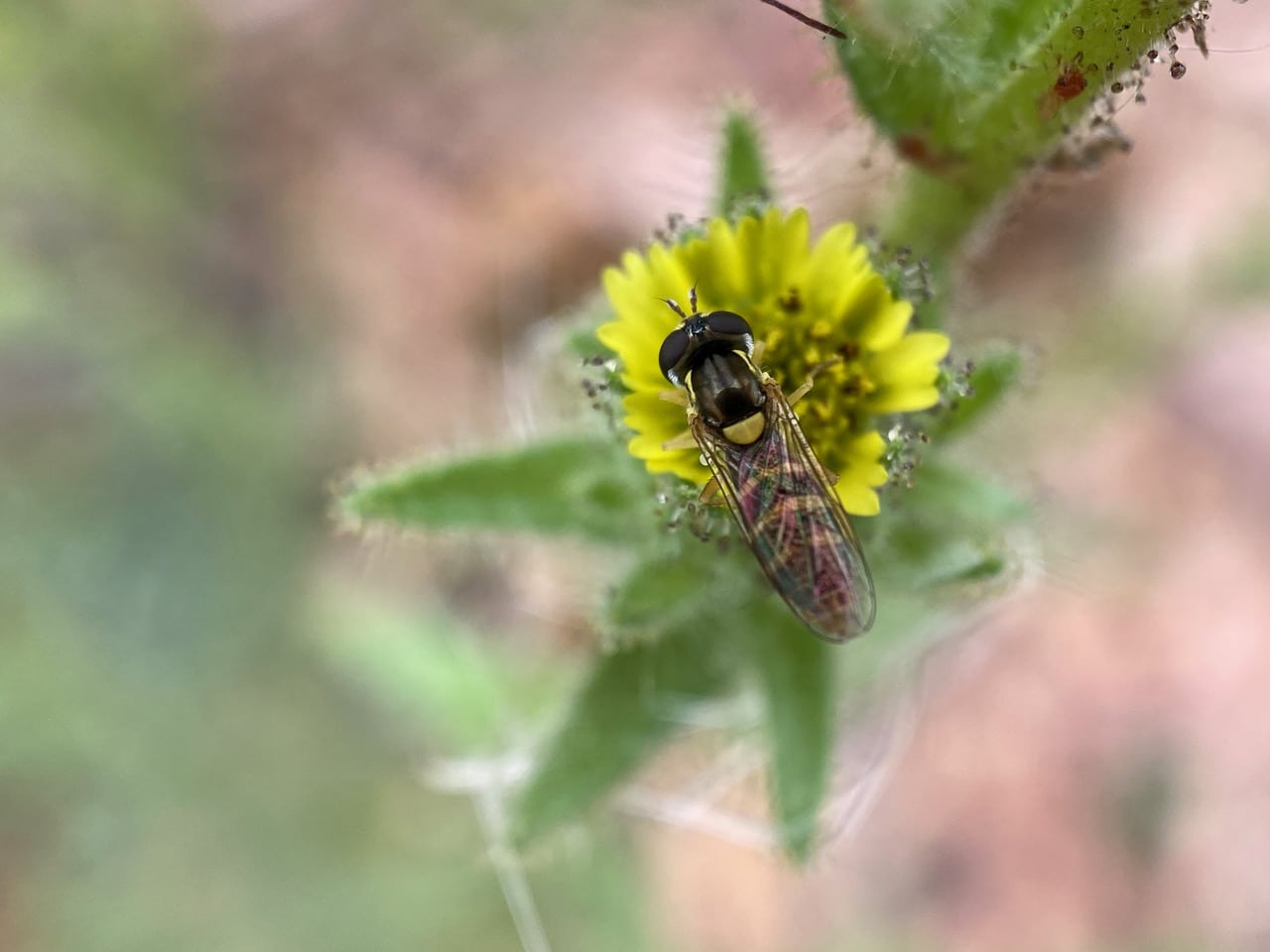
A female Forked Globetail, Sphaerophoria sulphuripes (family Syrphidae) is foraging on a fresh flowerhead of Coast Tarweed. Although her abdomen is concealed behind the closed wings, we can still tell her gender from her eyes – they do not meet on top of the head. Males of most hover fly species have holoptic eyes that meet in a central line on top of the head.
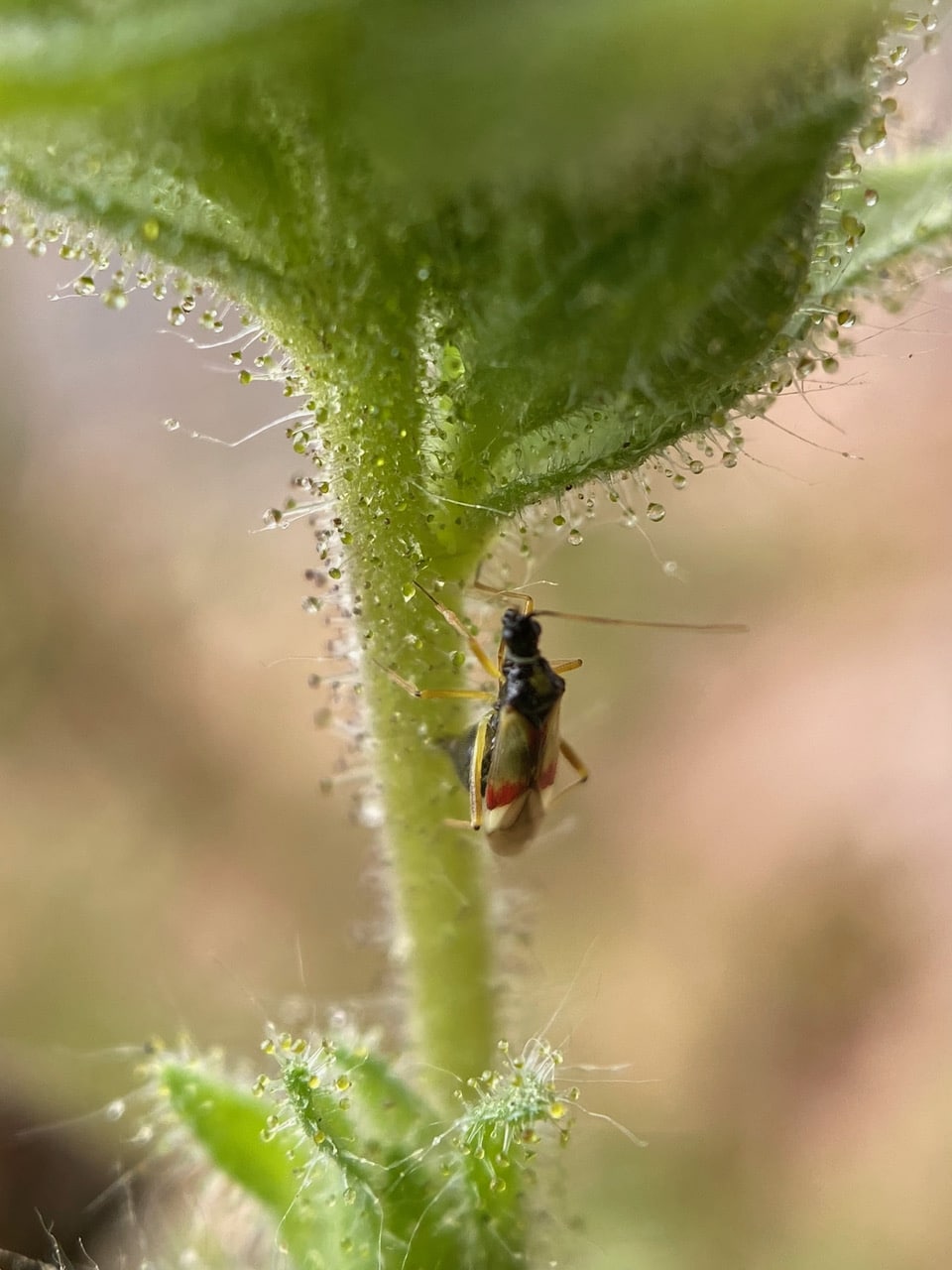
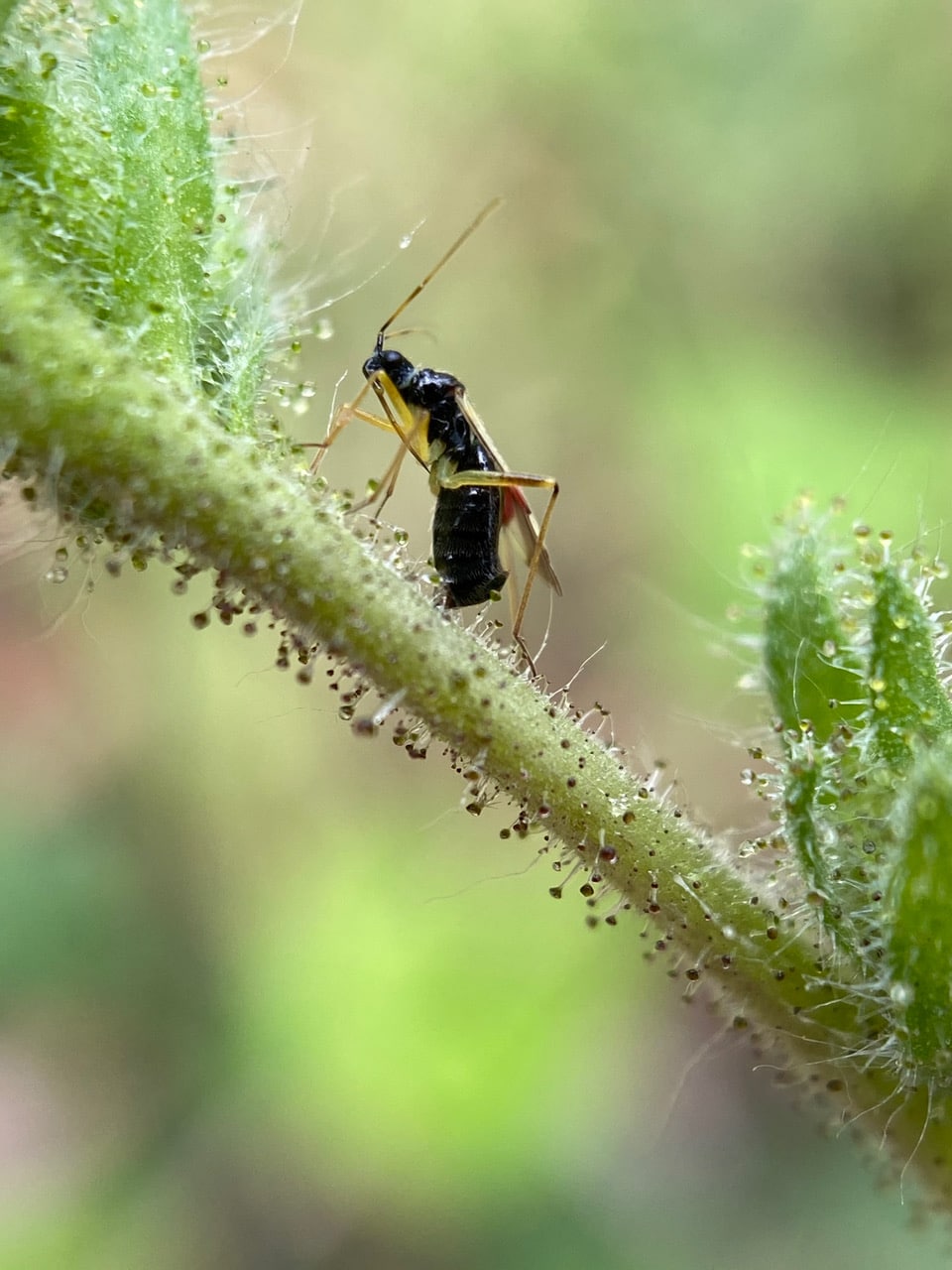
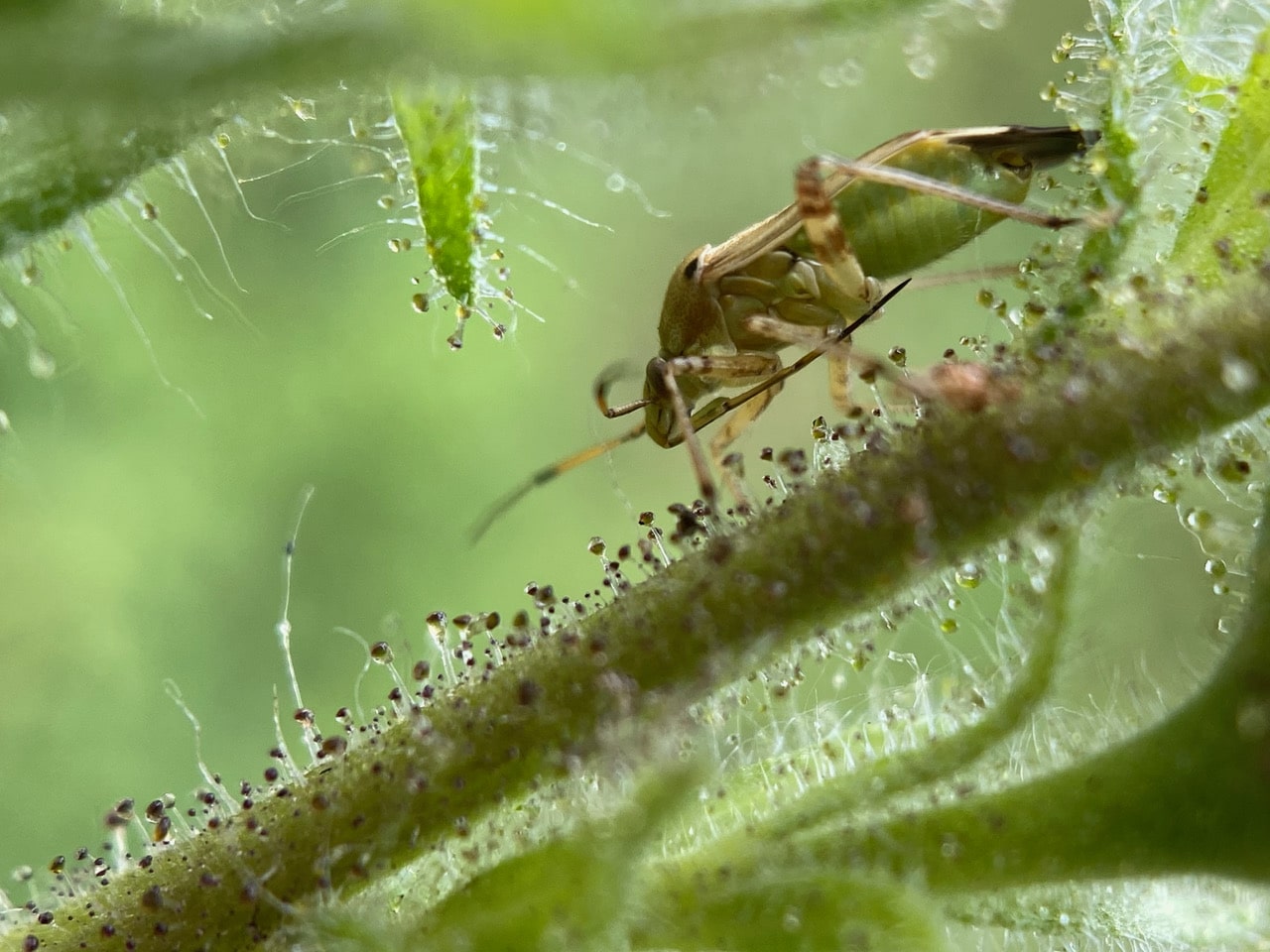
Most Phacelia Plant Bugs, Tupiocoris californicus (family Miridae) are skittish, fast to run away at the slightest disturbance. But this individual is unusually calm, staying put even as I approach with the camera. I think its abdomen in angled forward in oviposition (egg laying).
Yes, indeed, she’s laying eggs on the Coast Tarweed stem! Note the needle-like rostrum (mouthpart) that she has folded under her body when not feeding.
Mirid bugs are also referred to as plant bugs or leaf bugs. Miridae is one of the largest family of true bugs in the order Hemiptera. Like other Hemipterans, Mirids have piercing, sucking mouthparts to extract plant sap. Some species are predatory.
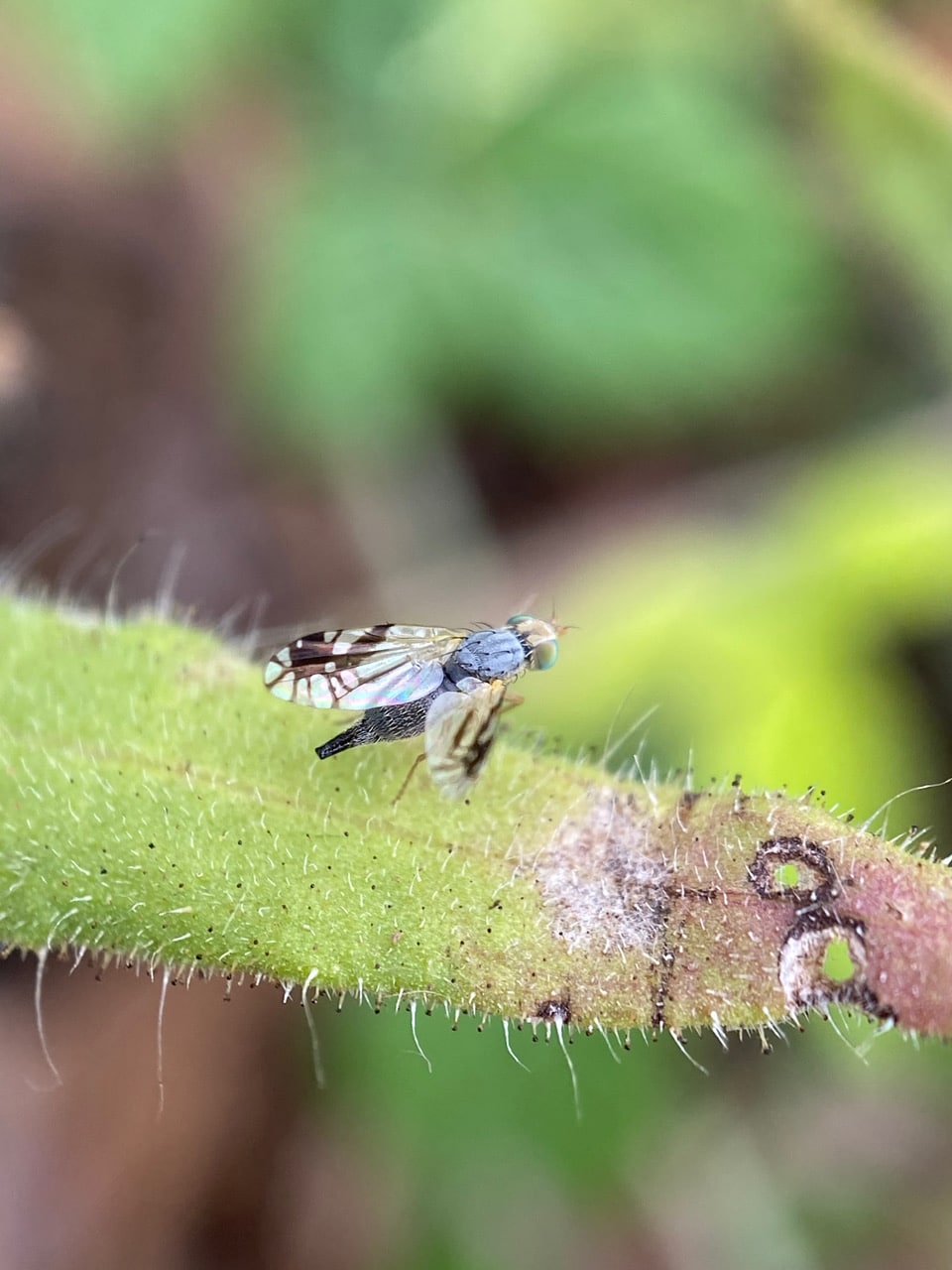
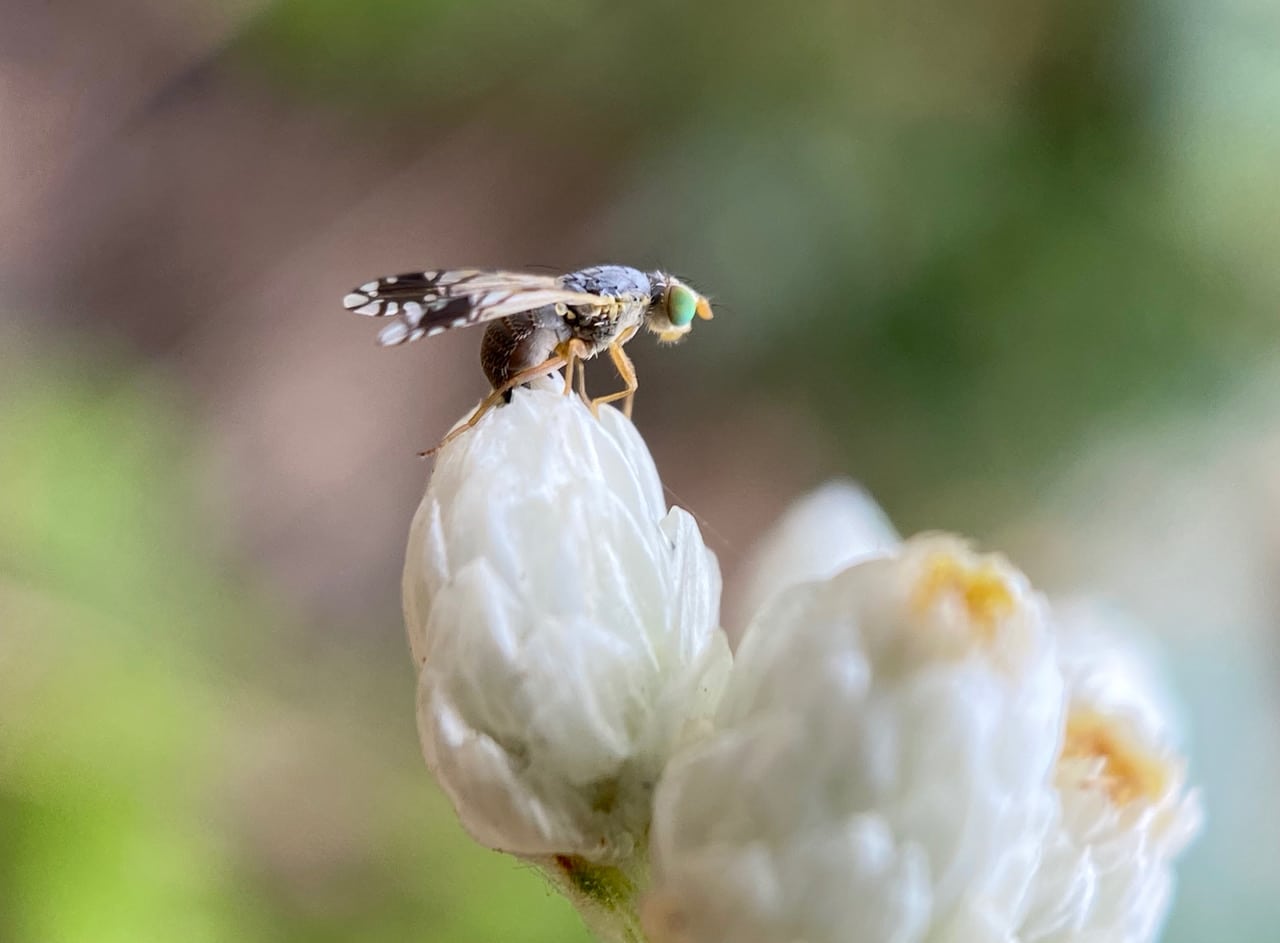
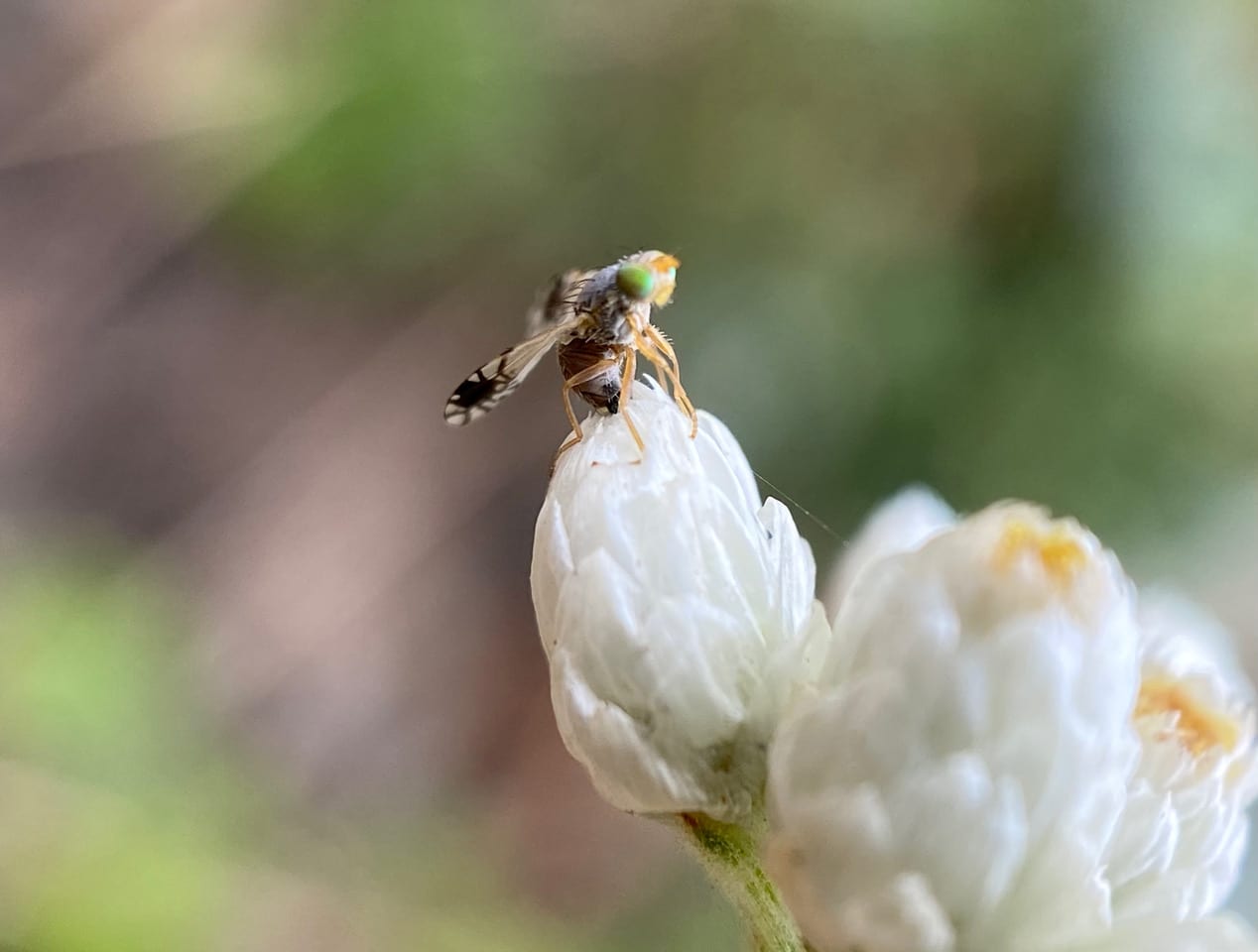
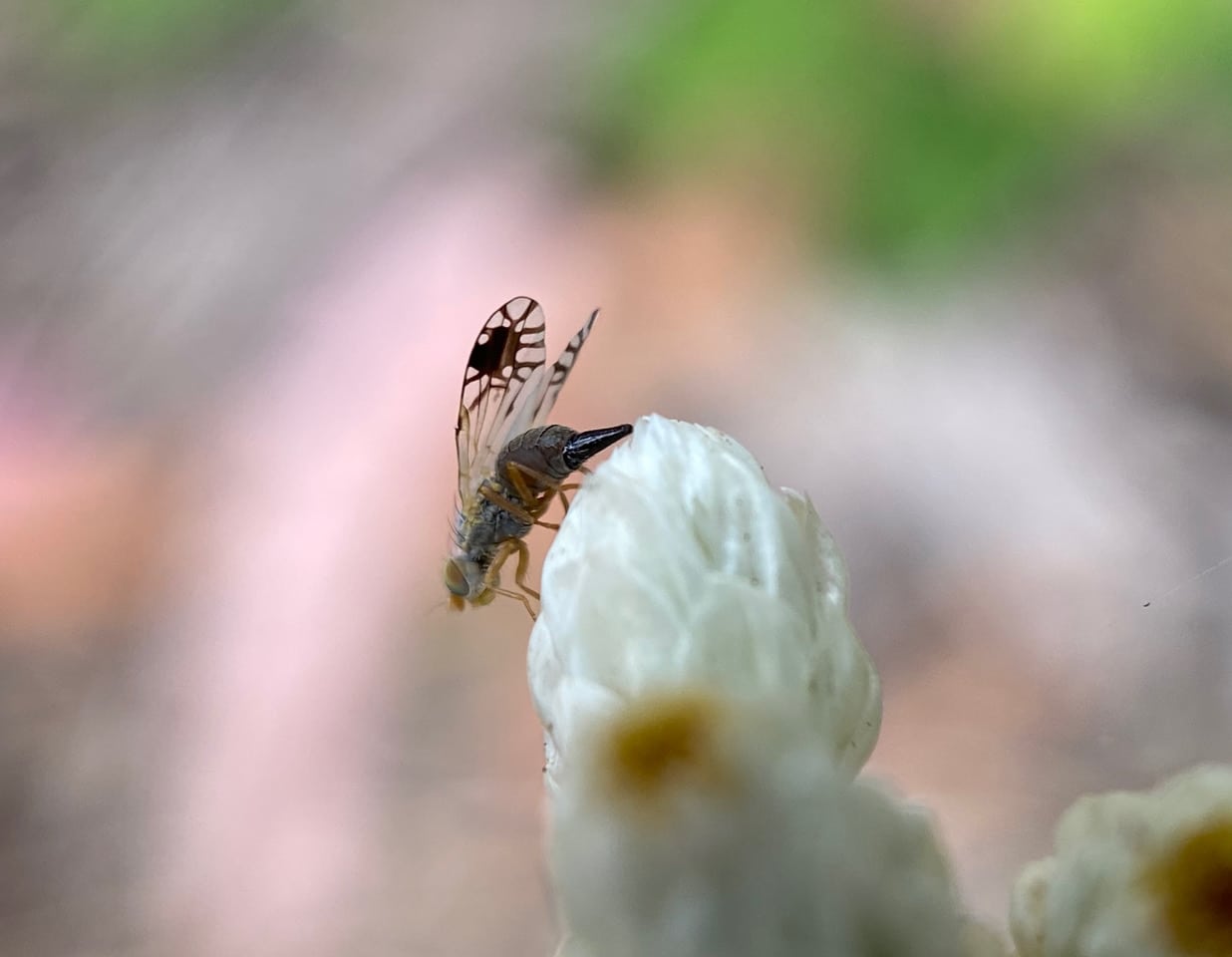
Ooh, a Fruit Fly, Trupanea sp. (family Tephritidae) is roaming a leaf of Coast Tarweed. The female has a long oviscape at the tip of her abdomen.
A Lygus Bug is patrolling the stem of Coast Tarweed.
The term lygus bug is used for any member of the genus Lygus, in the family of plant bugs, Miridae. Adult lygus are approximately 3 mm wide and 6 mm long, colored from pale green to reddish brown or black. They have a distinctive triangle or V-shape on their backs. Lygus bugs are known for their destructive feeding habits – they puncture plant tissues with their piercing mouthparts, and feed by sucking sap. Both the physical injury and the plant’s own reaction to the bug’s saliva cause damage to the plant. Many lygus bugs are well-known agricultural pests.
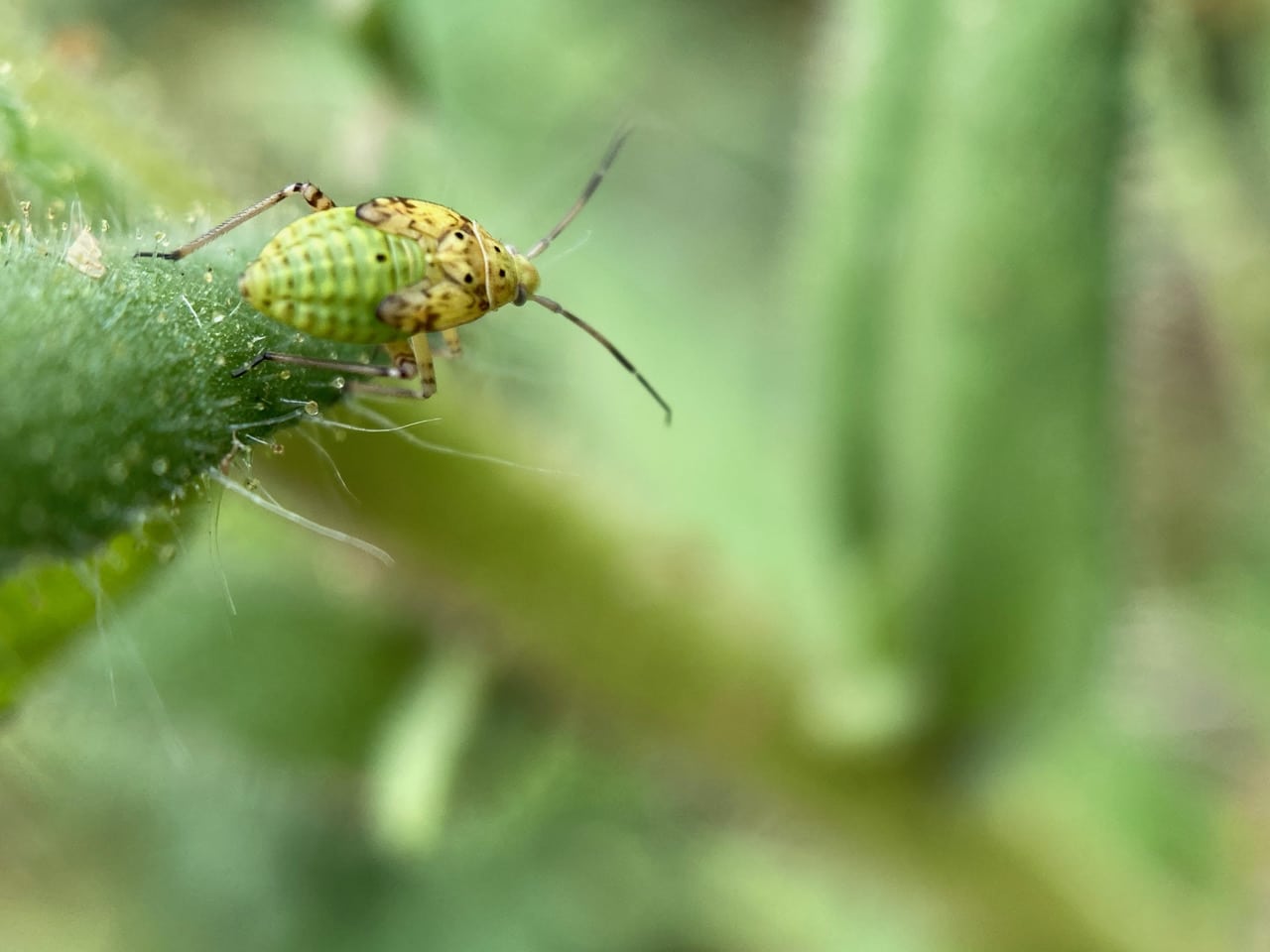
A Lygus Bug nymph is running away from the camera. Note the short wing pads on its back.
“True bugs” in the order Hemiptera undergo incomplete metamorphosis without a pupal stage. The nymphs, which look like adults, develop through a series of molts, each time getting bigger after shedding their old exoskeleton. At the last molt, they transform into adults with functional wings and reproductive parts.
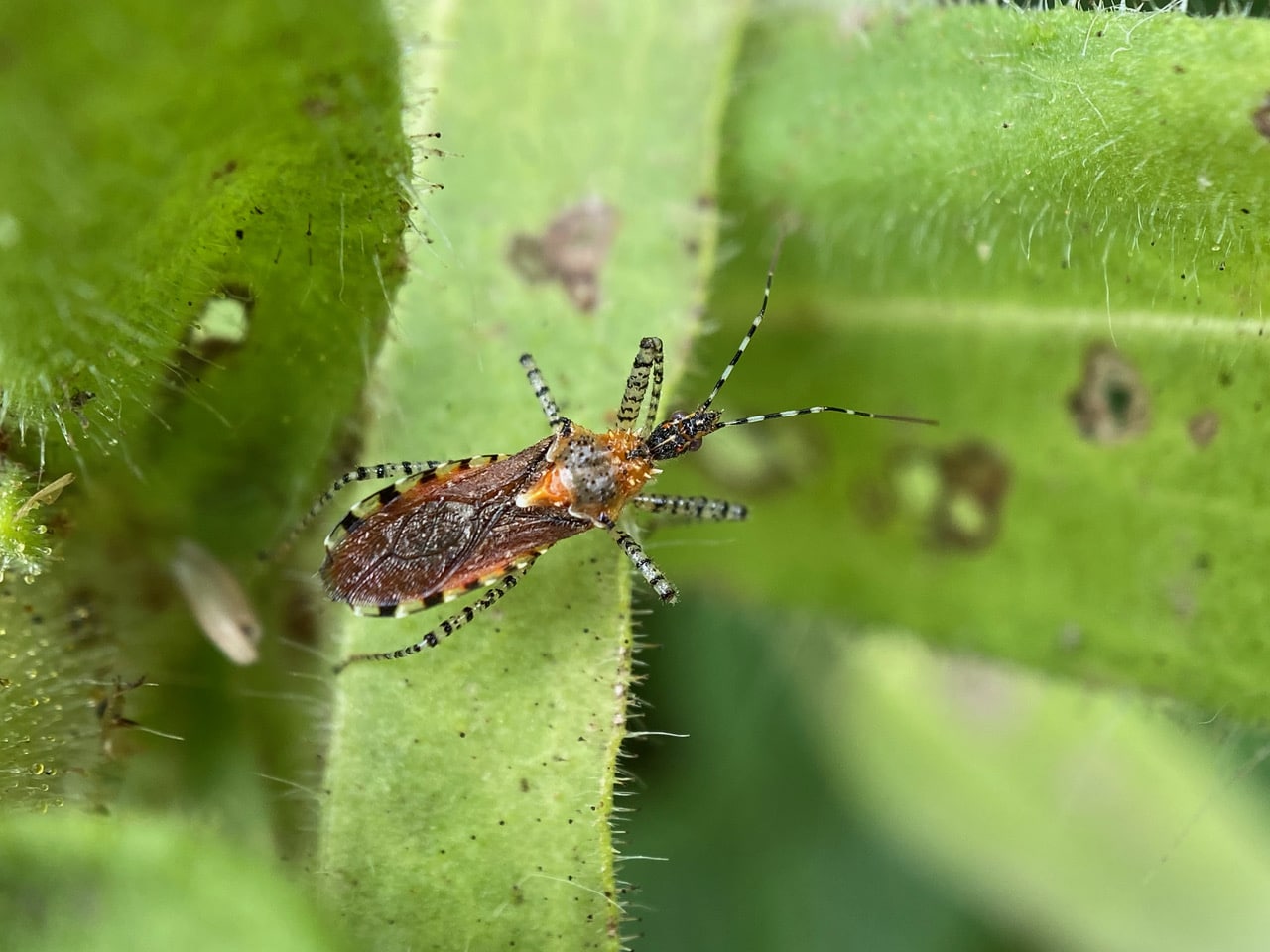
Ooh, I haven’t seen one of these in a long while – it’s a Thorn-necked Assassin Bug, Pselliopus spinicollis (family Reduviidae)! Love its zebra-striped appendages!
The Reduviidae are members of the order of true bugs, Hemiptera. The family members are almost all predatory. The bugs commonly have an elongated head with a distinct narrowed “neck”, long legs, and prominent, segmented, tubular mouthparts called the “rostrum”. Most species are bright in color with hues of brown, black, red, or orange. The most distinctive feature of the family is that the tip of the rostrum fits into a ridged groove in the prosternum, where it can be used to produce sound by stridulation when threatened.
Reduviidae use the long rostrum to inject a lethal saliva that contains digestive enzymes to liquify the insides of the prey, which are then sucked out. This process is generally referred to as extraoral digestion. The saliva is commonly effective at killing prey substantially larger than the bug itself.
The Thorn-necked Assassin Bug, Pselliopus spinicollis makes its way up the foliage of Coast Tarweed.
The genus name Pselliopus is most descriptive. Greek psellion ‘anklet/bracelet’ + pous ‘foot’ probably refer to the banded legs. Even the edges of the abdomen are banded. The bugs are found in meadows, fields; typically on flowers. Adults hibernate under rocks, bark, sometimes in groups.
A female Fruit Fly, Trupanea sp. (family Tephritidae) is laying eggs into an opened flowerhead of the last remaining California Everlasting, Pseudognaphalium californicum. Wow, the last time I observed this behavior was on 7/10/23. Apparently the female fruit flies continue to lay eggs in their host plant for as long as it is in bloom.
The female Trupanea spends quite some time laying her eggs into the everlasting flowerhead, letting me observe her from different angles. She does not seem at all perturbed by my presence. Her larvae probably feed on the flowers or developing seeds of the everlasting.
Her job done, the female steps away with her ovipositor retracted in the oviscape.
Then she proceeds to clean her oviscape with her hind legs. Congratulations on a job well done, Mama Fly!
I am happy to find that the patch of California Goldenrod, Solidago velutina ssp. californica between the Radio Tower and the Water Tank is blooming gloriously. Together with the Fragrant Everlasting, the goldenrod provides the last significant floral resources for the insects before the season is over. Here a tiny ant is foraging among the flowers.
A Spotted Cucumber Beetle, Diabrotica undecimpunctata (family Chrysomelidae) lurks within an inflorescence of California Goldenrod.
Members of the family Chrysomelidae are commonly known as Leaf Beetles. Adults and larvae feed on all sorts of plant tissues, and all species are fully herbivorous. Many are serious pests of cultivated plants, including food crops. Others are beneficial due to their use in biocontrol of invasive weeds. Chrysomelids are popular among insect collectors, as many are conspicuously colored, typically in glossy yellow to red or metallic blue-green hues, and some have spectacularly bizarre shapes. Photos of Leaf Beetles (Family Chrysomelidae) · iNaturalist
Native to North America, the Spotted Cucumber Beetle can be a major agricultural pest, causing damage to crops in the larval as well as adult stages of their life cycle. Larvae, sometimes known as rootworms feed on the roots of emerging plants. In the adult stage the beetles cause damage by eating the flowers, leaves, stems and fruits of the plant.
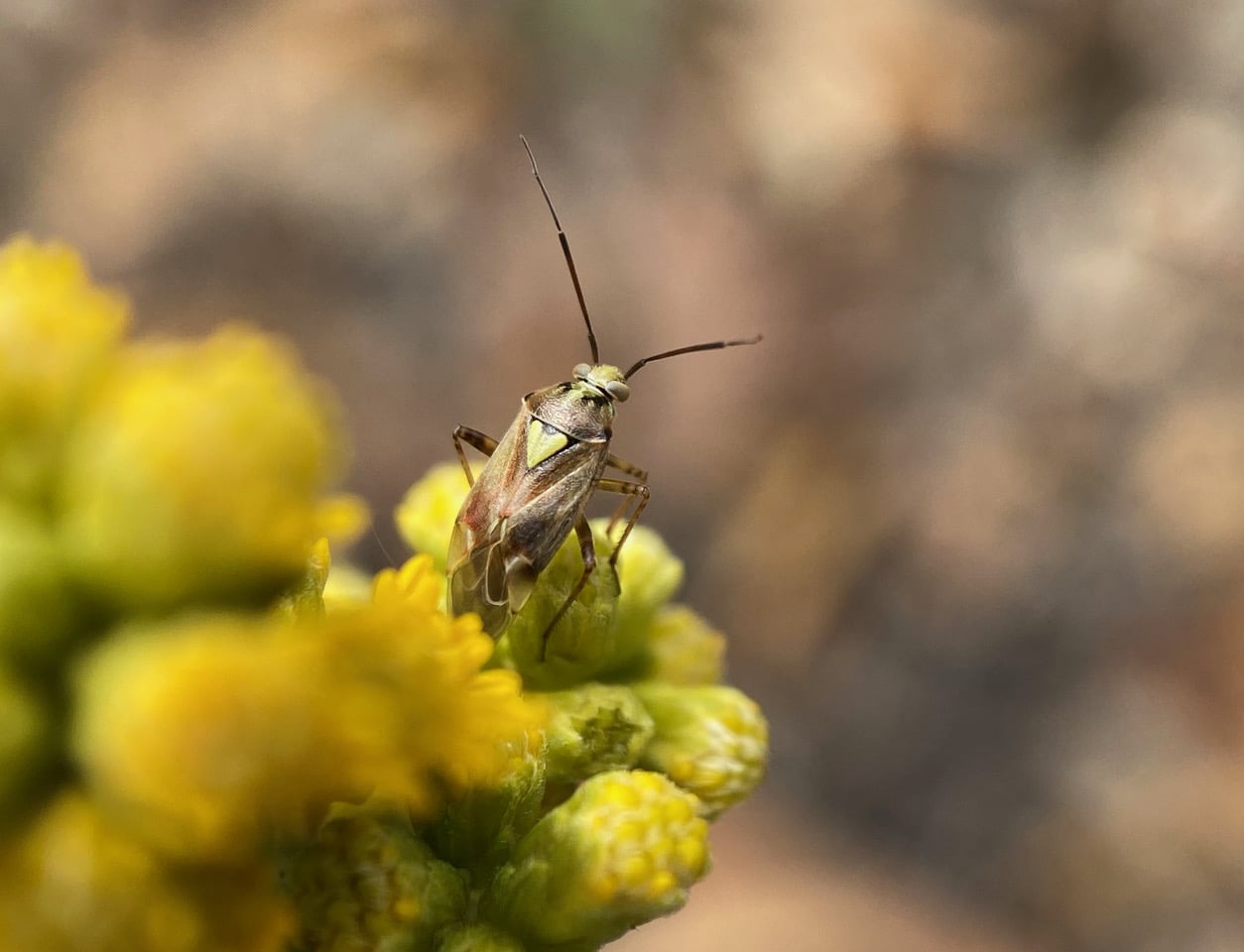
The ubiquitous Lygus Bug again. What a beauty!
The term lygus bug is used for any member of the genus Lygus, in the family of plant bugs, Miridae. Adult lygus are approximately 3 mm wide and 6 mm long, colored from pale green to reddish brown or black. They have a distinctive triangle or V-shape on their backs. Lygus bugs are known for their destructive feeding habits – they puncture plant tissues with their piercing mouthparts, and feed by sucking sap. Both the physical injury and the plant’s own reaction to the bug’s saliva cause damage to the plant. Many lygus bugs are well-known agricultural pests.
One useful feature in identifying members of the family Miridae or plant bugs is the presence of a cuneus; it is the triangular tip of the corium, the firm, horny part of the forewing, the hemielytron. The cuneus is visible in nearly all Miridae.

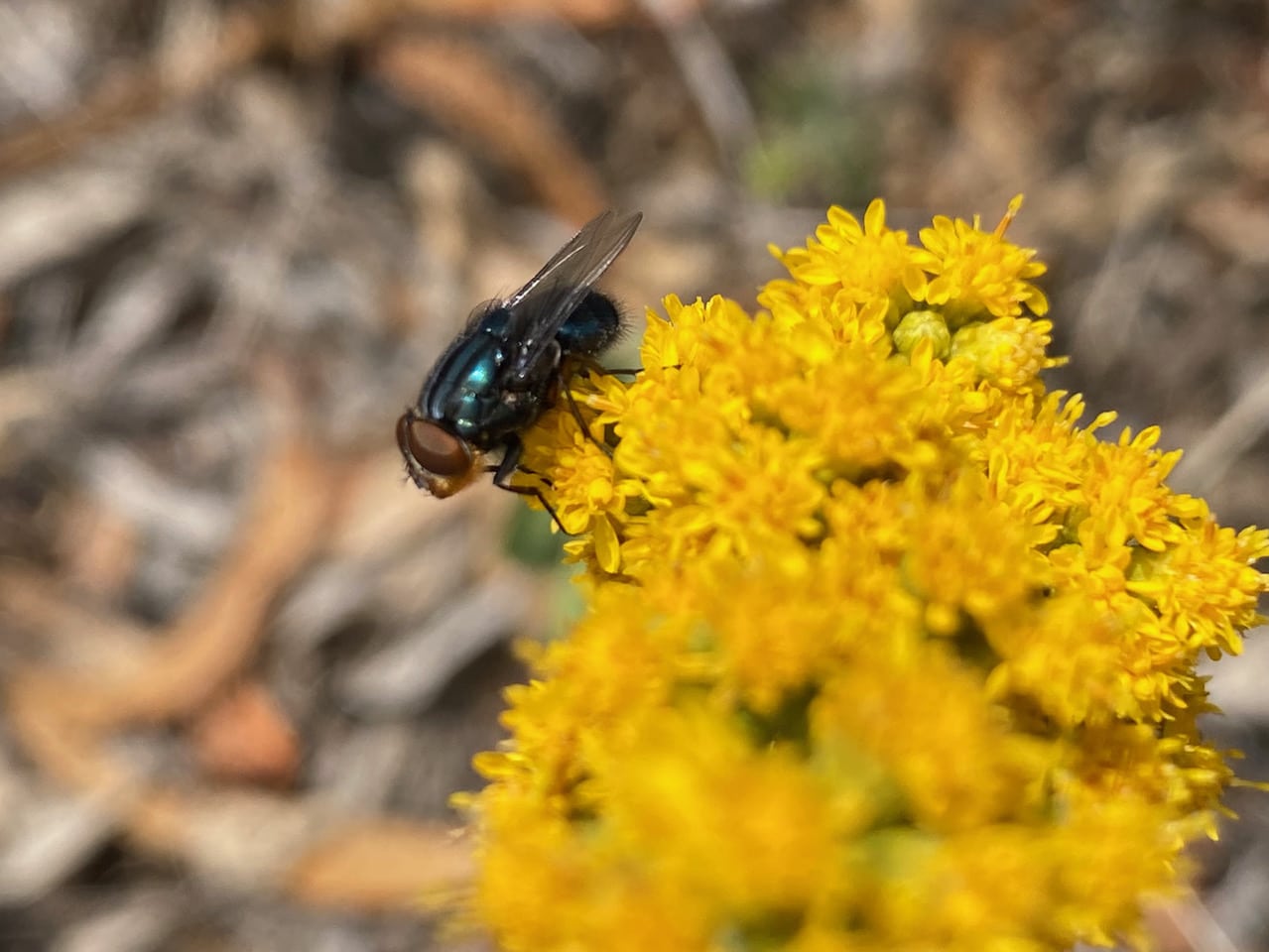
A Secondary Screwworm Fly is foraging on the flowers of California Goldenrod.
The Secondary Screwworm, Cochliomyia macellaria (family Calliphoridae, commonly known as blow flies) ranges throughout the United States and the American tropics. The body is metallic greenish-blue and characterized by three black longitudinal stripes on the dorsal thorax. Females are attracted to carrion where they lay their eggs. These screwworms are referred to as “secondary” because they typically infest wounds after invasion by primary myiasis-causing flies. While the flies carry various types of Salmonella and viruses, C. macellaria can also serve as important decomposers in the ecosystem. In a lifetime, a female may lay up to 1000 or more eggs. Females may also lay their eggs with other females, leading to an accumulation of thousands of eggs. The larval stage of C. macellaria is referred to by the common name of secondary screwworms; this is due to the presence of small spines on each body segment that resemble parts of a screw. The larvae feed on the decaying flesh of the animal that they have been laid on until they reach maturity. Eventually the larvae fall off the food source to pupate in the top layer of the soil. Adult females will continue to feed on tissues of animals; however, now they preferentially feed off of live tissues and tissue plasma. Adult males will no longer consume tissue, but instead will eat nearby vegetation and take nourishment from floral nectar.
A Lacewing larva is hunting among the clusters of California Goldenrod flowerheads.
Lacewings are insects in the large family Chrysopidae of the order Neuroptera. Adults are crepuscular or nocturnal. They feed on pollen, nectar and honeydew supplemented with mites, aphids and other small arthropods. Eggs are deposited at night, hung on a slender stalk of silk usually on the underside of a leaf. Immediately after hatching, the larvae molt, then descend the egg stalk to feed. They are voracious predators, attacking most insects of suitable size, especially soft-bodied ones (aphids, caterpillars and other insect larvae, insect eggs). Their maxillae are hollow, allowing a digestive secretion to be injected in the prey. Lacewing larvae are commonly known as “aphid lions” or “aphid wolves”. In some countries, Lacewings are reared for sale as biological control agents of insect and mite pests in agriculture and gardens.
A glimpse of the tapered rear of the Lacewing larva as it disappears into the dark recesses of the inflorescence. A Woodlouse Fly, Stevenia deceptoria (family Rhinophoridae) is browsing an inflorescence of California Everlasting. These small, slender, black, bristly flies are somewhat related to the Tachinidae. The larvae are mostly parasitoids of woodlice (pill bugs), beetles, spiders and other arthropods, and occasionally snails.
Native to Europe, Stevenia deceptoria is now widespread in the US. The flies are parasitoids of terrestrial woodlice (roly polies) of the order Isopoda (Oniscoidea).

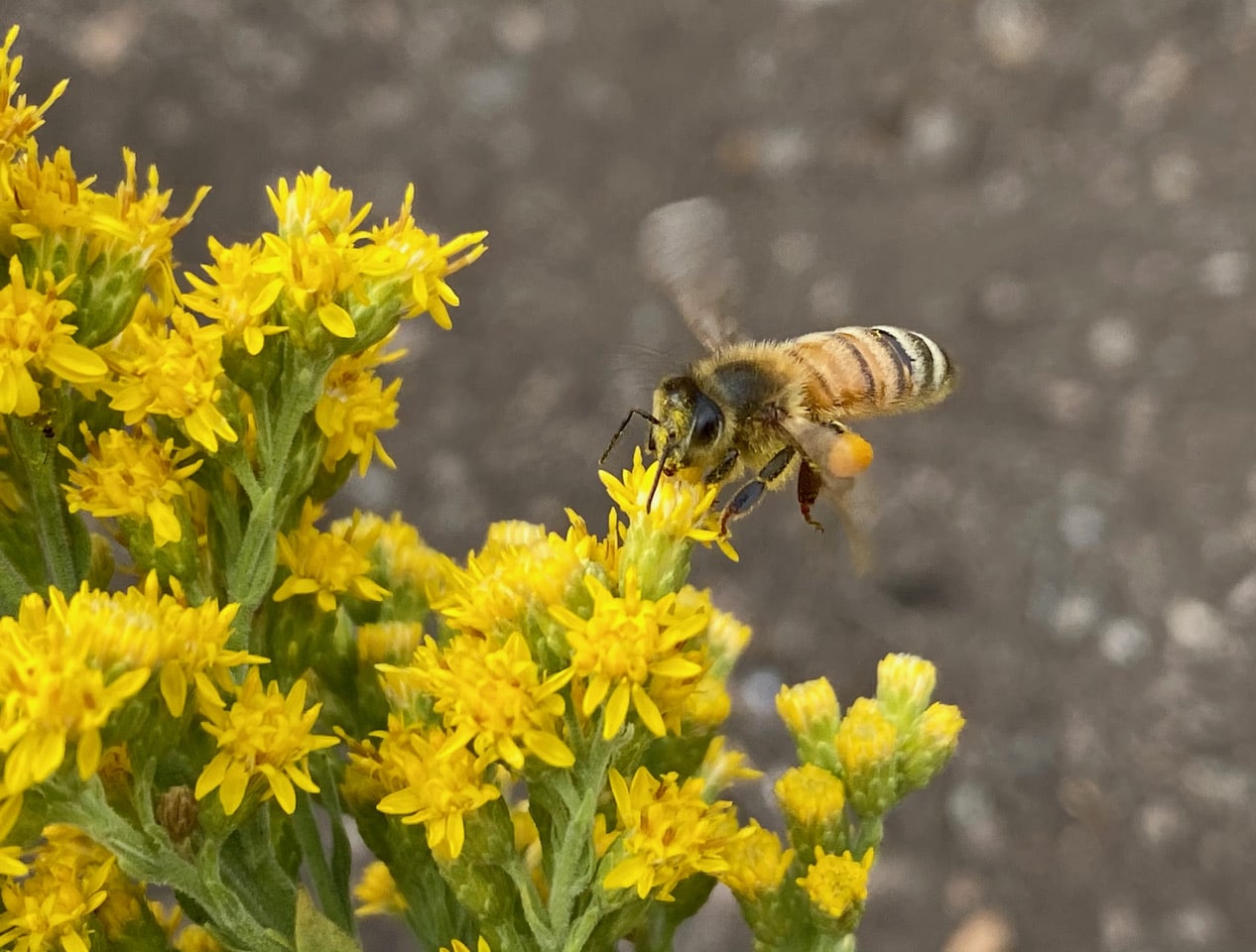
Her face encrusted with yellow pollen, a Honey Bee, Apis mellifera (family Apidae) is foraging on the flowers of California Goldenrod. She has already collected a sizable load of pollen in her pollen baskets.
The pollen collecting apparatus in Apidae bees, which include honey bees and bumble bees, is commonly called a “pollen basket” or corbicula. This region is located on the tibia of the hind legs and consists of hairs surrounding a concave region. After the bee visits a flower, she begins to groom herself and brushes the pollen down toward her hind legs and packs the pollen into her pollen basket. A little nectar mixed with the pollen keeps it all together like putty, and the stiff hairs surrounding the pollen basket hold it in place. A honey bee can fly with a full pollen load that weighs as much as a third of her body weight.
.jpg)
Many years ago, a fellow docent at the Oakland Museum, a retired entomologist told me that every Honey Bee worker out foraging should be treated with respect – they are all little old ladies. Bud was absolutely correct. All Honey Bee foragers are female, and they are the oldest of their hive mates. How do honey bees get their job assignments within their social organization?
A bee’s job is, first of all, determined by its sex. Male bees, or drones, don’t do any work. Making up roughly 10% of the colony’s population, they spend their whole lives eating honey and waiting for the opportunity to mate with the queen. The queen mates with up to 20 drones and will store their sperm in her spermatheca for the rest of her life. That’s where male duties end. Female bees, known as worker bees, make up the vast majority of a hive’s population, and they do all the work to keep it functioning. Females are responsible for the construction, maintenance, and proliferation of the nest and the colony. When a worker bee emerges as an adult, she immediately starts cleaning the cell from which she hatched. Her first 3 days are spent cleaning cells to prepare them for the queen’s next round of eggs. Then her hormones kick in to initiate the next phase of work: nursing the young. The worker bee spends about a week nursing the brood, feeding larvae with royal jelly. Next, the worker bee enters the third phase, as a sort of utility worker, moving farther away from the nest’s center. Here she builds cells and stores food in the edge of the nest for about a week. A worker’s hormone shifts into the final phase of work at around 41st day: foraging. This work is the most dangerous and arguably the most important. It’s only done by older bees who are closer to death. As the worker bee approaches her fourth week of nonstop work, she senses her end of days, and removes herself from the hive, so as not the become a burden to the colony. If she dies in the hive, her hive mates would have to remove her corpse. Thus is the life of a female honey bee during the active seasons of spring and summer, compulsively working from the day she’s born until the day she expires.
So, don’t forget to tip your hat to the “little old ladies” you see in the garden!