

Pollinator Post 9/3/23
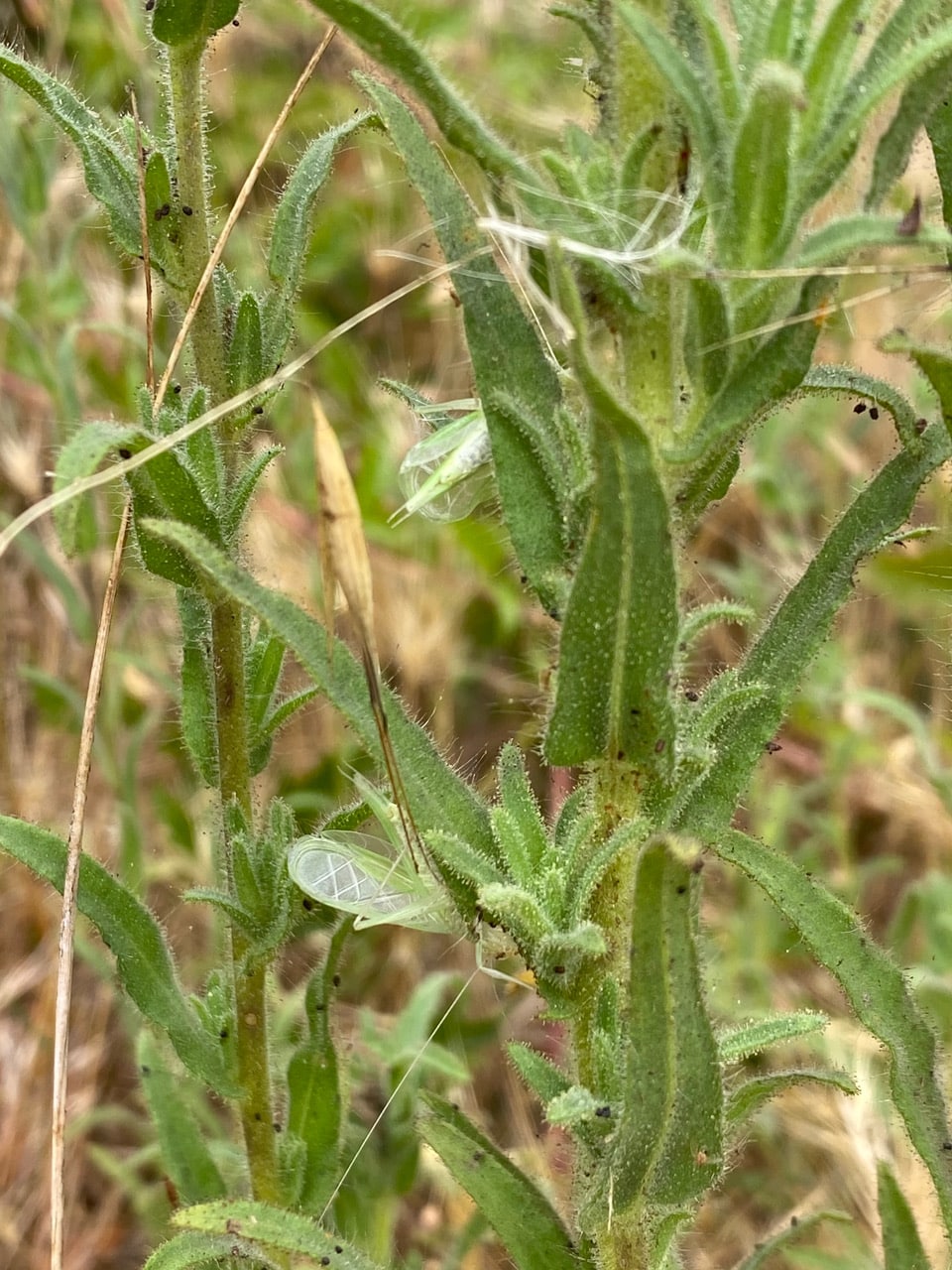
As I step down from Siesta Gate to the short path that leads to Skyline Trail, I hear the distinct song of a Tree Cricket. It’s almost 10 am. What is a Tree Cricket doing, serenading in daylight? Well it is a cool, heavily overcast morning just past full moon. Maybe the Tree Crickets are out partying overtime? It only takes me a few seconds to find the songster, and he has a companion close by! They are both on the same Coast Tarweed, Madia sativa on the edge of the path. It is a “pinch myself” moment. Ever since I found my first Tree Cricket at Skyline Gardens last year, I have wanted to see and hear them sing, and have wondered if I would be brave enough to come out here after dark for the show.
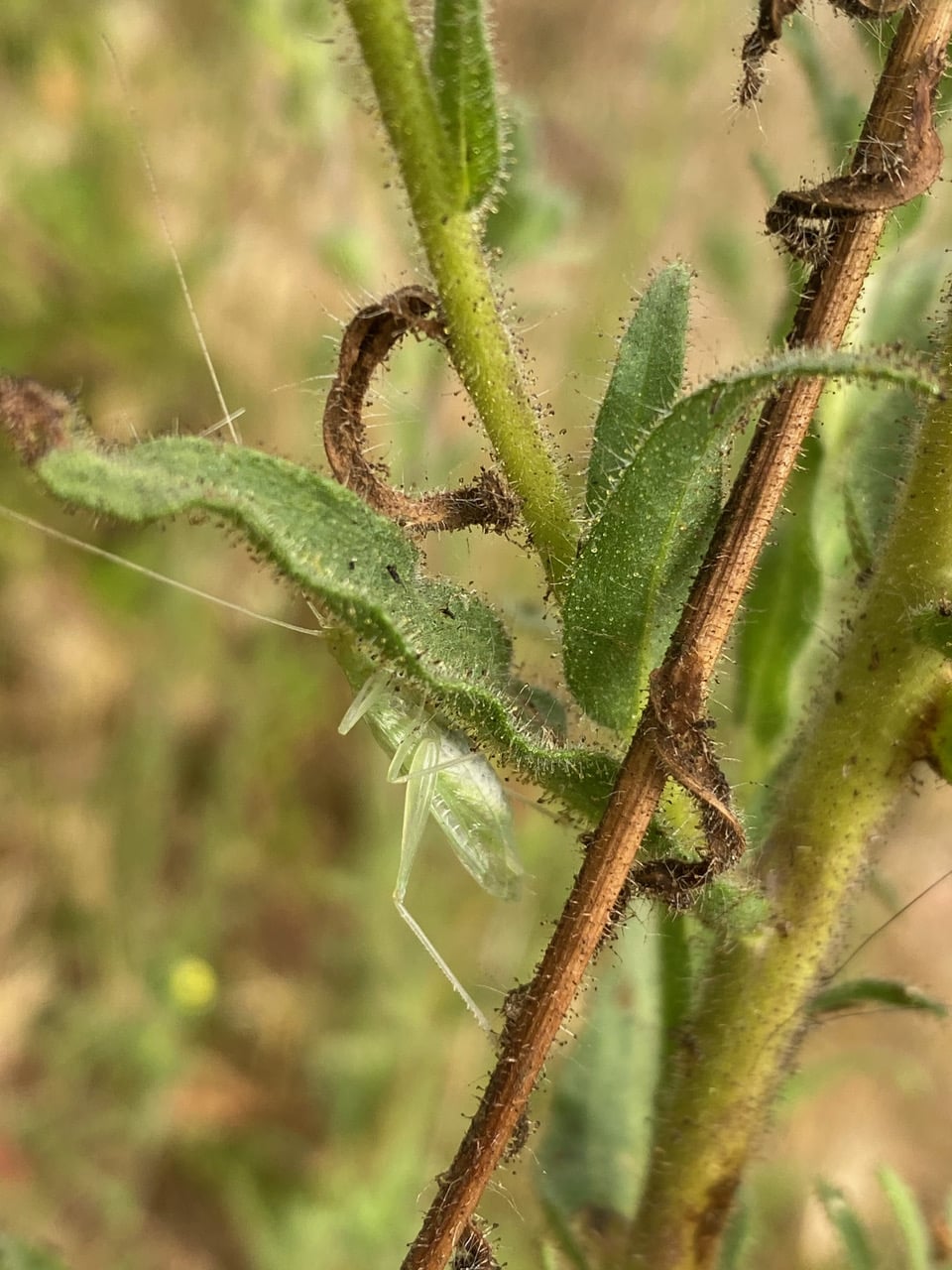
The song stops when I stop next to the plant. Then I notice a movement in another Coast Tarweed only 2 feet away. It is another male Common Tree Cricket!
Tree Crickets are so called because many species hang out in trees. They are in the order Orthoptera (crickets, katydids, grasshoppers, etc.) and in the “true cricket” family Gryllidae. The Common Tree Crickets are in the genus Oecanthus (the “O” is silent and the “E” is long). Tree Crickets inhabit trees, shrubs and tall weeds, feeding on plant parts, some insects (e.g., aphids, scales) and other materials (e.g., fungi, pollen).
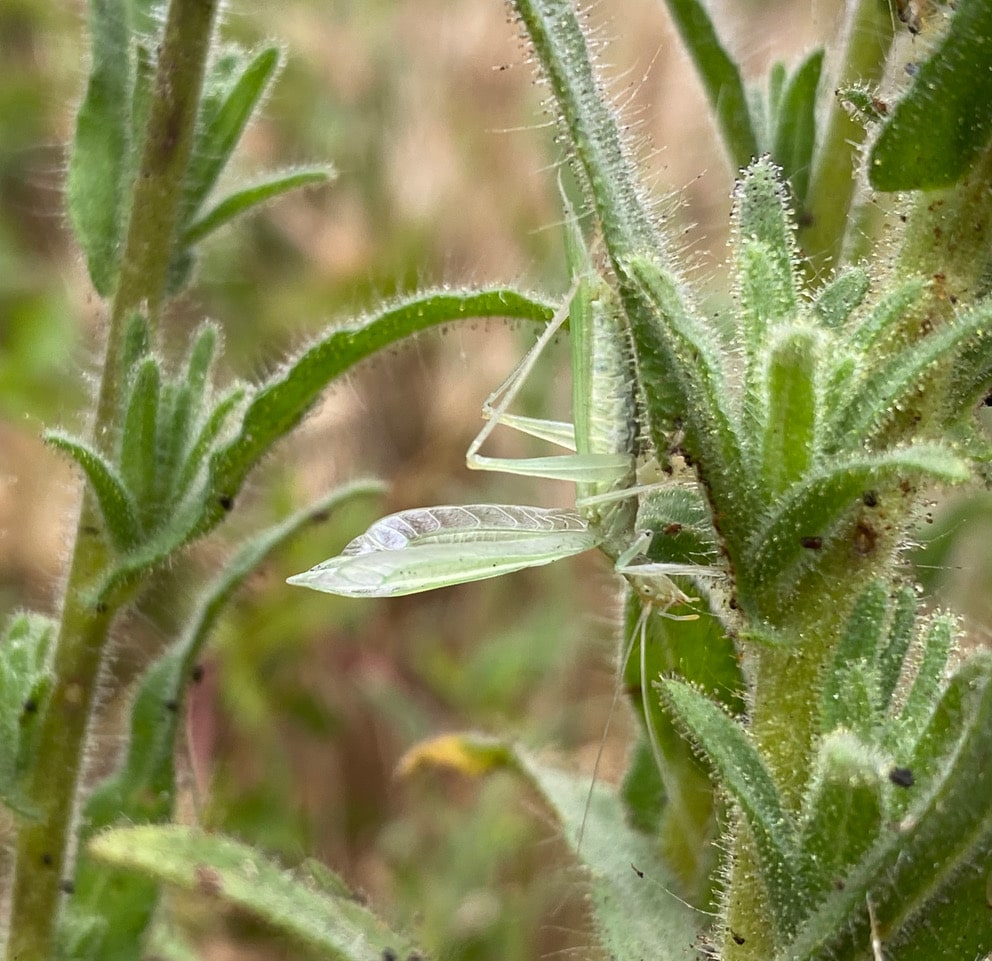
As I am talking to a couple of friends who happen come on the path, the song starts again. The male Tree Cricket has lifted his forewings at right angles to his body, and is visibly and audibly stridulating just inches from me. I record his performance on a short video.
More often heard than seen, tree crickets are active at dusk and at night. In late summer, males produce a high-pitched whine or “song”, a prelude to courtship and mating.
Tree Crickets have two sets of wings; a female’s forewings hug her body, and males’ forewings are flat and wide. Males produce sound by rubbing together rough areas (called the “rasp” and “file”) at the base of the forewings, a method of sound production called stridulation. During sound production, the males hold their wings straight up at right angle to the body. Each species of tree cricket has its signature calls, and the tempo of the call is affected by the temperature of the ambient air. Females do not call, but they do listen with auditory organs located on the forelegs. Females prefer males who sing bass (a lower call indicates a larger caller).
The singing male attracts the gal of his dreams, and courtship ensues, a dance that lasts for as long as half hour, involving much antenna waving. The position of his raised wings reveals to her a “honey pot” – a small trough located between his wings. In it, the metanotal gland produces a fluid for the female to feed on that will boost her reproductive success. In reaching for the prize, she places herself in a position that allows the male to deliver a spermatophore into her genital opening.
Female lay eggs in late summer or fall in whatever substrate they exist on – they drill into the bark of woody twigs or into herbaceous plants, and deposit one or more eggs in the bark or pith. Tree crickets undergo incomplete metamorphosis, resembling adults when they hatch and adding parts as they grow and molt (five times).
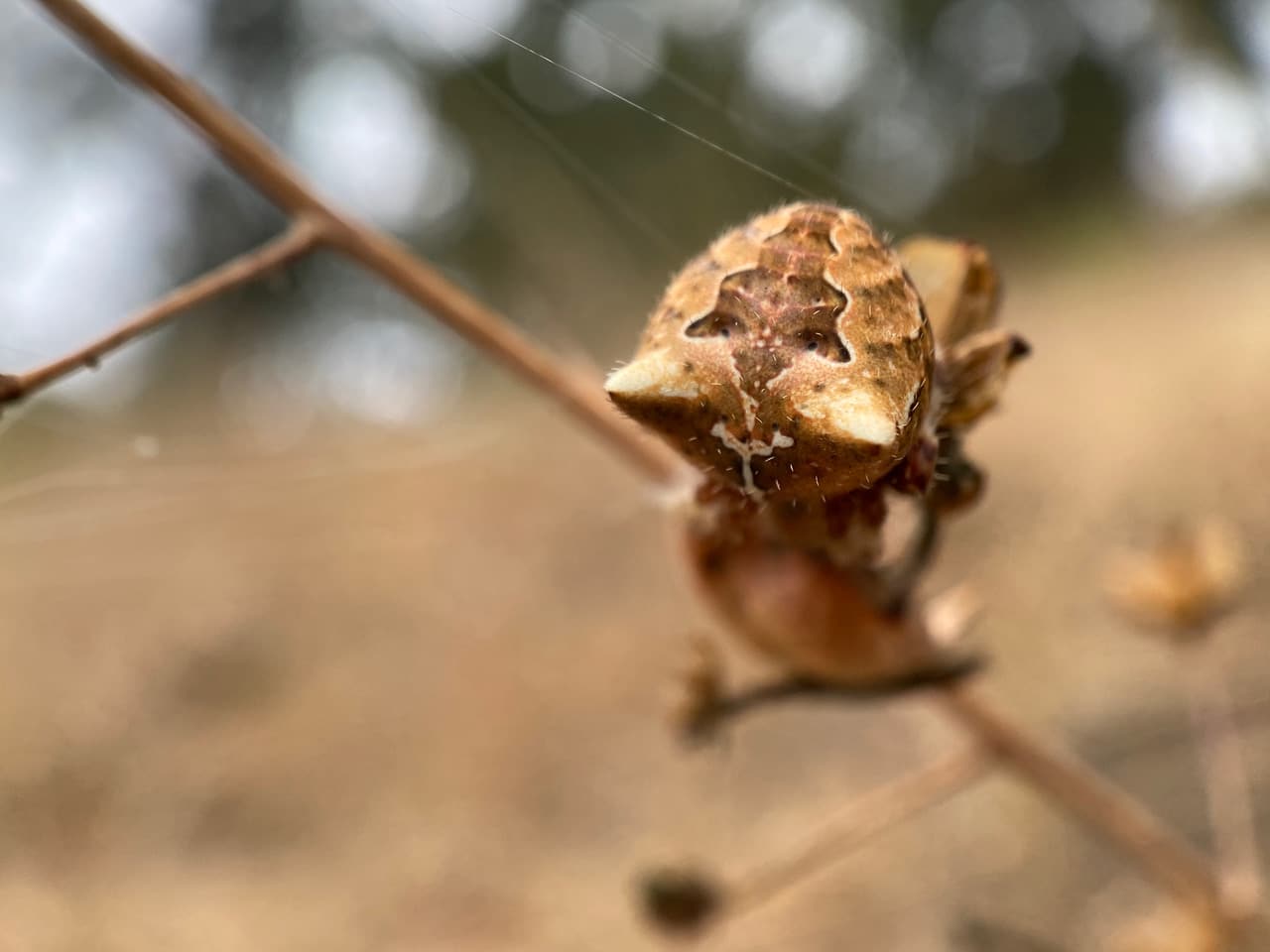
Our old friend, the Two-tubercled Orb-weaver Spider, Gibbaranea bituberculata (family Araneidae) is on her regular perch, a Soap Plant seed capsule, looking bigger and plumper than ever.
Gibbaranea bituberculata is a species of ‘orbweavers’ belonging to the family Araneidae. They are found in sunny habitats on shrubs, edges and low plants, where they can make their webs near the ground. Their basic color is very variable, but usually it is brownish, with whitish shades. The cephalothorax is covered with adpressed hairs.
Orb-weaver spiders are members of the spider family Araneidae. They are the most common group of builders of spiral wheel-shaped webs often found in gardens, fields, and forests. Generally, orb-weavers are three-clawed builders of flat webs with sticky spiral capture silk. The third claw is used to walk on the non-sticky part of the web. Typically, the prey insect that blunders into the sticky lines is stunned by a quick bite, and then wrapped in silk.

Just a couple of feet away, the other, smaller Two-tubercled Orbweaver is on her perch next to a spent seed capsule of another Soap Plant, Chlorogalum pomeridianum. The plant and the spider seem to be made for each other.

A small Plant Bug on a Bay leaf is running away from my camera. It has been identified as Campyloneura virgula (family Miridae).
Campyloneura virgula is a species of bugs in the family Miridae; native to Europe, and introduced to the United States. Adults are 4-5 mm, with pale translucent hemelytra, very long antennae, bright yellow cuneus tipped with dark red. This common predatory bug hunts for small insects such as aphids and red mites. Adults’ flight time is from July to October during which they could be found on numerous deciduous trees, including hazel, hawthorn and oak. Males are extremely rare, raising the possibility that the species might be parthenogenetic (reproducing without mating).
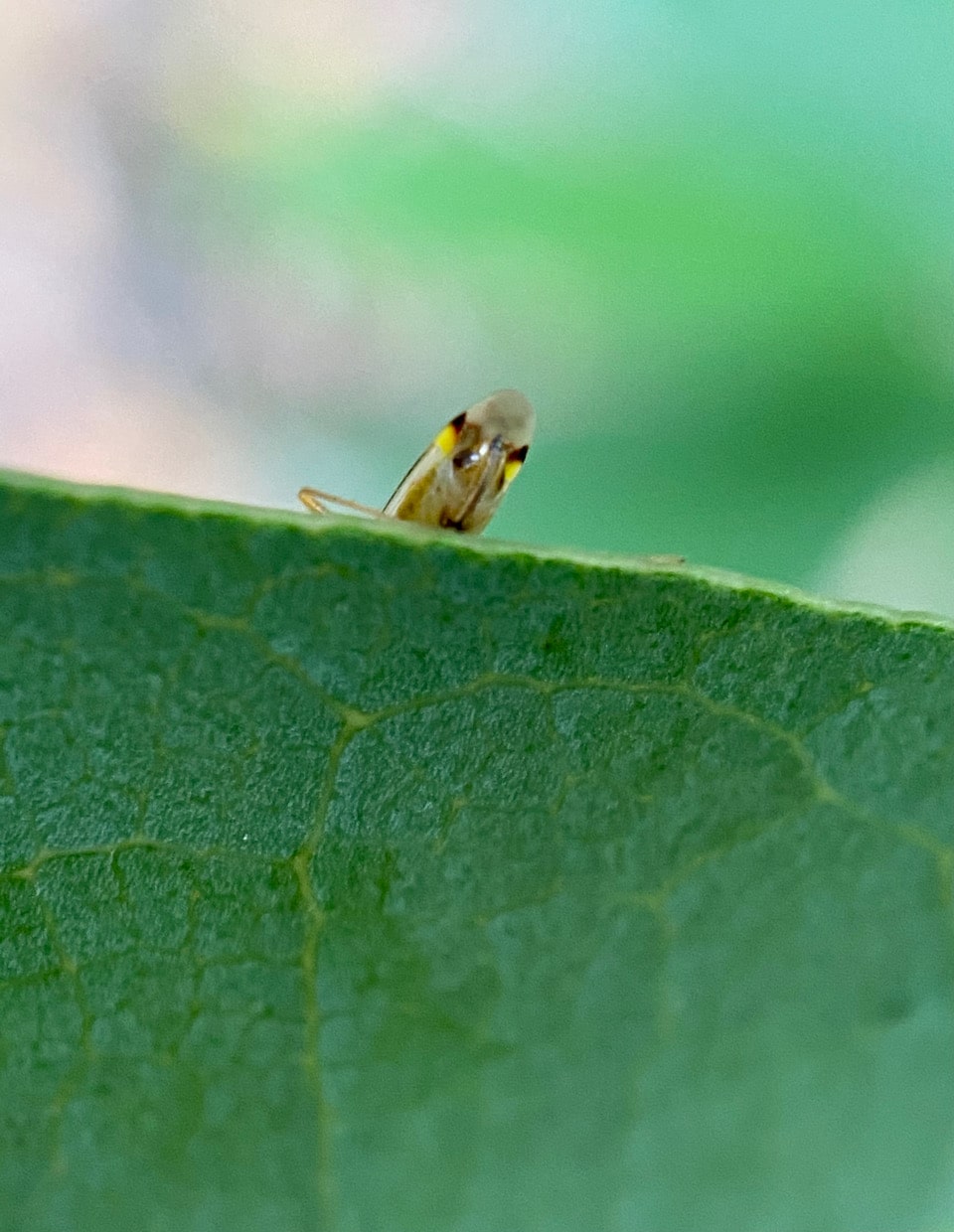
As Campyloneura virgula slips over the edge of the Bay leaf, I get a good view of its bright yellow cuneus tipped with dark red.
Mirid bugs are also referred to as plant bugs or leaf bugs. Miridae is one of the largest family of true bugs in the order Hemiptera. Like other Hemipterans, Mirids have piercing, sucking mouthparts to extract plant sap. Some species are predatory. One useful feature in identifying members of the family is the presence of a cuneus; it is the triangular tip of the corium, the firm, horny part of the forewing, the hemielytron. The cuneus is visible in nearly all Miridae.

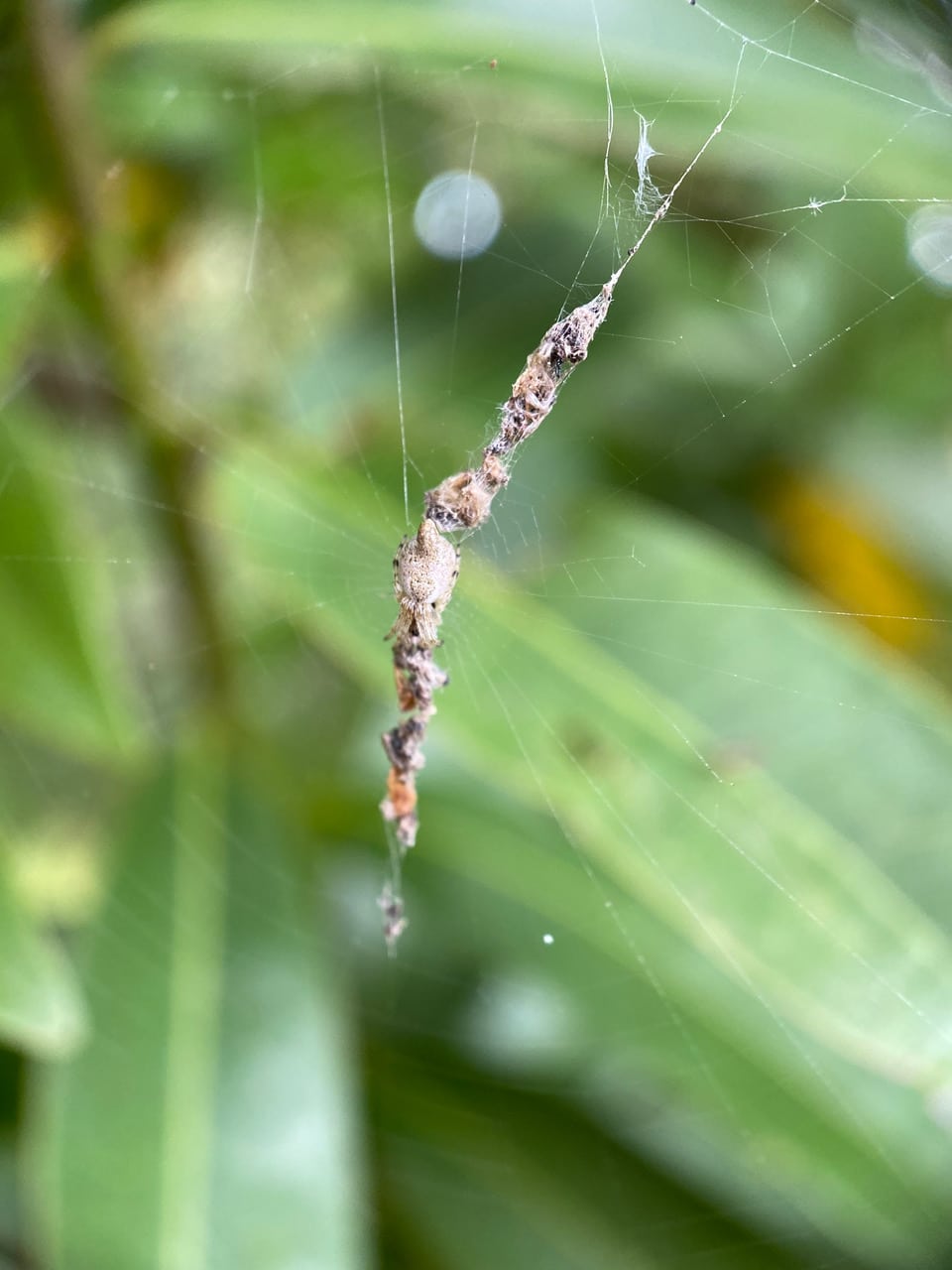
A Conical Trashline Orbweaver, Cyclosa conica (family Araneidae) has constructed a orb web between the foliage of a California Bay tree. The spider is sitting in the center of her web, head-down. What is unusual about its web is that the line of trash it has incorporated into the web is not vertical. The part above the hub is angled to the right. On closer inspection I realize why – the web has been repaired probably after it has been damaged by a trapped prey.
Trashline spiders are so-called for their web decoration. Cyclosa create orb-shaped webs using both the sticky and non-sticky threads, mostly during times of complete darkness. Across its spiral wheel-shaped web, Cyclosa fashions a vertical “trashline” made of various components such as prey’s carcasses, detritus, and at times, egg cases. The trashline helps the spider to camouflage exceptionally well from predators. The spider sits in the web hub to conduct its sit-and-wait hunting, ensnaring prey at nearly any time of day; it only leaves its spot to replace the web prior to sunrise.
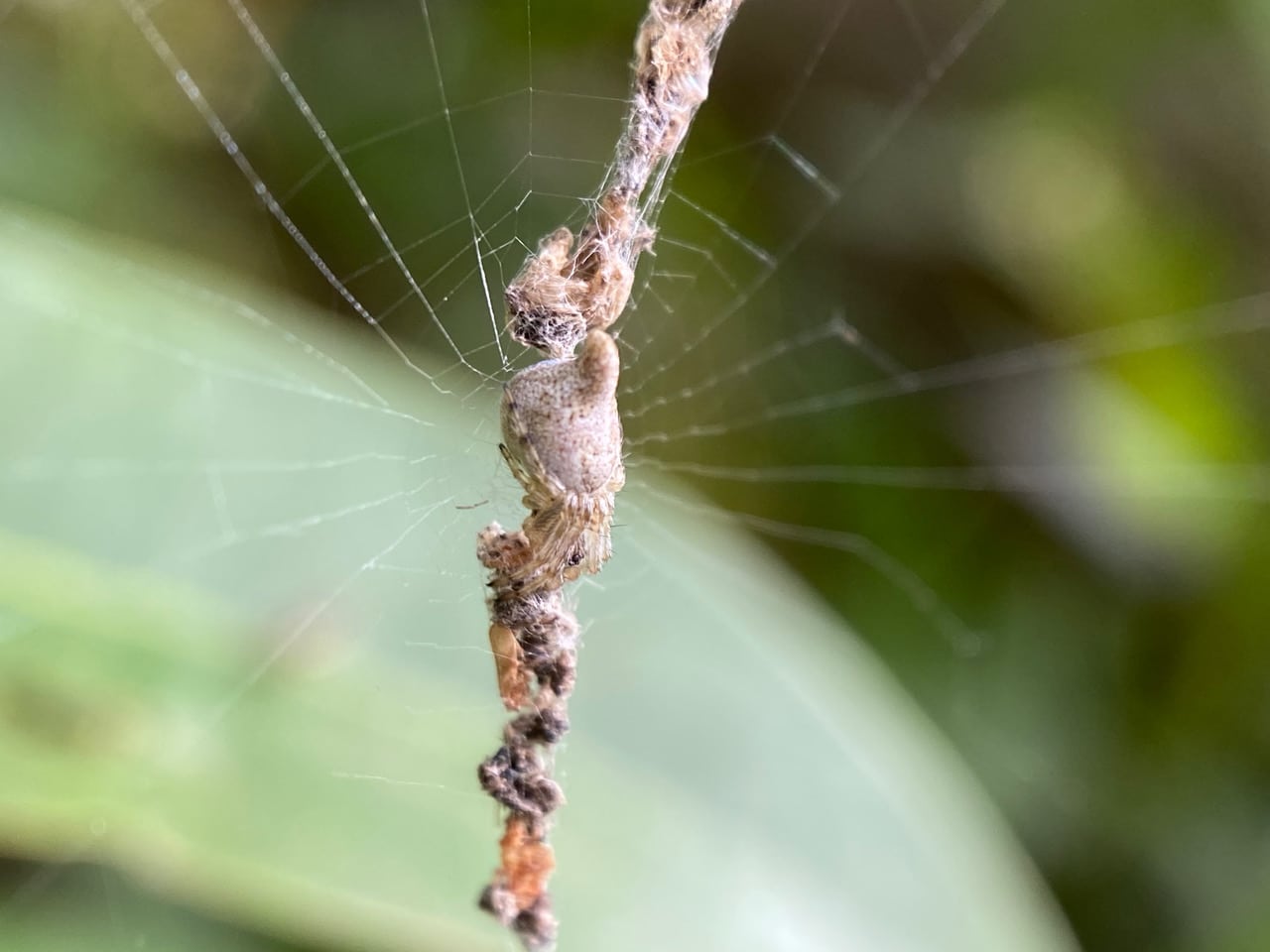
A closer view of the Conical Trashline Orbweaver. It has its legs folded against its body, completely hiding its cephalothorax. This is an odd looking spider. It has a single tubercle (hump) on the rear of its abdomen. The spider can be quite variable in color and pattern; however, its shape is so distinctive it is hard to mistake.

Hello, Blue!
Do you see our Pale Swallowtail caterpillar, hanging on its Coffeeberry leaf? Blue is likely on its last instar, measuring about 2 in. now. It has been using the same home leaf since I found it as a itsy-bitsy bird poop mimicking caterpillar on 7/29/23. Blue feeds away from the home leaf, but will always return to rest on the silk pad that it has laid down on its home leaf.

Close view of Blue’s enlarged thorax from the back, showing its fake eyespots. The blue spots and the yellow band on the edge of its thorax are more prominent every time I visit Blue. Its body seems to be turning more green as well.
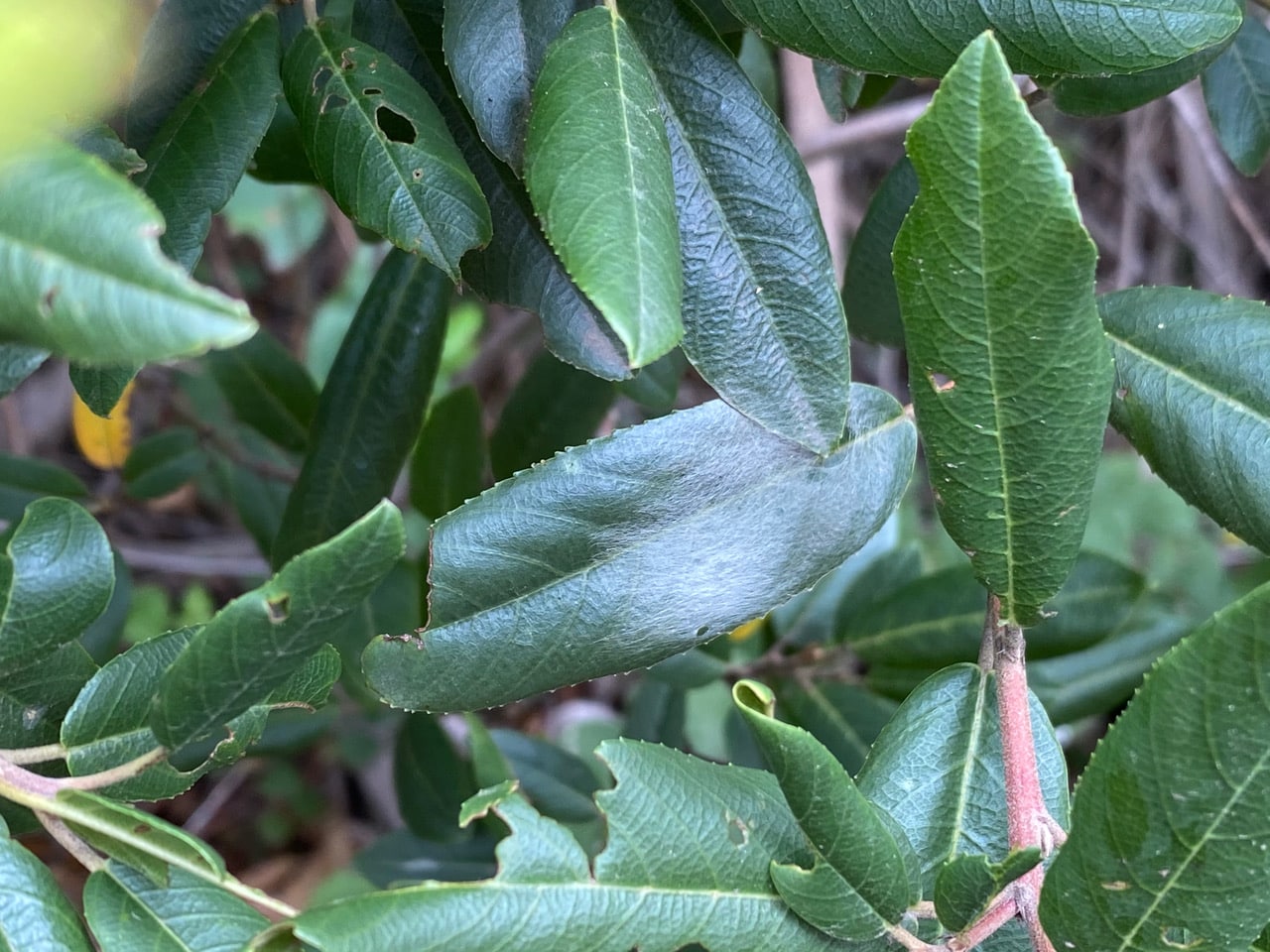 A stone’s throw from Blue’s coffeeberry bush is a much larger Coffeeberry shrub next to a open, grassy field. I have often stopped here to scan the plant for more Pale Swallowtail caterpillars. There are plenty of feeding scars on the leaves, but I never found a caterpillar on this plant. Then today a leaf very low on the plant catches my attention. Part of it is covered with a layer of white silk, just like Blue’s home leaf. I bet it used to belong to a Pale Swallowtail caterpillar!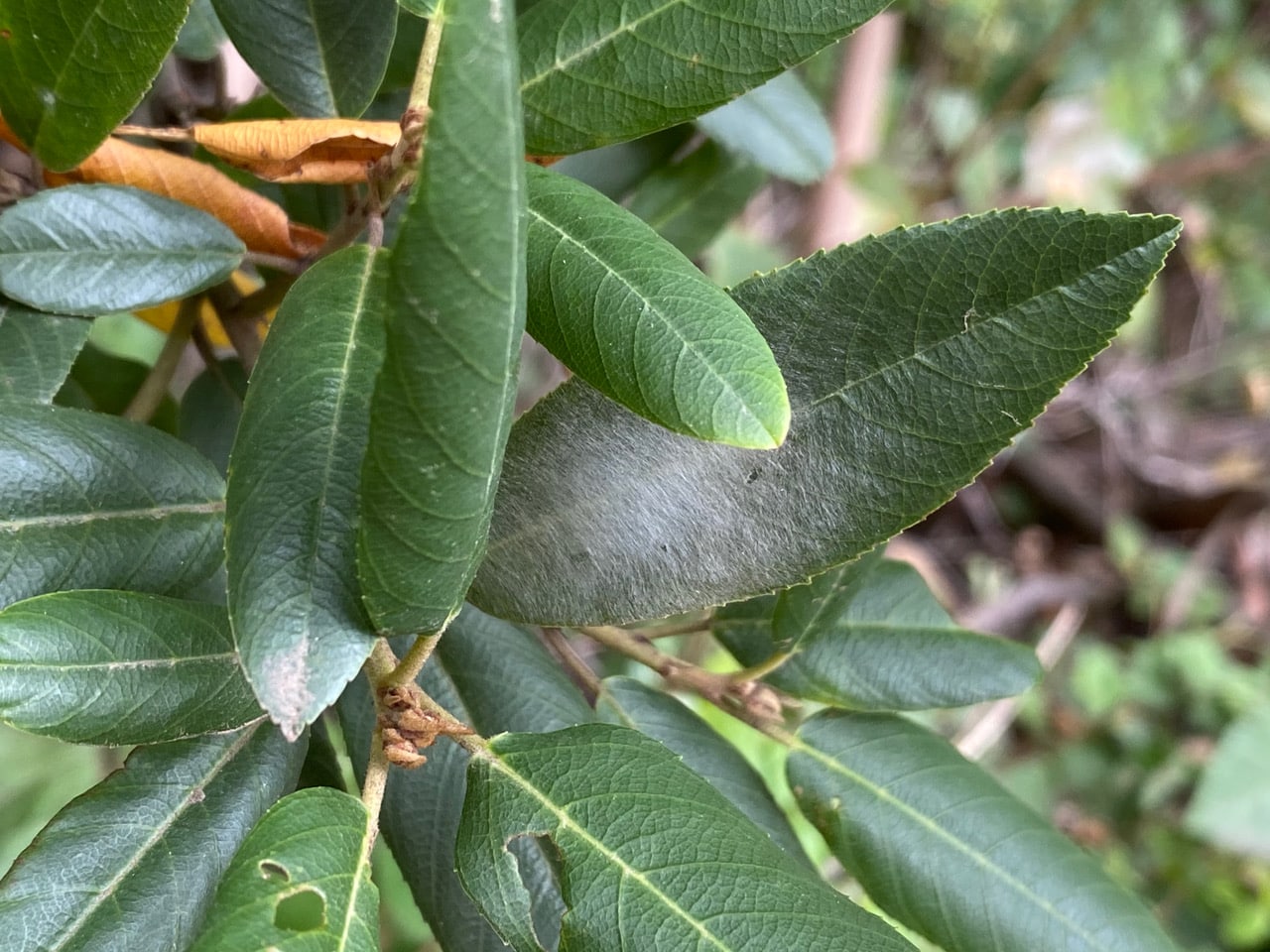
Ooh, here’s another home leaf on the same Coffeeberry! There must be many Pale Swallowtail caterpillars, but they are so well camouflaged that we simply don’t see them.
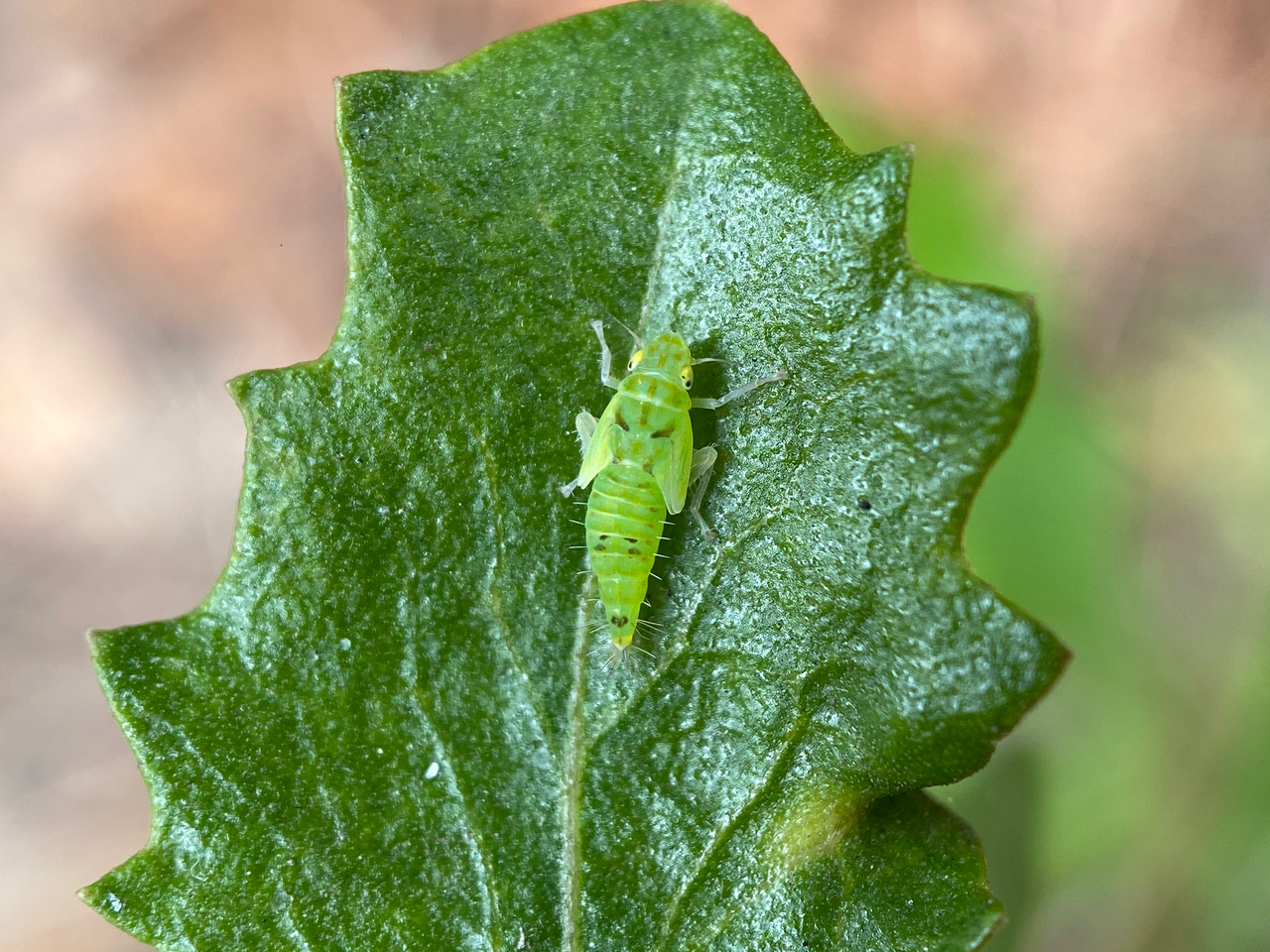
Hey, who’s this stranger on a leaf of Coyote Brush? Given its short wing pads, it must be a nymph of some sort.
I am delighted that iNaturalist could identify the nymph – it is a Leafhopper, Neocoelidia sp. (family Cicadellidae).
Leafhopper is the common name given to true bugs in the family Cicadellidae. The bugs are plant feeders that suck plant sap from grass, shrubs, or trees. Their hind legs are modified for jumping, and are covered with hairs that facilitate the spreading of a secretion over their bodies that act as a water repellent and carrier of pheromones. They undergo partial metamorphosis, and have various host associations, varying from very generalized to very specific.

Its tongue extended, a Metallic Syrphid Fly, also known as Sedgesitter, Platycheirus sp. (family Syrphidae) is feeding on the reproductive parts of a Wood Calamint flower, Clinopodium menthifolium.
Platycheirus is found in grass and herb vegetation. Adults of many species feed on pollen of wind-pollinated plants, such as Salix, Plantago, Poaceae, Cyperaceae, but they visit other flowers also. Many stay active during cold and rainy weather. Larvae feed on aphids.