

Pollinator Post 9/7/23 (1)
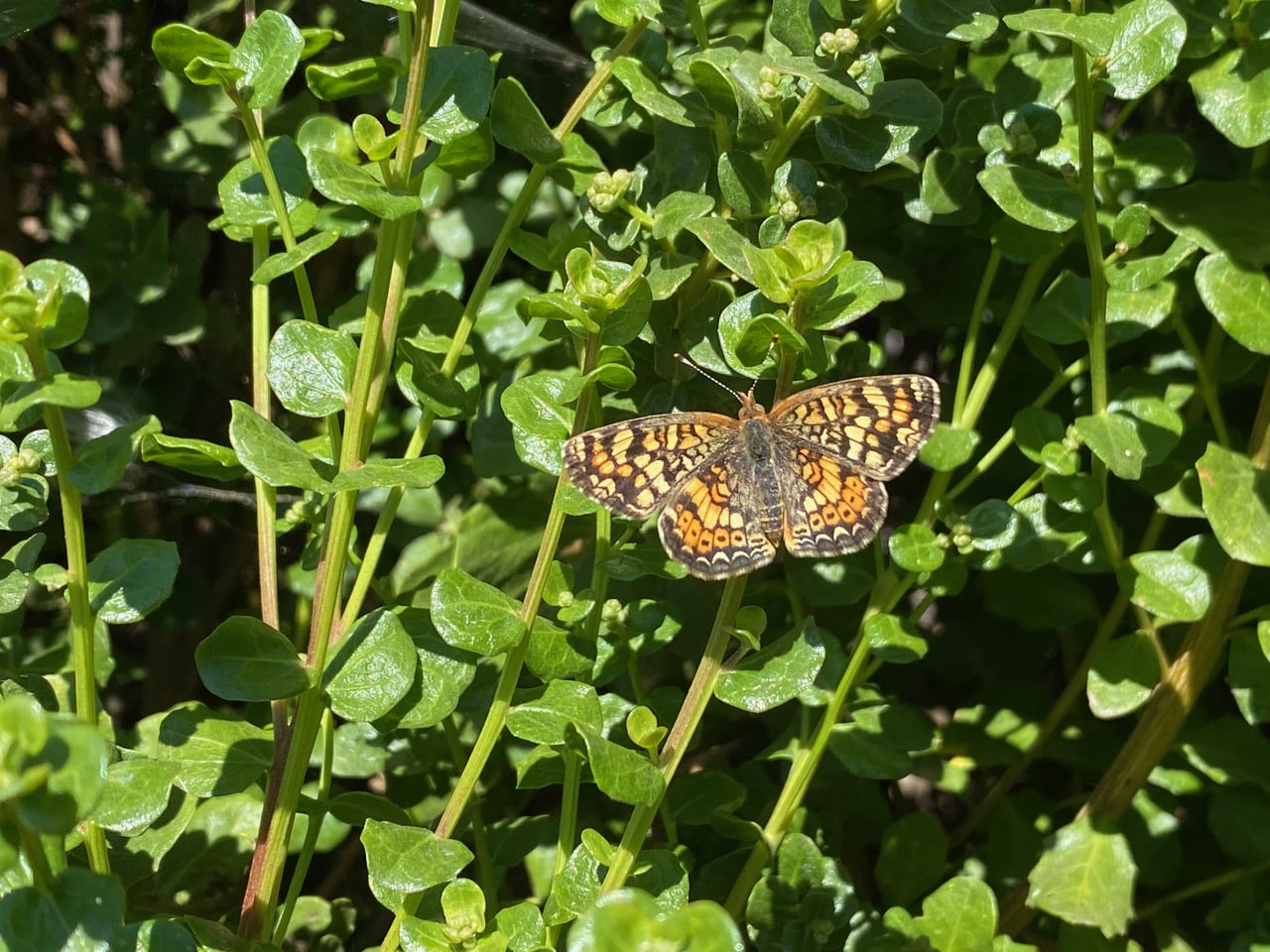
I have barely stepped into the garden through the Steam Train entrance when I am greeted by this charming little butterfly, the Field Crescent, Phyciodes pulchella (family Nymphalidae). It flutters in front of me, then lands on a Coyote Brush and spreads its wings for this photo.
The species is found in western North America. Flight time is April to September. Larvae feed on Asteraceae species. Females lay eggs in large batches on underside of host plant leaves. Caterpillars feed on leaves; young ones sometimes live in a loose web.
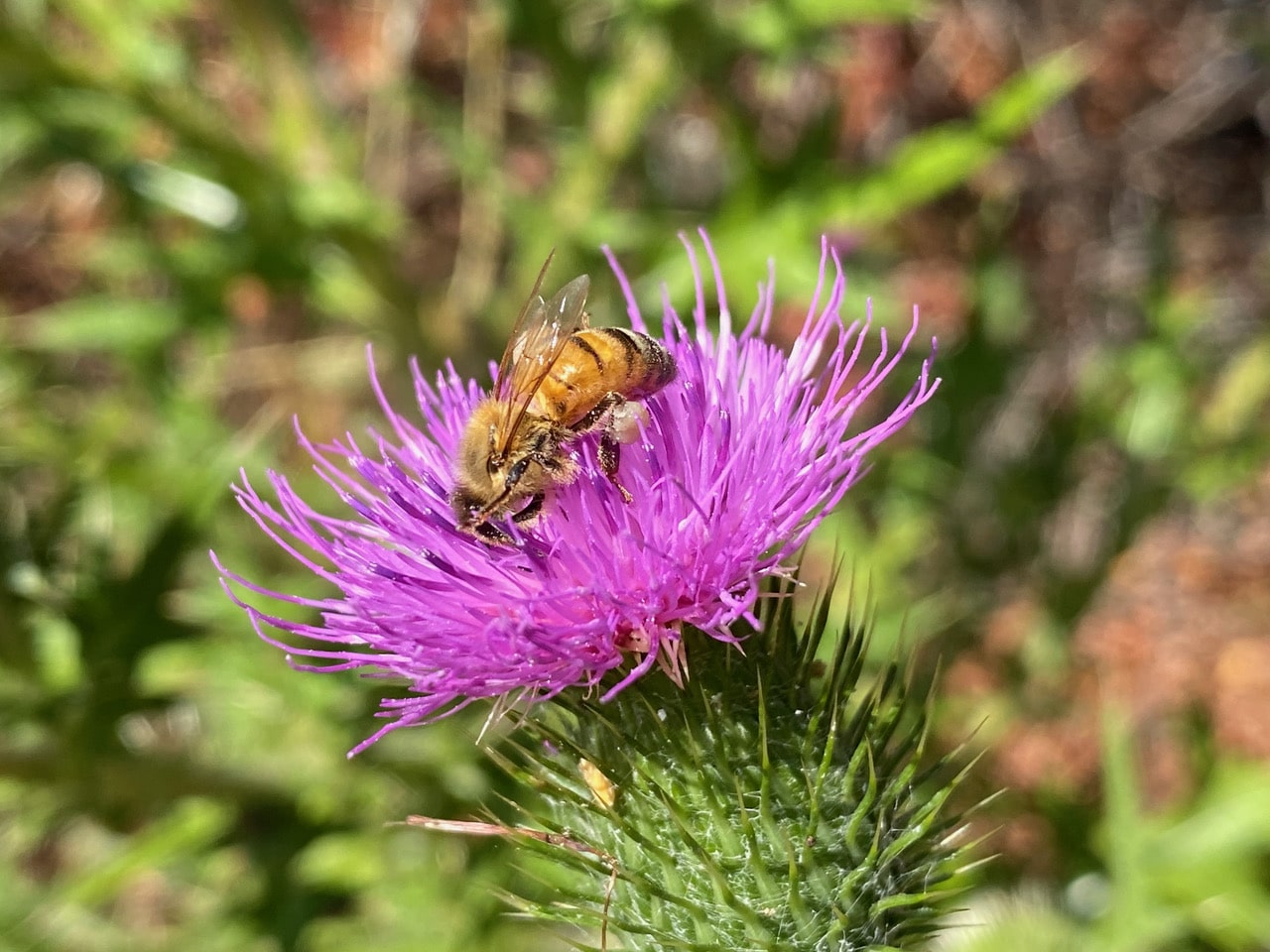
The garden seems quiet except for these two large Bull Thistles, Cirsium vulgare. The plants are almost my height, bearing numerous flowerheads buzzing with insect activity. With hardly anything else in bloom at this time, the mood on the thistle can only be described as frantic. The bees, large and small are competing fiercely for the floral resources, bumping each other off the flowerheads. A Honey Bee, Apis mellifera is knee-deep among the flowers, taking nectar.

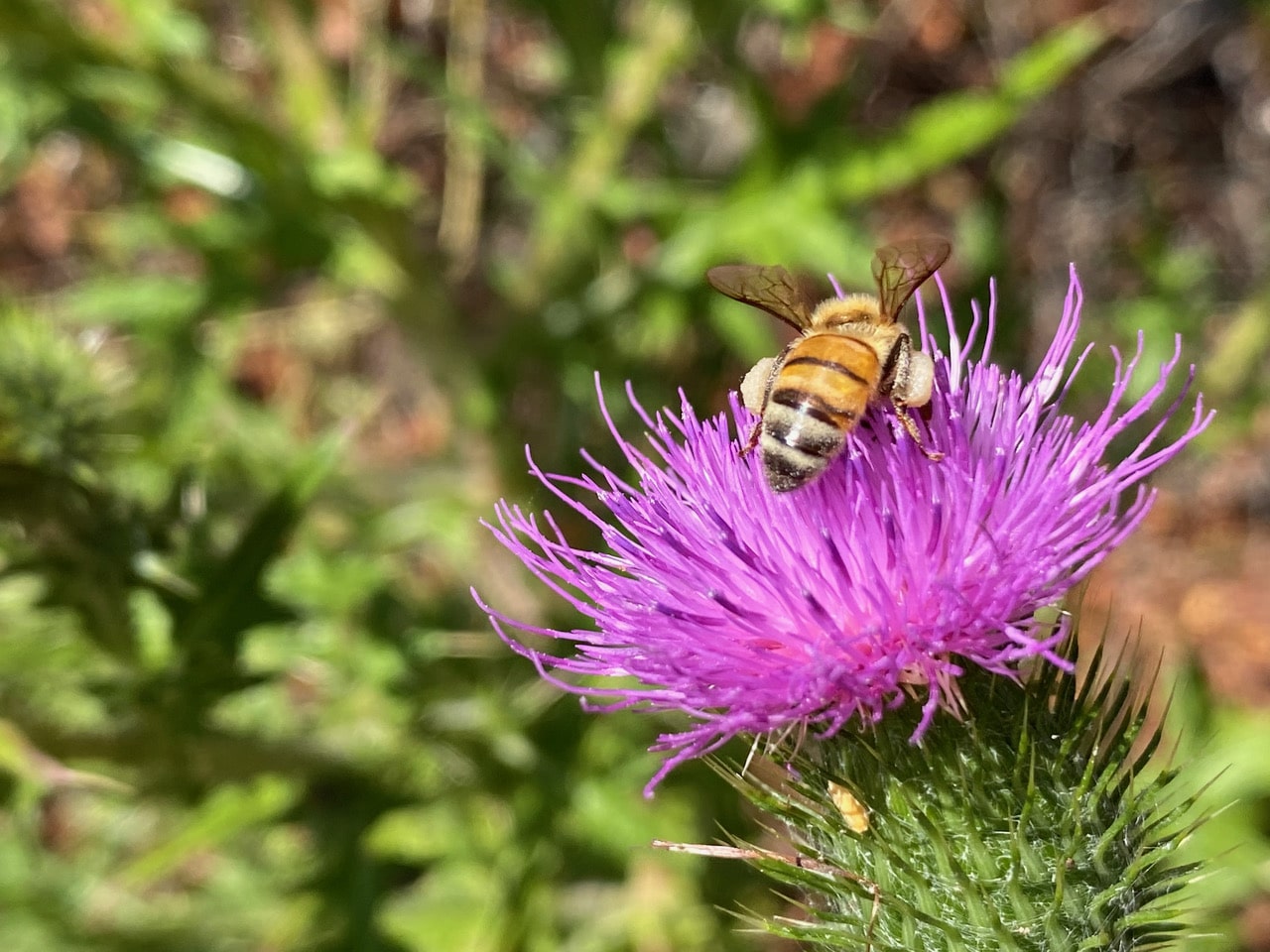

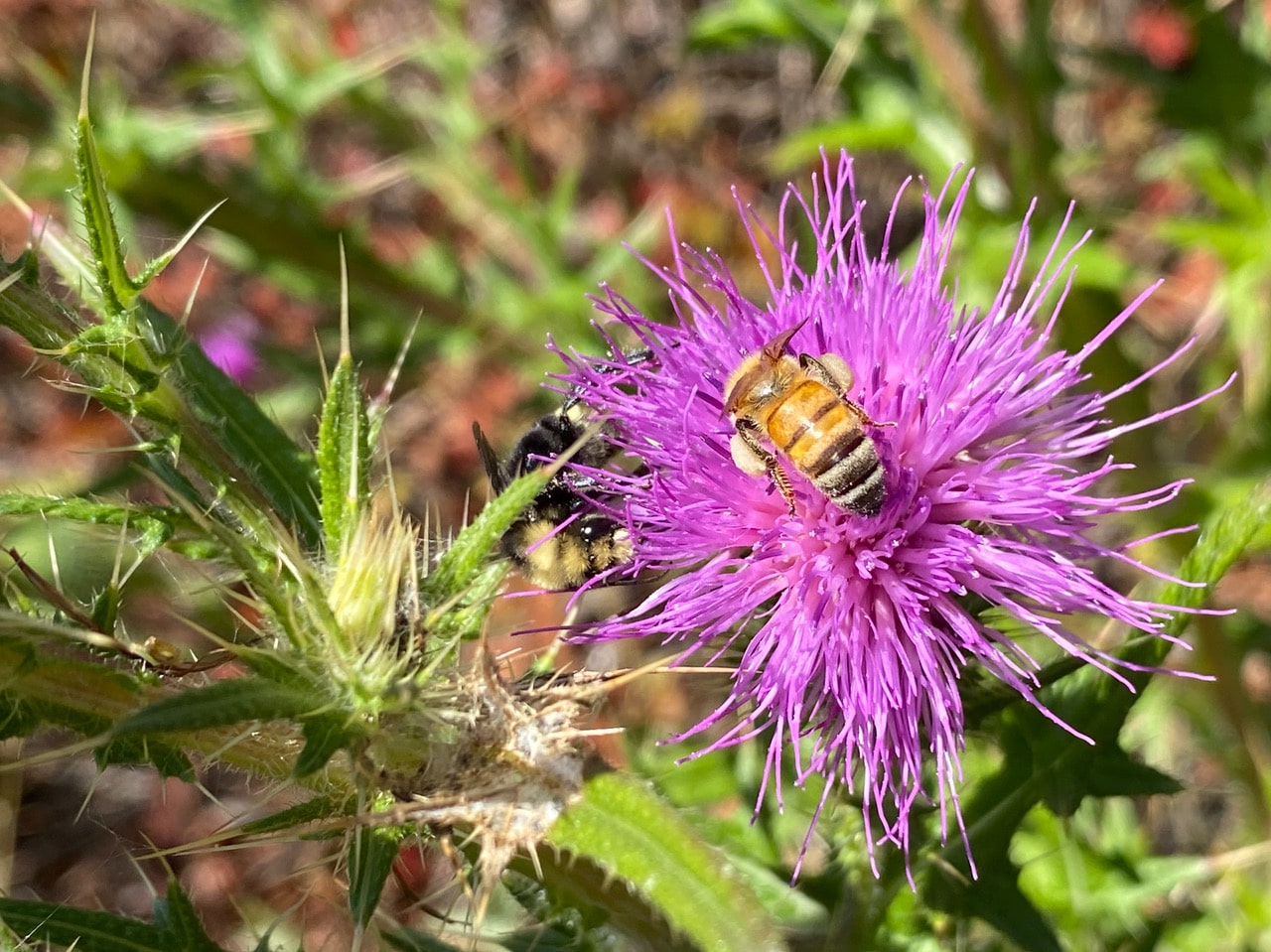



She has a sizable load of cream-colored thistle pollen in her pollen baskets.
The pollen collecting apparatus in Apidae bees, which include honey bees and bumble bees, is commonly called a “pollen basket” or corbicula. This region is located on the tibia of the hind legs and consists of hairs surrounding a concave region. After the bee visits a flower, she begins to groom herself and brushes the pollen down toward her hind legs and packs the pollen into her pollen basket. A little nectar mixed with the pollen keeps it all together like putty, and the stiff hairs surrounding the pollen basket hold it in place. A honey bee can fly with a full pollen load that weighs as much as a third of her body weight.
.jpg)
A Yellow-faced Bumble Bee, Bombus vosnesenskii is also taking nectar. Judging by her large size and freshness, I think she is probably a new queen or gyne. New queens and drones (males) are produced late in the season for reproductive purposes. They will mate, and the queens will overwinter. After hibernation, the queens will establish new colonies in early spring next year.
A Honey Bee joins the bumble bee on the flowerhead.
They seem to tolerate each other, until the Honey Bee brushes past the Bumble Bee. The latter takes off in an instant.
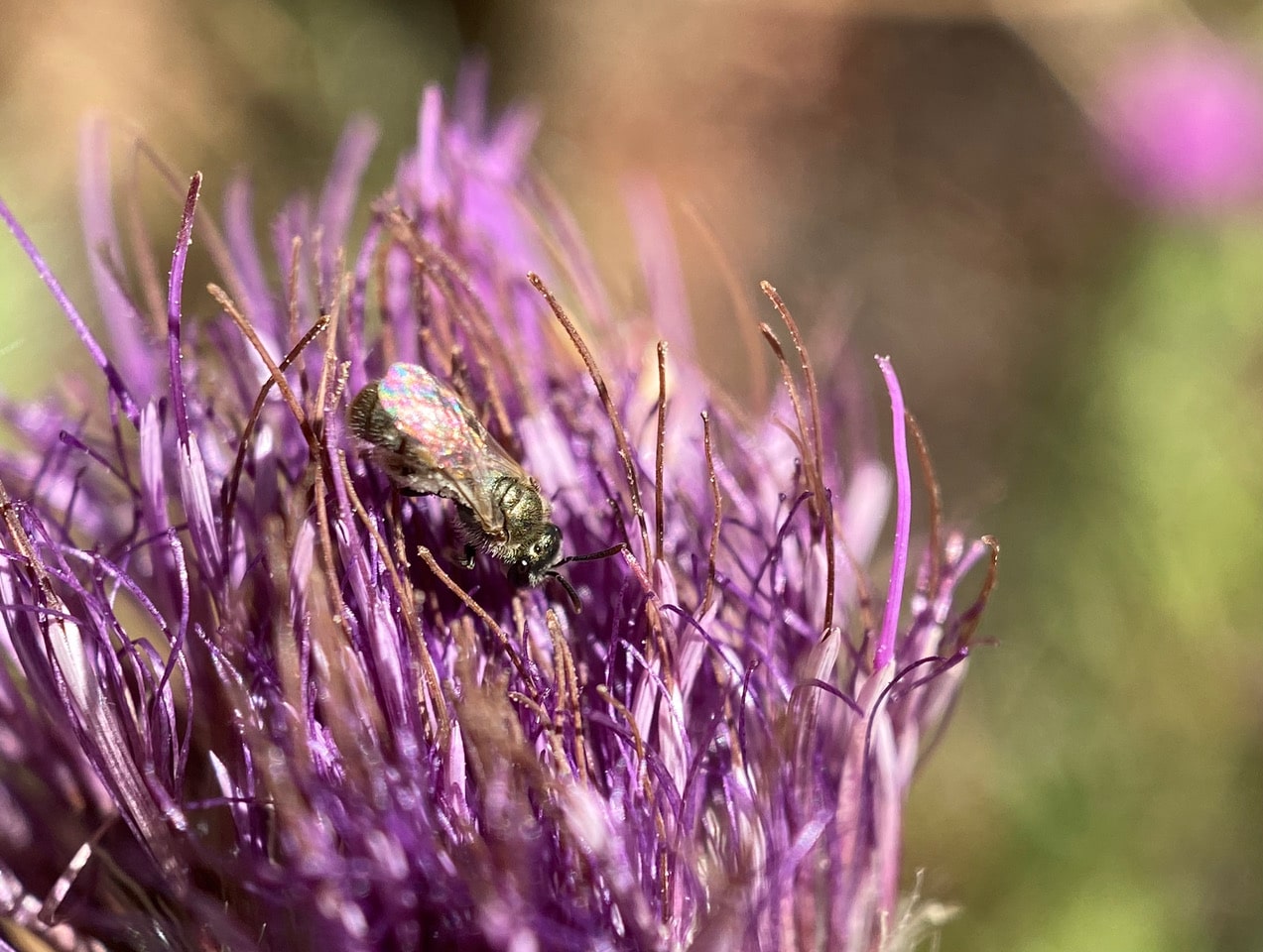
I try to take pictures of a tiny bee foraging on the thistle flowers, but time and again she is bumped off the flowerheads before I can get a shot. The poor thing finally settles for a faded flowerhead. I am not sure what she can gather there.
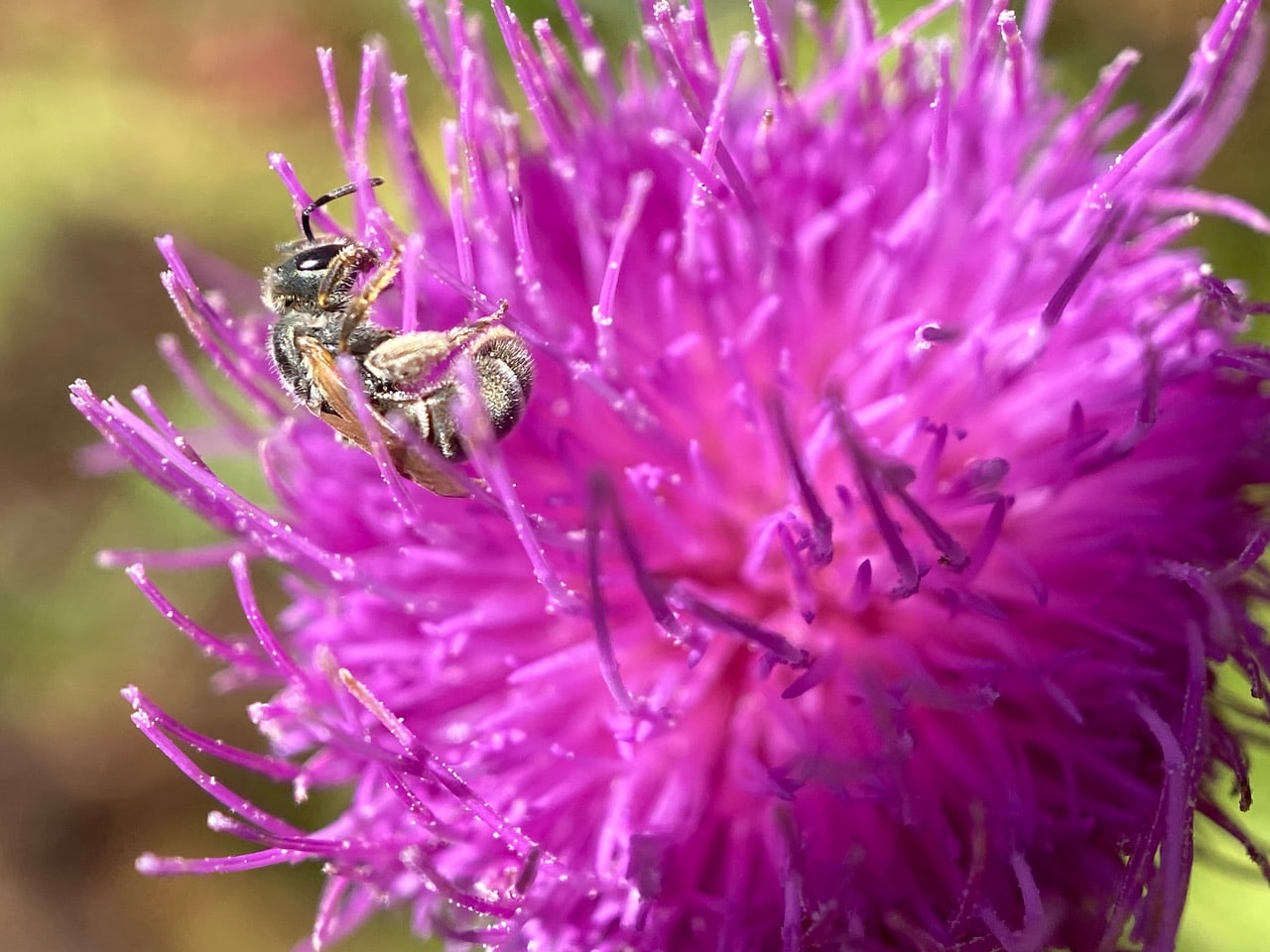
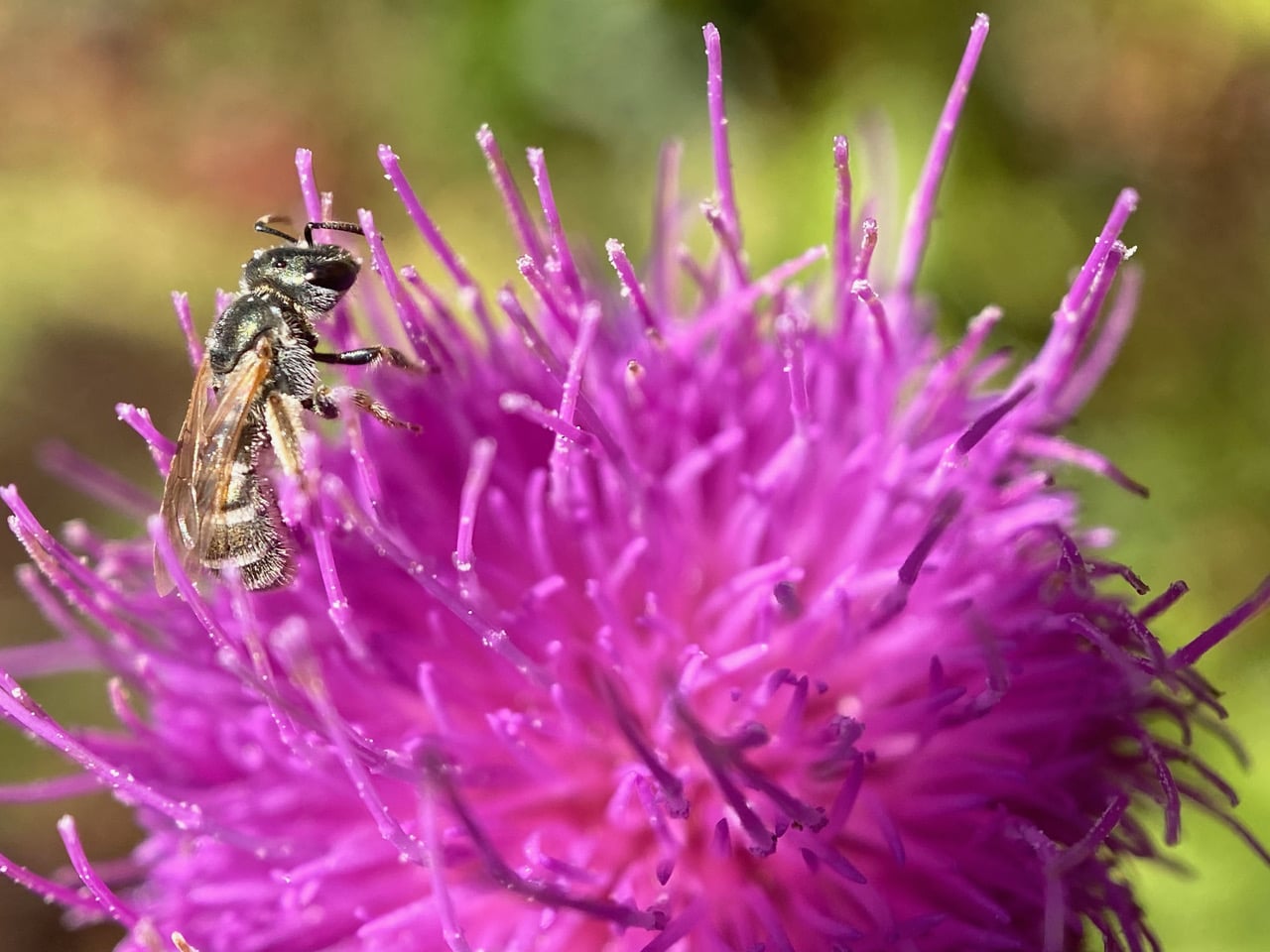
Here’s a larger bee. She is gathering pollen at a frantic pace, and manages to hold her own for a while. In the end, she still has to vacate the flowerhead for a bumble bee.
The bee appears to be a Sweat Bee, Halictus sp. (family Halictidae). Note that she has hairs at the edge of each of her abdominal segments. This feature distinguishes her from the genus Lasioglossum which has hairs at the base of the segments.
Halictus is found worldwide; they are most common in the Northern Hemisphere. All are generalists, foraging from a wide variety of flowering plants. Many species are social and produce several generations per year. This is not surprising as most blooming plants are season-specific; a bee that requires pollen and nectar across multiple seasons would not thrive as a specialist. All Halictus in North America nest in the ground, often in aggregations; and they may nest in the same area for decades.
I met my first F-winged Barklouse just a week ago. The pattern on the wings of this small insect is so distinctive, I recognize it immediately under the macro lens on a California Bay leaf today.
The F-winged Barklouse, Graphopsocus cruciatus (family Stenopsocidae) belongs to an ancient lineage of insects in the order Psocodea (formerly Psocoptera). The scientific name comes from the Greek psocus (to grind) referring to the psocodean jaws, which are shaped to grind food, rather like a pestle and mortar. These insects are conveniently discussed in two groups – barklice that live outdoors, and booklice that are found in human habitations.
Barklice are usually found in moist places, such as leaf litter, under stones, on vegetation or under tree bark. They have long antennae, broad heads and bulging eyes. They feed on algae, lichens, fungi and various plant matter, such as pollen. Barklice are usually less than 6 mm, and the adults are often winged. The wings are held roof-like over their bodies. Some species are gregarious, living in small colonies beneath a gossamer blanket spun with silk from labial glands in their mouth. Sometimes the colonies seem to move in coordinated fashion, rather like sheep.
Booklice are wingless and are much smaller (less than 2 mm). They are commonly found in human dwellings, feeding on stored grain, book bindings, wallpaper paste and other starchy products, and on the minute traces of mold found in old books.
Psocodea undergo incomplete metamorphosis. They are regarded as the most primitive amongst the hemipteroids (true bugs, the thrips and lice) because their mouthpart show the least modification from those of the earliest known fossils.
When I took this picture I didn’t notice the fine silk threads covering the insect. Apparently the F-winged Barklouse is a silk-producing species. The insect is not moving – perhaps it is sleeping? Has it covered itself with the silk for protection while it rests? The species is known to cover its eggs with a webbing of silk to protect them from ants and spiders.
Side view of the F-winged Barklouse. See the letter F on the wing? The silk threads are not as visible in this light.
The F-winged Barklouse is thought to have been introduced in the1930s to both the east and west coast of North America from Europe or Asia.
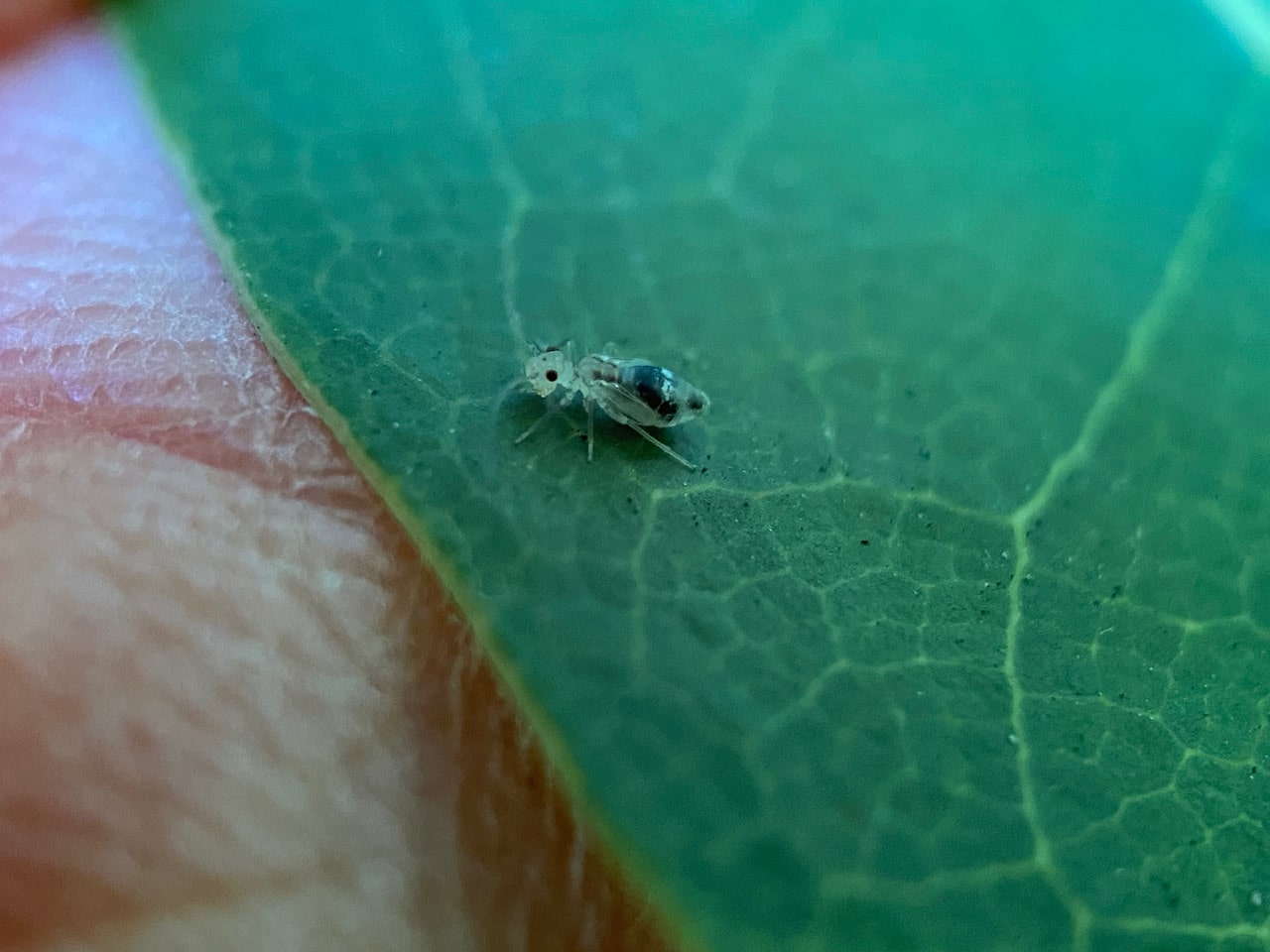
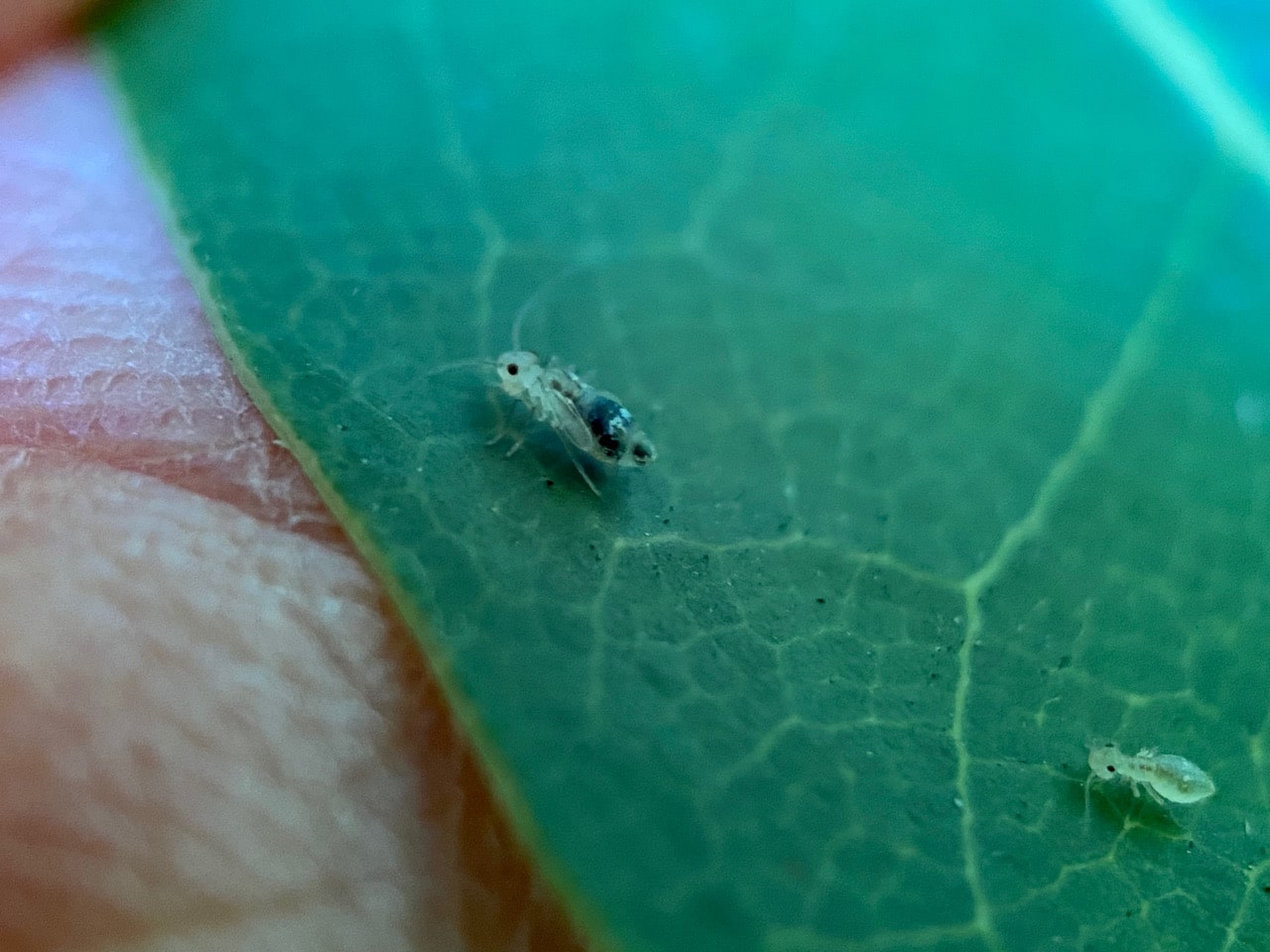
On another Bay leaf just a couple of feet away, I spot this tiny, translucent nymph. Note its wing buds. Will the youngster grow up to be a F-winged Barklouse?
The Barklouse nymph photographed in the shade.
As I am photographing the nymph, a younger nymph comes into view. Adorable!
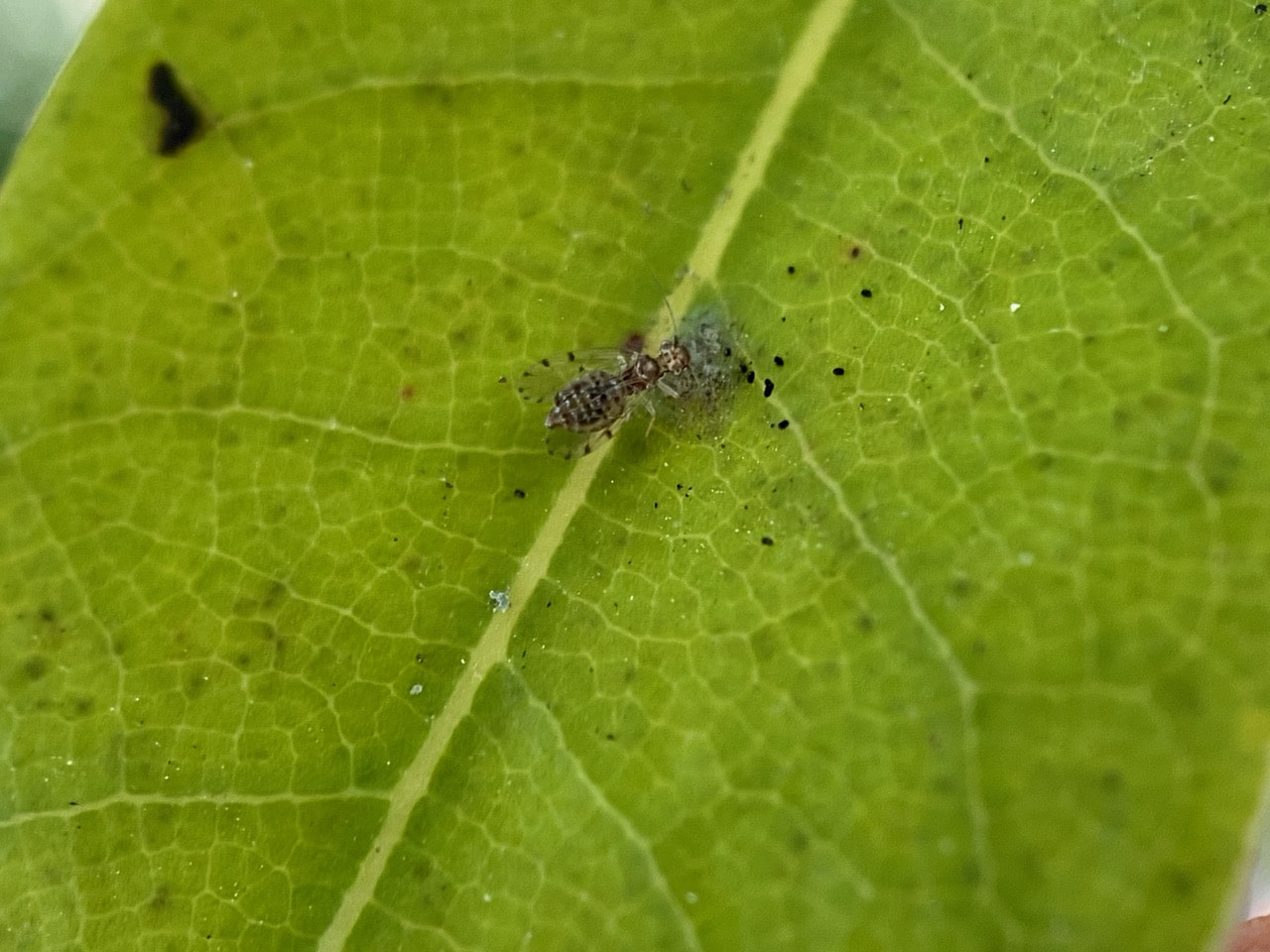
Yet another kind of Barklouse on the same Bay tree, barely 2 mm long! It is an Outer Barklouse in the family Ectopsocidae (order Psocodea). It seems to be feeding on something on the leaf. The black spots on its transparent wings blend in with the tiny droppings on the leaf!
The family Ectopsocidae includes fewer than 200 species, most of them in the genus Ectopsocus. They are found to inhabit dead leaves on tree branches and leaf litter. They are brown, small-sized barklice, 1.5-2.5 mm in length. Forewings are short, broad, and held in horizontal position (rather than tent-like as in other psocids).
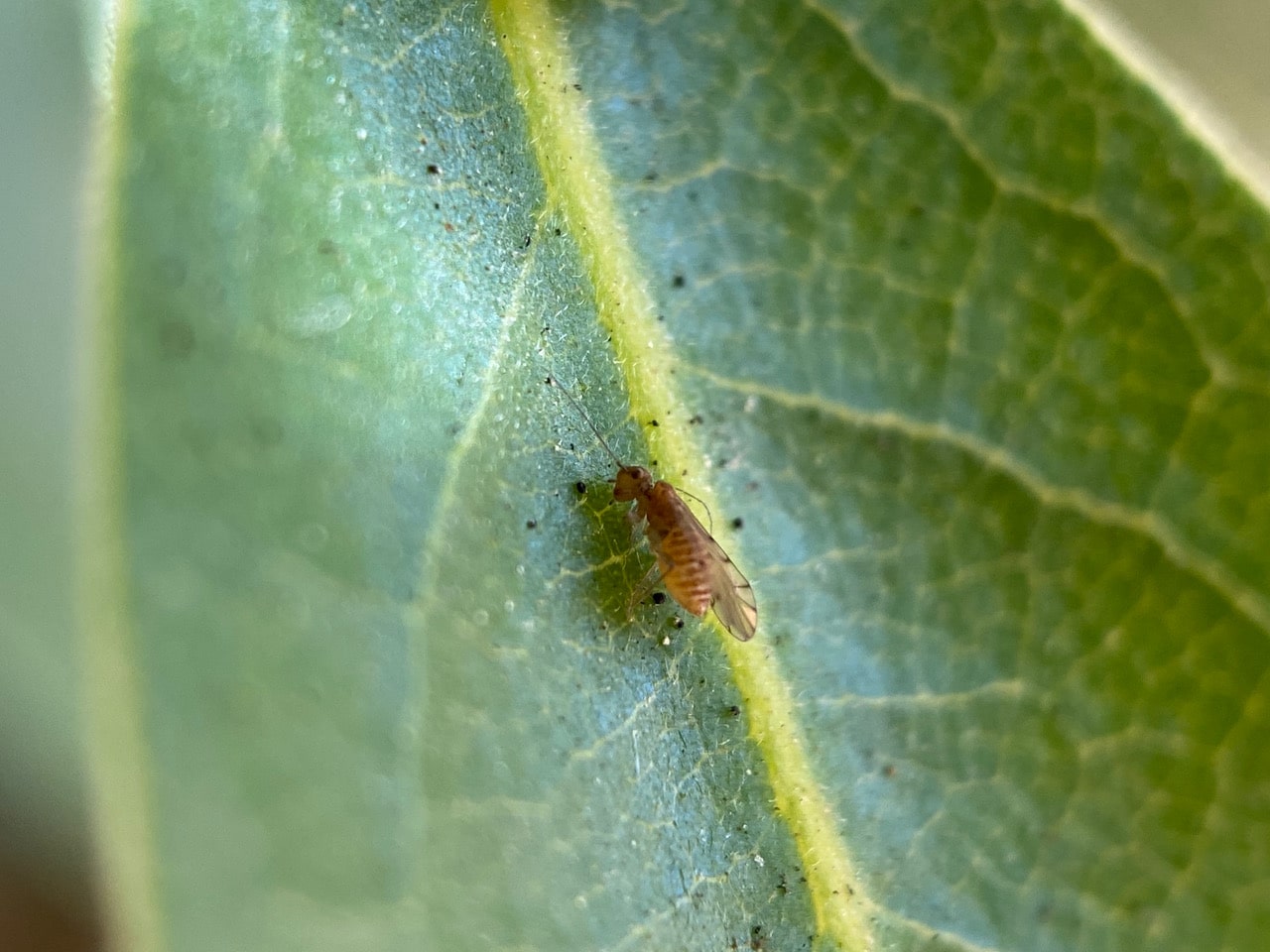
Side view of a different Outer Barklouse. Although all the Barklice I have encountered so far have been found on Bay leaves, I believe the tiny insects are everywhere. They just happen to be more visible against the large flat surfaces of bay leaves. Imagine trying to see them on the foliage of Coyote Brush!