

Pollinator Post 9/13/23 (1)

Due to traffic delays, I can’t get to Skyline Gardens until 5:30 pm for an afternoon walk. It is pleasant up here as air has cooled down considerably, but I am fast losing light for photography.
Our female Two-tubercled Orb Weaver is resting, snug on her dried Oak leaf retreat.

I can’t see it very clearly, but Leggy is resting under its own oak leaf, about 5 inches below the female on the same Soap Plant. Leggy is beginning to look more and more like a male to me, given its narrow abdomen.

Now that I know they like to hang out in damp places with dense vegetation, it is not hard to find them. Here’s one on a Coffeeberry leaf under the canopy of Eucalyptus and Bay trees – a Blue-green Sharpshooter, Graphocephalus atropunctata (family Cicadellidae). Endemic to California, the small insect is a hemipteran bug that feeds with piercing-sucking mouthparts.
Sharpshooters feed on the plant’s xylem, extracting small amounts of nutrients in large volumes of water, forcing them to eliminate up to 300 times their body weight in liquid waste each day. To accomplish this, the sharpshooters employ an energy-efficient mechanism called super propulsion to expel their urine using an anal catapult.

Perched on a dried seed capsule of Soap Plant, the body of a Margined Calligrapher, Toxomerus marginatus (family Syrphidae) appears luminous in the fading afternoon light.
Toxomerus marginatus, also known as the Margined Calligrapher, is a common species of hoverfly. It is found in many parts of North America, in diverse habitats. Highly adaptable, the species can occur in very disturbed habitats. Adults, only 5-6 mm long, have a shiny abdomen narrowly margined with yellow. Adults feed on a wide range of flowers. The larvae are predators of thrips, aphids, and small caterpillars.
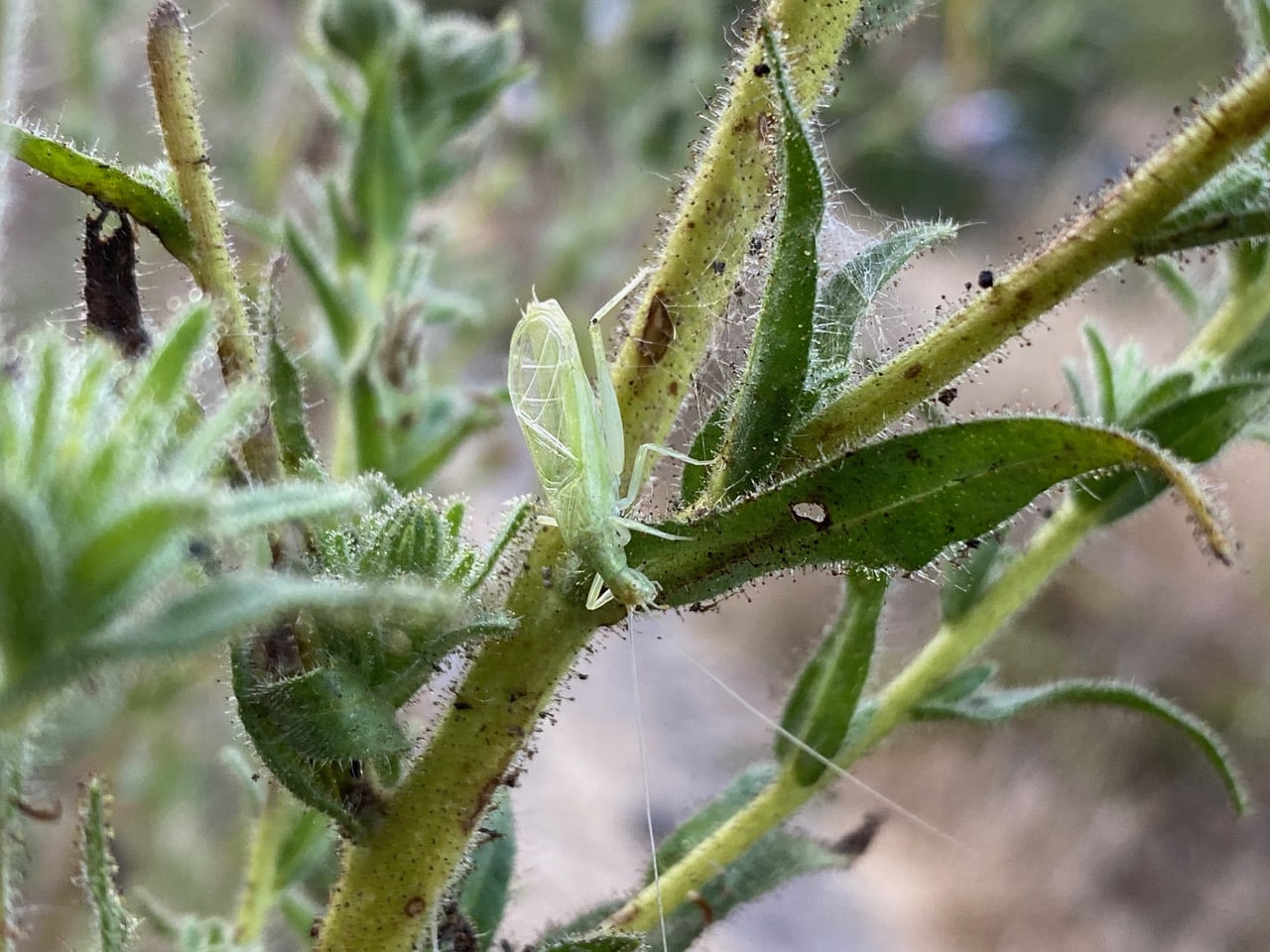
On the short path leading back to Siesta Gate, I stop short at hearing the song of a Tree Cricket. Scanning the Coast Tarweed, Madia sativa flanking the path, I spot a male Common Tree Cricket, Oecanthus sp.(family Gryllidae). Then another, and another… Females too. They have gathered for their nocturnal courtship ritual!
Tree Crickets are so called because many species hang out in trees. They are in the order Orthoptera (crickets, katydids, grasshoppers, etc.) and in the “true cricket” family Gryllidae. The Common Tree Crickets are in the genus Oecanthus (the “O” is silent and the “E” is long). Tree Crickets inhabit trees, shrubs and tall weeds, feeding on plant parts, some insects (e.g., aphids, scales) and other materials (e.g., fungi, pollen).

Close-up of a male Tree Cricket showing his broad transparent forewings which are held flat over his abdomen. They are his unique musical instrument that confers his ability to attract a female, a key to his reproductive success.
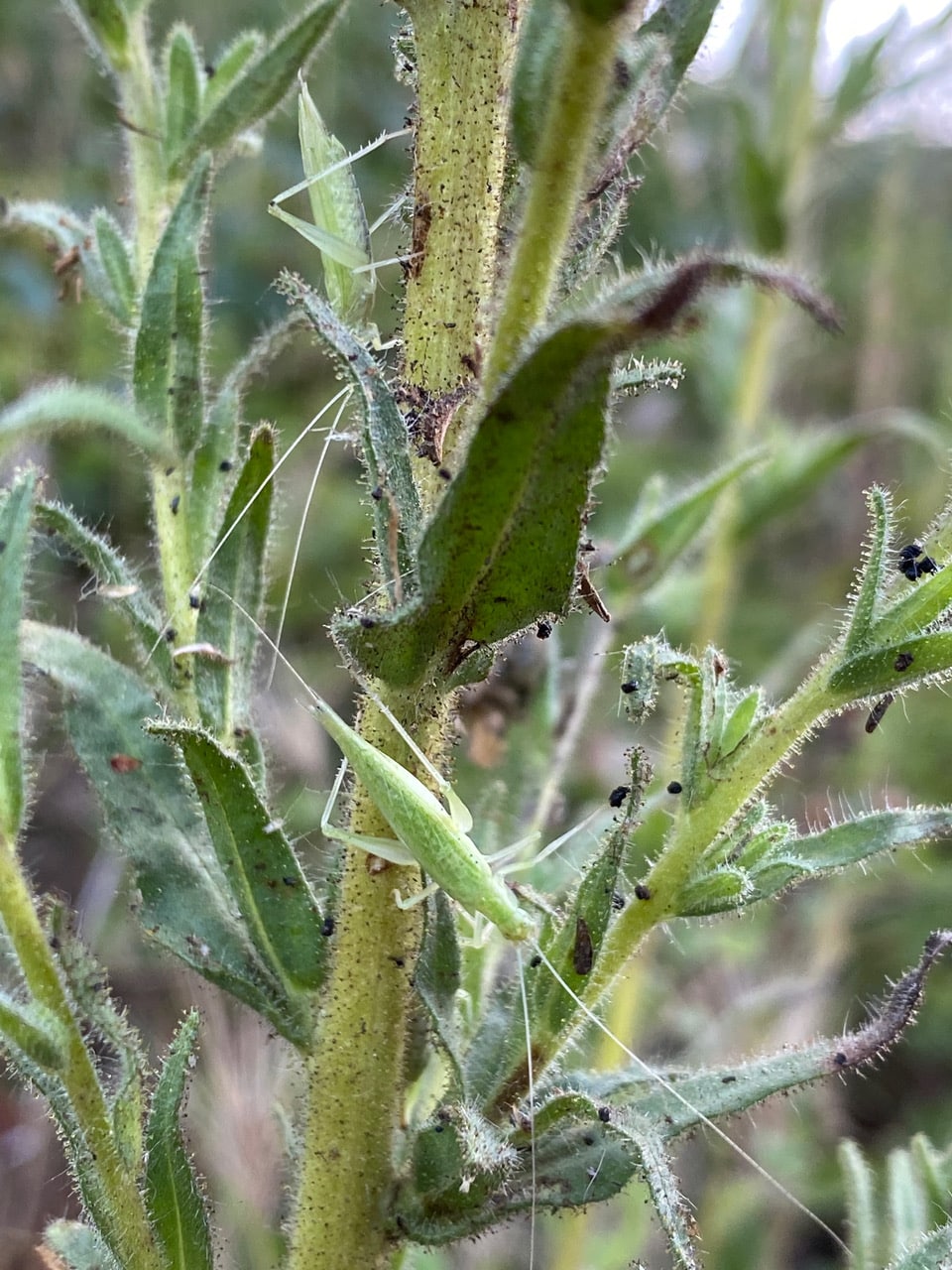
A female moving down the plant is closely followed by a male Common Tree Cricket.
More often heard than seen, tree crickets are active at dusk and at night. In late summer, males produce a high-pitched whine or “song”, a prelude to courtship and mating.
Tree Crickets have two sets of wings; a female’s forewings hug her body, and males’ forewings are flat and wide. Males produce sound by rubbing together rough areas (called the “rasp” and “file”) at the base of the forewings, a method of sound production called stridulation. During sound production, the males hold their wings straight up at right angle to the body. Each species of tree cricket has its signature calls, and the tempo of the call is affected by the temperature of the ambient air. Females do not call, but they do listen with auditory organs located on the forelegs. Females prefer males who sing bass (a lower call indicates a larger caller).
The singing male attracts the gal of his dreams, and courtship ensues, a dance that lasts for as long as half hour, involving much antenna waving. The position of his raised wings reveals to her a “honey pot” – a small trough located between his wings. In it, the metanotal gland produces a fluid for the female to feed on that will boost her reproductive success. In reaching for the prize, she places herself in a position that allows the male to deliver a spermatophore into her genital opening.
Female lay eggs in late summer or fall in whatever substrate they exist on – they drill into the bark of woody twigs or into herbaceous plants, and deposit one or more eggs in the bark or pith. Tree crickets undergo incomplete metamorphosis, resembling adults when they hatch and adding parts as they grow and molt (five times).
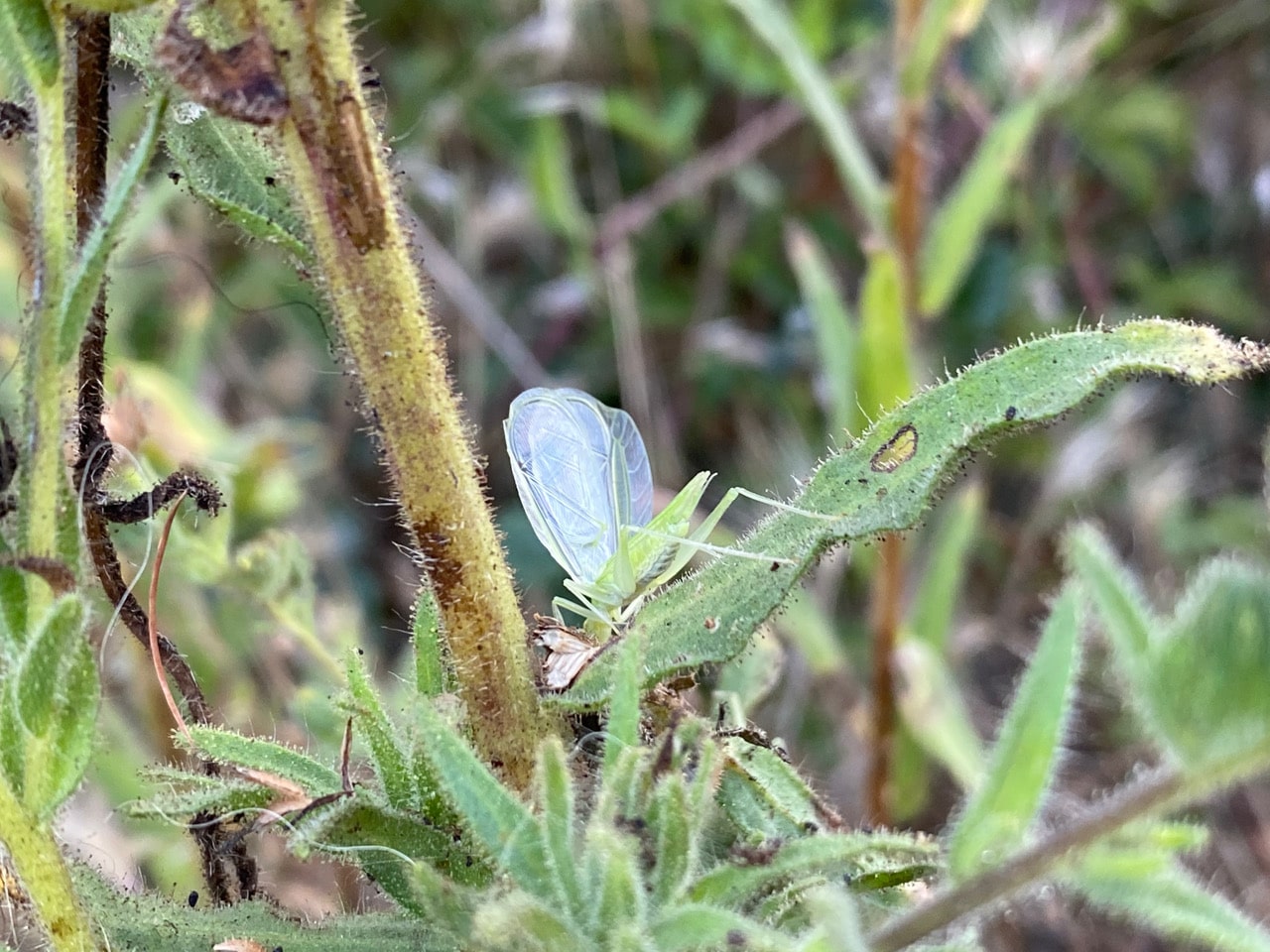
It’s not a deafening cacophony like that of cicadas. Individual males will occasionally pipe up here and there, conveniently alerting me to their positions. The males’ upraised wings during stridulations are also quite easy to spot in the vegetation.
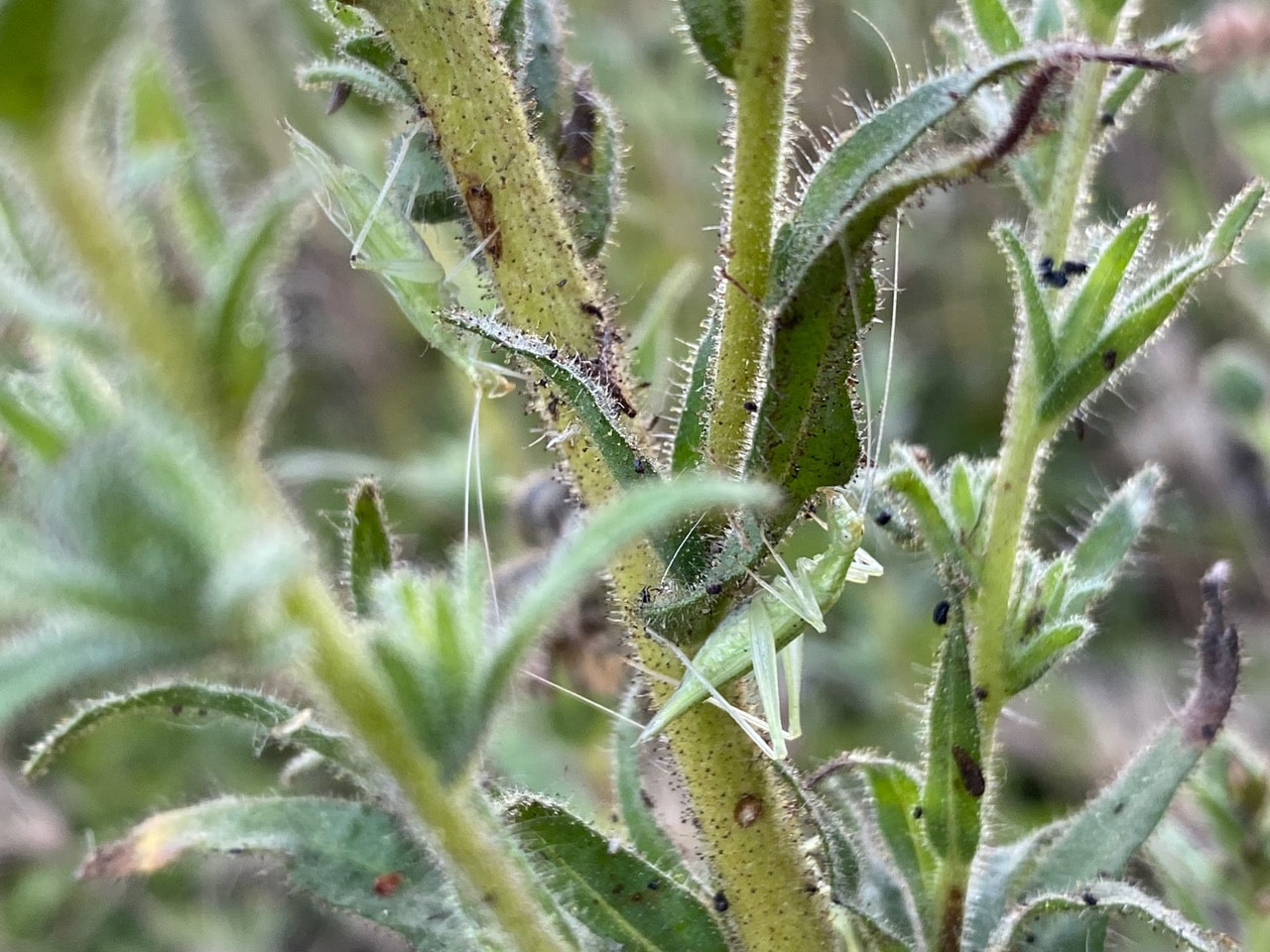
On the same Coast Tarweed barely 2 ft tall, I find three pairs of Tree Crickets busily engaged in courtship. I sit down on the path and watch them in awe, like a wide-eyed kid at a three-ring circus, trying hard to focus on each arena in turn.