Bringing Back the Natives Garden Tour and Green Home Features Showcase

Pollinator Post 9/14/23

Since I reported about Blue’s disappearance many people have e-mailed me with well wishes for the caterpillar.  I am deeply moved and somewhat surprise that a little caterpillar could have this kind of emotional impact on us.  After all Blue was a very sedentary creature, almost never away from its silk pad during the day.  No daring-does, no drama, just living its quiet life.  Yet Blue has touched the hearts of so many.  I love Blue for its stillness and steadfastness – qualities we all aspire to in the core of our being.  I still feel awkward having to refer to Blue as “it” in the narrative, but I had little choice as it is impossible to tell a caterpillar’s gender.  In retrospect, Blue has been living its wild life, totally unaided.  I have not been taking care of Blue in any tangible way, merely observing its development and behavior.  There’s no reason that we have to worry about its survival.  Blue is well equipped, through millions of years of evolution, to deal with the travails of caterpillarhood, and transition to life as a butterfly.  I have full confidence that Blue will do just fine out of our sight.

I have good news.  Read on.
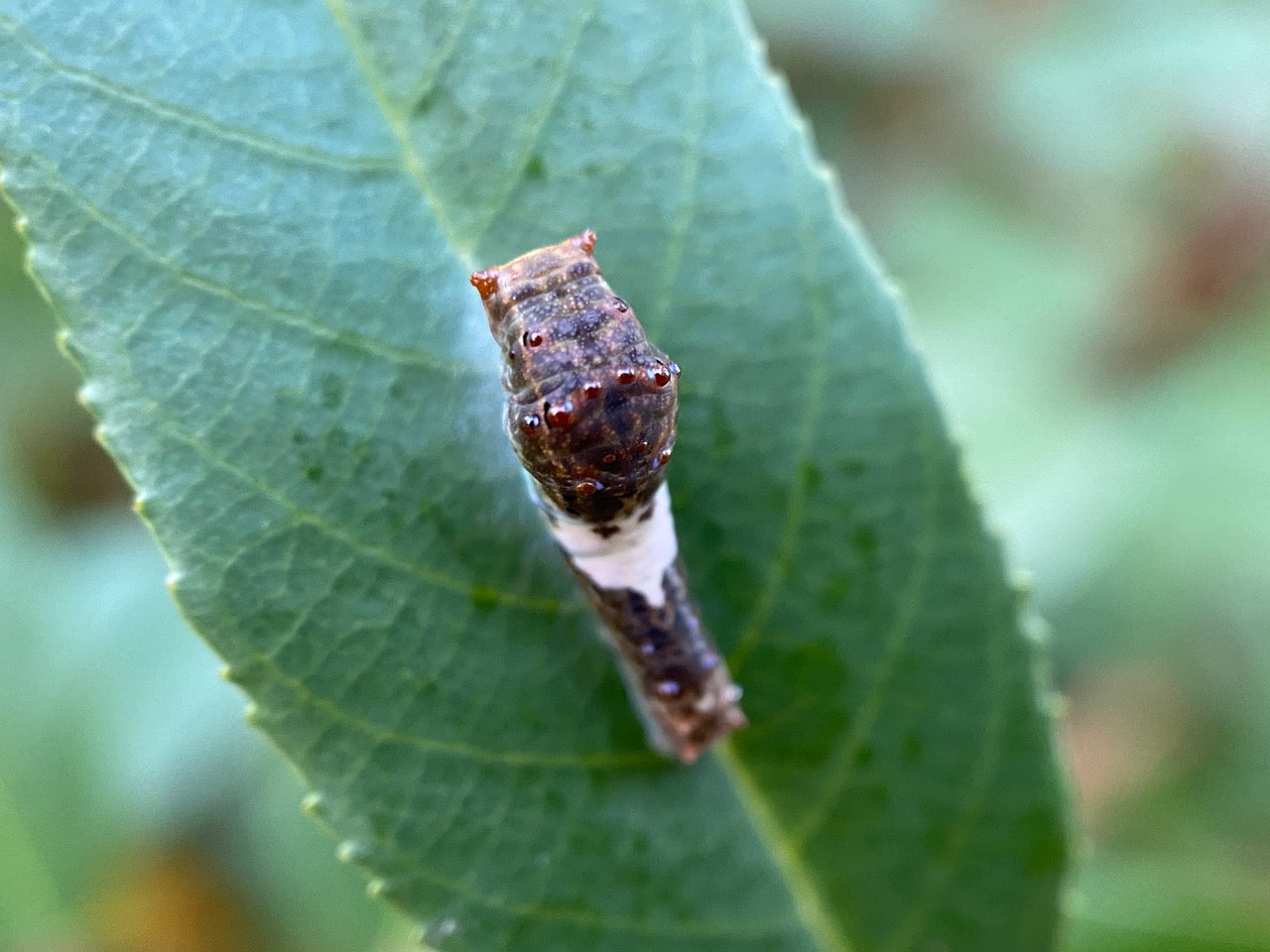
The air quality has improved significantly this afternoon.  I bolt out the door and head to Skyline for a walk to clear my mind.  At a little past 5 pm, the hills are socked in with fast drifting fog.  I don’t expect to see any insect and simply let my legs lead the way.  I find myself heading up the paved road from Siesta Gate.  At the top of the ridge just past the Radio Tower, I decide it’s too cold and turn back.  Almost unconsciously my eyes scan the hillside to the west of the road looking for coffeeberry.  Why is there a dearth of this native plant in this wild park?  Then I spot a Coffeeberry shrub in the shade of a tall Eucalyptus tree, surrounded by an abundance of Poison Oak and Coyote Brush.  There appears to be a bird dropping on a leaf facing the road.  I quickly scramble up the slope and examine it through my macro lens.  Sure enough, it’s a tiny Pale Swallowtail caterpillar that is a bird poop mimic.  It is the same instar as Blue and Cinch when I first found them!    
The caterpillar has prominent shiny bumps (technically scoli) across its mottled brown body, and an eagle-shaped white marking across its mid-section, just like Blue and Cinch used to look.  It is probably a second or third instar already.  I’ll call it Bumps.  
Amazingly, Bumps is not even hiding.  It is in full view, on top of a leaf on an upper branch, its brown body contrasts strongly with the green background.  Bump’s safety relies on the inability of others to see things as they really are.  So often we misinterpret reality, our perception entangled with our past experiences and memories.  Bumps and the other bird poop mimics clearly reveal that weakness in us. 
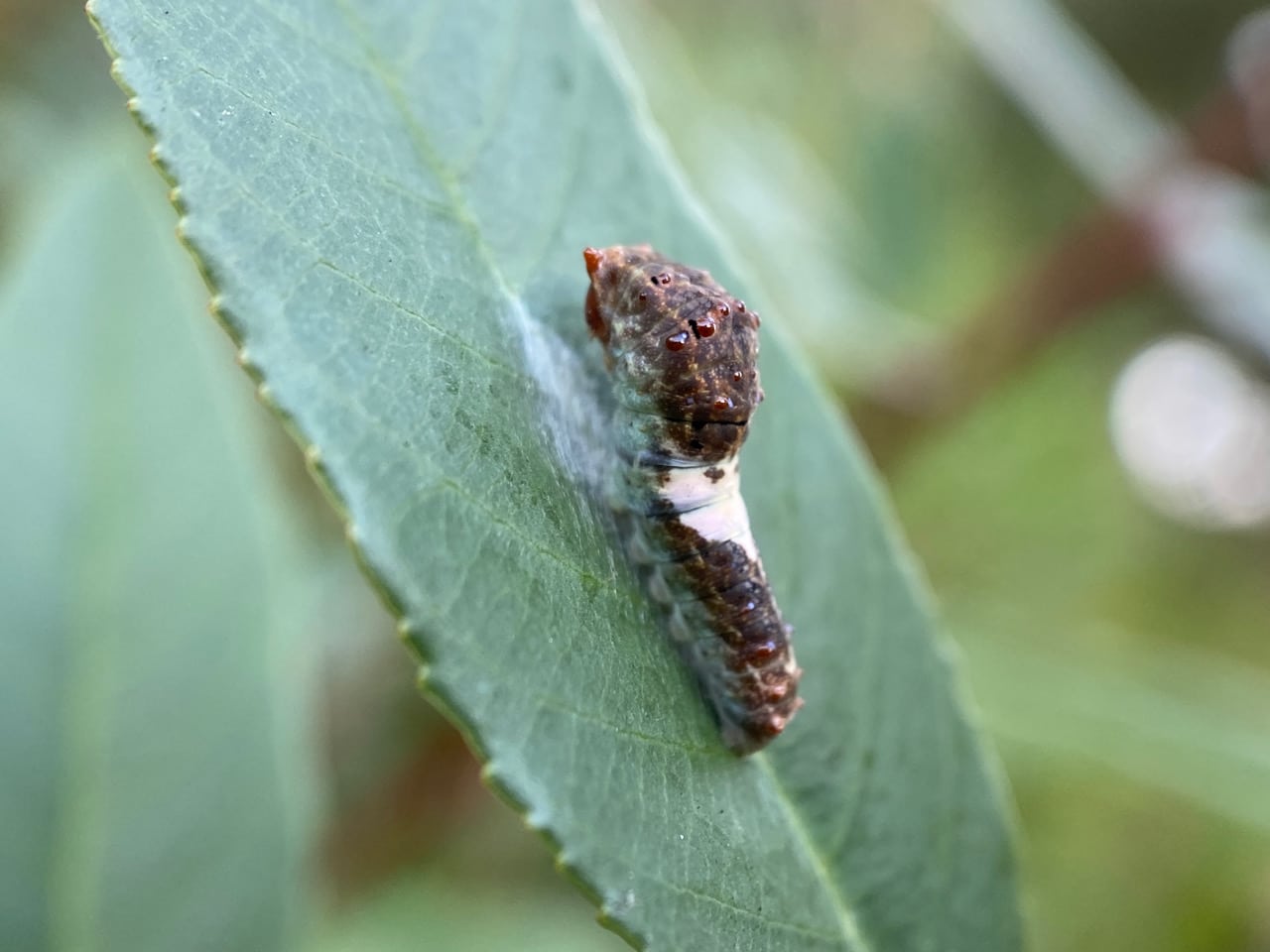
Side view of Bumps shows that it is resting on a silk pad that it has woven on the surface of the coffeeberry leaf.  The underside of its body is already a little bluish.  Wow, it will probably molt and change out of its bird poop costume soon.  One more Pale Swallowtail caterpillar to observe and love!  
The universe works in mysterious ways!

Curious about the Pollinator Posts? 

Who created the Pollinator Posts?2025-12-09T10:27:17-08:00

The Pollinator Post is a photo journal created by May Chen, a local naturalist.  It started many years ago, as simple e-mails sharing the excitement of discovery with fellow hikers and gardeners.  The burgeoning readership eventually necessitated the creation of the Google Group, the Native Gardeners three years ago.  Now the journal has found a permanent home at our website, with easy access to all.  Let May guide you through the miniature world of the creepy crawlies, regaling you with the drama that is happening right under our noses.  Enjoy!

May likes to describe herself as a career volunteer.  She has been a docent at Martin Griffin Preserve in West Marin for more than 20 years.  Her passion for plants and insects has led her naturally to the study of pollination biology.  She has taught docent-training classes on pollination at the Regional Parks Botanic Garden.  As a volunteer with the Friends of Sausal Creek, May has helped in the native plant nursery and tended the BridgeView Pollinator Garden.  She enjoys exploring the East Bay parks and gardens, and shares her observations on the Pollinator Post.  

Because of her initial focus on pollinators, especially bees, May has titled her missives “Pollinator Post”.  However, over the years of observation, she realized that we should view the botanical world as an interconnected whole that embraces other plant-insect interactions that are often overlooked – e.g. predator/prey, decomposer/recyclers, host/parasites, each contributing to the health and stability of the collective.  Too often we are quick to judge insects as “good” or “bad”, ignoring their true roles in the ecosystem.  We need to understand these relationships if we were to be good stewards of our gardens, our farms and wild lands.

To see more of May’s work, see the following article and videos:

The Buzz in My Garden by May Chen, originally published in the Regional Parks Botanic Garden quarterly newsletter Manzanita in 2018

Life and Death on Milkweed

Life and Death on Silverleaf Lupine

How were the photos taken?2026-01-06T09:08:09-08:00

The photos in the older Pollinator Posts were taken with a series of Canon Power Shot point-and-shoot cameras with built-in macro capabilities.  Once May discovered the amazing convenience of the iPhone camera in 2019, she gave away all her other camera equipment.  Since then she has taken all her photos with her trusty iPhone 11Pro.  The close-ups are taken with a Sandmarc attachable 10X macro lens.  “Anybody with a cell phone can do it!”


There are countless other attachable macro lens available on Amazon, some as inexpensive as $30, that also work  well.  In fact, here’s one recommended by a bee enthusiast friend, Emil. The disadvantage of this lens, when compared to the Sandmarc, is that it clips on, and the clip could get in the way. 

In what area, locations, and when were the photos taken?2025-12-08T15:17:07-08:00

The photos in the Posts were taken in the East Bay of the San Francisco Bay Area; they were taken at Crab Cove and Bay Farm Island in Alameda, Skyline Gardens and the Bridgeview Pollinator Garden in Oakland, Mendocino Park in Richmond, numerous sites in the East Bay Regional Park District, such as the Regional Parks Botanic Garden, and Inspiration Point, other open space areas in Alameda and Contra Costa counties. and occasionally at private gardens, among other locations..

The Pollinator Posts began on July 12, 2019. Post creation is paused at the end of each year, during the quiet time for insects, and resumes in the following spring.

How can the Posts help me garden for wildlife?2025-12-08T15:16:39-08:00

Browse the Posts to see what insects you might look for in your own garden on certain plants at a specific time of year. For example, you could search on “August”, and among the results you’ll see that you could be looking for leaf cutter bees on aster and, early in the morning, male longhorn bees sleeping on buckwheat or tarweed. If you have soap plant (aka soaproot) you might see the caterpillar of the western brown elfin butterfly, or dance flies.

Search on ‘pale swallowtail caterpillar” and you’ll see that it can be found on coffee berry, as can miner bees, hover flies, lady beetles, and more. Try it! Search on “clarkia,” “sunflower,” “gum plant,” or “acmon blue butterflies” and see what you discover!

How can I search the posts?2025-12-08T15:16:05-08:00

The search engine looks at every word in a post: you can search on an insect, such as caterpillar, a plant, like lupine, a month, or a location.

Can I use the photographs or text in these Posts?2025-12-08T15:15:11-08:00

The photographs and text in the Pollinator Posts are licensed as

CC BY-NC (Creative Commons: Attribution-NonCommercial). Basically, this means that the content can be used by others as long as they properly attribute it to © May Chen, and use it for non-commercial purposes.

Thank you to…2025-12-09T10:28:01-08:00

May Chen, for allowing her work to be made available to the general public on the Bringing Back the Natives Garden Tour’s website. 

David Faden, for solving the technical aspects of how to get the Posts, which were in an invite-only email Google Group, onto the Tour’s website. This was complicated, as you can see here.

Jeffrey Samorano, owner of Fearless Digital Journey, for integrating the posts into WordPress and making them functional and attractive.

Michael MayClytia Curley, and Robin Mitchell for their help with earlier versions of this project. 

It was a pleasure working with all of them on this project. 

Go to Top