

Pollinator Post 9/17/23

Bumps, our newfound Pale Swallowtail caterpillar is still on its Coffeeberry leaf. Its dorsal view has not changed much…
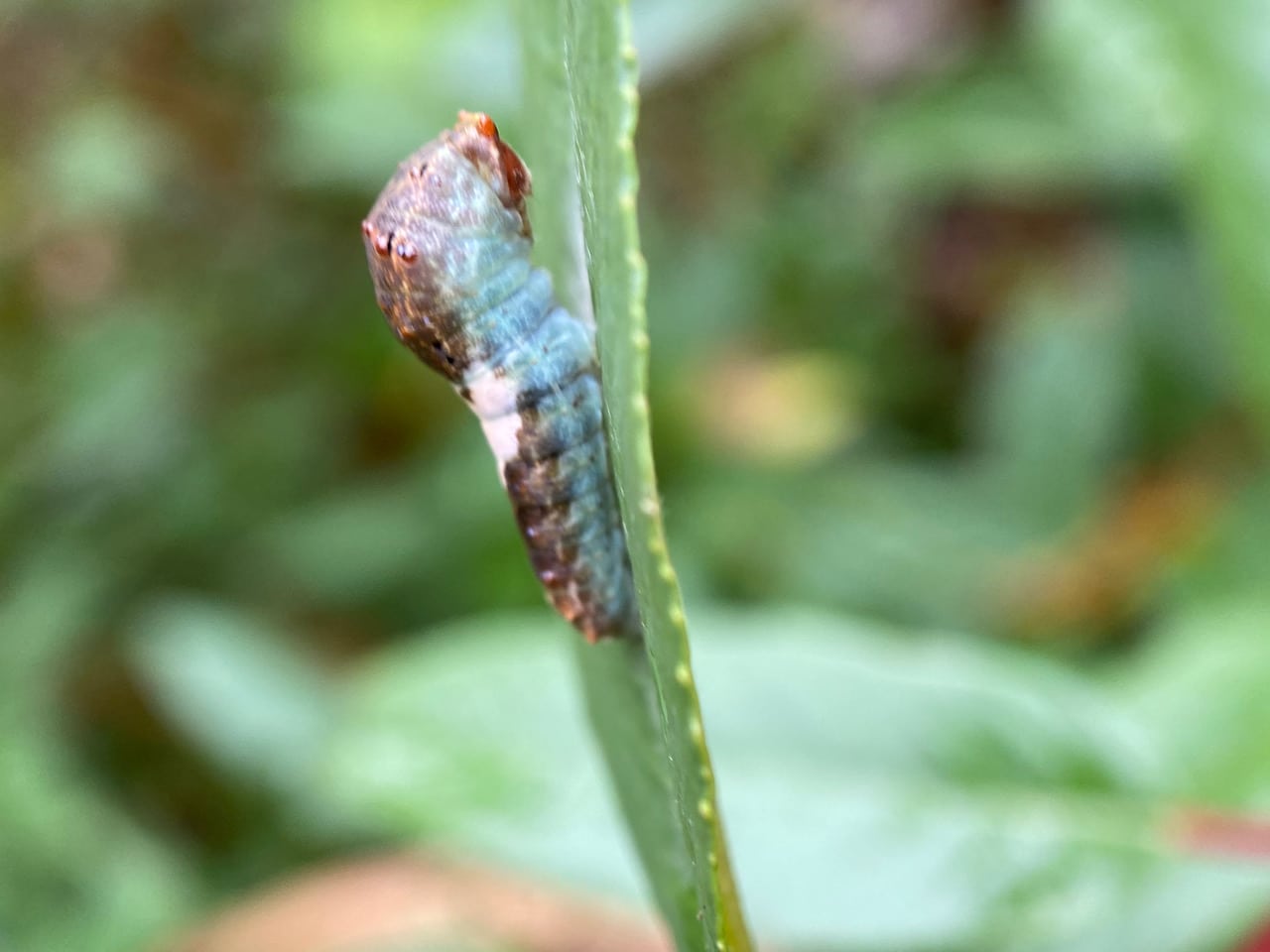
But the blue coloration seems to be creeping up Bumps’ flanks. Wow!

A large, bicolored ant is feeding on the flowers of a male Coyote Brush, Baccharis pilularis. It is a Carpenter Ant in the genus Camponotus (family Formicidae).
Carpenter Ants are among the largest ants in North America, with workers ranging from 1/4 – 1/2 inch long. They have only one bulge at their narrow “waist” (the single node on their petiole)) and an evenly rounded back, when viewed from the side. In established colonies, two castes of sterile workers develop – major and minor workers. The larger major workers defend the nest and forage for food. Minor workers tend to the young and maintain the nest.
Most carpenter ants build their nests in dead or decaying trees or logs, though they may inhabit wooden structures in people’s homes. Camponotus do not eat wood. They are generalist omnivores, and will forage for honeydew, fruits, plant juices, other small insects and invertebrates. Some herd aphids for their honeydew, and will sometimes carry aphids to new plants. Carpenter ants can’t sting but can inflict painful bites with their powerful jaws and spray formic acid into the wound, causing a burning sensation.
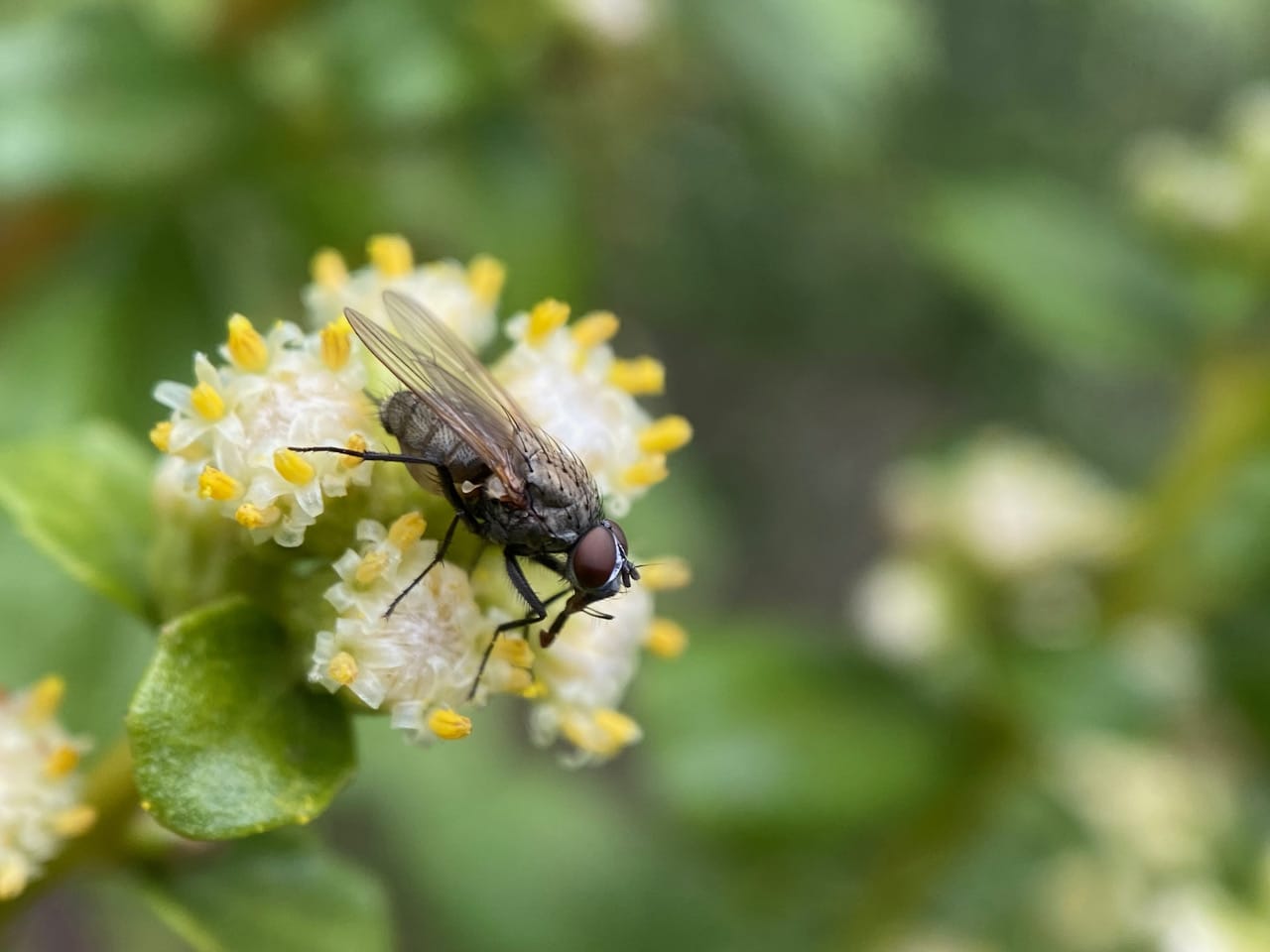
A Root Maggot Fly (family Anthomyiidae) is foraging on the male flowers of Coyote Brush.
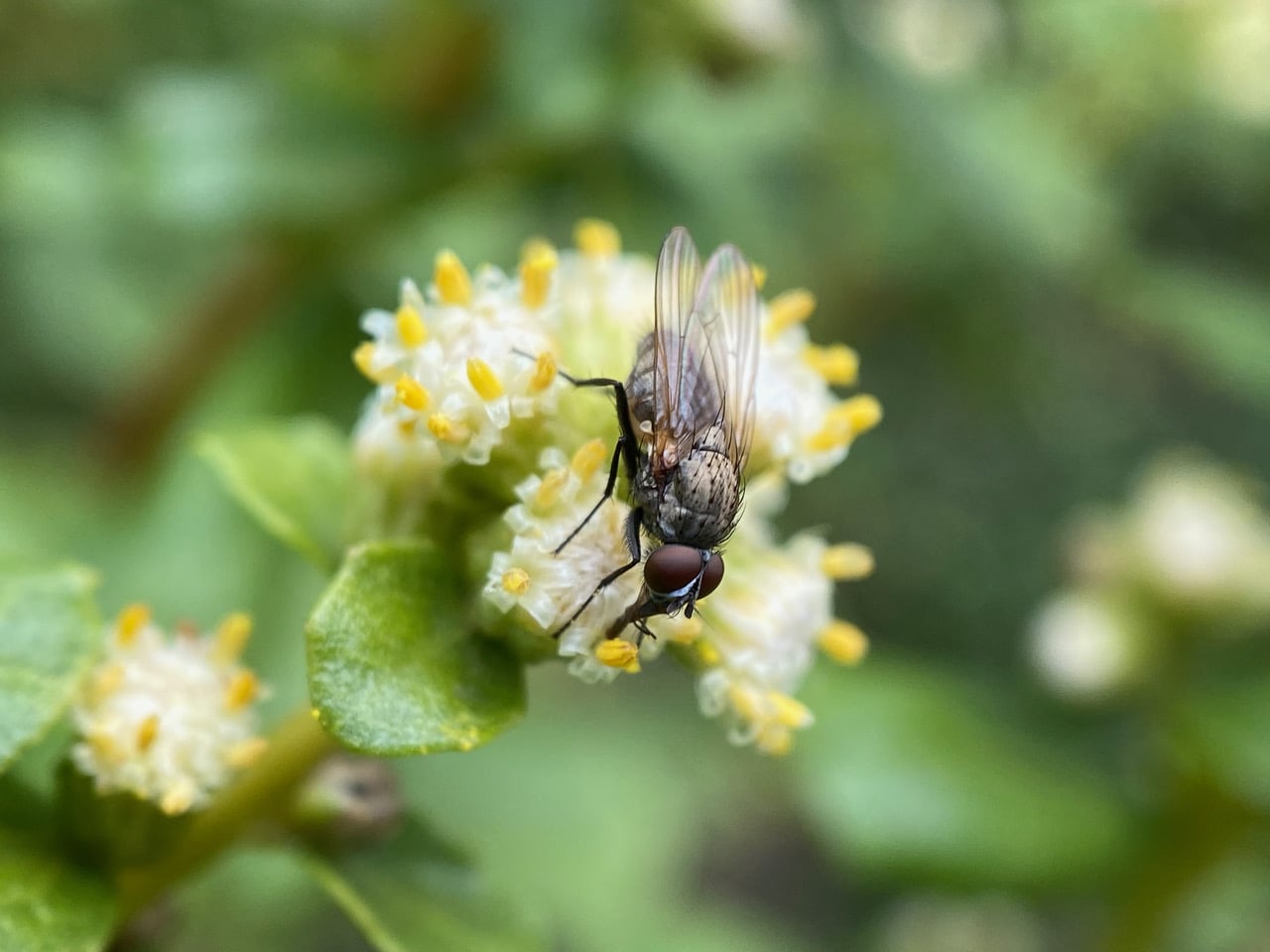
Members of the family Anthomyiidae are commonly called Root-maggot Flies. They are small to medium-size flies that resemble house flies but are somewhat more slender. They are usually dull gray or black and silver in color. The larvae typically feed in stems and roots of plants. Many are considered crop pests, and may attack root crops such as onions or rutabagas. Other species may feed on decaying matter, on feces, or are predators of other insects. Adult flies are important pollinators, usually feeding on nectar and pollen.
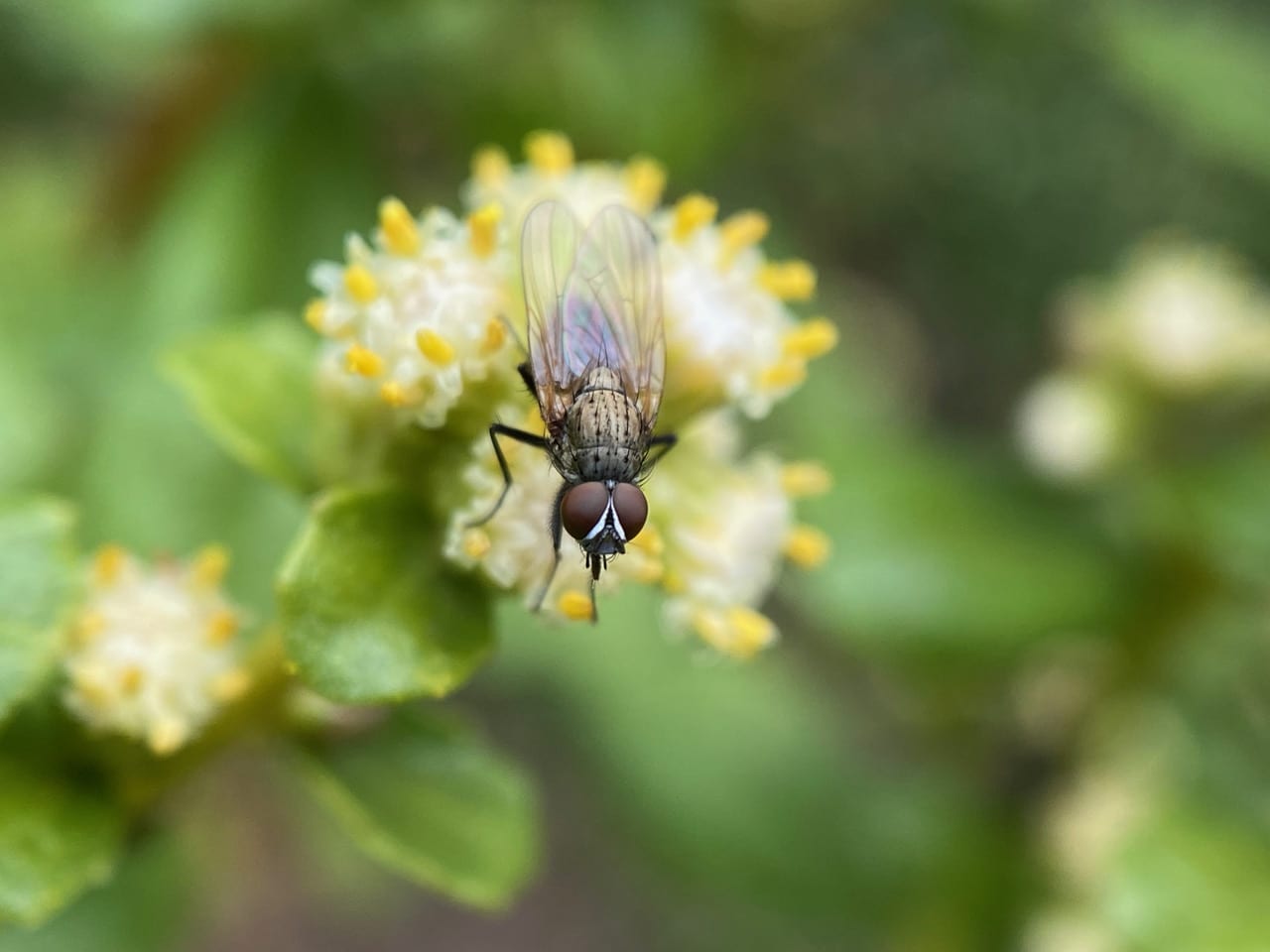
Front view of the Root Maggot Fly.
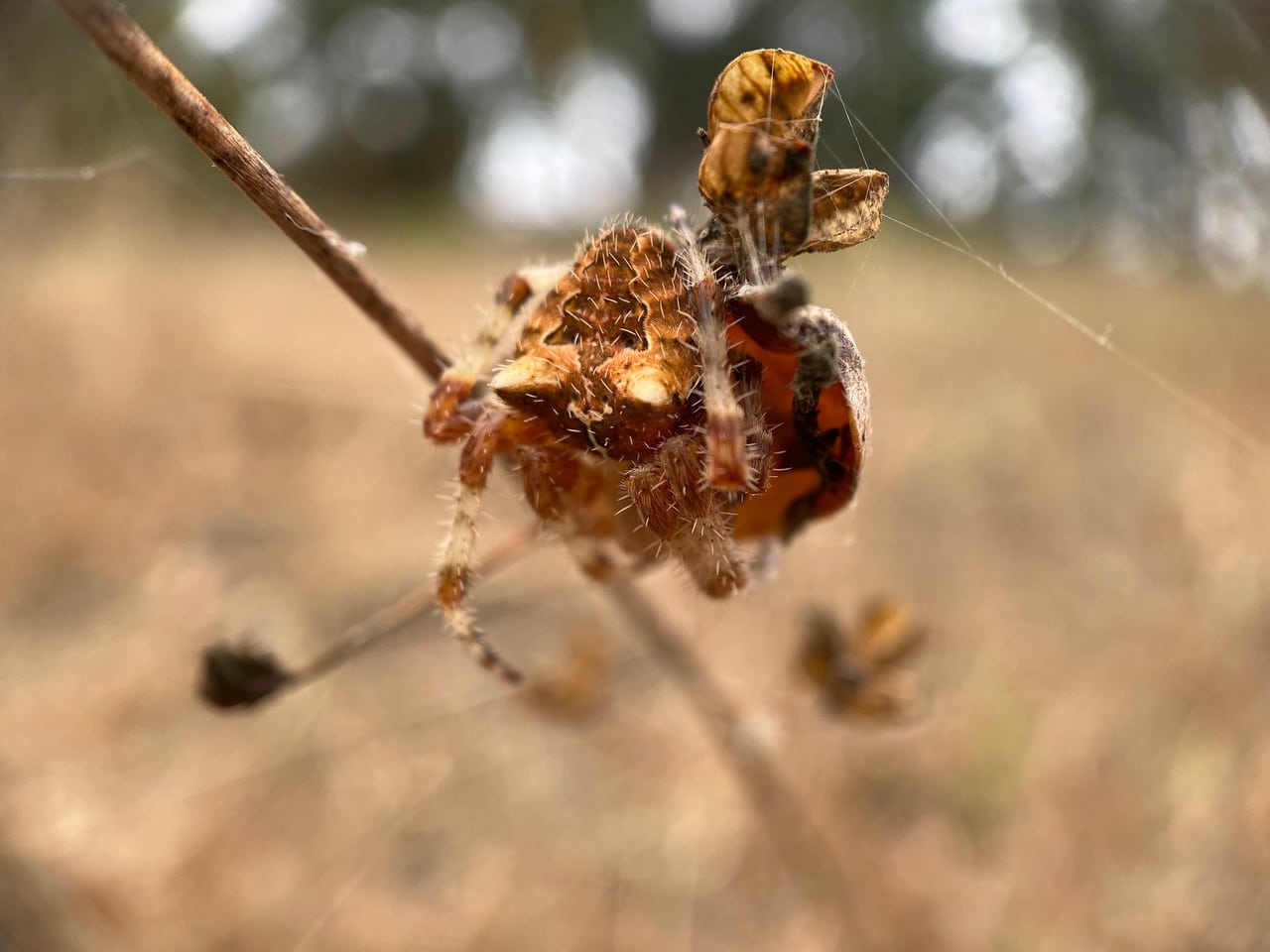 The female Two-tubercled Orb Weaver (we’ll call her T-T) is resting on her oak leaf retreat attached to a seed capsule of Soap Plant. The silk wrapped package seems to have disappeared. T-T must have devoured her wrapped prey. Was that Leggy, the small male that was moving into her territory and/courting her? I guess I’ll never know for sure.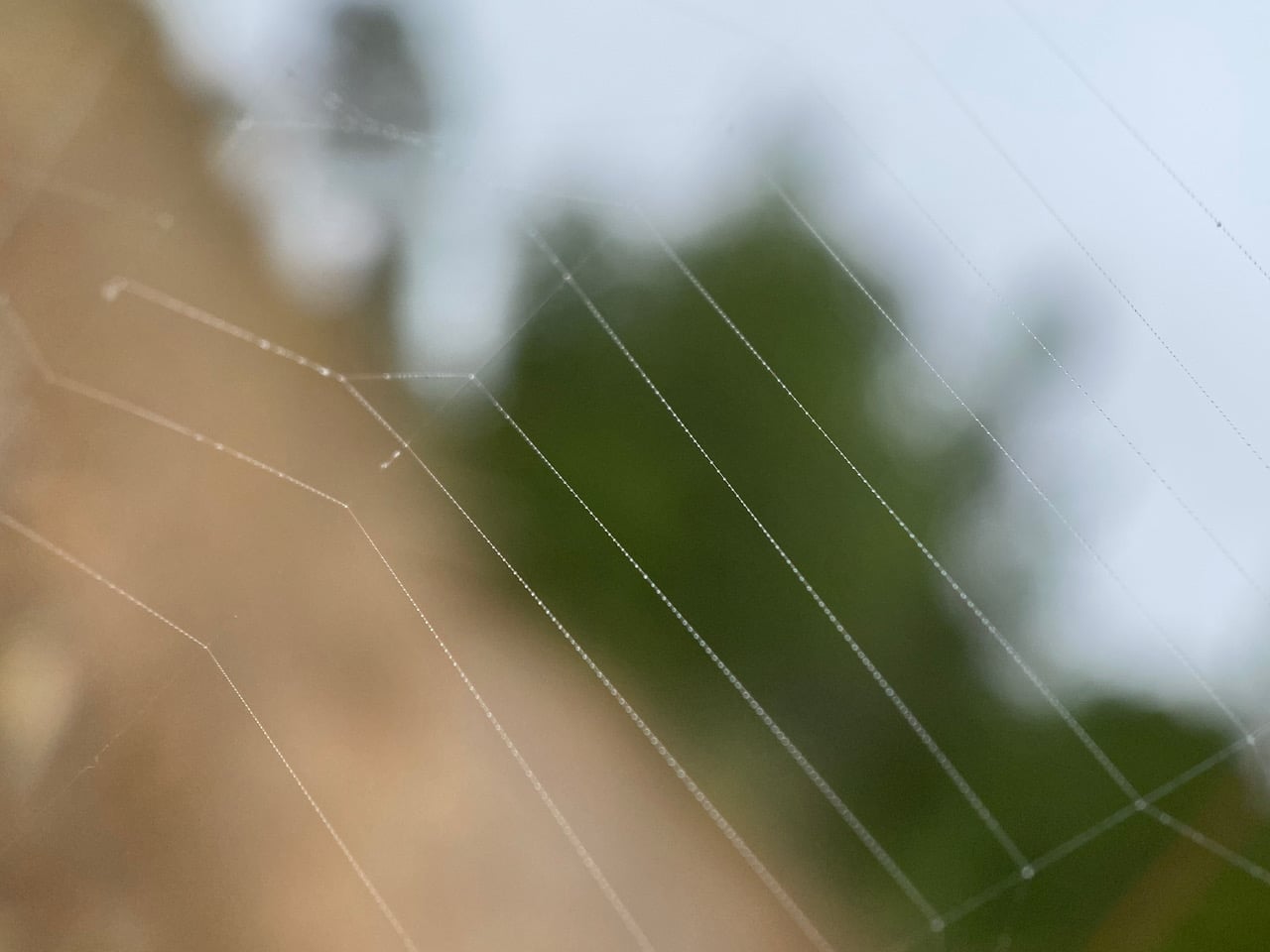
While photographing T-T, I find her orb web, which is really faint and wispy, hardly visible. The web with a diameter of about 10 inches, is strung under T-T’s retreat, connected to some grass stems below. It looks pristine, without any prey or debris. Close-up with the macro lens shows fresh droplets of glue on the spiral threads. T-T must have constructed it earlier this morning. Wow, obviously she is not “fading away” as I had thought, after laying her eggs. She is still catching prey and feeding.
I step away to stare at T-T in awe and admiration. With dwindling numbers of insects this time of year, life must be tough for a female spider hoping to reproduce. Perhaps cannibalizing her mate is the only way she could nourish herself and the developing eggs in her. As for Leggy, the male, if he has succeeded in mating with T-T before he was killed, it’s not such a bad deal; he has helped to nourish his own offspring, and with luck, his genes will survive into the next generation. Most male spiders are short-lived and die soon after mating anyway. It would be interesting to see if T-T could produce another clutch of eggs.
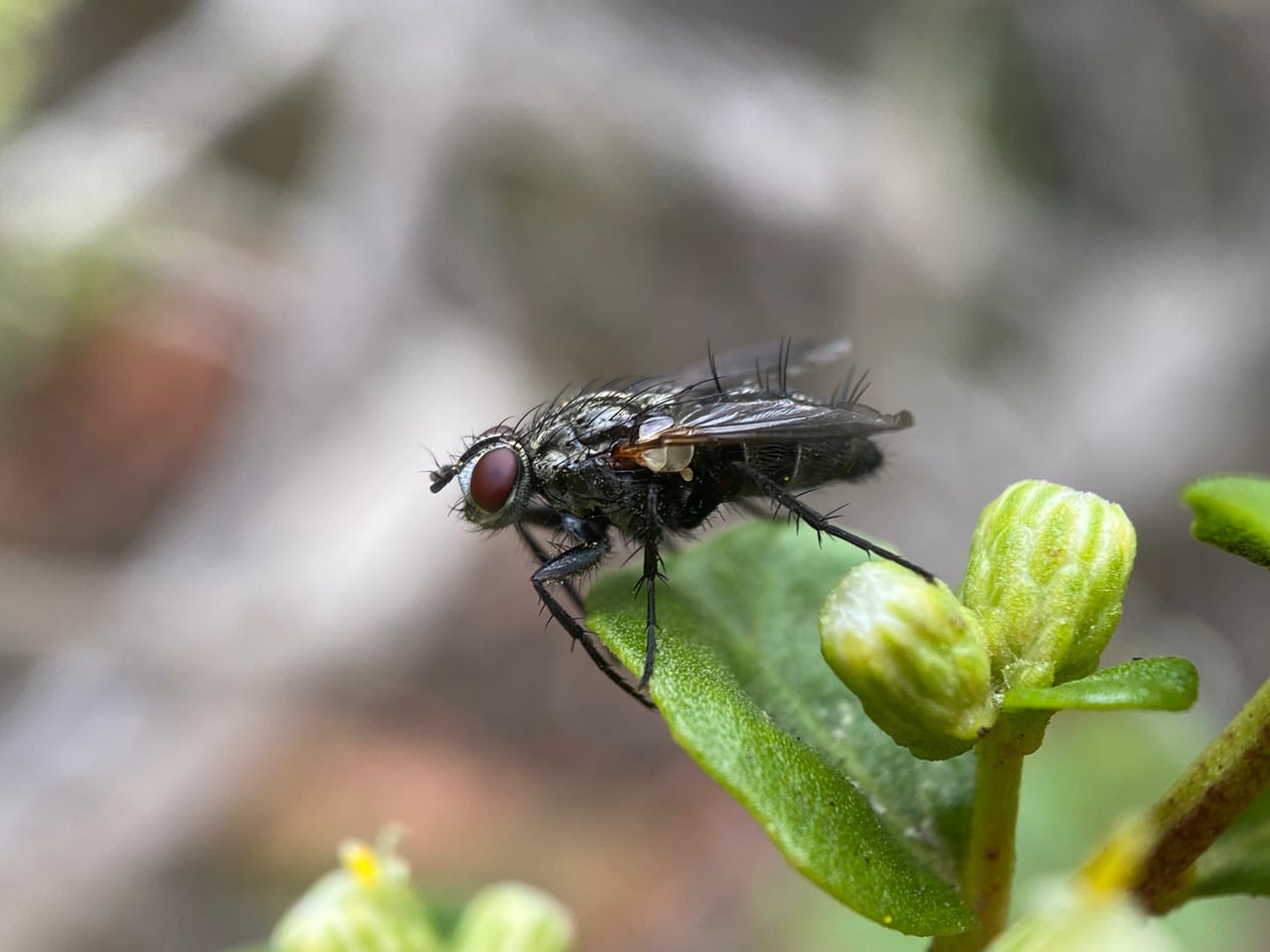
A Woodlouse Fly, Stevenia deceptoria (family Rhinophoridae) is foraging on a male Coyote Brush. These small, slender, black, bristly flies are somewhat related to the Tachinidae. The larvae are mostly parasitoids of woodlice (pill bugs), beetles, spiders and other arthropods, and occasionally snails.
Native to Europe, Stevenia deceptoria is now widespread in the US. The flies are parasitoids of terrestrial woodlice (roly polies) of the order Isopoda (Oniscoidea).

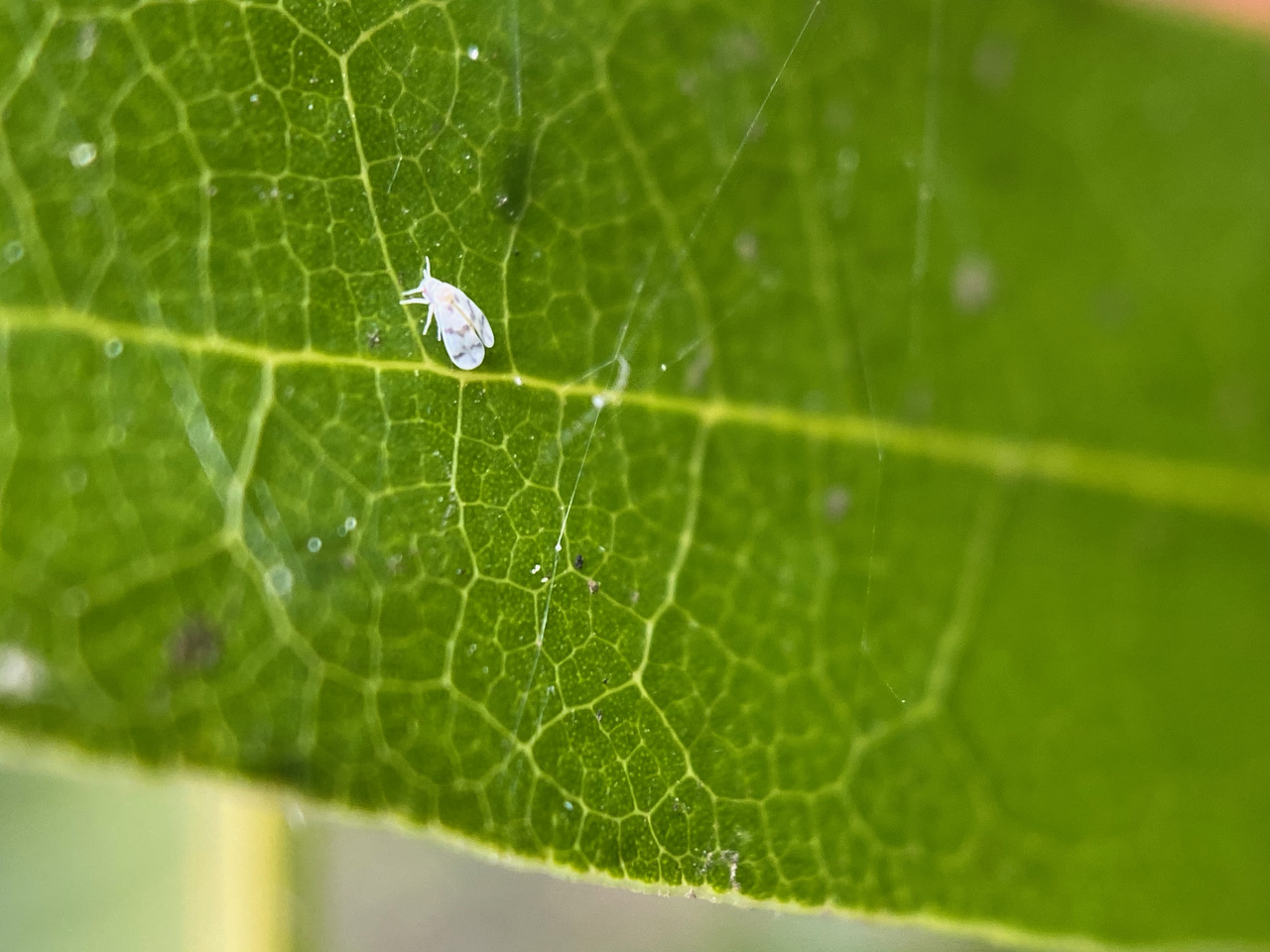
Something tiny and white has landed on a leaf of California Bay. It is a Whitefly (family Aleyrodidae).
Despite their name, whiteflies are not true flies, but are in the order Hemiptera, sap-sucking insects related to aphids, scales and mealybugs. They derive their name from the mealy white wax covering the adult’s wings and body. Adult whiteflies resemble tiny moths, most species with a wingspan of less than 3 mm and a body length of 1-2 mm.
Whiteflies use their piercing, needle-like mouthparts to suck sap from phloem, the food-conducting tissues in plant stems and leaves. Large colonies often develop on the underside of leaves. They can cause leaves to turn yellow, appear dry, or fall off plants. Like aphids, whiteflies excrete a sugary liquid called honeydew, so leaves may be sticky or covered with black sooty mold that grow on honeydew. The honeydew attracts ants, which interfere with the activities of natural enemies that may control the whiteflies. By far the whitefly’s major importance as crop pests is their transmission of virus to some host plants.
Female whiteflies lay eggs on the lower leaf surface of host plants. There generally are four larval instars. All the instars are more or less in the shape of a flattened ellipse fringed with bristles and waxy filaments. The first instar are mobile crawlers, but soon attach to host plants to feed. From then until it emerges as an adult, it remains attached to the plant by its mouthparts. The stage before the adult is called a “pupa”, though it shares little in common with the pupal stage of holometabolous insects.
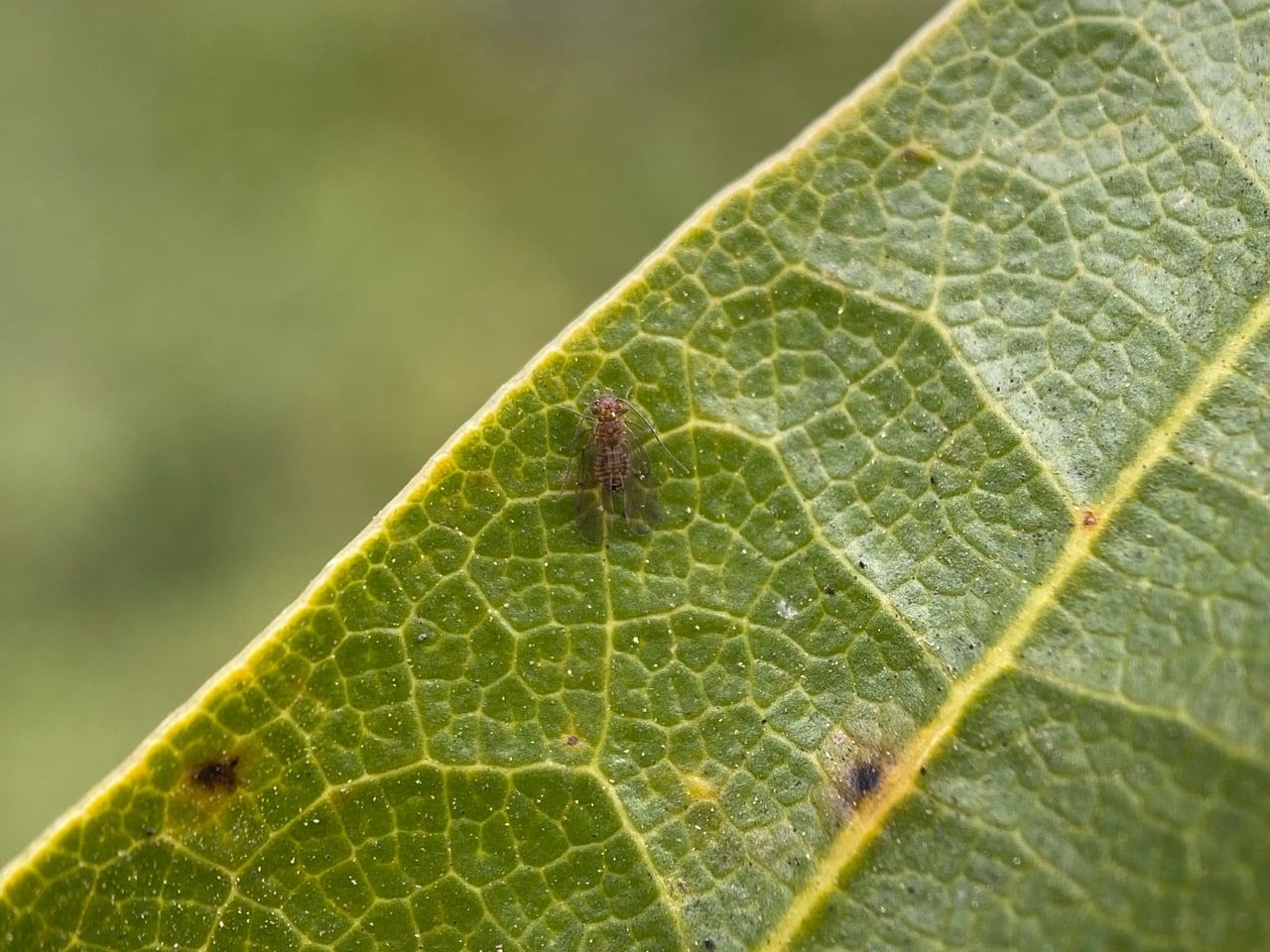
This tiny, odd looking insect, less than 2 mm. on a bay leaf is an Outer Barklouse in the family Ectopsocidae (order Psocodea, formerly Psocoptera).
The scientific name comes from the Greek psocus (to grind) and refers to the psocopteran jaws, which are shaped to grind food, rather like a pestle and mortar. These insects are conveniently discussed in two groups – barklice that live outdoors, and booklice that are found in human habitations.
Barklice are usually found in moist places, such as leaf litter, under stones, on vegetation or under tree bark. They have long antennae, broad heads and bulging eyes. They feed on algae, lichens, fungi and various plant matter, such as pollen. Barklice are usually less than 6 mm, and the adults are often winged. The wings are held roof-like over their bodies. Some species are gregarious, living in small colonies beneath a gossamer blanket spun with silk from labial glands in their mouth. Sometimes the colonies seem to move in coordinated fashion, rather like sheep.
Booklice are wingless and are much smaller (less than 2 mm). They are commonly found in human dwellings, feeding on stored grain, book bindings, wallpaper paste and other starchy products, and on the minute traces of mold found in old books.
Psocodea undergo incomplete metamorphosis. They are regarded as the most primitive amongst the hemipteroids (true bugs, the thrips and lice) because their mouthpart show the least modification from those of the earliest known fossils.
The family Ectopsocidae includes fewer than 200 species, most of them in the genus Ectopsocus. They are found to inhabit dead leaves on tree branches and leaf litter. They are brown, small-sized barklice, 1.5-2.5 mm in length. Forewings are short, broad, and held in horizontal position (rather than tent-like as in other psocids).
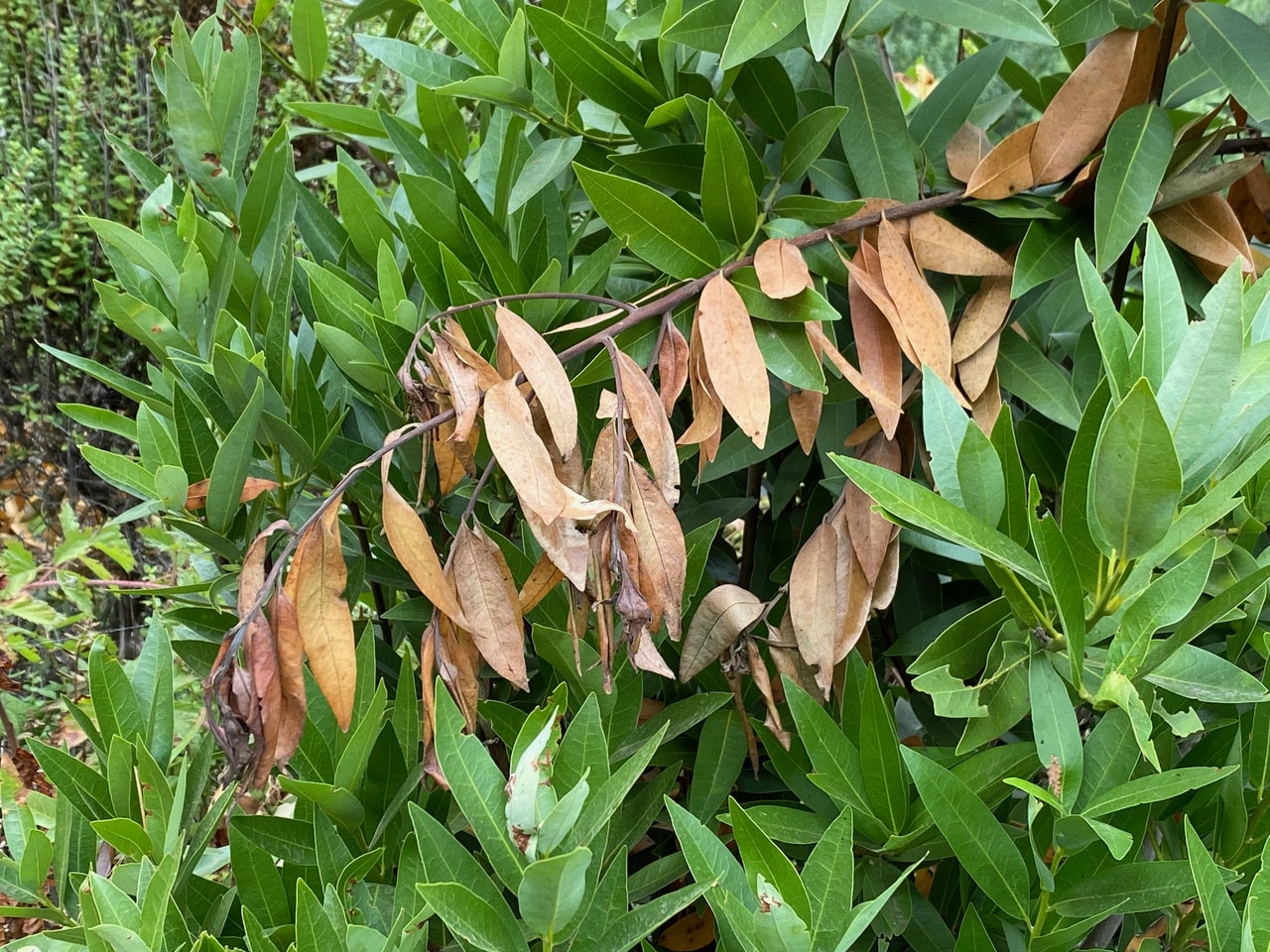
While removing a broken branch of a California Bay tree that is lying across the plant, I detect tiny movements among the brown leaves.
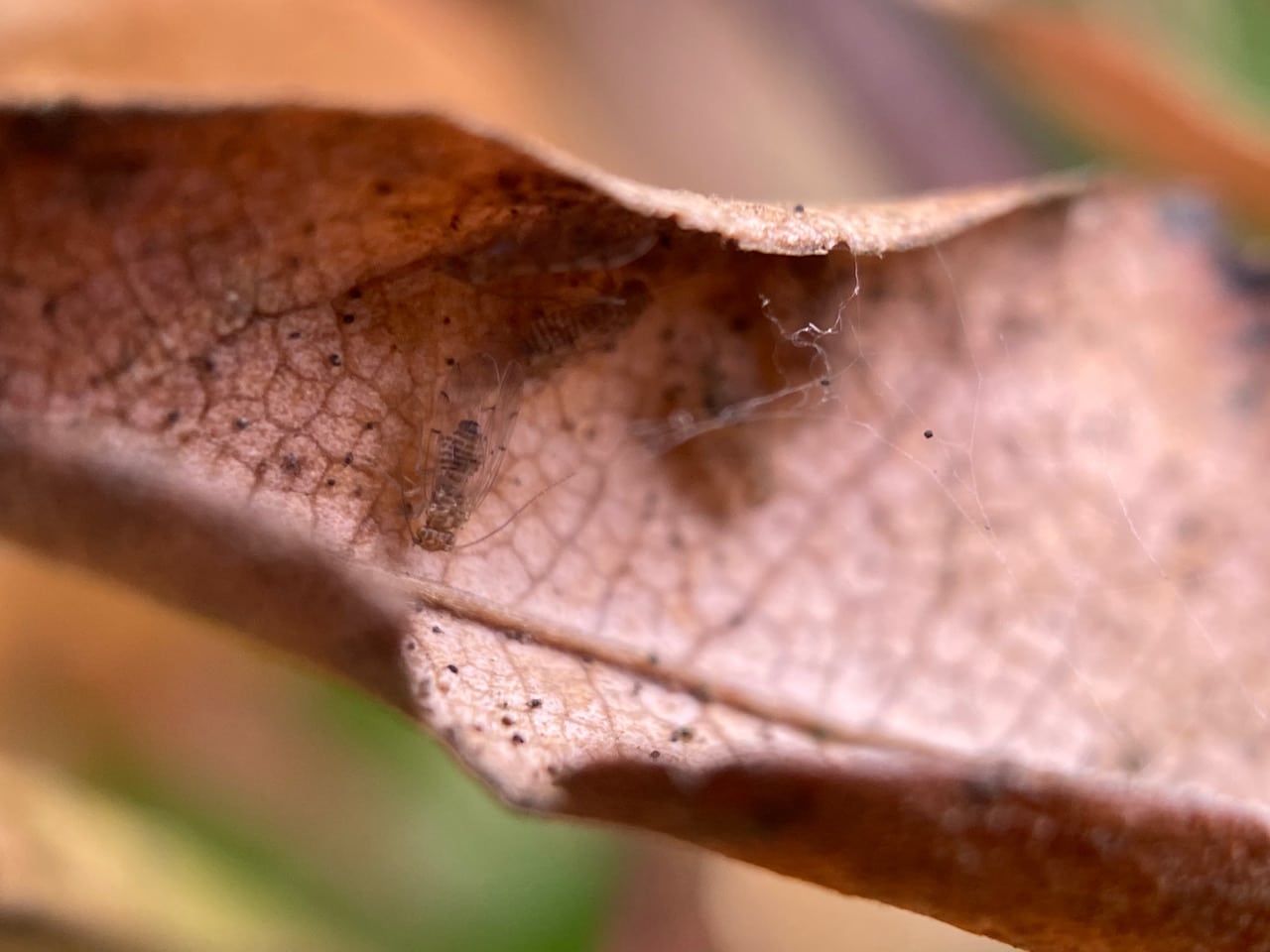
Hey, there are dozens of the Outer Barklice, Ectopsocus sp. (family Ectopsocidae, order Psocodea) on the dried leaves!

These Outer Barklice are tiny and translucent, appearing like mere smudges on the brown leaves. They are probably feeding on the molds growing on the dead leaf. Specialists with a tiny niche! But by sheer numbers, they are important decomposers/recyclers in the ecosystem, and they probably feed a slew of larger insects and invertebrates further up the food chain.
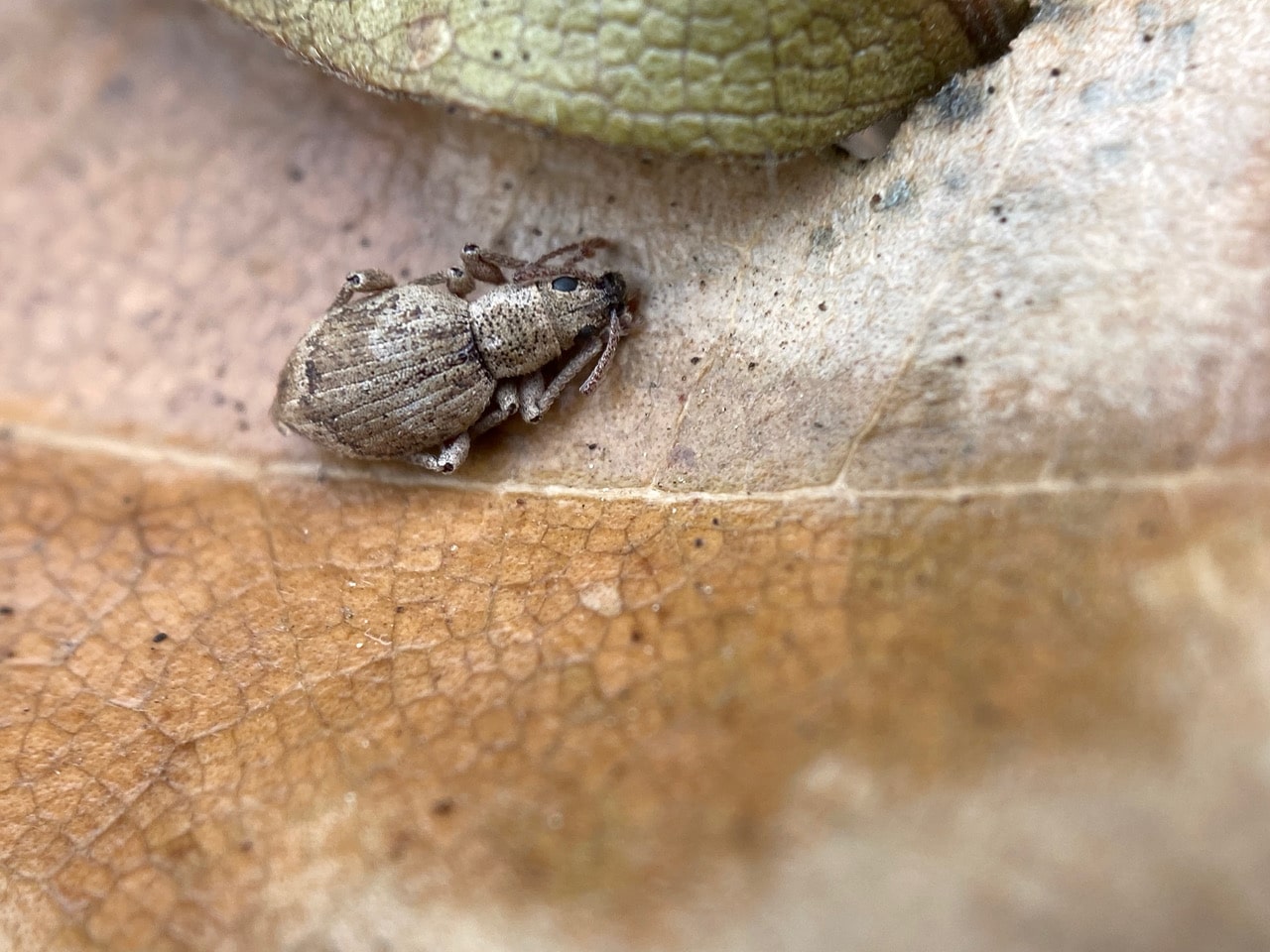
A small weevil is hidden among the brown leaves. I’m not sure if it’s alive. It has been identified by iNaturalist as the Obscure Root Weevil, Sciopithes obscurus (family Curculionidae).
The weevil is a native species in the Pacific Northwest of the US. Adults are 5-7 mm long and cylindrical in appearance. They have a very short snout with the elbowed antennae arising near the end of the snout well in front of the eyes. They are an overall mottled brown color with a distinctive wavy darker band across the wing covers near the rear end. None of the root weevils can fly and they are night-active, hiding during the day around the base of host plants, usually in mulch. About an hour after sunset they become active and crawl onto the plants to feed on leaves, producing their characteristic angular notches on the leaf margins. If disturbed, root weevils readily drop from plants and play dead. Females create a small egg chamber by folding over the margin of a leaf, then depositing several eggs in that chamber. The Obscure Root Weevils feed on a wide variety of ornamental and agricultural plants. The adults feed on the foliage and the larvae feed on the roots. Larvae are typical of root weevils and weevils in general in that they are white with dark heads, curved to a shallow “C” shape and without legs. Larvae are found at the base of host plants feeding on roots in the soil.
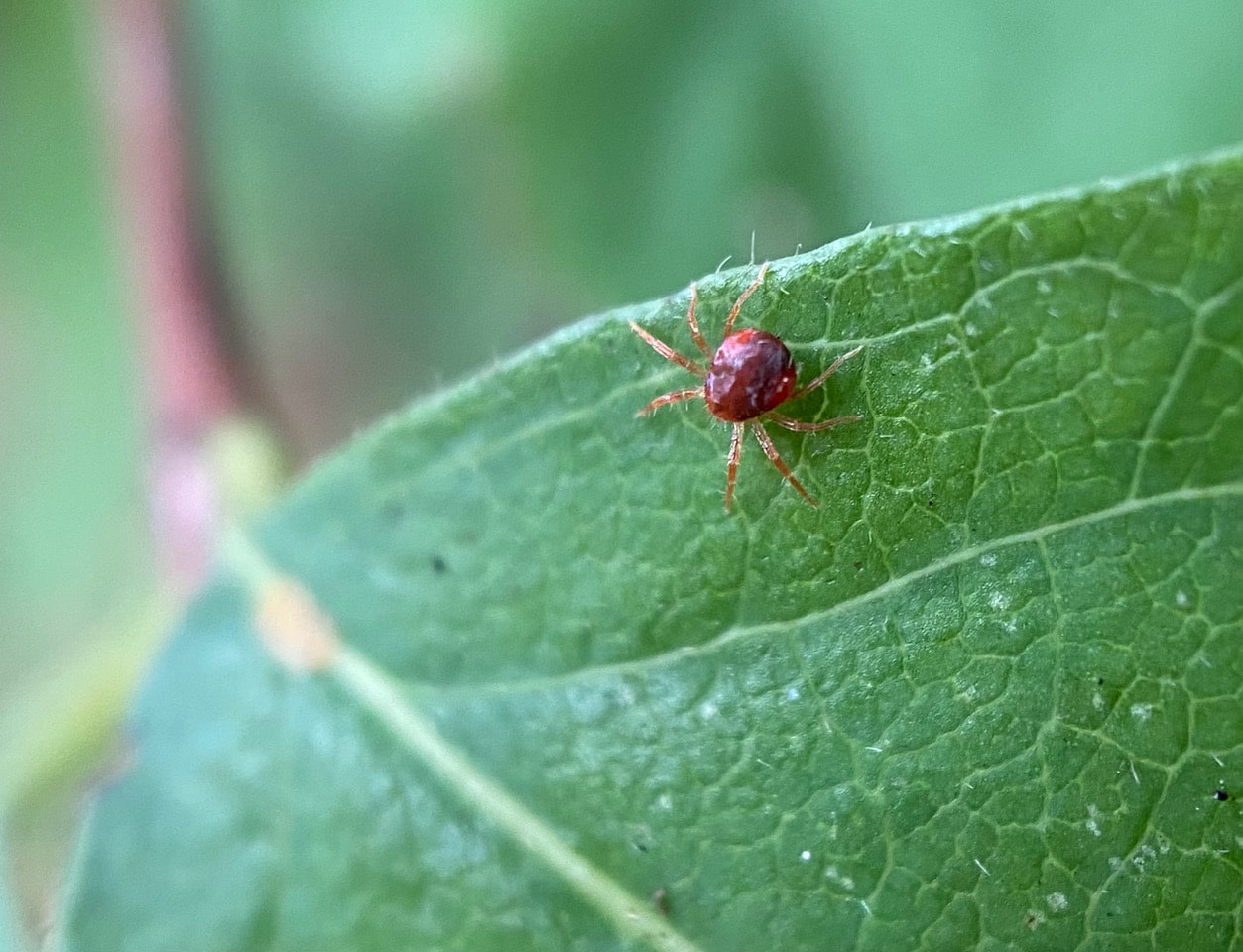
During its wanderings on a Coffeeberry leaf, a fleet-footed Whirligig Mite, Anystis sp. (family Anystidae) pauses for a breathless second, just long enough for me to snap a photo.
Anystis are predatory mites that prey on spider mites, aphids, leafhoppers, psyllid, thrips, and other small arthropods. They occur in trees, shrubs, and woody vines. Anystis are 1-1.5mm long, larger than most mite species. Adults are orange or red. The legs are covered with numerous, fine, short hairs. The distinct mouthparts project forward from the head. Adults’ overall shape is broadly rounded at the rear and more narrow in front. Nymphs and adults have 4 pairs of legs. The long legs appear to arise from a single point. This close spacing of the basal segments allows the mite’s common behavior of twirling around, which is the source of the name whirligig mites. The mites are highly mobile and move rapidly over plant surfaces. Adults live about 2-3 weeks. During this time, they consume about 40 spider mites or 6 leafhopper nymphs per day or their equivalent. Not a “chewer”, a mite punctures its prey and sucks out the juices. The Whirligig Mites are used as biological pest control agents in orchards. Only females are known in some populations and they reproduce parthenogenetically (without mating).
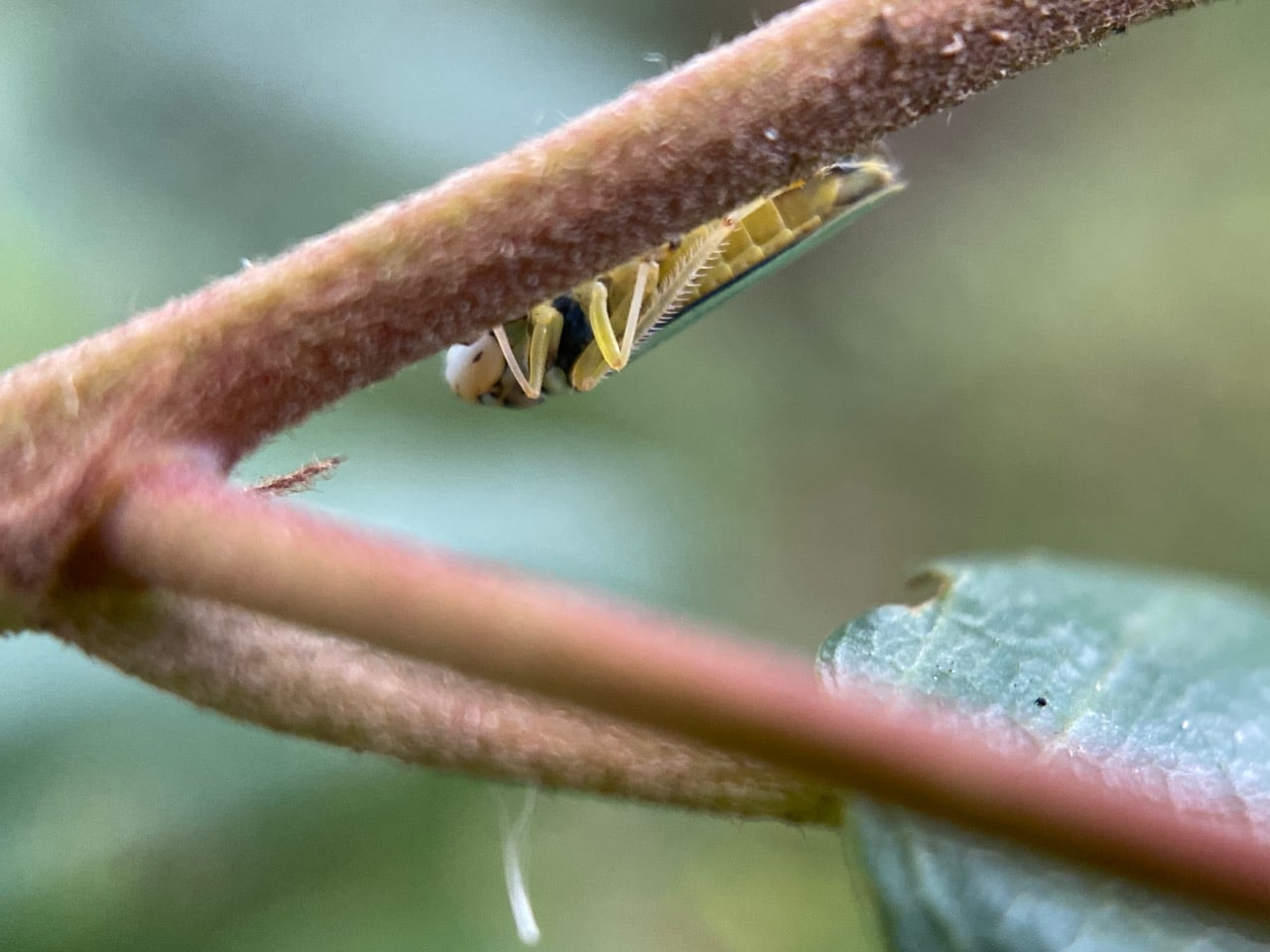
A Blue-green Sharpshooter, Graphocephalus atropunctata (family Cicadellidae) on a Coffeeberry shrub, Frangula californica is playing hide-and-seek with me. Every time I approach with the camera, it sidles sideways to the other side of the stem in a smooth, gliding motion. A minute later the bug would invariably appear on the same stem or leaf surface again. The bugs seem to enjoy the game. This ventral view of the Sharpshooter shows the rows of regularly spaced spines on its hindleg – diagnostic of the leafhopper family Cicadellidae.

Sharpshooters feed on the plant’s xylem, extracting small amounts of nutrients in large volumes of water, forcing them to eliminate up to 300 times their body weight in liquid waste each day. To accomplish this, the sharpshooters employ an energy-efficient mechanism called super propulsion to expel their urine using an anal catapult.
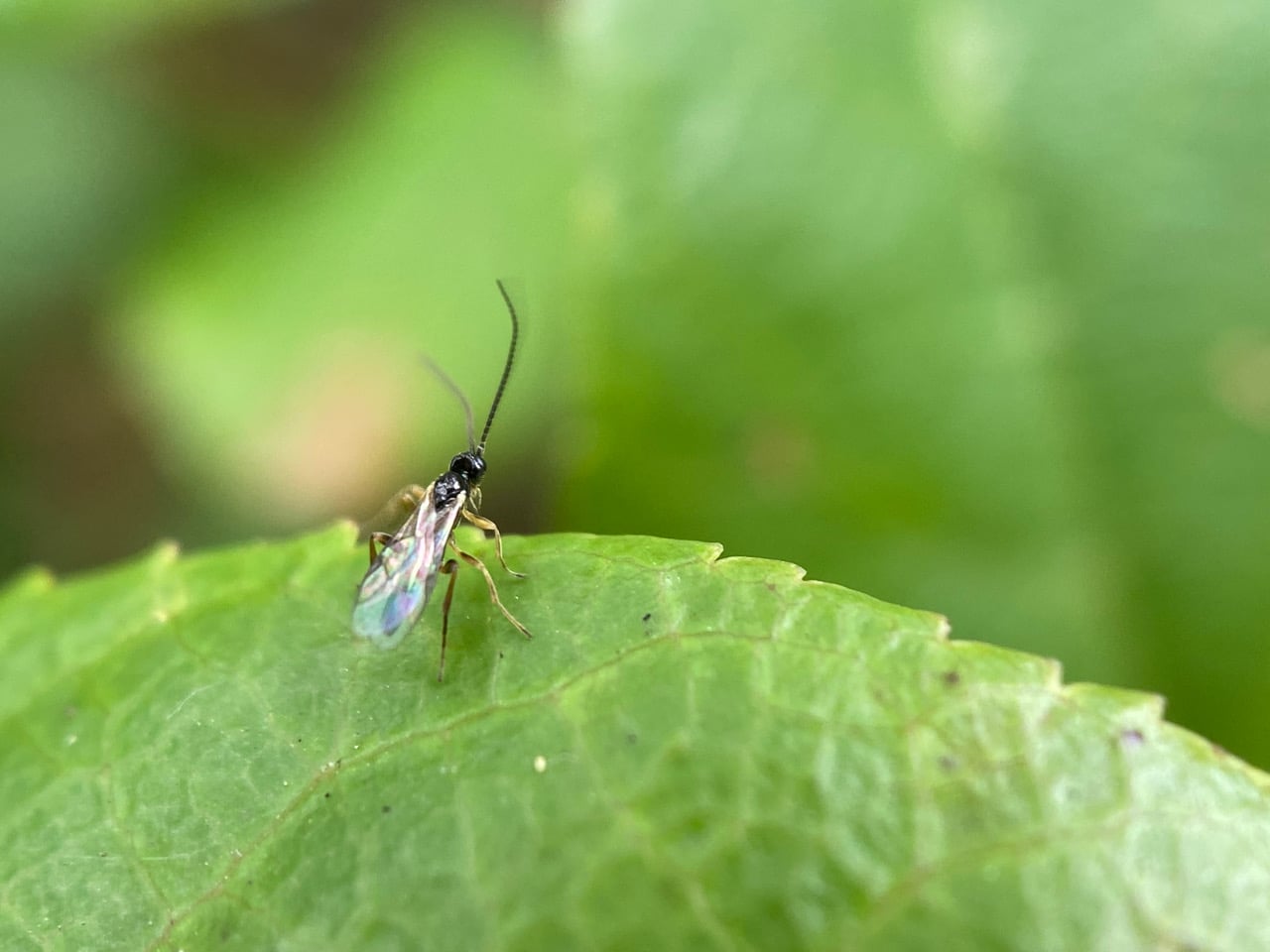
Its long antennae waving in the breeze, a tiny parasitoid wasp in the superfamily Ichneumonoidea pauses at the edge of a leaf.
The superfamily Ichneumonoidea comprises the two largest families within Hymenoptera: Ichneumonidae and Braconidae, both with a cosmopolitan distribution. Members of the two families are distinguished by wing venation. Most are slender, and the females of many species have extremely long ovipositors for laying eggs. Ichneumonoids are solitary wasps, and the vast majority are parasitoids; the larvae feed on or in another insect, eventually killing it. In general, ichneumonoids are host specific, and only attack one or few closely related host species. Many species use polydnaviruses to suppress the immune systems of their host insects.
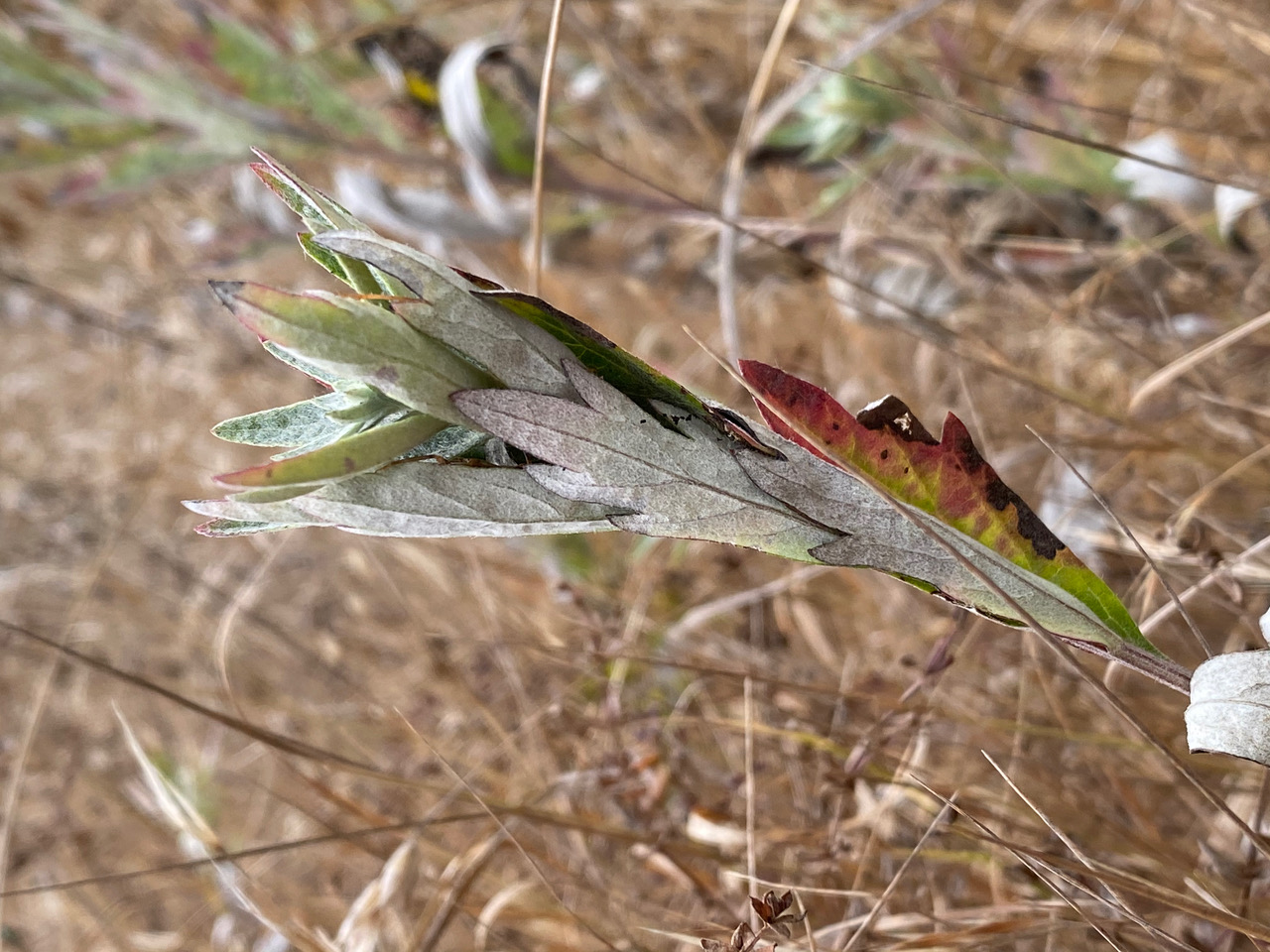
I do a double take as I pass this California Mugwort, Artemisia douglasiana. Most of the lower leaves have curled back in senescence, but the fresher top leaves are neatly wrapped around the stem and each other. The arrangement does not look natural to me. Maybe a spider has bound together the leaves to create a retreat for itself?
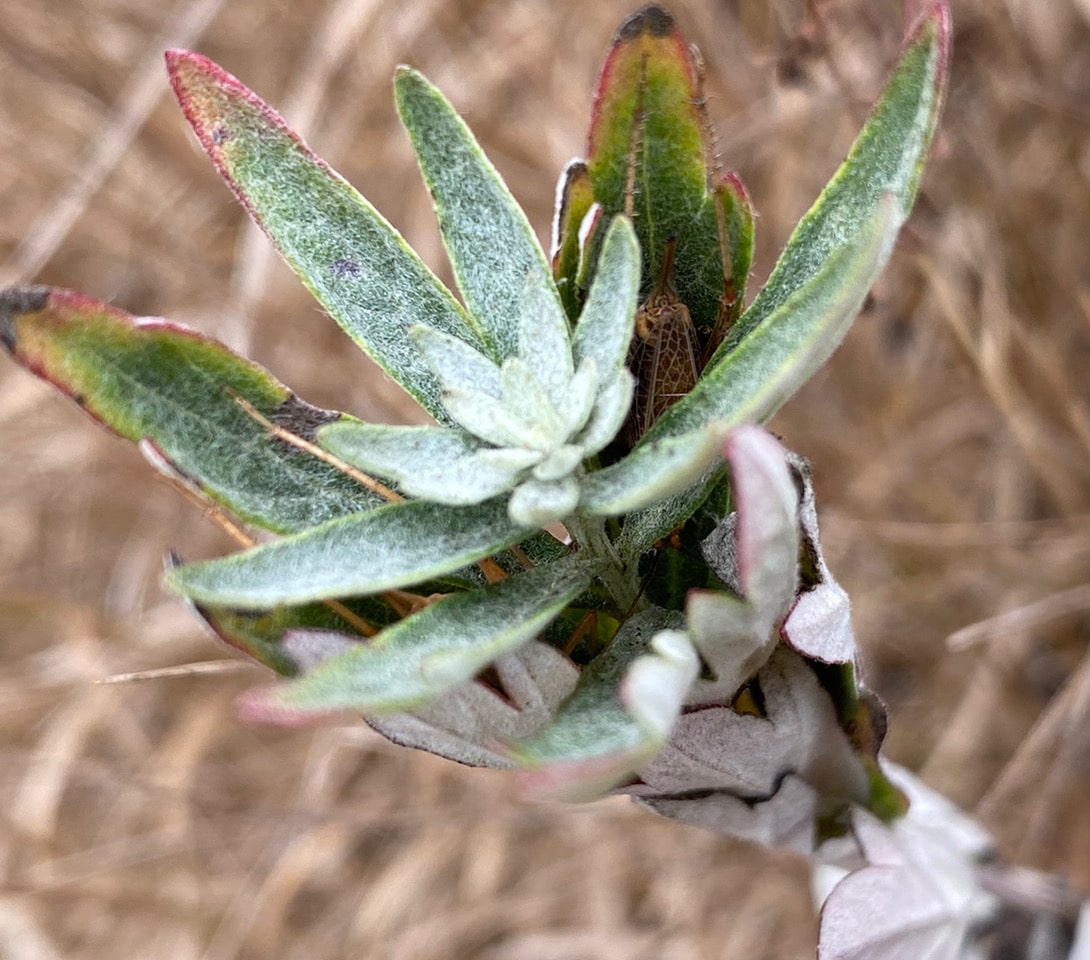
As I examine the plant more closely, I discover a large, dark insect resting head-down on a leaf above the “retreat”. It looks just like the one I found yesterday that was identified by iNaturalist as a member of the superfamily Grylloidea (crickets). As I review this photo at home, I realize that there are actually two crickets on the top – only the legs of the second cricket on the left are visible! What is happening here? Are the crickets using the plant as a safe place to sleep? What about the “retreat” below? I don’t have the heart to disturb all these critters to find out.
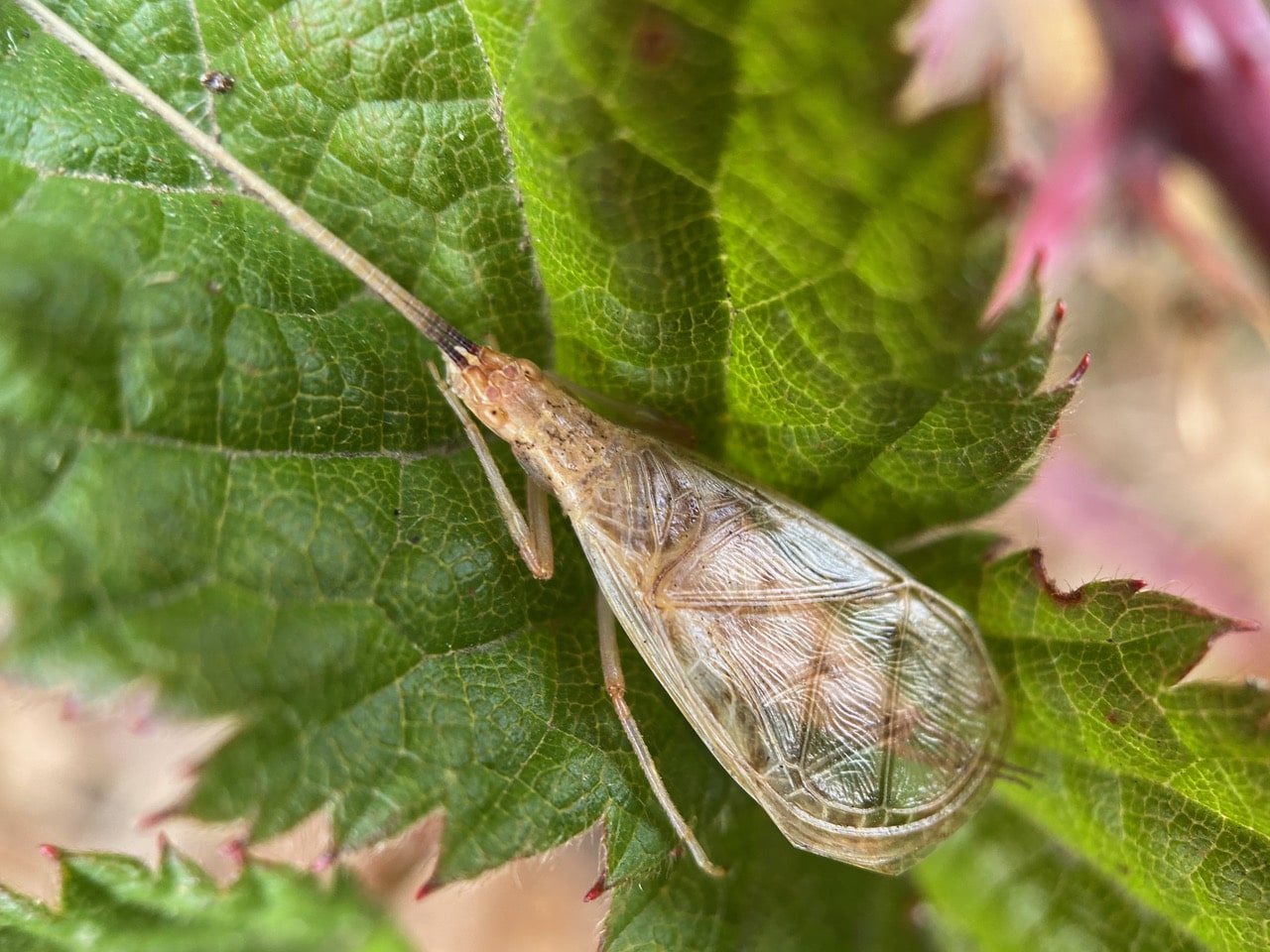
A male Western Tree Cricket, Oecanthus californicus (family Gryllidae) is resting motionless on a Blackberry leaf on the side of the trail. I am not sure if it is asleep or dead. It is easy to tell the genders apart in these insects – the males have these broadly rounded forewings that they use to serenade the females.
More often heard than seen, tree crickets are active at dusk and at night. In late summer, males produce a high-pitched whine or “song”, a prelude to courtship and mating.
Tree Crickets have two sets of wings; a female’s forewings hug her body, and males’ forewings are flat and wide. Males produce sound by rubbing together rough areas (called the “rasp” and “file”) at the base of the forewings, a method of sound production called stridulation. During sound production, the males hold their wings straight up at right angle to the body. Each species of tree cricket has its signature calls, and the tempo of the call is affected by the temperature of the ambient air. Females do not call, but they do listen with auditory organs located on the forelegs. Females prefer males who sing bass (a lower call indicates a larger caller).

North American species of Oecanthus can be distinguished by the markings and swellings on the first and second antennal segments. Since the tree cricket is not moving, I take the opportunity to get a macro photo of the base of its antennae. iNaturalist has since concurred that the creature is indeed a Western Tree Cricket, Oecanthus californicus.