

Pollinator Post 10/2/23
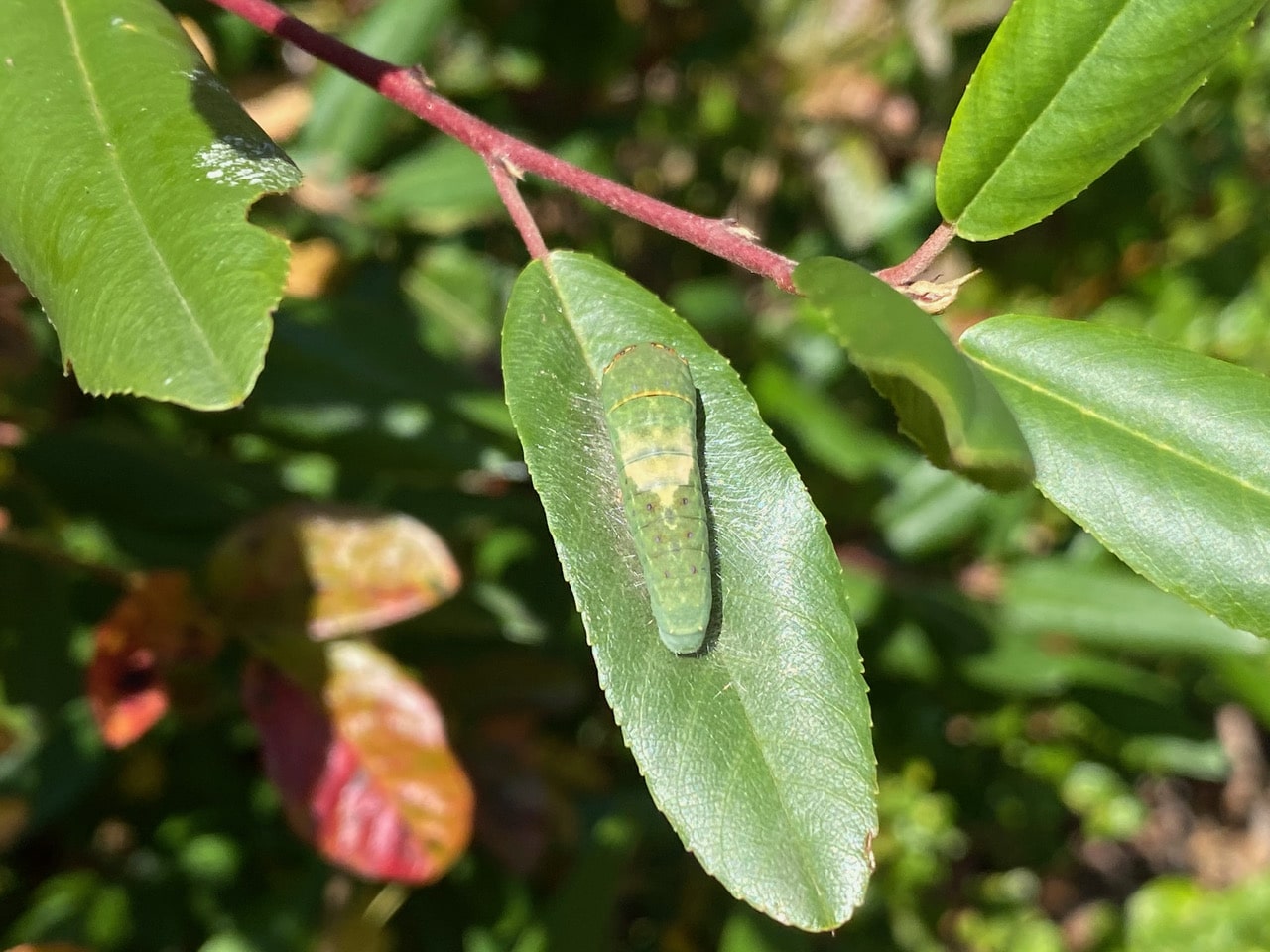
Hey, our Pale Swallowtail caterpillar B2 on the Coffeeberry leaf has turned around to face away again. It looks rather elongated today, with the white marking on the back stretching apart and fading. It’s remarkable how well B2’s color is blending in with its host plant.
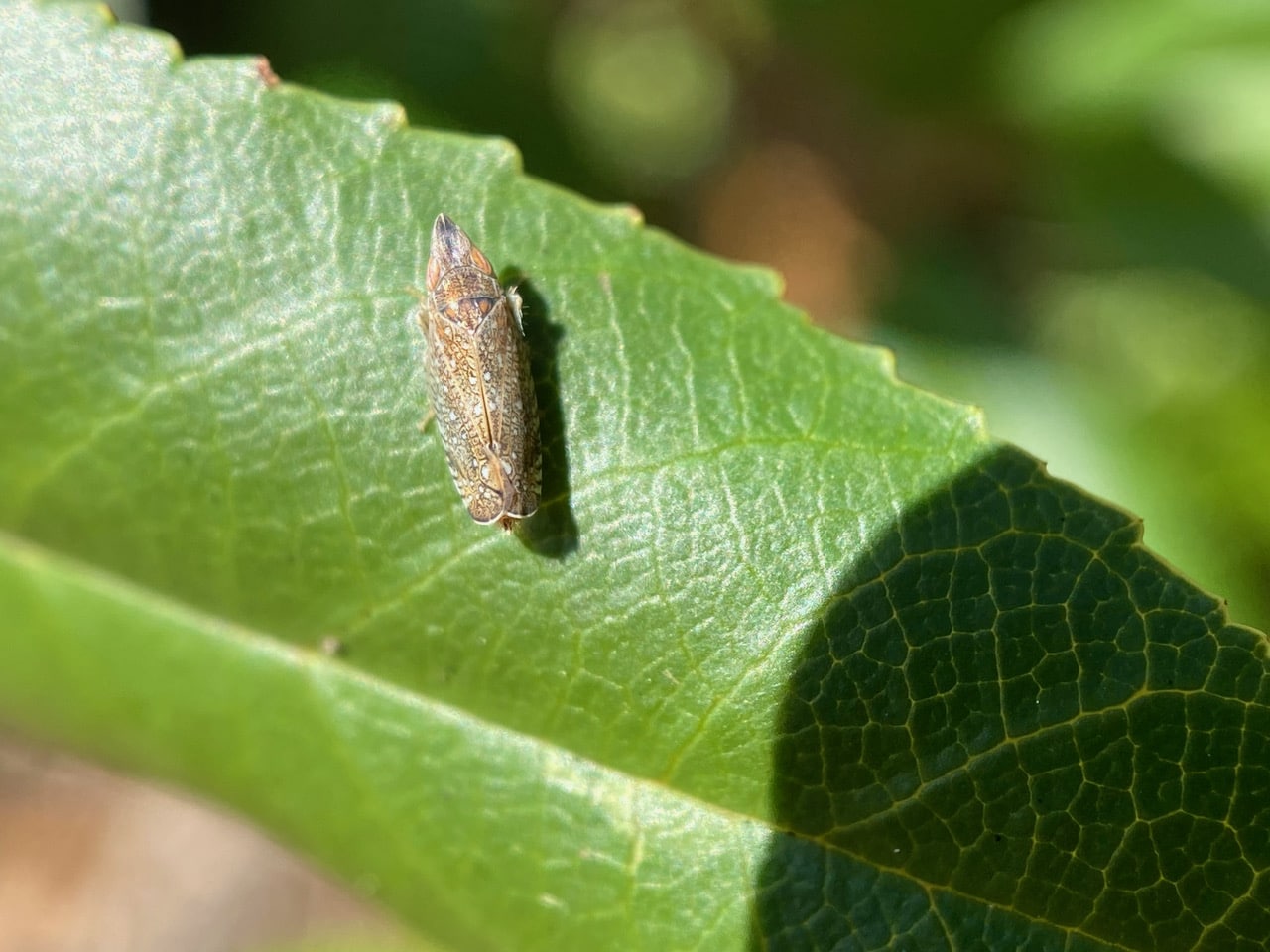


A tiny insect is resting on a Coffeeberry leaf close to B2. It is a Sharp-nosed Leafhopper, Scaphytopuis acutus (family Cicadellidae).
Leafhopper is the common name given to true bugs in the family Cicadellidae. The bugs are plant feeders that suck plant sap from grass, shrubs, or trees. Their hind legs are modified for jumping, and are covered with hairs that facilitate the spreading of a secretion over their bodies that act as a water repellent and carrier of pheromones. They undergo partial metamorphosis, and have various host associations, varying from very generalized to very specific.
While sucking the sap of plants, these insects excrete any extra sugar as a sticky liquid commonly called honeydew. This is a serious hazard for small insects, possibly sticking the insect to a leaf, or gluing its body parts together. Some bugs deal with this problem by shooting the waste away from their bodies at high speed. Leafhoppers have a unique solution – they make brochosomes, a proteinaceous material within a special gland in their guts, and secrete them by the billions in a milky anal fluid, and spread them over their bodies using their legs. When the fluid dries, the brochosomes form a powdery coating, and the leafhoppers spread them even further using comb-like hairs on their legs. The brochosomal coat is superhydrophobic, and acts as a water-repellent, non-stick coating protecting the leafhoppers from their own sticky exudates.
Ooh, here’s a tiny, colorful fly on another leaf! It is a Leaf-miner Fly in the family Agromyzidae. Once you’ve learned to spot them, you realize they are quite common.
The Agromyzidae are a family commonly referred to as the Leaf-miner Flies, for the feeding habits of their larvae, most of which are leaf miners on various plants. They are small flies, most species in the range of 2-3 mm. Agromyzidae larvae are phytophagous, feeding as leaf miners, less frequently as stem miners or stem borers. A few live on developing seeds, or produce galls. There is a high degree of host specificity. A number of species attack plants of agricultural or ornamental value, so are considered pests. The shape of the mine is often characteristic of the species and therefore useful for identification. Adults occur in a variety of habitats, depending on the larval host plants.
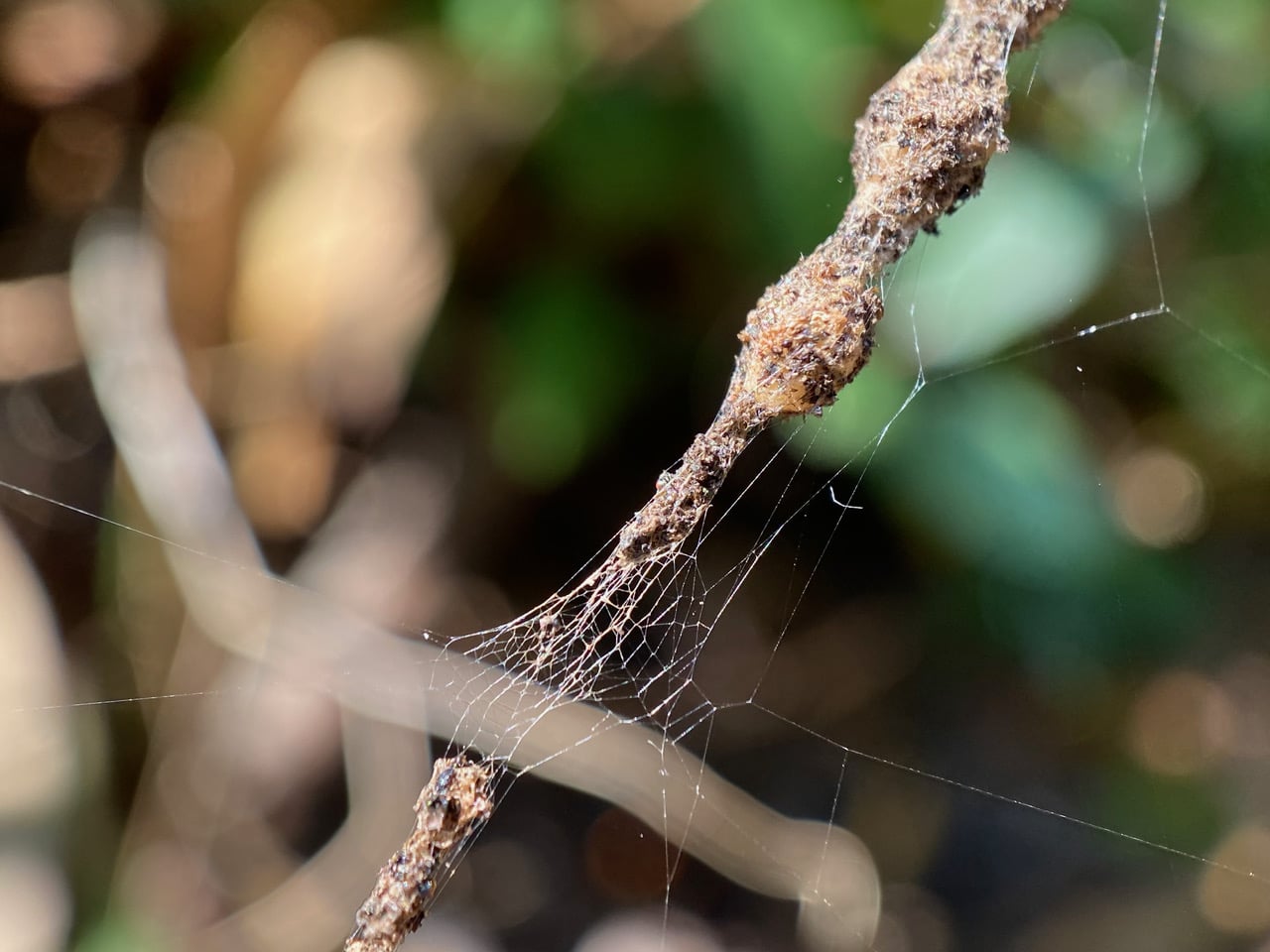
Looking down from B2’s leaf, I notice that the web of the Humped Trashline Orbweaver, Cyclosa turbinata (family Araneidae) is no more. The string of egg cases is still intact in their original place, still attached to the hub of the web, but the orb has not been maintained. The spider is nowhere to be seen. She must have died. Orb weaver females usually die soon after laying their eggs.
Cyclosa turbinata is native to the continental United States. It is a small species, about 4-7 mm in length. Their color is a mix of browns, blacks, and whites, and their abdomen tapers to a rounded point. C. turbinate is distinguished from the others in the genus by the presence of two anterior dorsal humps.
Trashline spiders are so-called for their web decoration. Cyclosa create orb-shaped webs using both the sticky and non-sticky threads, mostly during times of complete darkness. Across its spiral wheel-shaped web, Cyclosa fashions a vertical “trashline” made of various components such as prey’s carcasses, detritus, and at times, egg cases. The trashline helps the spider to camouflage exceptionally well from predators. The spider sits in the web hub to conduct its sit-and-wait hunting, ensnaring prey at nearly any time of day; it only leaves its spot to replace the web prior to sunrise.
The string of egg cases are in good shape, covered with debris, and securely wrapped and strung together with silk. With luck, they will stay this way until the spiderlings hatch out in the spring. You’ve done a magnificent job, mama spider!