

Pollinator Post 4/2/24 (2)
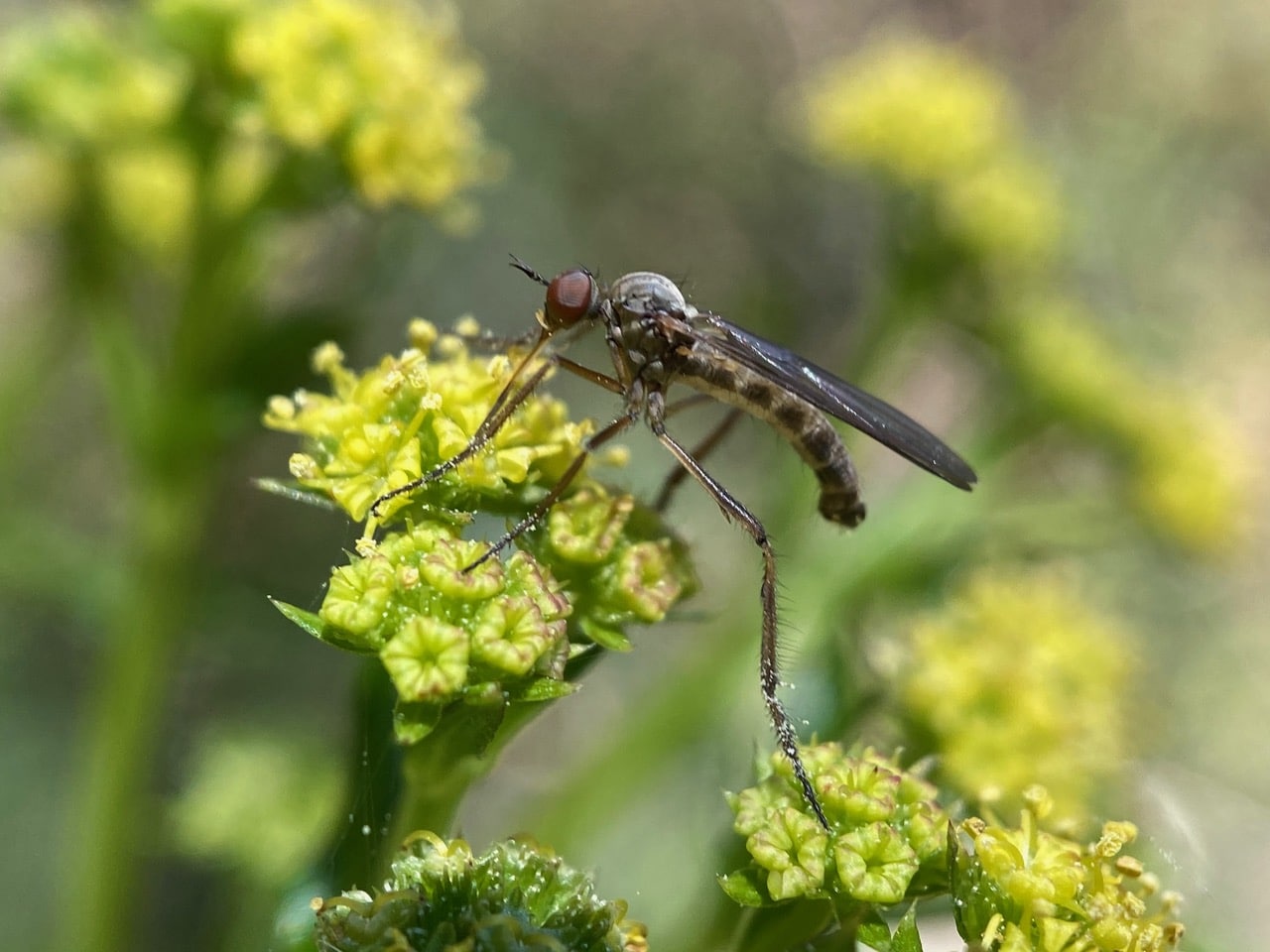 An Empidid Dance Fly (genus Empis, subgenus Enoplempis, family Empididae) is probing for nectar from a cluster of flowers of the Pacific Sanicle, Sanicula crassicaulis.
Dance Flies, in the family Empididae, get their name from the habit of males of some species to gather in large groups and dance up and down in the air in the hopes of attracting females. They are predominantly predatory and they are often found hunting for small insects on and under vegetation in shady areas. Both genders may also drink nectar. Male dance flies give their sweeties a nuptial gift to eat while they mate. The gift is thought to enable her to complete the development of her eggs. Males may wrap their gifts in balloons of silk or spit.
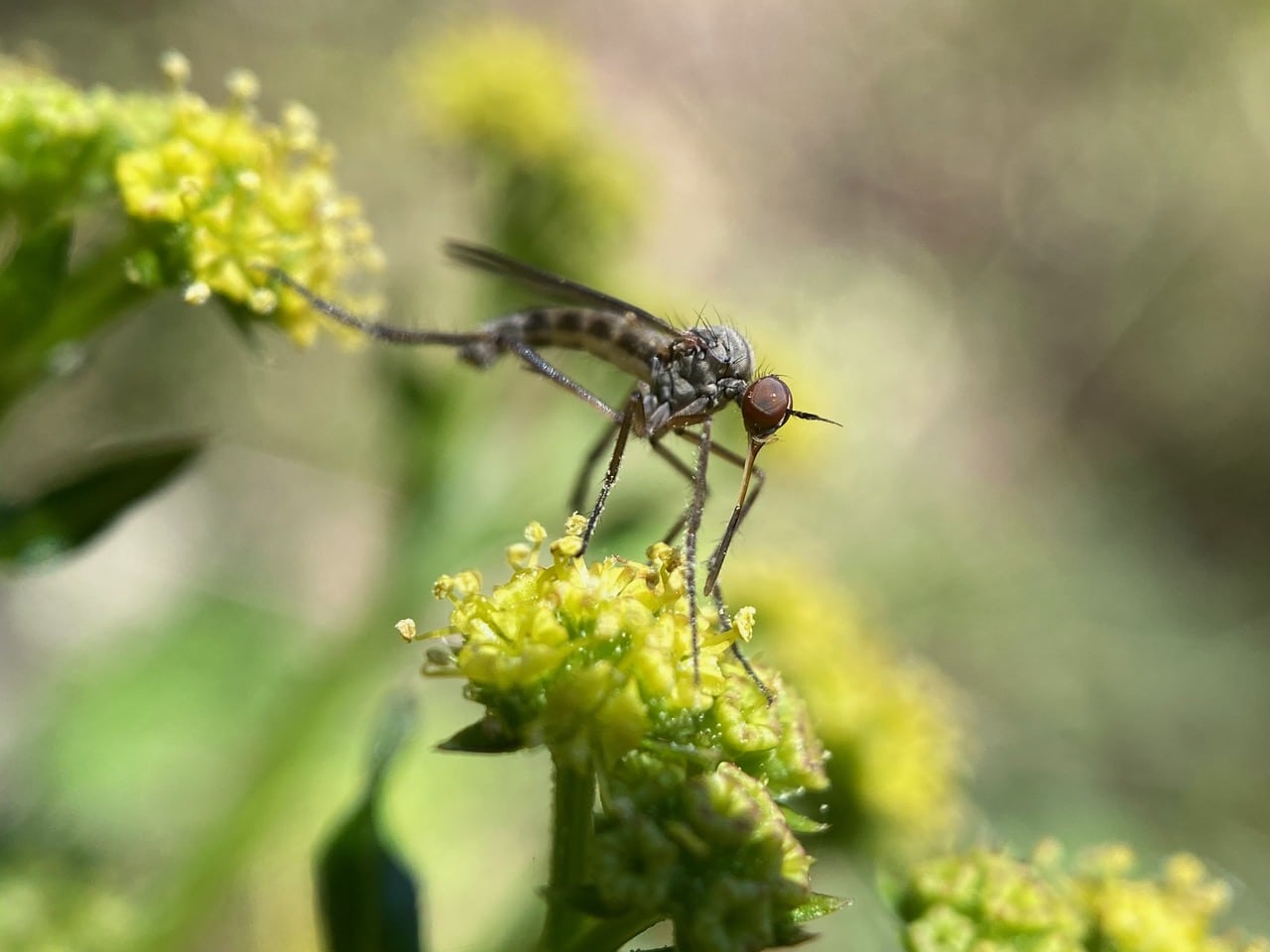
With its long legs, it can easily walk from one cluster to the next without having to fly.
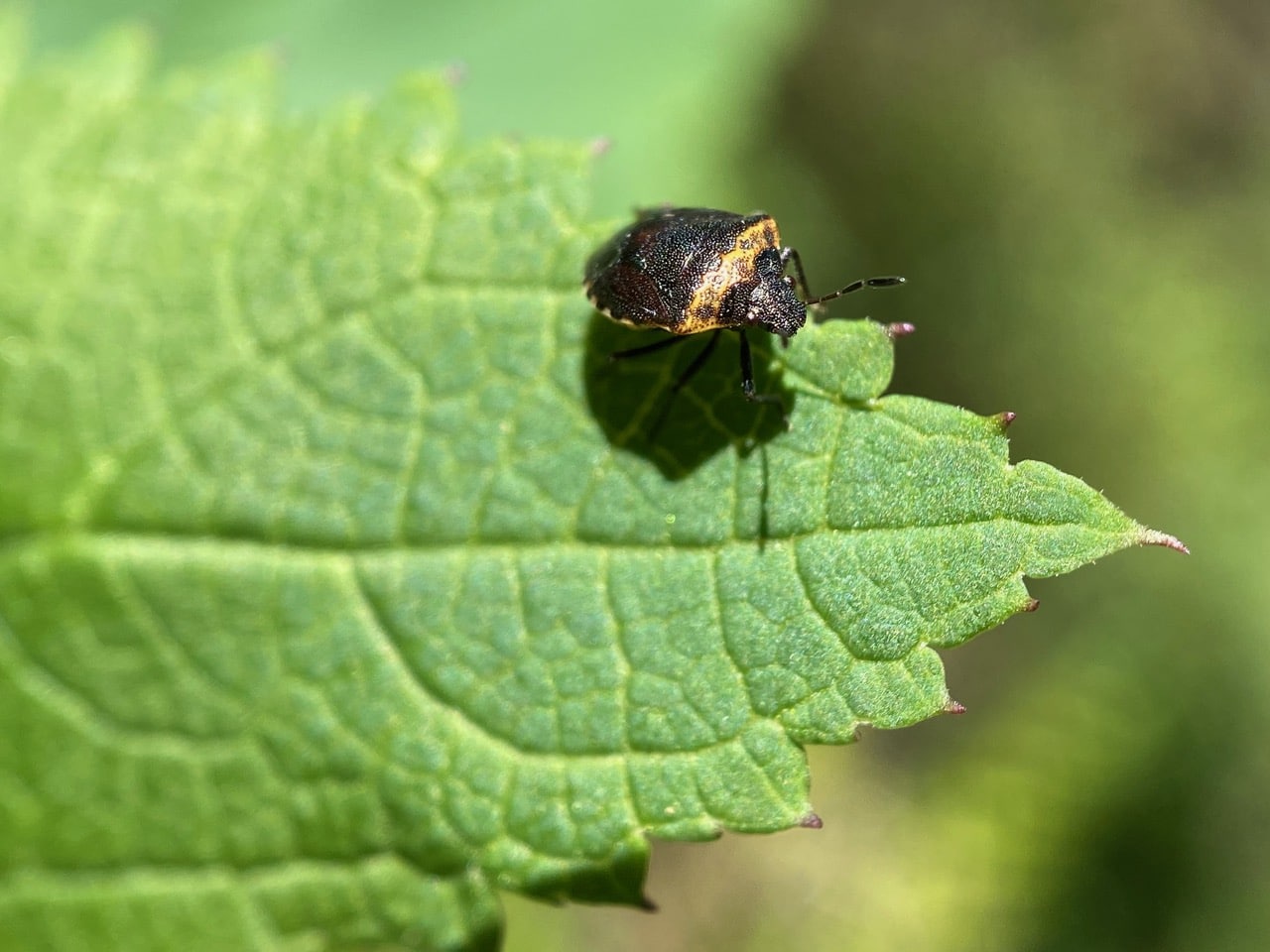
A small Stink Bug, Cosmopepla uhleri (family Pentatomidae) looks up at me meekly from a leaf of California Bee Plant, Scrophularia californica.
It is easily recognizable – black with an orange transhumeral band with black spots. The bug uses Scropularia californica as a host plant.
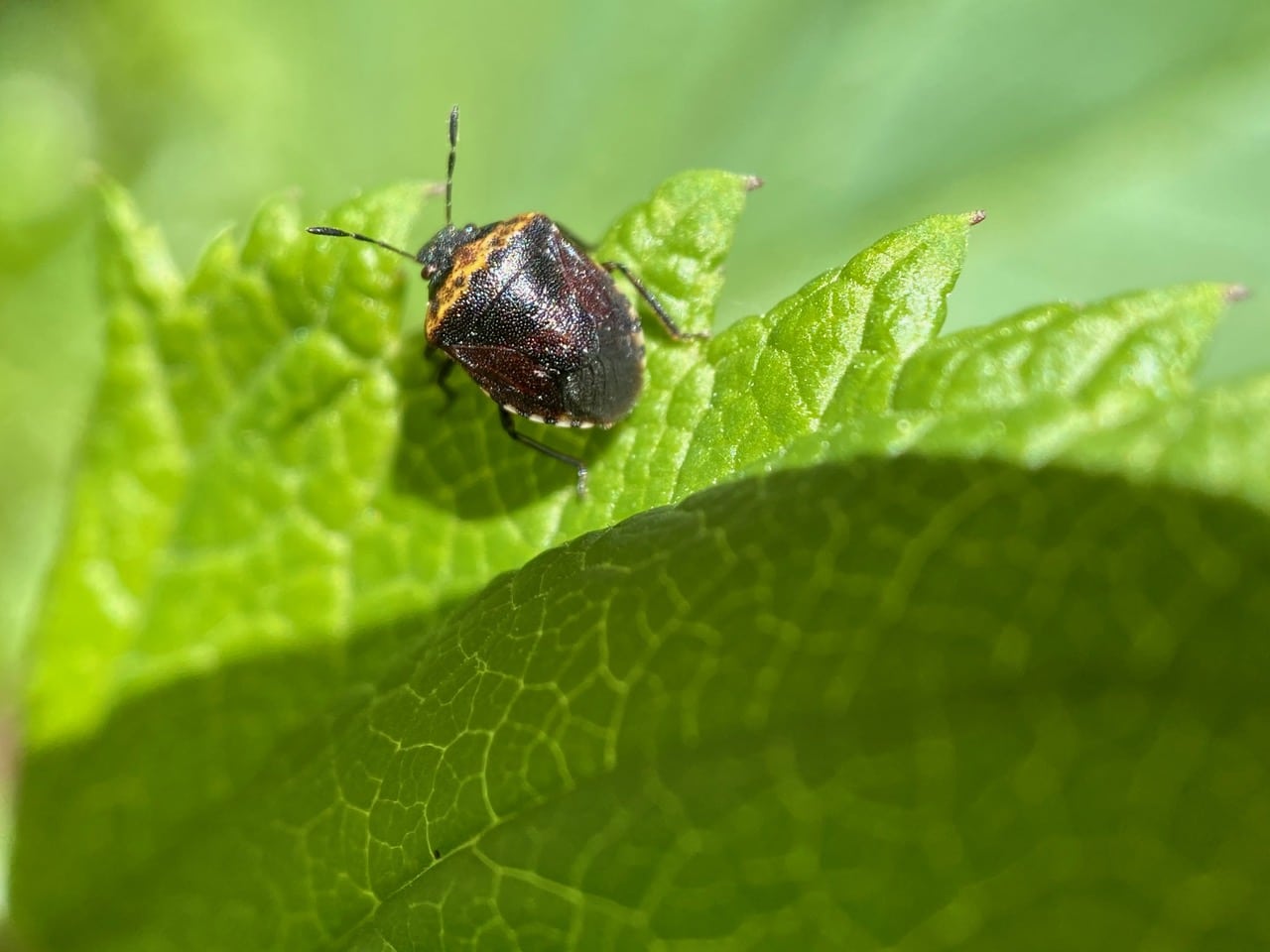
Pentatomidae is a family of insects belonging to the order Hemiptera or “true bugs”. As hemipterans, the pentatomids have piercing-sucking mouthparts, and most are phytophagous, including several species that are severe pests on agricultural crops. Stink Bugs feed on plant fluids by inserting their needlelike mouthparts into stems, leaves or seed pods. While feeding, they inject materials into the plant to aid in digestion and sap removal. Penetration by the mouthparts can cause physical damage, much like stabbing the plant with a fine needle. Cosmopepla uhleri is so small that the damage is generally limited to fine stippling on the leaves of California Bee Plant.
All Pentatomids have 5-segmented antennae (hence their family name, Penta – five and tomos – section.) They generally have a large triangular scutellum in the center of the back. The adult is generally shield-shaped when viewed from above. The common name of Stink Bug refers to their ability to release a pungent defensive spray when threatened, disturbed, or crushed.
#/media/File:Heteroptera_morphology-d.svg)
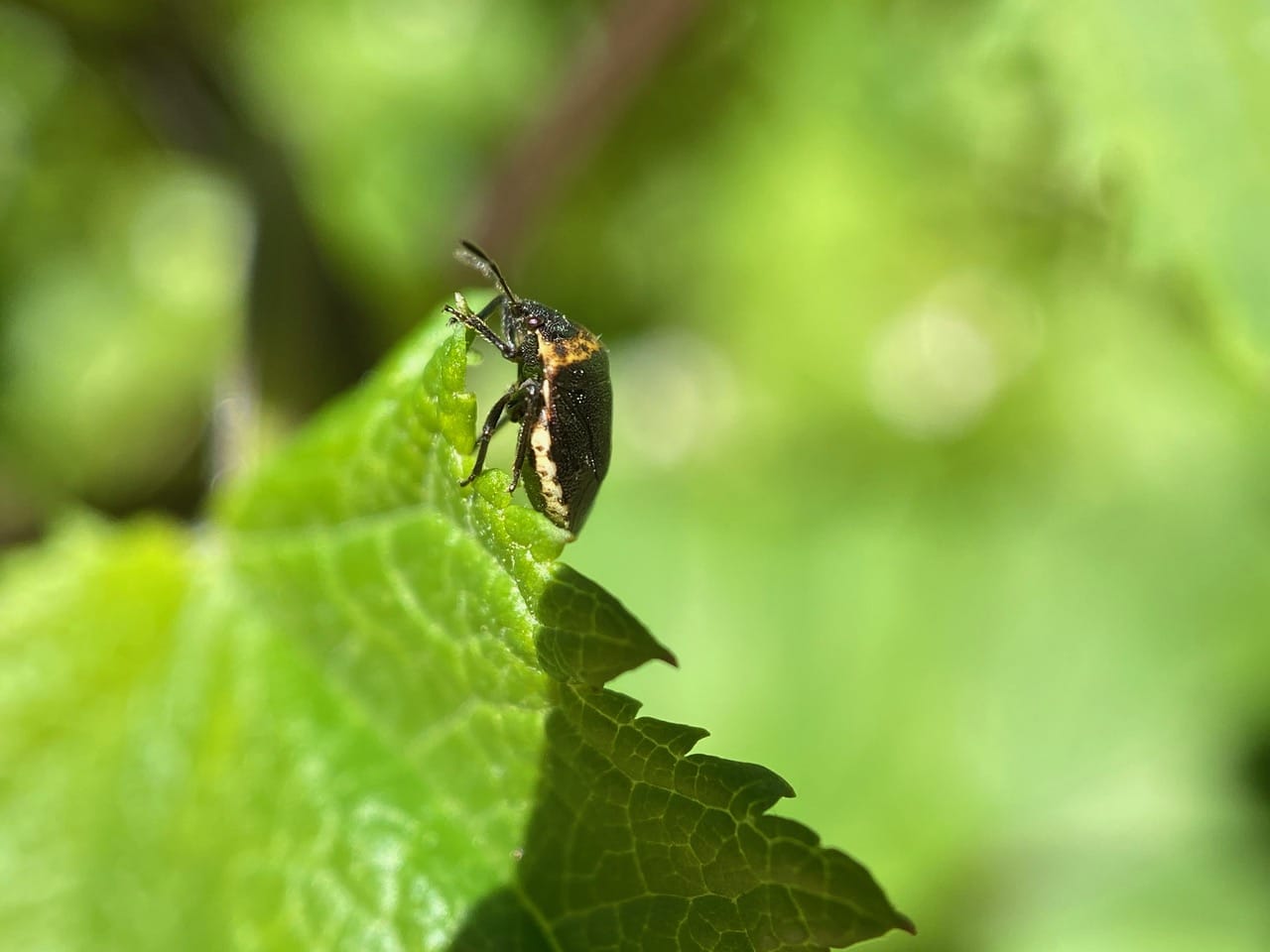
A band of colorful pattern can often be seen on the side of the bug’s abdomen under its black wings.
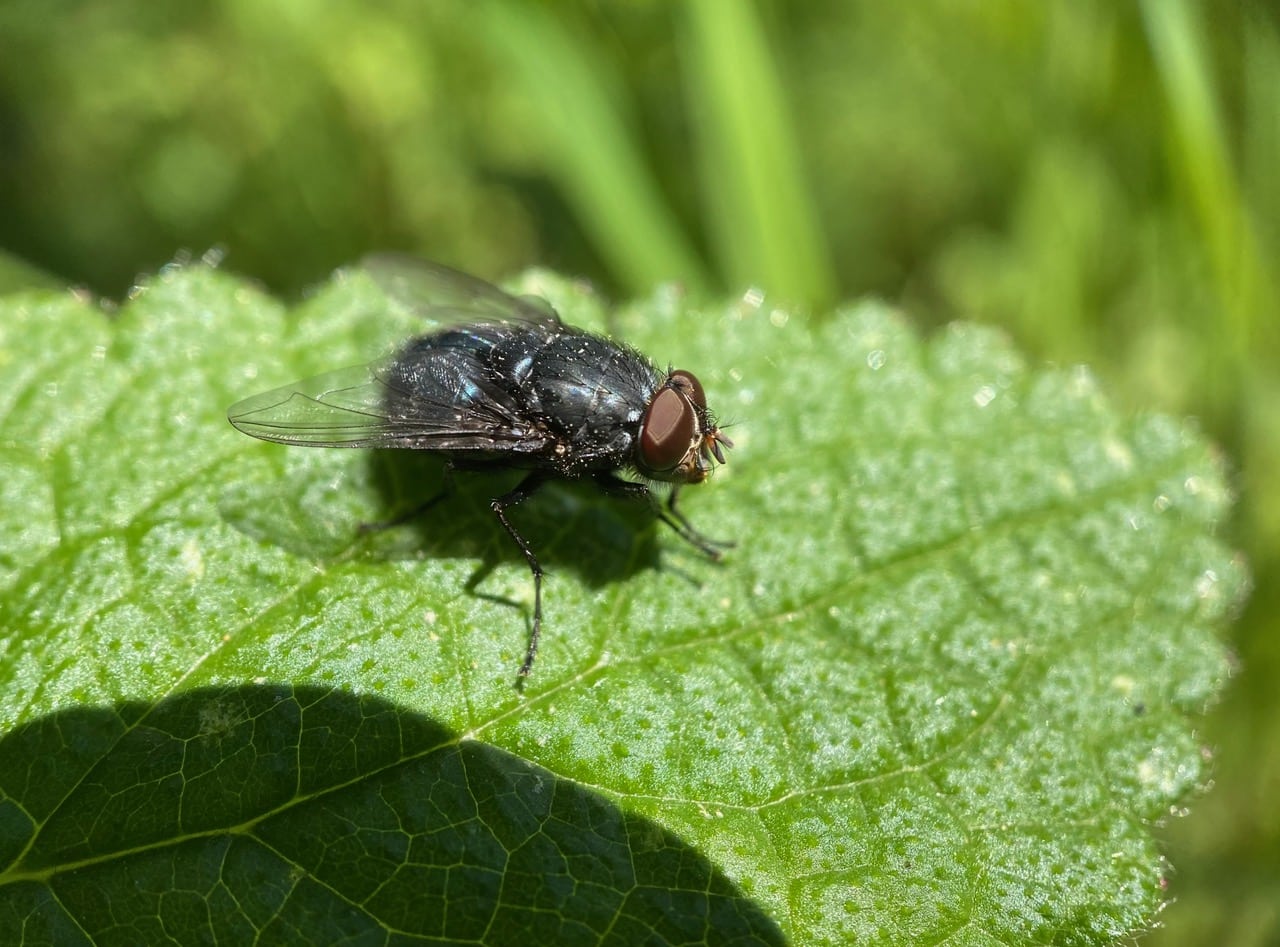
A Bluebottle Fly, Calliphora sp. (family Calliphoridae) lands on a leaf of California Bee Plant.
The Calliphoridae are variously known as blow flies, carrion flies, greenbottles, and bluebottles. Adults are usually brilliant with metallic sheen, often with blue, green, or black thoraces and abdomens. There are three cross-grooves on the thorax; calypters are well developed. Females visit carrion both for proteins and egg laying. The larvae that hatch feed on dead or necrotic tissue, passing through three instars before pupation. After the third instar, the larva leaves the corpse and burrows into the ground to pupate. Adult blow flies are occasional pollinators, being attracted to flowers with strong odors resembling rotting meat. The flies use nectar as a source of carbohydrates to fuel flight.
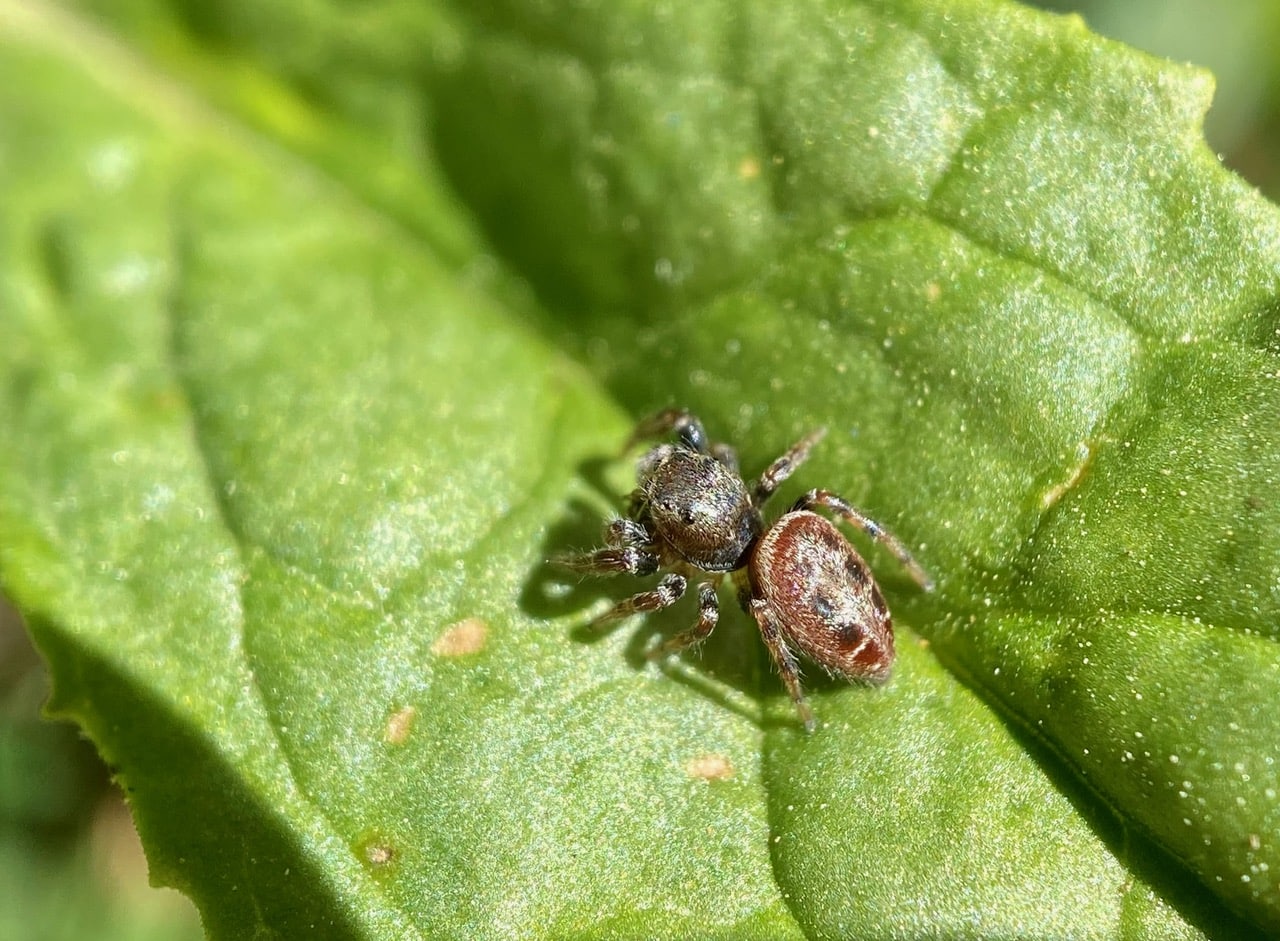
A young female Red-backed Jumping Spider, Phidippus johnsoni (family Salticidae) is hunting on a Bee Plant leaf.
The species is one of the largest and most commonly encountered jumping spiders in western North America. This individual is most likely a female. Males have an all-red abdomen. Salticids are free-roaming hunters. They do not weave a web to catch prey. They stalk, then pounce on their prey. Just before jumping, the spider fastens a safety line to the substrate. It can leap 10-20 times their body length to capture prey. Their movement is achieved by rapid changes in hydraulic pressure of the blood. Muscular contractions force fluids into the hind legs, which cause them to extend extremely quickly.
Phidippus johnsoni – Wikipedia
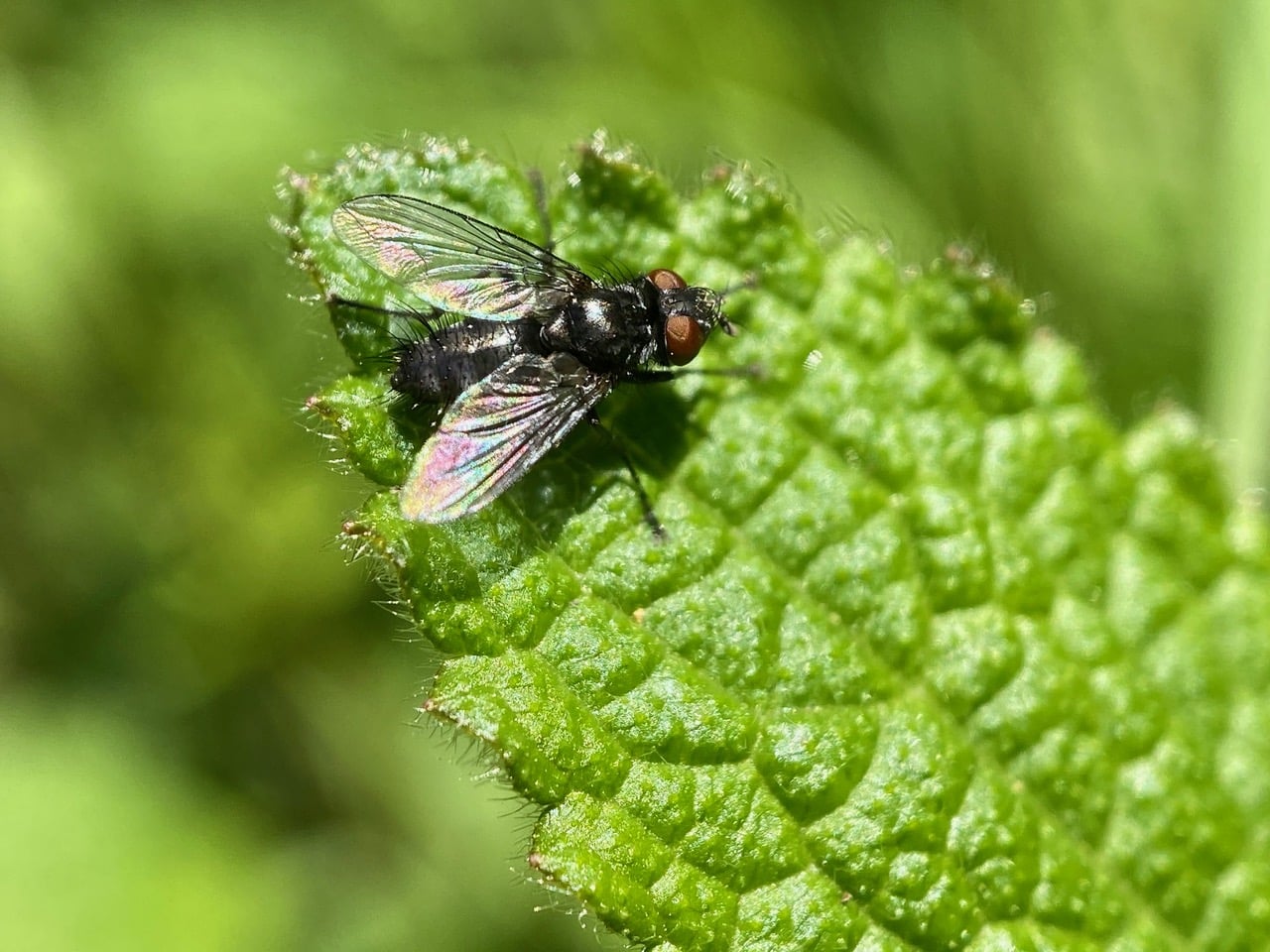
A small, dark and glossy fly lands on a Bee Plant leaf. It is a Woodlouse Fly, Stevenia deceptoria (family Rhinophoridae). These small, black, bristly flies are somewhat related to the Tachinidae. The larvae are mostly parasitoids of woodlice (pill bugs), beetles, spiders and other arthropods, and occasionally snails.

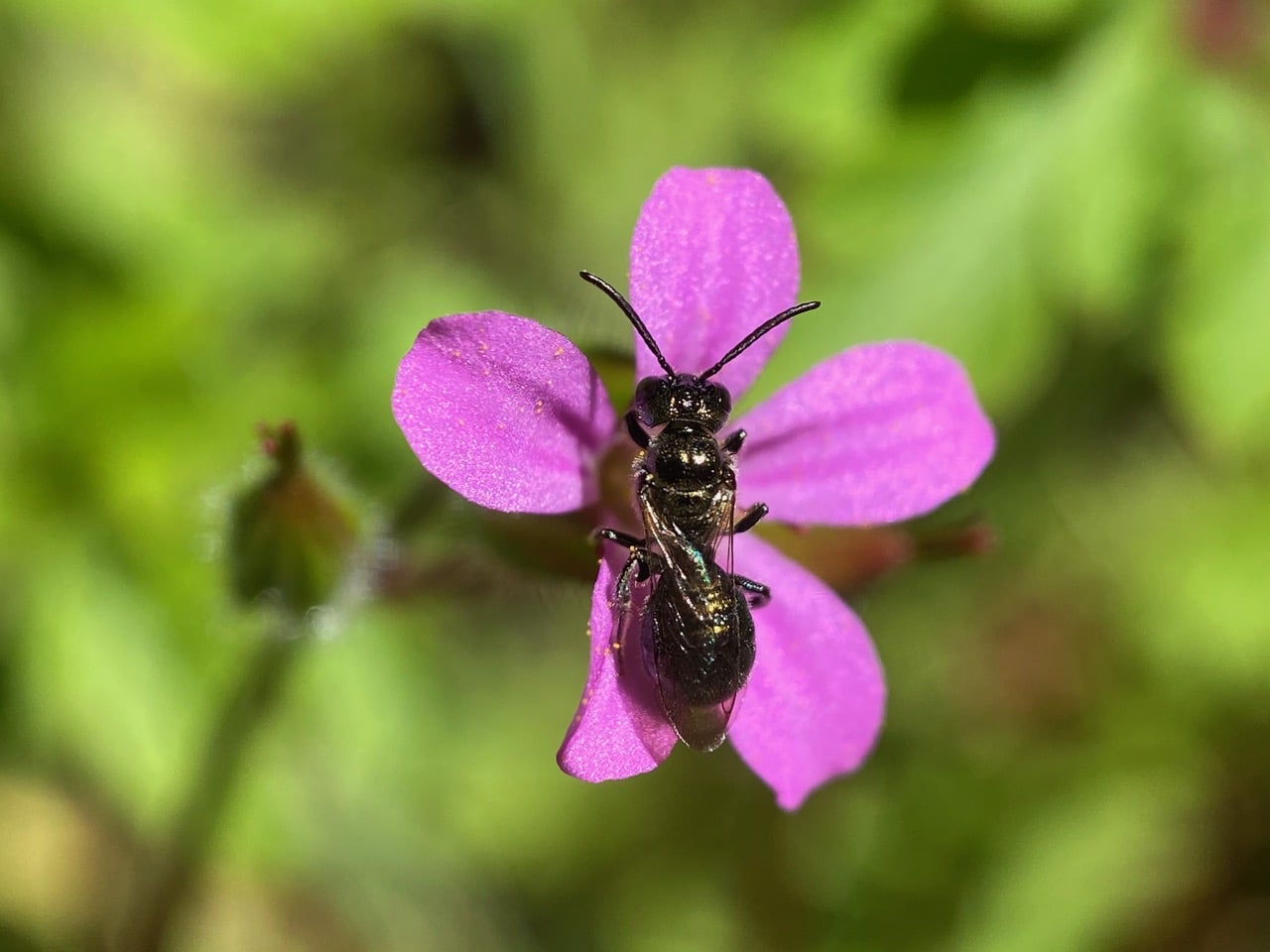
A very glossy black bee is taking nectar from a Wild Geranium flower. It is a male Small Carpenter Bee, Ceratina acantha (family Apidae), as evidenced by its long antennae and the lack of scopae on the hind legs.
The Small Carpenter Bee genus Ceratina is closely related to the more familiar, and much larger Carpenter Bees (genus Xylocopa). Ceratina are typically dark, shiny, even metallic bees, with fairly sparse body hairs and a weak scopa on the hind leg. The shield-shaped abdomen comes to a point at the tip. Some species have yellow markings, often on the face.
Females excavate nests with their mandibles in the pith of broken or burned plant twigs and stems. While many species are solitary, a number are subsocial. Both male and female carpenter bees overwinter as adults within their old nest tunnels, emerging in the spring to mate. In the spring, this resting place (hibernaculum) is modified into a brood nest by further excavation. The female collects pollen and nectar, places this mixture (called bee bread) inside the cavity, lays an egg on the provision, and then caps off the cell with chewed plant material. Several cells are constructed end to end in each plant stem.

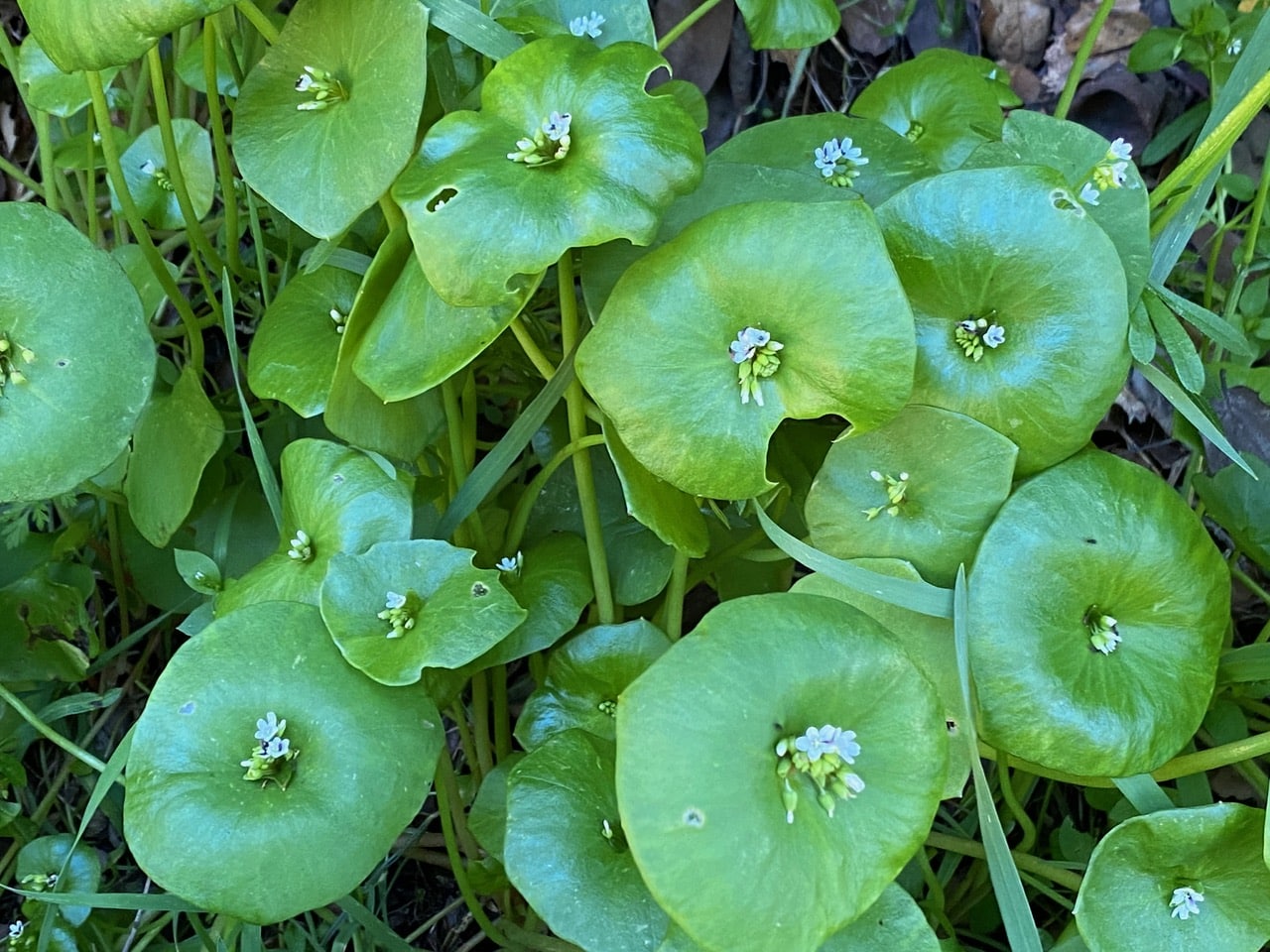
It is close to noon and getting hot. I veer to the shady side of the trail where the Miner’s Lettuce, Claytonia perfoliata is blooming profusely.
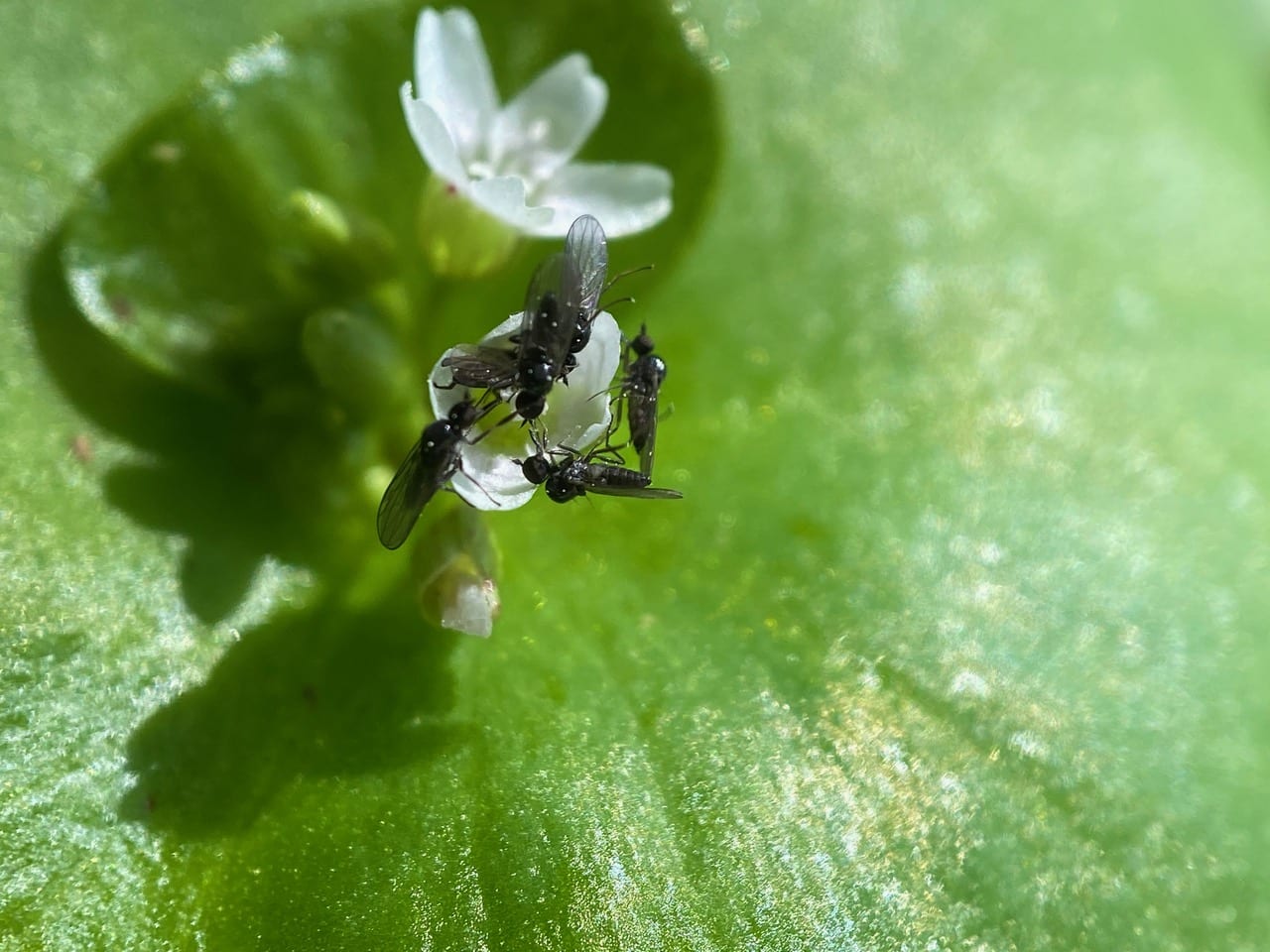
A few Hybotid Dance Flies (family Hybotidae) are crowded around a Miner’s Lettuce flower that isn’t even fully opened yet.
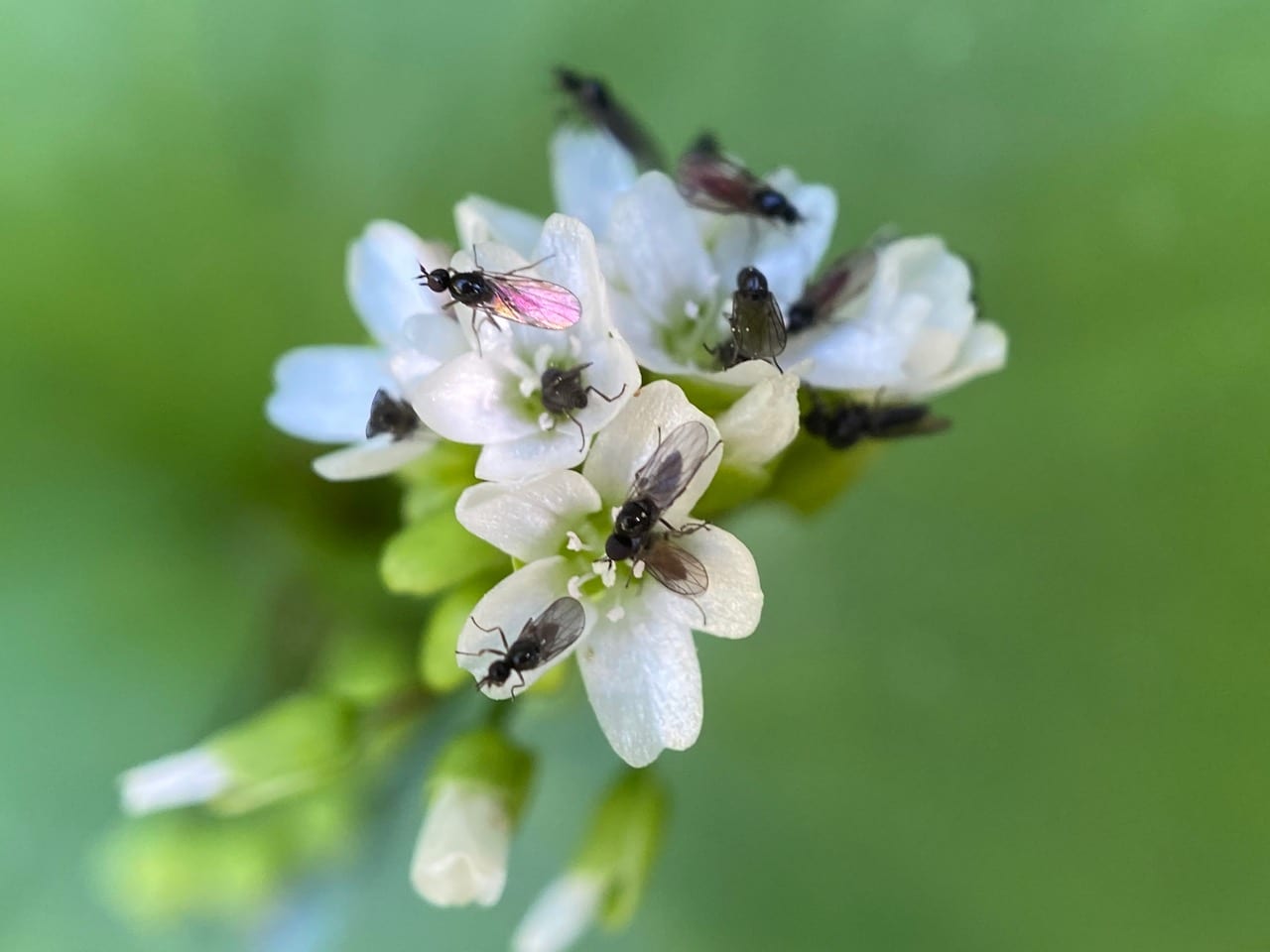
Wow, there’s a party happening on this cluster of Miner’s Lettuce flowers!
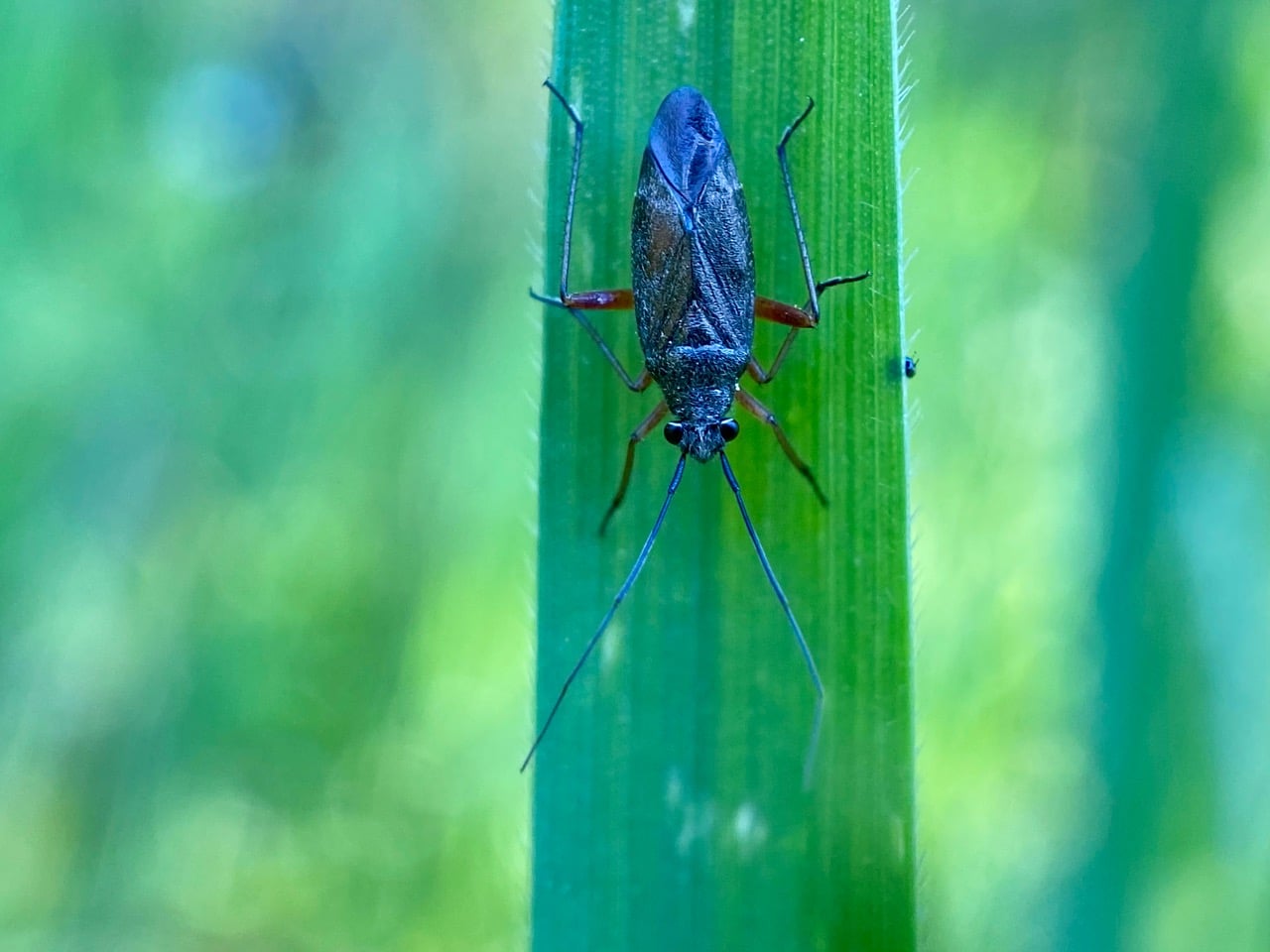
In the shade, a Black Grass Bug, Irbisia sp. (family Miridae) is perched on a blade of grass. It is a genus of plant bugs in the family Miridae.
Mirid bugs are also referred to as plant bugs or leaf bugs. Miridae is one of the largest family of true bugs in the order Hemiptera. Like other Hemipterans, Mirids have piercing, sucking mouthparts to extract plant sap. Some species are predatory. One useful feature in identifying members of the family is the presence of a cuneus; it is the triangular tip of the corium, the firm, horny part of the forewing, the hemielytron. The cuneus is visible in nearly all Miridae.
Irbisia is commonly found in chaparral, open woodlands and grasslands in western North America. The host plant for Irbisia are grasses (Poaceae), but late in the season the adults disperse to many other plants.

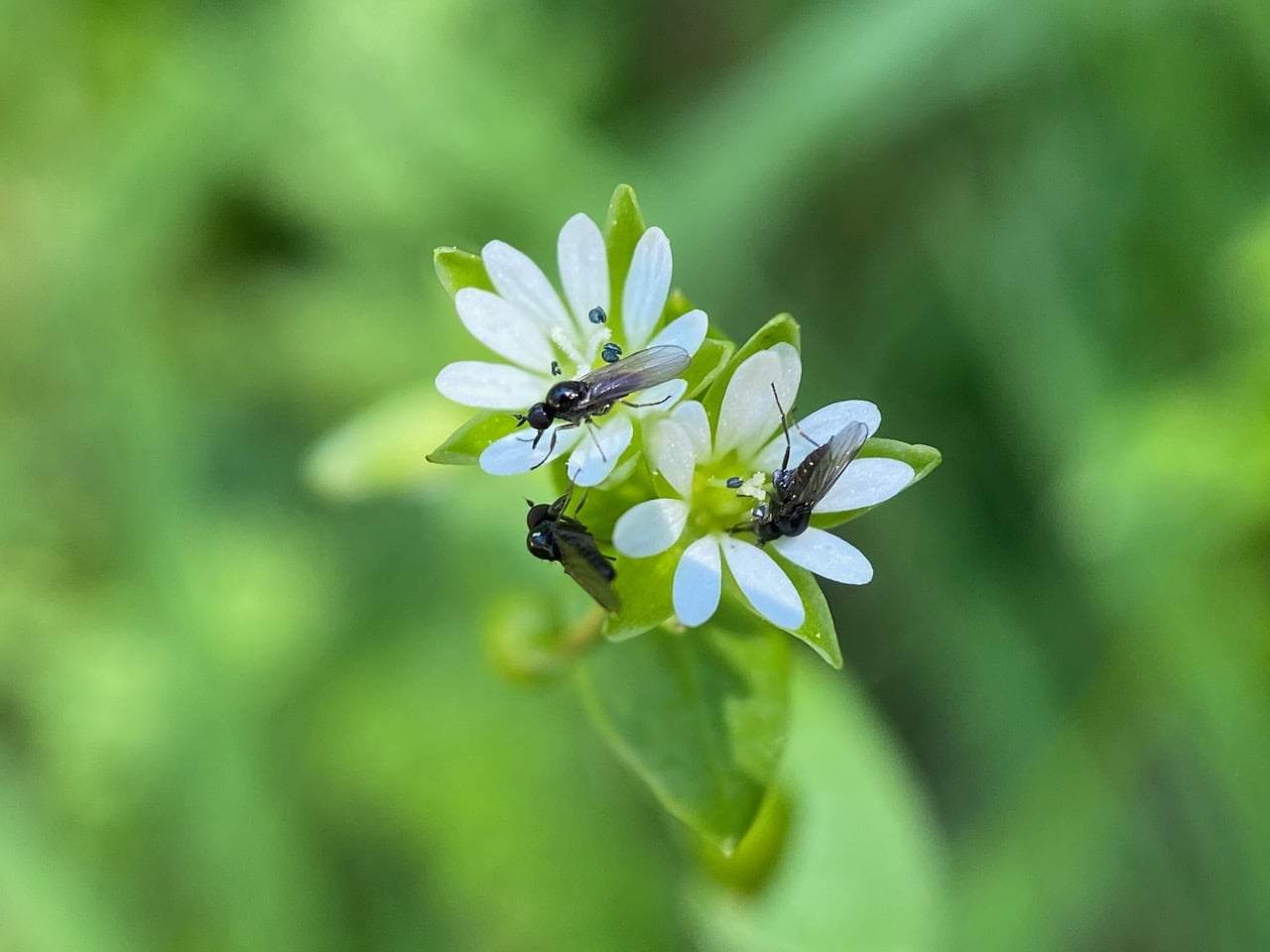
Hybotid Dance Flies foraging on the flowers of Common Chickweed, Stellaria media.
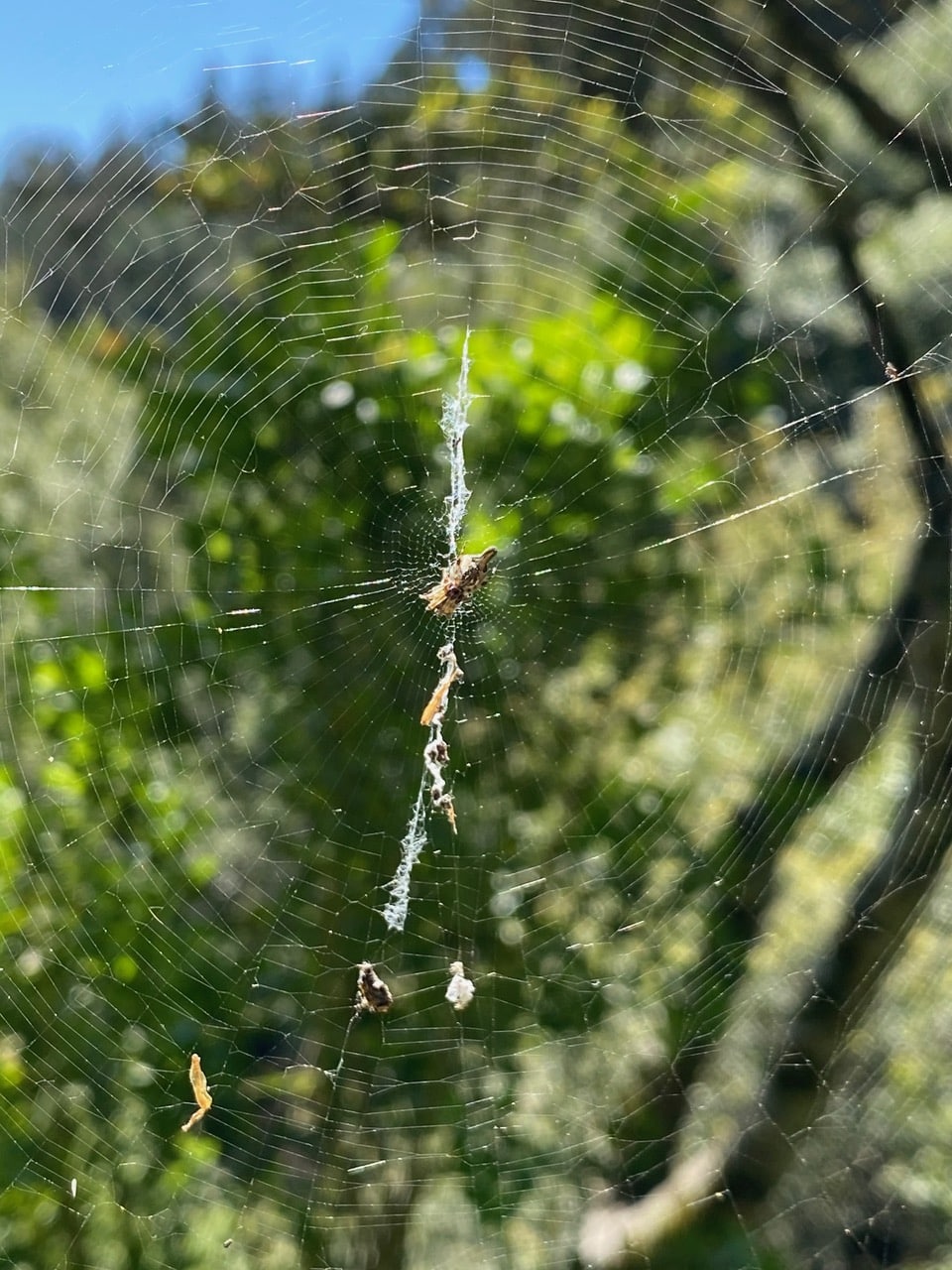
The bright sunlight highlights the web of the Conical Trashline Orbweaver, Cyclosa conica (family Araneidae) strung between the branches of shrubs. The spider has not been very successful today, as the heavy “trash line” that she has built vertically through the middle of the web is still relatively empty of insect carcasses.
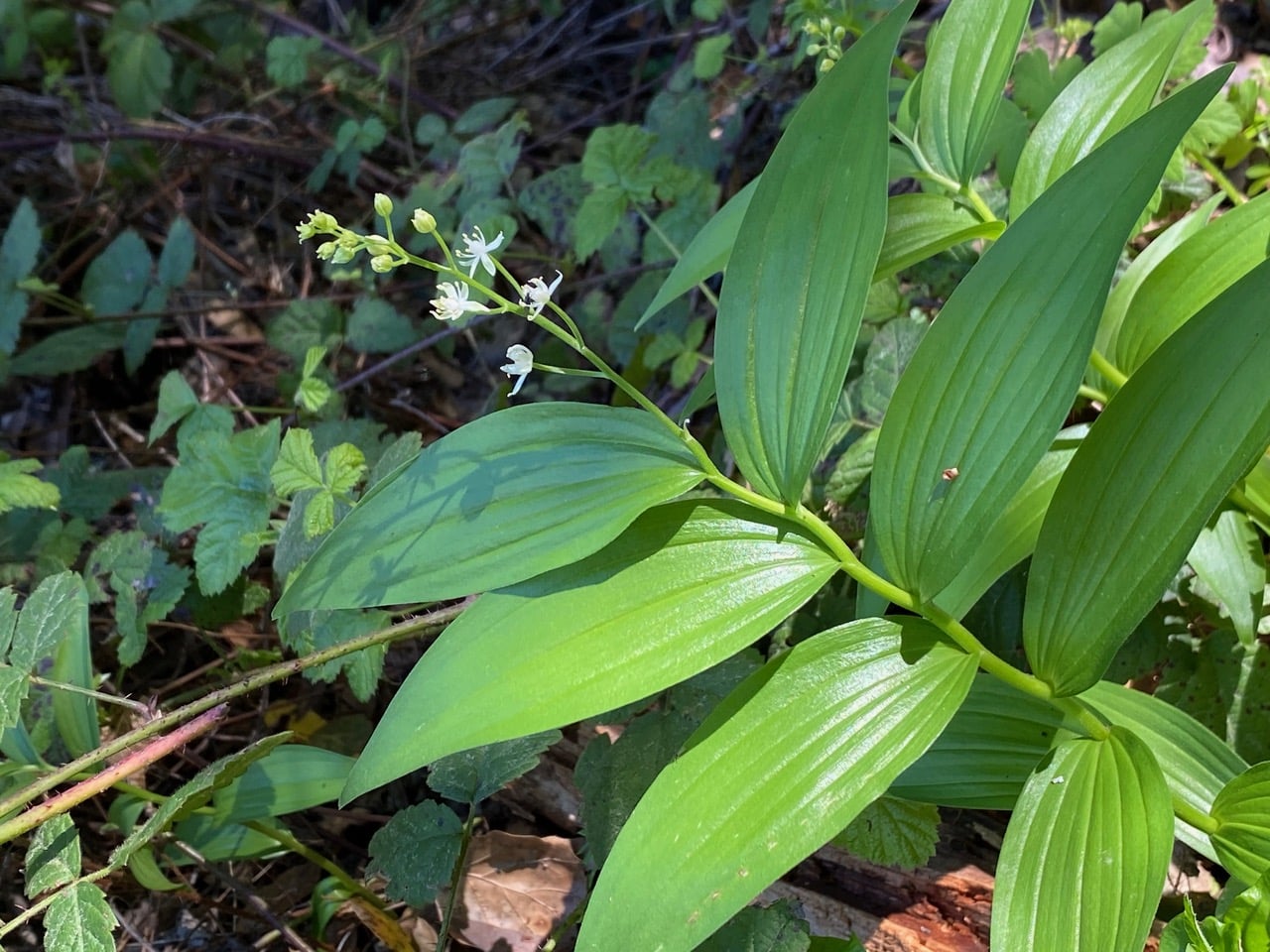
In the shade along the trail, some Star-flowered Lily-of-the-Valley, Maianthemum stellatum is blooming nicely.
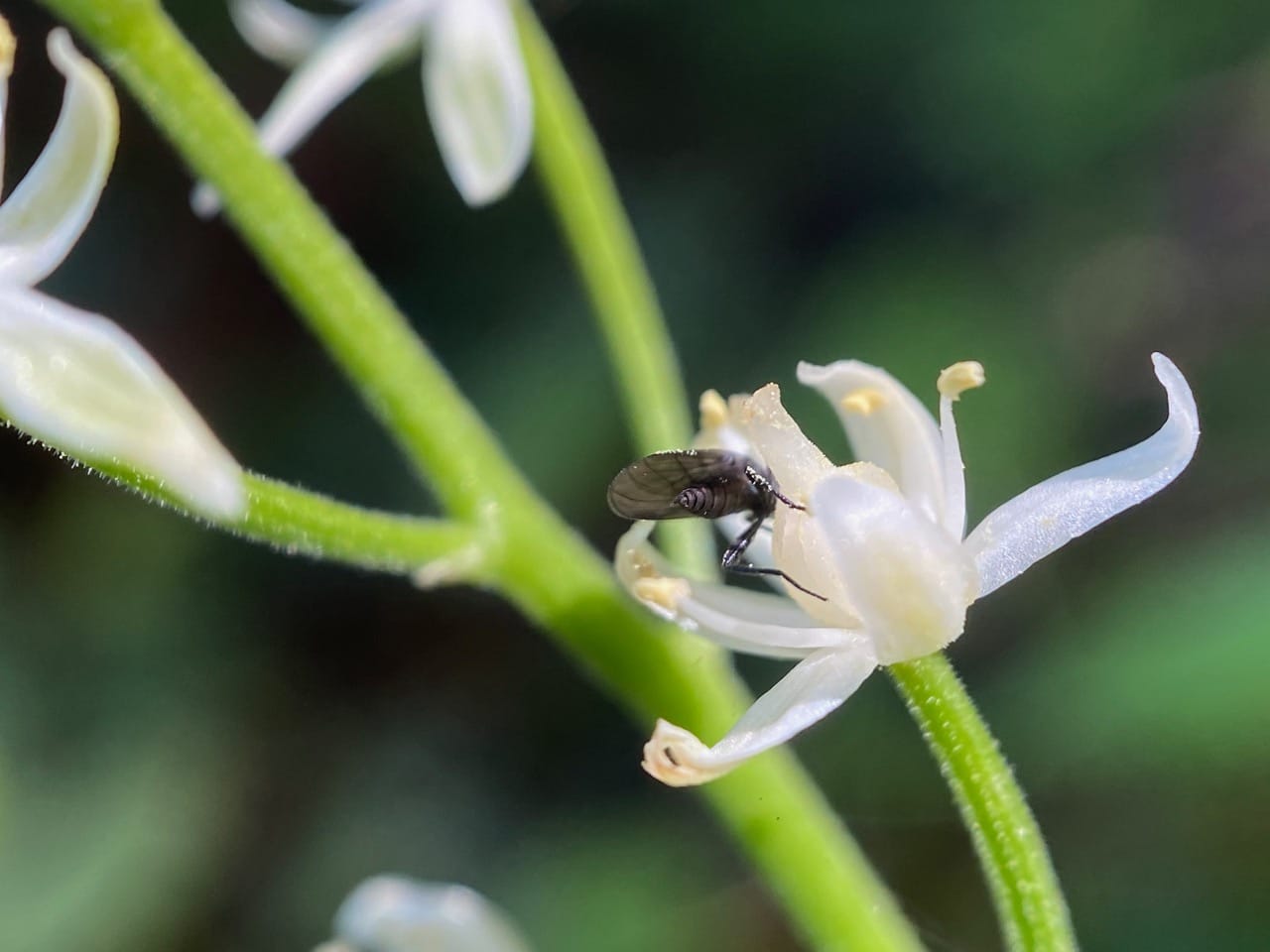
A Hybotid Dance Fly lands on one of the flowers, and climbs on the pistil.
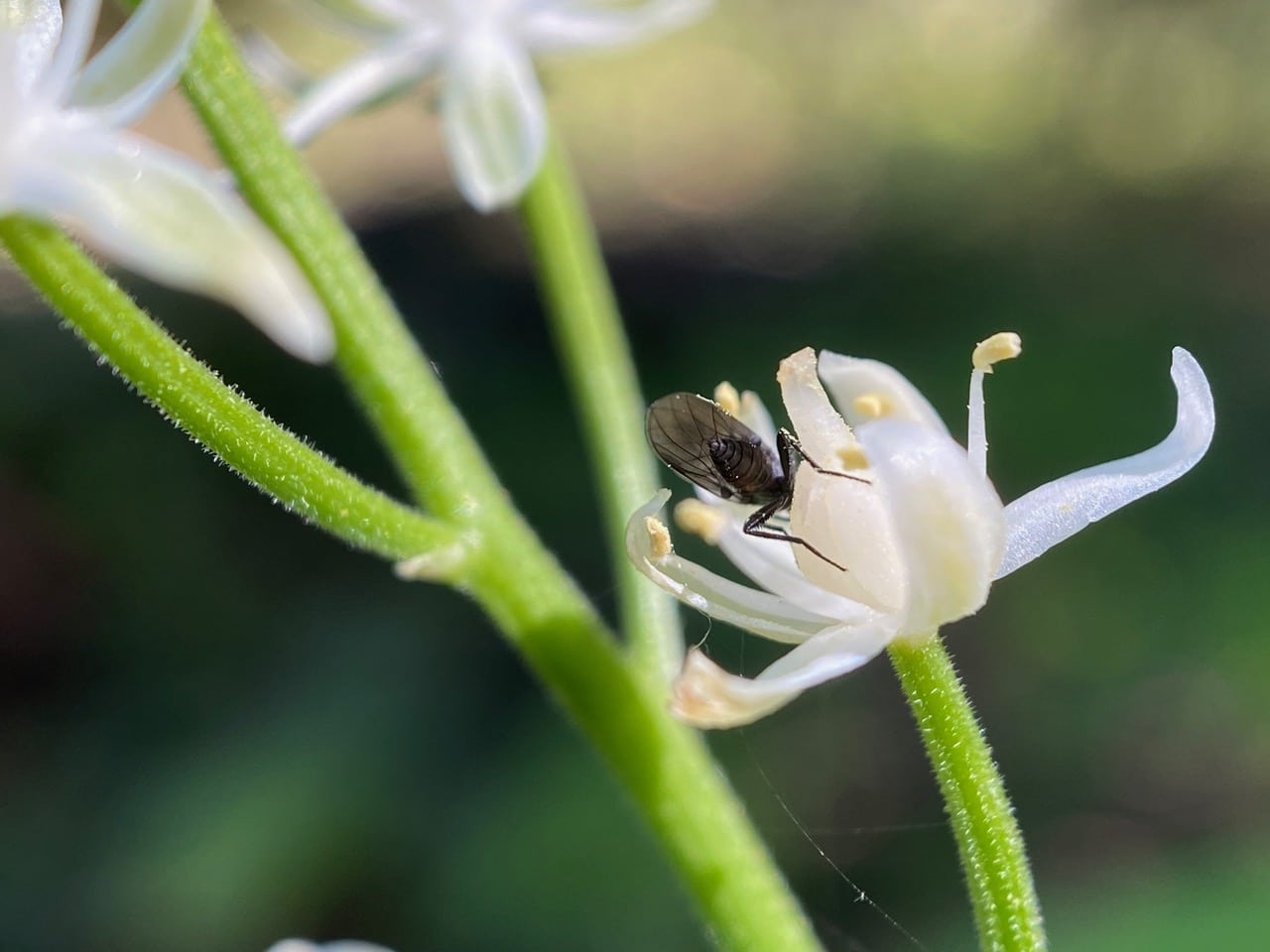
The fly angles itself downward to access nectar at the base of the flower.
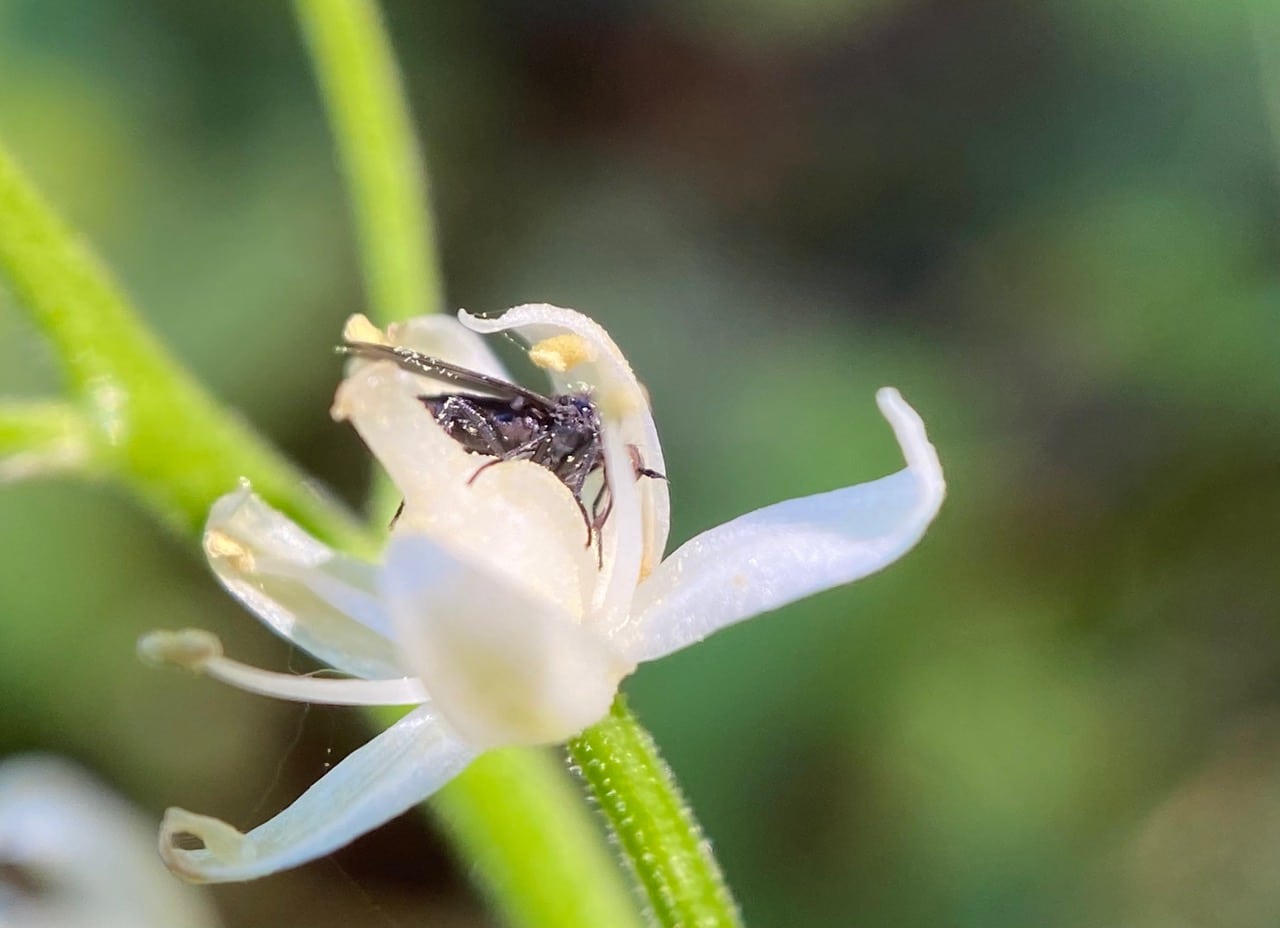
I see the fly trying to take nectar at the base of the flower, and in the process gets covered with pollen released from the surrounding arching stamens.
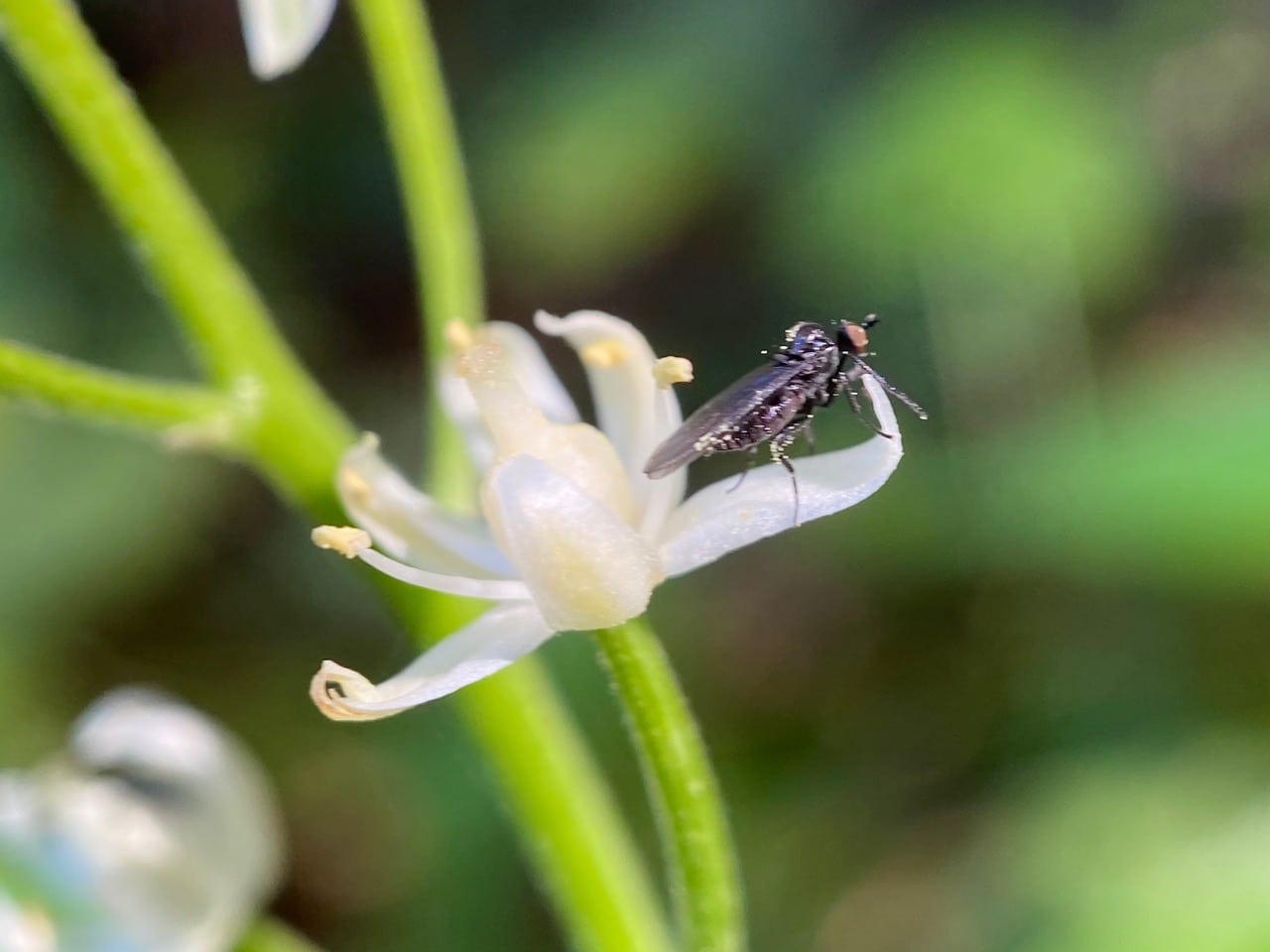
As the fly emerges from the flower covered with pollen, it grooms itself before flying off. The Hybotids appear to be the perfect size for pollinating the Star-flowered Lily-of-the-Valley. I think these avid seekers of nectar and pollen are responsible for pollinating this and many other native plants with small flowers. The little flies seem to be rather cold-tolerant, active during early spring when these host plants come into bloom.

Whoa, a Empidid Dance Fly lands abruptly on the tip of a Poison Oak twig in front of me. Instinctively I fire a few shots with my camera in quick succession before it flies off. It’s only when I review the photos that I realize that the fly is grasping a black insect it has captured in its hind pairs of legs. I have read extensively about the predatory behavior of these hunters, but have not actually witnessed it myself. Note the long, piercing-sucking proboscis of the fly, and its long legs so useful in holding prey.
Dance Flies, in the family Empididae, get their name from the habit of males of some species to gather in large groups and dance up and down in the air in the hopes of attracting females. They are predominantly predatory and they are often found hunting for small insects on and under vegetation in shady areas. Both genders may also drink nectar. Male dance flies give their sweeties a nuptial gift to eat while they mate. The gift is thought to enable her to complete the development of her eggs. Males may wrap their gifts in balloons of silk or spit.