

Pollinator Post 4/7/24
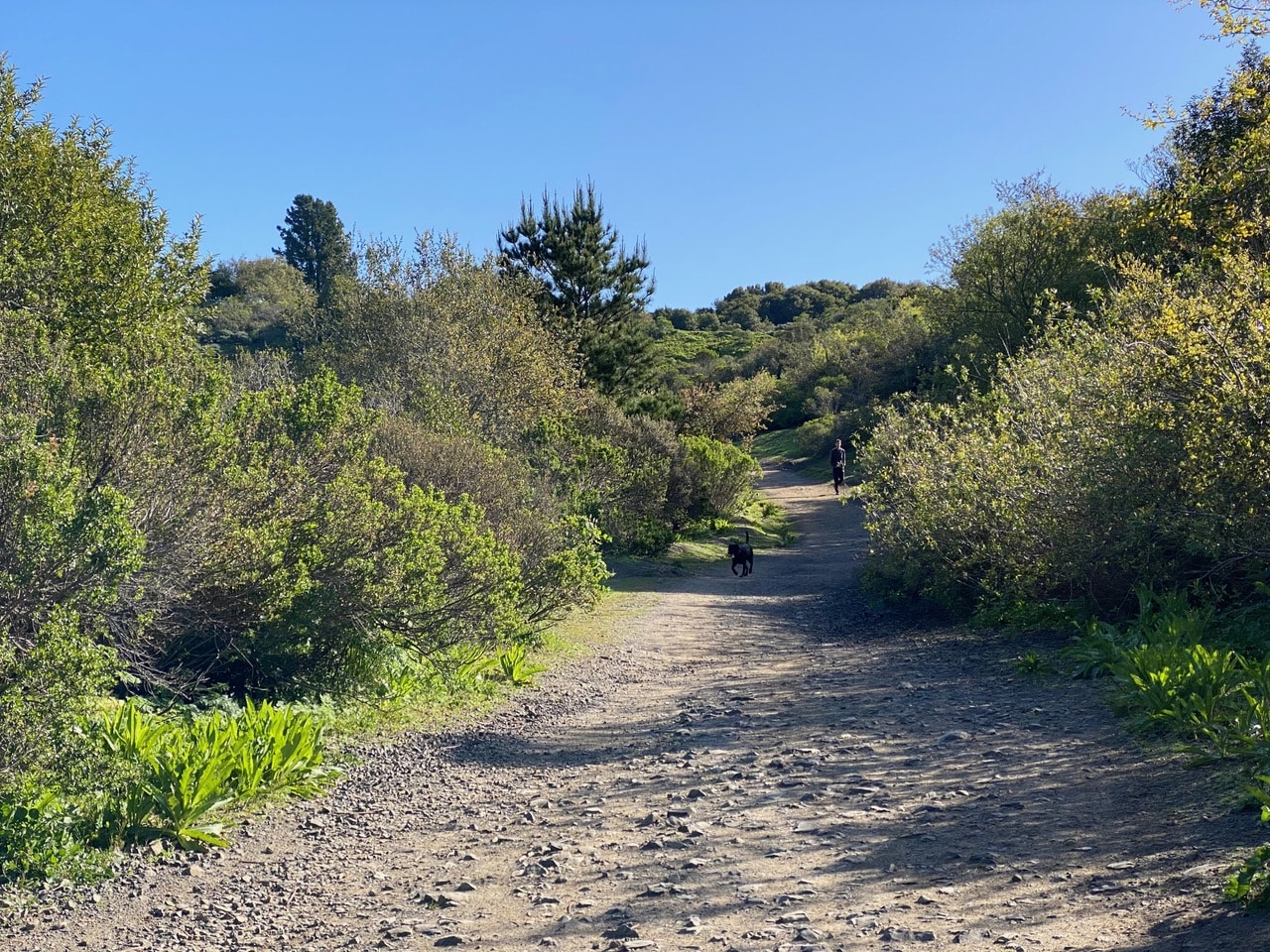
Longing for sunshine, I walk the open trails through the rolling hills of Sibley Volcanic Regional Preserve this cool, sunny morning.
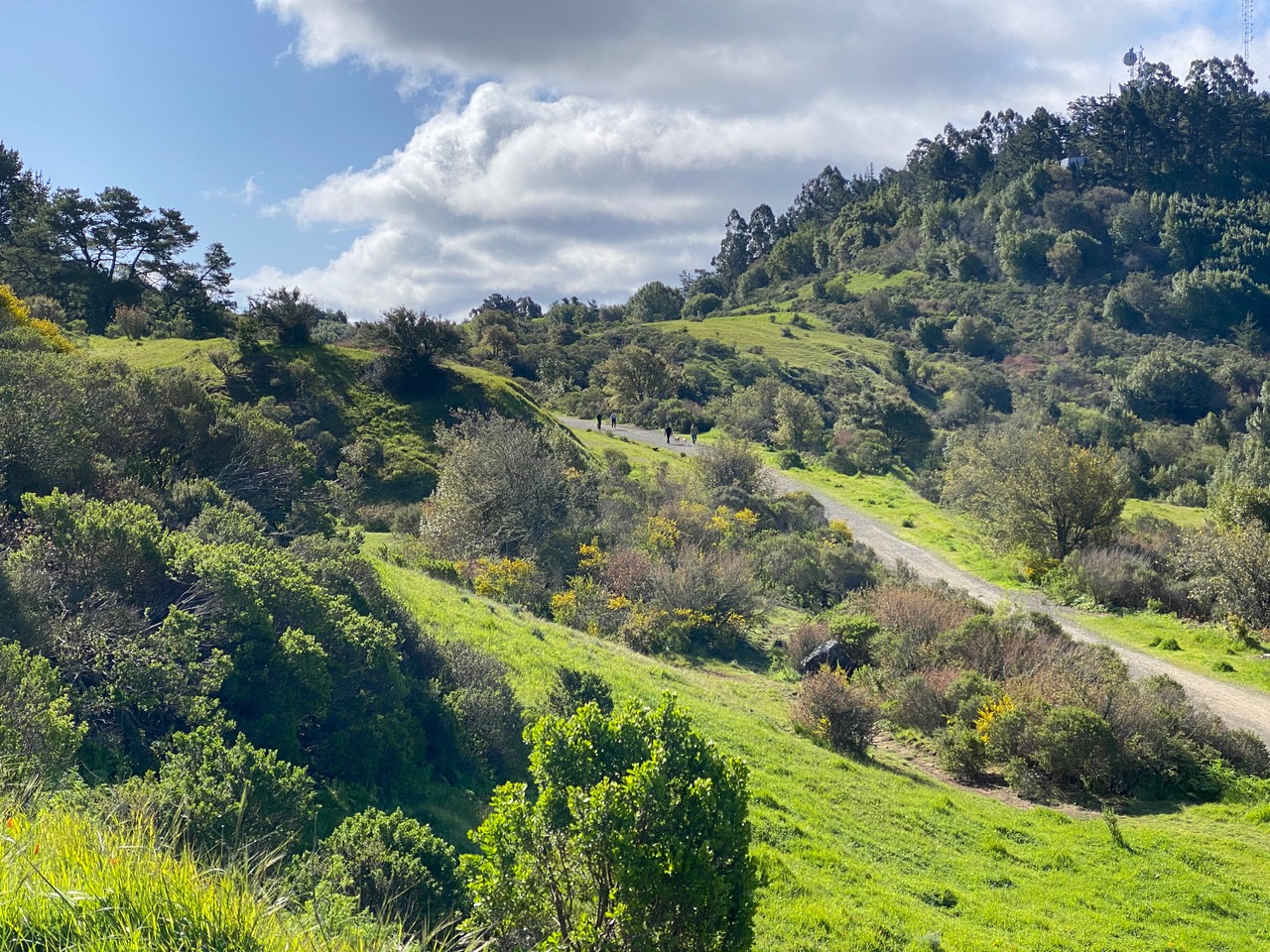
The hills are lush with every shade of green, the grasses taking on a neon hue.
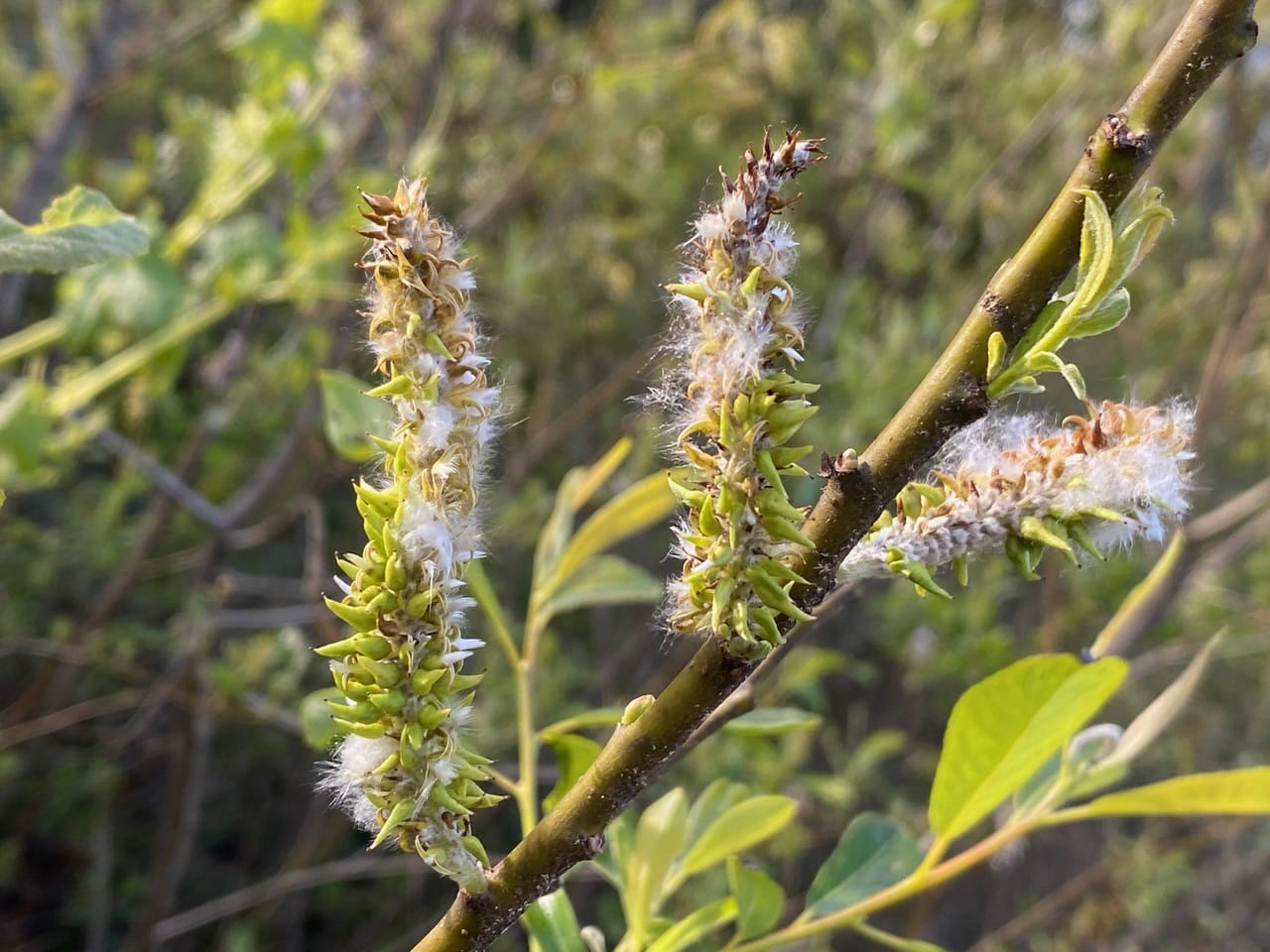
The catkins of a female Arroyo Willow, Salix lasiolepis have shed much of their fluffy plumed seeds. I wonder how seed dispersal by wind fared during the recent rains we had.
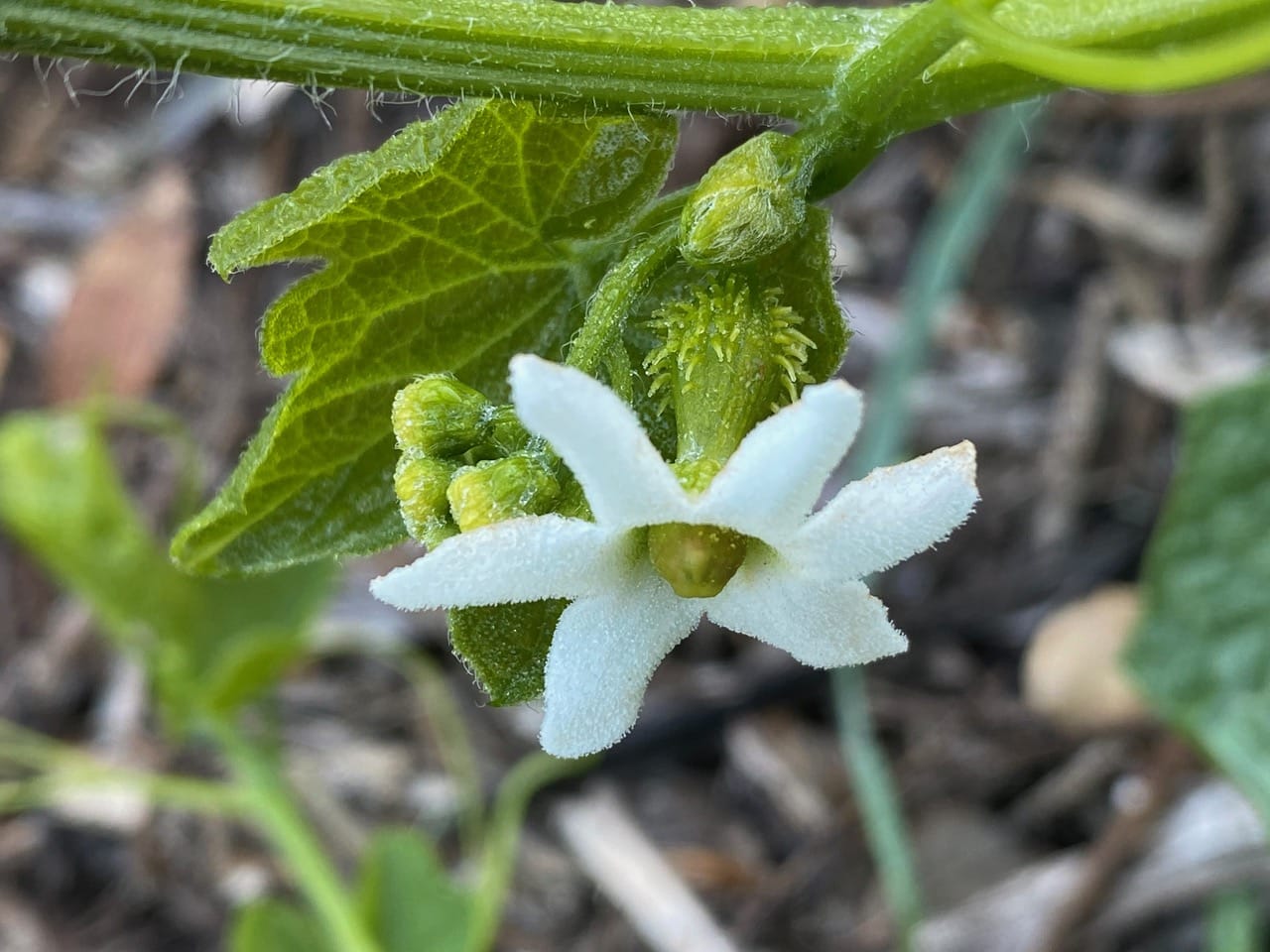
The Wild Cucumber, Marah oregana is still putting on a strong show along the trail. The monoecious plant is still producing new buds along the rambling vines. Here a female flower, already with a developing spiny fruit behind it, blooms next to a cluster of male flower buds emerging from the same leaf axil. It seems “ladies first” is the order of the day for Marah. Temporal separation of the sexes helps to prevent self-pollination, whether or not the sexes are in the same or separate flowers.

The Coast Live Oak, Quercus agrifolia has produced some new leaves and male catkins. What are those red swellings among the male flowers?
These are galls induced by the Kernel Flower Gall Wasp, Callirhytis serricornis (family Cynipidae). In its annual life cycle, this cynipid gall wasp induces two different galls on different parts of the oak in alternating generations. The galls on the catkins develop from the pollen sacs at the base of the flowers. Larvae feed on the gall tissues from within. Exit holes are conspicuous later in spring, as males and females of this generation emerge to reproduce and lay their eggs for the summer-fall generation. Females oviposit in the undersides of leaves in the veins. By July, the round green and red galls, about 1mm across, of this second, unisexual generation are noticeable. In the following spring, the unisexual females oviposit in the unopened buds of male flowers, and the cycle begins again. A tiny wasp with a mind-bending life cycle!
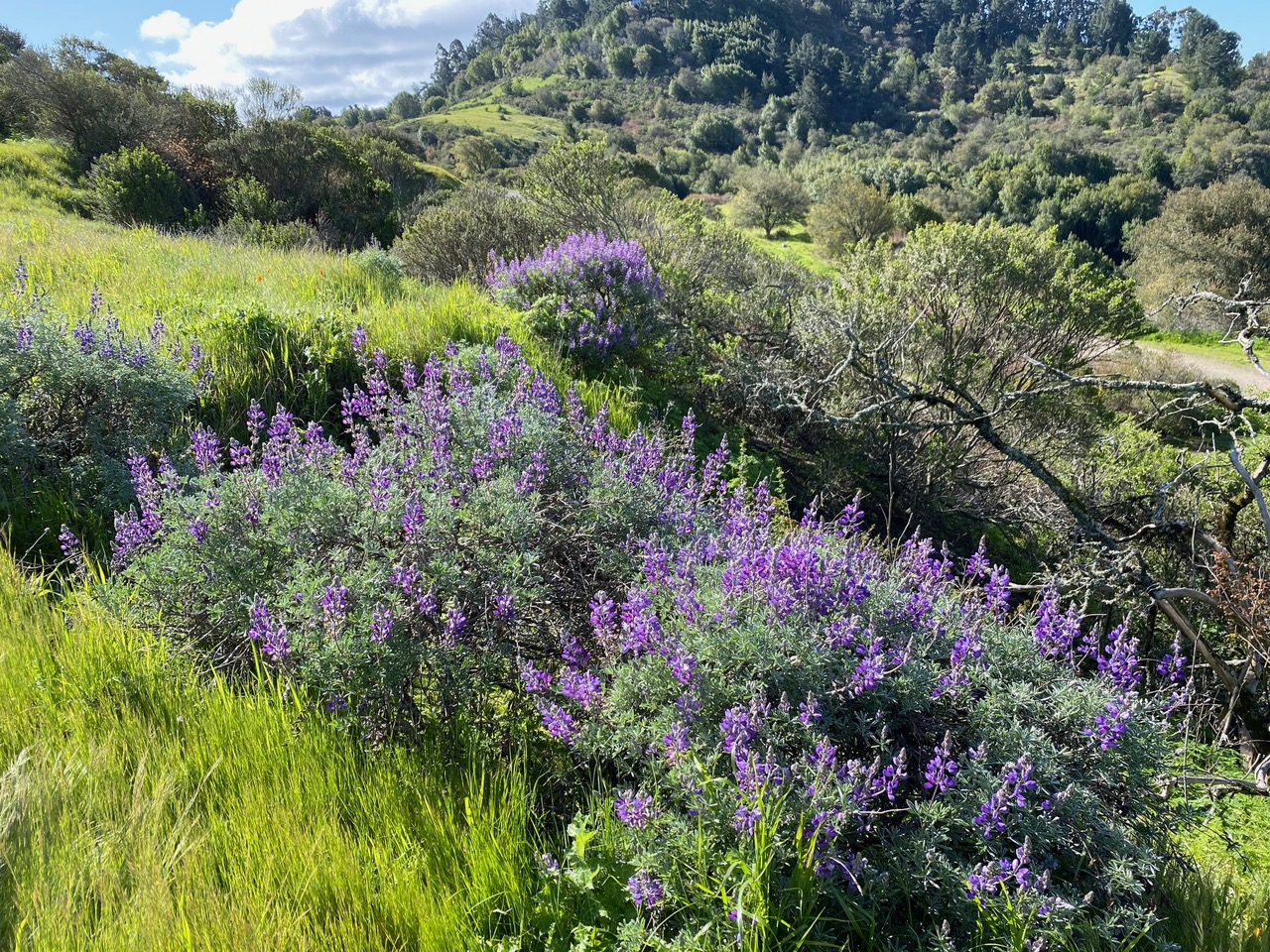
The Silverleaf Lupine, Lupinus albifrons has started to bloom in the preserve. I pause by these shrubs for a while, but see only a couple of Black-tailed Bumble Bees, Bombus melanopygus (family Apidae) forage among the flowers. Perhaps it’s too cold, temperatures hovering in the low 50s F?
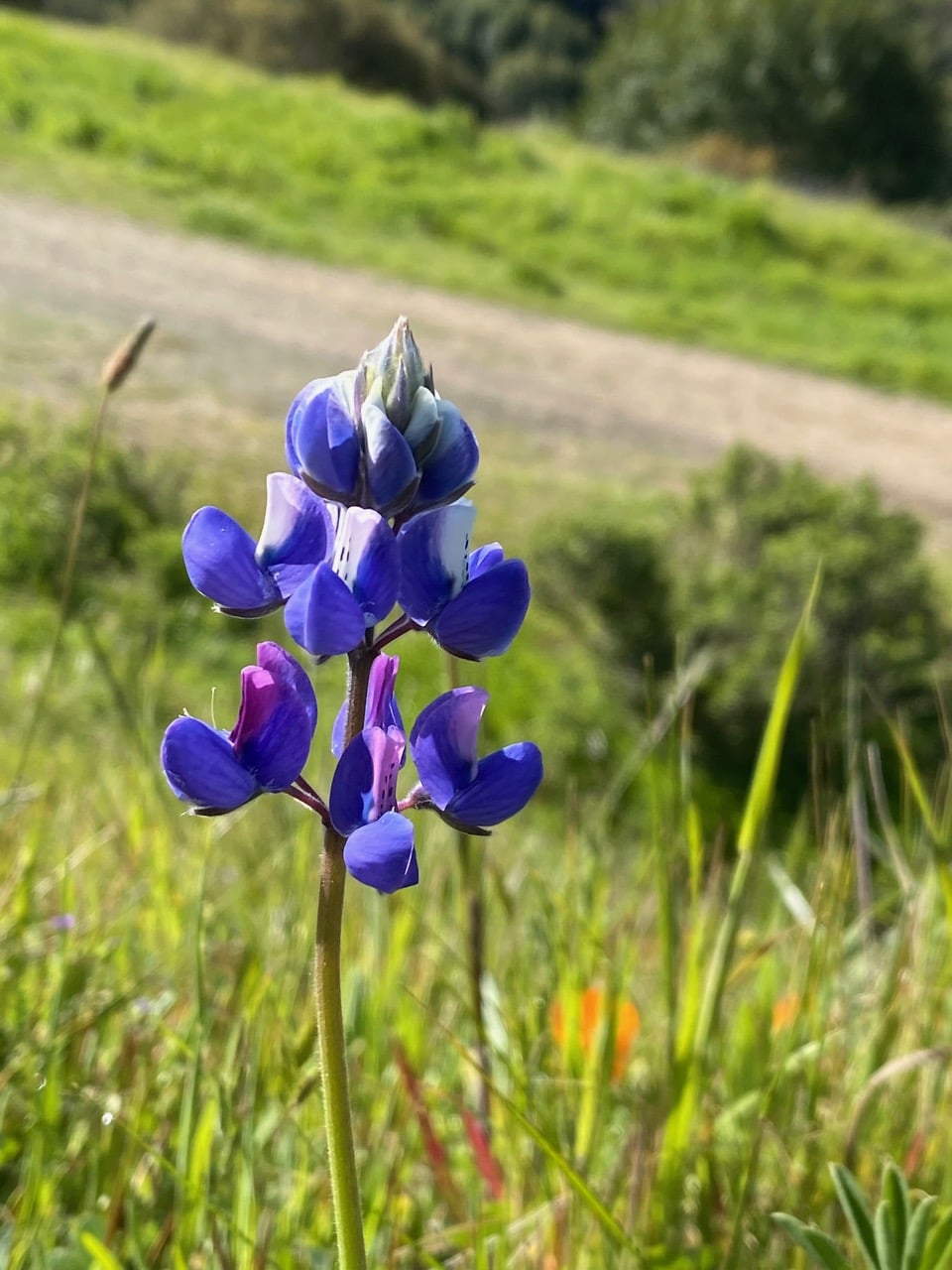
On the open grassy slopes, a much smaller species of lupine is blooming – the Sky Lupine, Lupinus nanus. The lower flowers on this spike
with reddish banners appear to have been pollinated. Most lupine flowers that have been visited by a heavy-bodied bee get “tripped”, exposing their reproductive parts through the lower petals. They also change colors.
Note that the top flowers have white banners (upper, erect petals). After the flowers are pollinated, the banners turn reddish-purple when the levels of the anthocyanin pigment rises 3-5 time. The color change is a response to ethylene (a gaseous plant hormone) produced by the pistil (female part of the flower) after it has been pollinated and is no longer receptive. Bees’ eyes are sensitive to white, but are blind to red hues. Bumble Bees, who are the lupine’s principal pollinators use the color change to guide them to the fresh flowers with the biggest rewards. This arrangement benefits both the plant and pollinator, maximizing pollination efficiency.
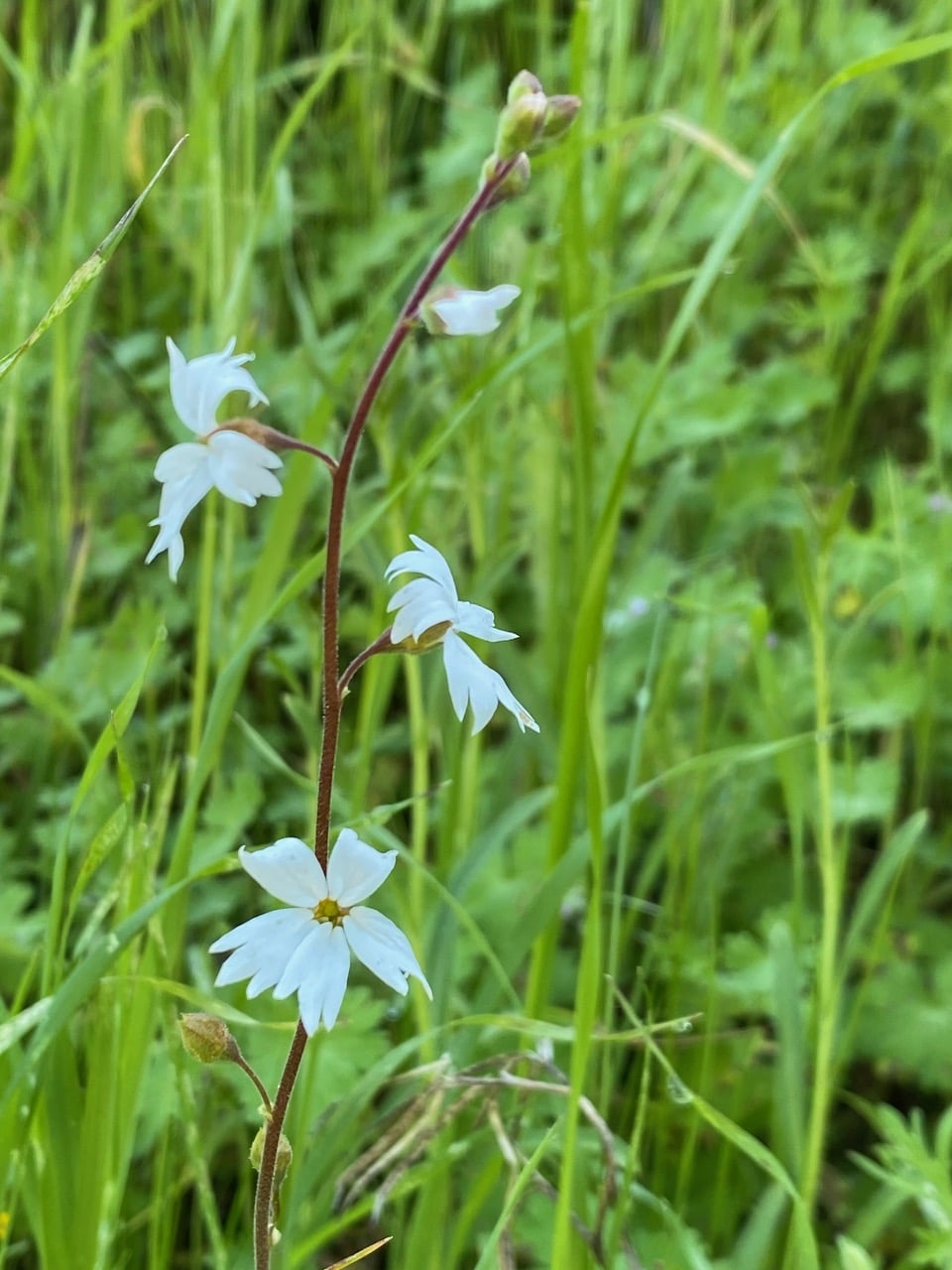
A spike of flowers of the Woodland Star, Lithophragma affine (family Saxifragaceae) has shown up among the grasses in a shady spot.
The five petals of Woodland Star, Lithophragma affine (family Saxifragaceae) are bright white with deep long lobes or teeth. A study has found a remarkable diversity in the scent compounds produced by the flowers. Every species of woodland star produces a unique floral bouquet to attract specialized pollinators. The plant has coevolved with a group of specialized moths in the genus Greya, that pollinate and lay eggs only in woodland star flowers. It is a sort of love-hate relationship. Although the plants lose some of their developing seeds to the moth larvae, the benefits the plants receive from pollination usually outweighs the costs.
Many of us are familiar with the story of the Yucca and the Yucca Moths, a much-celebrated mutualism between the plant and its pollinators. Well, like the Yucca Moths, the Greya moths that pollinate the Woodland Star are in the family Prodoxidae! In both cases, the moths visit the flowers to lay eggs, not to seek food. In the process of oviposition, their bodies come into contact with the pollen of the flower. This mode of pollination is termed brood site or nursery pollination. So tight is the mutualism that every species of Lithophragma is pollinated by its own species of Greya moth!
As in most moths, the Greya moths are nocturnal and navigate their world predominantly by their sense of smell. White flowers show up well in the moonlight, and scents travel just as well in the dark. The Woodland Star and the moths have shaped each other’s evolution.
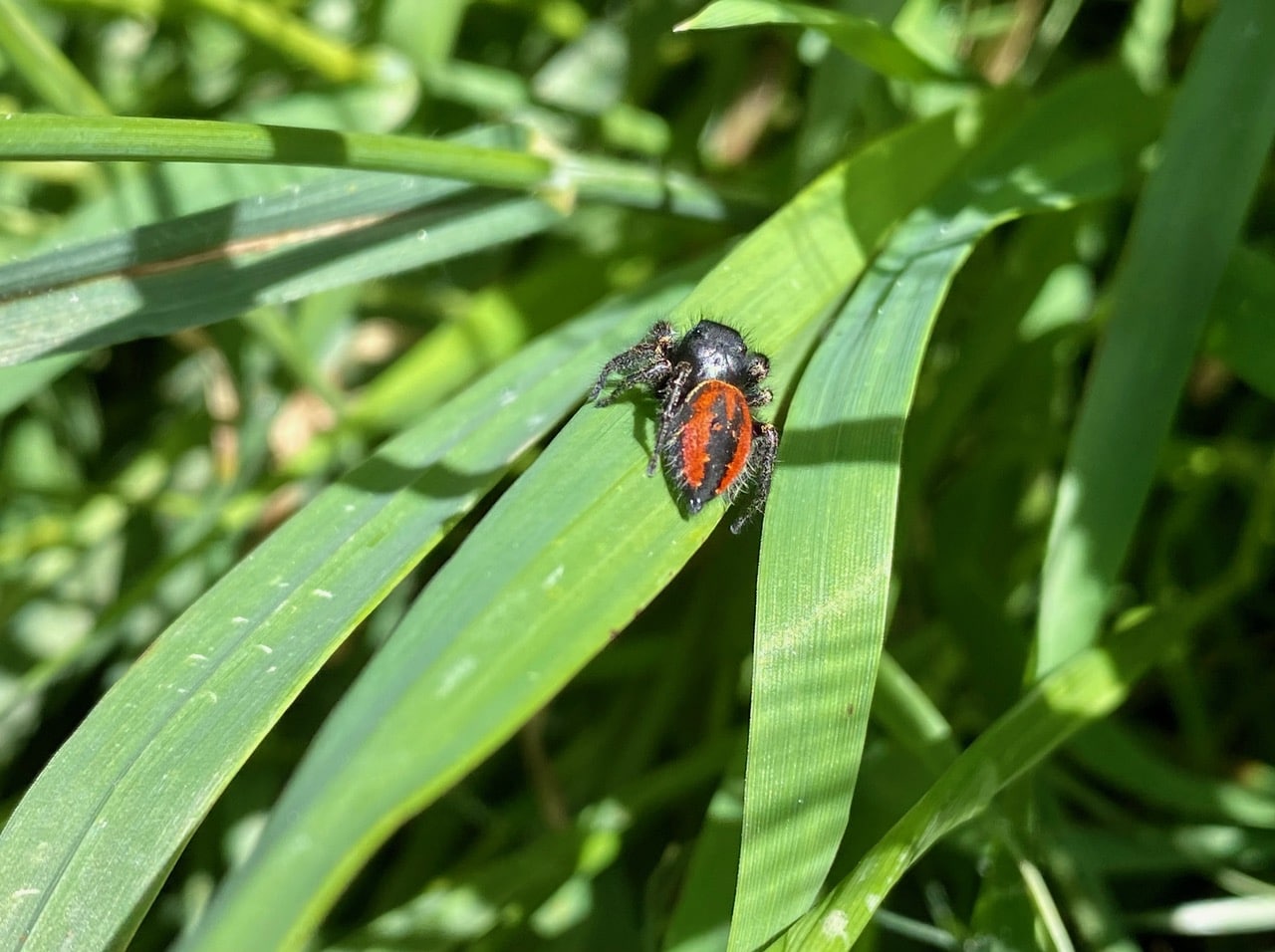
Ooh, that’s a large Red-backed Jumping Spider, Phidippus johnsoni (family Salticidae)!
The species is one of the largest and most commonly encountered jumping spiders in western North America. This individual is a female. Males have an all-red abdomen. Salticids are free-roaming hunters. They do not weave a web to catch prey. They stalk, then pounce on their prey. Just before jumping, the spider fastens a safety line to the substrate. It can leap 10-20 times their body length to capture prey. Their movement is achieved by rapid changes in hydraulic pressure of the blood. Muscular contractions force fluids into the hind legs, which cause them to extend extremely quickly.
I once kept a female Red-backed Jumping Spider as a pet for a few weeks, watching her pounce with incredible precision on the live flies I caught for her. I finally had to let her go when she began to display nesting behavior, ready to lay eggs. My love affair with Salticids persists to this day, and the spiders have always been easy to photograph.
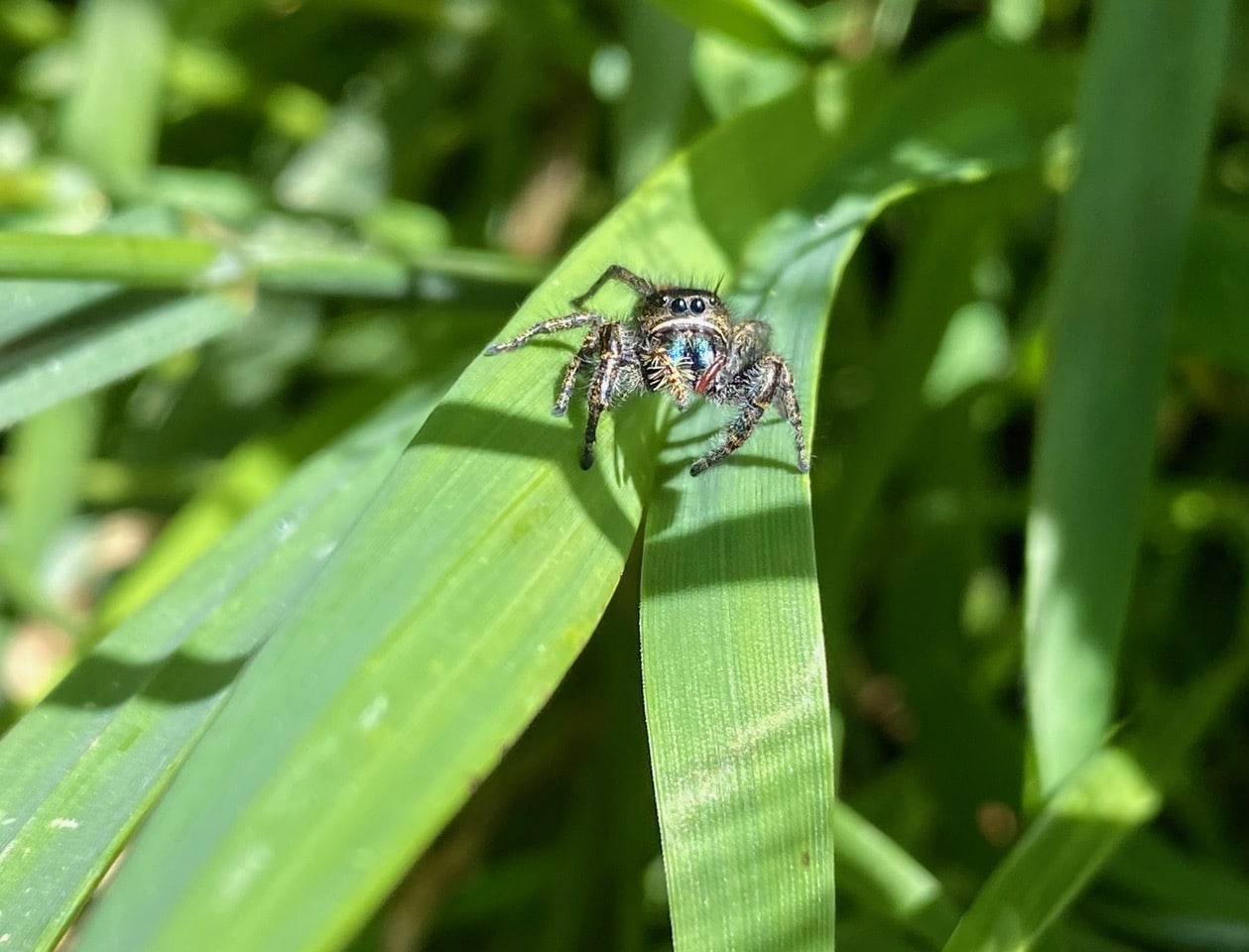
The spider spins around to face me, an endearing behavior typical of these bold and intelligent spiders. Her pair of iridescent blue chelicerae shimmer beautifully in the sunlight, partially covered by her pedipalps (one of which seems to have lost most of its bristles). The chelicerae are articulated fangs that are hollow and contain venom glands, used to inject venom into prey. The pedipalps are jointed appendages, much like small legs. They are used by the spider to sense objects, shape their webs, and to aid in prey capture and feeding. In male spiders, the pedipalps are also used to deliver sperm during mating.
Jumping spiders have excellent vision, with among the highest acuities in invertebrates. The 8 eyes are grouped four on the face (the two big Anterior Median Eyes in the middle, and two smaller Anterior Lateral eyes to the side), and four on top of the carapace. The anterior median eyes provide high acuity but small field of view, while the other six eyes act like our peripheral vision, with lower resolution but broad field of view. Since all eight eyes are fixed in place and can’t pivot independently from the body like human eyes can, jumping spiders must turn to face whatever they want to see well. This includes moving their cephalothorax up and down, an endearing behavior.
