

Pollinator Post 4/12/24 (2)
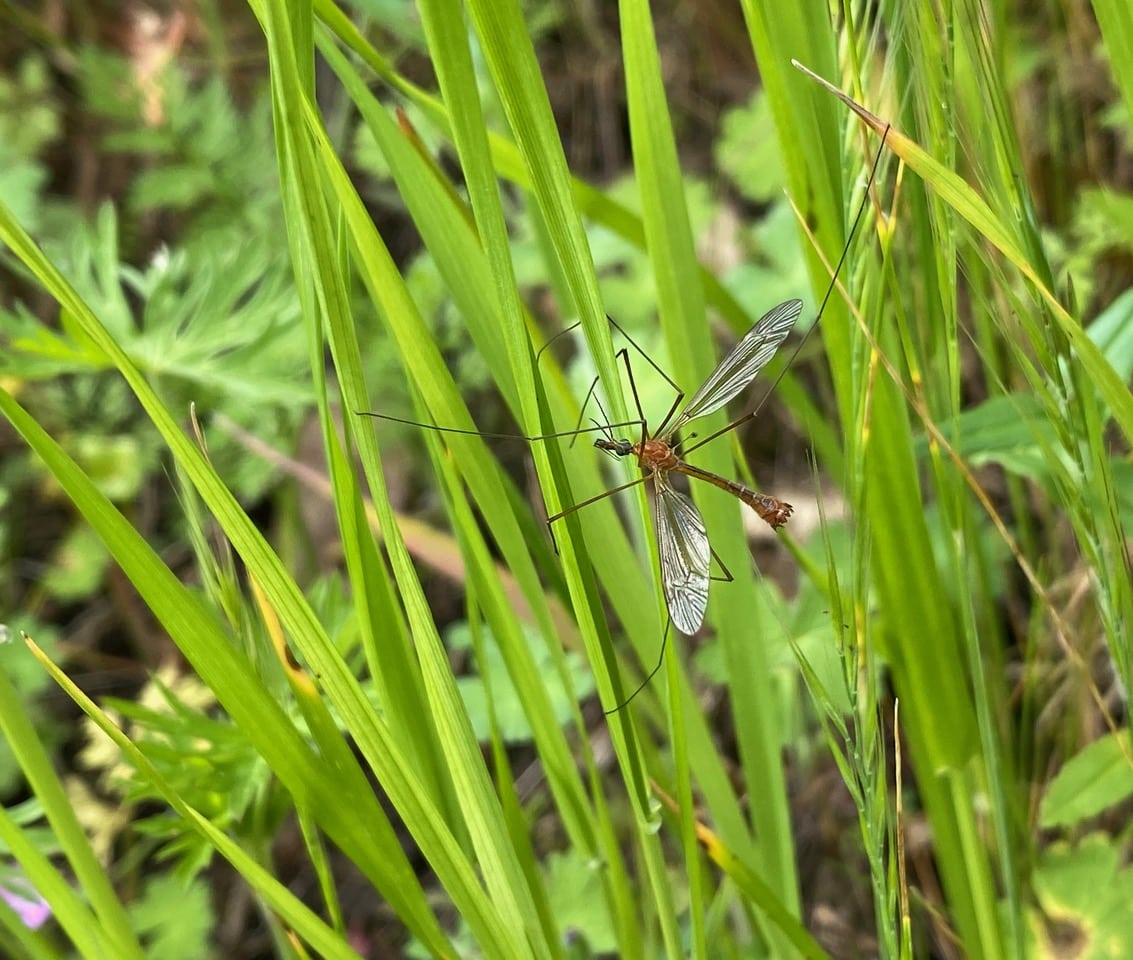
A large Crane Fly (family Tipulidae) lands clumsily on the low grasses. Why do insects evolve such unwieldy, cumbersome long limbs?
Crane flies resemble oversized mosquitos. They typically have a slender body and long, stilt-like legs that are deciduous, easily coming off the body. They occur in moist, temperate environments such as vegetation near lakes and streams. Adults generally do not feed, but some species consume nectar and pollen. Larval habitats include all kinds of freshwater, semiaquatic environments. They generally feed on decaying plant matter and microbes associated with decomposition. Their activity is important in the soil ecosystem, as they process organic material and increase microbial activity. Larvae and adult crane flies are also valuable prey items for many animals, such as insects, spiders, fish, amphibians, birds, and mammals.

The Blue Dicks, Dipterostemon capitatus has popped up among the grasses on the drier slopes.

An Odorous House Ant is crawling on the white filament sheaths that protect the stamens of a Blue Dicks flower. Is it looking for pollen?
The Odorous House Ant, Tapinoma sessile (subfamily Dolichoderinae, family Formicidae) is native to North America, ranging from southern Canada to northern Mexico. The species is found in a vast diversity of habitats, including within houses. The ants mainly feed on floral nectar and other sugary food. They also forage for honeydew produced by aphids and scale insects that they guard and tend.
Odorous House Ants are small ants, the workers measuring 2-3 mm. As in all members of the subfamily Dolichoderinae (odorous ants), this species does not possess a sting, instead relying on the chemical defense compounds produced from the anal gland. Such compounds are responsible for the smell given off by the ants when crushed or disturbed.
T. sessile colonies are polydomous (consist of multiple nests) and polygynous (contain multiple reproductive queens). The species practices seasonal polydomy – the colony overwinters in a single nest, and forms multiple nests during spring and summer when resources are more abundant and spread out.
The Odorous House Ants are rather docile, with little propensity for attack, preferring to use chemical secretions instead of biting. For this reason they are vulnerable to the invasion of the aggressive Argentine Ants, Linepithema humile.

I am startled to find a large white Crab Spider, Misumena sp. (family Thomisidae) sitting in a Blue Dicks flower with its two long pairs of front legs outstretched in a predatory pose.
Members of the family Thomisidae do not spin webs, and are ambush predators. The two front legs are usually long and more robust than the rest of the legs. Their common name derives from their ability to move sideways or backwards like crabs. Most Crab Spiders sit on or beside flowers, where they grab visiting insects. Some species are able to change color over a period of some days, to match the flower on which they are sitting.

Sensing my presence, the spider leaves her post and clambers down the flower cluster. Wow, she’s the largest, most mature Crab Spider I have seen so far this season.

Anchoring herself with a bit of silk from her spinneret, the spider is protecting herself from a fall by securing a drop line to the flower. She is relocating her ambush to the base of the flower cluster.

Her front legs outstretched, the trap is set again!

The English Plantain, Plantago lanceolata, a perennial plant is frequently viewed as a weed throughout North America. Although it is native to Eurasia, its range now extends to every continent. This plantain prefers disturbed areas, including open grasslands and waste lands. The talll inflorescence springs from a rosette of basal leaves and bears many flowers clustered together in a short spike. The flowers develop first at the base and the female parts mature before the male parts (protogyny). In the female phase, delicate, white, feathery styles protrude from the spike to receive incoming pollen.

In the male phase, the stamens protrude to release pollen to the wind. The large anthers are held on long, hair-like filaments. Although thought to be wind-pollinated, it has been observed that Honey Bees frequent the flowers.
The Common Buckeye butterflies often use the English Plantain as a food plant for its larvae.
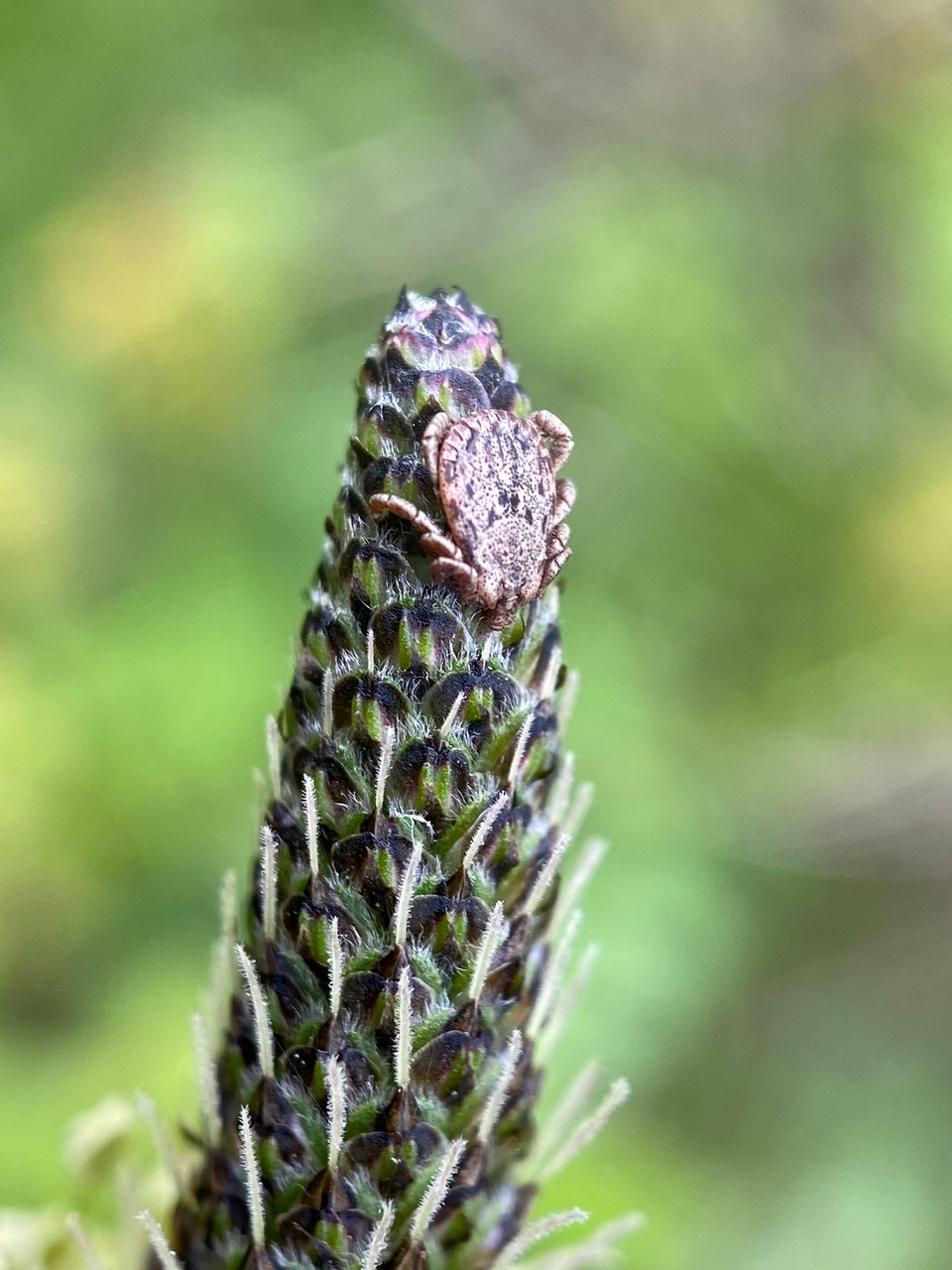
Flat as a pancake, a Pacific Coast Tick, Dermacentor occidentalis clings tightly to the top of a young spike of English Plantain flower.

The caterpillars feeding on the California Goldenrod, Solidago velutina (family Asteracea) have grown big and colorful. I can find only two on the plants today. Although superficially they look similar to the caterpillars of the Variable Checkerspot, they are somewhat different. Maybe they will grow into Northern Checkerspots instead? After all, the species is known to use the plants in the sunflower family exclusively for their larval food plant.


View from Diablo Bend. As the sun peeks through the clouds, the green hills take on a surreal neon quality.
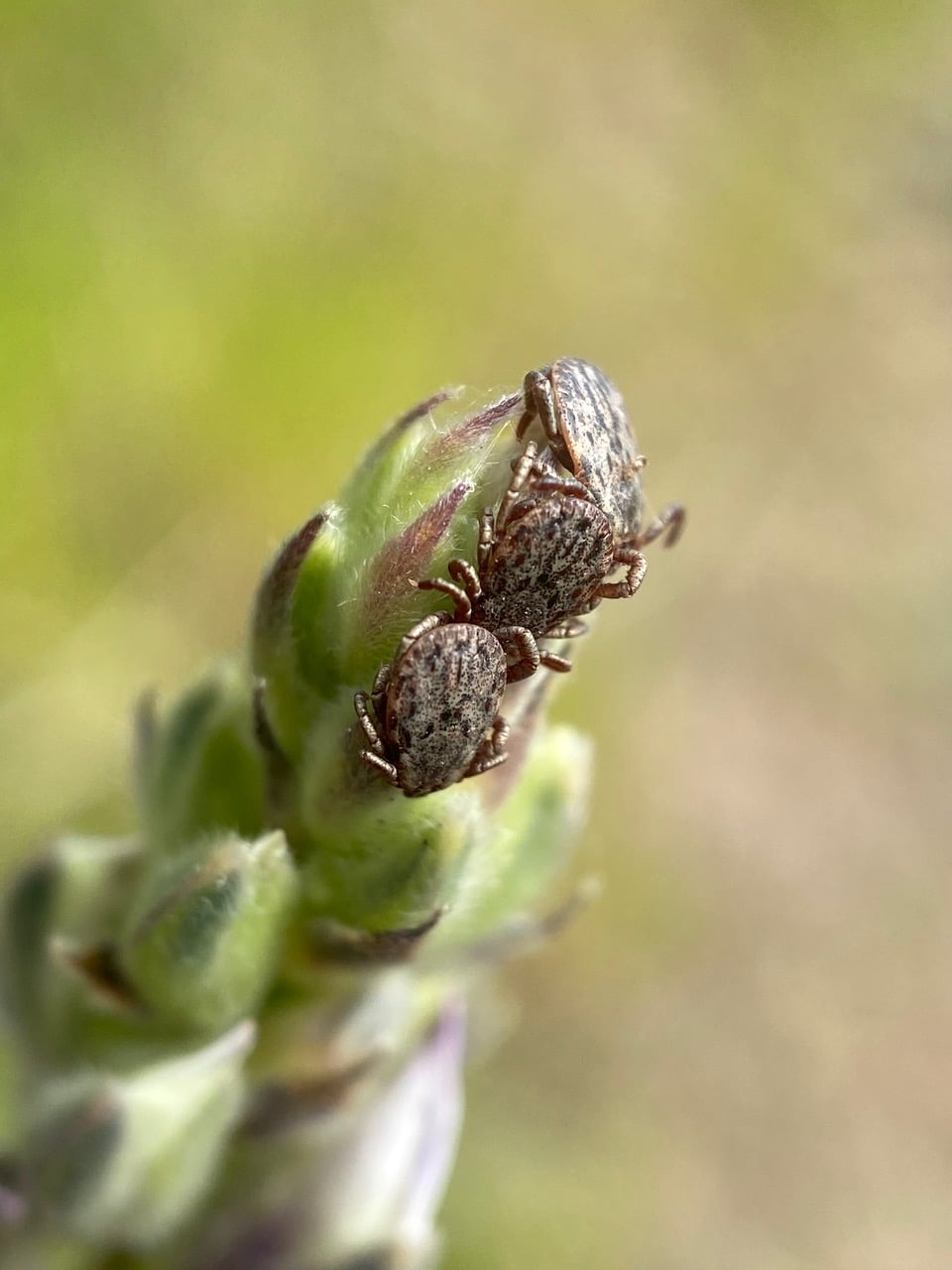
Three Pacific Coast Ticks, Dermacentor occidentalis are crowded onto the tip of a flower spike of Silverleaf Lupine, Lupinus albifrons that sticks into the trail near Diablo Bend. I am impressed by how the ticks seem to know the best places to find their hosts.
Ticks pick a place to wait by identifying well-used paths, resting on the tips of grasses and shrubs. They find their hosts by detecting animals’ breath and body odors, or by sensing body heat, moisture, and vibrations. Some species can even recognize a shadow. Ticks can’t fly or jump, but many species wait in a search position known as “questing”. Holding onto leaves or grass by their third and fourth pair of legs, they hold the first pair of legs outstretched, waiting to climb on to a passing host. When a host brushes the spot where the tick is waiting, it quickly climbs aboard.

Several Black-tailed Bumble Bees, Bombus melanopygus (family Apidae) are foraging on the Silverleaf Lupine. Here a bee has landed on the horizontal platform provided by the pair of wing petals, depressing them. The dark lines on the wing petals are “nectar guides” that show the bee where to stick its tongue. The nectary is located where the lines converge in the back.

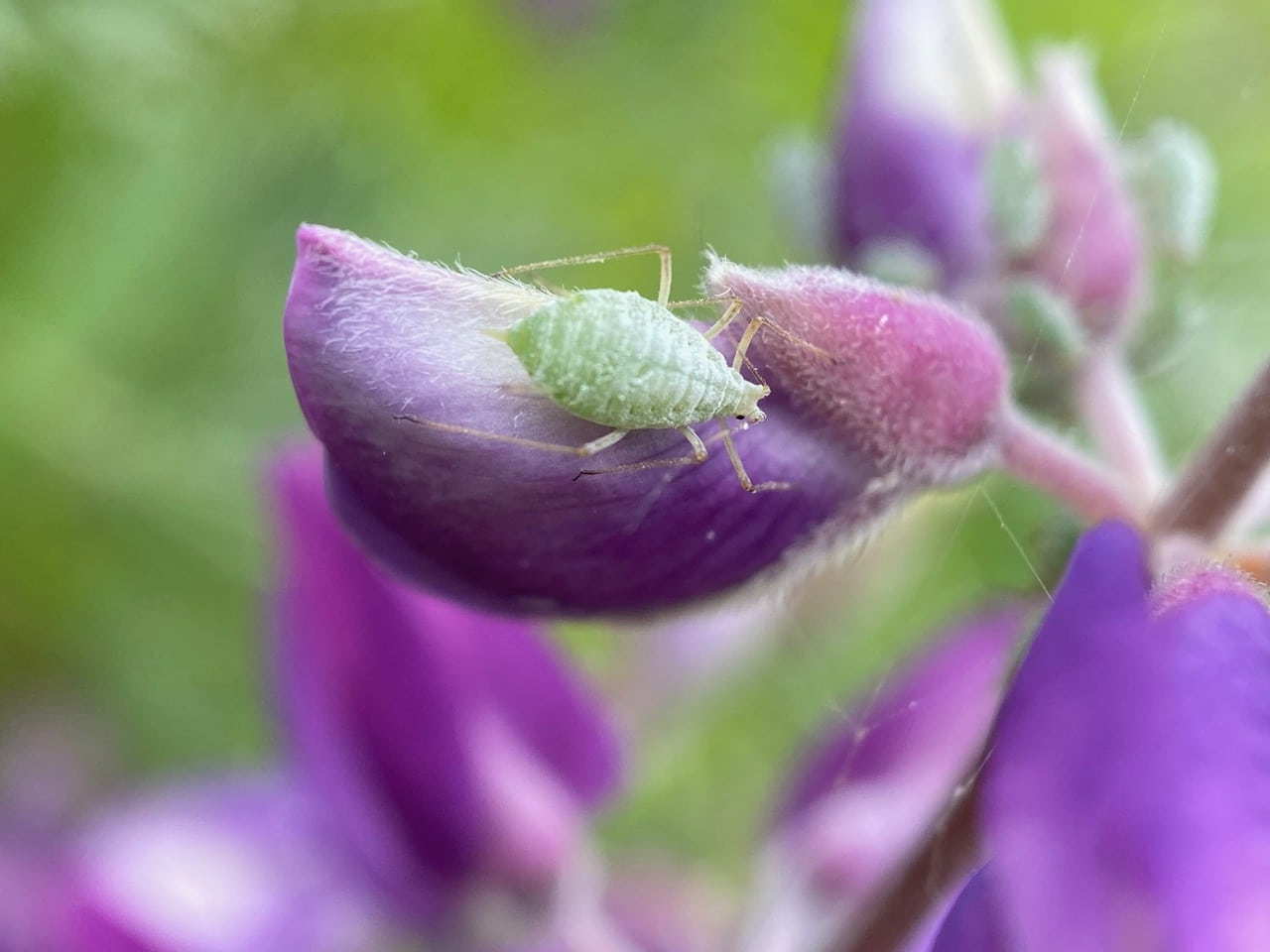
A large black-and-white hoverfly hovers over a few spikes of flowers on this lupine and stops at a couple of places to lay eggs. I am immediately on the lookout for aphids on the plant. Since the larvae of some hoverflies feed on aphids, the adult females tend to lay their eggs near aphid colonies to ensure an ample supply of food for their young. It doesn’t take long for me to find the aphids on the flower spikes that the hoverfly was hovering over. There are a few large aphids scattered among the flower buds, some accompanied by their babies. This appears to be the beginning of an aphid colonization. Life is getting interesting on the lupines!
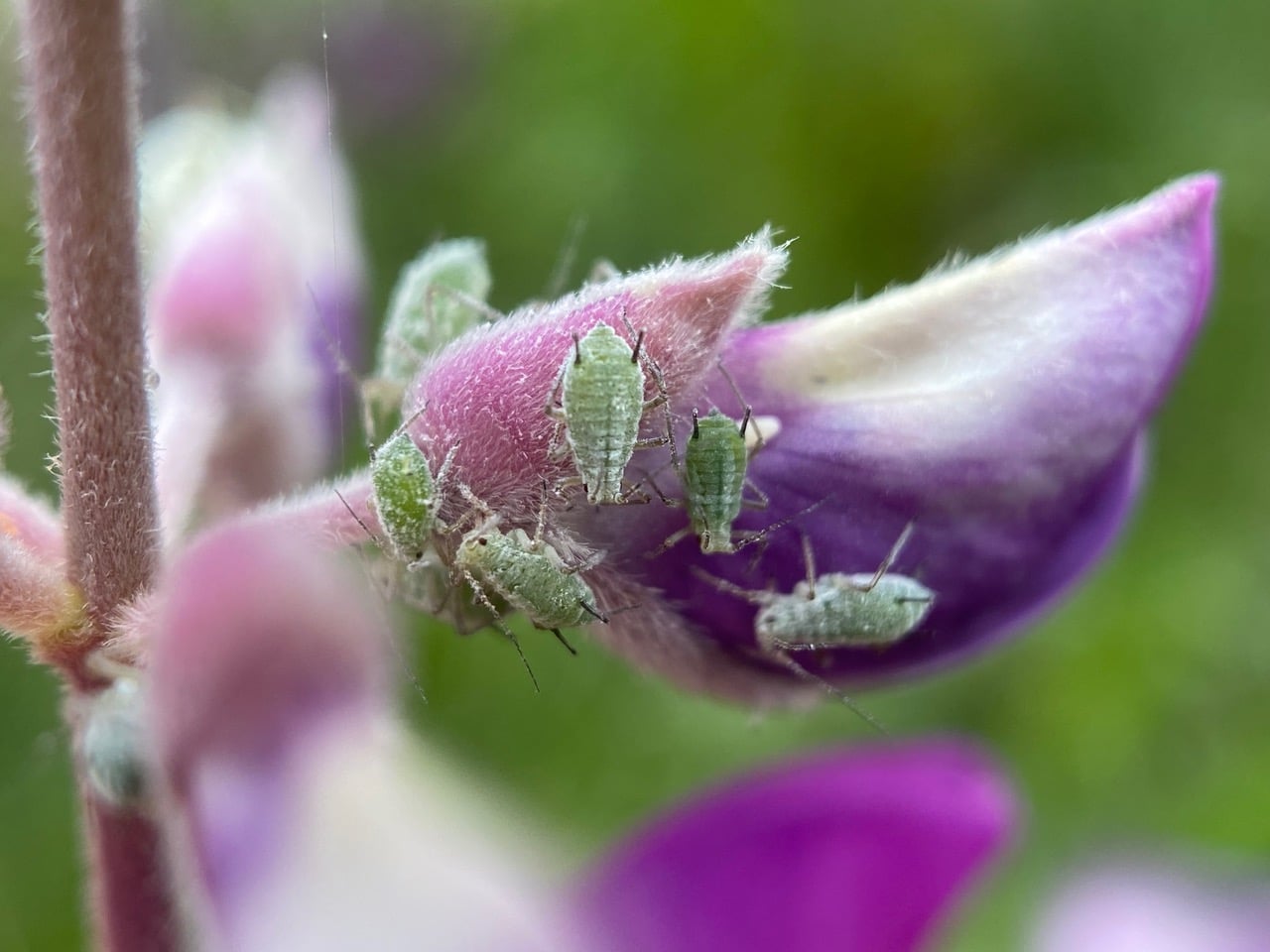
Young aphids on another flower bud.
The Lupin Aphid, Macrosiphum albifrons (family Aphididae) is specific to lupines and spends its entire life cycle on lupines. It has been recorded from 21 Lupinus species. It lives mainly on the leaves, stems and flower spikes. Originating in North America, it has spread to England and much of Europe, where it is considered an invasive pest. The aphids sequester the toxic alkaloids of their host plant for their own defense. As aphids go, this species is rather large, and they are dusted with a powdery white wax. Waxy secretions on the integument of aphids are thought to limit their contact with the sticky, sugary honeydew excreted from the same or other individuals in the colony, and possibly providing protection against fungi, parasitoids, predators, dehydration and/or frost.

Here’s another view of the same scene. The focus now is not on the aphids, but on the white rice-grain-like hoverfly egg that Mama hoverfly has strategically placed. Hoverfly larvae are voracious predators of aphids.

Ooh, more aphids! See the white ones? Those are actually the exuvia or shed exoskeletons left behind when the nymphs molt. Aphid nymphs undergo several molts before becoming adults. Like other members of the order Hemiptera or “true bugs”, aphids undergo incomplete metamorphosis, without the pupa stage.
 I am happy to see a large Yellow-faced Bumble Bee, Bombus vosnesenskii (family Apidae) forage on the lupines. The species has not been doing well, taking a big hit from the cold and rainy weather in early spring.
The weight of the bee landing on the lupine flower causes the two wing petals to splay apart, allowing the reproductive structures to pop up through the gap to hit the bee’s belly with pollen and to receive pollen that’s already on the bee. The bee gets the nectar and pollen, the flower gets pollinated – this is one of the most joyous mutualisms in the natural world that you can observe in your own backyard!