

Pollinator Post 4/16/24 (3)
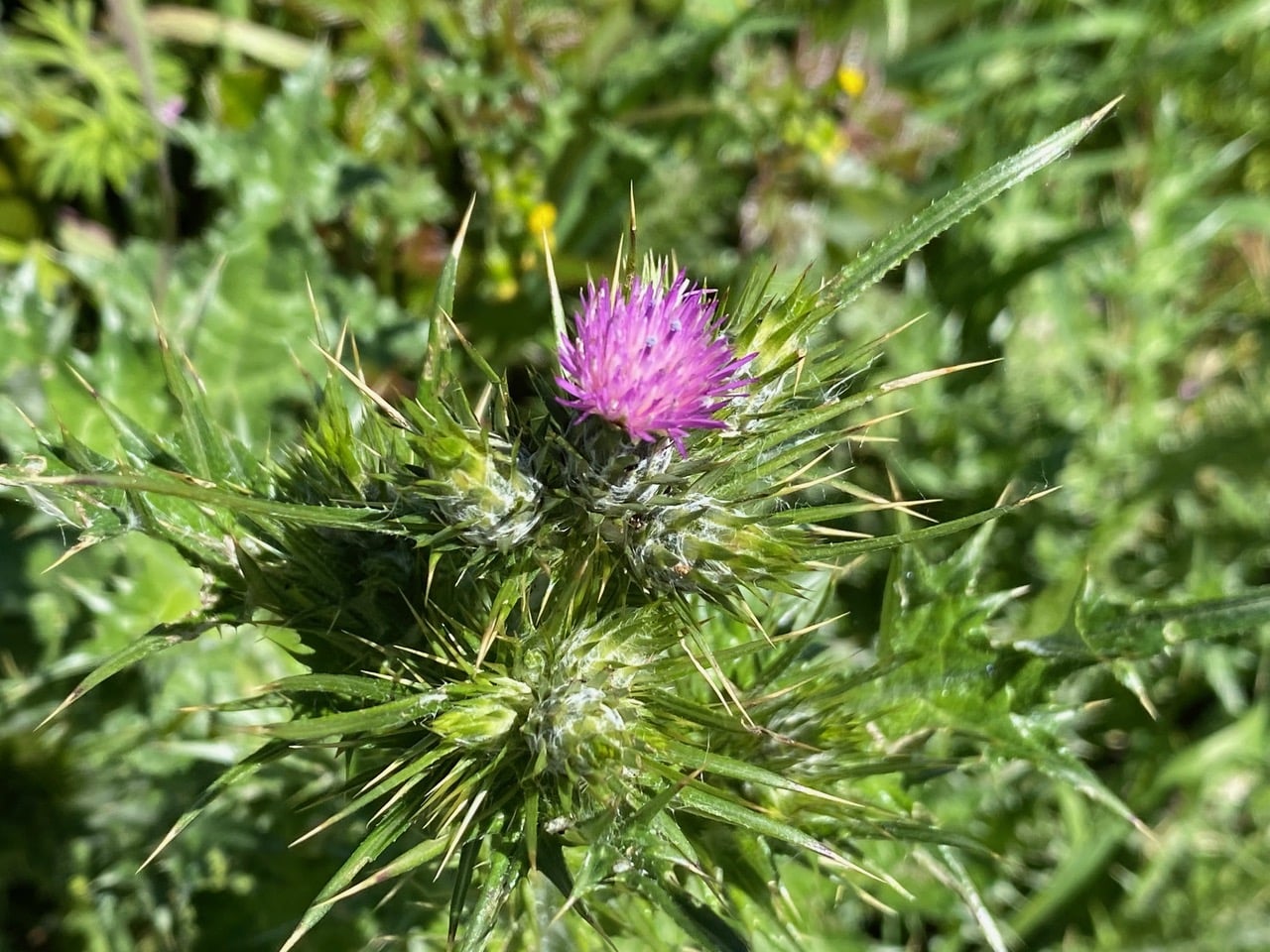
Heading back to the Steam Train entrance, I pass some Italian Thistles in bloom. I bend down to look for aphids along the stems.

No aphids, but I spot this Weevil on a leaf. It is vigorously rocking its head sideways, probably trying to drill its mouthparts into the leaf. It is a Nodding Thistle Receptacle Weevil, Rhinocyllus conicus (family Curculionidae).
The adult weevil is black and covered with a thin black and yellowish mottled coat of hairs. It is a short-snouted beetle up to 6 mm long. Eggs are laid on or near the bracts of the thistle flower head. The larvae burrow into the flower head and feed on the flower parts and developing seeds. Adults cause damage as well when they feed on the foliage.
The weevil is native to Eurasia and North Africa. Introduced to the United States for thistle biocontrol in 1969, it is now widely established in the country. The weevil is found to be very effective in reducing the spread of invasive thistles, including Italian thistles. However, the weevil will also readily attack native thistles in the genus Cirsium, in some cases contributing to population decline. For this reason this weevil is no longer used for thistle biocontrol.
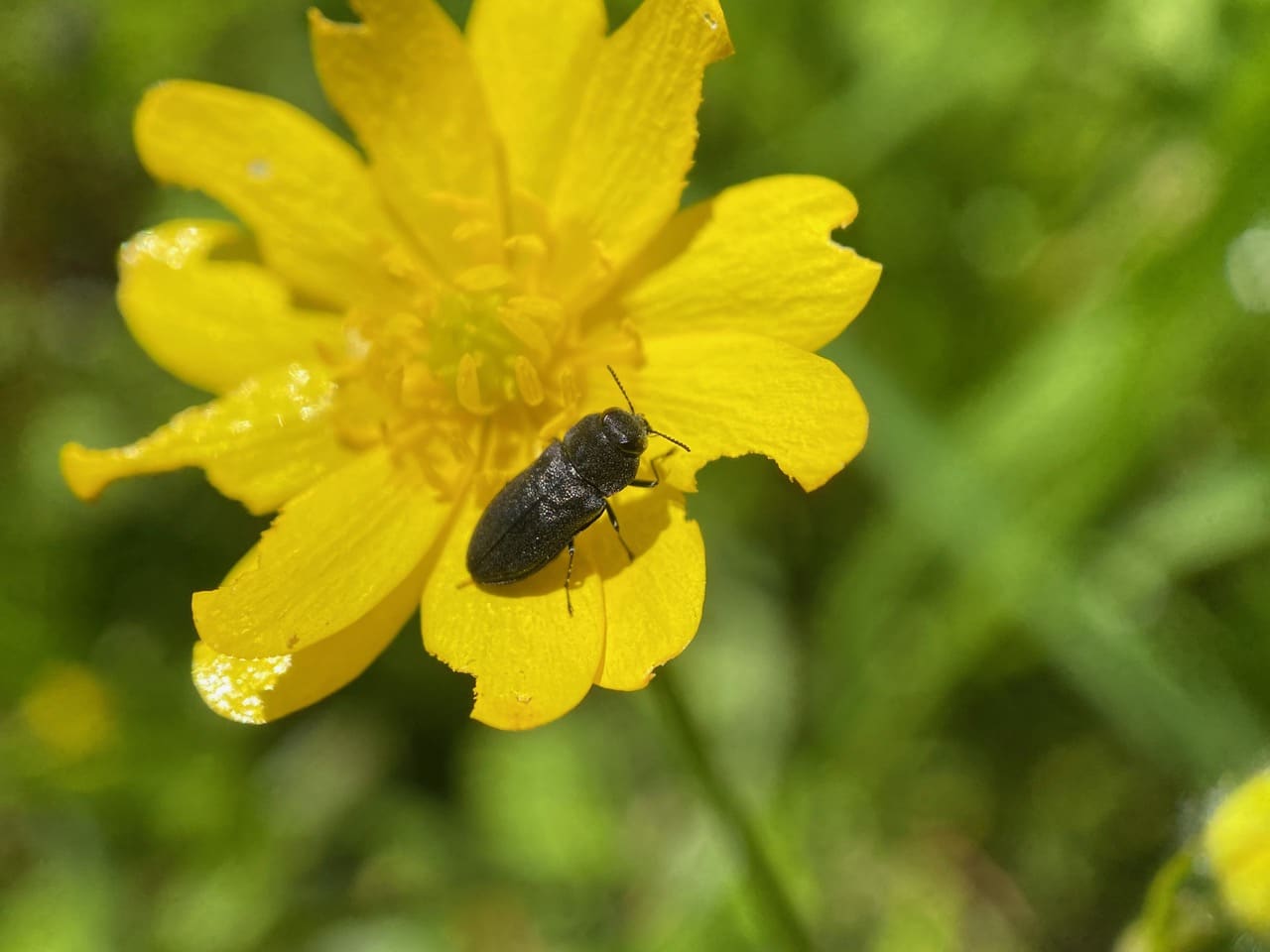
A Metallic Wood-boring Beetle (family Buprestidae) is feeding on the petal of a California Buttercup, Ranunculus californicus.
Buprestids are sometimes also called Jewel Beetles because of their glossy, iridescent colors. The larger and more spectacularly colored ones are highly prized by insect collectors. Their elytra have been traditionally used in beetlewing jewelry in some Asian countries. The iridescence common to these beetles is not due to pigments in the exoskeleton, but instead is caused by structural coloration, in which microscopic texture in their cuticle selectively reflects specific frequencies of light in particular directions. Buprestid larvae are known as flathead borers. They bore through roots, logs, stems, and leaves of various types of plants, ranging from trees to grasses. Adult jewel beetles mainly feed on plant foliage or nectar, although some species feed on pollen and can be observed visiting flowers.

A female Mining Bee, Andrena sp. (family Andrenidae) is foraging on a buttercup flowers.
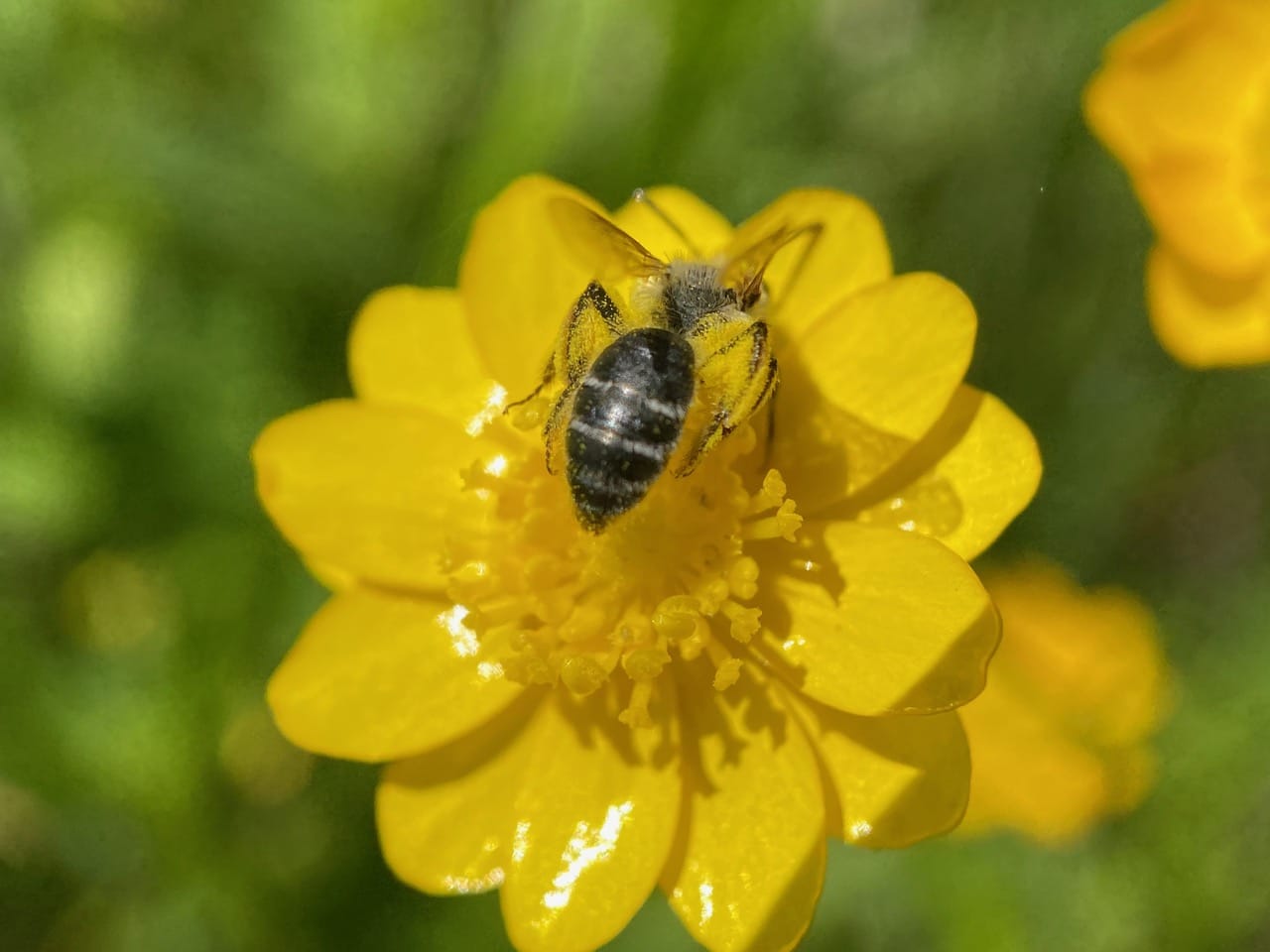
One last look at the fabulous scopae of the female Andrena filling with pollen.
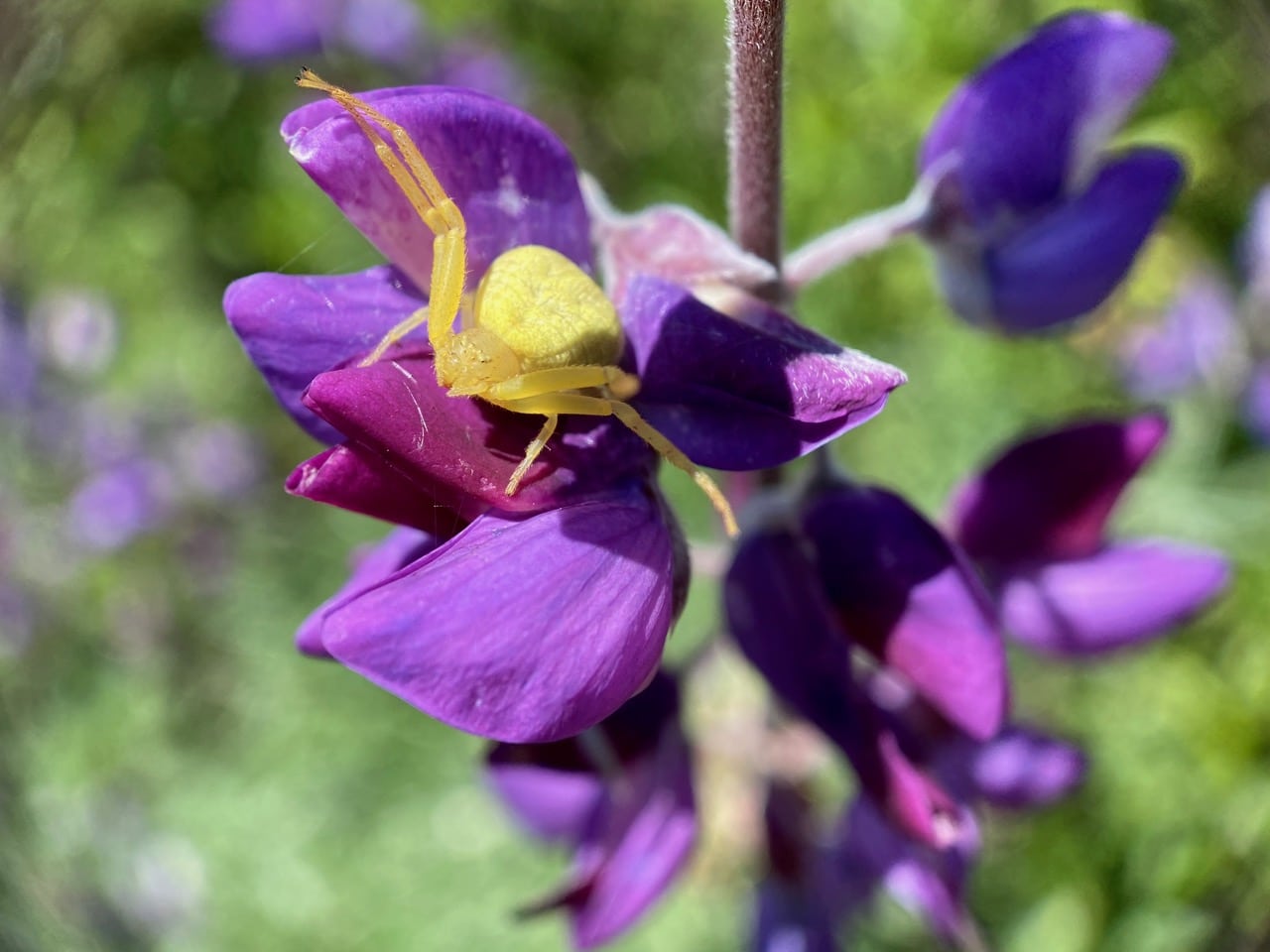
Whoa, a bright yellow Goldenrod Crab Spider, Misumena vatia (family Thomisidae) is standing in ambush on the flowers of Silverleaf Lupine, Lupinus albifrons. She does not bother with camouflage here. Is she attracting insects to her?
It is often assumed that Crab Spiders change colors to blend in with their surrounding. The truth is a little more complicated than that.
The spider can change its color between white and yellow to match the flower it is sitting on. The color change takes a few days. Maybe this spider has recently moved over from a nearby yellow flower?
There’s another trick that the spider might be playing that we are not aware of because we cannot see in the ultraviolet (UV) spectrum of light. It’s been discovered that Crab Spiders reflect UV light strongly. Most insects, notably the bees, see UV well, and favor sunlit flowers while foraging. Experiments have shown that flowers that have crab spiders sitting on them actually garner more insect visits than those that don’t! It is thought that perhaps color camouflage in the visible spectrum helps the spiders avoid vertebrate predators (birds, lizards, etc.), while the UV reflectance is useful for attracting insect prey.