

Pollinator Post 4/26/24
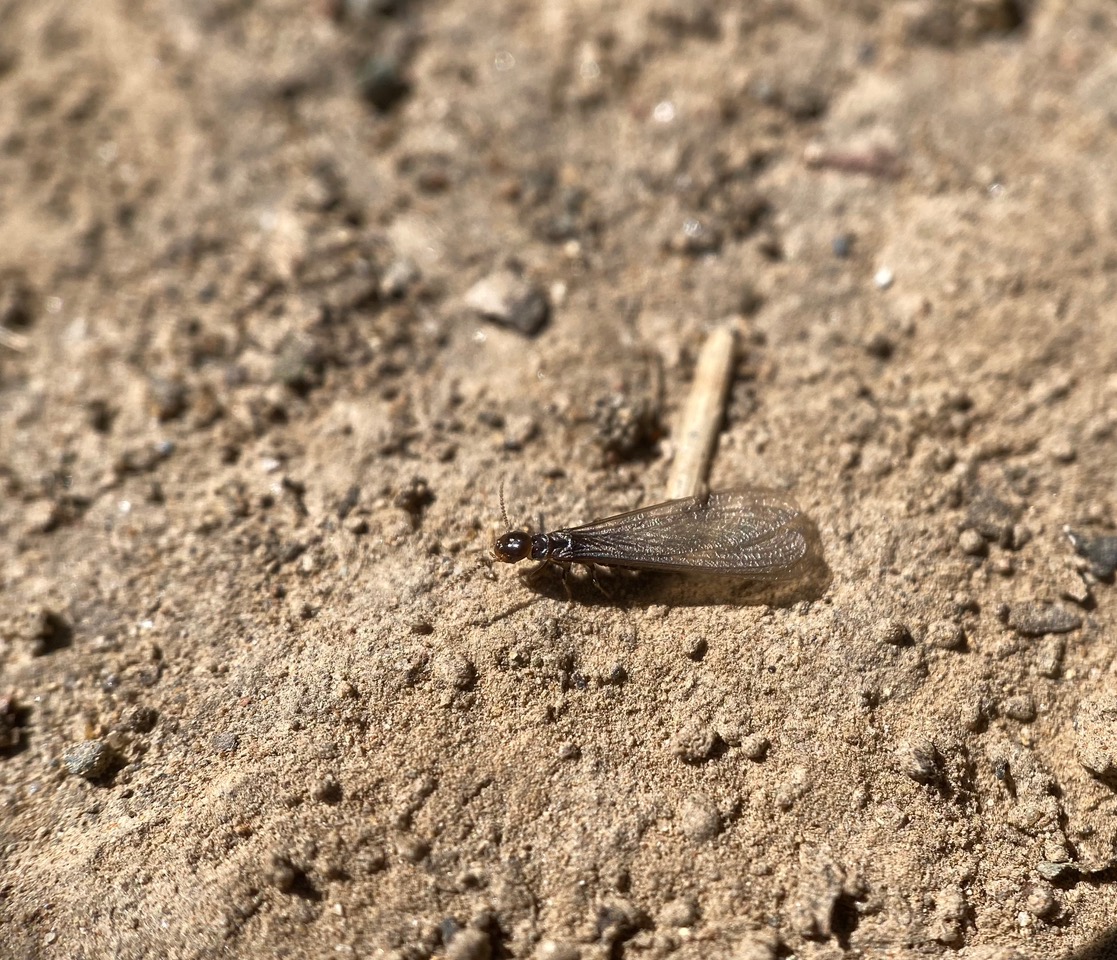
I am not able to get out until 3 pm today. Since it is somewhat windy, I don’t expect to take any pictures. But as soon as I turn a corner at the Sequoia Arena of Joaquin Miller Park, I am met by a surprise gust of wind that sweeps up dust as well as a big swarm of insects into the air from the dry, exposed ground. I figure I should record the experience:
After some of the insects settle, I discover that they are the alates (winged reproductives) of the Western Subterranean Termites, Reticuliformes hesperus (family Rhinotermitidae, order Blattodea). How cool – I am in the midst of a termite nuptial flight (swarming)!
Termites have a caste system in their social organization. Worker termites undertake the most labor within the colony, being responsible for foraging, food storage, and brood and nest maintenance. They are tasked with the digestion of cellulose in food and feeding their nest mates in the process of trophallaxis. The soldier caste is anatomically and behaviorally specialized to defend the colony. They have large heads with modified jaws so enlarged that they cannot feed themselves. Instead, like juveniles, they are fed by workers. The primary reproductive caste of a colony consists of the fertile adult female and male individuals, commonly known as the queen and king. These form lifelong pairs where the king will continuously mate with the queen. The queen is responsible for egg production. Alates, or winged reproductives are produced at certain time of year. With the right environmental conditions (usually warm, windless days after a rain), the alates fly off on nuptial flight in search of mates from other nearby colonies.
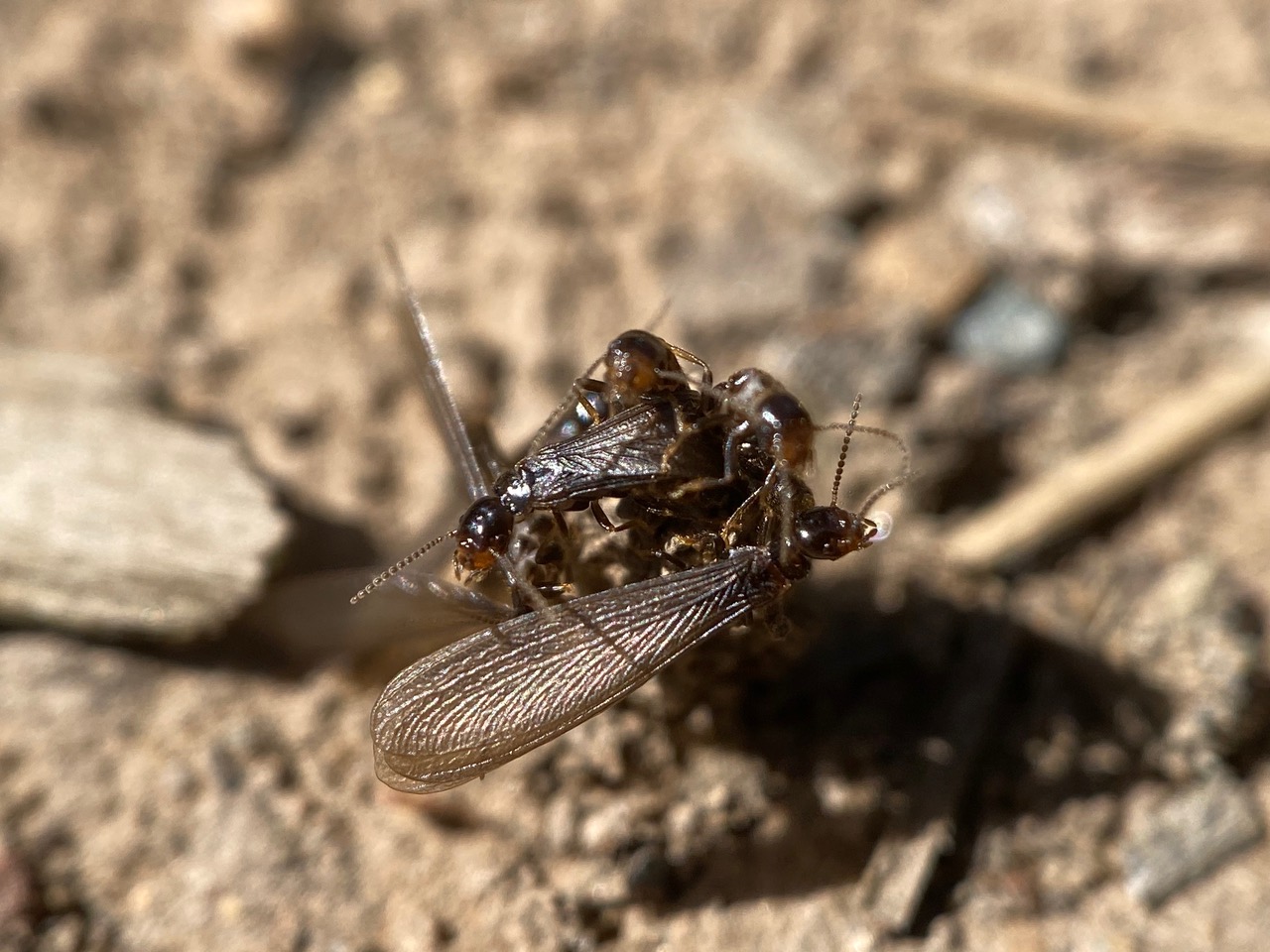
Countless termites are erupting out of miniature mud chimneys on the bare ground. Just two days ago at Skyline Gardens, I saw a worker termite construct/repair one of these chimneys from the inside. Wow, how timely!


Best to watch the action on video:
Why do the termites build the chimneys? The narrow passage way seems to make it difficult for the alates to exit from their underground nest. The elevated position does not seem to help with their lift-off, as the termites hit the ground before launching into the air. Perhaps the chimneys are not built specifically for the nuptial flight. The structures prevent rain from getting into their underground nest? Facilitate air circulation?

Winged termites are also emerging from holes/cracks in the ground.
 As the exit frenzy slows for a moment, I catch a glimpse of a white worker termite peeking out the hole.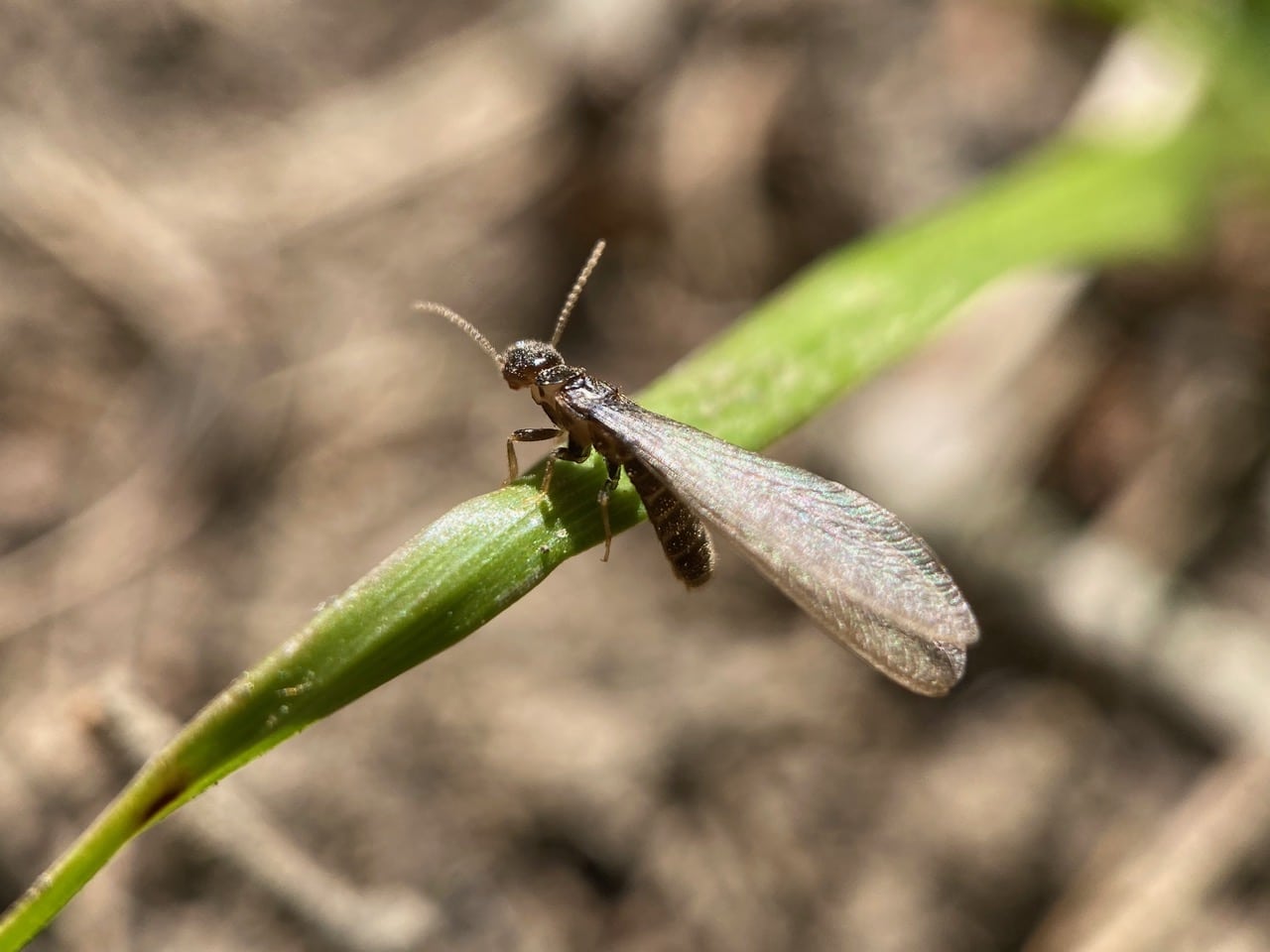
A dust-covered alate climbs a low blade of grass before launching into the air to join the swarm. It is a chaotic affair, and I am afraid to step on the thousands of termites massing on the ground. I decide to continue on my walk and to check on the termites later.

California Blackberry, Rubus ursinus is blooming well in the dappled shade of the woodlands. This female flower is visited by a False Flower Beetle, Anaspis sp. (family Scraptiidae).

False Flower Beetles, Anaspis atrata (family Scraptiidae) are commonly found in western North America. The adults are found on flowers, sometimes in large numbers, but are also found on foliage. The larvae are typically found under the bark of dead trees.
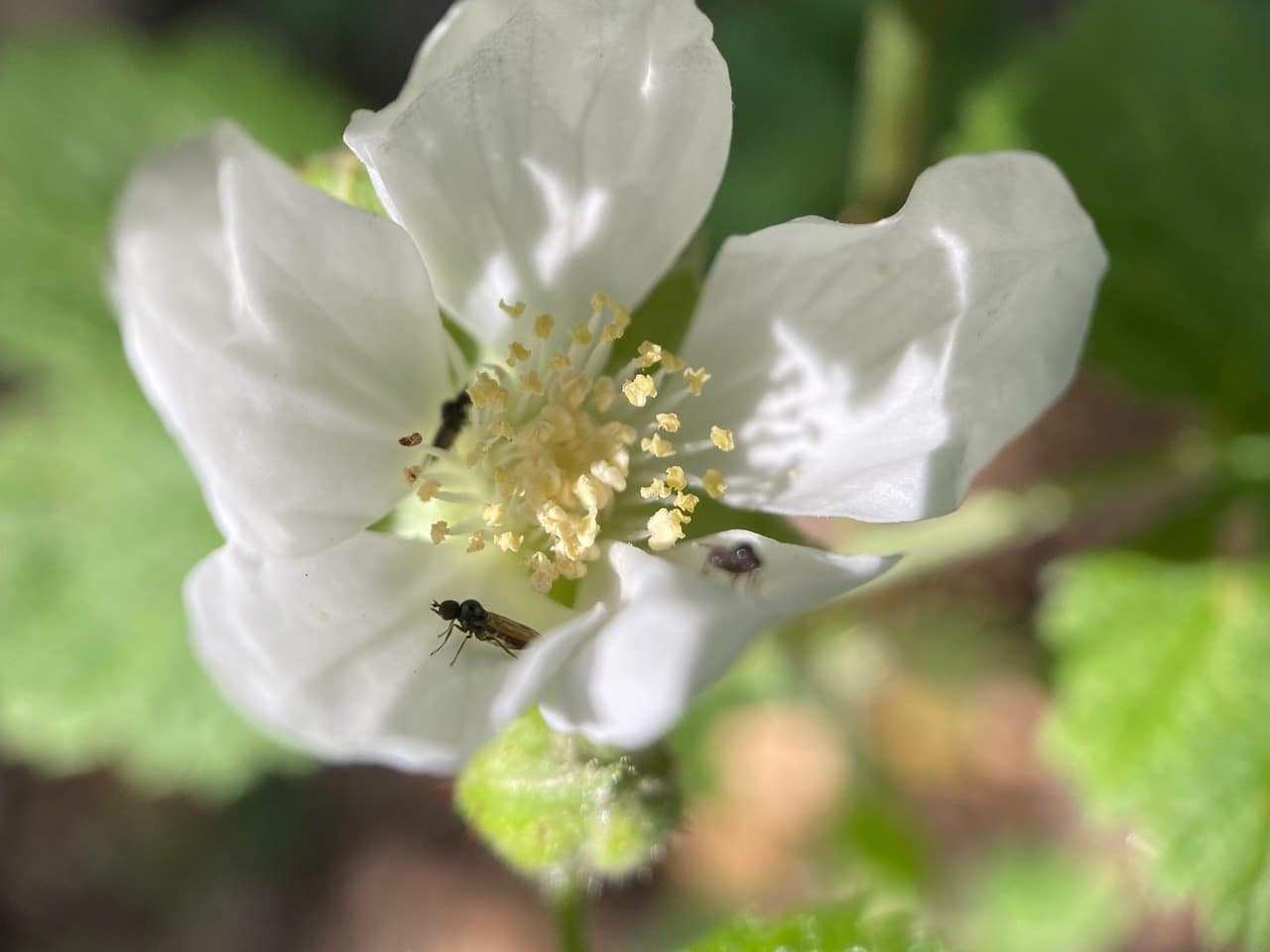
Several Hybotid Dance Flies, Anthalia sp. (family Hybotidae) visit a male flower of California Blackberry.
Almost all of the 11 species of Anthalia are restricted to North America. These small flies, 1-3 mm, are often found on small flowers. Adults feed on pollen.
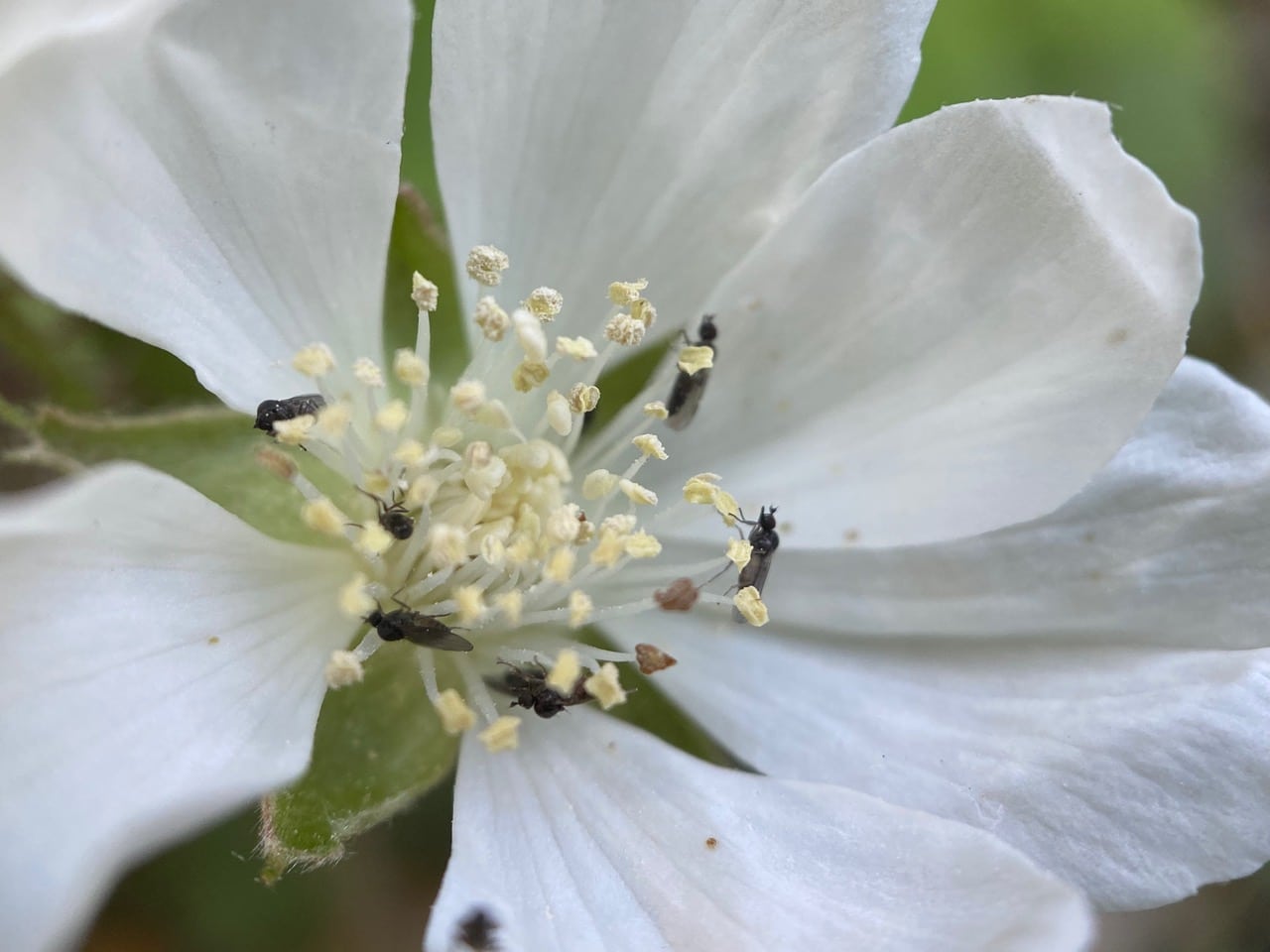 Hybotid Dance Flies enjoy a pollen party on a male flower of California Blackberry.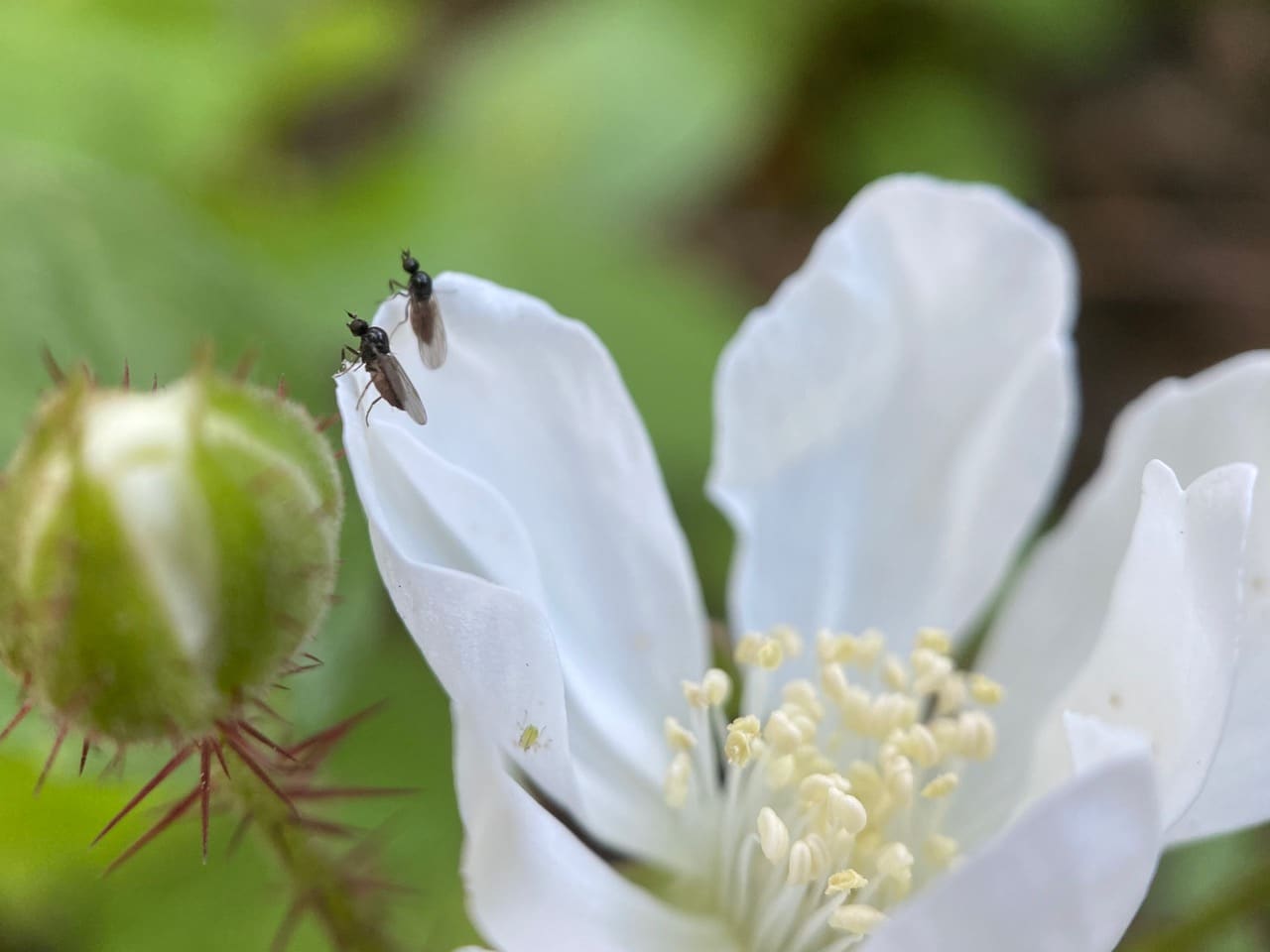
Ah, peace and quiet for a change.

A lone Hybotid Dance Fly, Anthalia sp. (family Hybotidae) has a female blackberry flower all to itself.

A Empidid Dance Fly (family Empididae) is taking nectar from a female flower of California Blackberry.
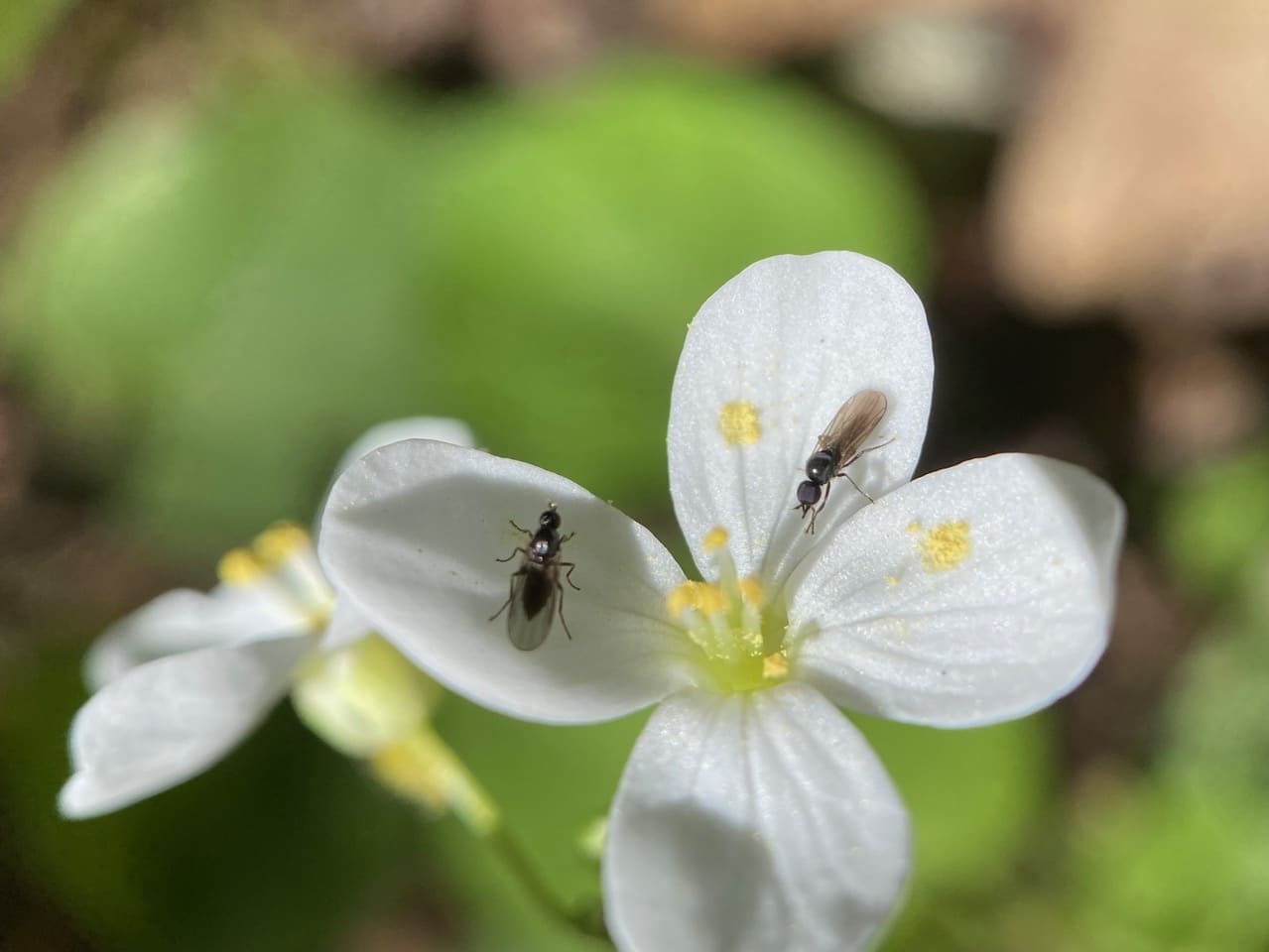
Hybotid Dance Flies, Anthalia sp. (family Hybotidae) feed on pollen of a Milk Maid flower, Cardamine californica.

I watch as a male Empidid Dance Fly (family Empididae) lands on a broken grass blade, grasping an insect prey in its middle legs. He is not feeding on the prey. Maybe he’ll offer it as a nuptial gift when he goes courting the females.
Empididae is a family of flies commonly called Dance Flies, Dagger Flies (referring to the sharp piercing mouthparts of some species) or Balloon Flies. They are small to medium-sized, non-metallic and rather bristly. The body is slender, the head often small and rounded with relatively large eyes. The legs are usually long and slender, and in some the forelegs are raptorial, adapted for catching and holding prey. Adult Empidids are found in a variety of forest habitats, and open grasslands. They are predominantly predator, often found hunting for small insects on and under vegetation in shady areas. Both genders may also drink nectar. A few species obtain all their protein needs by feeding on pollen. Larvae are generally found in moist soil, rotten wood, dung, or in aquatic habitats and also appear to be predaceous on various arthropods, particularly other Diptera larvae.
Dance Flies get their name from the habit of males of some species to gather in large groups and dance up and down in the air in the hopes of attracting females. Male dance flies give their sweeties a nuptial gift to eat while they mate. The gift is thought to enable her to complete the development of her eggs. Males may wrap their gifts in balloons of silk or spit, hence the other common name of Balloon Flies.

A tiny Soldier Beetle is dwarfed by a dark-winged Sawfly on a leaf of Miner’s Lettuce, Claytonia perfoliata. They both seem to be feeding on something on the leaf surface. Honeydew?
Sawflies are part of the insect order, Hymenoptera, together with bees, wasps and ants. They are considered to be the most primitive group and form the sub-order Symphyta. They differ from the bees, wasps and ants in not having a narrow ‘waist’ and in their wing venation. The common name comes from the saw-like ovipositor that the females use to cut into plant tissues to lay their eggs. Larvae are caterpillar-like and can be distinguished from lepidopteran caterpillars in that all body segments following the three bearing true legs have a pair of fleshy prolegs. Like the lepidopteran caterpillars, sawfly larvae walk about and eat foliage. In many species, the larvae feed in groups.

The tiny Soldier Beetle belongs to the genus Malthodes (family Cantharidae).
The Soldier Beetles, family Cantharidae are relatively soft-bodied, straight-sided beetles. One of the first described species has a color pattern reminiscent of the red coats of early British soldiers, hence the common name. They are also known commonly as Leatherwings because of their soft elytra.
Soldier beetles often feed on both nectar and pollen as well as predating on other small insects. The larvae are often active, and feed on the ground, hunting snails and other small creatures. Soldier beetles are generally considered beneficial insects by gardeners.
Malthodes is the most speciose Cantharidae genus, with about 130 ssp. in our area. It is distinguished by small size (1-4 mm) and having short elytra which leave the inner wings partly exposed and folded along the dorsal surface of the abdomen.
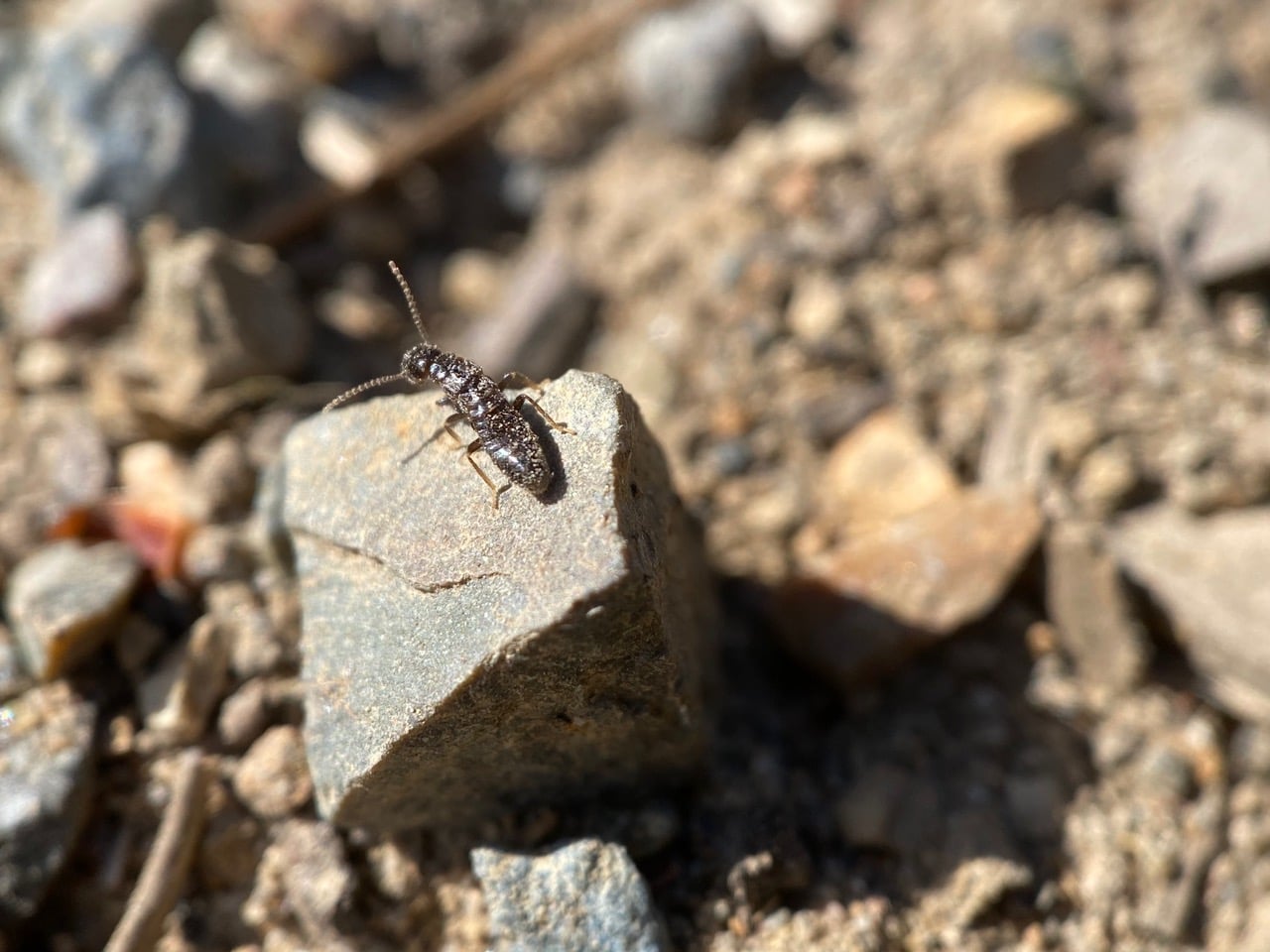 Checking back on the termites two hours later, I find the place surprisingly quiet. All the winged termites seem to have disappeared. A few dust-covered alates that have shed their wings can be seen hanging around, looking lost and forlorn. A lone female Dark-eyed Junco who was there earlier is still on the ground pecking on whatever termites she can find. I’m surprised no other birds came for the feast.
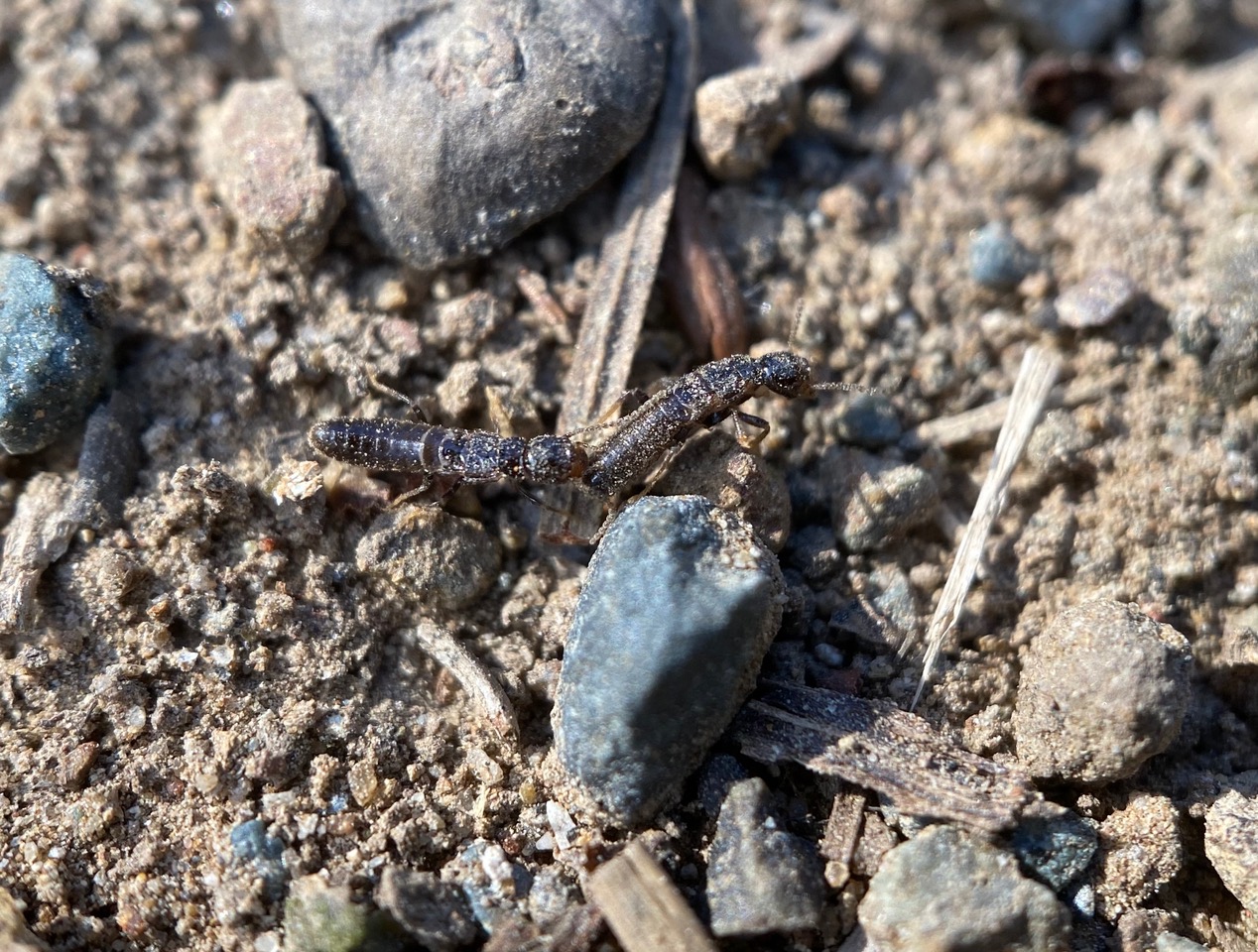
Then my eyes begin to pick up subtle movements on the ground. Some wingless alates have paired up, running around in tandem. I am not sure who is leading, the male or the female. These are the potential kings and queens. They are in a hurry to find a suitable place to excavate a nest and establish a new colony, before being picked off by a predator. Shedding their long cumbersome wings allows them to run much faster. The pairs are not holding on to each other, but are running in close proximity, nose-to-butt. It appears that the individual behind stays in touch with its antennae. It is fascinating that the pairs could run at that speed and not become separated. Their coordination is remarkable! Best of luck, your Highnesses!
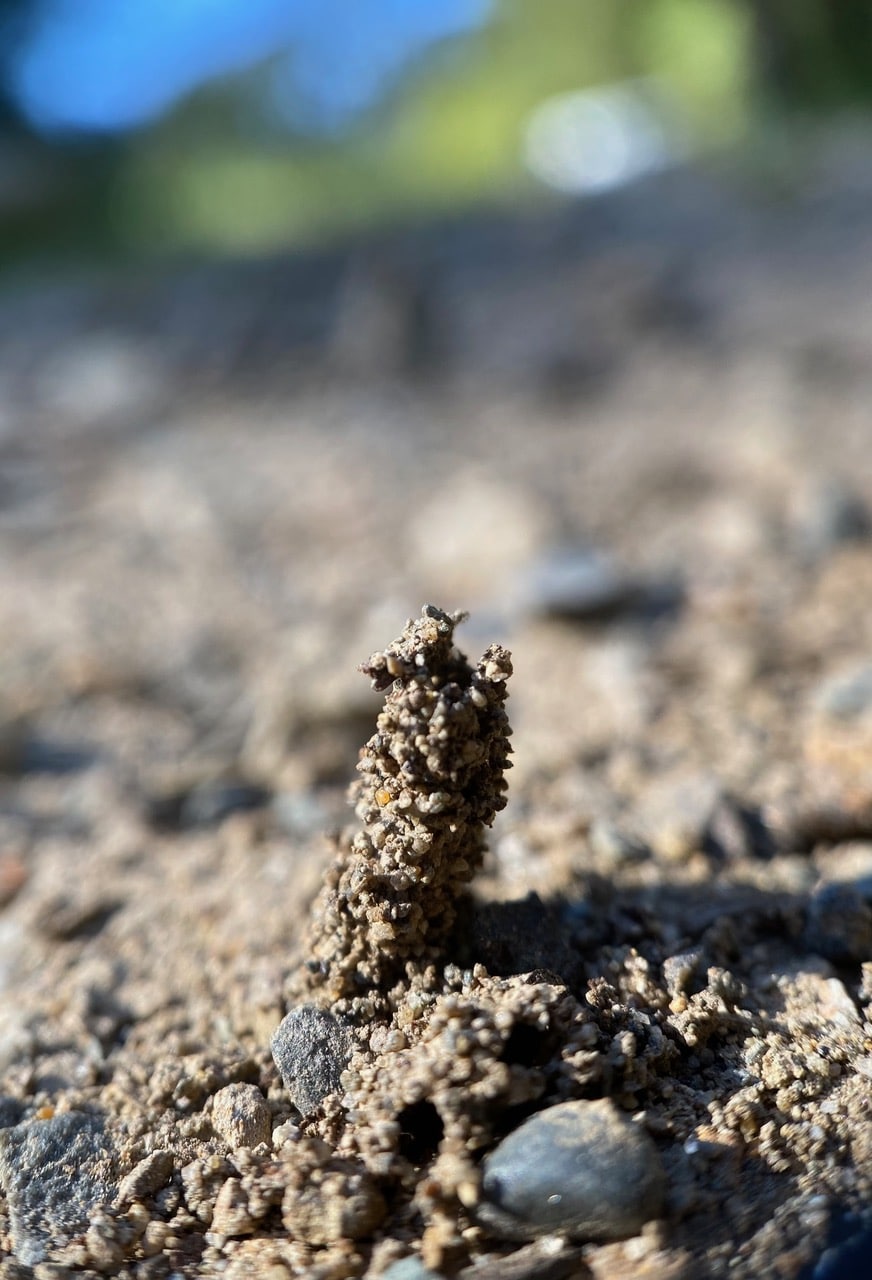
Now that the ground is largely vacated, I take the opportunity to photograph one of the chimneys from which many of the termite alates have emerged for their nuptial flight. It is made of mud and sand grains, and measures about 3/8” tall with a central opening. It must be remarkably strong to survive all that commotion.