

Pollinator Post 4/30/24 (1)
I am back at Skyline Gardens this morning, hoping to spend more time observing the nesting Mining Bees at Siesta Nose.
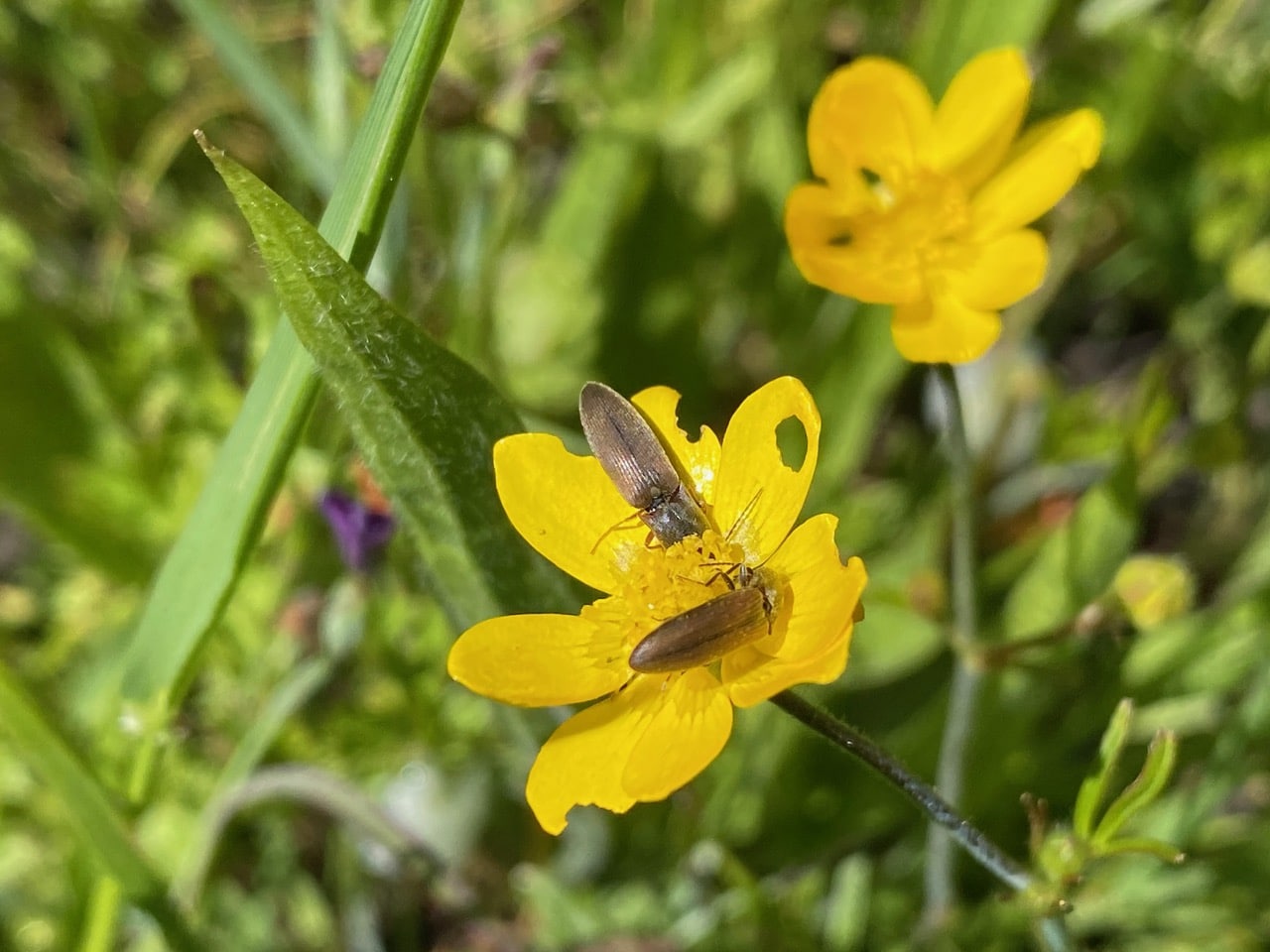
Passing the shrinking patch of California Buttercups, Ranunculus californicus near the Steam Train entrance, I see the same cast of characters on the flowers. Life continues at a frantic pace even as the buttercup season is winding down. Here, two Click Beetles (family Elateridae) are feeding on a buttercup flower.
 A Nodding Thistle Receptacle Weevil is out on a leaf of the Italian Thistle. I have never had such a good look of the secretive weevil.
 The adult weevil is black and covered with a thin black and yellowish mottled coat of hairs. It is a short-snouted beetle up to 6 mm long. Eggs are laid on or near the bracts of the thistle flower head. The larvae burrow into the flower head and feed on the flower parts and developing seeds. Adults cause damage as well when they feed on the foliage.
The weevil is native to Eurasia and North Africa. Introduced to the United States for thistle biocontrol in 1969, it is now widely established in the country. The weevil is found to be very effective in reducing the spread of invasive thistles, including Italian thistles. However, the weevil will also readily attack native thistles in the genus Cirsium, in some cases contributing to population decline. For this reason this weevil is no longer used for thistle biocontrol.
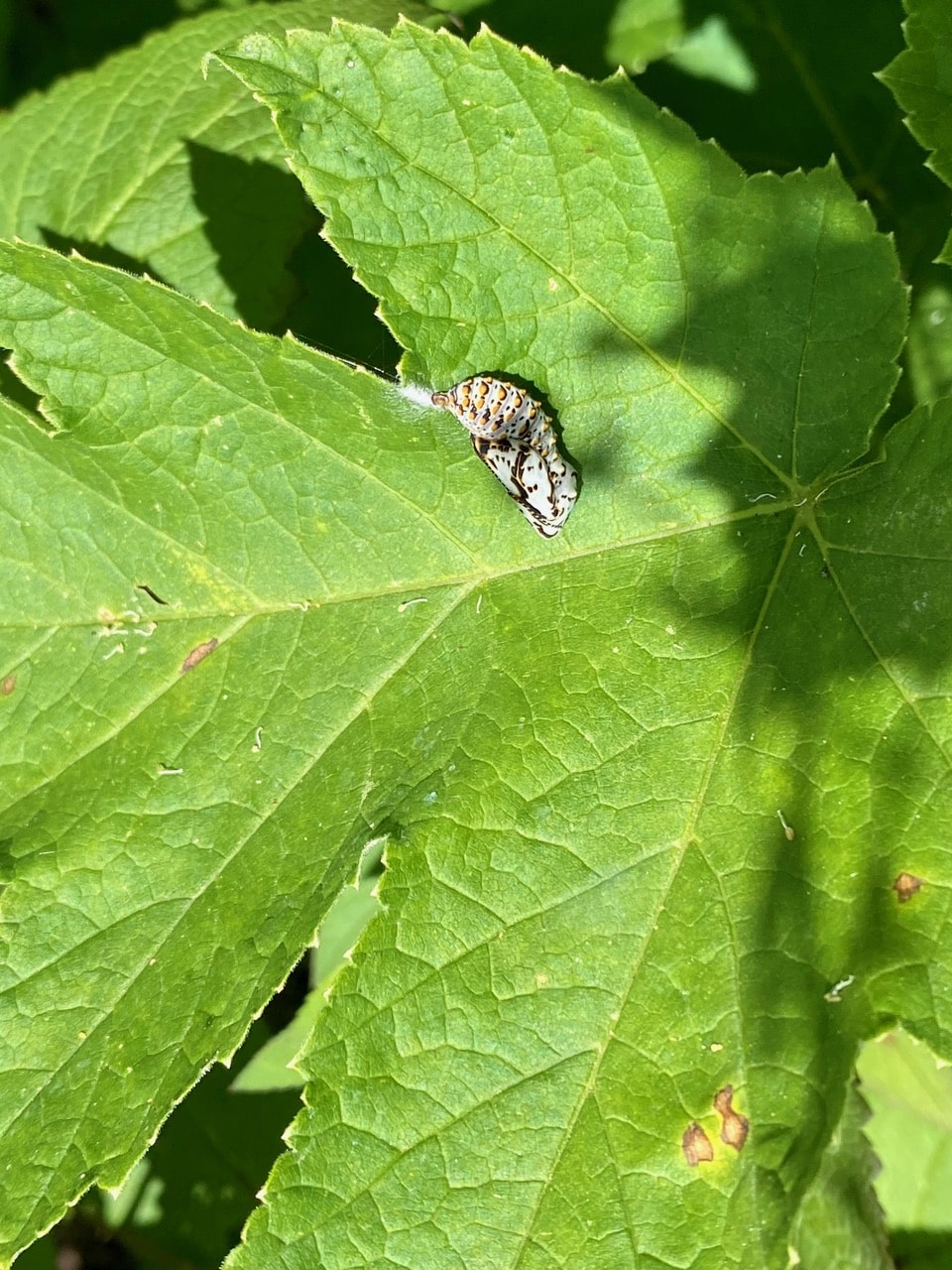
I spot something big and white on a leaf of Cow Parsnip, Heracleum maximum. Wow, I never expect to see a Variable Checkerspot chrysalis on a Cow Parsnip leaf, in full view! Mature caterpillars usually wander around to seek a secure, hidden spot to pupate, often on firm and hard substrate such as a tree trunk, or fence post.
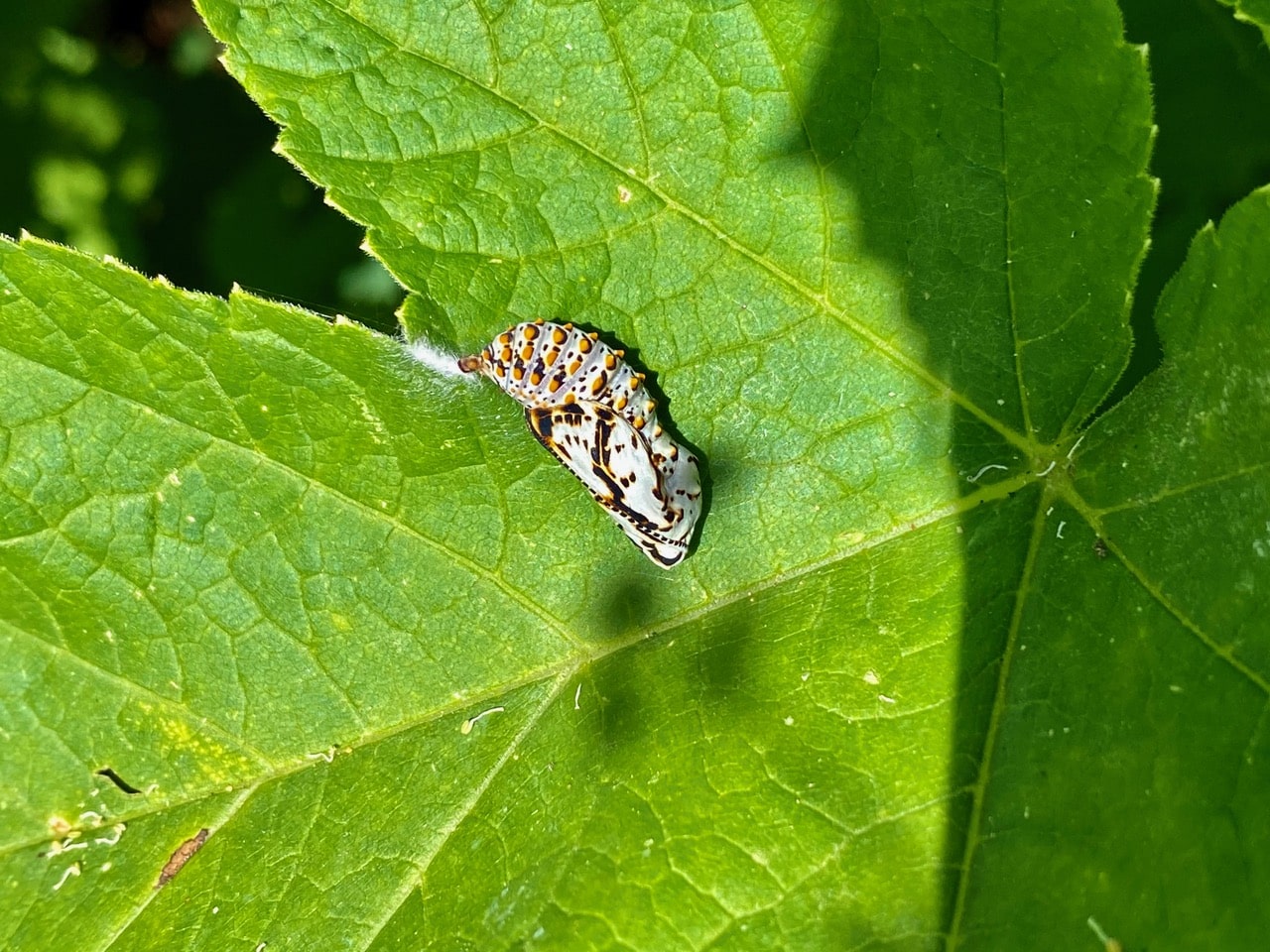 I stare at the chrysalis – such perfection! The future wings and antennae are already clearly outlined. The butterfly will have plenty of time to eclose before the leaf wilts, but it is quite vulnerable in such an exposed site. Despite the stillness of the chrysalis, pupation is not a resting stage of the butterfly’s life cycle. Tremendous changes are taking place within – of demolition and reconstruction.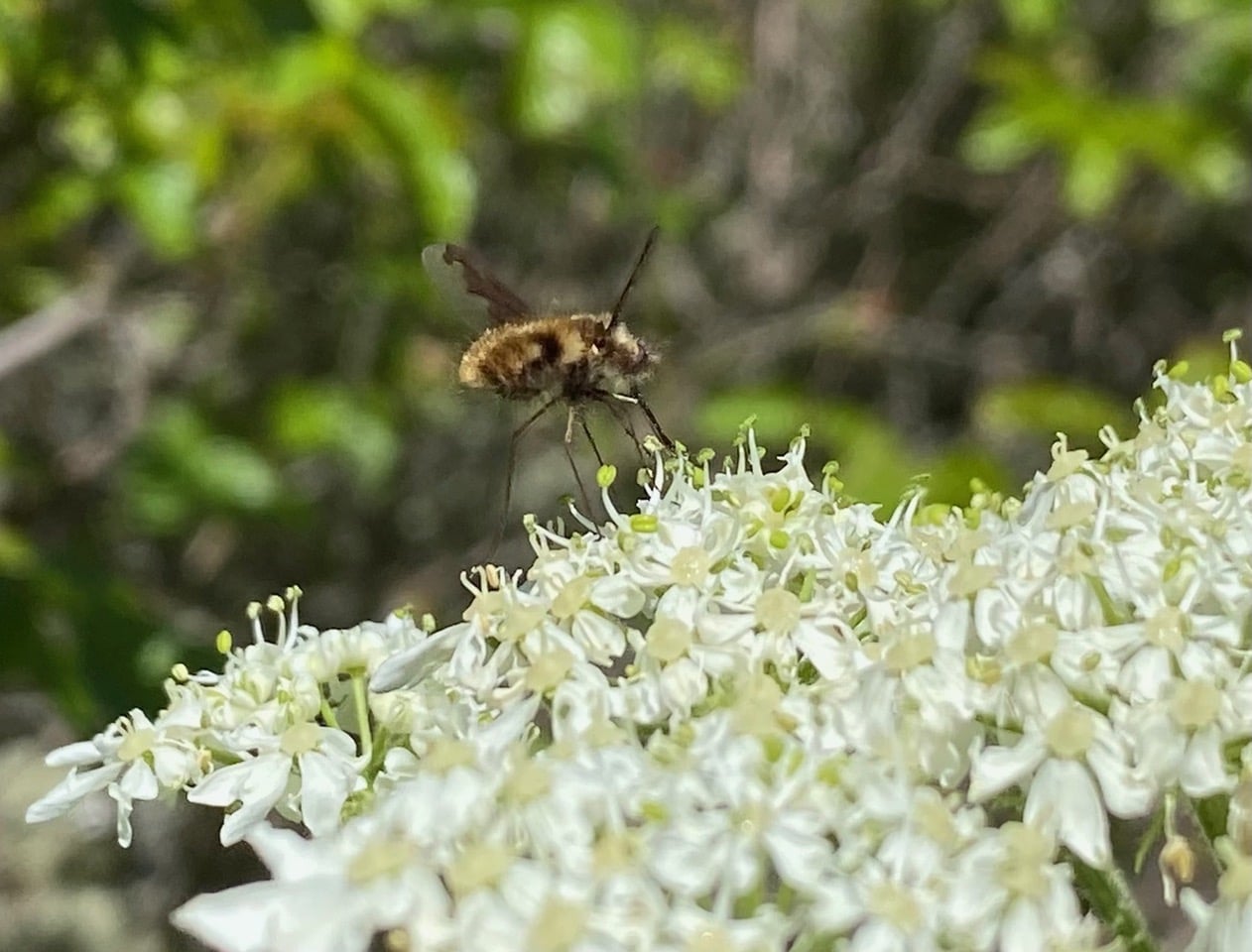
A Greater Bee Fly, Bombylius major (family Bombyliidae) is sipping nectar through its long proboscis while hovering over an umbel of Cow Parsnip flowers, Heracleum maximum. The fly barely touches down on the flowers with its long, skinny legs.
Bombylius major, commonly known as the Greater Bee Fly is a parasitic bee mimic fly in the family Bombyliidae. It derives its name from its close resemblance to bumble bees. Its flight is quite distinctive – hovering in place to feed, and darting between locations. The species has long skinny legs and a long rigid proboscis held in front of the head. Bombylius major is easily distinguished from the other local species of Bombylius for having wings with dark leading edge, hyaline trailing edge with sharp dividing border. This feature is visible even as the fly is hovering. Adults visit flowers for nectar (and sometimes pollen) from a wide variety of plant families, excelling at small tubular flowers, and are considered good generalist pollinators. Often the pollen is transferred between flowers on the fly’s proboscis.
The bee fly larvae, however, have a sinister side. They are parasitoids of ground-nesting bees and wasps, including the brood of digger bees in the family Andrenidae. Egg deposition takes place by the female hovering above the entrance of a host nest, and throwing down her eggs using a flicking movement. The larvae then make their way into the host nest or attach themselves to the bees to be carried into the nest. There the fly larvae feed on the food provisions, as well as the young solitary bees.
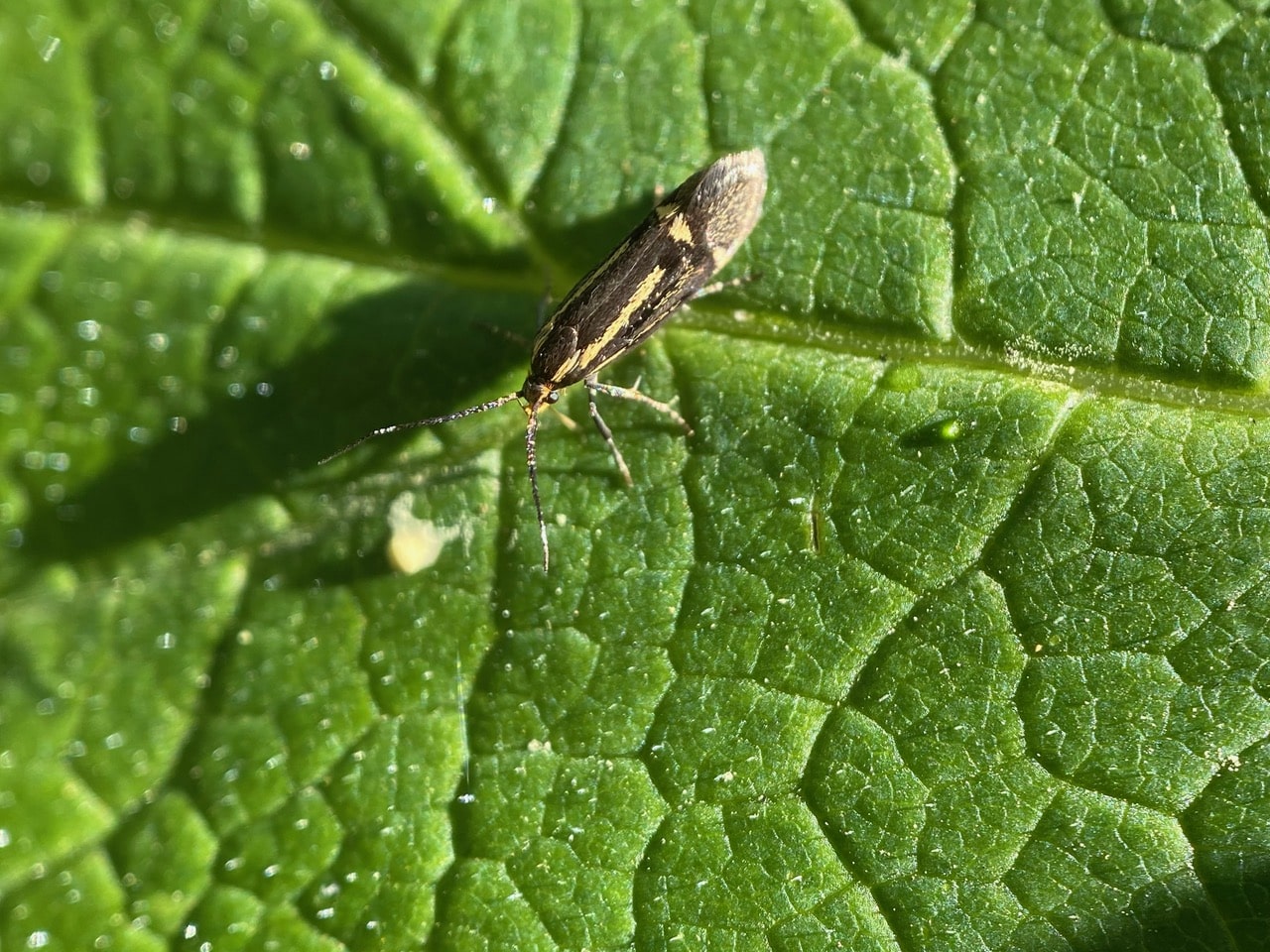
A small day-active moth, Sulphur Tubic, Esperia sulphurella (family Oecophoridae, or concealer moths) is feeding on something on the leaf of Bee Plant – honeydew perhaps?
The species is native to Europe, but has been introduced in California. Adults have a body length of 6-8 mm, are black with yellow markings. They are on wing in spring. Larvae are black and feed on dead wood.
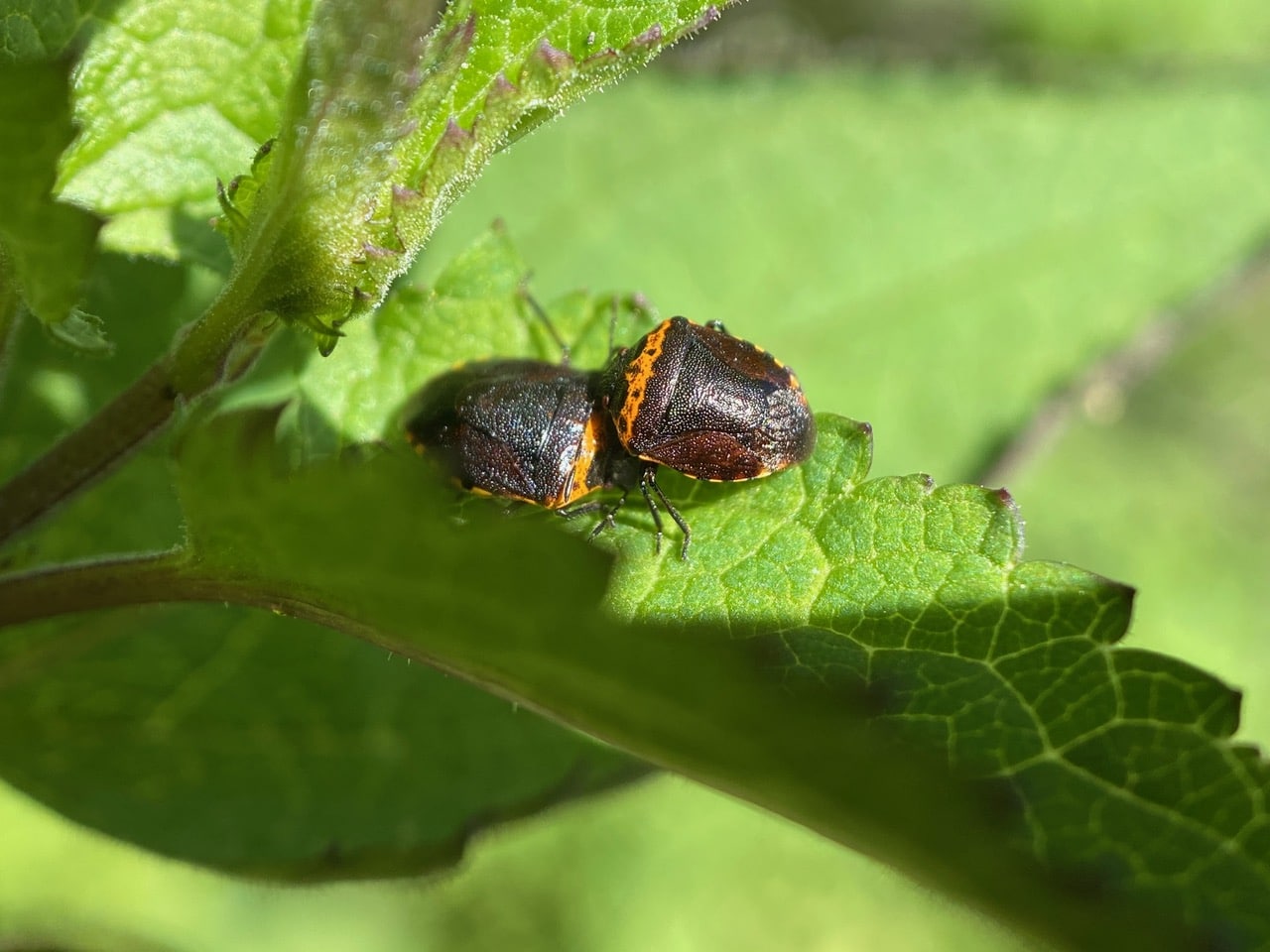
Two little Stink Bugs are enjoying the morning sun on a leaf of Bee Plant. The Stink Bugs, Cosmopepla uhleri (family Pentatomidae) are easily recognizable – black with an orange transhumeral band with black spots. The bug uses Scropularia californica as a host plant.
Pentatomidae is a family of insects belonging to the order Hemiptera or “true bugs”. As hemipterans, the pentatomids have piercing-sucking mouthparts, and most are phytophagous, including several species that are severe pests on agricultural crops. Stink Bugs feed on plant fluids by inserting their needlelike mouthparts into stems, leaves or seed pods. While feeding, they inject materials into the plant to aid in digestion and sap removal. Penetration by the mouthparts can cause physical damage, much like stabbing the plant with a fine needle. Cosmopepla uhleri is so small that the damage is generally limited to fine stippling on the leaves of California Bee Plant.
All Pentatomids have 5-segmented antennae (hence their family name, Penta – five and tomos – section.) They generally have a large triangular scutellum in the center of the back. The adult is generally shield-shaped when viewed from above. The common name of Stink Bug refers to their ability to release a pungent defensive spray when threatened, disturbed, or crushed.
#/media/File:Heteroptera_morphology-d.svg)
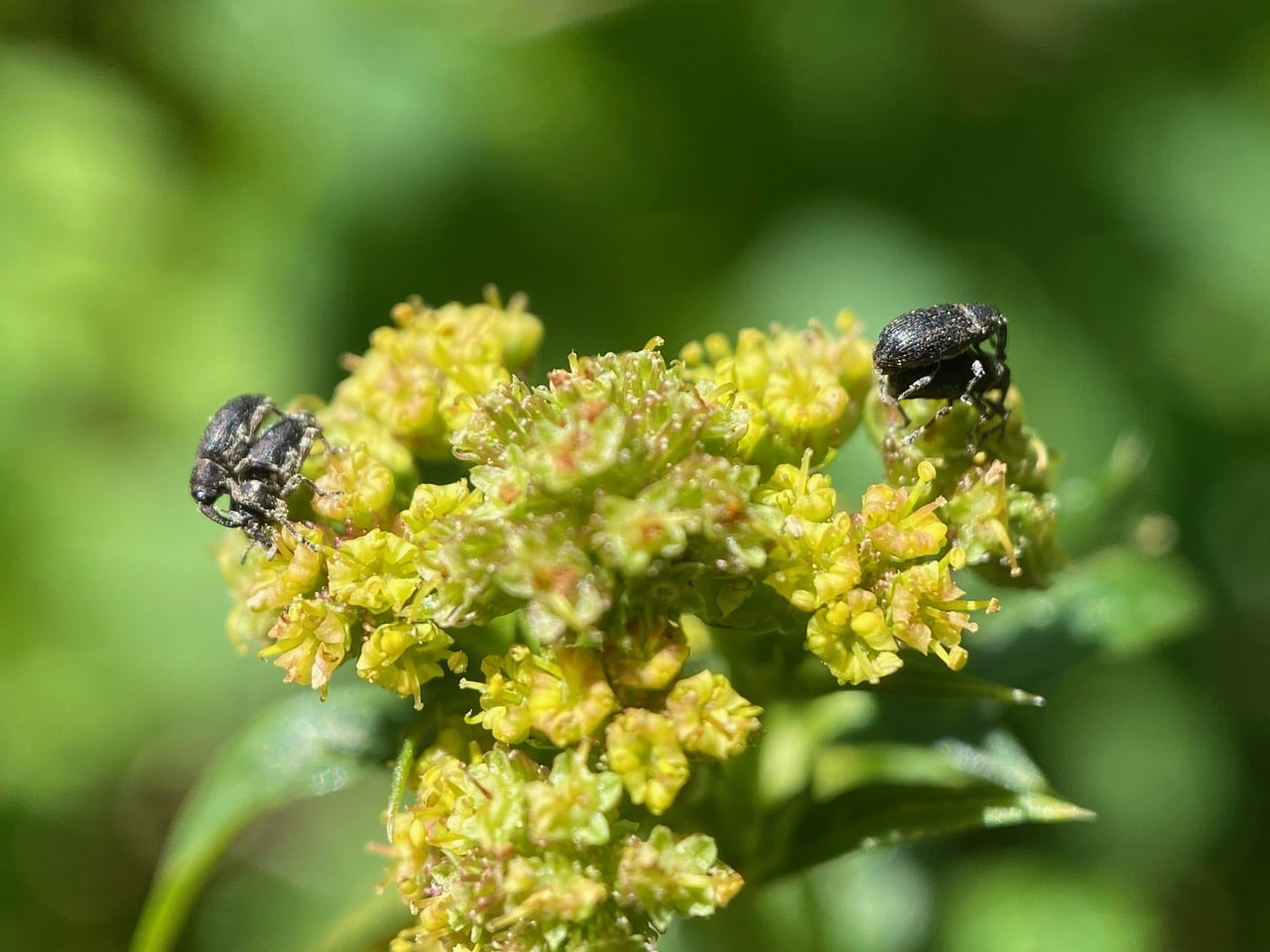
I have enough pictures of mating weevils on the Pacific Sanicle, Sanicula crassicaulis, but can’t resist photographing two pairs on the same inflorescence!
Weevils, family Curculionidae, are also called snout beetles. Curculionidae is one of the largest beetle families (about 40,000 species). Most weevils have long, distinctly elbowed antennae that may fold into special grooves on the snout. The snout is used not only for penetration and feeding but also for boring holes in which to lay eggs. The mouthparts are quite small and located at the end of the rostrum (snout), designed for chewing. Many weevils have no wings, while others are excellent fliers. Most are less than 6 mm in length. The majority of weevils feed exclusively on plants. The fleshy, legless larvae of most species feed only on a certain part of a plant – i.e., the flower head, seeds, fleshy fruits, stems, or roots. Many larvae feed either on a single plant species or on closely related ones. Adult weevils tend to be less specialized in their feeding habits. The family includes some very destructive agricultural pests.

Making it to Siesta Nose just before 11 am, I scan the bare ground on the uphill side of the trail for signs of Mining Bee (family Andrenidae) activities. The gentle east-facing slope is an ideal location for the ground-nesting bees. The first rays of the morning sun would warm the ground, waking the bees up so they get first dibs at the flowers.

Yes, the bees are there. The females alight on the ground with their scopae full of bright yellow pollen. These are not pollen grains loosely held among the scopal hairs. They look strangely wetted and clumped. Just as I have observed yesterday, the bees quickly slip into their nesting holes in the ground. Many diasappear into holes among the low vegetation at the edge of the trailI. I wonder what flowers the yellow pollen came from.
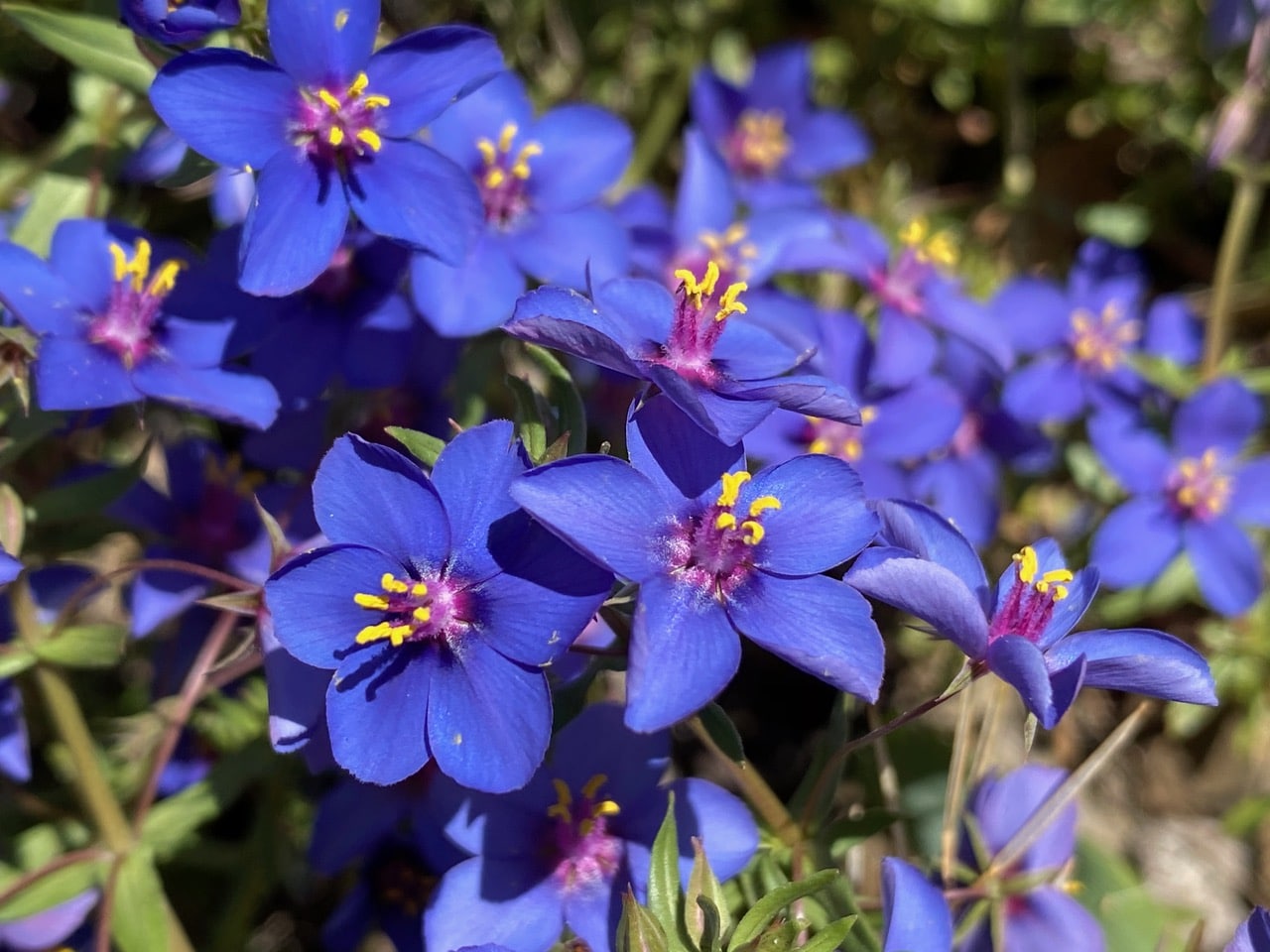
In the vicinity of the nest site within the bee’s flight range, there are only two possibilities – the Blue Pimpernels that are blooming gloriously along the trail…

… and the Smooth Cat’s Ear, Hypochaeris glabra blooming on the grassy slope west of the trail.
The annual herb is native to Europe, North Africa, and the Middle East, but is now widespread in California.
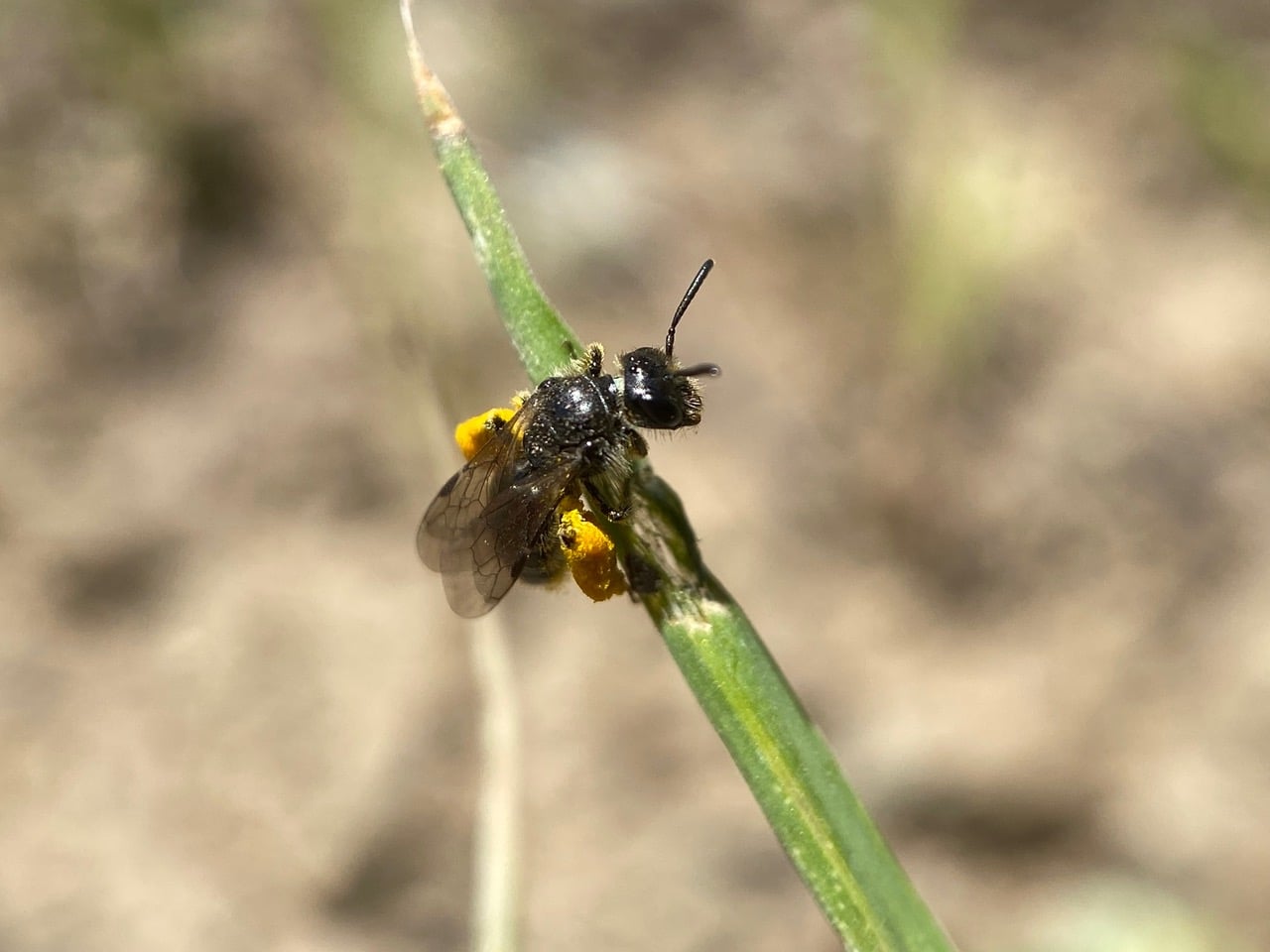
A Mining Bee (family Andrenidae) lands on a low blade of grass to catch her breath, and perhaps to scan the area around her nest hole for Cuckoo Bees, or potential predators.
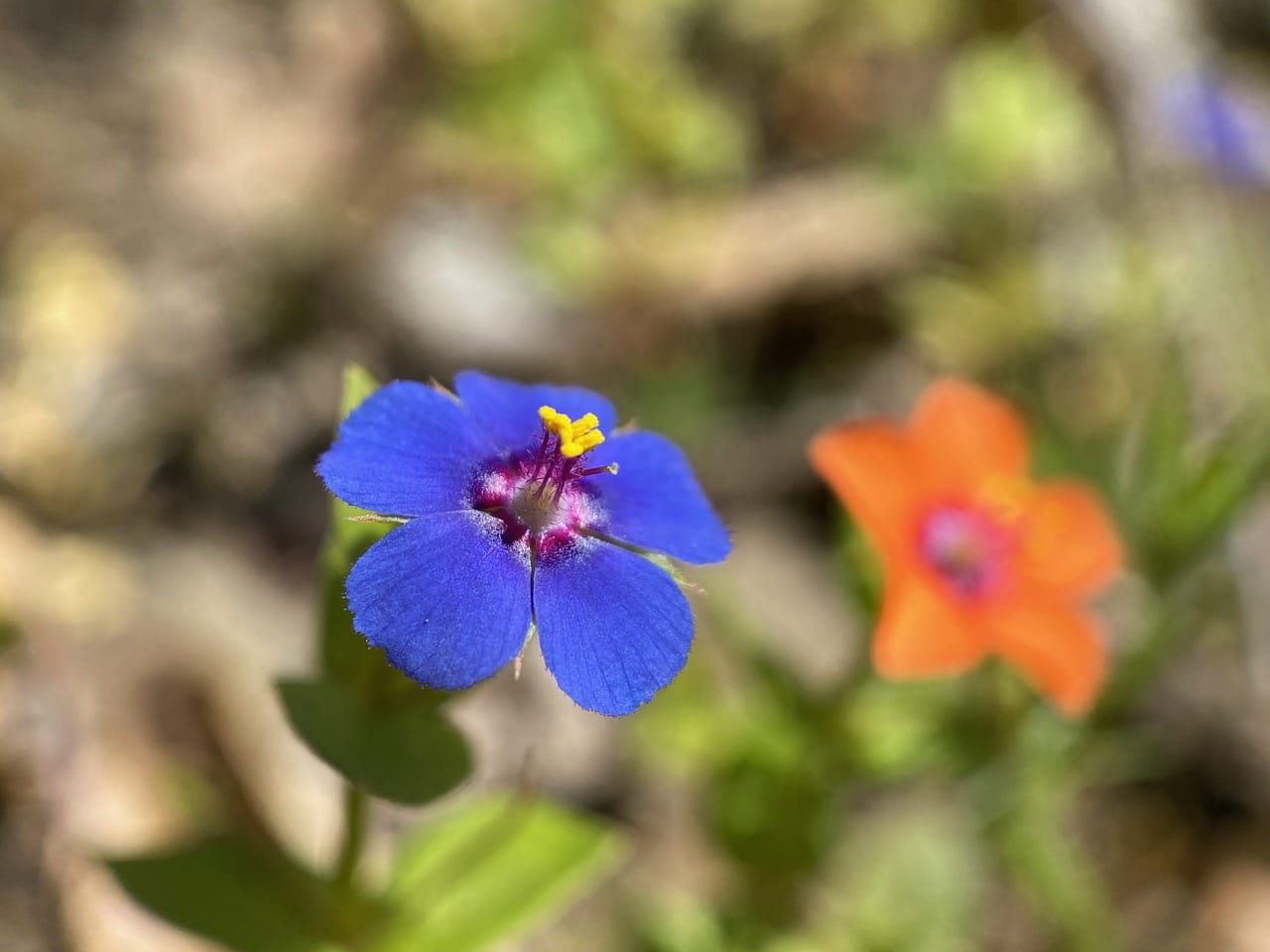
Lysimachia monelli, the Blue Pimpernel (family Primulaceae) is native to the Mediterranean region. It is a low-growing perennial with trailing stems. Wild specimens have blue or orange colored flowers.
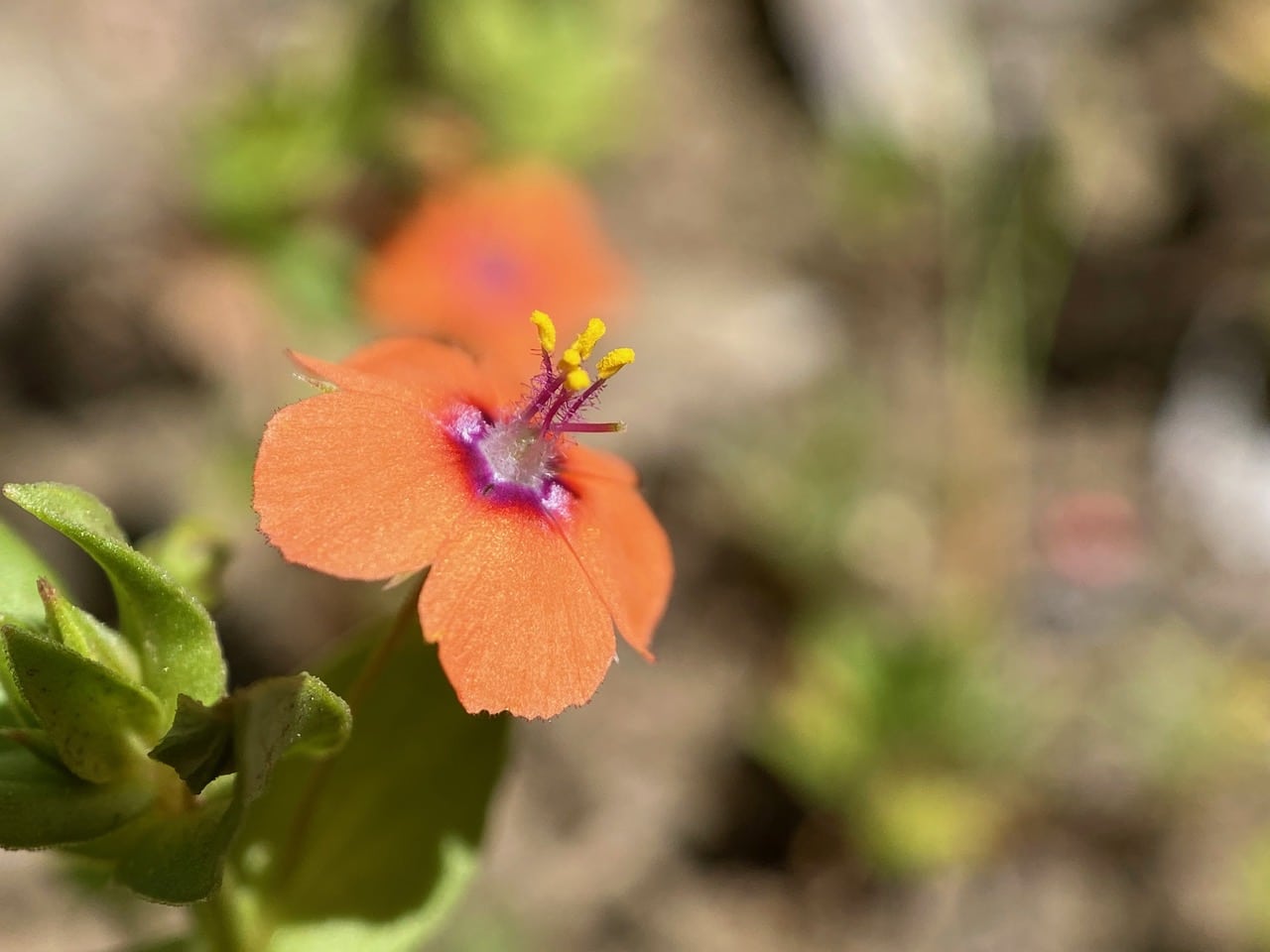
This is the more common color, known as the Scarlet Pimpernel, Lysimachia arvensis.
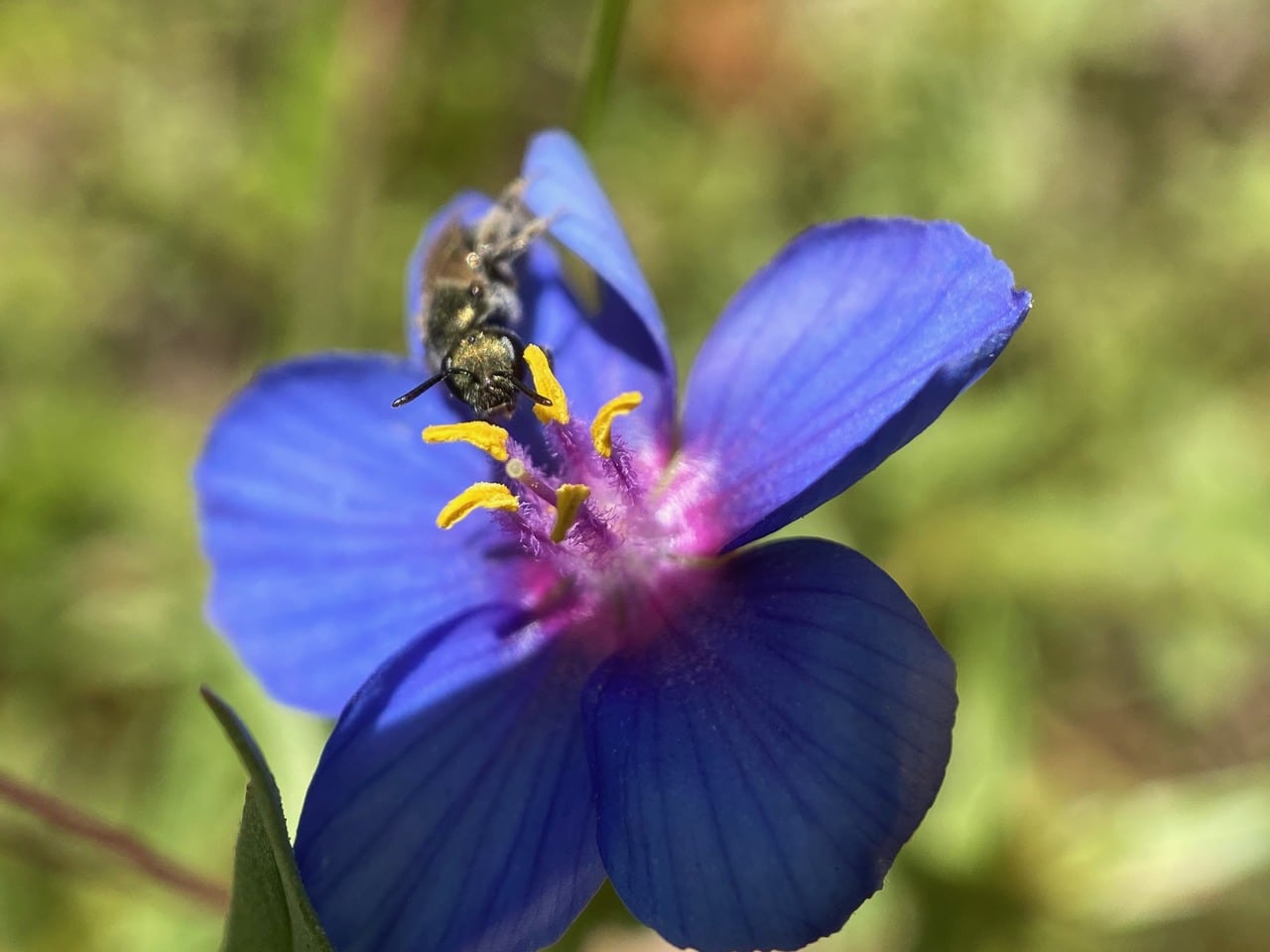
A little bee is visiting a Blue Pimpernel flower.

It appears to be a Metallic Sweat Bee, Lasioglossum (Dialictus) sp. (family Halictidae).
Lasioglossum species are found worldwide, and they constitute the largest bee genus. The subgenus Dialictus are the most likely to be seen in the U.S., with over 300 species of these tiny metallic bees. The majority of Lasioglossum are generalists. Because they are so abundant throughout the flowering season, the bees are often important pollinators. Their sheer numbers are enough to achieve excellent pollination of many wild flowers, especially of plants in the Asteraceae, which have shallow floral tubes that are easily accessed by these minute bees.
Lasioglossum are closely related to the genera Halictus and Agapostemon. These genera are commonly called “sweat bees” because of their attraction to human sweat, which they drink for its salt content. Lasioglossum are dusky black to brown slender bees with bands of hair on their abdomen. Female Sweat Bees (family Halictidae) carry pollen in the scopae on their entire hind legs and underside of their abdomen.
Lasioglossum exhibit a range of social behaviors; the genus includes solitary, communal, semi social, primitively eusocial, and even parasitic species. Almost all Lasioglossum in the U.S. nest in the ground. Generally these nests are built in the spring by fertilized females (called foundresses) that spent the winter in hibernation. In social species, the foundresses behave much like the queen Bumble Bees – they lay the first batch of eggs that develop into the first generation of female workers. The nest grows with each additional generation of bees. Later broods may consist of both males and females. They mate, and at the end of the season the fertilized females hibernate til the following spring, repeating the life cycle of the colony.
Dialictus is a subgenus of sweat bees belonging to the genus Lasioglossum. Most of the members of this subgenus have a metallic appearance. They are commonly found in the Northern Hemisphere and are found in abundance in North America. Members of this subgenus also have very diverse forms of social structure making them model organisms for studying the social behavior of bees.
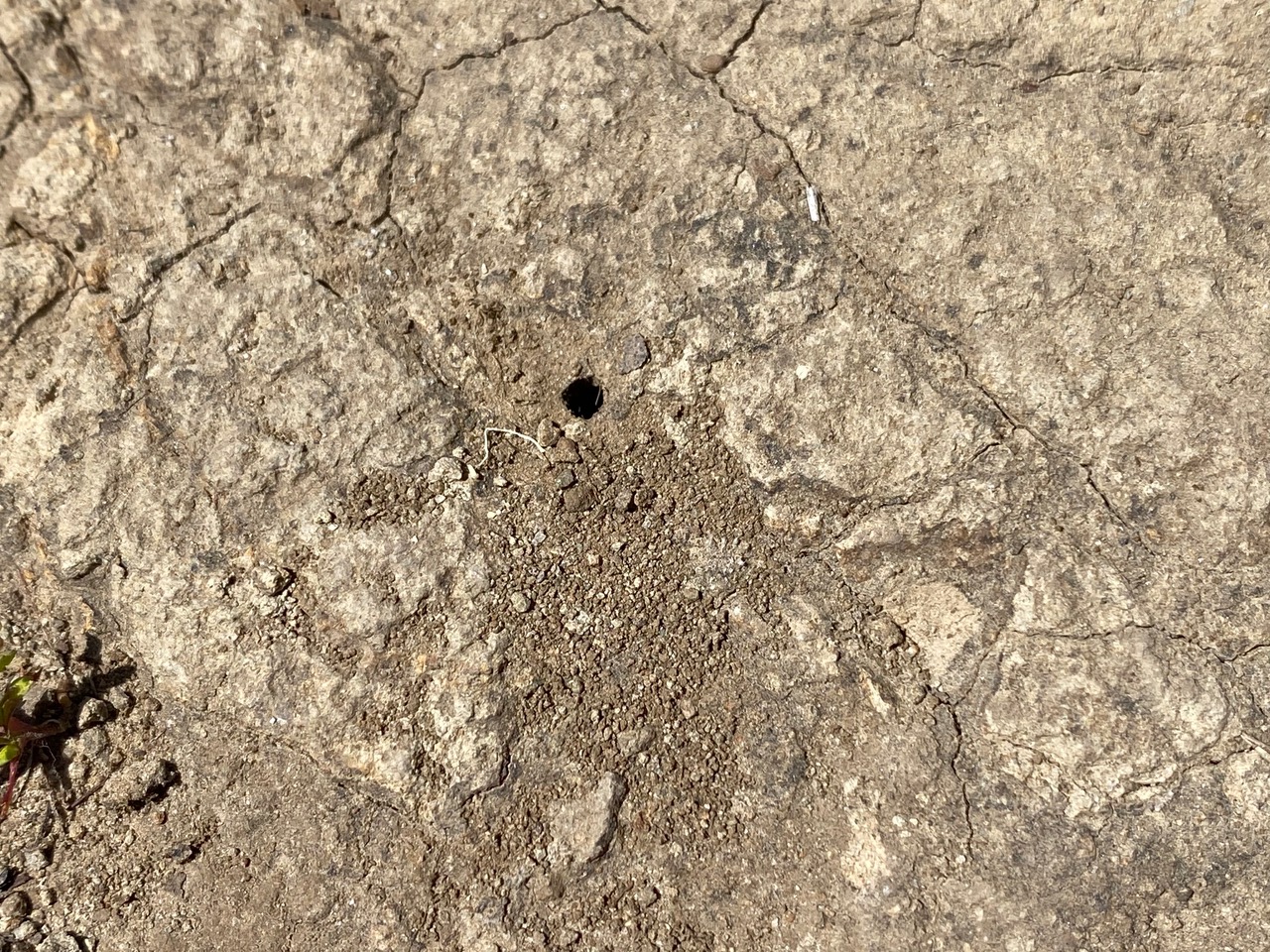
Most of the Mining Bees (family Andrenidae) nest entrances are barely 2 mm across, and they are not always this round. There are more of them in the bare patches among the low vegetation away from the trail.

A Rock Bristletail (family Meinertellidae) glides across the ground to find cover, its movements fast and slippery.
One of the oldest known insect fossils is a Bristletail, dating back 396 million years to the Devonian period. Bristletail (order Archaeognatha), any of approximately 350 species of primitive wingless insects that measure from 5 to 20 mm in length, and have three slender bristle-like appendages at the tip of the abdomen. Bristletails have small compound eyes and external mouthparts. Some species have scales covering the body. Young bristletails resemble adults except in size. Sexual maturity is attained in two to three years, and the life span of some species may be as long as seven years, undergoing as many as 35 molts.
Bristletails are common in grassy or woodland habitats, living in leaf litter, bark, rock crevices where they shelter during the day and perambulate at night. Herbivores and decomposers, bristletails use their mouthparts to feed on algae, fungi, lichens, mosses, detritus and decaying organic materials.
A Rock Bristletail is often found under rocks and stones. Like other Bristletails, it has three “tails”, long antennae, and a shrimp-like body. It resembles a Silverfish, but is not as flat and less likely to be found indoors. It is covered in small scales that shed easily, making it difficult for a predator to grab and hold onto it. A Bristletail molts throughout its life and prefers habitats that are moist and cool.
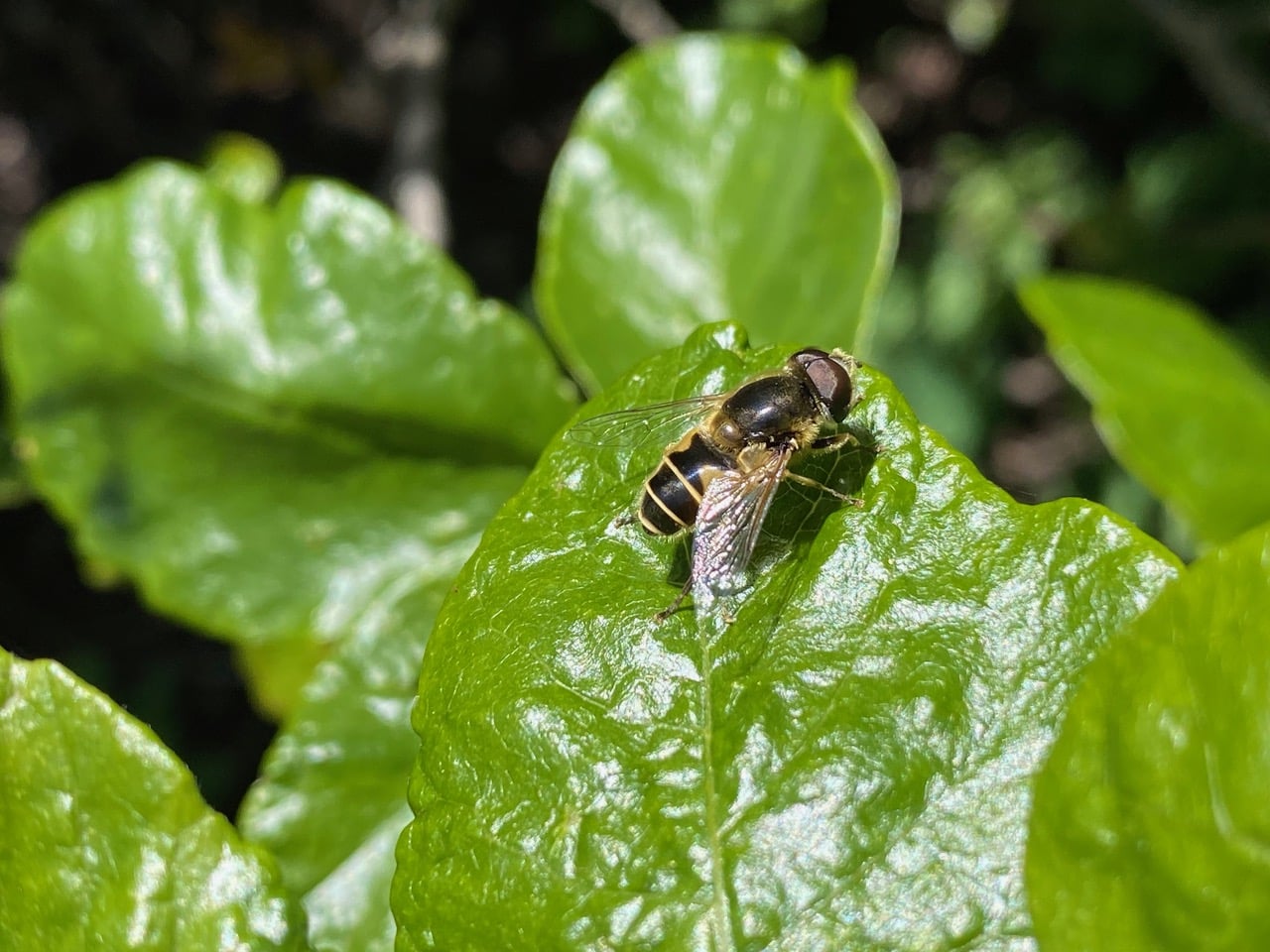
A Black-footed Drone Fly perches on a tender leaf of Poison Oak.
The Black-footed Drone Fly, Eristalis hirta (family Syrphidae) is a common Western North American species of hoverfly. The adults visit flowers for nectar and pollen. Larvae are aquatic filter-feeders of the rat-tailed type.
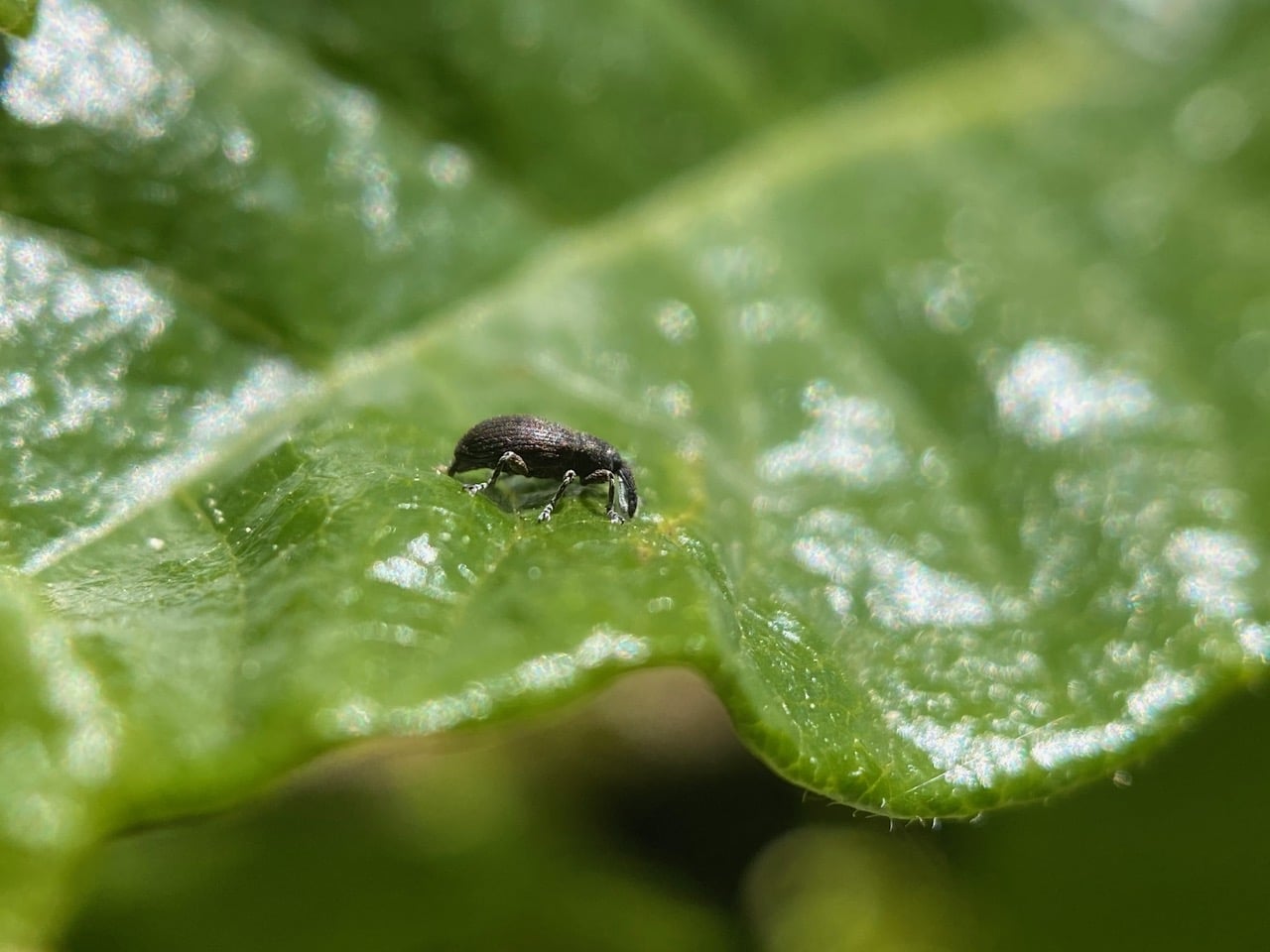
It is rather unusual to see this Weevil (family Curculionidae) on any plant other than the Pacific Sanicle, Sanicula crassicaulis. I have never seen these beetles fly. Has this individual fallen onto the Poison Oak leaf from an adjacent Sanicle?
Weevils, family Curculionidae, are also called snout beetles. Curculionidae is one of the largest beetle families (about 40,000 species). Most weevils have long, distinctly elbowed antennae that may fold into special grooves on the snout. The snout is used not only for penetration and feeding but also for boring holes in which to lay eggs. The mouthparts are quite small and located at the end of the rostrum (snout), designed for chewing. Many weevils have no wings, while others are excellent fliers. Most are less than 6 mm in length. The majority of weevils feed exclusively on plants. The fleshy, legless larvae of most species feed only on a certain part of a plant – i.e., the flower head, seeds, fleshy fruits, stems, or roots. Many larvae feed either on a single plant species or on closely related ones. Adult weevils tend to be less specialized in their feeding habits. The family includes some very destructive agricultural pests.

A small and slim male Mining Bee, Andrena sp. (family Andrenidae) is backing out of a flower of Bee Plant, Scrophularia californica. The bee is well matched in size for foraging on the small flower.
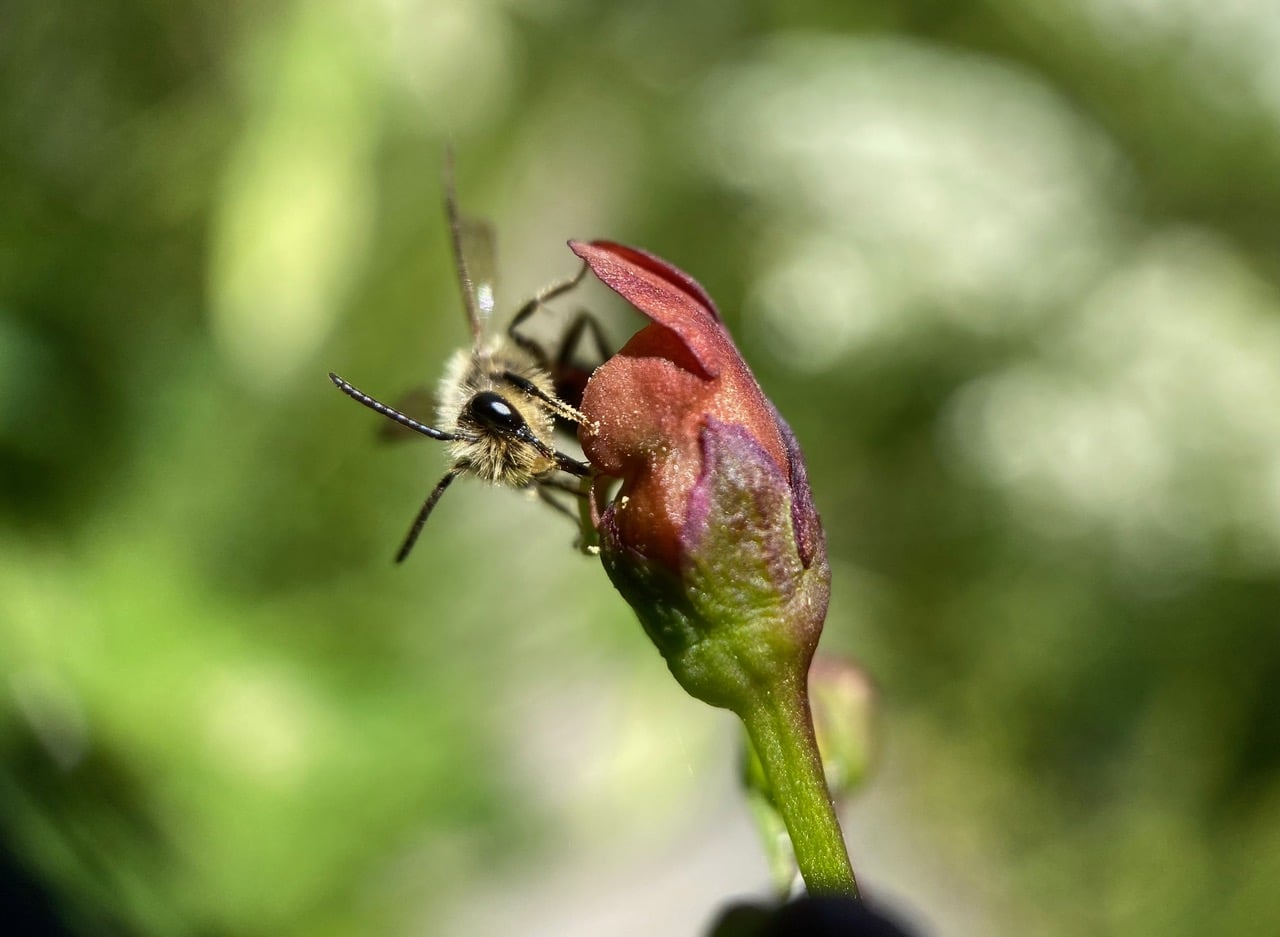
What a cutie, with a tuft of long hairs on his face! Although male bees do not intentionally collect pollen to provision the nest, they do get pollen stuck to their body when they seek nectar from flowers. Flying from plant to plant, they are capable of pollinating the flowers they visit.