

Pollinator Post 5/3/24 (2)
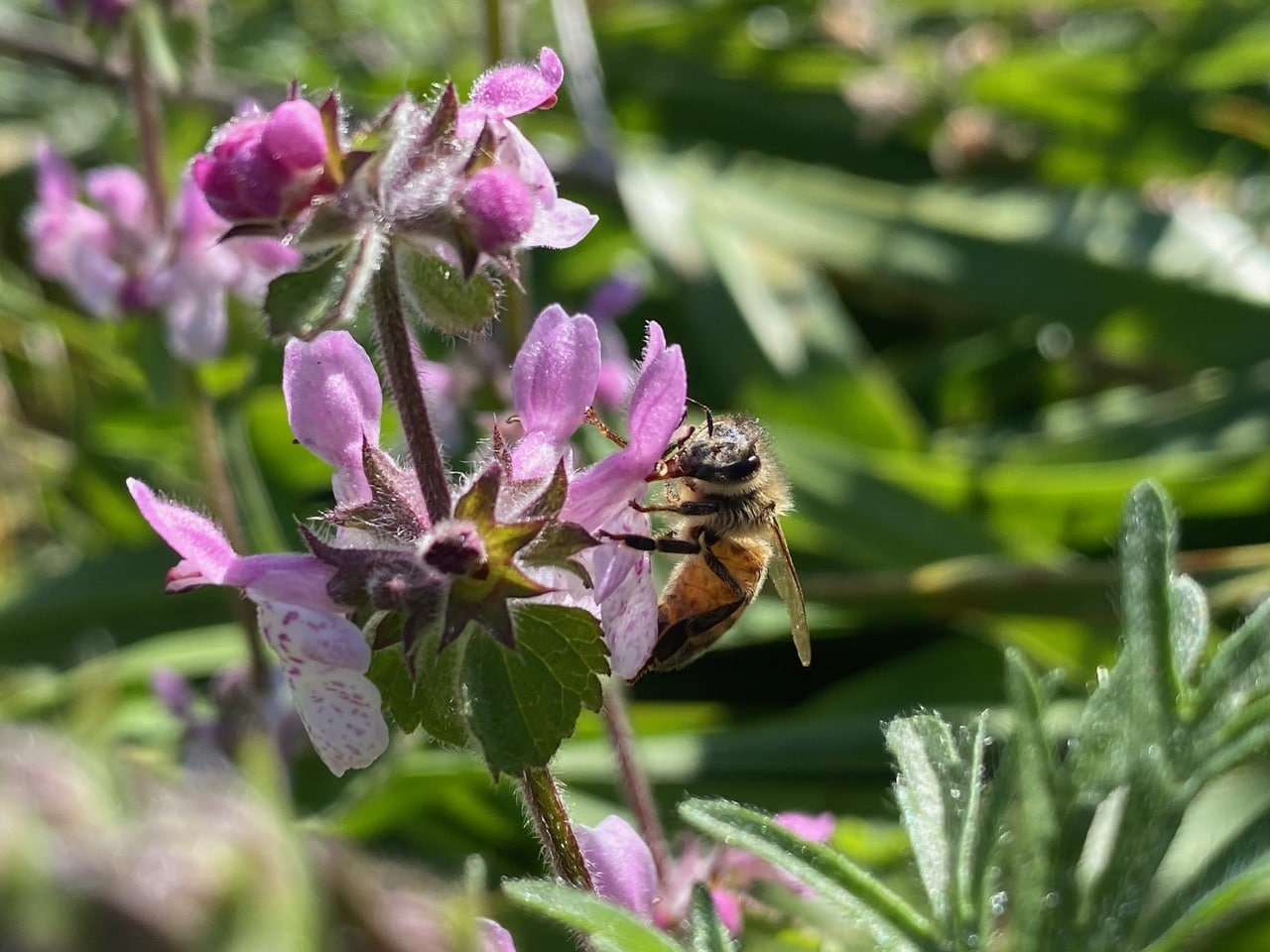
Her tongue extended, a Honey Bee, Apis mellifera (family Apidae) is taking nectar from a flower of Wood Mint, Stachys ajugoides.
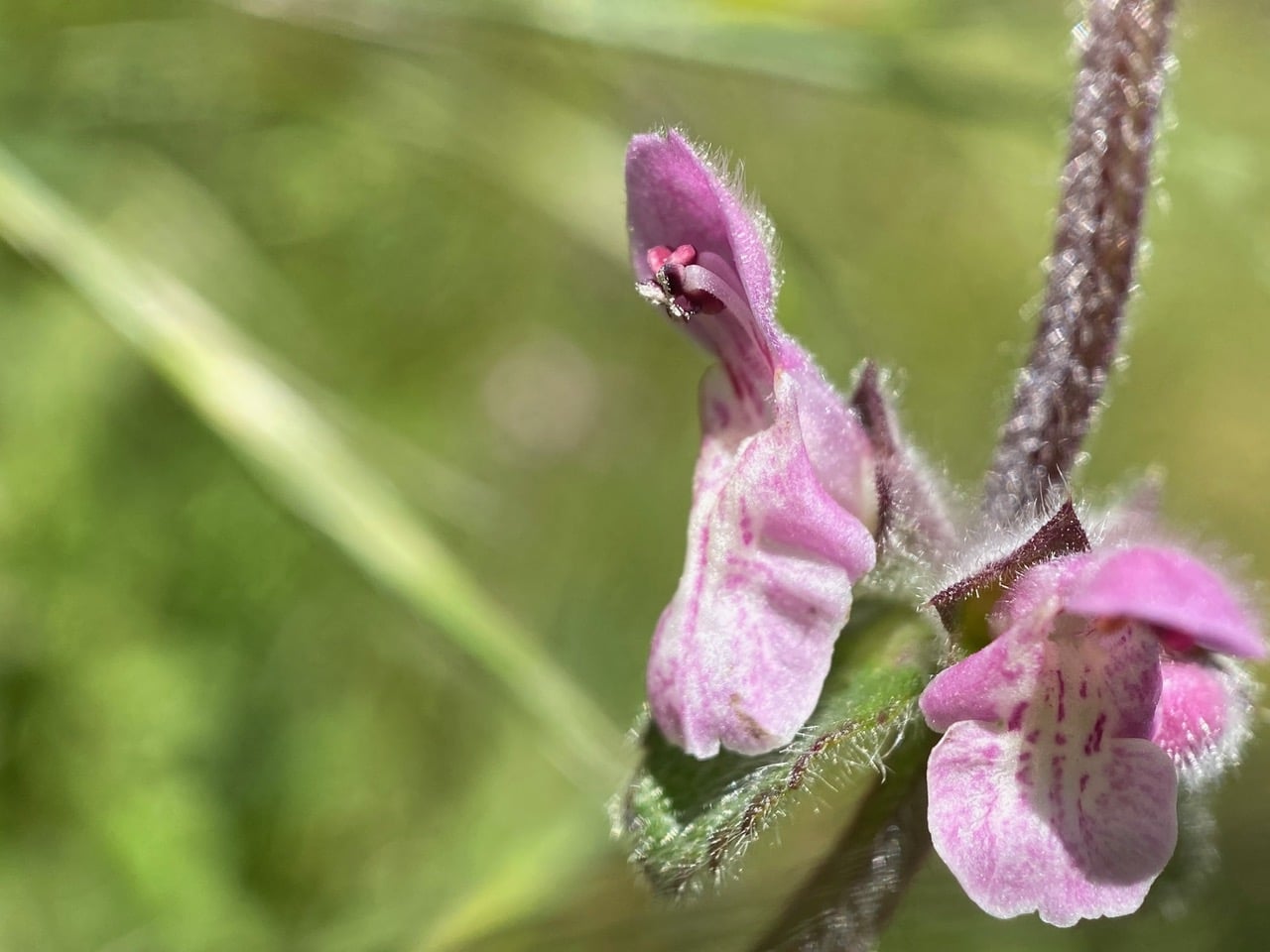
Four stamens stand upright in front of the upper lip of the fresh Stachys flower. First the two stamens on the sides release their pollen before they twist to opposite sides and wither. Then the pair in the middle will release their pollen. Any insect visiting the flower for nectar will get dabbed with pollen on its head.

Both pairs of stamens have withered. There is a style emerging from the midst of the stamens, only faintly visible from this angle.
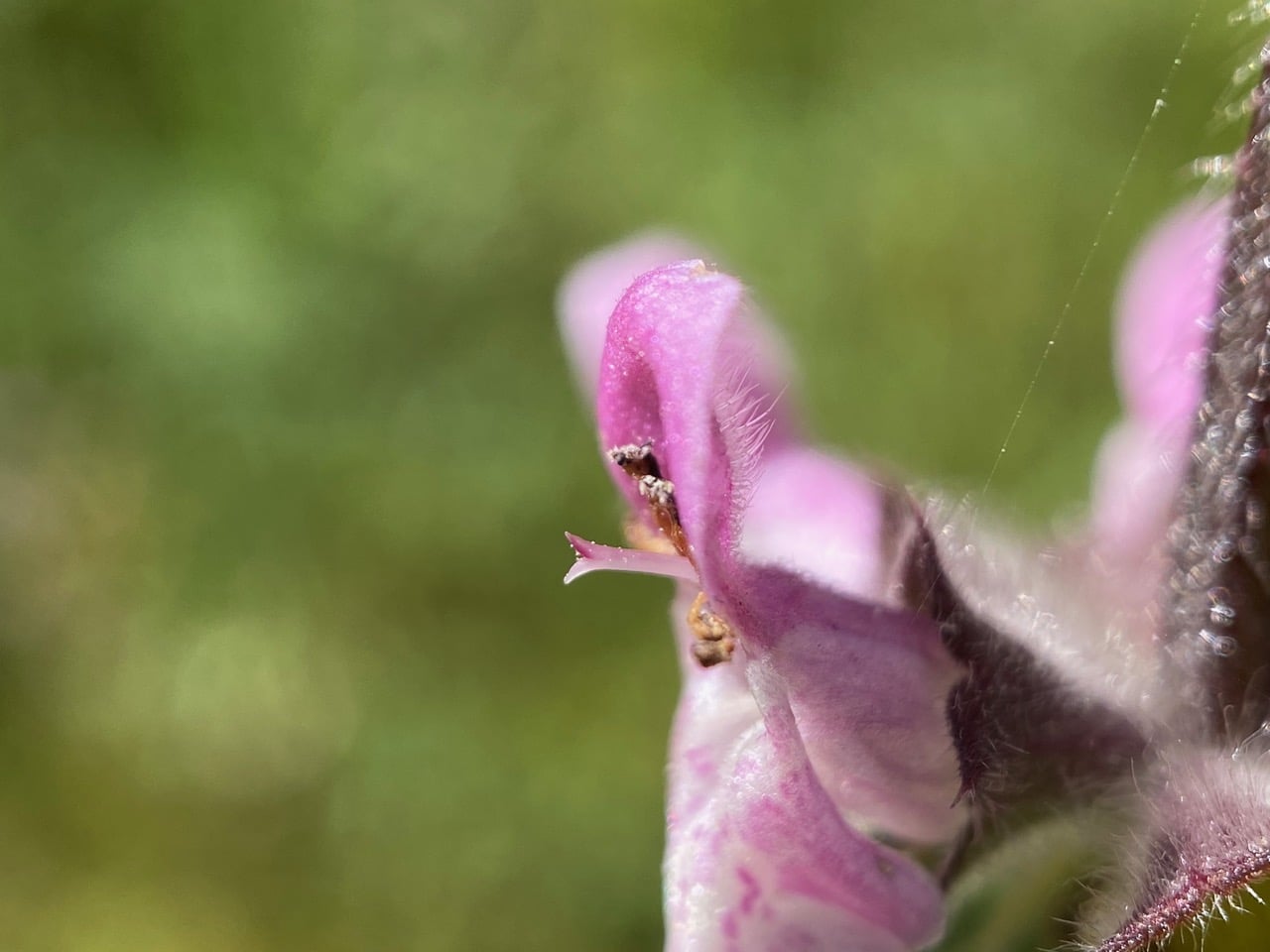
Side view of a Stachys flower showing the protruding style and forked stigma. The Stachys flower is protandrous, meaning the male parts mature before the female parts. Once the stamens (male parts) have done their job dispensing pollen, the style and forked stigma (female parts) lengthen from the base of the flower between the faded stamens to receive incoming pollen. The temporal separation of the sexes serves to prevent self-pollination.

A female California Mountain Digger Bee, Habropoda depressa (family Apidae) is flying noisily over a small patch of blooming Chia, Salvia columbaria, stopping occasionally to forage on the miniature sage flowers on their pom-pom flowerheads. It is hard to tell if the bee is taking nectar, or if she’s also collecting pollen. Chia has bright yellow pollen. What the bee has in her scopae and on her face may be pollen from California Poppy.
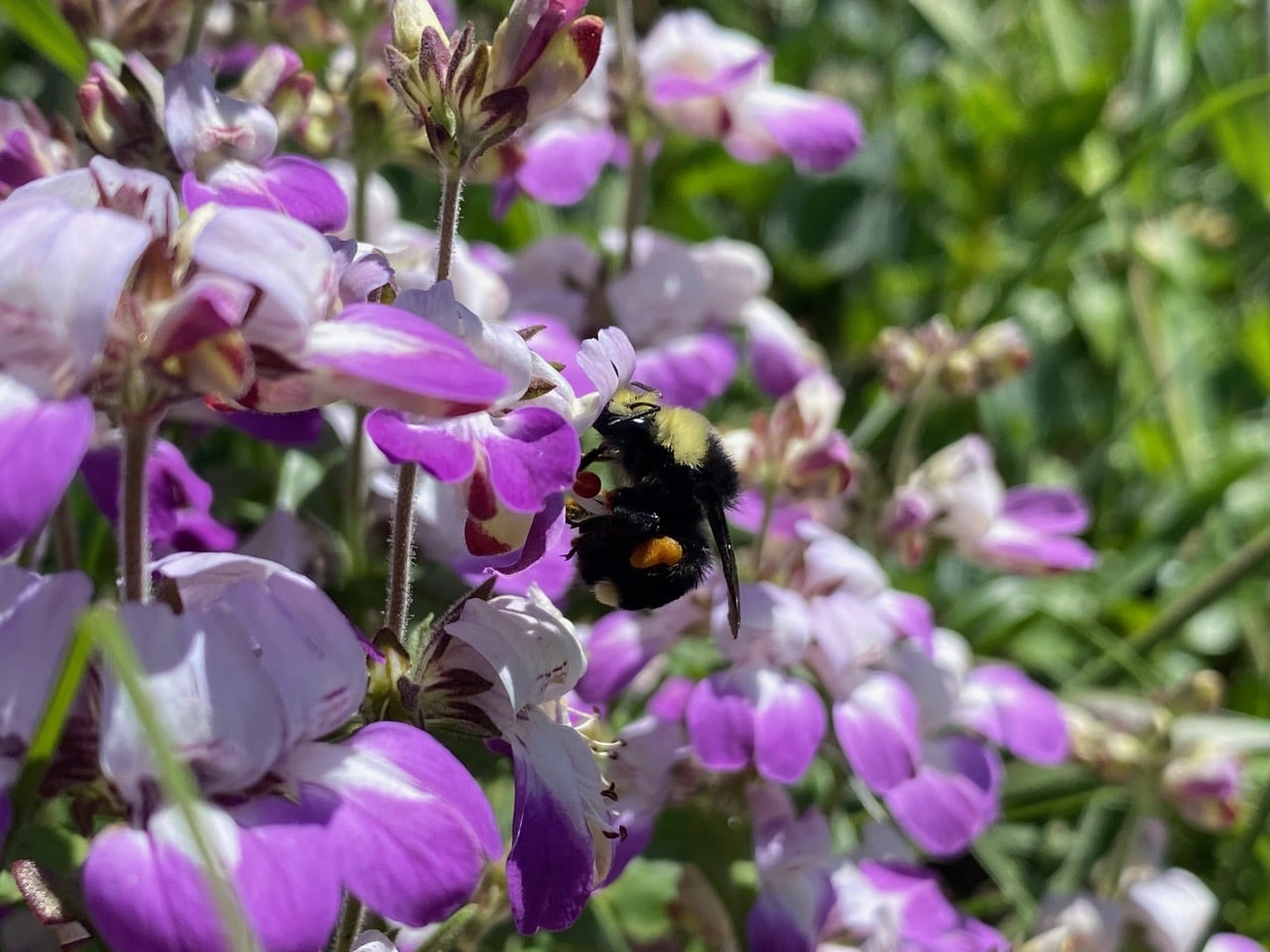
A Yellow-faced Bumble Bee, Bombus vosnesenskii (family Apidae) is foraging on the flowers of Chinese Houses, Collinsia heterophylla.
Although from different plant families, the flowers of Chinese Houses and those of the Lupines share uncanny structural similarities. In both, the reproductive structures are hidden away in a secret pocket, and require the weight of a hefty bee to depress the petals upon landing to expose the pollen bearing stamens and receptive stigmas. Bumble Bees are the primary pollinators of both flowers, using similar techniques.
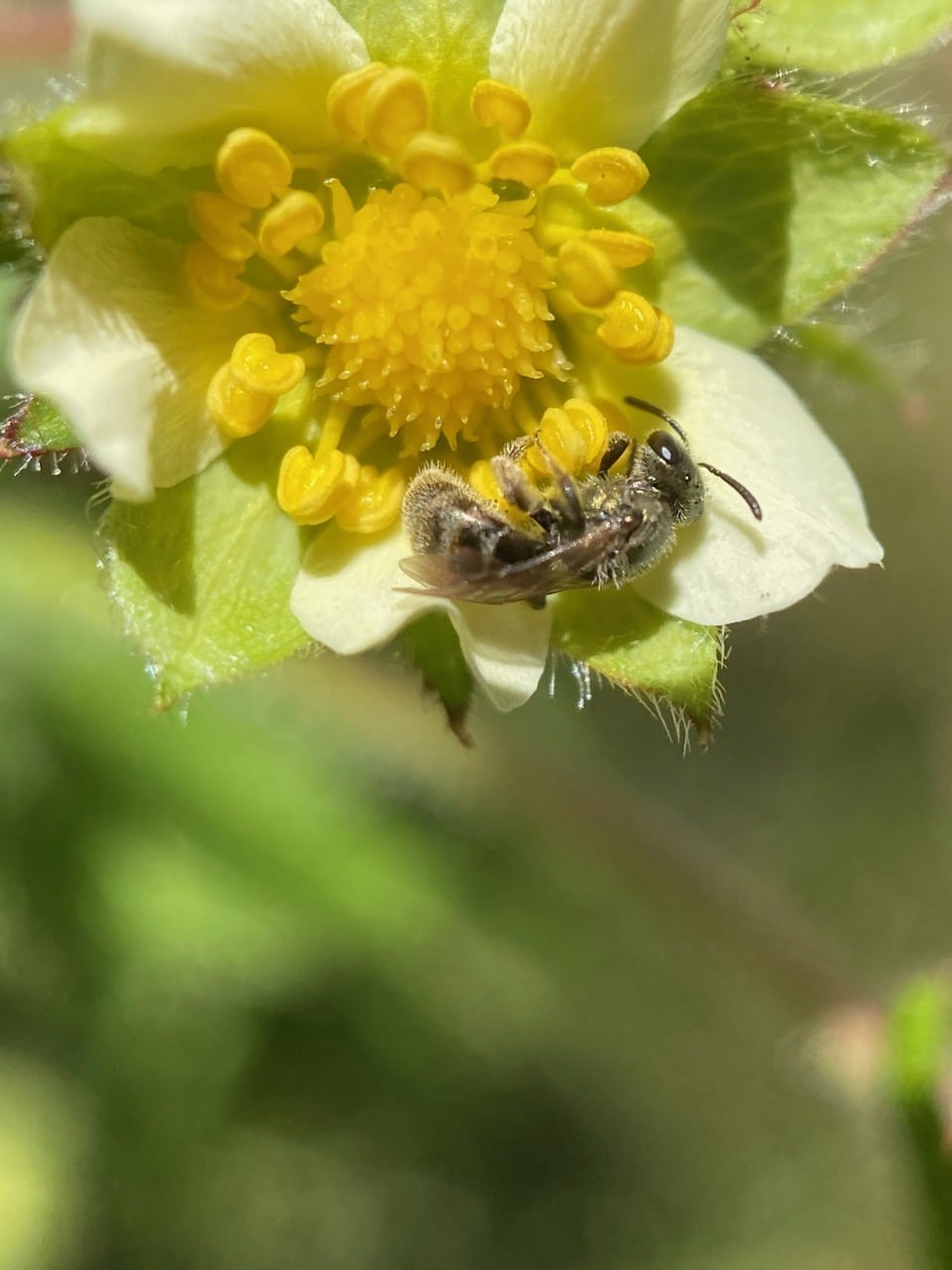
A Metallic Sweat Bee, Lasioglossum (Dialictus) sp. (family Halictidae) is foraging on a flower of Sticky Cinquefoil, Drymocallis glandulosa.
Lasioglossum species are found worldwide, and they constitute the largest bee genus. The subgenus Dialictus are the most likely to be seen in the U.S., with over 300 species of these tiny metallic bees. The majority of Lasioglossum are generalists. Because they are so abundant throughout the flowering season, the bees are often important pollinators. Their sheer numbers are enough to achieve excellent pollination of many wild flowers, especially of plants in the Asteraceae, which have shallow floral tubes that are easily accessed by these minute bees.
Lasioglossum are closely related to the genera Halictus and Agapostemon. These genera are commonly called “sweat bees” because of their attraction to human sweat, which they drink for its salt content. Lasioglossum are dusky black to brown slender bees with bands of hair on their abdomen. Female Sweat Bees (family Halictidae) carry pollen in the scopae on their entire hind legs and underside of their abdomen.
Lasioglossum exhibit a range of social behaviors; the genus includes solitary, communal, semi social, primitively eusocial, and even parasitic species. Almost all Lasioglossum in the U.S. nest in the ground. Generally these nests are built in the spring by fertilized females (called foundresses) that spent the winter in hibernation. In social species, the foundresses behave much like the queen Bumble Bees – they lay the first batch of eggs that develop into the first generation of female workers. The nest grows with each additional generation of bees. Later broods may consist of both males and females. They mate, and at the end of the season the fertilized females hibernate til the following spring, repeating the life cycle of the colony.
Dialictus is a subgenus of sweat bees belonging to the genus Lasioglossum. Most of the members of this subgenus have a metallic appearance. They are commonly found in the Northern Hemisphere and are found in abundance in North America. Members of this subgenus also have very diverse forms of social structure making them model organisms for studying the social behavior of bees.

A False Chinch Bugs, Nysius raphanus (family Lygaeidae or seed bugs) is perched on a flower of Sticky Cinquefoil, Drymocallis glandulosa.
Adults are grayish-brown, slender, and about 1/8 to 1/6 in. long. Like many other insects in the order Hemiptera, their forewings are partly thickened and partly membranous so when folded, the tips of the wings overlap, forming a fairly well-defined X on the back of the body.
Photos of False chinch bugs (Genus Nysius) · iNaturalist Canada
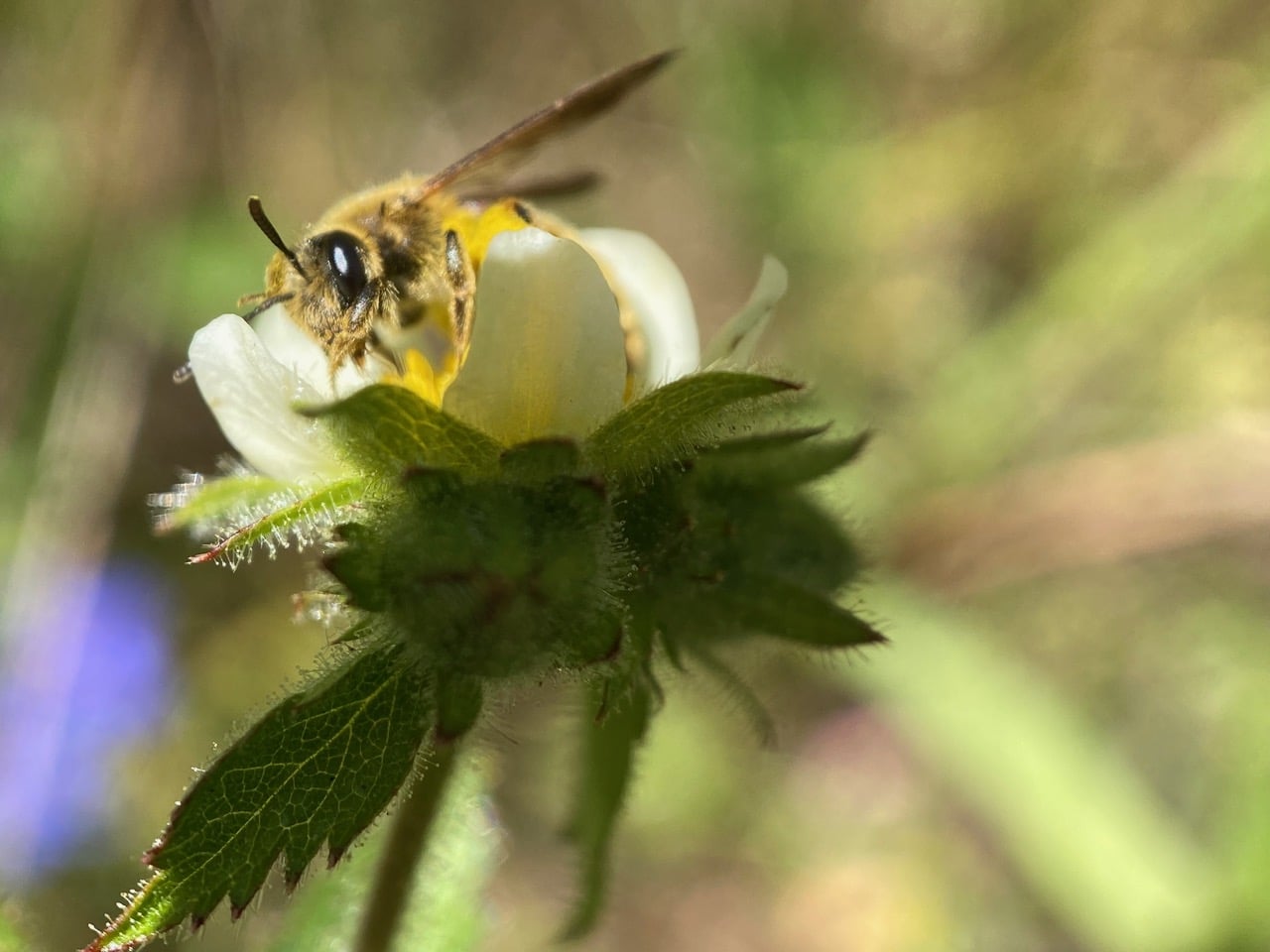
A Mining Bee, Andrena sp. (family Andrenidae) cleans her face after taking nectar from a flower of Sticky Cinquefoil.
Andrenidae is the largest of all bee families, with more than 4500 species in more than 40 genera. These bees are found worldwide, mostly in the western hemisphere. Sometimes called mining bees, Andrenidae nest in the ground. All Andrenidae line their nests with a waterproof substance secreted by the famale to protect her young from soil moisture and soil bacteria.
Andrena is one of the largest bee genera in the world. The floral preferences of Andrena species span the range of bee diets; some are broad generalists, and a number are strict specialists. Andrena are among the first bees to fly in the spring; their ability to withstand the chill is still a puzzle to scientists. The bees can’t fly until their body temperatures reach 50-60 F. They rely on the warmth of the sun to get them to speed, and it is not uncommon to see them warming up on leaves or rocks. This cold-hardiness makes Andrena excellent pollinators of early spring wildflowers and cultivated crops.
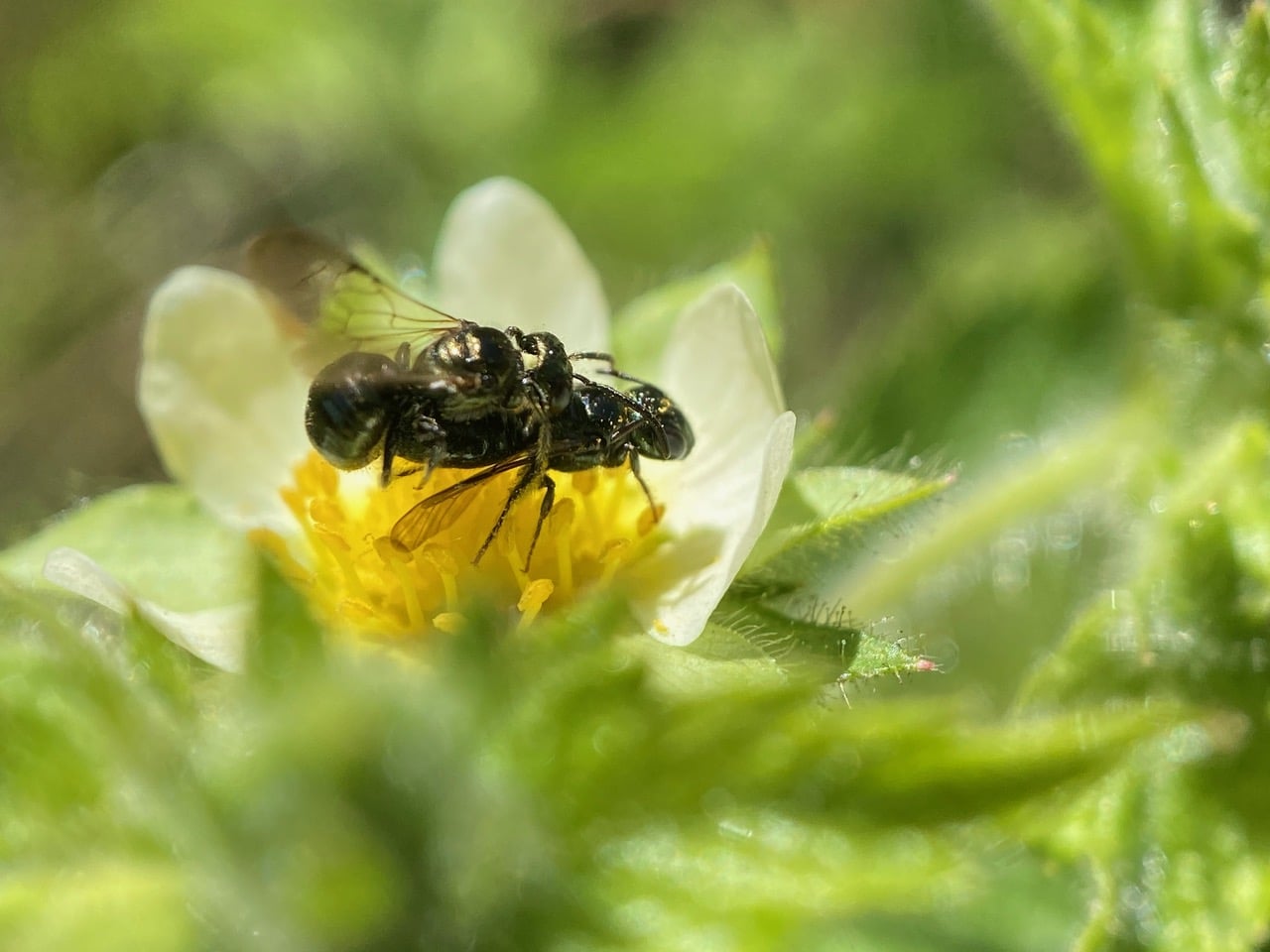
A pair of Small Carpenter Bees, Ceratina sp. (family Apidae) are mating on a flower of Sticky Cinquefoil. The male is constantly fanning his wings, while touching the antennae of the female with his own longer antennae. It’s not an easy photo to take, what with all the motion, the glossiness of the bees, and the bright mid day sun.
The Small Carpenter Bee genus Ceratina is closely related to the more familiar, and much larger Carpenter Bees (genus Xylocopa). Ceratina are typically dark, shiny, even metallic bees, with fairly sparse body hairs and a weak scopa on the hind leg. The shield-shaped abdomen comes to a point at the tip. Some species have yellow markings, often on the face.
Females excavate nests with their mandibles in the pith of broken or burned plant twigs and stems. While many species are solitary, a number are subsocial. Both male and female carpenter bees overwinter as adults within their old nest tunnels, emerging in the spring to mate. In the spring, this resting place (hibernaculum) is modified into a brood nest by further excavation. The female collects pollen and nectar, places this mixture (called bee bread) inside the cavity, lays an egg on the provision, and then caps off the cell with chewed plant material. Several cells are constructed end to end in each plant stem.


A day doesn’t go by without coming across a Crab Spider predation event. A Crab Spider, Mecaphesa sp. (family Thomisidae) is feeding on a hover fly it has caught on an umbel of Cow Parsnip flowers, Heracleum maximum. These ambush predators are good at what they do, and Cow Parsnip seems to be a perfect hunting ground for them!

A Metallic Sweat Bee, Lasioglossum (Dialictus) sp. (family Halictidae) is walking on an inflorescence of California Phacelia, Phacelia californica searching for stamens with fresh pollen.