

Pollinator Post 5/12/24 (2)
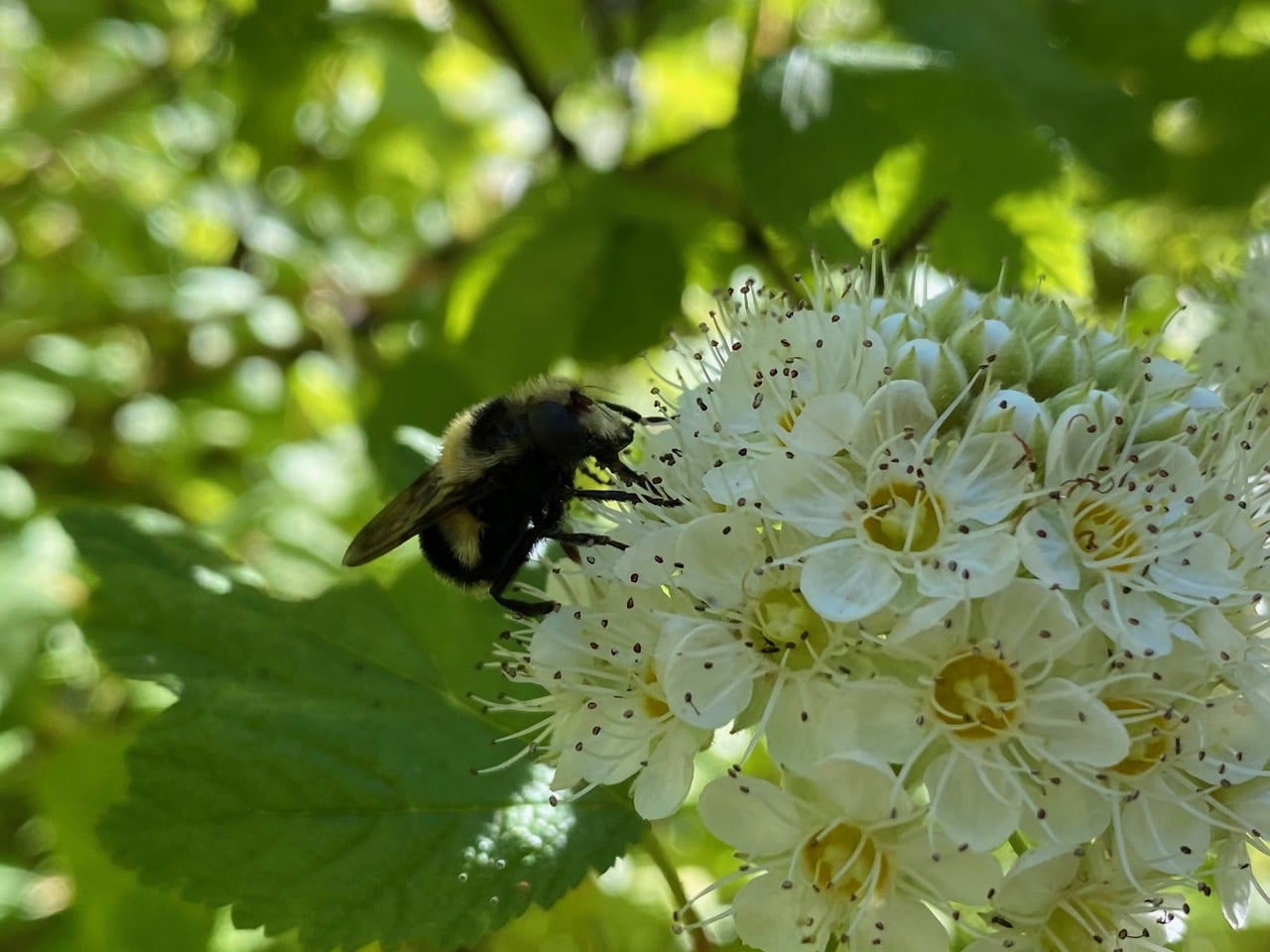
An insect resembling a Black-tailed Bumble Bee lands on an inflorescence of Pacific Nine Bark, Physocarpus capitatus in deep shade. Its movements are slow and it stays a long time – rather unusual behavior for a bumble bee. I suspect it is not a bee.
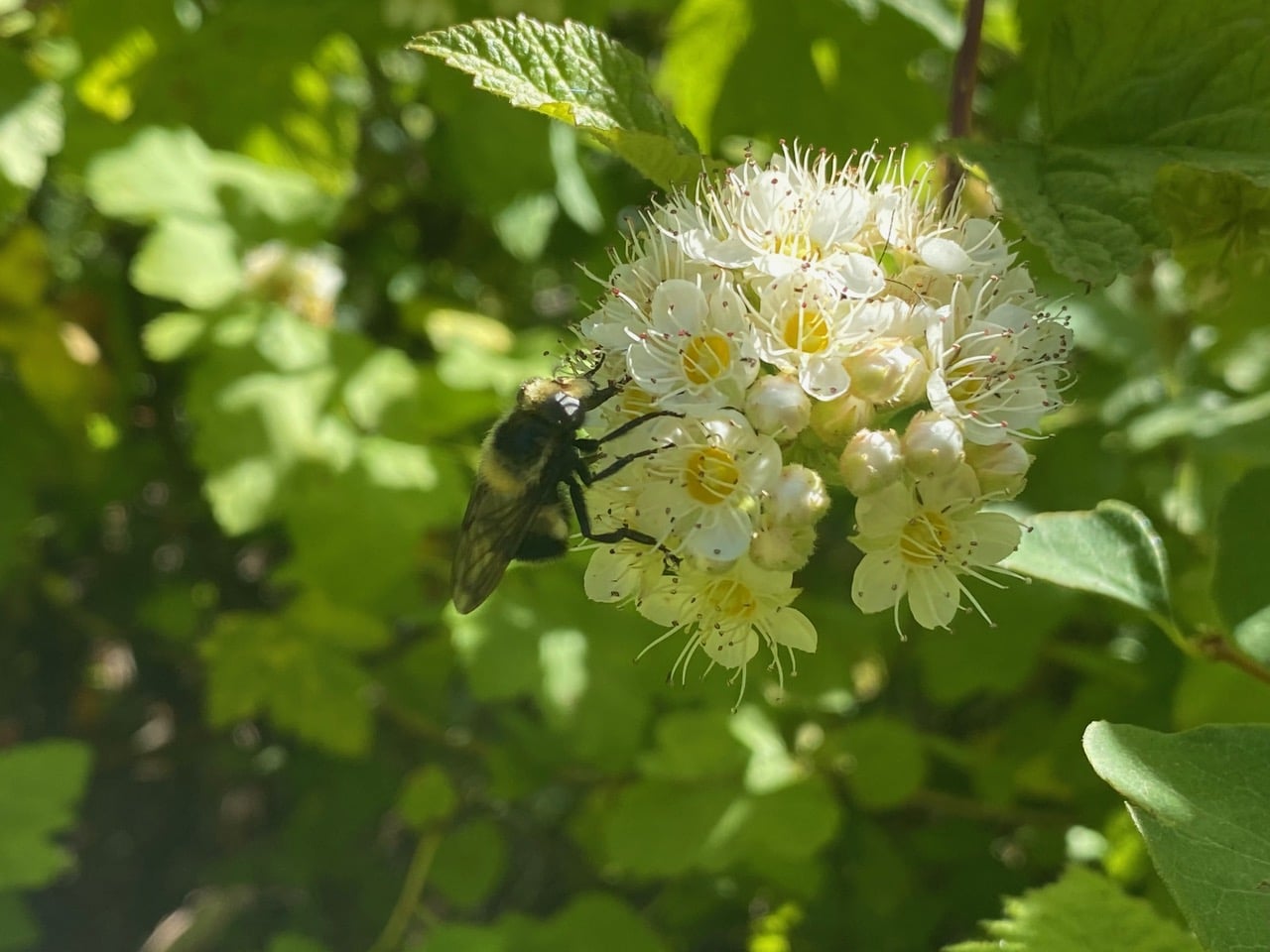
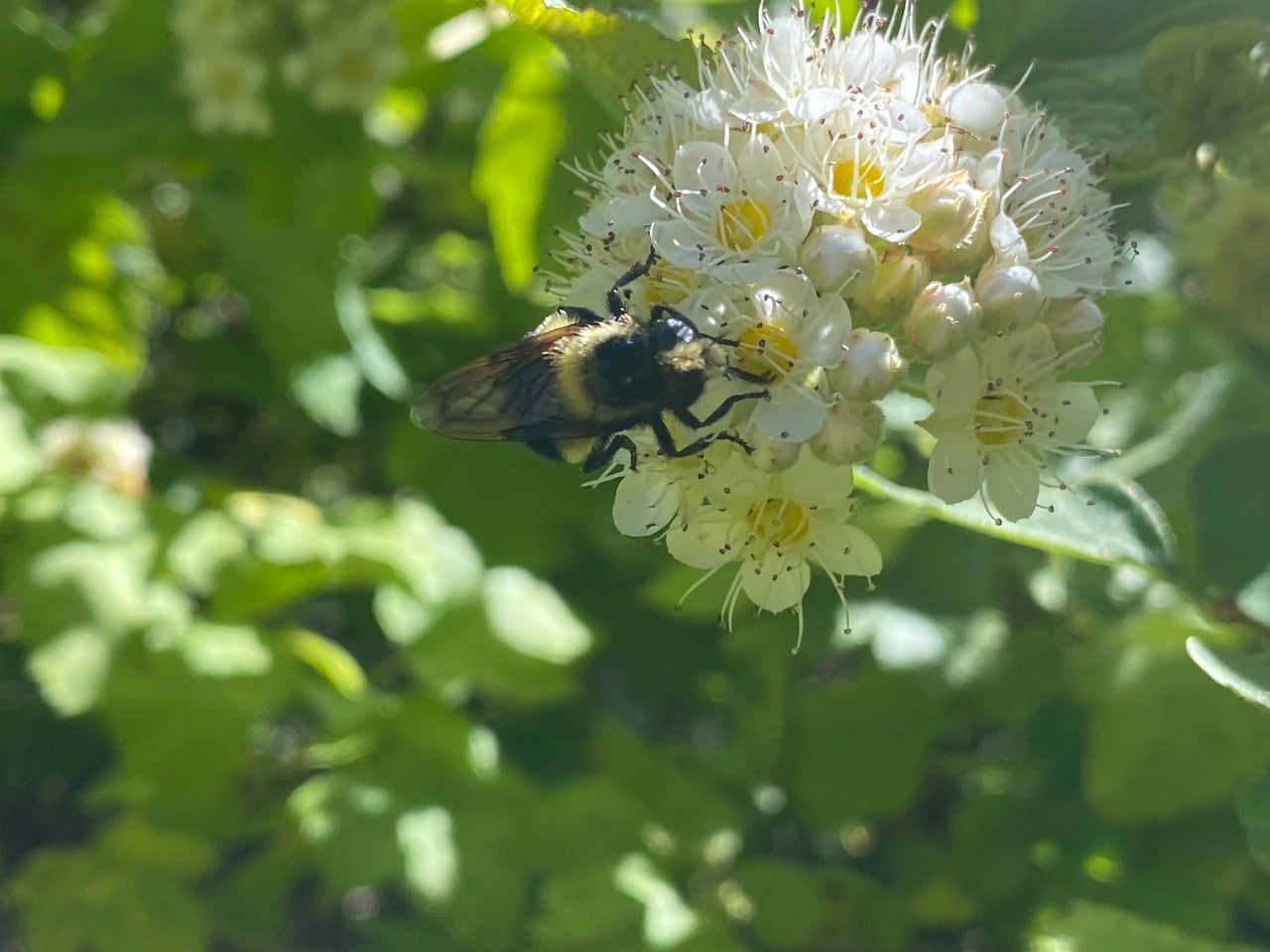





As the insect moves to a better lit inflorescence, I can see its large eyes, and tiny antennae. It has yellow hair on its “snout”. It is in fact a Bumble Bee Hoverfly!
The fly is a member of the Volucella bombylans Complex (family Syrphidae) which comprises numerous hover flies that are bumble bee mimics, also known as Bumble Bee Hoverflies. These flies look like a bumble bee with a furry black and yellow body, but they are given away by their heads, plumed antennae, large eyes and a single pair of wings. Fast fliers, the adults feed on nectar and pollen, with a preference for blue and yellow flowers. The females lay eggs in the nests of bumble bees and social wasps. The larvae live as scavengers on the bottom of the host’s nest, feeding on waste and dead host larvae. It is a rather unusual niche for a Syrphid larva.
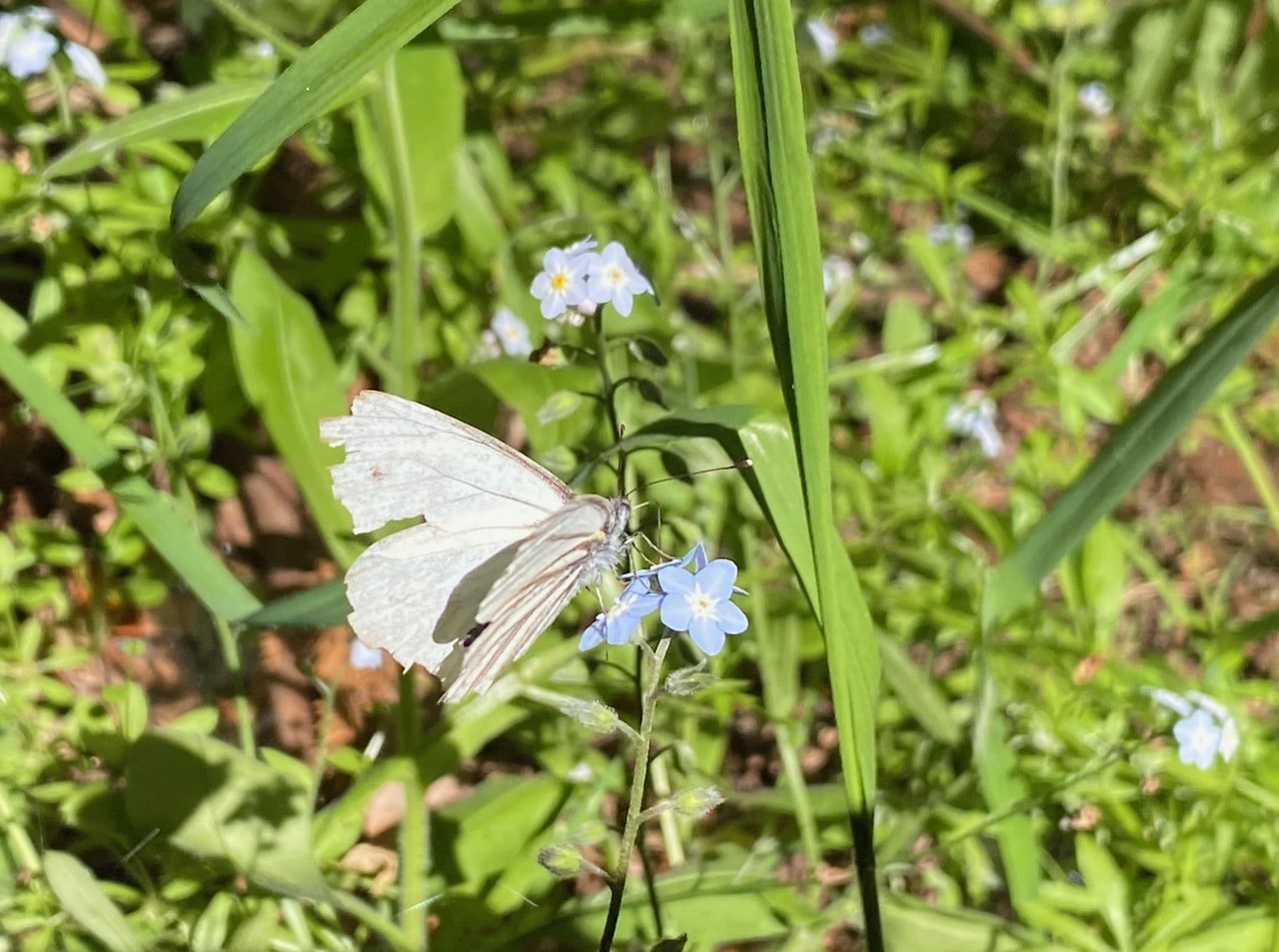
A white butterfly with tattered wings lands to take nectar from Forget-me-not, Myosotis sylvatica. It is probably a very old Cabbage White butterfly.
The cabbage white, Pieris rapae (family Pieridae) was introduced to the US along with European cabbage imports in the 1860’5. The caterpillars feed on plants in the mustard or Brassicaceae family, and occasionally some in the caper family. The butterflies have a darkened, yellowish underside of the hind wings, which enables them to heat up quickly in the sun. The butterfly’s white wings reflect ultraviolet light, which we can’t see but the butterflies can. To our eyes the butterflies seem plain and drab, but to each other, females are a gentle lavender and males shine with a deep royal purple. Brighter males are more attractive to females and the color’s strength reflects the amount of protein the males consumed as caterpillars. During mating, male butterflies transfer nutrients to the females in the form of infertile sperm, a nuptial gift which will enhance the female’s life expectancy and fertility. A male with a higher quality diet can afford to be brighter and to produce bigger and more nutritious nuptial gifts.
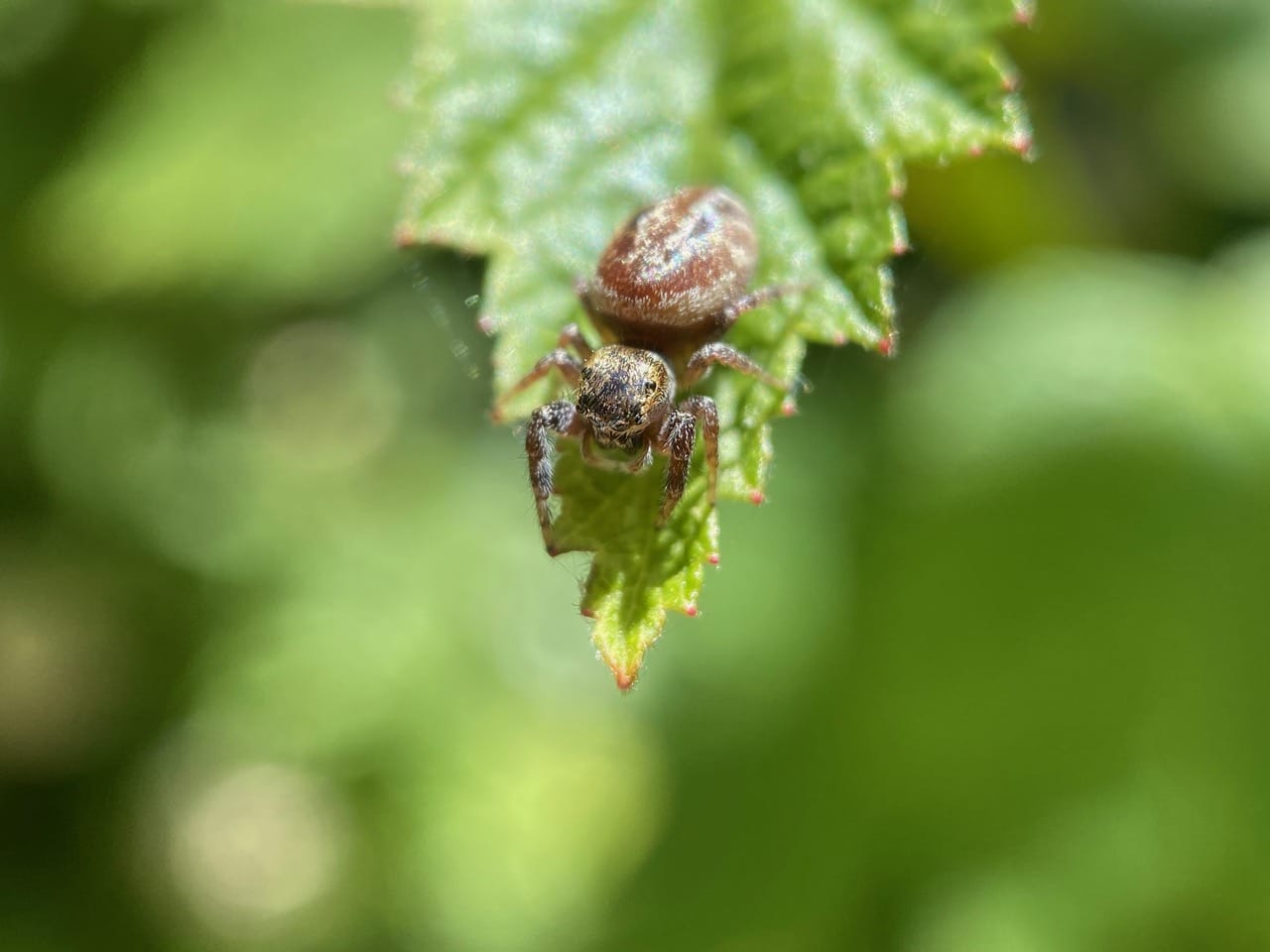
A female Oak Jumping Spider, Metaphidippus manni (family Salticidae) is patrolling a leaf, coming to a stop at the tip.
Salticids are free-roaming hunting spiders. They do not weave a web to catch prey. They stalk, then pounce on their prey. Just before jumping, the spider fastens a safety line to the substrate. It can leap 10-20 times their body length to capture prey. Their movement is achieved by rapid changes in hydraulic pressure of the blood. Muscular contractions force fluids into the hind legs, which cause them to extend extremely quickly. Jumping spiders are visual hunters. Their excellent vision has among the highest acuities in invertebrates. Since all their 8 eyes are fixed in place and cannot pivot independently from the body like human eyes can, jumping spiders must turn to face whatever they want to see well. This includes moving their cephalothorax up and down, an endearing behavior.
The Oak Jumping Spider, Metaphidippus manni (family Salticidae) is commonly found in oak woodlands of the Pacific Coast, stretching from British Columbia to Baja California, and east to central Arizona. There is marked sexual dimorphism in the species. Males are distinguished by dense white patches on chelicerae (paired structures in front of the face tipped with fangs) and cheek patches that contrast against a dark, shiny body.
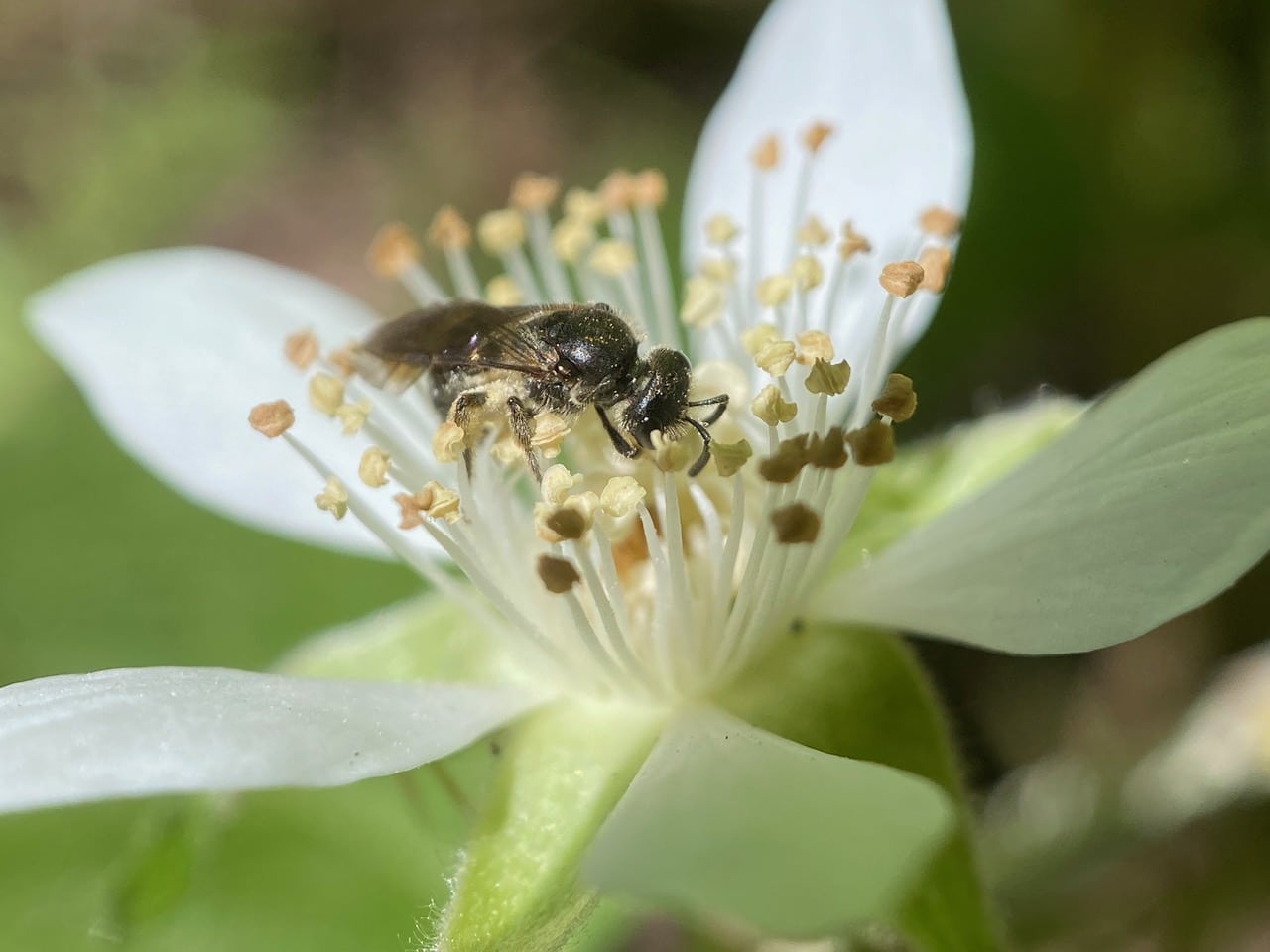
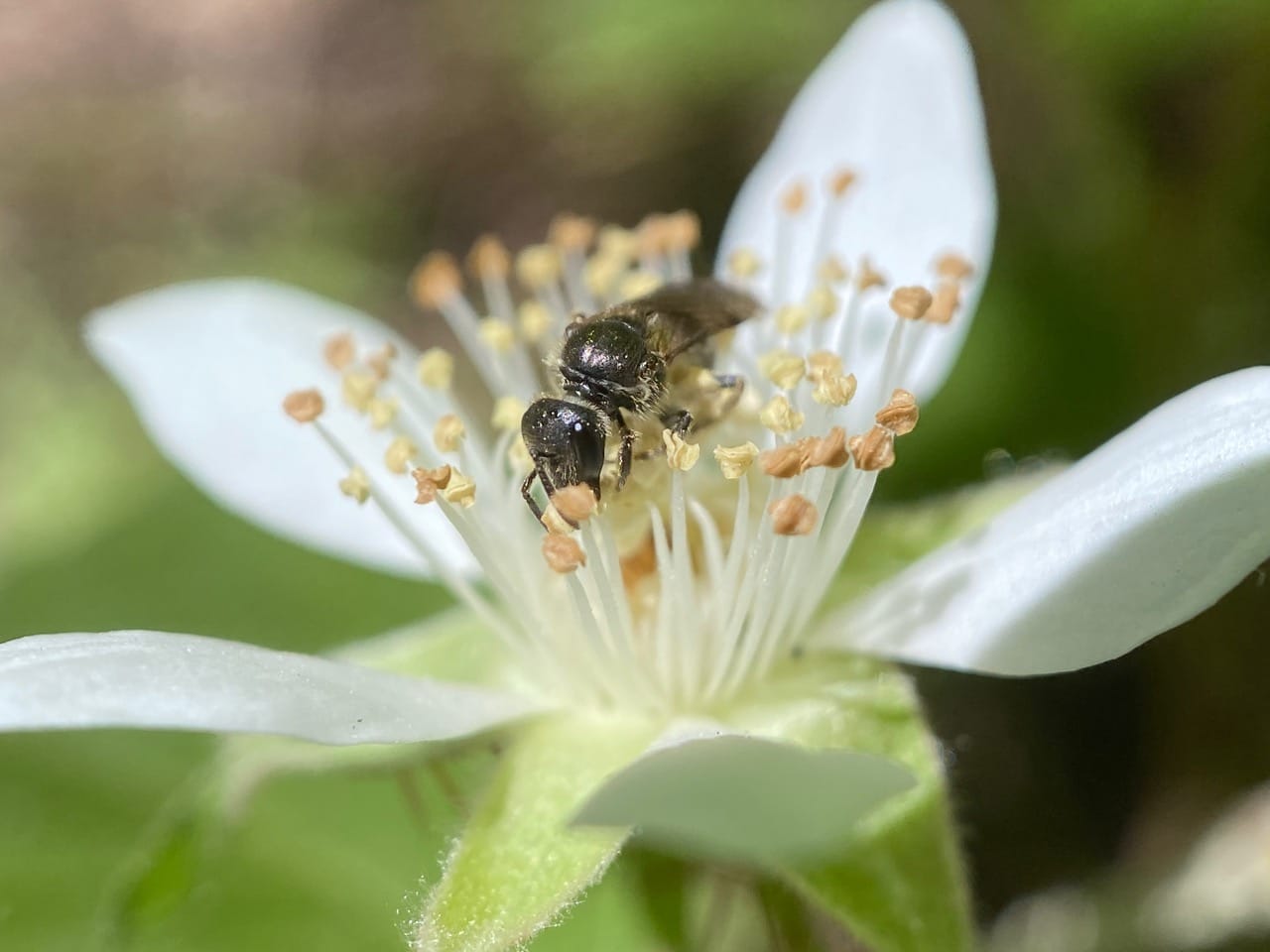
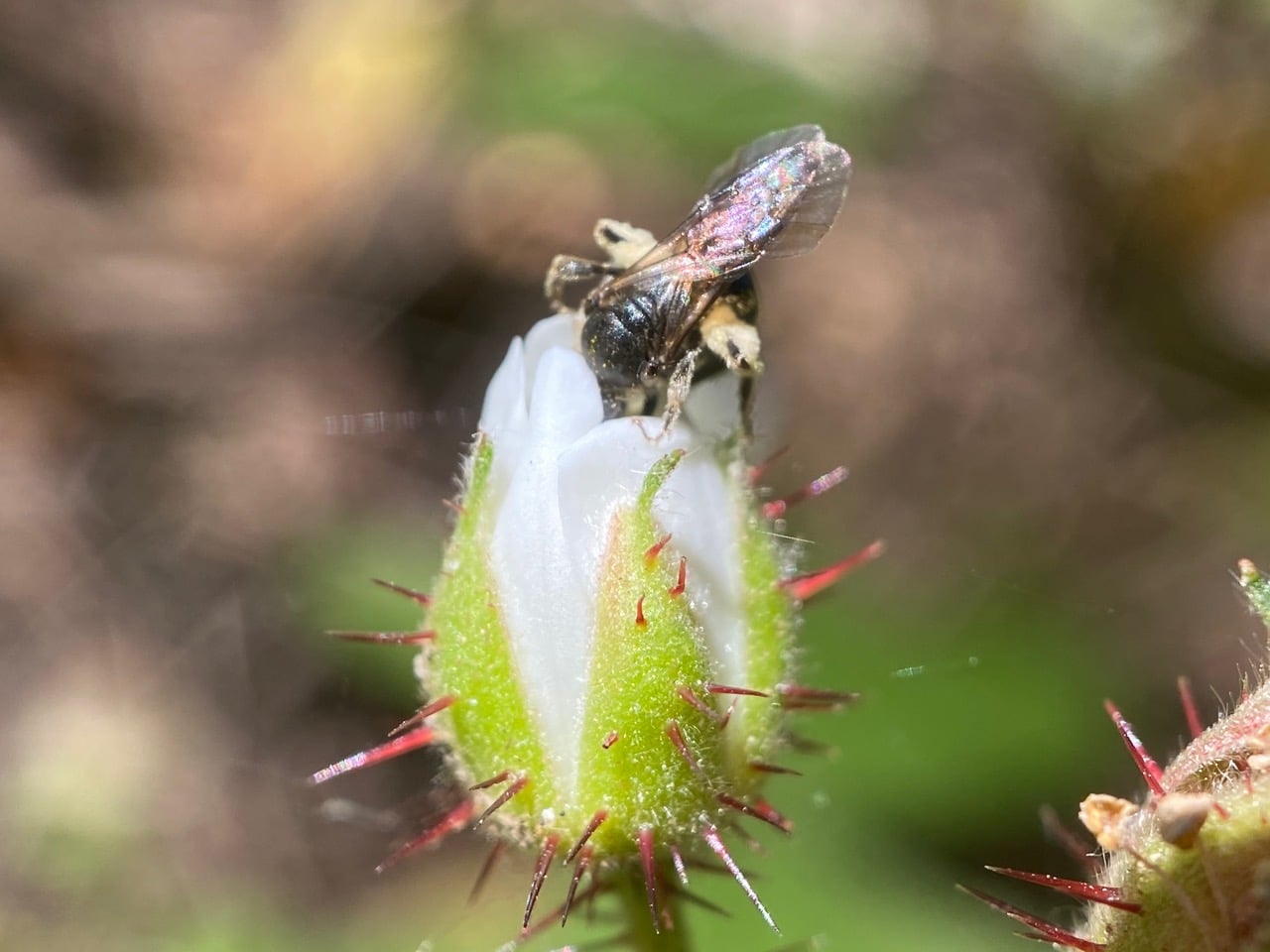
A small bee lands on a male flower of Pacific Blackberry, Rubus ursinus.
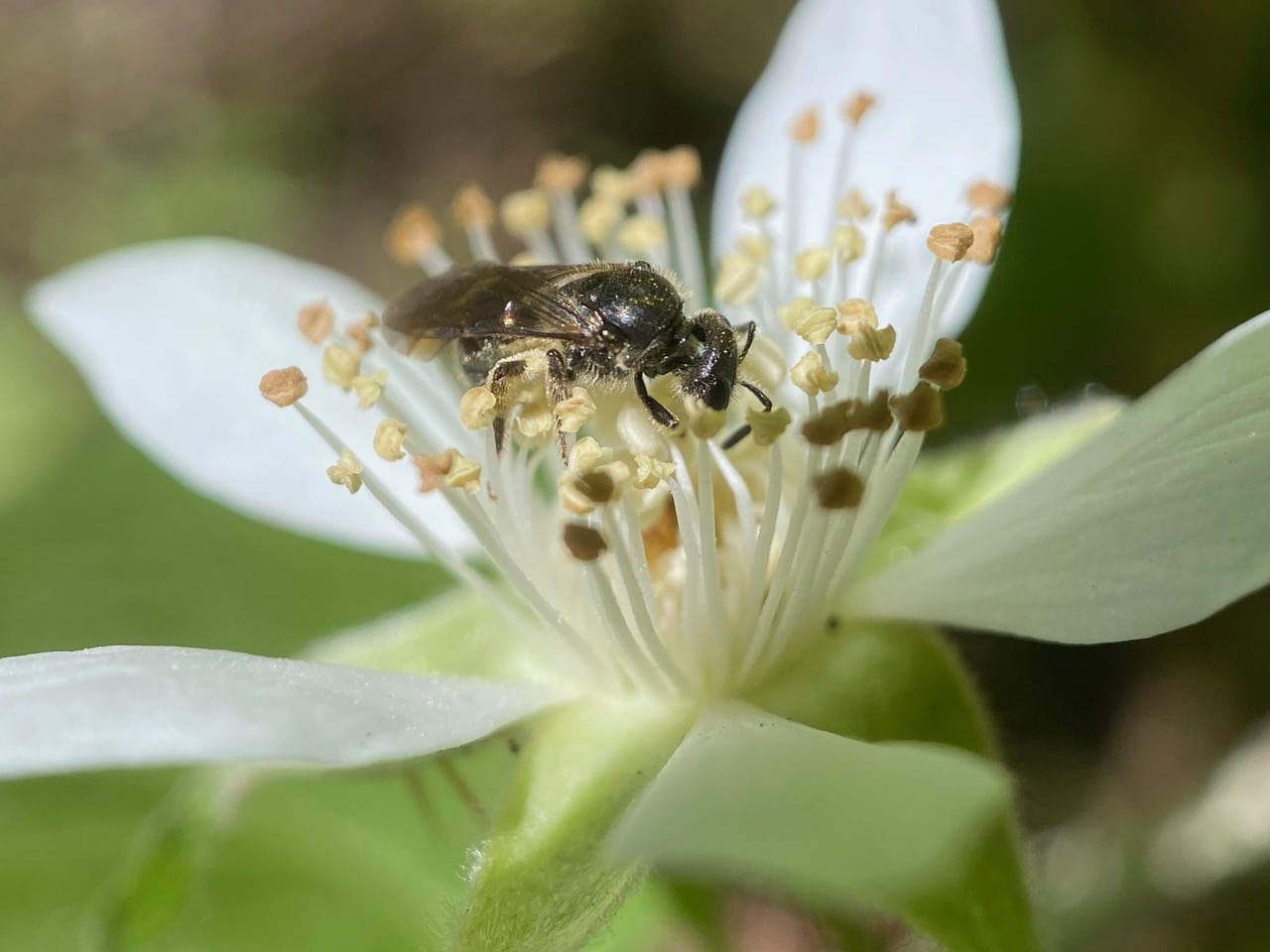
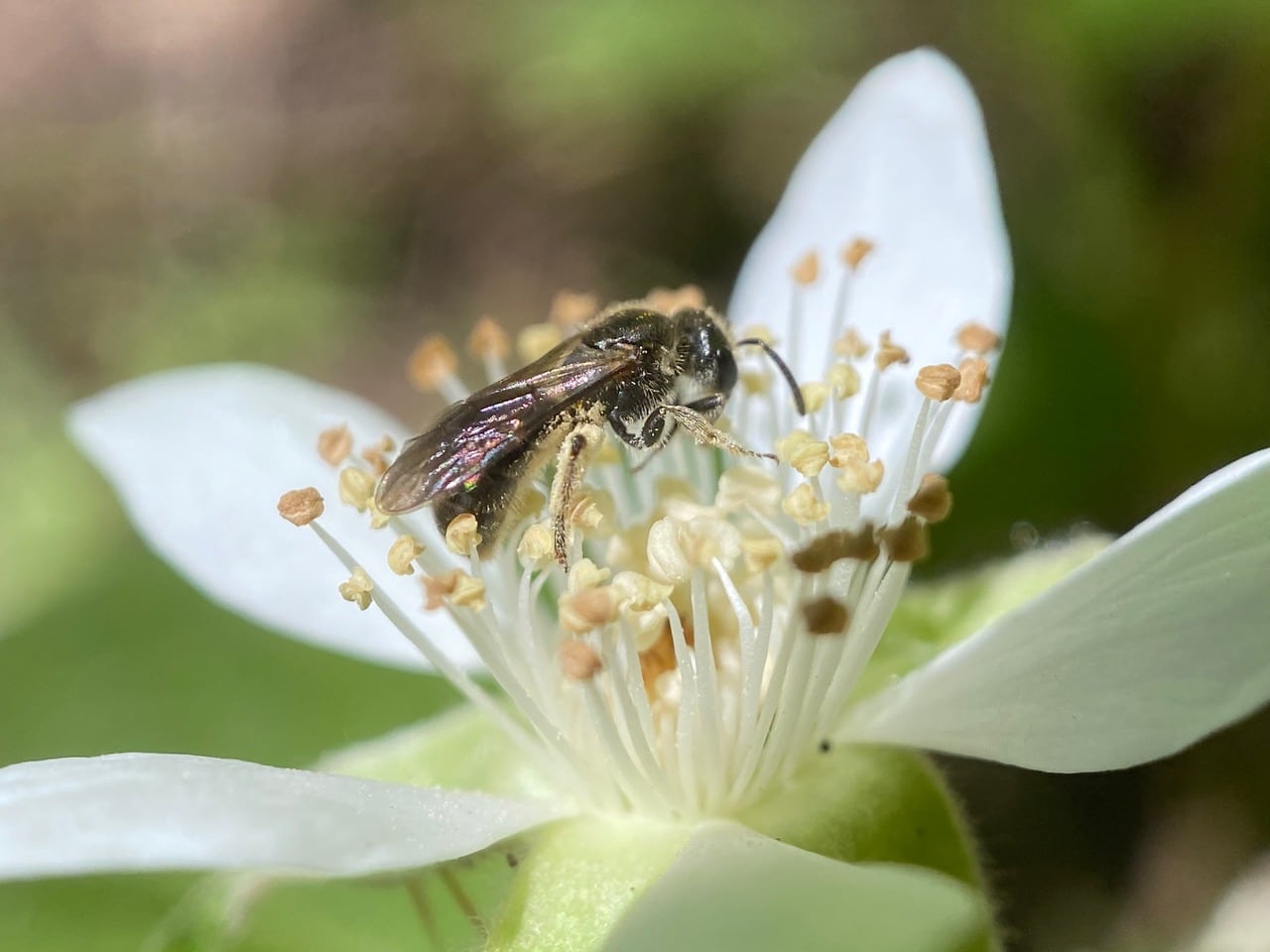
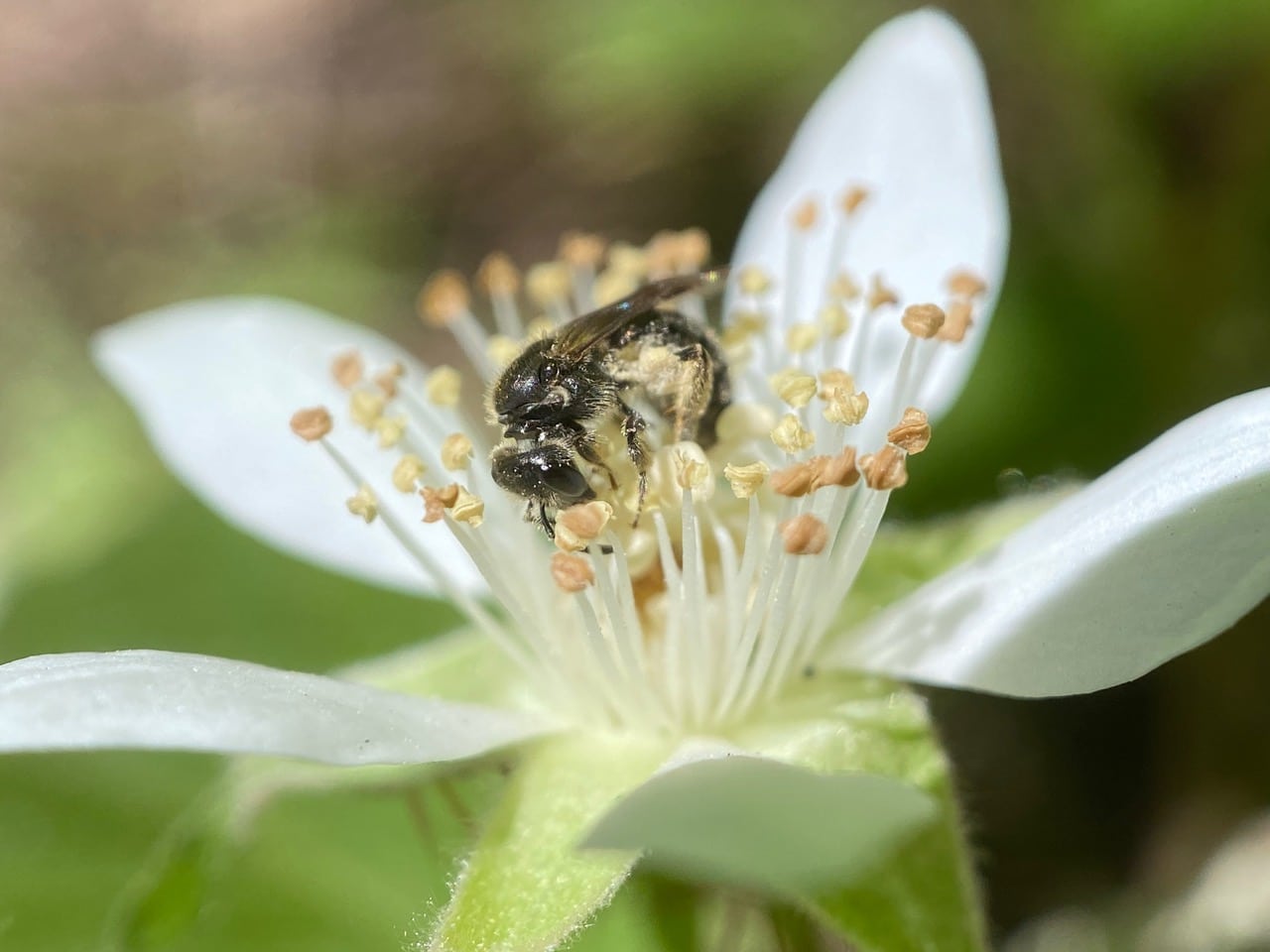
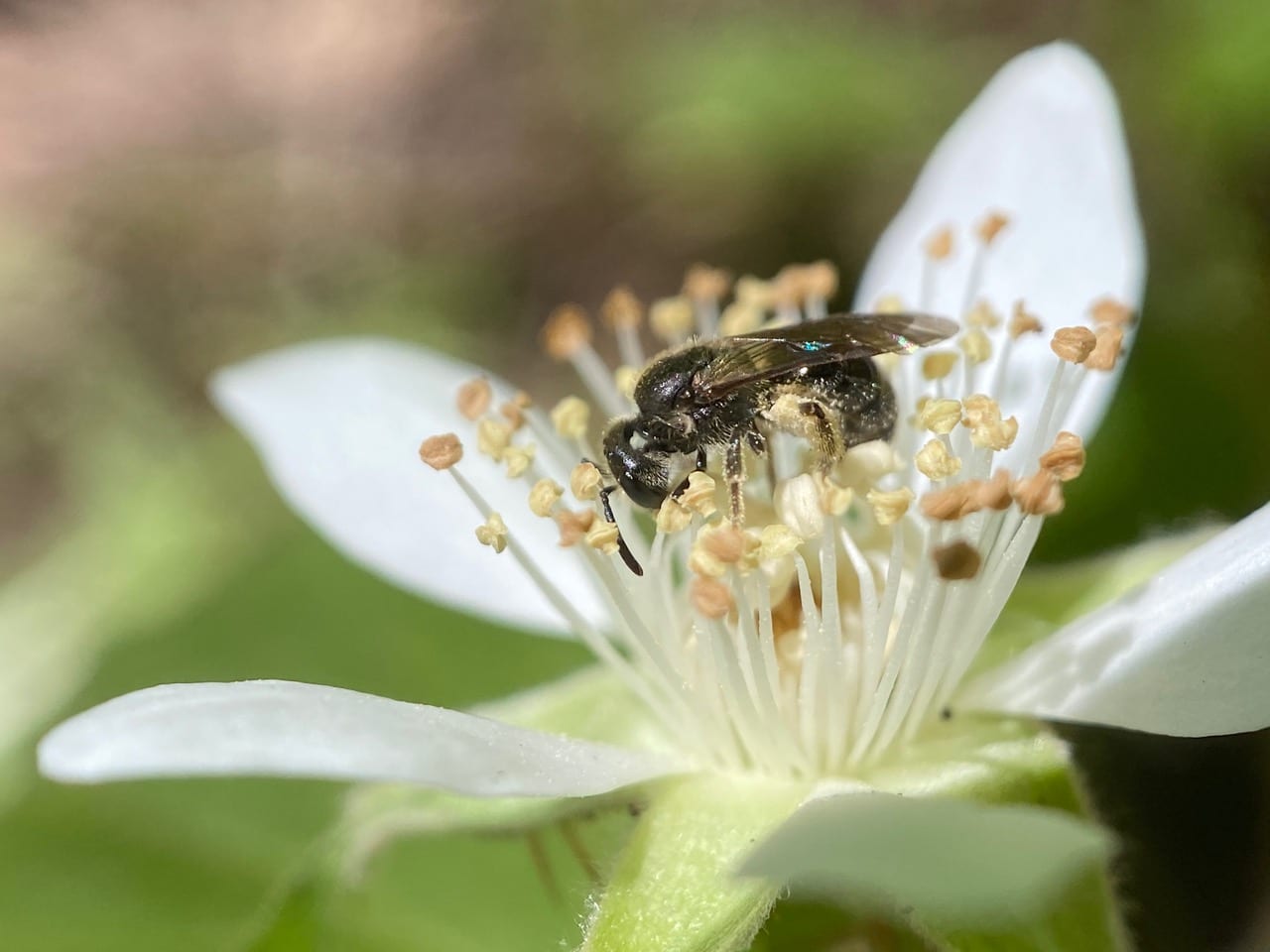
The bee is dark with a metallic shine. She carries pollen on the scopae of her hind legs, as well as on the underside of her abdomen. A Metallic Sweat Bee, Lasioglossum sp. (family Halictidae)?
The bee is actively collecting pollen. Scraping the anthers with her jaws and front legs, she pushes the loosened pollen onto the scopae of her hind legs with her middle legs.
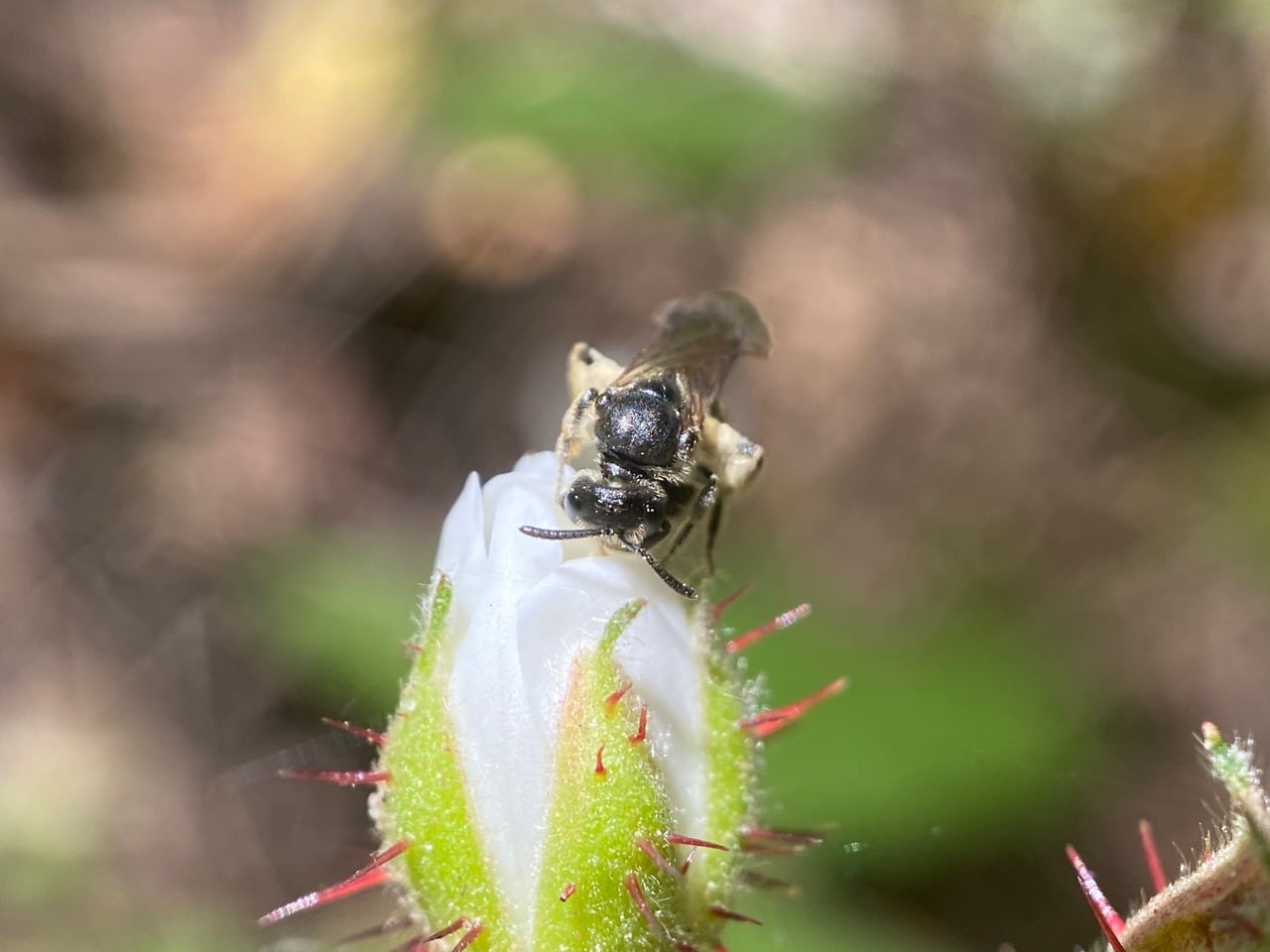
The Sweat Bee then flies to a blackberry flower bud that is barely open.
She reaches in for fresh pollen.
What a treat to see the charming fruits of Twinberry Honeysuckle, Lonicera involucrata.
When in bloom, small, tubular yellow flowers grow in pairs surrounded by two leafy bracts. The bracts turn from green to a striking dark red in summer as fruits ripen. The name involucrata refers to these bracts, which are collectively called an “involucre”. The paired black berries, about one-third inch in diameter, are unpleasantly bitter tasting. They are of limited food use to humans, but were used by Native Americans as a dye. The flowers are an important source of nectar for hummingbirds, butterflies and moths. The berries are eaten by bears, birds, and small mammals. Found throughout the western United States, the shrub grows in moist, wooded areas, especially in clearings and on the edges of wetlands.
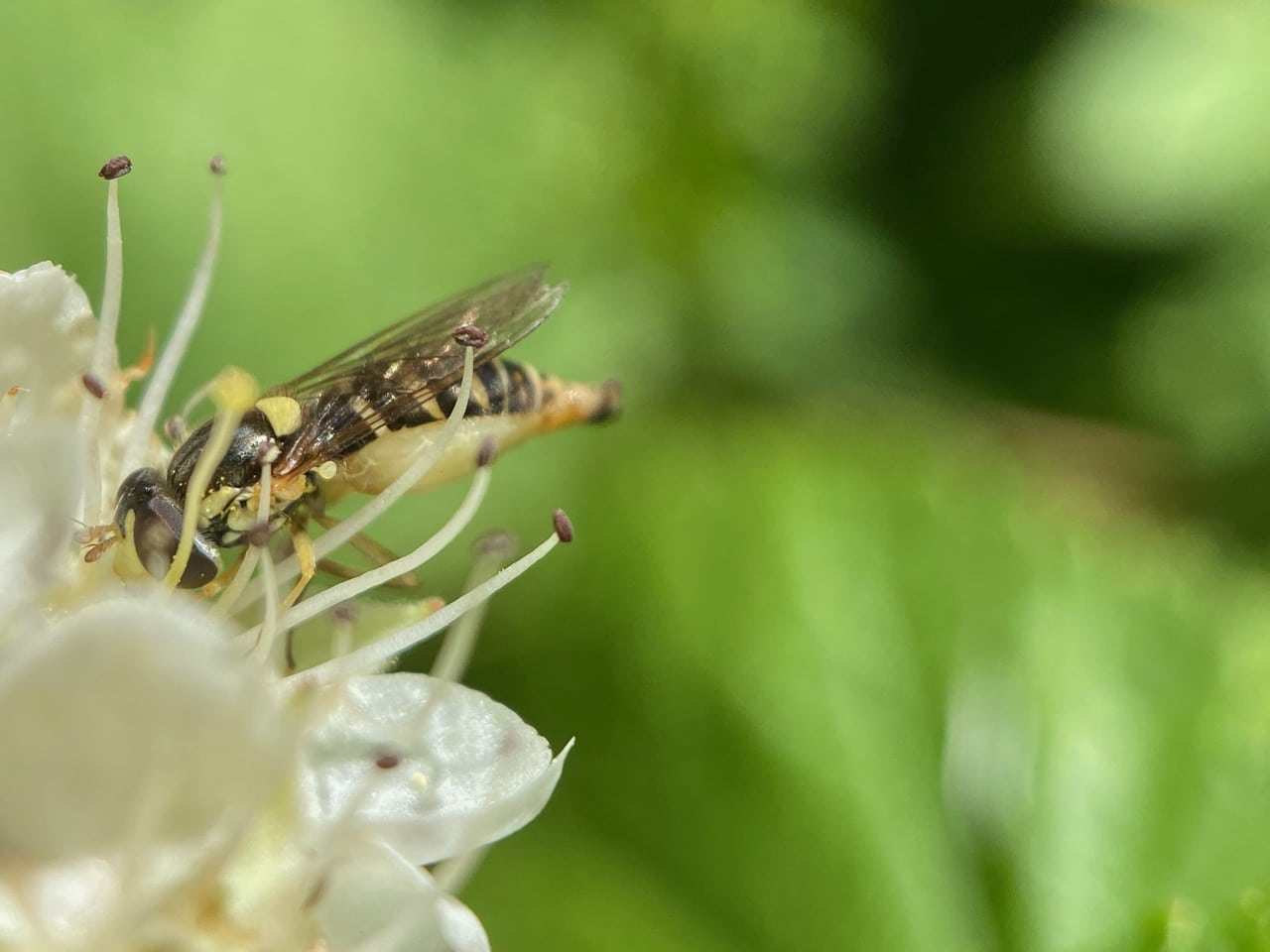
A gravid female Diamond Spottail, Fazia micrura (family Syrphidae) forages on the flowers of Pacific Nine Bark.
Members of the family Syrphidae are also called Hover Flies or Flower Flies. The adults of many species feed mainly on nectar and pollen, and are often seen hovering and nectaring at flowers. They are important pollinators of flowering plants in many ecosystems worldwide. The larvae feed on a wide range of foods. In many species, the larvae are insectivores and prey on aphids, thrips, and other plant-sucking insects. In other species, the larvae are saprotrophs, eating decaying plant and animal matter in the soil or in ponds and streams.
Many species of Hover Flies exhibit Batesian mimicry; they are brightly colored, with bands of yellow resembling the bees and wasps. The mimicry provides the fly with some measure of protection from potential predators, although the flies are harmless and lack a sting.
The Diamond Spottail, Fazia micrura is a Nearctic species that occurs in western North America, from British Columbia south to California and Texas; and Mexico. The fly has diamond-shaped yellow markings near the tip of its abdomen. Adults and larvae feed on pollen. Females lay eggs on flowers. Larvae are often encountered in the field chewing through the calyx and corolla of unopened flower buds. They are known to feed on pollen in the anthers. Usually only one larva is found in each flower.
A female Mining Bee, Andrena sp. (family Andrenidae) lands on an inflorescence of Pacific Nine Bark. She must be on a new foraging trip, as the scopae on her hind legs are empty of pollen.
Bees in the family Andrenidae, commonly called miner bees or mining bees, are solitary ground-nesters. Andrenids are fairly small bees, usually dark-colored, and often banded. They are identified by the dense bristles (scopae) at the bases of the legs and the shin-like sections (tibias) of the legs, as well as by certain creases and grooves on the face and head and by unique wing venation. Many Andrenids resemble wasps – slender with long abdomen. Most Andrenids are specialist pollinators whose life cycle is timed to correspond precisely to the blooming of specific flowers.
The bee proceeds to access nectar from the flower.
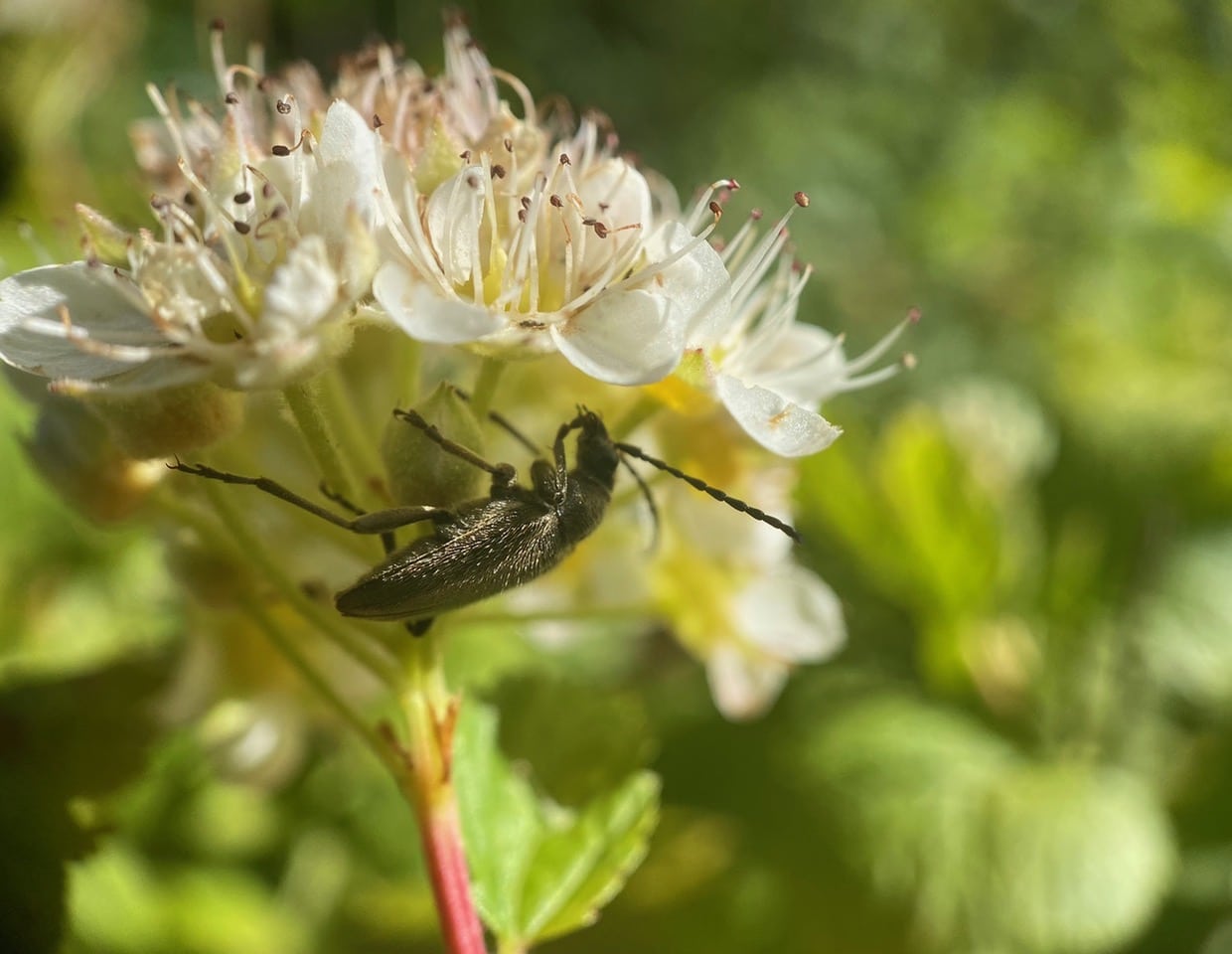
A Flower Longhorn Beetle, Brachysomida californica is foraging on an inflorescence of Pacific Nine Bark.
Flower Longhorn Beetles (family Cerambycidae, subfamily Lepturinae) are usually among the smaller members of their family. These beetles have a narrow body and very long legs. The thorax is markedly less wide than the wings, while the elytra tips are often pointed. They also share the family trait with other Cerambycids of having very long antennae. Sexual dimorphism is found in some species. The beetles are found on flowers where they feed on pollen and nectar, and are considered pollinators. They have a particular affinity for the umbel flowers of the carrot family, Apiaceae. The beetles spend their larval days as borers, just like other Cerambycids. However they are not considered pests, as they select trees that are stressed, dying, or dead.