

Pollinator Post 5/13/24 (1)
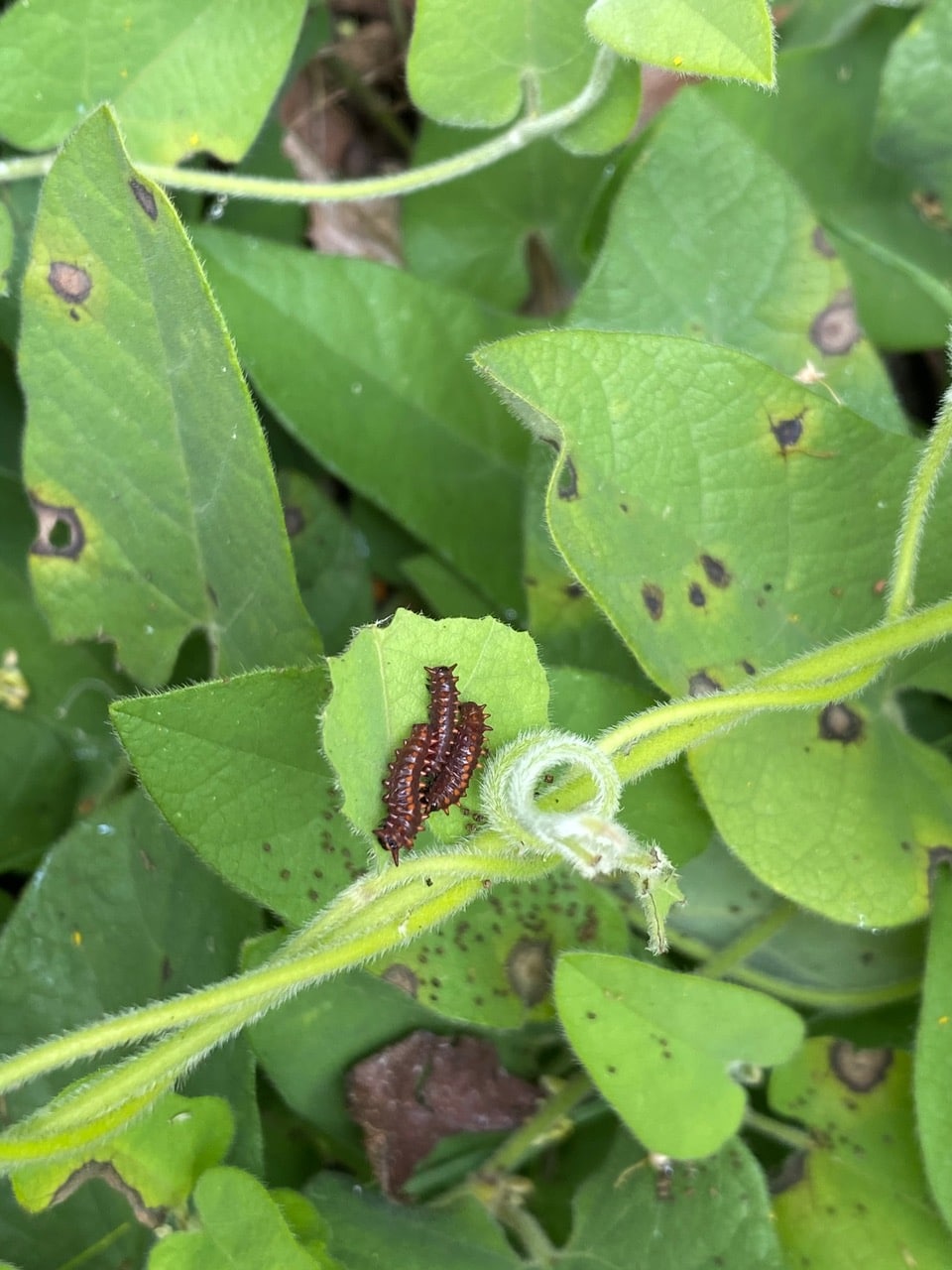
It’s time to visit the Regional Parks Botanic Garden again. Checking on the California Pipevine, Aristolochia californica, I am delighted to find tiny caterpillars of the Pipevine Swallowtail, Battus philenor (family Papilionidae). I meet a group of school children touring the garden with their docent, and have fun teaching them how to look for the young caterpillars. At this stage, the caterpillars’ frass (insect poop) looks like black dust, and it is usually found on the vegetation right under them. The children catch on quickly, and together we discover many clutches of young caterpillars.
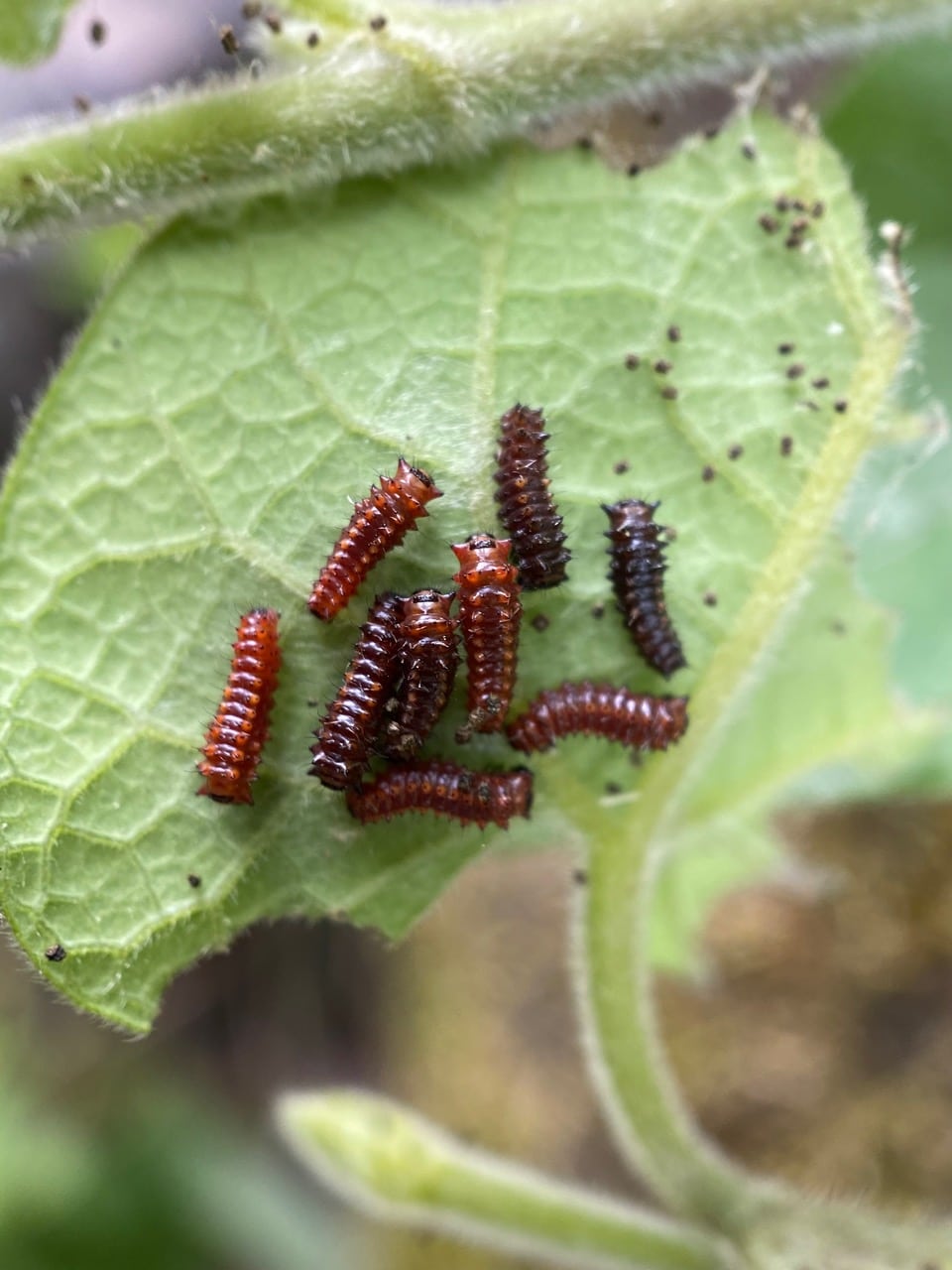







The young caterpillars feed in aggregations at this stage. As they get older, they will disperse to feed on their own.
Here are some slightly older caterpillars.
This one is already feeding on its own. It is acquiring the bright orange tubercles on its darkening body. The conspicuous contrasting colors serve as aposematic warning to ward off potential predators – “Eat me at your own peril; I am poisonous!” The pipevine plant contains poisonous aristolochic acid. Not only are the pipevine swallowtail caterpillars immune to the poison, they sequester the poison in their body for their own protection.
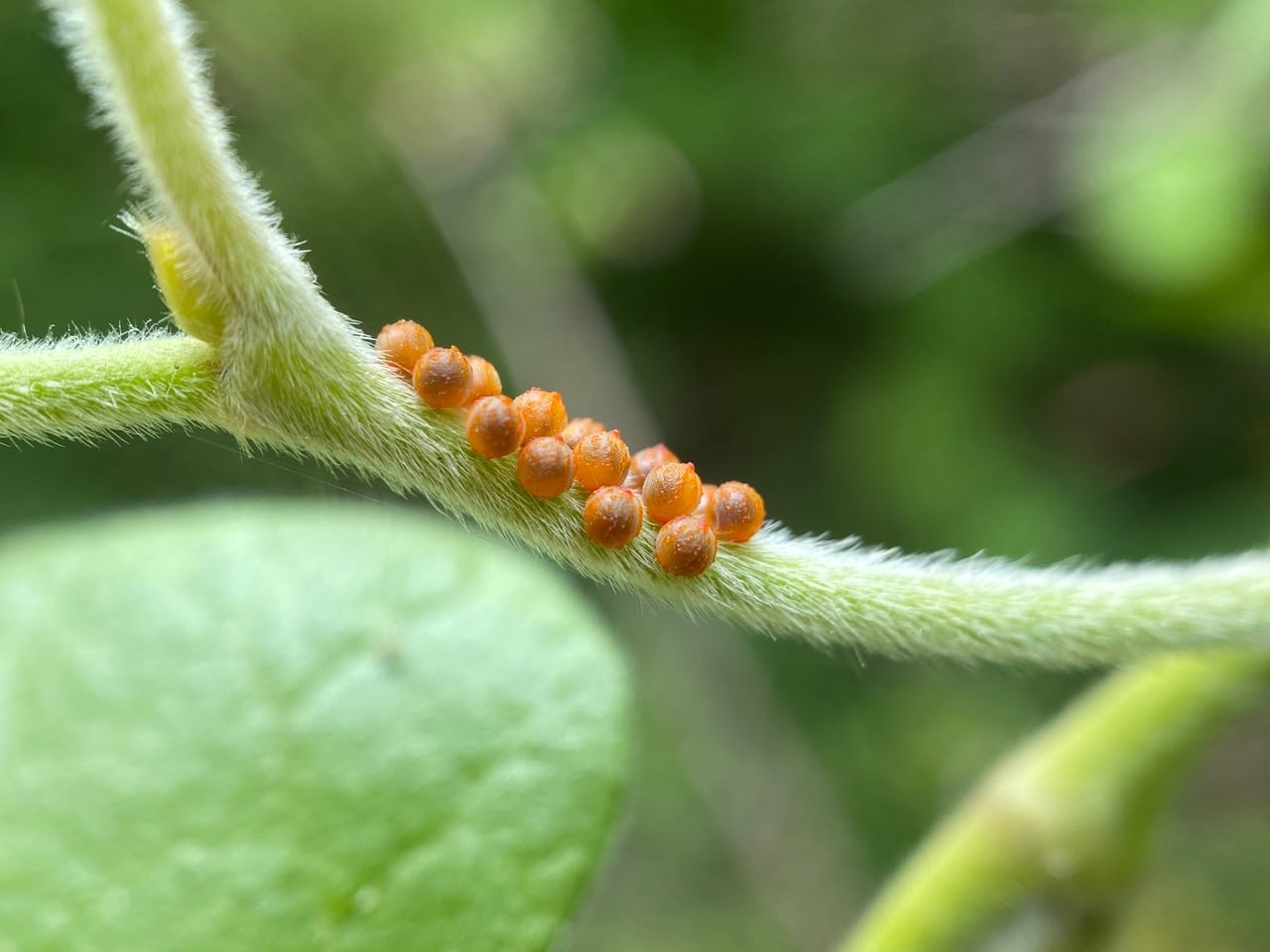
Ooh, there’s still unhatched eggs of the Pipevine Swallowtail on the Pipevine. Even the eggs are crusted with toxins.
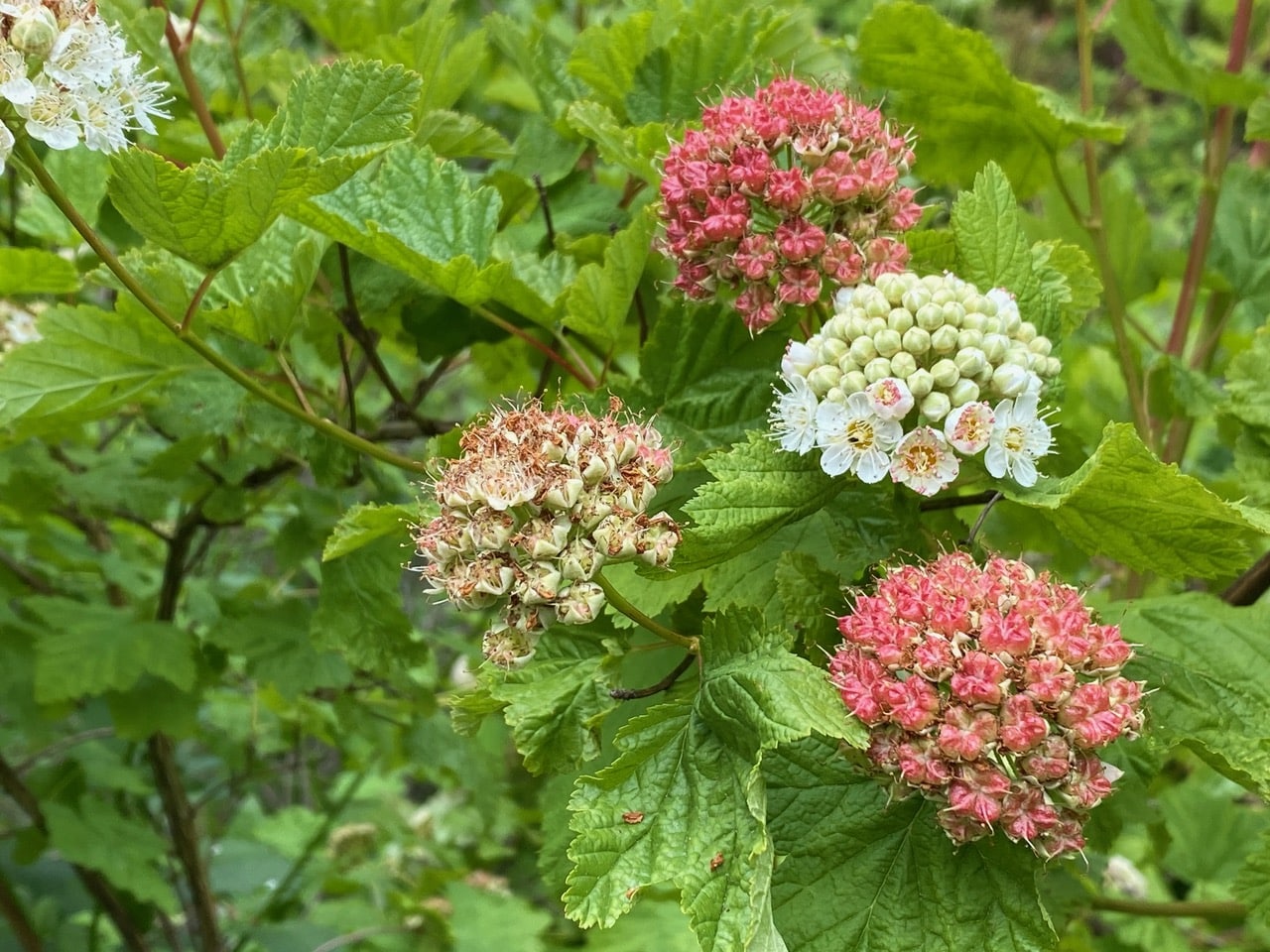
The Pacific Ninebark, Physocarpus capitatus is in full bloom. Some of the inflorescences are already developing into reddish fruits.
The dense deciduous shrub in the rose family is native to western North America. The plant produces ball-like clusters of small white flowers with five petals and numerous red-tipped stamens. The globular clusters of white flowers are eventually replaced by reddish 3 to 5-chambered fruits. The unique fruit is an inflated glossy red follicle which turns dry and brown and then splits open to release the seeds.
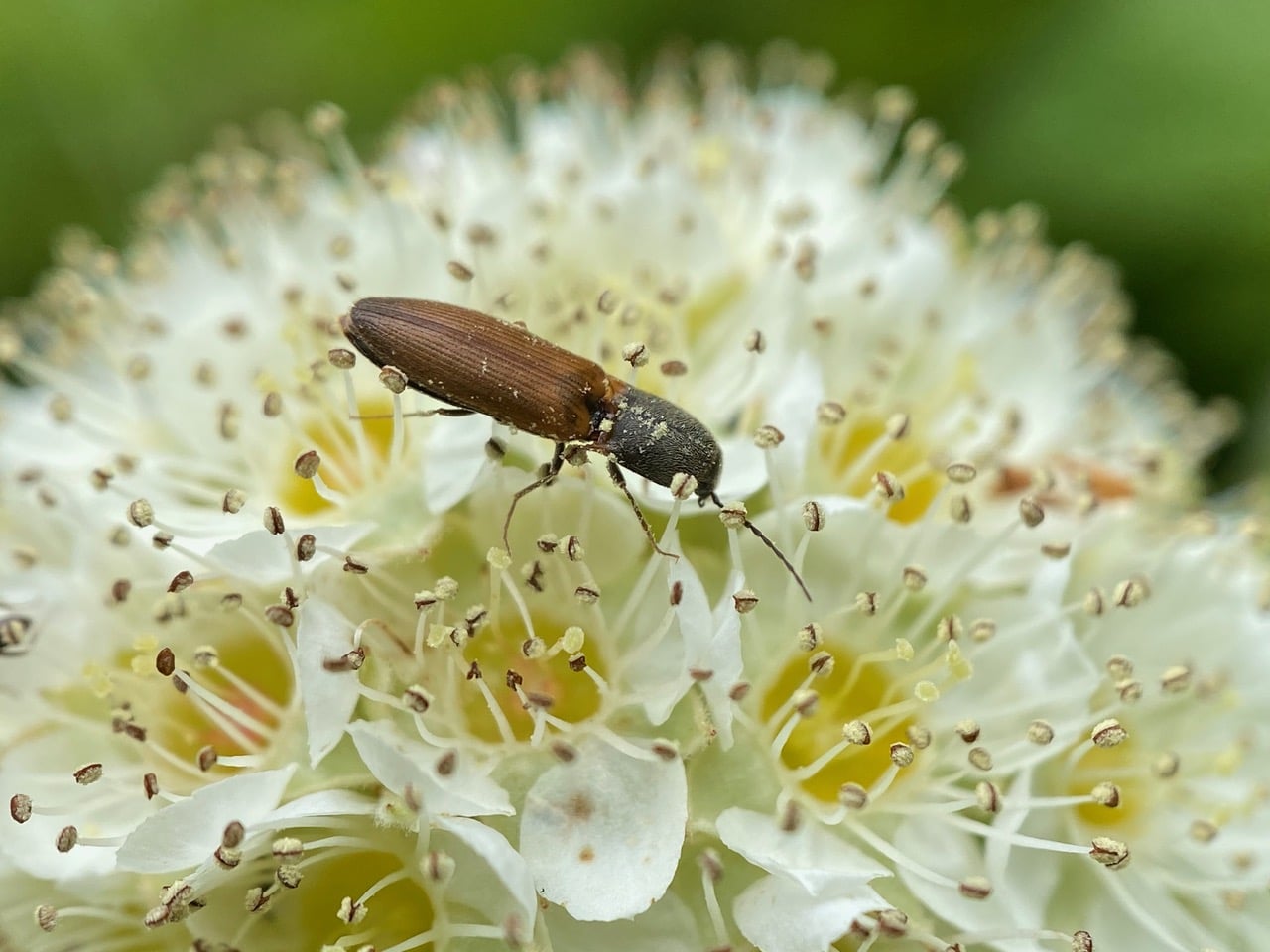
A Click Beetle (family Elateridae) is foraging on a Pacific Nine Bark inflorescence.
Adult Click Beetles are typically nocturnal and phytophagous (feeding on plants). Their larvae, called wireworms, are usually saprophagous, living on dead organisms, but some species are agricultural pest, and others are active predators of other insect larvae.
Elateridae or Click Beeltes are a cosmopolitan beetle family characterized by the unusual click mechanism they possess. A spine on the prosternum can be snapped into a corresponding notch on the mesosternum, producing a violent “click” that can bounce the beetle into the air. Clicking is mainly used to avoid predation, although it is also useful when the beetle is on its back and needs to right itself.
A Spotted Cucumber Beetle, Diabrotica undecimpunctata (family Chrysomelidae) is feeding among the flowers of Pacific Nine Bark. Note the fresh pinkish anthers of the young flowers, in comparison to the older flowers whose anthers have dehisced to release pollen.
Members of the family Chrysomelidae are commonly known as Leaf Beetles. Adults and larvae feed on all sorts of plant tissues, and all species are fully herbivorous. Many are serious pests of cultivated plants, including food crops. Others are beneficial due to their use in biocontrol of invasive weeds. Chrysomelids are popular among insect collectors, as many are conspicuously colored, typically in glossy yellow to red or metallic blue-green hues, and some have spectacularly bizarre shapes. Photos of Leaf Beetles (Family Chrysomelidae) · iNaturalist
Native to North America, the Spotted Cucumber Beetle can be a major agricultural pest, causing damage to crops in the larval as well as adult stages of their life cycle. Larvae, sometimes known as rootworms feed on the roots of emerging plants. In the adult stage the beetles cause damage by eating the flowers, leaves, stems and fruits of the plant.
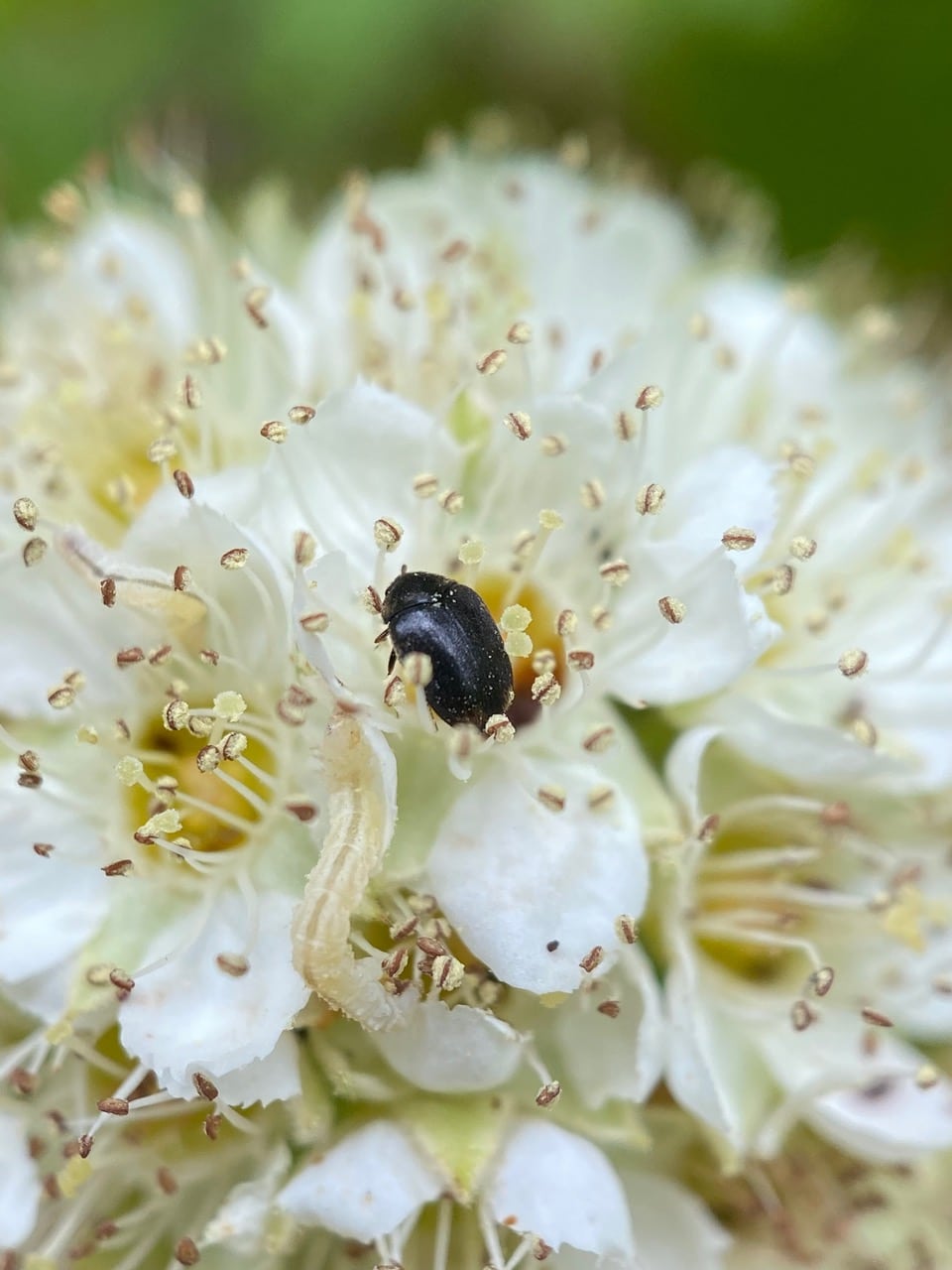
A False Flower Beetle, Anaspis sp. (family Scraptiidae) is foraging on the younger flowers of Pacific Ninebark.
The family Scraptiidae is a small group of Tenebrionoid beetles sometimes call False Flower Beetles. Anaspis atrata is commonly found in western North America. The adults feed on pollen, and are found on flowers, sometimes in large numbers. The larvae are typically found under the bark of dead trees, or among decaying wood or are associated with various fungal fruiting bodies.
When I took this picture of the black beetle, I didn’t even see the little pale caterpillar to its lower left! These flowers feed a huge community of insects, often overlooked because of their size.
The docent leading the group of children through the garden happens to be a friend of mine. When her tour is over, Susan joins me on my exploration of the garden.
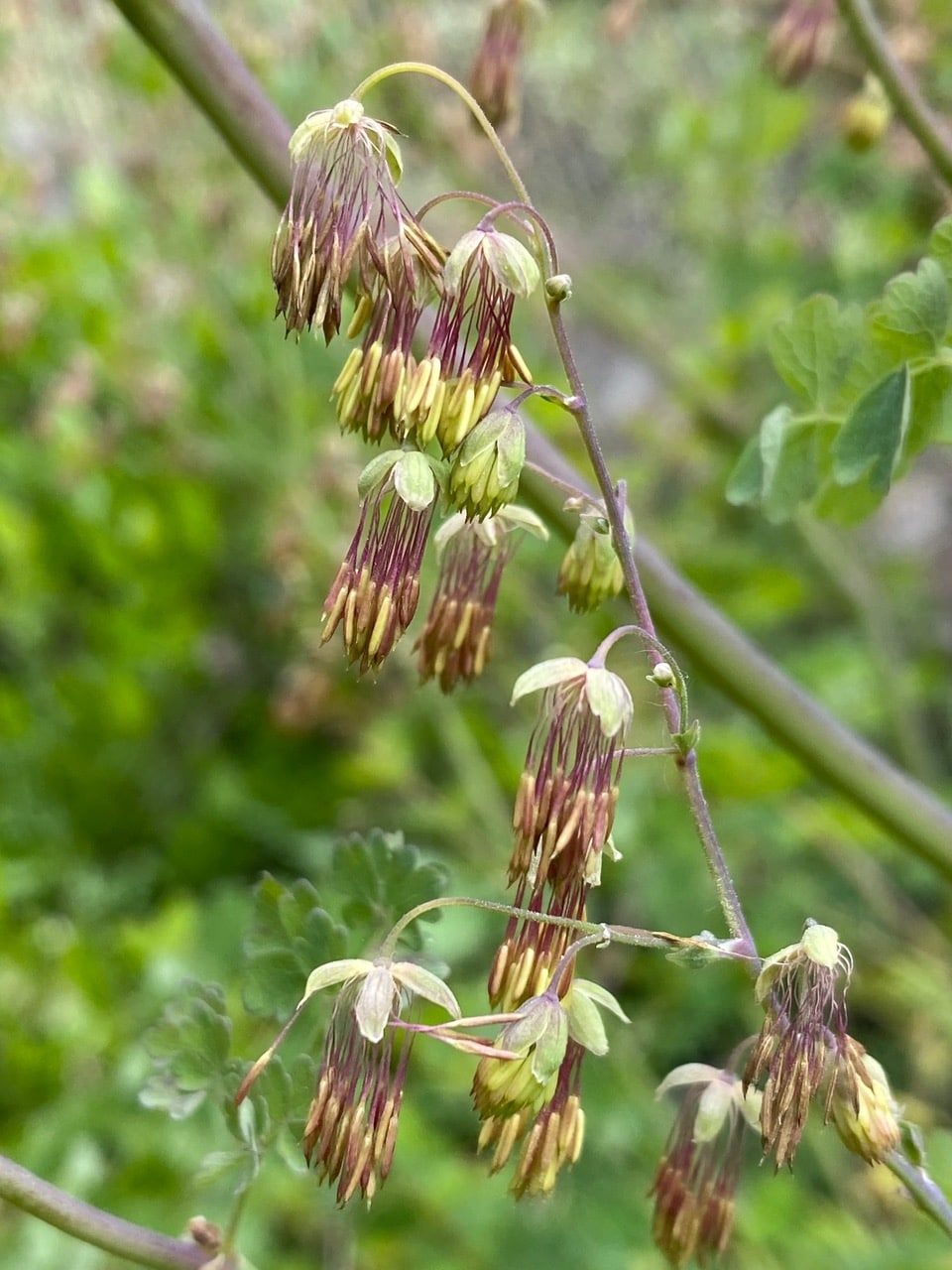
The dangling stamens of a male Meadow Rue, Thalictrum fendleri are blowing in the wind. An atypical member of the buttercup family Ranunculaceae, the species is dioecious, having male and female flowers borne on separate plants. The flowers of neither sex have petals. The male flowers are showier, with dangling cream-colored stamens. Pollen is released into the wind in overwhelming excess, as in most wind-pollinated plants. .
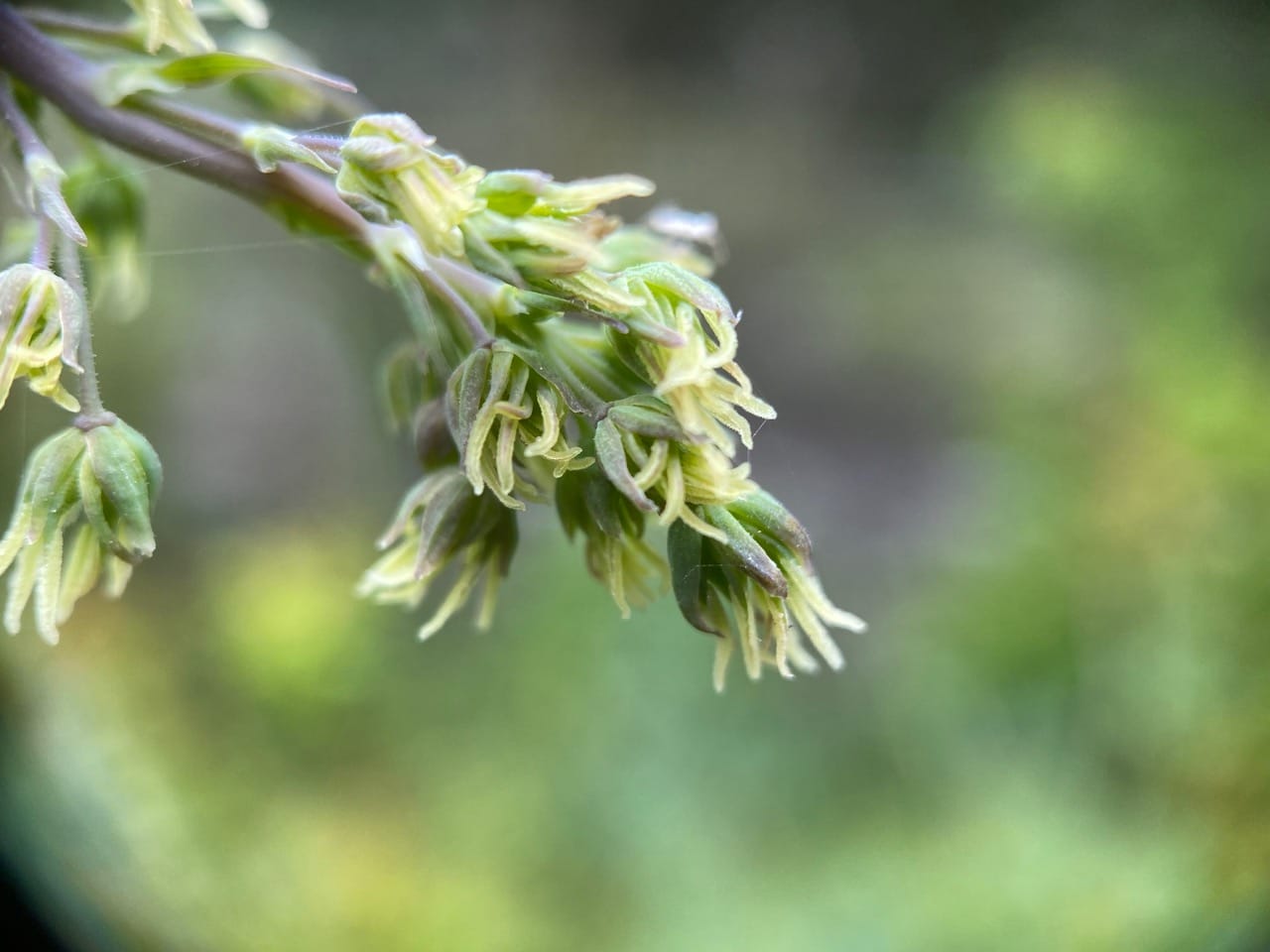
The female flowers of Meadow Rue are clusters of greenish pistils. I am glad that the garden has both sexes growing right next to each other for comparison (and for pollination purposes too).
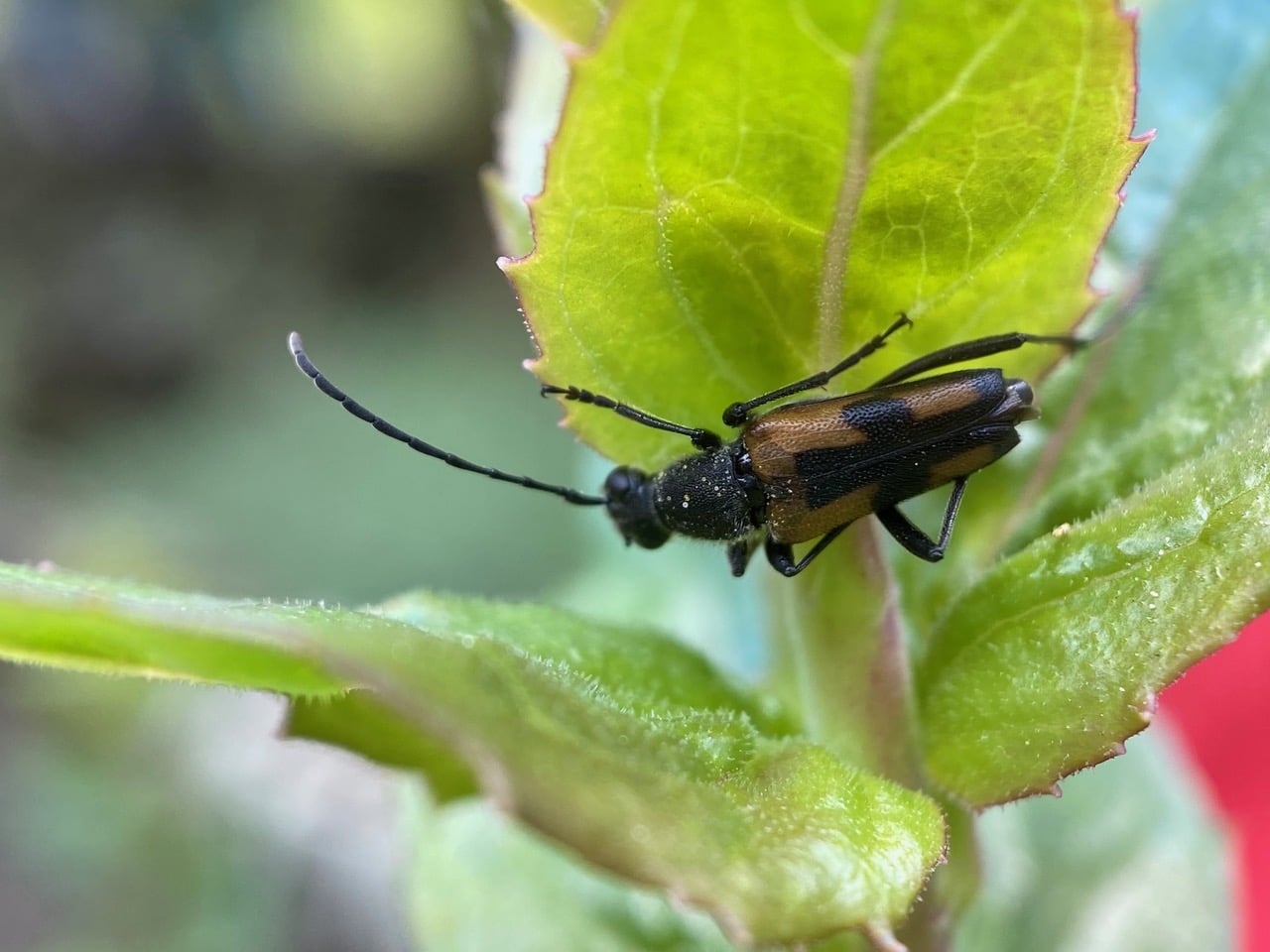
A male Dimorphic Flower Longhorn Beetle, Anastrangalia laetifica is hiding among the leaves of a plant unfamiliar to me.
Flower Longhorn Beetles (family Cerambycidae, subfamily Lepturinae) are usually among the smaller members of their family. These beetles have a narrow body and very long legs. The thorax is markedly less wide than the wings, while the elytra tips are often pointed. They also share the family trait with other Cerambycids of having very long antennae. Sexual dimorphism is found in some species. The beetles are found on flowers where they feed on pollen and nectar, and are considered pollinators. They have a particular affinity for the umbel flowers of the carrot family, Apiaceae. The beetles spend their larval days as borers, just like other Cerambycids. However they are not considered pests, as they select trees that are stressed, dying, or dead.
The term “dimorphic” in the common name refers to the obvious visual differences between the sexes. Females are considerably larger, with 4 black spots on the bright red elytra, while the males are black or brown.
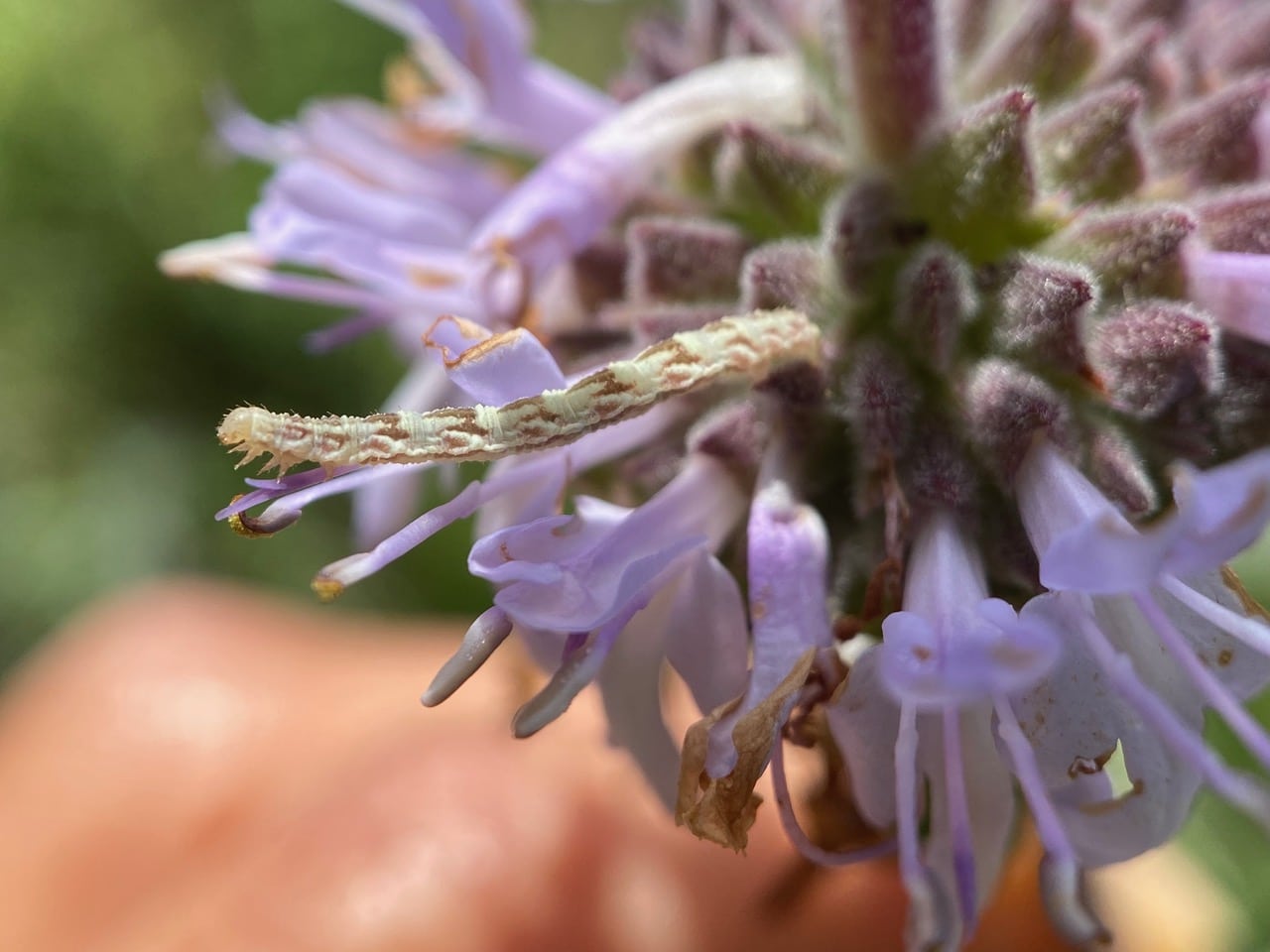
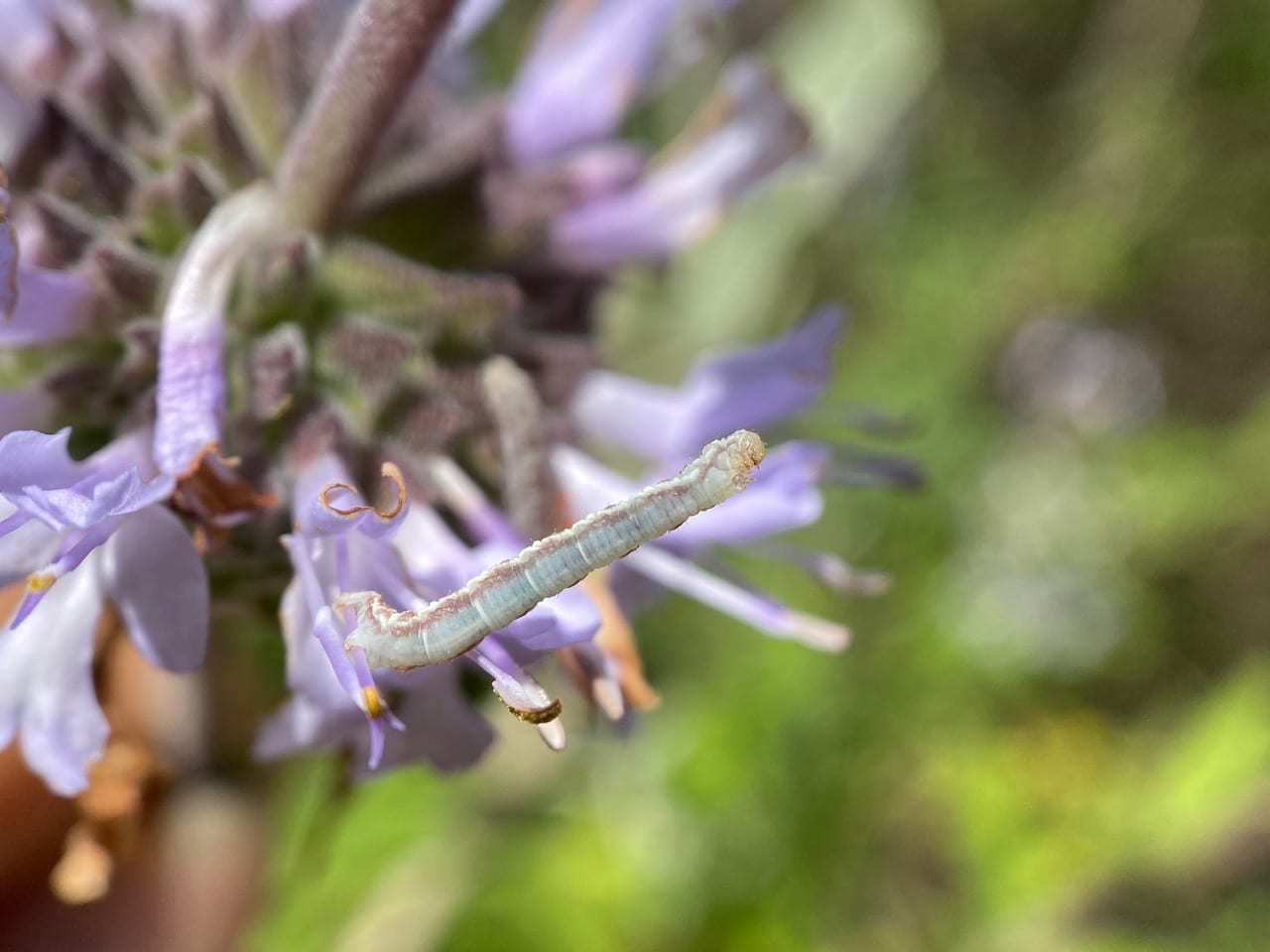
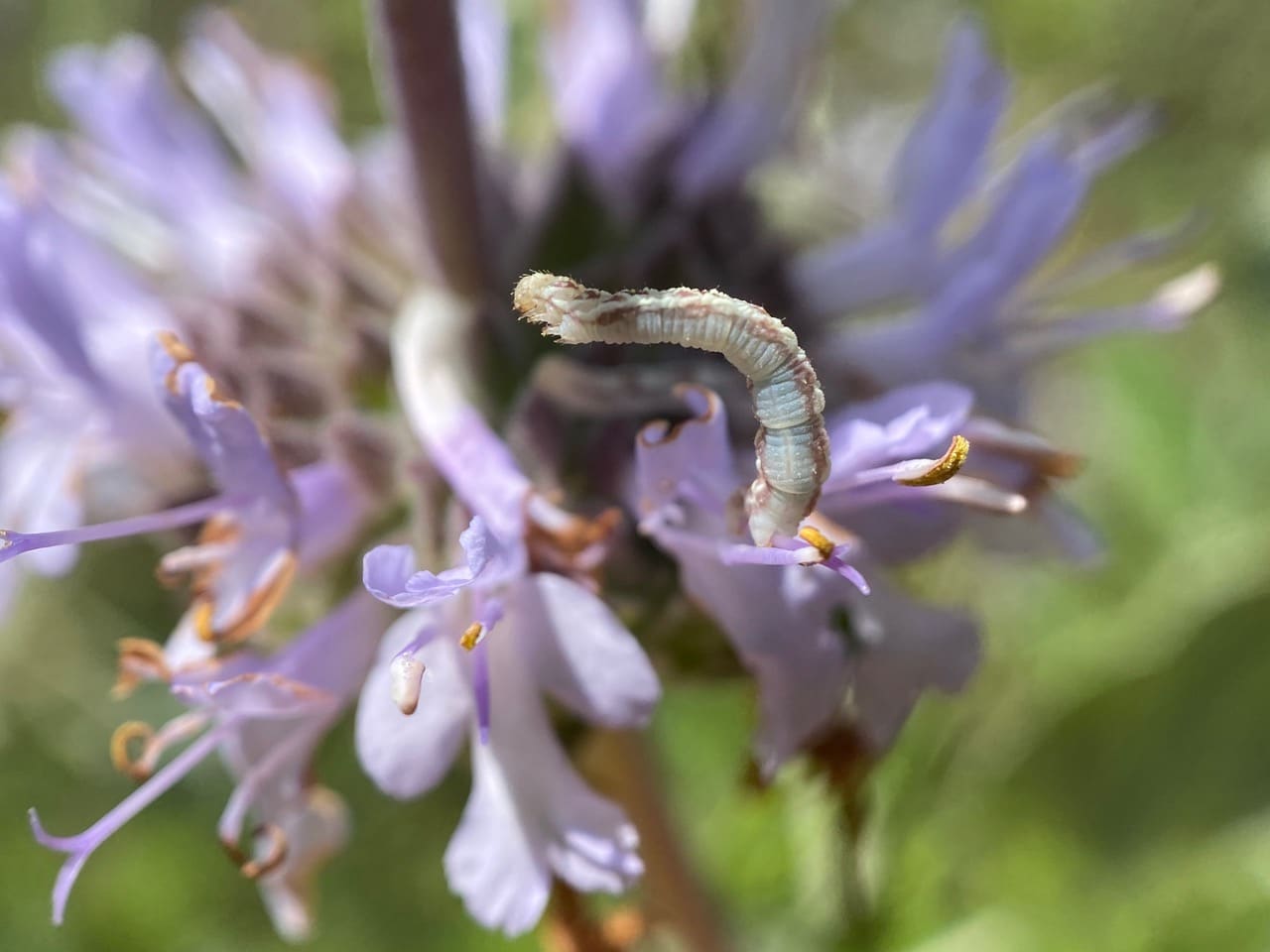
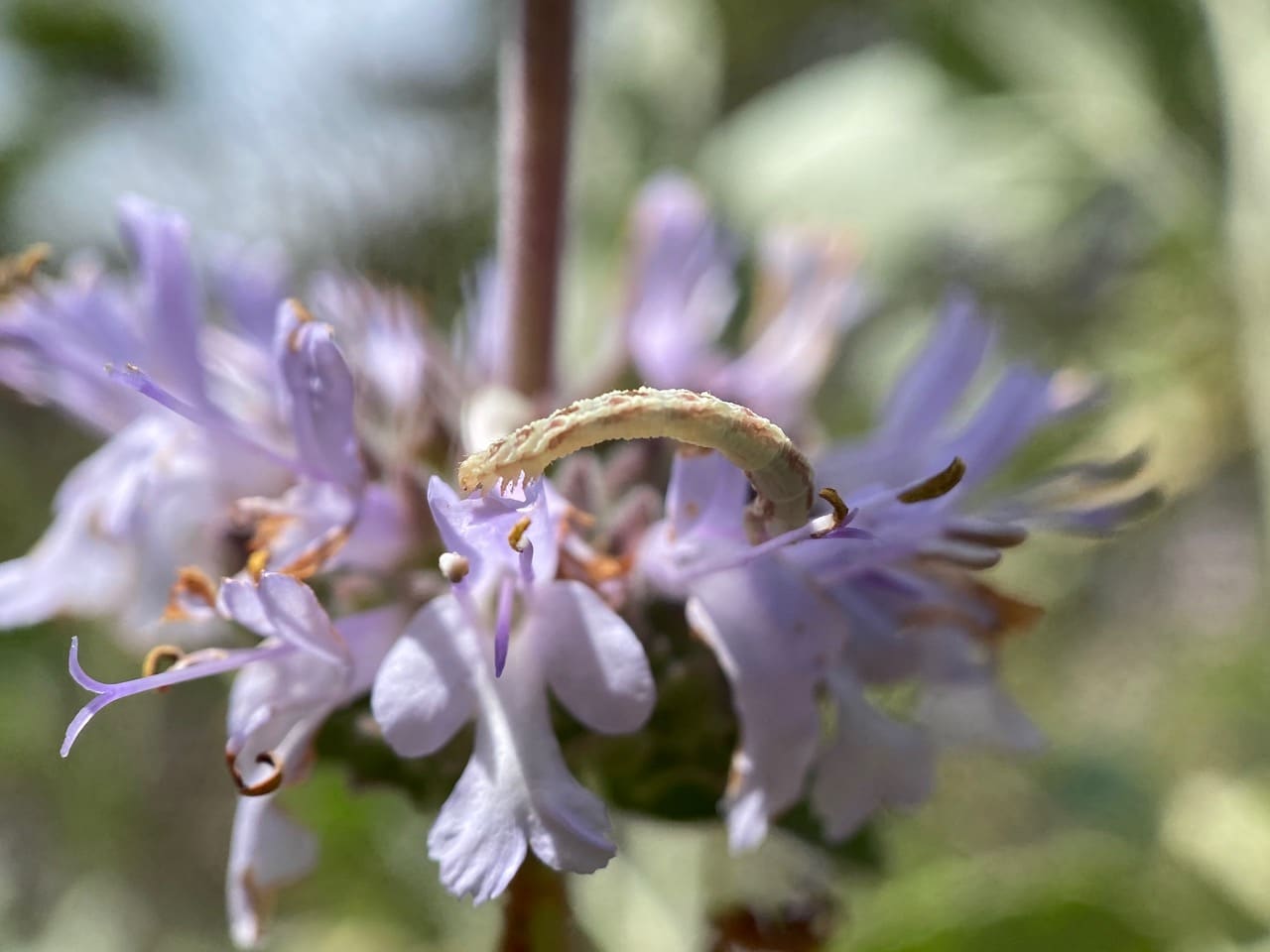
While we are looking out for bees visiting the Black Sage, Salvia mellifera, Susan’s sharp eyes spot an Inch Worm (family Geometridae) that is moving onto the filament of a flower.
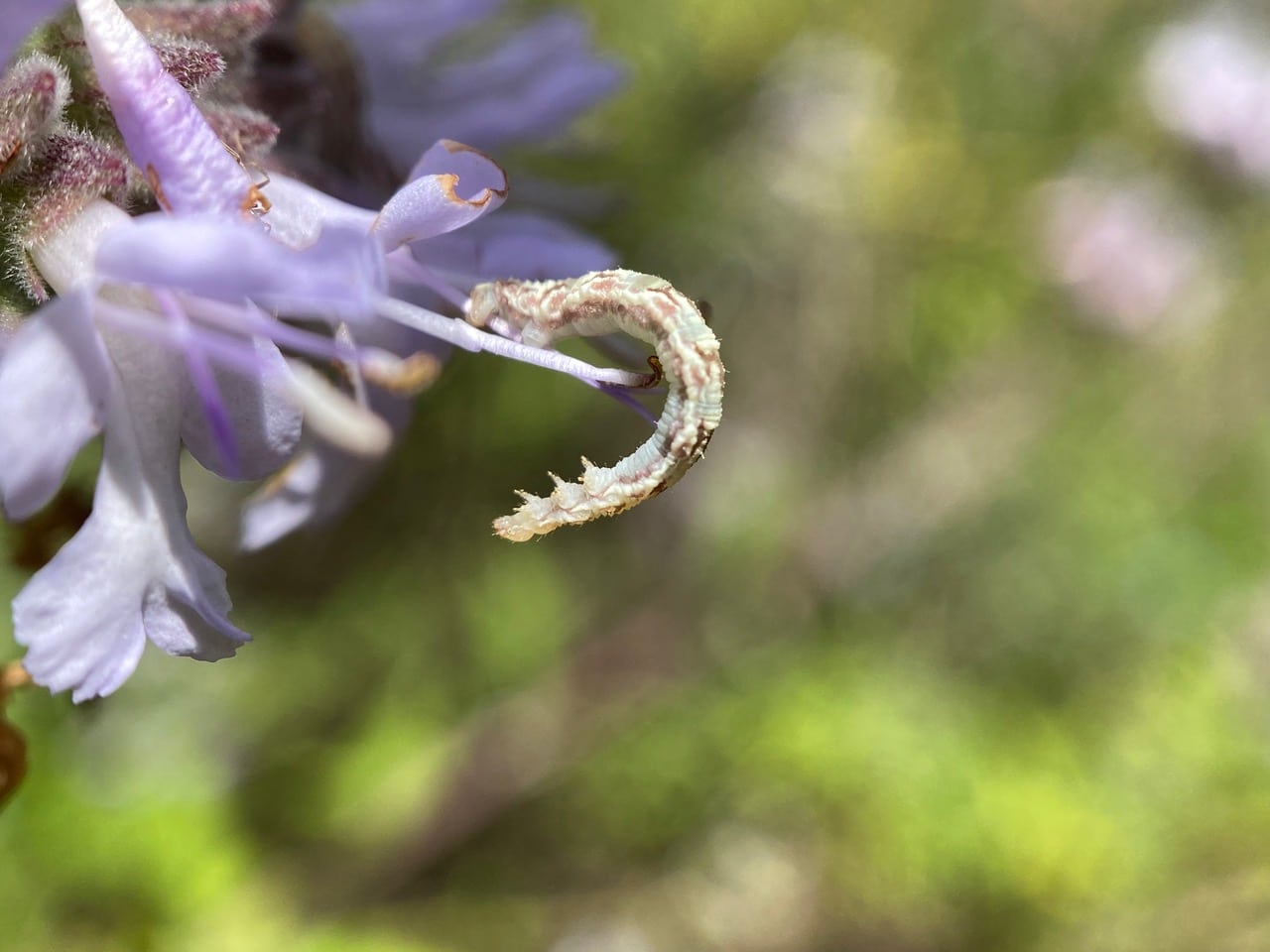
Startled by an ant, the Inchworm rears up instantly, stiffening its body in a way one does not expect of a soft caterpillar. It is holding on to the stamen only by its anal prolegs.
We watch with amazement as the Inchworm goes through a series of calisthenic moves to get itself onto the next perch. Note the three pairs of true legs near its head. These will eventually develop into the legs of the adult moth. Between these legs and the anal prolegs, there’s an absence of prolegs that most other caterpillars have.
Inchworms are also called loopers and measuring worms. The majority of the inchworms are the larvae of moths in the family Geometridae. The name comes from the Greek “geo” for earth and “metro” from measure, because the caterpillars seem to be measuring the surface on which they are walking.
All caterpillars have three pairs of jointed legs behind their heads. These legs are called true legs because they will become the six legs of the adult butterfly or moth. There are additional appendages, called prolegs, along their bodies. Prolegs are not true legs, they are just outgrowths of the body wall and will be lost at metamorphosis. They have little hooks on their soles to help the caterpillar walk and grip onto things.
Most caterpillars have five sets of prolegs, four in the middle of the body and one pair at the hind end. Inchworms have the normal six true legs but only two or three pairs of prolegs, all located at the tail end of the body, with none in the middle. When an inchworm walks, it moves its tail-end prolegs up behind its true legs, causing the center of its body to loop upward. Then it stretches its front end forward to take another step.
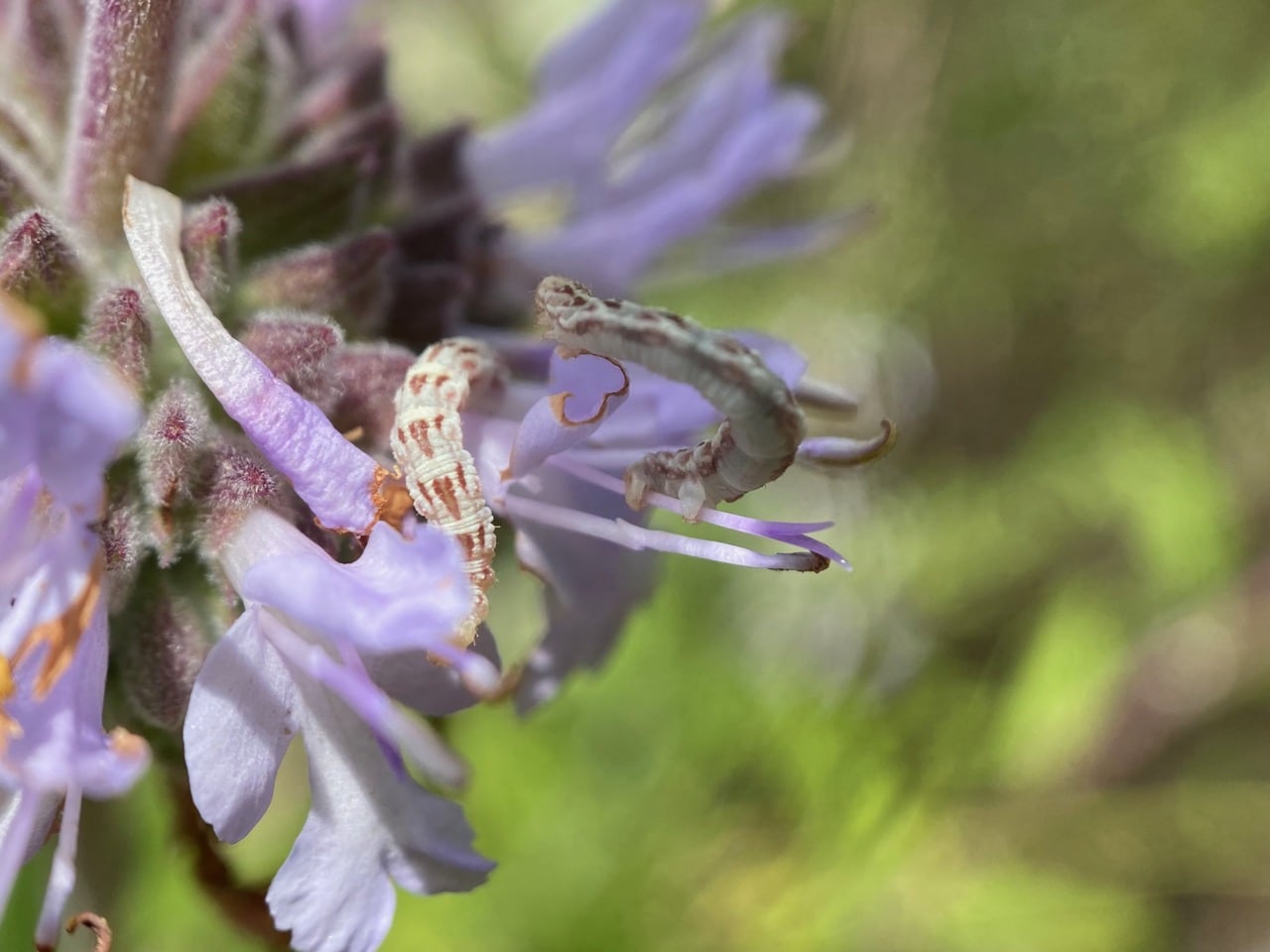
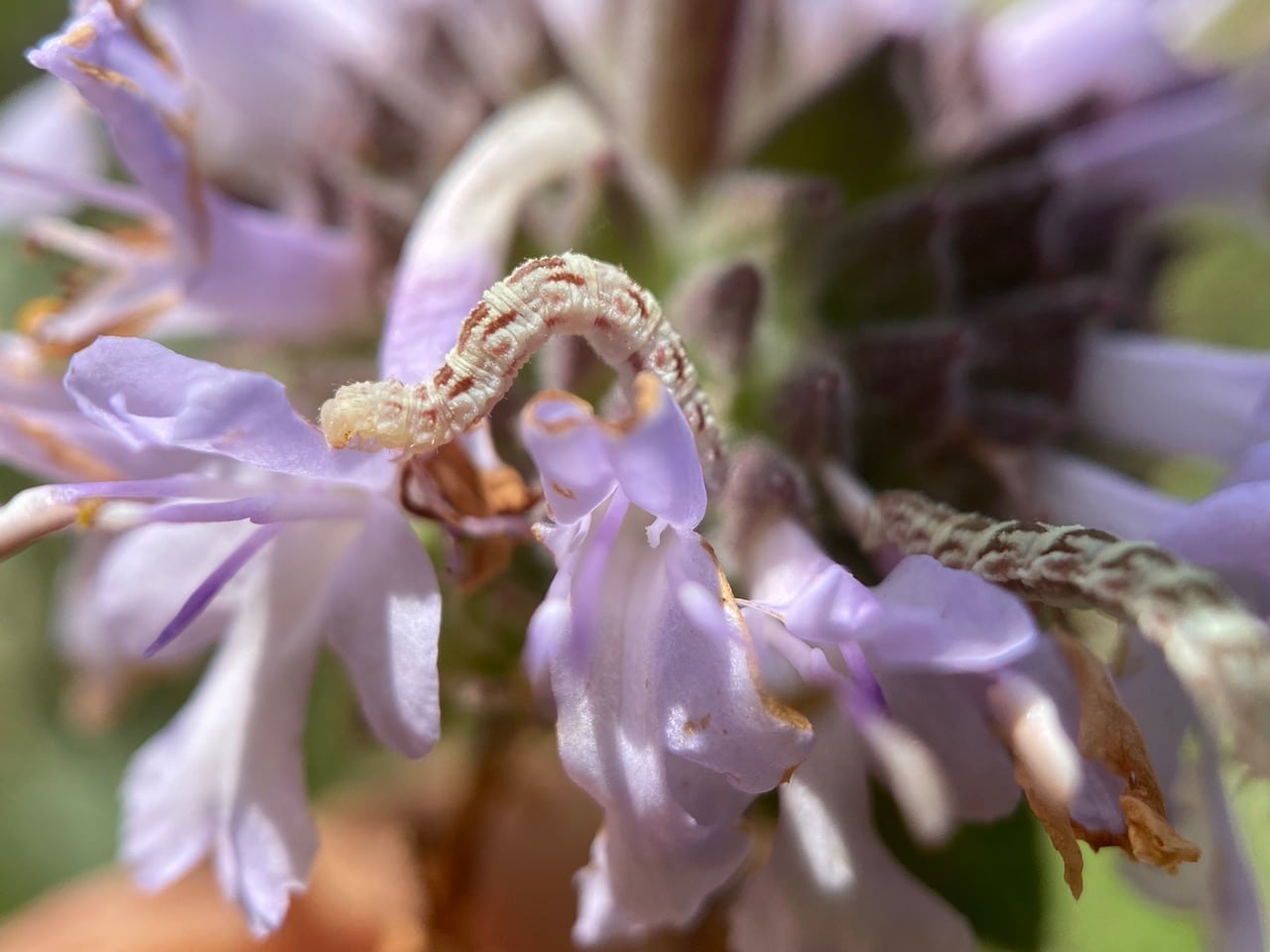
Ooh, there’s another Inchworm here! They are so hard to see in this busy background.
The two Inchworms avoid contact with each other and eventually settle down to feed on their own flower.
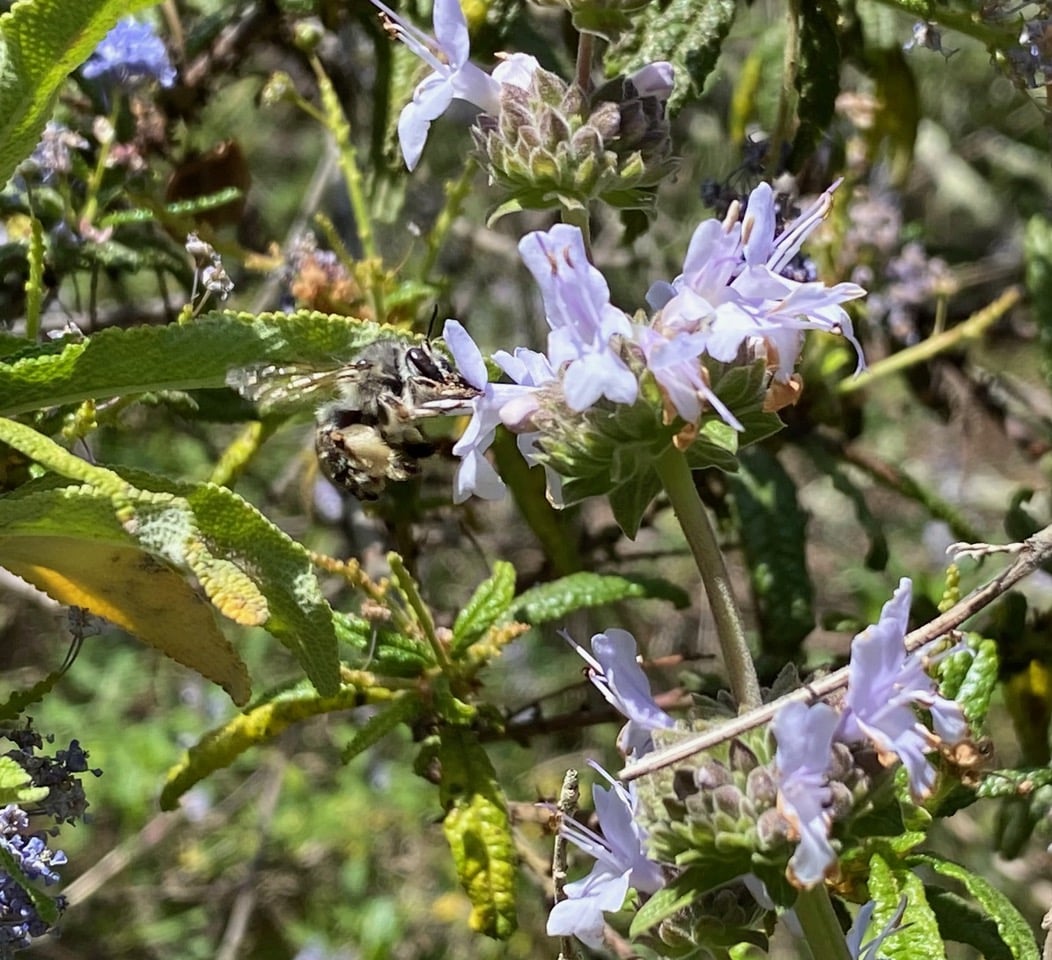
A fast-flying bee the size and shape of a bumble bee stops to take nectar from a Black Sage flower. It is a female California Mountain-Digger Bee, Habropoda depressa (family Apidae).
These bees are solitary ground nesters that prefer hard-packed soils. Adults are active from February to early June in California. They are generalist foragers, visiting flowers from several families, including exotic and horticultural varieties. During the nesting season, females spend evenings outside burrows, roosting on nearby vegetation before returning to their nest the following morning.
A female Longhorn Bee, Eucera sp. (family Apidae) is landing on a flower of Silverleaf Lupine, Lupinus albifrons. She already has some orange pollen in the scopae of her hind legs.
The name Eucera is Greek for “well-horned”, a reference to the long antennae of the males. Abundant throughout the United States and Canada, especially in the west, these fast-flying bees are hairy and generally large. Only one subgenus (Synhalonia) occurs in the United States and Canada. Eucera includes both specialists and generalist bees. Specialists often limit themselves to flowers in the pea family (Fabaceae). Eucera are among the first bees to emerge in the spring and are rare by August. They nest in the ground and are mostly solitary. Nest entrances have a mound of excavated soil heaped symmetrically around them. When females emerge they are mobbed by several males who have emerged earlier. Competition among the males is often aggressive, resulting in tumbling “mating balls” of males clustered around a female. Once the female has been mated, however, her scent changes, and males leave her alone.
This female Eucera is one chunky bee! Lupine flowers require heavy-bodied bees for tripping the pollination mechanism, and Bumble Bees and Digger Bees are well qualified for the job.