

Pollinator Post 6/2/24 (2)

After seeing the Tiburon Jewelflower at Old St. Hilary’s Preserve, Andy, Susan and I next visit the Ring Mountain Preserve at the north end of the Tiburon peninsula in search of the Tiburon Mariposa Lily. The two rare flowers are blooming at the same time on similar serpentine outcrops not far from each other. While the grasses at Ring Mountain have mostly turned brown, some wildflowers are still in bloom, albeit at their tail end. In the blinding mid-day sun, I mostly limit my photography to flowers that have insects on them.
A large, brown butterfly flits over the dried grasses, blending in imperceptibly. It finally lands to take nectar from on an inflorescence of Coyote Mint, Monardella villosa.
The Common Wood-Nymph, Cercyonis pegala is a North American species of butterfly in the family Nymphalidae. The butterfly varies greatly according to location. All individuals are brown with two eyespots on each forewing. The number of eyespots on the underside of the hindwing varies. In the western part of its range, some populations have a pale yellow patch around the large eyespots. The butterflies are found in large, sunny, grassy areas including prairies, open meadows, bogs, and old fields. The larval host plants are a variety of grasses. In late summer, females lay eggs singly on host plant leaves. Caterpillars hatch but do not feed, instead hibernating until spring. Adults feed on flower nectar, rotting fruits, tree sap, and decaying matters.
Common Wood-Nymph Cercyonis pegala (Fabricius, 1775) | Butterflies and Moths of North America



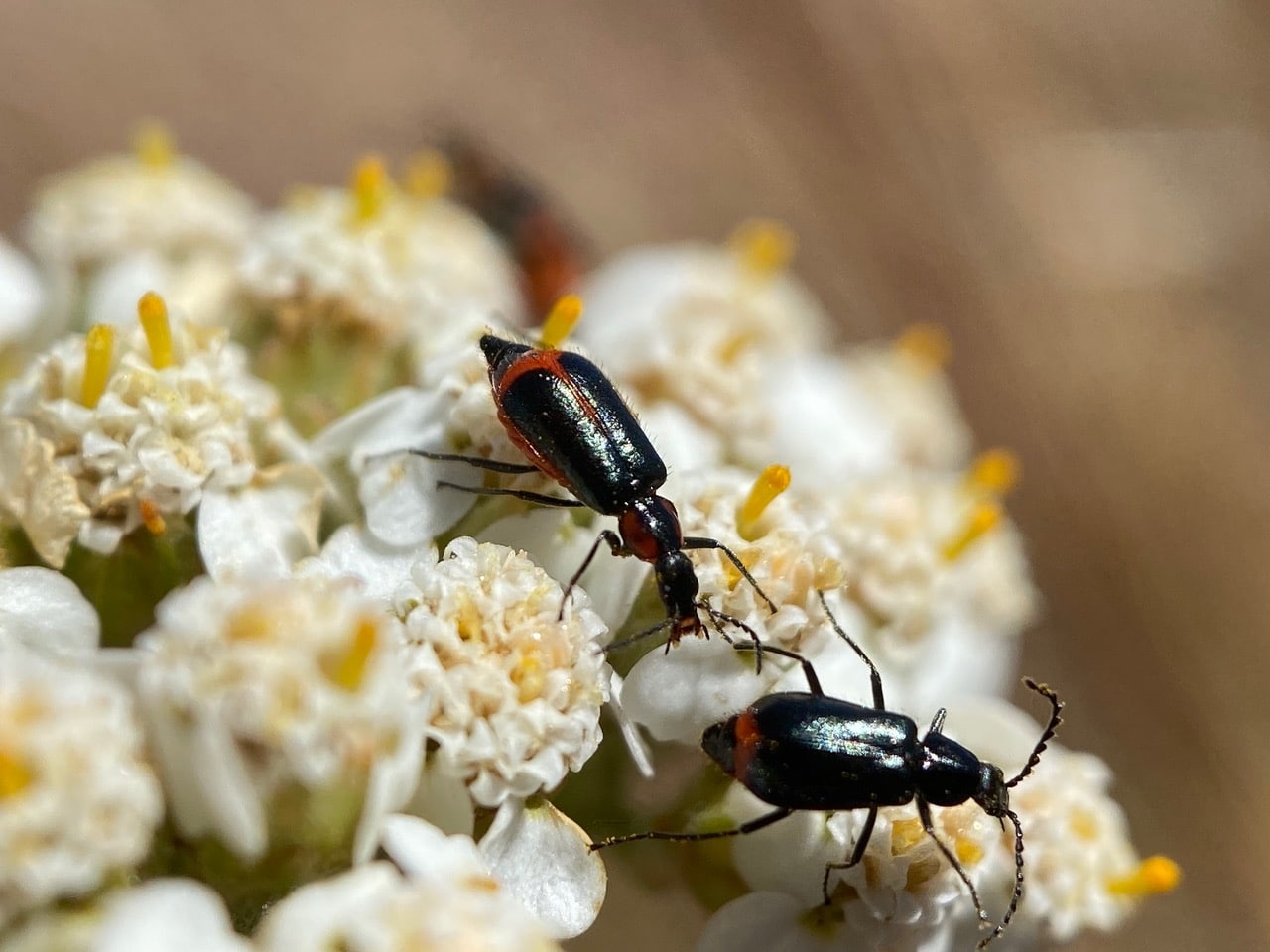
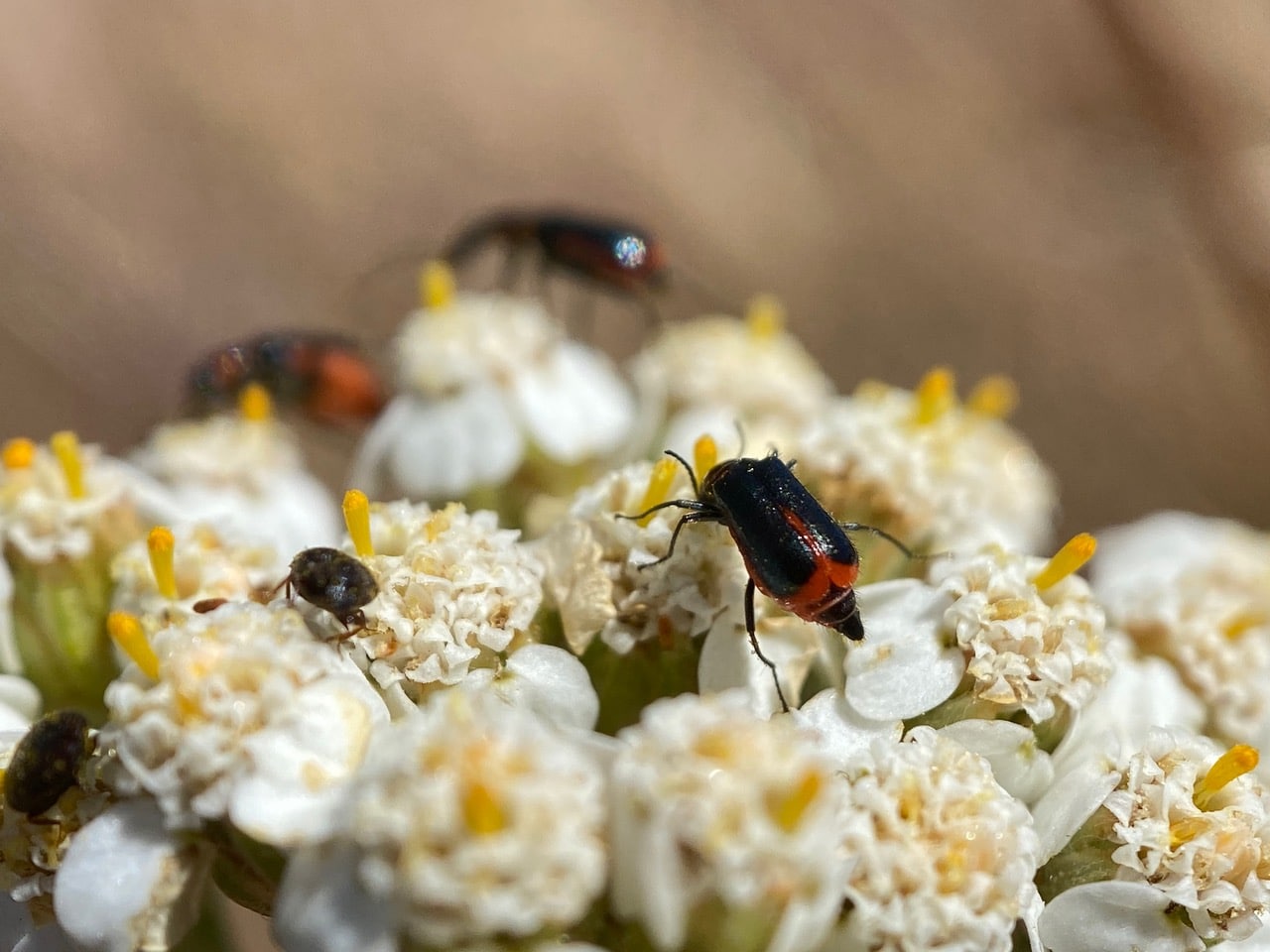
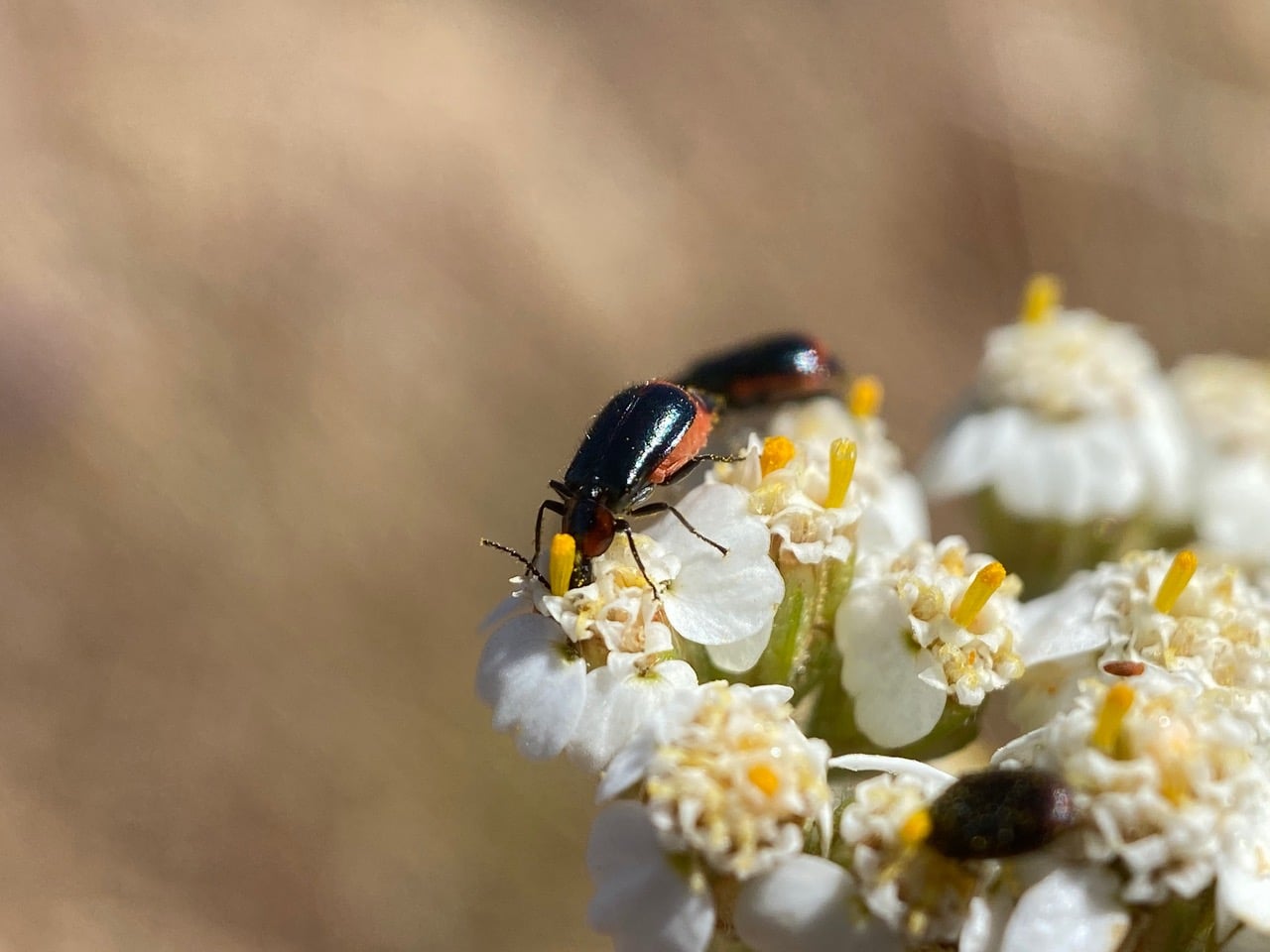
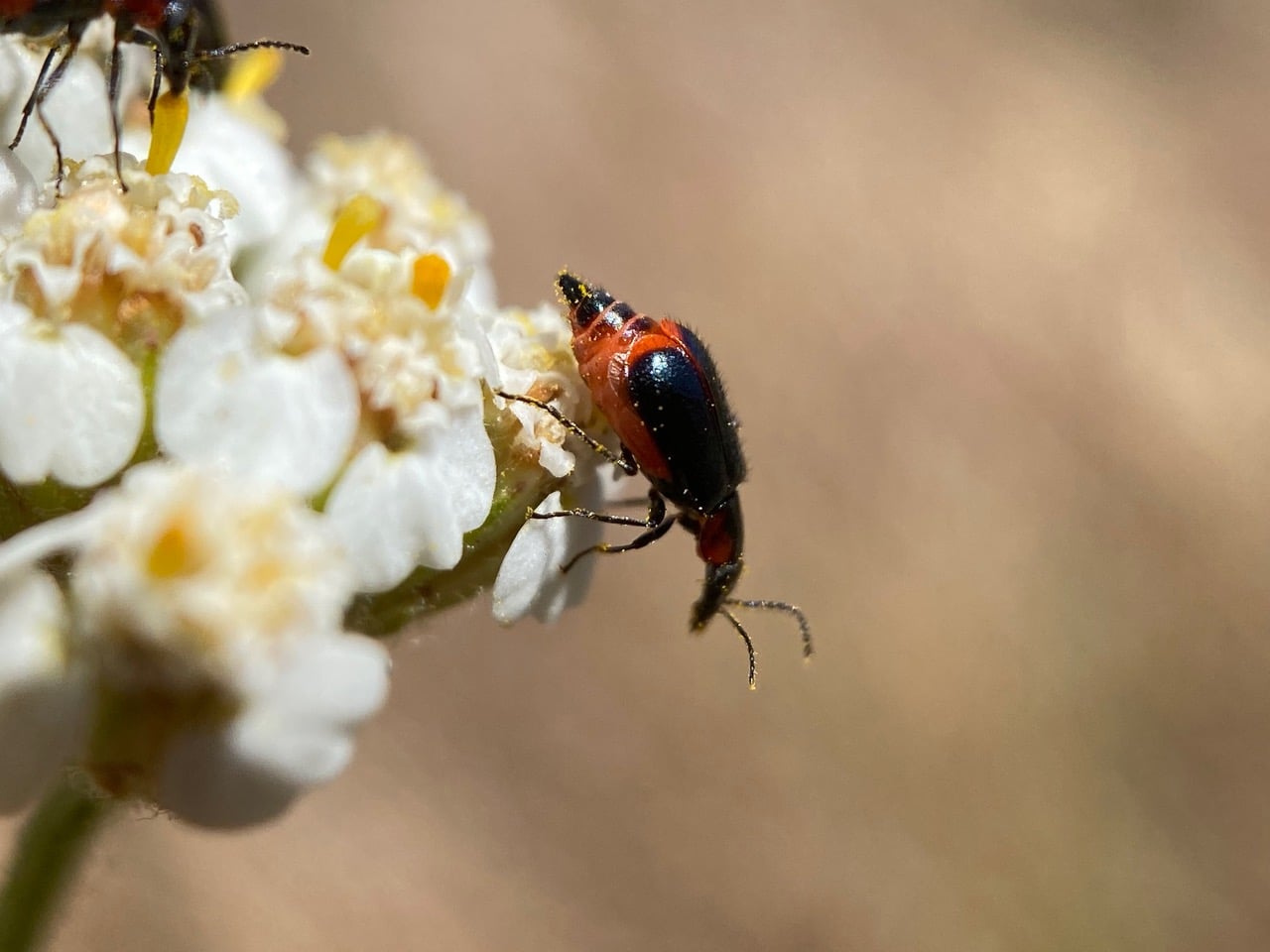
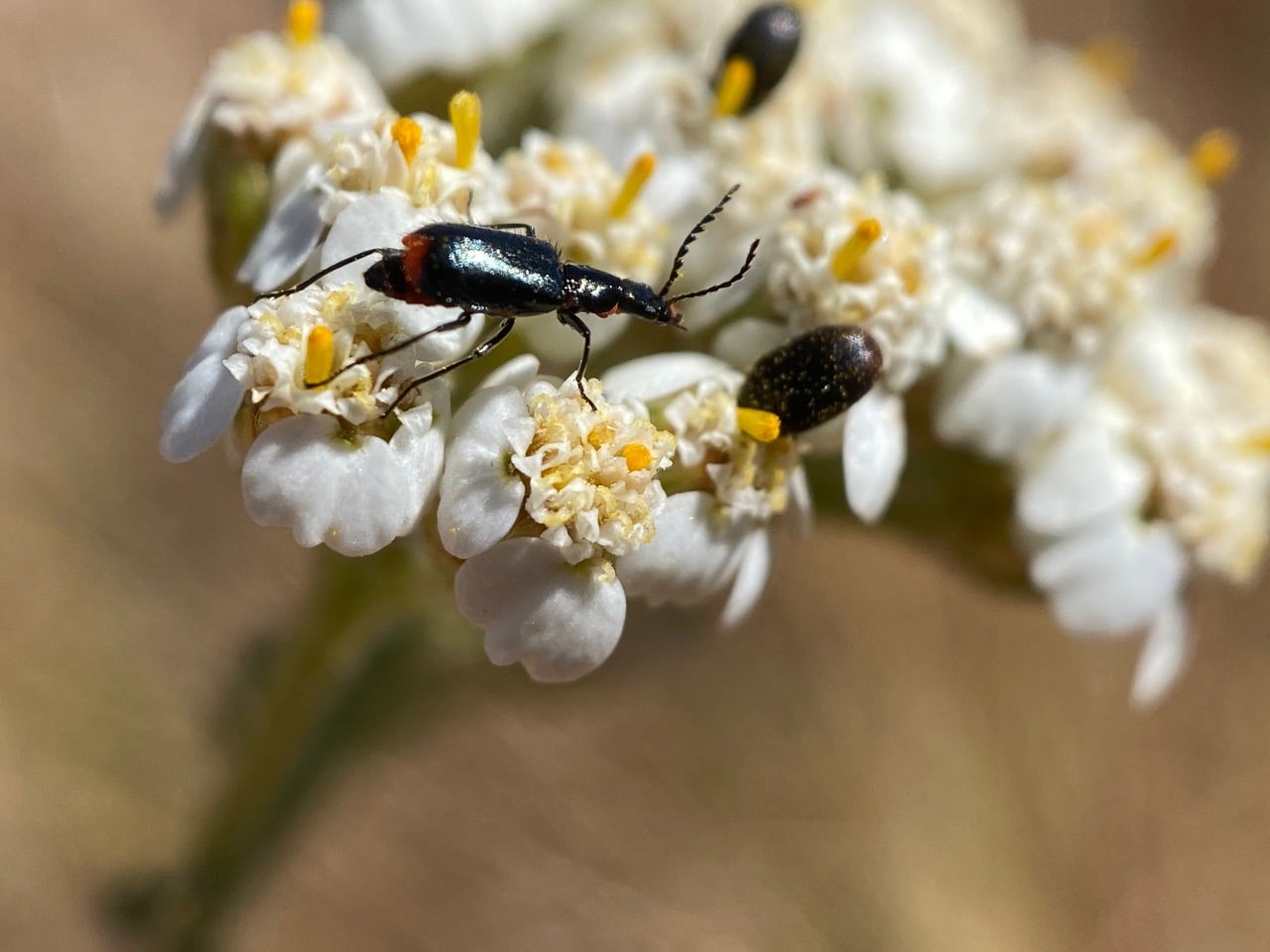 Many shiny beetles are rummaging around on an inflorescence of Yarrow, Achillea millefolium. It is difficult to make out the colors on these beetles under the bright noon day sun.

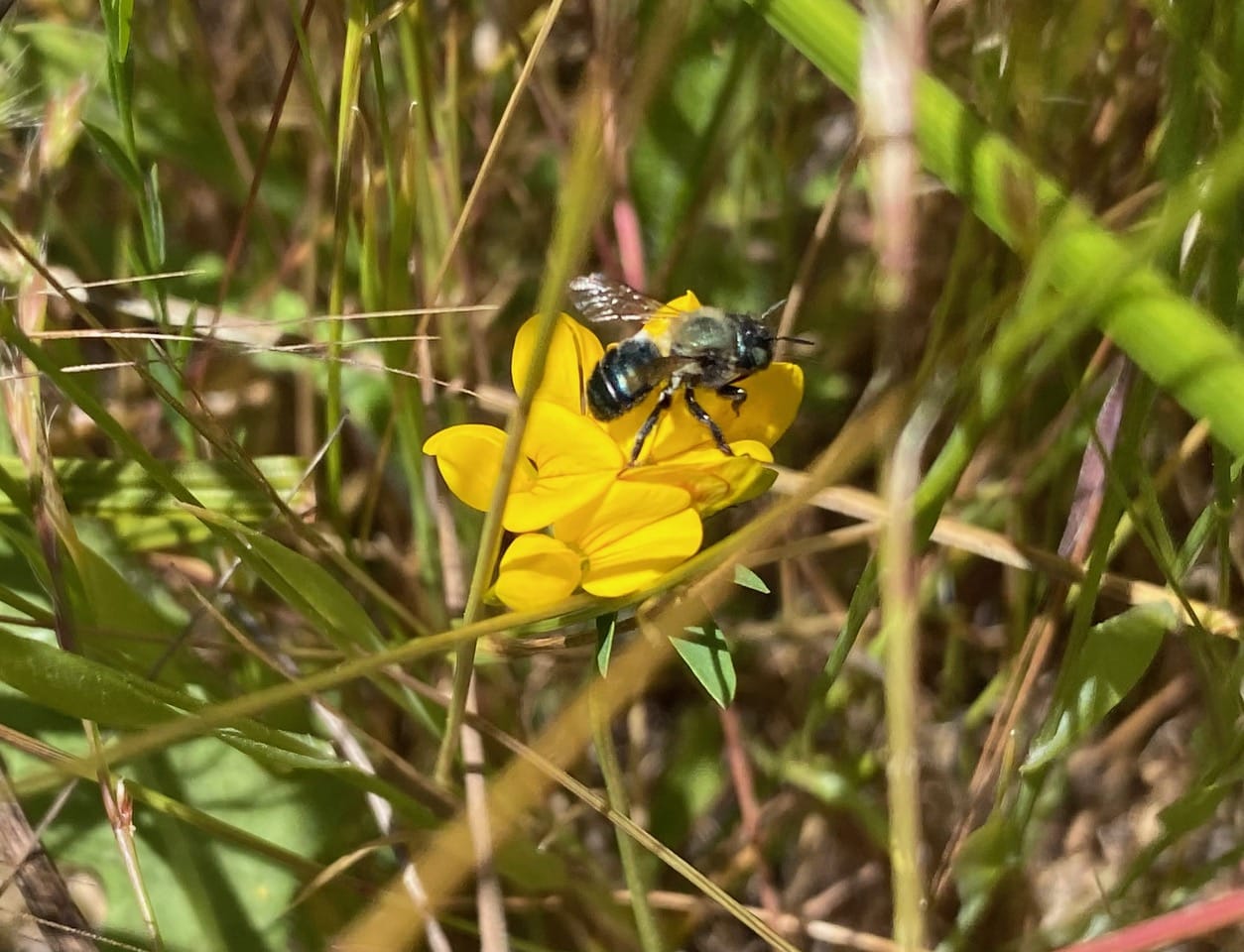
A small metallic blue bee is visiting the yellow Acmispon flowers blooming in the undergrowth of grasses.
Closing in, I recognize the bee as a Mason Bee, Osmia sp. (family Megachilidae). Note that the bee has no scopa on its hind legs. The scopae of members of the family Megachilidae are located on the underside of the abdomen of the bee. I wonder if these little bees can “trip” the pea flowers of Acmispon and have the pollen delivered directly to their abdominal scopae while they take nectar? The larger pea flowers of the Silverleaf Lupine are tripped and pollinated by bumble bees. Osmia seems to be the perfect size for Acmispon.
Mason Bee is a name commonly used for species of bees in the genus Osmia, of the family Megachilidae. Mason Bees are named for their habit of using mud or other “masonry” products in constructing their nests, which are made in naturally occurring gaps/cavities such as cracks in stones, hollow stems or holes in wood made by wood-boring insects. Osmia means ‘odor’, and refers to a faint lemony scent used by these bees to mark their nest entrances. Osmia species are frequently metallic green or blue. Females have black ventral scopae (special pollen collecting hairs) on the underside of their abdomen, which are difficult to see unless laden with pollen. Ventral abdominal scopae is a feature shared by all members of the Megachilidae family, which include the wool-carder bees (genus Anthidium), and leaf-cutter bees (genus Megachile).
Mason Bees are a solitary species and are non-aggressive. Every female is fertile and makes her own nest. Each nest cell is provisioned with pollen and contains one egg which will develop into a larva. The female creates a partition of mud between the nest cells. The process continues until she has filled the cavity. She plugs the entrance to the cavity, and then may seek another nest location. The larvae that hatch out consume their provisions and begin spinning a cocoon around itself and enters pupal stage. Adults mature in fall or winter, hibernating inside its cocoon.
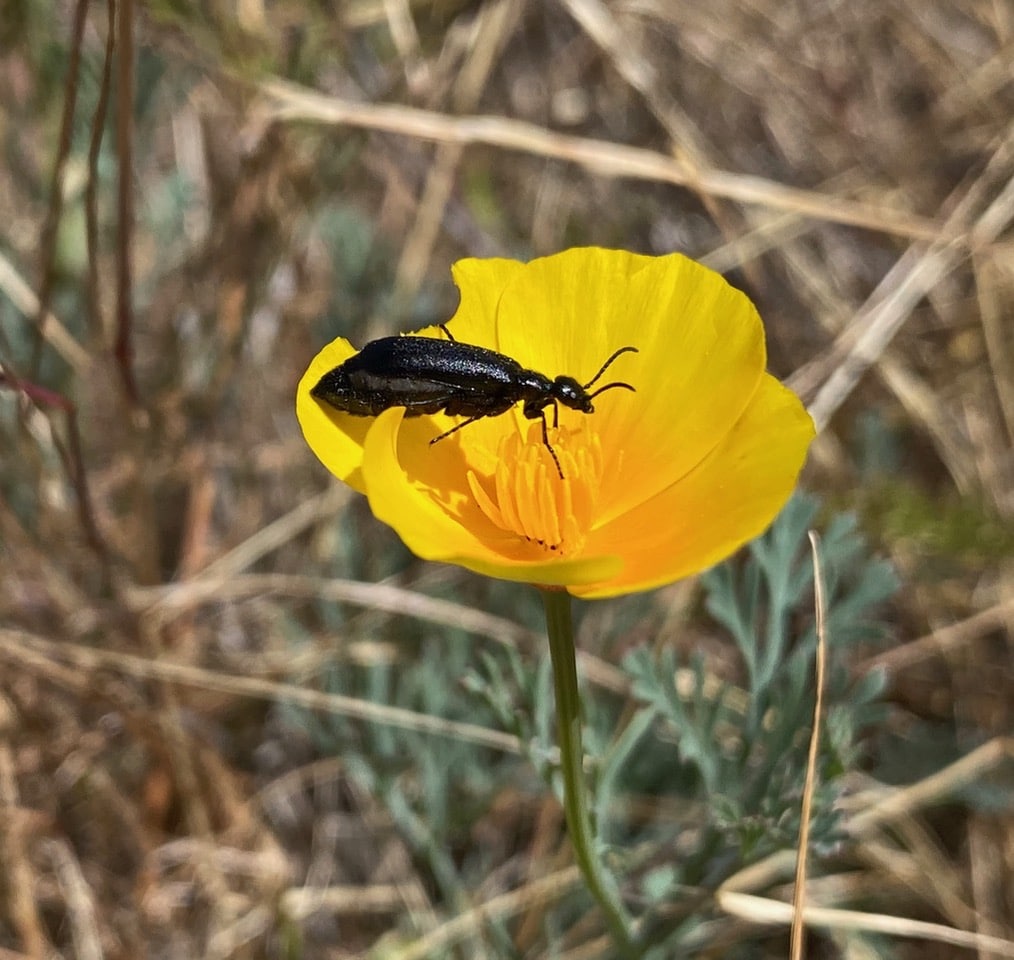
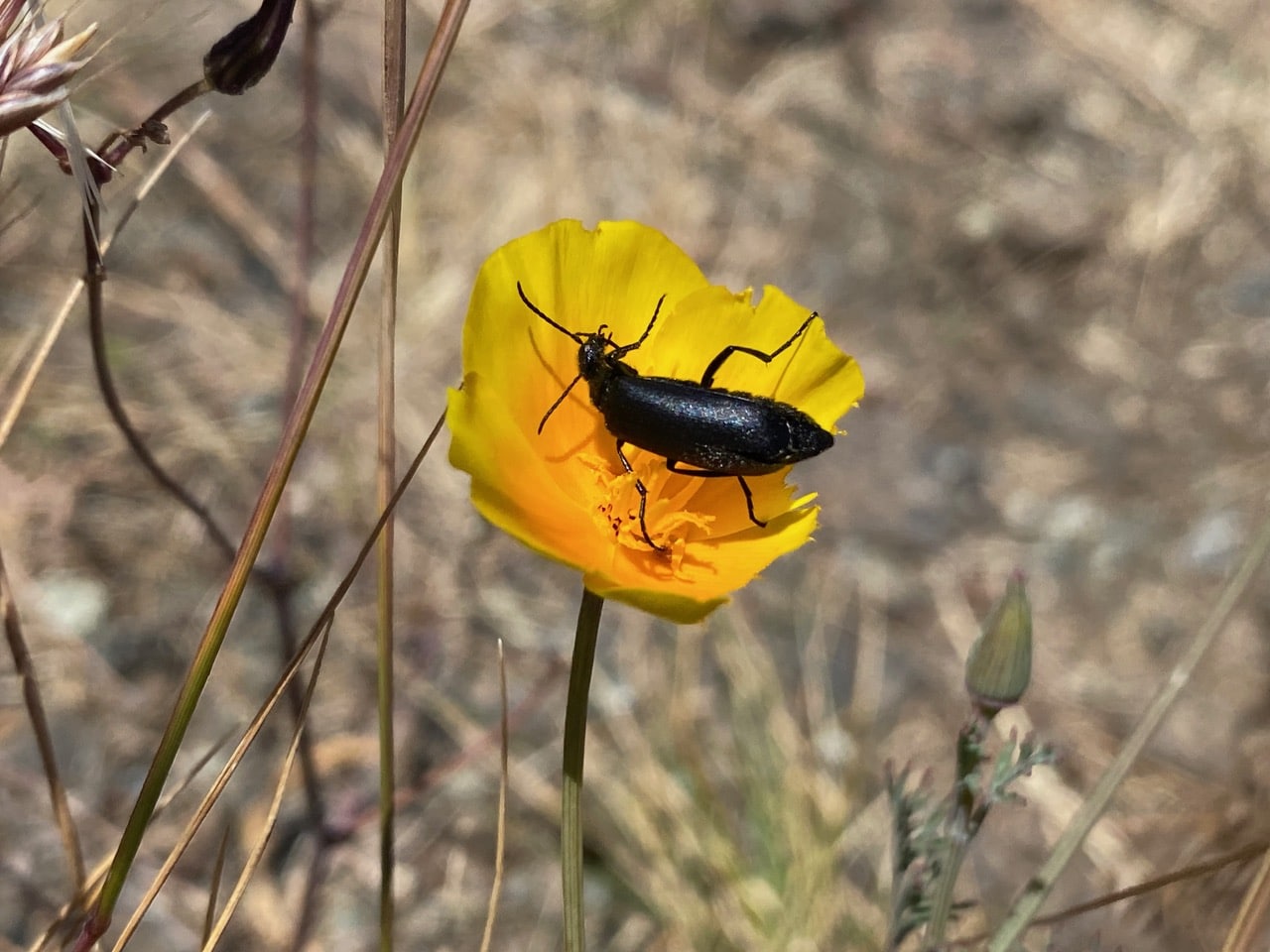
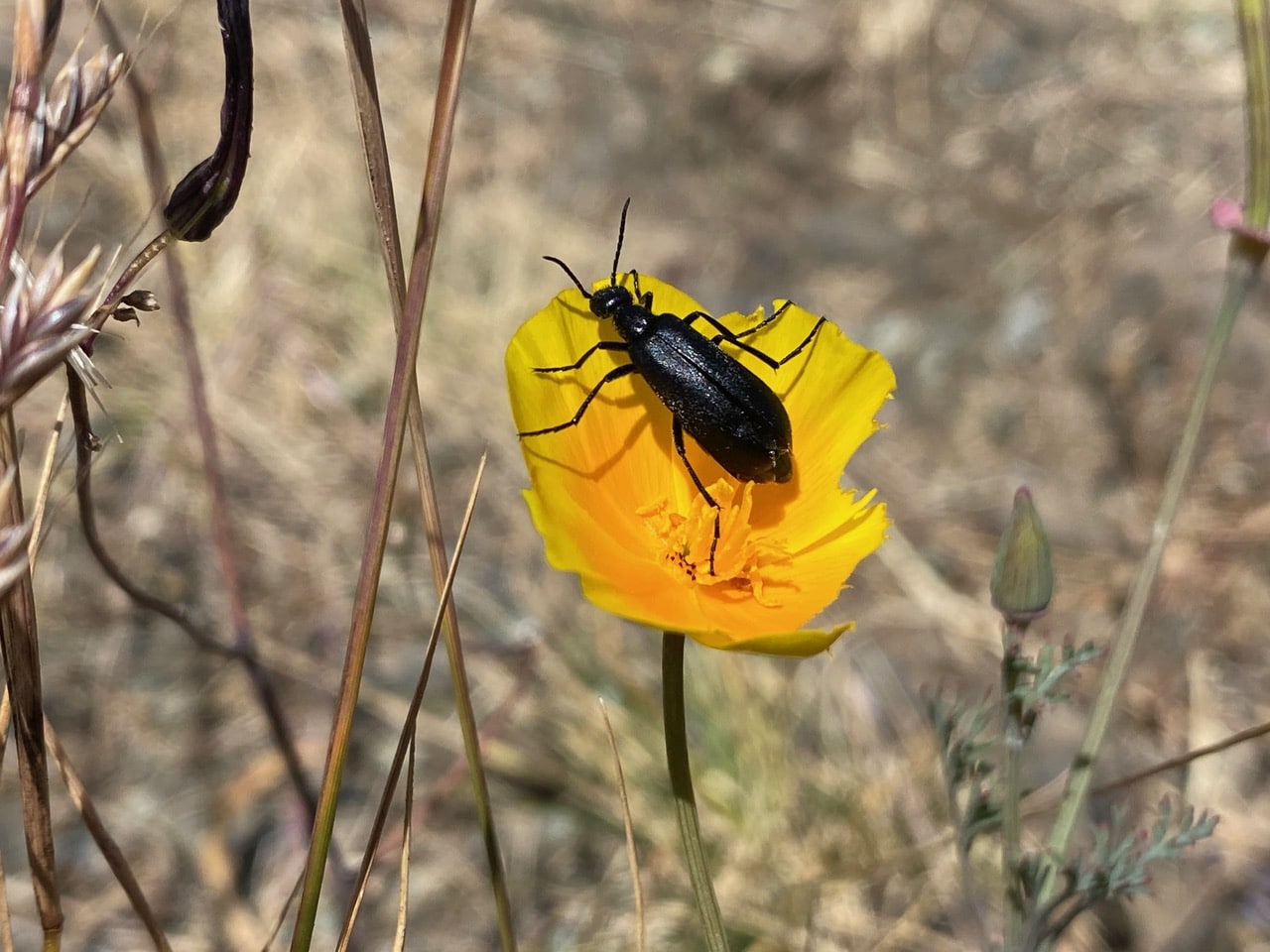
A Burning Blister Beetle, Epicauta sp. (family Meloidae) is feeding on a California Poppy flower, Eschscholzia californica.
Blister Beetles are beetles in the family Meloidae, so called for their defensive secretion of a blistering agent, cantharidin. Blister Beetles are hypermetamorphic, going through several larval stages, the first of which is typically a mobile triungulin. The larvae are insectivorous, mainly attacking bees, though a few feed on grasshopper eggs. The adults feed on flowers and leaves of plants.
Epicauta is a genus of beetles in the family Meloidae, particularly diverse in northern Arizona. Adult beetles feed on plants. The larvae are predators on the eggs of grasshoppers. The beetles can significantly damage plants, and many are known as agricultural pests around the world. Like other blister beetles, Epicauta produce cantharidin, a toxic terpenoid which can kill animals such as horses if they ingest enough of the beetles. A few beetles consumed in a single feeding of alfalfa hay may be lethal.
Note the feeding damage on the poppy petals.
A smaller male is trying to mate with a female Blister Beetle who would rather be feeding.
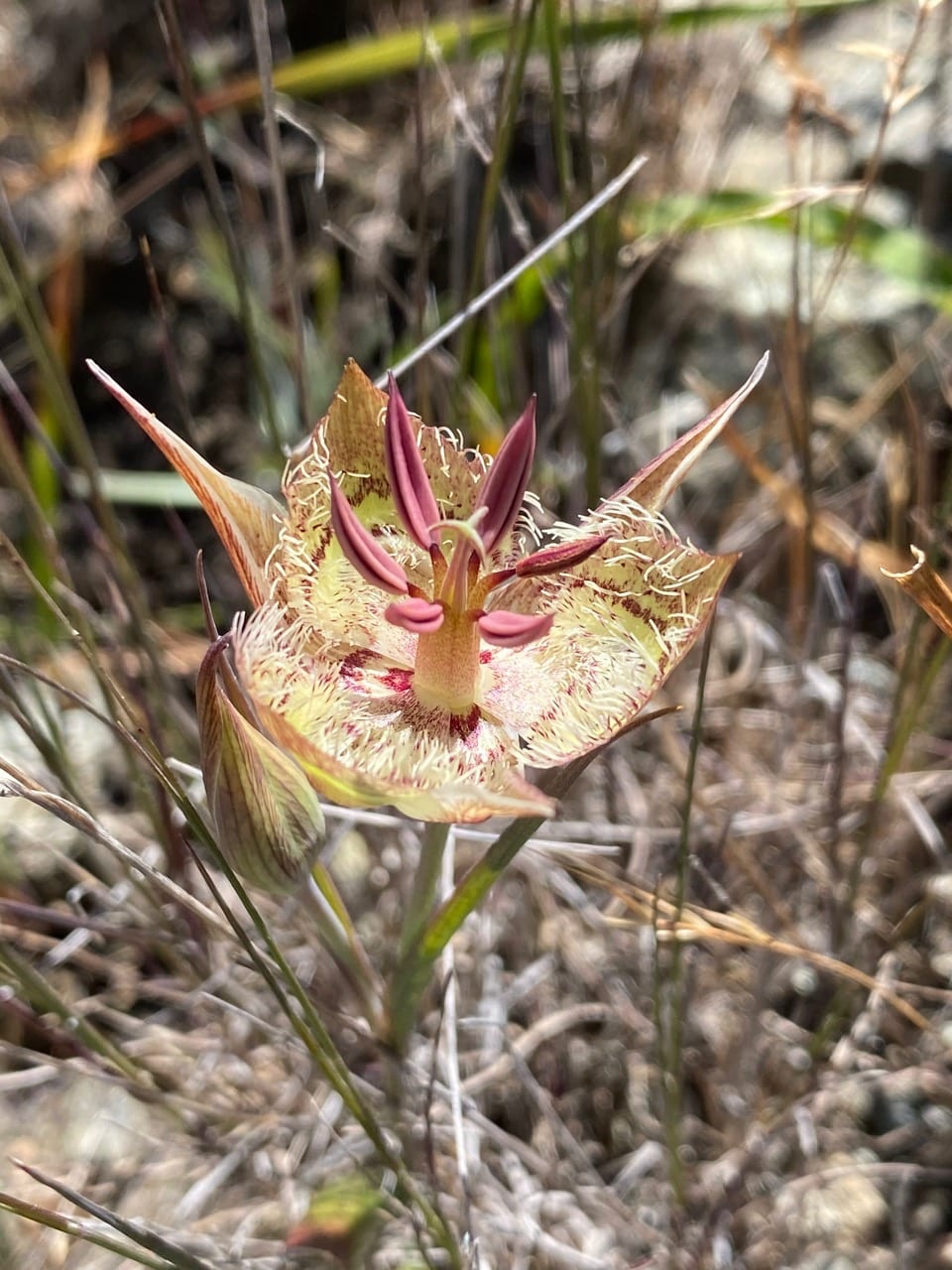
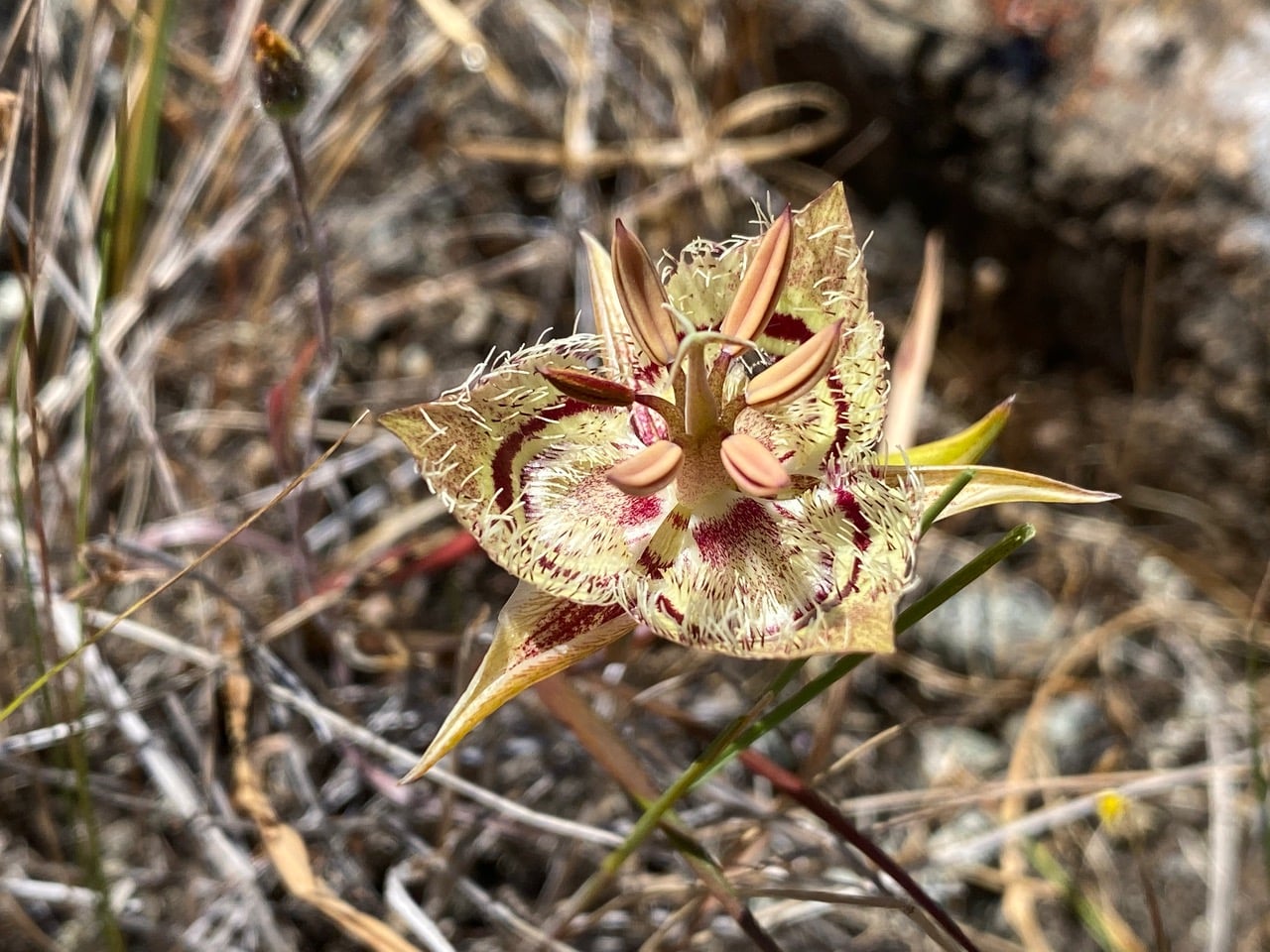
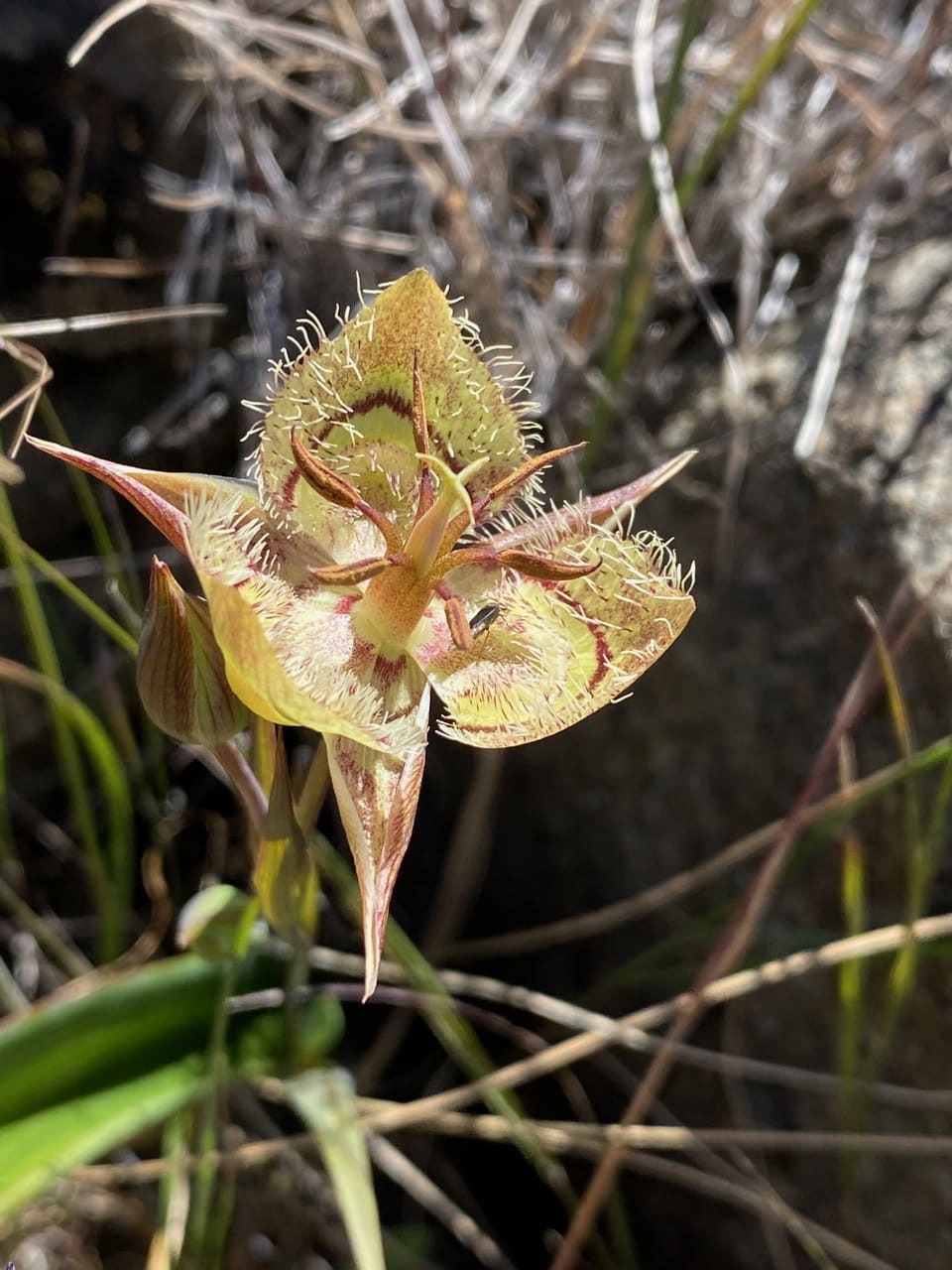
Sharp-eyed Susan spots the first Tiburon Mariposa Lily, Calochortus tiburonensis among the serpentine outcrops. Once we have the search image, we are suddenly able to find dozens of them hiding in plain sight among the drying vegetation. “Why would a flower want to be camouflaged?” asks Susan. I have no idea!
The flower exhibits what’s called “cat’s ear” floral syndrome – characterized by small spreading petals densely covered in hairs. One theory posits that the hairs serve as a maze for visiting insects, so they would spend more time navigating the flower, perhaps facilitating transfer of pollen. The other function of the hairs might be to shade the flower from UV damage.
C. tiburonensis flower is known to be protandrous, the male parts maturing before the female parts. The flower in this picture is a young one, with five fresh anthers and only one anther that has dehisced and shriveled. What a bizarre looking flower – it displays its sexual parts so prominently!
I wonder what those reddish-purple markings on the petals are communicating to the insects. Are they nectar guides? But bees are red-blind. Are the purple areas near the base of the petals where the nectaries are located? While lingering at the nectaries, an insects is likely to be showered with pollen from the large anthers overhead.
Here’s a pair of flowers. The one on top is faded, well on its way to developing a seed pod. The one at the bottom is probably in its female phase. All its anthers have shriveled. A little moth, the Sulphur Tubic is feeding on nectar on one of the petals. It seems the flower can accommodate a larger pollinator that can fit under the stamens and be able to rub against the pollen from the anthers.
A Sulphur Tubic feeding at another Tiburon Mariposa Lily flower.
I found the following online information about the pollination of this flower:
“Protandry likely limits self-pollination in the species although seed can be produced upon hand self-pollination. In nature, Tiburon mariposa lily appears to be primarily outcrossing and dependent upon insects for pollination. The flowers are thought to be pollinated primarily by bumble bees.” Yes, a bumble bee would be the perfect size! However I am not seeing any bumble bee visiting the flowers today.
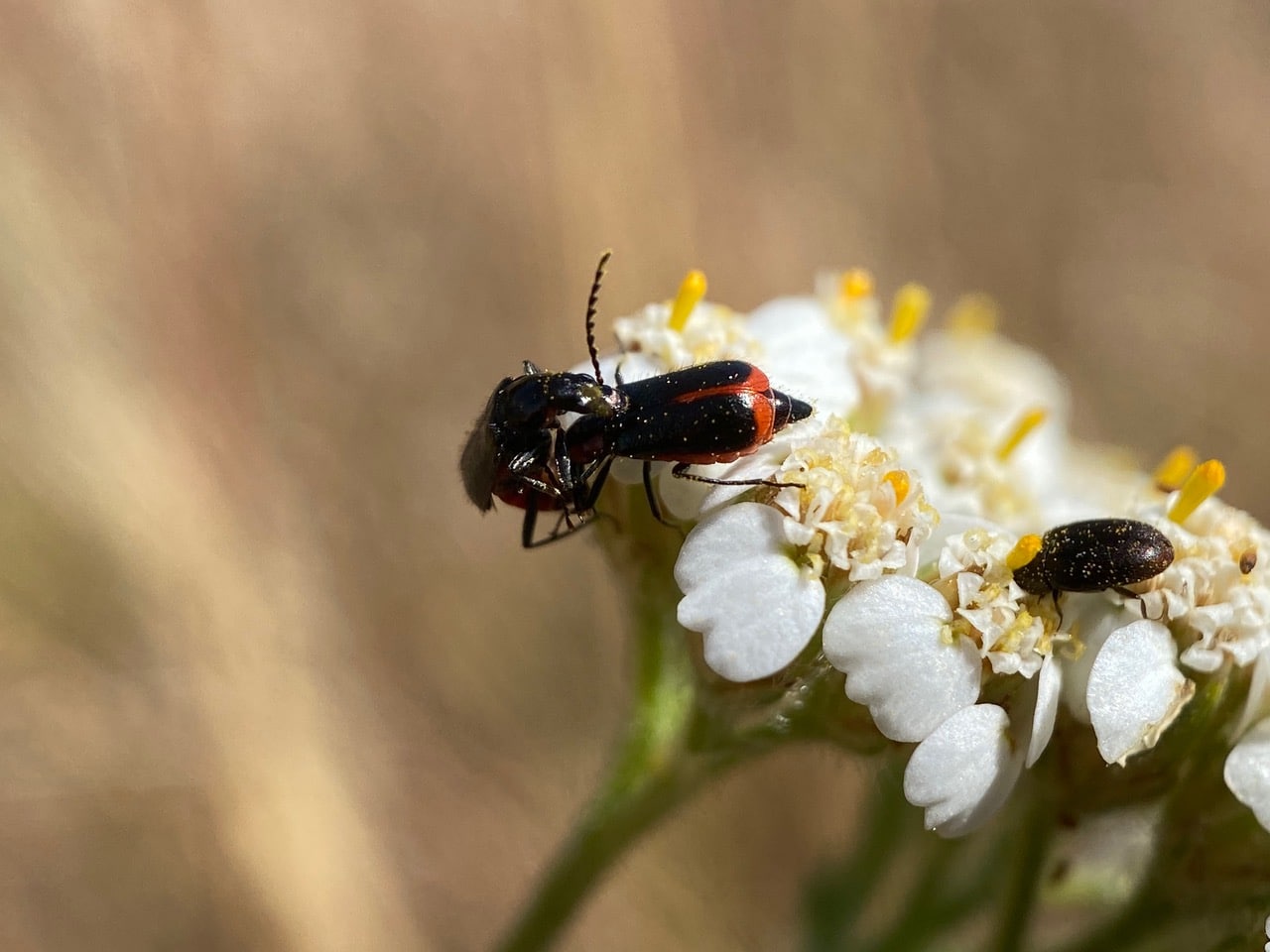
Many shiny beetles are rummaging around on an inflorescence of Yarrow, Achillea millefolium. It is difficult to make out the colors on these beetles under the bright noon day sun. The beetles appear to be Malachite Beetles (subfamily Malachiinae, family Melyridae).
The Malachite Beetle (subfamily Melachiinae) is a member of the family of Soft-winged Flower Beetles (family Melyridae). Most Melyrids are elongate-oval, soft-bodies beetles 10 mm or less in length. Members of the subfamily Malachiinae have peculiar orange structures along the sides of the abdomen which can be everted, but usually kept hidden. Most adults and larvae are predaceous. Omnivorous adult Melyrids are often found on flowers out in the open, where they feed on pollen, insect eggs, and flower-loving insects that land within their grasp. The larvae generally stay concealed under tree bark or leaf litter or soil, where they prey on other invertebrates.
Note the beetle’s pectinate antennae. The segments of pectinate antennae are longer on one side, giving the antenna a comb-like appearance. The term pectinate derives from the Latin pectin, meaning comb. Pectinate antennae are found in some beetles and sawflies. Insect antenna forms – BugGuide.Net
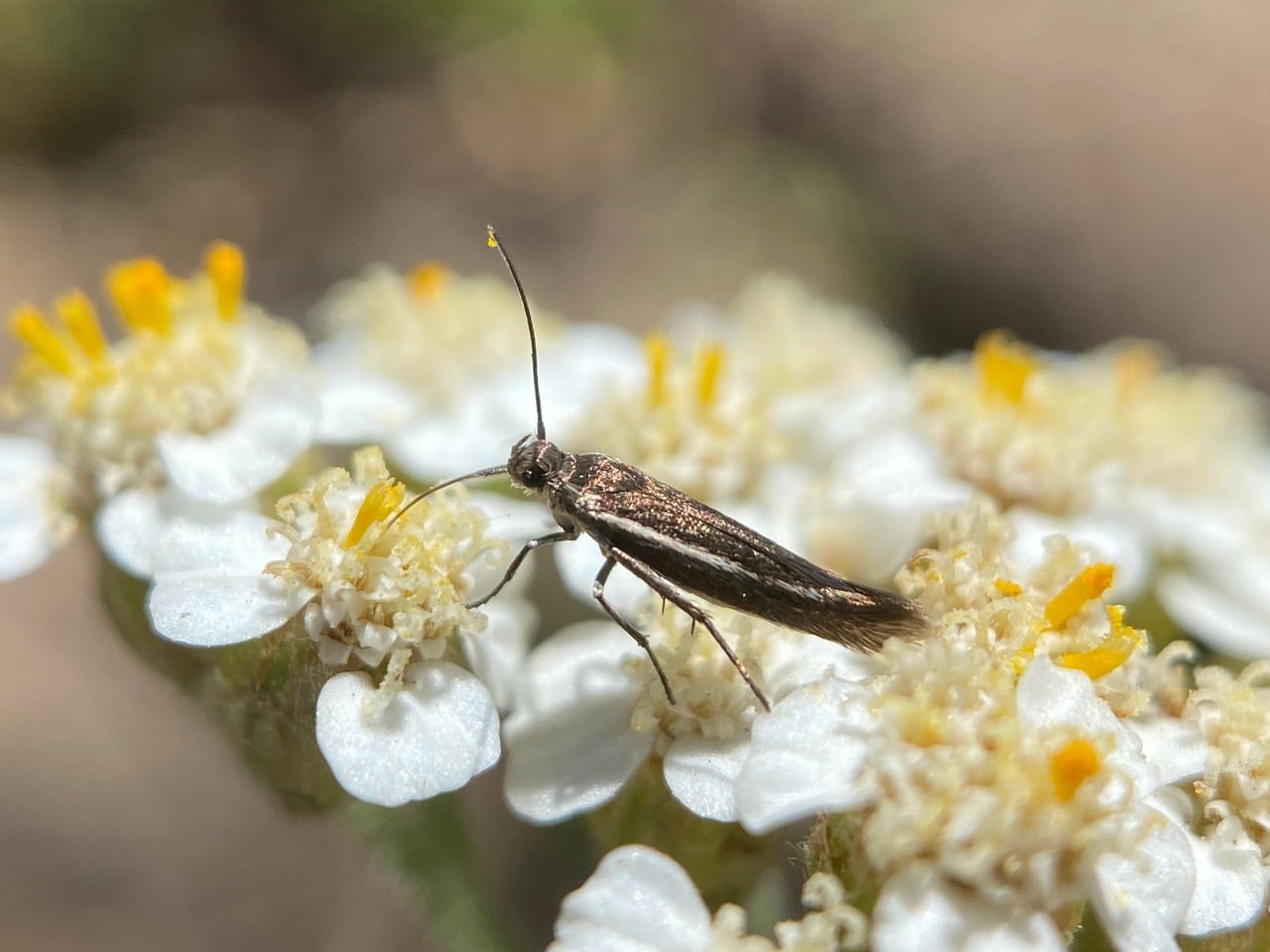
Its proboscis extended, a Sulphur Tubic, Esperia sulphurella (family Oecophoridae, or concealer moths) is taking nectar from a flower of Yarrow, Achillea millefolium.
The moth is native to Europe, but has been introduced in California. Adults have a body length of 6-8 mm, are black with yellow markings. They are on wing in spring. Larvae are black and feed on dead wood.
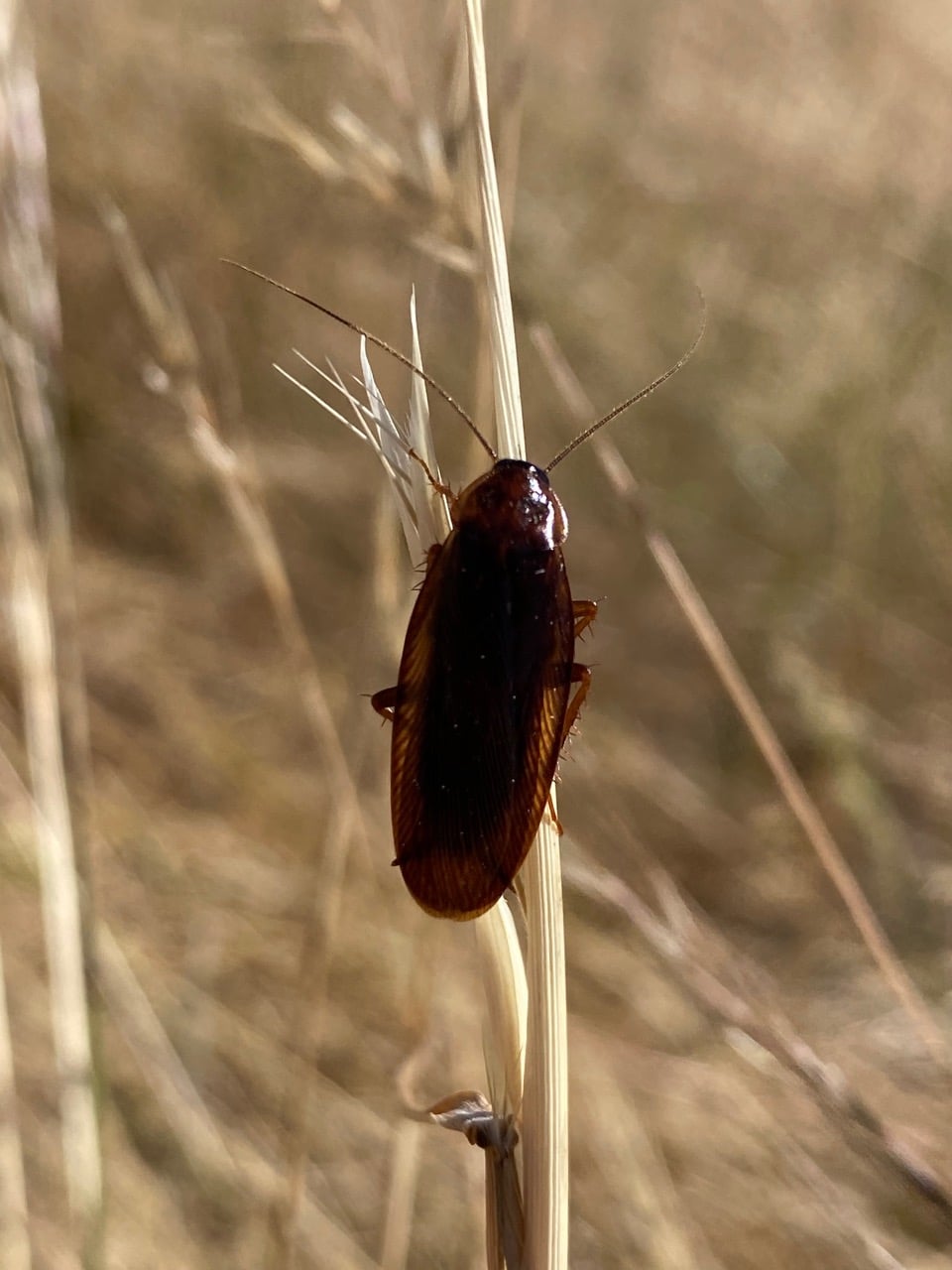
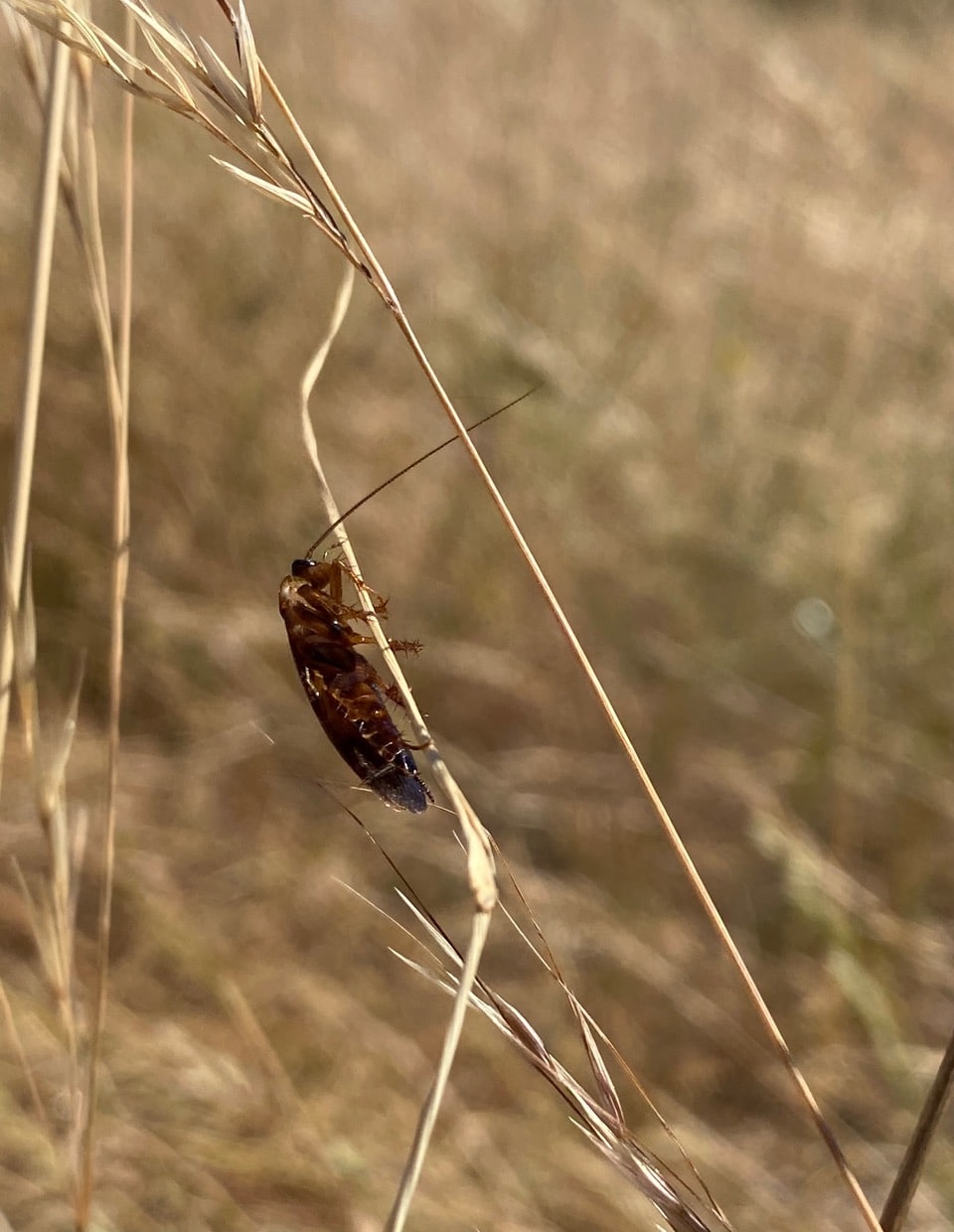
My eyes make out a dark oval shape on the bleached grass stalk.
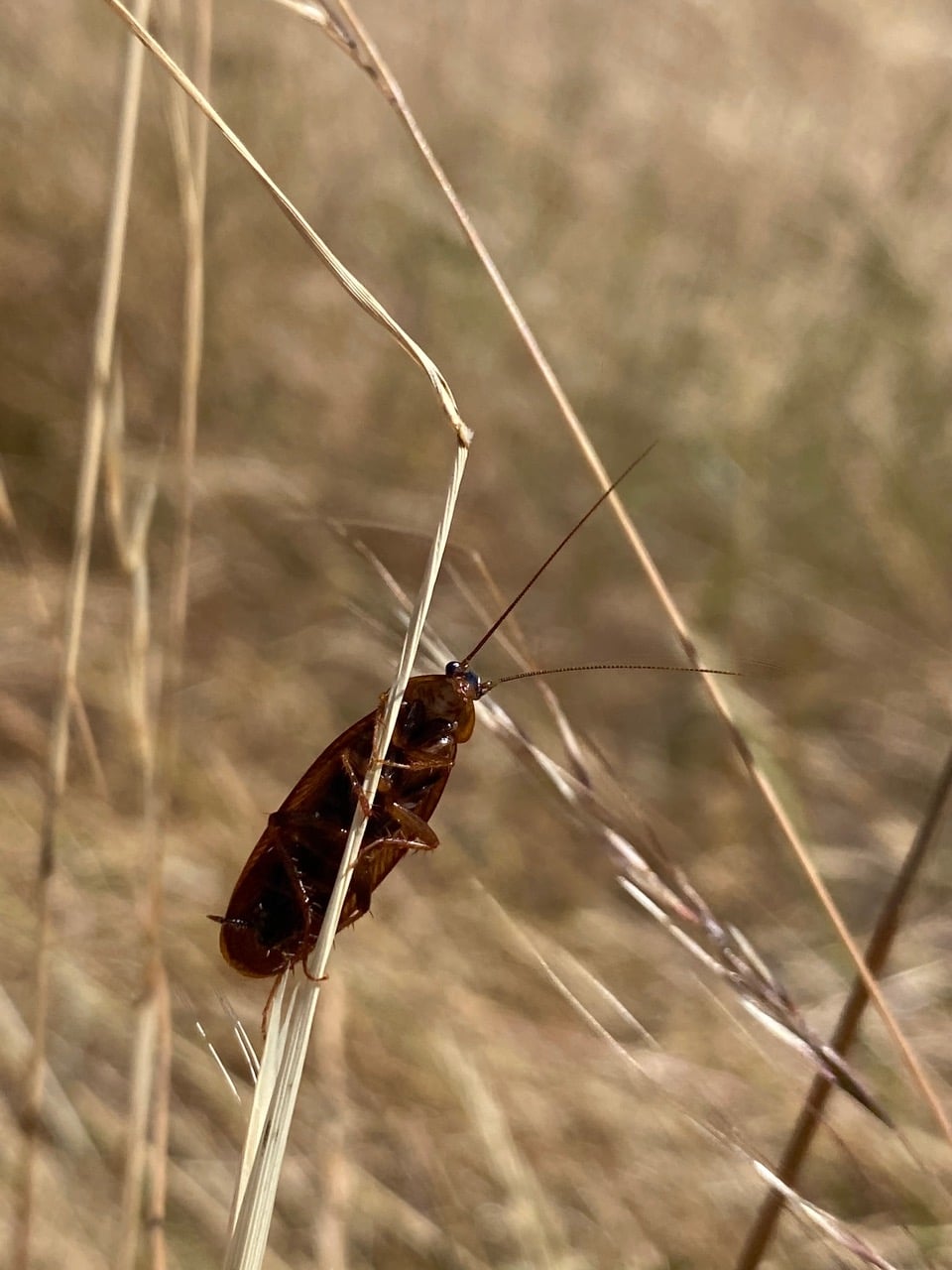
Side view of the insect presents a very flat profile. A Cockroach??
Aww, it even looks adorable in this view!
iNaturalist has identified the insect as a Western Wood Cockroach, Parcoblatta americana (family Ectobiidae, order Blattodea).
The species is known in Mexico and the western United States, including Oregon, California, Nevada, and Arizona. These roaches prefer to live in the open wilderness. They are found in woods, grasslands, dried-up riverbanks, and chaparral. There is marked sexual dimorphism – the males are winged, and females lack wings. Both genders have been found in the nests of harvester ants where they reside during the day, and emerge at night to feed on the debris pile around the ant nest. Nymphs have been found in pack rat nests. Females and nymphs live on the ground, and are found under rocks, in rotting wood, in ant nests. Adult males live separately from the females and nymphs, and are sometimes found perching on chaparral plants at night.