

Pollinator Post 6/8/24 (2)
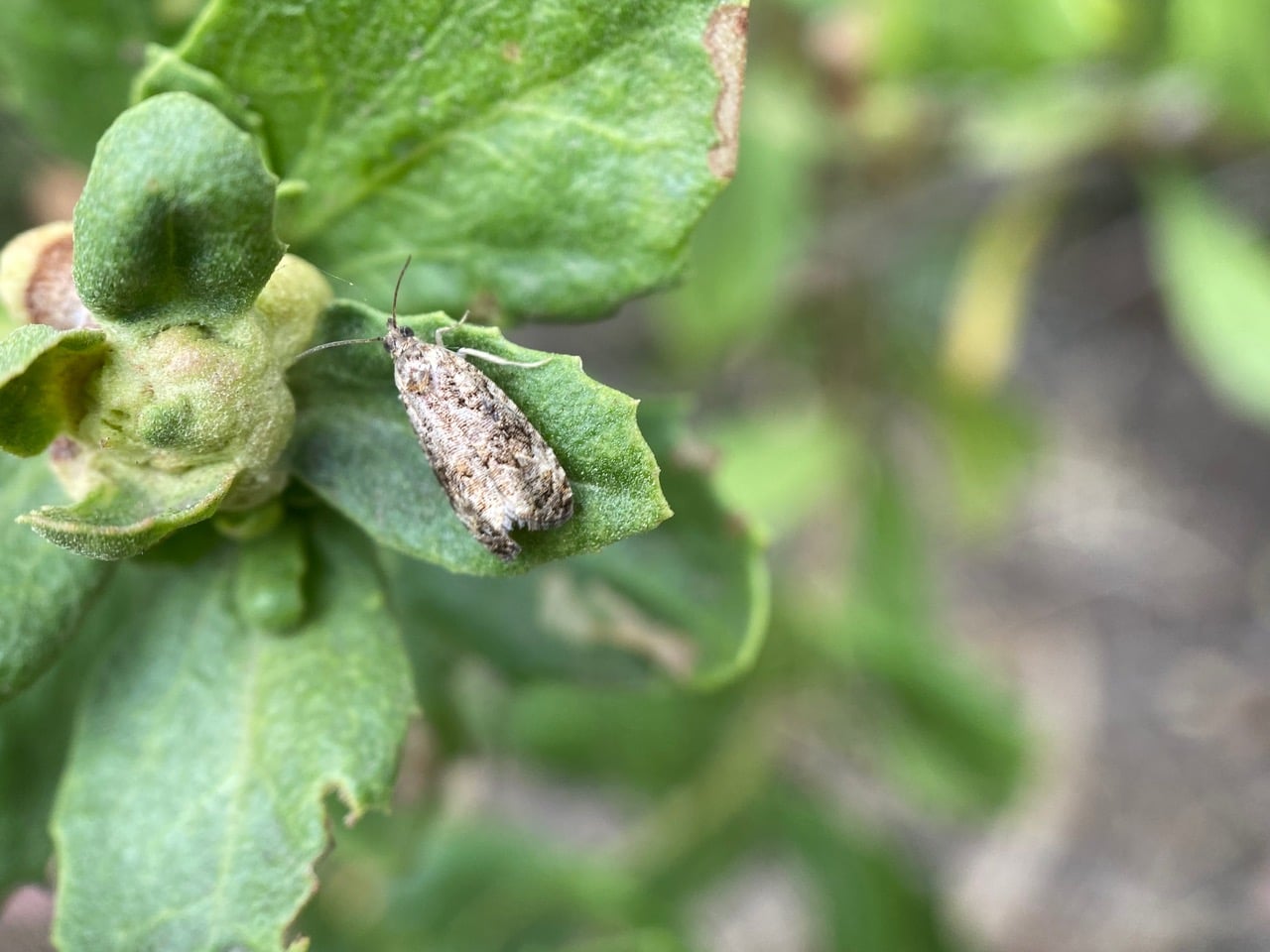
A tiny moth lands on a terminal leaf of Coyote Brush, Baccharis pilularis. iNaturalist has identified it as a Tortricid Leafroller Moth (family Tortricidae).
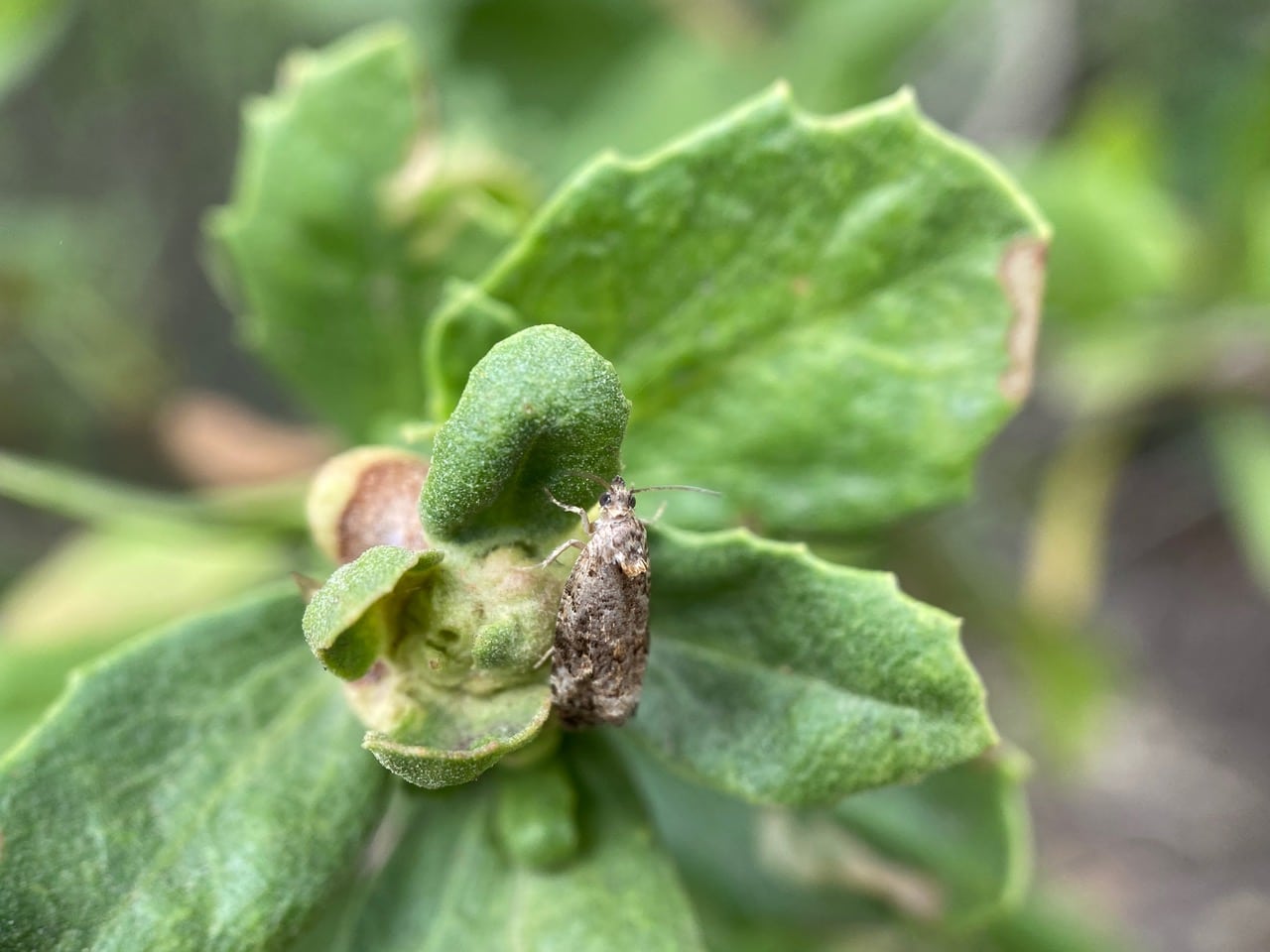
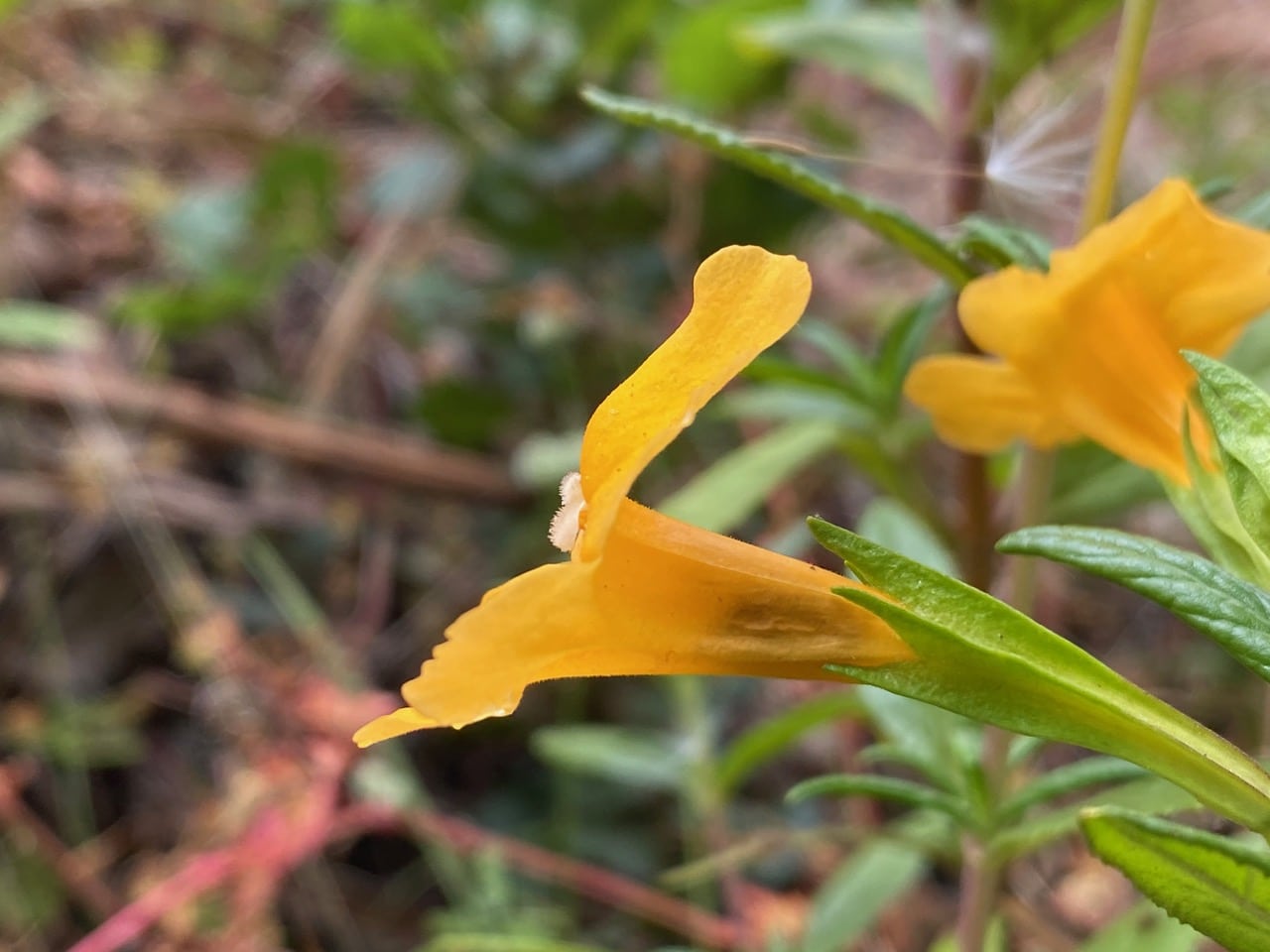



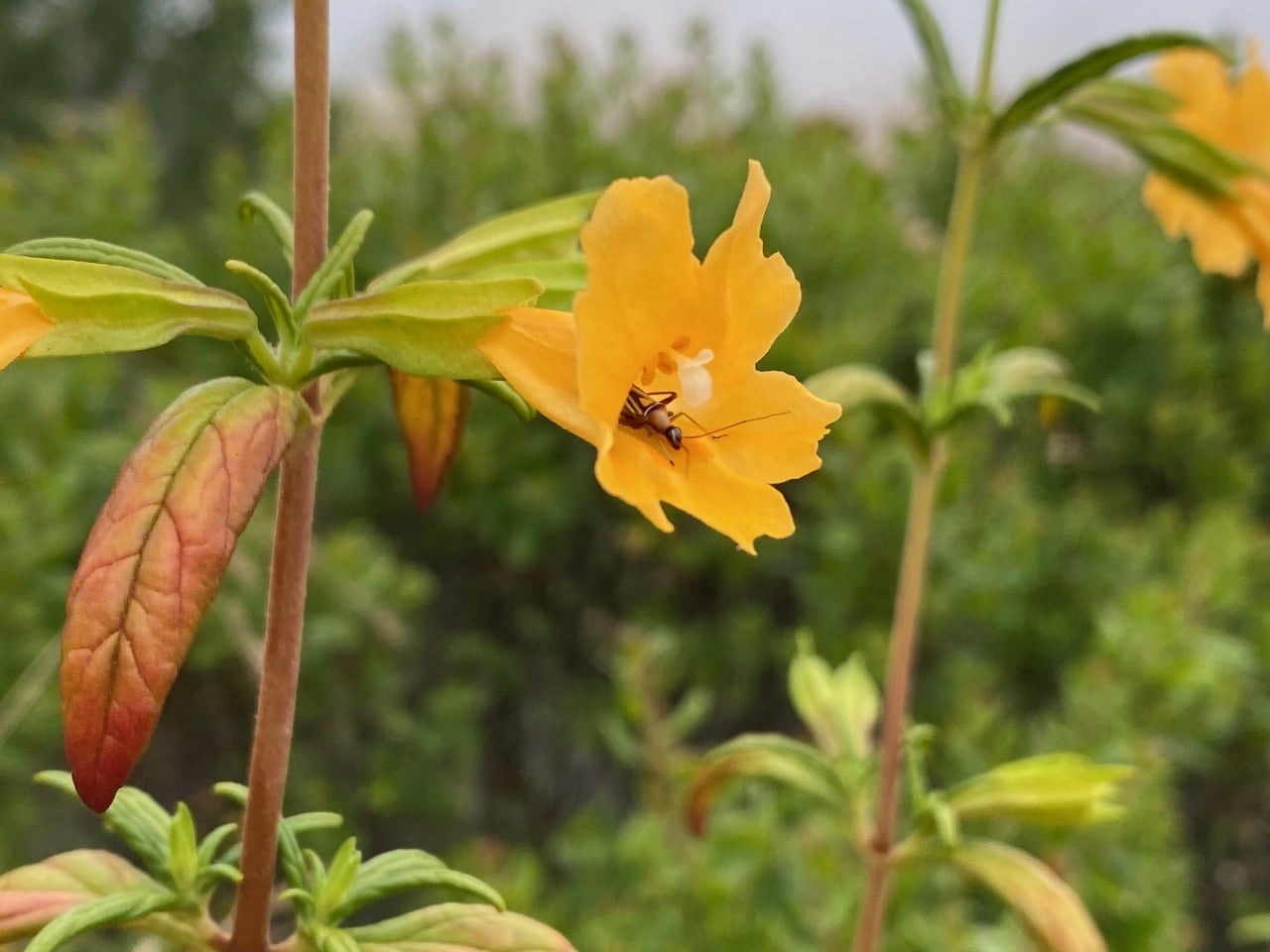 Room with a view! A Plant Bug, Closterocoris amoenus (family Miridae) surveys the world from its roost in a Sticky Monkeyflower. These bugs (and their ant-mimic nymphs) are often found resting in this position.


Members of the family Tortricidae are commonly known as tortrix moths or leafroller moths. Many are economically important pests. The typical resting posture of the adult is with the wings folded back, producing a rather rounded profile. Tortricid moths are generally small, with a wingspan of 3 cm or less. Many species are drab and have mottled and marbled brown colors. Larvae of some species feed by boring into stems, roots, buds or seeds. Others feed externally and construct leaf rolls.
Leaf shelter-builders, either leaf-tiers or leaf-rollers, do not manipulate leaves directly but use their silk to draw plant surfaces together. The caterpillars impart potential energy to their silk strands by stretching them beyond their equilibrium length as they are spun out. Axial retraction of the stretched strands then draws the bound plant surfaces together. Although a single stretched strand exerts only a minuscule force, the combined force generated by many such strands attached to the same opposable plant surfaces is substantial and allows the caterpillars to manipulate leaves many times their size and mass.
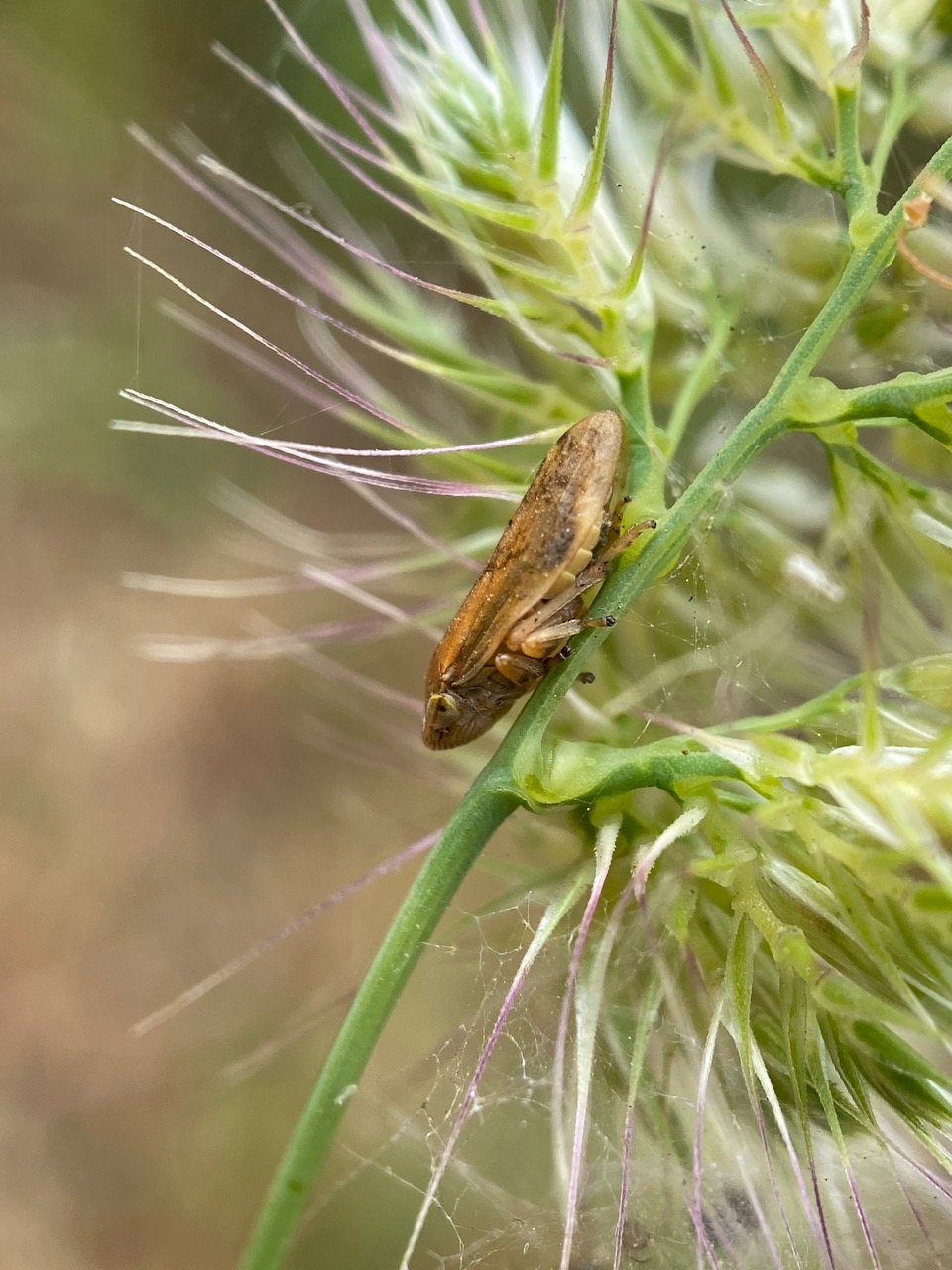
A Meadow Spittlebug, Philaenus spumarius (family Aphrophoridae) is resting on a grass seed head. Before I put on the macro lens, I couldn’t tell which end was its head.
The Froghopper is the adult form of the spittlebugs that make the foamy masses that hang from many plants in early spring. Like the adults, the nymphs use their piercing, sucking mouthparts to feed on plant juices. The nymph produces a cover of foamed-up plant sap reminiscent of saliva, hence the common name of spittlebug. Whereas most insects that feed on sap feed on the nutrient-rich fluid from the phloem, Aphrophoridae tap into the much more dilute sap flowing upward via the xylem. The large amount of excess water that must be excreted and the evolution of special breathing tubes allow the young spittlebug nymphs to grow in the relatively protective environment of the spittle.
The Froghopper is a “true bug” in the order Hemiptera, family Aphrophoridae. Froghoppers are champion jumpers among insects, out-performing even the fleas. The bug can leap the human equivalent of a skyscraper without a running start! The muscles in its hind legs act like a “catapult” to release energy explosively. Its athletic prowess not withstanding, the Froghopper is better known for its young, the “spittle bugs”. The nymphs produce foamy white masses on plants within which they feed on plant sap. Froghoppers have piercing-sucking mouthparts, and feed on plant sap as both nymphs and adults. A recent report claims, “Froghoppers are the super-suckers of the animal world. The tiny insects produce negative pressures equivalent to people sucking a 100-meter-long straw.” So the little bug has two titles under its belt – champion jumper, and super-sucker!
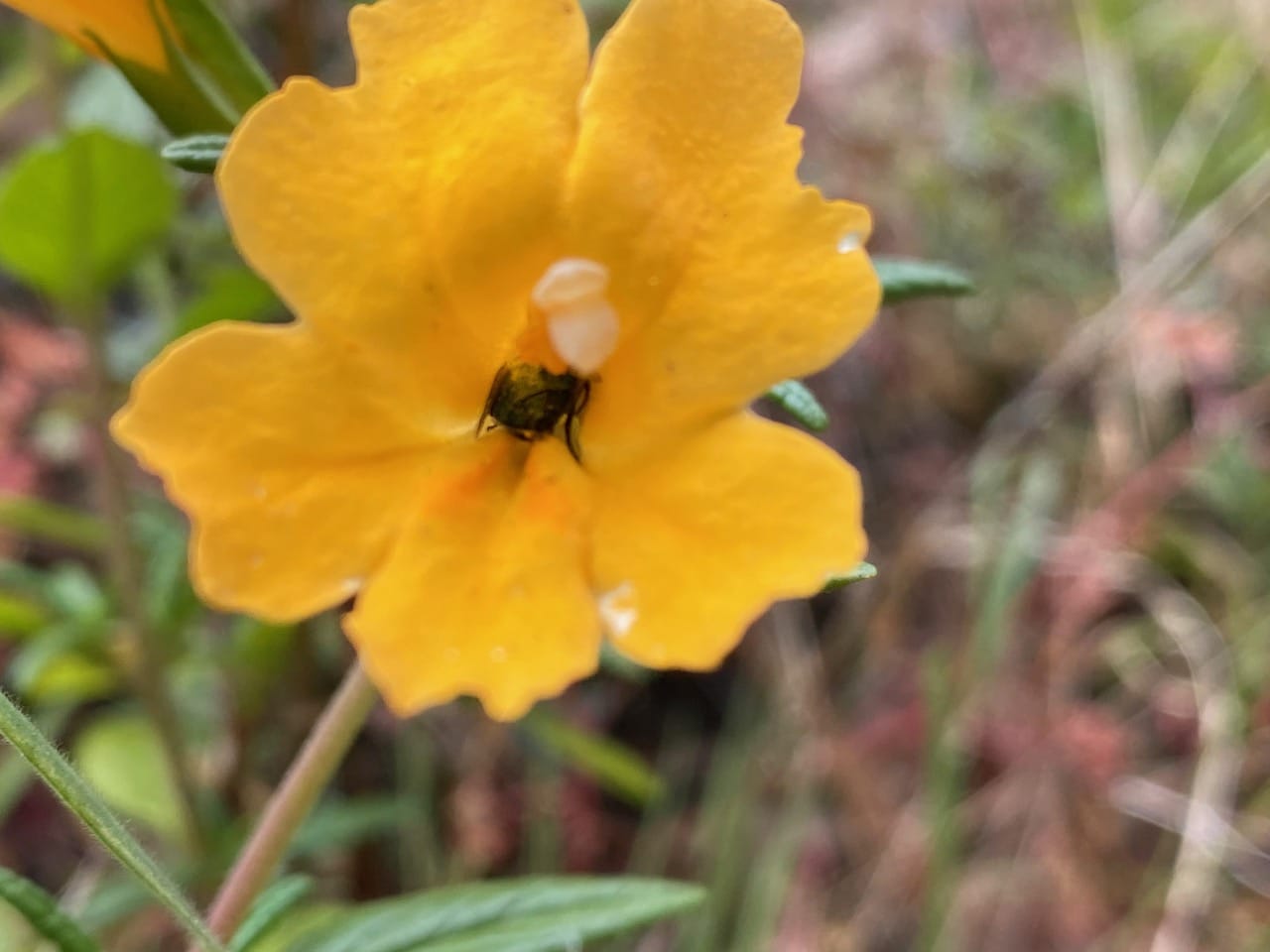
There’s something dark deep in the throat of that Sticky Monkeyflower, Diplacus aurantiacus. A Small-headed Fly?
Yes, indeed, a Small-headed Fly, Eulonchus sp. (family Acroceridae) is still fast asleep in the flower, sheltered from the elements.
A male Variable Duskyface Fly, Melanostoma mellinum (family Syrphidae) is sampling pollen from the stamens behind the white stigma on a Sticky Monkeyflower.
Melanostoma mellinum is a very common species of hover fly found in many parts of Europe including the Mediterranean basin and North Africa, the East Palearctic, and North America. A small species, their wingspan between 4.7 and 7.0 mm. Very similar to Platycheirus, but can be distinguished by fine details. In M. mellinum, the normally pale halteres turn bright blueish-green in females about to lay eggs.
The species’ preferred habitat include grasslands and moorlands, including those in hilly and mountainous regions. Adults can be found feeding on pollen of grasses and other wind-pollinated plants. Little is known of their biology, but the larvae are suspected to be a general predator of small insects in the leaf litter.
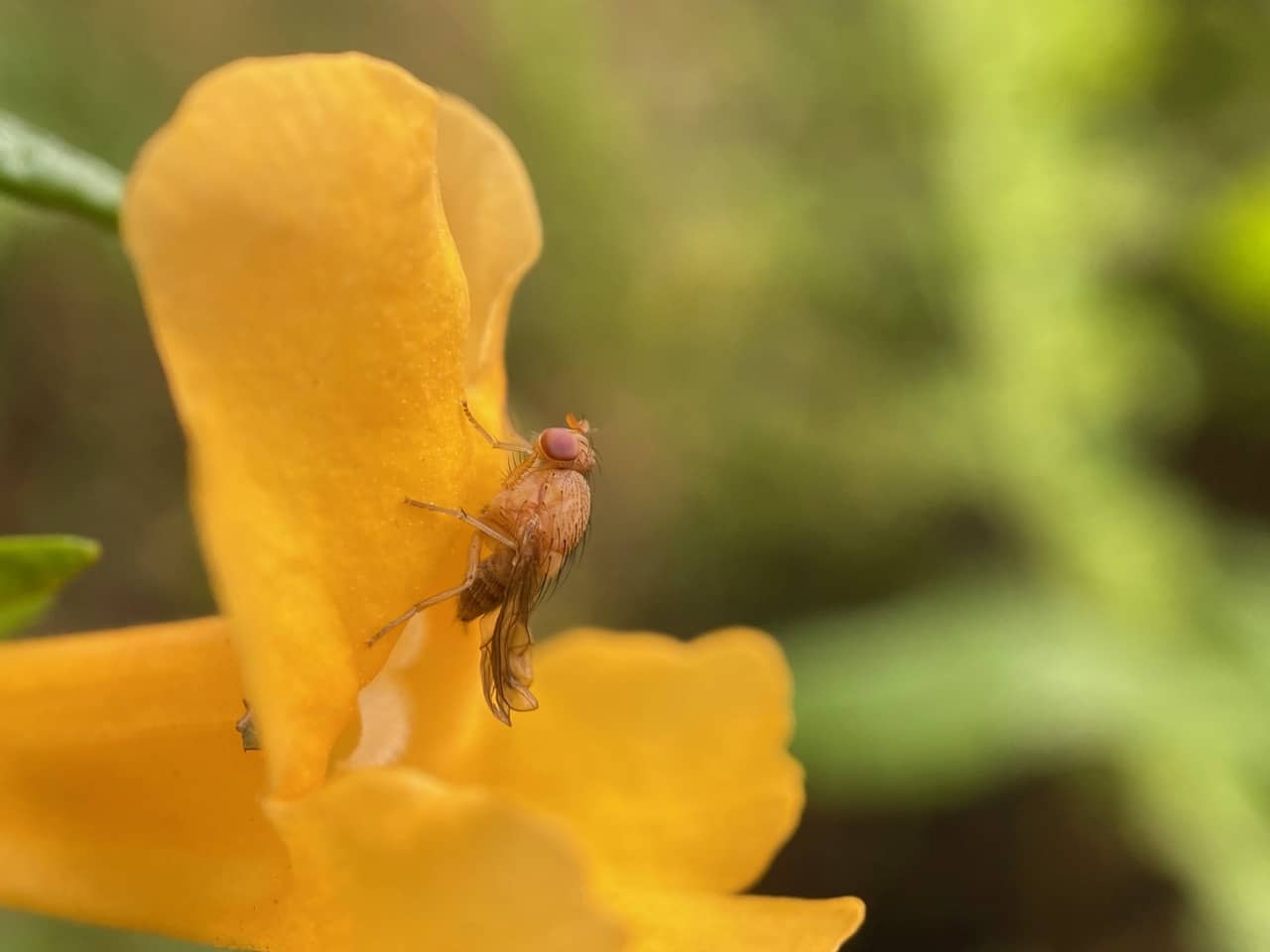
What’s with the wings of this Lauxaniid Fly? They look crumpled and deformed. Did the fly just eclose from its pupa, and need time to straighten out its wings?
Lauxaniidae are small flies (2-7 mm in length). They are often rather plump and dull, the body color varying from yellow-brown to black, or with a combination of these colors. They are characterized by strong, backward pointing bristles on the front (top of the head right above the eyes). The larvae are mostly saprophages, feeding in leaf litter, soil, bird nests, etc. Larvae of some mine fallen leaves, others live in rotten wood.
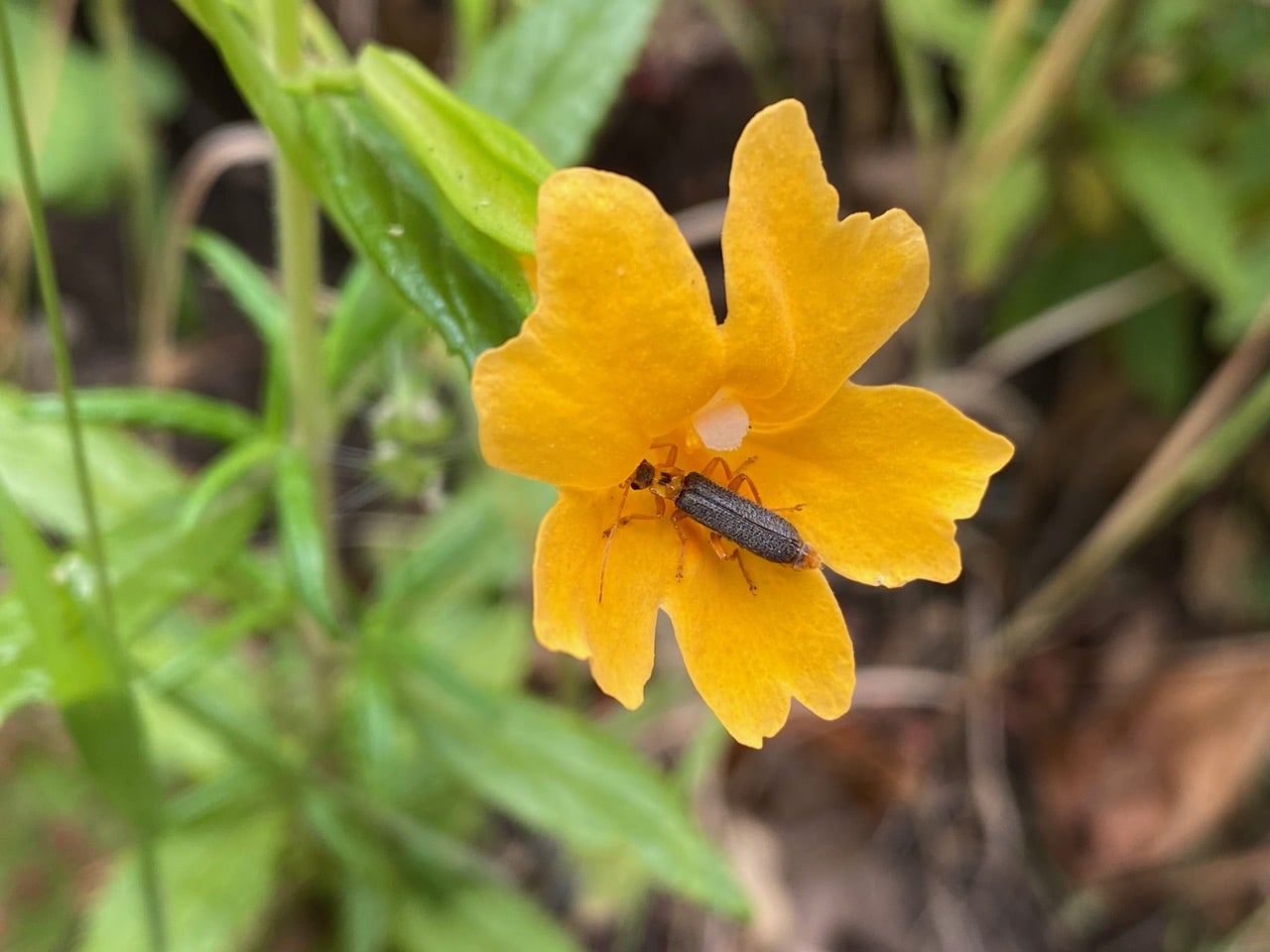
A Soldier Beetle, Cultellunguis americanus (family Cantharidae) is foraging in a Sticky Monkeyflower.
The Soldier Beetles, family Cantharidae are relatively soft-bodied, straight-sided beetles. One of the first described species has a color pattern reminiscent of the red coats of early British soldiers, hence the common name. They are also known commonly as Leatherwings because of their soft elytra.
Soldier beetles often feed on both nectar and pollen as well as predating on other small insects. The larvae are often active, and feed on the ground, hunting snails and other small creatures. Soldier beetles are generally considered beneficial insects by gardeners.
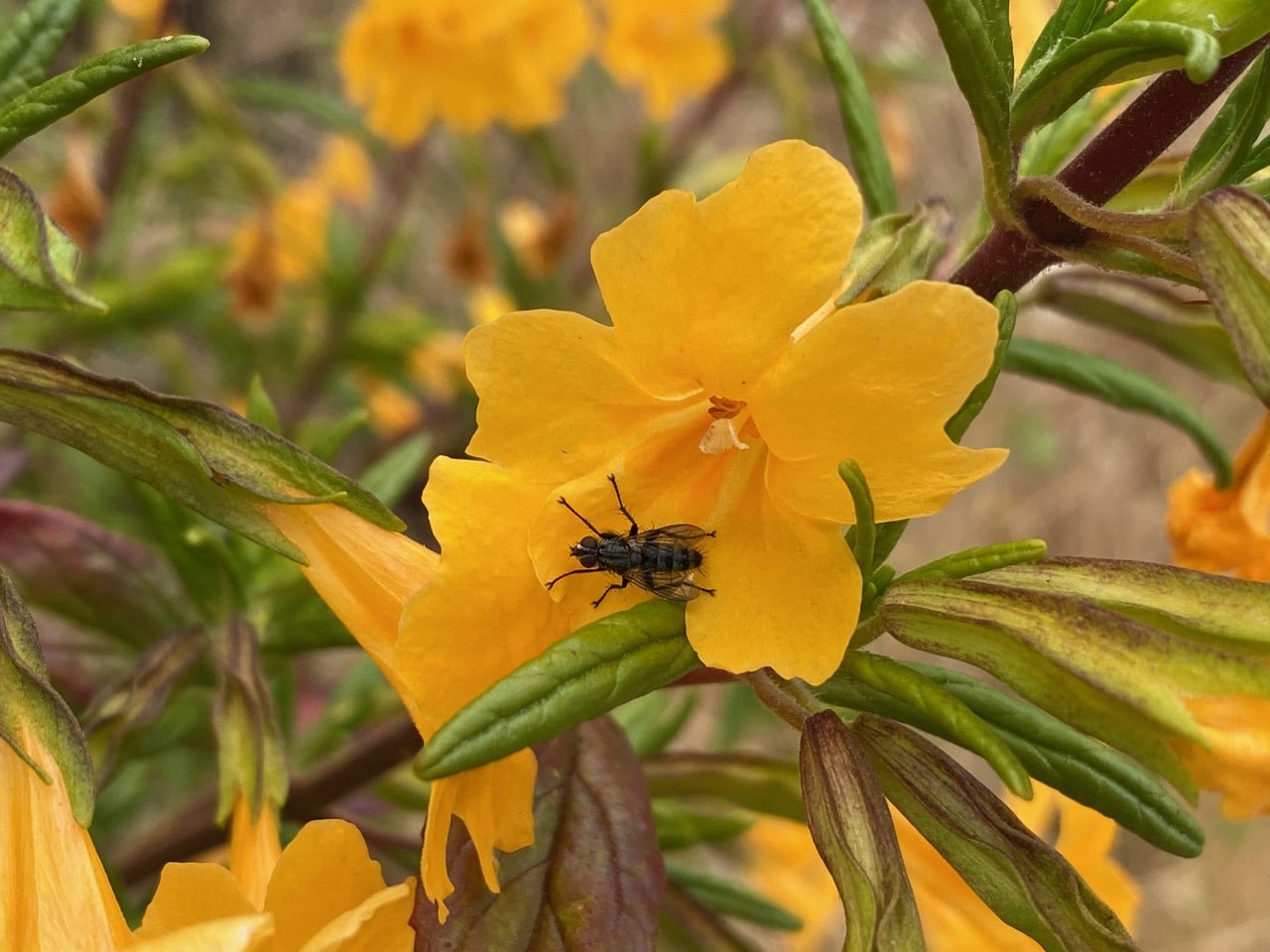
A dark, bristly little fly lands on a Sticky Monkeyflower.
It is a Woodlouse Fly, Stevenia deceptoria (family Rhinophoridae). These small, slender, black, bristly flies are somewhat related to the Tachinidae. The larvae are mostly parasitoids of woodlice (pill bugs), beetles, spiders and other arthropods, and occasionally snails.
Native to Europe, Stevenia deceptoria is now widespread in the US. The flies are parasitoids of terrestrial woodlice (roly polies) of the order Isopoda (Oniscoidea).

At Diablo Bend, Sticky Monkeyflowers are blooming gloriously on the ridge overlooking Siesta Valley.
Room with a view! A Plant Bug, Closterocoris amoenus (family Miridae) surveys the world from its roost in a Sticky Monkeyflower. These bugs (and their ant-mimic nymphs) are often found resting in this position.Mirid bugs are also referred to as plant bugs or leaf bugs. Miridae is one of the largest family of true bugs in the order Hemiptera. Like other Hemipterans, Mirids have piercing, sucking mouthparts to extract plant sap. Some species are predatory.
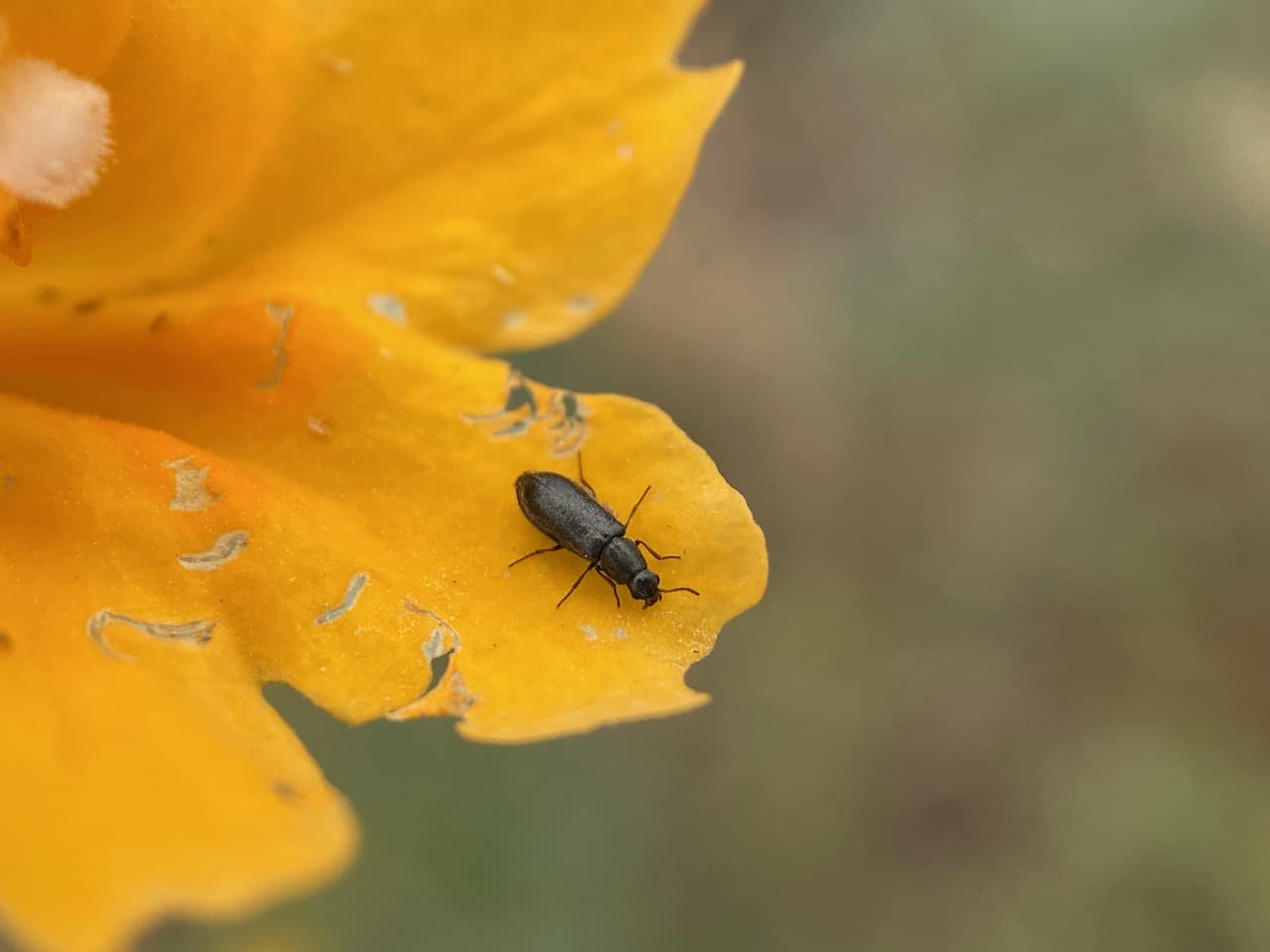
A Soft-wing Flower Beetle (family Melyridae, subfamily Dasytinae) is scavenging stray pollen on the lower lip of a Sticky Monkeyflower.
Dasytinae is a subfamily of Soft-wing Flower Beetles (family Melyridae), historically treated as a separate family “Dasitidae”. Dasytinae are typically small (less than 8 mm), and parallel-sided, with brownish to blackish integument (rarely metallic), and with or without a covering of short pubescence. They are very diverse in western North America, especially in California. They are often found in large numbers on flowers feeding on pollen. Pollen can easily adhere to the hairs on their wings, making these beetles good pollinators.
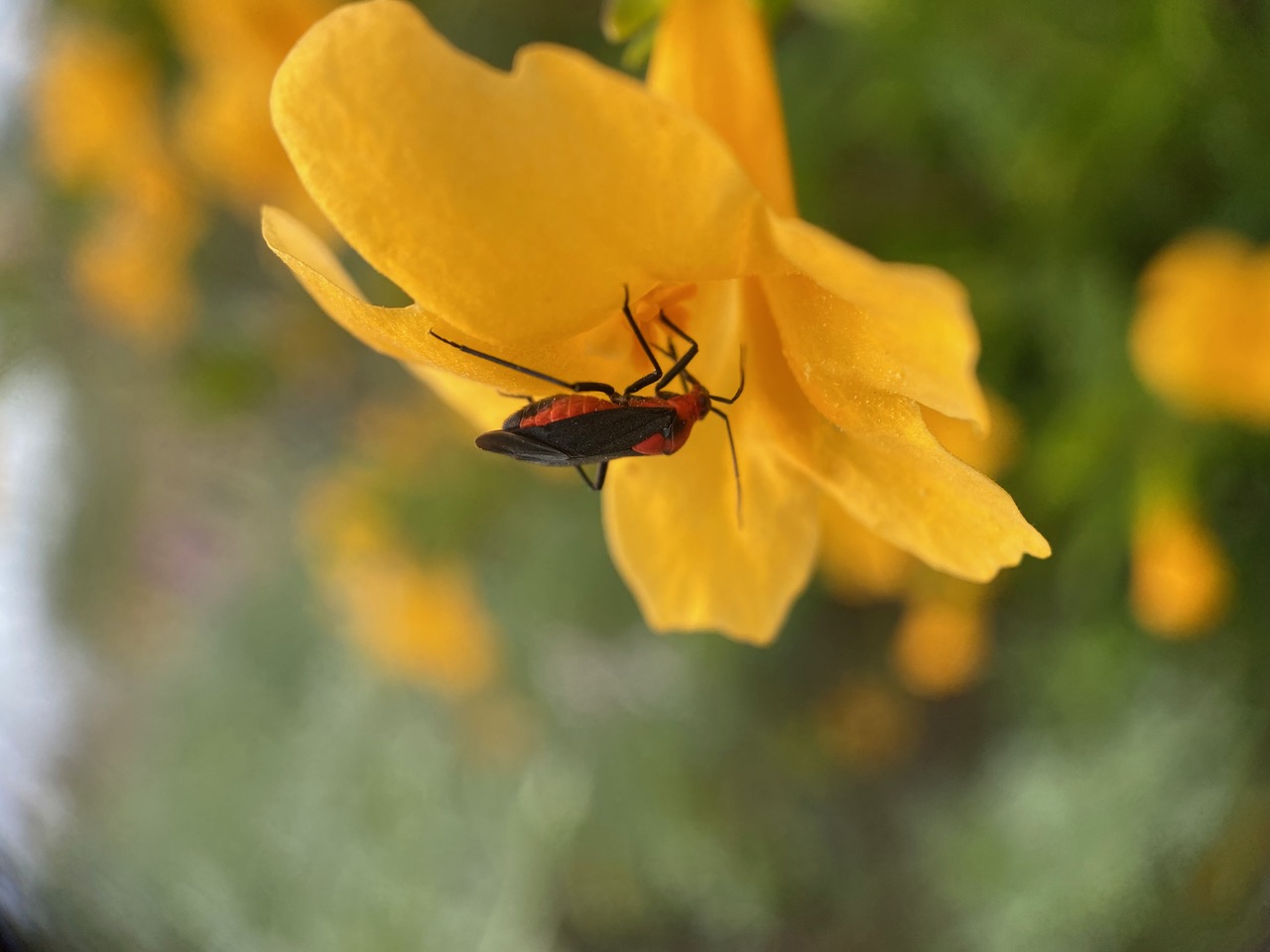
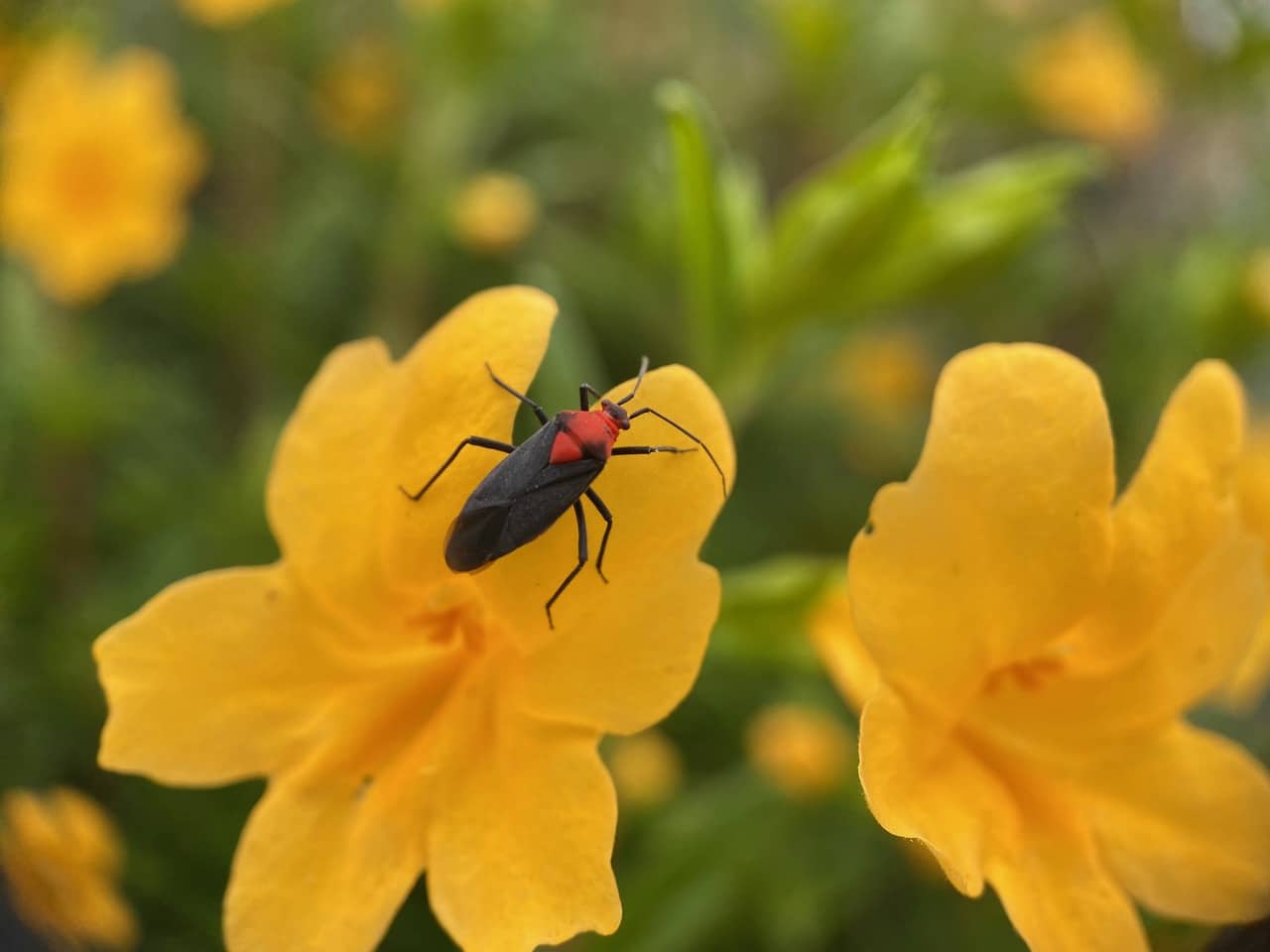
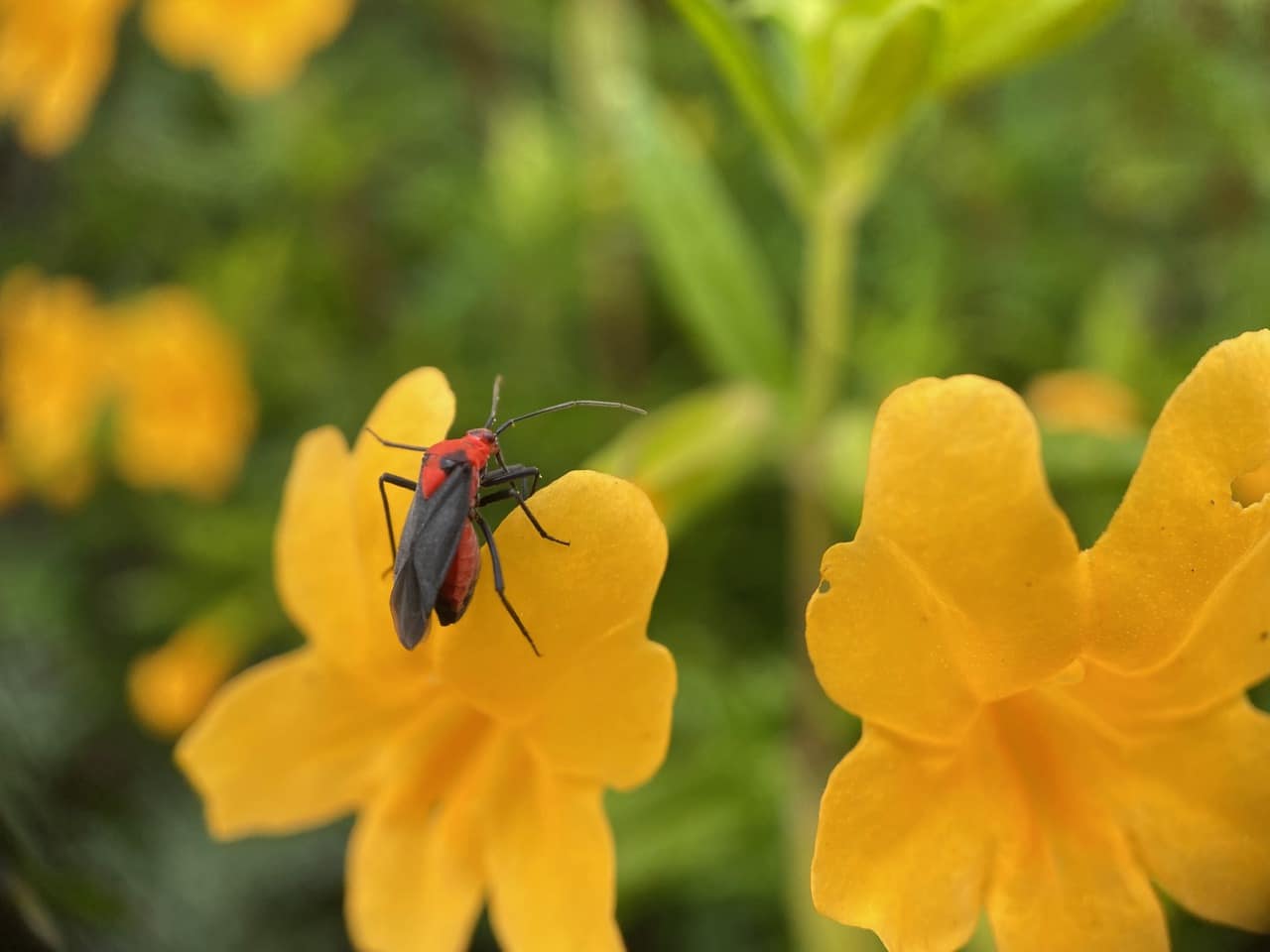
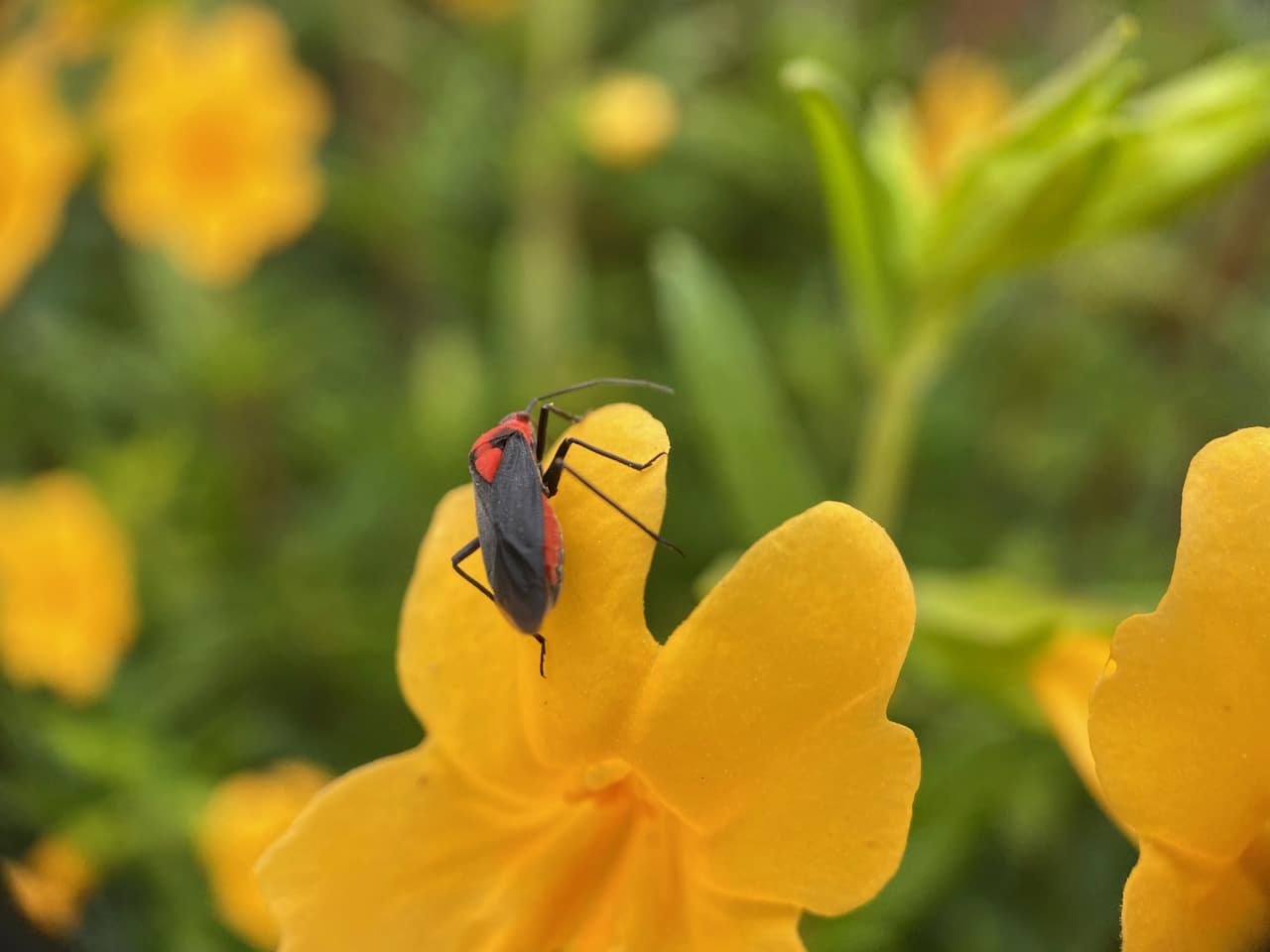
Ooh, who’s that striking black-and-red bug on the Sticky Monkeyflower?
The bug seems to be accessing the stamens with its rostrum.
iNaturalist has helped identify the bug as a Plant Bug, Aoplonema nigrum (family Miridae). Unfortunately, there’s hardly any information about the species available.
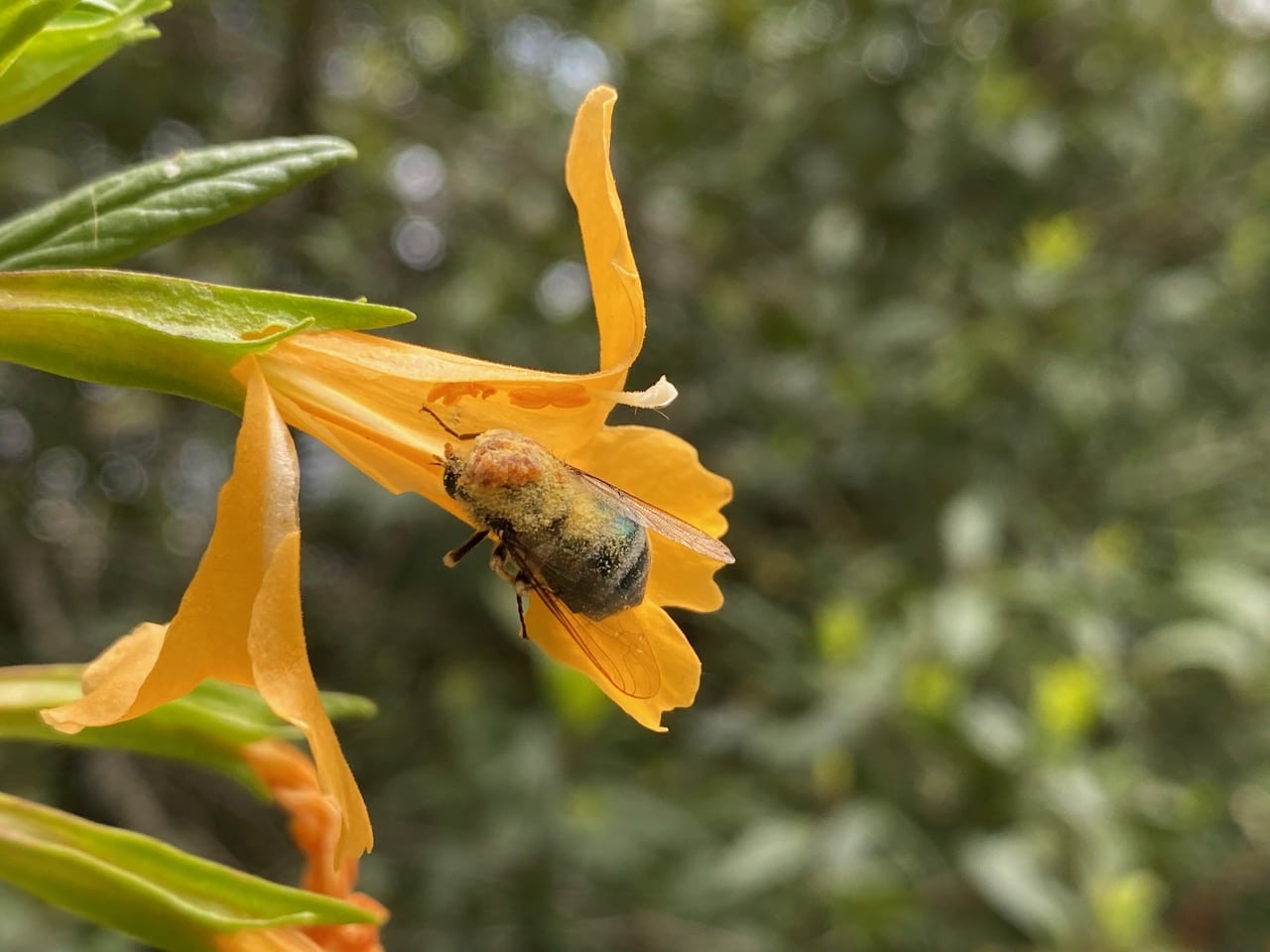
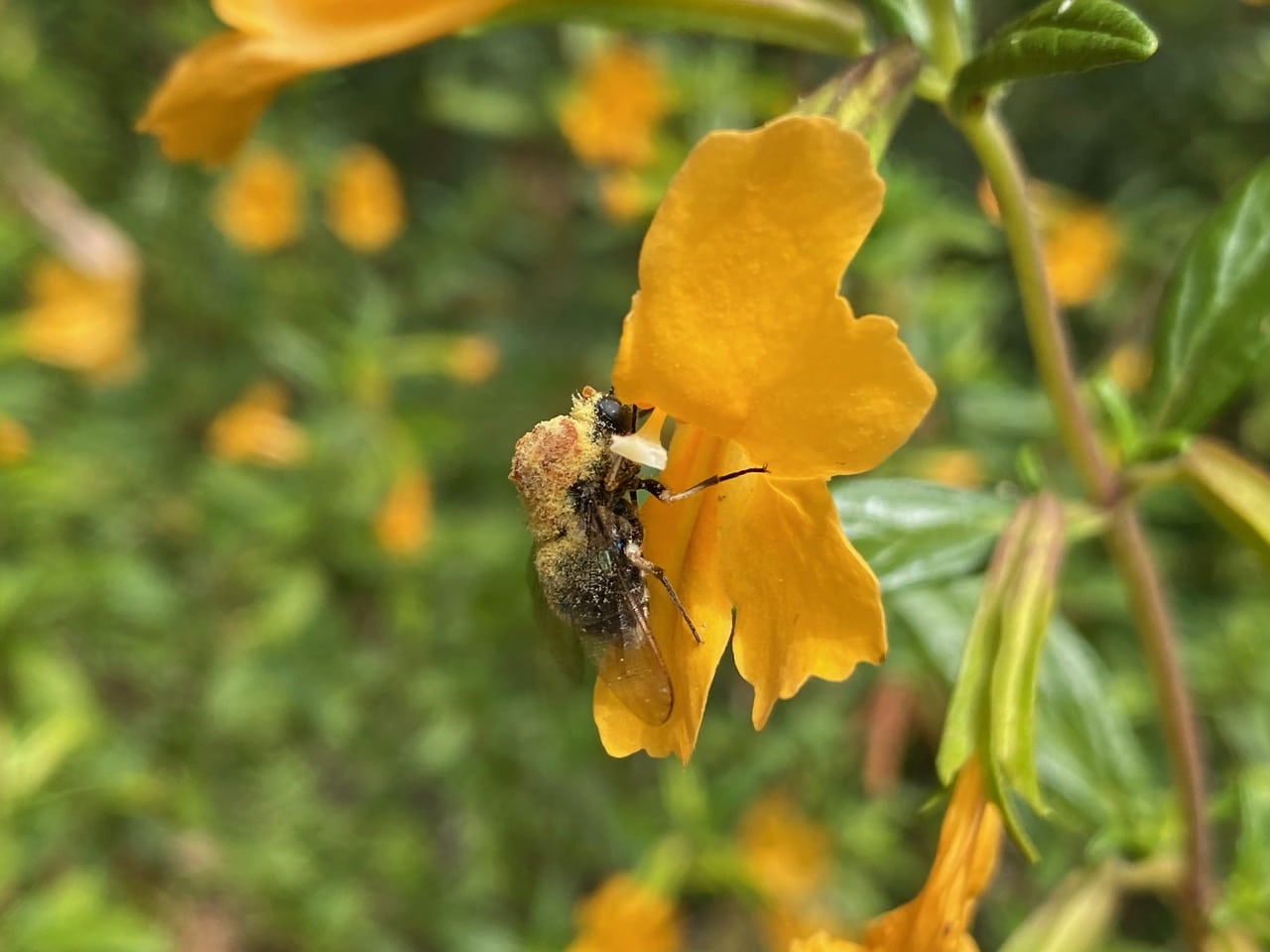
At 5 minutes past noon, I find this Small-headed Fly, Eulonchus sp. (family Acroceridae) still resting in a Sticky Monkeyflower. I can see a pile of pollen has accumulated on its back.
As far as is known, all Acroceridae are parasitoids of spiders. Not just any spiders, but the Mygalomorphs of a more ancient lineage. This Acrocerid species, most likely Eulonchus tristis is known to parasitize the California Turret Spiders. Females lay large numbers of eggs near their host nests. After hatching the young larvae, called planidia seek out the spiders. The planidia can move in a looping movement like an inchworm and can leap several millimeters into the air. When a spider contacts an Acrocerid planidium, the planidium grabs hold, crawls up the spider’s legs to its body, and forces its way through the body wall. Often, it lodges near the spider’s book lung, where it may remain for years before completing its development. Mature larvae pupate outside the host. The Acrocerid adults are nectar feeders with exceptionally long probosces which are folded on the underside of the body when not in use. Acrocerids are rare but can be locally abundant. They are believed to be efficient pollinators for some native plants, including the Sticky Monkeyflowers.
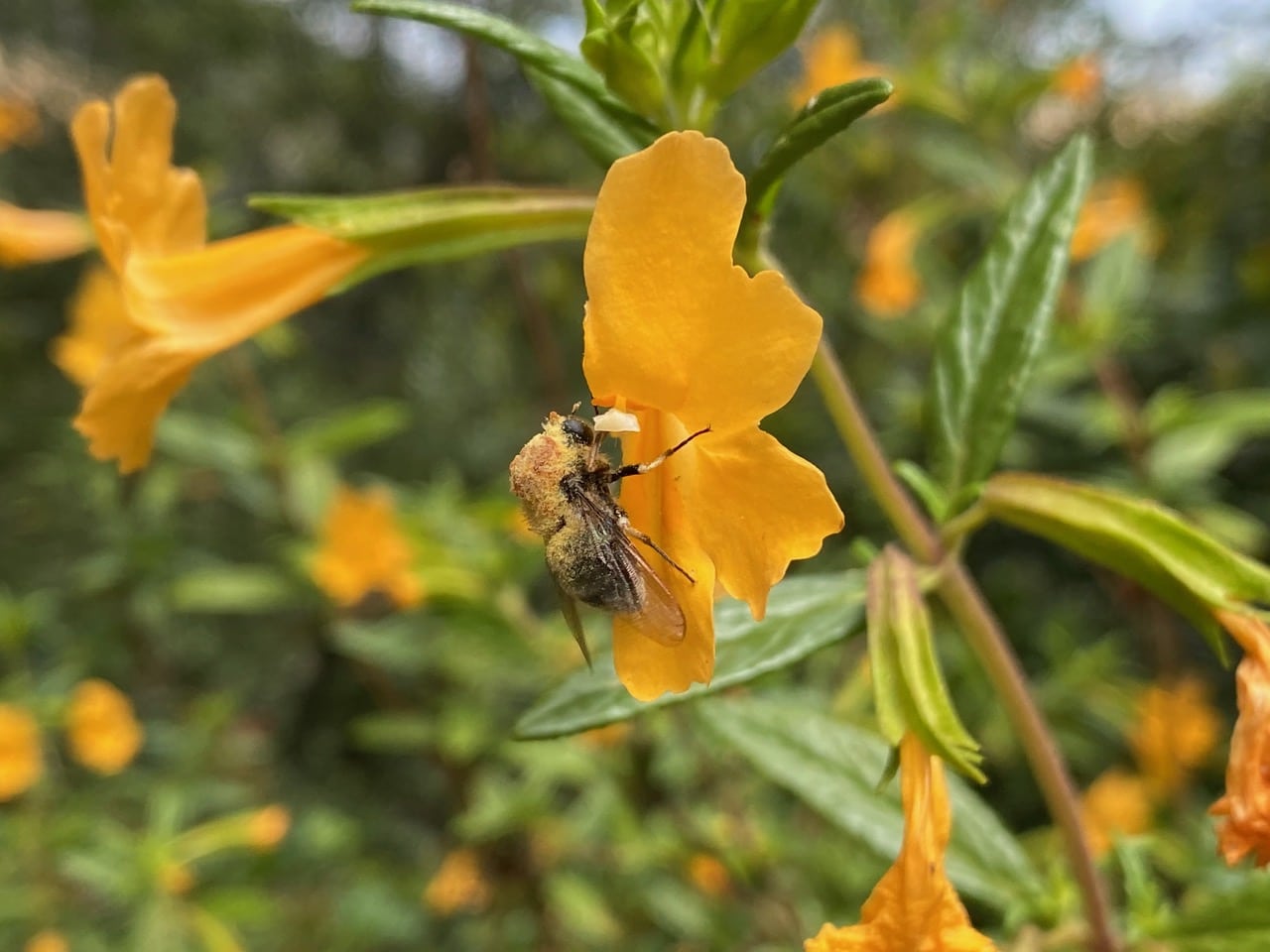
I gently peel back half of the flower to expose the fly inside. Wow, what’s that orange lump on the fly’s humped thorax? I have seen this before on other Small-headed Flies that perched on vegetation. I have wondered if the lumps weren’t pollen that has been mixed with bodily fluid that has leaked from the insects. Are the wounds incurred during competition for mates, or even during aggressive mating?
Rudely awakened, the fly tries to steady itself on the half flower.
Then, I notice that the fly is vibrating its wings. Perhaps it is trying to warm up its muscles so it can fly.
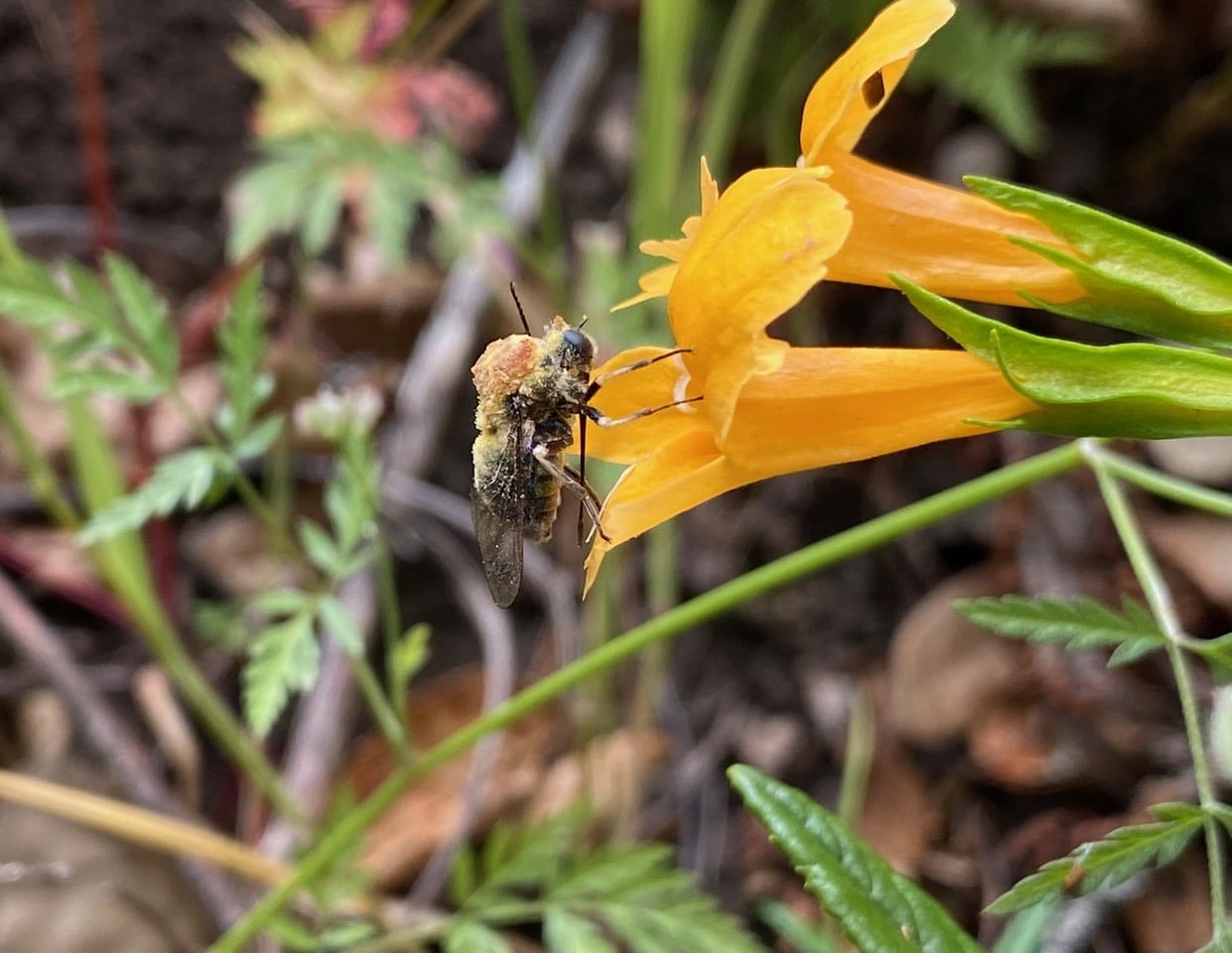
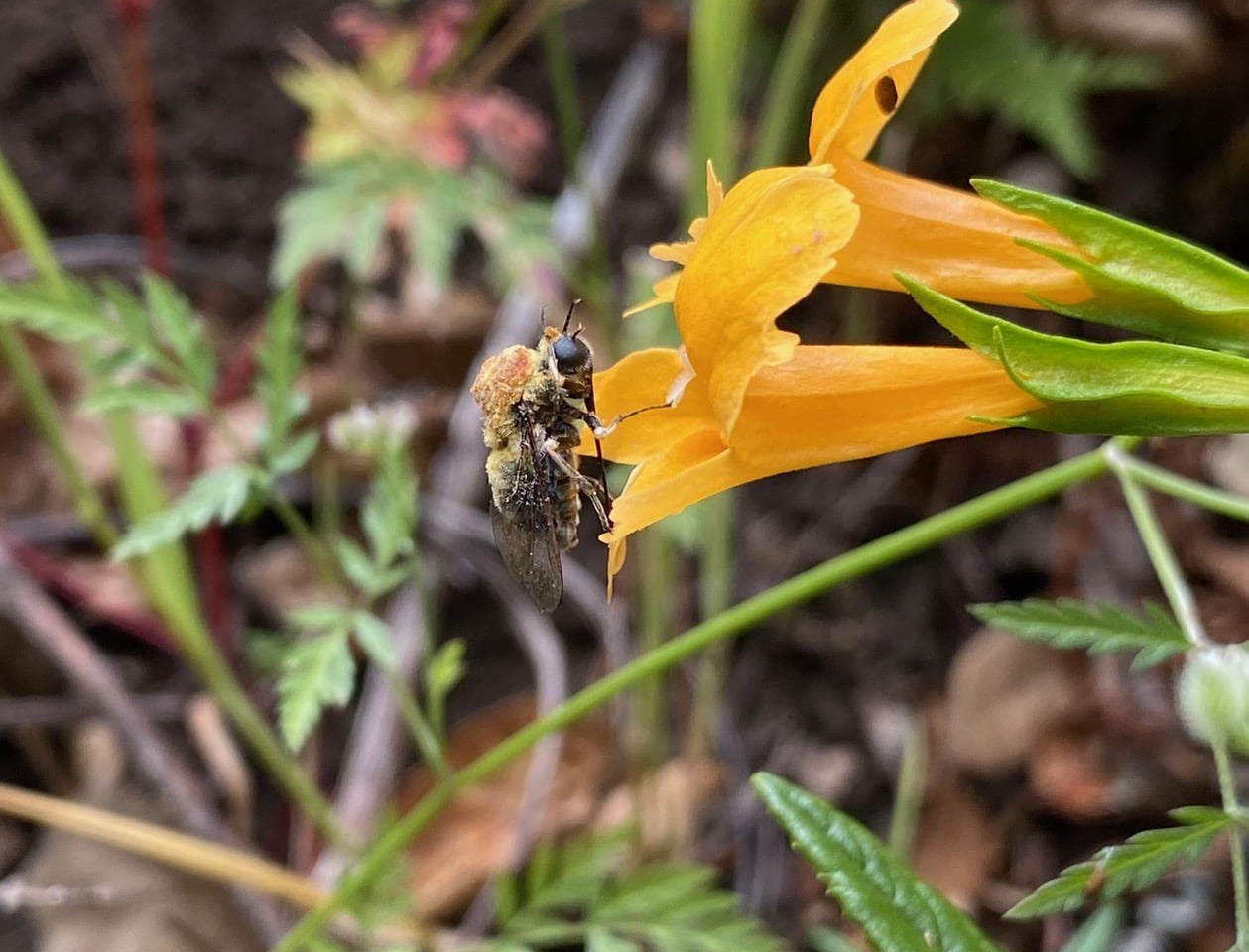
Flying across the trail, the Small-headed Fly lands on another Sticky Monkeyflower next to the trail. Here it proceeds to groom itself. Note the fly’s long proboscis folded under its body. It’s as long as its body!
My acquaintance with the Small-headed Flies goes back a few years when I was a volunteer at the Bridgeview Pollinator Garden in Oakland. Each year I would watch the flies appear on the Sticky Monkeyflower, Diplacus aurantiacus just as the plant begins to bloom in May. In the early morning, the flies would be safely tucked within the floral tubes, with only their shiny butts visible. As the sun begins to warm up the air, the flies would wake up, move outside the flowers to bask and groom themselves. Often their backs are covered with pollen if the stamens on the roof of their chosen overnight shelter were dispensing a golden shower while they snoozed.
From my own observations over the years, this Eulonchus species has a close relationship with the Sticky Monkeyflower. The fly’s whole life revolves around the flowers. They sleep, feed, court and mate around the plant and its flowers. The flies use their long probosces to access nectar from the deep-throated flowers of Sticky Monkeyflower, and Ithuriel’s Spear that bloom around the same time. And since the flies are often covered with pollen, it’s hard not to believe that they are significant pollinators for Diplacus aurantiacus.