

Pollinator Post 6/17/24 (1)

On my walk in Joaquin Miller Park today, I come across some California Honeysuckle, Lonicera hispidula that are blooming beautifully at the tips of the drooping vines. I pause to appreciate the flowers, but do not see any insect visitors.

Many of the non-native Fennel that has been hacked back along Sanborn Drive have sprouted new, tender leaves. Among them I find little treasures – eggs of the Anise Swallowtail butterflies! With many of their native food plants (mostly Apiaceae) in decline, the butterfly has adapted to laying eggs on Fennel, Foeniculum vulgare, a member of the same plant family. The smooth, globular eggs are laid singly on the host plant.
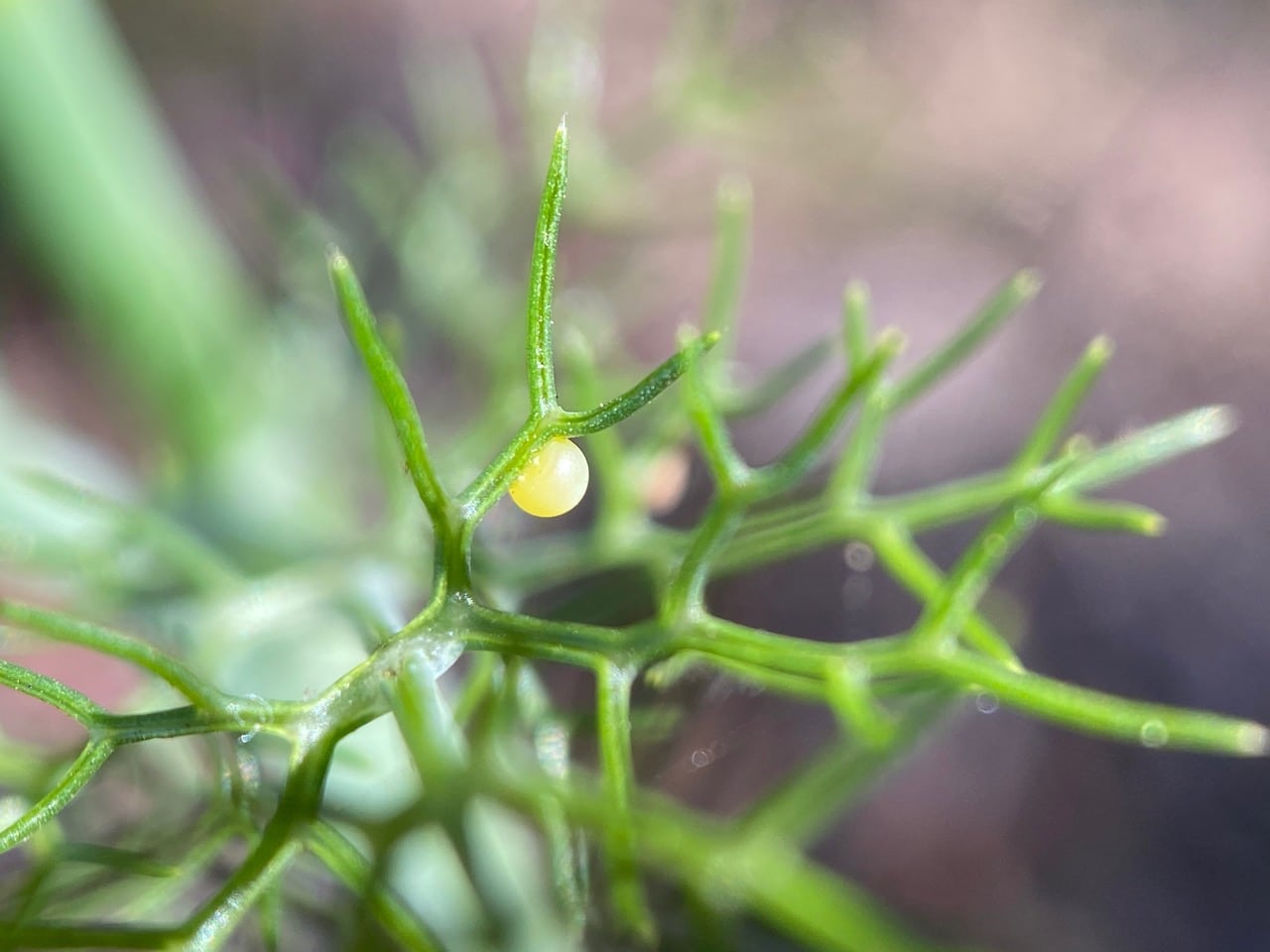
Most of the eggs I find today are very fresh – a pale, clear yellow.
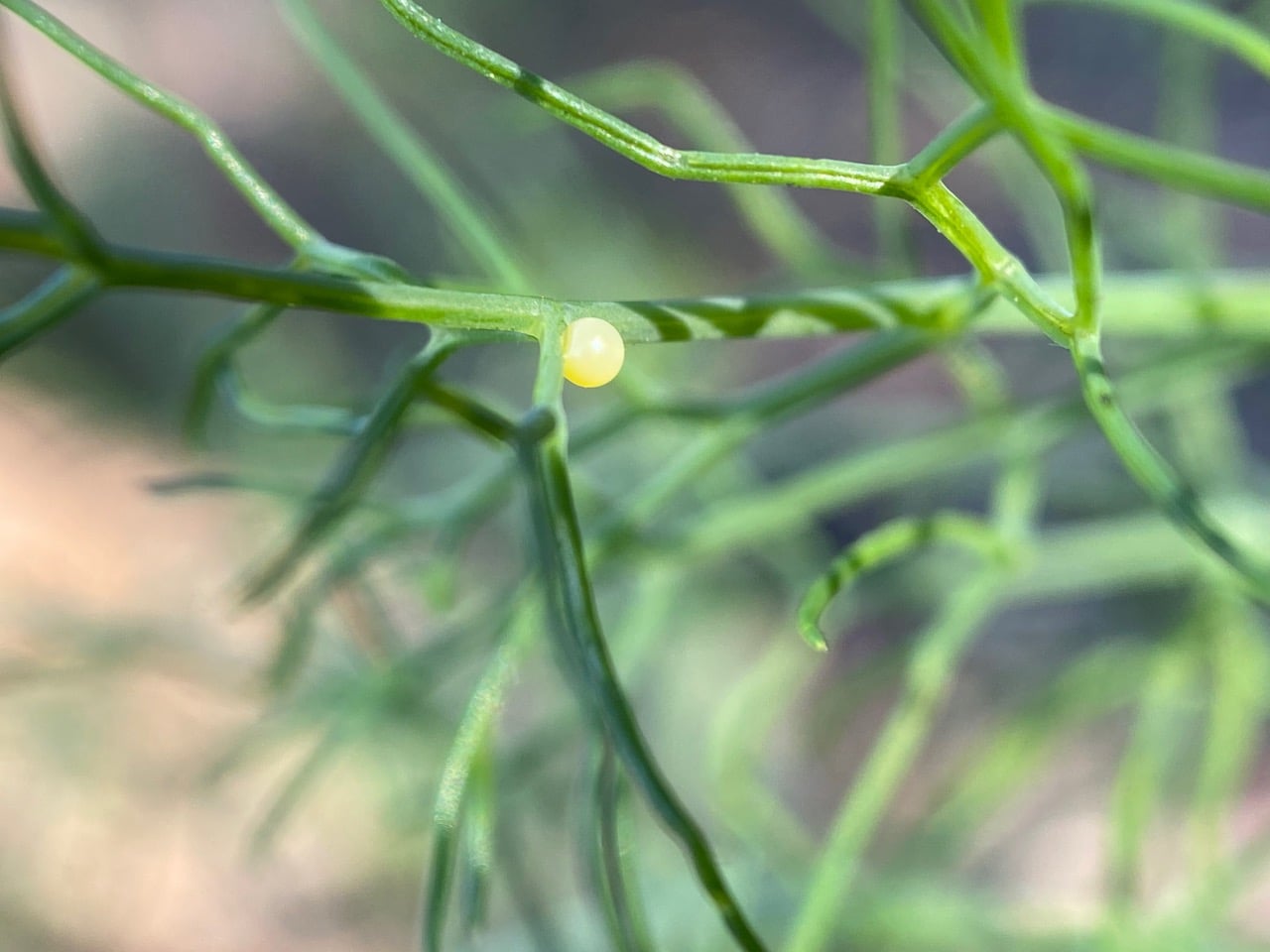
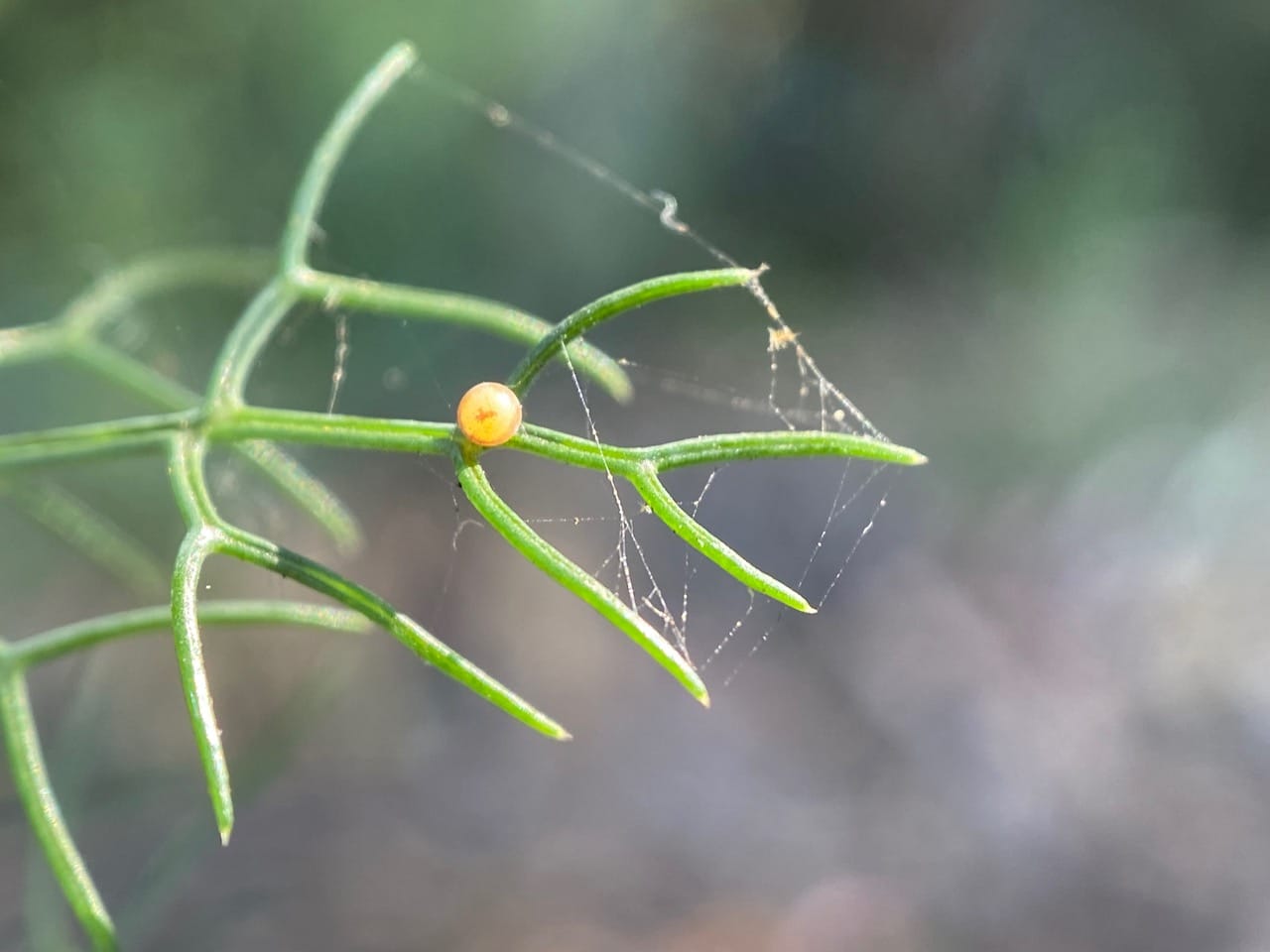
This one is older, with some darker reddish brown colors developing in the egg.
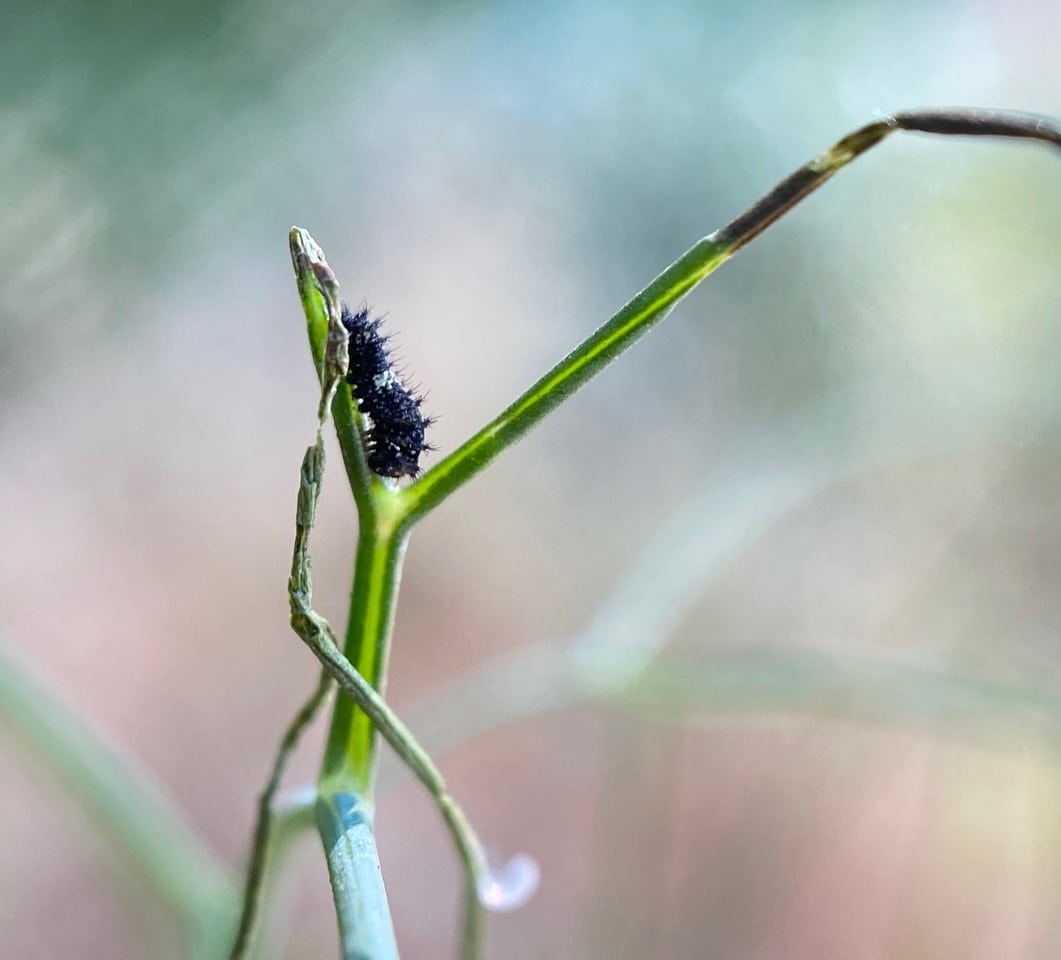
Ooh, here’s a tiny caterpillar! Looks like its feeding has caused the leaves to brown and wilt. The caterpillar has a patch of white in its mid section, making it look like bird poop. Swallowtail caterpillars are well-known for their bird-poop mimicking larvae in their early instars. The disguise likely keeps the caterpillars safe from hungry birds until they are more mobile.

I find a few more of the young caterpillars, all about the second instar. The Anise Swallowtail caterpillar will undergo drastic changes in appearance as it grows, eventually acquiring a green camouflage to blend in with its host plant.
Instar is the term given to the developmental stage of an insect between molts. For example, after hatching from the egg an insect is said to be in its first instar. When the insect molts it is then a second instar and so on.

I stop by the large shrub of Coffeeberry, Frangula californica that is in bloom.
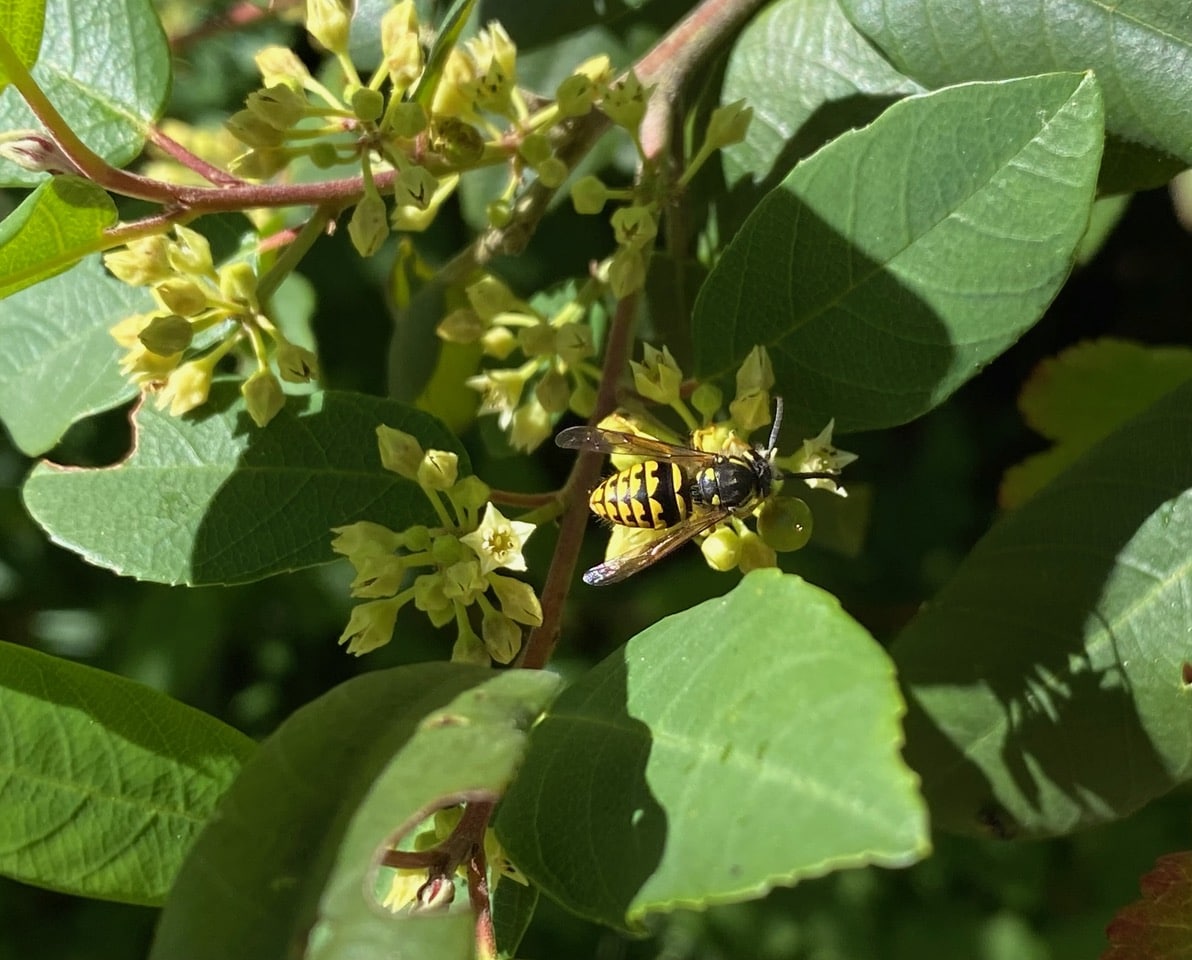
Many Yellowjacket wasps are taking nectar from the small flowers of Coffeeberry.
Adult Yellowjackets mainly feed on a liquid diet, consisting of flower nectar and fallen and decaying fruits. Although they often appear at picnics to partake of our meats, they usually masticate these to be fed to the larvae back at the hive. In the wild, adult wasps collect different types of insects to feed the growing young. Some yellowjackets preemptively chew the insects before feeding them to the larvae. The larvae have a role in the colony – as the digestive system. After digesting their protein-rich food, Yellowjacket larvae produce a sweet secretion that the adults regularly consume.
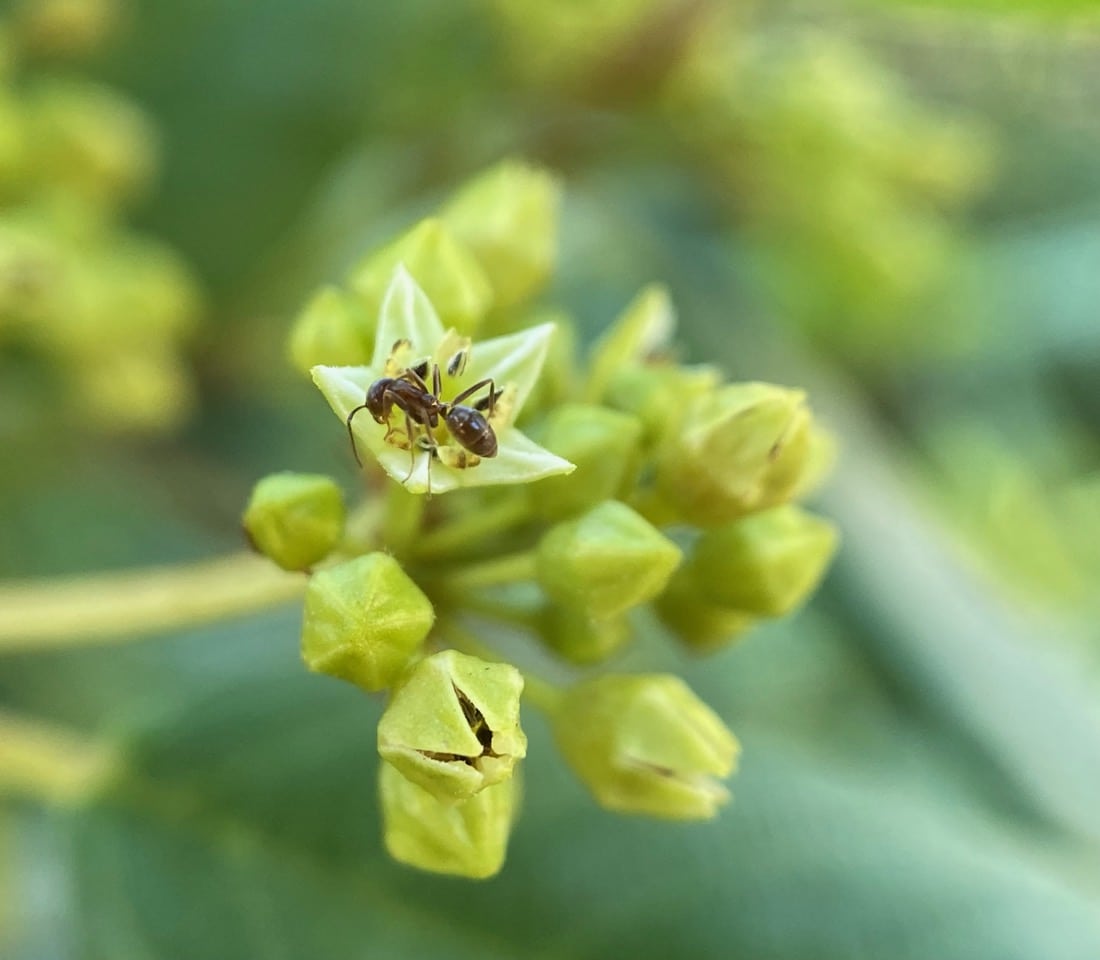
An Argentine Ant is foraging on a Coffeeberry flower.
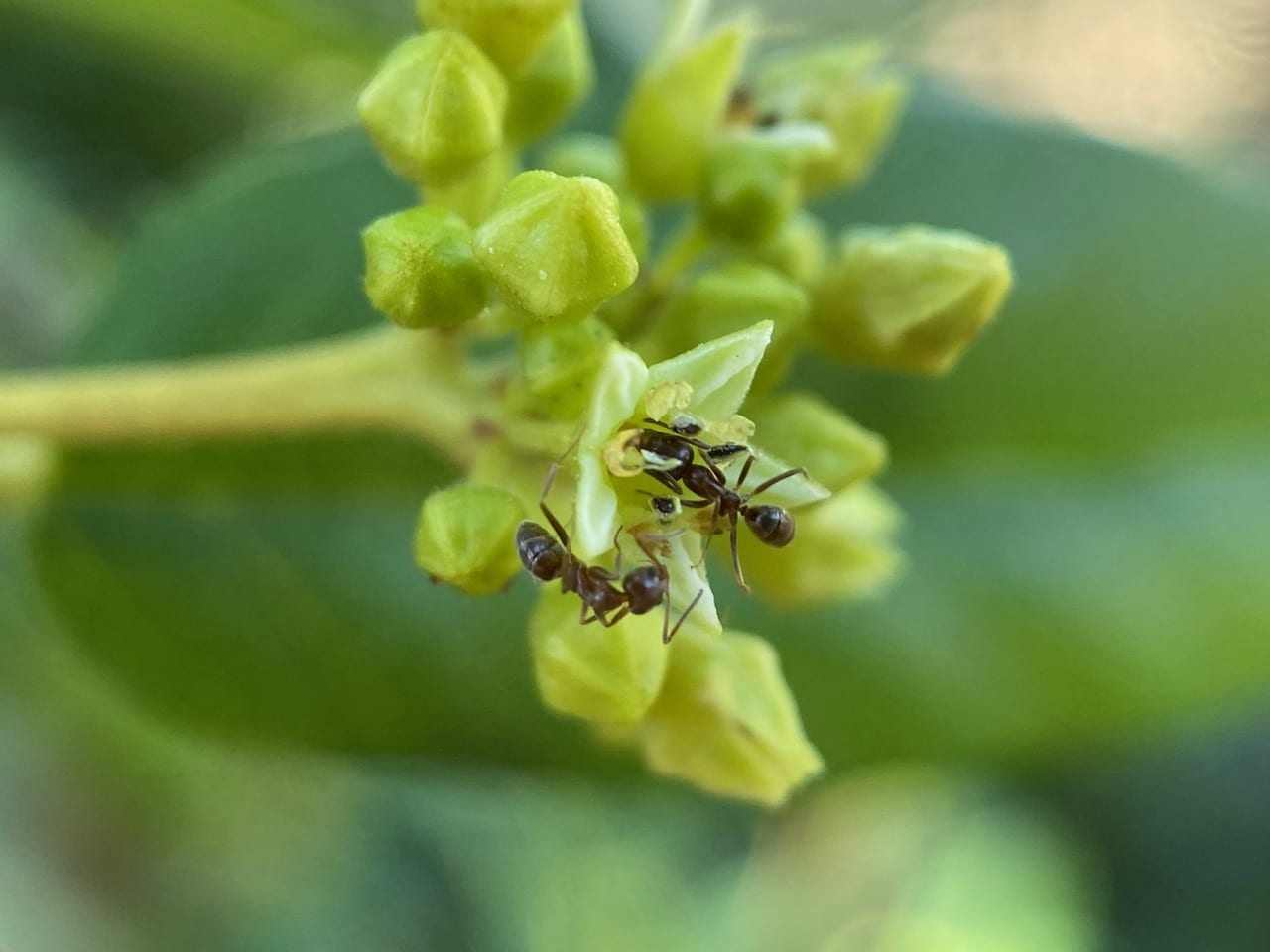
The Argentine Ant, Linepithema humile (family Formicidae) is native to Northern Argentina, but it has been inadvertently introduced by humans to many countries, and is now an established invasive species in many Mediterranean climate areas worldwide. The success of the species can be attributed to their lack of aggression between the colonies. There is no apparent antagonism between separate colonies of its own kind, resulting in “super-colonies” that extend across hundreds or thousands of kilometers in different parts of the their range. Genetic, behavioral, and chemical analyses show that introduced Argentine Ants on separate continents actually represent a single global supercolony.
The Argentine Ants are ranked among the world’s worst invasive animal species. In its introduced range, the Argentine ant often displaces most or all native ants and can threaten native invertebrates and even small vertebrates that are not accustomed to defending against the aggressive ants. This can, in turn, imperil other species in the ecosystem, such as native plants that depend on native ants for seed dispersal, or lizards that depend on native ants for food.

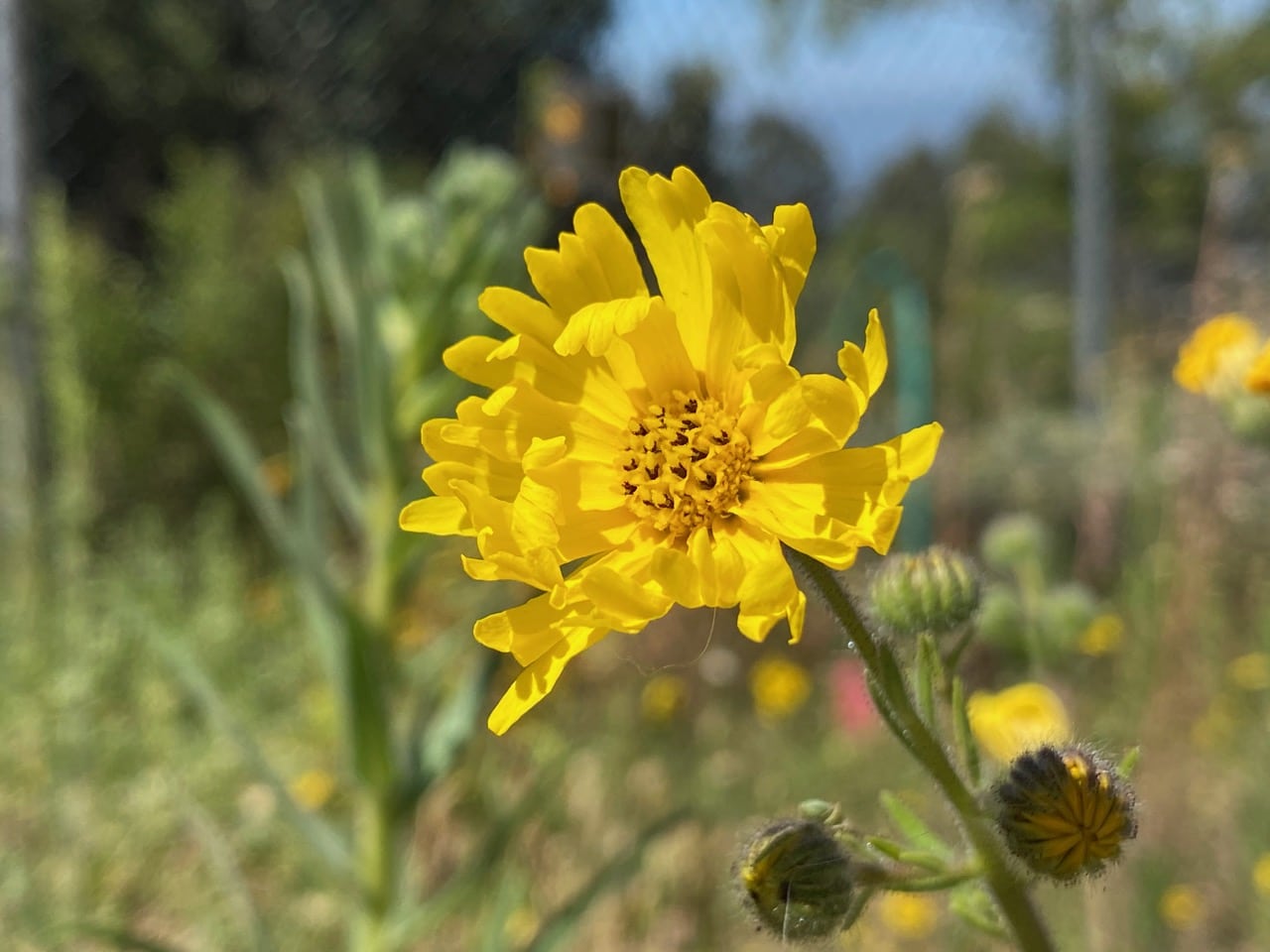
It is a warm day. By the time I reach the FOSC Native Plant Nursery at 10:45 am, the Elegant Tarweed, Madia elegans has partially closed its flowerheads by curling the ray petals inwards.
Unusual among plants, Madia starts to close its flowerheads at mid-morning when the day heats up. The flowerheads open up again in the cool of the evening through the next morning. Why does Madia do this?
The Madia flowerhead closes on hot days because it lacks a way to prevent moisture loss. While the closing seems to happen by the clock, it’s really because the drought stress is worse at about the same time each day. The leaves and stems have a very efficient way to avoid wilting – they contain a mucilage (gel-like substance) that holds water tightly. But this material is lacking in the flowers. Closing the flowerheads reduces the surface from which water can evaporate, preventing desiccation. From my own observation, each Madia flowerhead can go through the opening/closing cycles for about 5 days before senescing.
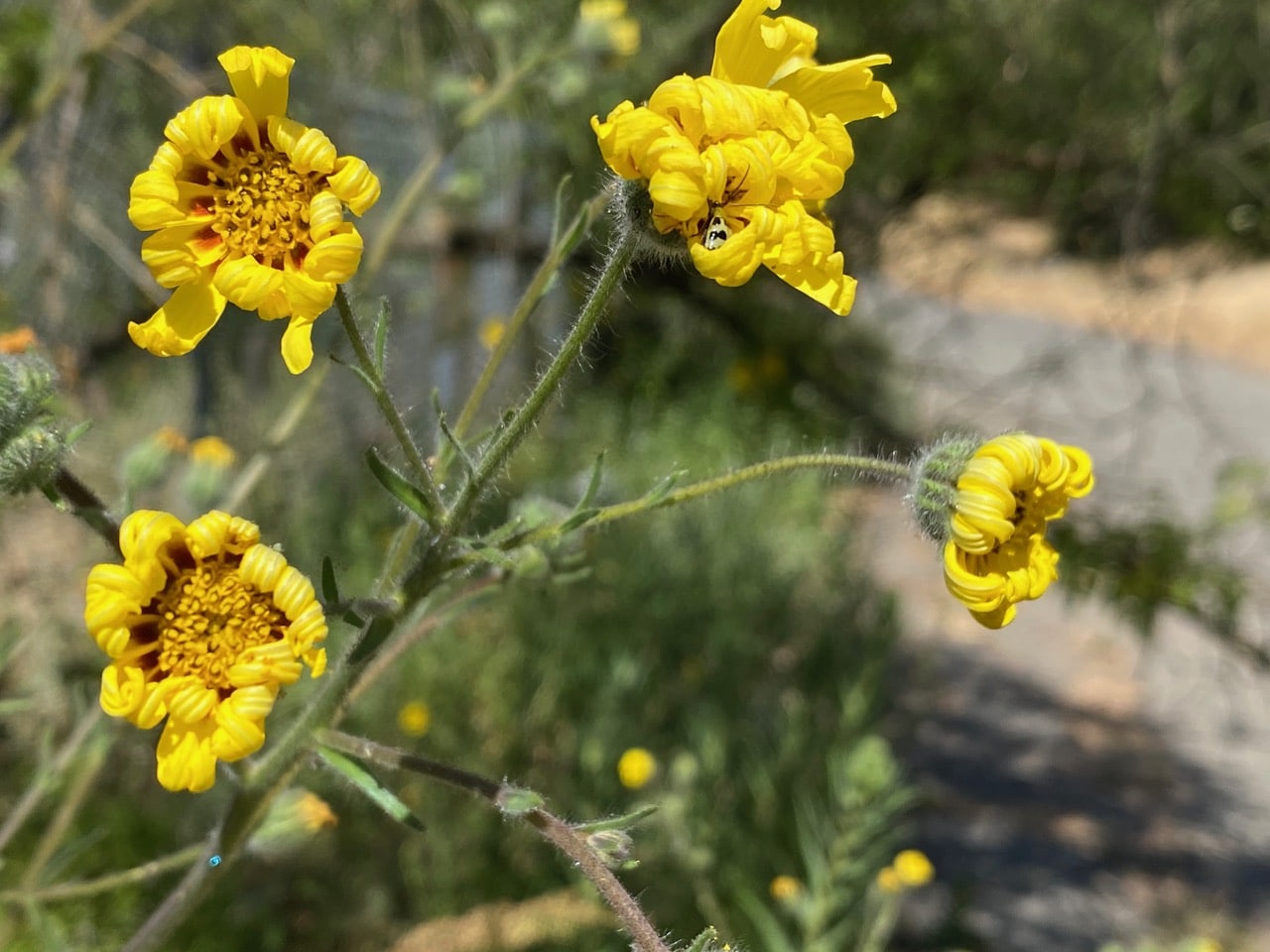

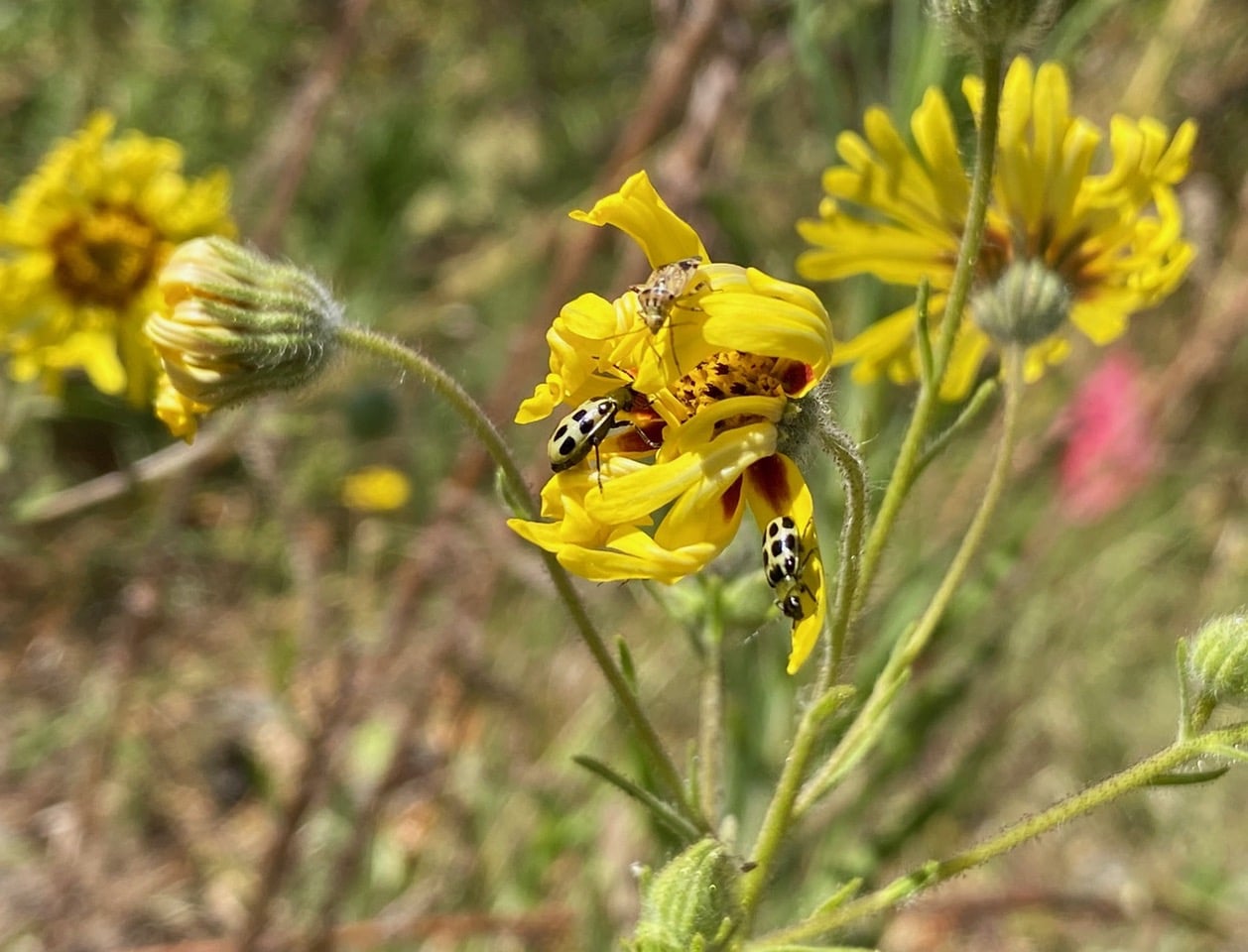
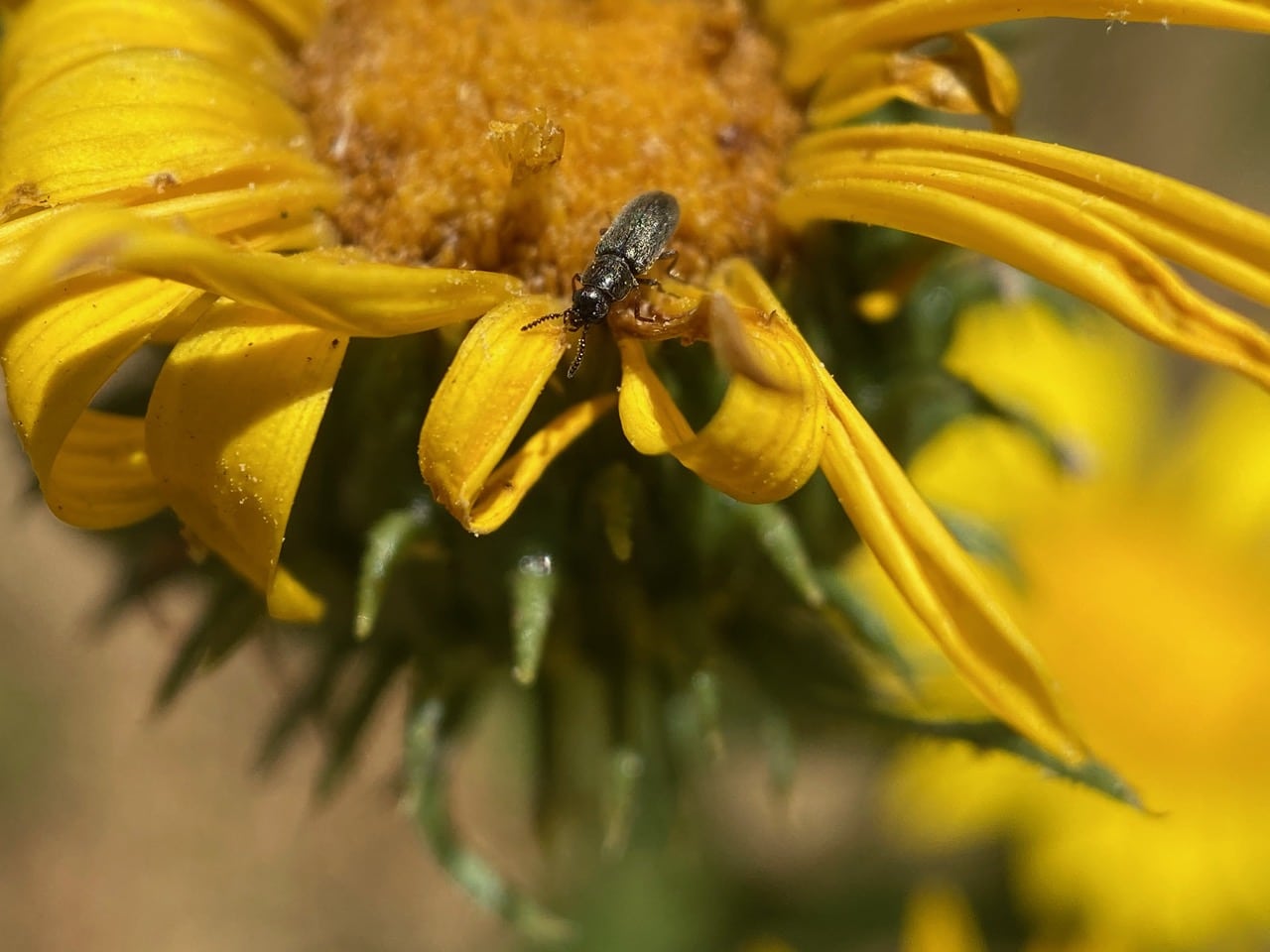
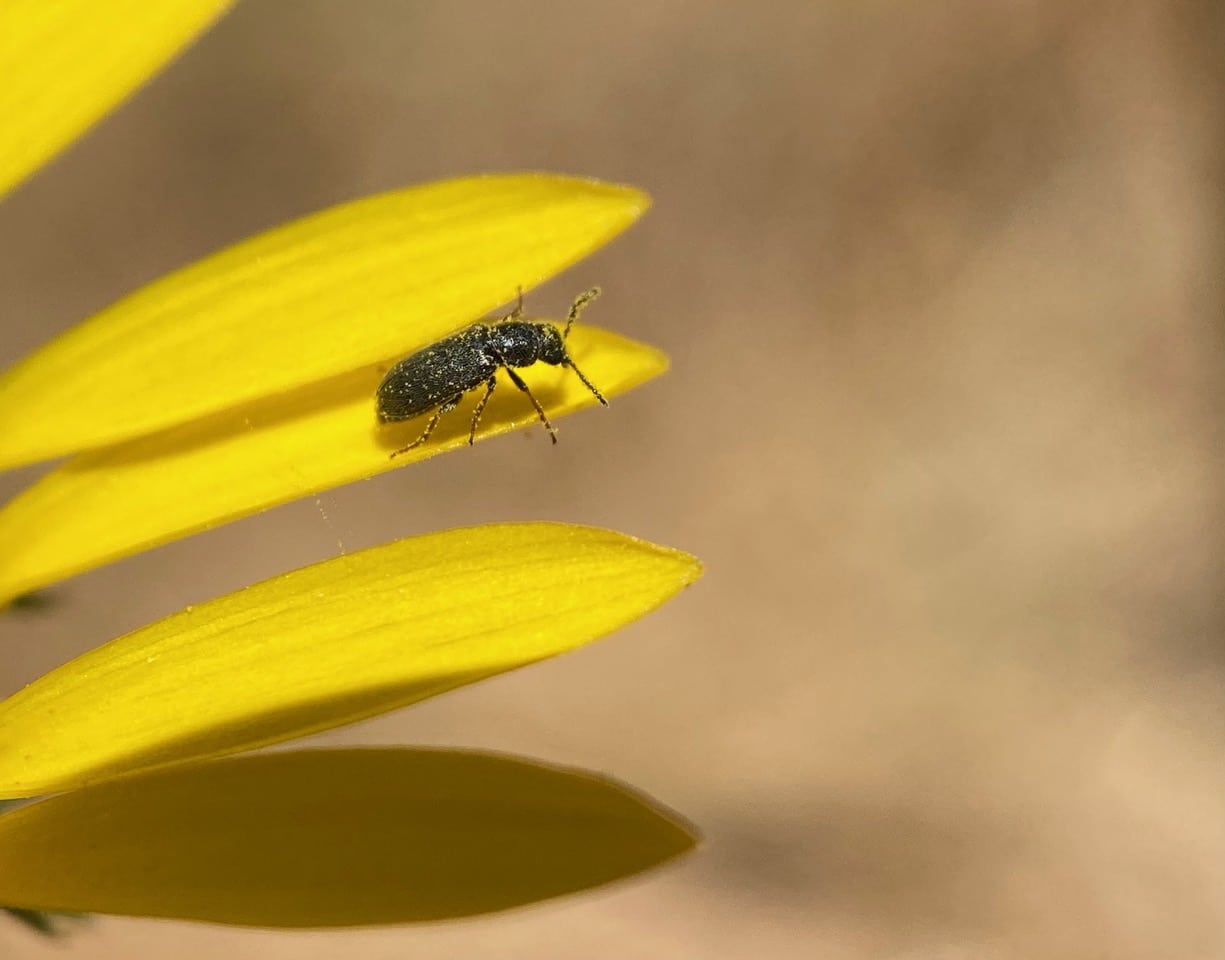
Once the flowerhead closes, the Lygus Bug and the Cucumber Beetles will have to find some place else to feed.
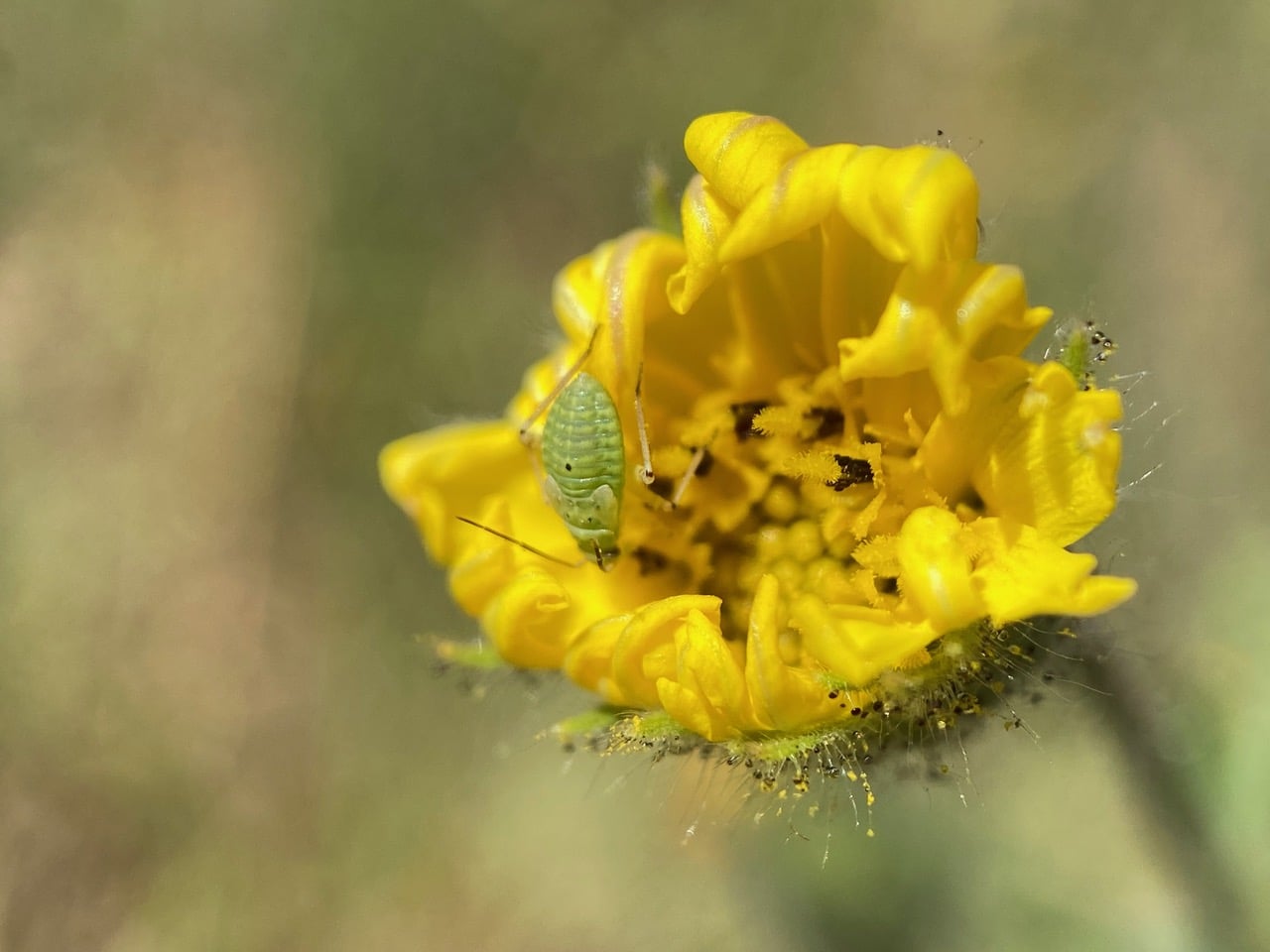
A nymph of a Lygus Bug (family Miridae) is moving around on a partially closed flowerhead of Elegant Tarweed. Note its wing pad.
“True bugs” in the order Hemiptera undergo incomplete metamorphosis without a pupal stage. The nymphs, which look like adults, develop through a series of molts, each time getting bigger after shedding their old exoskeleton. At the last molt, they transform into adults with functional wings and reproductive parts. It takes a little time for the new adults to acquire their full coloration.
The term lygus bug is used for any member of the genus Lygus, in the family of plant bugs, Miridae. Adult lygus are approximately 3 mm wide and 6 mm long, colored from pale green to reddish brown or black. They have a distinctive triangle or V-shape on their backs. Lygus bugs are known for their destructive feeding habits – they puncture plant tissues with their piercing mouthparts, and feed by sucking sap. Both the physical injury and the plant’s own reaction to the bug’s saliva cause damage to the plant. Many lygus bugs are well-known agricultural pests.
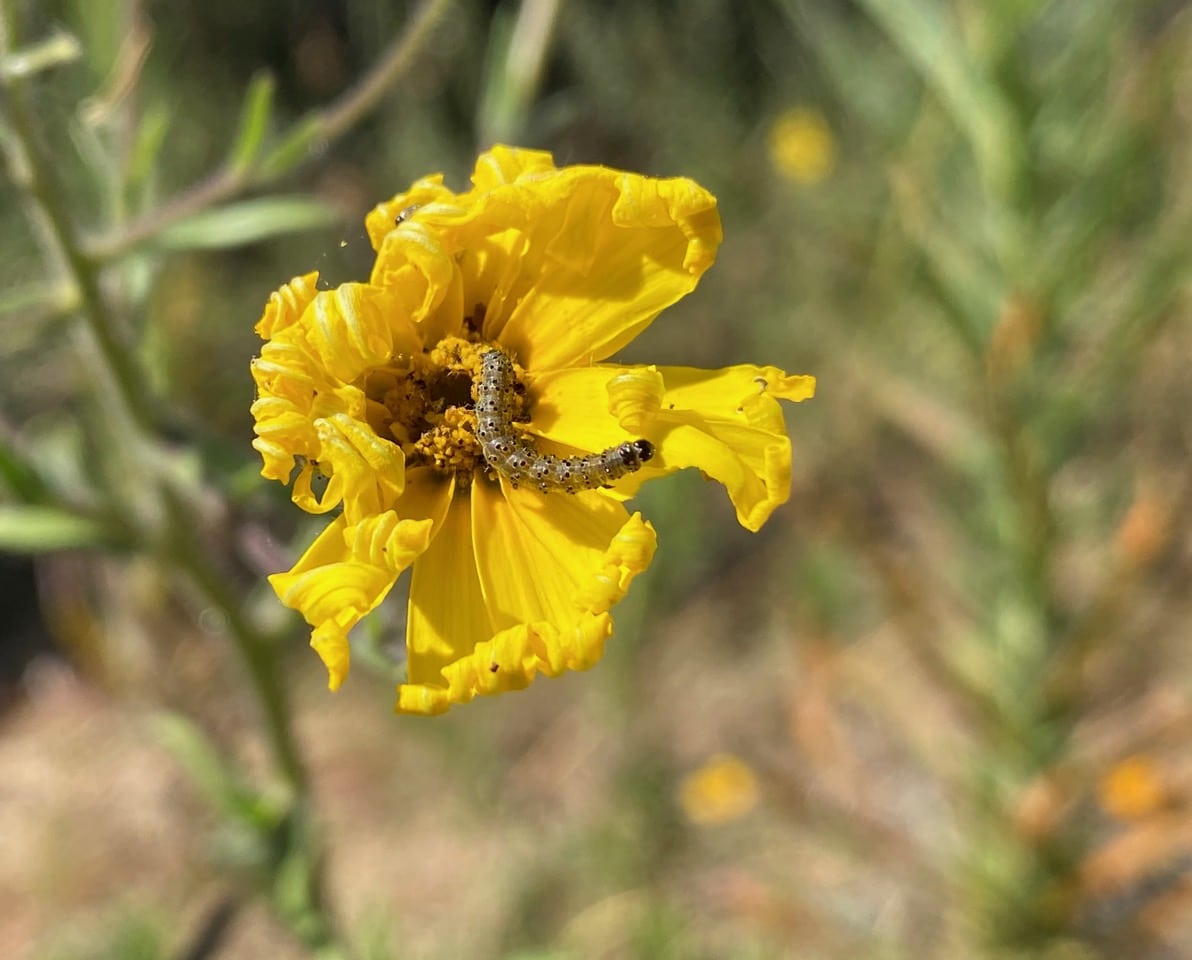
What does a caterpillar do when the Madia flowerhead closes up?

This Owlet Moth caterpillar, Heliothodes diminutiva (family Noctuidae) has partially drawn together the ray petals of an Elegant Tarweed flowerhead with a web of silk. It is an attempt to create a shelter under which to feed, safe from predators. Now that the flowerhead is closing by itself, what would the caterpillar do?

Aphids of various ages and sizes are feeding on the stem of a California Mugwort, Artemisia douglasiana (family Asteraceae, division Anthemideae). iNaturalist has identified the aphids as Anthemid Aphids, Macrosiphoniella sp. (family Aphididae).
Members of the genus Macrosiphoniella are green or brown aphids often covered with a thin layer of wax powder over most of the body. The eyes are red. Their siphunculi (“tail pipes”) are rather short, thick and tapered. Their life cycle does not involve host alternation, and all species feed on daisies (Asteraceae), most on species of the division Anthemideae. Many Macrosiphoneilla species feed on just one genus of this group, some on just one species. Sexual forms occur is autumn and eggs hibernate on low parts of plants or on dead leaves. When disturbed the aphids tend to drop off their plant and ‘play dead’.
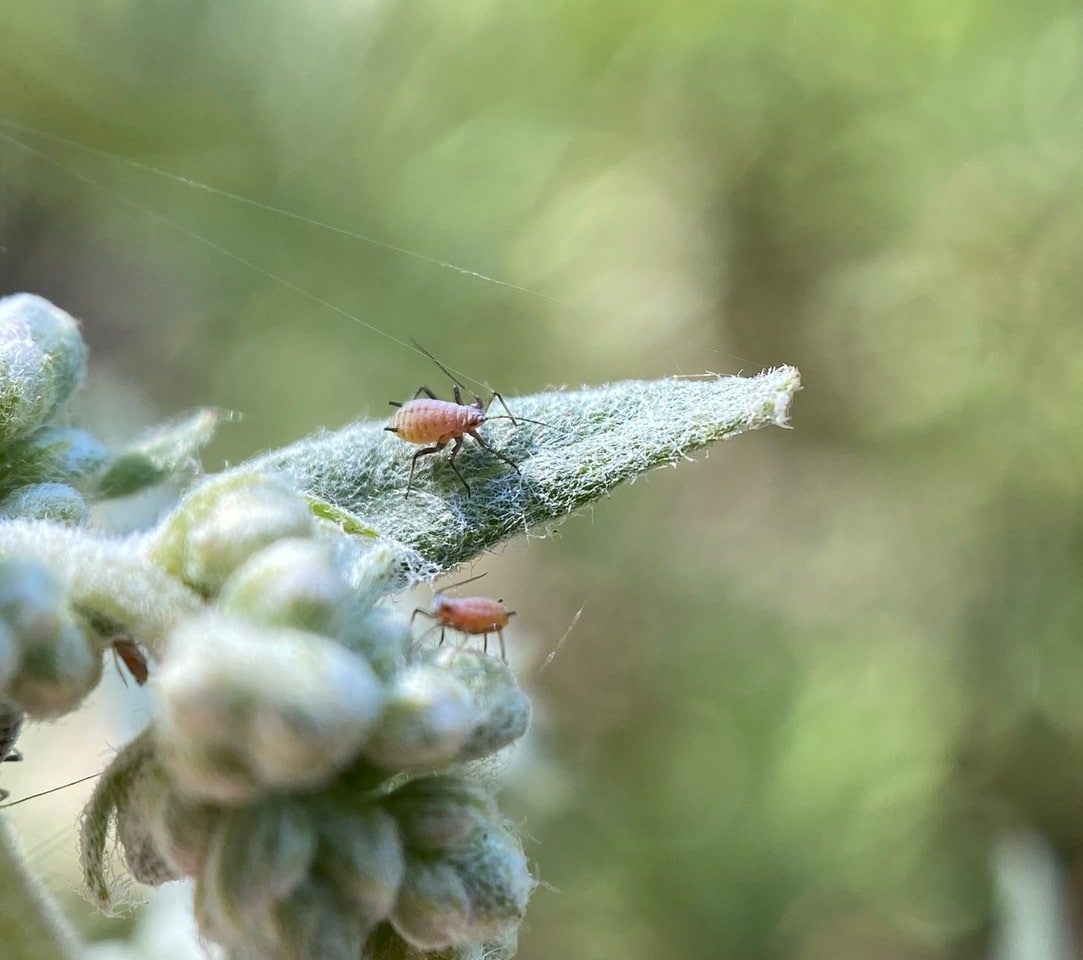
The younger aphids appear brown before they accumulate wax on their body. Eventually the wax filaments make aphids look fluffy and cottony, as if they are covered with wool. The wax keeps predators away and helps the aphids move easily around plant hairs.
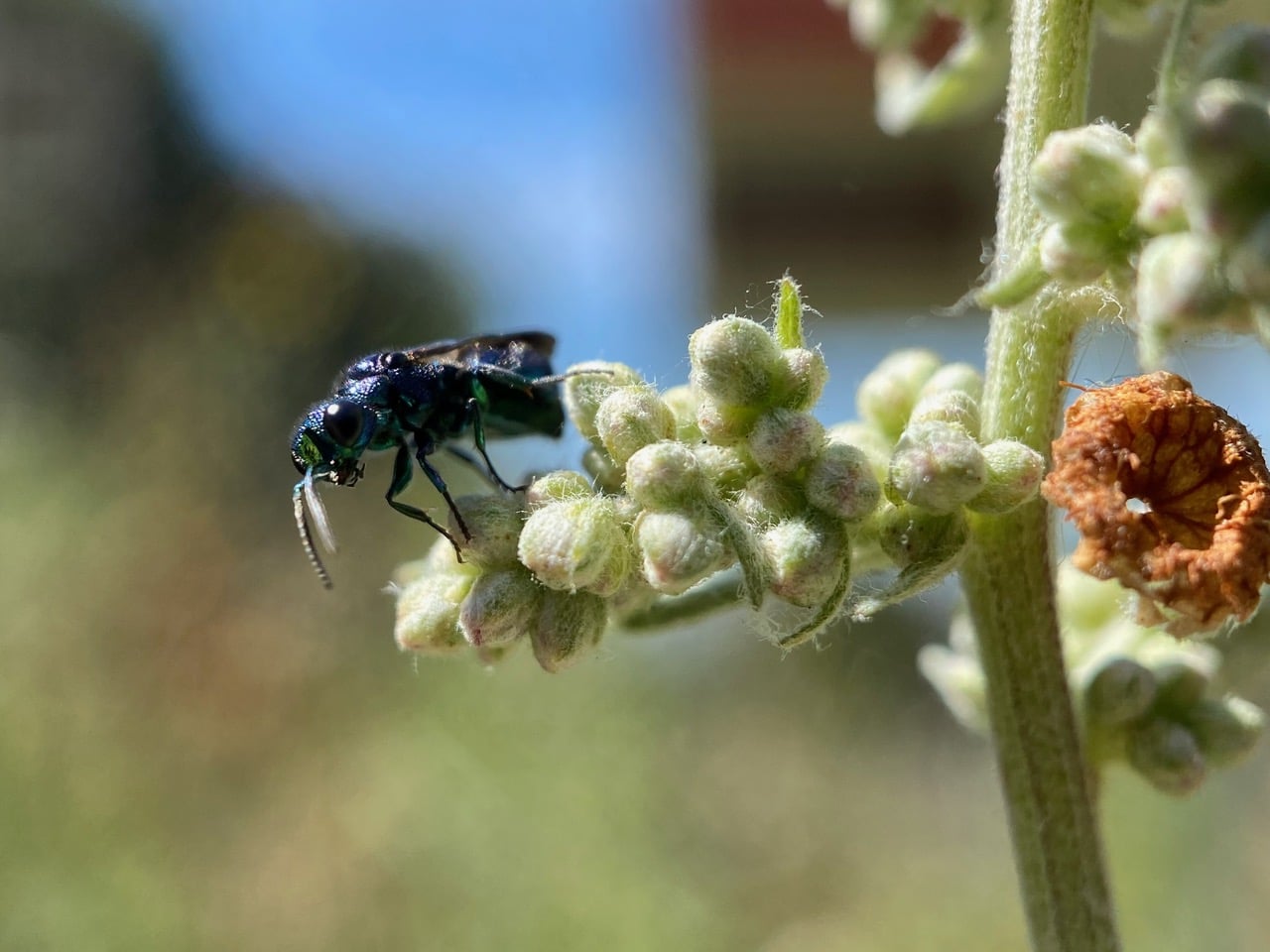
Glints of iridescent blue alert me to the arrival of a Cuckoo Wasp on the California Mugwort. None of my photos does justice to the brilliance and beauty of the wasp. iNaturalist has identified the wasp as a member of the genus Omalus (family Chrysididae, subfamily Chrysidinae))
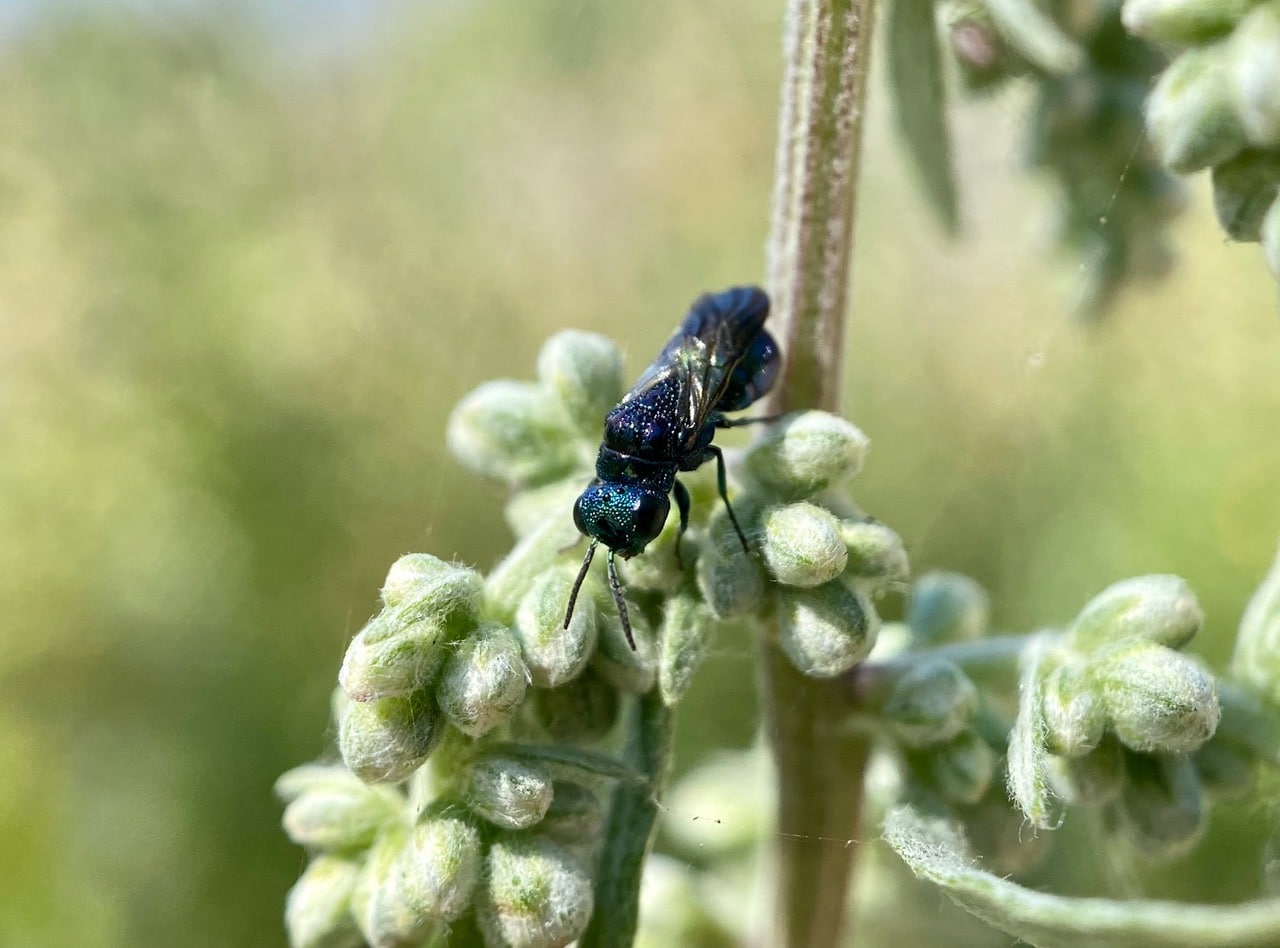
Commonly known as Cuckoo Wasps or Emerald Wasps, the wasp family Chrysididae is a very large cosmopolitan group of parasitoid or kleptoparasitic wasps. They are often highly sculptured (“pitted), with brilliant metallic colors created by structural coloration. They are most diverse in desert regions of the world, as they are typically associated with solitary bee and wasp species, which are also most diverse in such areas. The term “cuckoo wasp” refers to the cuckoo-like way in which these wasps lay eggs in the nest of unrelated host species. Chrysidids are always solitary, and are active mainly in the hottest and driest months of summer in Mediterranean climates. They are found in habitats where the adults can find hosts to parasitize. Some species visit flowers such as the Apiaceae, Asteraceae and Euphorbiaceae.
Members of the largest subfamily, Chrysidinae, are generally kleptoparasites, laying their eggs in host nests, where their larvae consume the host egg or larva, then the food provided by the host for its own young.

Like most Cuckoo Wasps in the subfamily Chrysidinae, Omalus has flattened or concave lower abdomens and can curl into a defensive ball (“volvation”) when attacked by a potential host, in the manner of a pill bug. The hosts for Omalus are Aphid Wasps (family Crabronidae, subfamily Pemphredoninae) which hunt for aphids to provision for their young. Omalus lays eggs on aphids so they get carried to the nest by the wasp’s host.
Aphid Wasps (Subfamily Pemphredoninae) · iNaturalist
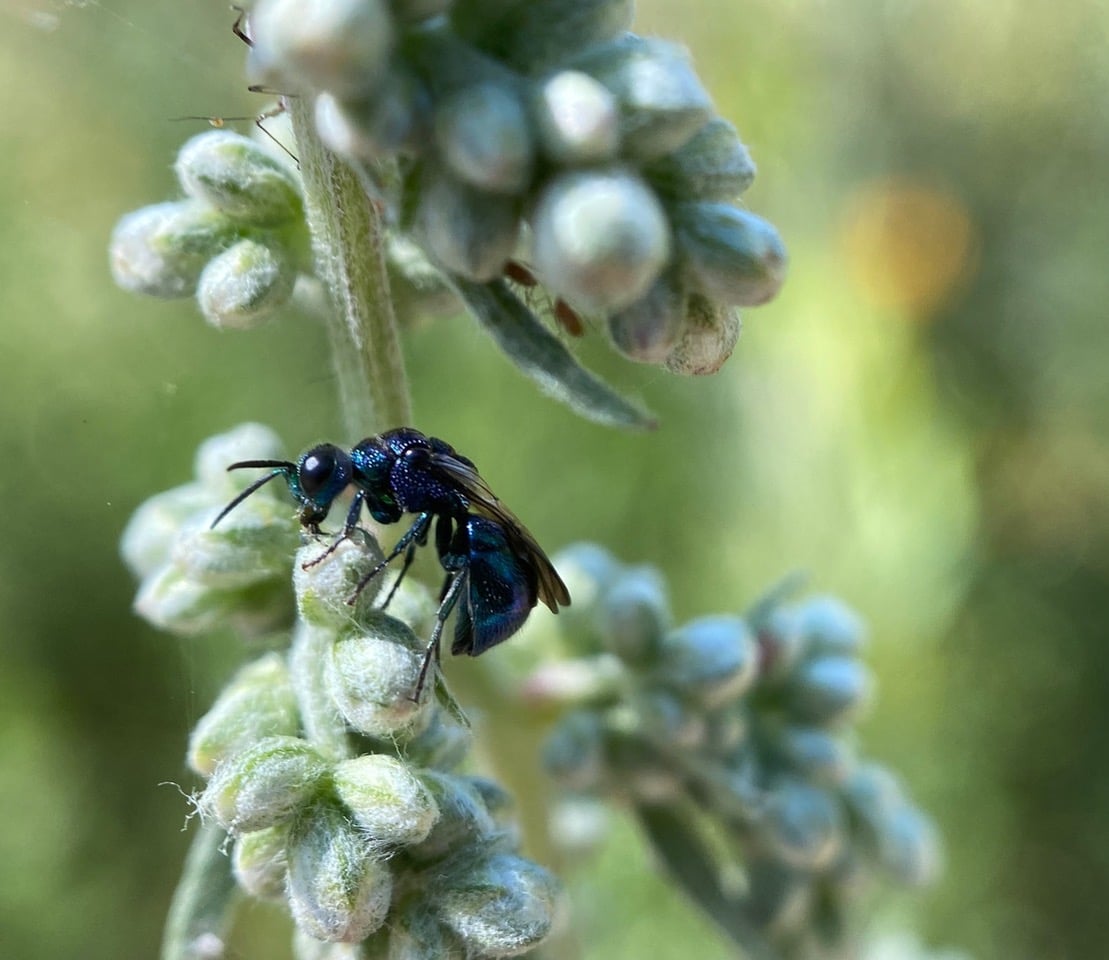
No wonder that Omalus keeps coming back to this particular aphid-infested mugwort. She is here to lay eggs on the aphids so that they will be carried into the nest of the Aphid Wasp, the host of the cuckoo wasp. Omalus does not have to enter the host nest to lay eggs, but instead employs the intermediary of aphids. What a clever ploy! It takes me a while to wrap my head around this.

It’s only when the Cuckoo Wasp gets into the sunlight that its true brilliance is evident.

From a distance, I spot a female Mason Bee, Osmia sp. (family Megachilidae) collecting pollen on a flowerhead of Hairy Gumweed, Grindelia hirsutula. Note that the underside of her abdomen is coated with yellow pollen. This is where members of the Megachilidae family have their scopae (special pollen collecting hairs). To gather pollen, the female taps the surface of the flowerhead very rapidly and gently, almost like a vibration.
Mason Bee is a name commonly used for species of bees in the genus Osmia, of the family Megachilidae. Mason Bees are named for their habit of using mud or other “masonry” products in constructing their nests, which are made in naturally occurring gaps/cavities such as cracks in stones, hollow stems or holes in wood made by wood-boring insects. Osmia means ‘odor’, and refers to a faint lemony scent used by these bees to mark their nest entrances. Osmia species are frequently metallic green or blue. Females have black ventral scopae (special pollen collecting hairs) on the underside of their abdomen, which are difficult to see unless laden with pollen. Ventral abdominal scopae is a feature shared by all members of the Megachilidae family, which include the wool-carder bees (genus Anthidium), and leaf-cutter bees (genus Megachile).
Mason Bees are a solitary species. Every female is fertile and makes her own nest. Each nest cell is provisioned with pollen and contains one egg which will develop into a larva. The female creates a partition of mud between the nest cells. The process continues until she has filled the cavity. She plugs the entrance to the cavity, and then may seek another nest location. The larvae that hatch out consume their provisions and begin spinning a cocoon around itself and enters pupal stage. Adults mature in fall or winter, hibernating inside its cocoon.
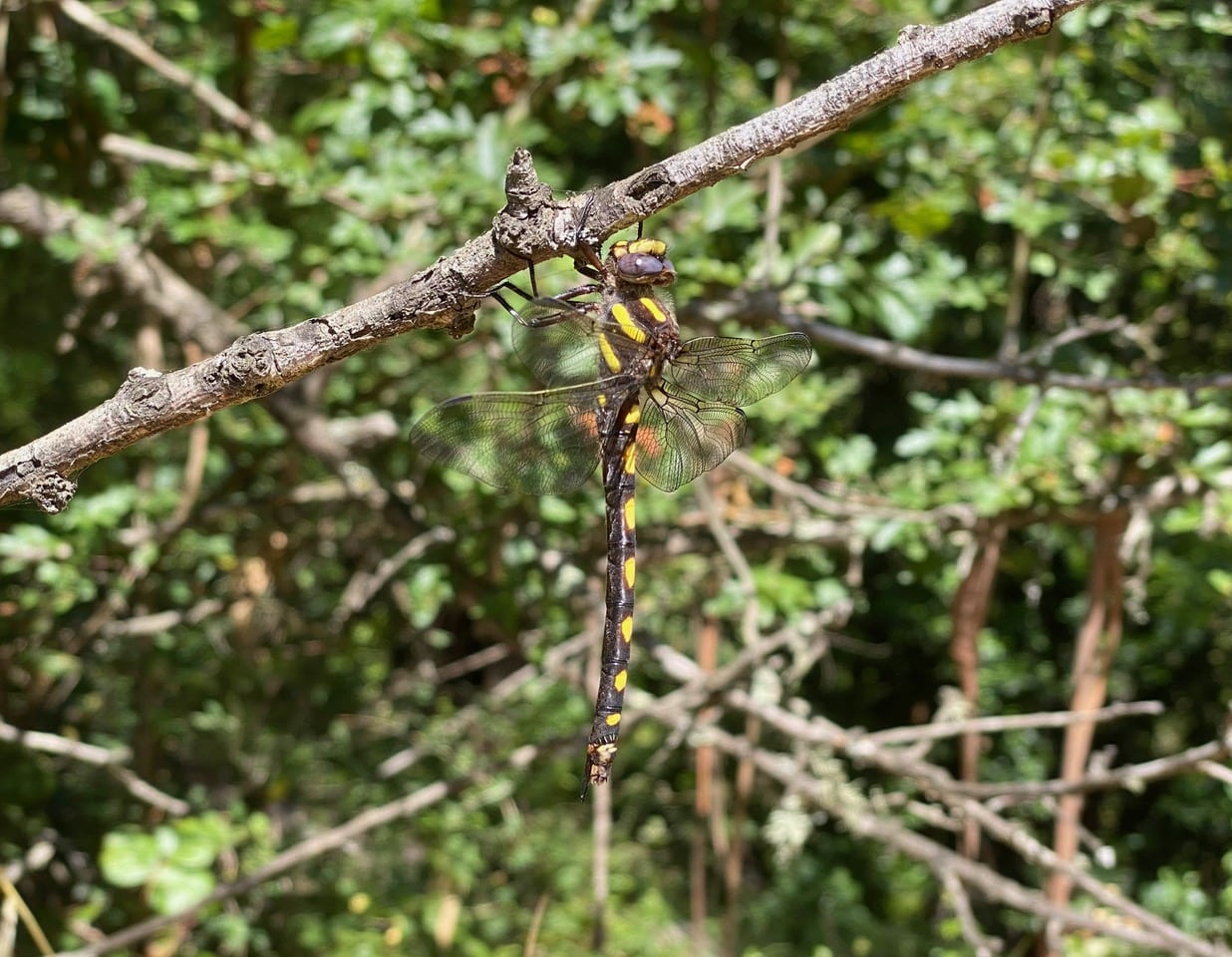
A large Dragonfly flies over the patch to Grindelia and perches vertically on a bare branch. I can only approach it from an awkward angle and the insect is hardly visible against the busy background. But its ID is obvious from its large size and its black-and yellow coloration. It is a Pacific Spiketail, Cordulegaster dorsalis (family Cordulegastridae).
Commonly called a “biddy”, the Pacific Spiketail is a huge, striking, fearless dragonfly. It is an agile predator of flying insects, including other dragonflies. The species is the only member of the family Cordulegastridae in California. Both sexes are similar in size (3+ inches long) and color pattern, but females can be distinguished by their impressive, spike-like ovipositor at the tip of the abdomen. Females rarely visit water except to breed and lay eggs. Oviposition is accomplished alone by hovering vertically over shallow water and repeatedly plunging the ovipositor into the muddy or sandy substrate. I can still clearly recall witnessing this remarkable behavior many years ago on a creek in Marin County.