

Pollinator post 6/21/24 (2)
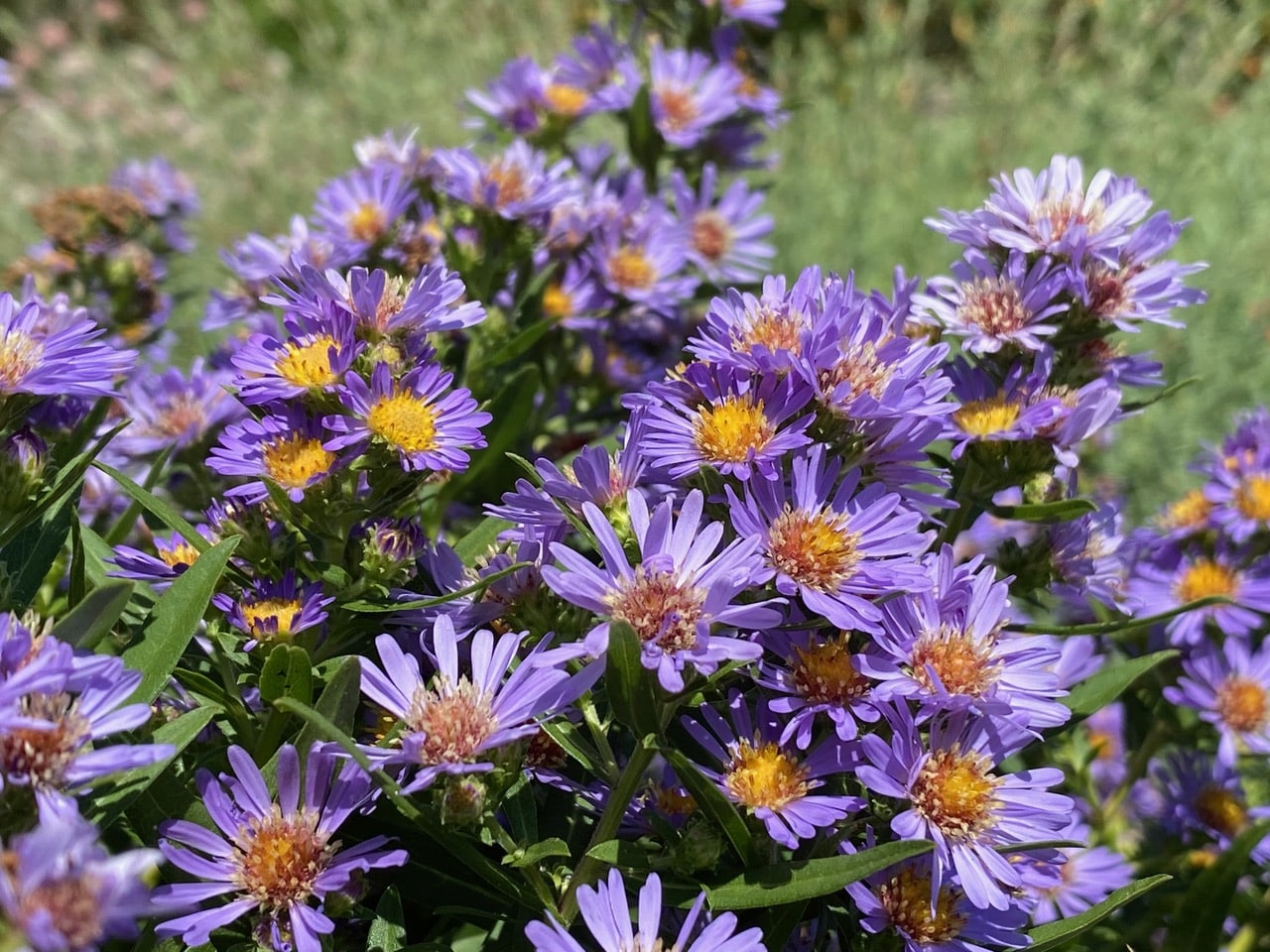 There is a plant in Stefanie’s backyard that is an insect magnet. The Plumas Purple Aster, Symphyotrichum x “Plumas Purple” is a low, dense form of the Pacific Aster, Symphyotrichum chilense. It is propagated from wild stock, not a cultivar. There are so many insects visiting the flowers that I find it difficult to focus on any of them.
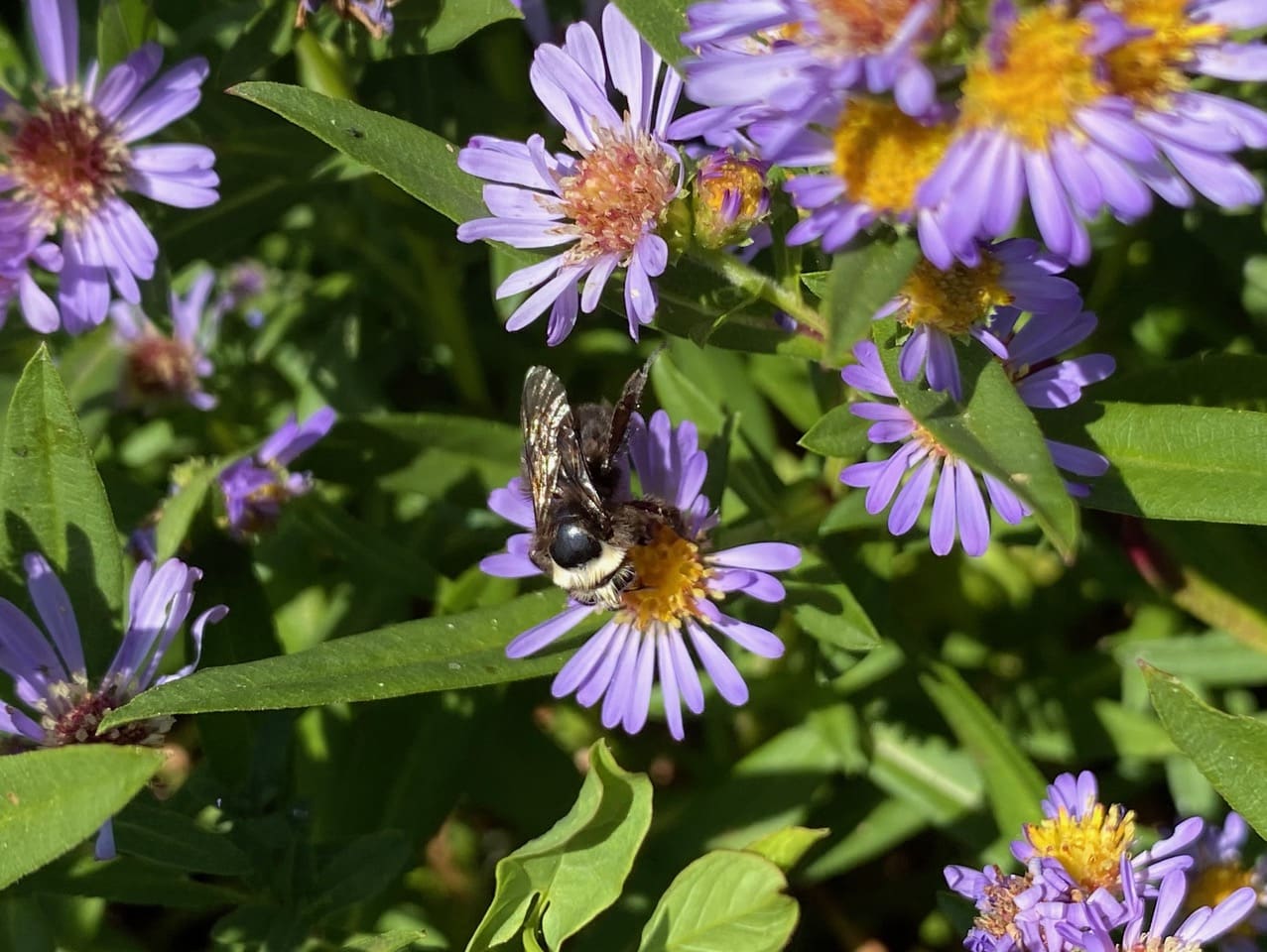
Her balding thorax shining in the sunlight, a senior Yellow-faced Bumble Bee, Bombus vosnesenskii (family Apidae) is taking nectar on a flowerhead of Pacific Aster.
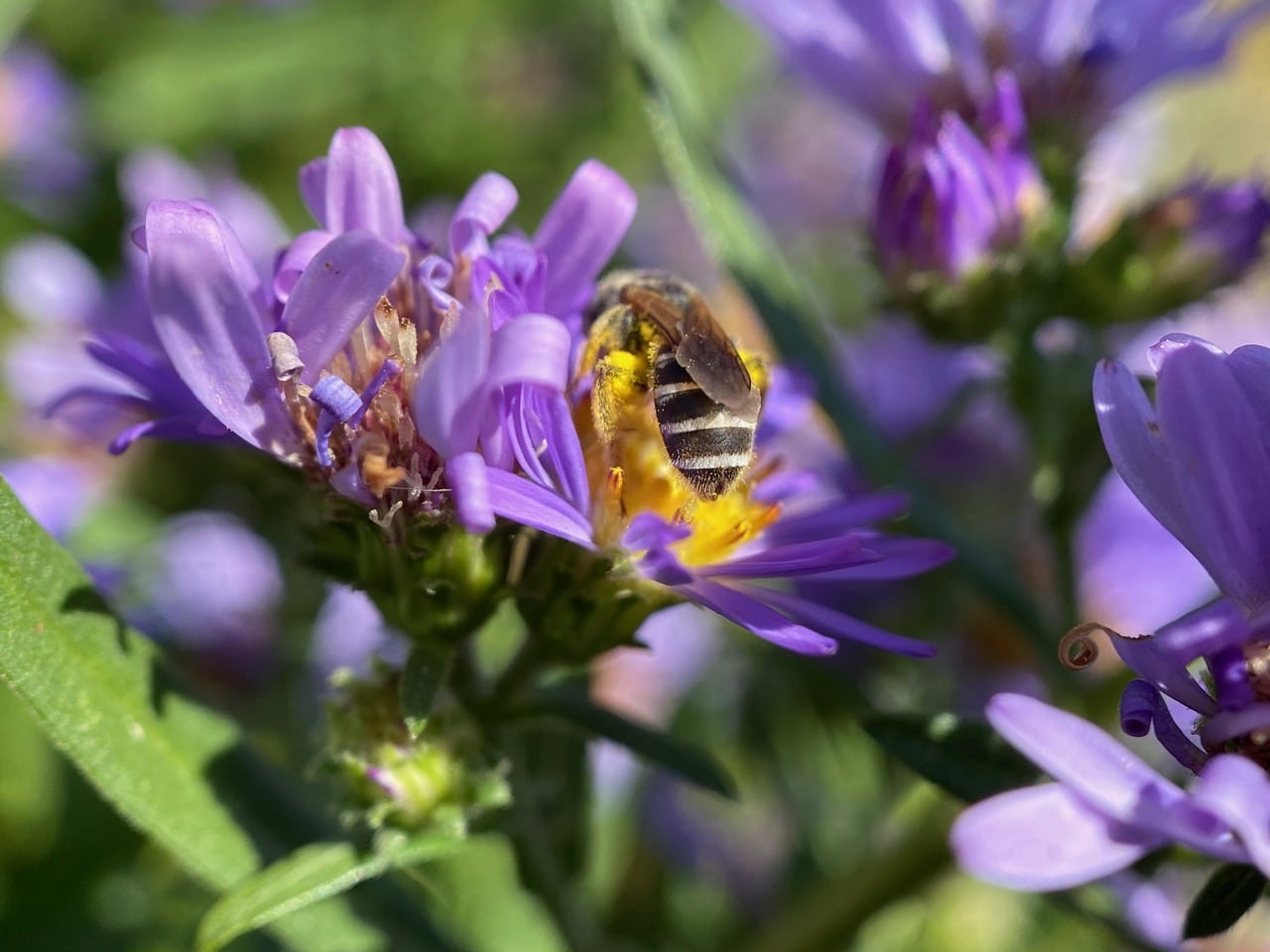
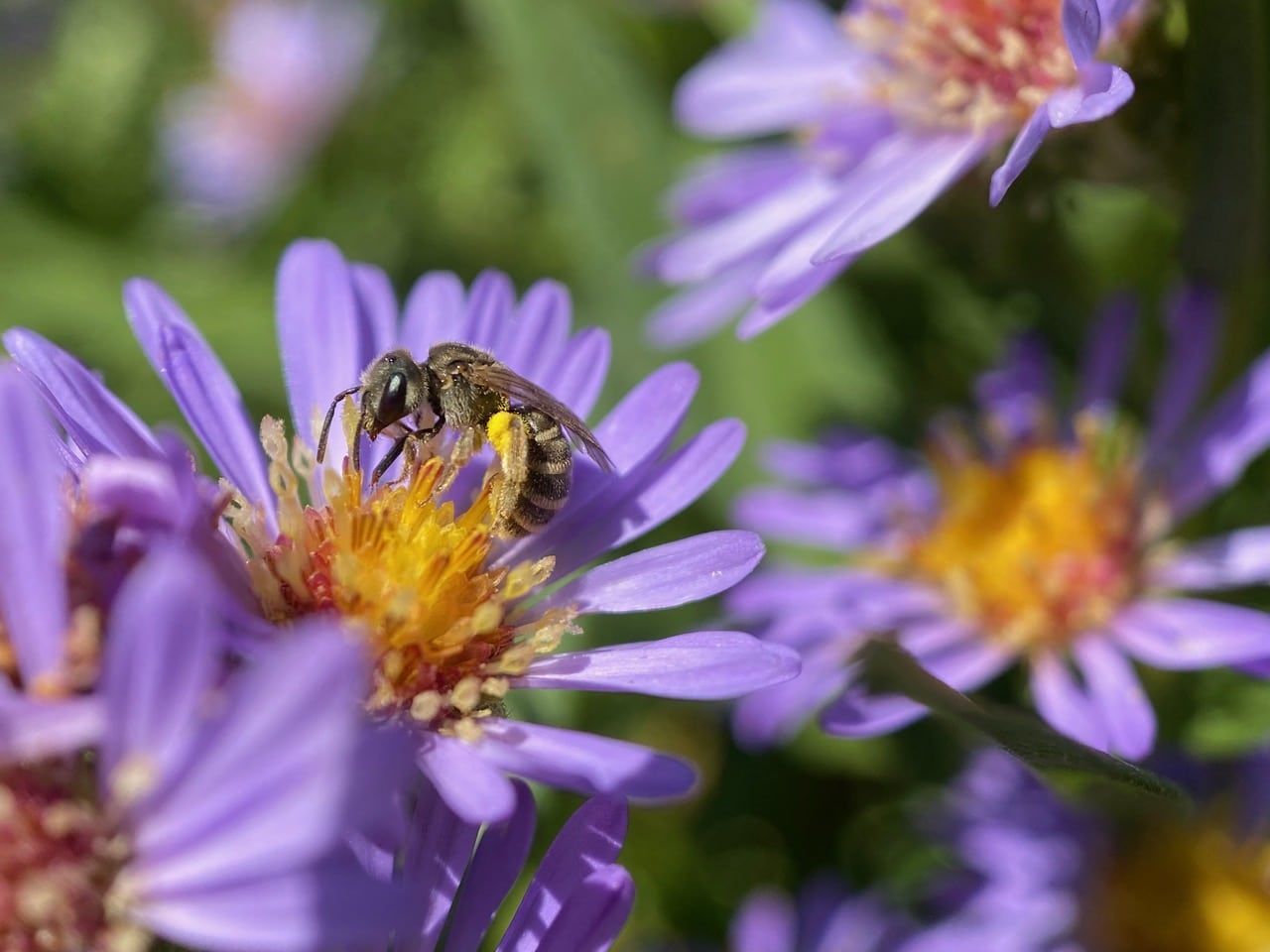



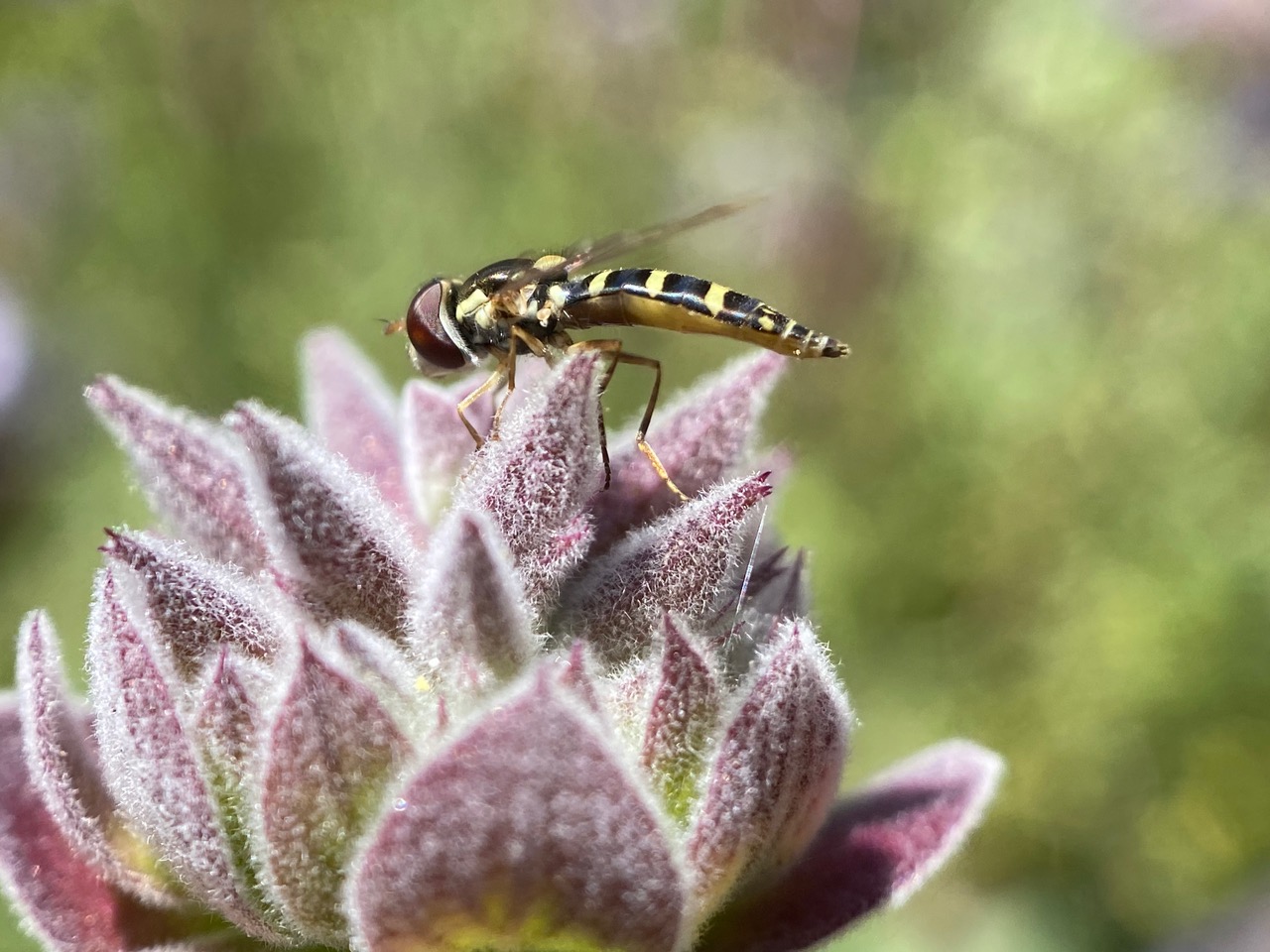
 Even the tiny Common Grass Skimmer, Paragus haemorrhous (family Syrphidae) manages to scoot in for a share of the nectar and pollen offered by the Pacific Aster.

 I begin to notice small bees on the Cleveland Sage flowers. A Sweat Bee, Halictus sp. (family Halictidae) has landed on a fading flower.
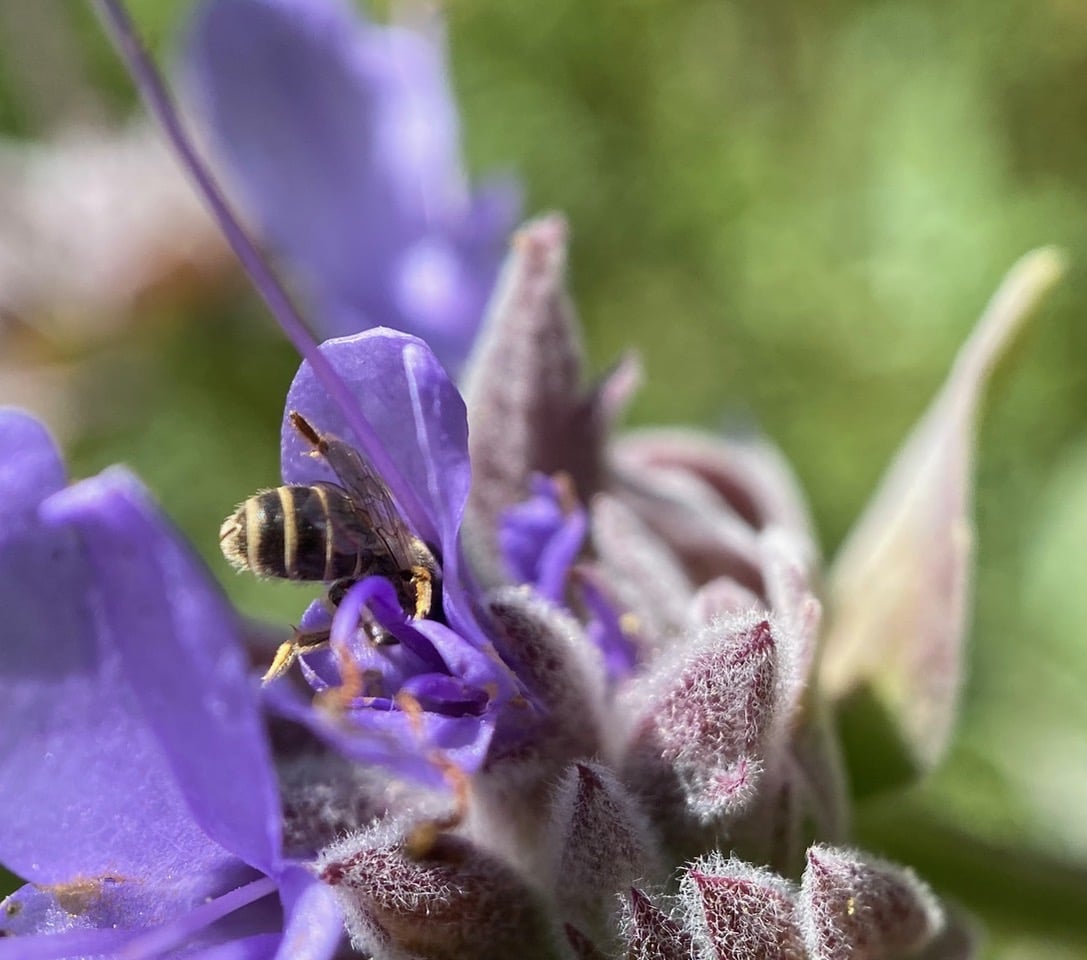



A Sweat Bee, Halictus sp. (family Halictidae) has yet to fill her scopae. It won’t take long on this fresh flowerhead of Pacific Aster in the male phase, loaded with pollen.
There are countless Sweat Bees on the Pacific Aster. This is truly the season of Sweat Bees, family Halictidae.
Halictus is found worldwide; they are most common in the Northern Hemisphere. All are generalists, foraging from a wide variety of flowering plants. Many species are social and produce several generations per year. This is not surprising as most blooming plants are season-specific; a bee that requires pollen and nectar across multiple seasons would not thrive as a specialist. All Halictus in North America nest in the ground, often in aggregations; and they may nest in the same area for decades.
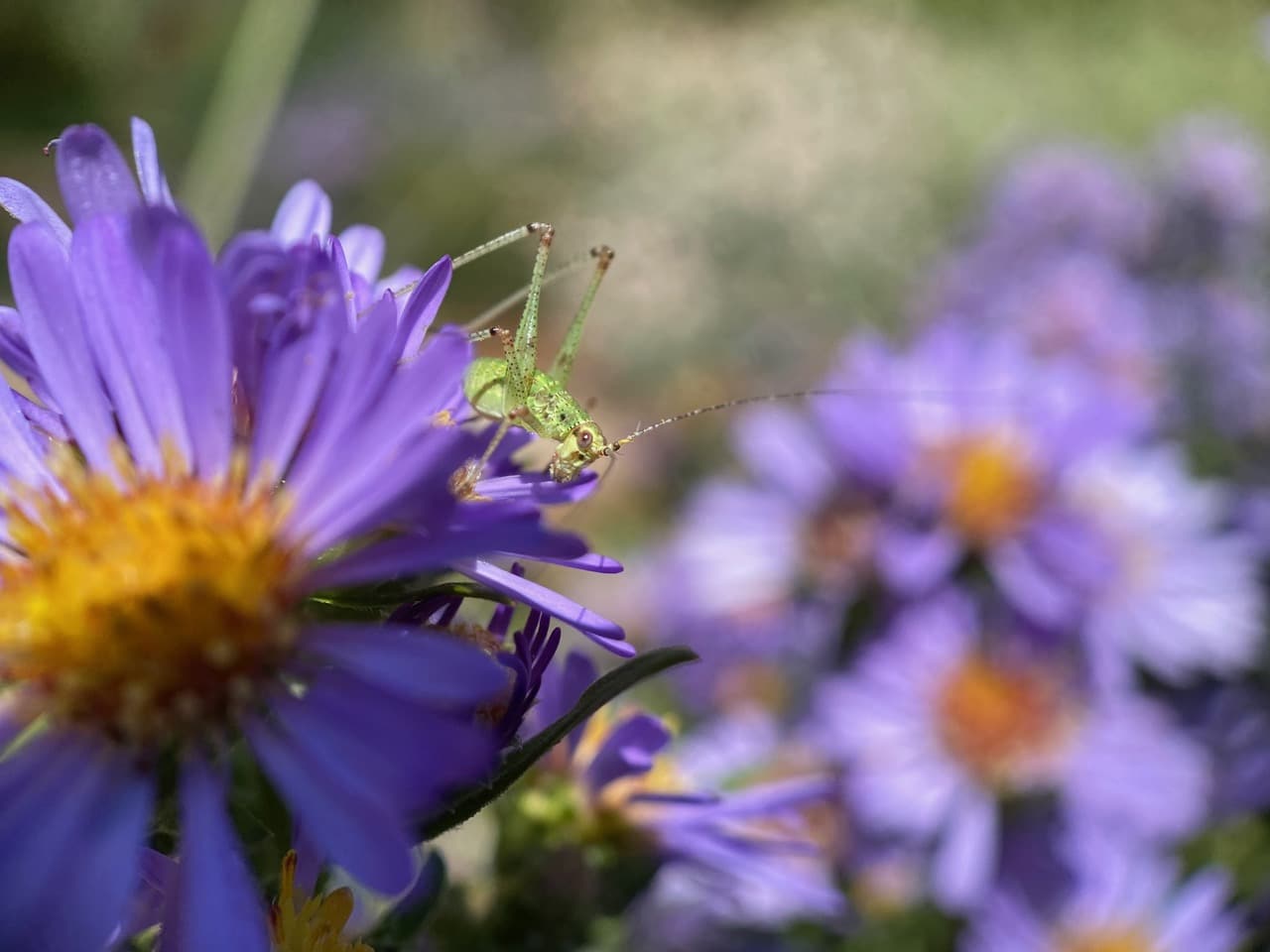
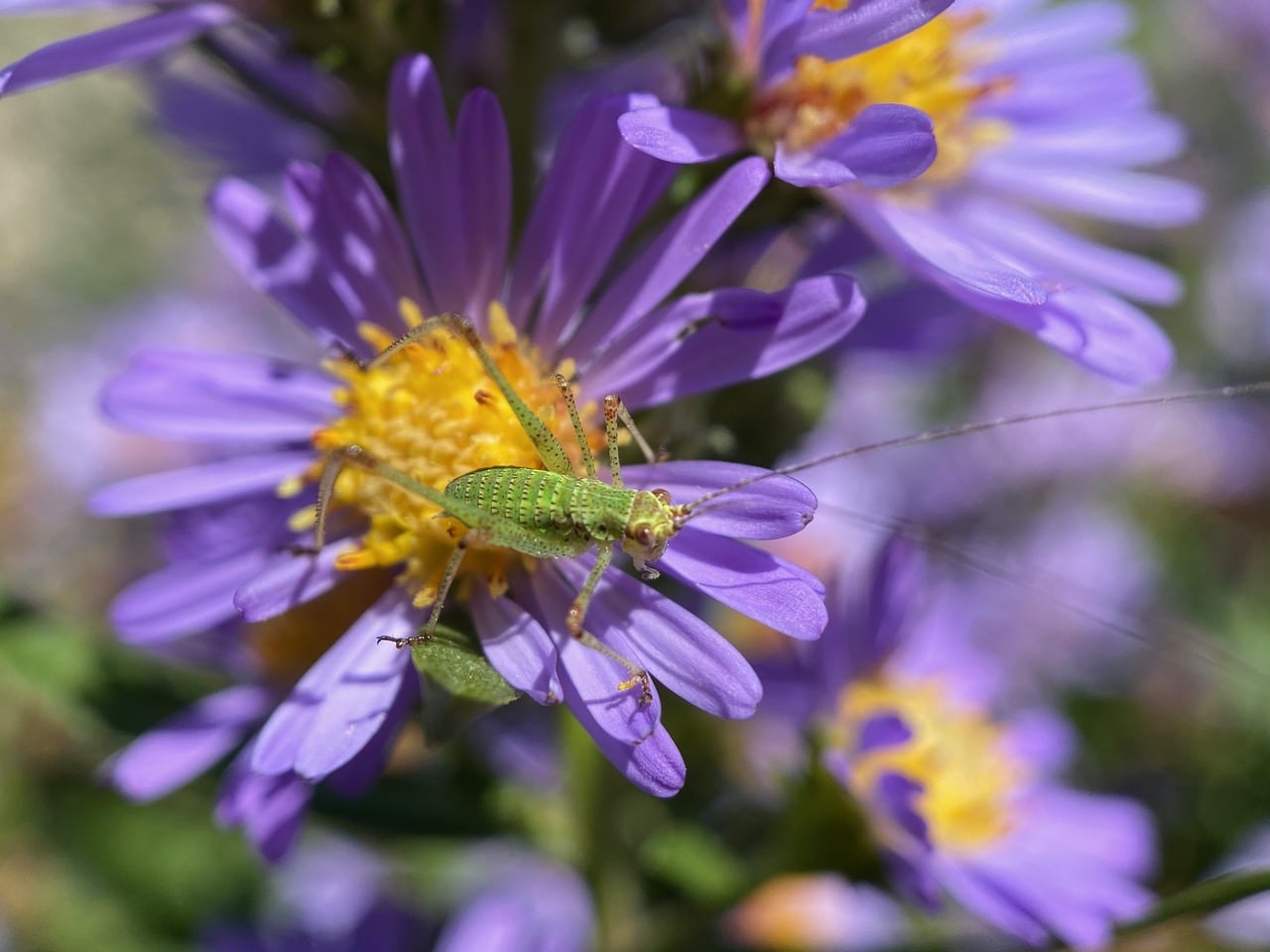
A Mediterranean Katydid, Phaneroptera nana (family Tettigoniidae) peers at me from the next Pacific Aster flowerhead.
Insects in the family Tettigoniidae are commonly called katydids or bush crickets. They are primarily nocturnal in habit with strident mating calls. Many species exhibit mimicry and camouflage, commonly with shapes and colors resembling leaves. The diet of most katydids includes leaves, flowers, bark, and seeds, but many species are predatory, feeding on other insects, snails, or even small vertebrates such as snakes and lizards. Some are considered agricultural pests.
The Mediterranean Katydid is native to Europe, the Near East and North Africa. As an invasive species, it has spread to the San Francisco Bay Area. It mainly inhabits sunny and dry habitats, especially shrubs and low branches of trees. Katydids court acoustically. Phaneroptera nana female sings in response to the male, prompting the male to move towards her. Females chew on the lamina of plants to insert their eggs which usually hatch in summertime. P. nana is commonly found through the summer and fall seasons. The species is known to cause damage in pear orchards, feeding on pears that have not ripened.
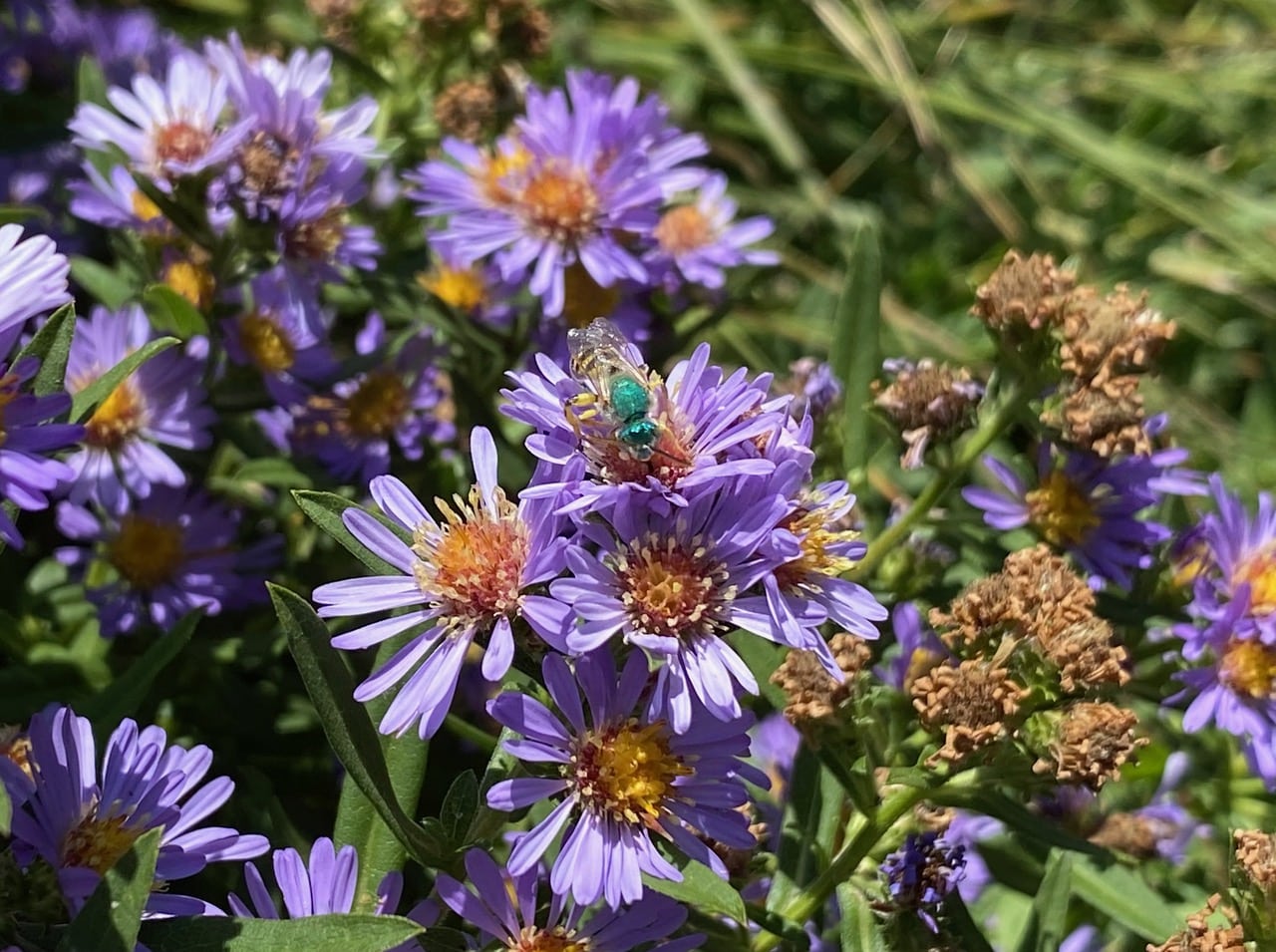
Ooh, see that green iridescent glint on the Pacific Aster? It is a male Striped Sweat Bee, Agapostemon sp. (family Halictidae). Although not very visible from this angle, the male has a black-and-yellow striped abdomen.
The genus Agapostemon is widespread and abundant throughout North America. They are most diverse and abundant in temperate regions and southwestern U.S. deserts. Agapostemon are commonly called “sweat bees” because they are closely related to, and resemble bees in the Halictus and Lasioglossum genera. Unlike those bees however, Agapostemon are not attracted to human sweat.
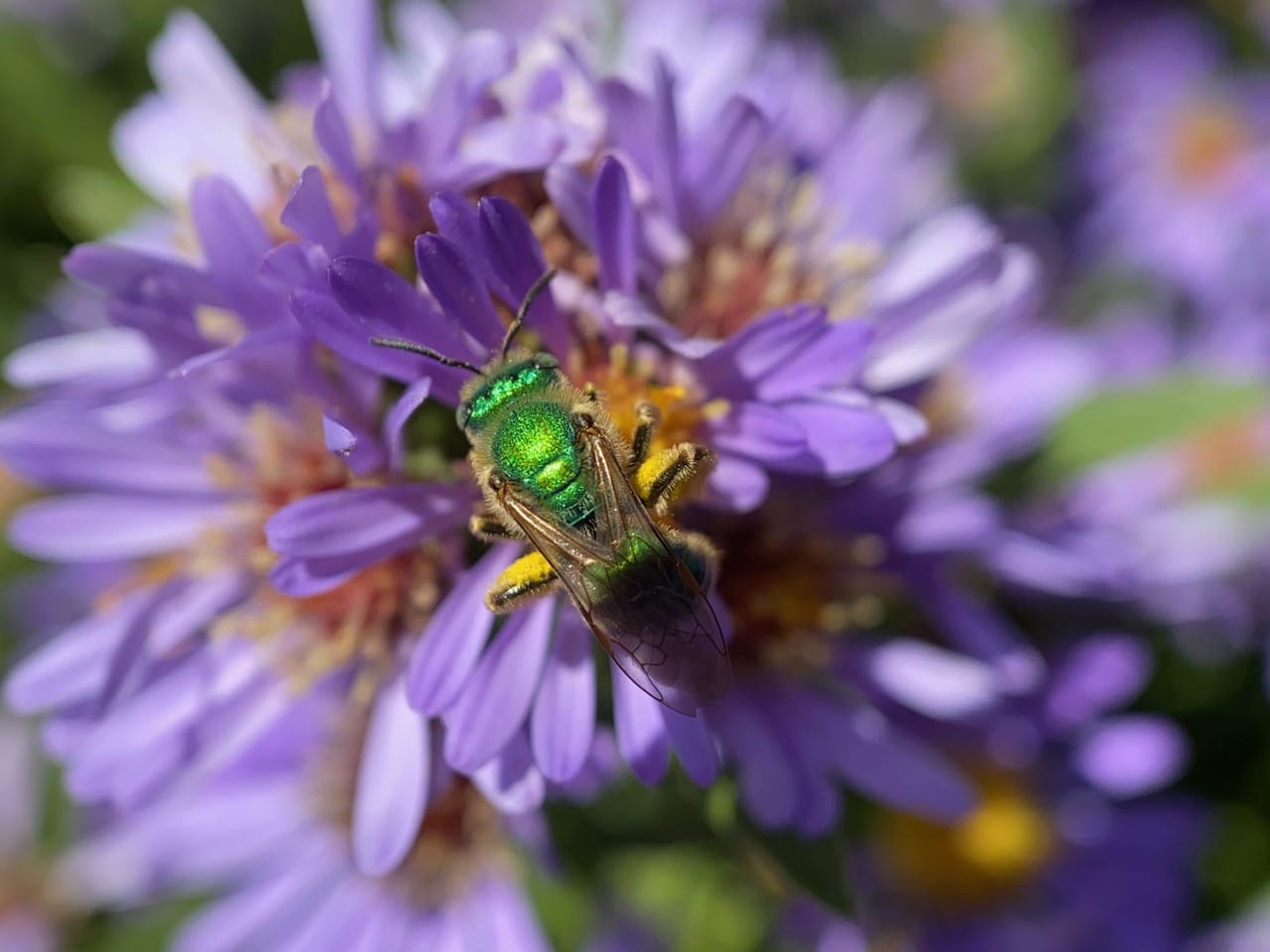
Agapostemon are brightly colored metallic green or blue bees measuring 7 to 14.5 mm long. Most species have a metallic green head and thorax, and black-and-yellow striped abdomen; some females are entirely bright green or blue. Females carry pollen on scopal hairs located on their hind legs. Agapostemon are generalists. Like other members of the family Halictidae, they are short-tongued and thus have difficulty extracting nectar from deep flowers. Males are often seen flying slowly around flowers looking for females. The bees favor flowers with high densities.
These are summer to fall bees.
Here’s an all-green female Agapostemon, foraging on a flowerhead of Pacific Aster. She has gathered some yellow pollen on the scopae on her hind legs.
Agapostemon females dig deep vertical burrows in flat or sloping soil, or sometimes in banks. Most species are solitary, but some species nest communally. Up to two dozen females may share a single nest entrance, but each individual builds and provisions its own cluster of brood cells. Where a communal nest gallery shares a single entrance, one bee usually guards the hole, with only her head visible from above ground. Unlike other social bees, in communal bees there is no reproductive division of labor. In cool temperate regions, there is one generation per year, with females active in the early summer and males and pre-diapausing females active in the late summer. Only mated females survive the winter. This is probably because unmated females cannot enter diapause (insect version of hibernation).
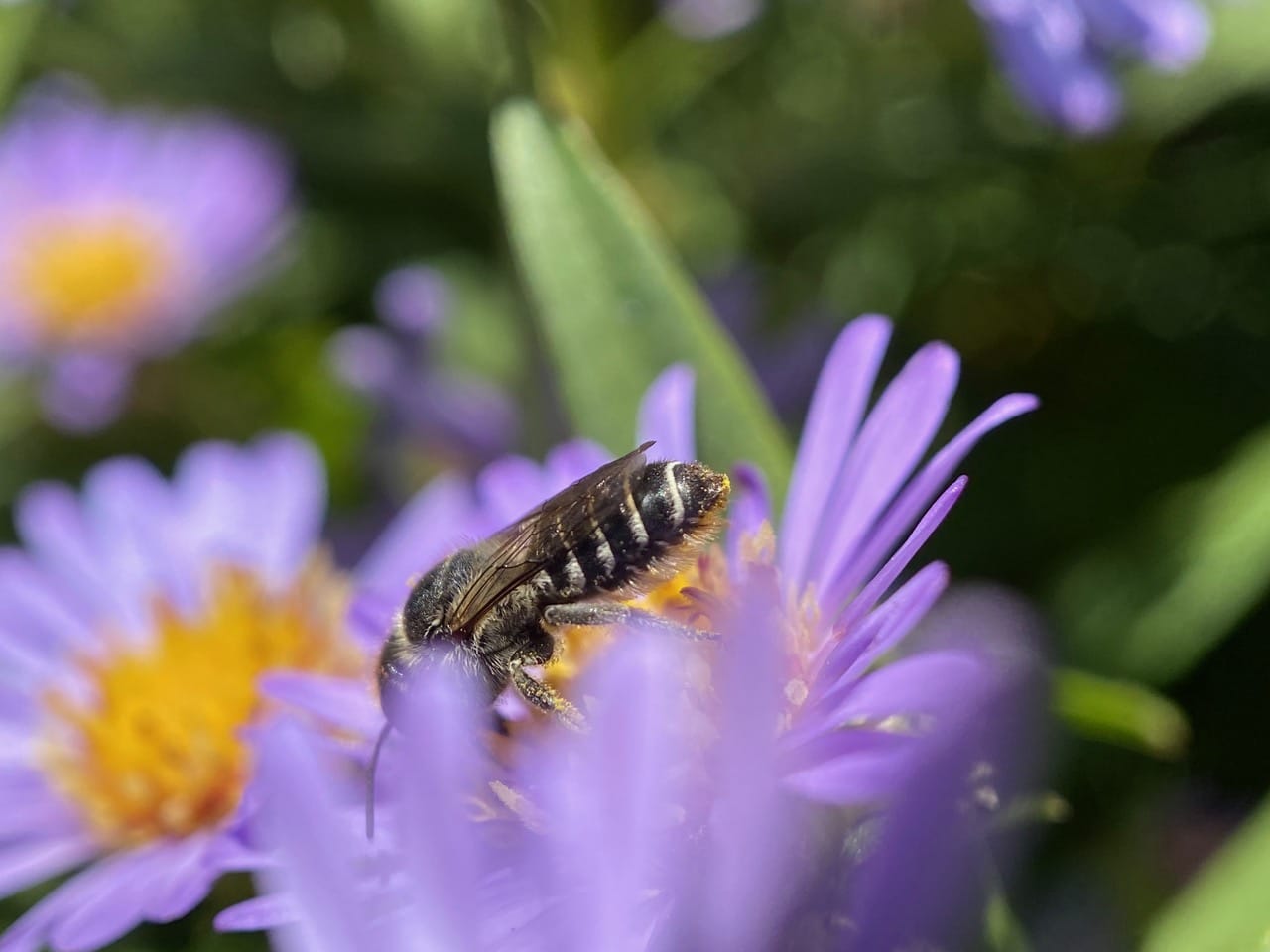
A female Western Leaf-cutter Bee, Megachile perihirta (family Megachilidae) is foraging on a flowerhead of Pacific Aster. Yellow pollen is visible on the underside of her abdomen where her scopa is located.
The female Leaf-cutter Bee assumes the typical posture while foraging. She holds her abdomen tip-up while taking nectar. She taps the anthers of the flowers lightly and rapidly with her abdomen while collecting pollen. The bees tend to favor flowers in the sunflower family Asteraceae which have a concentration of tightly packed florets on a relatively flat surface.
Leaf-cutter Bees, Megachile sp. (family Megachilidae) are stout-bodied, usually with pale hair on the thorax and stripes of white hairs on the abdomen. Females usually have a triangular abdomen with a pointed tip, and males’ faces are covered with dense, pale hair. Flight season is from May into September, with peak activity from June to August.
Solitary females construct nests in tubular cavities, including hollow stems, tree holes, and abandoned beetle burrows in wood. Many use holes drilled into wood, straws, or other manufactured tunnels. Females cut pieces from leaves or flower petals for use in the construction of brood cells. Most Megachile females are generalists when foraging for pollen. Pollen is transported in dense scopae on the underside of the abdomen.
I am lucky to get this close to a female Leaf-cutter Bee.
As she raises her abdomen, I can see the scopal hairs on the underside of her abdomen that is used to transport pollen
Even the tiny Common Grass Skimmer, Paragus haemorrhous (family Syrphidae) manages to scoot in for a share of the nectar and pollen offered by the Pacific Aster. The Common Grass Skimmer, Paragus haemorrhous (family Syrphidae) is one of the smallest hover flies we have, measuring only about 4 mm in length. The species has a world-wide distribution, found in unimproved grassland, dune grass, open areas and pathsides in forest, and meadows. Adults visit flowers for nectar and pollen. Larvae feed on aphids on low herbaceous plants.
Photos of Common Grass Skimmer (Paragus haemorrhous) · iNaturalist
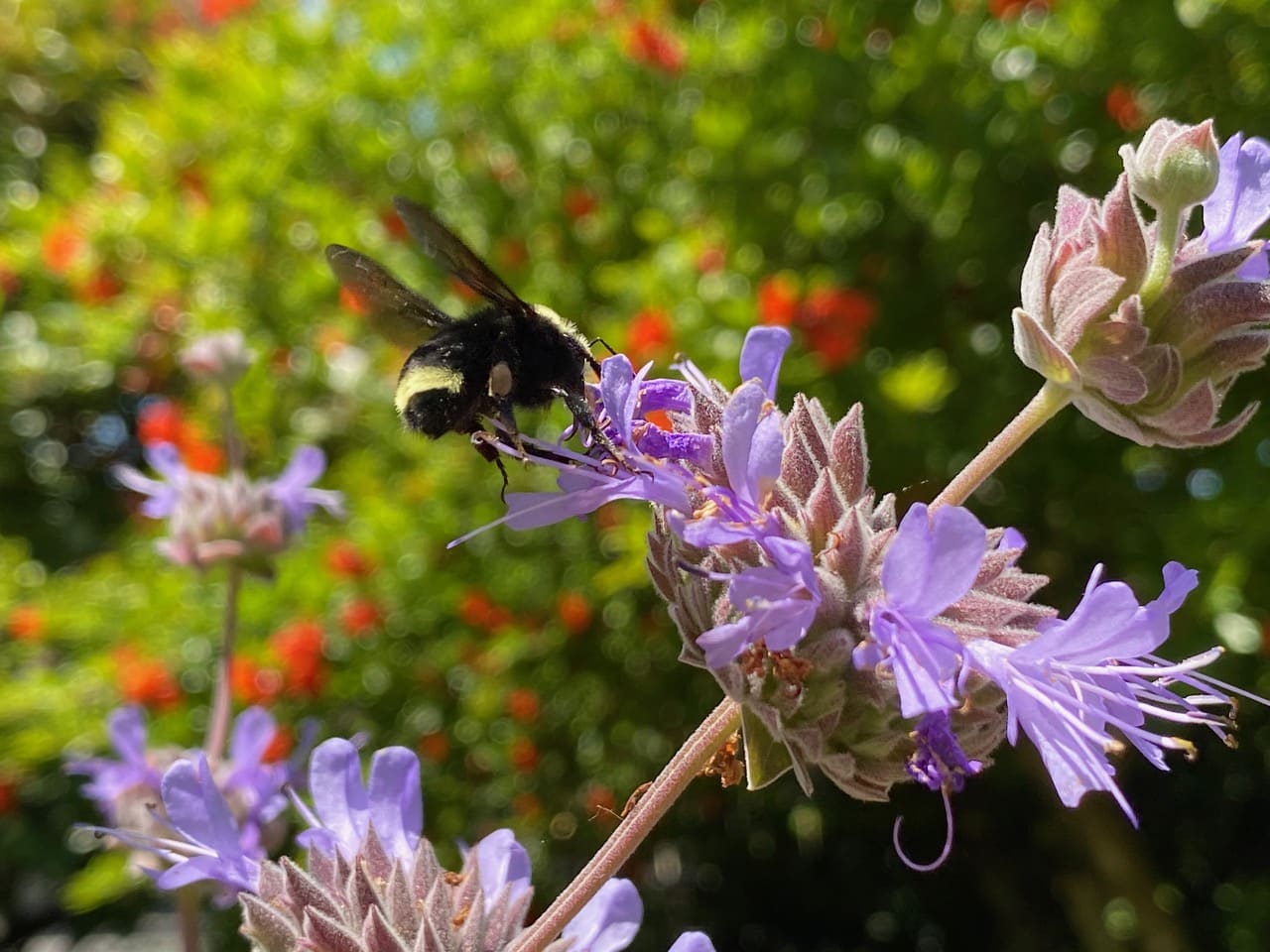
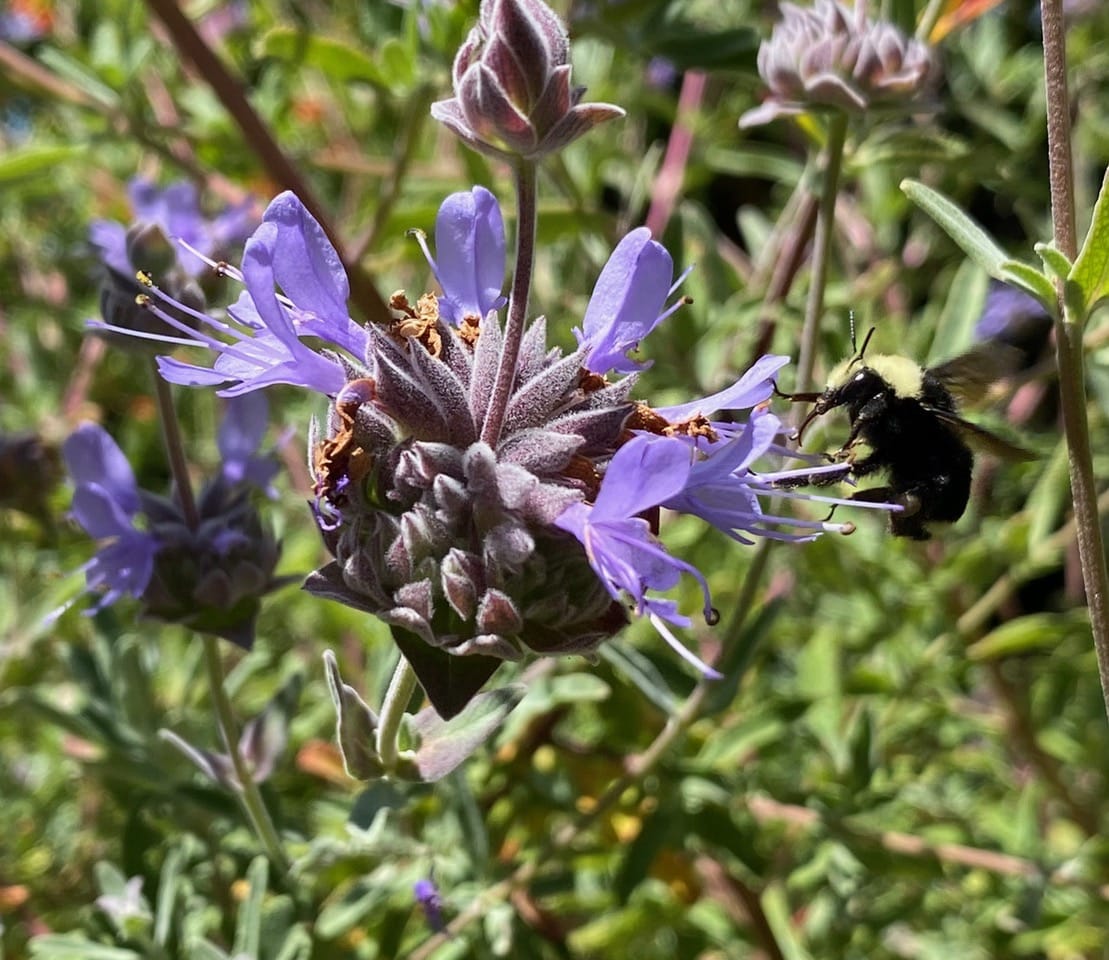
In the back of the garden, bumble bees are buzzing around the large inflorescences of a Cleveland Sage, Salvia clevelandii x ‘Bozo Blue’. The bees would occasionally land and reach in for nectar. I am not sure how they collect pollen from these small flowers, or if the pollen in their pollen baskets were gathered from the sage.
Her tongue still extended, a Yellow-faced Bumble Bee, Bombus vosnesenskii (family Apidae) backs away from a flower of Cleveland Sage from which she has been taking nectar.
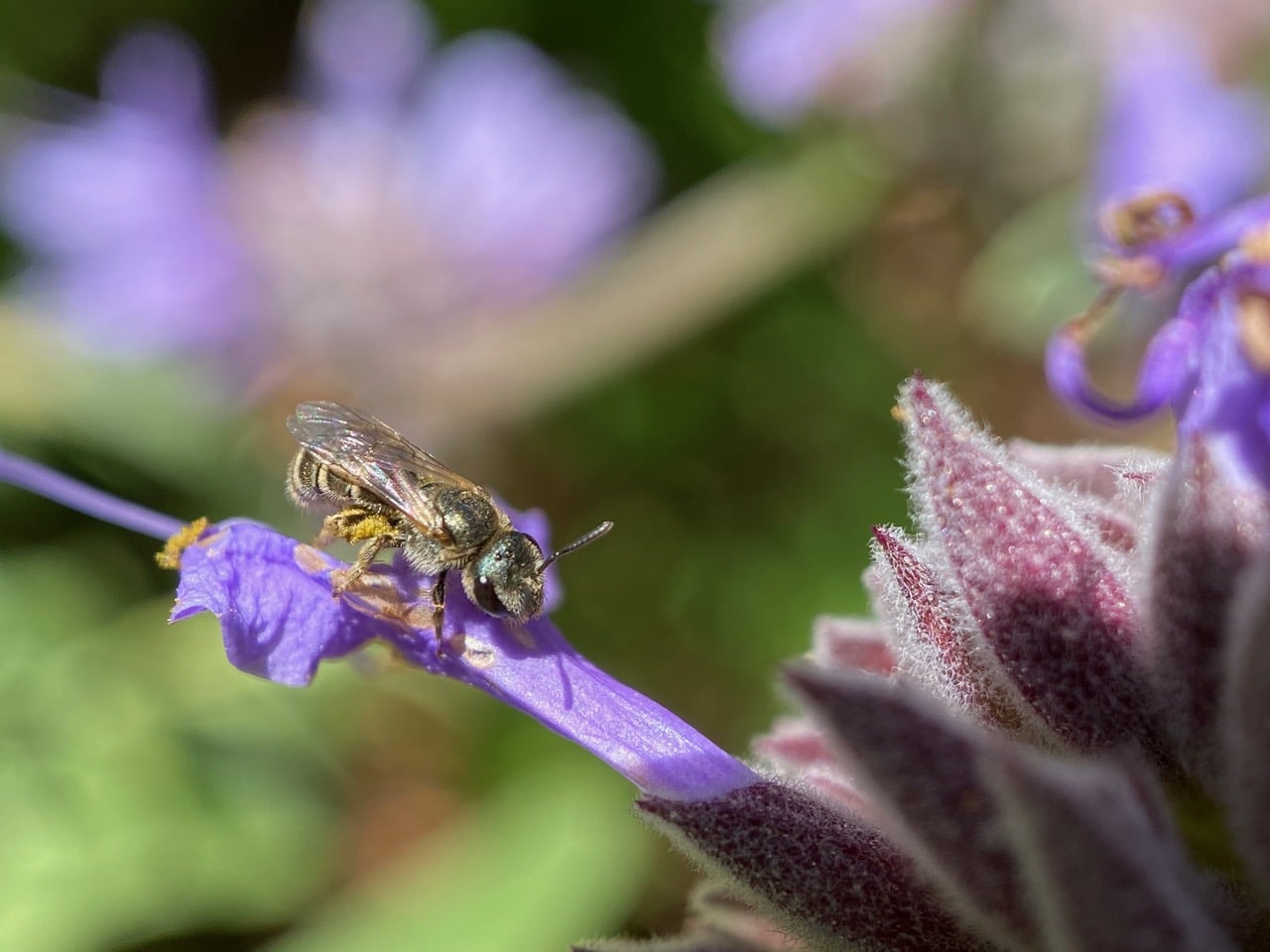
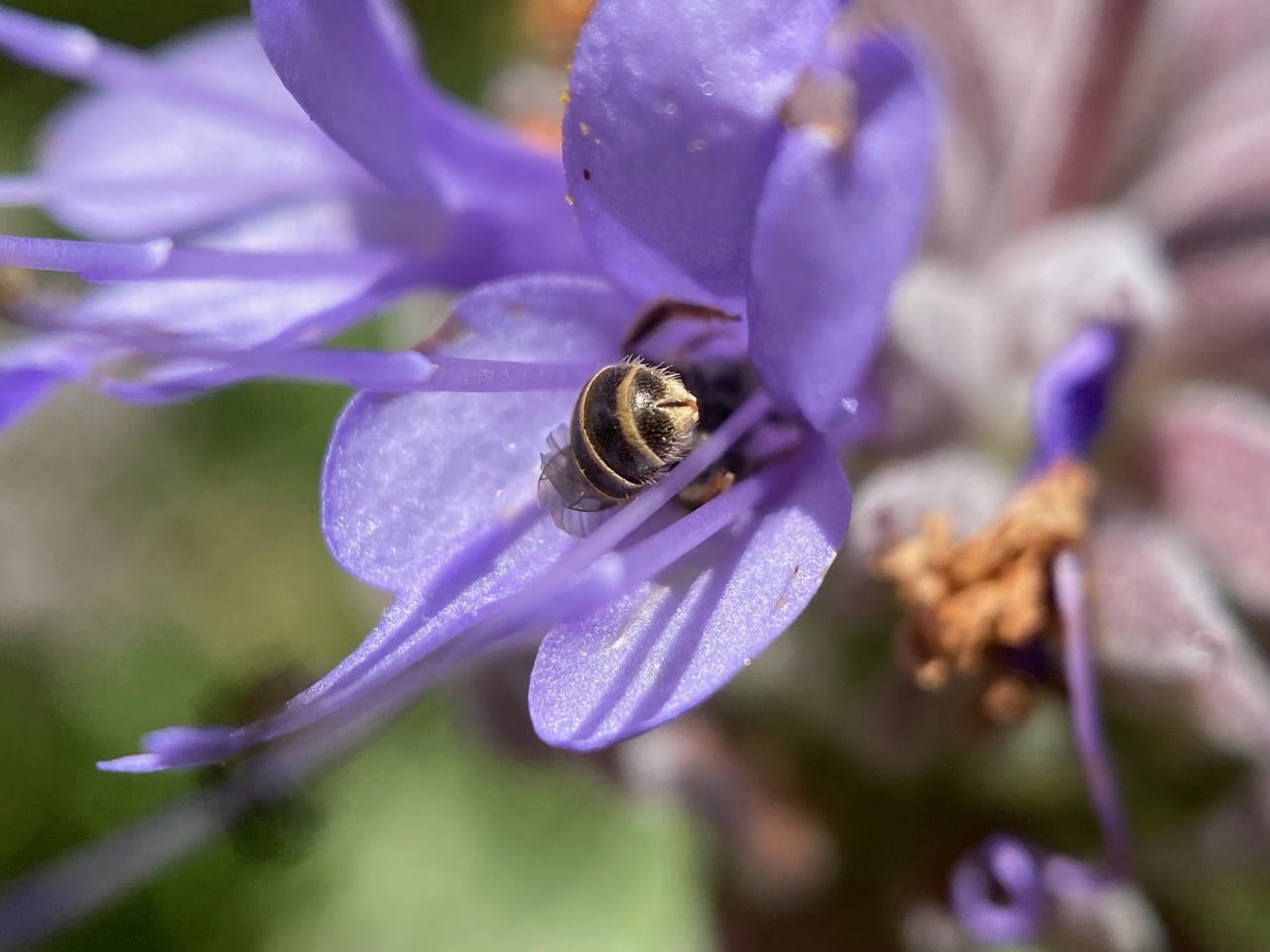
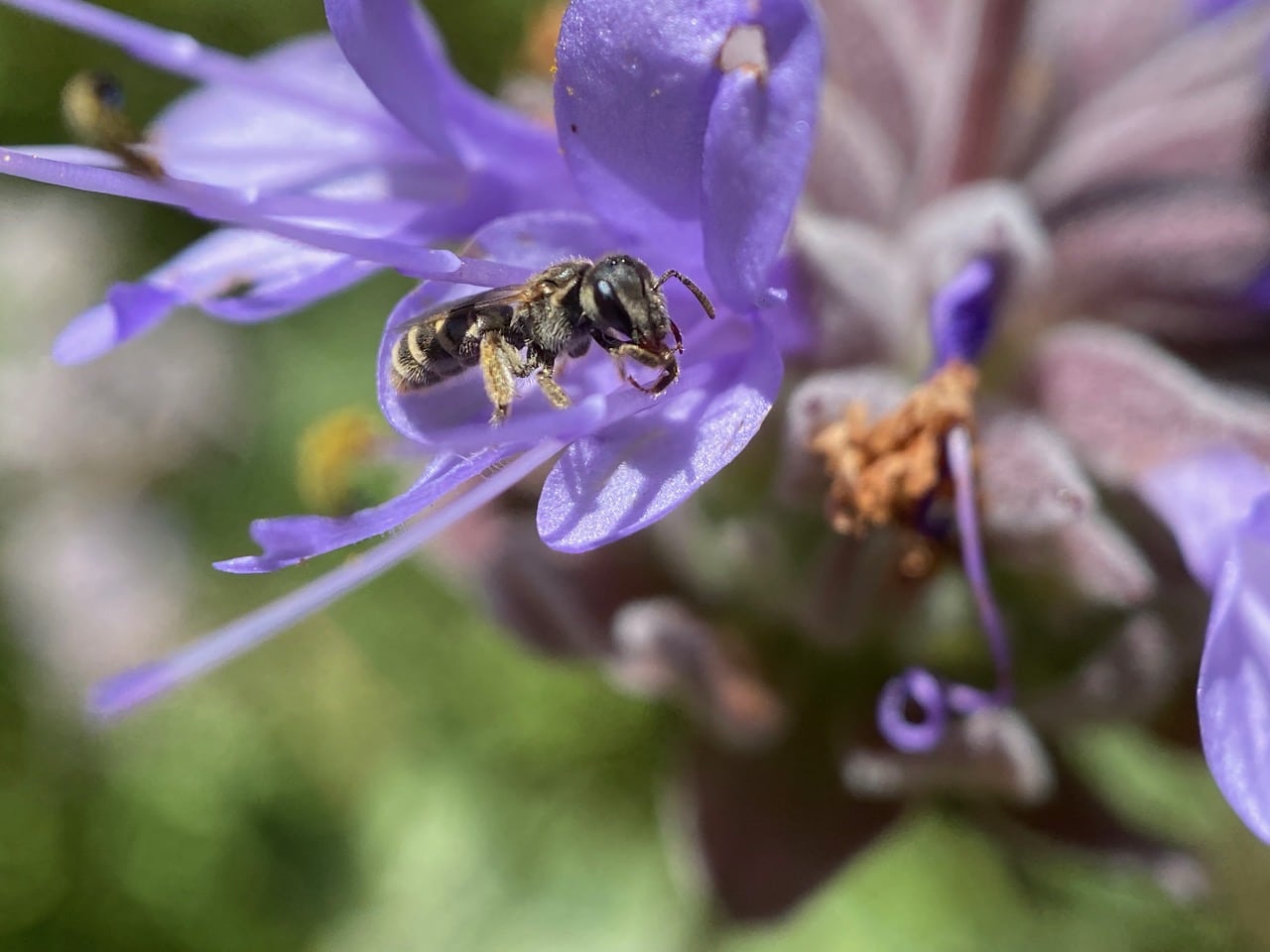
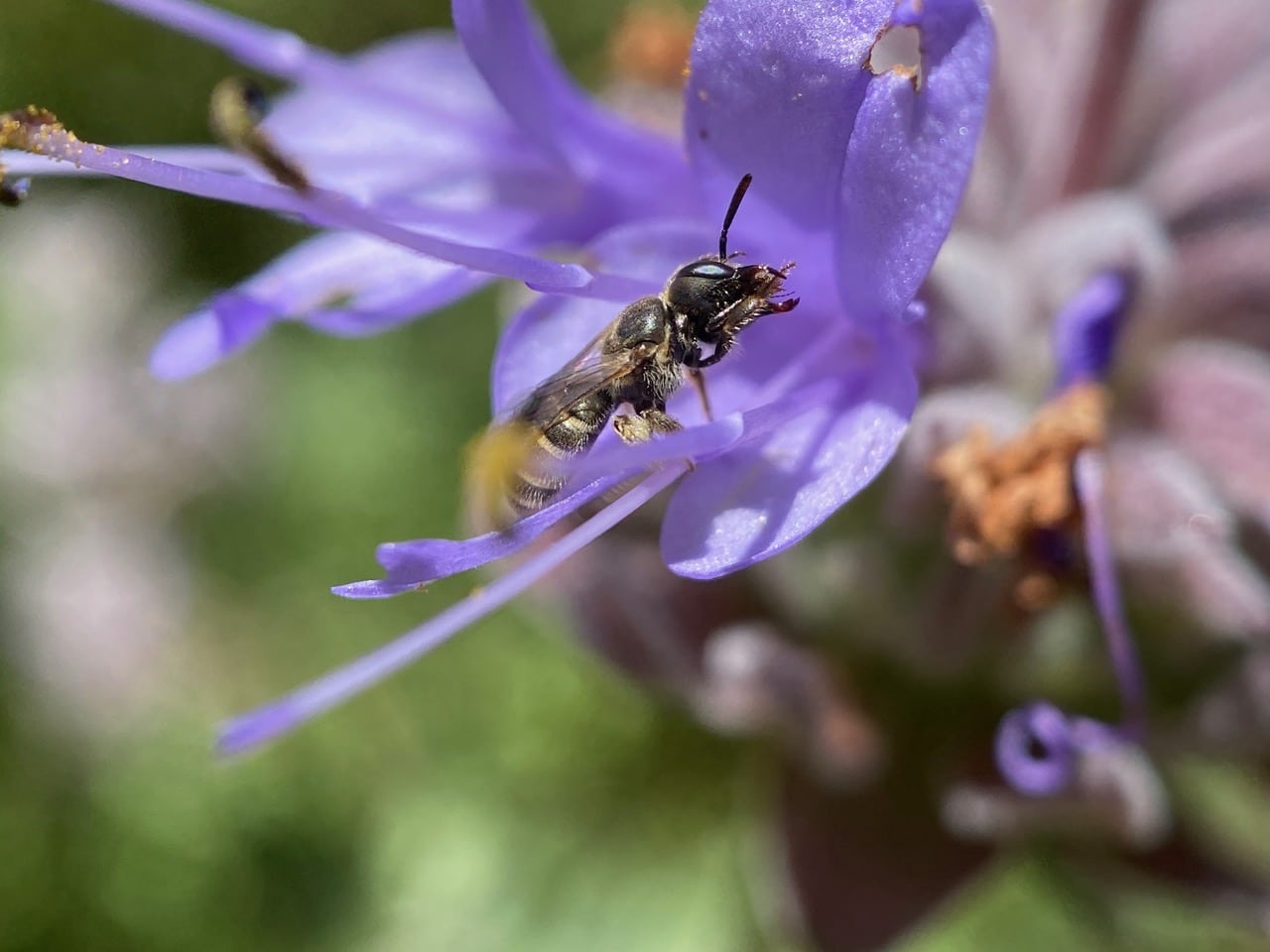
I begin to notice small bees on the Cleveland Sage flowers. A Sweat Bee, Halictus sp. (family Halictidae) has landed on a fading flower. The little bee approaches the fresh flowers on the inflorescence, and dives into one. Note the furrow at the tip of her abdomen – it confirms her identity as a “Furrow Bee” in the genus Halictus (family Halictidae).
The “furrow”, only present in females. This is the reason why Halictus are sometimes called Furrow Bees. The furrow on the last tergite (top segment of the abdomen) is referred to as a ‘rima’. The purpose of this feature is unknown.
Time for serious grooming! Note the bee’s mandibles.
A small fly hovers over the young flower buds of Cleveland Sage.
The fly settles on an immature inflorescence of Black Sage. I can see the four diamond-shaped yellow markings near the tip of its abdomen. It is a Diamond Spottail, Fazia micrura (family Syrphidae).
The Diamond Spottail, Fazia micrura is a Nearctic species that occurs in western North America, from British Columbia south to California and Texas; and Mexico. The adult and larva feed on pollen. Females lay eggs on flowers. Larvae are often encountered in the field chewing through the calyx and corolla of unopened flower buds. They are known to feed on pollen in the anthers. Usually only one larva is found in each flower.
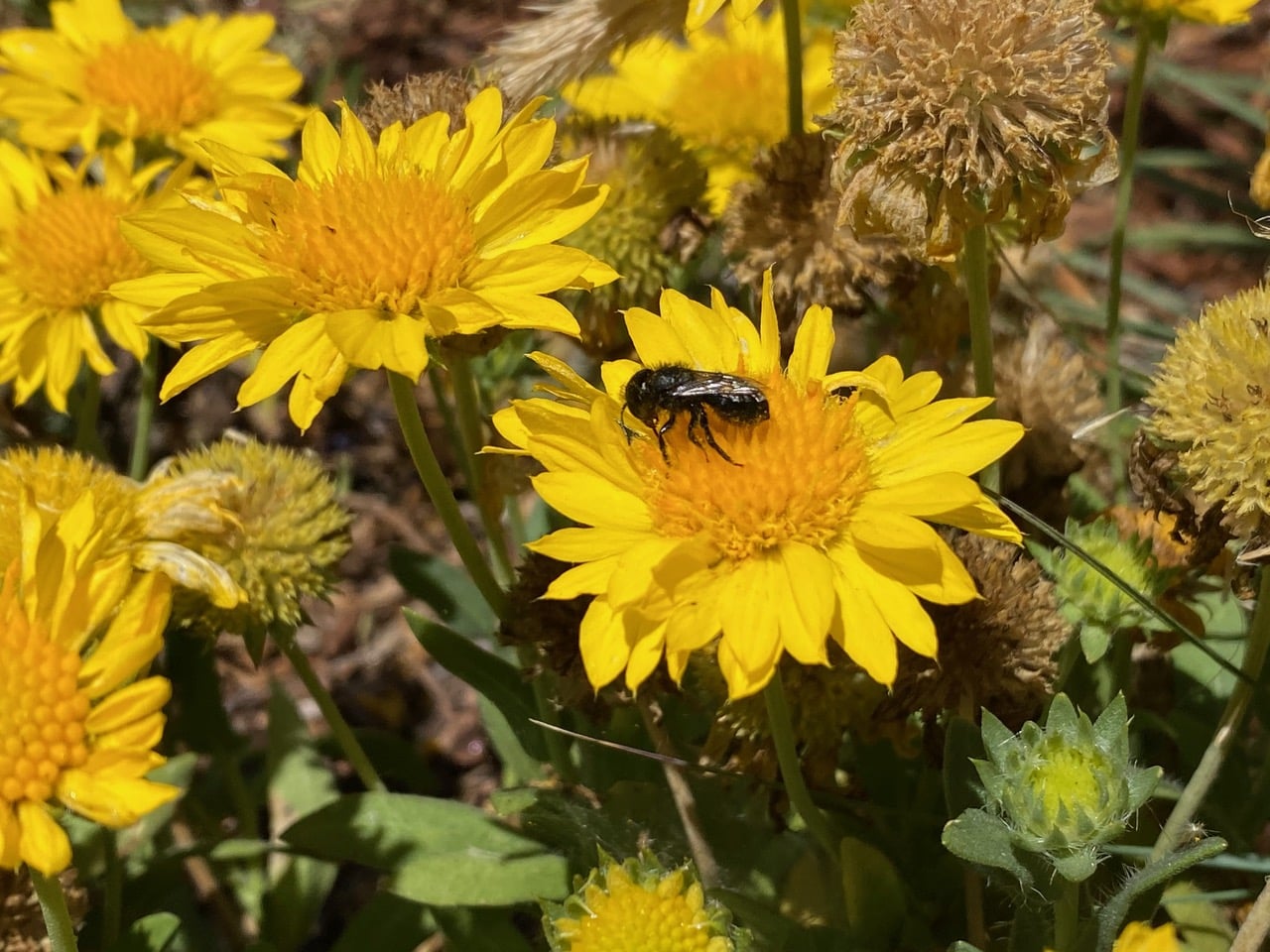
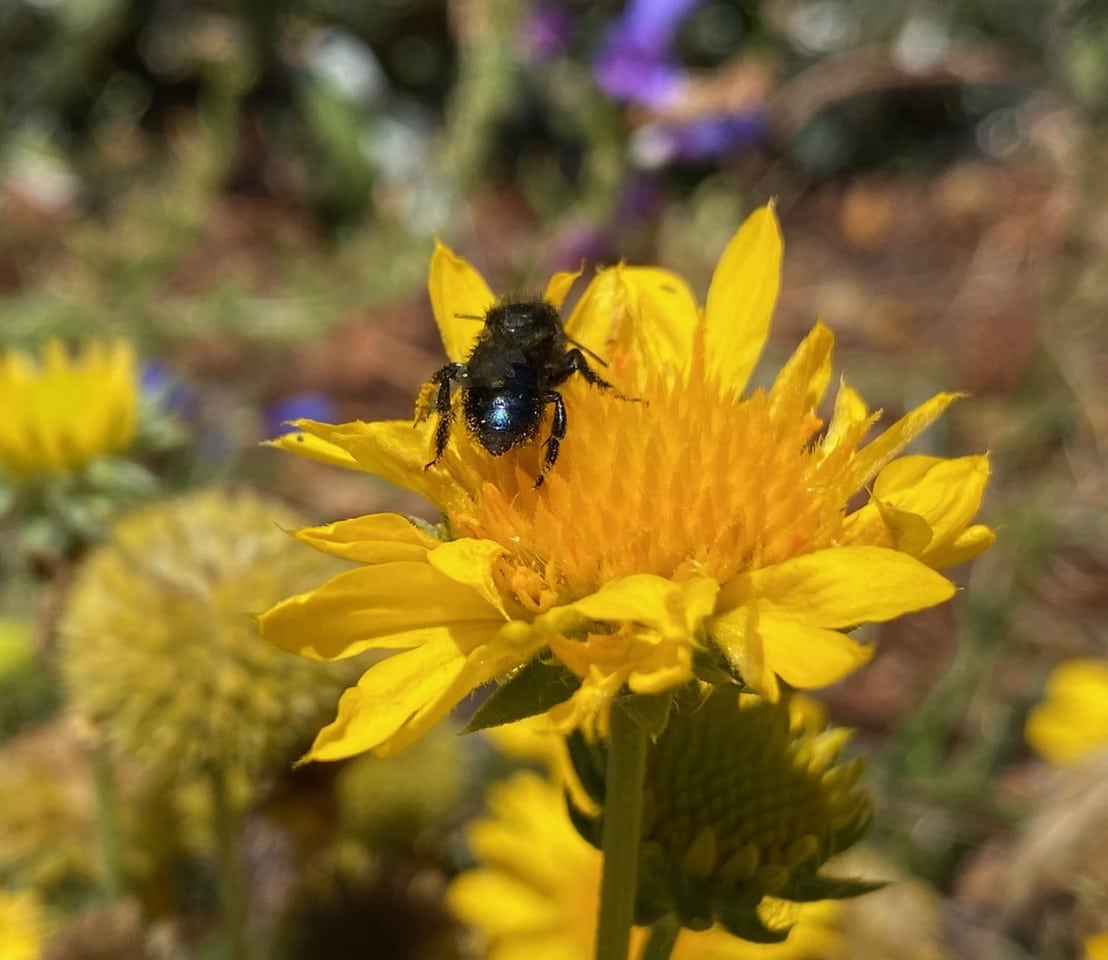
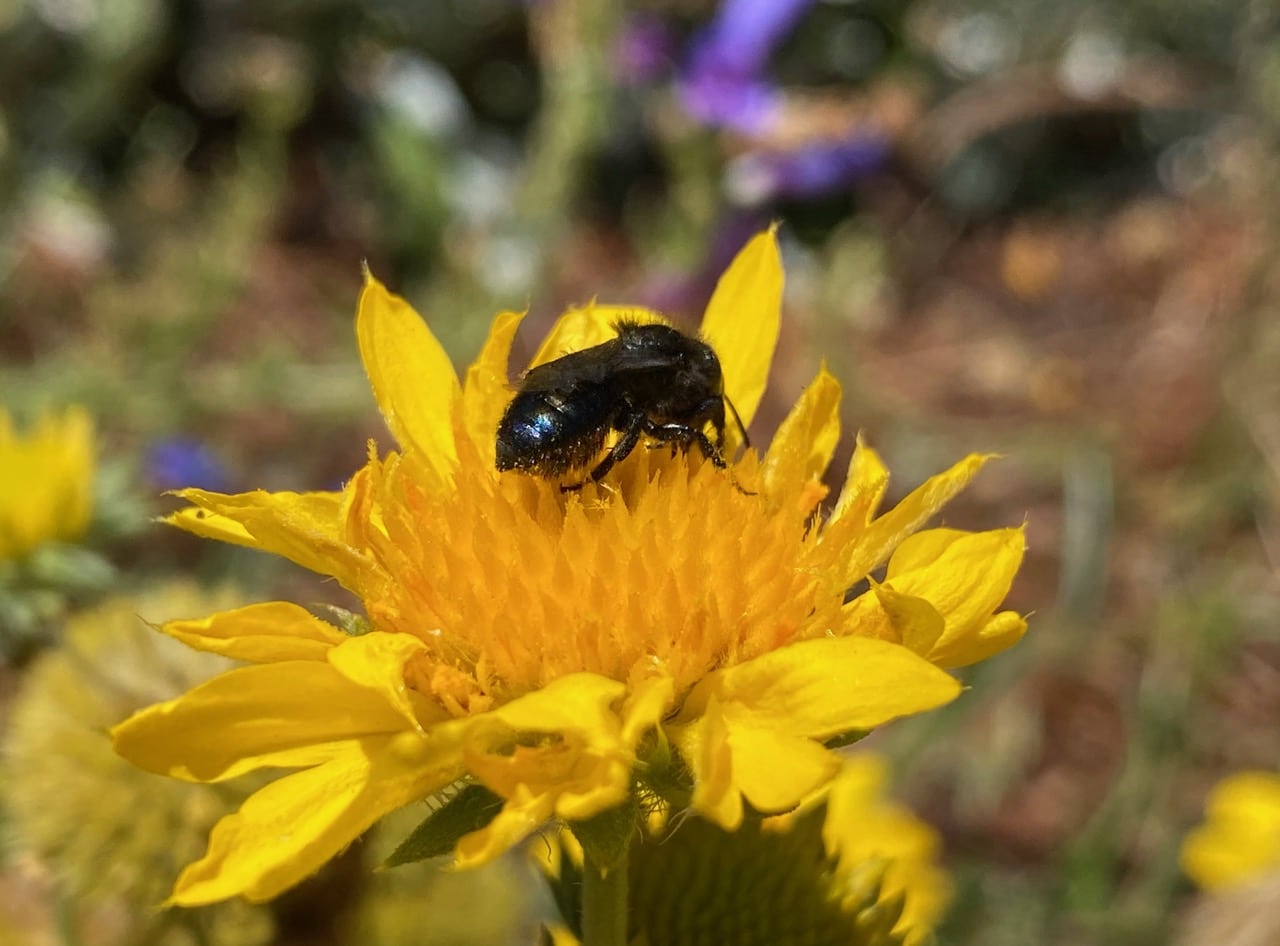
Ooh, who’s that jet-black bee on the Blanket Flower?
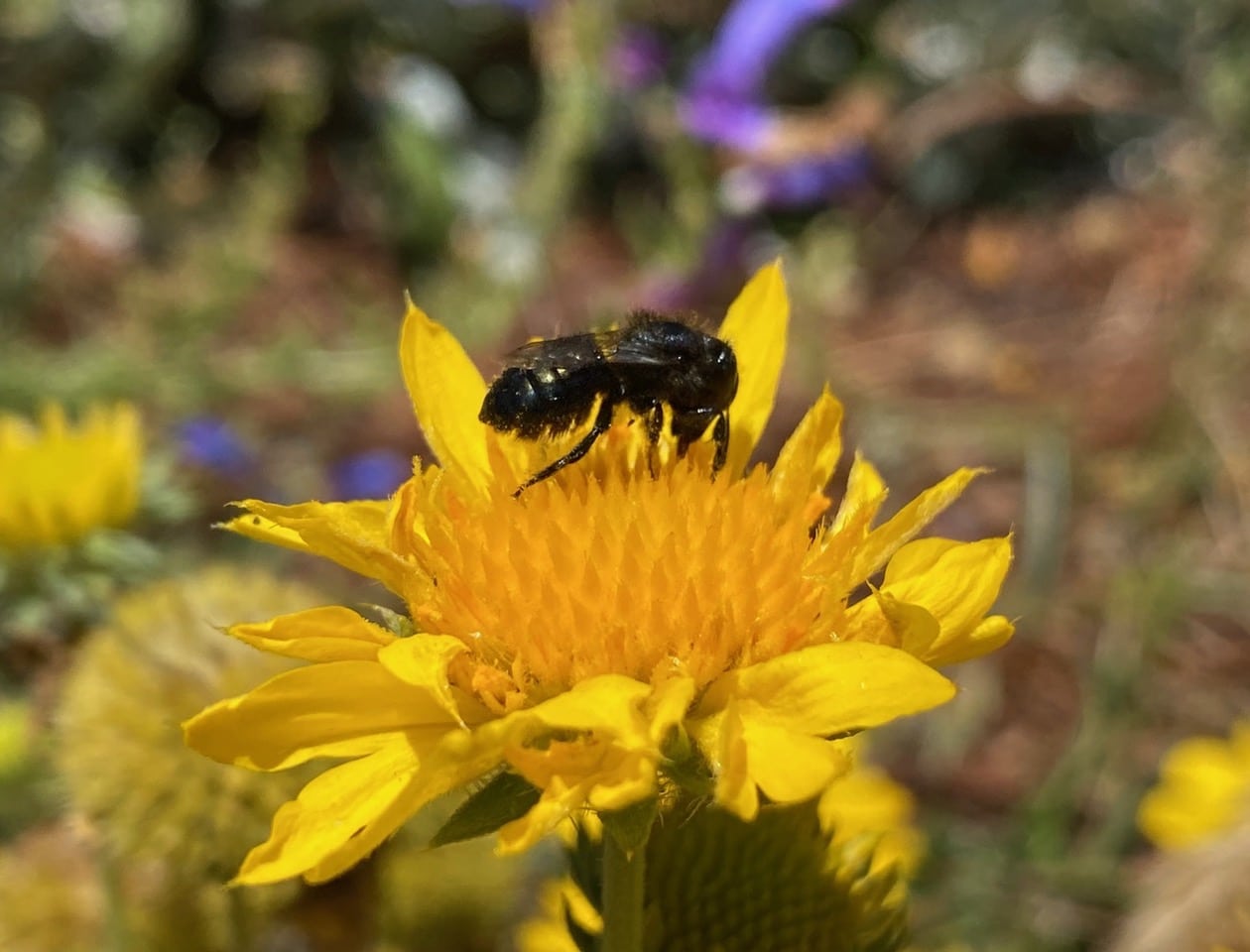
The bee is black all over. Even her hairs are jet black. She appears to have a large head and jaws.
Hmm… the female bee has no scopa on her hind legs.
Ahh, that’s the view I was hoping for! Note the shaggy, dark hairs on the underside of her abdominal segments?
The glossy, metallic body, and the abdominal scopa all point to a Mason Bee, Osmia sp. (family Megachilidae). iNaturalist has identified the bee to the subgenus, Cephalosmia.
Mason Bee is a name commonly used for species of bees in the genus Osmia, of the family Megachilidae. Mason Bees are named for their habit of using mud or other “masonry” products in constructing their nests, which are made in naturally occurring gaps/cavities such as cracks in stones, hollow stems or holes in wood made by wood-boring insects. Osmia means ‘odor’, and refers to a faint lemony scent used by these bees to mark their nest entrances. Osmia species are frequently metallic green or blue. Females have black ventral scopae (special pollen collecting hairs) on the underside of their abdomen, which are difficult to see unless laden with pollen. Ventral abdominal scopae is a feature shared by all members of the Megachilidae family, which includes the wool-carder bees (genus Anthidium), and leaf-cutter bees (genus Megachile).
Mason Bees are a solitary species. Every female is fertile and makes her own nest. Each nest cell is provisioned with pollen and contains one egg which will develop into a larva. The female creates a partition of mud between the nest cells. The process continues until she has filled the cavity. She plugs the entrance to the cavity, and then may seek another nest location. The larvae that hatch out consume their provisions and begin spinning a cocoon around itself and enters pupal stage. Adults mature in fall or winter, hibernating inside its cocoon.