

Pollinator Post 6/28/24 (2)
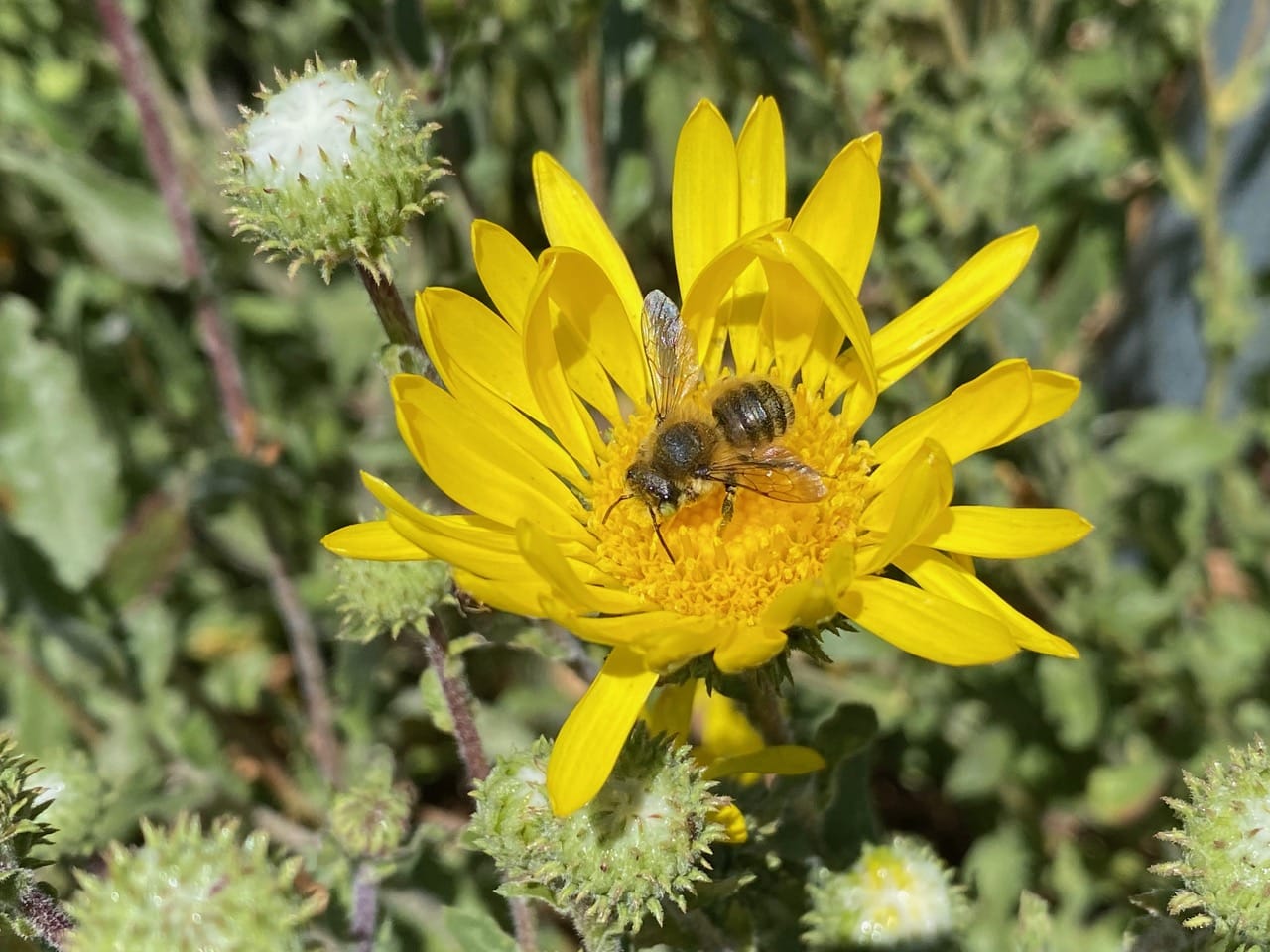
A large Hairy Gumweed, Grindelia hirsutula by the curb on the side of the house is in peak bloom. A male Western Leafcutter Bee, Megachile perihirta visits one of the fresh flowerheads.
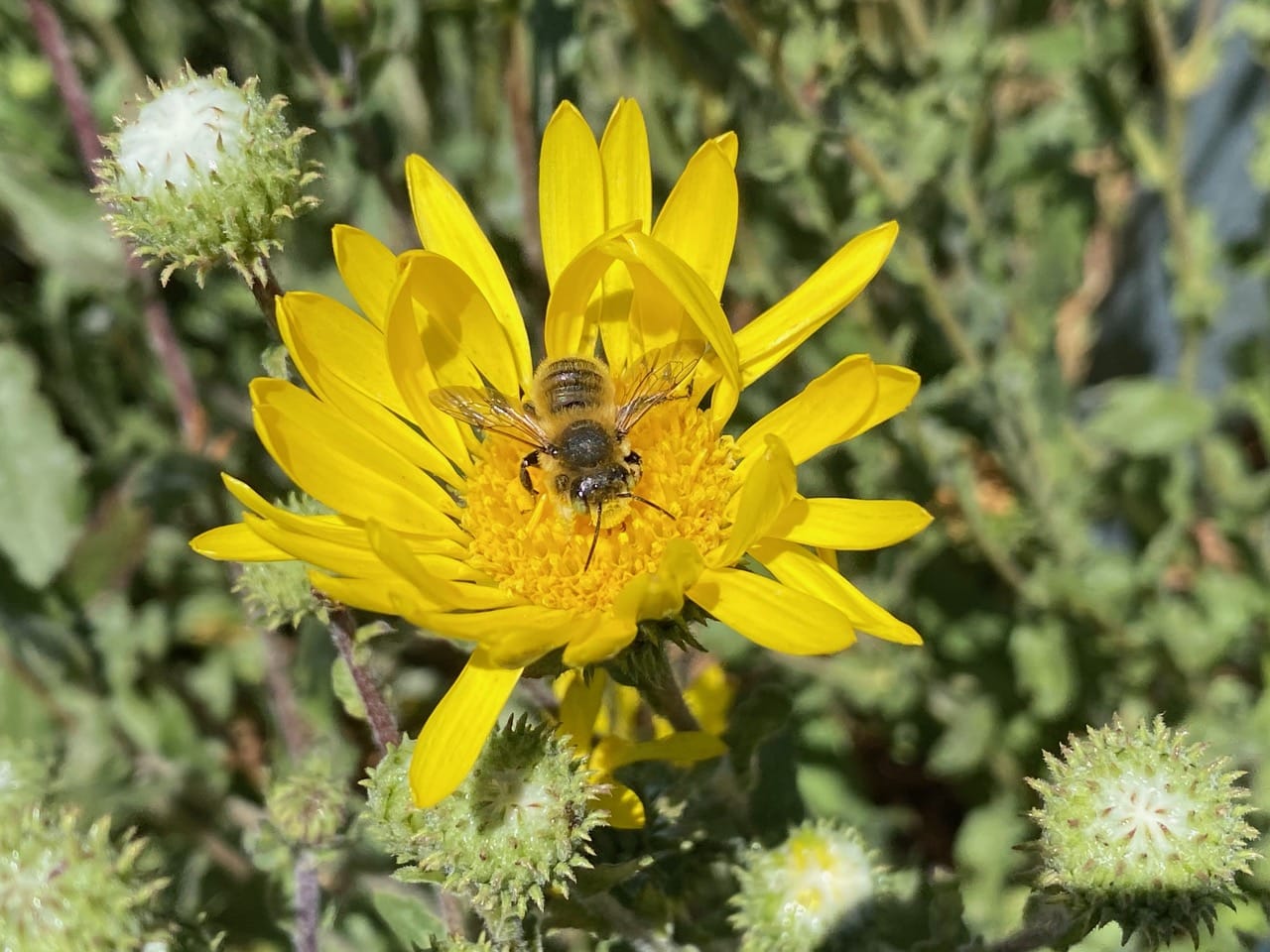
As the bee turns his head, I can see the handsome yellow mustache on his face.
Leaf-cutter Bees, Megachile sp. (family Megachilidae) are stout-bodied, usually with pale hair on the thorax and stripes of white hairs on the abdomen. Females usually have a triangular abdomen with a pointed tip, and males’ faces are covered with dense, pale hair. Flight season is from May into September, with peak activity from June to August.
Solitary females construct nests in tubular cavities, including hollow stems, tree holes, and abandoned beetle burrows in wood. Many use holes drilled into wood, straws, or other manufactured tunnels. Females cut pieces from leaves or flower petals for use in the construction of brood cells. Most Megachile females are generalists when foraging for pollen. Pollen is transported in dense scopae on the underside of the abdomen.
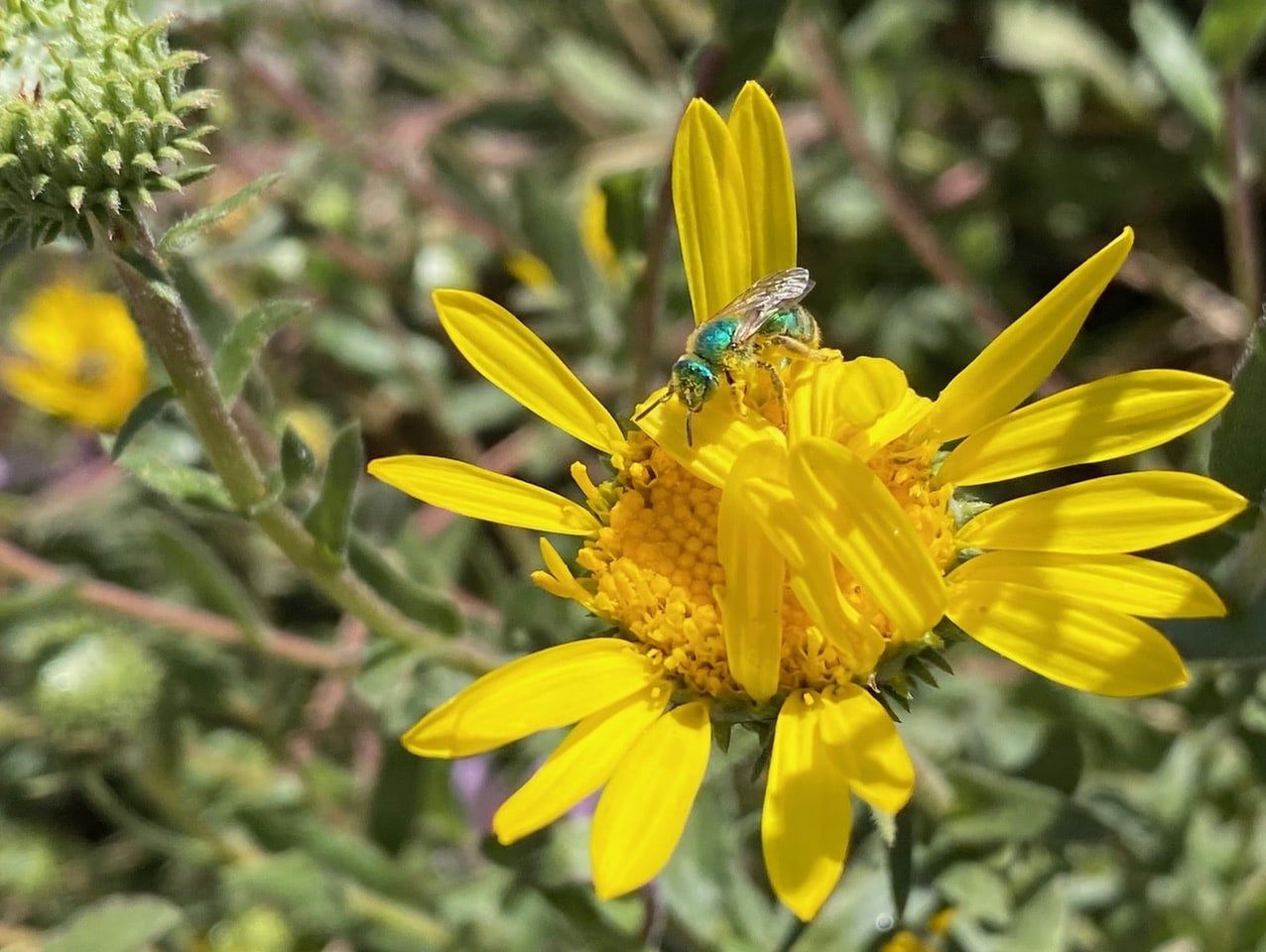
In a flash of iridescent green, a female Striped Sweat Bee, Agapostemon sp. (family Halictidae) lands on a partially opened flowerhead of Hairy Gumweed, Grindelia hirsutula.

The genus Agapostemon is widespread and abundant throughout North America. They are most diverse and abundant in temperate regions and southwestern U.S. deserts. Agapostemon are commonly called “sweat bees” because they are closely related to, and resemble bees in the Halictus and Lasioglossum genera. Unlike those bees however, Agapostemon are not attracted to human sweat.
Agapostemon are brightly colored metallic green or blue bees measuring 7 to 14.5 mm long. Most species have a metallic green head and thorax, and black-and-yellow striped abdomen; some females are entirely bright green or blue. Females carry pollen on scopal hairs located on their hind legs. Agapostemon are generalists. Like other members of the family Halictidae, they are short-tongued and thus have difficulty extracting nectar from deep flowers. Males are often seen flying slowly around flowers looking for females. The bees favor flowers with high densities. These are summer to fall bees.

Agapostemon females dig deep vertical burrows in flat or sloping soil, or sometimes in banks. Most species are solitary, but some species nest communally. Up to two dozen females may share a single nest entrance, but each individual builds and provisions its own cluster of brood cells. Where a communal nest gallery shares a single entrance, one bee usually guards the hole, with only her head visible from above ground. Unlike other social bees, in communal bees there is no reproductive division of labor. In cool temperate regions, there is one generation per year, with females active in the early summer and males and pre-diapausing females active in the late summer. Only mated females survive the winter. This is probably because unmated females cannot enter diapause (insect version of hibernation).

The bee pokes its head under the unfurled ray petals of the flowerhead.

Her scopae packed with yellow pollen, a different female Sweat Bee, Agapostemon sp. (family Halictidae) is foraging on a freshly opened flowerhead of Grindelia. She is collecting pollen from the tips of the anther tubes of the florets around the edge of the flowerhead.
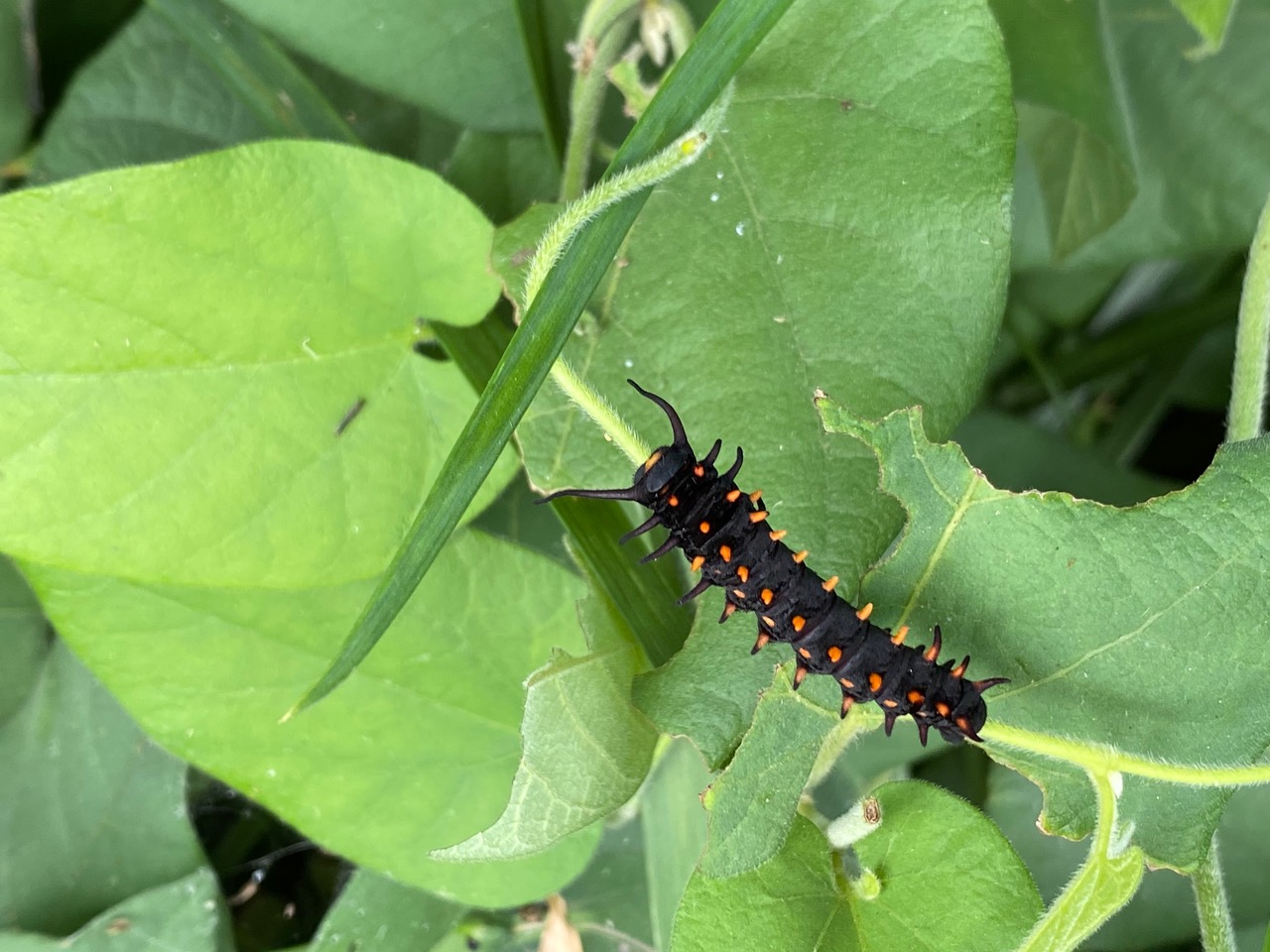
A Pipevine Swallowtail caterpillar is feeding on a leaf of California Pipevine, Aristolochia californica. While the adult butterflies take nectar from many different flowers, the caterpillars feed only on Pipevines (genus Aristolochia), their sole food plant. Not only are the larvae able to tolerate the poison, aristolochic acid in the leaves, they are able to sequester it in their body as a defense mechanism. The striking orange-red tubercles on their black body serve to warn potential predators of the poison.

Under a sturdy leaf of a large Agave plant next to the patch of Pipevine, I find the same Pipevine Swallowtail chrysalis that I saw on my last visit on 6/19/24.
Note the silk harness that loops around the chrysalis and holds it in place. It is constructed by the Swallowtail caterpillar right before it molts for the last time and transforms into a chrysalis.
The chrysalis stage in Pipevine Swallowtail typically lasts 10-20 days (except for overwintering pupae). Insect development is highly dependent on temperature; given the extreme warm temperatures in the forecast for the coming week, this butterfly should be eclosing any time now!
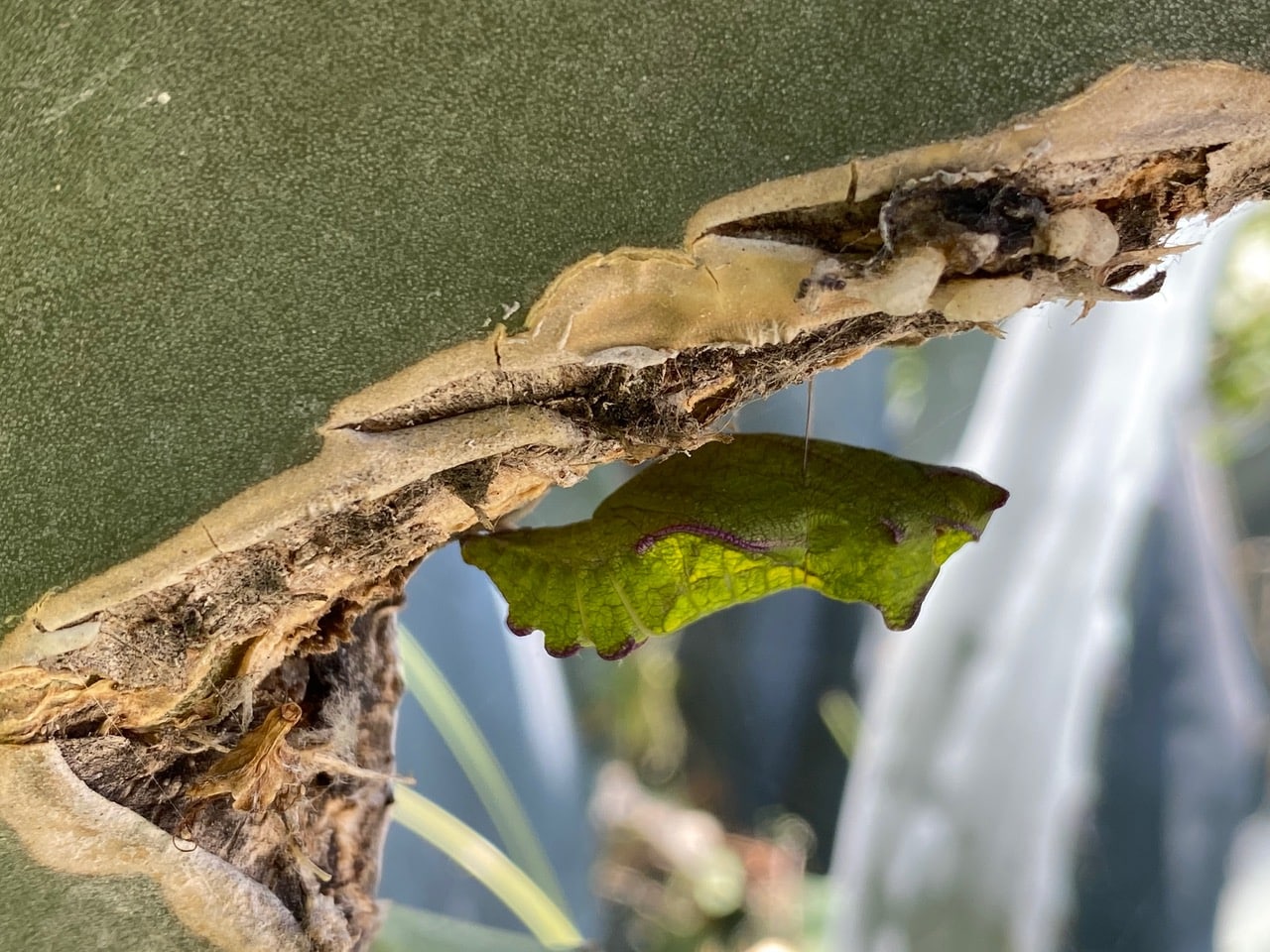
Ooh, I find another chrysalis, also green (They come either green or brown.) This one is hanging on the scar tissue of a large Prickly Pear Cactus adjacent to the Agave.
Most caterpillars do not pupate on the host plants that they feed on. When mature, they wander off in search of a protected site. They often use surfaces that are hard and firm, such as a tree trunk or fence post.
It was formerly thought that pupation is a quiescent resting period in a butterfly’s life cycle. Nothing can be further from the truth. The chrysalis is a hotbed of demolition and reconstruction.