

Pollinator Post 6/29/24

I visit a neighbor’s garden this morning. Although I have been passing his house in the car for years, I haven’t realized what a gem of a garden it has.
About half of Tim’s spacious backyard on a slope is covered with a golden riot of blooming Elegant Tarweed, Madia elegans.

Tim has suggested that I visit before 10 am, as the Elegant Tarweed closes its flowerhead when the day heats up.




Unusual among plants, Madia starts to close its flowerheads at mid-morning when the day heats up. The flowerheads open up again in the cool of the evening through the next morning. Why does Madia do this?
The Madia flowerhead closes on hot days because it lacks a way to prevent moisture loss. While the closing seems to happen by the clock, it’s really because the drought stress is worse at about the same time each day. The leaves and stems have a very efficient way to avoid wilting – they contain a mucilage (gel-like substance) that holds water tightly. But this material is lacking in the flowers. Closing the flowerheads reduces the surface from which water can evaporate, preventing desiccation. From my own observation, each Madia flowerhead can go through the opening/closing cycles for about 5 days before senescing.
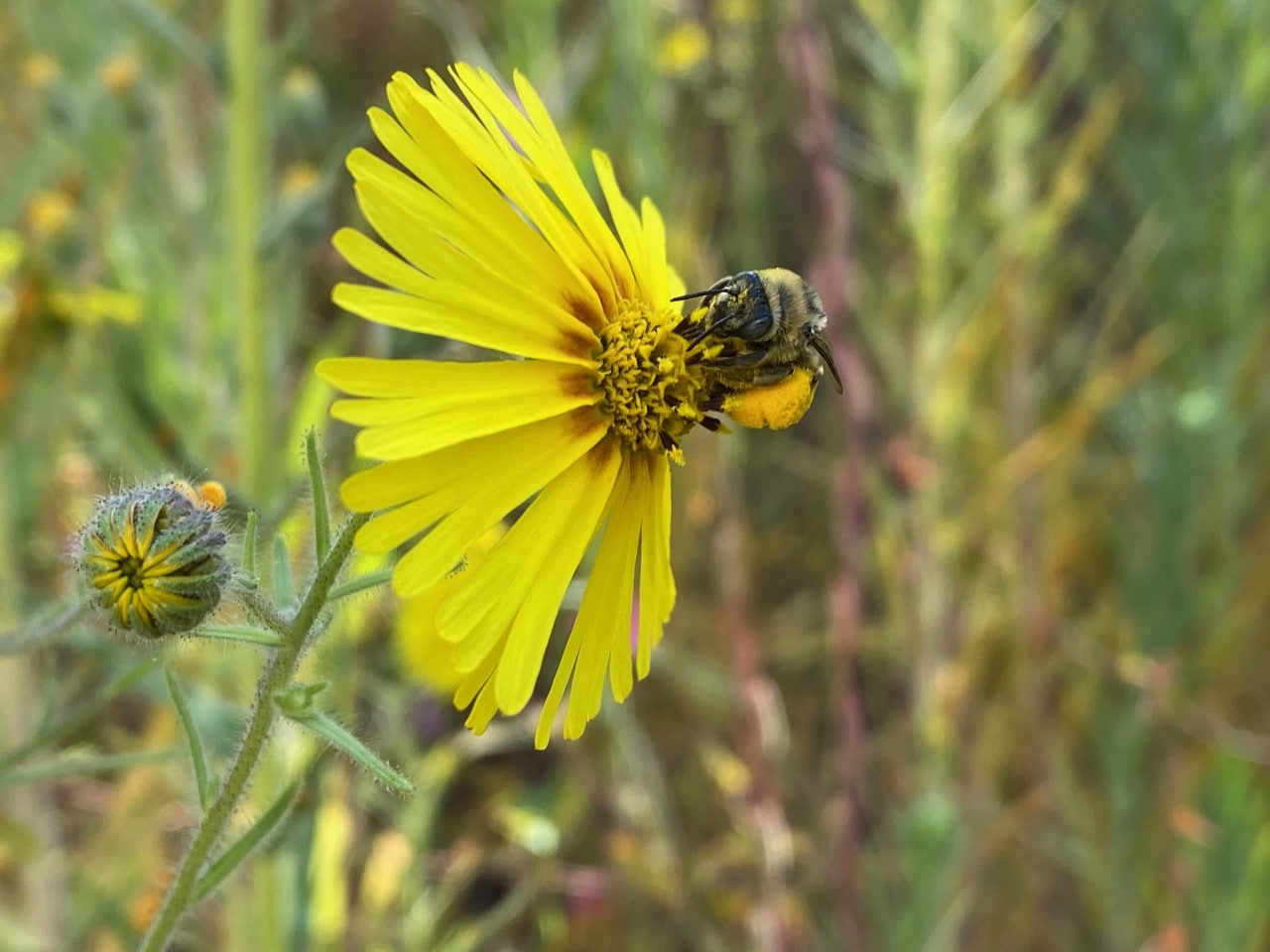
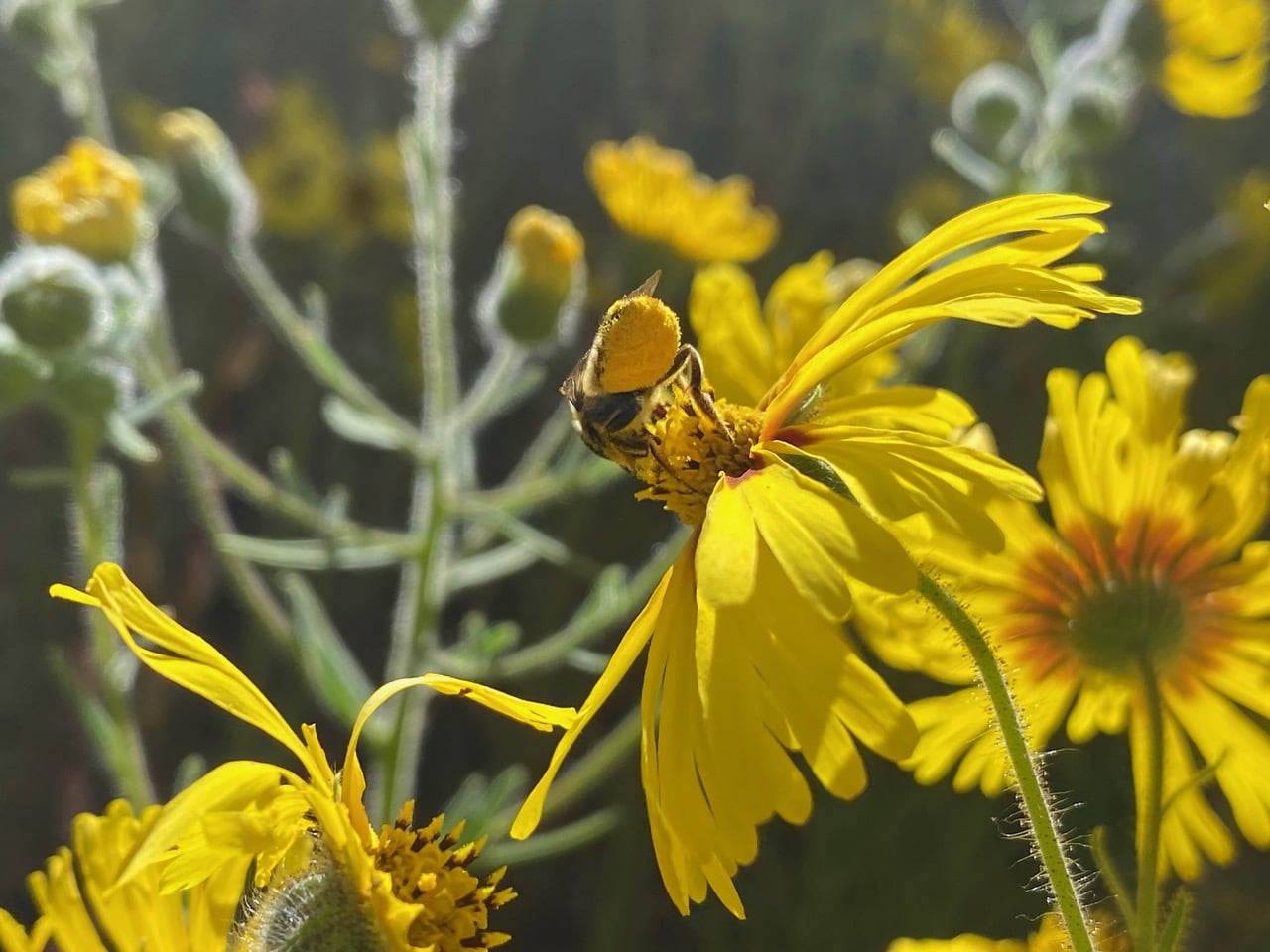
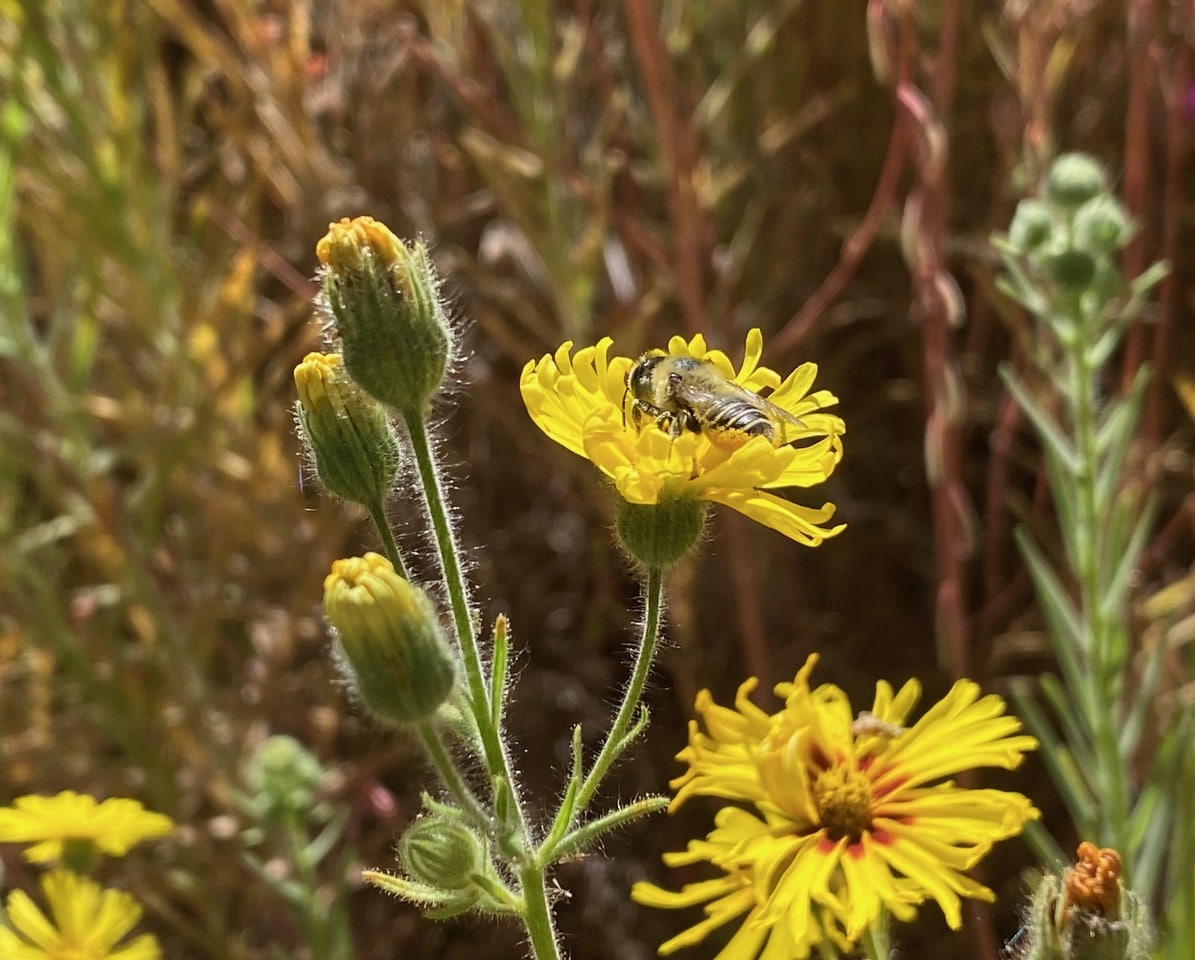
Although there are many interesting plants in bloom in the garden, I decide to concentrate on the Elegant Tarweed as there is so much bee activity on the blooms. Among the first bees I encounter is this female Western Leaf-cutter Bee, Megachile perihirta (family Megachilidae). Note the yellow pollen in the scopa on the underside of her abdomen.
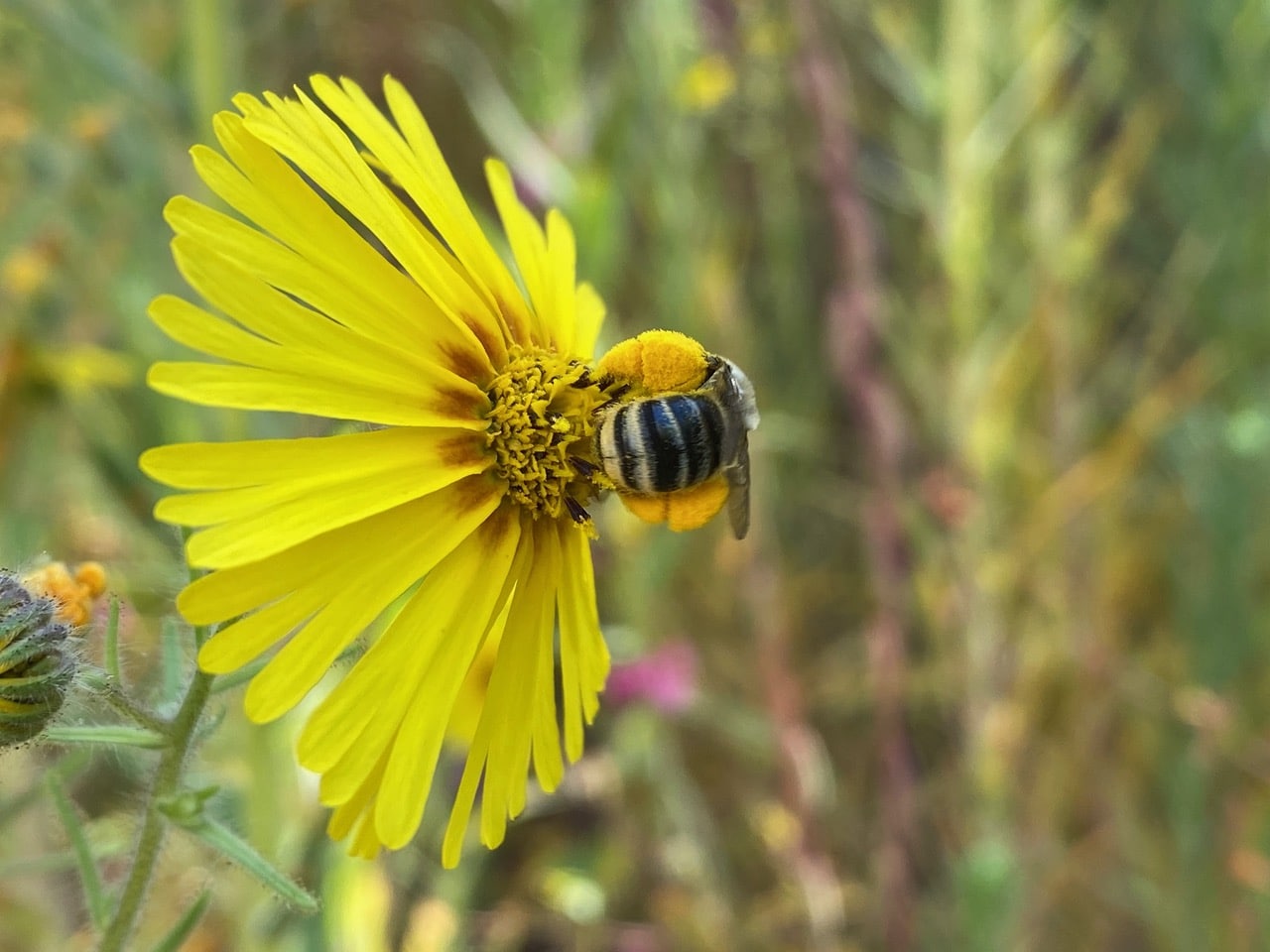
Ooh, our pollen gathering superstar – the female Summer Longhorn Bee, Melissodes sp. (family Apidae)!
The robust little bee pivots around swiftly but steadily on the flowers to collect pollen into the huge scopae on her hind legs.
The Summer Longhorn Bees, Melissodes sp. (family Apidae) are medium to large bees, stout-bodied, usually with gray hair on the thorax and pale hair bands on the abdomen. Males usually have yellow markings on their faces and have very long antennae from which their common name is derived. They are active May to September, with peak flight in late June to early August. The females prefer flat, bare ground for digging their solitary nests, though they sometimes nest in aggregations. Pollen is transported in scopae on the hind legs. Pollen loads are often copious and brightly colored and thus very distinguishable. Melissodes are specialists on Asteraceae – females gather pollen from flowers of Aster, Bidens, Coreopsis, Cosmos, Encelia, Gaillardia, Helianthus, and Rudbeckia ssp.
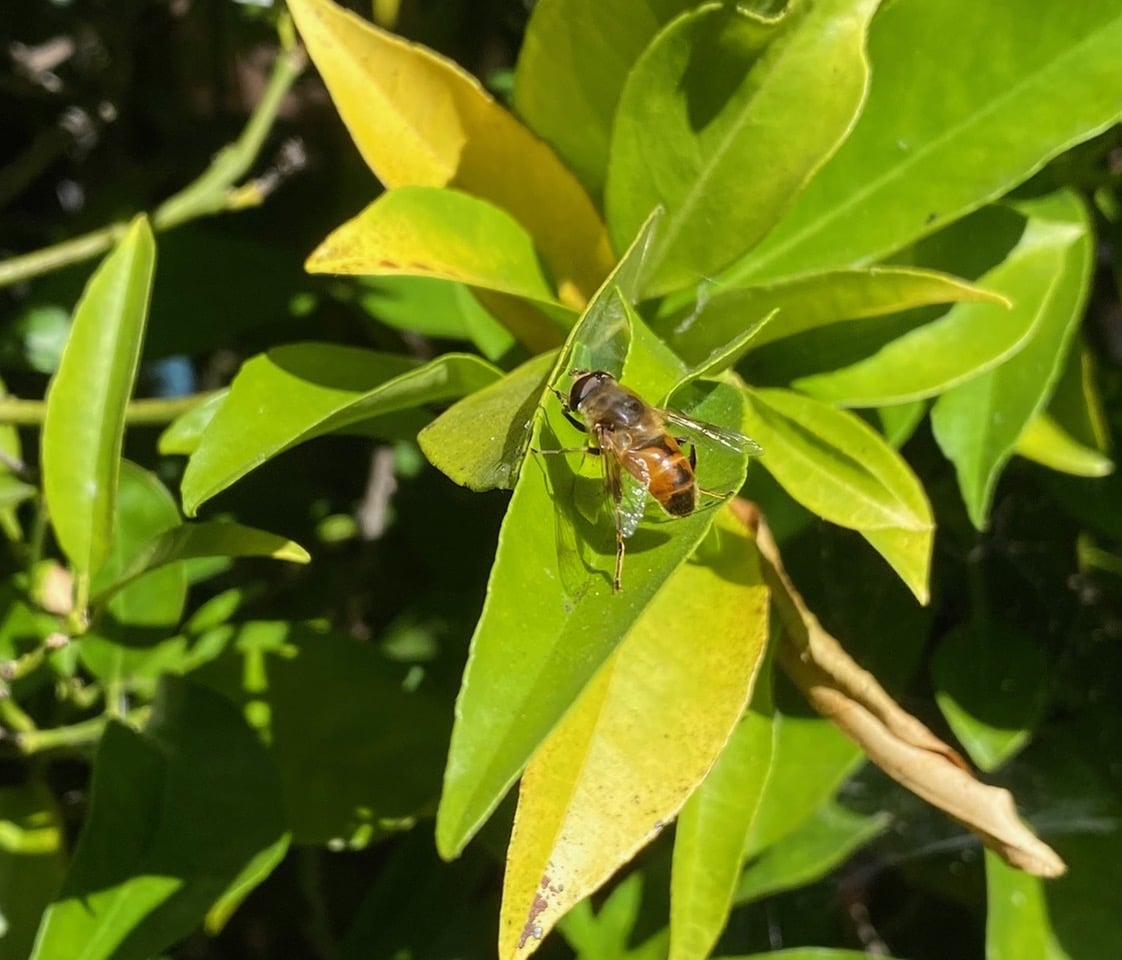
A Common Drone Fly, Eristalis tenax (family Syrphidae) lands on a leaf of a citrus tree. From the back, the hover fly could easily be mistaken for a Honey Bee. Of all the hover flies, this species best mimics the Honey Bee. Both the bee and its mimic hail from Europe.
Why would a fly evolve to look like a bee? Any animal will think twice before attacking a bee because the bee can sting, and it can bring the wrath of the whole colony upon a predator. The fly is stingless and otherwise defenseless. This kind of mimicry is called Batesian Mimicry, after the English naturalist, Henry Walter Bates. Both the Honey Bee and the Drone Fly are originally from Europe. It makes sense that both insects evolved in the same place.
The Common Drone Fly, Eristalis tenax (family Syrphidae) is the most widely distributed Syrphid species in the world, occurring in all regions except the Antarctic. It was introduced into North America from Europe and is widely established. Adults visit flowers for nectar and pollen, and are significant pollinators. They are called drone flies because of their resemblance to a drone Honey Bee. The larva is aquatic. It has a siphon on its rear end that acts like a snorkel, helping it breathe under water. The siphon can be several times the length of the larva’s body, hence the common name, rat-tailed maggot. The larvae are saprophagous, feeding on bacteria in stagnant water rich in decomposing organic matter.
I find these potted young oaks in Tim’s backyard. He is propagating oaks of various species to be used in habitat restoration projects around the area. What an inspiration!
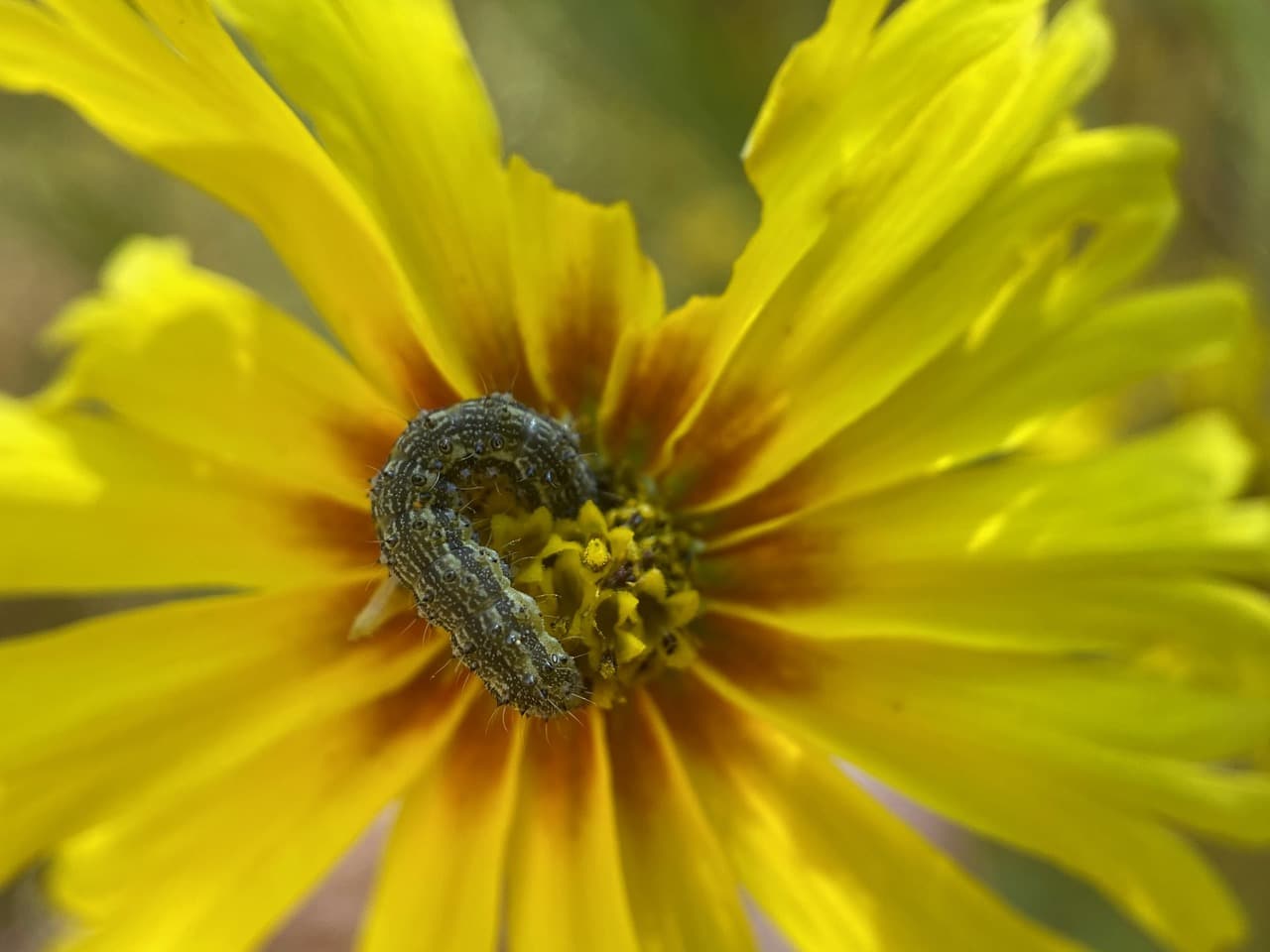
A small caterpillar of the Small Heliothodes Moth, Heliothodes diminutiva (family Noctuidae) is feeding on the flowers of an Elegant Tarweed.
The Small Heliothodes Moth, Heliothodes diminutiva (family Noctuidae) is day-active. It is found from California, through Oregon to Washington, always on plants in the family Asteraceae.
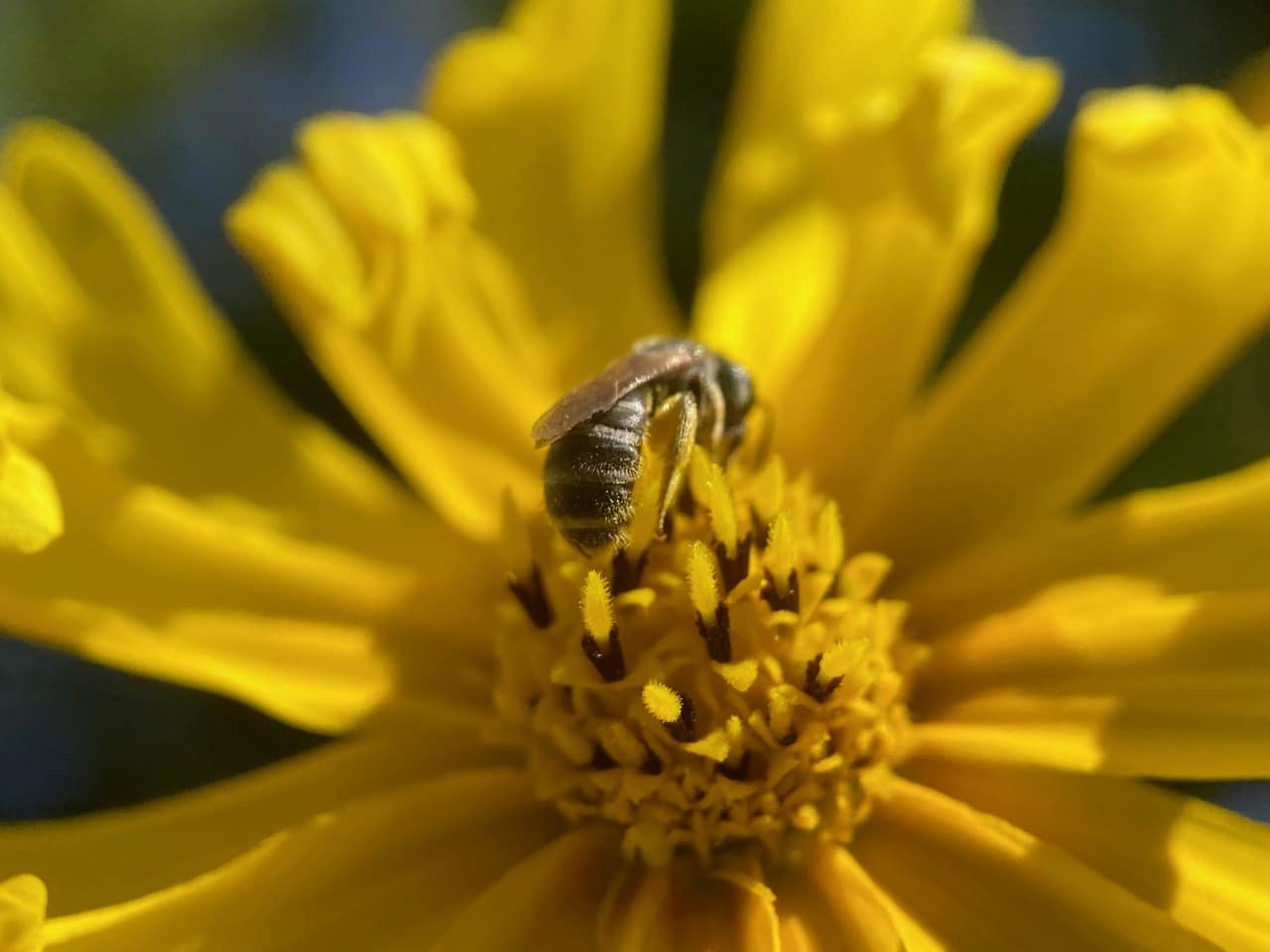
A Sweat Bee, Halictus sp. (family Halictidae) is foraging on a flowerhead of Elegant Tarweed.
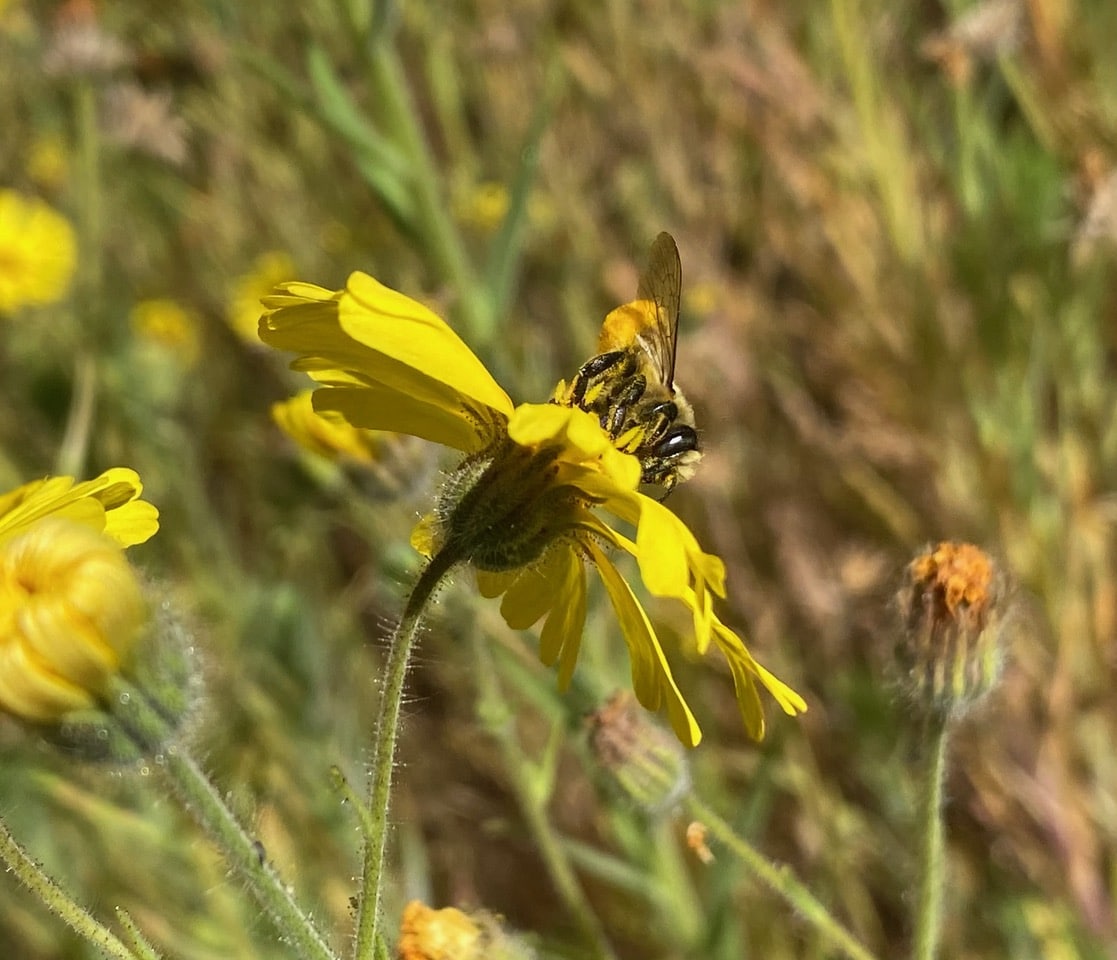
Looking upslope against the morning sun, I see the underside of a female Western Leaf-cutter Bee, Megachile perihirta (family Megachilidae) on a flowerhead of Elegant Tarweed. Her abdominal scopa is already covered with yellow pollen. Females of the family Megachilidae (which includes the Mason Bees, Leaf-cutter Bees and the Wool-carder Bees) have the special pollen collecting hairs on the underside of their abdomen.
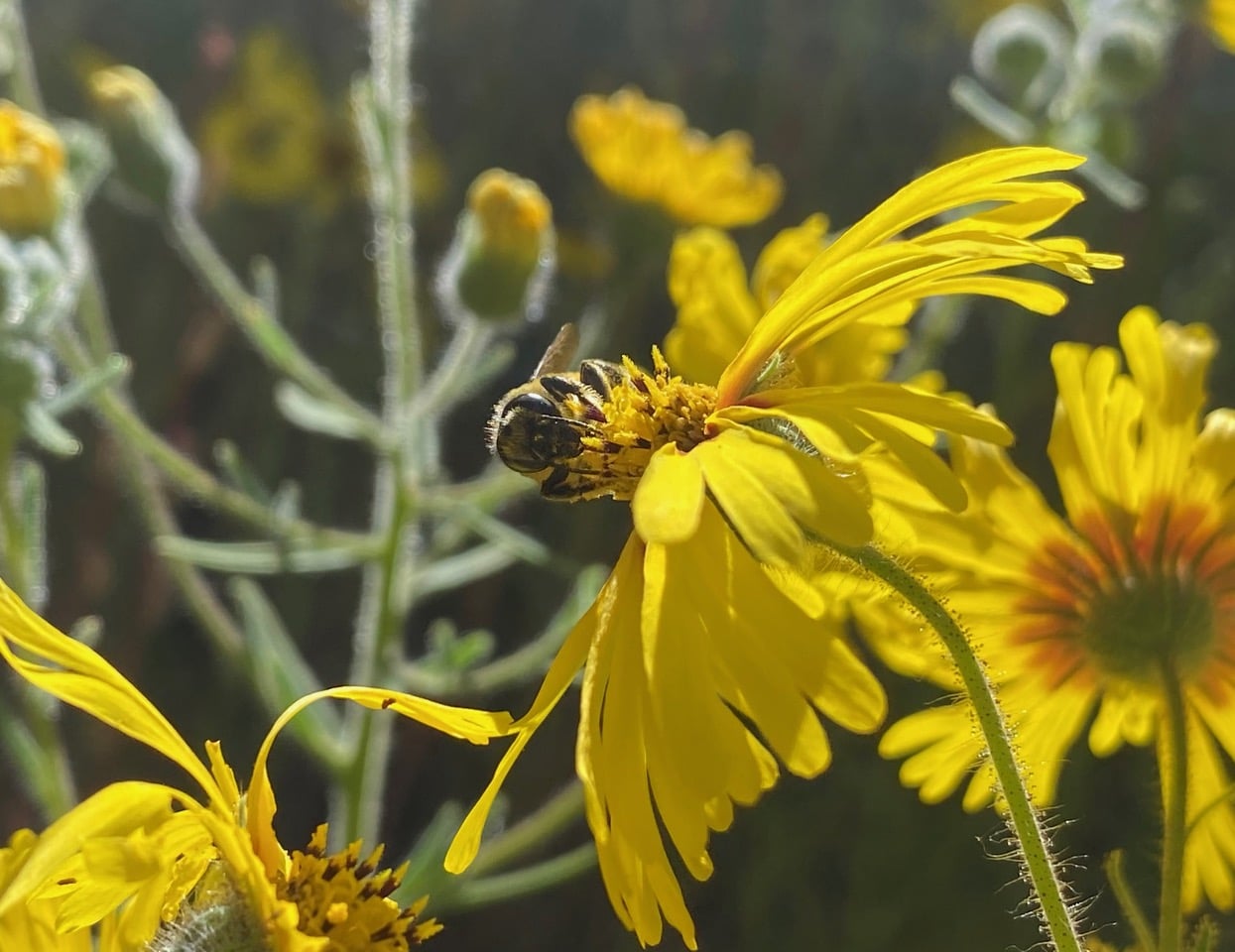
Here’s the other end of the Leaf-cutter Bee as she turns around on the flowers. Leaf-cutter Bees have large, powerful mandibles. Females use these to cut pieces off leaves or flower petals to line their brood cells.
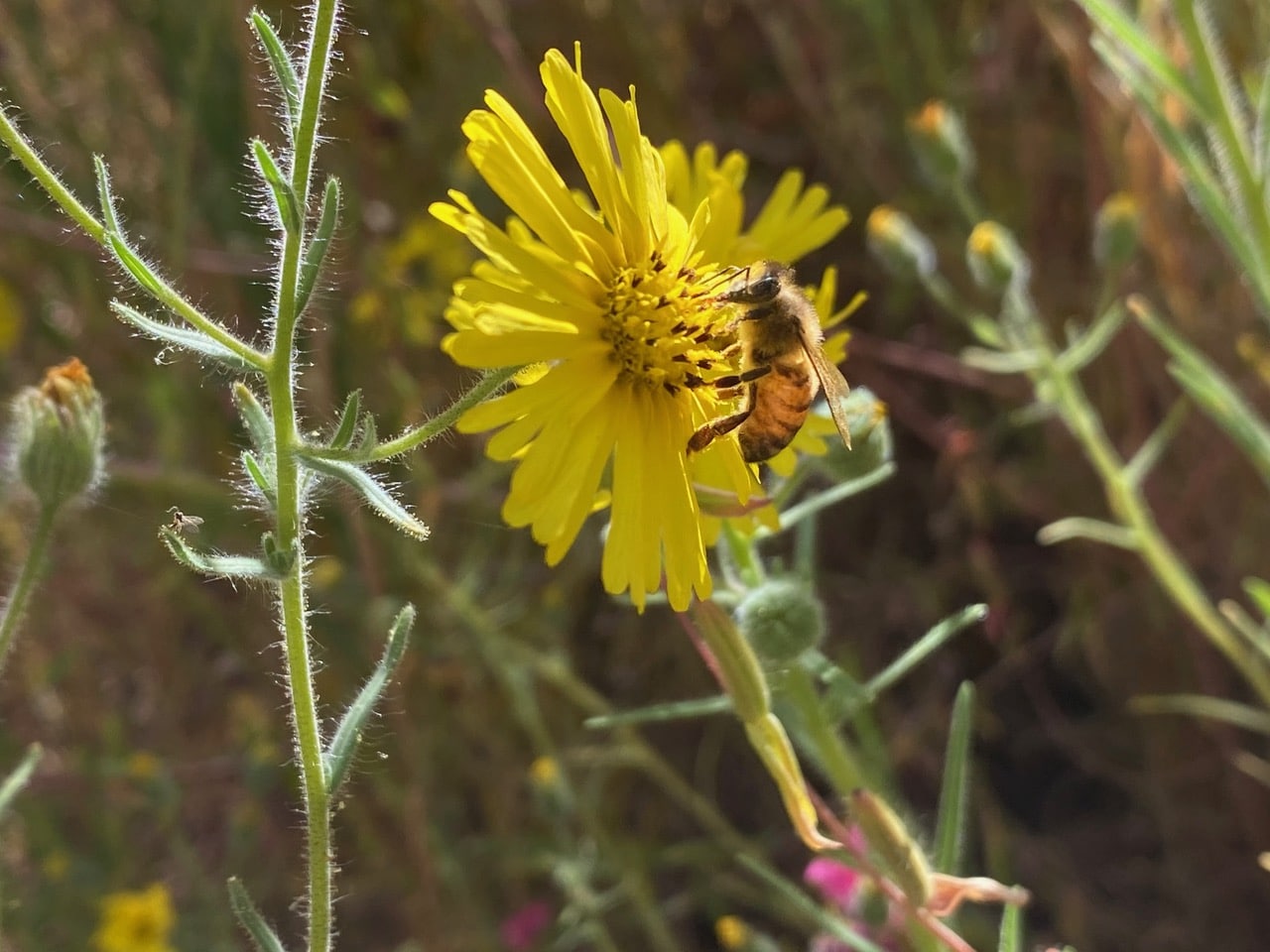
Backlit by the sun, a Honey Bee, Apis mellifera (family Apidae) seems to glow while she forages on a flowerhead of Elegant Tarweed.
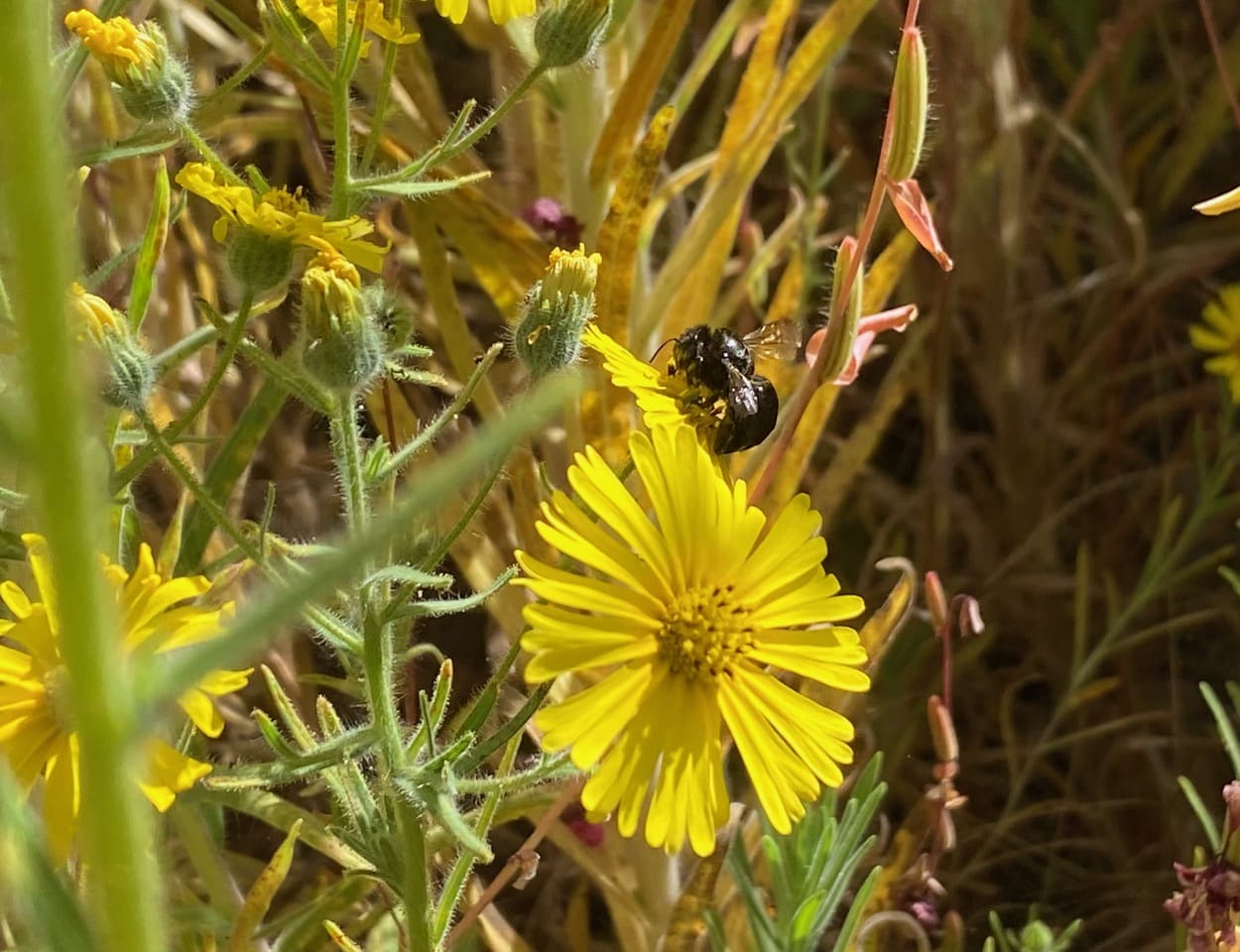
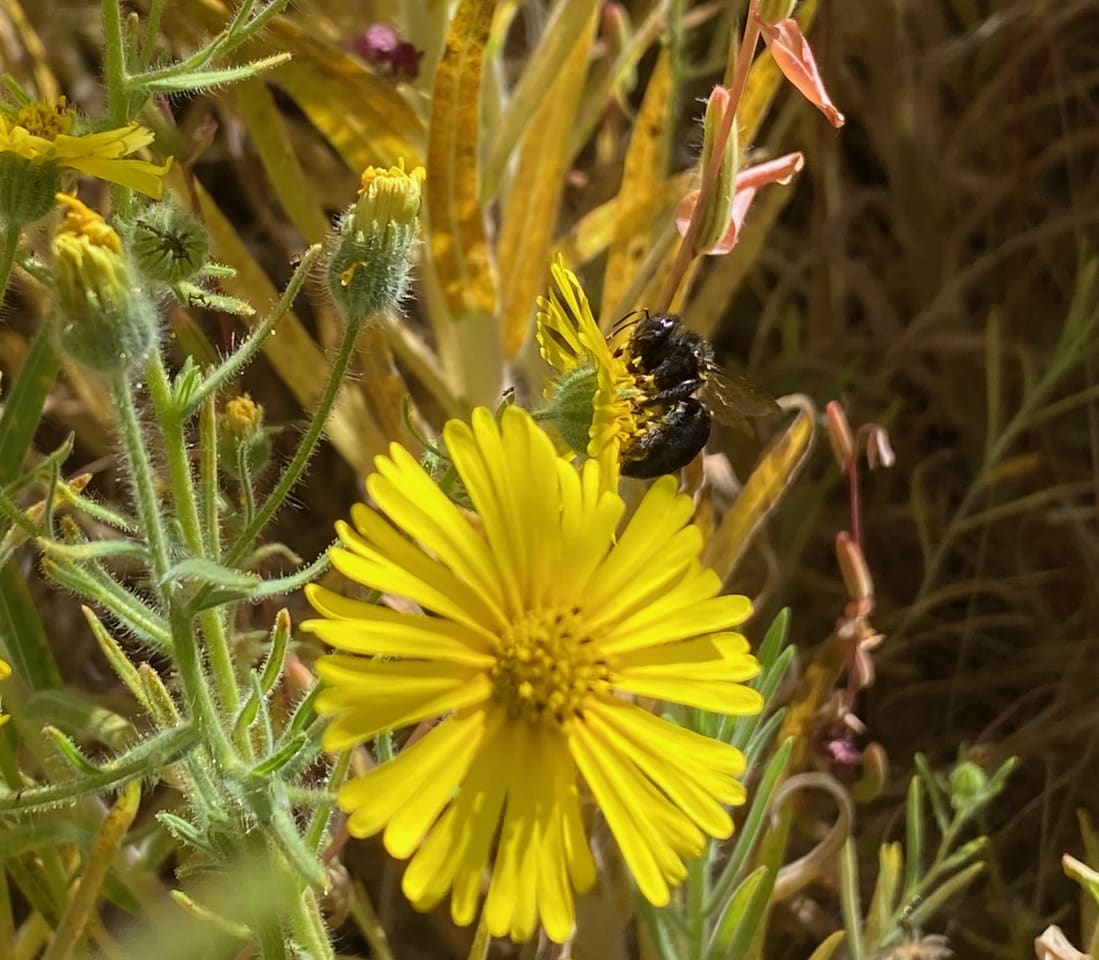
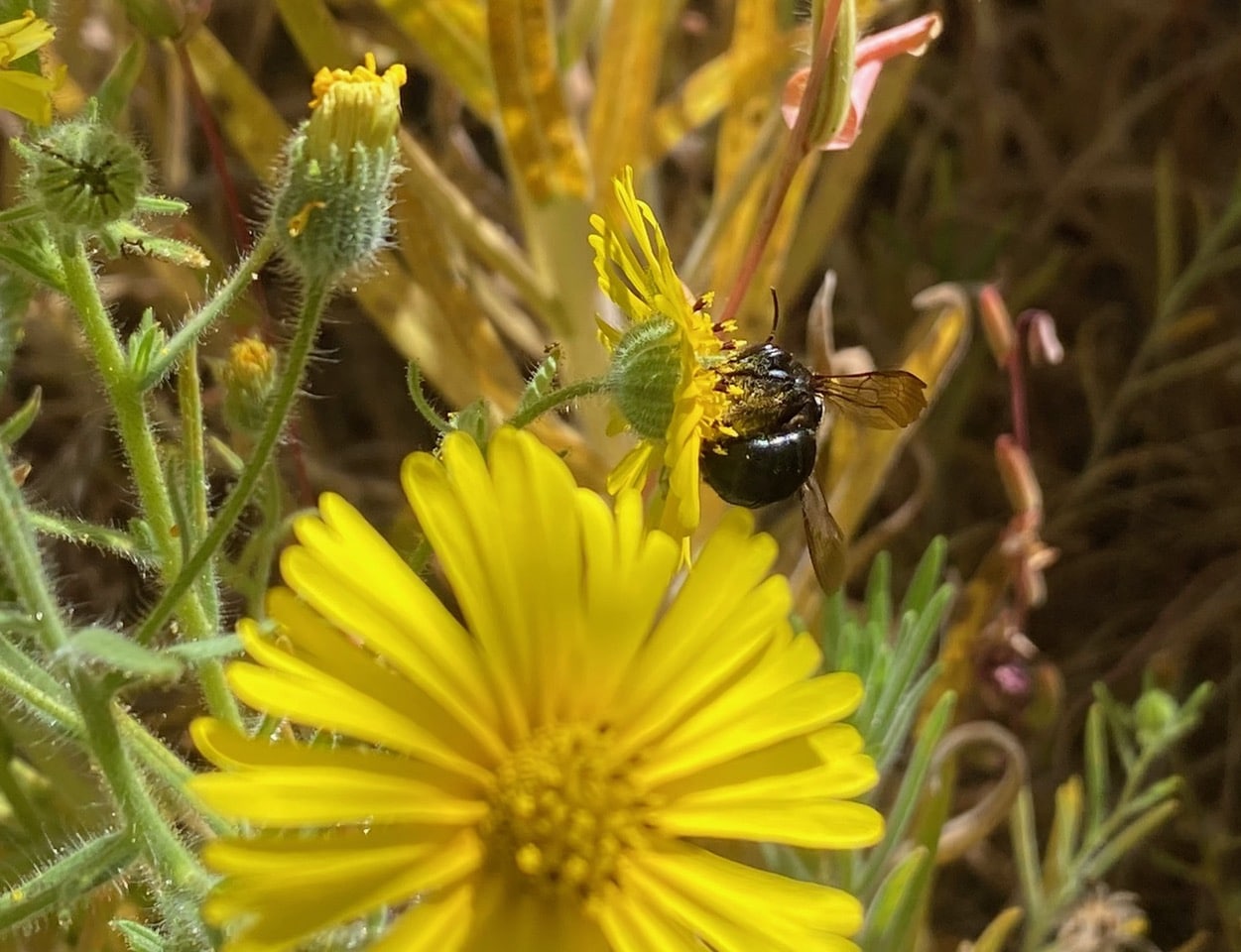
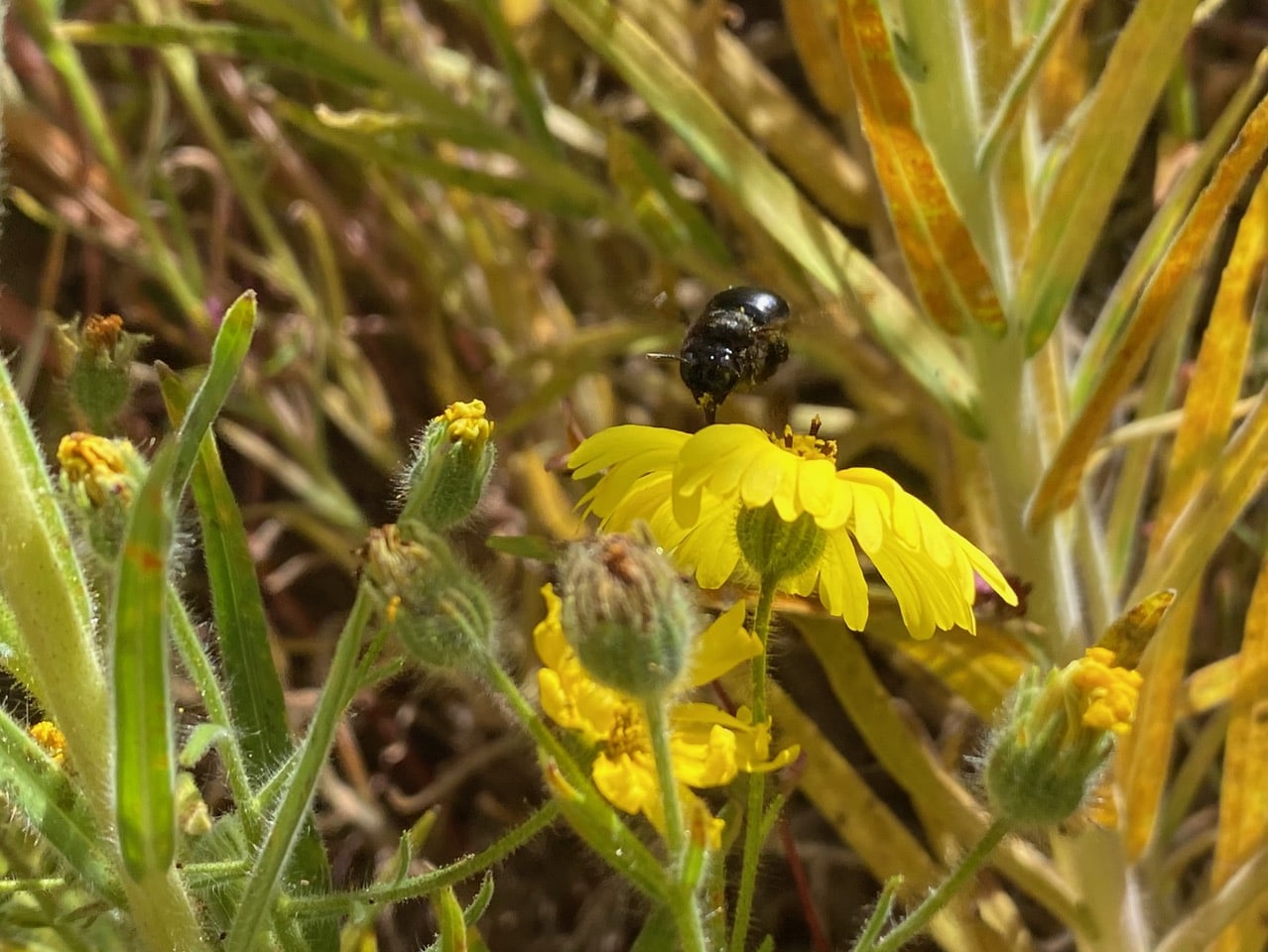
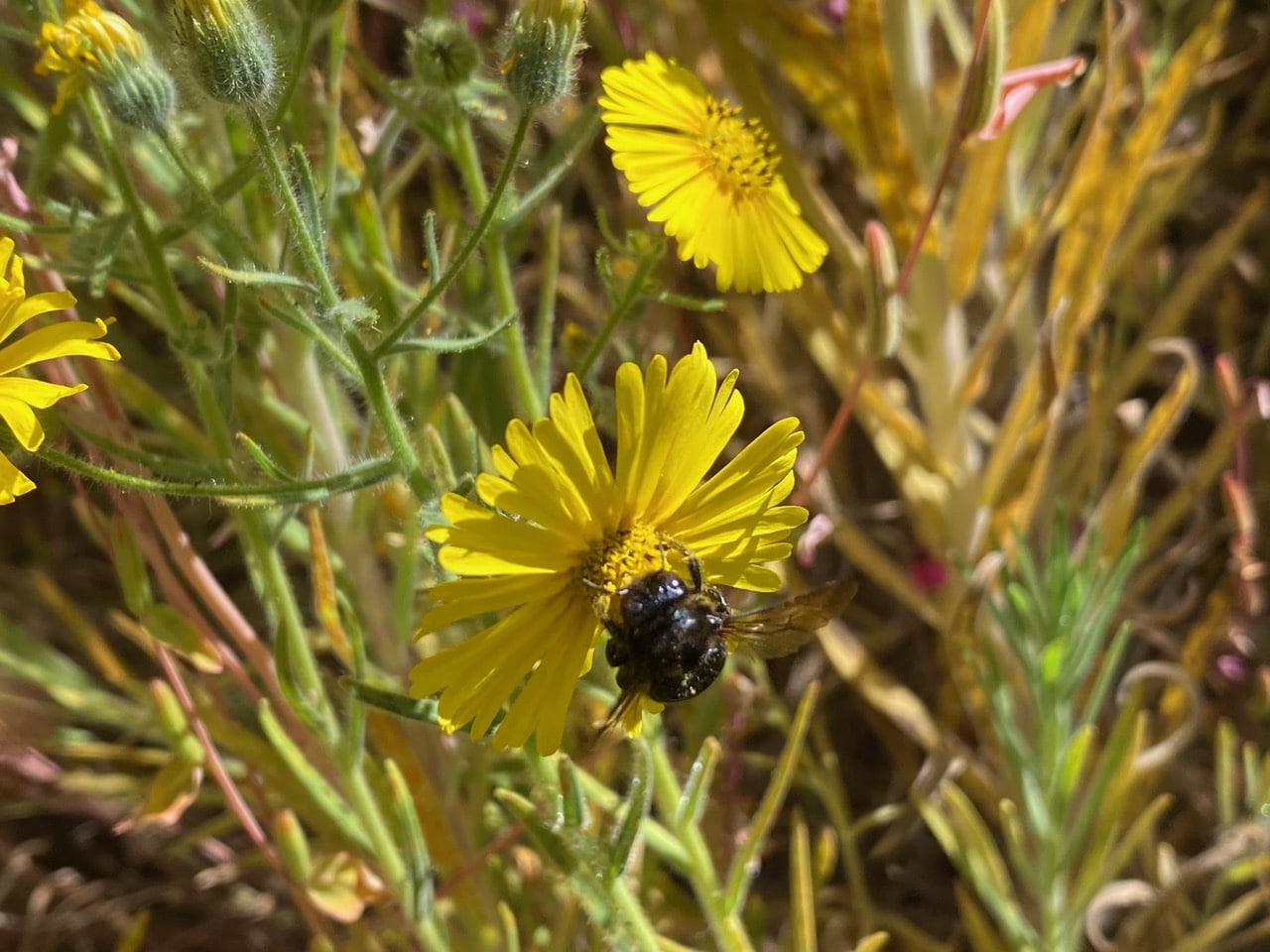
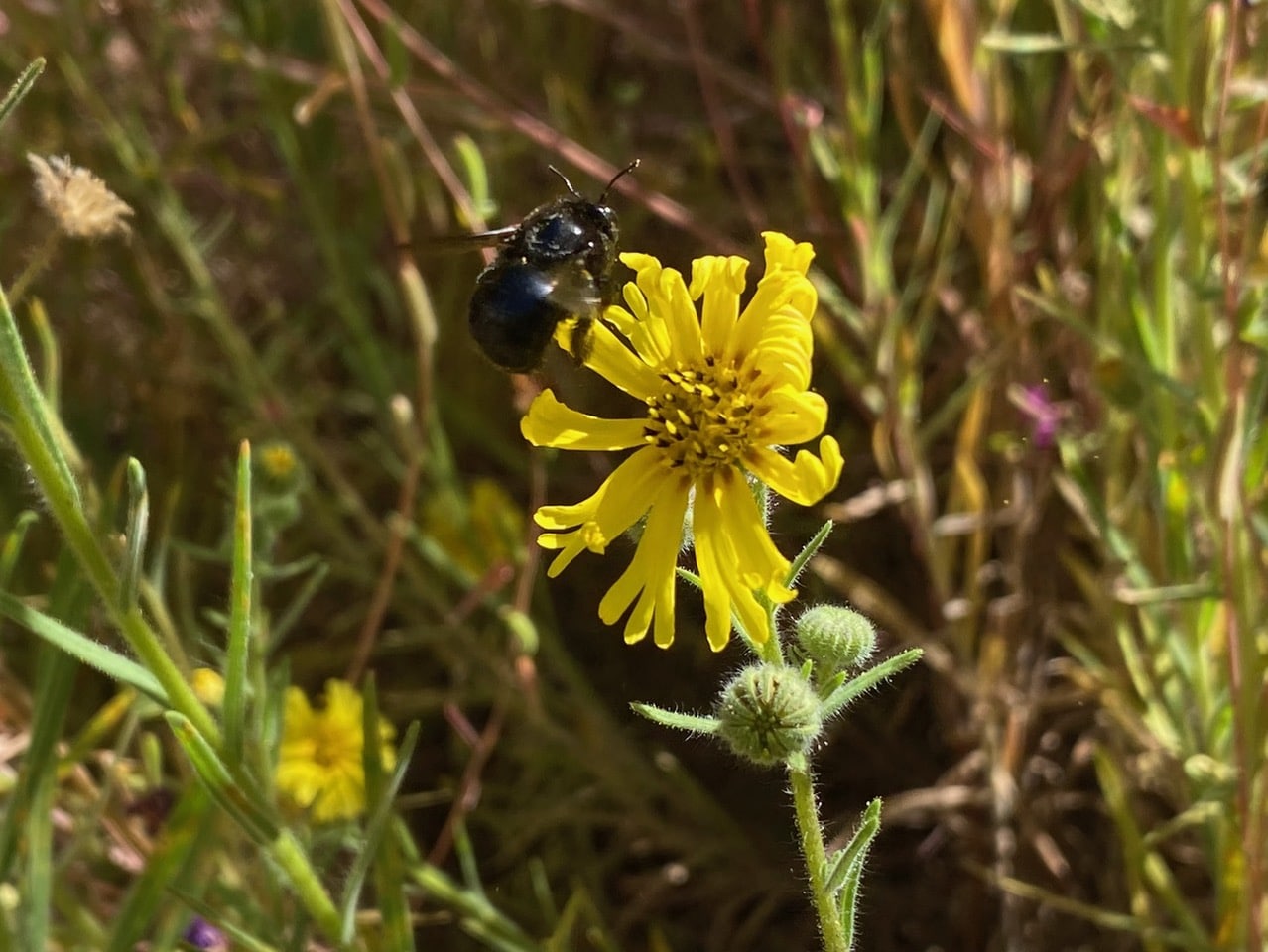
Fast flyers, the Carpenter Bees, Xylocopa sp. (family Apidae) are almost impossible to photograph. As these large, glossy bees forage among the dense stand of Elegant Tarweed, they seem to be bouncing from one flowerhead to the next.
Carpenter bees are large, shiny, and stout bodied, with sparse hair. Females are mostly black, while males often have some yellow hairs. The common name “carpenter bee” derives from their nesting behavior; nearly all species burrow into hard plant material such as dead wood or timber. The bees vibrate their bodies as they rasp their mandibles against hard wood, each nest having a single entrance which may have many adjacent tunnels. The entrance is often a perfectly circular hole about 0.6 in. in diameter on the underside of a beam, bench, or tree limb. Carpenter bees do not eat wood. They discard the bits of wood, or reuse particles to build partitions between brood cells. The tunnel functions as a nursery for brood and storage for the pollen/nectar on which the brood subsists.
This female Carpenter Bee is taking some time gathering pollen from the Madia flowers, allowing me to get close enough for this shot.
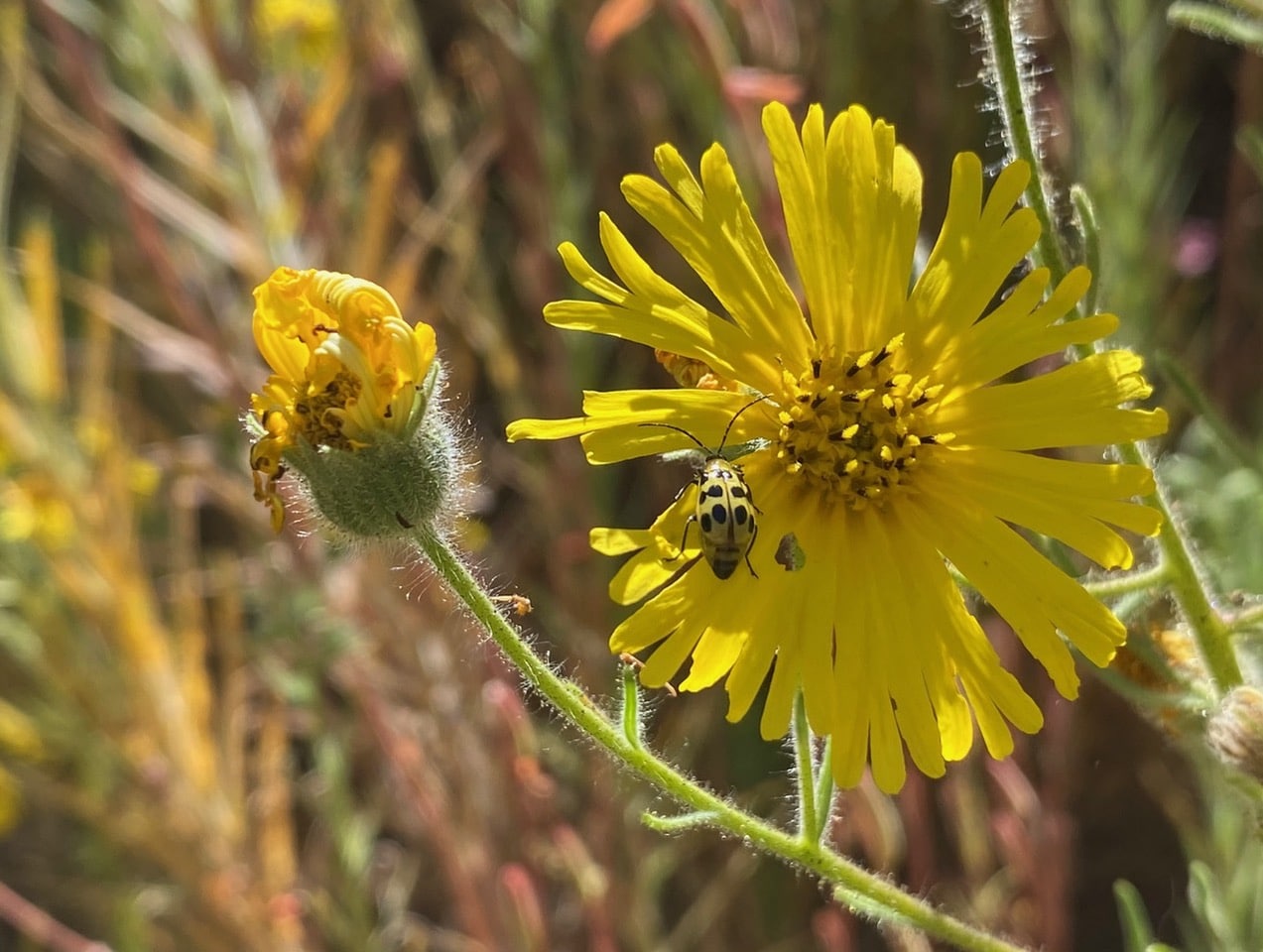
A Spotted Cucumber Beetle, Diabrotica undecimpunctata (family Chrysomelidae) is wandering on the ray flowers of the Elegant Tarweed flowerhead.
Members of the family Chrysomelidae are commonly known as Leaf Beetles. Adults and larvae feed on all sorts of plant tissues, and all species are fully herbivorous. Many are serious pests of cultivated plants, including food crops. Others are beneficial due to their use in biocontrol of invasive weeds. Chrysomelids are popular among insect collectors, as many are conspicuously colored, typically in glossy yellow to red or metallic blue-green hues, and some have spectacularly bizarre shapes. Photos of Leaf Beetles (Family Chrysomelidae) · iNaturalist
Native to North America, the Spotted Cucumber Beetle can be a major agricultural pest, causing damage to crops in the larval as well as adult stages of their life cycle. Larvae, sometimes known as rootworms feed on the roots of emerging plants. In the adult stage the beetles cause damage by eating the flowers, leaves, stems and fruits of the plant.
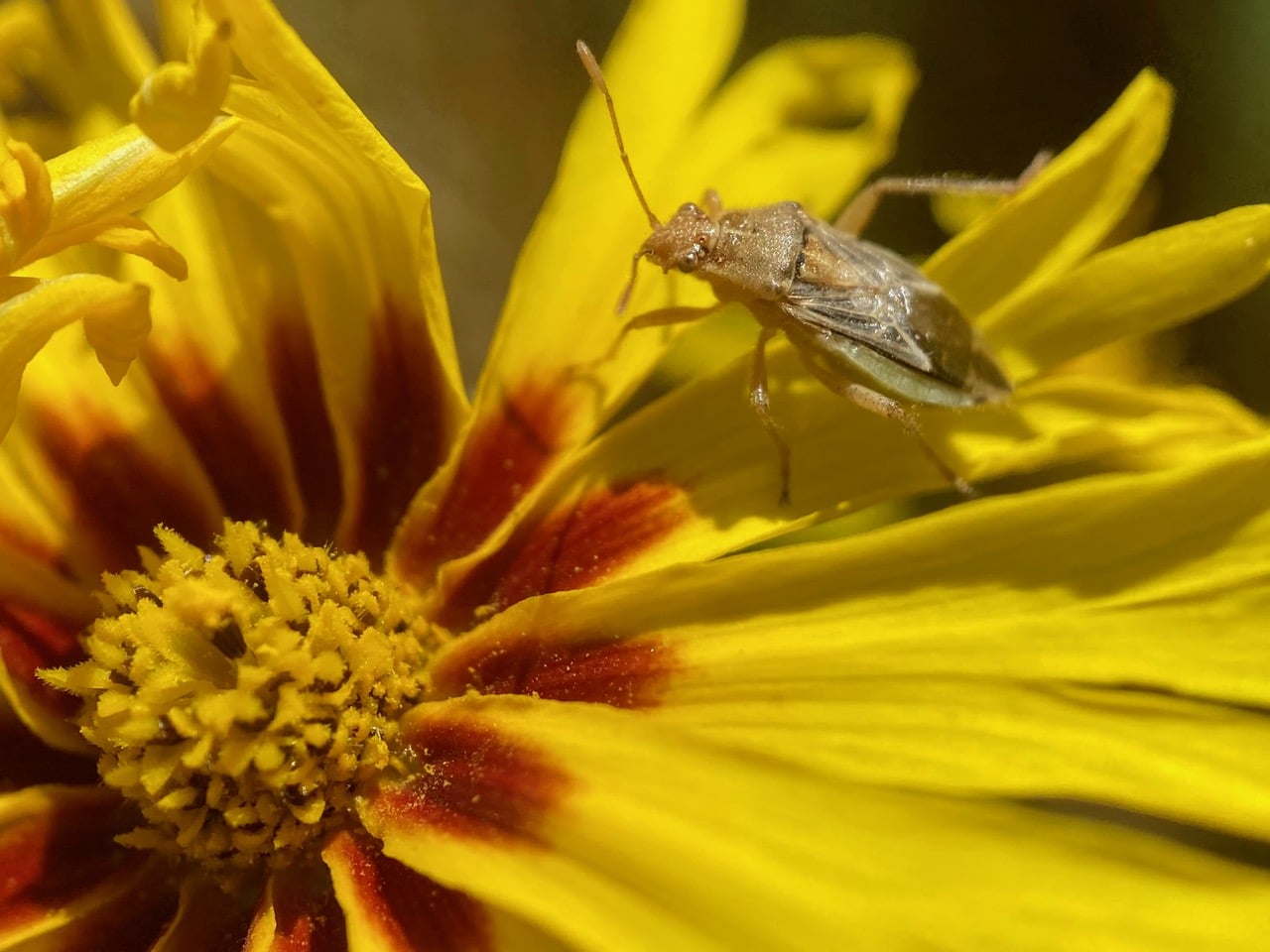
A Scentless Plant Bug, Arhyssus sp. (family Rhopalidae) is moving on a flowerhead of Elegant Tarweed.
The Rhopalidae are distinguished by many veins on the membranous portion of the forewings. They differ from coreids and other hemipterans in lacking functional scent glands. All are plant-feeders, usually on ripe seeds.
Ooh, another female Leaf-cutter Bee!
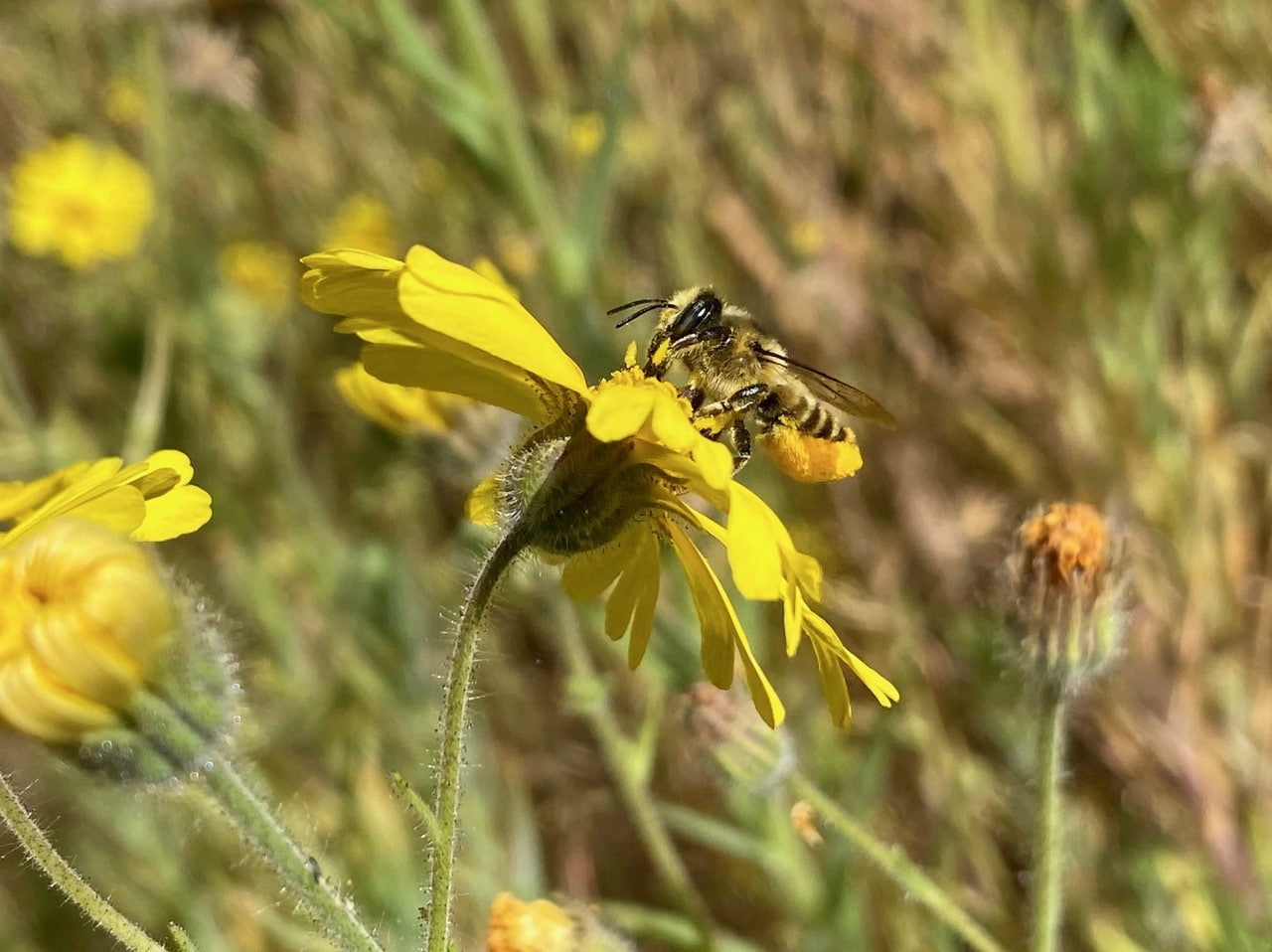
Her flexible abdomen arched skyward exposing her pollen covered belly, a female Western Leaf-cutter Bee, Megachile perihirta (family Megachilidae) is taking nectar from the flowers of Elegant Tarweed.
Finally, a clear view of the female Leaf-cutter Bee’s abdominal scopa covered with pollen!
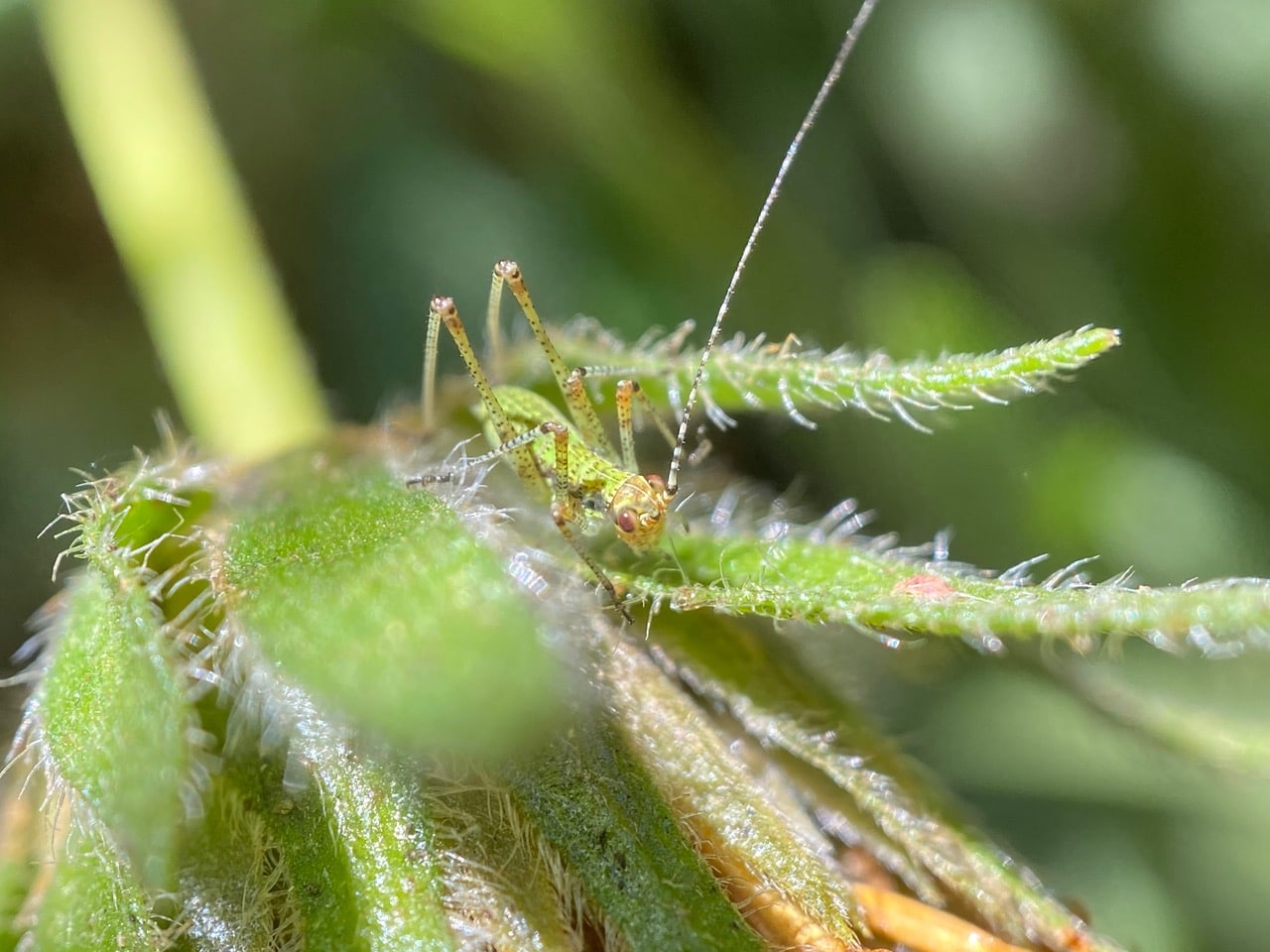
Perched on a phyllary of a fading Mule’s Ear, Wyethia sp. a young nymph of Mediterranean Katydid, Phaneroptera nana (family Tettigoniidae) says goodbye to me as I leave the front garden.
Insects in the family Tettigoniidae are commonly called katydids or bush crickets. They are primarily nocturnal in habit with strident mating calls. Many species exhibit mimicry and camouflage, commonly with shapes and colors resembling leaves. The diet of most katydids includes leaves, flowers, bark, and seeds, but many species are predatory, feeding on other insects, snails, or even small vertebrates such as snakes and lizards. Some are considered agricultural pests.
The Mediterranean Katydid is native to Europe, the Near East and North Africa. As an invasive species, it has spread to the San Francisco Bay Area. It mainly inhabits sunny and dry habitats, especially shrubs and low branches of trees. Katydids court acoustically. Phaneroptera nana female sings in response to the male, prompting the male to move towards her. Females chew on the lamina of plants to insert their eggs which usually hatch in summertime. P. nana is commonly found through the summer and fall seasons. The species is known to cause damage in pear orchards, feeding on pears that have not ripened.