

Pollinator Post 7/9/24 (1)

Taking advantage of this morning’s cool, overcast conditions, I make a dash for the parking strip in front of Naomi’s neighbor’s house in Alameda. Surely the Longhorn boys are still sleeping?
Arriving at 8:30 am, and temperature of 63 F, I am delighted to find the male Summer Longhorn Bees, Melissodes sp. (family Apidae) still asleep on their regular roost site, a senescent Elegant Tarweed, Madia elegans. The arrangement of the slumber party has changed. The 16 bees are sleeping on 6 adjacent seed heads in smaller, loose clusters. It is impossible to get them all in one photo, especially in low light and breezy conditions.

Here’s the biggest cluster, with 6 bees of various shades ranging from silver to golden brown.
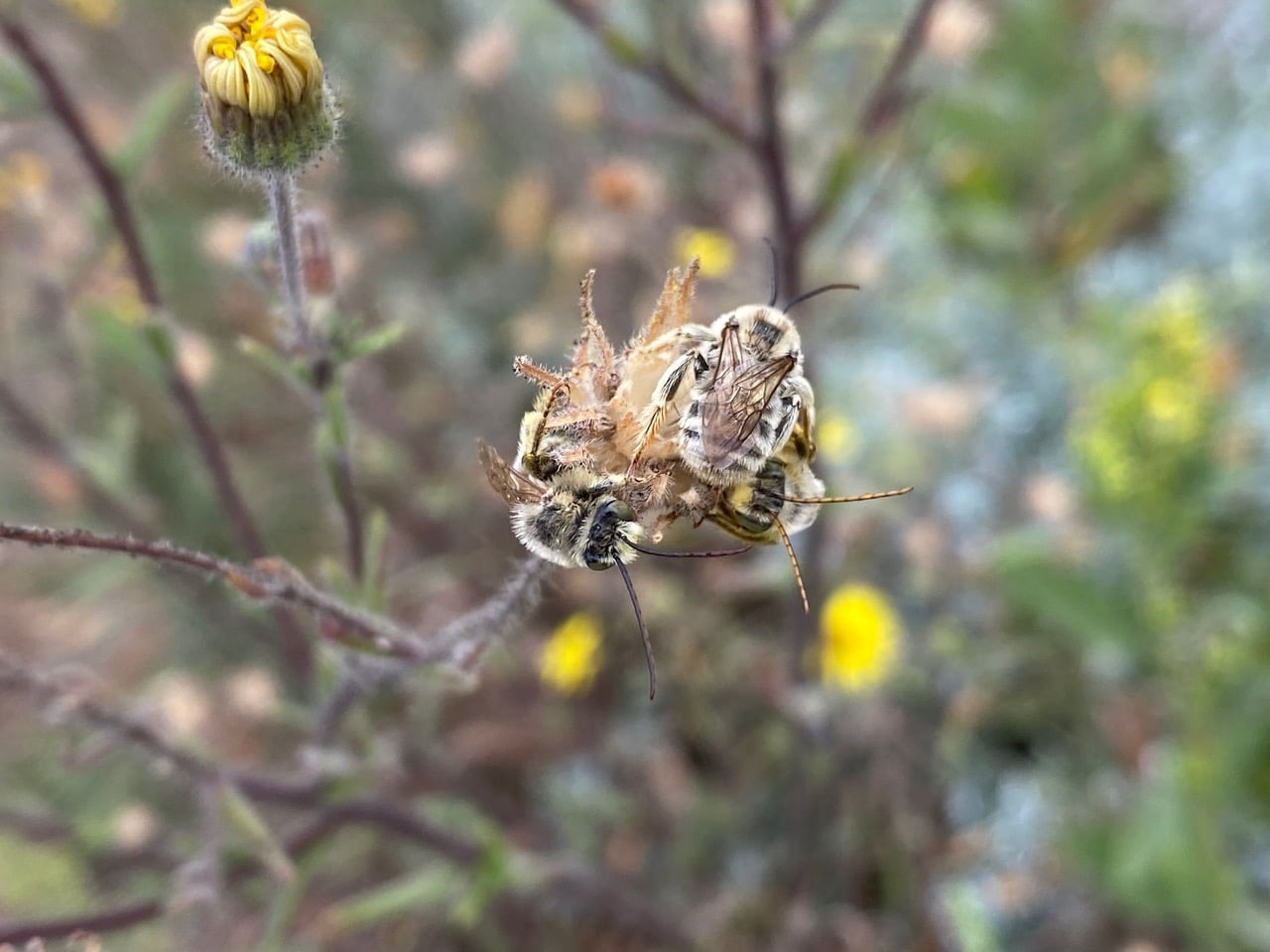
Here’s a smaller cluster. The bees sleep with their eyes wide open – they do not have eyelids!

The bees are showing some wear and tear – the hairs on their abdomens are worn down, and the edges of their wings are somwhat tattered.
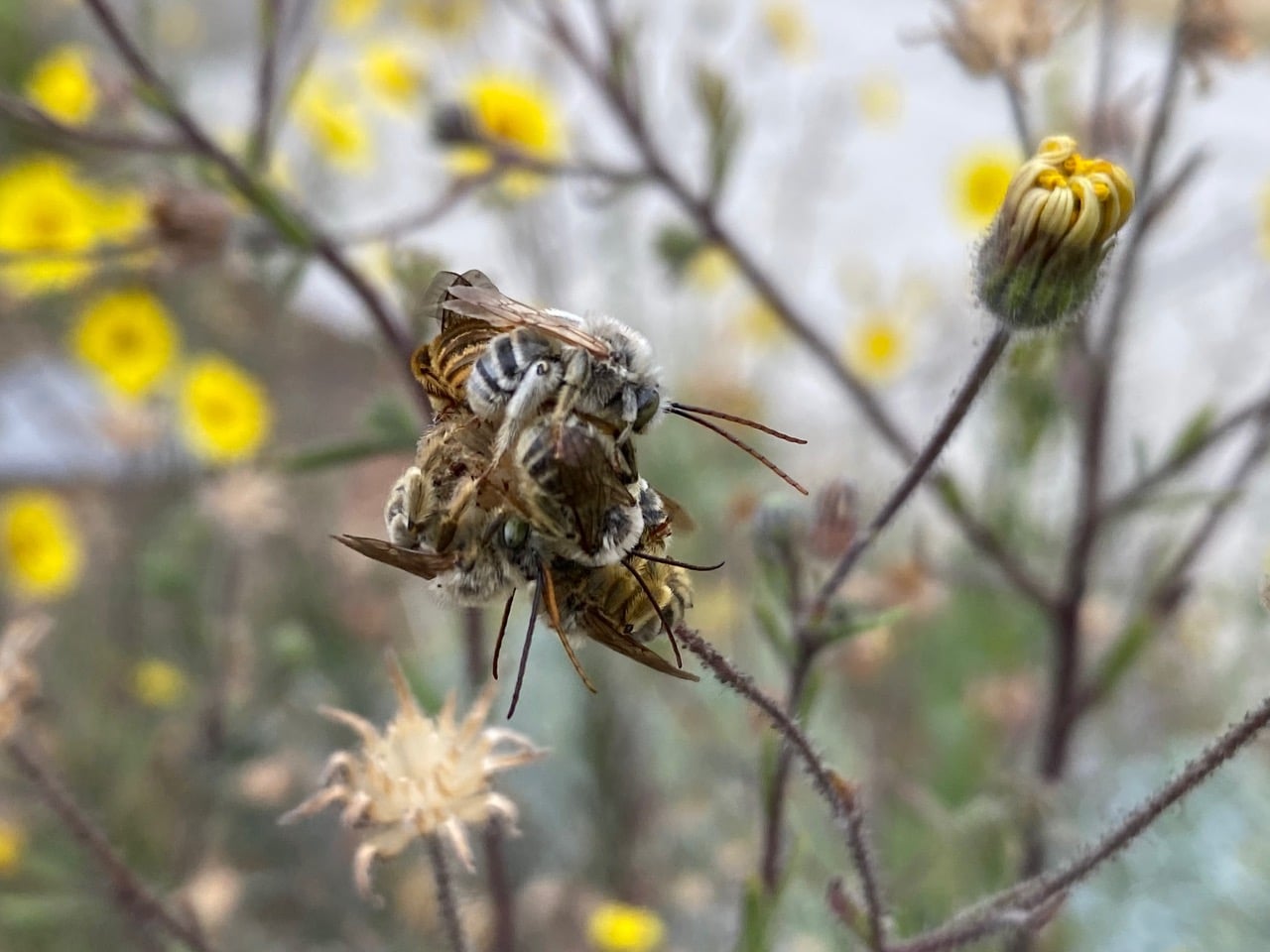
It makes me smile to think that these boys will be competing with each other for the females when they wake up. Yet, they gather every night to sleep in such intimate aggregations. Perhaps it is a matter of survival. There is safety in numbers – the bees can alert each other of potential danger.
 On the other side of the big tree, the single male longhorn is sleeping on a different Madia plant today, just inches from the one he slept on the other day. Curiously, he is again accompanied by two Cuckoo Bees, the Suave Nomad Bees, Nomada suavis (family Apidae). It is reasonable to assume that these are the same three characters I saw the other day. What is the attraction between the Cuckoo Bees and the Longhorn?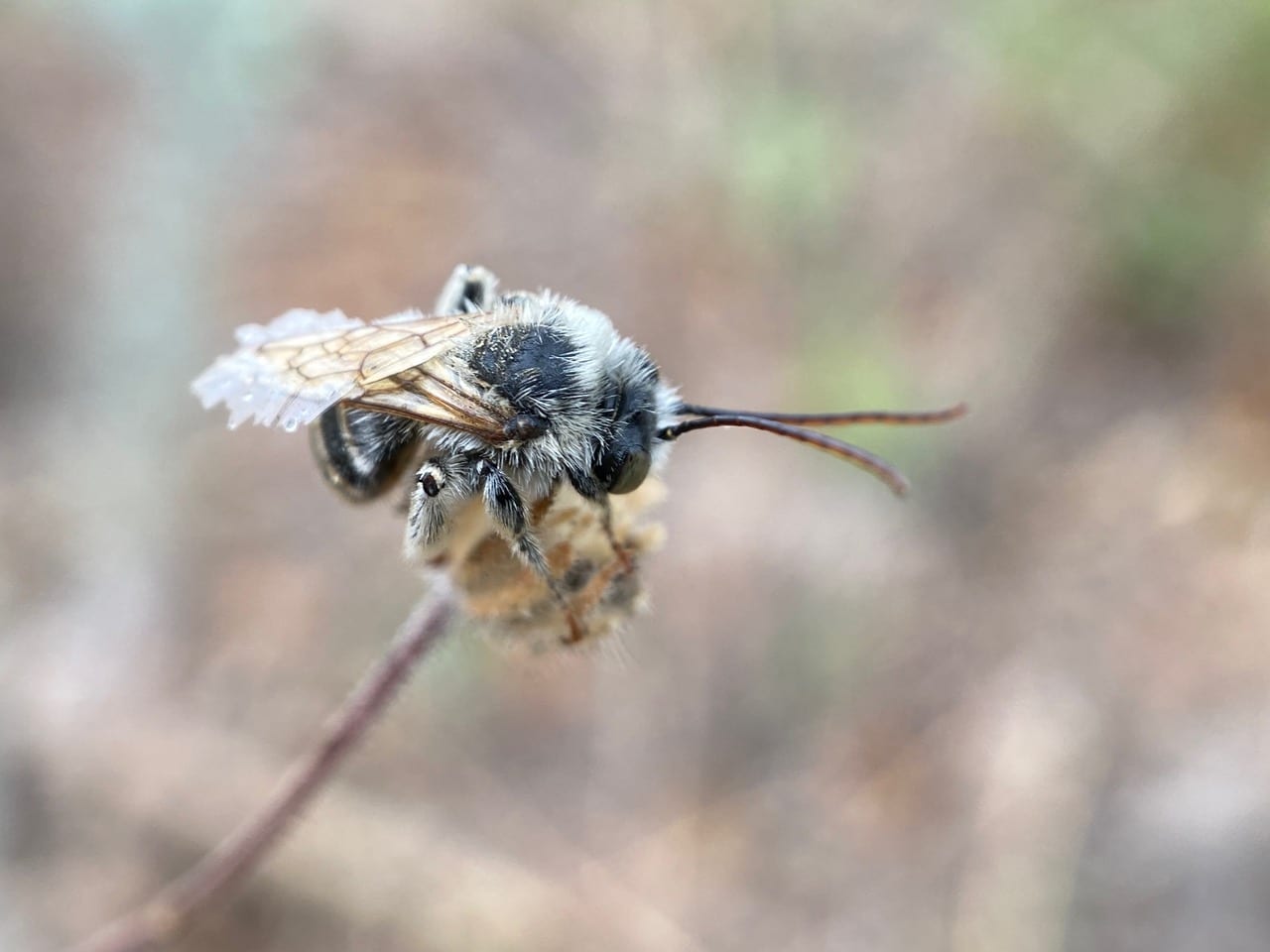
On closer inspection (possible only because the bees are asleep), the male Longhorn Bee appears to be rather worn out. He has lost a lot of hair, and his wings are tattered. Why is he on his own, and not with the others of his kind on the other side of the big tree. Has he been cast out by the other boys? As a decoy for the parasitic Cuckoo Bees?
This is the Cuckoo Bee that is closest to the Longhorn. It is holding onto the stem by its mandibles.

This is the other Cuckoo Bee. Although both are asleep, they would sometimes fold their wings, only to open them up again. I am not sure what prompts that behavior. Wind movements? It would be interesting to know the sexes of these two Cuckoo Bees. Since Cuckoo Bees do not construct nests, both genders probably sleep out in the open. Why do they seek the company of the males of their host species? Why do they always sleep close to this particular male longhorn, and not with the males in aggregation. Unfortunately, there is nothing in the literature I can find that answer these questions.

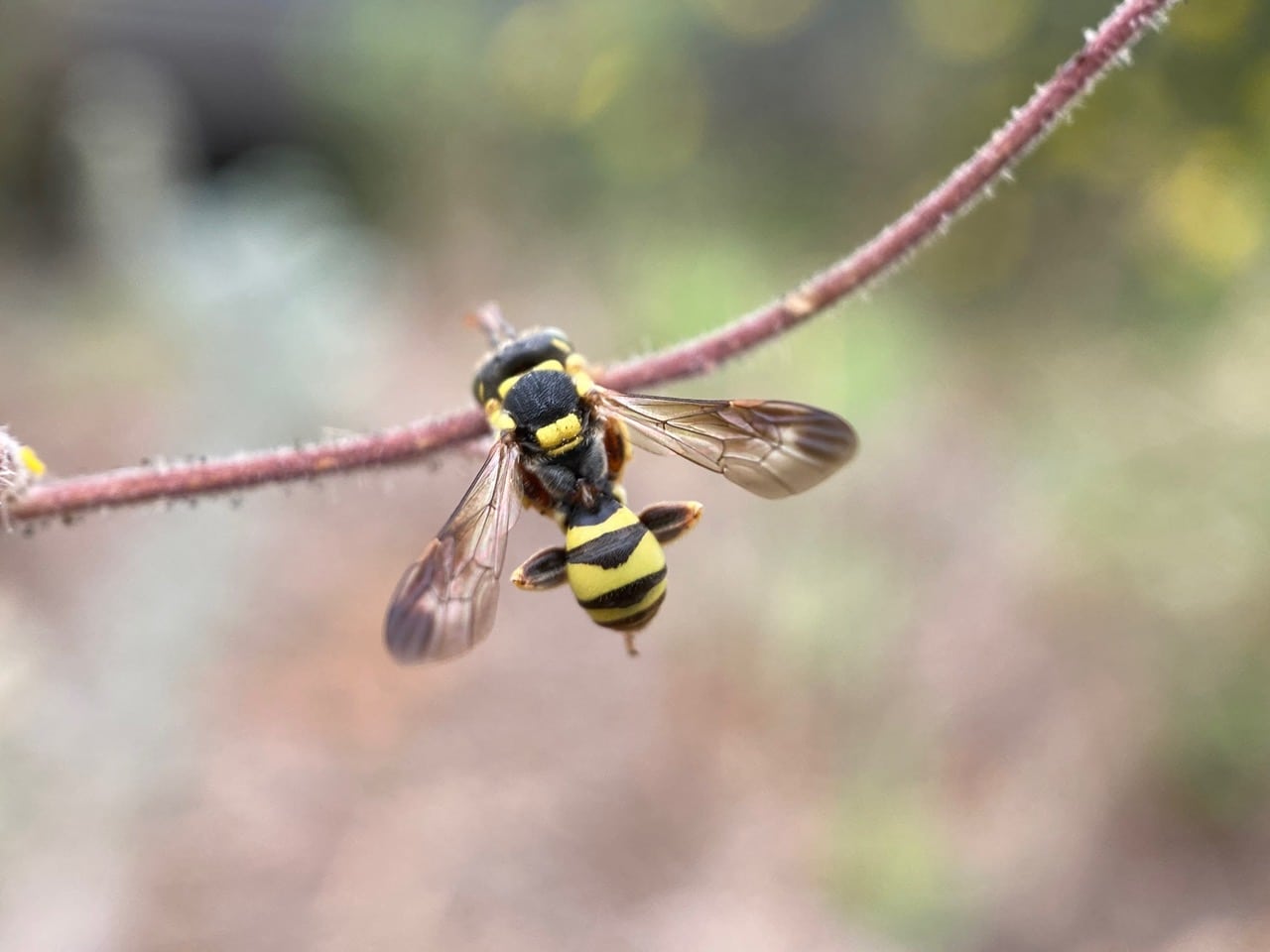
A female Forked Globetail, Sphaerophoria sulphuripes (family Syrphidae) visits a flowerhead of Elegant Tarweed, Madia elegans. I am rather surprised to see an insect active so early in cloudy conditions.
The species is native to western North America. There is marked sexual dimorphism in the Forked Globetail – the males have a narrow abdomen with a reddish, swollen tip. Adults visit flowers for nectar and pollen. The larvae of Sphaerophoria feed on aphids and other soft-bodied insects.
Forked Globetail (Sphaerophoria sulphuripes) · iNaturalist