

Pollinator Post 8/29/24 (1)

For those who wrote me, thank you for your inquiries and well wishes. My husband Fred is recovering well from his spinal surgery, and has been coming out with me to Bay Farm Island occasionally for his daily rehab walks. I have recently been introduced to a bee enthusiast/expert and photographer who lives in Alameda, and it is through Emil that I learned about some bee/wasp hotspots in Alameda and the adjacent island of Bay Farm. Quite fortuitously, I have discovered the perfect place for Fred’s rehab – a level paved path that runs along the north shore of Bay Farm, linking several little breezy parks complete with trees and lawns. To top it off, there is a bench for Fred to sit on every 500 steps or so. Small victories are sweet!
That’s Alameda Beach on the opposite shore. While Fred walks the paved path, I look for insects among the Oregon Gumplant, Grindelia stricta along a parallel dirt path by the water. Both of us progress at about the same speed- snail’s pace.
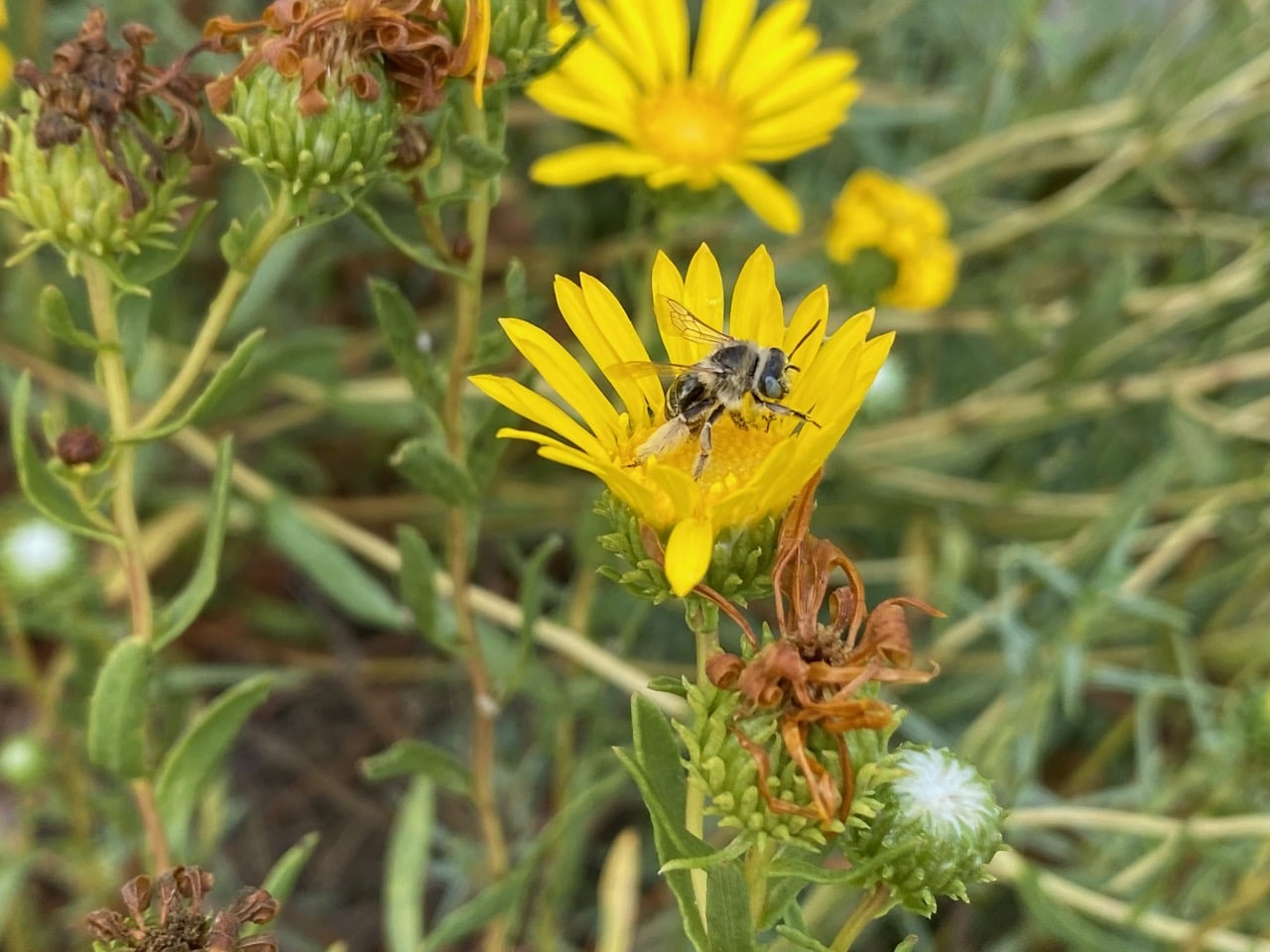
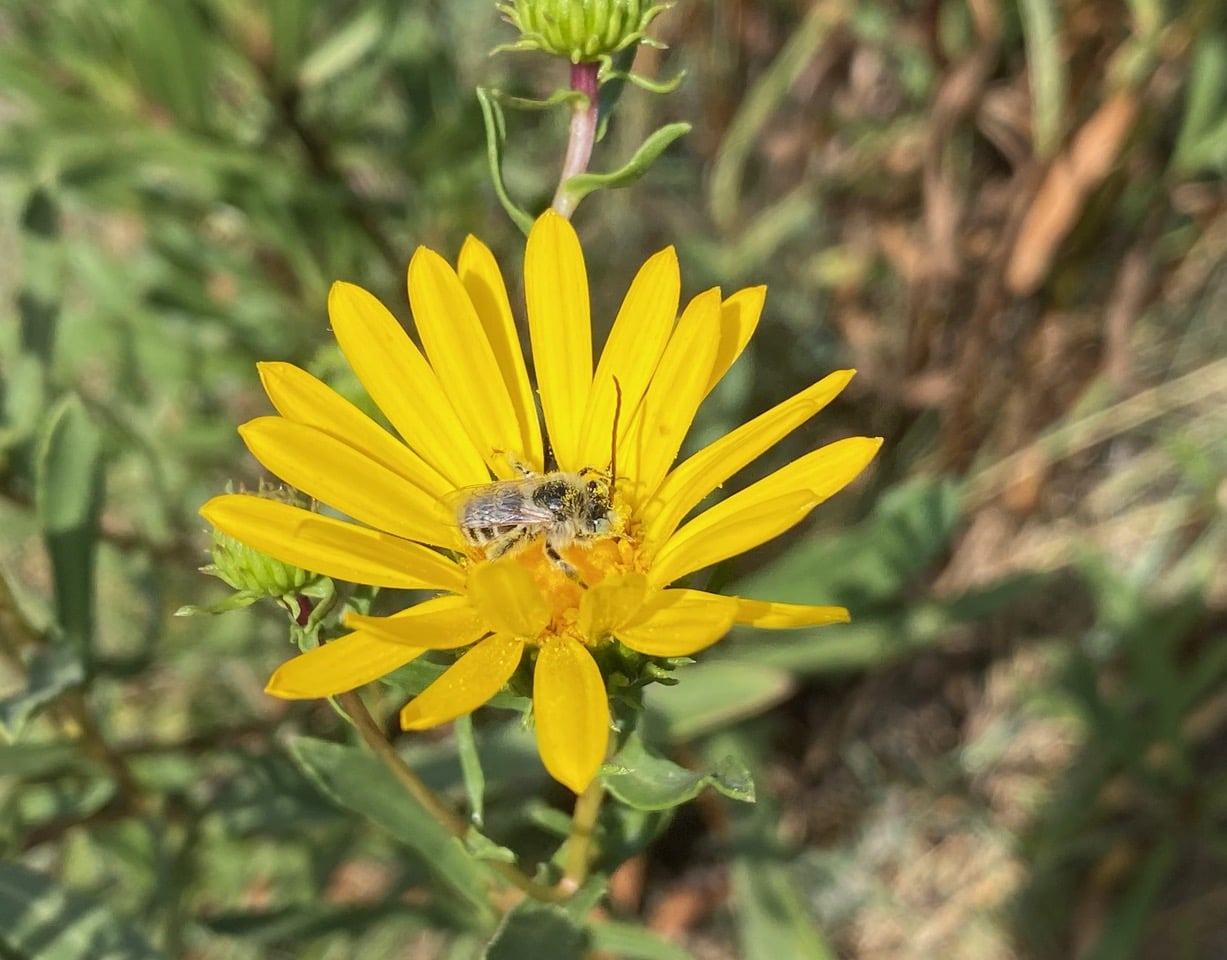
The female Longhorn Bees, Melissodes sp. (family Apidae) are the first to appear on the Grindelia on this overcast but warm morning.
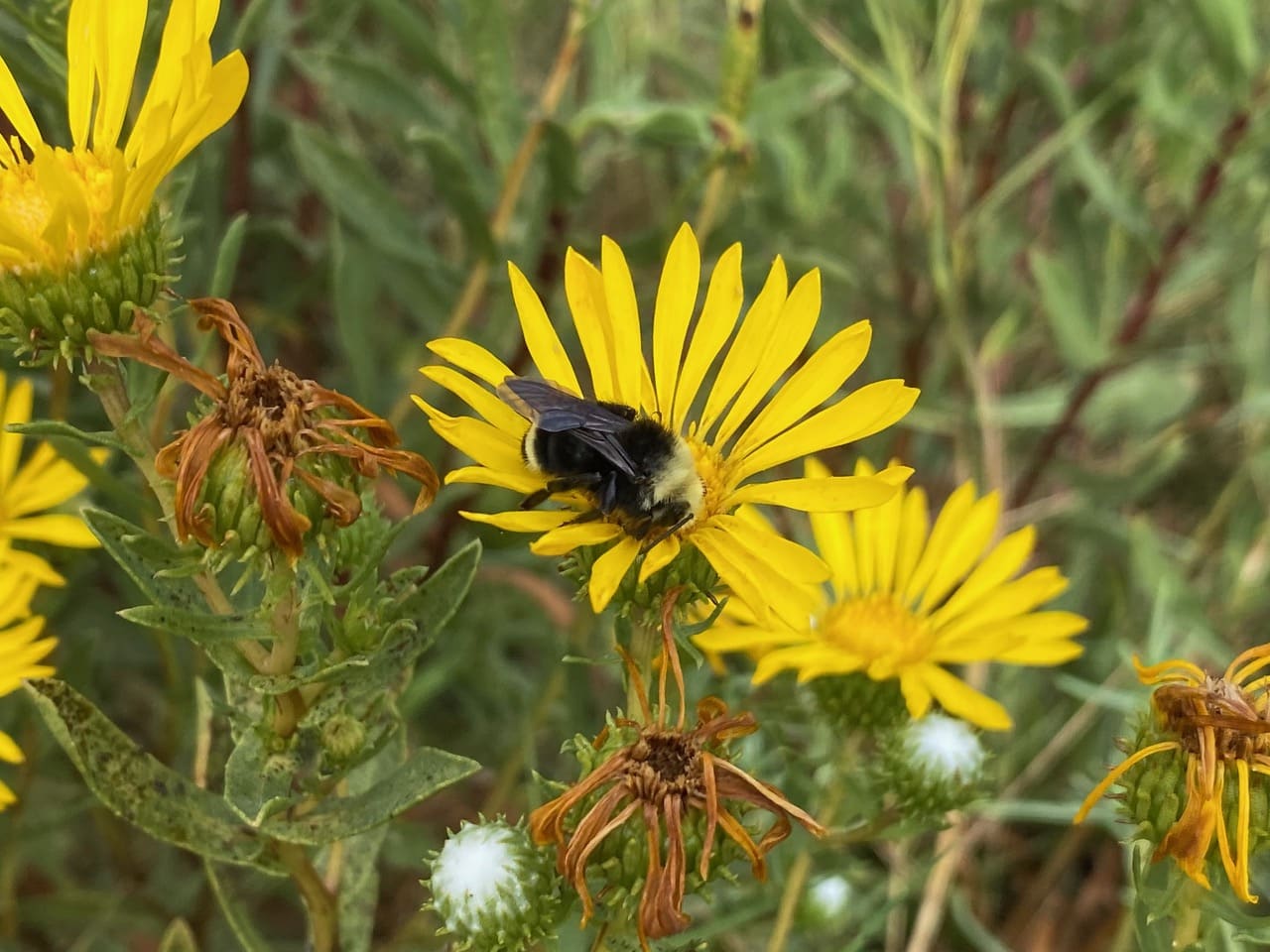
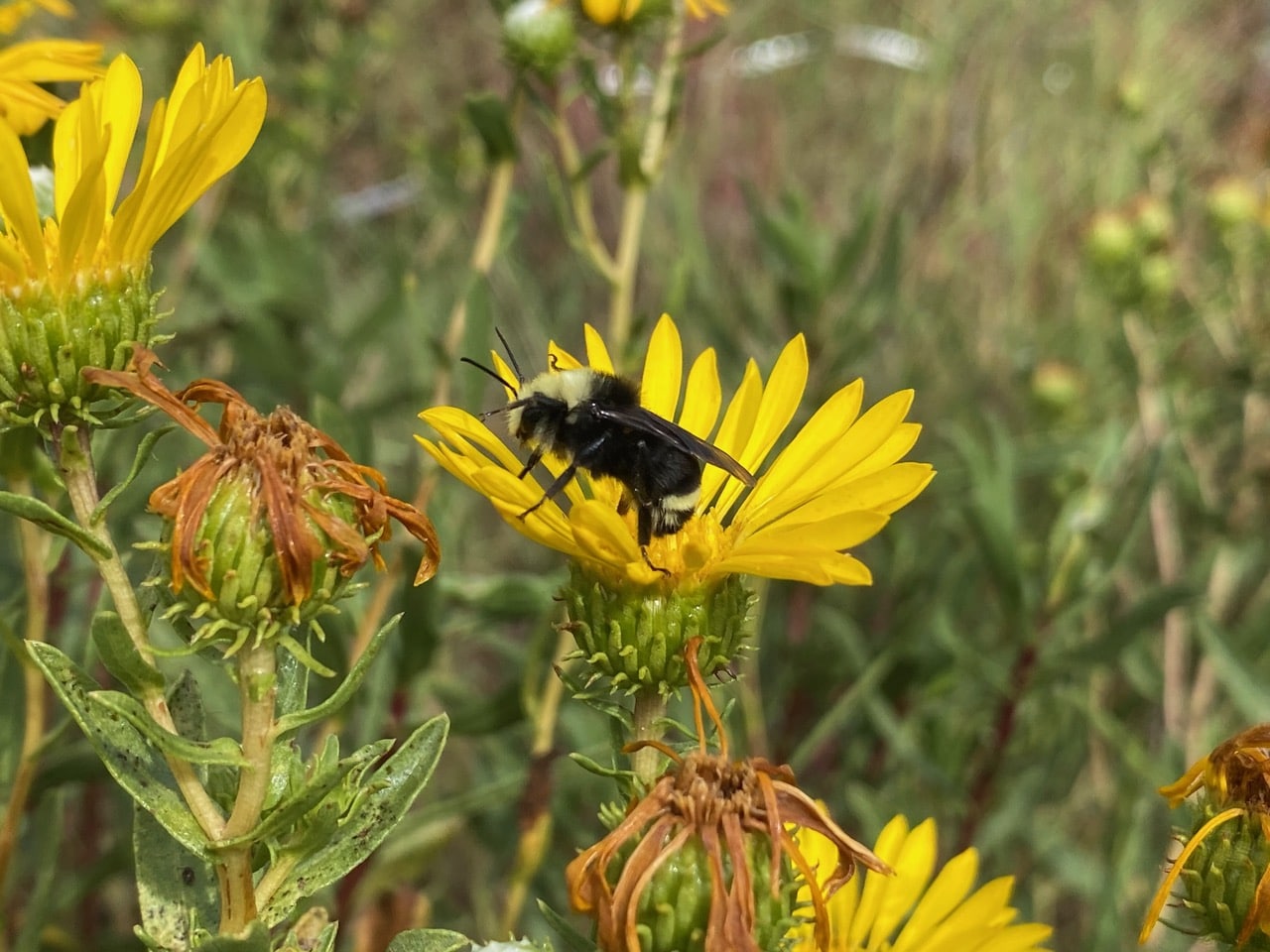


A Yellow-faced Bumble Bee, Bombus vosnesenskii (family Apidae) is fast asleep on a Grindelia flowerhead.
As I watch, the bee wakes up, grooms itself thoroughly and flies away.
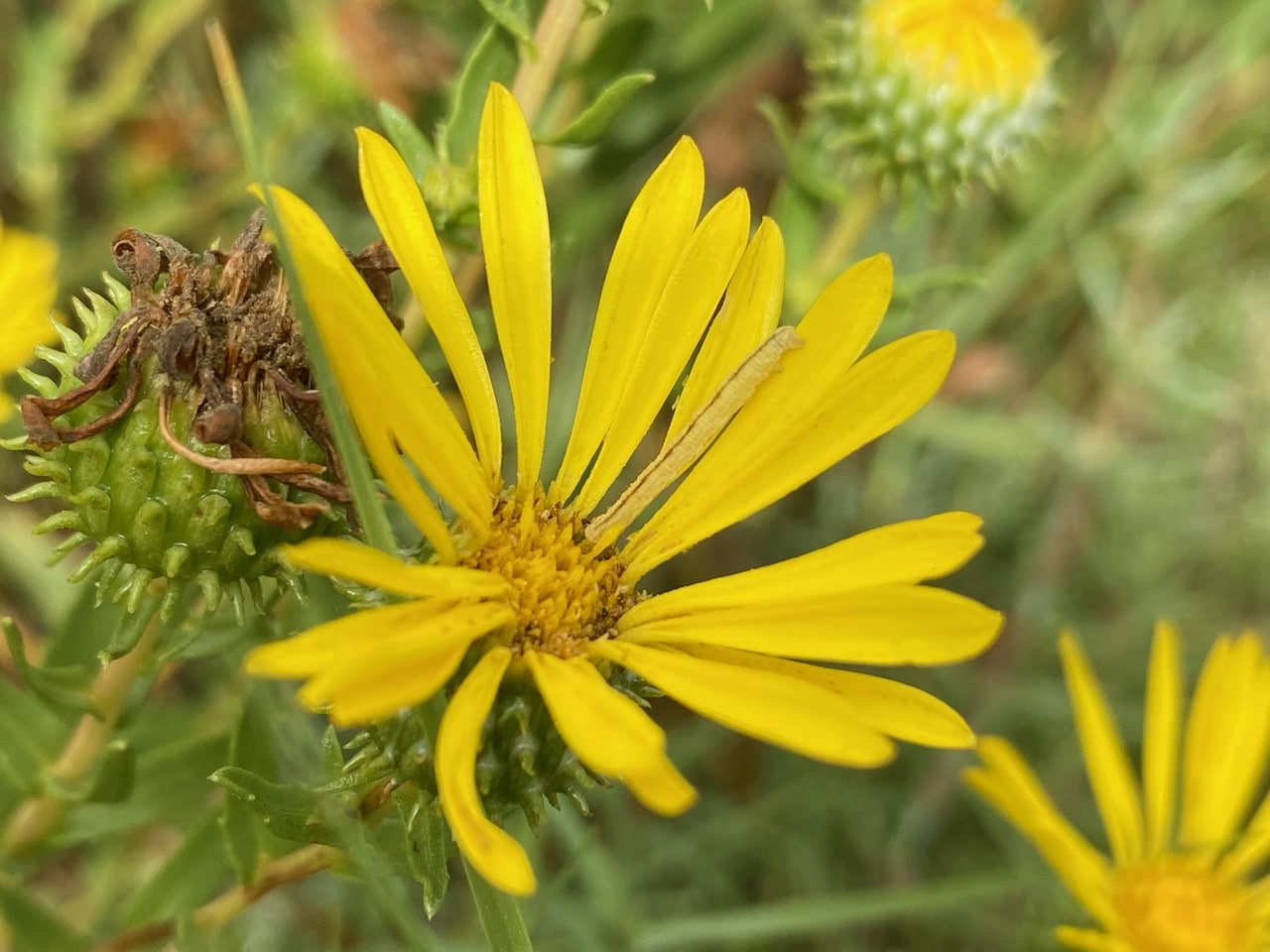
Do you see the caterpillar? It is hardly visible, stretched out parallel to the ray petals. The caterpillar is an Inchworm, larva of the moth genus Eupithecia (family Geometridae).
All caterpillars have three pairs of jointed legs behind their heads. These legs are called true legs because they will become the six legs of the adult butterfly or moth. There are additional appendages, called prolegs, along their bodies. Prolegs are not true legs, they are just outgrowths of the body wall and will be lost at metamorphosis. They have little hooks on their soles to help the caterpillar walk and grip onto things.
Most caterpillars have five sets of prolegs, four in the middle of the body and one pair at the hind end. Inchworms have the normal six true legs but only two or three pairs of prolegs, all located at the tail end of the body, with none in the middle. When an inchworm walks, it moves its tail-end prolegs up behind its true legs, causing the center of its body to loop upward. Then it stretches its front end forward to take another step.
Eupithecia is the largest genus of moths in the family Geometridae. They are commonly known as “pugs”. Adults are typically small, (12-35 mm) with muted colors, usually resting with forewings held flat at right angles to the body. The moths are generally nocturnal. The caterpillars mainly feed on the flowers and seeds of their food plants rather than the foliage. Many species have a very specific food plant.
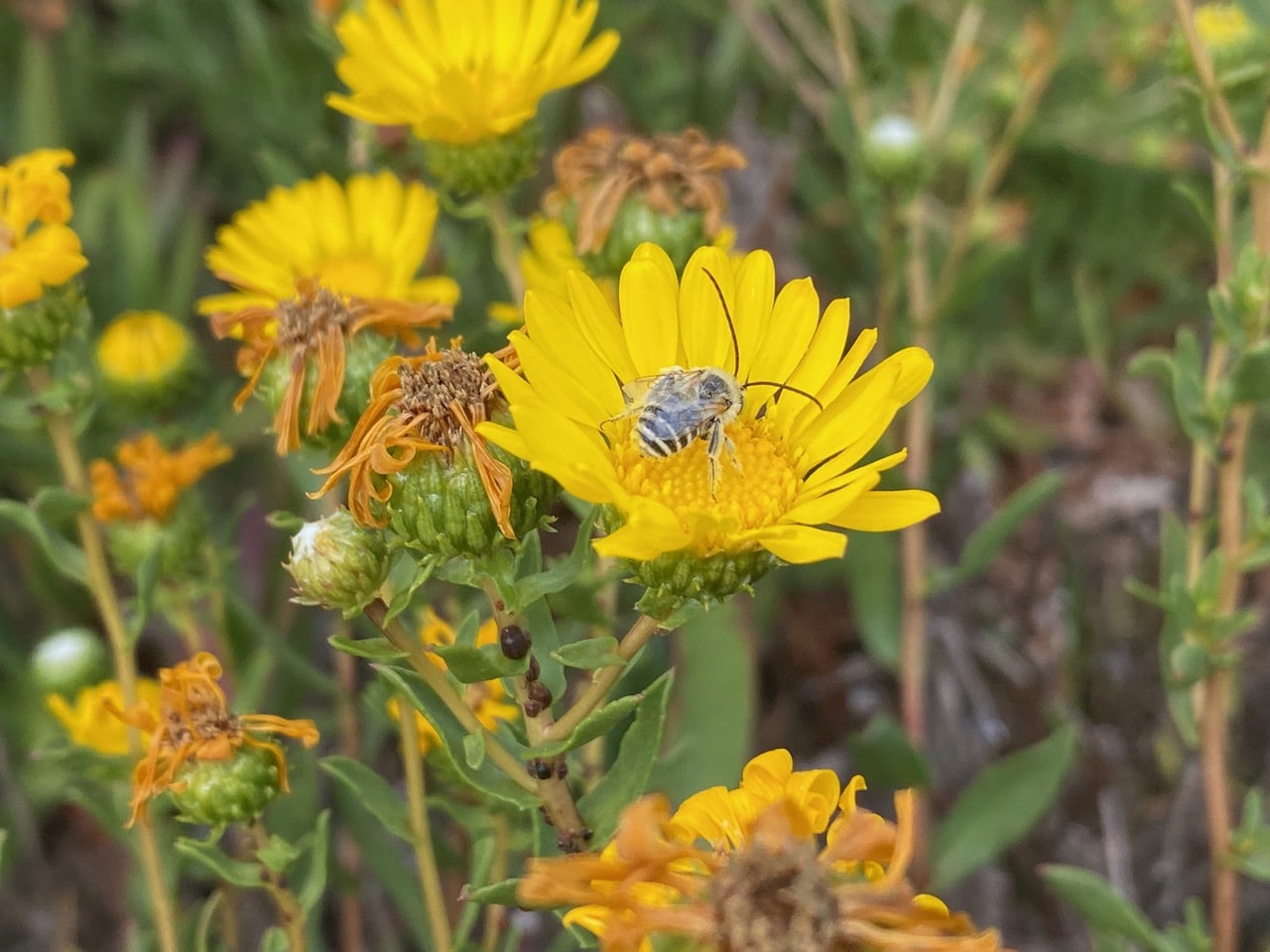
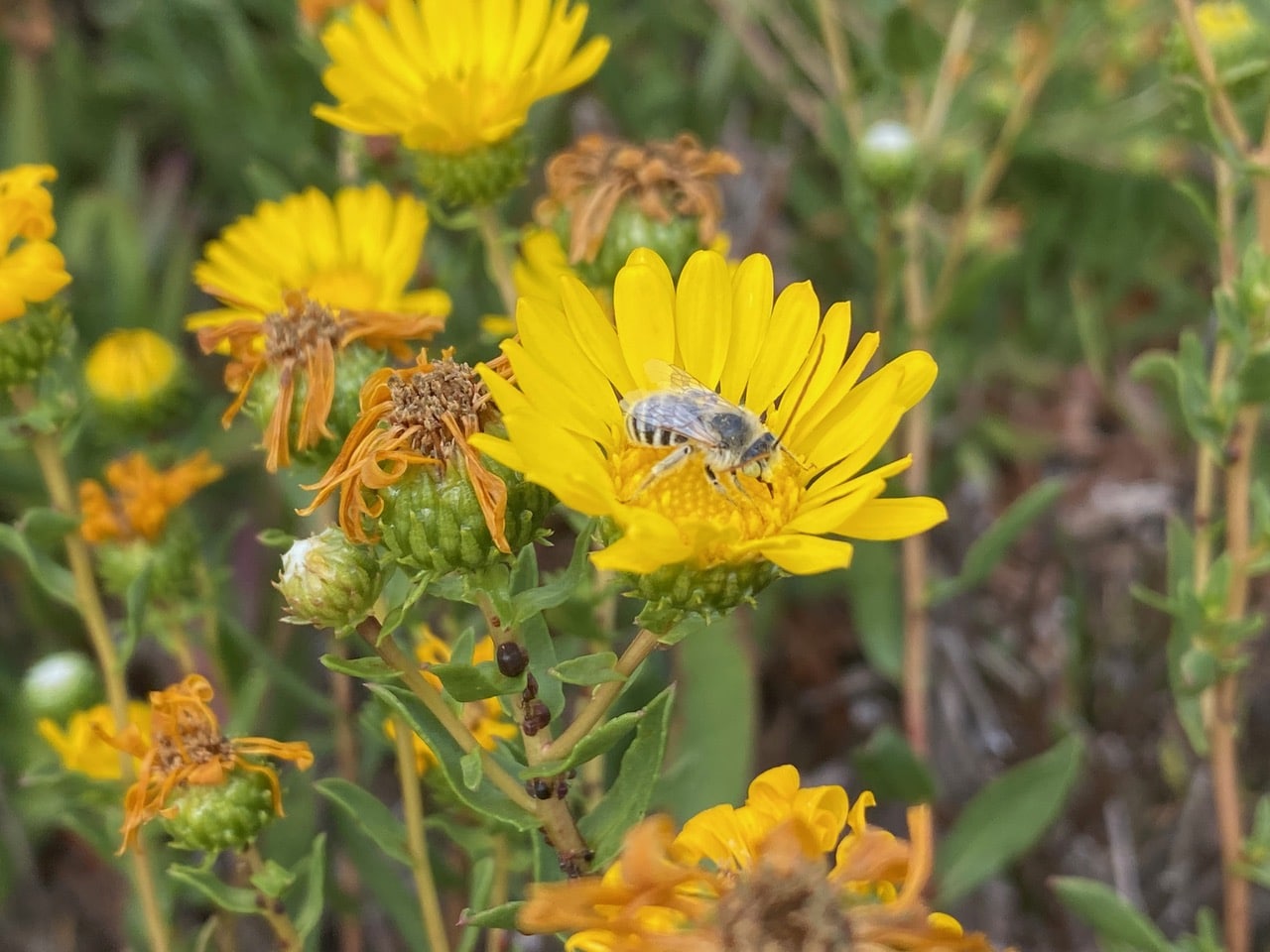
As the sun peeks through the clouds, I begin to see male Longhorn Bees, Melissodes sp. active around the Grindelia.
Thanks to their long antennae, it is easy to spot the male Longhorn Bees from a distance.
The Summer Longhorn Bees, Melissodes sp. (family Apidae) are medium to large bees, stout-bodied, usually with gray hair on the thorax and pale hair bands on the abdomen. Males usually have yellow markings on their faces and have very long antennae from which their common name is derived. They are active May to September, with peak flight in late June to early August. The females prefer flat, bare ground for digging their solitary nests, though they sometimes nest in aggregations. Pollen is transported in scopae on the hind legs. Pollen loads are often copious and brightly colored and thus very distinguishable. Melissodes are specialists on Asteraceae – females gather pollen from flowers of Aster, Bidens, Coreopsis, Cosmos, Encelia, Gaillardia, Helianthus, and Rudbeckia ssp.
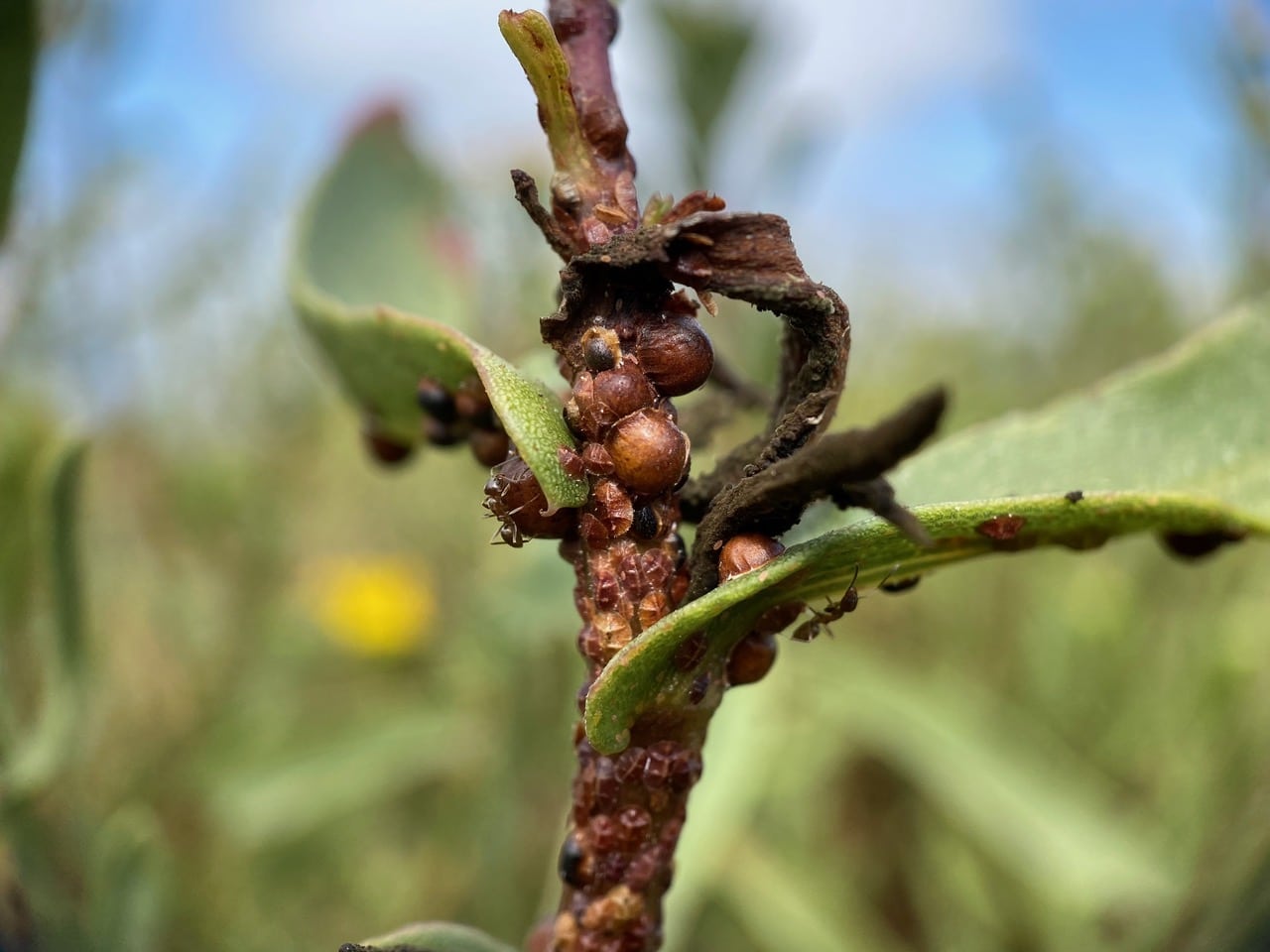
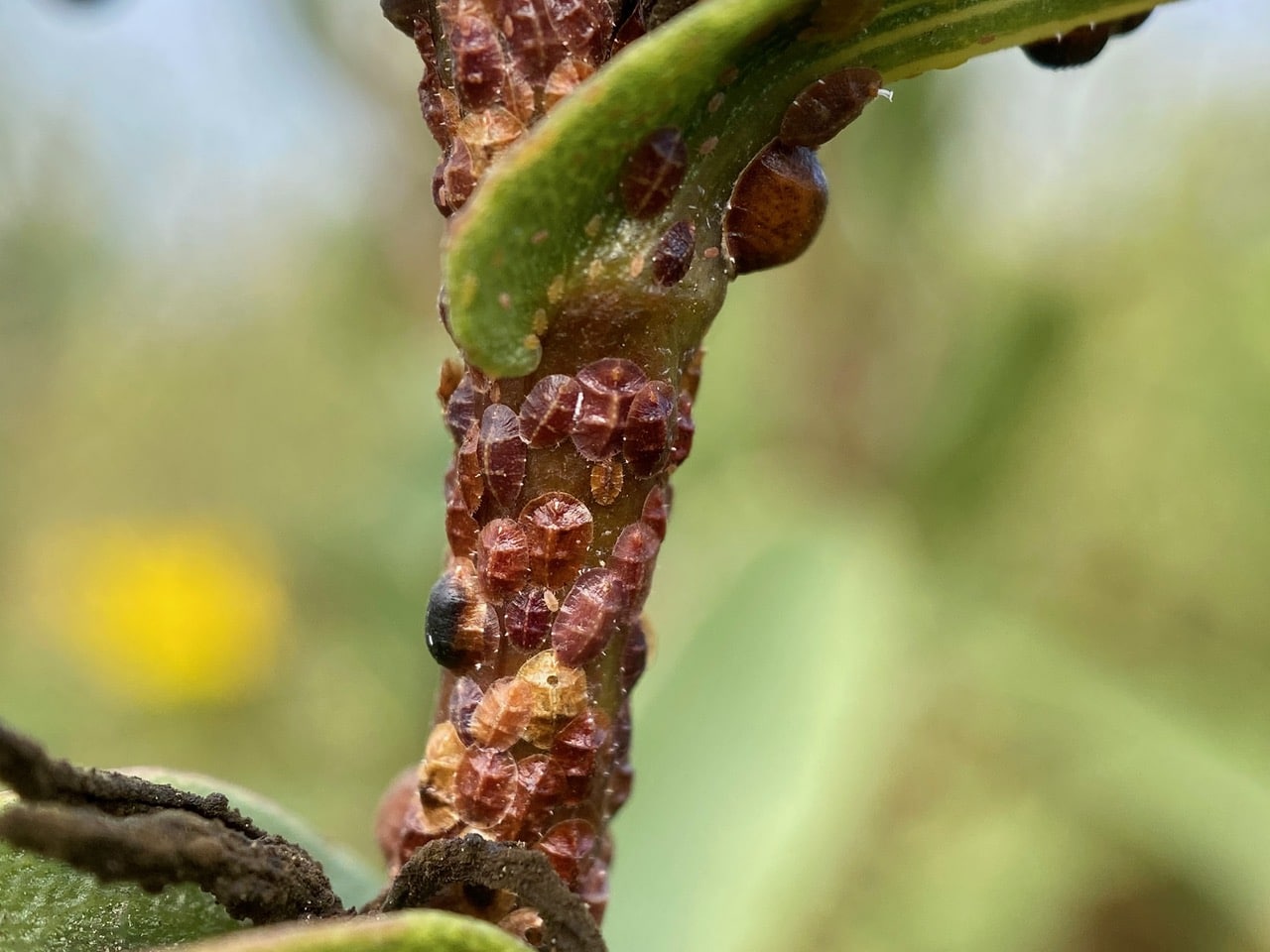
As I am photographing the bee, I notice brown bumps on the stem of the plant.
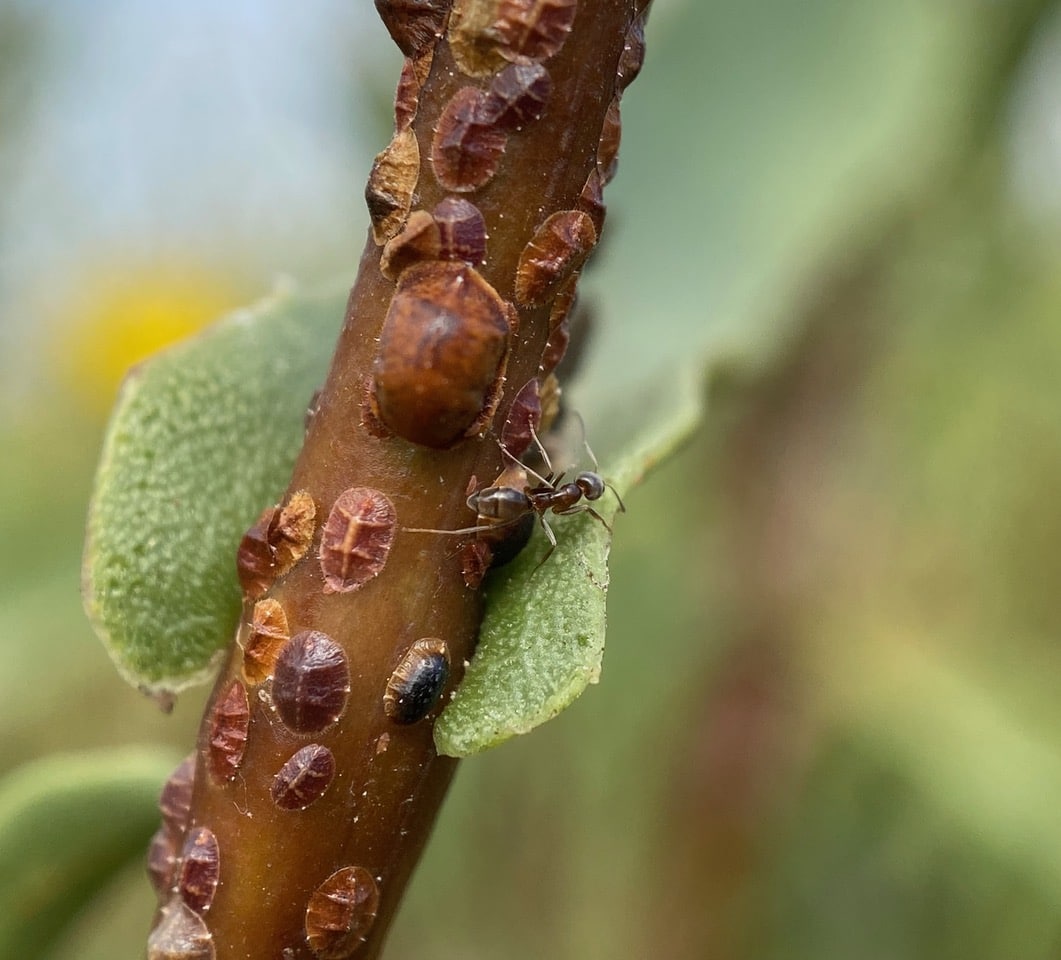
Focusing on the densest aggregation of the brown bumps, I begin to notice ants running around and over them. What is going on? Are the ants here to harvest honeydew?
Are these scale insects? iNaturalist has helped identify them as the Brown Soft Scale, Coccus hesperidum (family Coccidae).
The species has a cosmopolitan distribution and feeds on many different host plants – crops, ornamental and greenhouse plants. The adult female scale insect is oval and dome-shaped, about 3-5 mm long. It retains its legs and antennae throughout its life. Males of the species are rarely found. The Brown Soft Scale is ovoviviparous and produces young mostly by parthenogenesis. Over the course of her life, the female may produce up to 250 eggs, a few being laid each day. The eggs are retained inside the insect until they hatch, at which time small nymphs emerge and are brooded for a few hours before dispersing. These first-stage nymphs are known as crawlers and move a short distance from the mother before settling and starting to feed. They have piercing-sucking mouthparts and feed on the host plant’s sap. They are largely sedentary for the rest of their lives and pass through two more nymphal stages before becoming adults. There may be 3-7 generations in a year. Males are occasionally produced and these pass through four nymphal stages before becoming winged adults.
The individual scales show up better where they are not crowded together. They come in different sizes and shades of brown, depending on age. It’s hard to believe that these are living insects!
An Argentine Ant, Linepithema humile (family Formicidae) is tending the scale insects.
In order to obtain all the nutrients they need, the scale insects ingest large quantities of sap. They then excrete the excess sugary fluid as honeydew. This is attractive to ants which often tend the scale insects, driving away predators. The Brown Soft Scale does not normally kill the host plant, but heavy feeding by the scale insects reduces plant vigor, and kills twigs. Sooty mold that grows on the excreted honeydew on the plant surfaces may interfere with photosynthesis and render the plants unsightly.
An Argentine Ant is prodding a scale insect with its antennae.
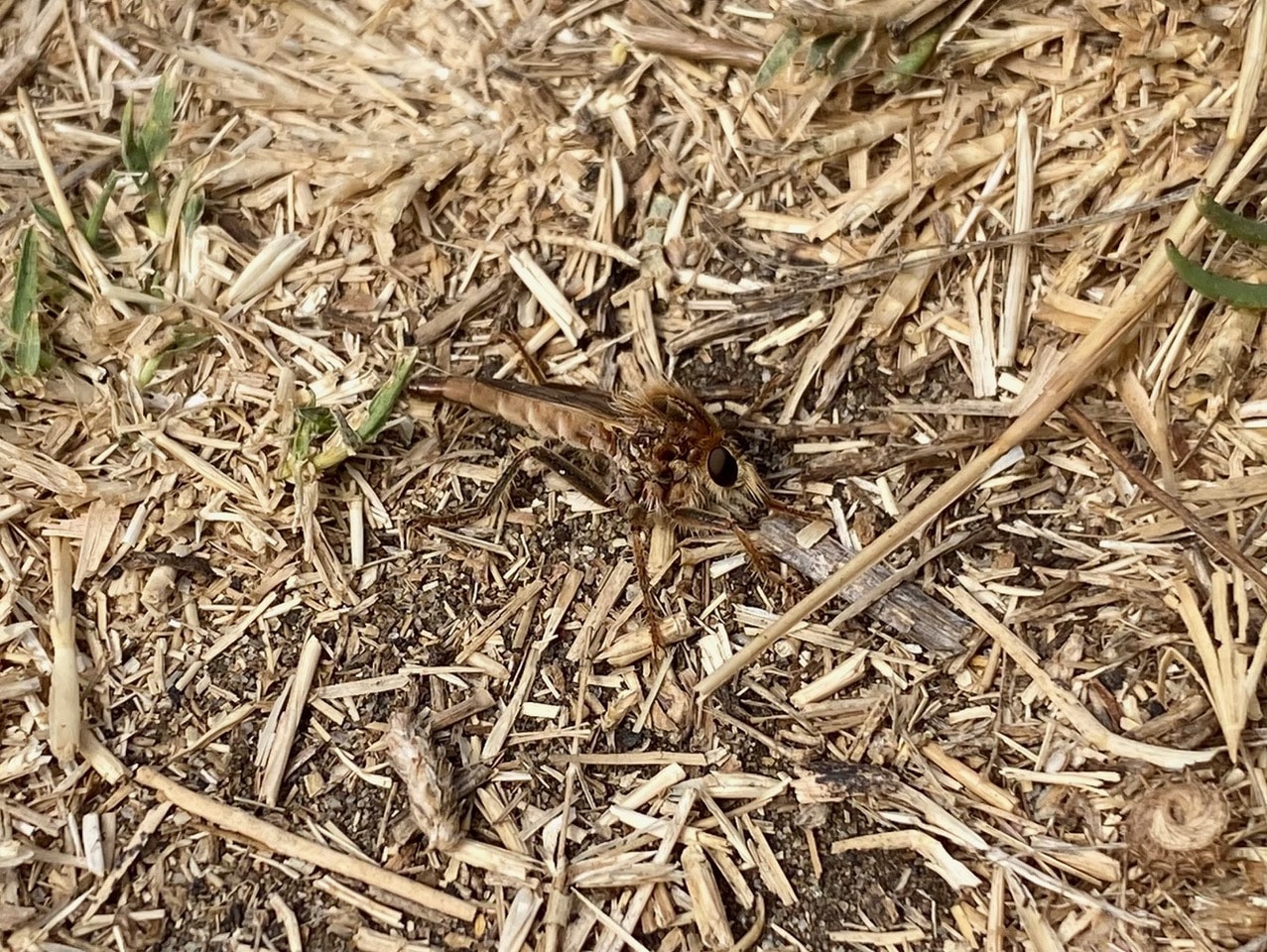
A large insect about an inch long is flying low along the dirt path in front of me, then plops down on the dry plant debris on the ground. Not exactly the best background for a photo! But I am thrilled to find that it is a Robber Fly (family Asilidae)!
Asilids have three simple eyes (ocelli) in a characteristic depression on the tops of their head between their two large compound eyes. This feature is clearly visible in the front view and is a morphological peculiarity of Asilidae. The face also has a characteristic dense bundle of mustache-like bristles, called a “mystax”. Apparently the mystax helps protect the head and face of the fly from its struggling prey bent on defense.
The name “robber flies” reflects their notoriously aggressive predatory habits; they feed mainly or exclusively on other insects and, as a rule, they wait in ambush and catch their prey in flight. Asilids have long, stout, spiny legs for capturing prey. The fly attacks its prey by stabbing it with its short, strong proboscis, injecting the victim with saliva containing neurotoxic and proteolytic enzymes which very rapidly paralyze the victim and digest the insides; the fly then sucks the liquefied material through the proboscis. In general, Asilids attack a very wide range of prey, including other flies, beetles, butterflies and moths, various bees, ants, wasps, dragonflies, damselflies, grasshoppers, and some spiders. Larvae of robberflies live in soil, rotting wood, leaf mold, and similar materials, some being predatory and others detritivorous.
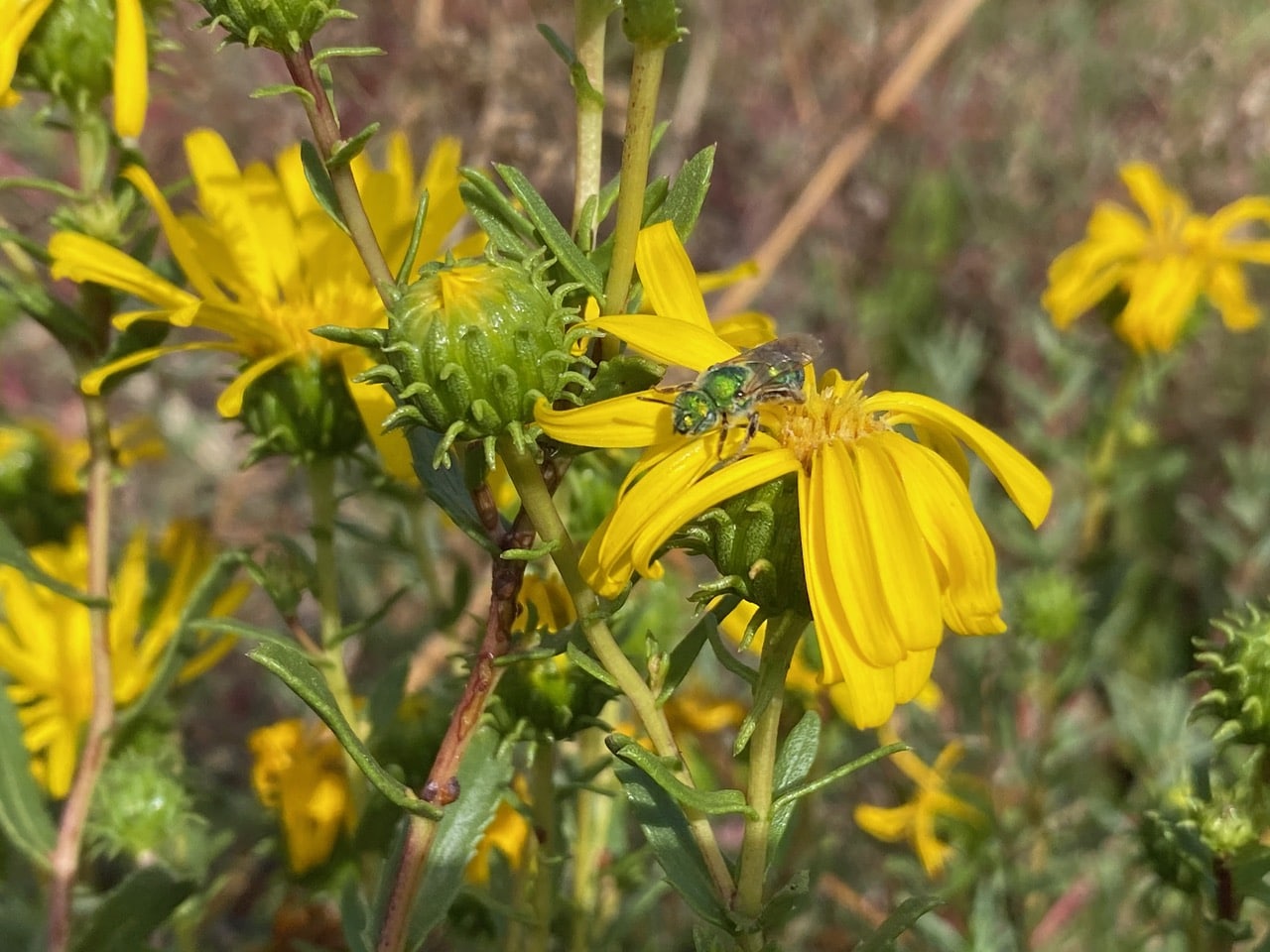
A female Texas Striped Sweat Bee, Agapostemon texanus (family Halictidae) is foraging on a Grindelia flowerhead.
The genus Agapostemon is widespread and abundant throughout North America. They are most diverse and abundant in temperate regions and southwestern U.S. deserts. Agapostemon are commonly called “sweat bees” because they are closely related to, and resemble bees in the Halictus and Lasioglossum genera. Unlike those bees however, Agapostemon are not attracted to human sweat.
Agapostemon are brightly colored metallic green or blue bees measuring 7 to 14.5 mm long. Most species have a metallic green head and thorax, and black-and-yellow striped abdomen; some females are entirely bright green or blue. Females carry pollen on scopal hairs located on their hind legs. Agapostemon are generalists. Like other members of the family Halictidae, they are short-tongued and thus have difficulty extracting nectar from deep flowers. Males are often seen flying slowly around flowers looking for females. The bees favor flowers with high densities. These bees are active summer to fall.
Agapostemon females dig deep vertical burrows in flat or sloping soil, or sometimes in banks. Most species are solitary, but some species nest communally. Up to two dozen females may share a single nest entrance, but each individual builds and provisions its own cluster of brood cells. Where a communal nest gallery shares a single entrance, one bee usually guards the hole, with only her head visible from above ground. Unlike other social bees, in communal bees there is no reproductive division of labor. In cool temperate regions, there is one generation per year, with females active in the early summer and males and pre-diapausing females active in the late summer. Only mated females survive the winter. This is probably because unmated females cannot enter diapause (insect version of hibernation).
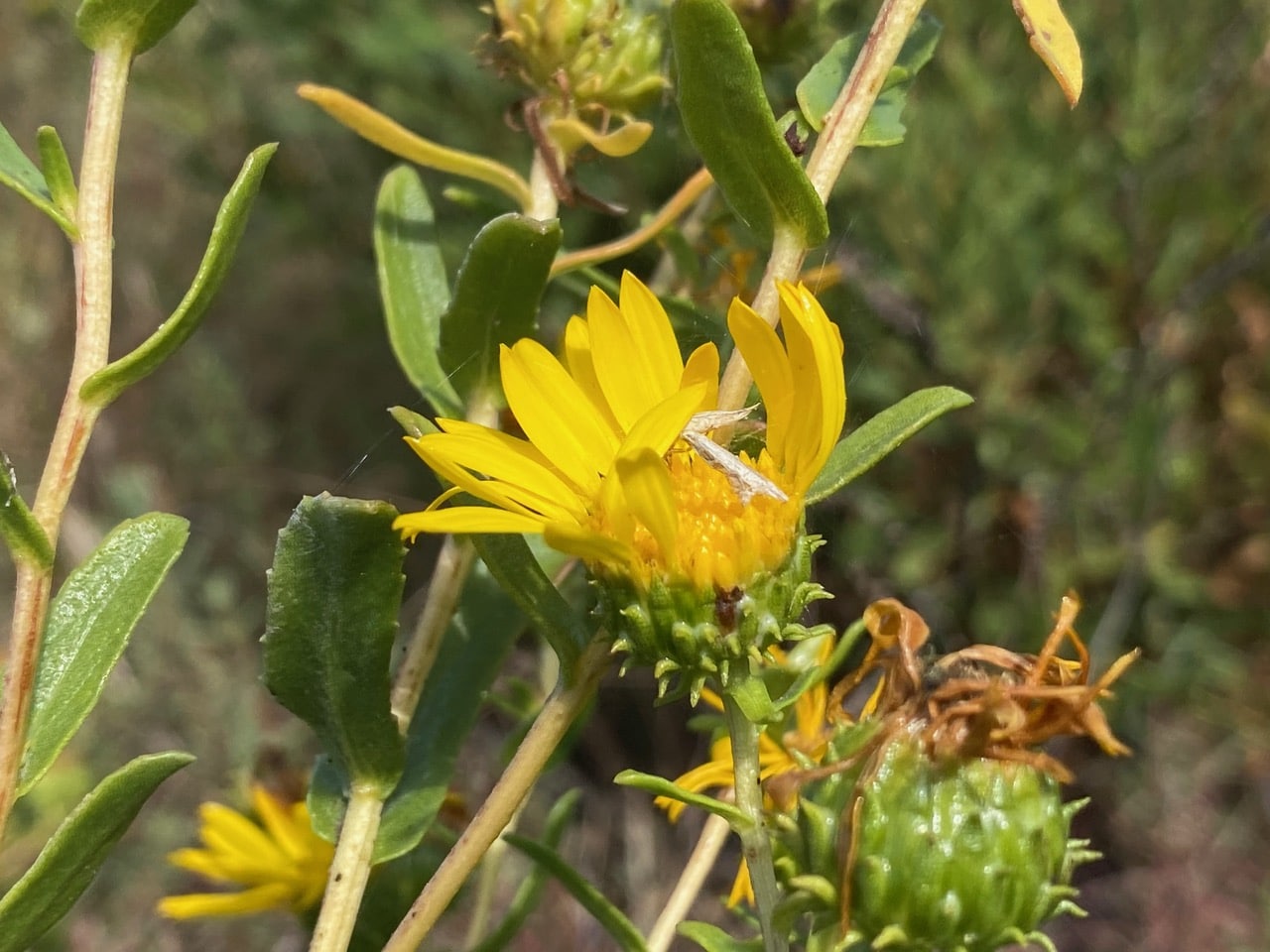
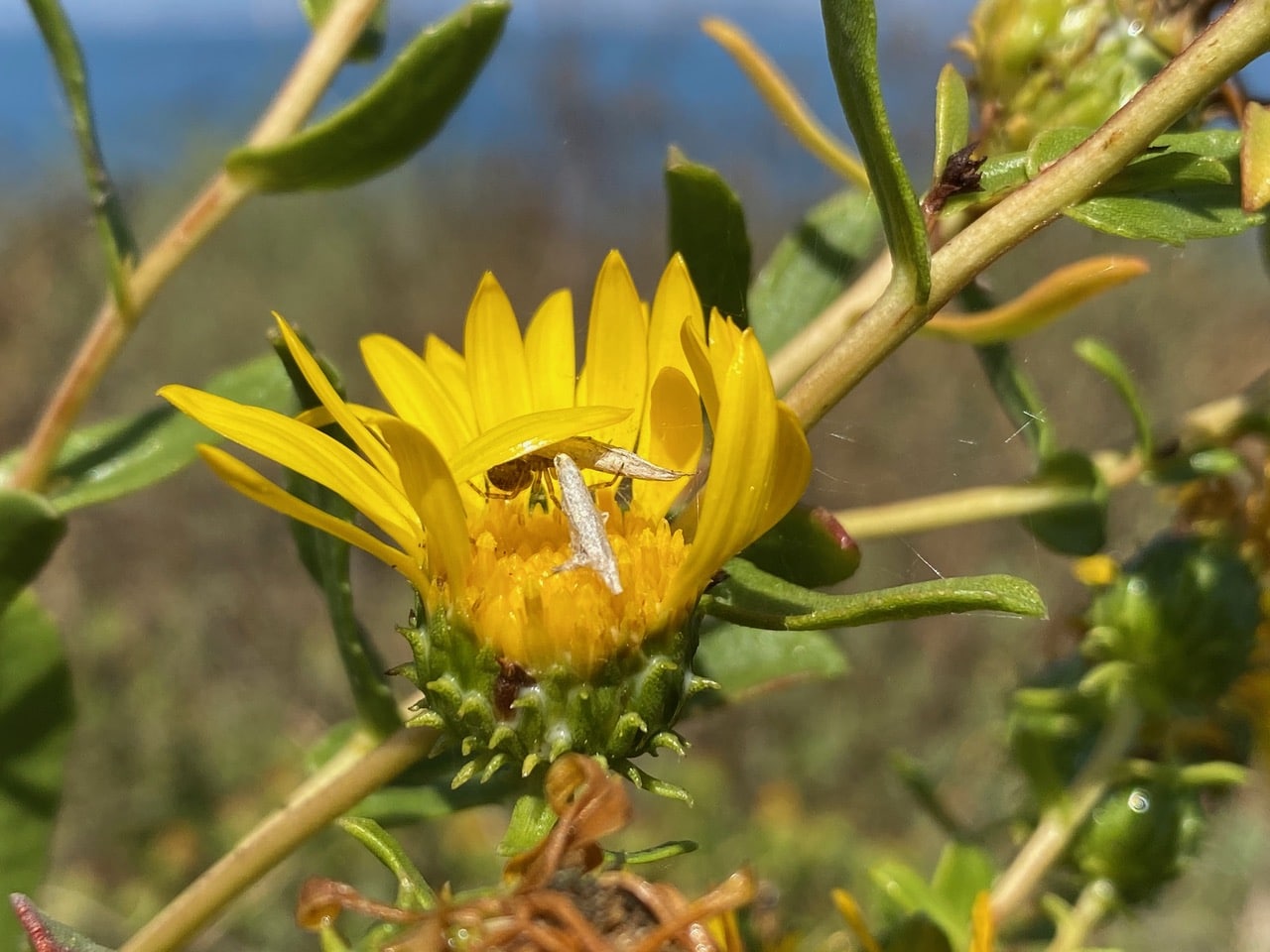
What’s going on with that Grindelia flowerhead with the bent ray petal and whitish things on it?
Ah, a Tangle-web Spider (family Theridiidae) has captured two little moths and is feeding on one of them! You can glimpse part of the spider’s web in and around the flowerhead.
Spiders in the family Theridiidae are called Tangle-web Spiders or Cobweb Spiders. They make a messy, tangled scaffold with a central area consisting of a three-dimensional trellis of silk. From the web to the ground are vertical threads with sticky glue at the bottom. If an insect crawls against the thread it will break and the prey will hang in the air awaiting the attack of the spider. Although Cobweb Spiders are small, they are violent attackers that can take down prey much larger than themselves.
Members of the Theridiidae family are also called Comb-footed Spiders because they have a “comb” on their last pair of legs. The comb is a series of serrated spines which they use to comb out the silk from the spinnerets. Theridiids are cribellate spiders with a specialized organ called a cribellum, which makes silk with “mechanical stickiness” instead of the liquid glue of other spiders. Unlike a typical spinneret, the cribellum has thousands of tiny spigots, all producing extremely thin threads that the spider combs into a single, wooly fiber. Instead of glue, nanofibers from this silk seem to trap prey by fusing with a waxy coating on an insect’s body.
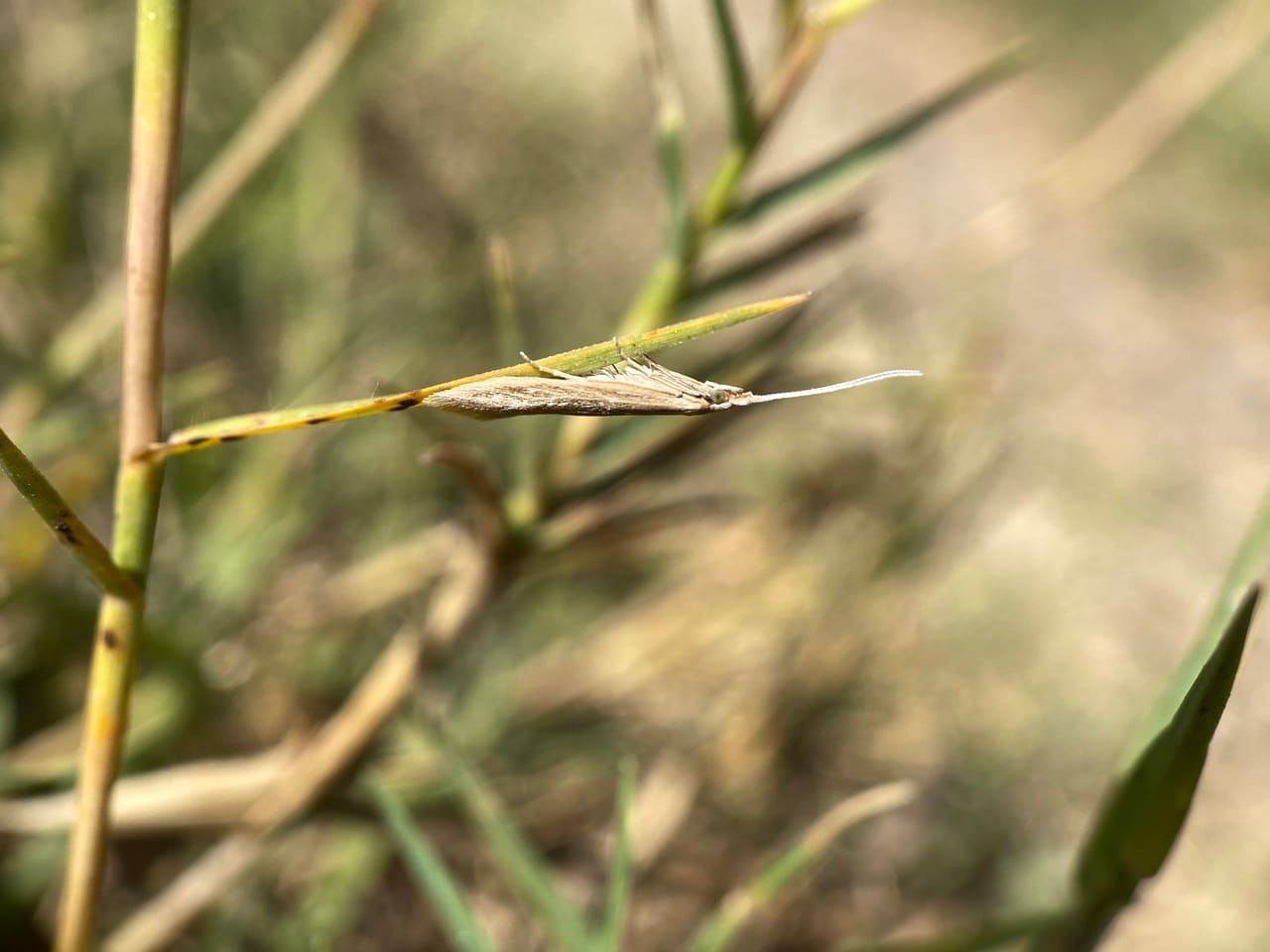
A tiny, pale insect flies in front of me and suddenly disappears on the Saltgrass, Distichlis spicata. I am not sure if the insect is still there, but I close in with my macro lens on the spot where I think it has landed. Surprise – it is a tiny moth masquerading as grass! iNaturalist has identified it as a Diamondback Moth, Plutella sp. (family Plutellidae).
Moths in the family Plutellidae are small to medium in size with wingspans ranging from 7 to 55 mm. The head usually bears smooth scales and the antennae are often thickened in the middle. The wings are elongated and the hindwings often bear long fringes The coloring is generally drab, with various banding and marking. The adults are mostly nocturnal or crepuscular. The larvae feed on the surfaces of leaves which they skeletonize. The host plants vary, but many are in the mustard family, Brassicaceae.