

Pollinator Post 8/31/24 (4)
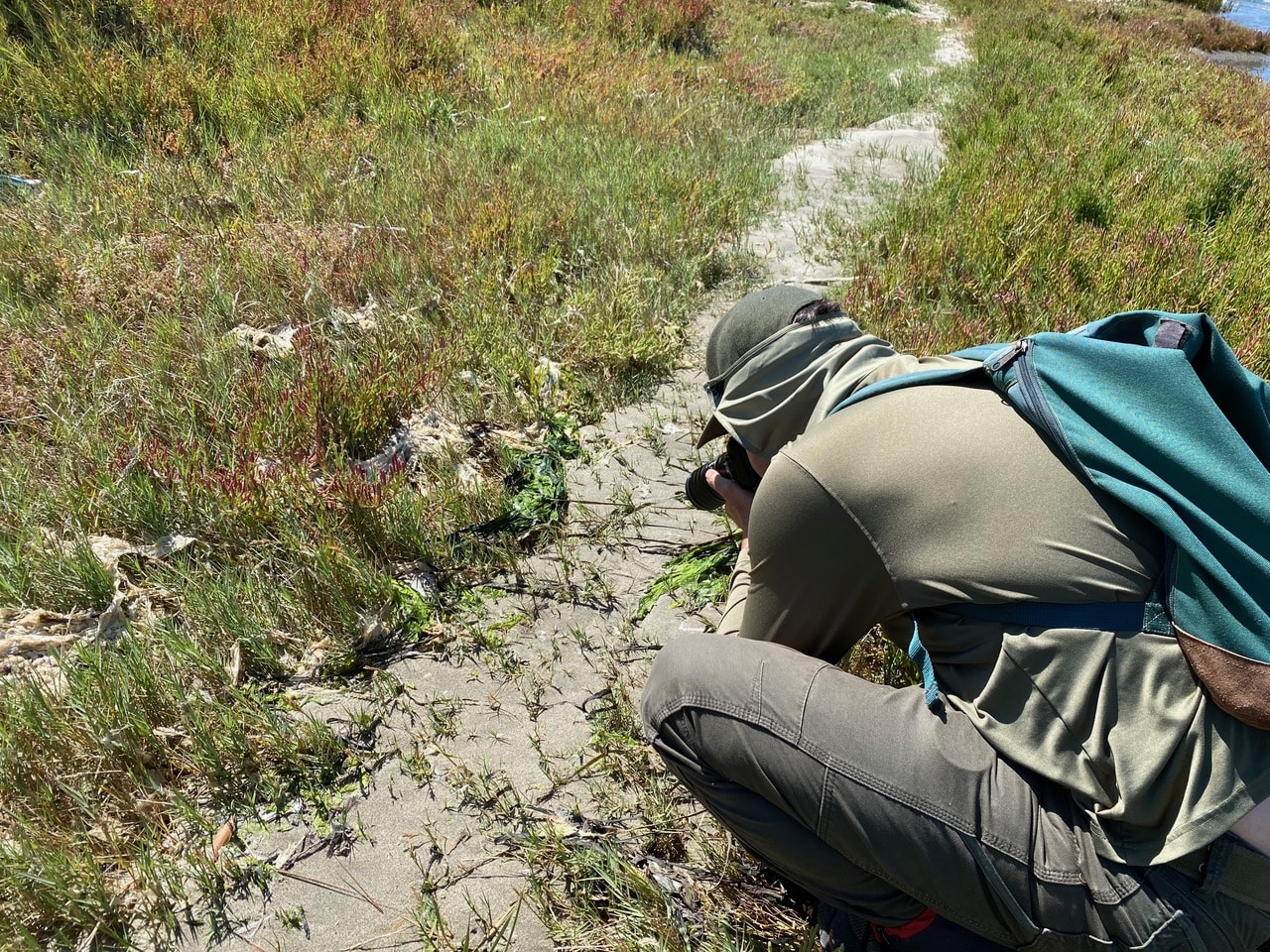
Emil leads us on a narrow sandy path that winds through salt grass, pickleweed, Jaumea, and Frankenia, strewn with beach wrack of rotting algae. He spots a mating pair of Tiger Beetles, and immediately gets into position to photograph them.
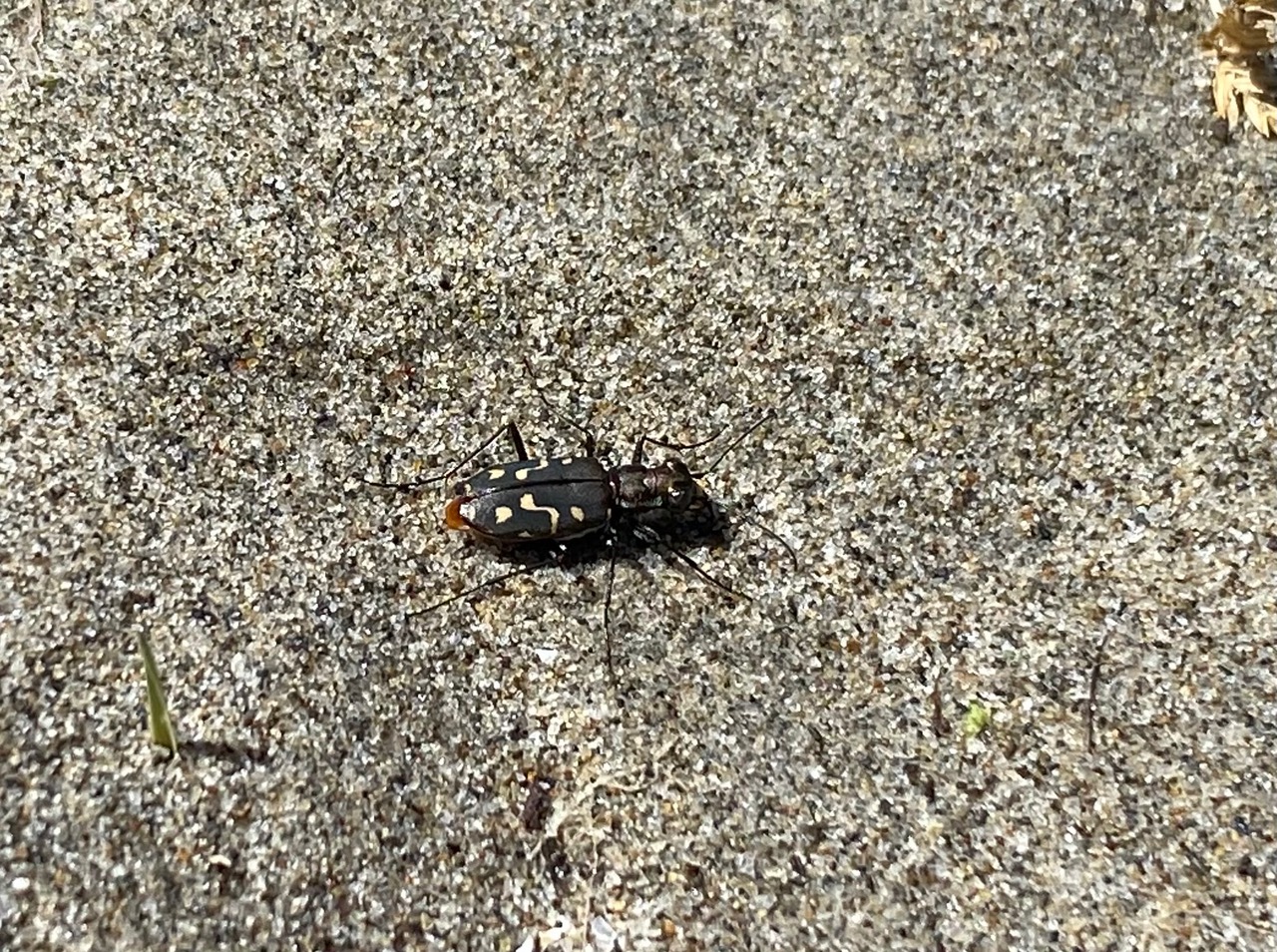
It is almost impossible for me to get close enough to these elusive and fast-running beetles to photograph them without a telephoto lens, but luck is with me! iNaturalist has identified the beetle as the Wetsalts Tiger Beetle, Cicindela haemorrhagica (family Cicindelidae).
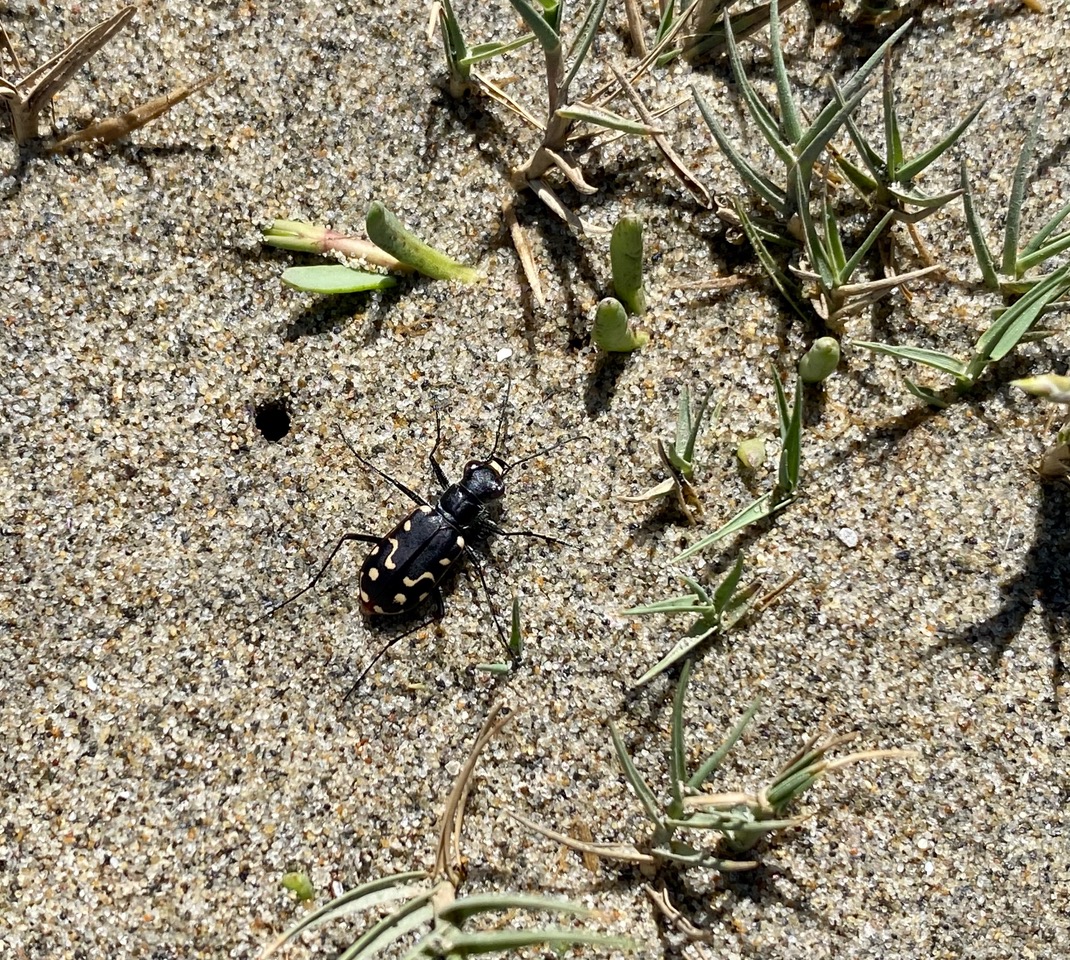
Tiger Beetles are a family of beetles, Cicindelidae, known for their aggressive predatory habits and running speed. The fastest known species can run at about 125 body lengths per second! Tiger Beetles often have large bulging eyes, long, slender legs and large curved mandibles. All are predatory, both as adults and as larvae. The genus Cicindela has a cosmopolitan distribution, is usually diurnal and may be out on the hottest days. The fast-moving adults run down their prey and are extremely fast on the wing. Apparently their running speed exceeds their brain’s ability to process visual images – occasionally the beetles have to abruptly stop in mid-chase to visually reorient. What a riot to watch!
The larvae of tiger beetles live in cylindrical burrows as much as a meter deep. The grubs have a large head, armored on top with up to six small eyes and formidable mandibles beneath. A flat plate right behind their head fills the burrow flush with the surface while they wait at the entrance in ambush for passing prey. There is a prominent hump on their fifth abdominal segment with two pairs of backward pointing hooks to anchor them in their burrow against struggling prey. Danger lurks at every turn, both on and below ground for the other little creatures that make their home in this sandy habitat.
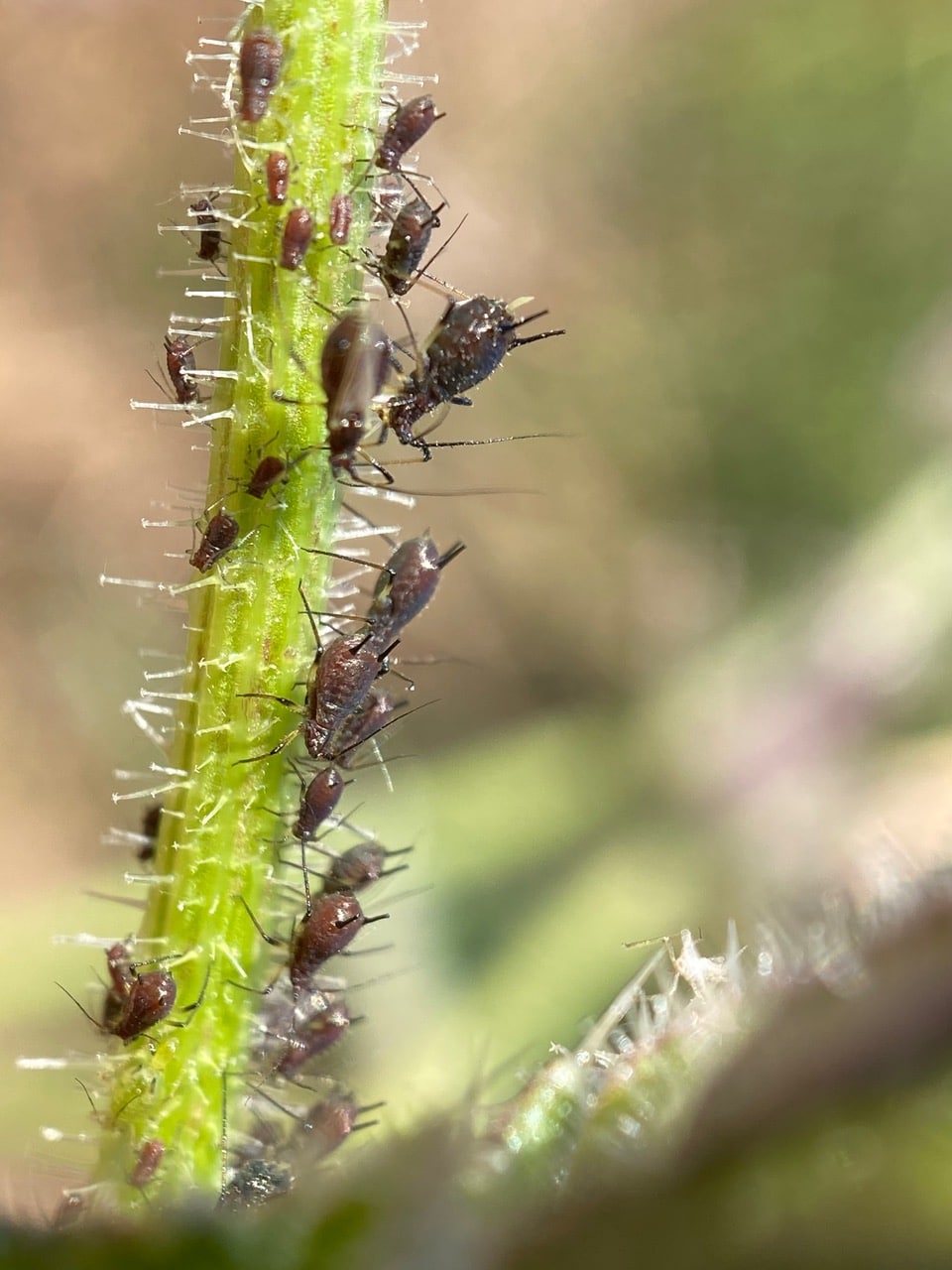
Aphids of various ages and sizes crowd a stem of a Bristly Oxtongue by the foot path. iNaturalist has helped identify the species as the Rose Aphid, Macrosiphum rosae (family Aphididae).
Aphids are small sap-sucking insects in the order Hemiptera. A typical life cycle involves flightless females giving live birth to female nymphs, – who may also be already pregnant, an adaptation called telescoping generations – without the involvement of males. Maturing rapidly, females breed profusely so that the population multiplies quickly. Winged females may develop later in the season, allowing the insects to colonize new plants. In temperate regions, a phase of sexual reproduction occurs in the autumn, with the insects often overwintering as eggs.
The life cycle of some species involves an alternation between two species of host plants. Some species feed on only one type of plant, while others are generalists, colonizing many plant groups. Some ants have a mutualistic relationship with aphids, tending them for their honeydew and protecting them from predators.
Aphids usually feed passively on phloem of plants. Once the phloem vessel is punctured, the sap, which is under pressure, is forced into the aphid’s food canal. Aphids produce large amounts of a sugary liquid waste called “honeydew”. A fungus called sooty mold can grow on honeydew deposits that accumulate on leaves and branches, turning them black.

It is not surprising to find a Lady Beetle on the same plant. Both adults and larvae are voracious aphid predators. The Convergent Lady Beetle, Hippodamia convergens (family Coccinellidae) is easily recognizable from the two converging white lines on its pronotum.
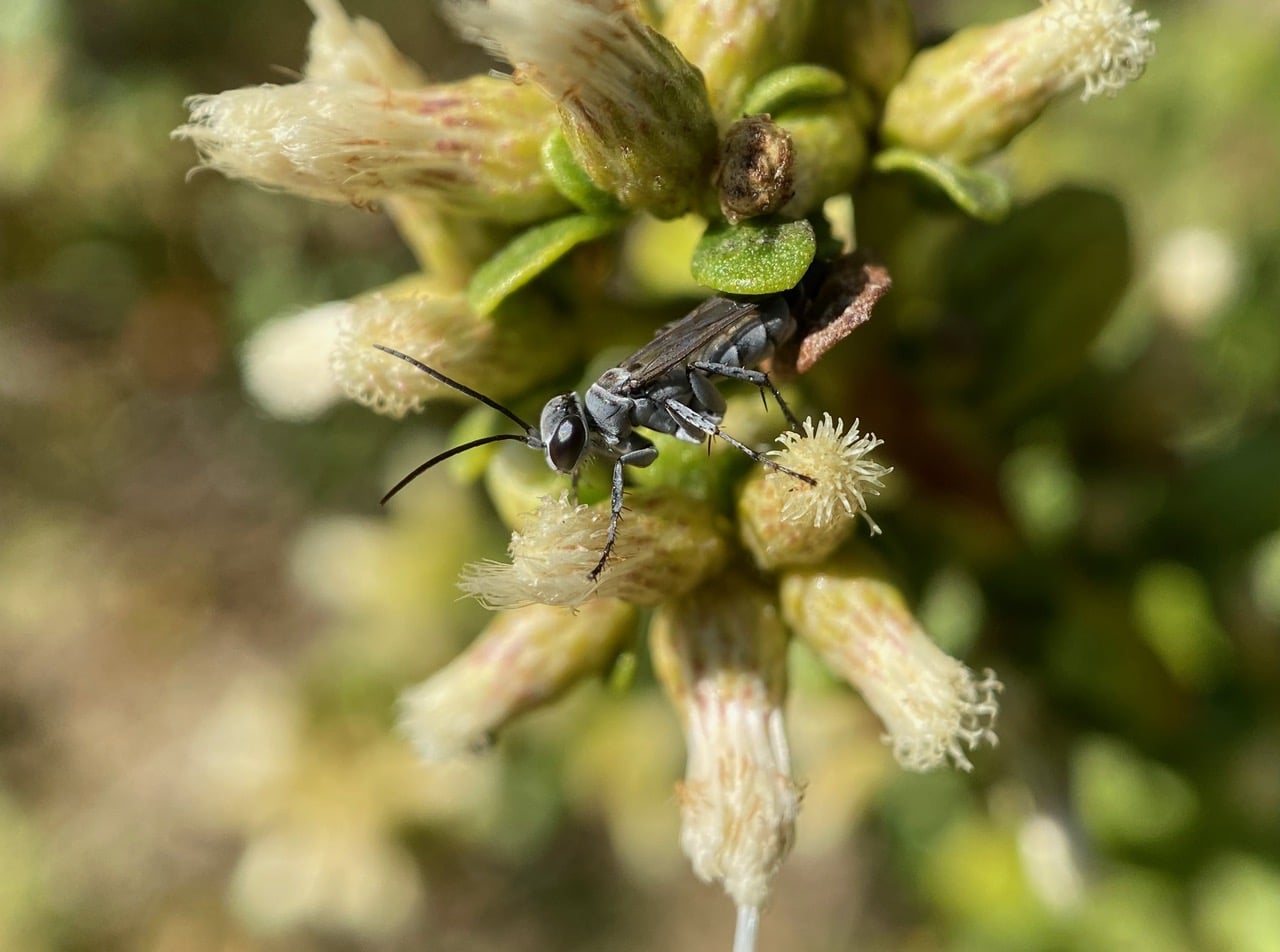
A wasp is perched on a cluster of female Coyote Brush flowers, Baccharis pilularis. iNaturalist has helped identify it as a Spider Wasp in the family Pompilidae.
Wasps in the family Pompilidae are commonly called spider wasps or pompilid wasps. Nearly all are solitary, and most capture and paralyze spiders to provision for their offspring. Pompilids typically have long, spiny legs; the third femur is often long enough to reach past the tip of the abdomen. The tibiae of the rear legs usually have a conspicuous spine at their distal end. The wasps are typically dark (black or blue, sometimes with metallic reflections).
Adult pompilids visit flowers for nectar. Depending on genus and species, pompilids capture a variety of spiders for their larvae to feed on. Any given pompilid tends to attack only a limited diversity of spiders. The female wasp searches the ground and/or vegetation for a spider, and upon finding one, stings it, paralyzing the spider. She then digs a burrow, or flies or drags the spider to a previously made burrow. Most pompilids provide each of their larvae with a single prey, which must be large enough to serve as its food source throughout its development. Typically, a single egg is laid on the spider, and the nest or burrow is closed. When the egg hatches, the larva feeds on the spider, saving the vital organs for last, ensuring that the food remains fresh to the end. The final, fifth instar spins a durable silk cocoon in which it pupates, emerging as an adult later in the season or the following year.