

Pollinator Post 9/6/24 (2)
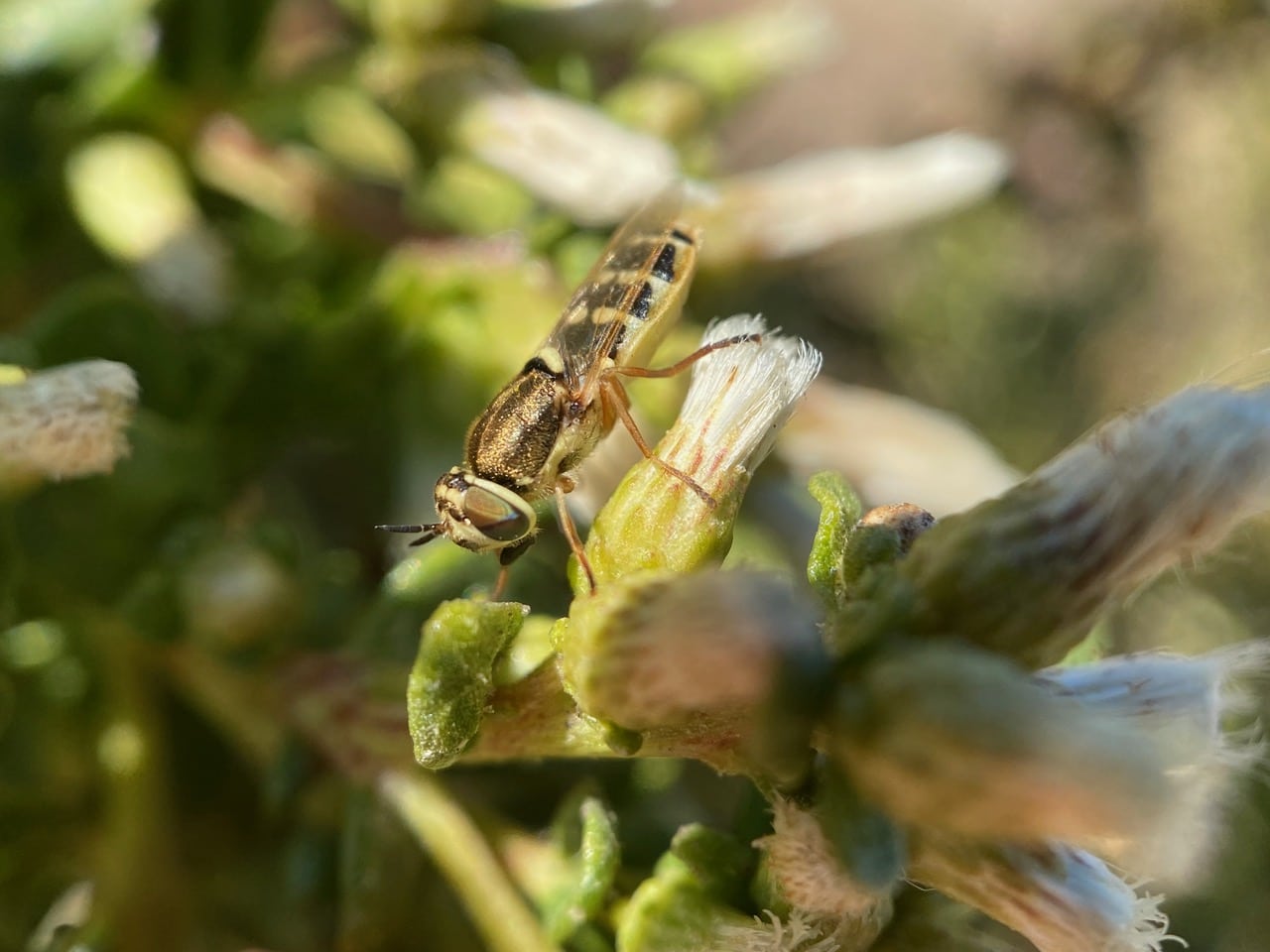
A Soldier Fly, Odontomyia sp. (family Stratiomyidae) is foraging on the flowerheads of a female Coyote Brush, Baccharis pilularis.
Members of the genus Odontomyia occur throughout much of the world, found in woodlands, fields, usually near water. They are 9-12 mm in length. Adults take nectar, also sometimes found on dung. Larvae are aquatic and feed on algae. Eggs are laid on the edge of body of water. Larvae stick the tip of their abdomen through the water surface to obtain air.

When not in flight, Soldier Flies (family Stratiomyidae) tend to hold their wings neatly folded, one above the other over the abdomen, not quite covering the width of their abdomen.
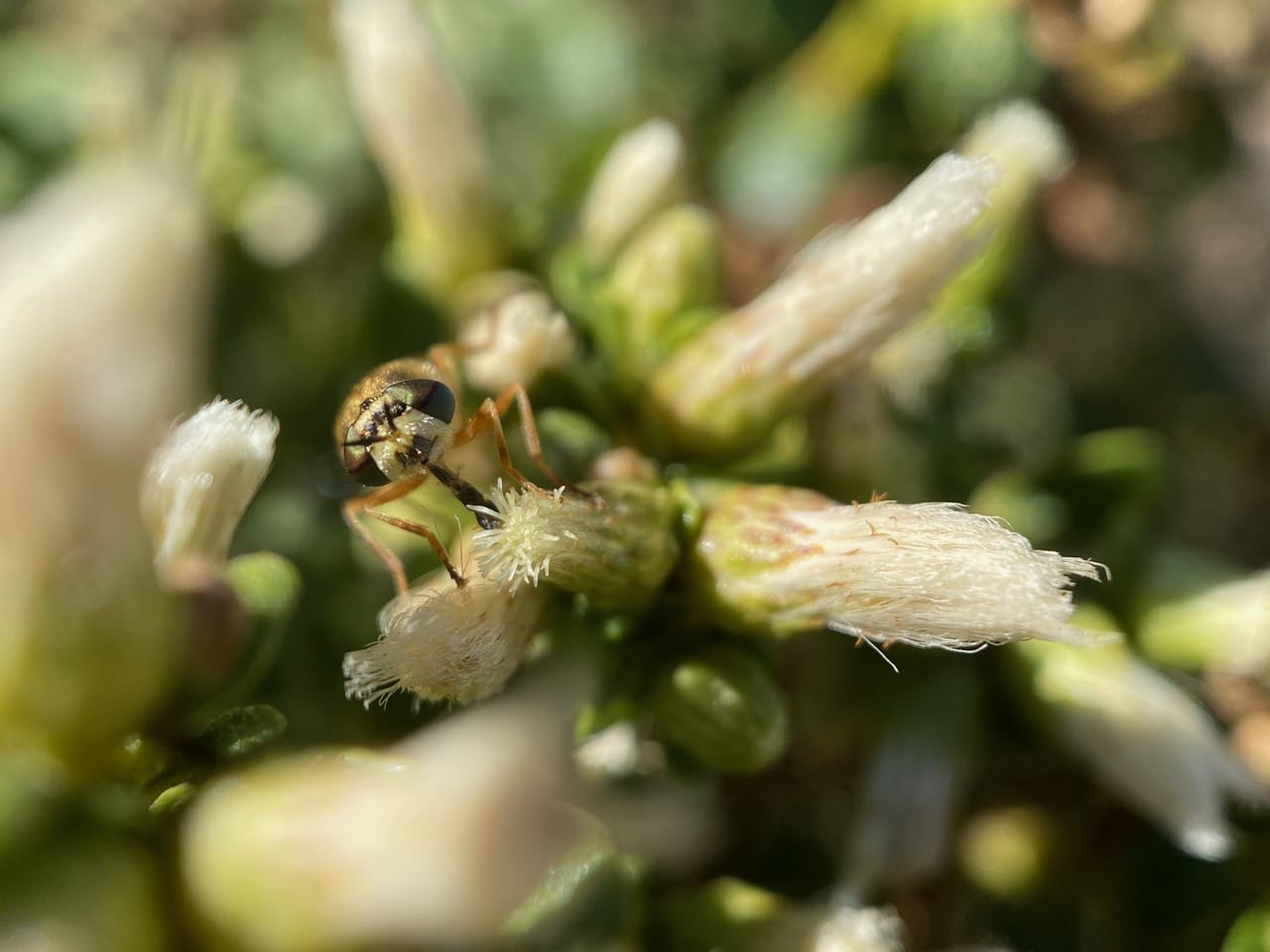
Its proboscis extended, the fly is taking nectar from the female flowers of Coyote Brush.
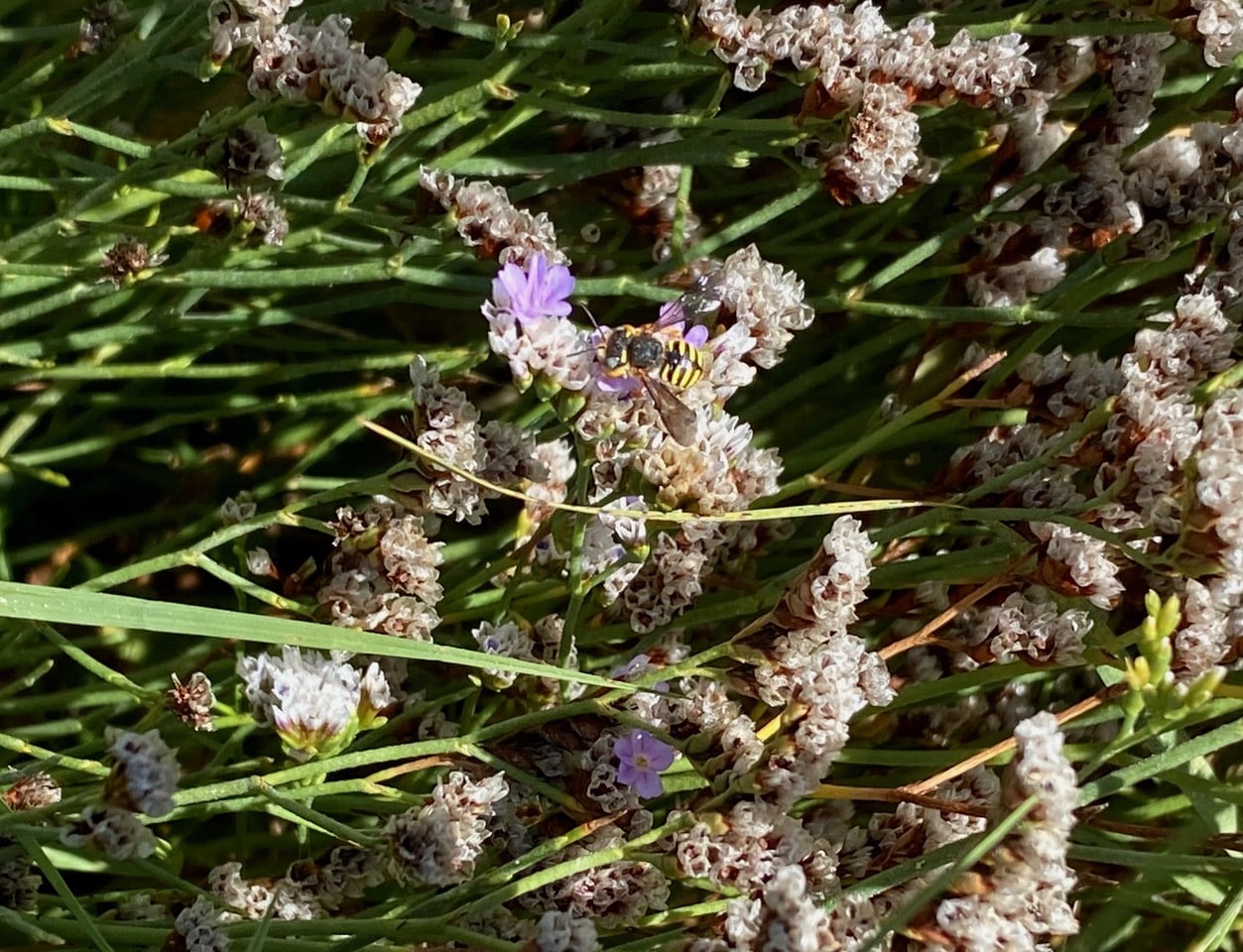
A European Woolcarder Bee, Anthidium manicatum (family Megachilidae) is foraging on an inflorescence of the Sea Lavender, Limonium sp.
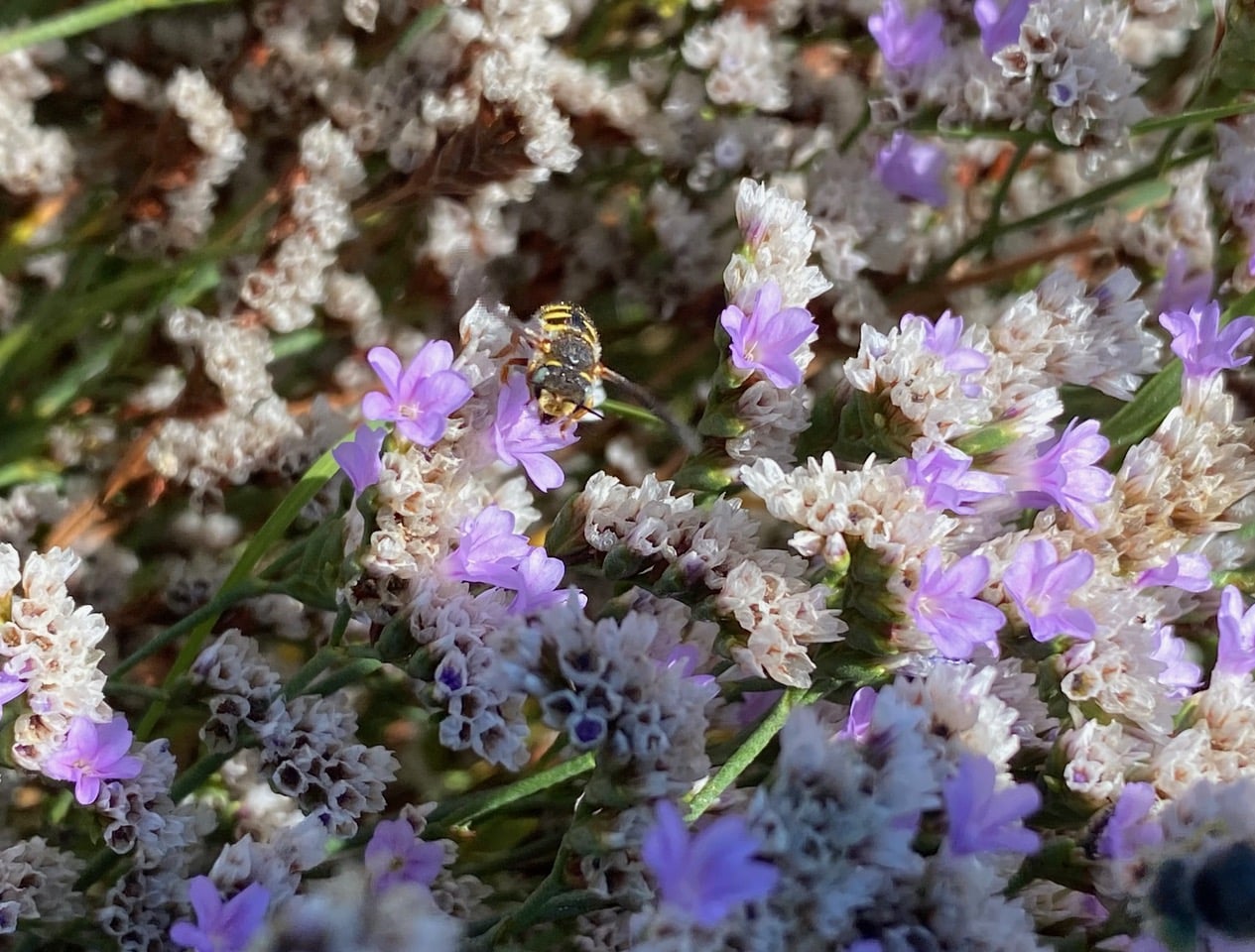
Anthidium manicatum, commonly called the European Woolcarder Bee, is a species in the family Megachilidae, which includes the leaf-cutter bees and mason bees. They get the name “carder” from the behavior of the females scraping hair from leaves and stems of wooly plants. The substantially larger males engage in territorial behavior, aggressively chasing other males and pollinators from their territory. They mate with the females that forage in their territory. The females construct their nests in pre-existing cavities, using the hairs of wooly plants that they collect with their sharply toothed mandibles. They then roll up the fibers into a ball and transport them to the nest to line the nest cell, where they lay an egg and a provisioning mass consisting of nectar and pollen. Females largely use the hairs of plants in the mint family, Lamiaceae, especially those of genus Stachys and Betonica. The European Woolcarder Bees visit a wide range of flowers, with a preference for blue flowers that have long throats. They are considered generalists. Females carry pollen in the scopa on the underside of their abdomen. Both males and females can hover in midair near flowers similar to the hover flies (family Syrphidae).
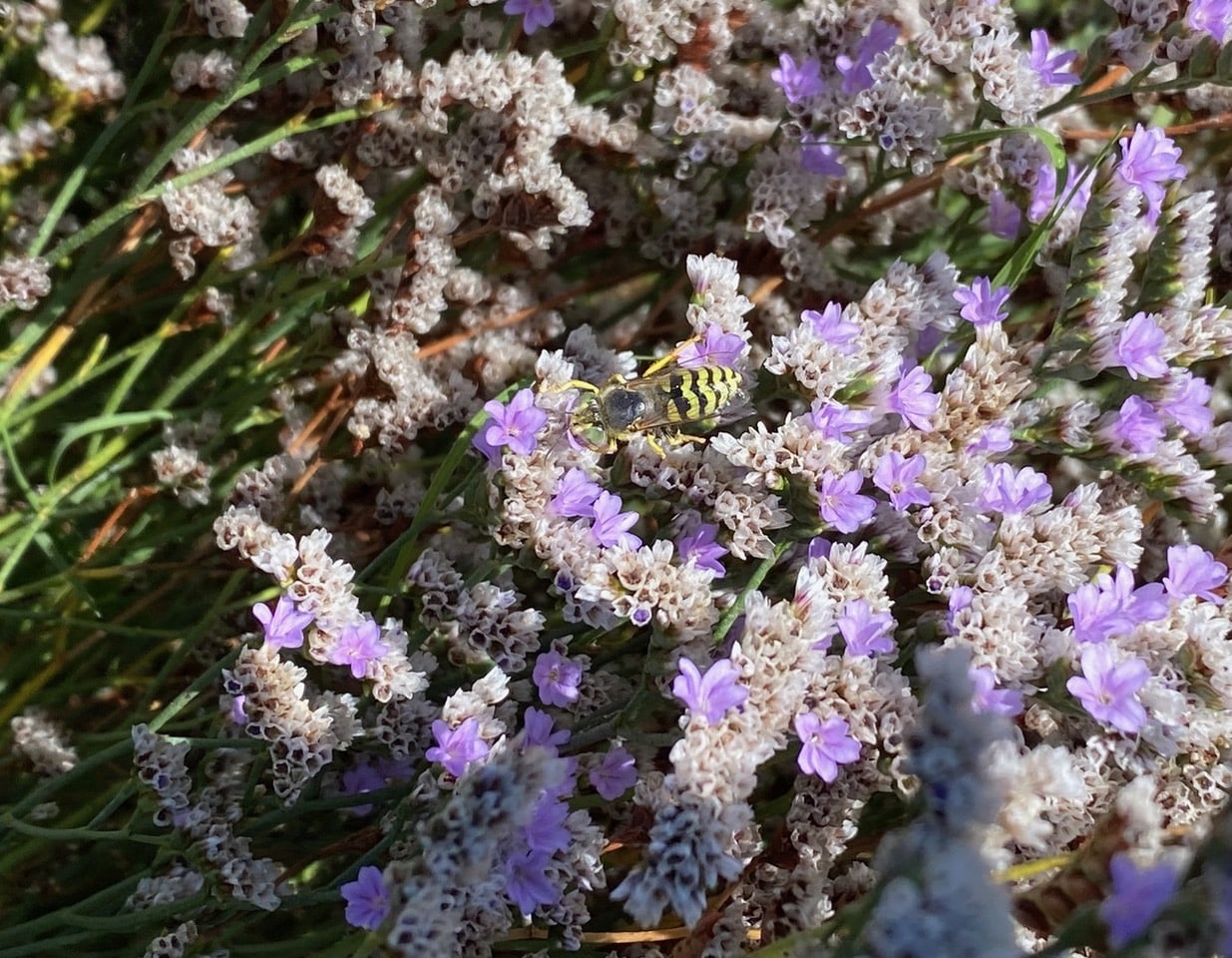
It is hard to spot the American Sand Wasp, Bembix americana (family Crabronidae) amidst the inflorescence of Sea Lavender. The wasp’s black-and-white abdomen blends well with the white calyces of the small flowers.
Sand wasps in the genus Bembix are familiar and common throughout North America, digging their burrows in dunes, on beaches, and other habitats with loose, deep sand. The female rapidly kicks out large quantities of sand using a “tarsal rake” of spines on each front leg. The burrow is excavated before the wasp goes hunting. Bembix are generalist, opportunistic hunters. True flies in the order Diptera are the usual prey. A victim is paralyzed or killed by the wasp’s sting, and is then flown back to the nest. Most species will lay an egg on the first victim, while some species lay an egg in the empty cell before starting to hunt. Once the egg hatches, mama wasp brings flies to her larva as needed. This “progressive provisioning” is rare in the insect world. When the larva reaches maturity, mama wasp closes the cell. Inside, the larva spins an oblong cocoon, weaving sand grains into the structure and resulting in a hardened capsule. Overwintering takes place as a prepupa inside this cocoon, but there are usually two generations a year.

It is time to check on the Spittlebugs on the Grindelia again.

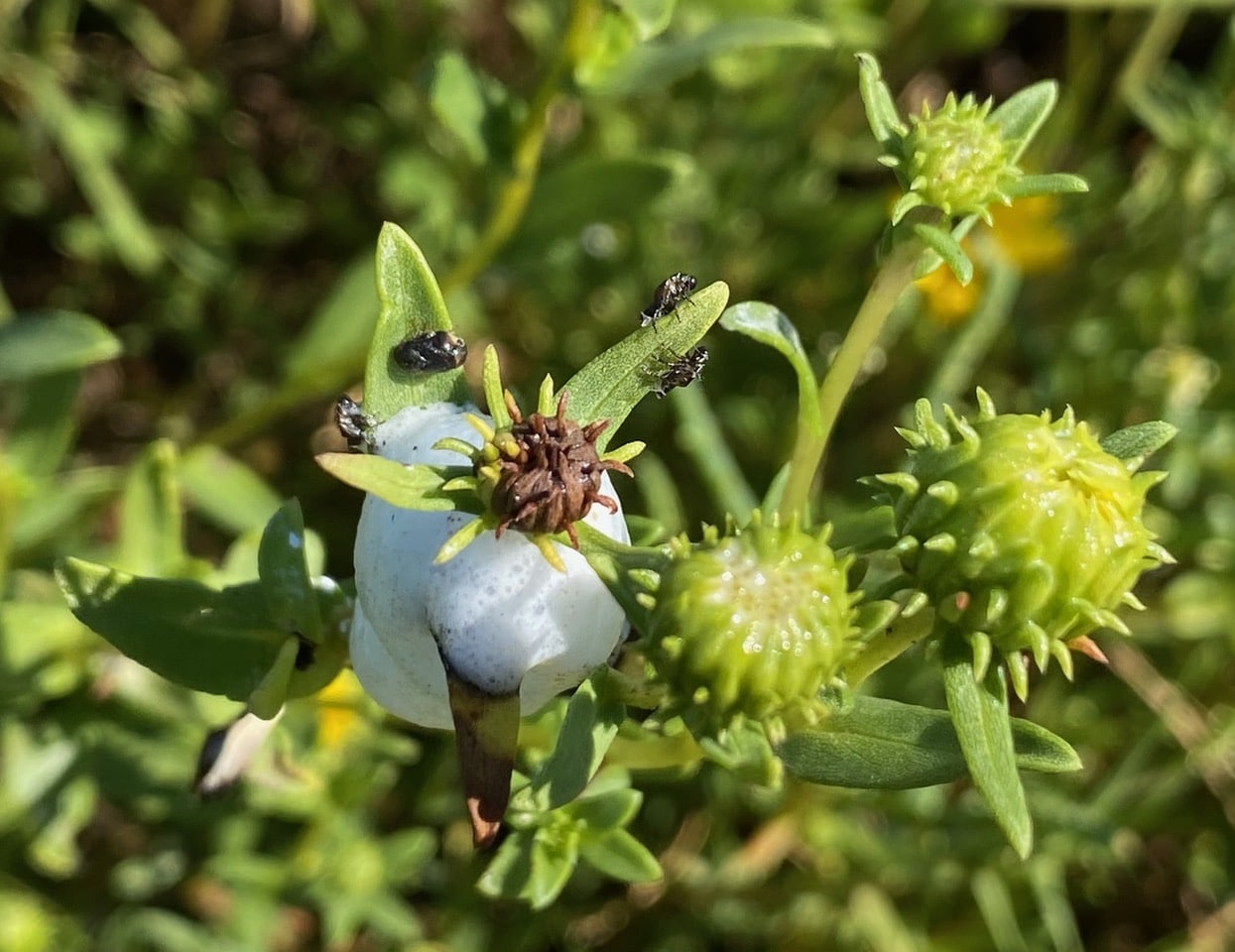
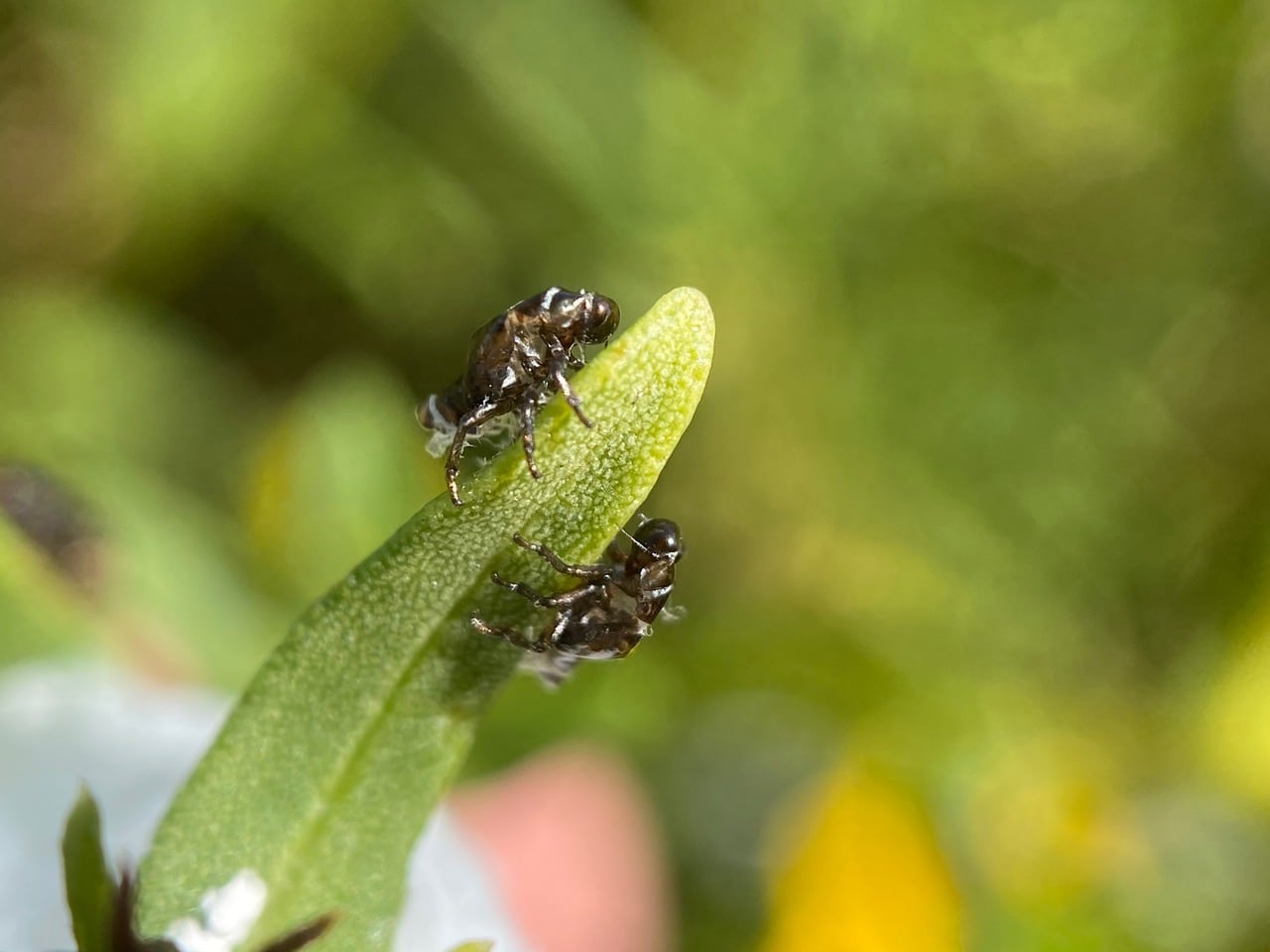 Close-up view of the Spittlebug exuvia still clinging to the tip of the Grindelia leaf.
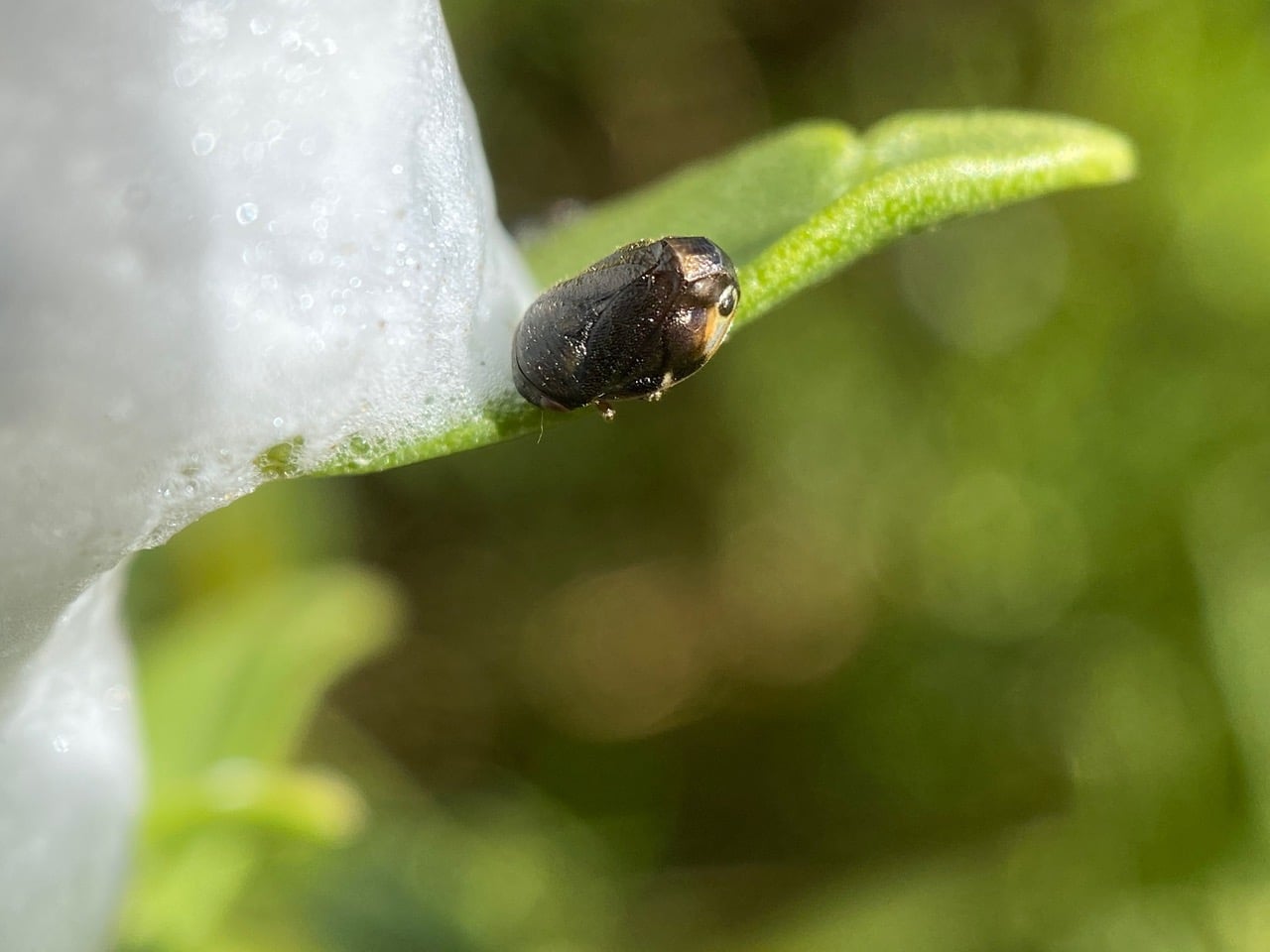
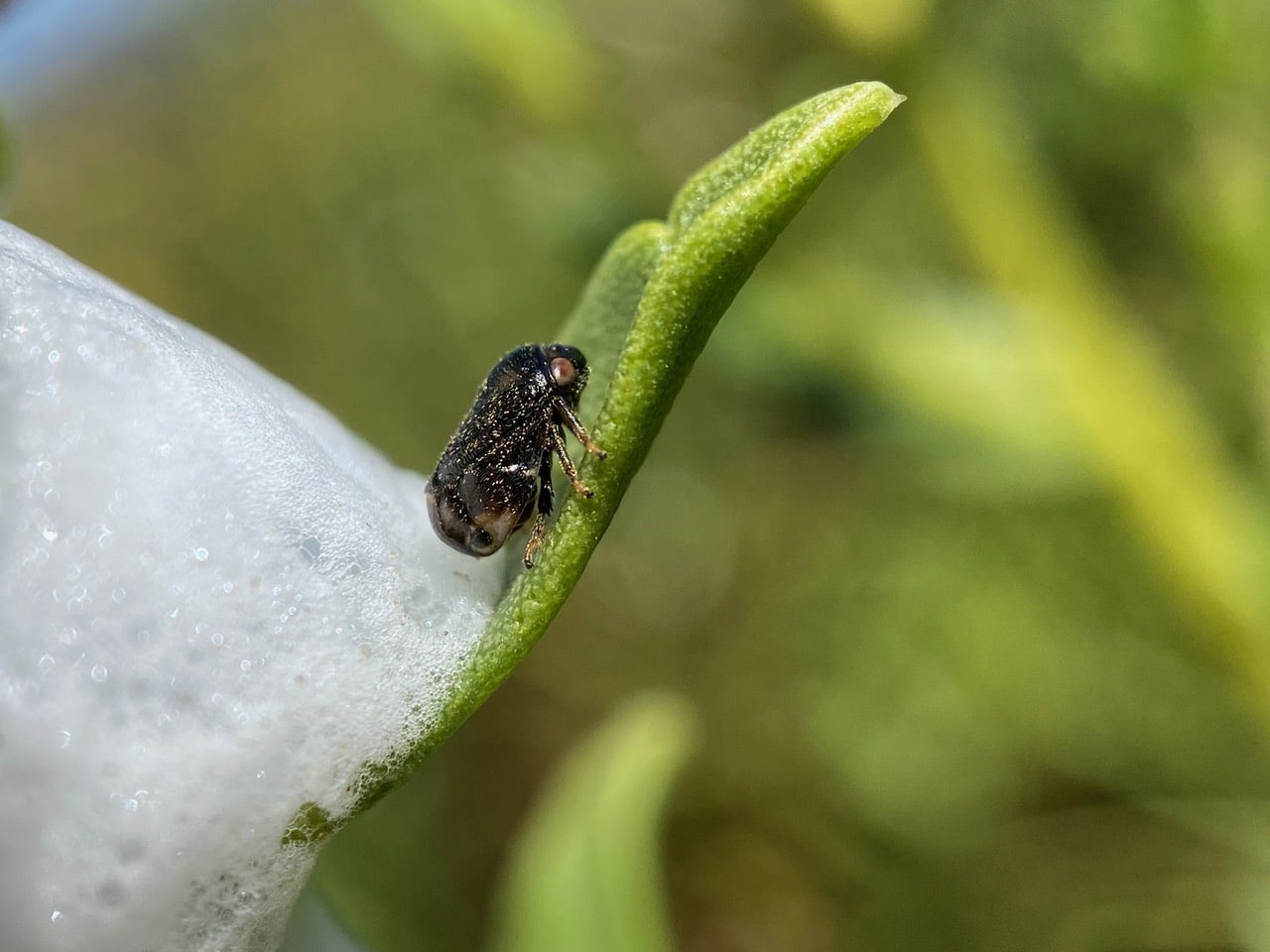


A Spittlebug exuvia clings lifelessly to the stem above a foam mass. Exuvia is the shed exoskeleton of an insect (or other arthropod) after molting. The nymph has climbed up out of the foam shelter for its final molt into an adult.
The Froghoppers (superfamily Cercopoidea) are a group of “true bugs” in the order Hemiptera. Adults are capable of jumping many times their height and length, giving them their common name, but many species are best known for their plant-sucking nymphs which produce foam shelters, and are referred to as “spittlebugs”. The superfamily currently consists of three families: the Aphrophoridae, Cercopidae, and Clastopteridae. The nymphs produce a cover of foamed-up plant sap visually resembling saliva, hence the common name. Whereas most insects that feed on plant sap tap into the nutrient-rich fluid from the phloem, the spittlebugs utilize the much more dilute sap flowing upward from the roots via the xylem. The insects’ digestive system contains symbiotic bacteria that provide them with the essential amino acids. The large amount of excess water that must be excreted and the evolution of special breathing tubes allow the young spittlebug nymphs to grow in the relatively protective environment of their foam shelters. The foam serves a number of purposes. It hides the nymph from the view of predators and parasites, and it insulates against heat and cold, providing thermal as well as moisture control. It also has an acrid taste that deters predators.
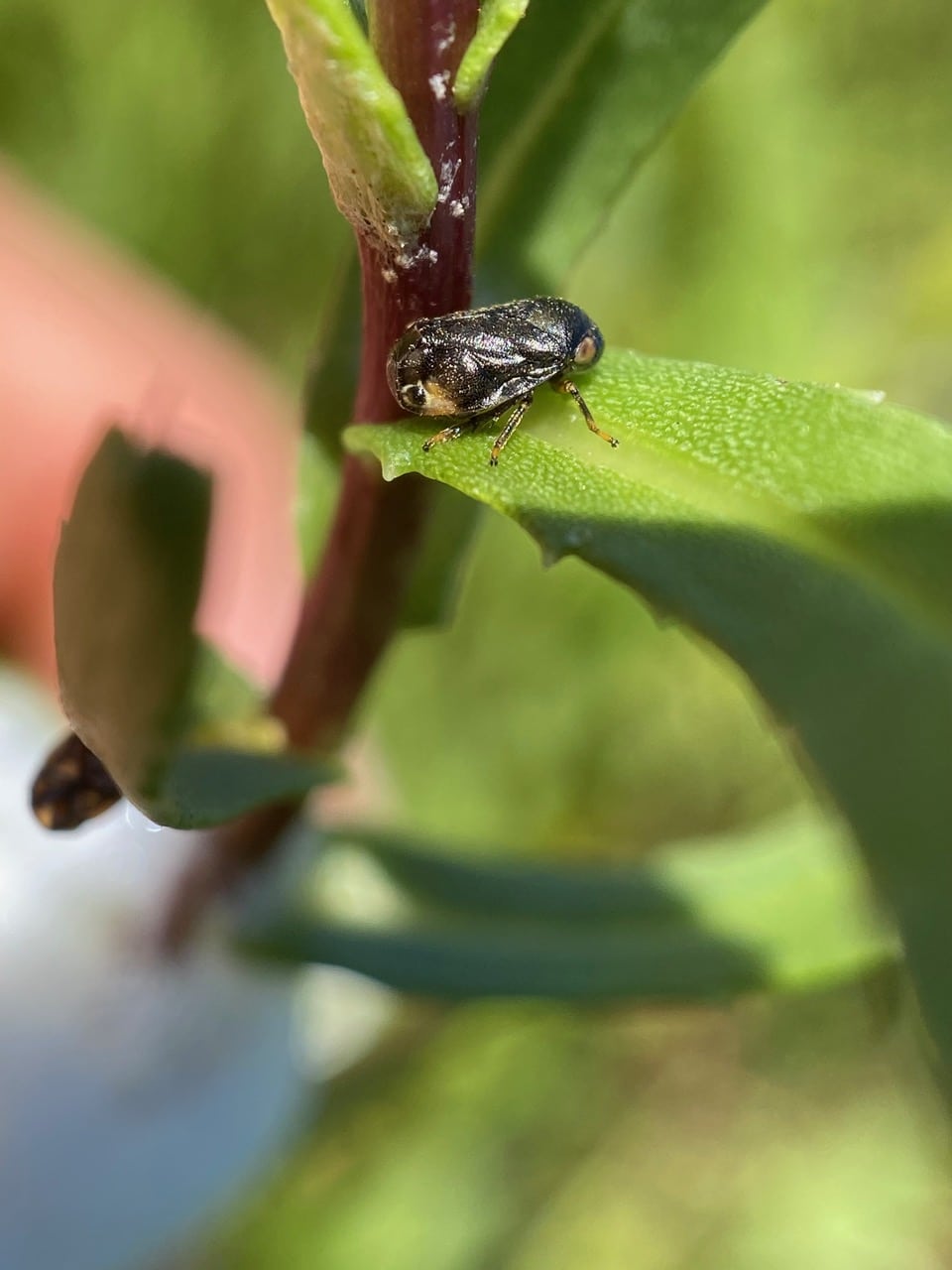
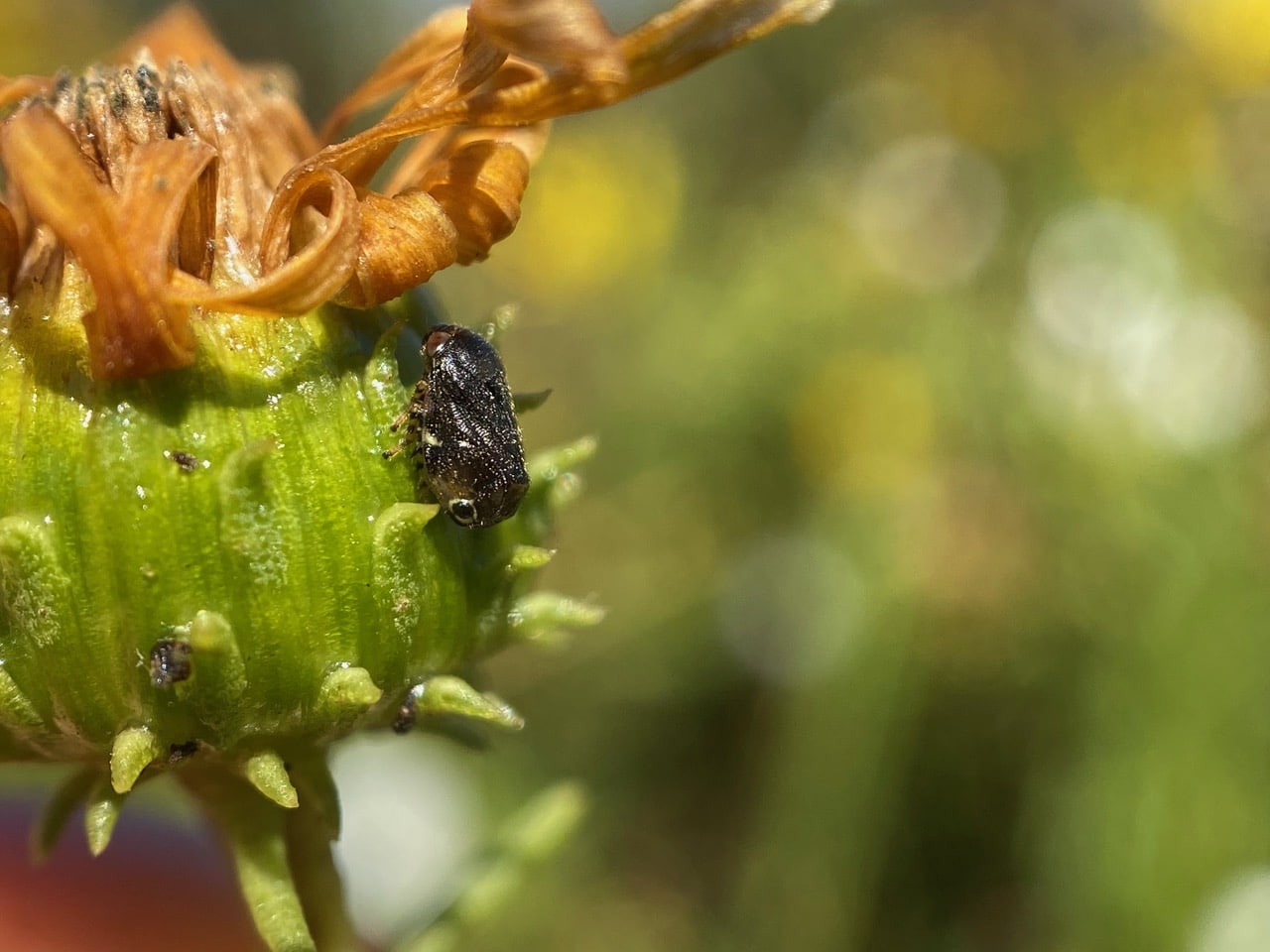
A adult Spittlebug, Complex Clastoptera lineatocollis (family Clastopteridae) is resting at a leaf axil. Note the false eyespot on its hind wing. Members of the family Clastopteridae have their wings modified to form false heads at the tail end, an anti-predator adaptation.
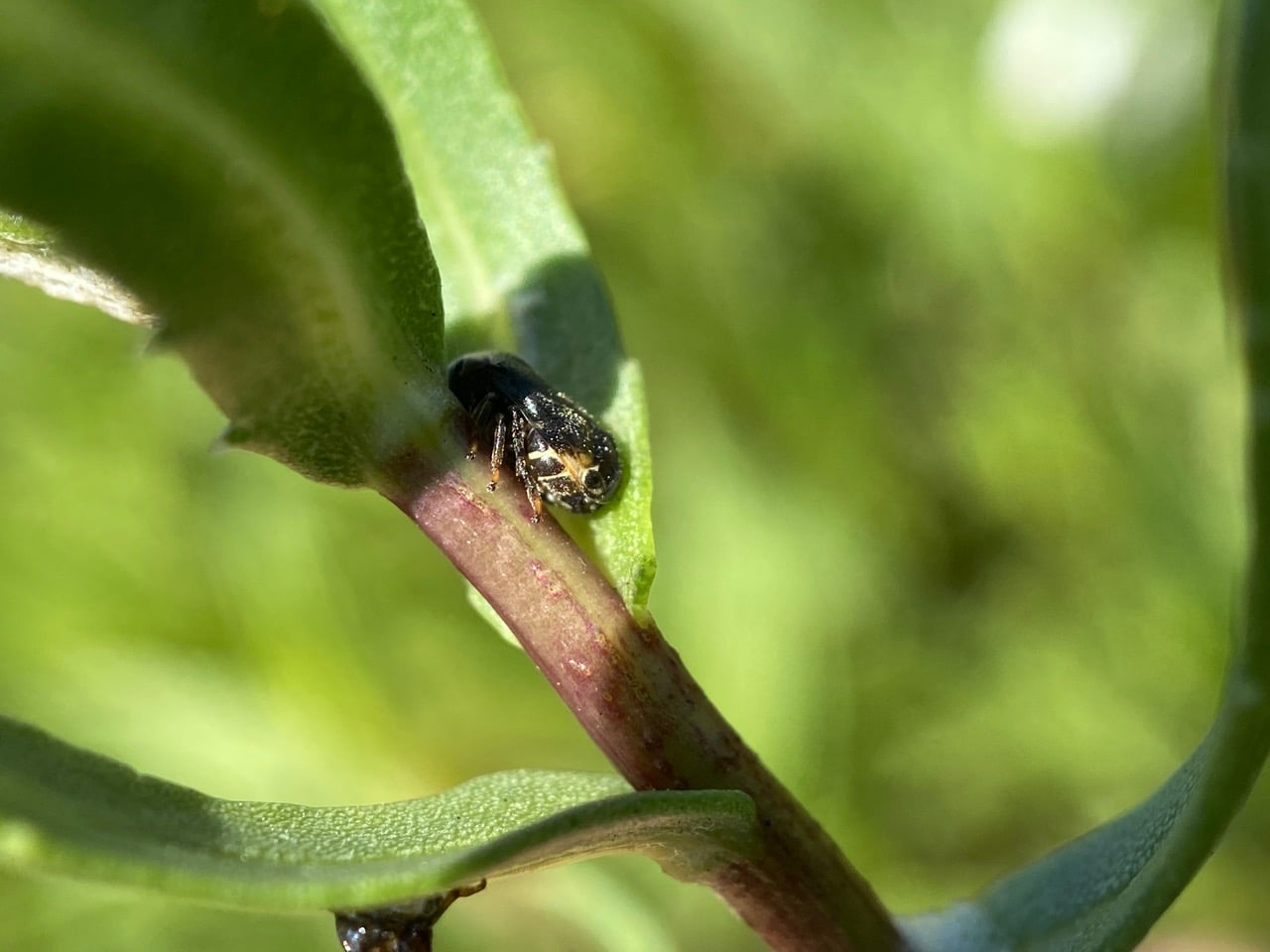
As the bug disappears into the shadows, I glimpse white stripes on its abdomen under the dark wings.
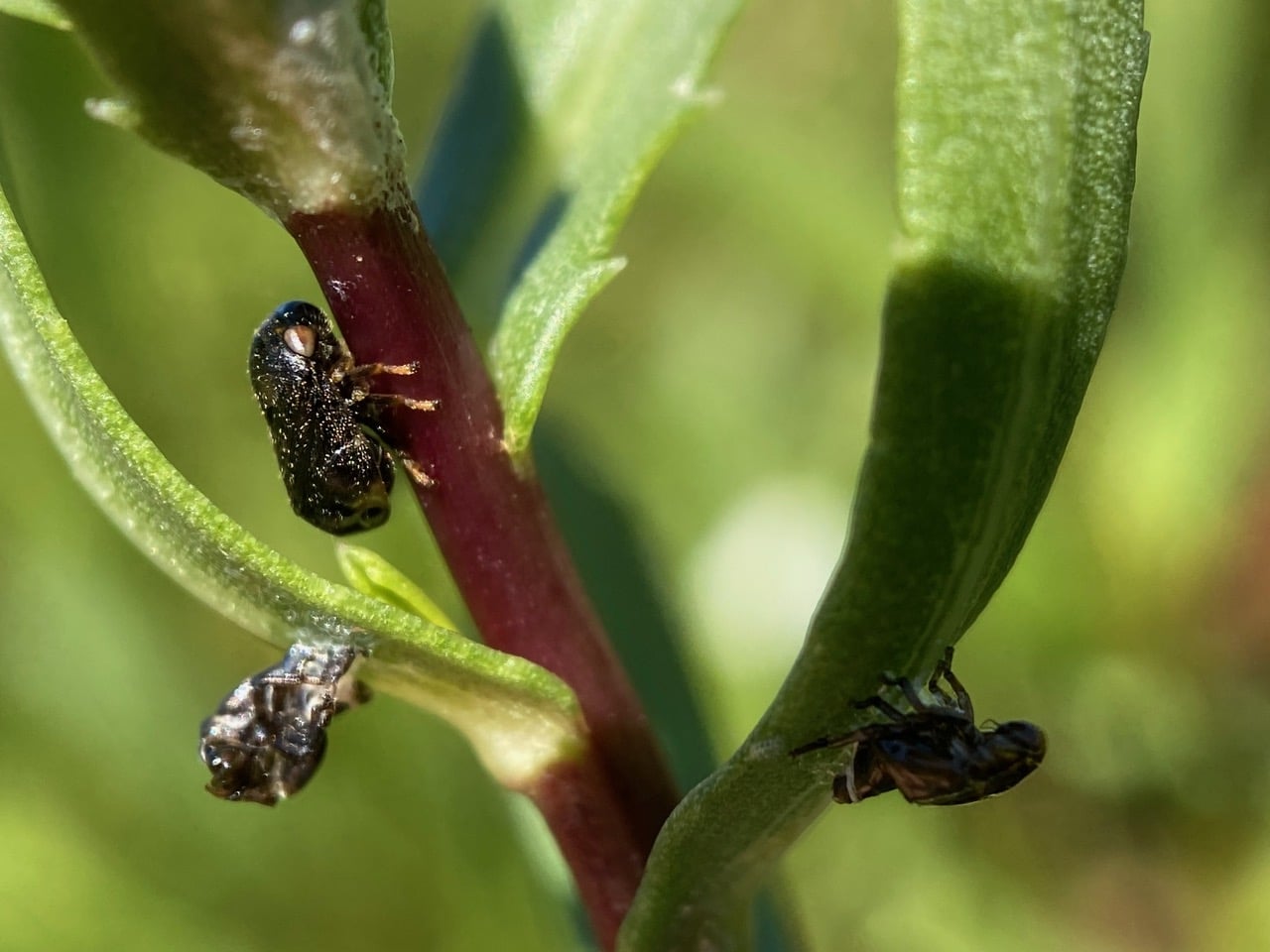
Here’s another dark adult Spittlebug in the company of two exuvia.
Ooh, there’s been major spittlebug emergence at the branch tip of this Grindelia – three exuvia and an adult are visible in this view. Did the nymphs share the same foam shelter? Note that the immature flowerhead above the foam mass has aborted, probably due to lack of sap flow, thanks to the feeding activities of the nymphs.
Close-up view of the Spittlebug exuvia still clinging to the tip of the Grindelia leaf.Here’s the adult Spittlebug, Complex Clastoptera lineatocollis (family Clastopteridae) hunkered down next to the foam mass. Note the false head at its rear end – amazing!
The Spittlebug turns around and gives me a glimpse of its real eyes. They are purplish-red.
On an adjacent Grindelia branch, I find a similar adult Spittllebug resting on an involucre of a spent flowerhead.
The Spittlebug is a long-suffering photographic subject, sitting stock-still, never attempting to flee. It takes me many attempts to get a close view of its mouthparts. If you squint hard enough, you might see the short, black pointed tip at the end of its ’snout’. Since the bug itself is barely 3 mm long, that proboscis can’t possibly go deep into plant tissues. Or maybe that’s not its proboscis? Members of the order Hemiptera have their mouthparts (called a rostrum) folded under their body when not feeding.
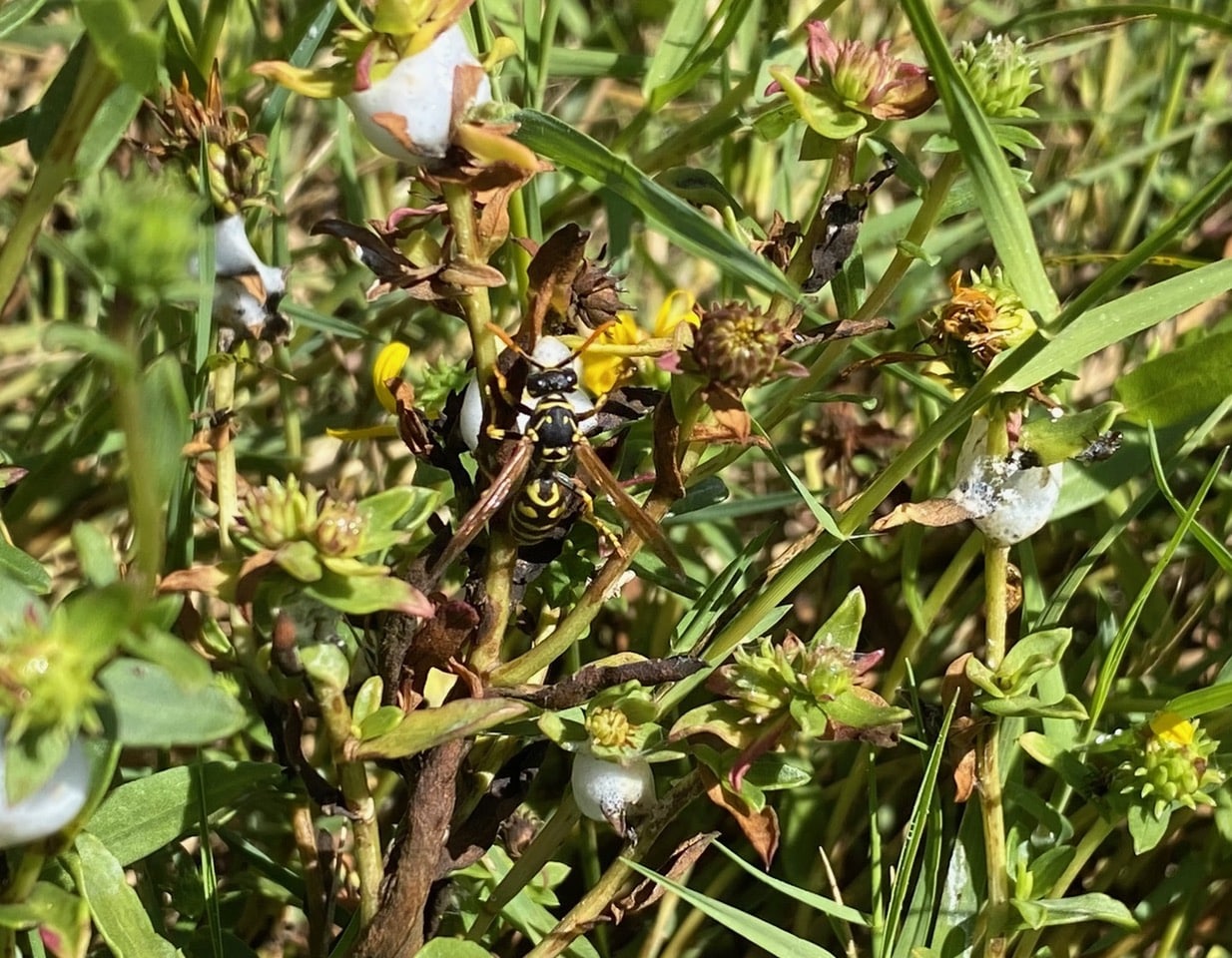
The spittlebug-infested Grindelias are frequently visited by the European Paper Wasp. This one has landed by a foam mass. Is it hunting for the spittlebugs?
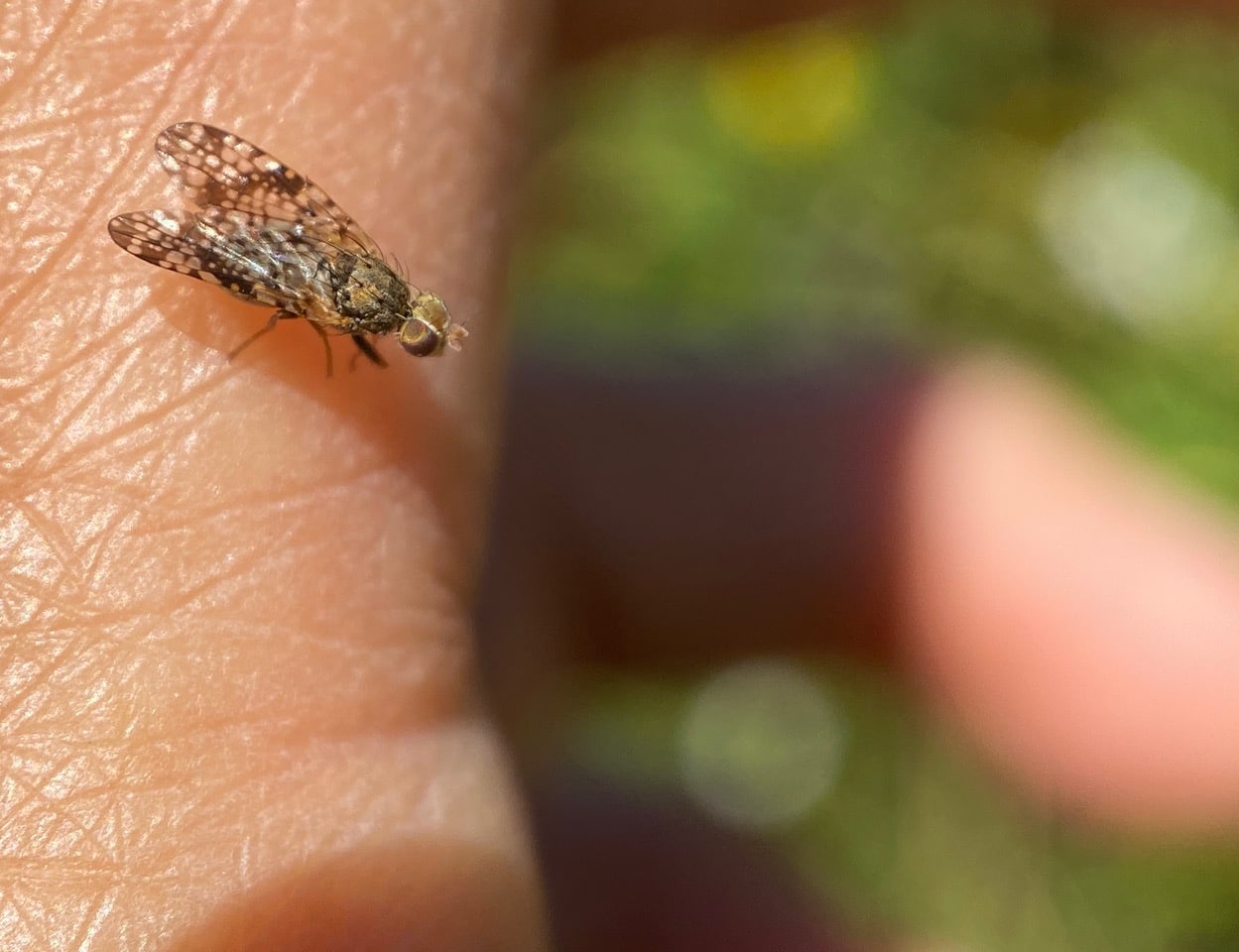
A Fruit Fly, Campiglossa sp. (family Tephritidae) has somehow landed on my finger. It must have climbed on when I was holding the Grindelia flowerhead to photograph the Spittlebug.
Commonly called Fruit Flies, Tephritids are small to medium-sized flies that are often colorful, and usually with picture wings. The larvae of almost all Tephritidae are phytophagous. Females deposit eggs in living, healthy plant tissues using their telescopic ovipositors. Here the larvae find their food upon emerging. The larvae develop in leaves, stems, flowers, seeds, fruits, and roots of the host plant, depending on the species. Adults are often found on the host plant and feeding on pollen, nectar, rotting plant debris, or honeydew. Tephritid flies are of major economic importance as they can cause damage to fruit and other plant crops. On the other hand, some Tephritids are used as agents of biological control of noxious weeds.
Members of genus Campiglossa in the Fruit Fly family Tephritidae are found worldwide. They are mostly found in the flowerheads of Asteraceae. Adult females oviposit in flowerheads of Asteraceae. The short, stout larvae of Campiglossa live in the ovaries. Many species are monophagous (feeding on one type of plants) or oligophagous (feeding on a limited number of related plants).
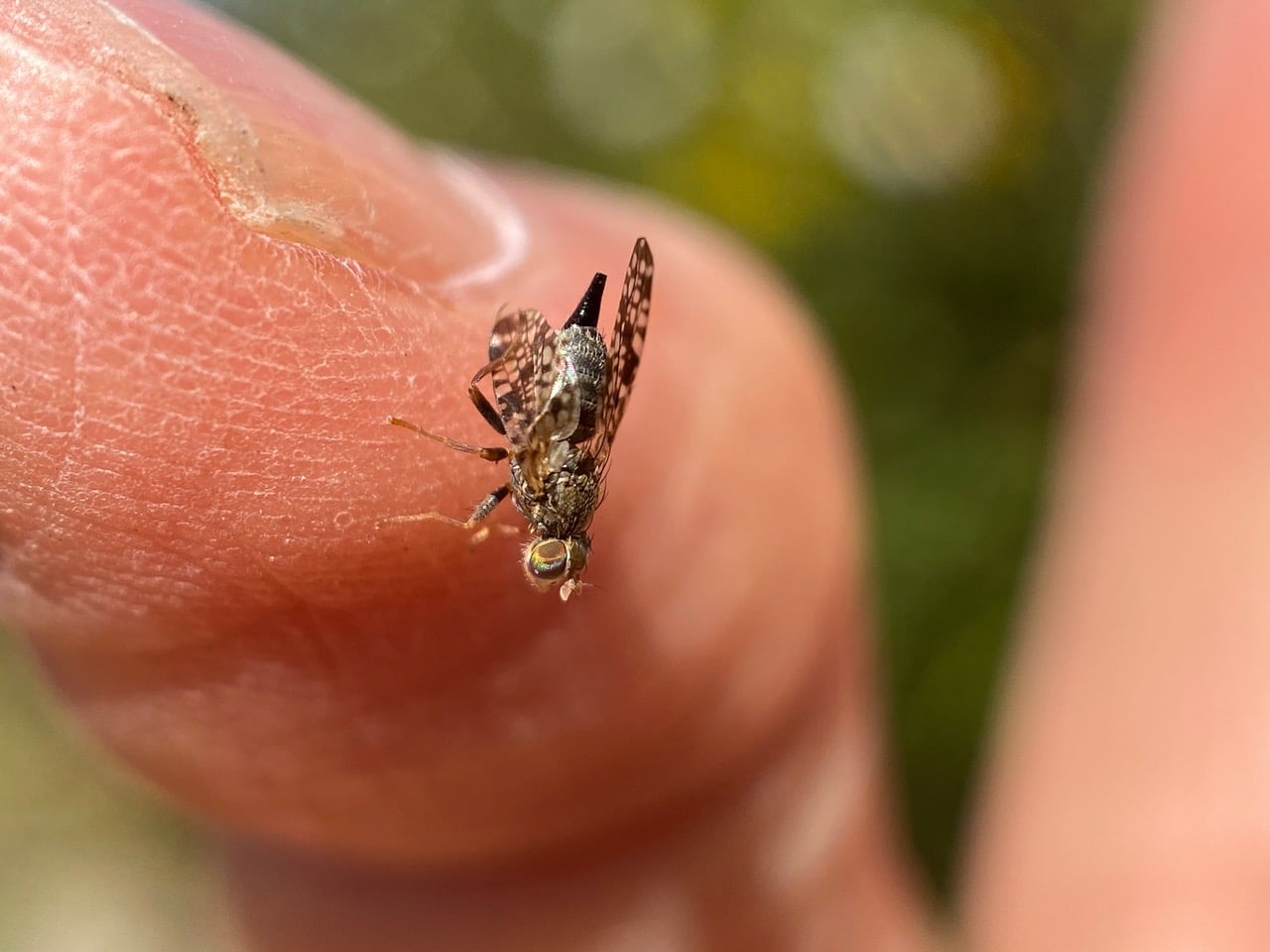
Amazingly, the Fruit Fly is so comfortable on my finger that she proceeds to groom herself. I know that the fly is female because she has an oviscape on the tip of her abdomen – that black, pointed, sclerotized structure through which the female’s telescopic ovipositor is extended when laying eggs. This female must have been on the Grindelia flowerhead to lay her eggs!
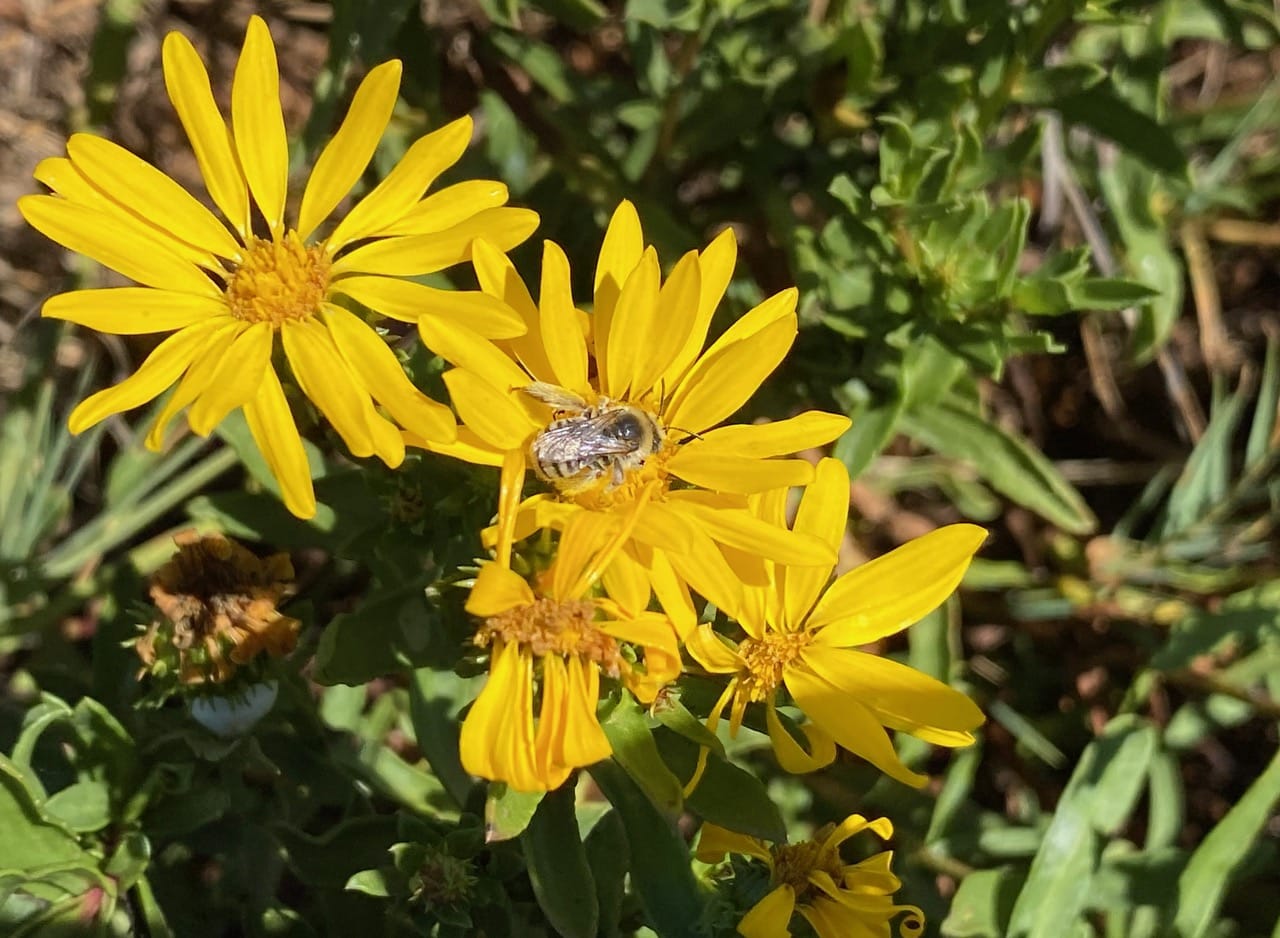
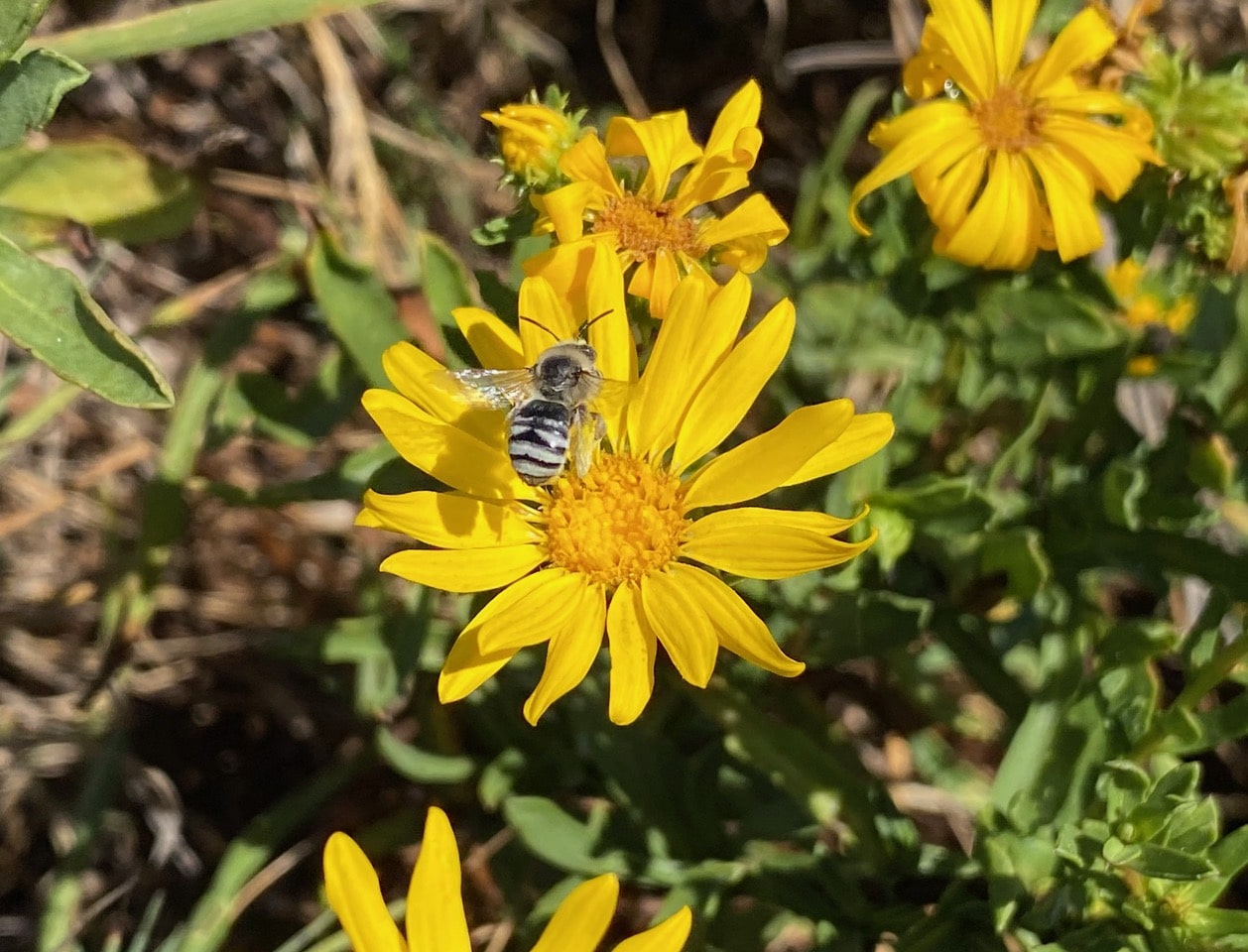
Ooh, a female Summer Longhorn Bee, Melissodes sp. (family Apidae)is foraging on a Grindelia flowerhead.
Off to another flower! There’s no time to waste for these busy bees.
Who would’ve thought that one could have so much fun “bugging” along the north shore of Bay Farm Island?