

Pollinator Post 9/17/24 (1)

It is cool and cloudy all over the Bay Area, but at least the sun is peeking out here at Bay Farm Island, where I am once again walking through the Oregon Gumweed, Grindelia stricta.
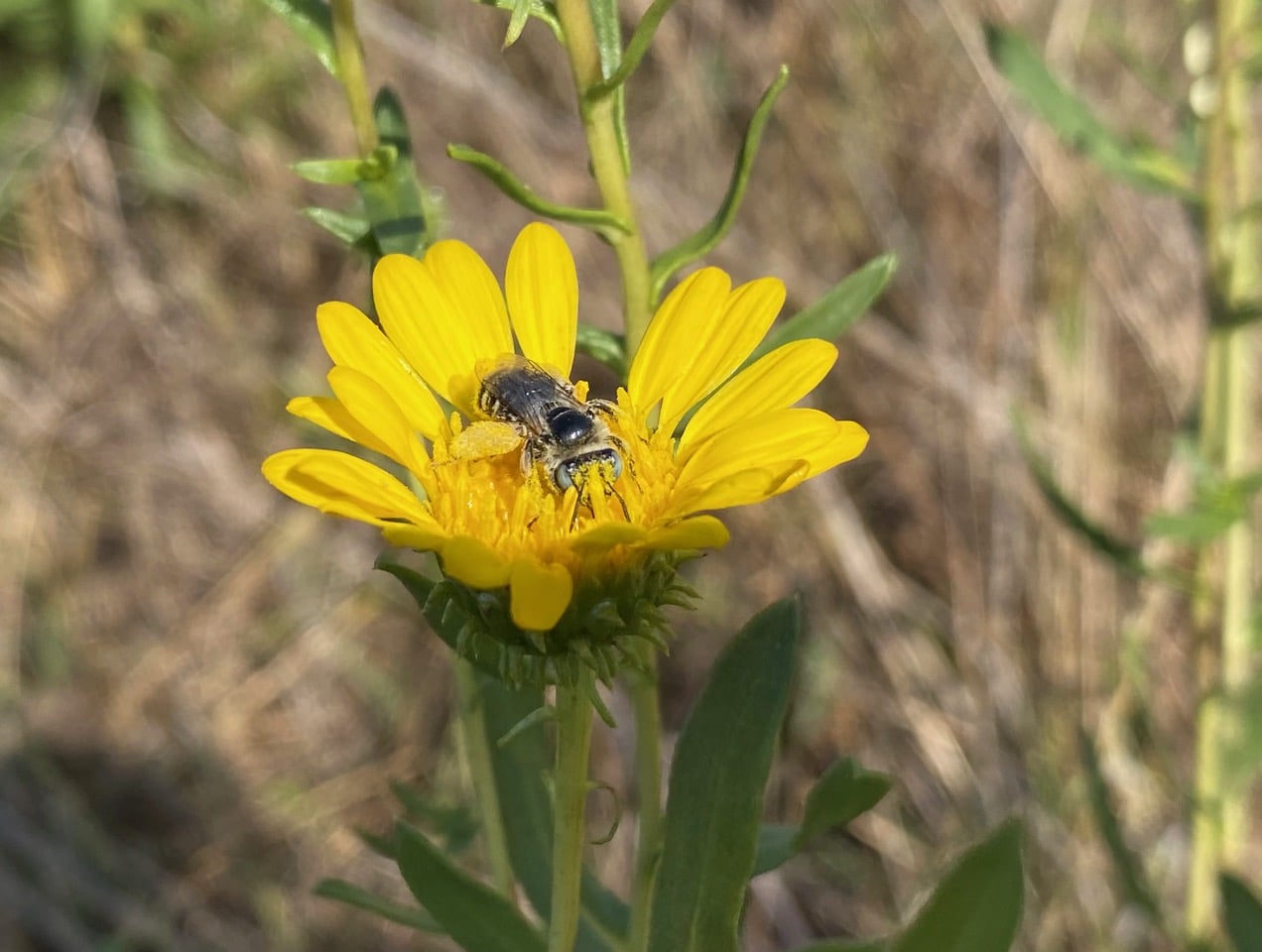

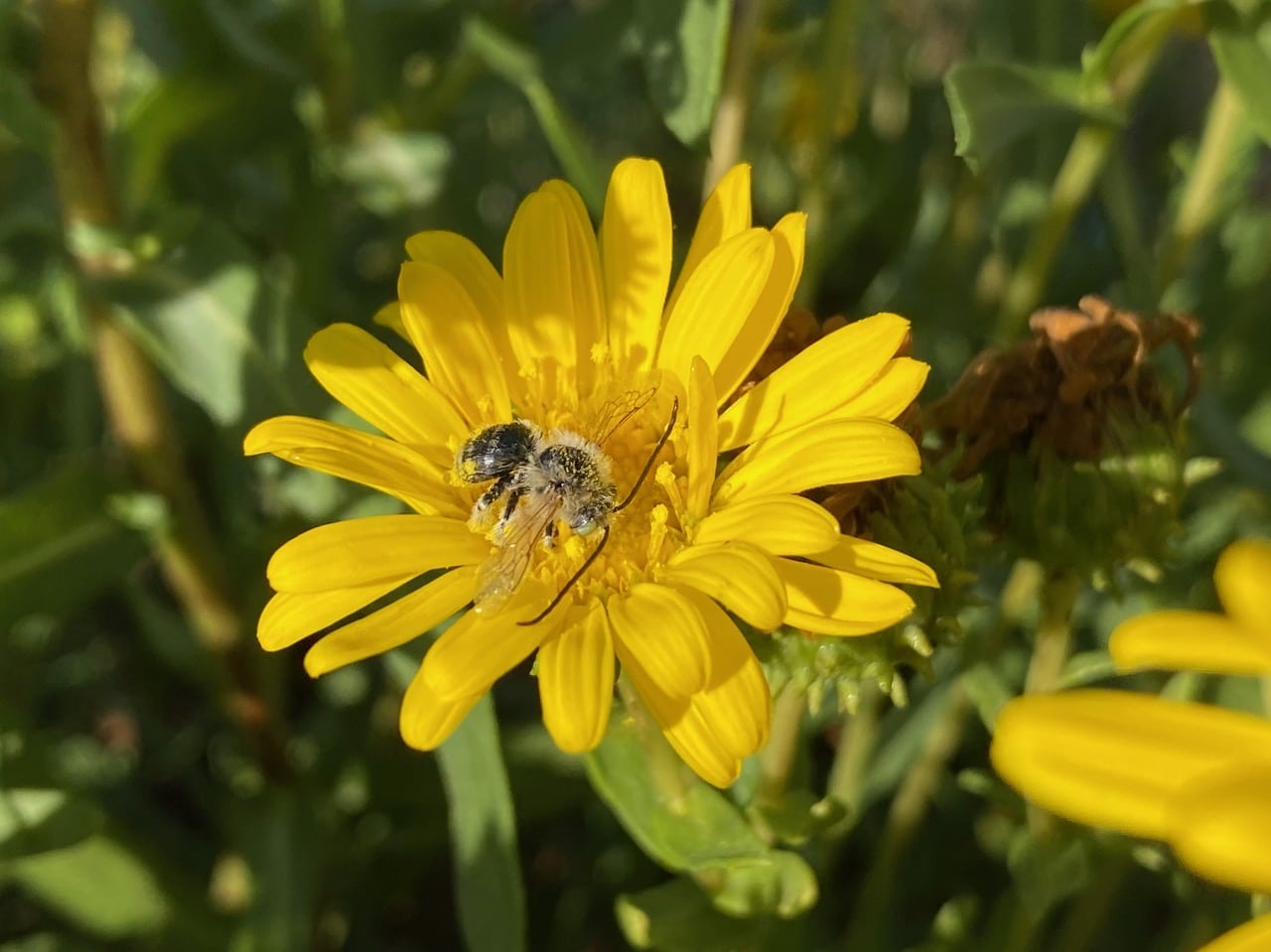
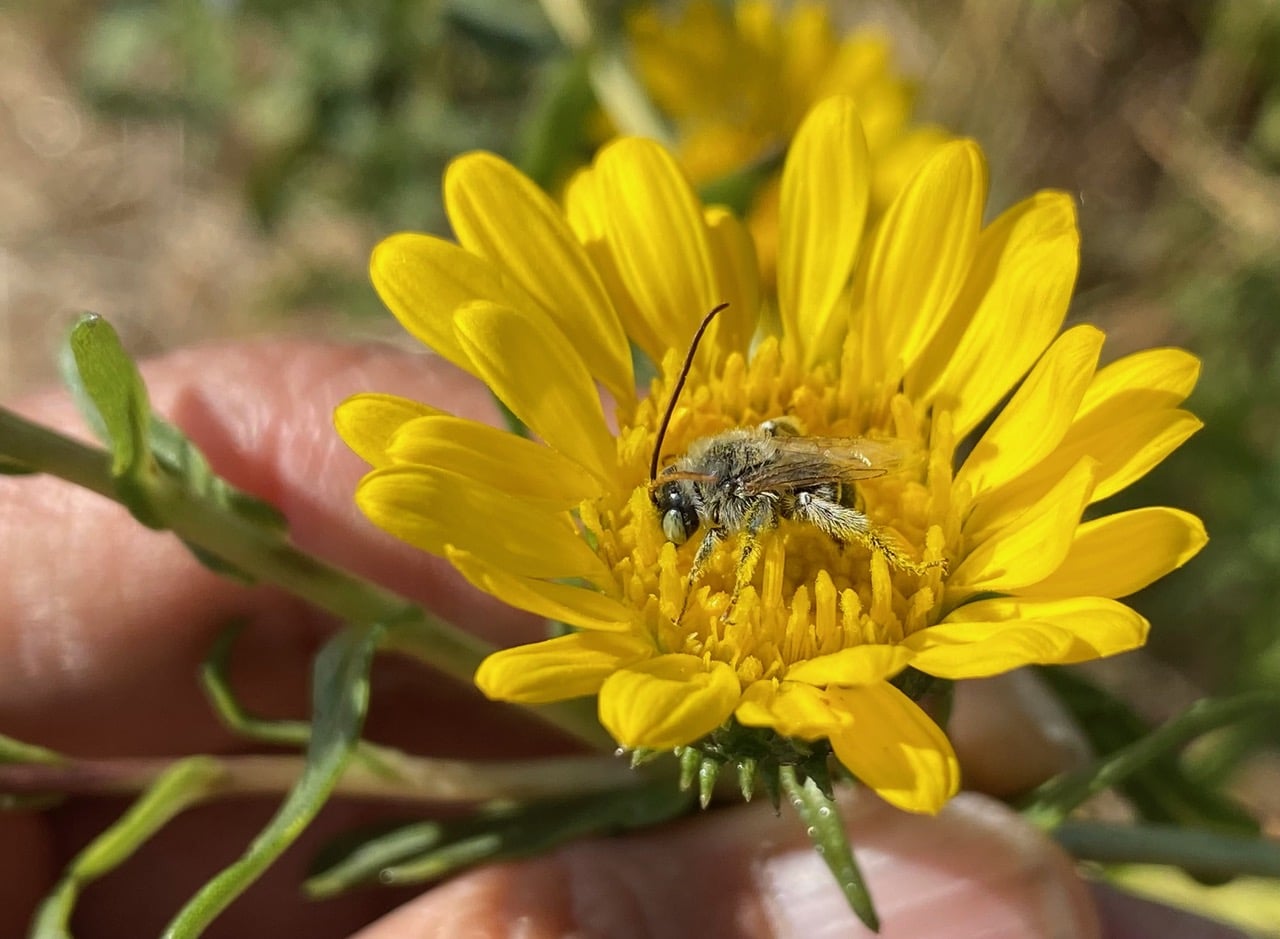
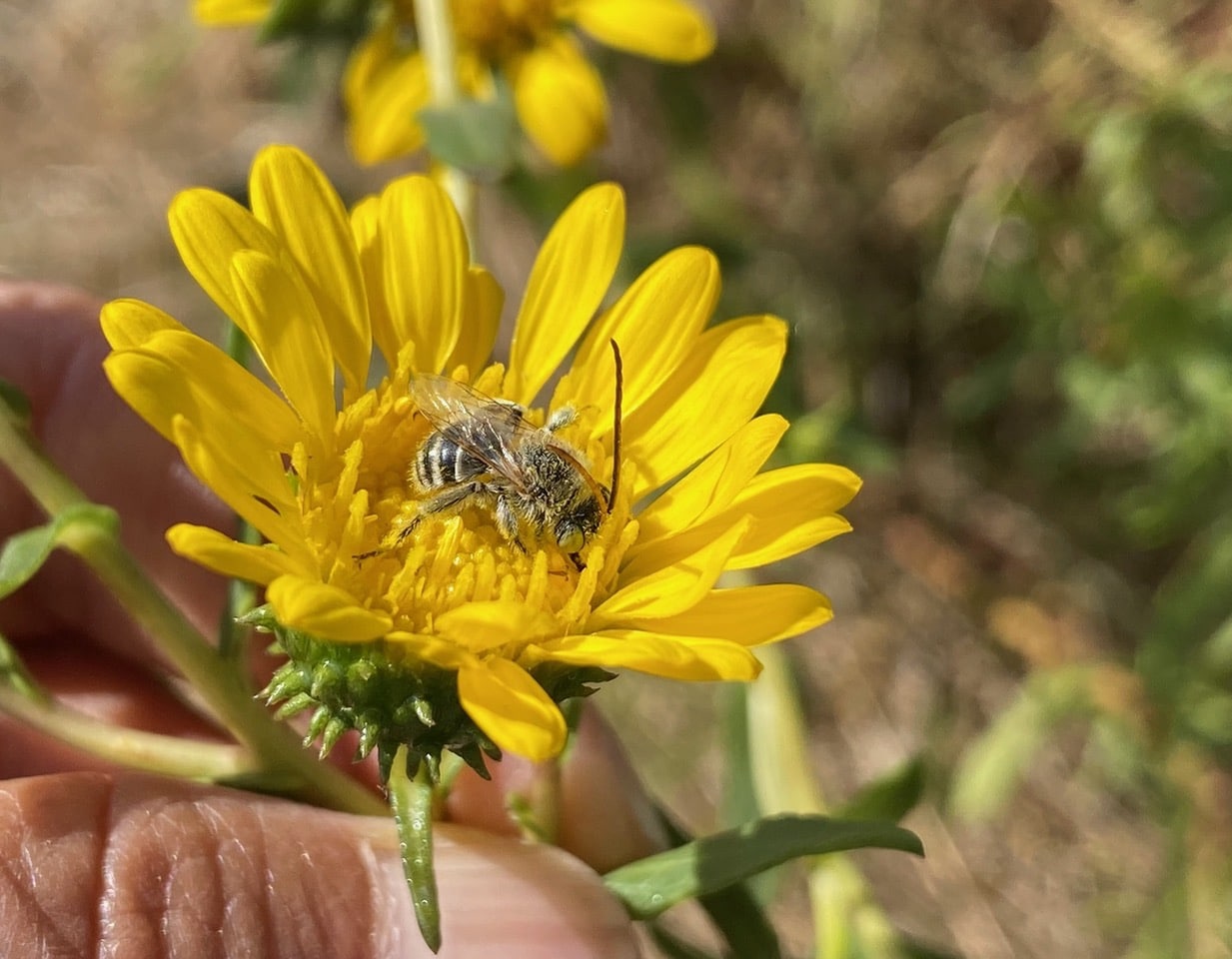
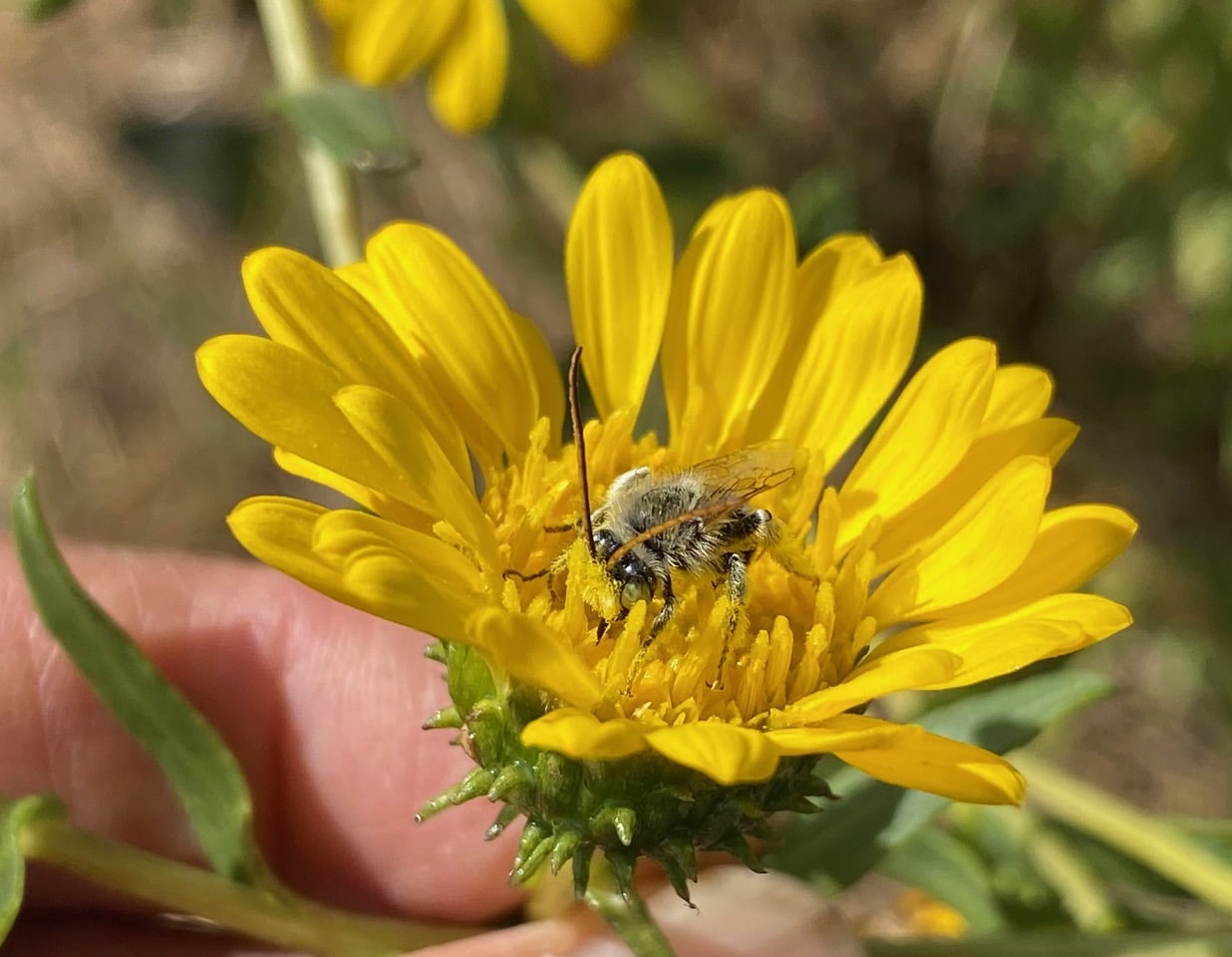
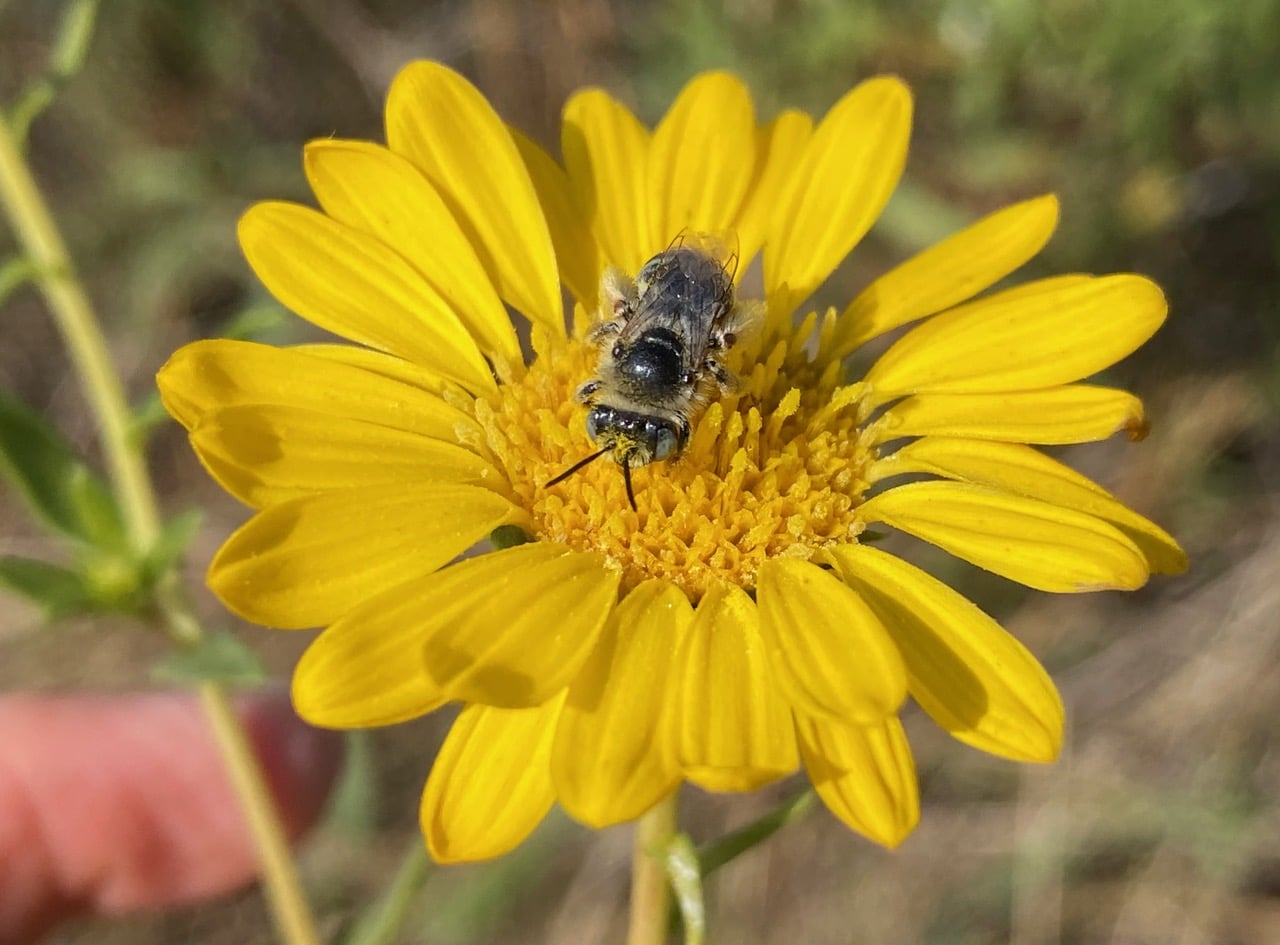
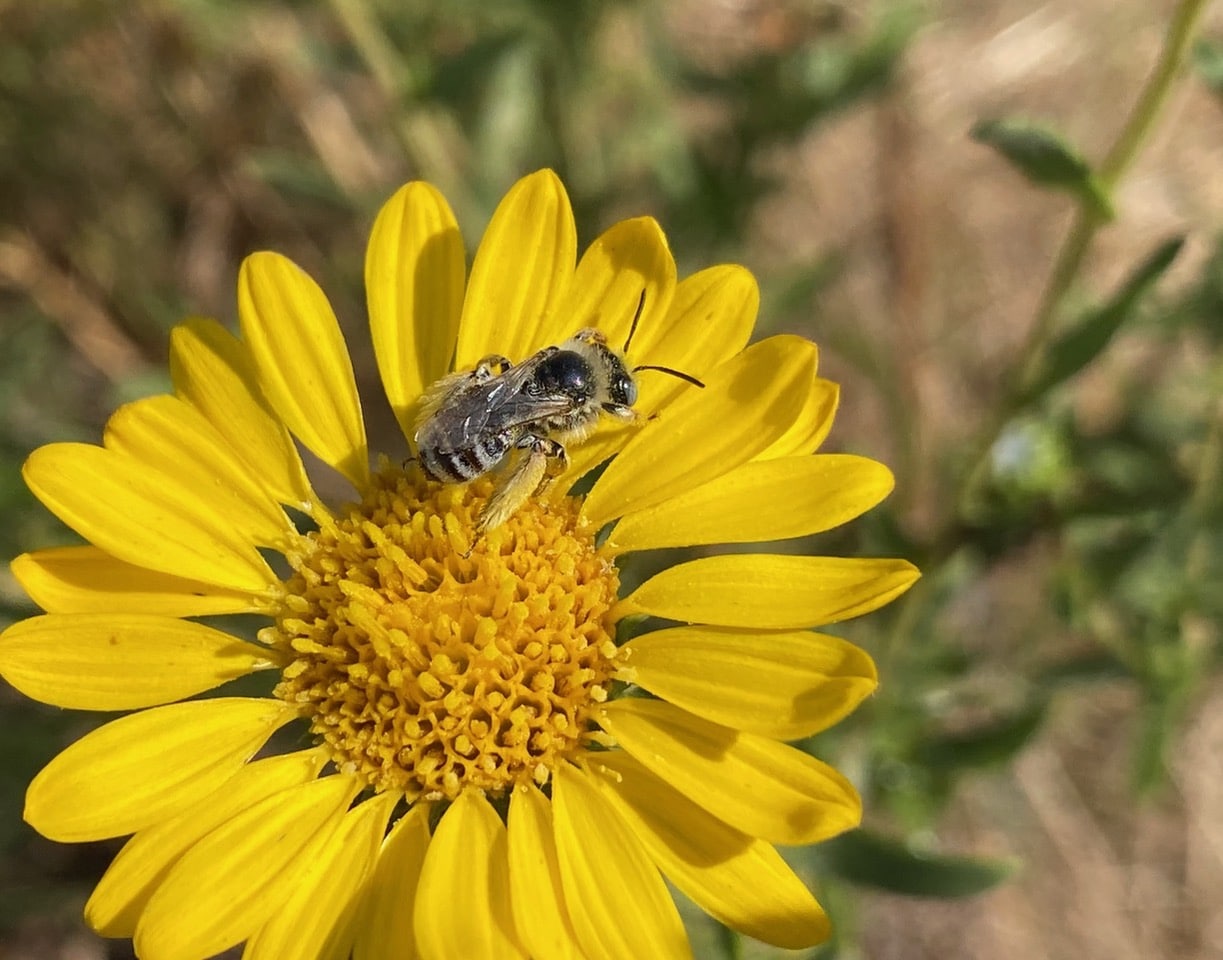
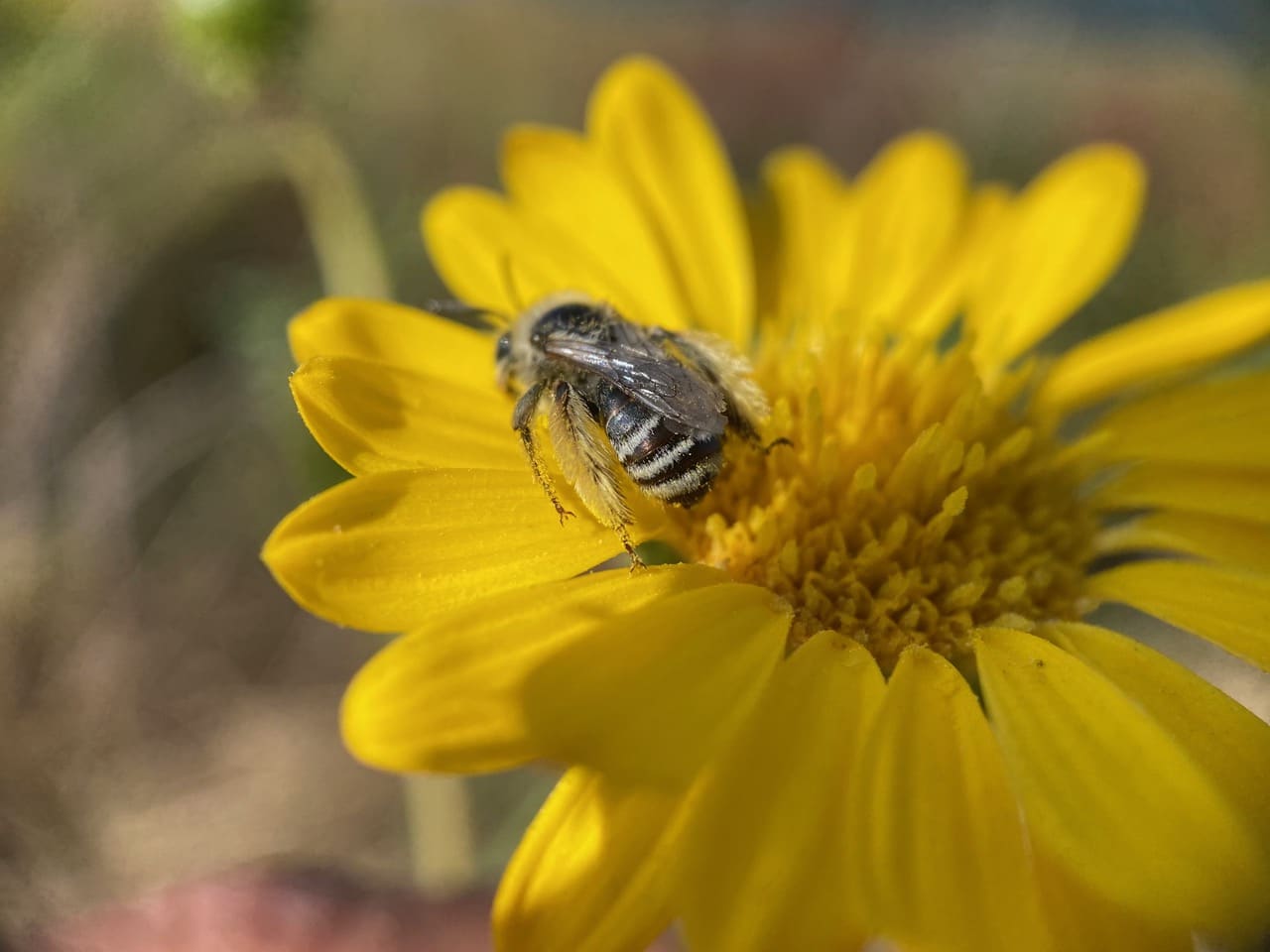
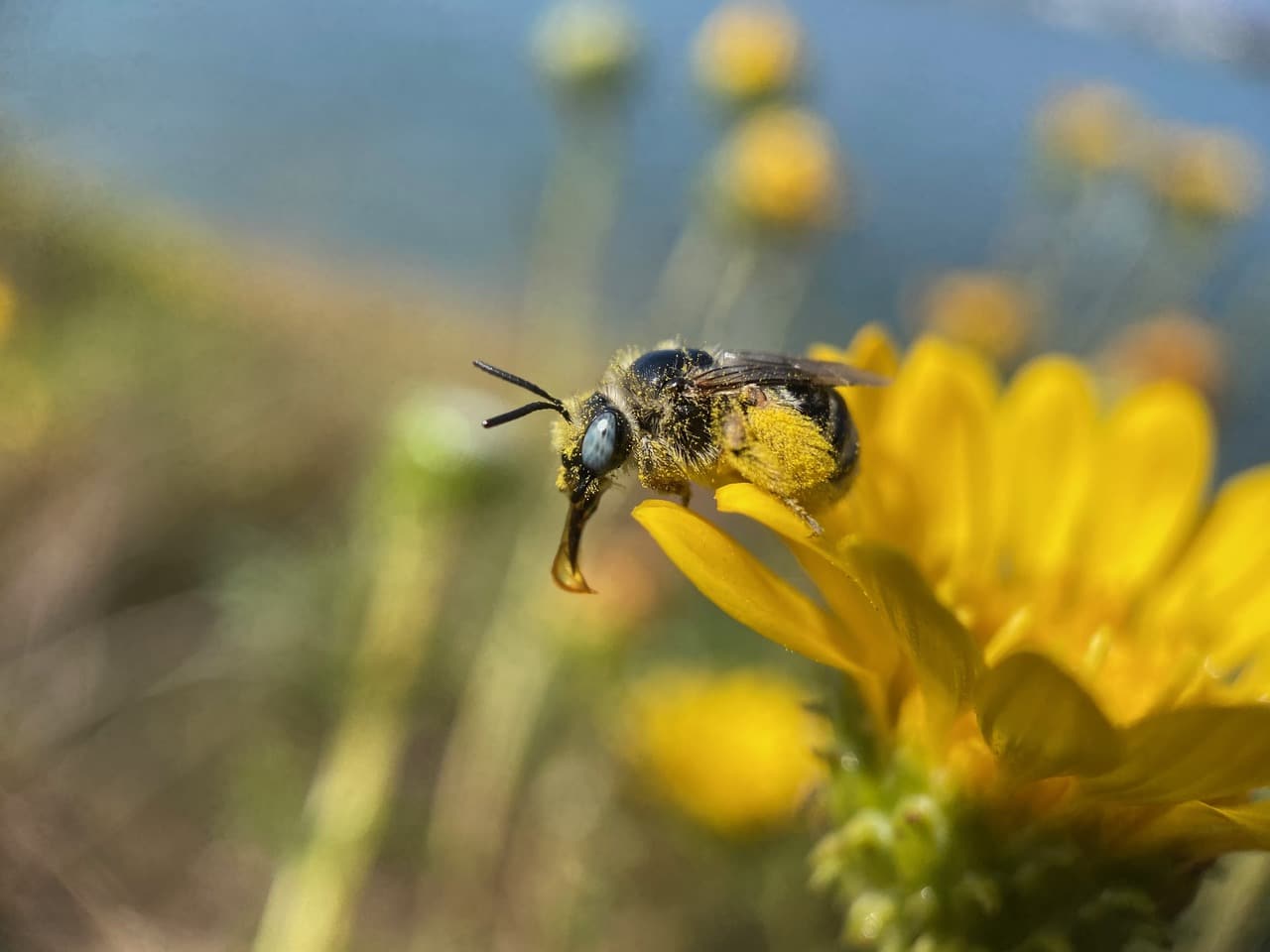

A female Summer Longhorn Bee, Melissodes sp. (family Apidae) is foraging on a flowerhead of Oregon Gumweed, Grindelia stricta. She has quite a load of pollen in the large scopae on her hind legs.
Unlike the Bumble Bees and Honey Bees which have corbiculae (“pollen basket”) on their hind legs, the bees that have scopae pack their pollen without compacting it into a moist mass. The pollen grains are held loosely by electro-static attraction to the scopal hairs, and comes off easily as the bees forage. This is why it is generally believed that bees that transport pollen in scopae are more efficient pollinators than those with pollen baskets.
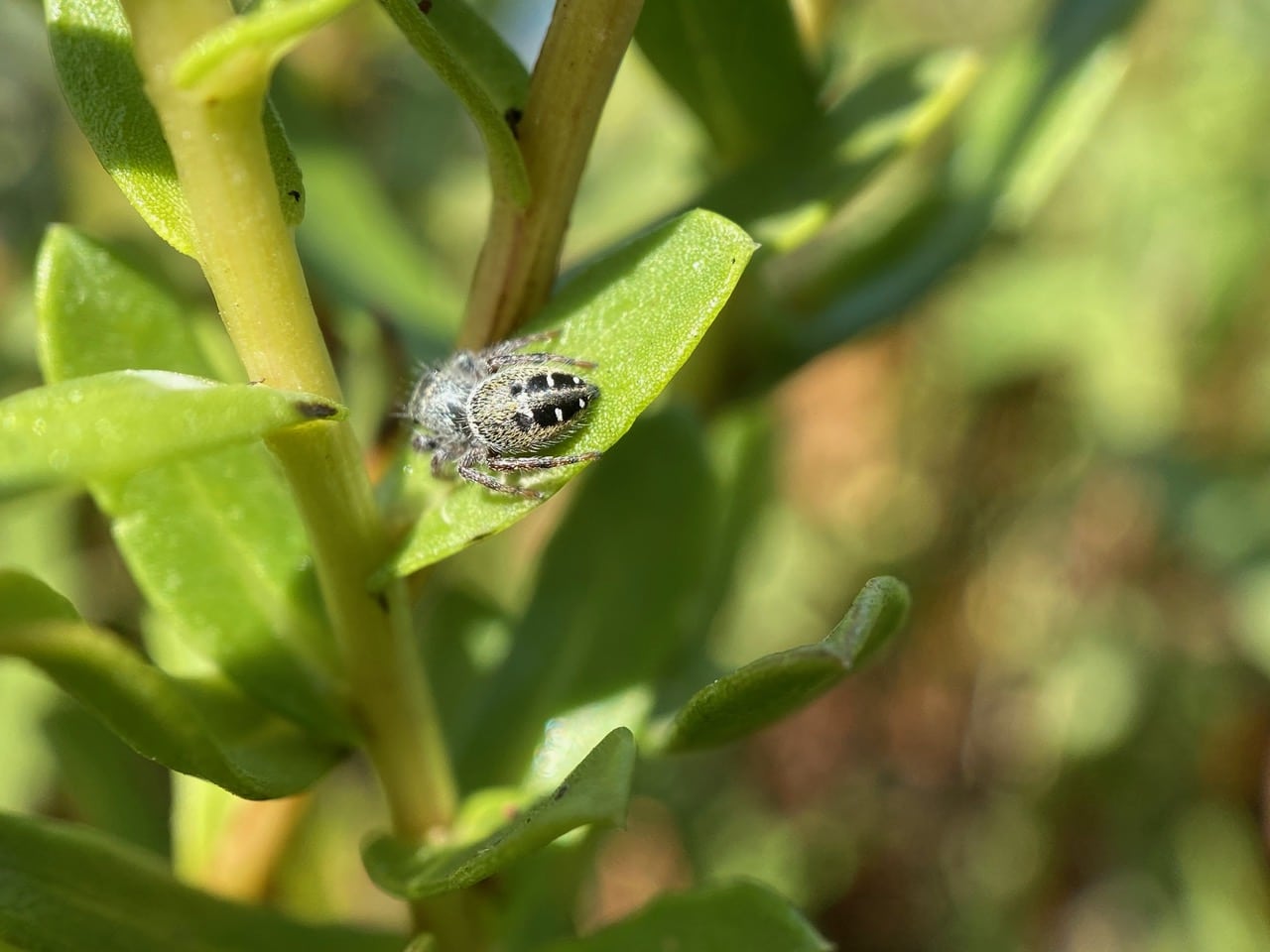
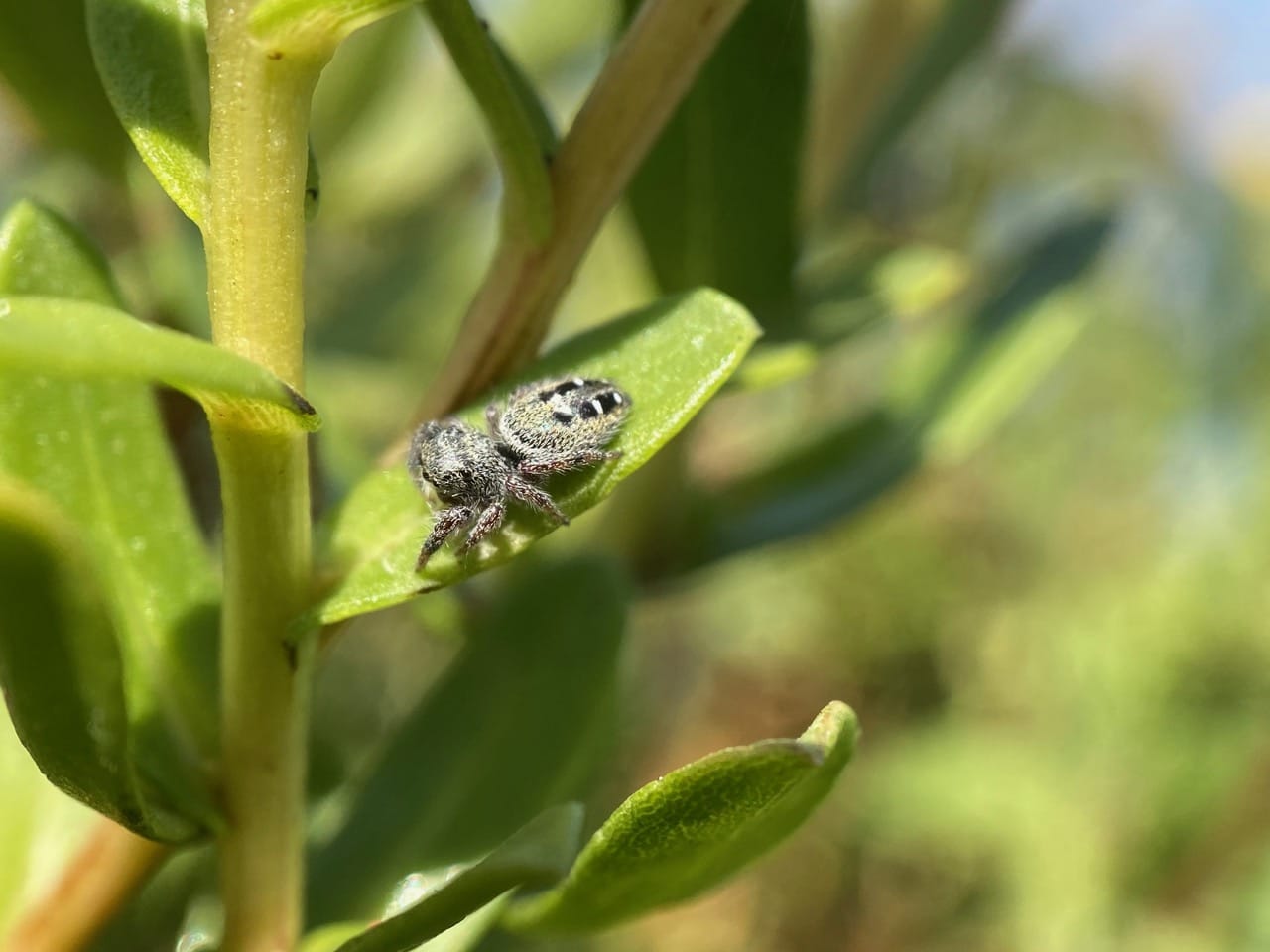
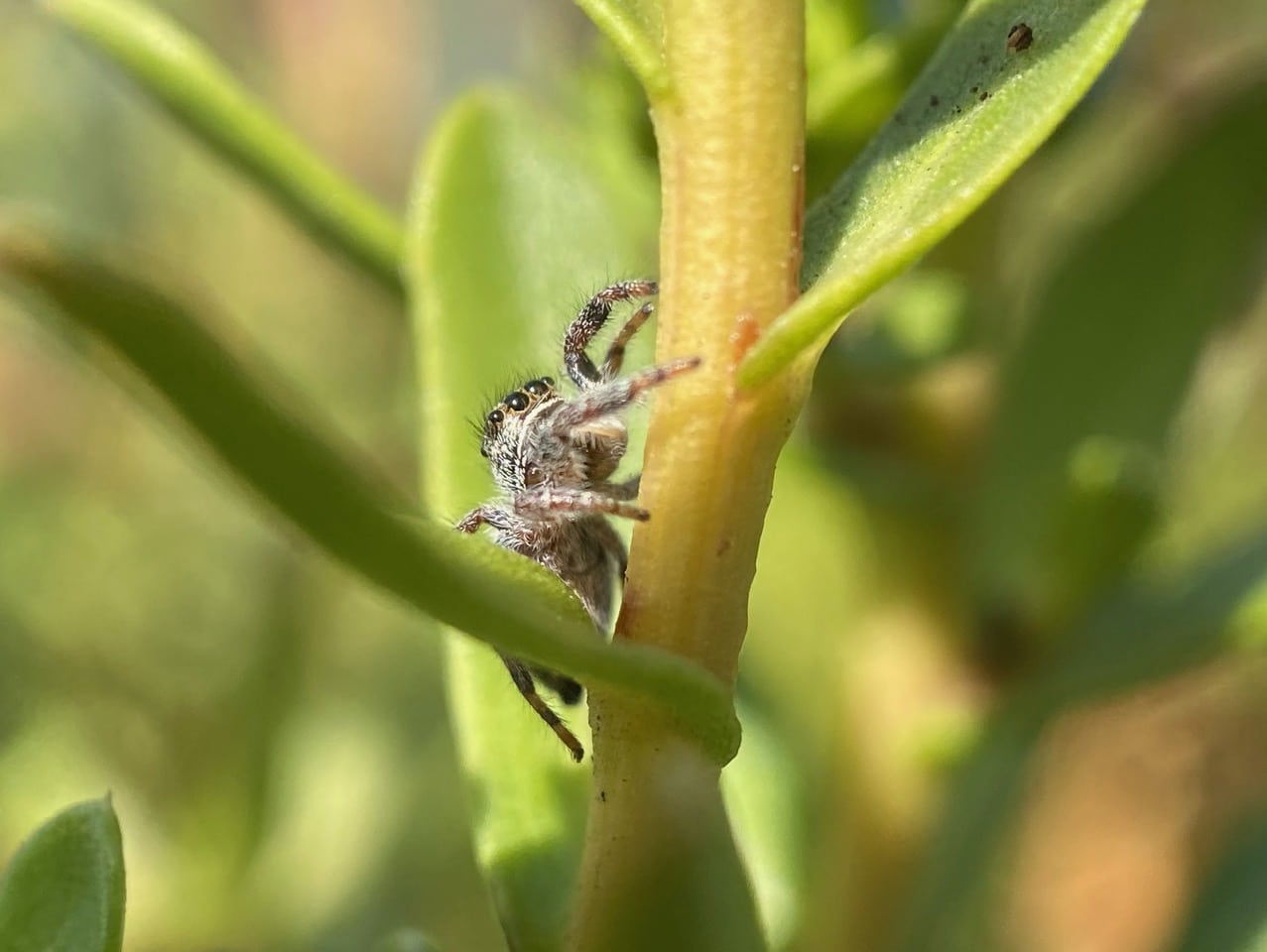
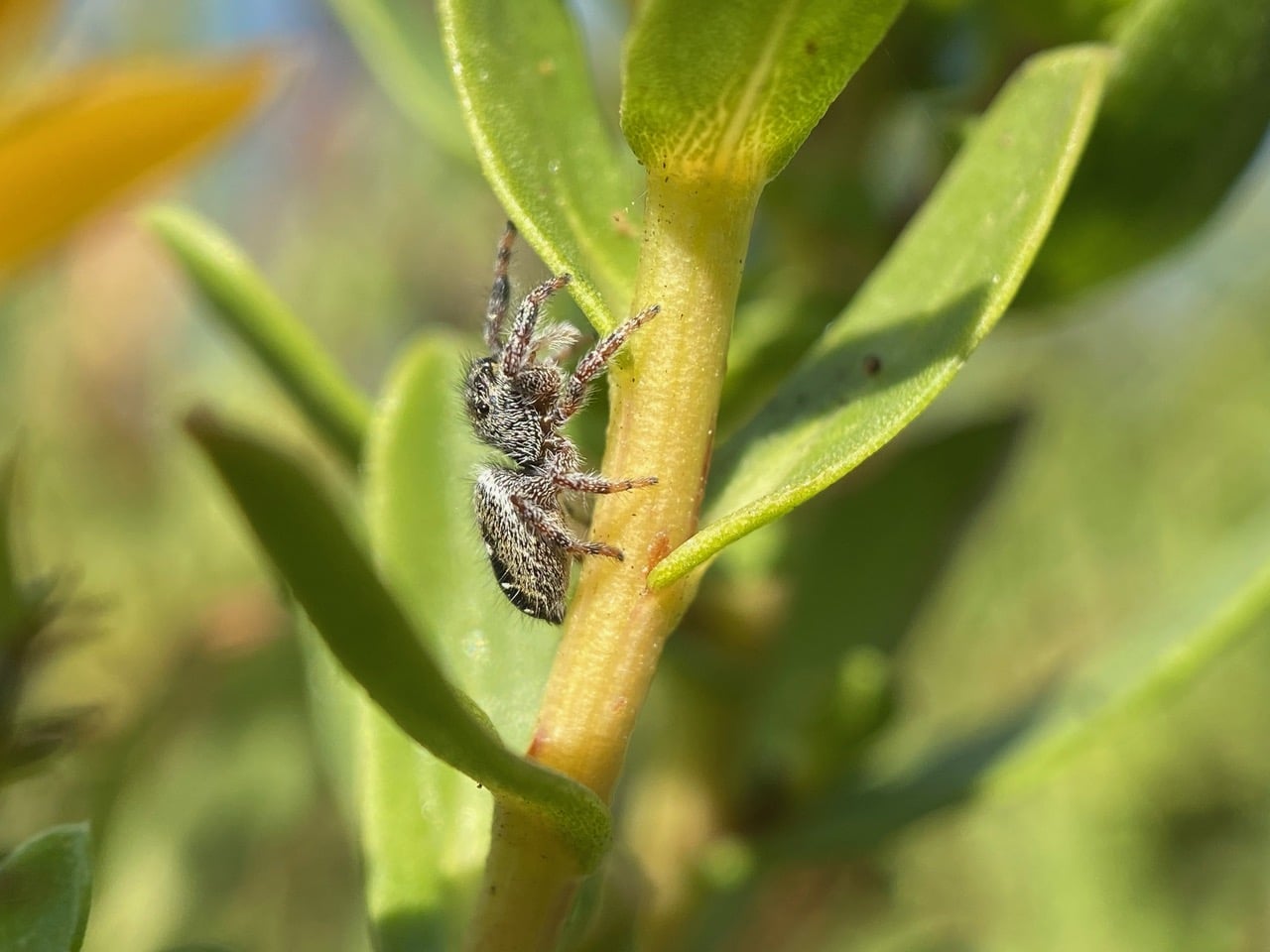
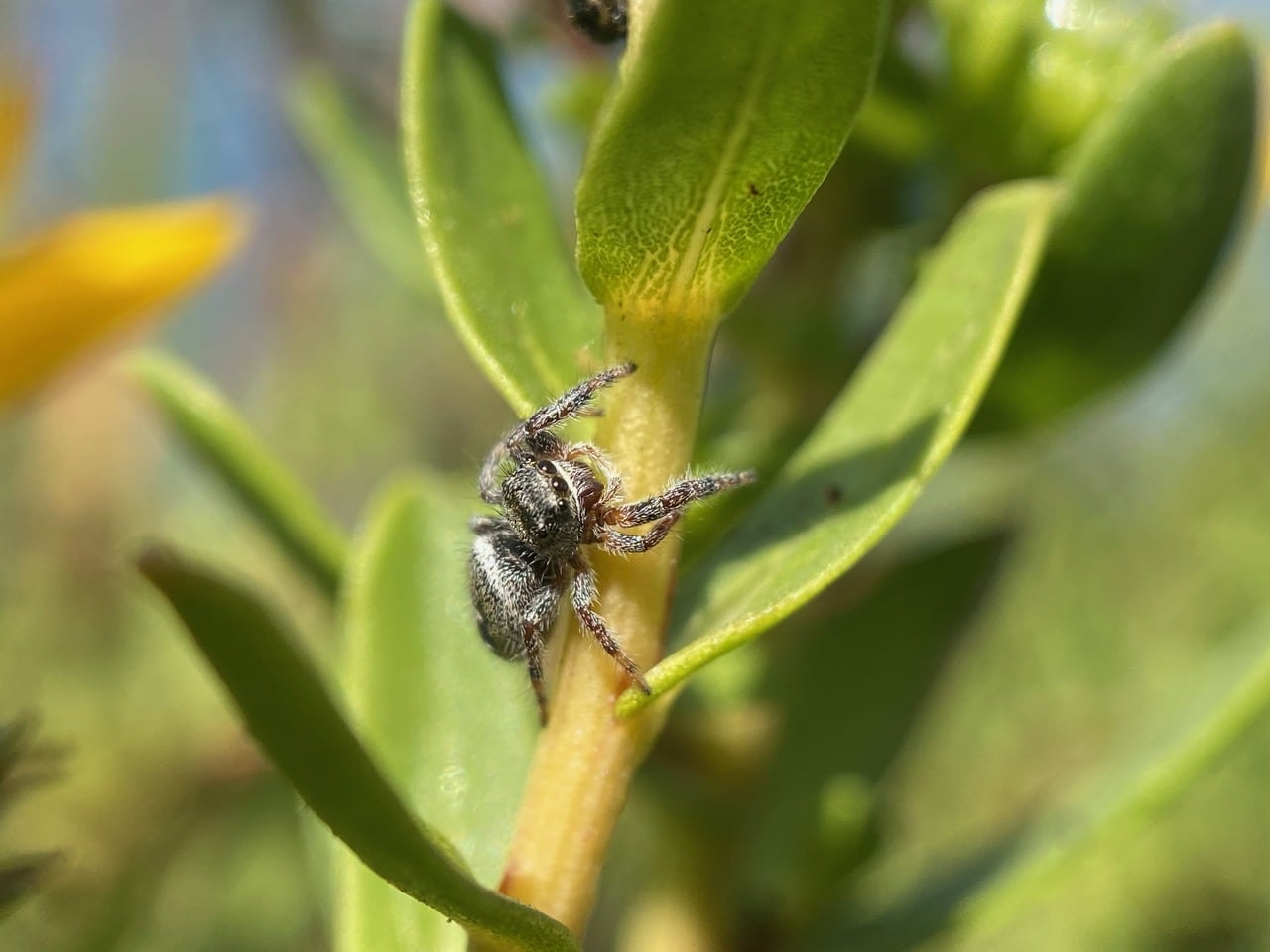
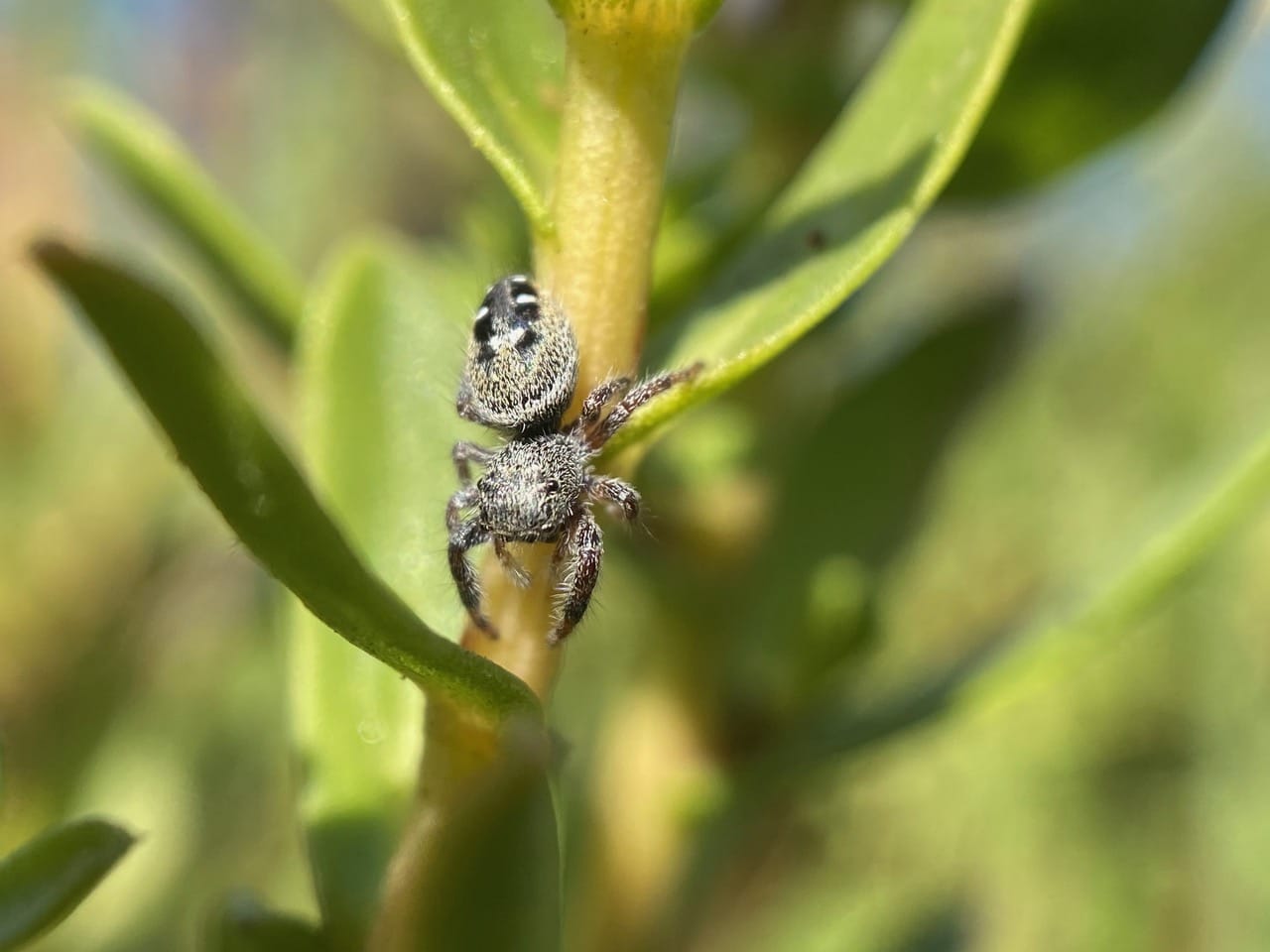
A Jumping Spider, Phidippus sp. (family Salticidae) is on a leaf of Grindelia.
Salticids or Jumping Spiders are free-roaming hunting spiders. They do not weave a web to catch prey. They stalk, then pounce on their prey. Just before jumping, the spider fastens a safety line to the substrate. It can leap 10-20 times their body length to capture prey. Their movement is achieved by rapid changes in hydraulic pressure of the blood. Muscular contractions force fluids into the hind legs, which cause them to extend extremely quickly. Jumping spiders are visual hunters. Their excellent vision has among the highest acuities in invertebrates. Since all their 8 eyes are fixed in place and cannot pivot independently from the body like human eyes can, jumping spiders must turn to face whatever they want to see well. This includes moving their cephalothorax up and down, an endearing behavior.
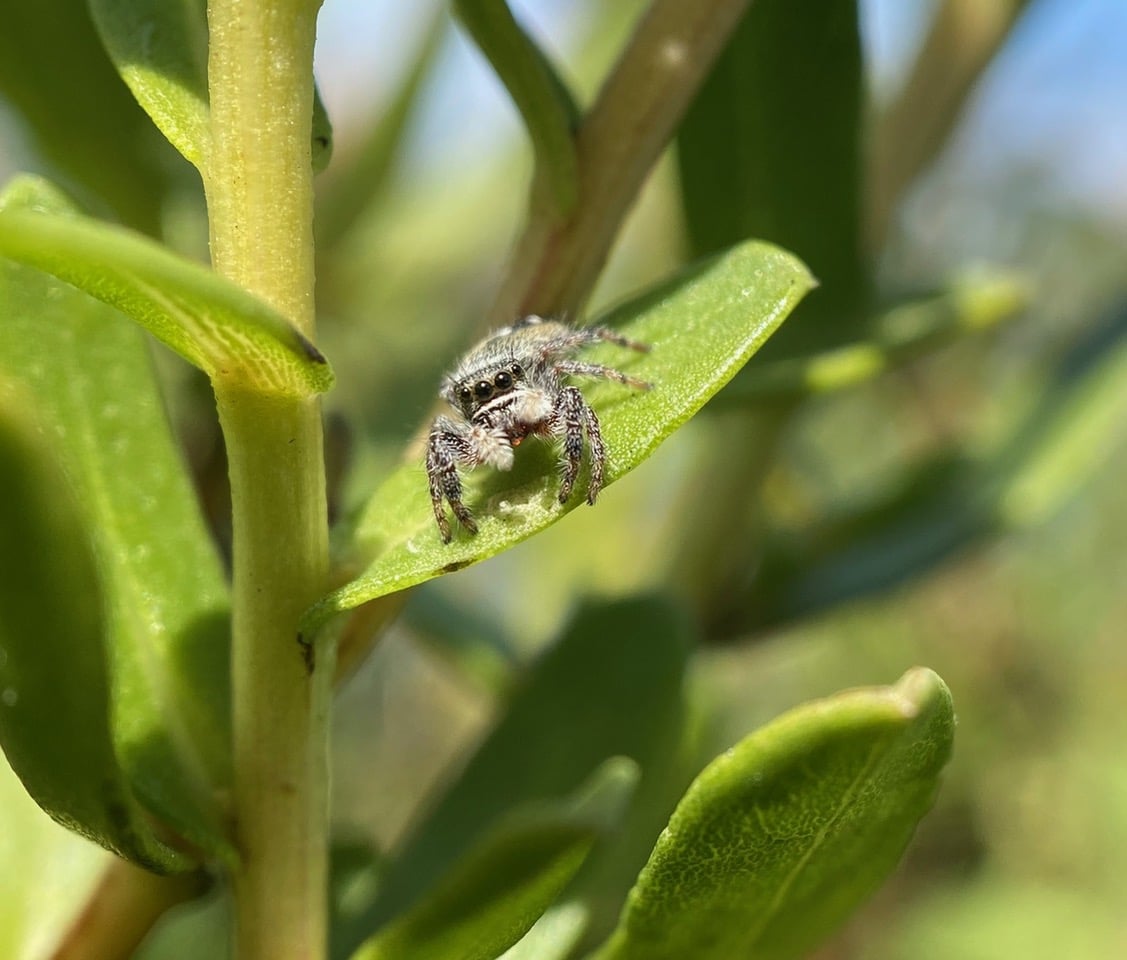
The spider spins around to face me, waving its fuzzy pedipalps excitedly. Note the prominent white stripe below its eyes.
The pedipalps are jointed appendages, much like small legs. They are used by the spider to sense objects, shape their webs, and to aid in prey capture and feeding. In male spiders, the pedipalps are also used to deliver sperm during mating.
Jumping spiders have excellent vision, with among the highest acuities in invertebrates. The 8 eyes are grouped four on the face (the two big Anterior Median Eyes in the middle, and two smaller Anterior Lateral eyes to the side), and four on top of the carapace. The anterior median eyes provide high acuity but small field of view, while the other six eyes act like our peripheral vision, with lower resolution but broad field of view. Since all eight eyes are fixed in place and can’t pivot independently from the body like human eyes can, jumping spiders must turn to face whatever they want to see well. This includes moving their cephalothorax up and down, an endearing behavior.

The spider runs up the stem.
Nearly all its eight eyes are visible in this angle, situated around a raised area on its cephalothorax.
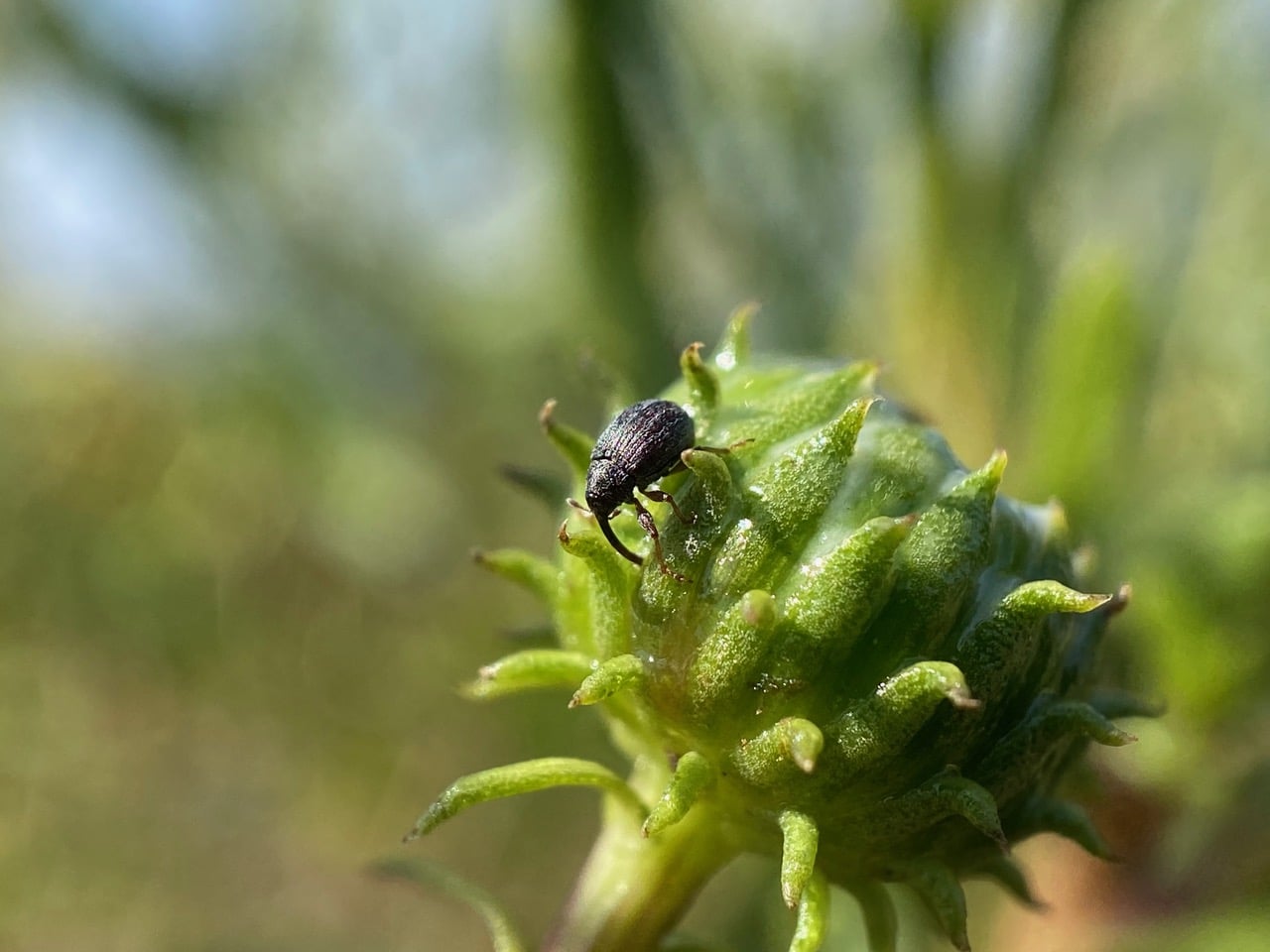
A Weevil (family Curculionidae) is feeding on the side of a immature flowerhead of Grindelia.
Weevils, family Curculionidae, are also called snout beetles. Curculionidae is one of the largest beetle families (about 40,000 species). Most weevils have long, distinctly elbowed antennae that may fold into special grooves on the snout. The snout is used not only for penetration and feeding but also for boring holes in which to lay eggs. The mouthparts are quite small and located at the end of the rostrum (snout), designed for chewing. Many weevils have no wings, while others are excellent fliers. Most are less than 6 mm in length. The majority of weevils feed exclusively on plants. The fleshy, legless larvae of most species feed only on a certain part of a plant – i.e., the flower head, seeds, fleshy fruits, stems, or roots. Many larvae feed either on a single plant species or on closely related ones. Adult weevils tend to be less specialized in their feeding habits. The family includes some very destructive agricultural pests.
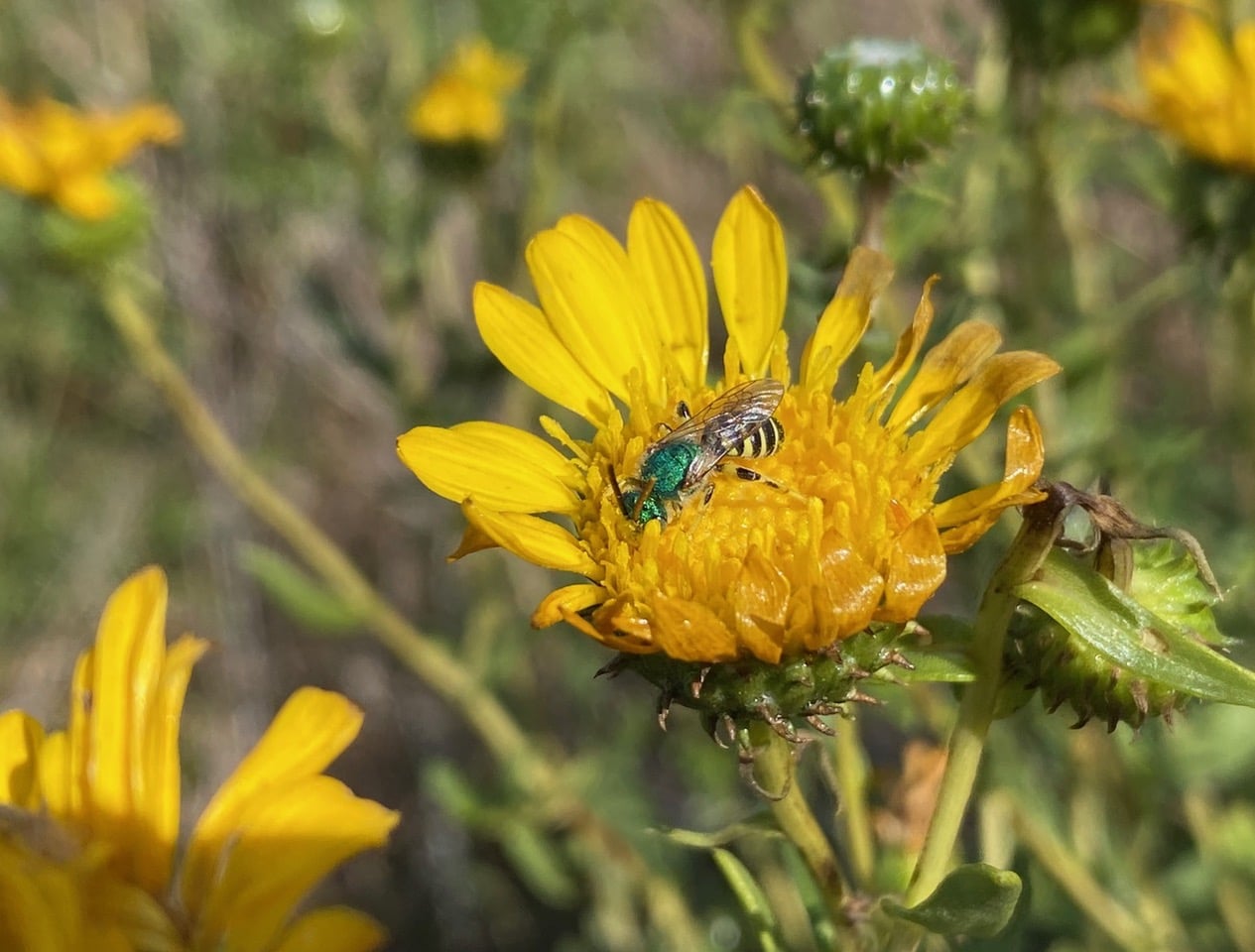
A male Texas Striped Sweat Bee, Agapostemon texanus (family Halictidae) is face-deep in a Grindelia flowerhead, taking nectar. I have been seeing only males of this species lately. What happened to the females?
The genus Agapostemon is widespread and abundant throughout North America. These ground nesting bees are most diverse and abundant in temperate regions and southwestern U.S. deserts. Agapostemon are commonly called “sweat bees” because they are closely related to, and resemble bees in the Halictus and Lasioglossum genera. Unlike those bees however, Agapostemon are not attracted to human sweat.
Agapostemon are brightly colored metallic green or blue bees measuring 7 to 14.5 mm long. Most species have a metallic green head and thorax, and black-and-yellow striped abdomen; some females are entirely bright green or blue. Females carry pollen on scopal hairs located on their hind legs. Agapostemon are generalists. Like other members of the family Halictidae, they are short-tongued and thus have difficulty extracting nectar from deep flowers. Males are often seen flying slowly around flowers looking for females. The bees favor flowers with high densities. They are active summer to fall.
A female Summer Longhorn Bee, Melissodes sp. (family Apidae) is foraging on a Grindelia flowerhead, her scopae relatively empty.
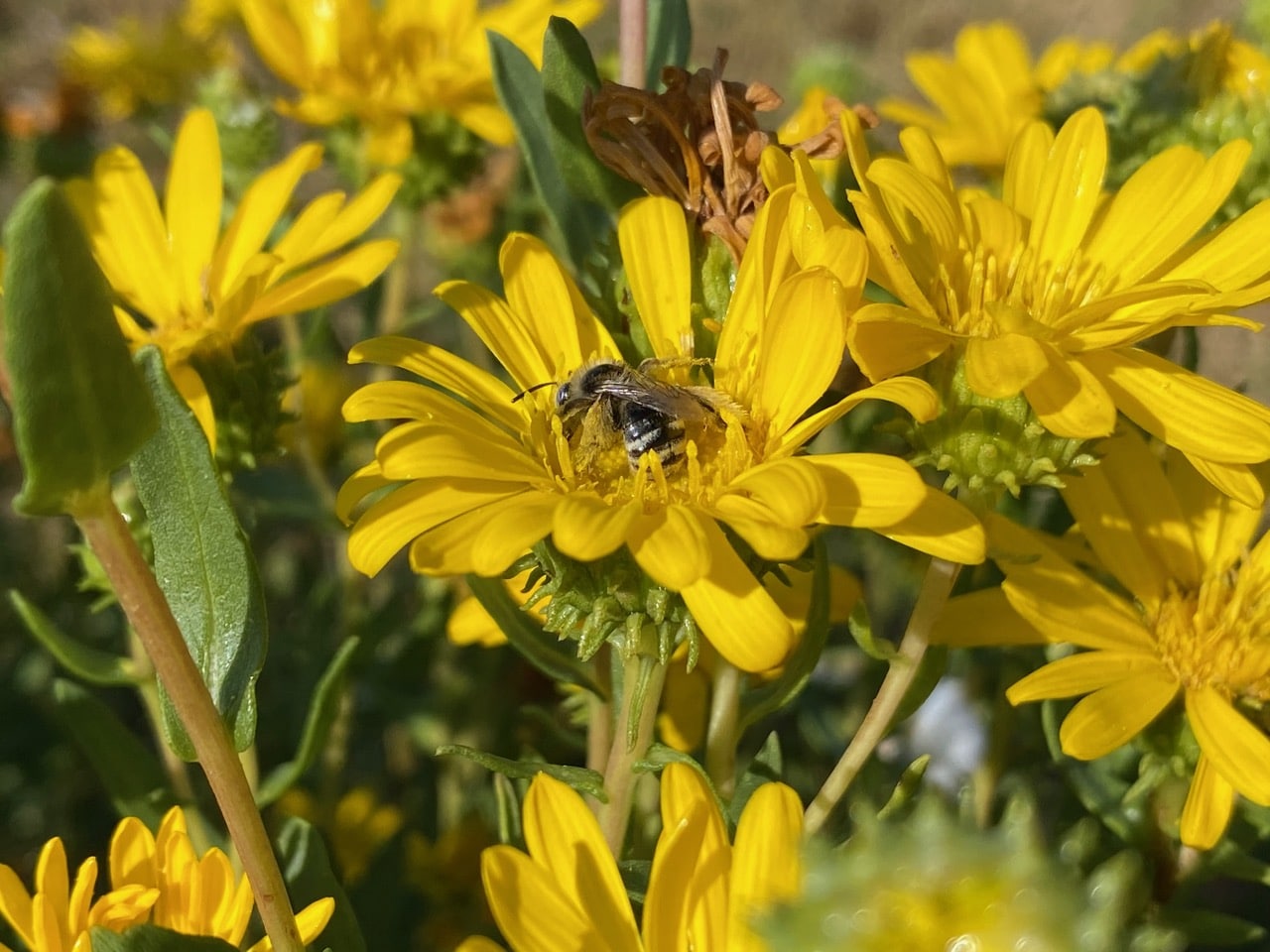
I part some vegetation around a Grindelia flowerhead to take a better look at the stationary male Melissodes. Covered with pollen he is hunched over, but something tells me that he is not merely asleep. After waiting a while, I gently prod him with a piece of dried grass. He does not budge. The bee is dead. Apparently he has chosen a flowerhead hidden low among a tangle of Grindelia foliage to take his last sip of nectar. Is this how the Longhorns here die, faithful to their beloved Grindelia to the very end? Melissodes are specialists on plants in the sunflower family Asteraceae. The Longhorns at Bay Farm apparently feed from the Grindelia exclusively. I have never seen them forage on other flowers here.
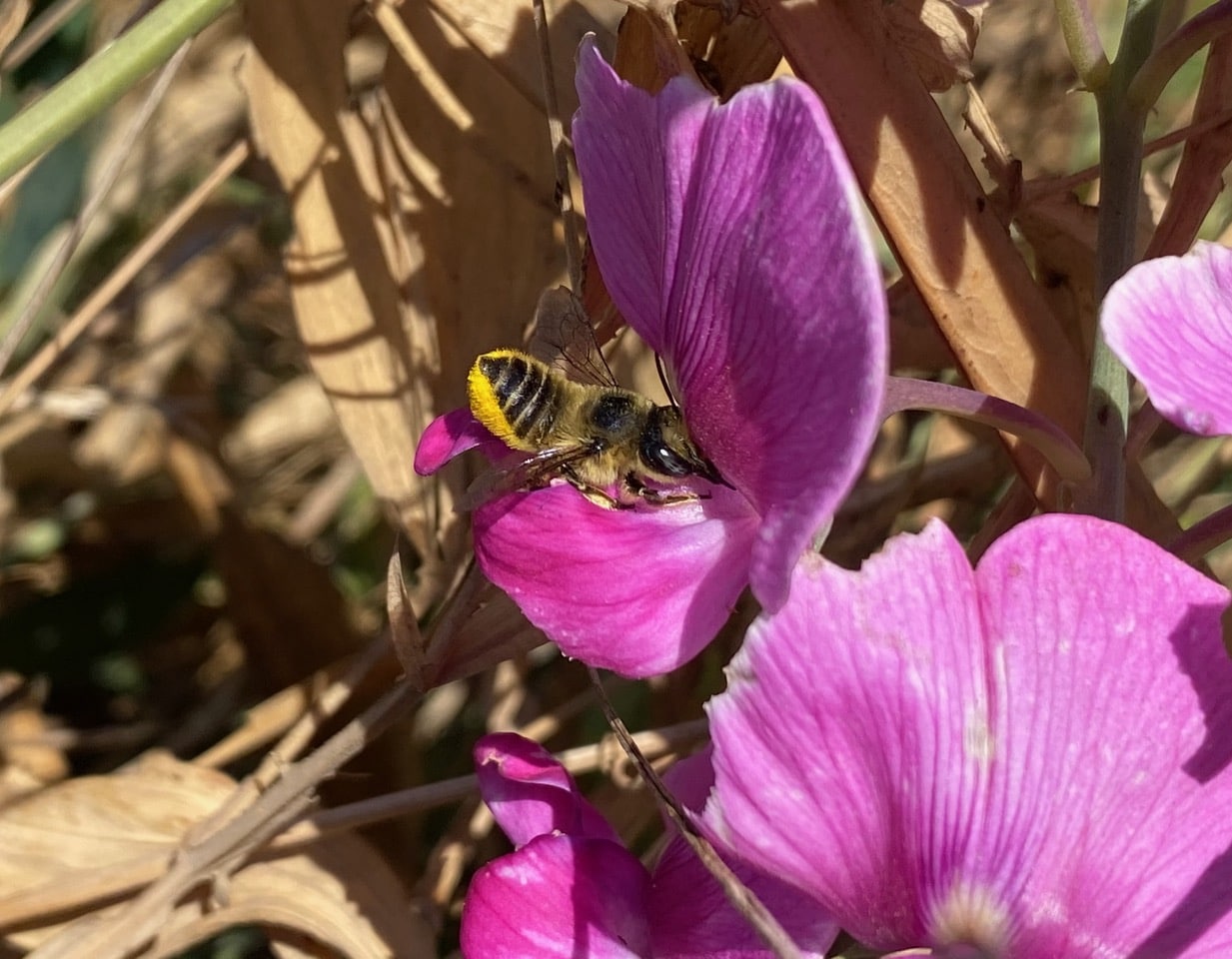
What a surprise to find a female Western Leafcutter Bee, Megachile perihirta (family Megachilidae) stealing nectar from a flower of Everlasting Pea, Lathyrus latifolius! A few of these exotic plants grow scattered along the dirt path, probably escapees from the neighboring gardens. With floral resources dwindling, the bees have resorted to flowers they normally do not visit. The yellow pollen on her scopae on the underside of her abdomen is not from the pea flowers. The pea pollen is hidden in an envelope called the keel under the wing petals that the bee has landed on. She is obviously not capable of accessing that envelope. But she knows where the nectar is hidden – at the back of the flower where the petals converge.
Leaf-cutter Bees, Megachile sp. (family Megachilidae) are stout-bodied, usually with pale hair on the thorax and stripes of white hairs on the abdomen. Females usually have a triangular abdomen with a pointed tip, and males’ faces are covered with dense, pale hair. Flight season is from May into September, with peak activity from June to August.
Solitary females construct nests in tubular cavities, including hollow stems, tree holes, and abandoned beetle burrows in wood. Many use holes drilled into wood, straws, or other manufactured tunnels. Females cut pieces from leaves or flower petals for use in the construction of brood cells. Most Megachile females are generalists when foraging for pollen. Pollen is transported in dense scopae on the underside of the abdomen.
Photos of Western Leafcutter Bee (Megachile perihirta) · iNaturalist
There are so many Summer Longhorn Bees out foraging this afternoon! Perhaps because they couldn’t forage this morning when it was very cloudy and cool. It is, however, rather windy now, and I have to hold on to the flowerheads to be able to photograph the bees.
The Summer Longhorn Bees, Melissodes sp. (family Apidae) are medium to large bees, stout-bodied, usually with gray hair on the thorax and pale hair bands on the abdomen. Males usually have yellow markings on their faces and have very long antennae from which their common name is derived. They are active May to September, with peak flight in late June to early August. The females prefer flat, bare ground for digging their solitary nests, though they sometimes nest in aggregations. Pollen is transported in scopae on the hind legs. Pollen loads are often copious and brightly colored and thus very distinguishable. Melissodes are specialists on Asteraceae – females gather pollen from flowers of Aster, Bidens, Coreopsis, Cosmos, Encelia, Gaillardia, Helianthus, and Rudbeckia ssp.
Although male bees do not intentionally collect pollen, they can be effective pollinators, as pollen tends to stick to their body parts (including the prolific mustaches) and this can be tranferred from flower to flower as the bees seek nectar.
Here’s a female Summer Longhorn Bee, Melissodes sp. (family Apidae).
What she lacks in antenna length compared to the males, she more than makes up for in the long scopal hairs on her hind legs.
Close-up of a female Summer Longhorn Bee, Melissodes sp. (family Apidae) showing the shaggy hairs of her empty scopae. She is an older individual, with balding abdomen and tattered edges to her wings.
Dusted with pollen, a female Melissodes is hunched over the ray petals of a Grindelia flowerhead cleaning her tongue. Amazingly at no time does the process involve her front legs. For quite some time she repeatedly extends and retrieves her tongue along with some brown accessory parts. Self-cleaning mouthparts – Awesome!
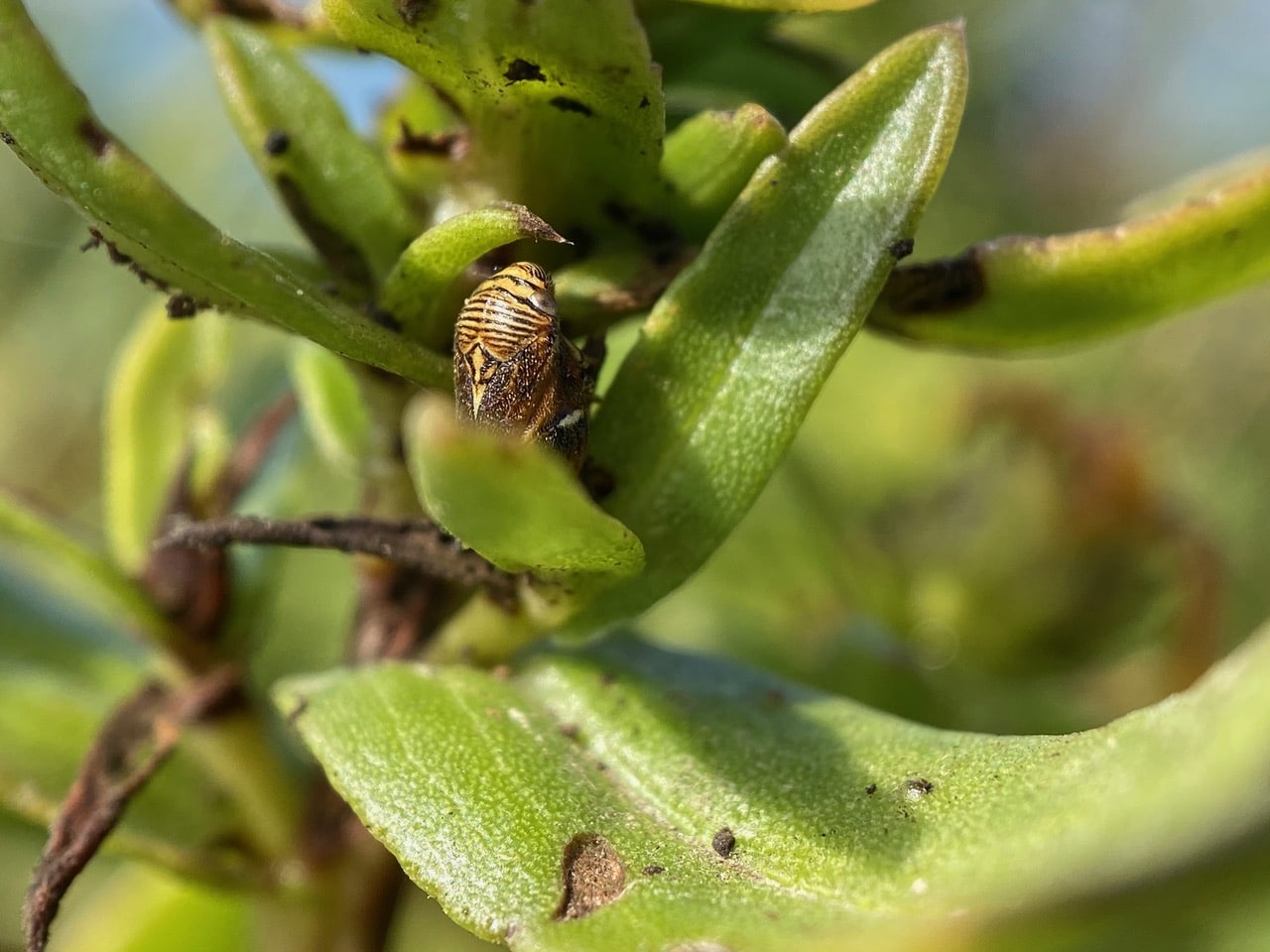
I cannot find the brown Spittlebug on the Grindelia where it eclosed three days ago. Neither can I find the black individual. So I am quite delighted to spot this brown one on an adjacent plant. Did our hero move over? This is the only adult Spittlebug I see today. Rather a let down – after the flurry of eclosures three days ago, I had expected to find many adults.
I mark the plant in an attempt to track this Spittlebug.