

Pollinator Post 9/19/24 (2)
There is still time for a walk at Shoreline Park in the afternoon.



Brisk winds are blowing, and I have to brace the Grindelia flowerheads with my left hand to take pictures of the insects on them – a trick I learned from Emil, my bee-nerd friend. It is amazing how cooperative some of the insects are.
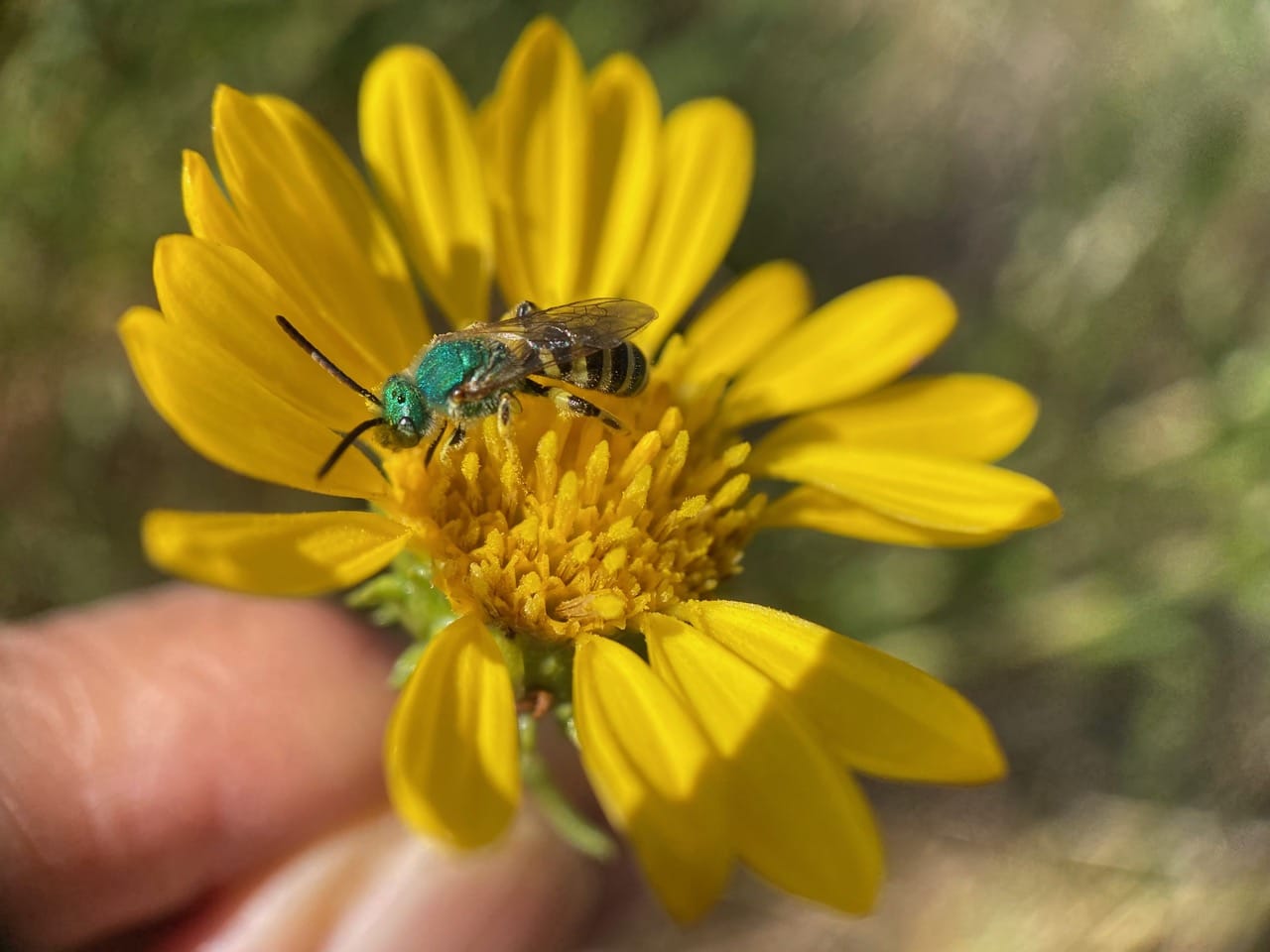
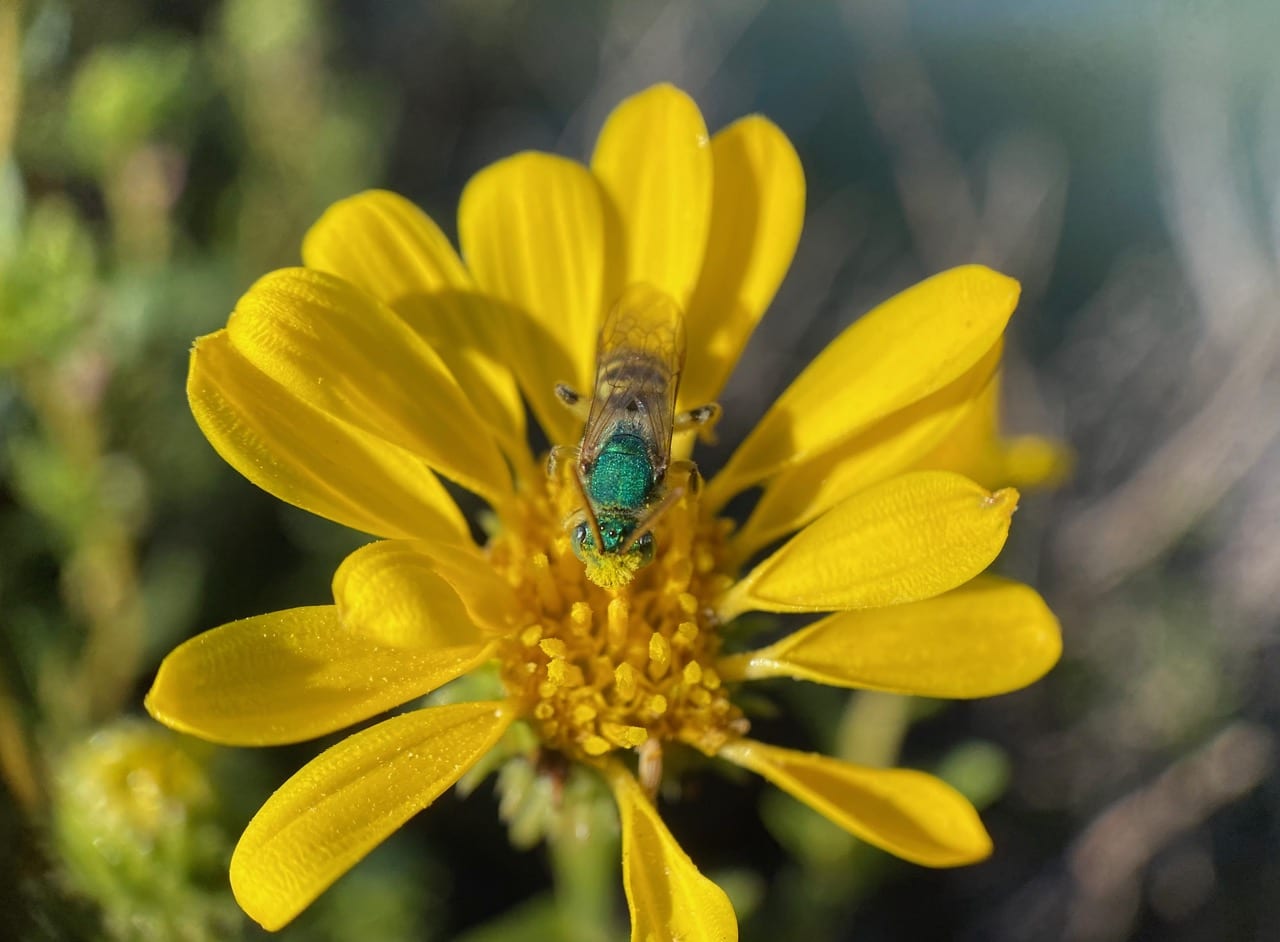
A male Texas Striped Sweat Bee, Agapostemon texanus (family Halictidae) looks up from his nectar binge, yellow pollen stuck to his mustache.
The genus Agapostemon is widespread and abundant throughout North America. These ground nesters are most diverse and abundant in temperate regions and southwestern U.S. deserts. Agapostemon are commonly called “sweat bees” because they are closely related to, and resemble bees in the Halictus and Lasioglossum genera. Unlike those bees however, Agapostemon are not attracted to human sweat.
Agapostemon are brightly colored metallic green or blue bees measuring 7 to 14.5 mm long. Most species have a metallic green head and thorax, and black-and-yellow striped abdomen; some females are entirely bright green or blue. Females carry pollen on scopal hairs located on their hind legs. Agapostemon are generalists. Like other members of the family Halictidae, they are short-tongued and thus have difficulty extracting nectar from deep flowers. Males are often seen flying slowly around flowers looking for females. The bees favor flowers with high densities. They are active summer to fall.
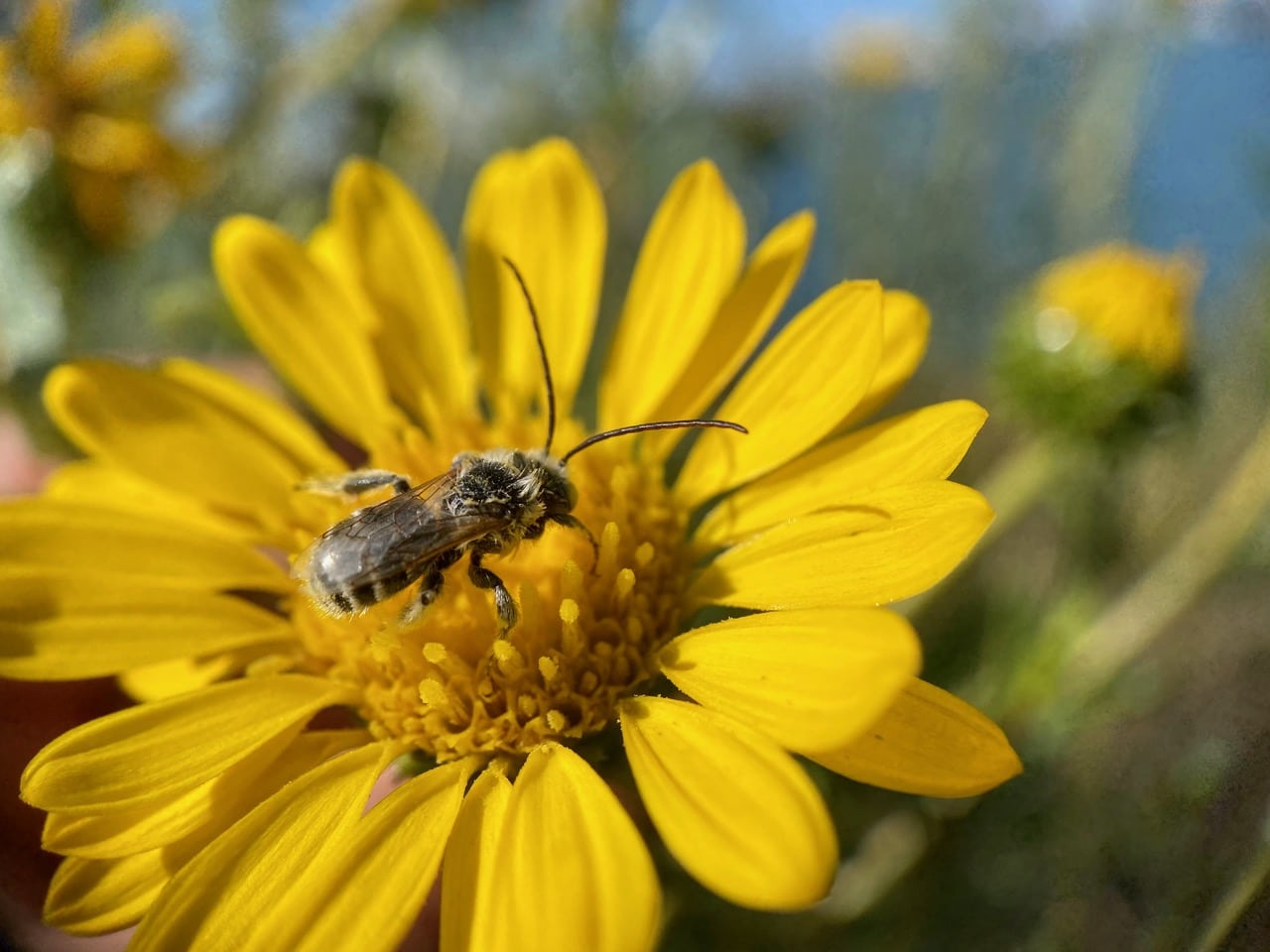
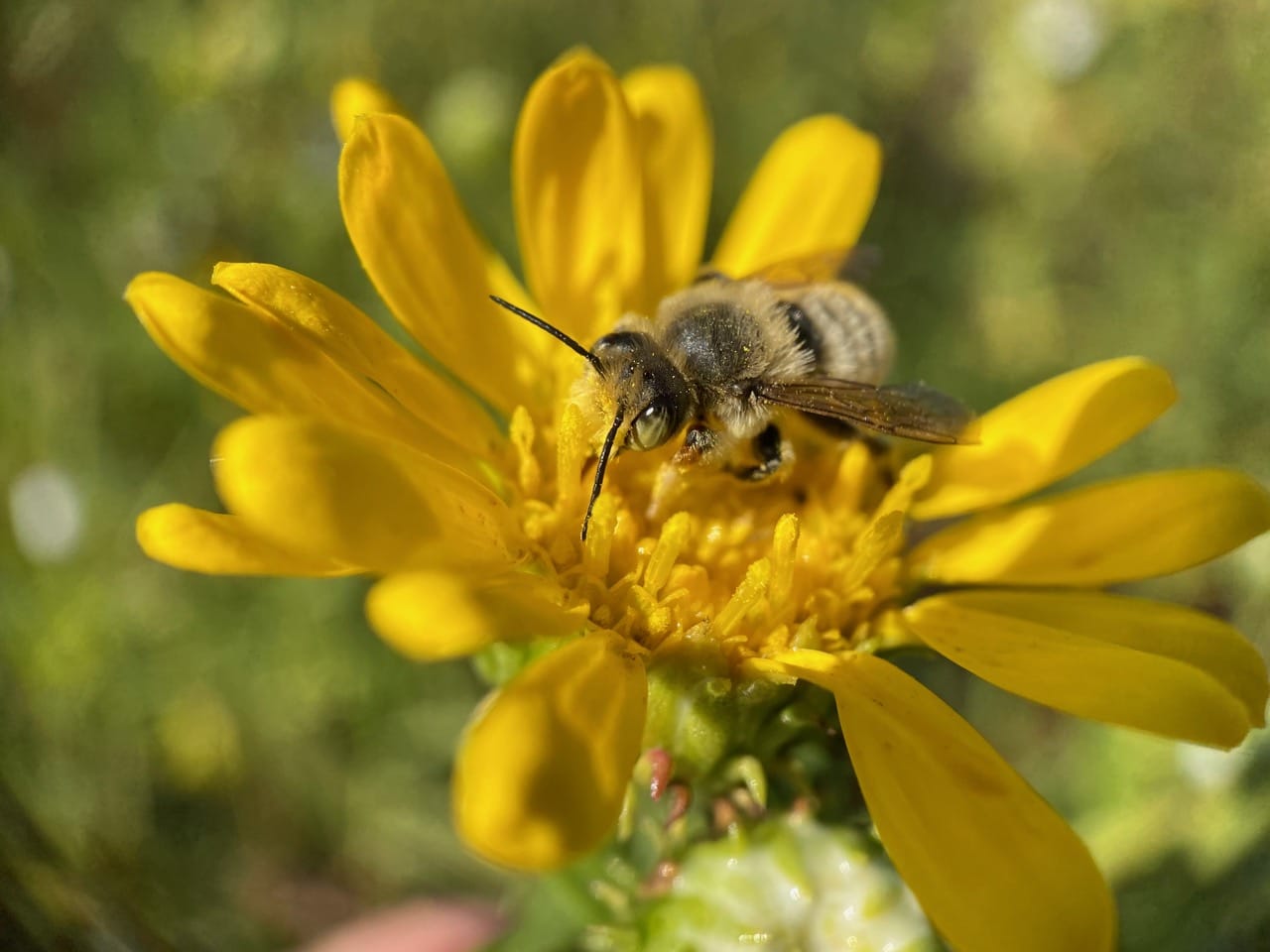
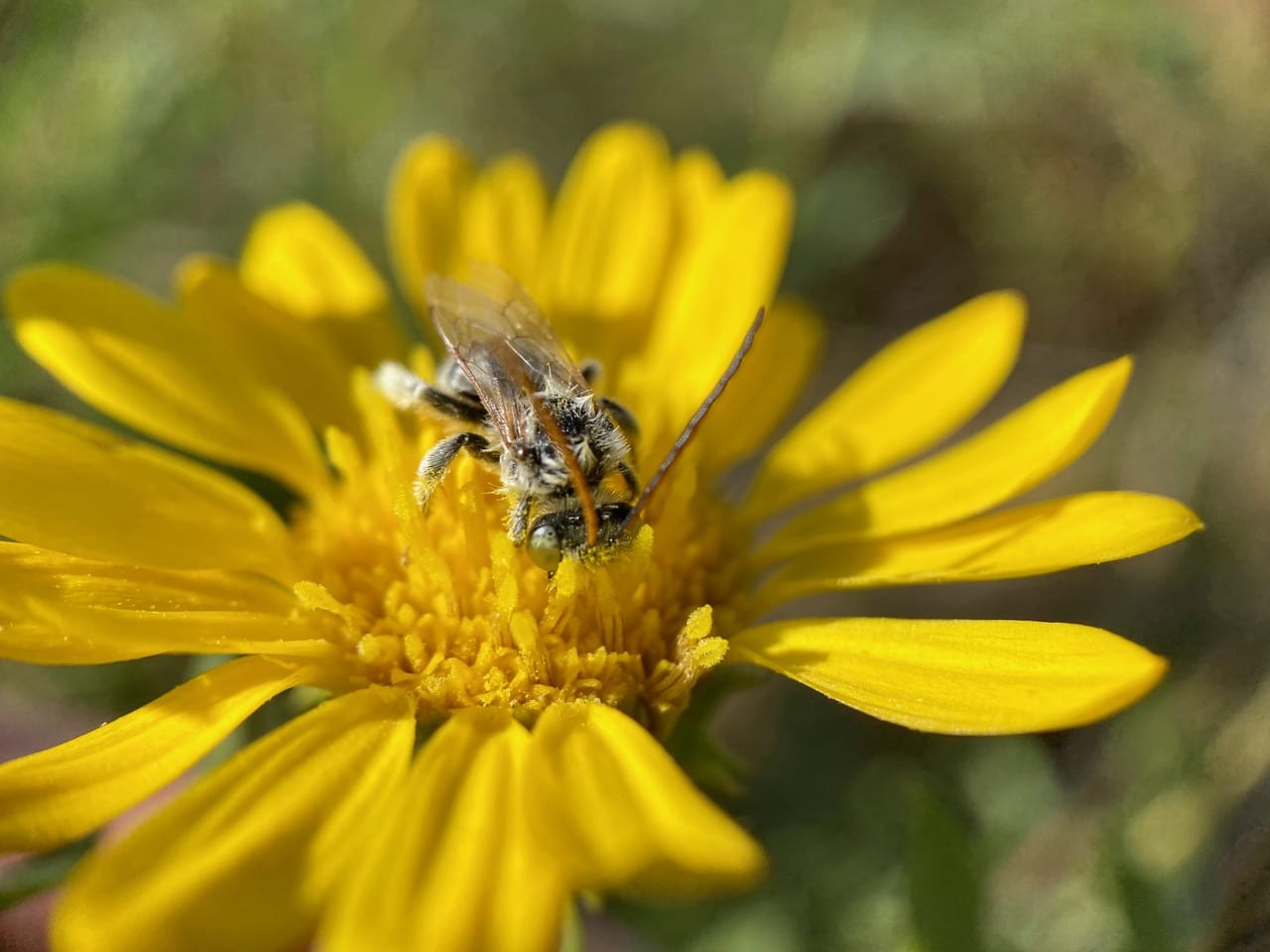
A Summer Longhorn Bee, Melissodes sp. (family Apidae) lands on a Gridelia flowerhead. Note that he does not have a scopa on his hind legs. Male bees do not need scopae as they do not collect pollen to provision the nest.
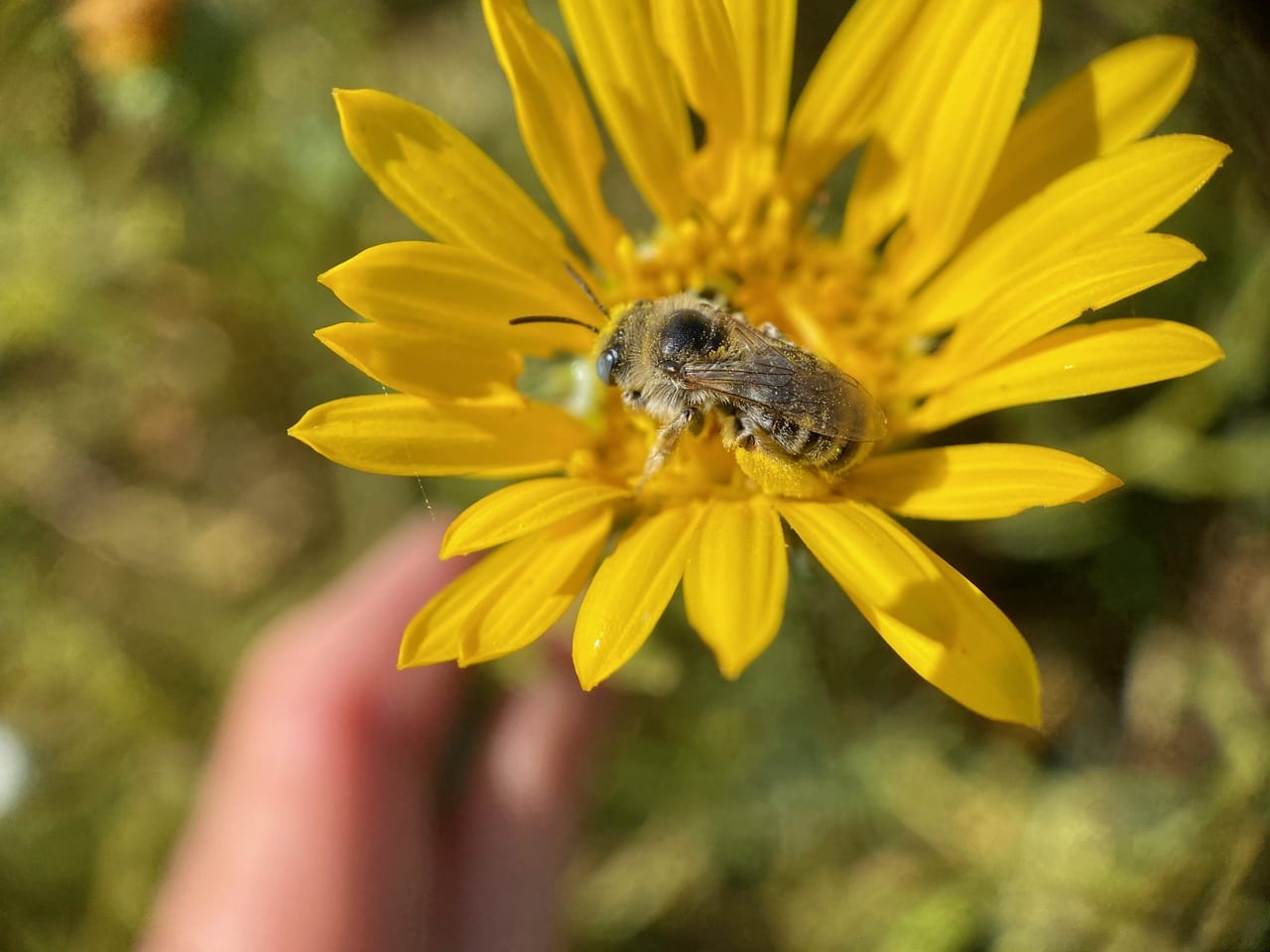
The Summer Longhorn Bees, Melissodes sp. (family Apidae) are medium to large bees, stout-bodied, usually with gray hair on the thorax and pale hair bands on the abdomen. Males usually have yellow markings on their faces and have very long antennae from which their common name is derived. They are active May to September, with peak flight in late June to early August. The females prefer flat, bare ground for digging their solitary nests, though they sometimes nest in aggregations. Pollen is transported in scopae on the hind legs. Pollen loads are often copious and brightly colored and thus very distinguishable. Melissodes are specialists on Asteraceae – females gather pollen from flowers of Aster, Bidens, Coreopsis, Cosmos, Encelia, Gaillardia, Helianthus, and Rudbeckia ssp.

What are those long antennae for? A bee’s antennae serve numerous functions: smell, taste, perceive humidity and temperature, feel, monitor gravity and flight speed and even detect sound waves to help guide the bee in its daily activities. Male bees generally have longer anttennae than their female counterparts. Male antennae have an extra segment and the segments themselves are longer. This is because male antennae are specialized to pick up the subtle scent of female pheromones. The extra long antennae of the Melissodes male have yet another function not commonly known:
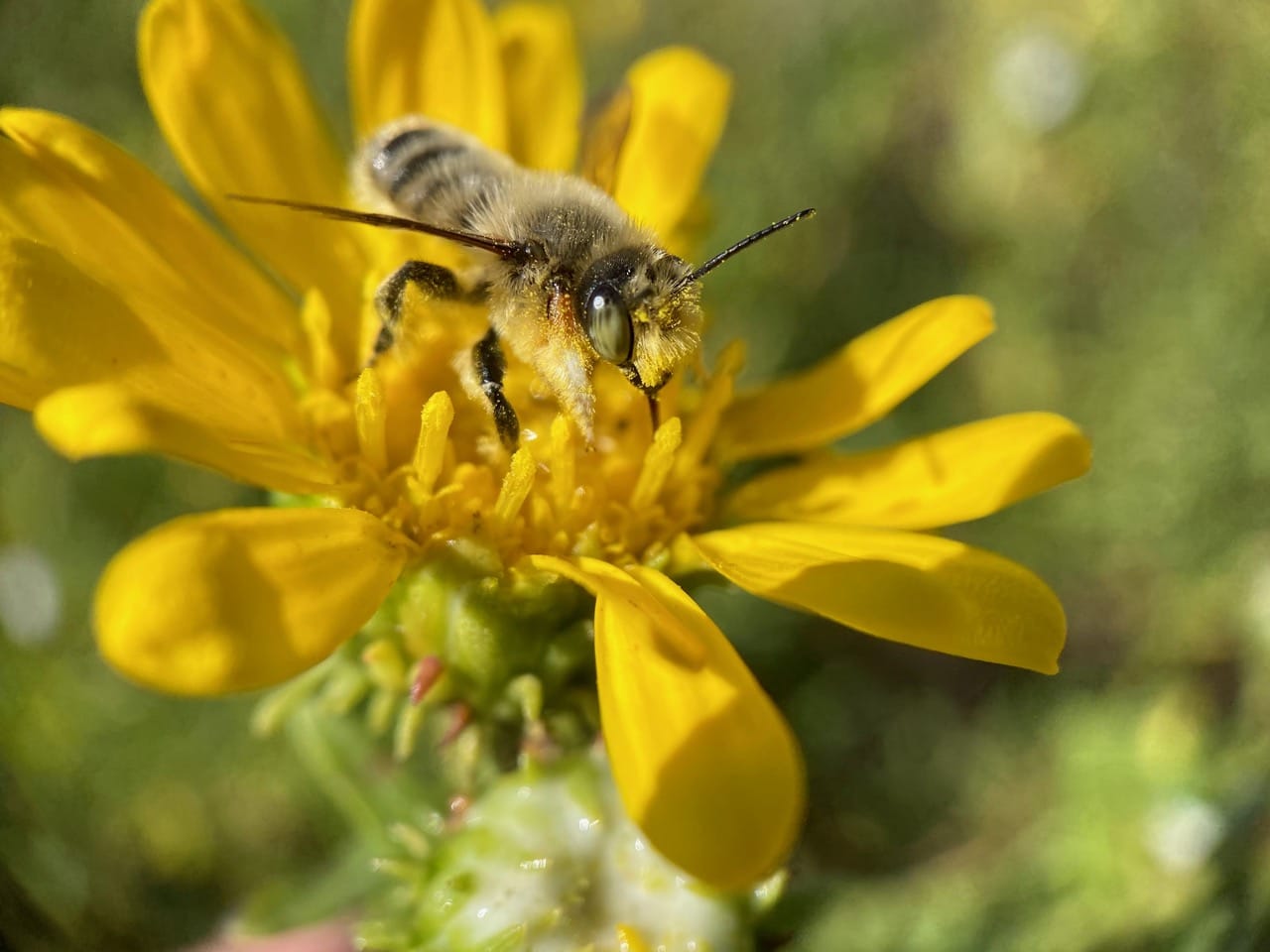
Here’s a female Melissodes, with much shorter antennae. She can be easily identified by the long hairs on the scopae of her hind legs. These are used for carrying huge loads of pollen.
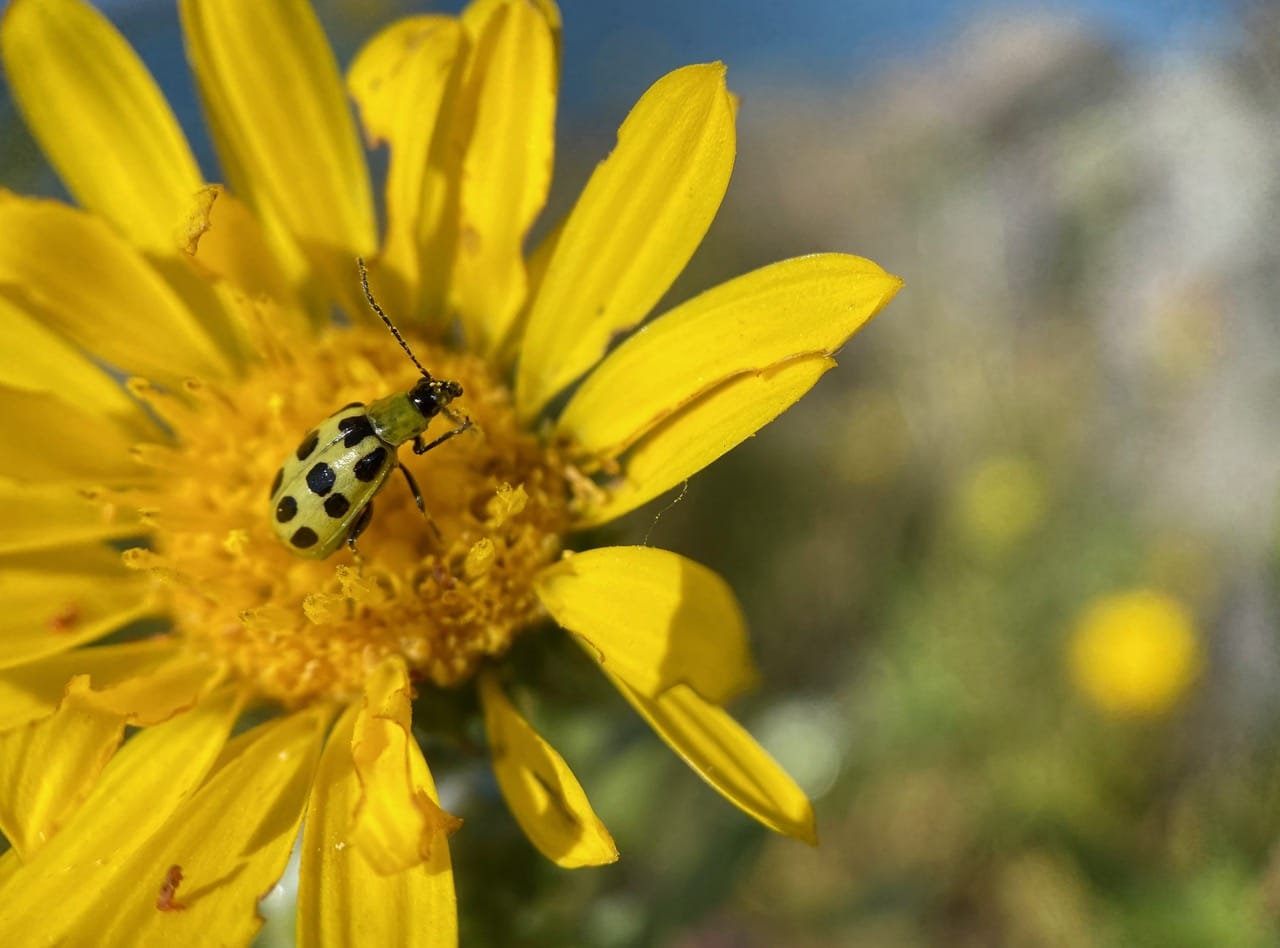
A Spotted Cucumber Beetle, Diabrotica undecimpunctata (family Chrysomelidae) cleans its antenna while foraging on a Grindelia flowerhead.
Members of the family Chrysomelidae are commonly known as Leaf Beetles. Adults and larvae feed on all sorts of plant tissues, and all species are fully herbivorous. Many are serious pests of cultivated plants, including food crops. Others are beneficial due to their use in biocontrol of invasive weeds. Chrysomelids are popular among insect collectors, as many are conspicuously colored, typically in glossy yellow to red or metallic blue-green hues, and some have spectacularly bizarre shapes. Photos of Leaf Beetles (Family Chrysomelidae) · iNaturalist
Native to North America, the Spotted Cucumber Beetle can be a major agricultural pest, causing damage to crops in the larval as well as adult stages of their life cycle. Larvae, sometimes known as rootworms feed on the roots of emerging plants. In the adult stage the beetles cause damage by eating the flowers, leaves, stems and fruits of the plant.
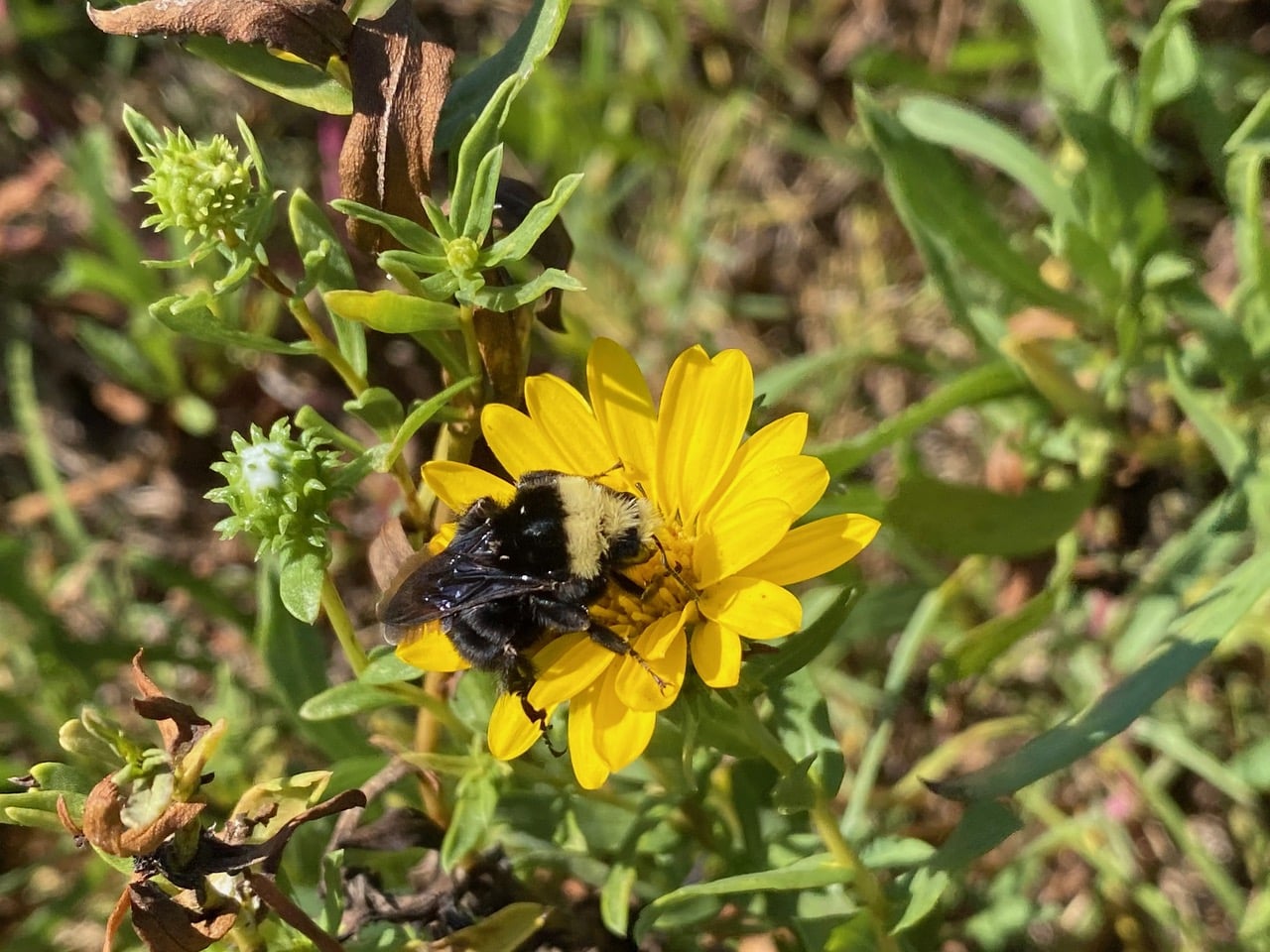
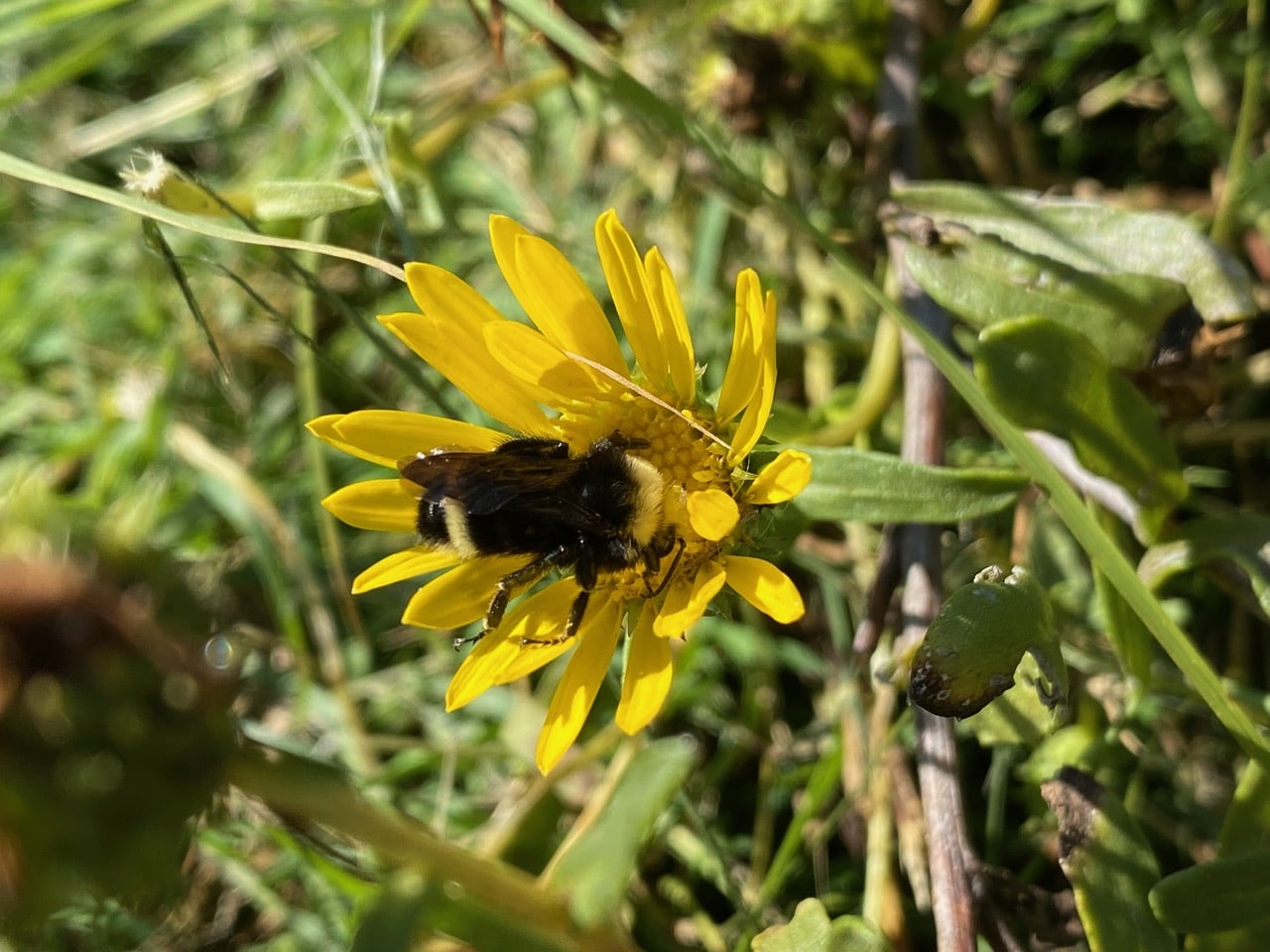
Hunched over a Grindelia flowerhead, a large queen Yellow-faced Bumble Bee, Bombus vosnesenskii (family Apidae) is taking a nap. Queen bumble bees can be distinguished visually from the workers by their sheer size. I have not seen a worker bumble bee for a while. I think their season might have ended. The new queens produced this year are the only bees in the colony that will overwinter, while the rest of the colony dies (including the old queen). Most of the new queens have probably mated, and they will be the ones establishing new colonies next spring. Their job now is to bulk up with nectar and pollen, and find a suitable site for hibernation.
Her royal highness wakes up and immediately grooms herself before flying away.
A male Western Leafcutter Bee, Megachile perihirta (family Megachilidae) visits a Grindelia flowerhead.
Leaf-cutter Bees, Megachile sp. (family Megachilidae) are stout-bodied, usually with pale hair on the thorax and stripes of white hairs on the abdomen. Females usually have a triangular abdomen with a pointed tip, and males’ faces are covered with dense, pale hair. Flight season is from May into September, with peak activity from June to August.
Solitary females construct nests in tubular cavities, including hollow stems, tree holes, and abandoned beetle burrows in wood. Many use holes drilled into wood, straws, or other manufactured tunnels. Females cut pieces from leaves or flower petals for use in the construction of brood cells. Most Megachile females are generalists when foraging for pollen. Pollen is transported in dense scopae on the underside of the abdomen.
Photos of Western Leafcutter Bee (Megachile perihirta) · iNaturalist
Note the bushy “mustache” on his face and the white hairs on his reddish front legs.
Males of some species of Megachile (including M. perihirta) have enlarged forelegs with long border hairs. They use these to cover the eyes of females while mating, presumably as blinders to calm them and increase receptivity.


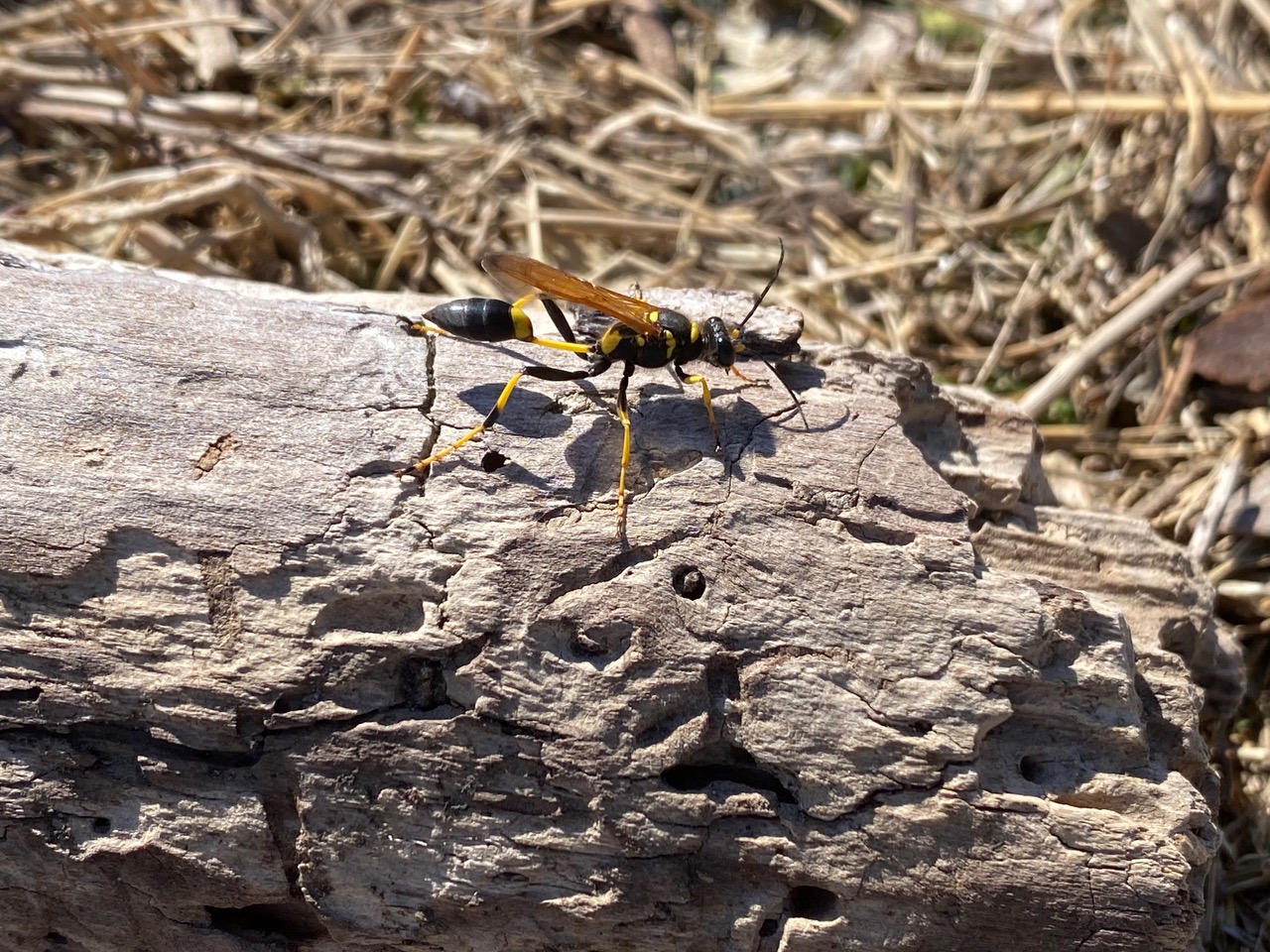
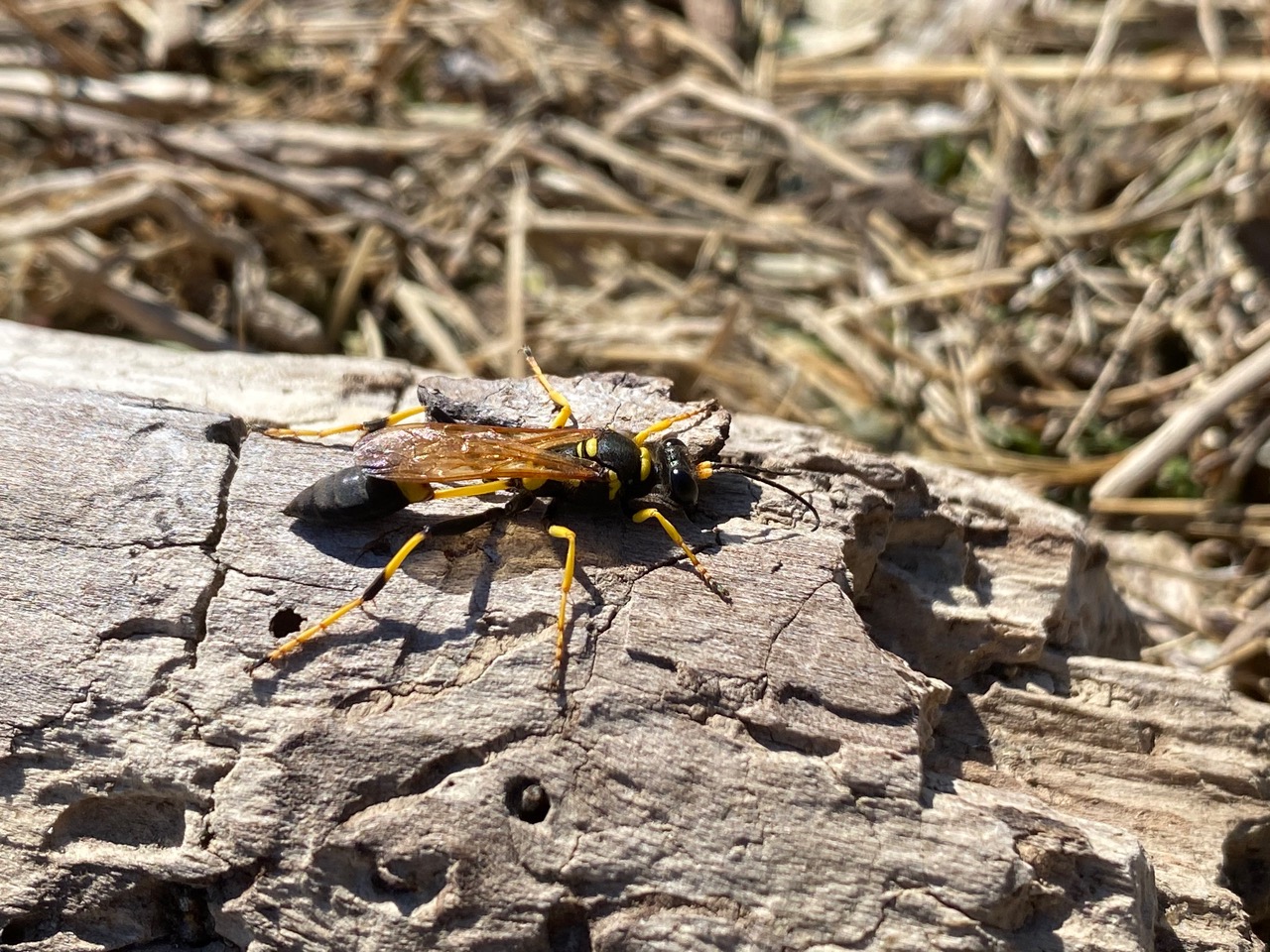
I often encounter the Yellow-legged Mud-daubers around the wet section of the trail, seeking mud for nest construction. They are difficult to photograph, as they often land on the grass and undergrowth, making them difficult to see. Imagine my delight when this individual lands on a piece of bleached wood by the trail. Noon day shadows not withstanding, the outline of the long-waisted wasp is visible.
The Yellow-legged Mud-dauber, Sceliphron caementarium (family Sphecidae) is widespread in the Americas. The species is found in a wide variety of habitats, such as rock ledges, man-made structures, puddles and other water edges. The wasp can reach a length of 24-28 mm. They are generally black with yellow markings, with impossibly long and skinny “waist”. They are solitary parasitoid wasps that build nests out of mud. Females collect mud balls at puddles and pool edges for constructing nests. The nests comprise up to 25 vertically arranged, individual cylindrical cells. Eventually the cells are covered over as a cluster by more mud, forming a smooth structure the size of a human fist. Nest constructed, the female wasp goes hunting for spiders. The prey are stung and paralyzed and placed in the cell, usually 6-15 per cell. A single egg is laid on the prey within each cell. The wasp then seals the cell with a thick mud plug. The larva that hatches out feeds on the spiders, pupates in the cell and emerges as an adult, breaking out of its mud nursery. Adult wasps can be seen in mid-summer feeding on nectar at flowers.
Much to my surprise, the Mud-dauber actually spreads eagle and flattens itself on the wood to bask!
Ooh, another queen Yellow-faced Bumble Bee taking a nap!
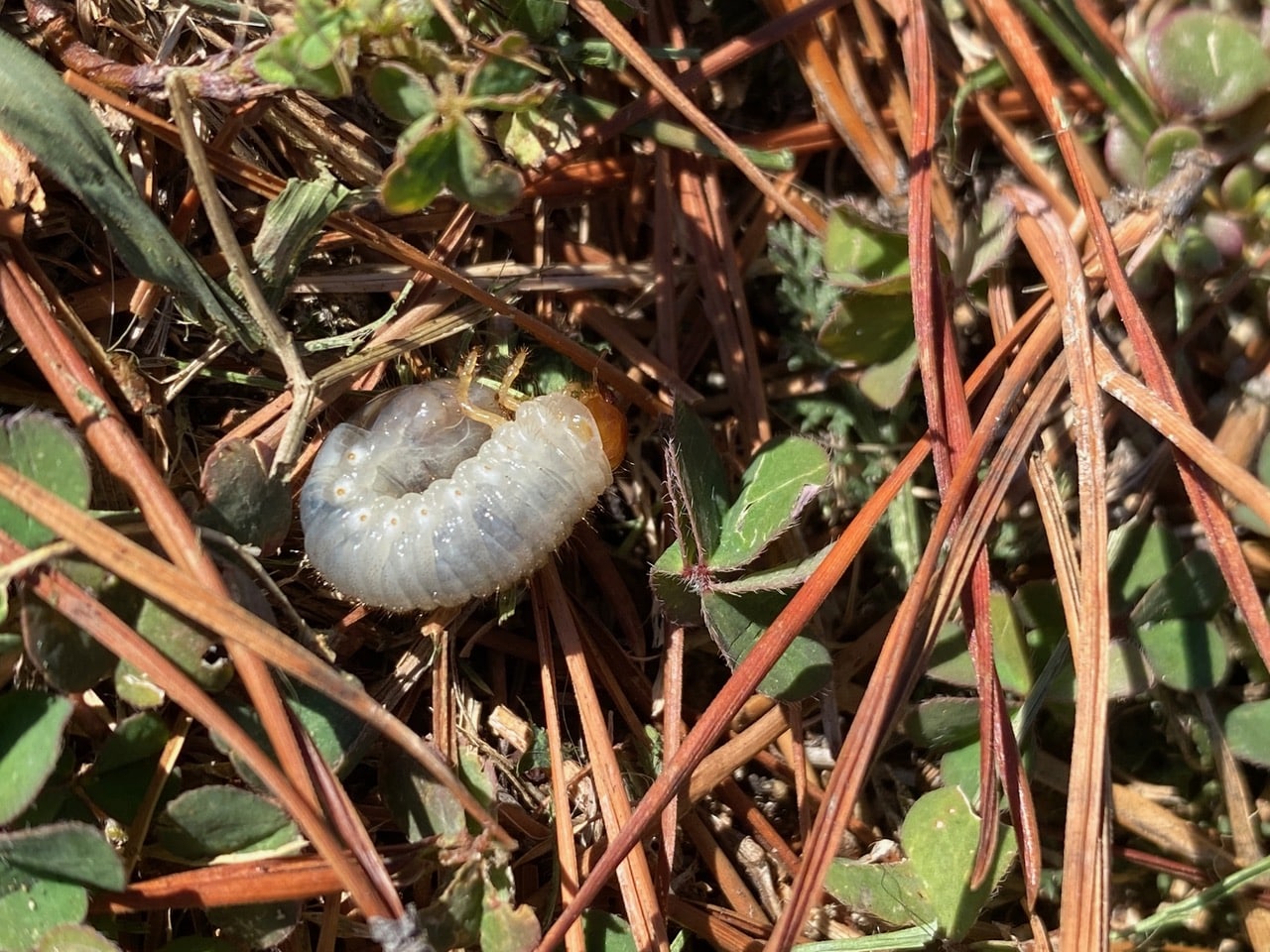
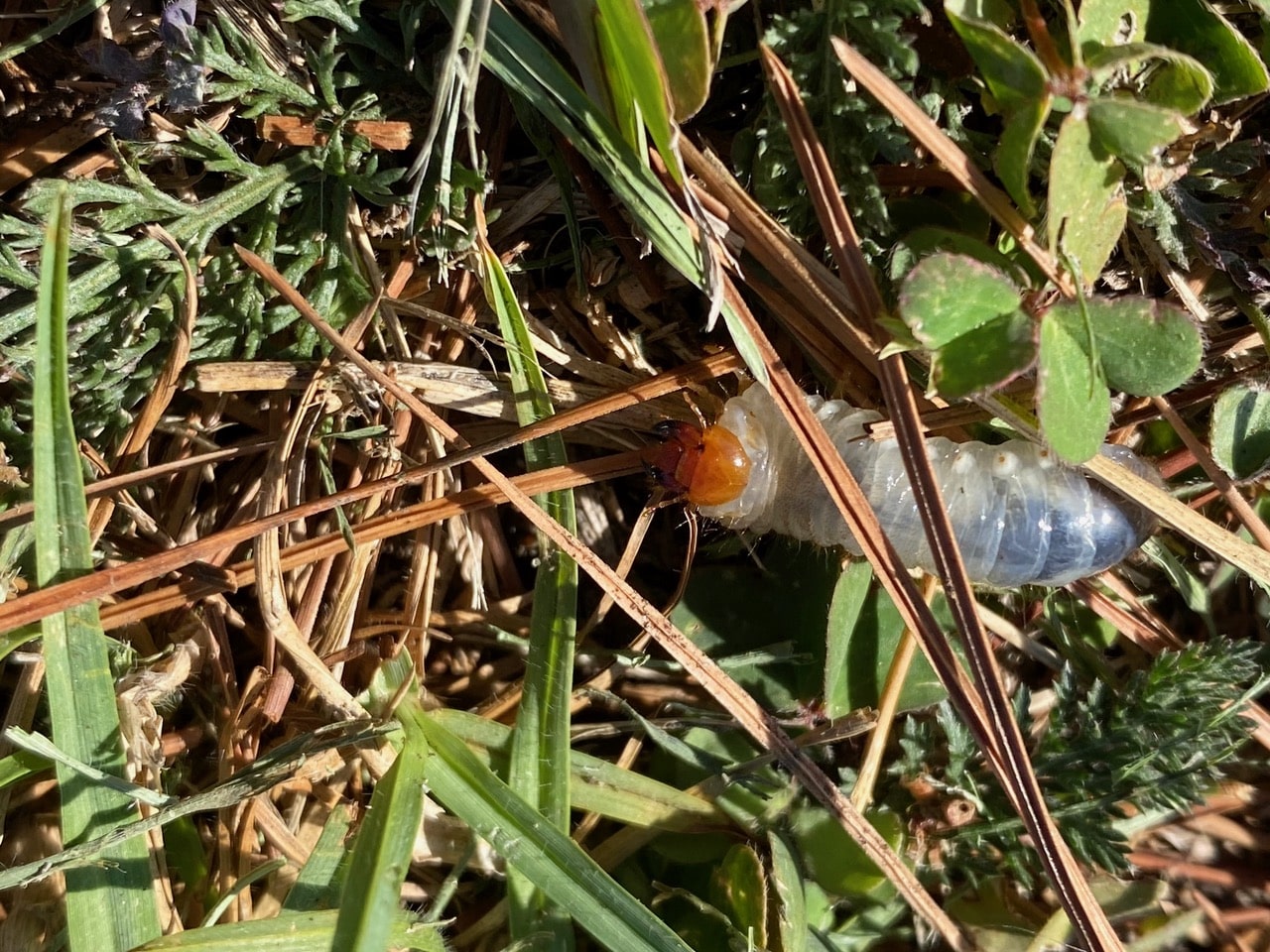
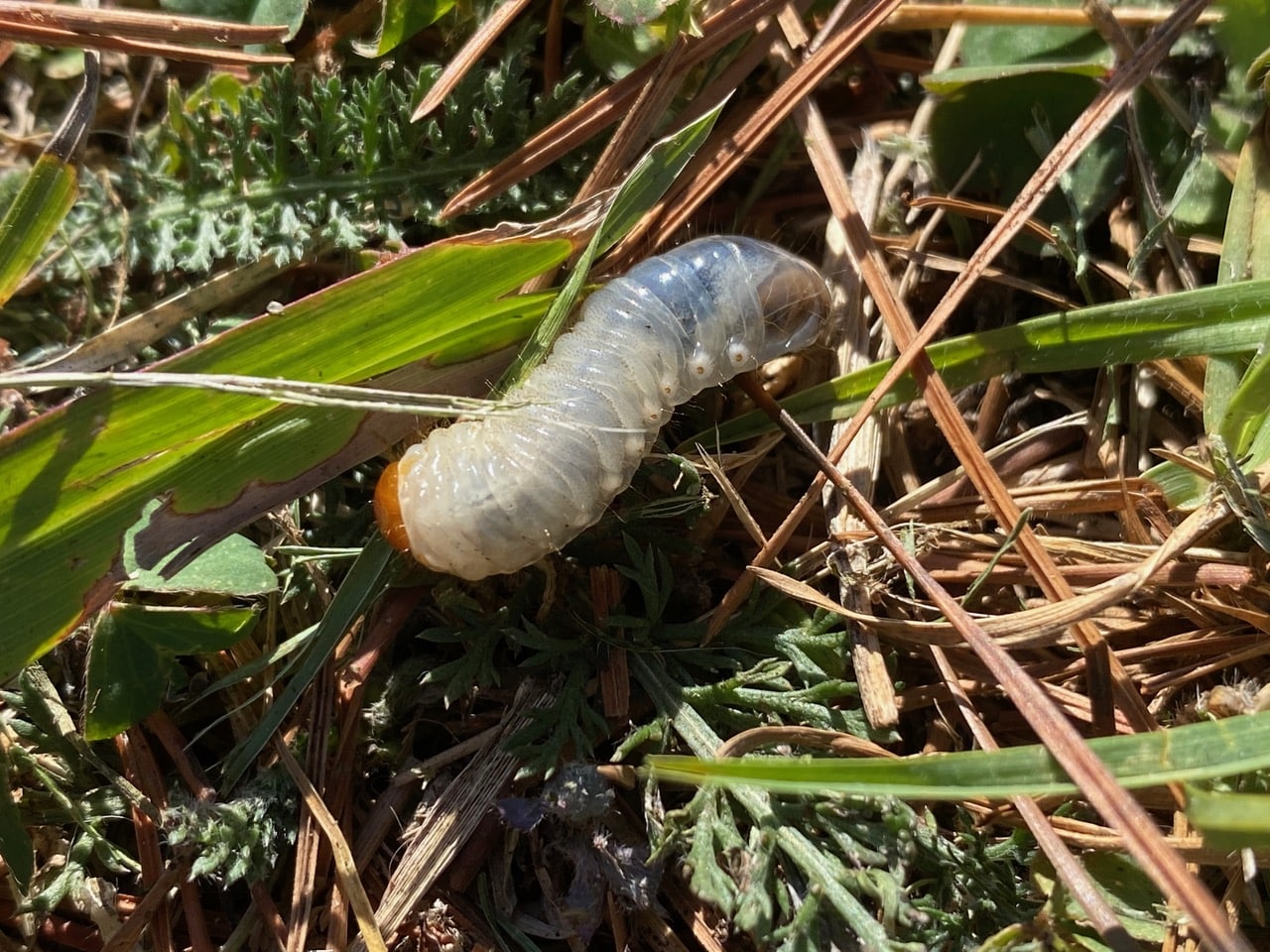
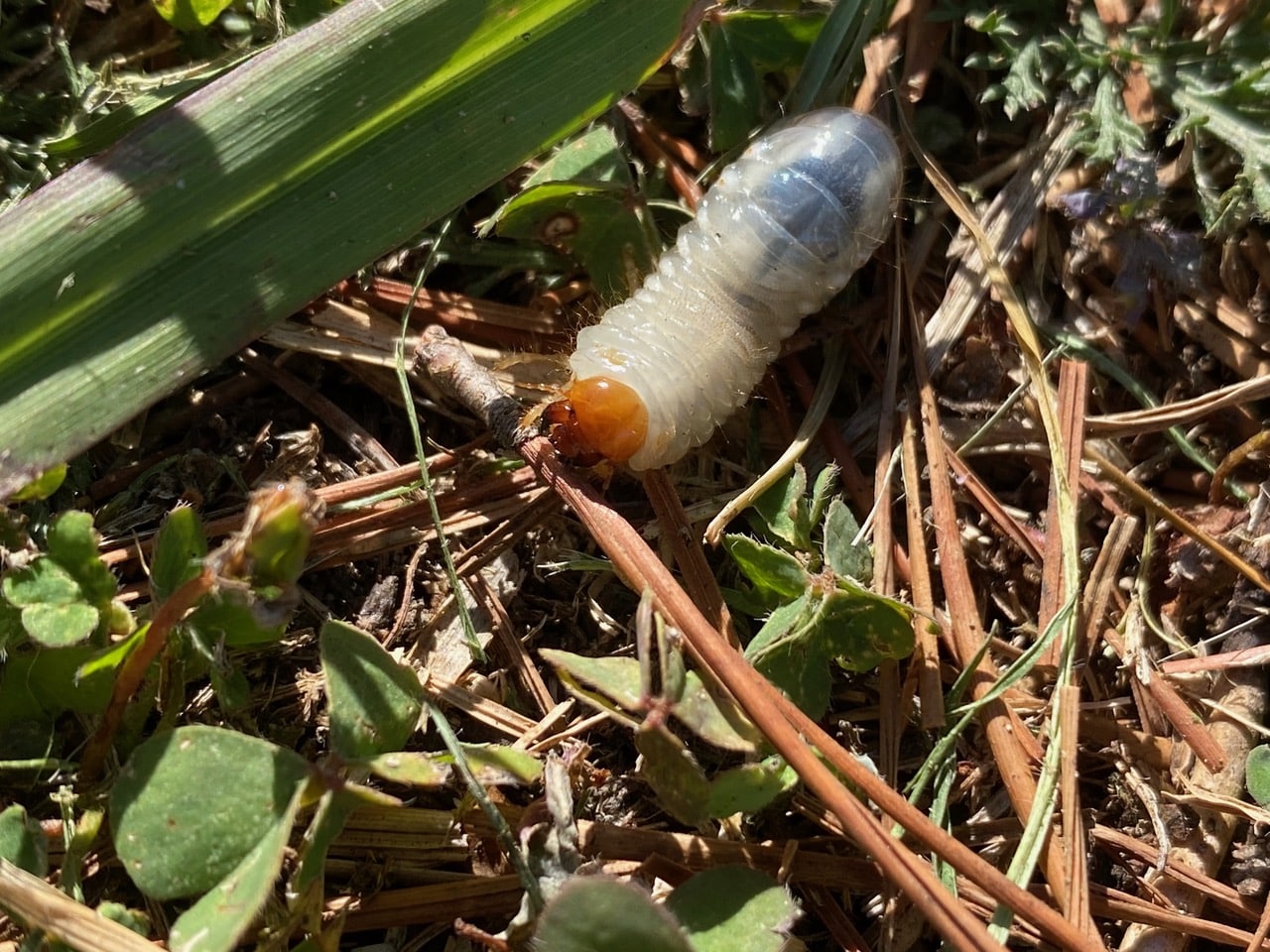
As I walk on the newly mowed grass at the park, I encounter this huge White Grub crawling on the lawn. It is the largest beetle larva I have ever seen, almost 2 inches long. Its skin is very translucent, especially the rear end where some of its internal organs are visible.
When I try to push away the pine needles for a better view, the grub immediately curls up into a C-shape and remains still for a while. Now I can see the three pairs of legs behind its chestnut brown head.
White Grubs are often found in compost piles, lawns, or garden beds. These white, C-chaped critters can be 1/4 inch long or 2 inches long, depending on the species. White Grubs are the larvae of some Scarab beetles (family Scarabaeidae). There are three species that feed on the roots of grasses, making them a potential pest to lawns when in high numbers.
One of the largest species of White Grubs one might find in California are of the Figeater Beetles, Cotinis mutabilis. The adult beetles are commonly called flower chafers since many of them feed on pollen, nectar, or petals. Its habitat is primarily the southwestern United States (including California) and Mexico. The beetles are attracted to ripening and fermenting fruits which emit gases that lead the beetles to them, and to fruits that other animals or insects have already damaged. After mating, eggs are laid in decaying matter or compost piles, which provide sustenance for the emerging larvae. These can grow to 2 in. and are thick and white with a dark head. At rest, they curl into a firm C shape. The larvae feed on the roots of grasses and other plants. When infestations of grass-feeding white grubs occur, the lawn may feel soft and spongy, easily rolled back like carpet. Raccoons and moles often dig in the garden looking to snack on these hefty grubs.
Look at those holes (spiracles) along the side of the grub – they are huge and clearly visible!
Spiracles are respiratory openings found on the thorax and abdomen of insects. The spiracles are connected to trachea – tubes within the insect’s body. Air enters the trachea via the spiracles and the oxygen then diffuses into the insect’s body.
Those are impressive chompers!