

Pollinator Post 10/11/24
It’s time to pay a visit to the East Bay Regional Parks Botanic Gardens in the Berkeley hills.
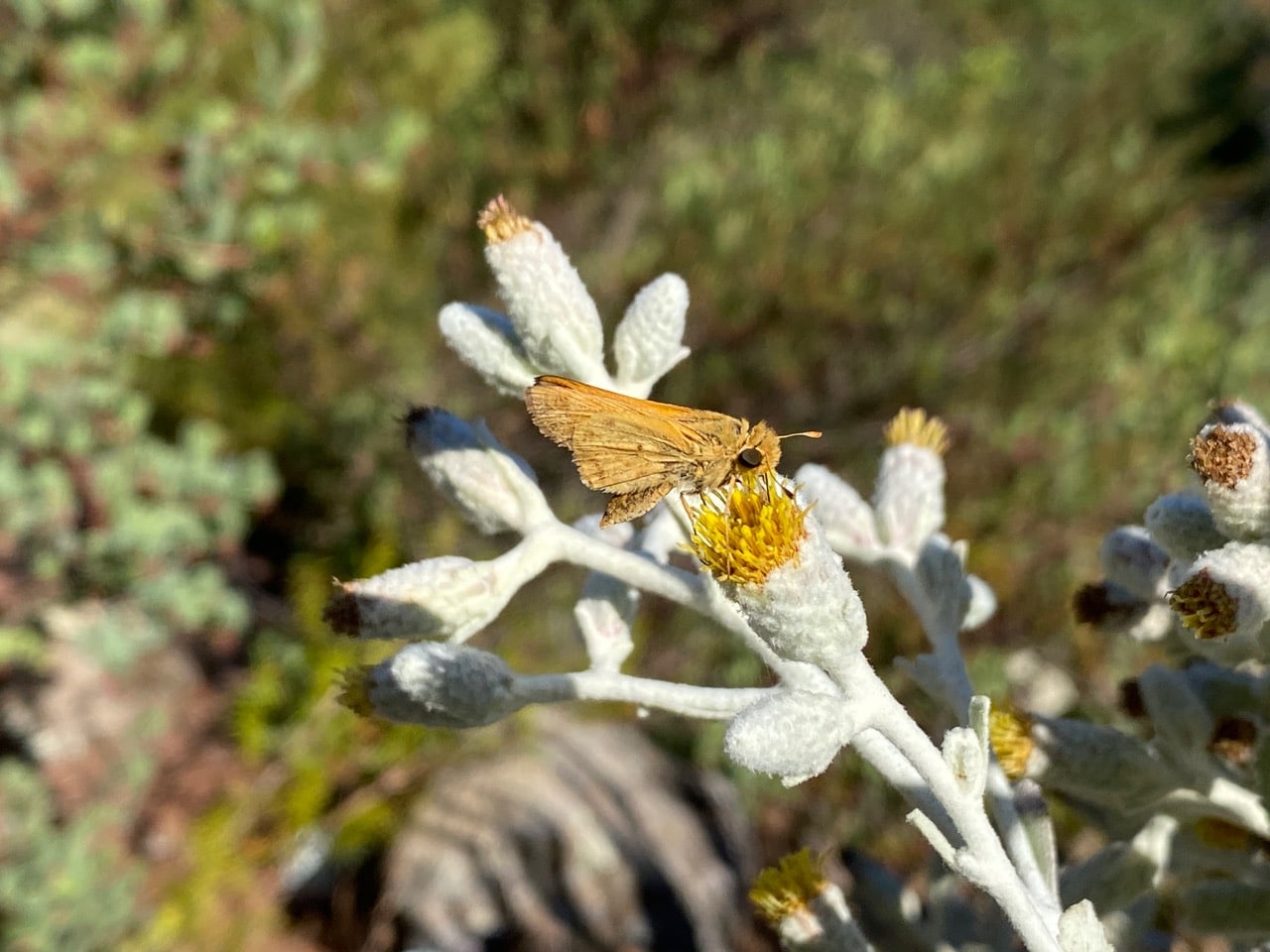
Insect activity has quieted down considerably. A scruffy Skipper butterfly (family Hesperiidae) is taking nectar from one of the last remaining fresh flowerheads of Island Hazardia, Hazardia detonsa.
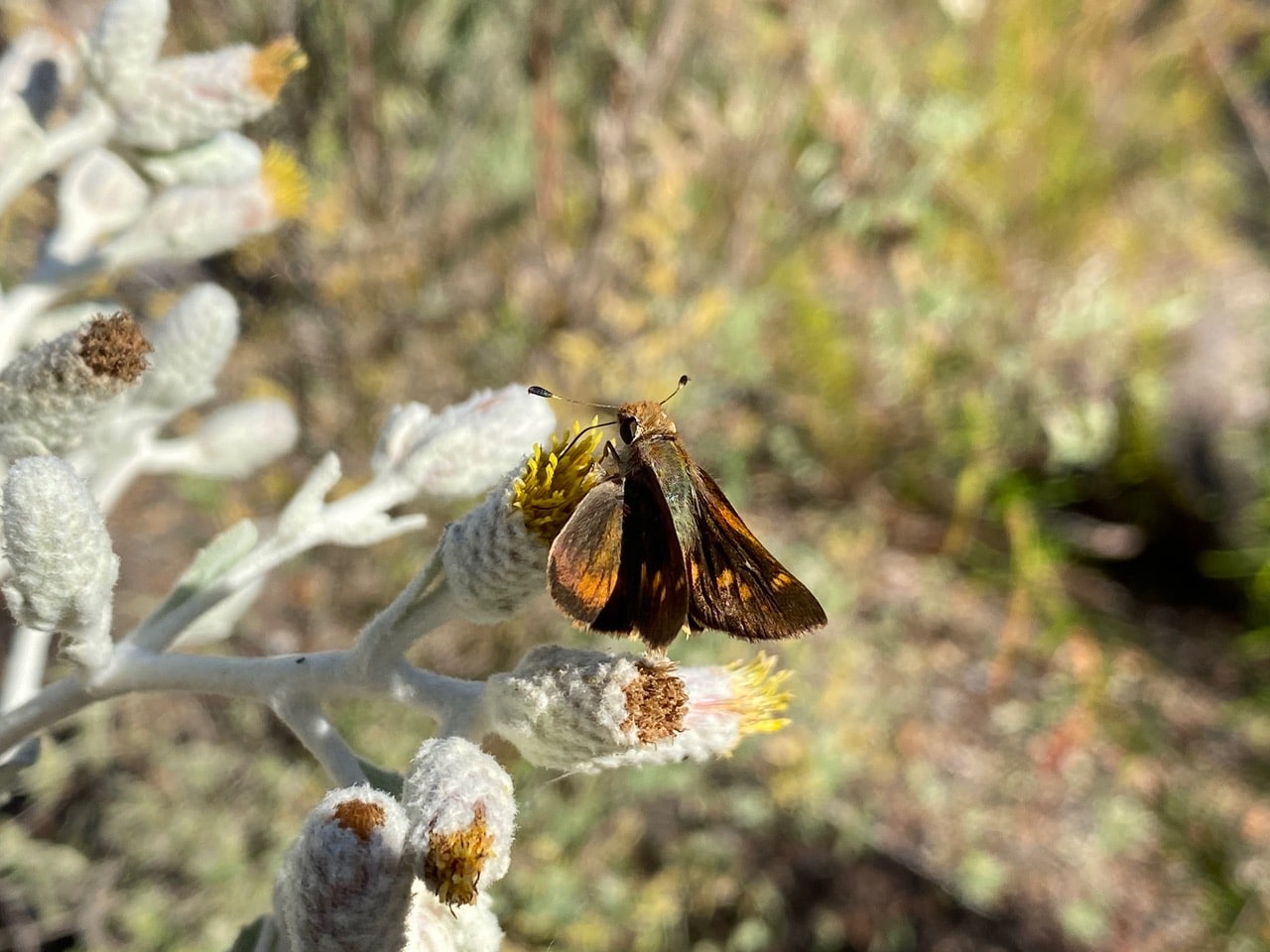
This Skipper is recognizable as the Umber Skipper, Lon melane (family Hesperiidae).
Skippers are a family, the Hesperiidae, of the order Lepidoptera (butterflies and moths). They are named for their quick, darting flight habits. Most have the antenna clubs hooked backwards like a crochet hook. They also have generally stockier bodies and larger compound eyes than the other butterflies. Their wings are usually small in proportion to their bodies. When at rest, skippers keep their wings usually angled upwards or spread out, and only rarely fold them up completely. Californian species are mostly brown or tan, with black, orange, or yellow markings.
Skipper caterpillars are usually green or brown, sometimes yellowish, never brightly colored. They have a distinctive “collar”, a narrow ring around the body right behind the head. Caterpillars are camouflaged and often hide during the day. Many species make nests of leaves and silk for additional protection. Most North American species feed on grasses, but some common species eat shrubs and trees, especially in the bean family. Most species are limited to a single group of food plants. Adult skippers are only active during the day, but Skipper caterpillars feed mainly when it is dark or partly light.
The Umber Skipper, Lon melane, is found in California west of the Sierra Nevada divide. The habitat consists of desert foothills, grassy areas, stream sides, roadsides, gardens, parks and open woodland. There are two generations per year with adults on wing from March to May, and again from September to October. The adults feed on flower nectar from a wide range of plants. The larvae feed on the leaves of various grasses. They live in shelters made of rolled or tied leaves.
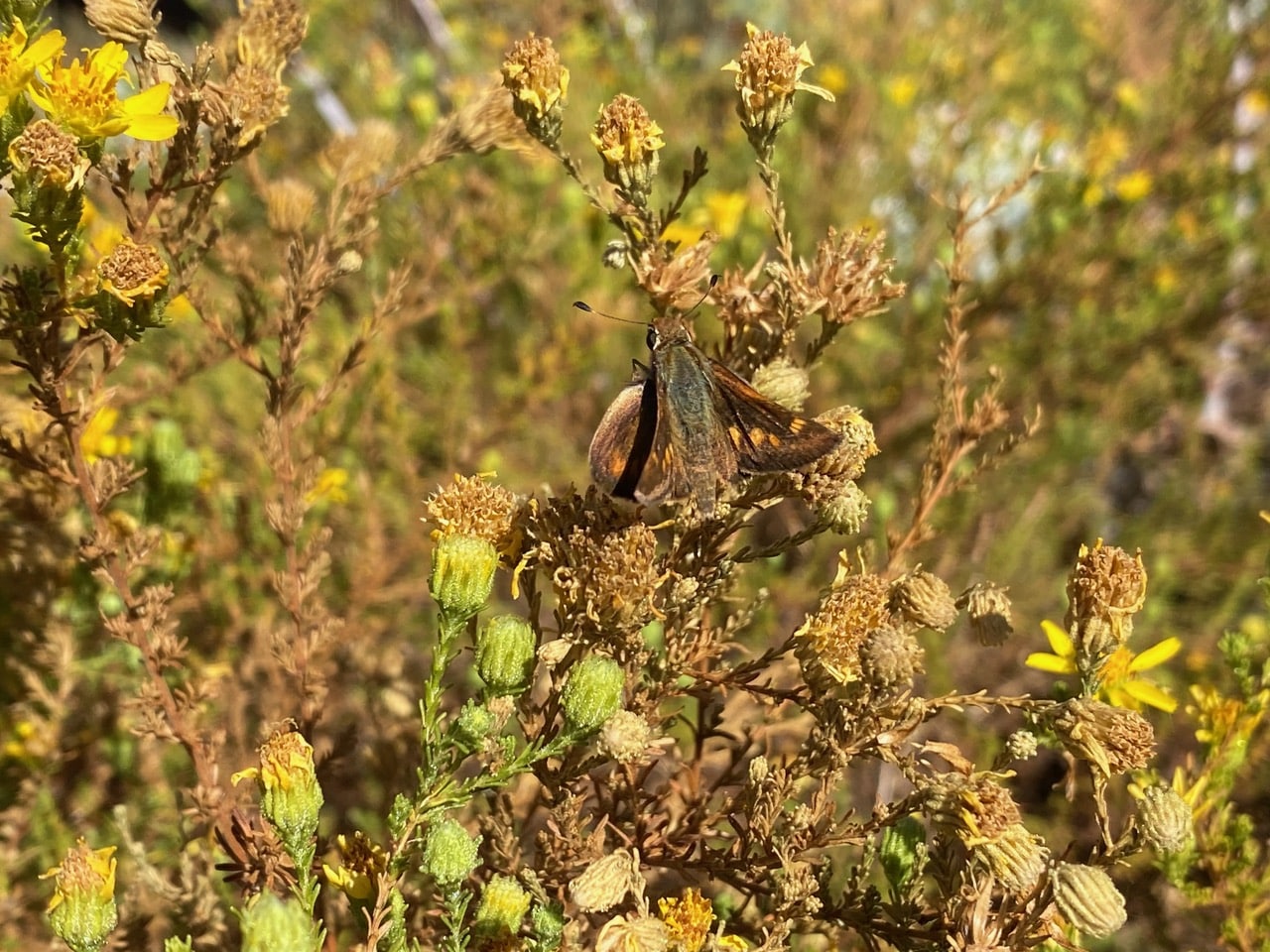
The brown-and-orange Skippers are particularly well camouflaged against the wilted flowerheads of the Tarplant, Deinandra sp.
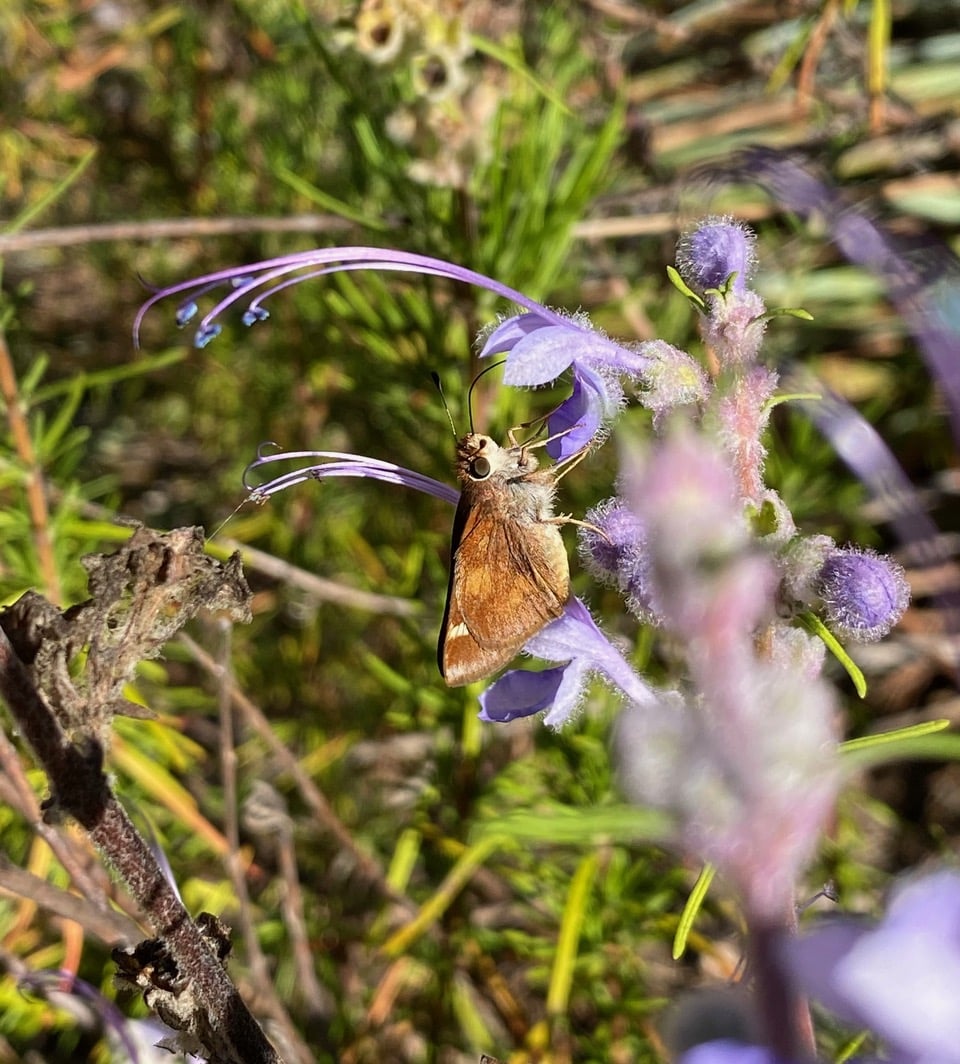
An Umber Skipper, Lon melane (family Hesperiidae) is taking nectar from a flower of Woolly Bluecurls, Trichostema lanatum. The reproductive structures of this flower protrudes way beyond the corolla – even a nectaring butterfly is not likely to make contact with them. These flowers are probably pollinated by the hummingbirds which frequently visit the flowers for nectar. Another likely pollinator is the long-tongued hawk moths (family Sphingidae) that hover in front of flowers while taking nectar.
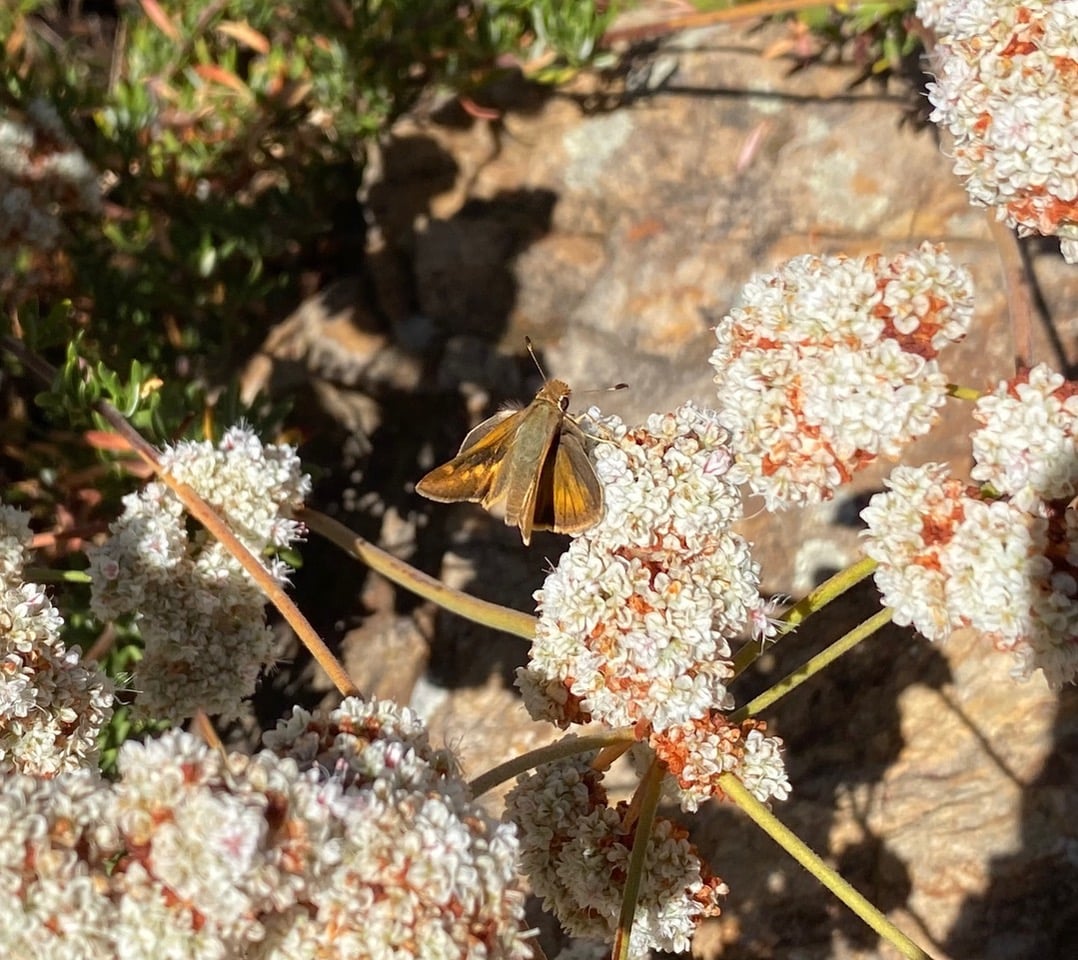
Umber Skippers everywhere! This one is on the fading California Buckwheat, Eriogonum fasciculatum. When I visited the garden in late August, the plant was in peak bloom, abuzz with insect activity. The tiny Masked Bees, Hylaeus sp. (family Colletidae) were swarming over the inflorescences like midges. Not a single one of those bees is here today.
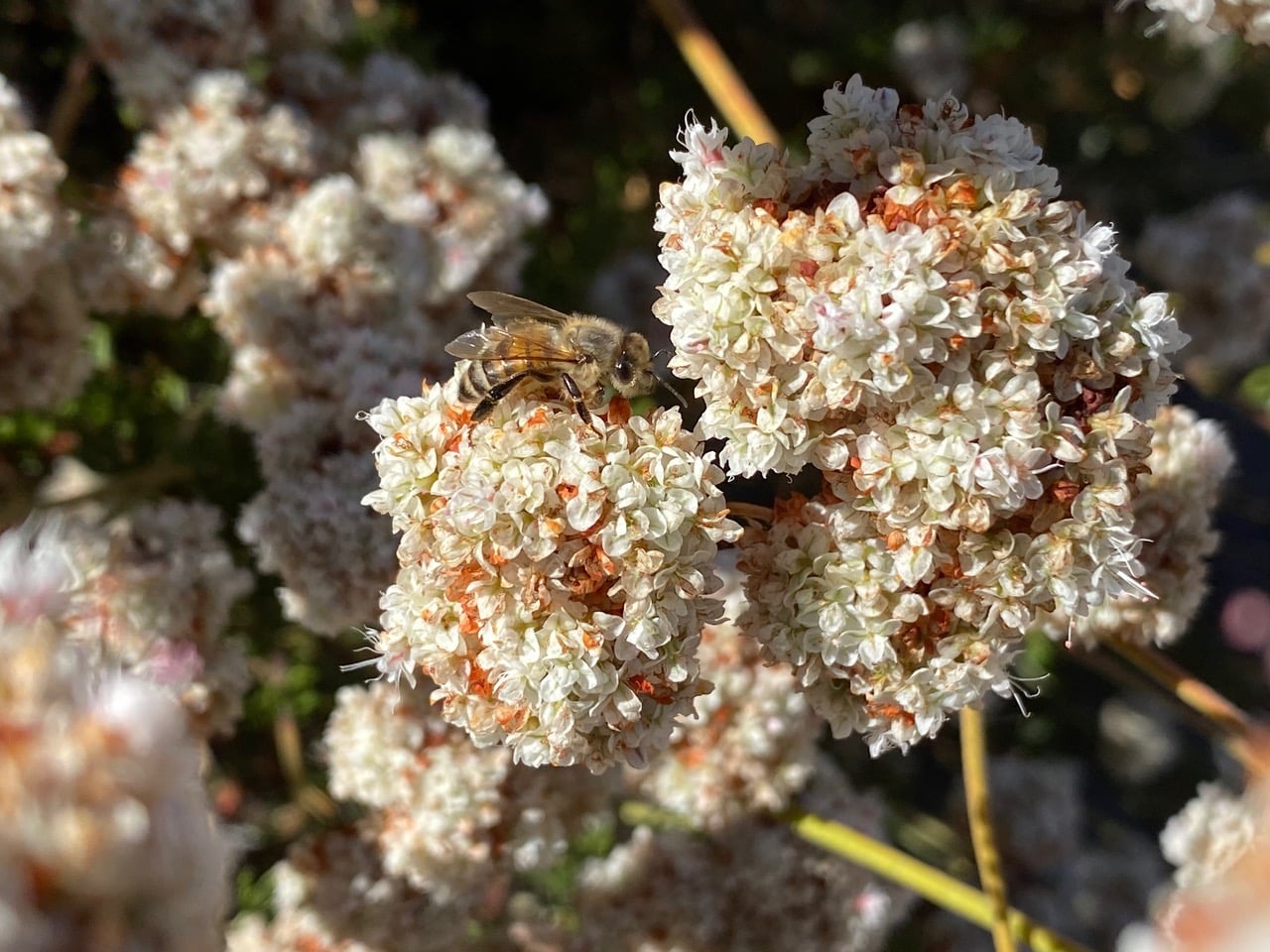
The only insects visiting the tired flowers now are a few flies and the Honey Bees, Apis mellifera (family Apidae).
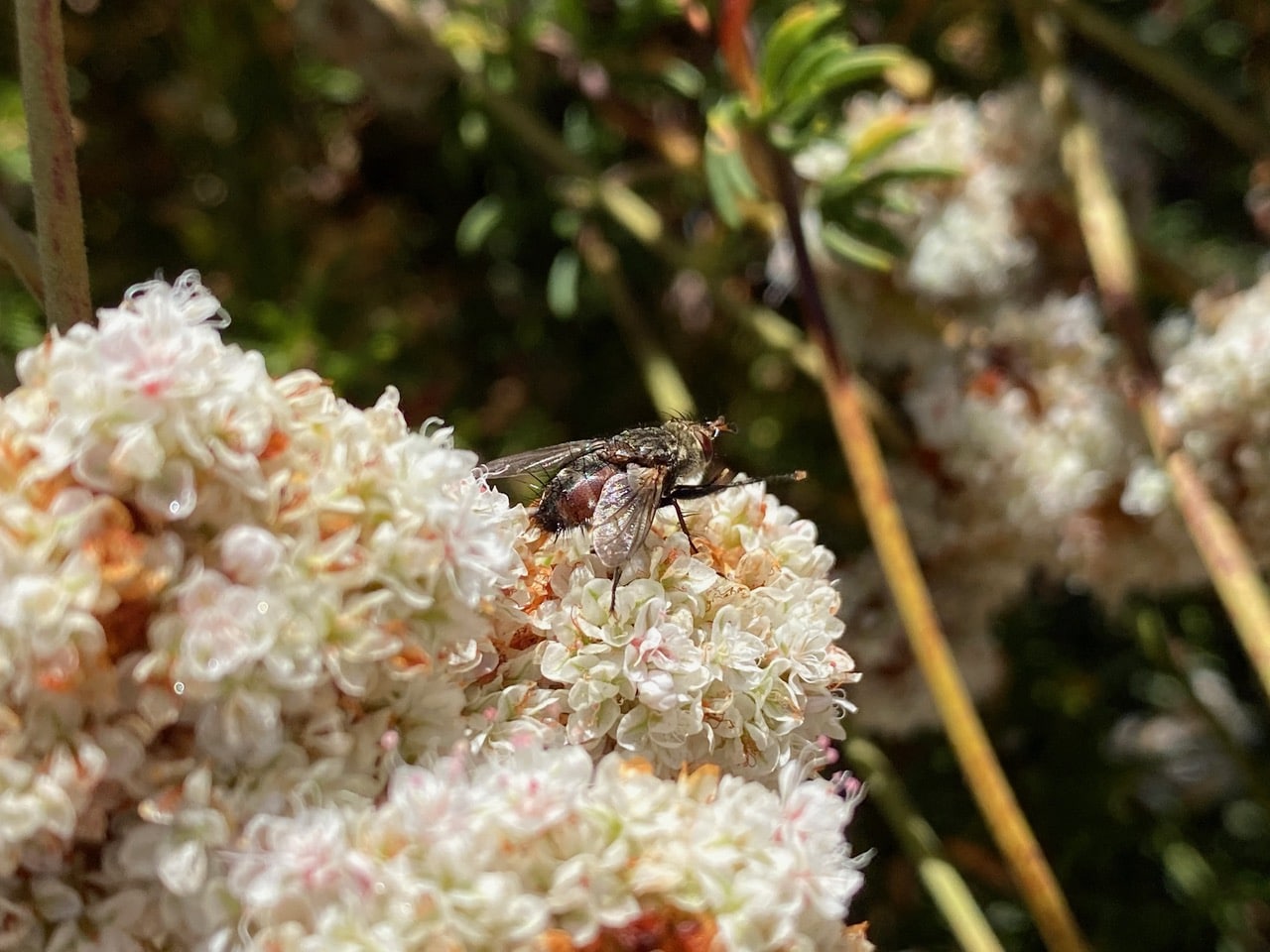
Hey, there’s an interesting insect over there! It is a Bristle Fly (family Tachinidae) grooming itself.
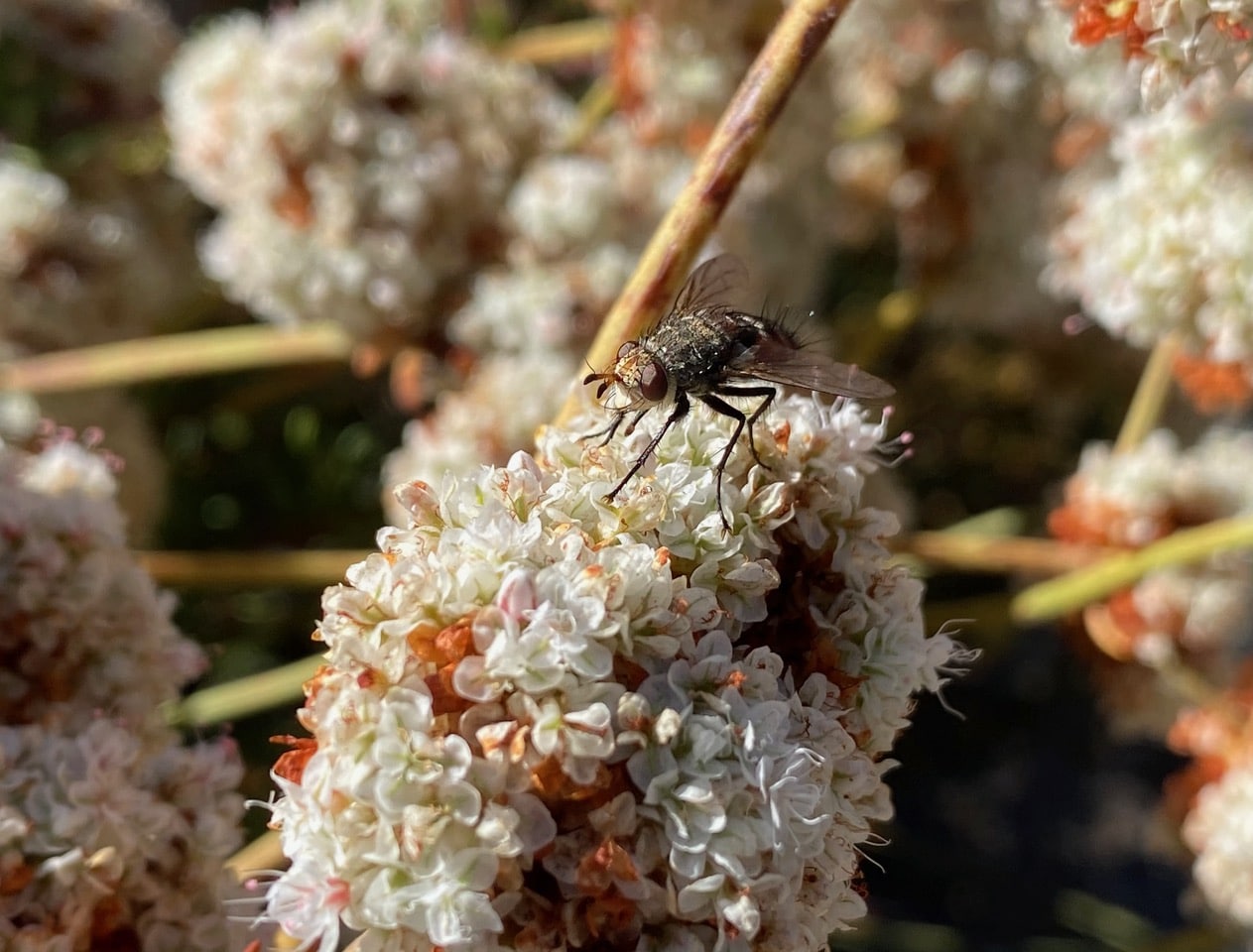
The family Tachinidae is by far the largest and most important group of parasitoid flies. All species are parasitic in the larval stage. Most adults have distinct abdominal bristles, hence the common name. Adults feed on liquids such as nectar and honeydew. They can be found resting on foliage, feeding at flowers or searching for hosts.
Most tachinids attack caterpillars, adult and larval beetles, true bugs, grasshoppers, and other insects. Females lay eggs in or on the host. Tachinid larvae live as internal parasites, consuming their hosts’ less essential tissues first and not finishing off the vital organs until they are ready to pupate. The larvae leave the host and pupate on the ground. Tachinids are very important in natural control of many pests, and many have been used in biological control programs.
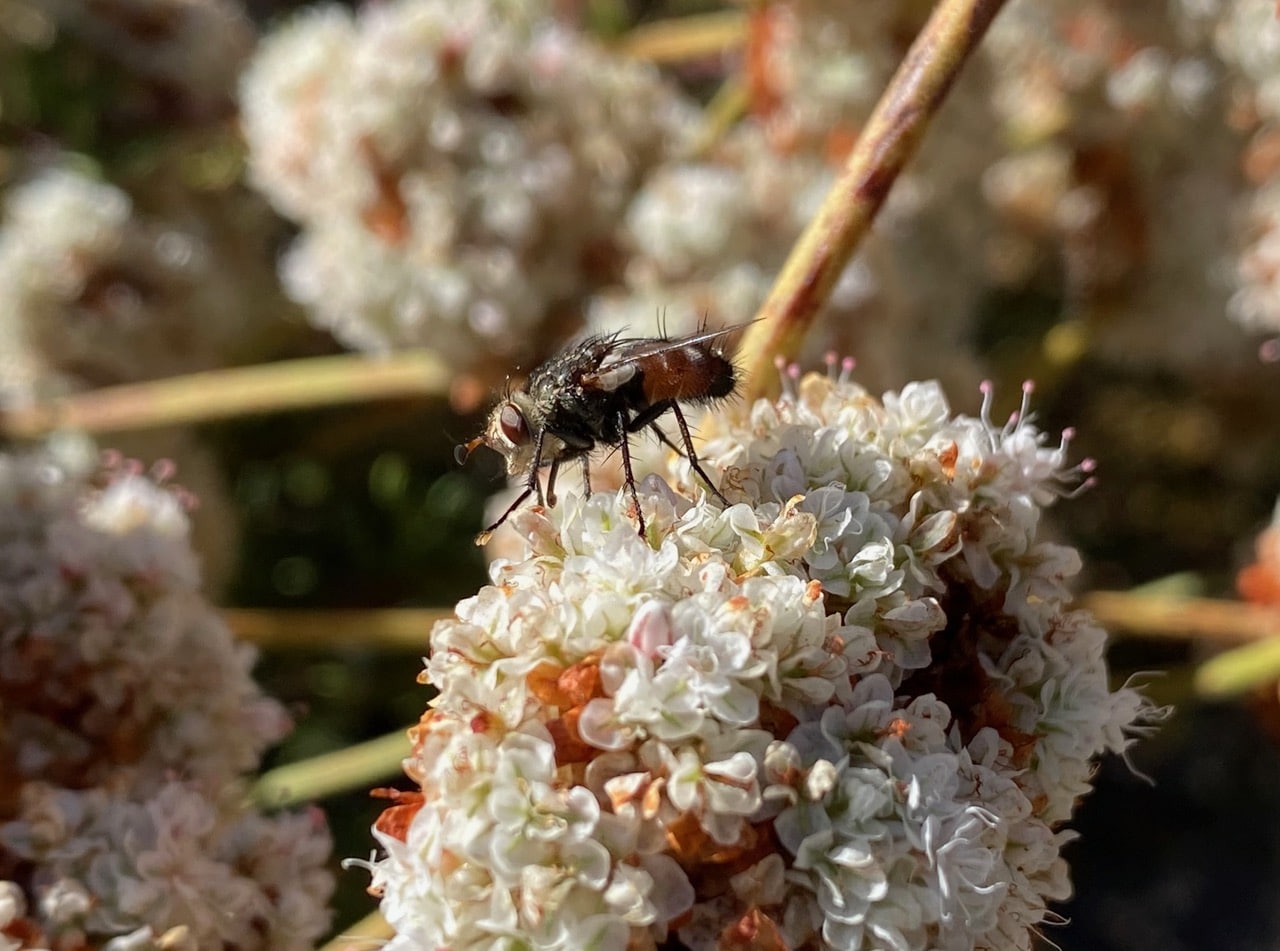
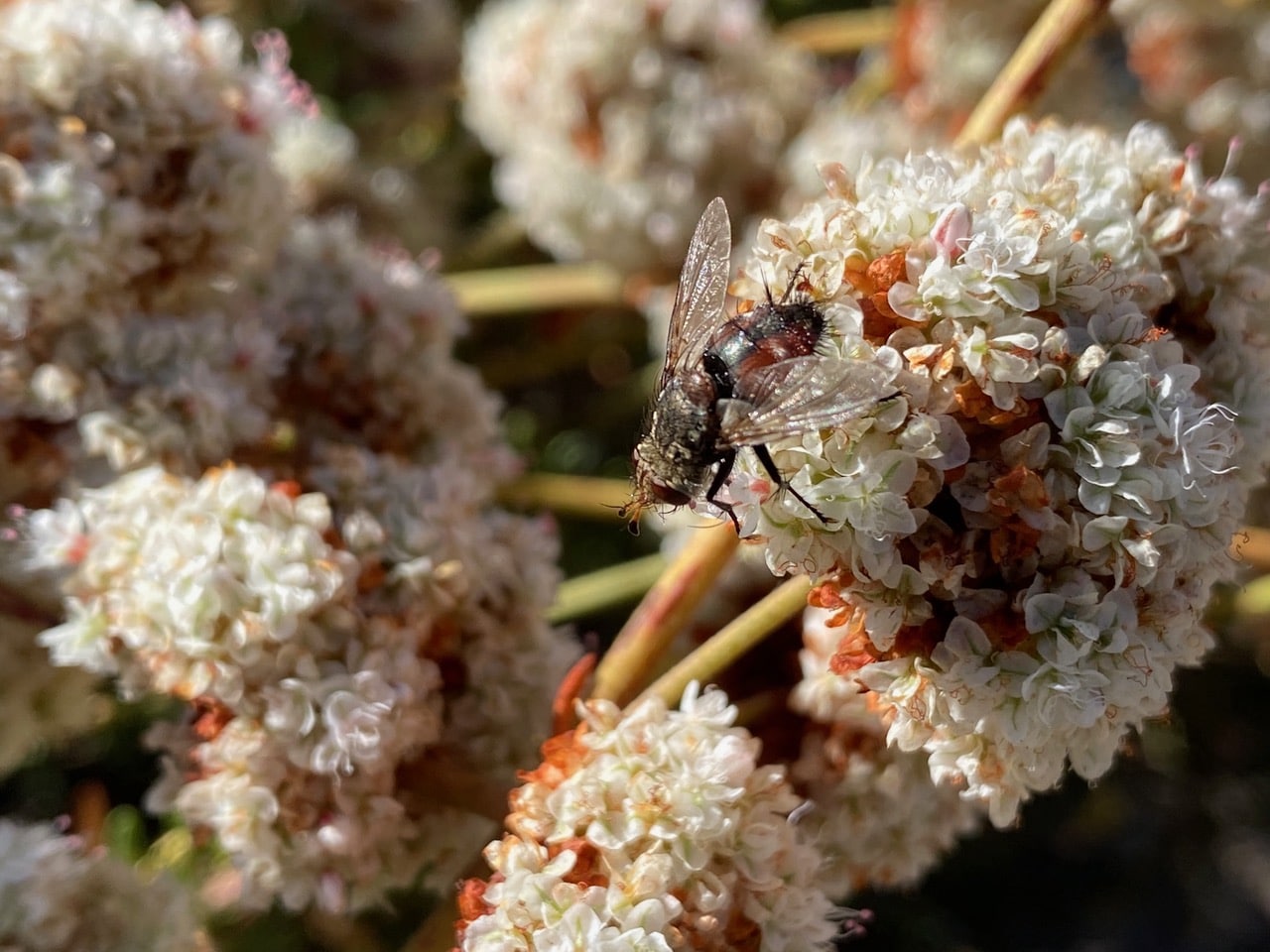
The fly appears to be in the genus Peleteria, but I can’t be sure. There are many similar looking Tachinid flies, distinguishable only by wing venation, facial bristle placement, and other minute details.
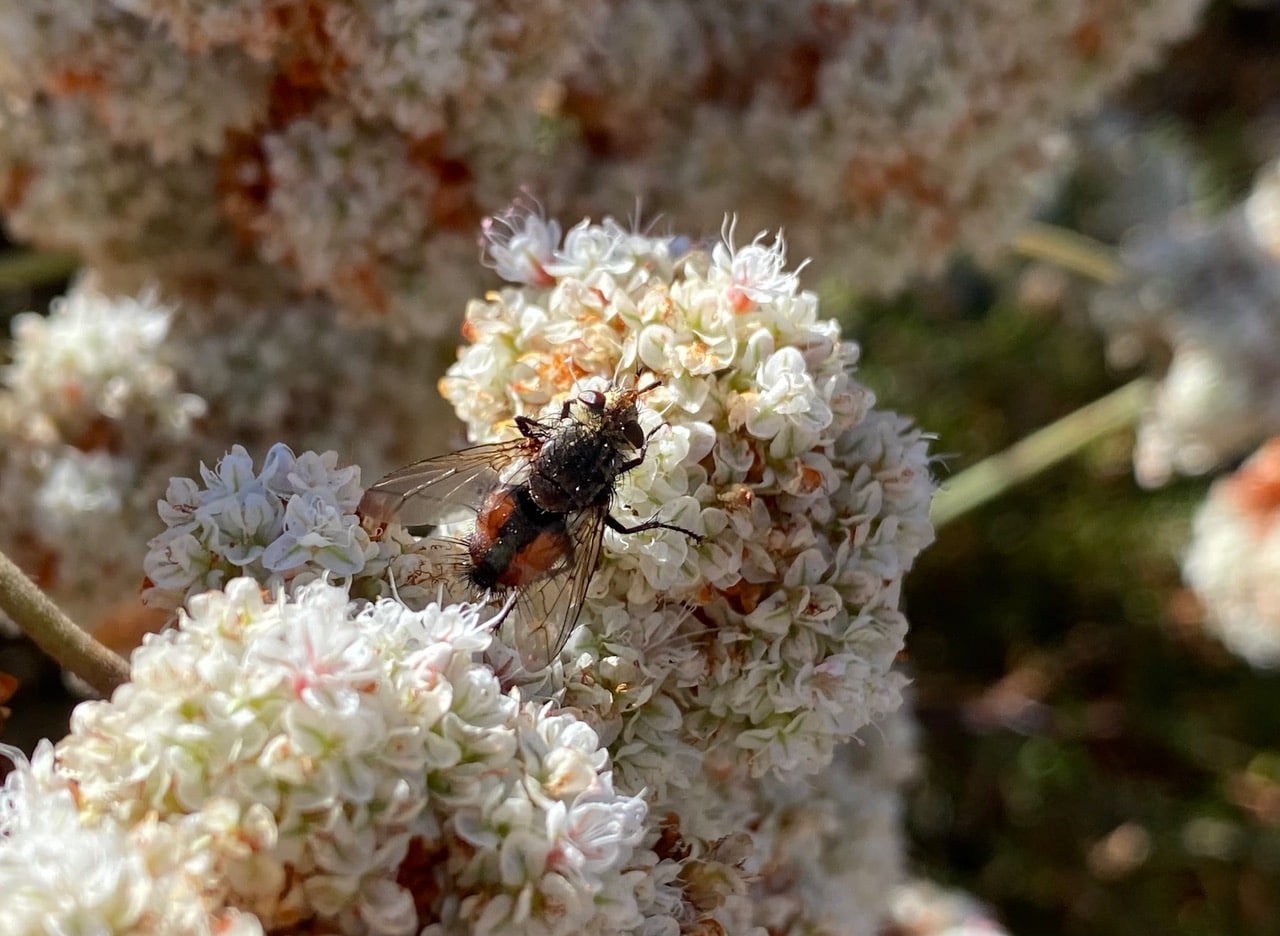
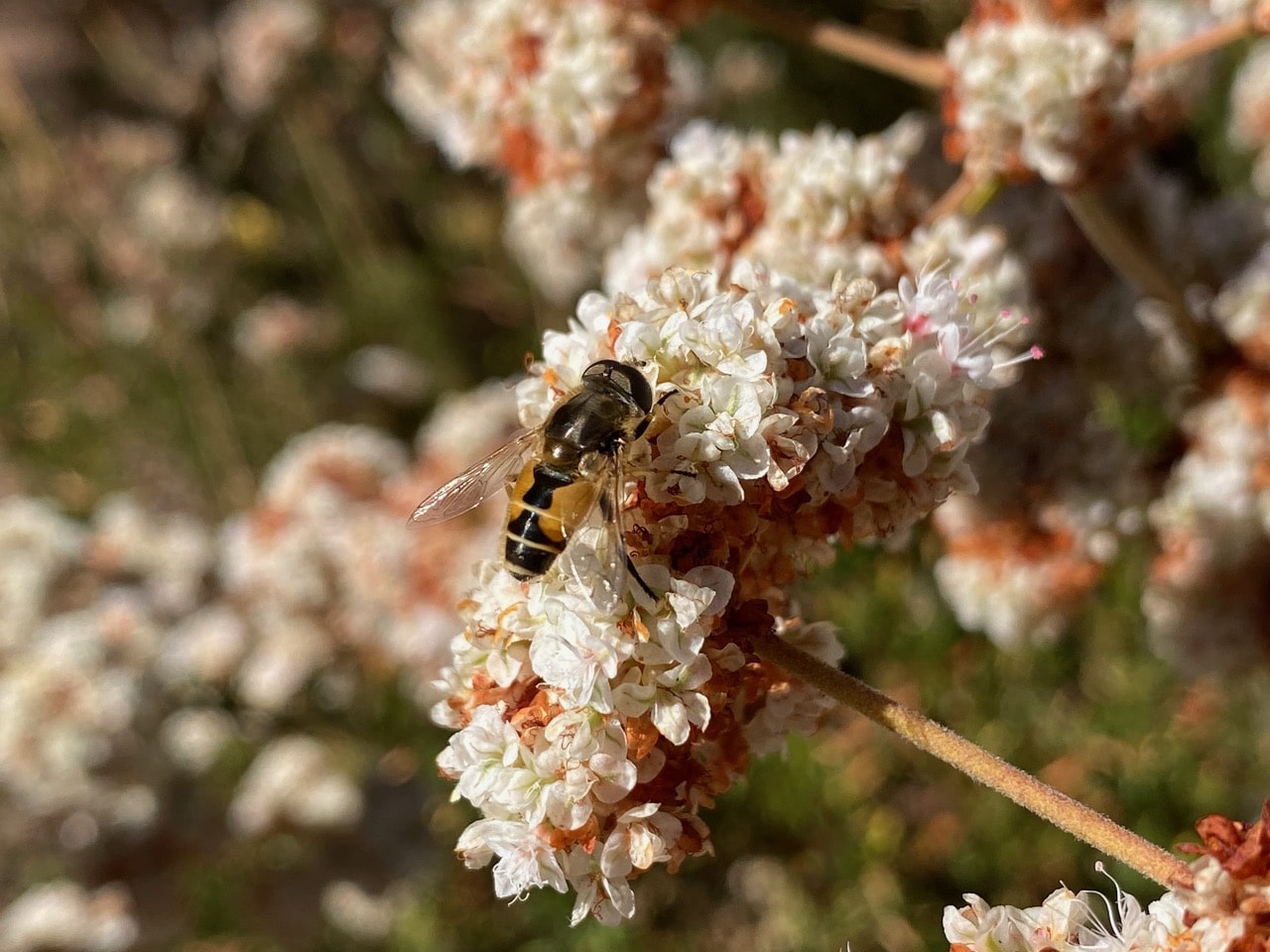
A Eurasian Drone Fly, Eristalis arbustorum (family Syrphidae) visits an inflorescence of California Buckwheat.
The Eurasian Drone Fly, Eristalis arbustorum is an abundant species of hover fly that occurs throughout the northern hemisphere, including Europe, North Africa and North India. It was introduced to North America in the mid 1800’s and is now ubiquitous throughout much of the United States and Canada. The common name “drone fly” refers to its resemblance to the drone of the honeybee. Hoverflies get their names from the ability to remain nearly motionless while in flight. The adults are also known as flower flies as they are commonly found on and around flowers feeding on nectar and pollen. The Eurasian Drone Fly is found in a diversity of habitats, including wetland, forests, montane tundra, as well as farmland, urban parks and gardens. It visits the flowers of a wide range of low-growing plants and shrubs. The larvae are aquatic, occurring in shallow, nutrient rich standing water and in cow manure and compost heaps. Also known as “rat-tailed maggots”, the larvae have a siphon on their rear end that acts like a snorkel, helping them breathe under water. The siphon can be several times the length of the larva’s body. The larvae are saprophagous, feeding on bacteria in stagnant water rich in decomposing organic matter.
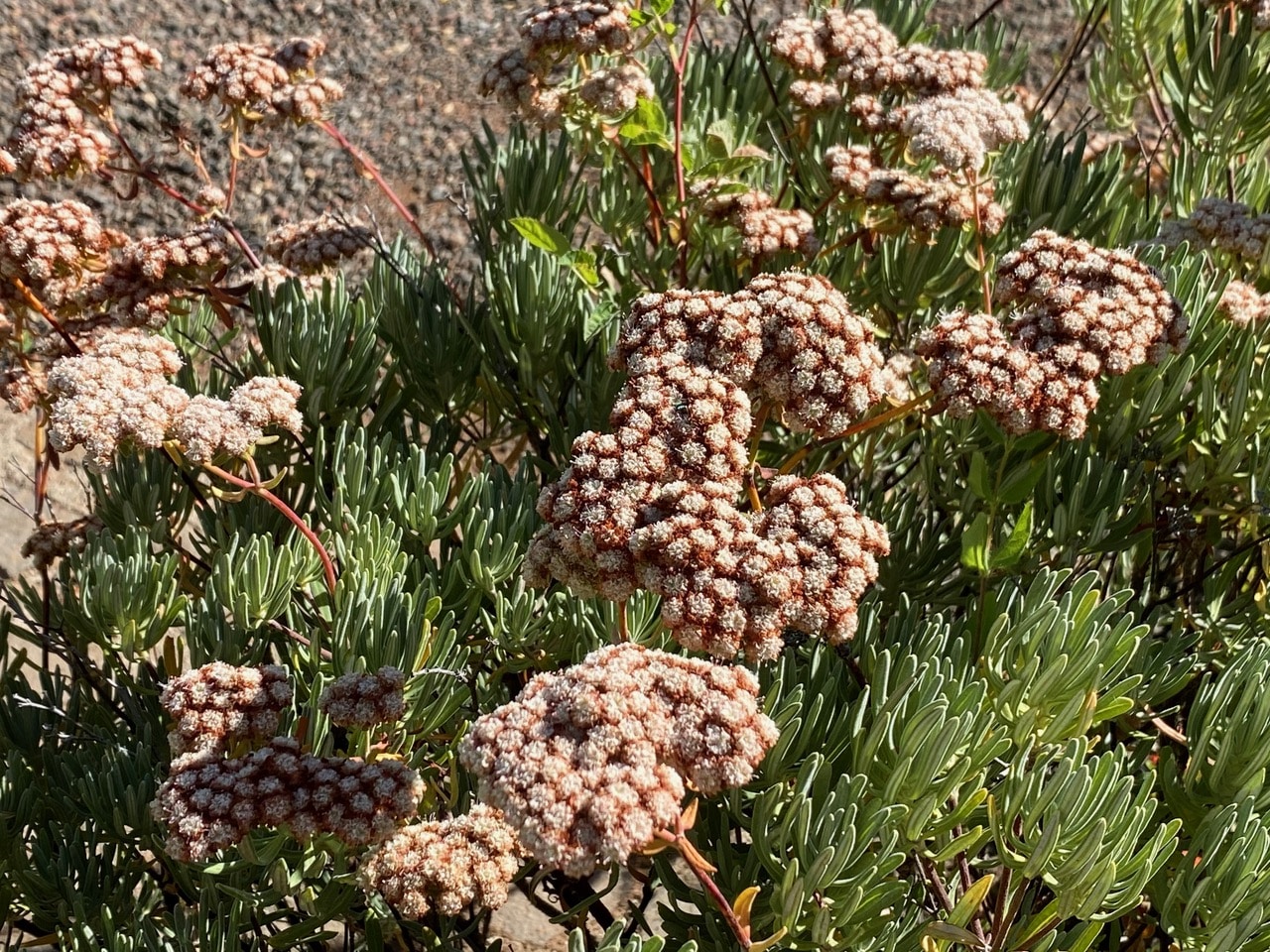
The inflorescences of Santa Cruz Island Buckwheat, Eriogonum arborescens are turning brown. Senescence never looks so beautiful. In fact, I find this stage of the plant’s flowering cycle the most attractive.
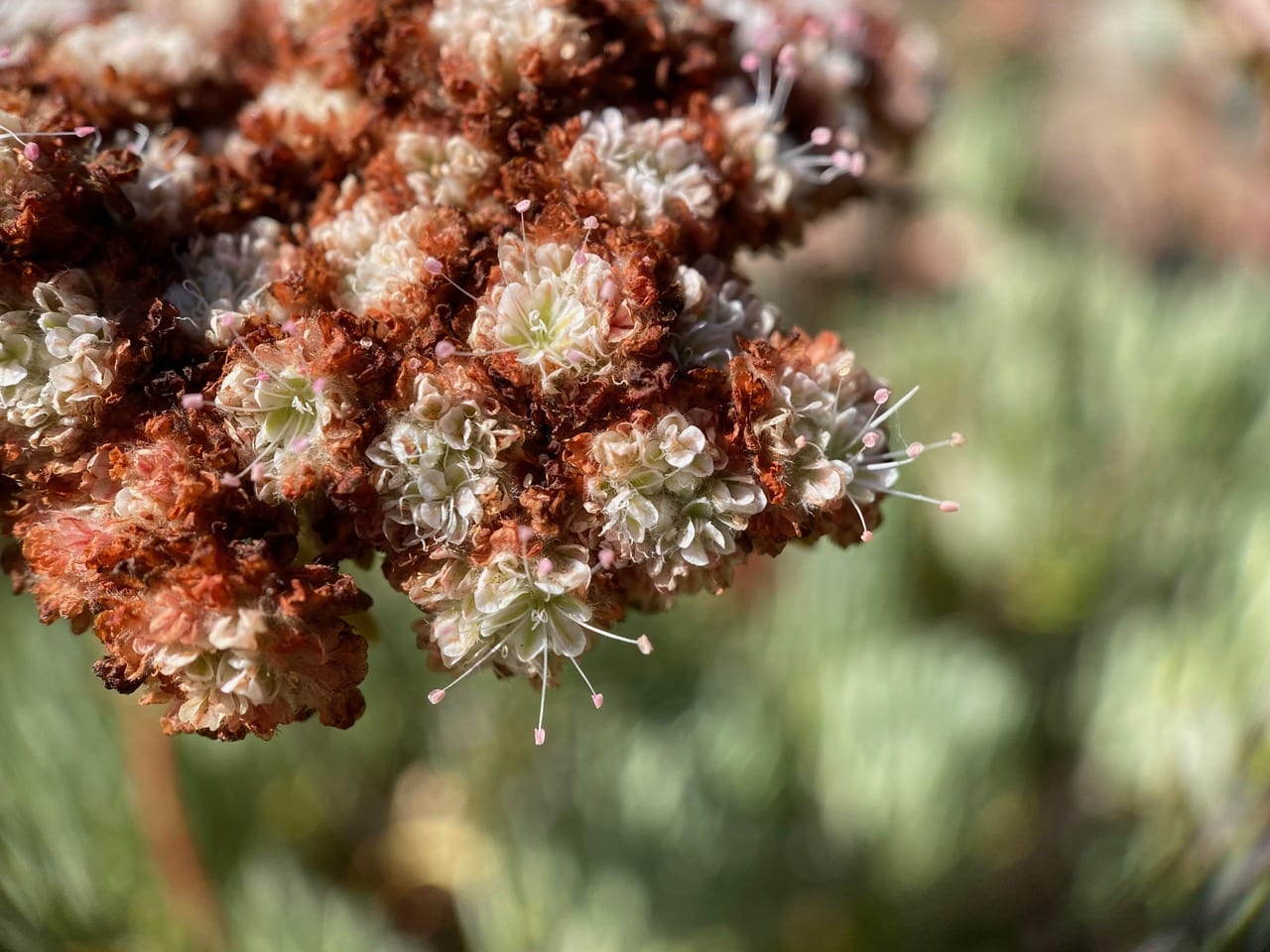
The oldest flowers in each cluster have withered and turned brown, while the fresh flowers in the center remain cream-colored, giving rise to this intriguing mosaic.
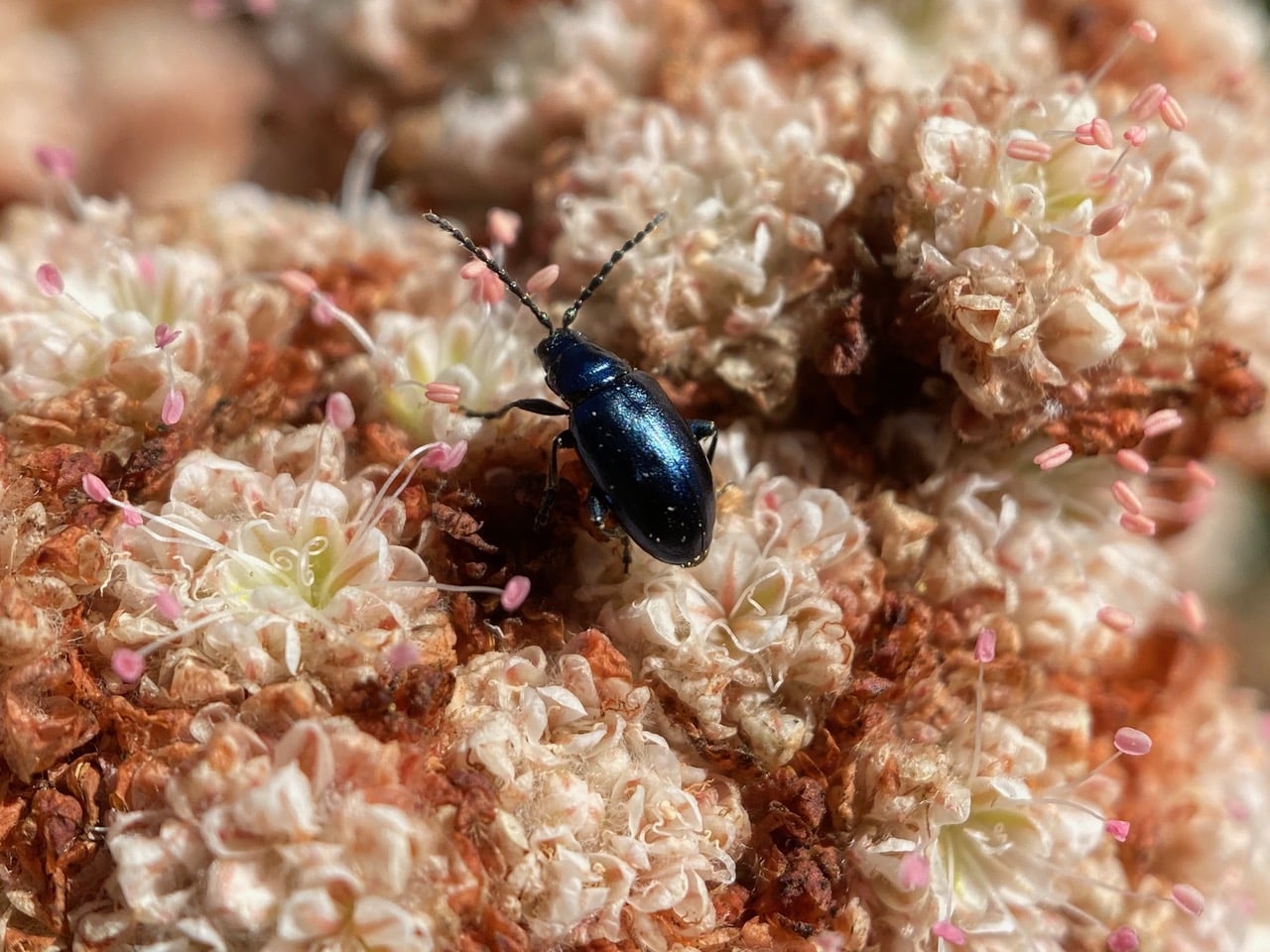
Several highly iridescent blue beetles are on the Santa Cruz Island Buckwheat inflorescences. I recognize them as the Metallic Flea Beetles, Altica sp. (family Chrysomelidae) that I used to find on the Naked Buckwheat, Eriogonm nudum at Skyline Gardens, where heavy infestations have wreaked havoc for the plants.

The Metallic Flea Beetle, Altica sp. is a large genus in the subfamily Galerucinae of the family Chrysomelidae, or Leaf Beetles. They have a worldwide distribution. The name Altica is derived from the Greek word haltikos, meaning good jumpers. The beetles have strong hind legs allowing them to jump long distances like true fleas. The beetles are able to jump away when threatened. Altica flea beetles are 3-9 mm in length, and females are typically larger than males. Most Altica beetles have hard outer wings elytra that are metallic blue to green in color that protect similarly colored metallic bodies that reflect purple and bronze colors and are elongate oval in shape. Antennae have 11 segments and are filiform (threadlike). The species are similar to each other, often distinguished from each other only by the aedeagus (insect version of penis). Both larval and adult Altica are phytophagous, feeding on plant foliage of very specific plant taxa.
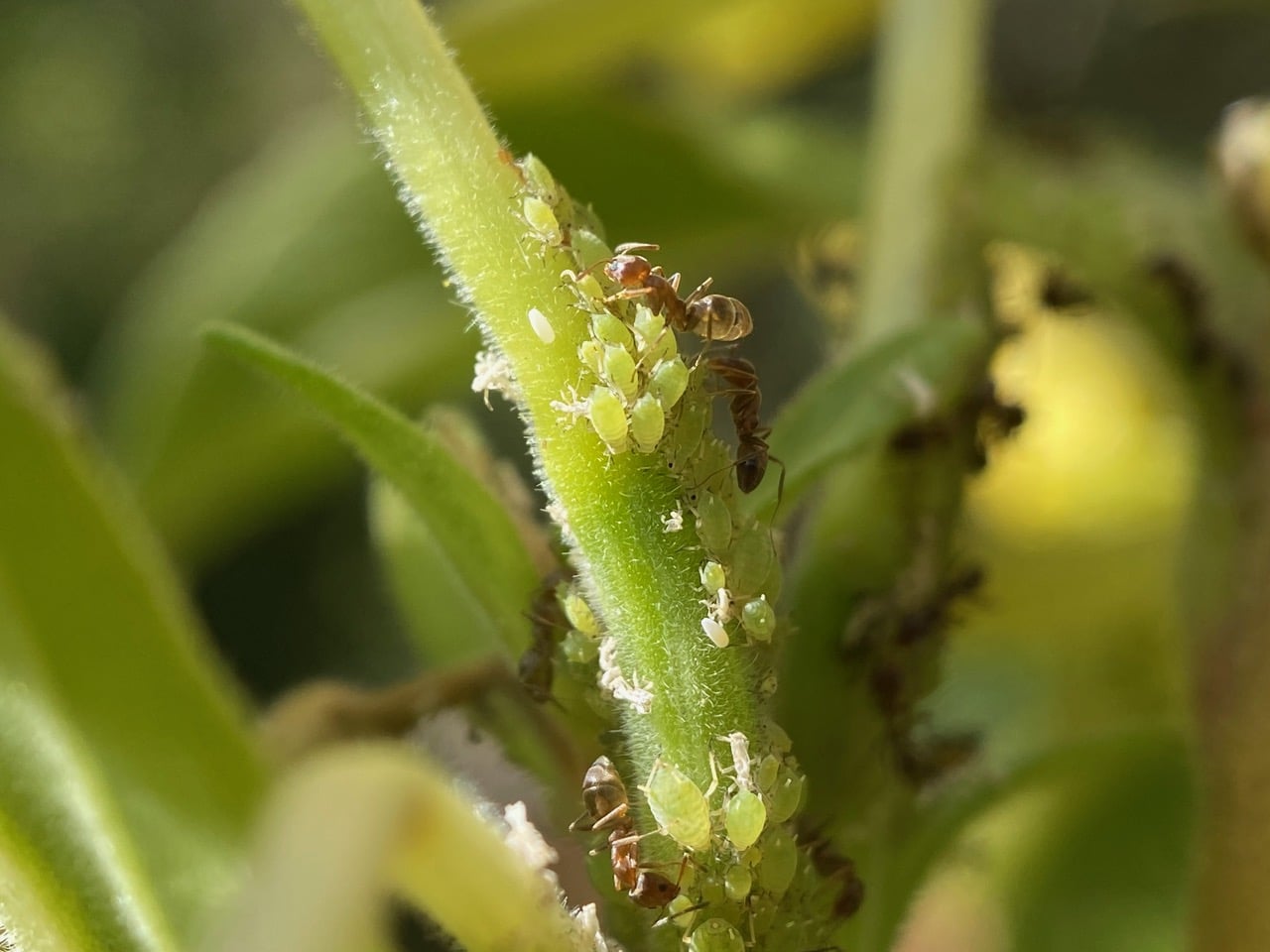 Argentine Ants, Linepithema humile (family Formicidae) are busy tending aphids on a flower stalk of an Evening Primrose, Oenothera sp.
Ants and aphids share a well-known mutualistic relationship. The aphids produce honeydew, a sugary food for the ants; in exchange, the ants care for and protect the aphids from predators and parasites. Some ants will “milk” the aphids to make them excrete the sugary substance. The ants stroke the aphids with their antennae, stimulating them to release the honeydew. Aphid-herding ants make sure the aphids are well-fed and safe. When the host plant is depleted of nutrients, the ants carry their aphids to a new food source. If predatory insects or parasites attempt to harm the aphids, the ants will defend them aggressively. Some species of ants continue to care for aphids during winter. The ants carry the aphids to their nest for the winter months, and transport them to a host plant to feed the following spring.
Wait a minute, do you see the hover fly eggs? To the left of the top ant, there is a white Syrphid egg that resembles a miniature grain of rice. Further down the stem, there is another egg laid among the baby aphids. The larvae of many hover flies (family Syrphidae) feed on aphids. To ensure an abundance of food for their young, female Syrphid flies seek out aphid colonies to lay their eggs among them. I wonder if the ants know to remove the eggs to protect their herd of aphids? It’s a complicated world full of friends and foes.
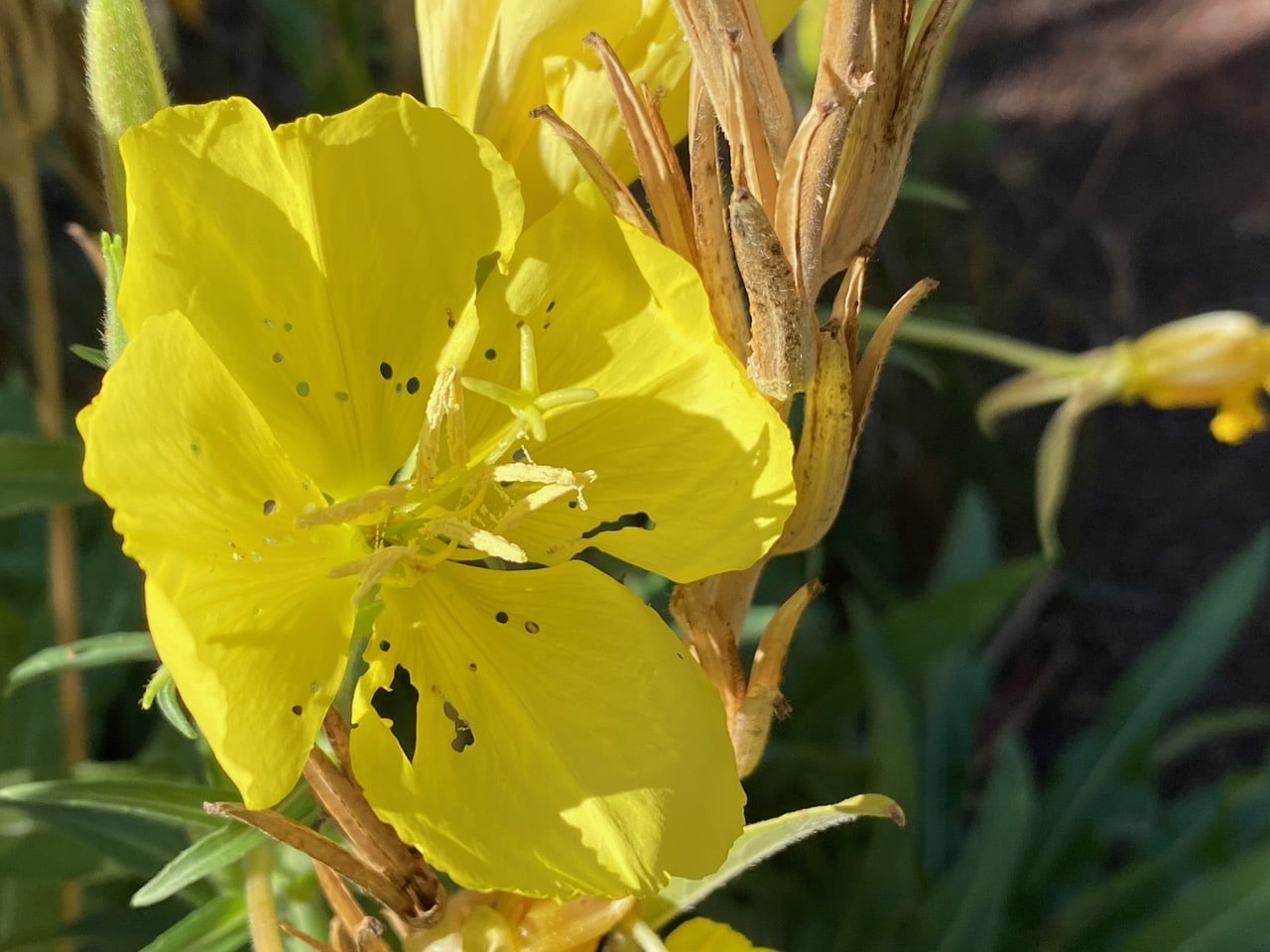
Some of the Evening Primrose flowers are shot through with holes. The aphids can’t be responsible for them. They have piercing-sucking mouthparts, not for chewing.
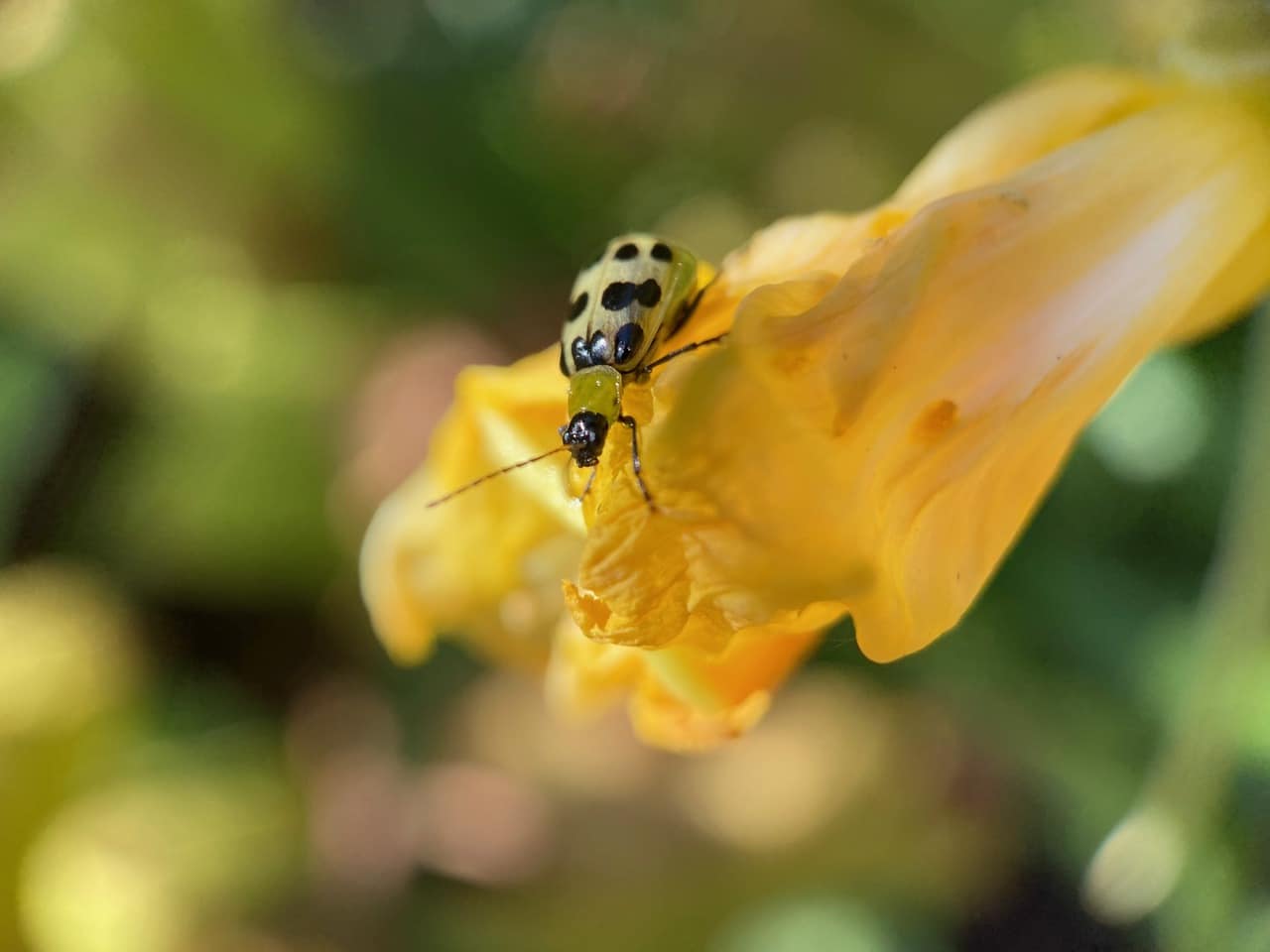
The culprit is most likely this Spotted Cucumber Beetle, Diabrotica undecimpunctata (family Chrysomelidae), seen here on a wilted flower. Beetles have chewing mouthparts.
Members of the family Chrysomelidae are commonly known as Leaf Beetles. Adults and larvae feed on all sorts of plant tissues, and all species are fully phytophagous. Many are serious pests of cultivated plants, including food crops. Others are beneficial due to their use in biocontrol of invasive weeds. Chrysomelids are popular among insect collectors, as many are conspicuously colored, typically in glossy yellow to red or metallic blue-green hues, and some have spectacularly bizarre shapes. Photos of Leaf Beetles (Family Chrysomelidae) · iNaturalist
Native to North America, the Spotted Cucumber Beetle can be a major agricultural pest, causing damage to crops in the larval as well as adult stages of their life cycle. Larvae, sometimes known as rootworms feed on the roots of emerging plants. In the adult stage the beetles cause damage by eating the flowers, leaves, stems and fruits of the plant.
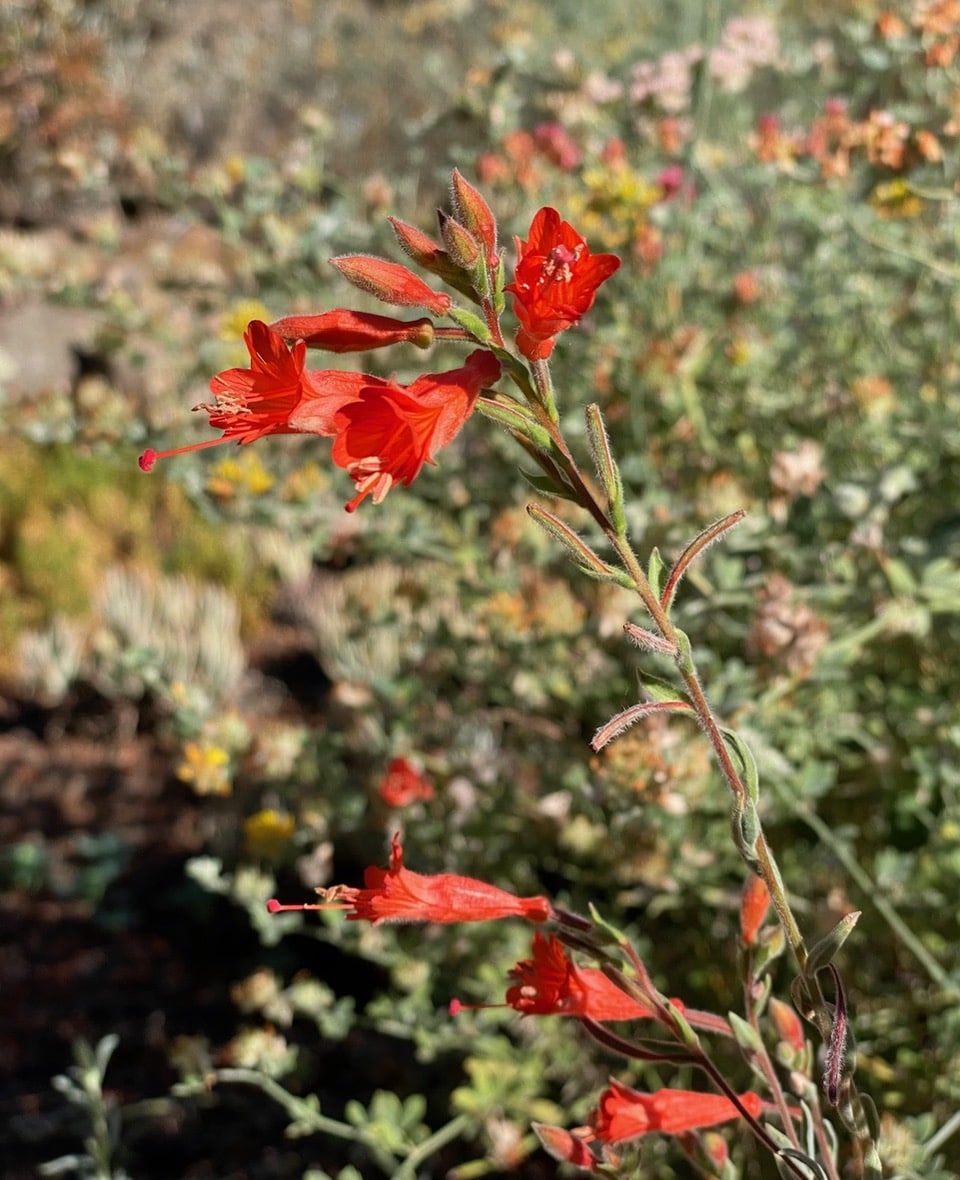
The flowers of the California Fuchsia, Epilobium canum are strictly pollinated by hummingbirds. I hardly ever find insects on the flowers. To prove the point, an Anna’s Hummingbird scolds me with loud chittering noises while I try to photograph the plant.
California Fuchsia and hummingbirds have a mutualistic relationship with each other: Epilobium requires hummers for pollination while its flowers are a main source of summer nectar for the birds. One hardly ever sees an insect visit the California Fuchsia flowers. Bees don’t even see red color well, and few have a long enough tongue to reach the nectar at the end of that long tube. Small bees might enter the corolla to steal nectar without making contact with the reproductive parts. The flower is a classic example of a hummingbird pollinated flower: red, tubular flower with exserted reproductive structures (stamens and pistils) that project beyond the corolla, and generous amounts of nectar. Hummingbirds are attracted to red flowers, and while hovering in front of the flower, they probe for nectar with their beak and tongue. In the process, the bird is likely to come in contact with the stamens, leaving with a dusting of pollen on their bill or body. While visiting the next flower, the pollen might be brushed off on the mature stigma that protrudes the furthest from the corolla. Pollination accomplished!
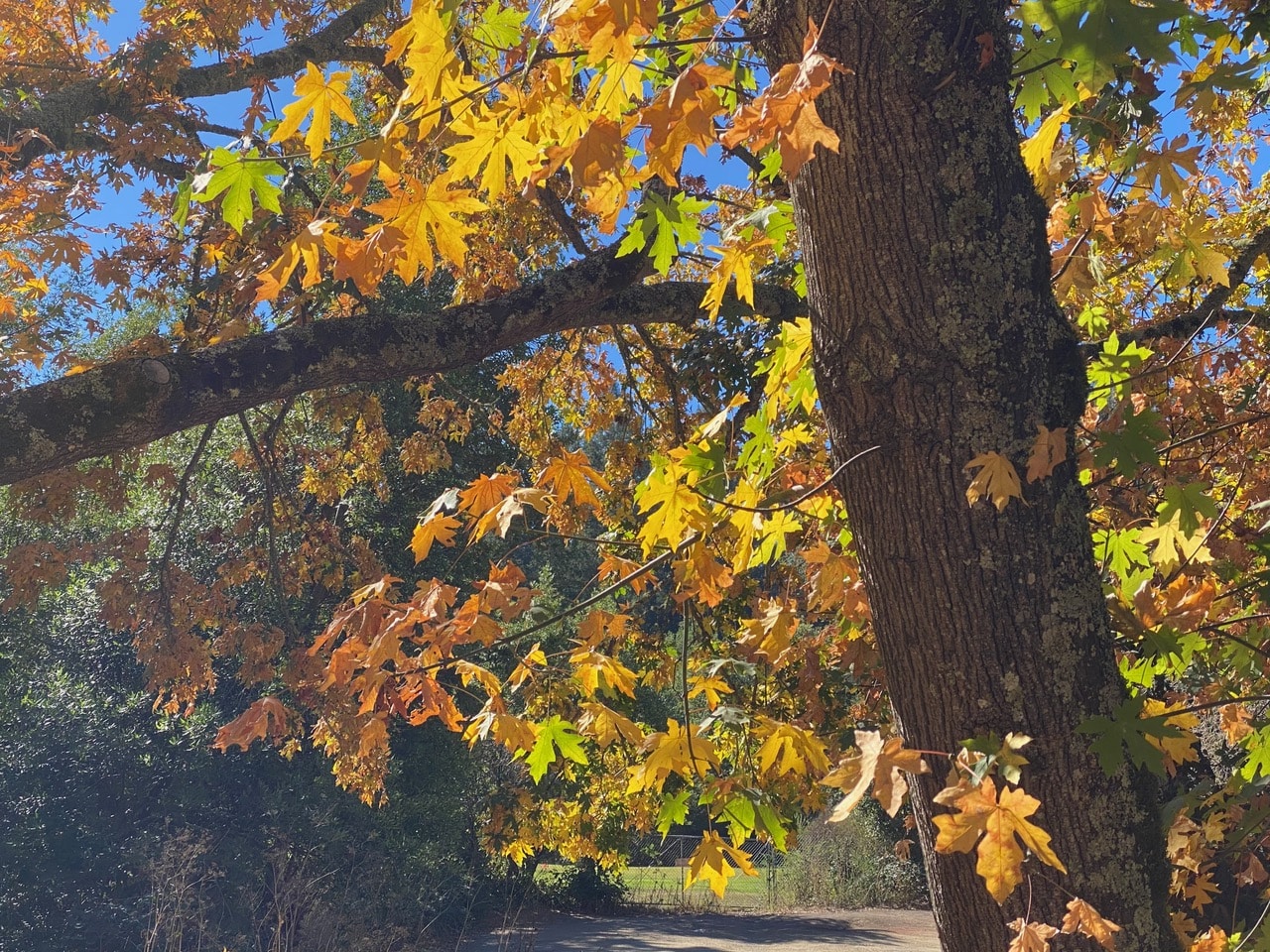
The Bigleaf Maple, Acer macrophyllum in the parking lot is ablaze with autumn colors.