

Pollinator Post 10/15/24 (1)
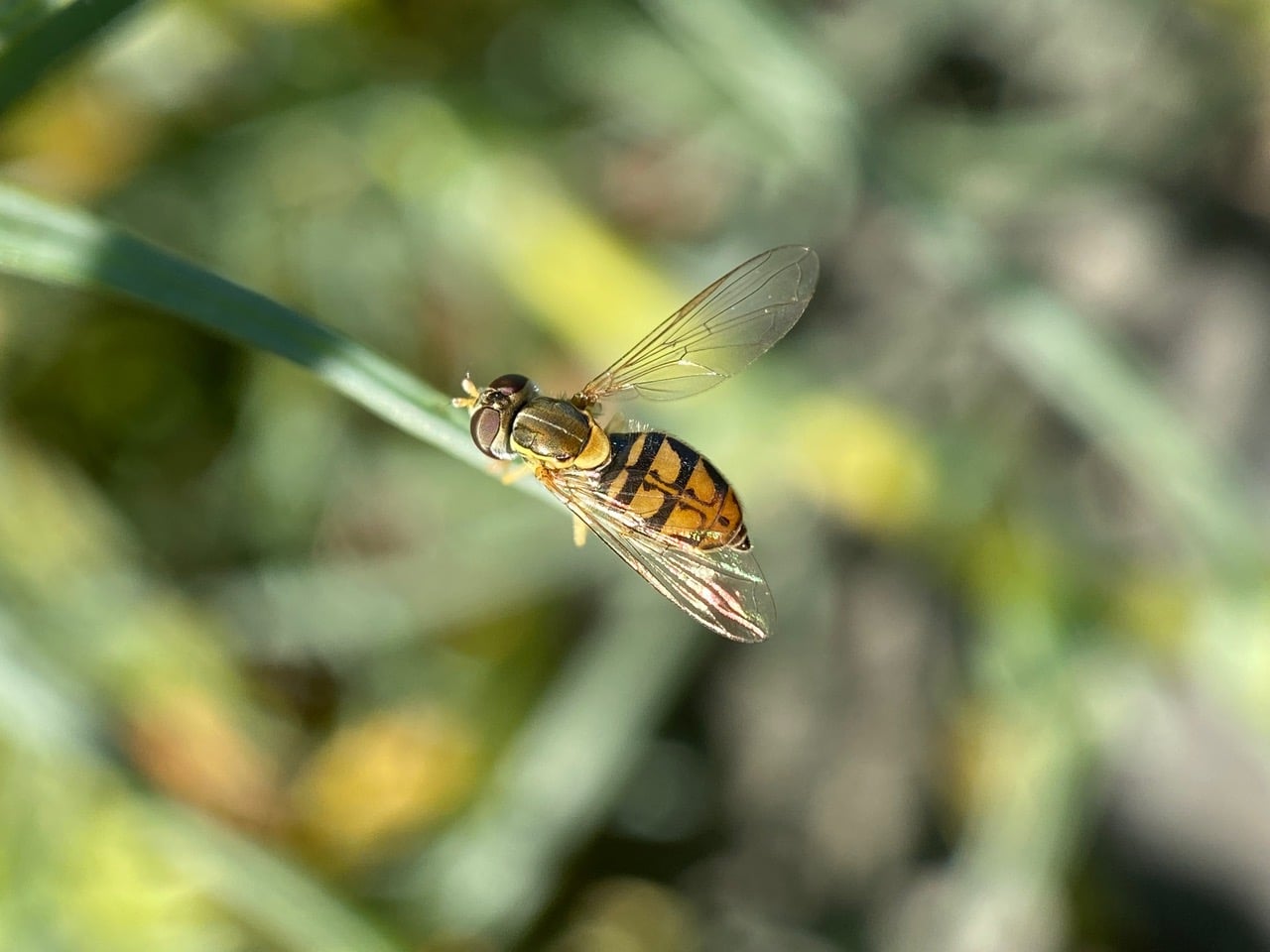
A female Margined Calligrapher, Toxomerus marginatus (family Syrphidae) lands on a blade of grass.
Toxomerus marginatus, also known as the Margined Calligrapher is a common species of hoverfly found in North America. These are small hoverflies, measuring 5-6 mm in length. The abdomen is black and yellow, and is narrowly margined with yellow. Adults are found in diverse habitats such as forests, fields, meadows, marshes, deserts, and alpine areas. They are highly adaptable and can occur is very disturbed habitats. Larvae prey on aphids, thrips, mites, and small caterpillars. Adults visit flowers for nectar and pollen.
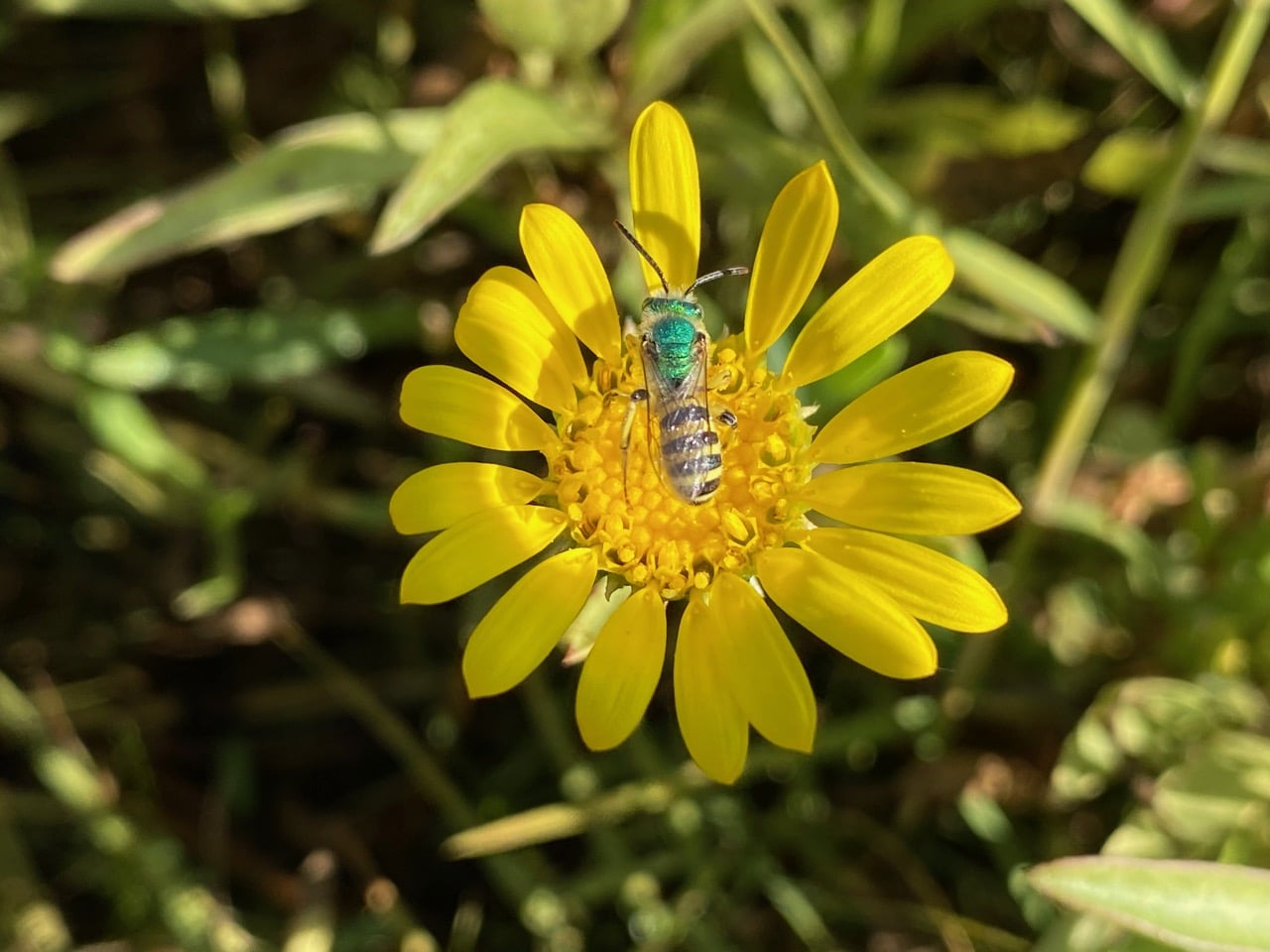
A male Texas Striped Sweat Bee, Agapostemon texanus (family Halictidae) visits a Grindelia flowerhead.
In Greek, the genus name Agapostemon means “stamen loving”, referring to the bee’s need to forage for pollen. The family Halictidae consists of small, non-aggressive bees with short tongues. They are called sweat bees because they are often attracted to human perspiration from which they obtain salts and water.
The Texas Striped Sweat Bee, Agapostemon texanus is most commonly found in the west coast of the United States. The species is easily recognized by its metallic green coloration. The females have an entire body that is brilliant blue-green, while the males have an abdomen that is brownish-black with yellow bands. The males (9-10 mm) are smaller than the females (11mm). Due to their short tongues, the Texas Striped Sweat Bees have a limited ability to access nectar from deep flowers. They are generalist foragers, visiting a wide range of flowers.

Male Texas Striped Sweat Bees have a black-and-yellow striped abdomen, while the females are entirely bright green.

A female Texas Striped Sweat Beee, Agapostemon texanus (family Halictidae) is foraging on a Grindelia flowerhead.
Female Agapostemon texanus are active May through October, while males are on wing from July through October. Two generations are produced per year. In the fall fertilized females overwinter in their nests while males typically die. In the spring the fertilized females emerge. They construct their underground nests in bare, loamy soil, lay their eggs in brood chambers and provision them with pollen before dying. In this first generation, the eggs hatch into mostly females as they develop from fertilized eggs. To fix the skewed sex ratio these females lay unfertilized haploid eggs that develop into males. During the summer months the male and female Texas Striped Sweat Bees mate, thus repeating the cycle.
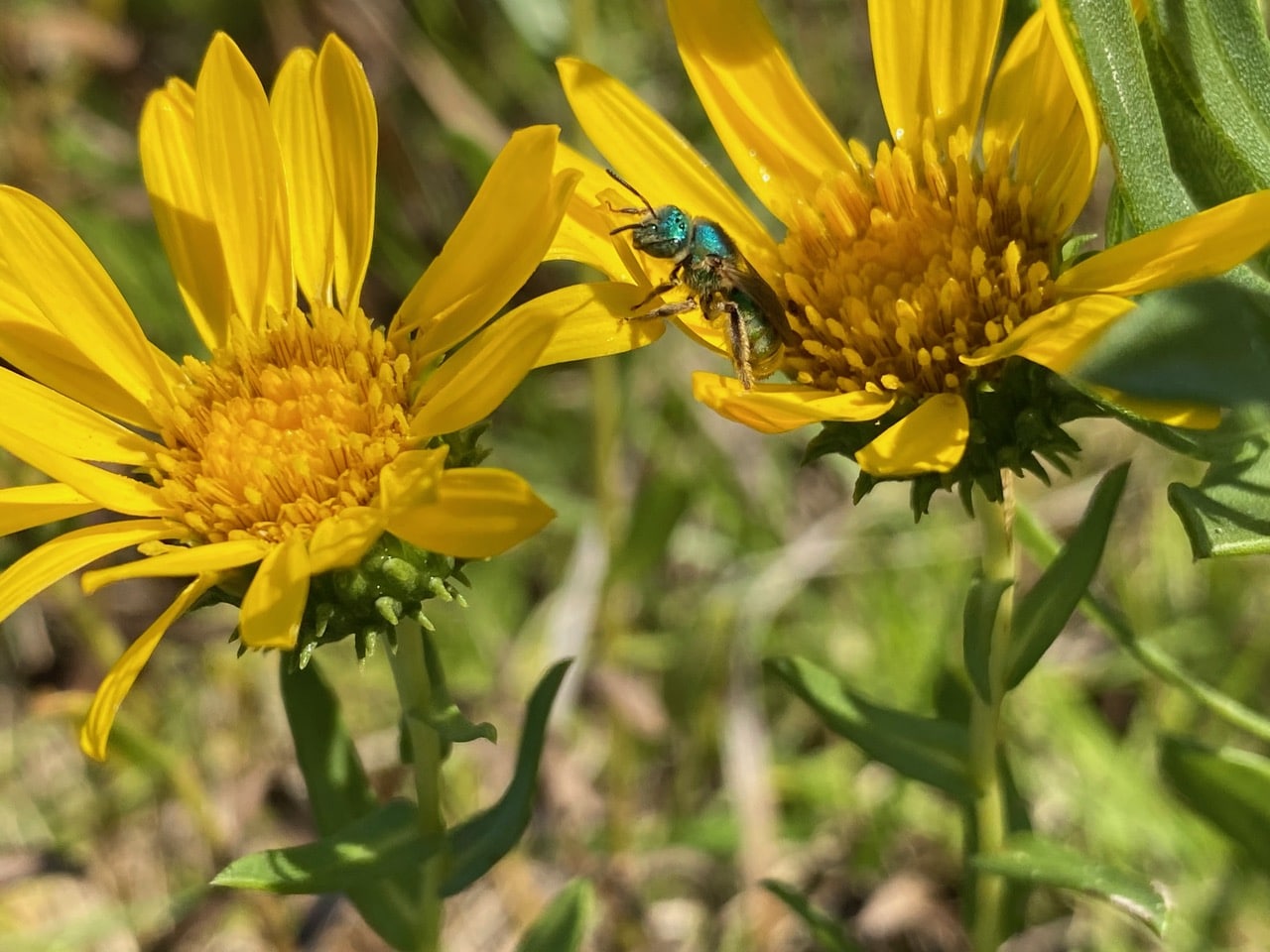
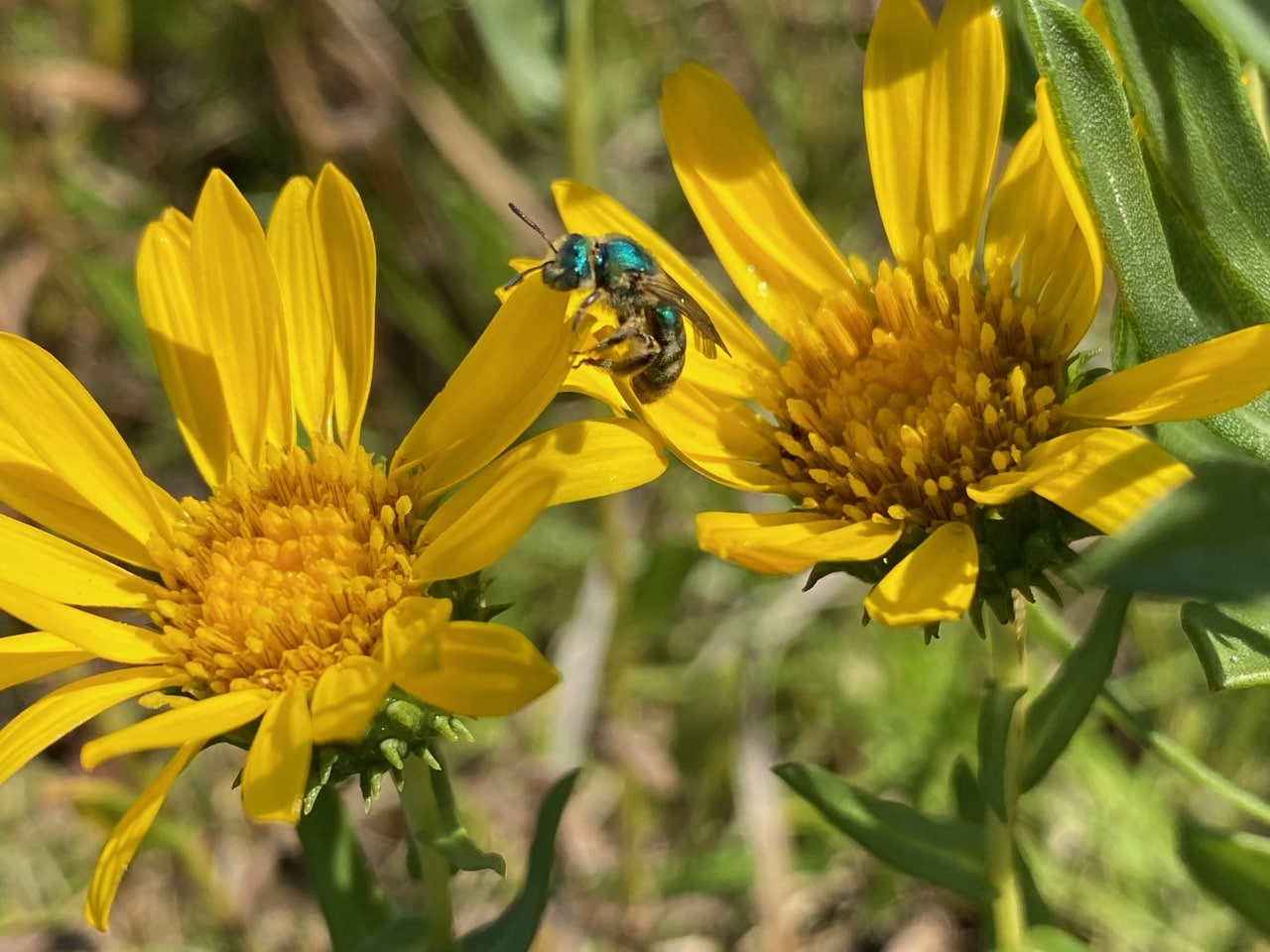
The two Grindelia flowerheads are adjacent to each other. The female Texas Striped Sweat Bee simply has to clamber onto the next one without having to fly.
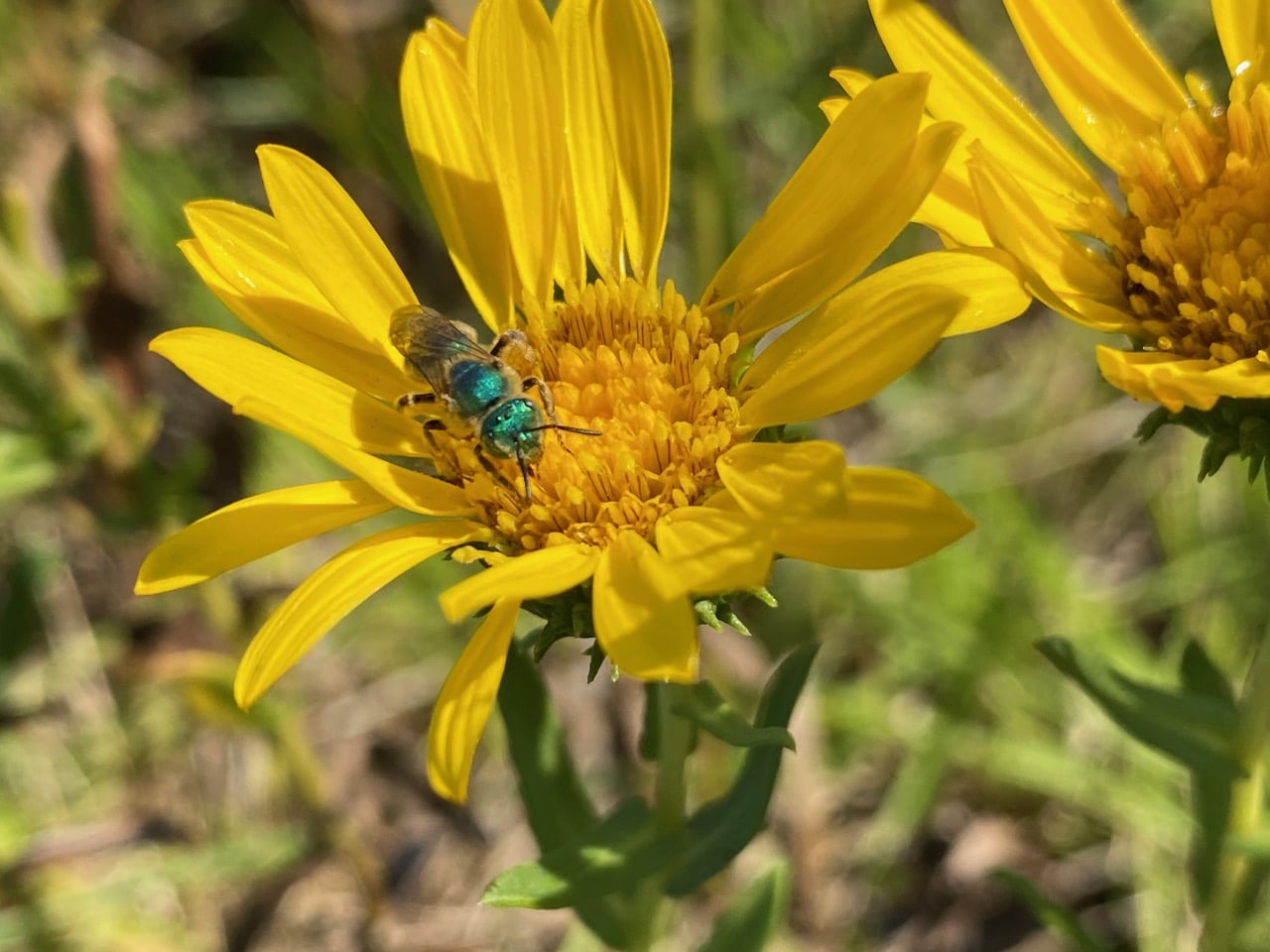
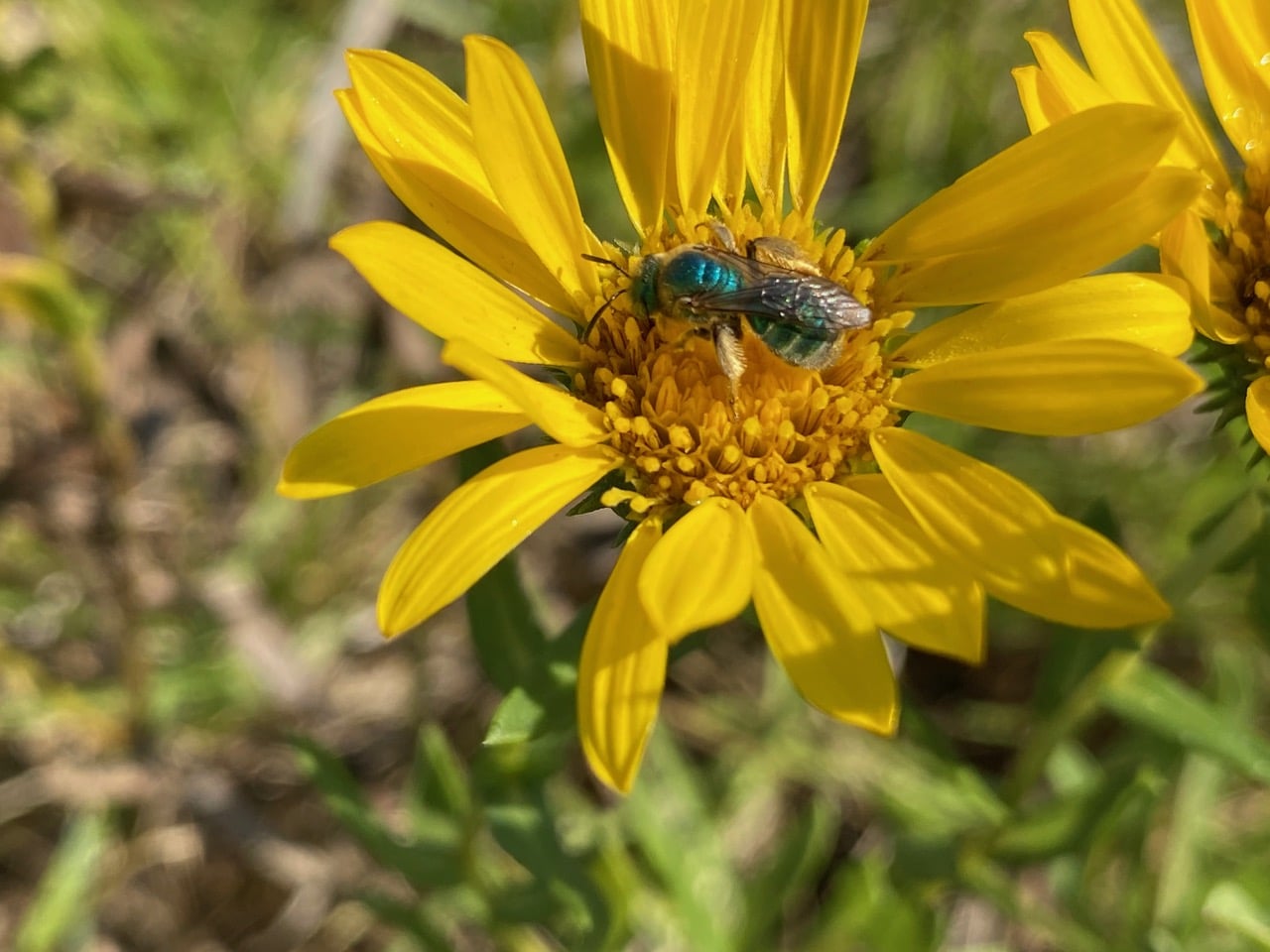
The scopa on her hind legs are empty. The female is merely taking nectar, and not collecting pollen.
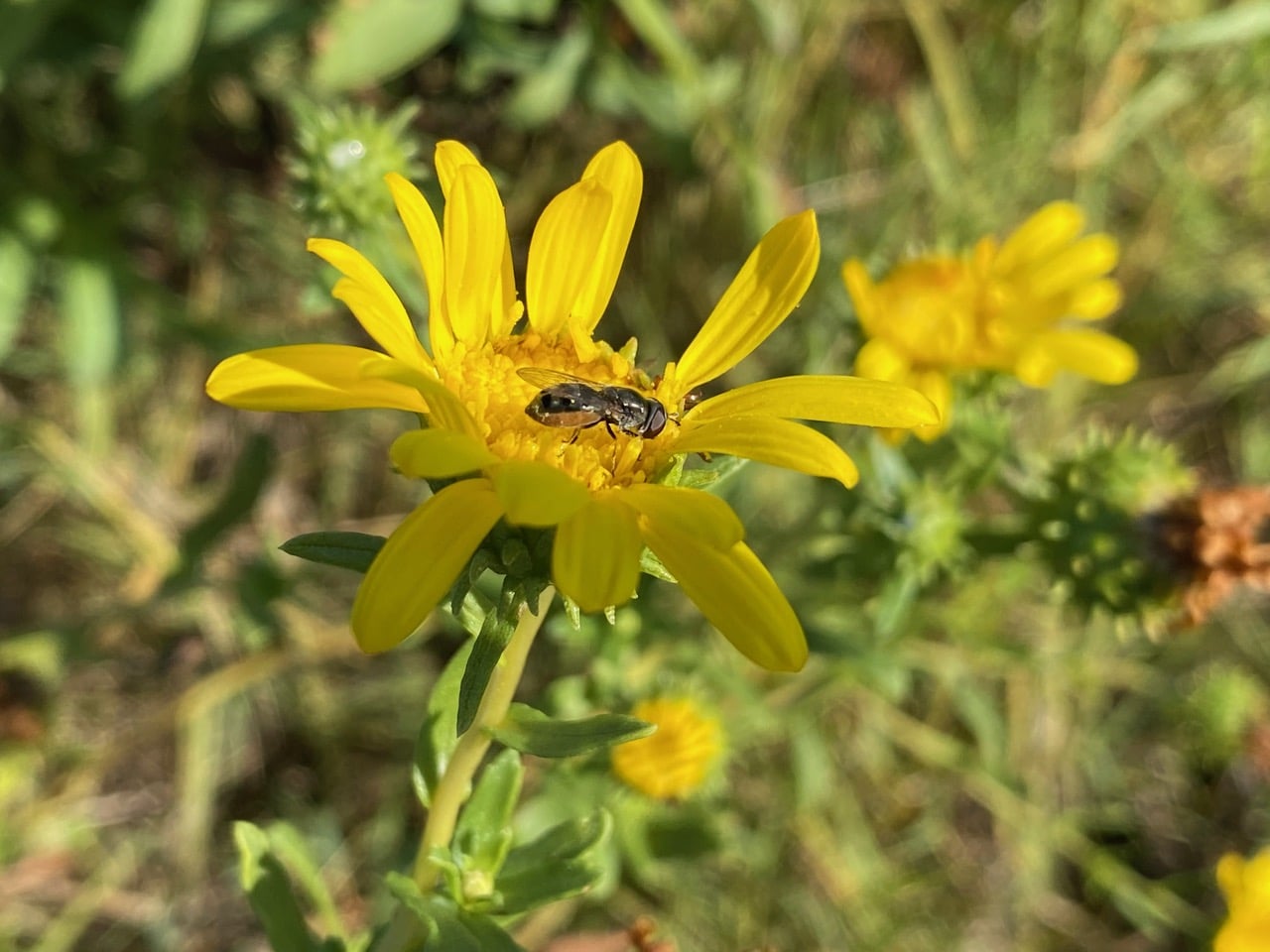
A dusky metallic insect has landed on a fresh Grindelia flowerhead.
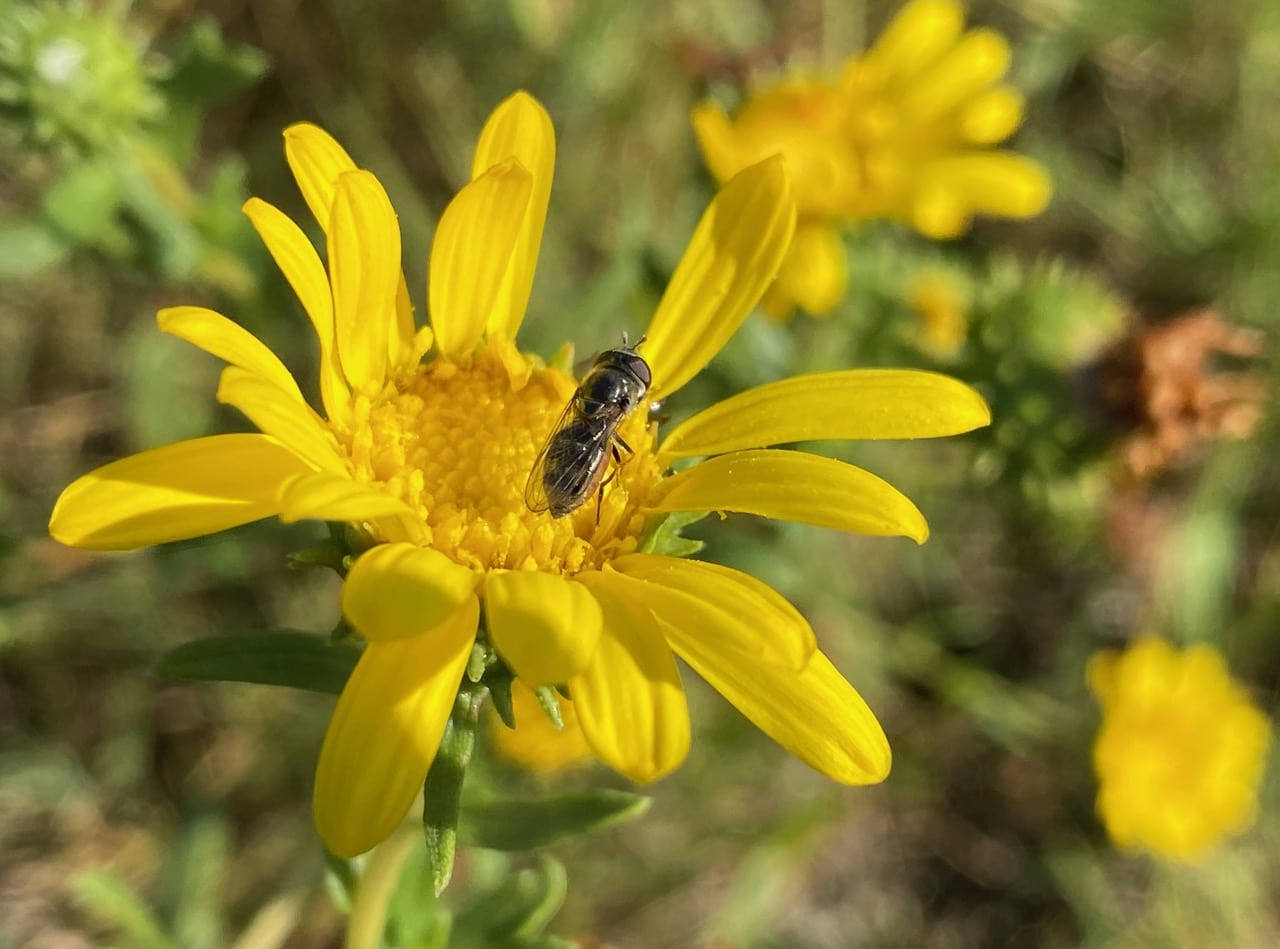
Ooh, I think I know this hover fly!
 It is a female Sedgesitter, Platycheirus sp. (family Syrphidae).
 Her abdomen greatly distended, the Sedgesitter is obvious a gravid female. She goes around the rim of the flowerhead, feeding on the pollen from the only opened flowers – the ray florets.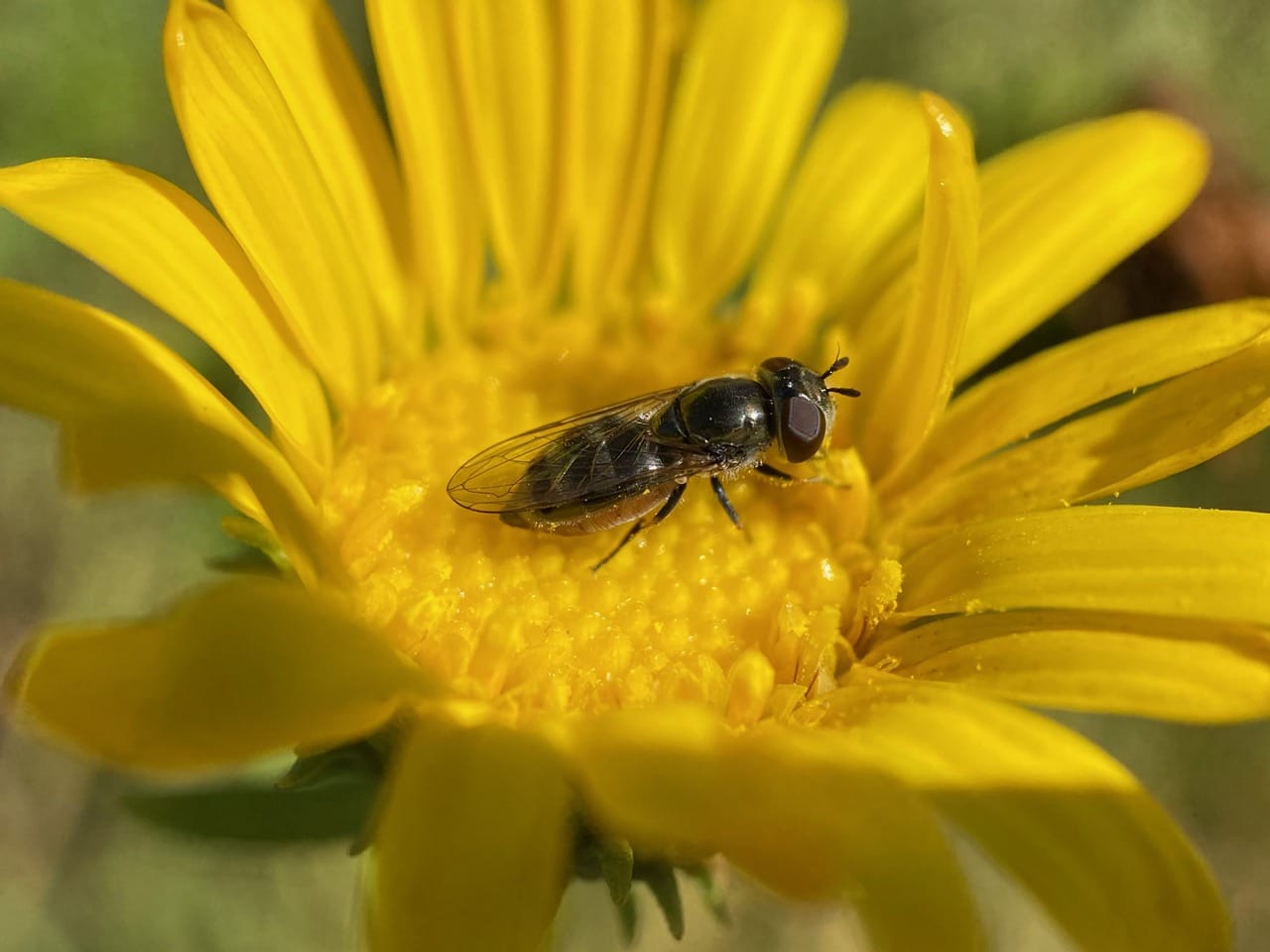
The Platycheirus hoverfly is commonly found in grass and herb vegetation. Adults of many species feed on pollen of wind-pollinated plants, such as Salix, Plantago, Poaceae, Cyperaceae, but they visit other flowers also. Many stay active during cold and rainy weather. Larvae feed on aphids.
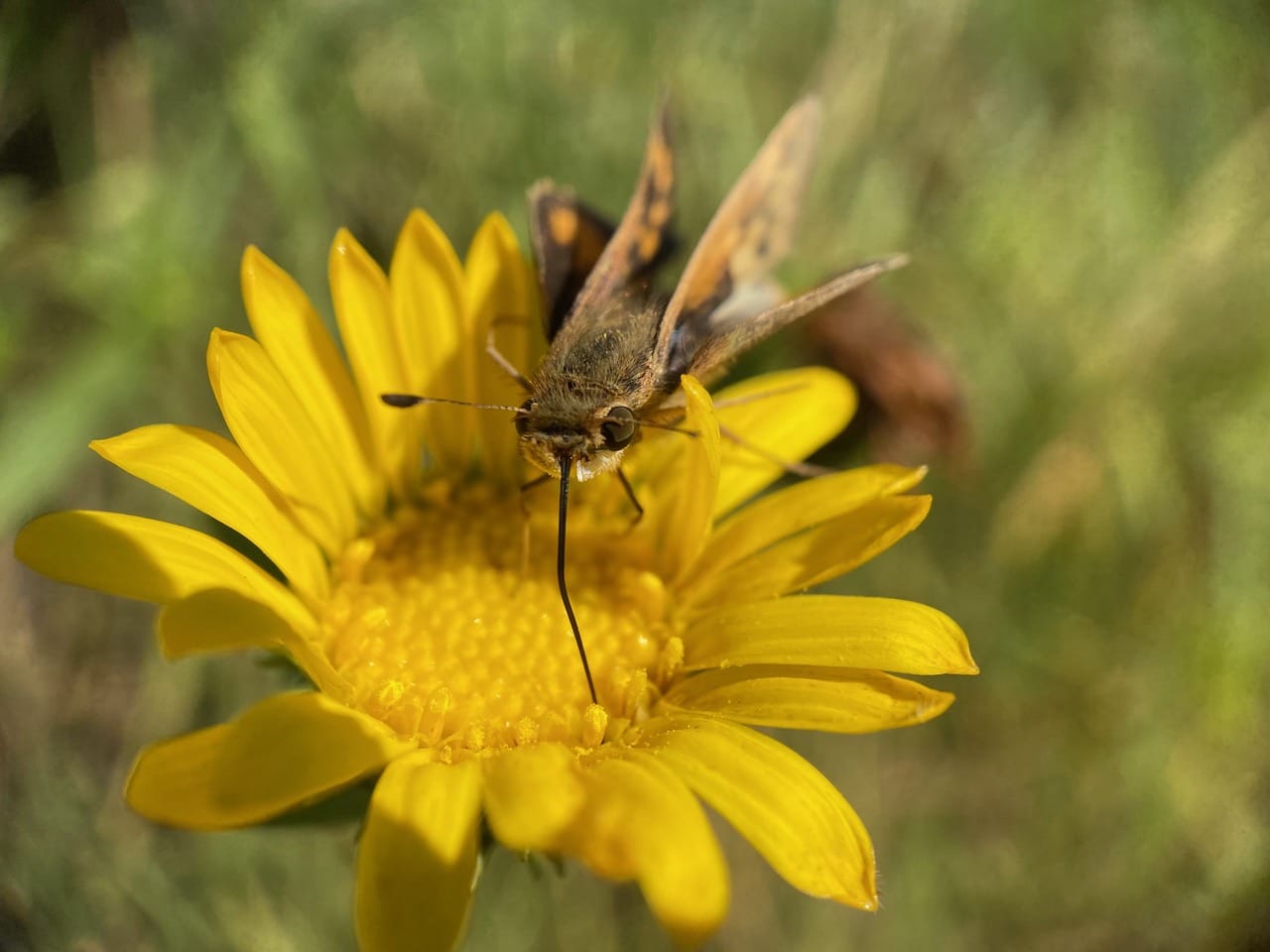
The hover fly is unceremoniously bumped off the flowerhead while I am photographing her with a macro lens. I am suddenly staring into the face of a Skipper butterfly (family Hesperiidae). Note that it has its long proboscis angled toward the only opened flowers – the ray florets on the rim of the flowerhead.
A tubular sucking organ, the proboscis enables a butterfly to extract sweet nectar from flowers, regardless of the shape of the blossom. When not in use, the proboscis is rolled up out of the way. Unlike caterpillars, adult butterflies do not have any chewing mouthparts, and therefore must obtain their nutrition from sipping liquids. Hydrostatic pressure extends the curled proboscis which is inserted deep into the tubes of flowers. At emergence from the chrysalis, the proboscis initially consists of two parts that appear like a forked tongue. Almost immediately the two tubes are “zipped” together to form the single tube. In addition to flower nectar, butterflies also use the proboscis to suck up moisture from puddles, liquids from fermenting fruits, rotting animal flesh or animal excrements.
Skippers are a family, the Hesperiidae, of the order Lepidoptera (butterflies and moths). They are named for their quick, darting flight habits. Most have the antenna clubs hooked backwards like a crochet hook. They also have generally stockier bodies and larger compound eyes than the other butterflies. Their wings are usually small in proportion to their bodies. When at rest, skippers keep their wings usually angled upwards or spread out, and only rarely fold them up completely. Californian species are mostly brown or tan, with black, orange, or yellow markings.
Skipper caterpillars are usually green or brown, sometimes yellowish, never brightly colored. They have a distinctive “collar”, a narrow ring around the body right behind the head. Caterpillars are camouflaged and often hide during the day. Many species make nests of leaves and silk for additional protection. Most North American species feed on grasses, but some common species eat shrubs and trees, especially in the bean family. Most species are limited to a single group of food plants. Adult skippers are only active during the day, but Skipper caterpillars feed mainly when it is dark or partly light.
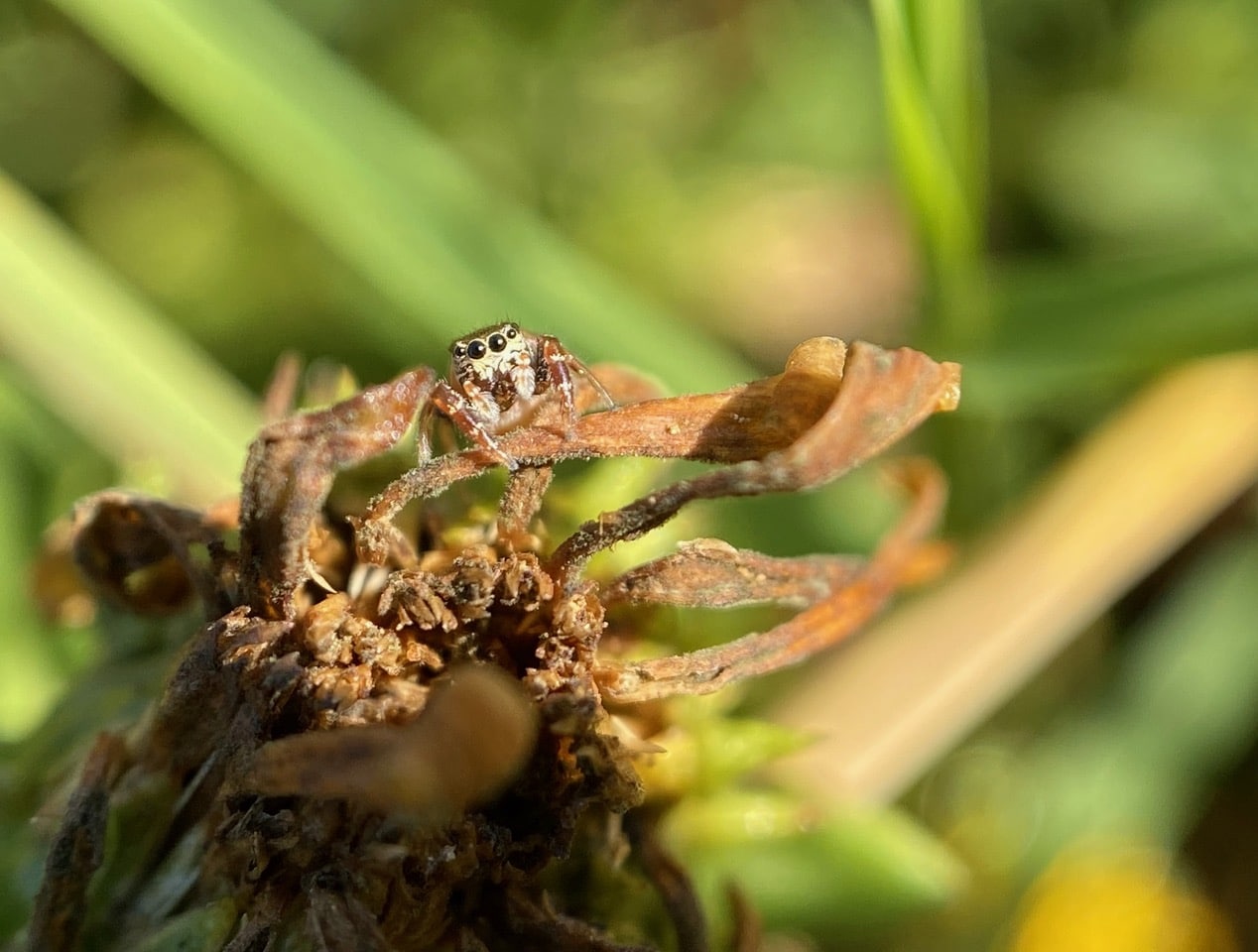
On a withered Grindelia flowerhead, a tiny Jumping Spider is watching me with intense eyes. It is a Buttonhook Leafbeetle Jumping Spider, also known as the Grapevine Jumping Spider, Sassacus vitis (family Salticidae).
Salticids are free-roaming hunting spiders. They do not weave a web to catch prey. They stalk, then pounce on their prey. Just before jumping, the spider fastens a safety line to the substrate. It can leap 10-20 times their body length to capture prey. Their movement is achieved by rapid changes in hydraulic pressure of the blood. Muscular contractions force fluids into the hind legs, which cause them to extend extremely quickly. Jumping spiders are visual hunters. Their excellent vision has among the highest acuities in invertebrates. Since all their 8 eyes are fixed in place and cannot pivot independently from the body like human eyes can, jumping spiders must turn to face whatever they want to see well. This includes moving their cephalothorax up and down, an endearing behavior.
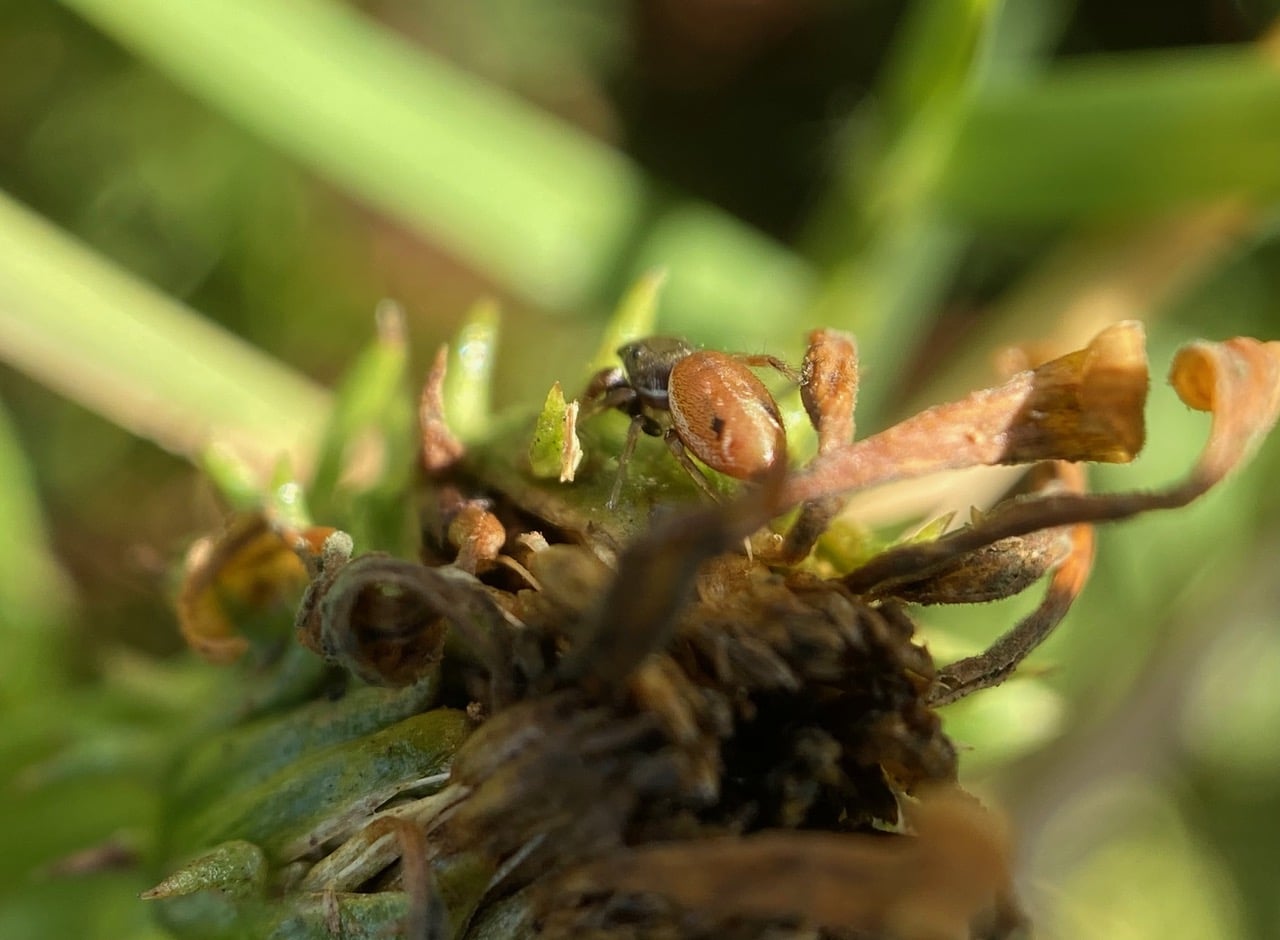
When the spider turns around, I am surprised to find that its body does not shine brightly. Perhaps the spider is freshly molted, and its true colors and reflectivity of its hairs have not fully developed.
The Buttonhook Leafbeetle Jumping Spider, Sassascus vitis is native to North America, with a range spanning from Canada to Panama. It is a small jumping spider with iridescent gold abdomen and white ring around the anterior surface of abdomen. Body is covered with golden scales. Males are 3.5 mm long, females 4.5 mm. The name vitis is Latin for “grapevine”. The spider is commonly found on shrubs and vines and in fields. Best known as a common resident of vineyards.

A Western Aphideater, Eupeodes fumipennis (family Syrphidae) lands on a Grindelia flowerhead. The hover fly is a perfect example of Batesian mimicry. It has black-and-yellow stripes on its abdomen, reminiscent of the stinging wasps and bees. The resemblance provides the harmless fly with a measure of protection from potential predators who may want to avoid confrontation with an aggressive insect.
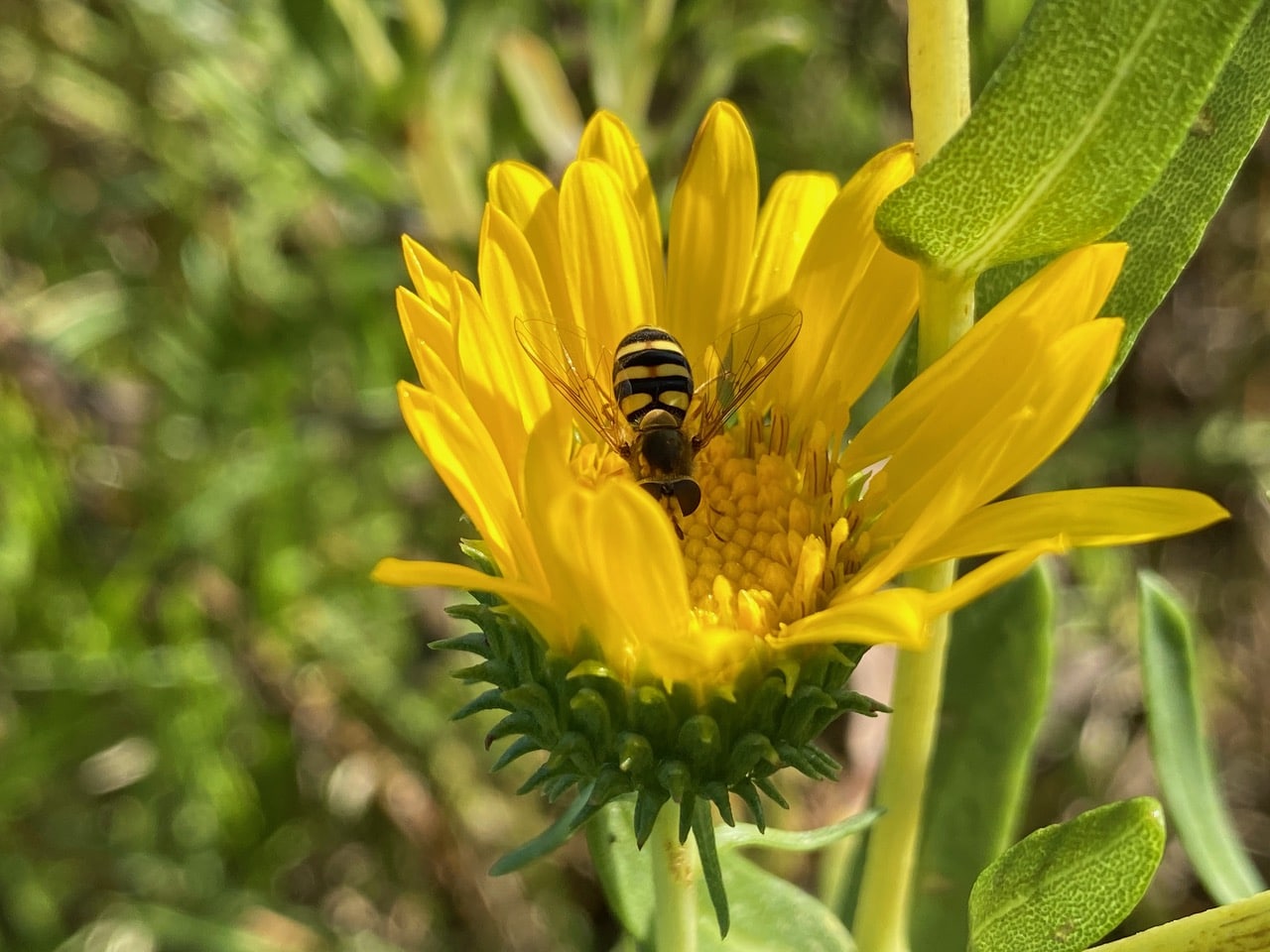
The Western Aphideater, Eupeodes fumipennis (family Syrphidae) is found in western North America, mostly seen March through October. As the common name implies, larvae prey on aphids and other soft-bodied insects. Adults visit flowers for nectar and pollen.

The foliage of certain patches of the Grindelia along the trail are yellow and tarnished with black Sooty Mold. The culprits seem to have all but disappeared. They were the tiny Lace Bugs, Corythucha sp. (family Tingidae) that suck sap from the plant, secreting copious amount sugary honeydew that encourage the growth of the fungi on the leaves.
The Tingidae are a family of very small (2-10 mm) insects in the order Hemiptera that are commonly referred to as lace bugs. They are called lace bugs because the pronotum and fore wings of the adult have a delicate and intricate network of divided areas that resemble lace. Their body is flattened dorsoventrally, and the head is often concealed under the hood-like pronotum. Lace Bugs feed by sucking sap from plants, extracting the protein they need and excreting liquid waste as honeydew. The most common symptom of feeding is the stippled and mottled yellowish foliage. In heavy infestations, black sooty mold may develop on the honeydew, impairing photosynthesis by the plant. This may result in some dieback of twigs and branches and a reduction in flowering the following year. Tingids are usually host-specific and can be very destructive to plants. Each individual usually completes its entire lifecycle on the same plant, if not the same part of the plant.
The genus Corythucha is primarily distributed in the northern hemisphere, including Europe, North America and eastern Asia.
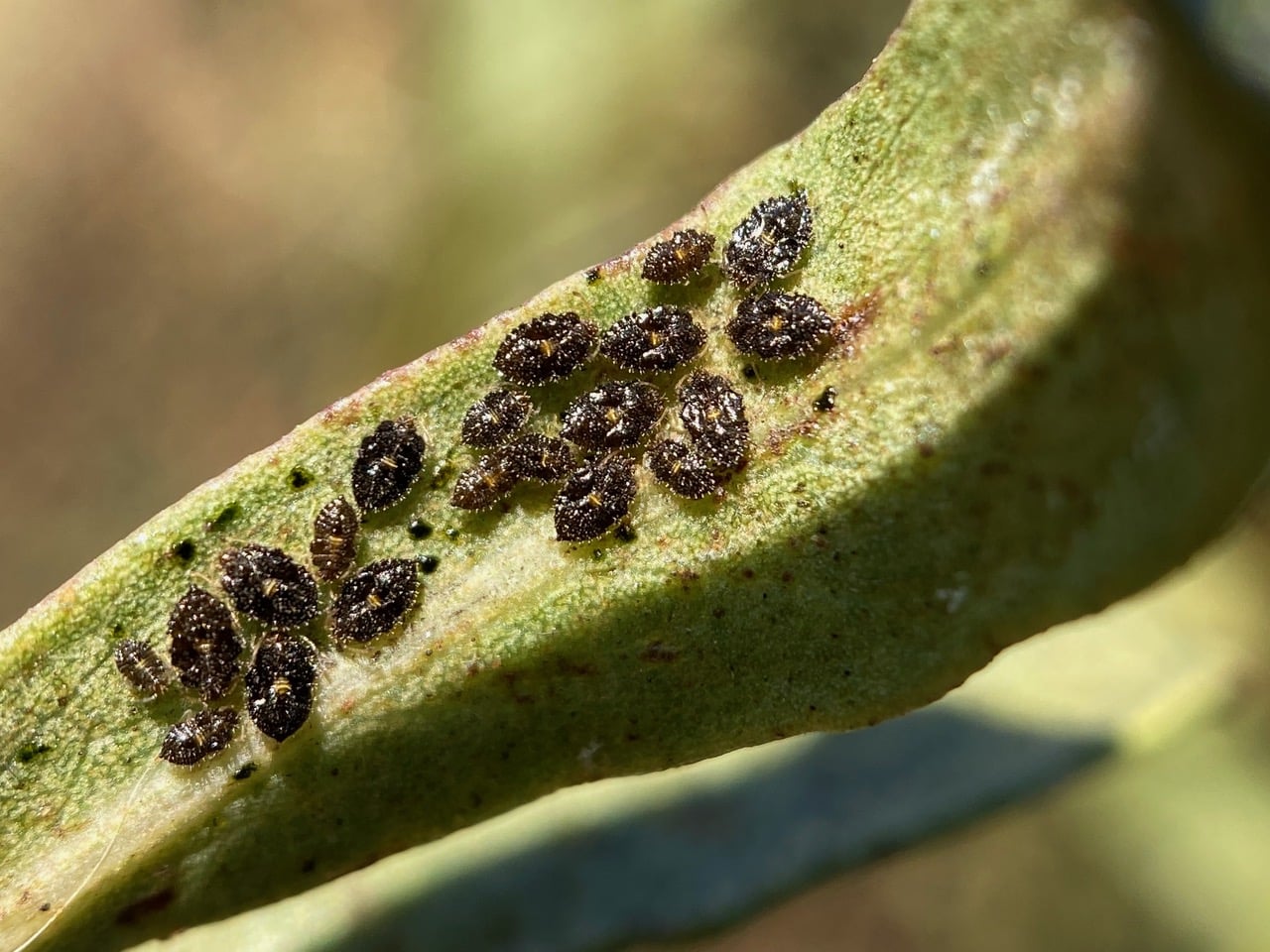
What looks like a cluster of Lace Bug nymphs are actually the exuvia they have left behind. Exuvia is the shed exoskeletons of insects (and other arthropods) discarded after they molt.