

Pollinator Post 10/25/24

It’s a cool, calm morning at Shoreline Park on Bay Farm Island. The yellows of the Grindelia flowers have given way to the reds of the Fleshy Russian Thistle, Salsola soda along the shoreline.
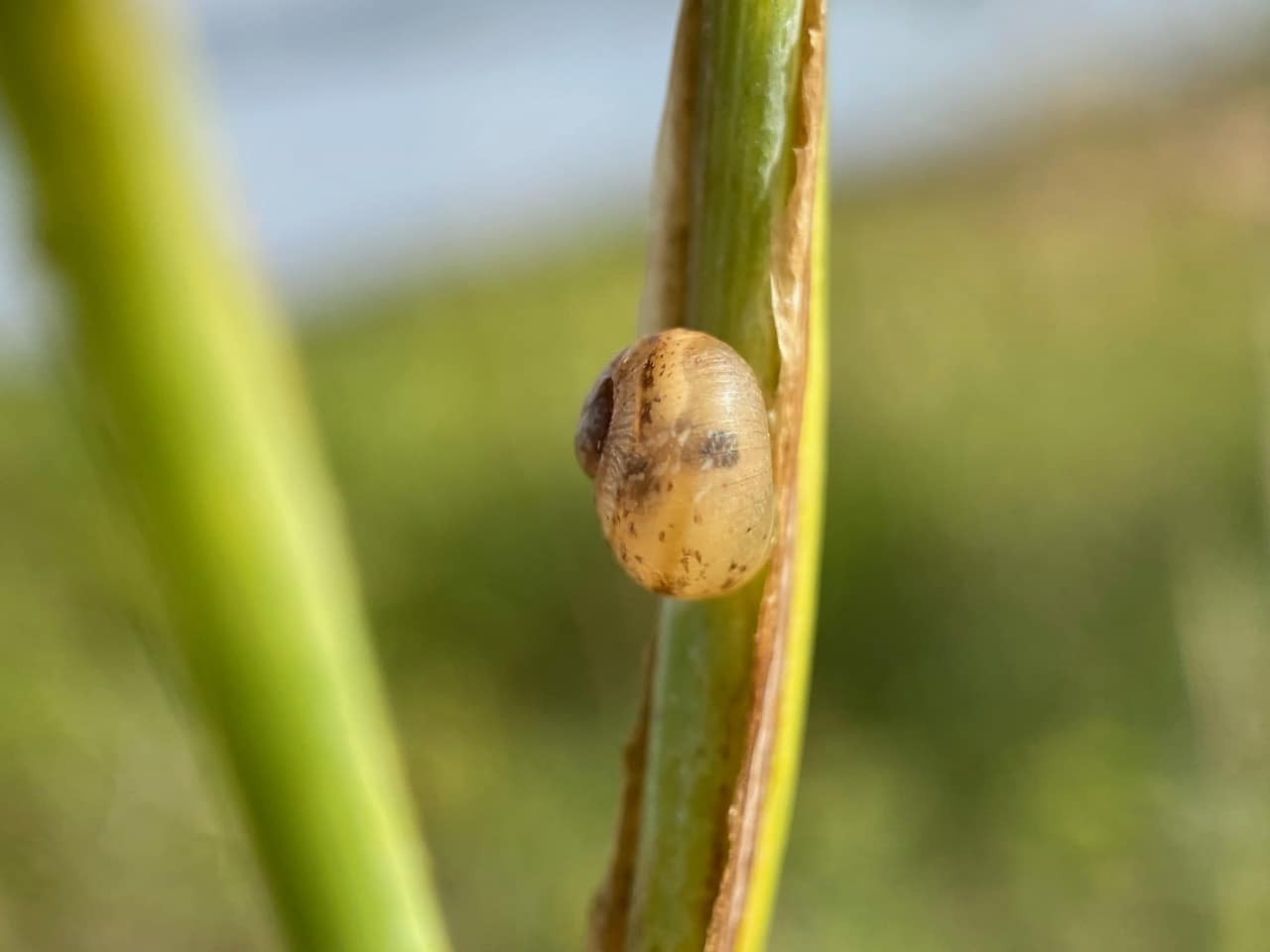
Something is clinging to a leaf of Fennel. It’s the size and shape of a Lady Beetle pupa, but the colors are all wrong.

Viewed from another angle, it turns out to be a very young Garden Snail, Cornu aspersum (family Halicidae). Not fully calcified, its shell is translucent.
Young snails have shells that are nearly transparent. The older they get, the thicker their shells become. Glands that are distributed across their body solidify the shell with calcium carbonate. This creates two layers of calcium in the snail shell – one runs horizontally, and the other vertically. The arrangement stabilizes the snail’s shell and make it less likely to break. Until the snails reach sexual maturity, the shell continues to grow on the open end, the number of whorls increasing as the snail grows.
Cornu aspersum is native to the Mediterranean region, but the snail has spread to many geographic regions, and is now cosmopolitan in temperate zones. The snail is primarily a herbivore. It feeds on numerous types of fruit trees, vegetable crops, garden flowers and cereals. It is also an omnivorous scavenger that feeds on rotting plant material and animal matter. Cornu aspersum obtains the calcium required to build its shell by consuming soil. In turn, it is a food source for many other animals, including small mammals, some birds, lizards, frogs, centipedes, and predatory insects. The species may be used as an indicator of environmental pollution, because it deposits heavy metals, such as lead, in its shell.
Garden Snail (Cornu aspersum) · iNaturalist
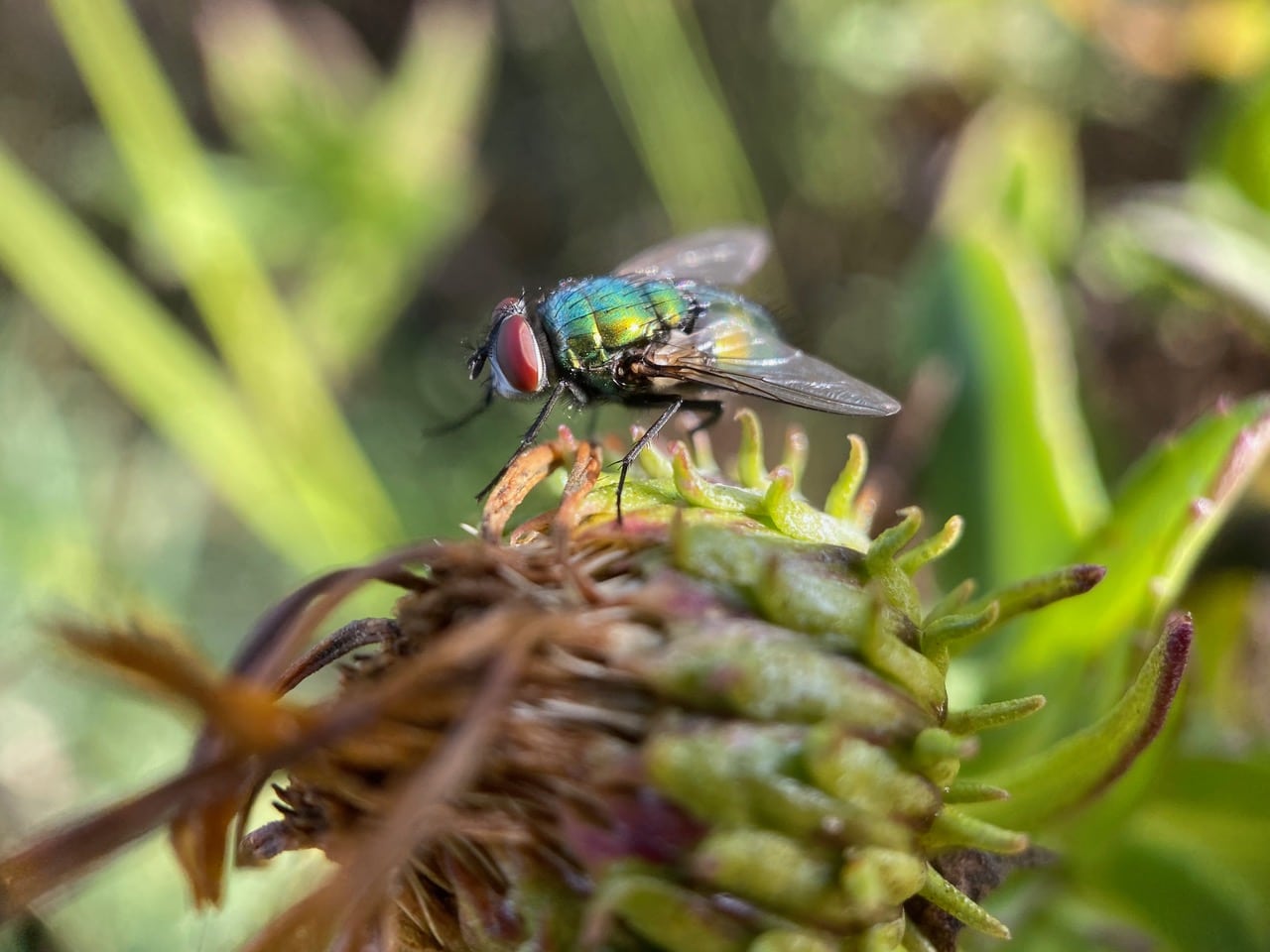
A Common European Greenbottle Fly, Lucilia sericata (family Calliphoridae) has landed on a spent Grindelia flowerhead.
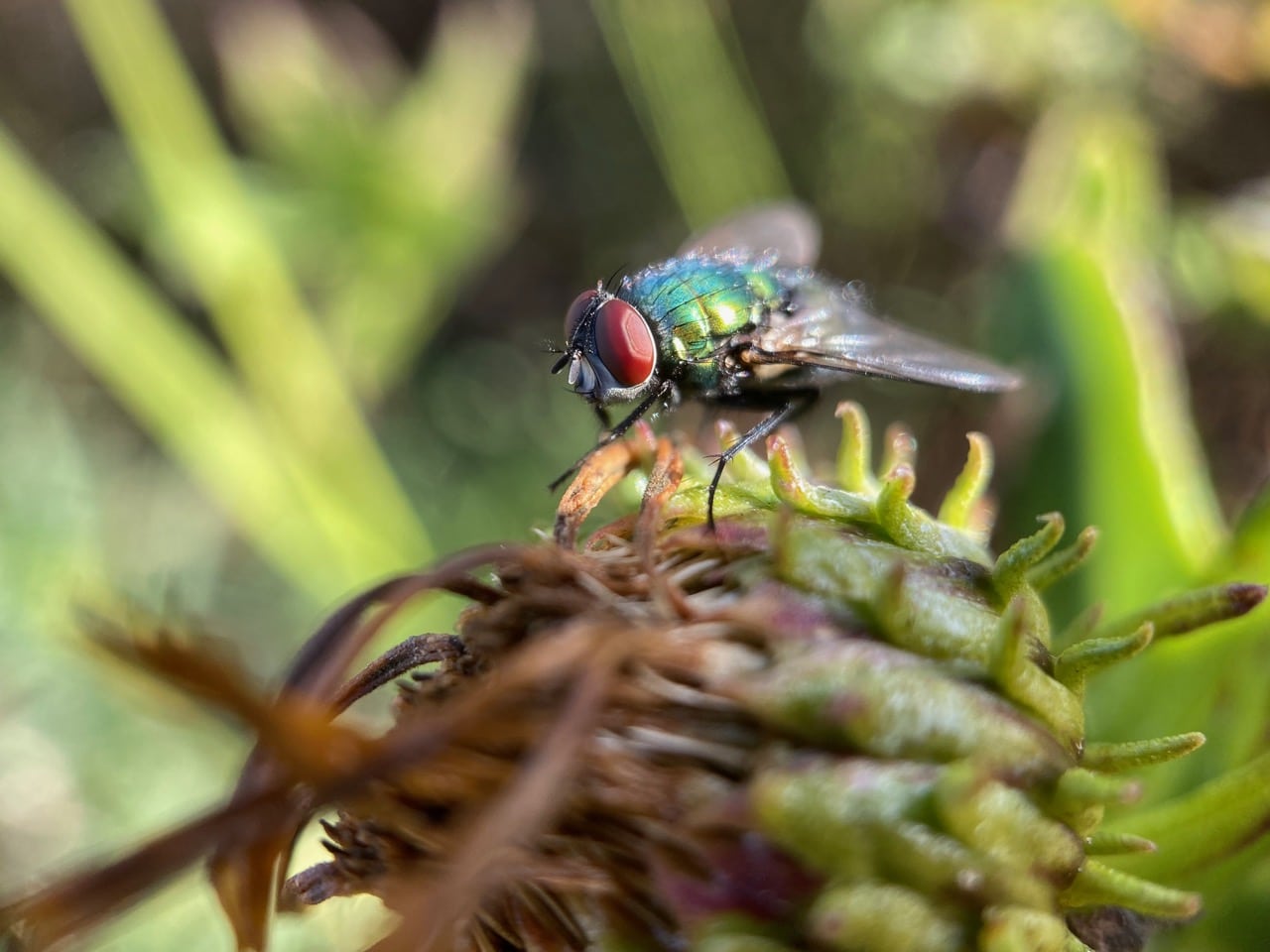
The Common European Greenbottle Fly is a Blowfly found in most areas of the world and is the most well-known of the numerous green bottle fly species. The lifecycle of Lucilia sericata is typical of blowflies. Females lay masses of eggs in fresh carrion. The flies are extremely prolific – a single female may produce 2,000 to 3,000 eggs in her lifetime. The larvae feed on dead or necrotic tissue, passing through 3 larval instars. Third-instar larvae drop off the host to pupate in the soil. The adults feed opportunistically on nectar, pollen, feces, or carrion; they are important pollinators as well as important agents of decomposition. Pollen is used as an alternative protein source, especially for gravid females who need large amounts of protein and cannot reliably find carrion.
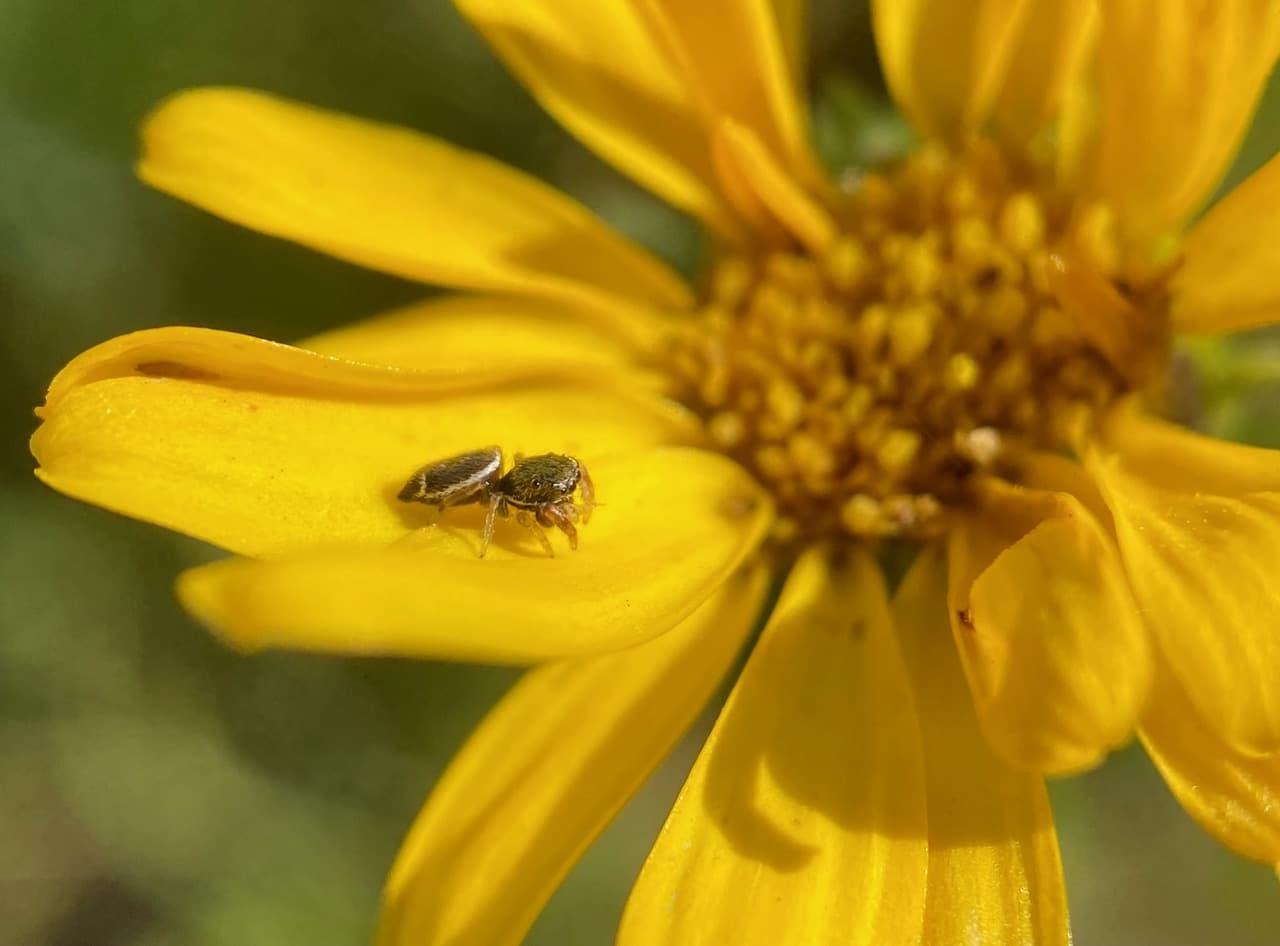
A Buttonhook Leafbeetle Jumping Spider, also known as the Grapevine Jumping Spider, Sassacus vitis (family Salticidae) is hunting on a Grindelia flowerhead.
Salticids are free-roaming hunting spiders. They do not weave a web to catch prey. They stalk, then pounce on their prey. Just before jumping, the spider fastens a safety line to the substrate. It can leap 10-20 times their body length to capture prey. Their movement is achieved by rapid changes in hydraulic pressure of the blood. Muscular contractions force fluids into the hind legs, which cause them to extend extremely quickly. Jumping spiders are visual hunters. Their excellent vision has among the highest acuities in invertebrates. Since all their 8 eyes are fixed in place and cannot pivot independently from the body like human eyes can, jumping spiders must turn to face whatever they want to see well. This includes moving their cephalothorax up and down, an endearing behavior.
The Buttonhook Leafbeetle Jumping Spider, Sassascus vitis is native to North America, with a range spanning from Canada to Panama. It is a small jumping spider with iridescent gold abdomen and white ring around the anterior surface of abdomen. Body is covered with golden scales. Males are 3.5 mm long, females 4.5 mm. The name vitis is Latin for “grapevine”. The spider is commonly found on shrubs and vines and in fields. Best known as a common resident of vineyards.
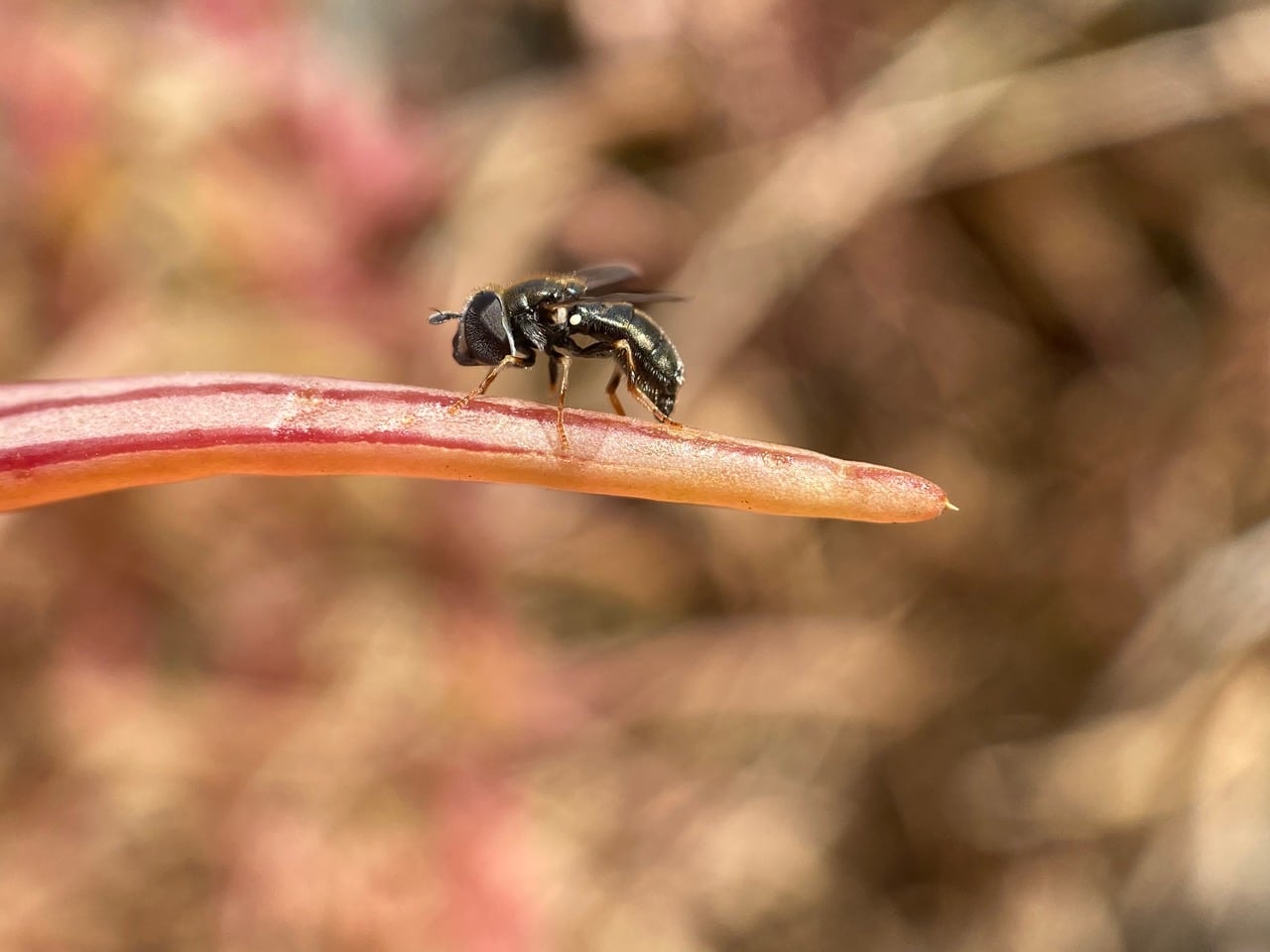
A Common Grass Skimmer, Paragus haemorrhous (family Syrphidae) lands on a leaf of Fleshy Russian Thistle, Salsola soda. Unlike most individuals of the species, it does not have any red on its abdomen.
The Common Grass Skimmer, Paragus haemorrhous (family Syrphidae) is one of the smallest hover flies in our area, measuring only about 4 mm in length. The species has a world-wide distribution, found in unimproved grassland, dune grass, open areas and pathsides in forest, and meadows. Adults visit flowers for nectar and pollen. Larvae feed on aphids on low herbaceous plants.

The hover fly proceeds to groom itself, brushing its abdomen with its hind legs.
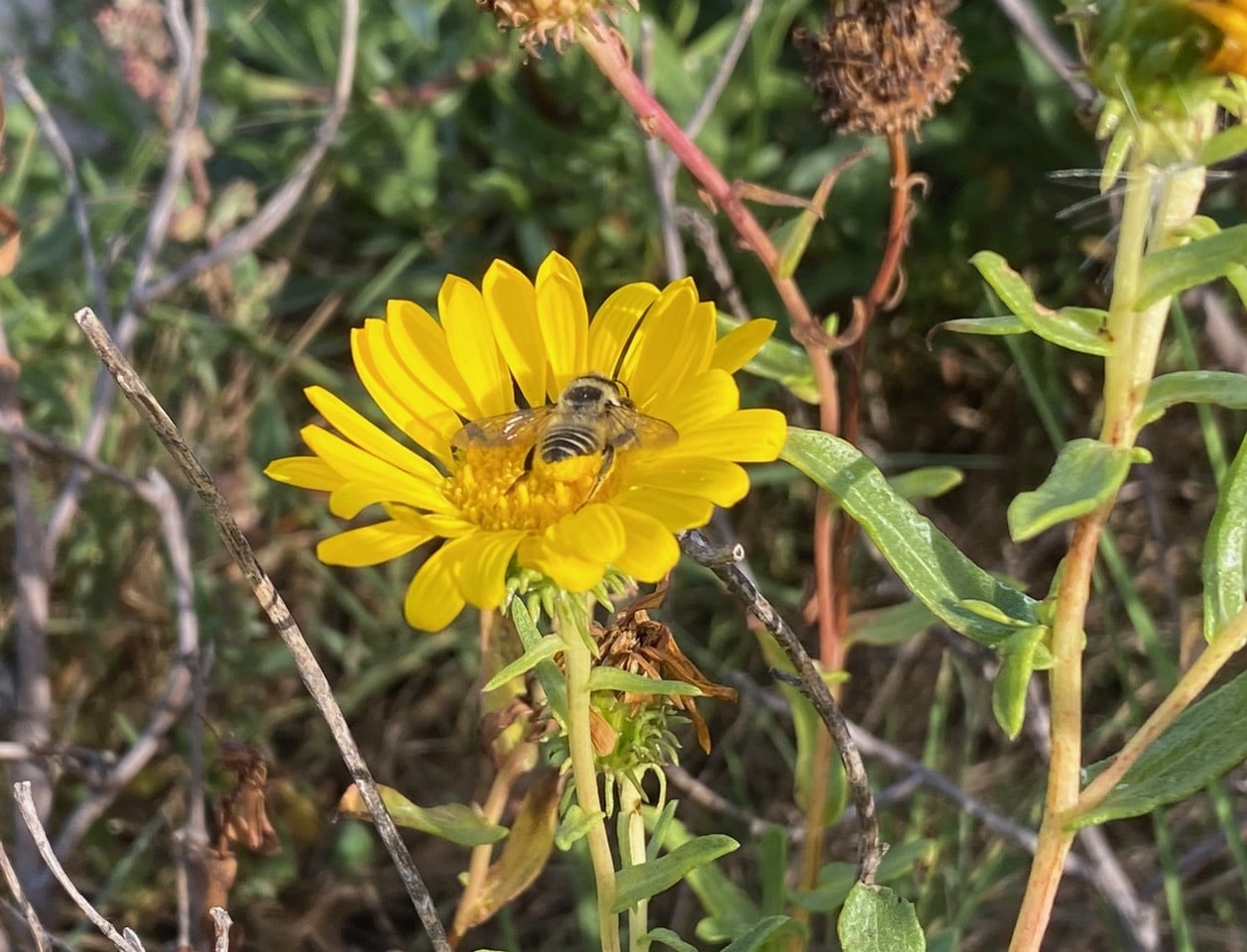
A female Western Leafcutter Bee, Megachile perihirta (family Megachilidae) lands on a Grindelia flowerhead and in a blur of rapid movements gathers pollen onto the scopa on the underside of her abdomen. There is no time to waste. With the abundance of blooms waning, the late-season bee is hard pressed to find enough nectar and pollen to provision her nest.
Leaf-cutter Bees, Megachile sp. (family Megachilidae) are stout-bodied, usually with pale hair on the thorax and stripes of white hairs on the abdomen. Females usually have a triangular abdomen with a pointed tip, and males’ faces are covered with dense, pale hair. Flight season is from May into September, with peak activity from June to August.
Solitary females construct nests in tubular cavities, including hollow stems, tree holes, and abandoned beetle burrows in wood. Many use holes drilled into wood, straws, or other manufactured tunnels. Females cut pieces from leaves or flower petals for use in the construction of brood cells. Most Megachile females are generalists when foraging for pollen. Pollen is transported in dense scopae on the underside of the abdomen.
Photos of Western Leafcutter Bee (Megachile perihirta) · iNaturalist
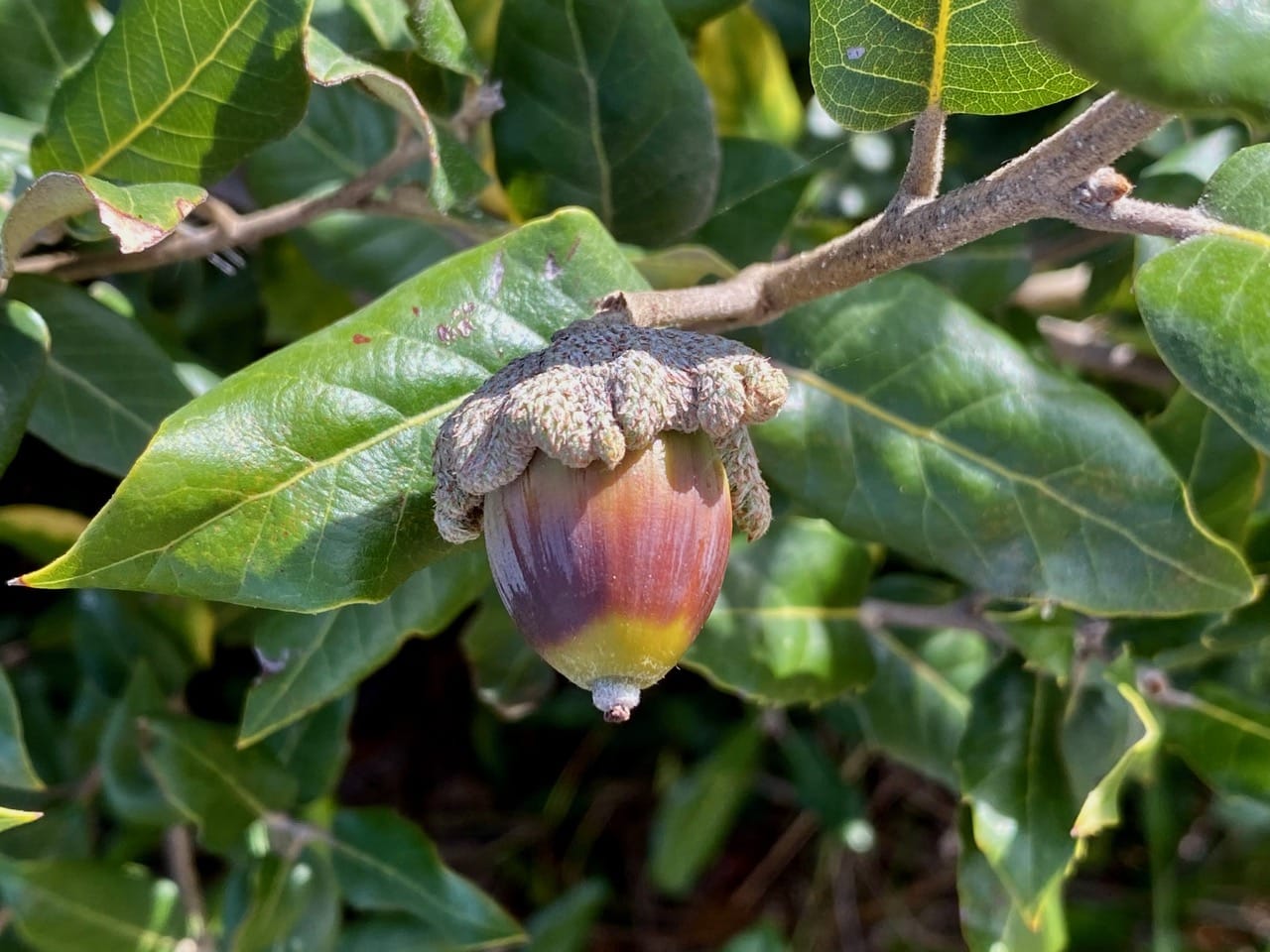
There are two large shrubby oaks by the trail. I have hardly paid attention to them until I notice the robust acorns on them today. Definitely not Coast Live Oak, as I have assumed all along. The acorns are stout and topped with a ruffled scaly cap. iNaturalist has identified it as the Holm Oak, Quercus ilex. It is an evergreen native to the Mediterranean region, a widely planted naturalized species in California.

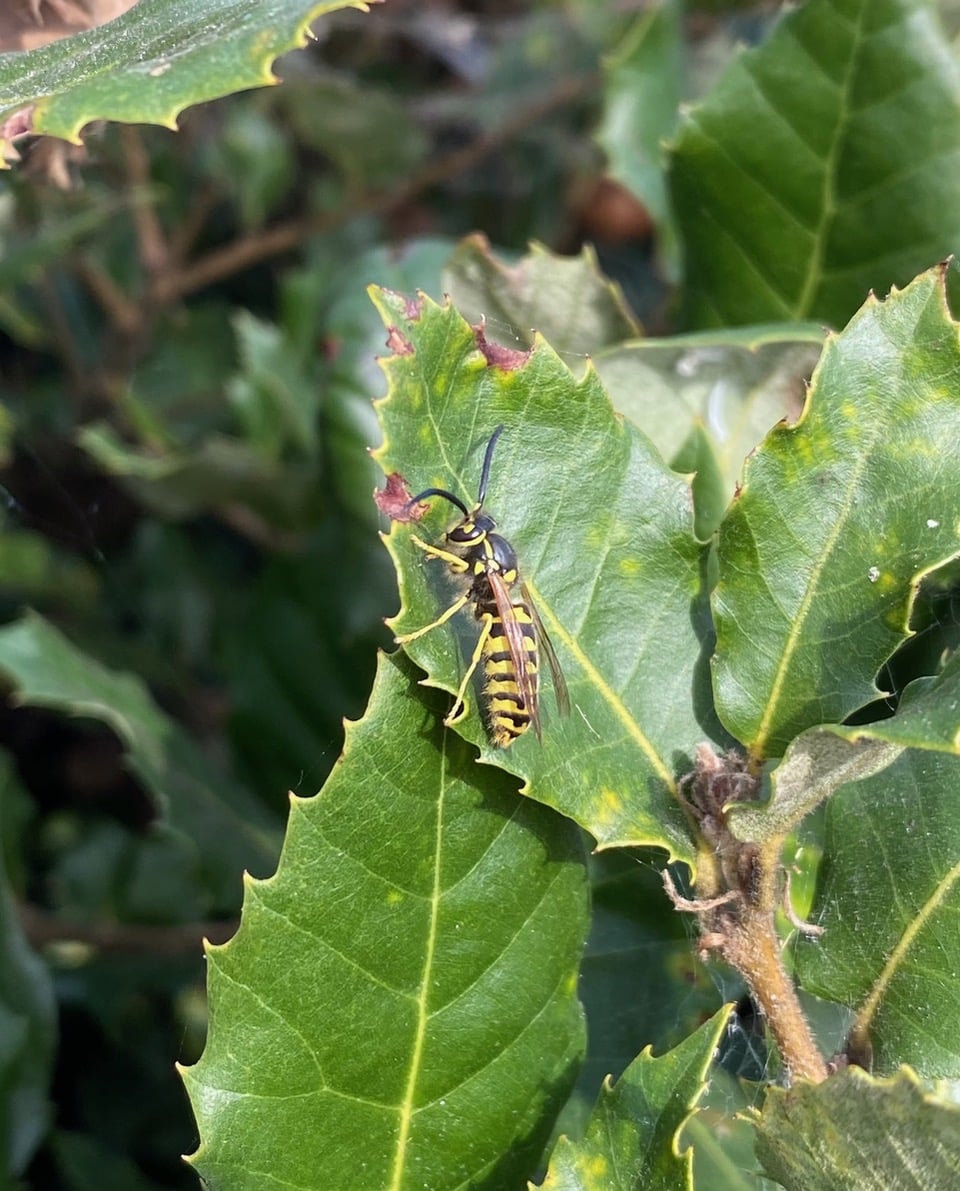
As I am photographing the acorns on the oak, I notice a large Western Yellowjacket, Vespula pensylvanica (family Vespidae) grooming itself on a leaf. It has extra long abdomen and antennae – a drone!
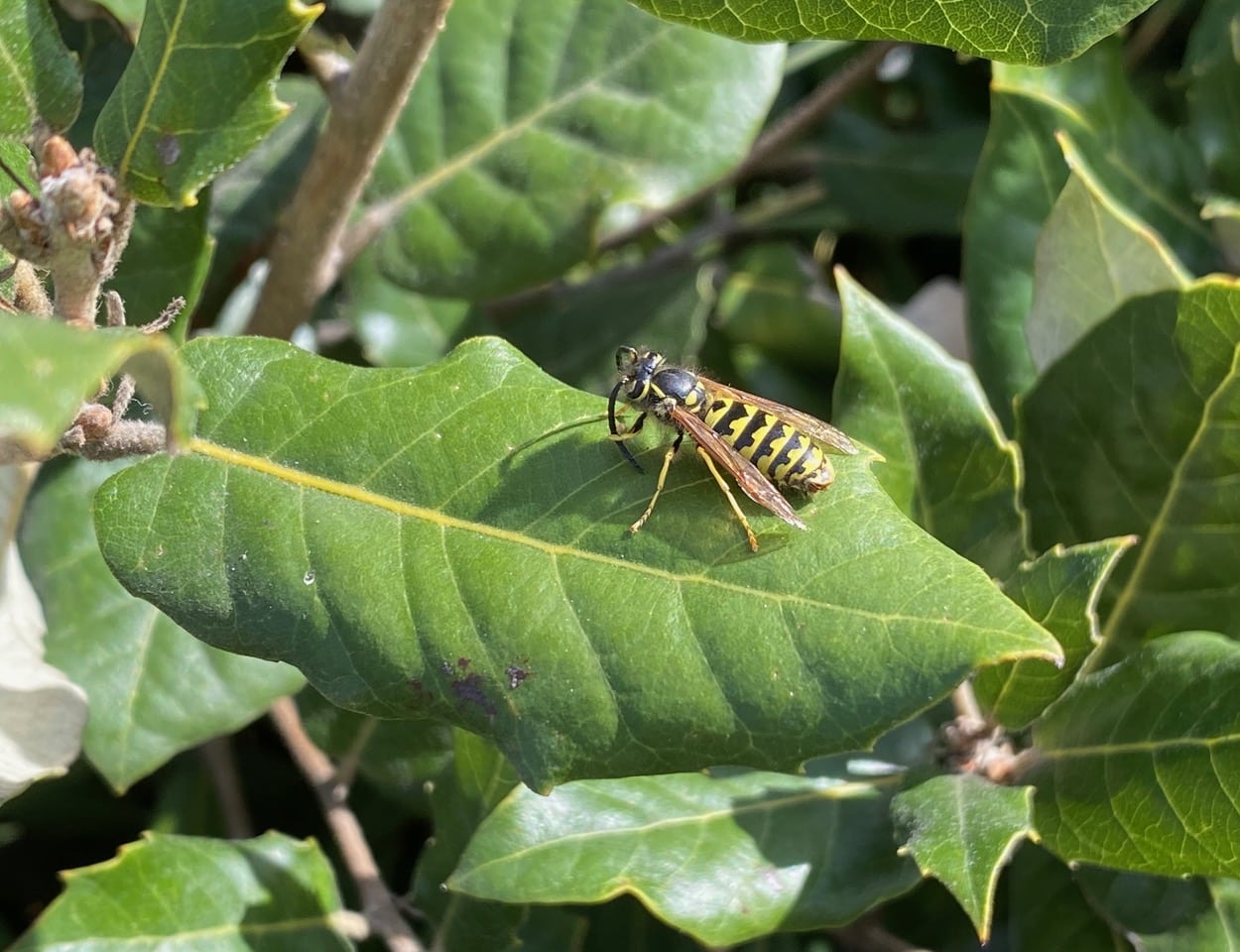
The antennae of male Hymenopterans (bees, wasps and ants) are often much longer than their female counterparts. Male antennae have an extra segment and the segments themselves are longer. This is because male antennae are specialized to pick up the subtle scent of female pheromones.
Wasps have antenna cleaners on their front legs similar to the bees’. To clean the antenna, the wasp draws the antenna through the antenna cleaner, to rid it of debris or dust which might interfere with the many sensory organs within the antenna. A wasp’s antennae serve numerous functions: smell, taste, perceive humidity and temperature, feel, monitor gravity and flight speed and even detect sound waves to help guide the wasp in its daily activities.
The drone’s abdomen appears longer because the males have an extra abdominal segment – 7 compared to the female’s 6.
Looking up from the shrub, I find myself in the midst of a frantic Yellowjacket swarm. Wow, this is unbelievable – a second swarm this season! I saw my first one just 10 days ago near this location. Knowing that this is a mating swarm, I am not concerned about being stung. The drones are seldom seen, except on these special occasions when the queens and drones fly to meet and mate with the reproductives from other colonies. The wasps are not out to defend their nest. Besides the drones have no stingers. (Females have stingers which are modified ovipositors). I turn on the video to record the swarming frenzy.
The following information is gleaned from the website of the Illinois College of Aces, Department of Crop Sciences:
“Yellowjackets, like other social insects, have a caste system with division of labor. Each colony has a queen whose purpose is to reproduce. Male yellowjackets fertilize the queen, and sterile female workers forage for food, take care of the queen and the young, and defend the nest.
Single queens begin building nests in the spring. Depending on the species, she will locate a sheltered space underground, often an abandoned rodent burrow, or in a structure and construct a golf ball sized nest of paper that is made by mixing wood fibers with her saliva. She lays eggs and cares for the grub-like larvae in the nest. The first generation of sterile female workers emerge in June and assume the care of the nest. This allows the queen to concentrate on reproduction. Yellowjacket adults feed on nectar, fruit juices, sap and other liquids and provide insects and carrion to the larvae. The population of worker yellowjackets increases during the summer and peaks in early to mid-August.
From late summer into early fall the queen produces queen and male yellowjackets. Each nest can produce thousands of new queens. Queens and males swarm from the nest and mate. The males, workers, and old queens die as winter approaches. Newly mated queens seek overwintering sites in protected places such as logs, under bark or leaf litter, and occasionally in human-made structures. They remain dormant through the winter and begin the cycle once again in the spring.”
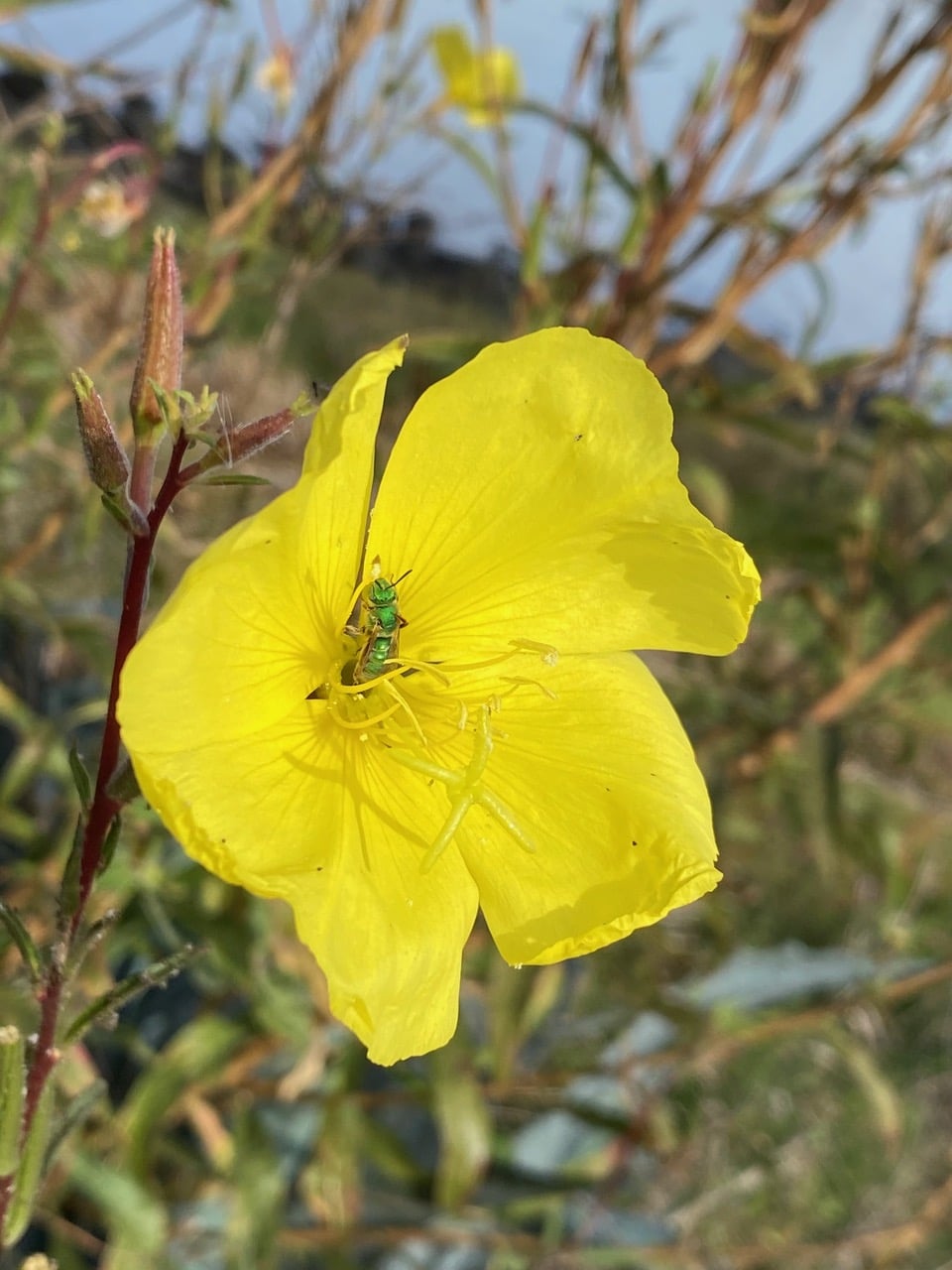
An iridescent green flash alerts me to the presence of a female Striped Sweat Bee, Agapostemon subtilior (family Halictidae) in the large flower of the Evening Primrose, Oenothera sp. She must have gotten down to the base of the flower to access nectar, and is having a bit of trouble climbing up the petal. I have often seen this happen to small bees that visit the evening primrose flowers.

See the faint lines radiating from the base of the petals? When viewed under ultraviolet (UV) light, an evening primrose flower reveals distinct dark patterns on its petals called “nectar guides”, which are invisible or hardly visible to the human eye but visible to pollinating insects such as bees and butterflies, guiding them directly to the flower’s nectar source, maximizing pollination success. The nectar guides on a variety of flowers often appear as a “bullseye” design with darker areas leading to the center of the flower where the nectar is located.
Bees see a shifted spectrum compared to humans – we see the seven colors of the rainbow (red to violet), they see yellow through ultraviolet. Some nectar guides can be seen with the human eye, but the bees may see additional patterns with their ability to detect UV. Nectar guides can be dots, lines, or patterns that direct the bees to the center of the flower where nectar is located.

The bee finally climbs up the stamens to exit the flower. Perhaps the smooth, slippery petal is the flower’s way of forcing its pollinators to make contact with its reproductive structures to facilitate the transfer of pollen.
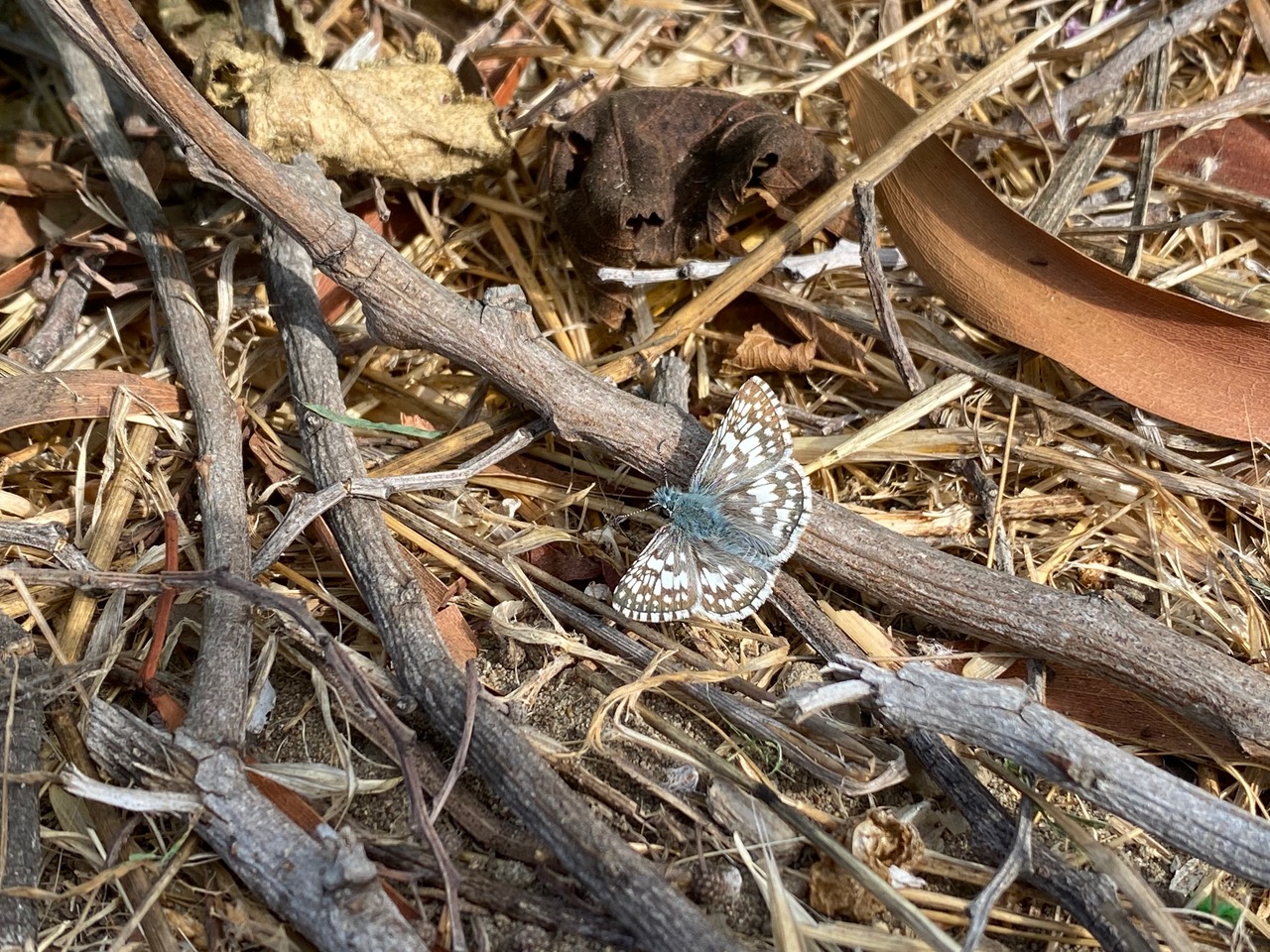
A Common Checkered-Skipper, Burnsius communis (family Hesperiidae) lands on the ground among the leaf litter and twigs.
Because of its small size, bluish color, and spread-wing posture, the butterfly is often mistaken for one of the “Blues” in the family Lycaenidae. Skippers have the antennae clubs hooked backward like a crochet hook, while the typical butterflies have club-like tips to their antennae. Skippers also have generally stockier bodies and larger compound eyes.
Checkered Skippers belong to the subfamily Pyrginae, commonly known as spread-wing skippers, in the family Hesperiidae. Spread-wing skippers bask with their wings held wide open. The wings are held closed when they are at rest. Caterpillars make folded-leaf nests in which they live and feed on several plants in the mallow family, Malvaceae.

A female Striped Sweat Bee, Agapostemon subtilior (family Halictidae) is foraging on a flowerhead of Bristly Oxtongue, Helmithotheca echioides. Note that I no longer label these bees as the Texas Striped Sweat Bee, Agapostemon texanus. This is in accordance to the new taxonomic split, although there is probably little difference in the two species except for some anatomical details. The distribution map clear shows that the Striped Sweat Bees in the western United States belong to the species A. subtilior.
In Greek, the genus name Agapostemon means “stamen loving”, referring to the bee’s need to forage for pollen. The family Halictidae consists of small, non-aggressive bees with short tongues. They are called sweat bees because they are often attracted to human perspiration from which they obtain salts and water.
The Striped Sweat Bee, Agapostemon subtilior is most commonly found in the west coast of the United States. The species is easily recognized by its metallic green coloration. The females have an entire body that is brilliant blue-green, while the males have an abdomen that is brownish-black with yellow bands. The males (9-10 mm) are smaller than the females (11mm). Due to their short tongues, the Striped Sweat Bees have a limited ability to access nectar from deep flowers. They are generalist foragers, visiting a wide range of flowers.
Female Agapostemon subtilior are active May through October, while males are on wing from July through October. Two generations are produced per year. In the fall fertilized females overwinter in their nests while males typically die. In the spring the fertilized females emerge. They construct their underground nests in bare, loamy soil, lay their eggs in brood chambers and provision them with pollen before dying. In this first generation, the eggs hatch into mostly females as they develop from fertilized eggs. To fix the skewed sex ratio these females lay unfertilized haploid eggs that develop into males. During the summer months the male and female Striped Sweat Bees mate, thus repeating the cycle.
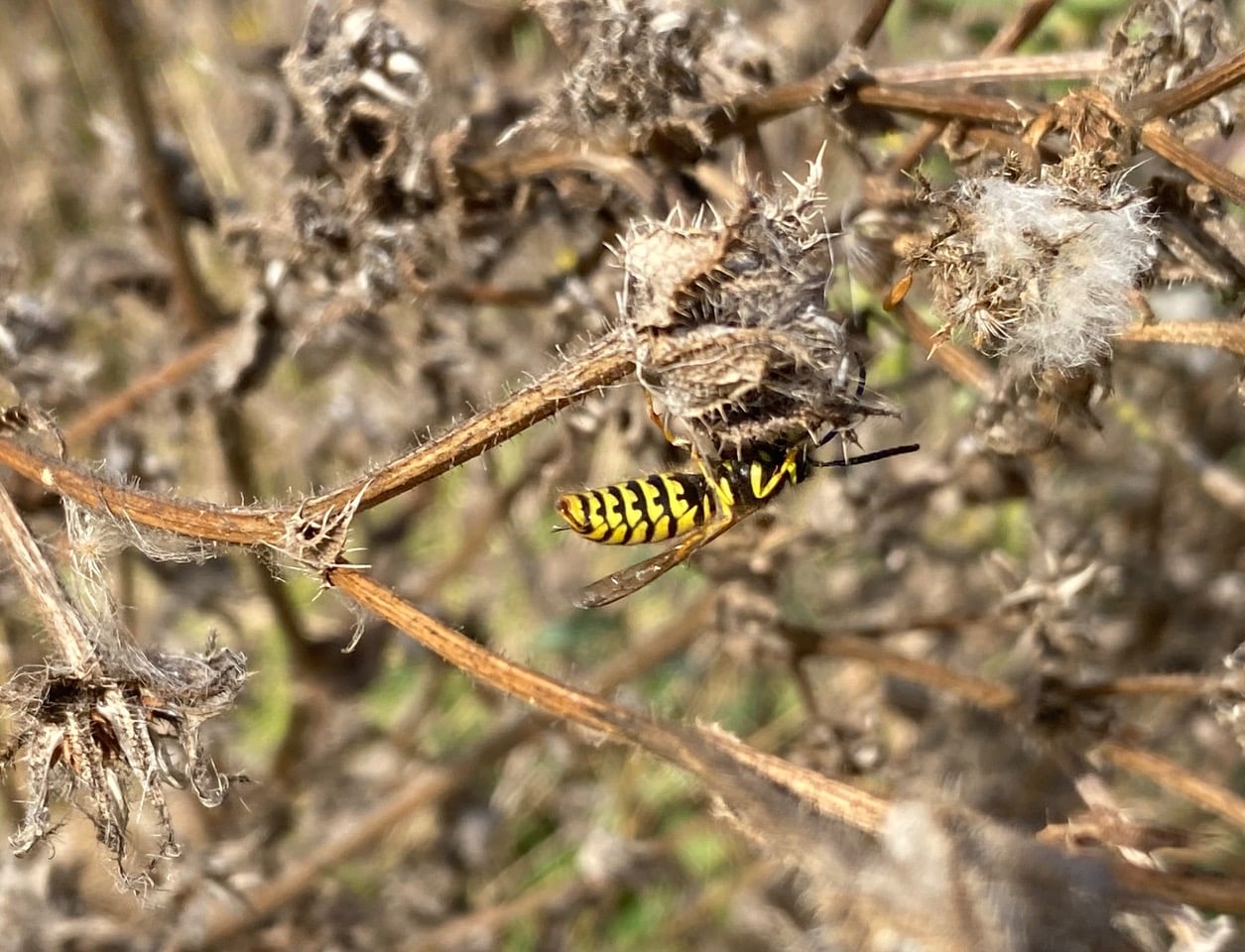
A male Yellowjacket is moving among the dried branches of a Bristly Oxtongue.

A lucky shot of the Yellowjacket drone as it lifts off.

An unidentified wasp is perched on a Bristly Oxtongue flowerhead.
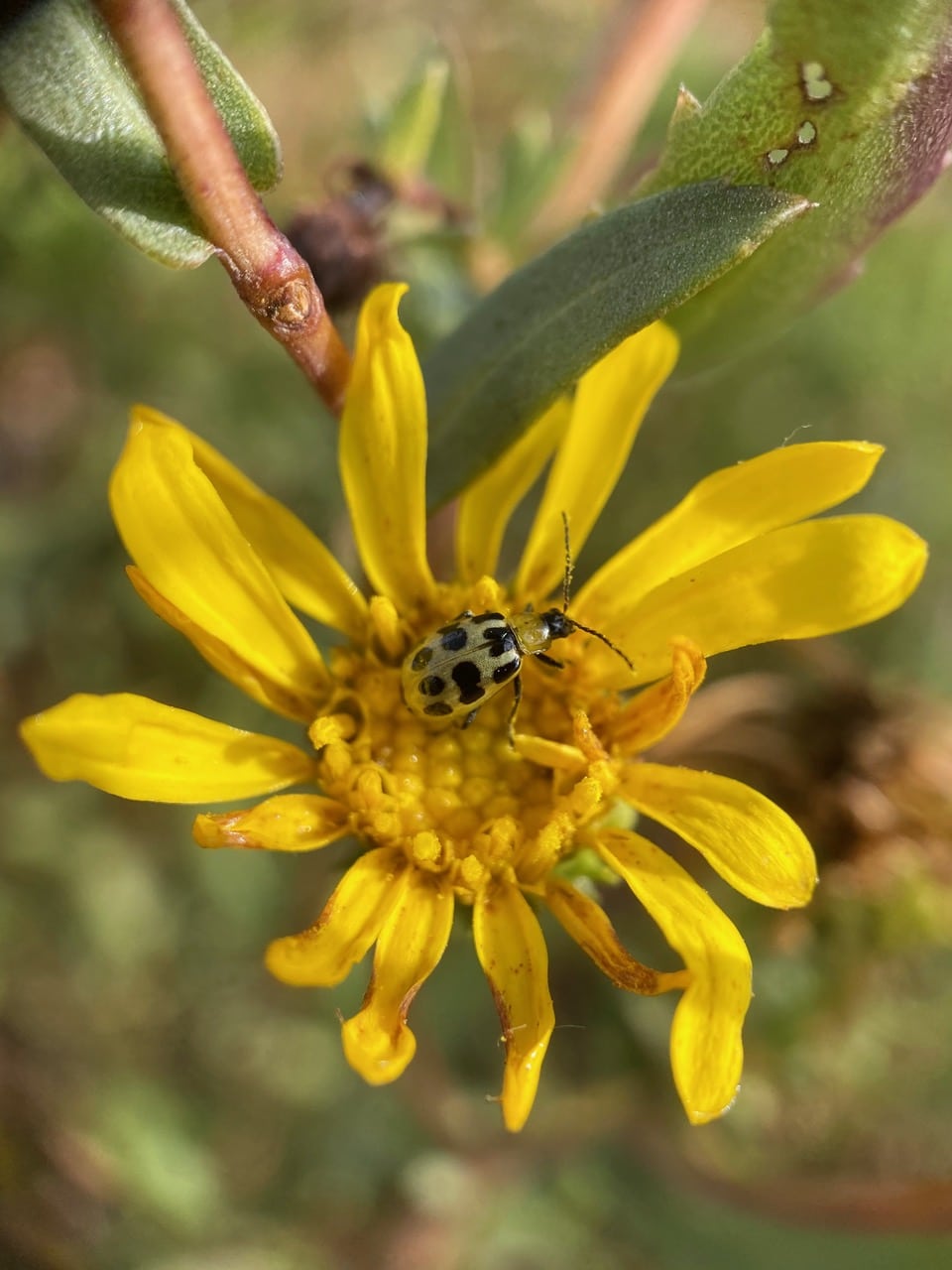
The Spotted Cucumber Beetle, Diabrotica undecimpunctata (family Chrysomelidae) remains a persistent presence on the Grindelia through the changing seasons, a phenomenon seen in most gardens. This is probably due to their versatile appetite for a wide variety of plants and plant parts.
Members of the family Chrysomelidae are commonly known as Leaf Beetles. Adults and larvae feed on all sorts of plant tissues, and all species are fully herbivorous. Many are serious pests of cultivated plants, including food crops. Others are beneficial due to their use in biocontrol of invasive weeds. Chrysomelids are popular among insect collectors, as many are conspicuously colored, typically in glossy yellow to red or metallic blue-green hues, and some have spectacularly bizarre shapes.
Native to North America, the Spotted Cucumber Beetle can be a major agricultural pest, causing damage to crops in the larval as well as adult stages of their life cycle. Larvae, sometimes known as rootworms feed on the roots of emerging plants. In the adult stage the beetles cause damage by eating the flowers, leaves, stems and fruits of the plant.
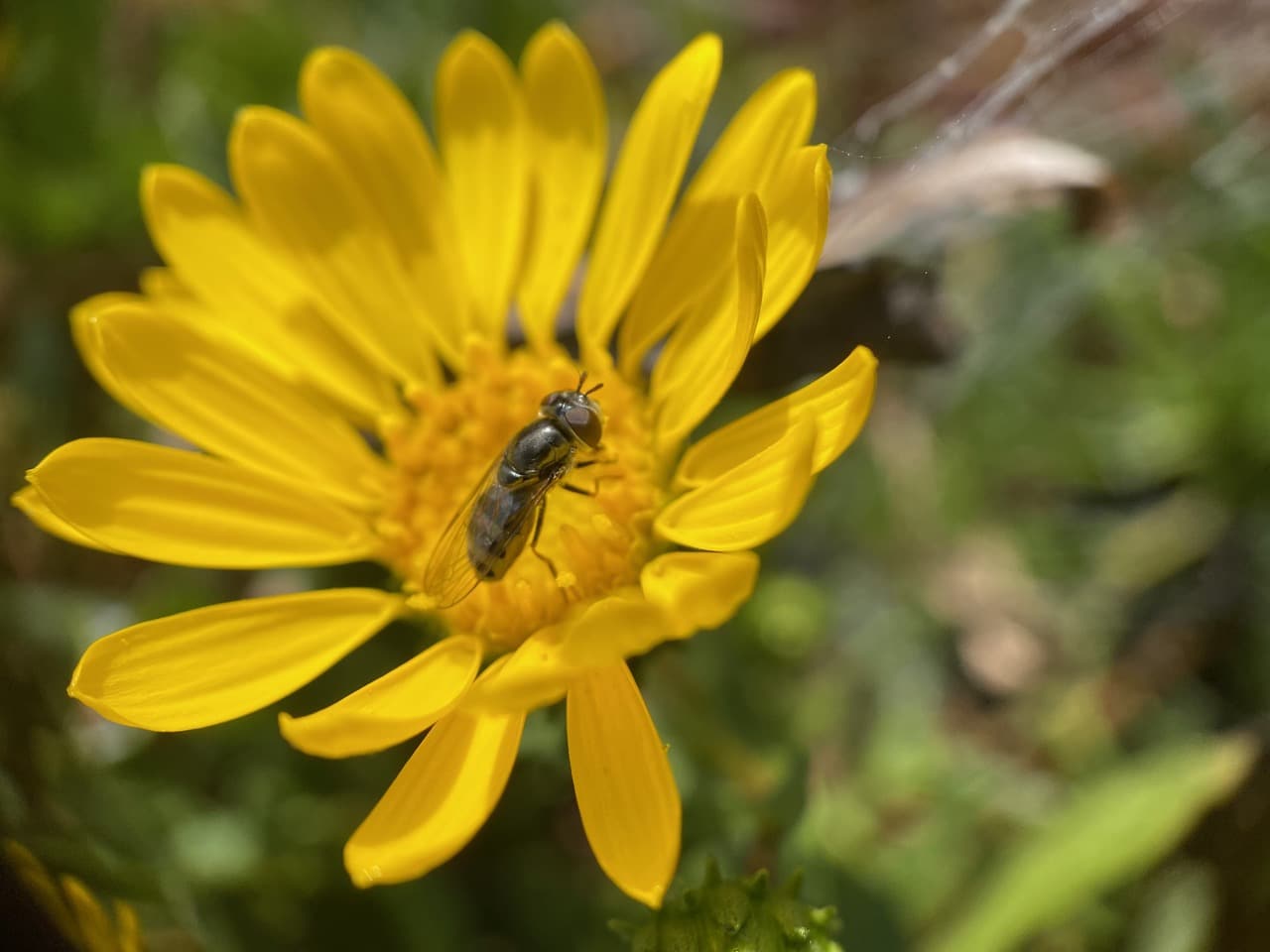
A dusky, metallic hover fly is feeding on pollen on a Grindelia flowerhead. It is easily recognizable as the Sedgesitter, Platycheirus sp. (family Syrphidae).
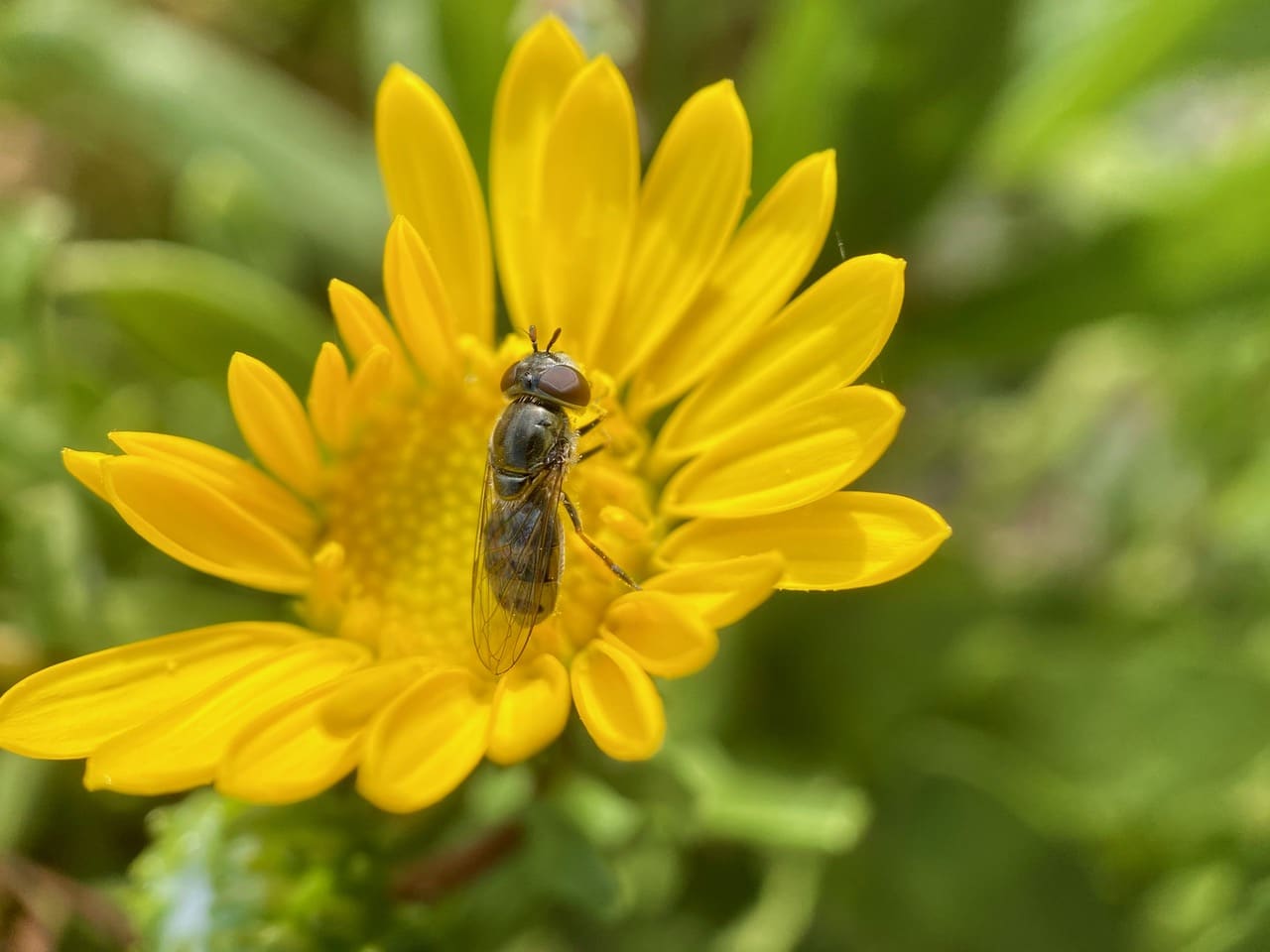
Platycheirus is found in grass and herb vegetation. Adults of many species feed on pollen of wind-pollinated plants, such as Salix, Plantago, Poaceae, Cyperaceae, but they visit other flowers also. Many stay active during cold and rainy weather. Larvae feed on aphids.
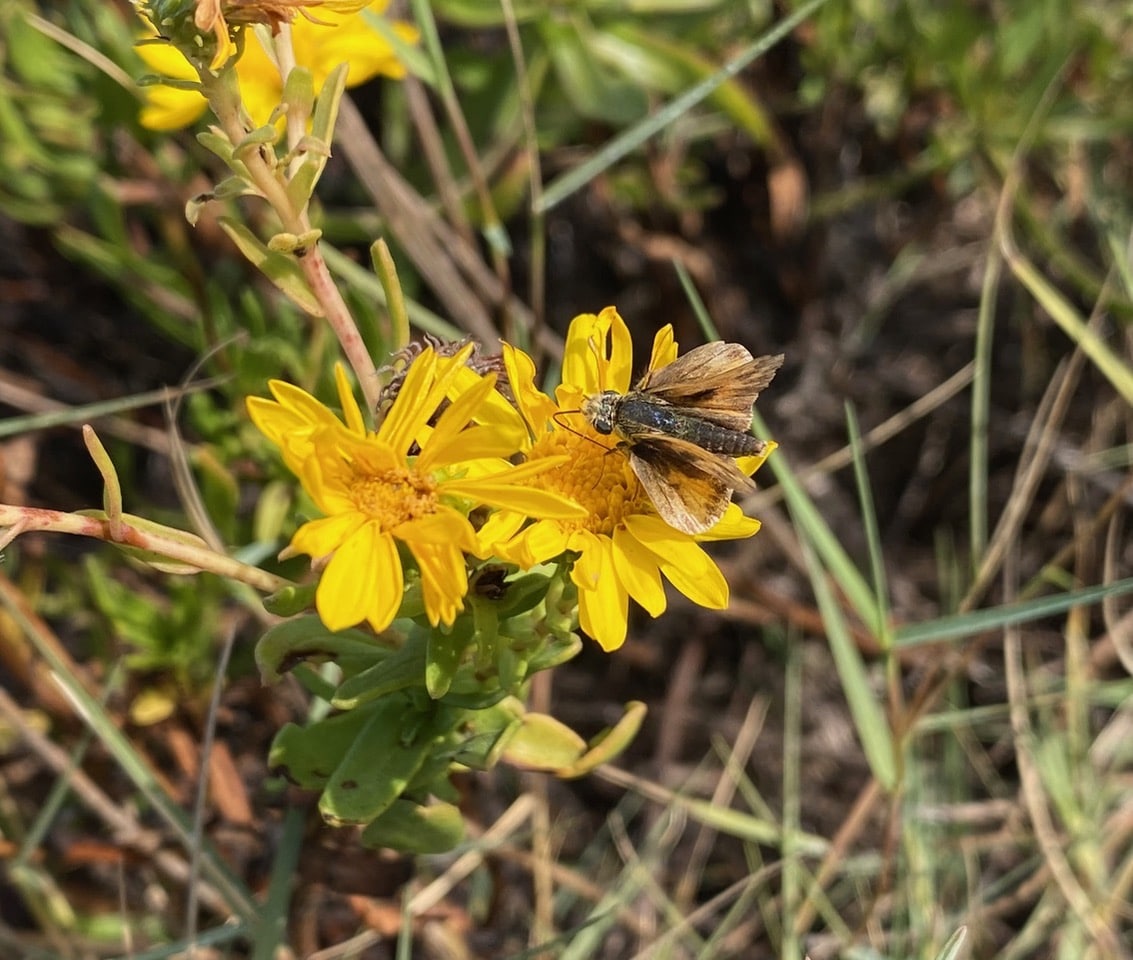
This is probably the oldest Skipper I have ever seen. The butterfly doesn’t show the typical orange and brown colors as it has lost most of the scales from its wings as well as its body. Amazingly, it can still fly well and is enjoying nectar from the Grindelia flowers.
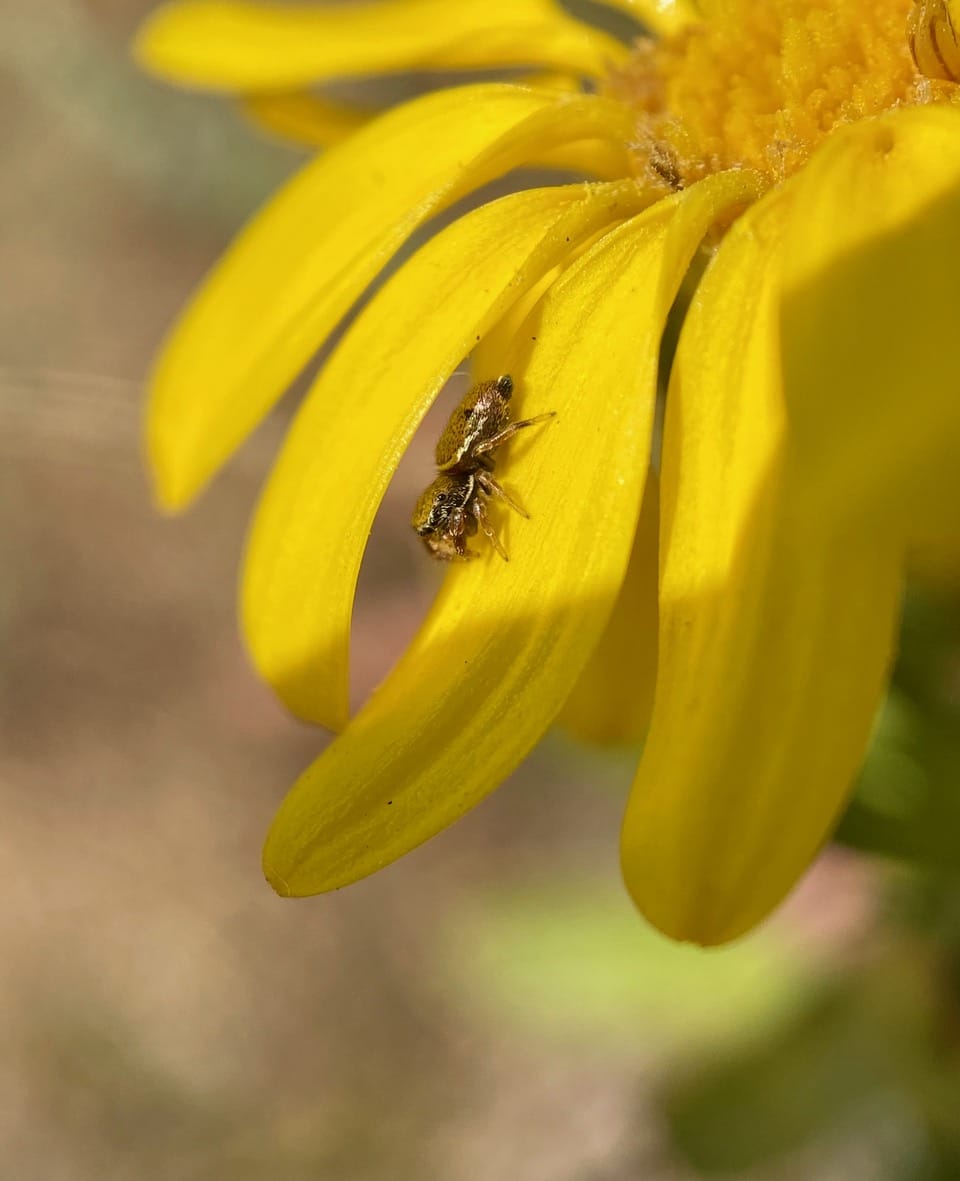
A Buttonhook Leafbeetle Jumping Spider, also known as the Grapevine Jumping Spider, Sassacus vitis (family Salticidae) is hunting on a ray petal of a Grindelia flowerhead. I must have seen at least half a dozen of these tiny spiders on the Grindelia today. The spiders are obviously well-adapted for this habitat.
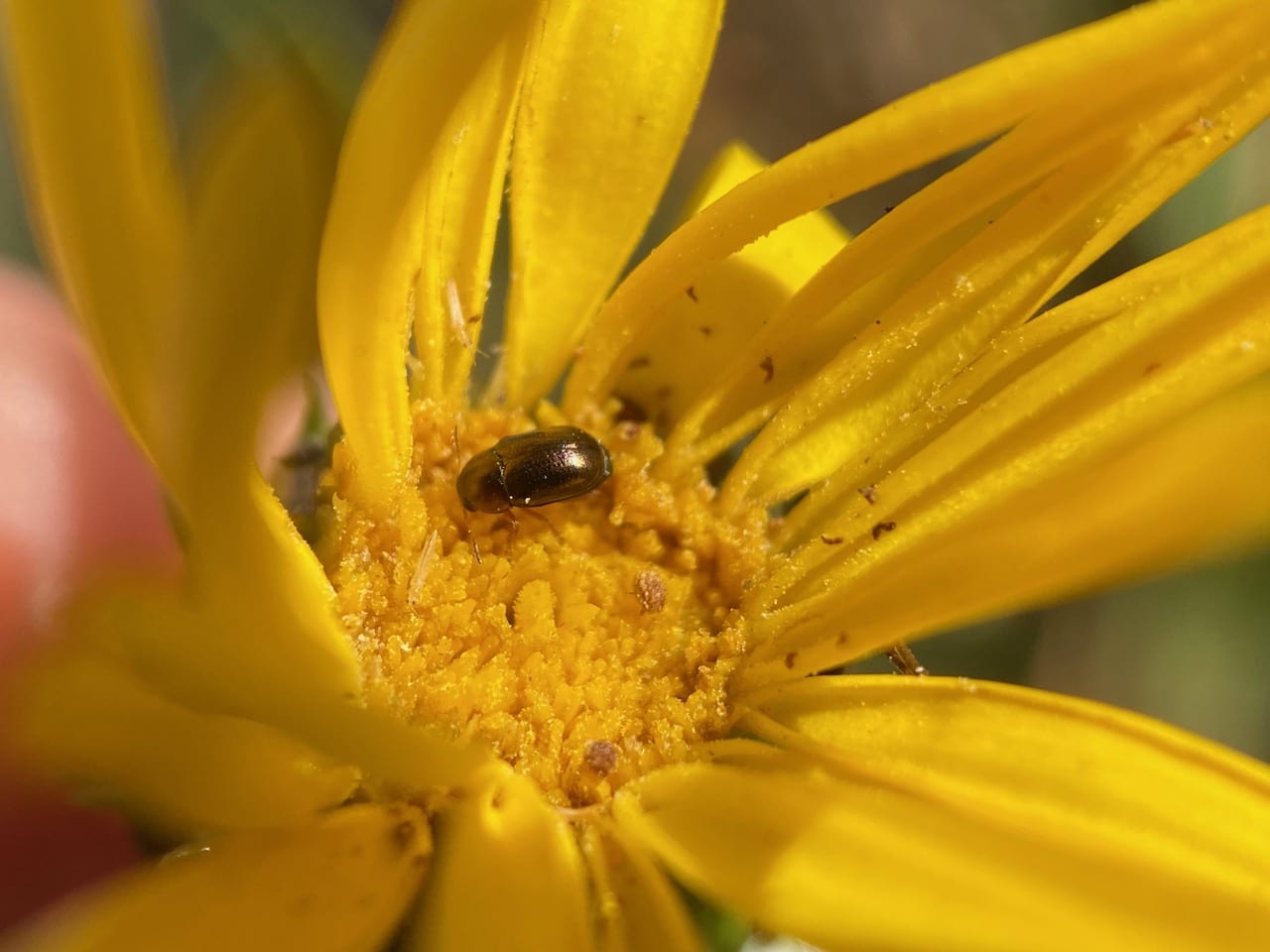
With similar metallic shine as the Grapevine Jumping Spider, a Bronze Leaf Beetle, Diachus auratus (family Chrysomelidae) is feeding on a Grindelia flowerhead. Note that all the florets of the flowerhead are missing their reproductive structures. Is the beetle responsible for all the damage?
Members of the family Chrysomelidae are commonly known as Leaf Beetles. Adults and larvae feed on all sorts of plant tissues, and all species are fully phytophagous. Many are serious pests of cultivated plants, including food crops. Others are beneficial due to their use in biocontrol of invasive weeds. Chrysomelids are popular among insect collectors, as many are conspicuously colored, typically in glossy yellow to red or metallic blue-green hues, and some have spectacularly bizarre shapes.
The Bronze Leaf Beetle, Diachus auratus is a species of case-bearing leaf beetle in the family Chrysomelidae, subfamily Cryptocephalina. It is found in Australia, the Caribbean, the Americas, Oceania, and Southern Asia. Adults, 1-2 mm, are found on many unrelated plants, especially plants in bloom. Case-bearing leaf beetles are found in two subfamilies within Chrysomelidae. As she lays her eggs, the female case-bearing leaf beetle covers each one with a layer of excrement. After the larvae hatch, they retain this covering (case) as camouflage and add to it throughout their larval life. When disturbed, the larvae pull in their head and legs; because their color and shape resemble caterpillar droppings they are ignored by predators. Eventually the larva seals the case to pupate inside, before emerging as an adult. Some species are myrmecophiles, living near or even inside ant nests.
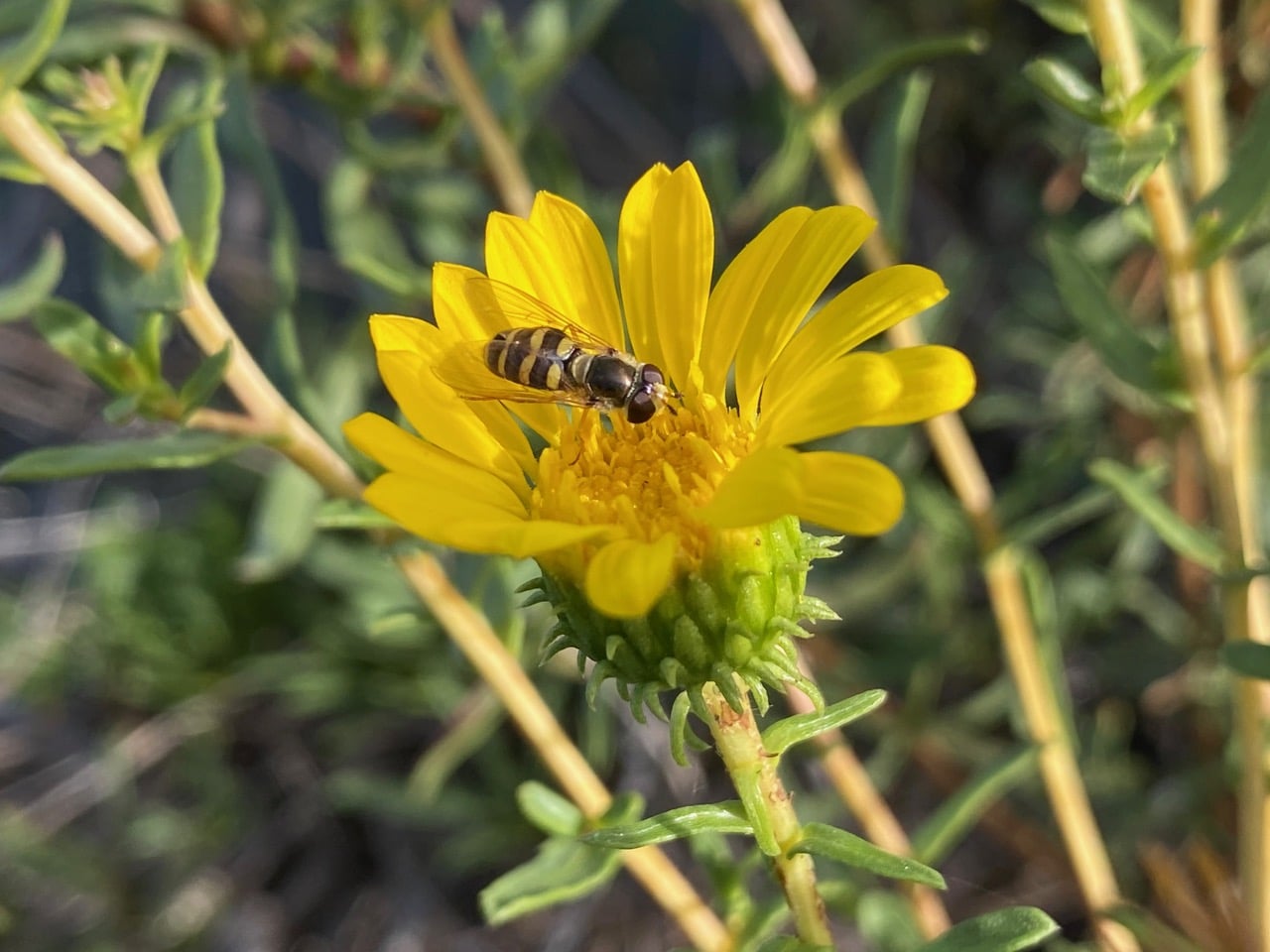
A Western Aphideater, Eupeodes fumipennis (family Syrphidae) lands on a Grindelia flowerhead. The hover fly is a perfect example of Batesian mimicry. It has black-and-yellow stripes on its abdomen, reminiscent of the stinging wasps and bees. The resemblance provides the harmless fly with a measure of protection from potential predators who may want to avoid confrontation with an aggressive insect.
The Western Aphideater, Eupeodes fumipennis (family Syrphidae) is found in western North America, mostly seen March through October. As the common name implies, larvae prey on aphids and other soft-bodied insects. Adults visit flowers for nectar and pollen.