

Pollinator Post Dec. 2024 (2)

12/22/24 Regional Parks Botanic Gardens.
The bright red swellings on the edges of the leaves of a manzanita catch my eyes. I recognize them as the leaf galls induced by the aphid, Tamalia coweni (family Aphididae). Much as I’d like to satisfy my curiosity, I refrain from breaking open one of them in this public garden.
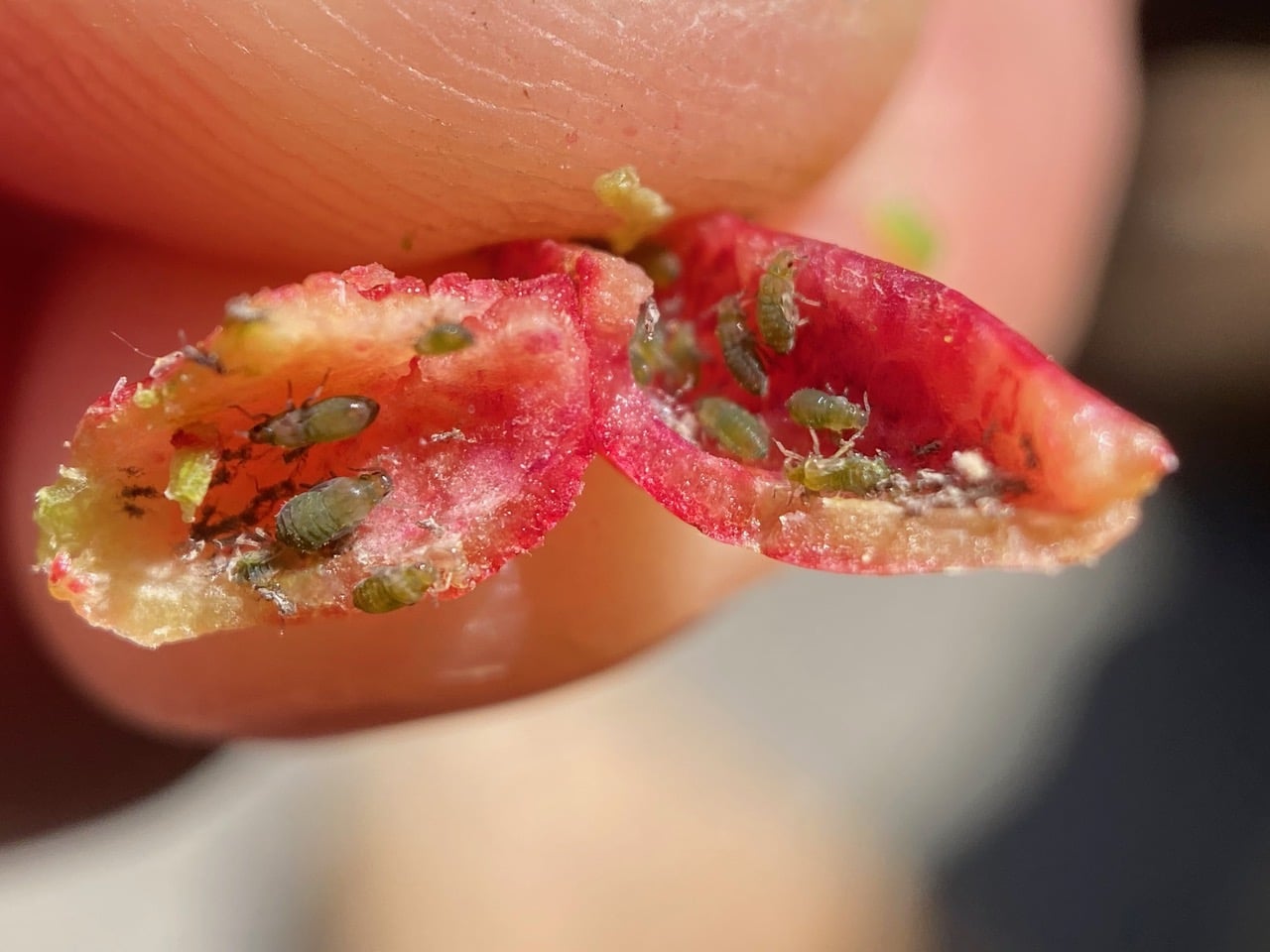
Here’s a photo from 6/19/24. My friends and I examined the contents of one of those manzanita leaf galls in a friend’s garden. Tiny olive-colored aphids spilled from the thick-walled gall as Ben opened it up with his fingers.
The Manzanita Leaf-gall Aphid, Tamalia coweni (family Aphididae) is a widespread species native to the west coast of North America. Feeding by the aphid on Arctostaphylos leaves induces red or reddish-green pod-shaped galls within which the aphids feed and develop. The tiny, gray or greenish aphids feed by sucking on tissue within the leaf galls. These aphids feed only on manzanita. Throughout most of the year adult females (which may be winged or wingless) give birth to live young without mating. In the fall, a sexual generation of winged males and females is produced. The winged aphids disperse, mate, and the females lay overwintering eggs on bark at the base of the plant. Eggs hatch in late winter or spring and the emerging aphids walk up to the leaves, settle to feed, and initiate galls. They have several generations per year. The galls do not significantly affect plant health, but some consider them aesthetically objectionable.
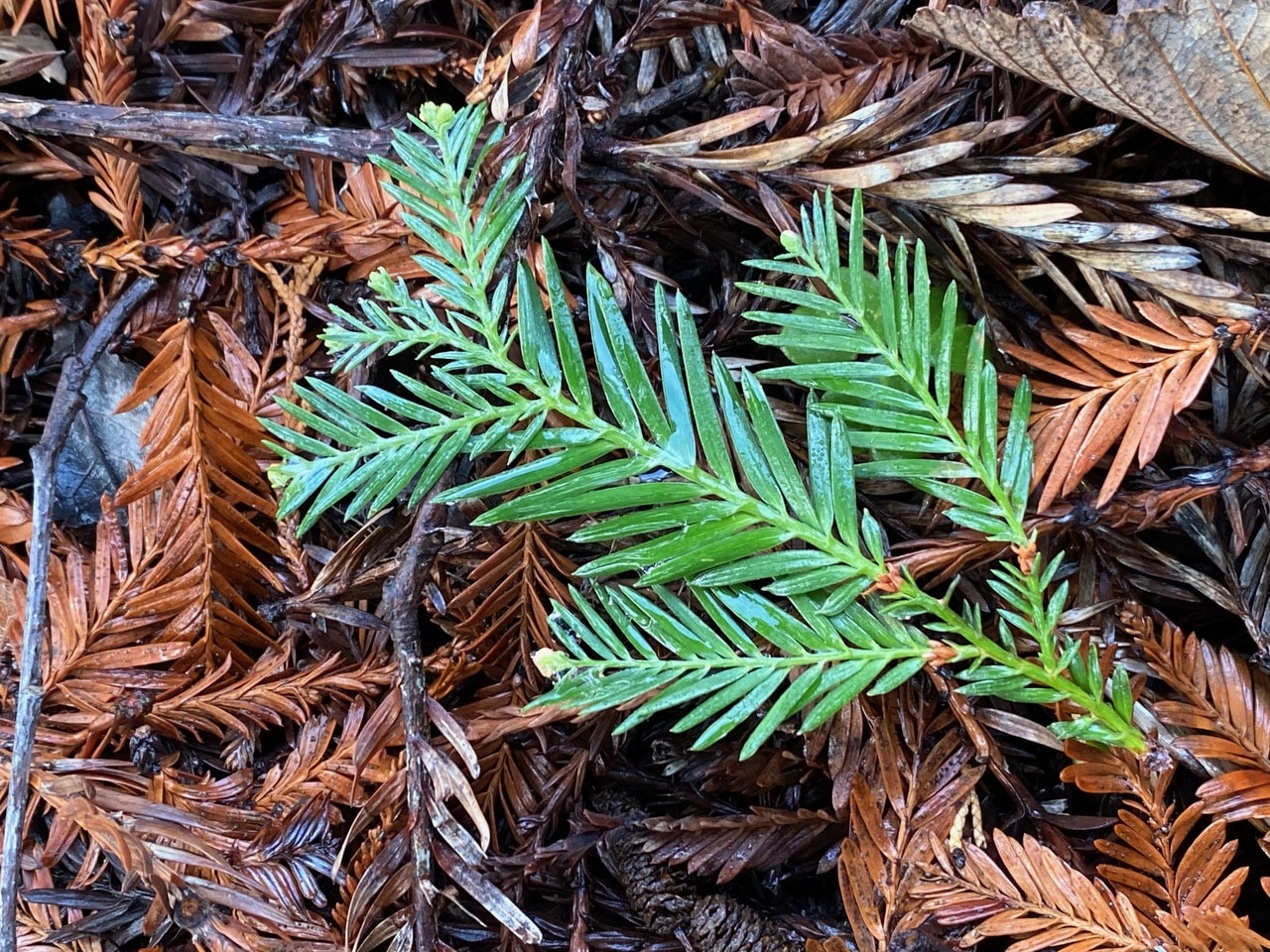 Walking through the redwood section of the garden, I find many green sprigs that have been broken during the storms now lying on the forest floor.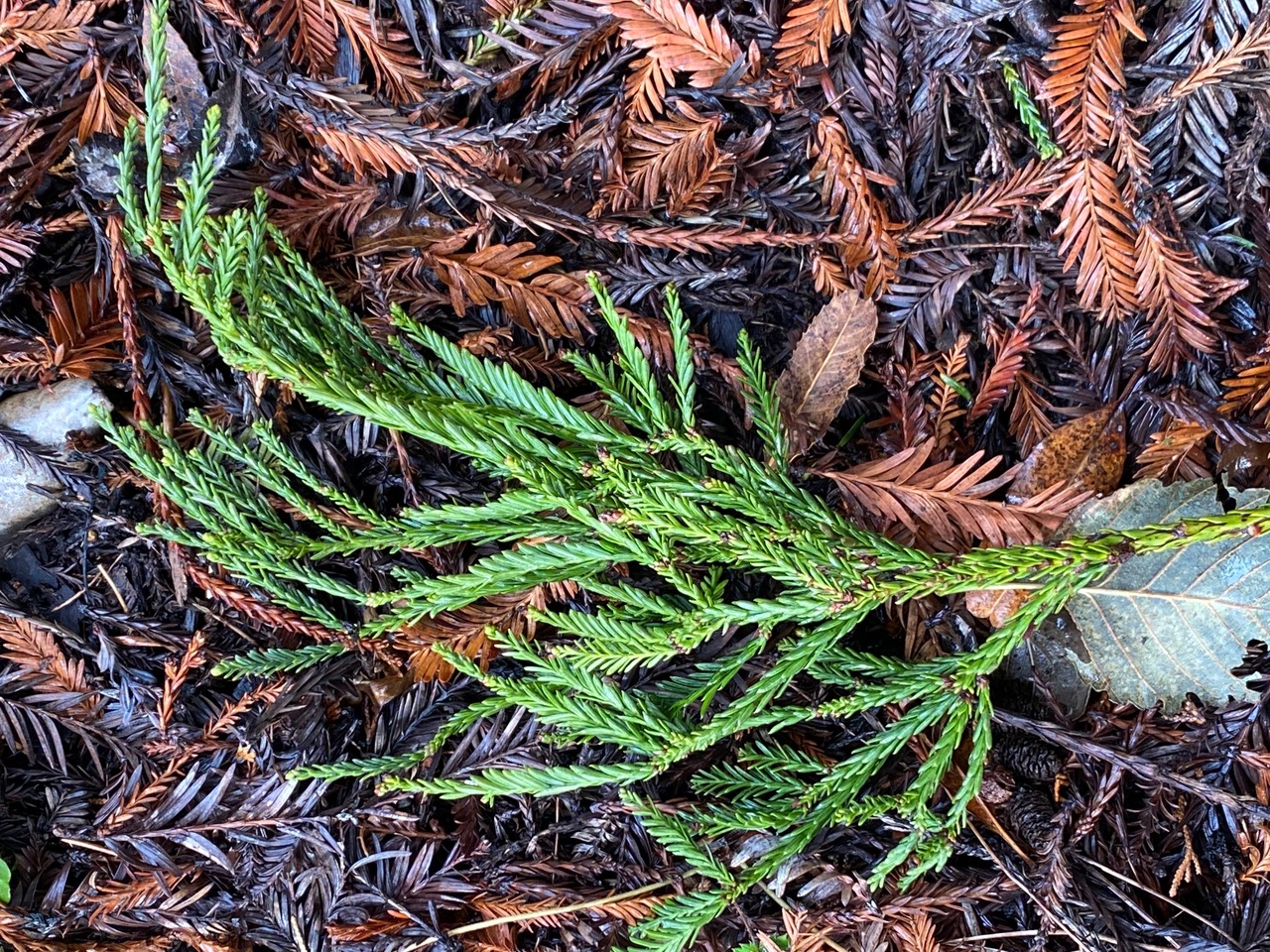
Then I come across some fallen redwood foliage that are distinctly different. These are the axial shoots broken off from the tops of the trees, usually found on the forest floor only after severe storms.
The Coast Redwood, Sequoia sempervirens, have two types of leaves, one to make food and the other to absorb water. The peripheral leaf (shown in the previous photo) spends its working hours making the tree’s food – converting sunlight into sugar through photosynthesis. The other, the axial leaf, does almost nothing to help with photosynthesis. Instead its specialty is to absorb water.
In wet forests, photosynthesis can be inhibited by films of water covering leaf stomata when they get wet. For redwoods, the different leaf types allow the trees to get wet and still be able to photosynthesize. The peripheral leaves have a waxy coating that slows water absorption but may help them continue photosynthesis throughout the wet season. Resembling asparagus stalks with leaves bunched close to the twig, the axial shoots make up a small portion of the canopy but absorb water at about four times the rate of the peripheral shoots. A study at UC Davis has found that a large redwood can absorb up to 14 gallons of water in just the first hour its leaves are wet.
In the wet, rainy north coast, the water-absorbing leaf type is found on the tree’s lower branches, leaving the upper, sunnier levels to the photosynthesizing leaf type. In their drier southern range, the water-collectors live among the tree’s higher levels to take more advantage of fog and rain.

At the far end of the garden, I again encounter the tiny Chalcidoid wasp in the family Pirenidae – on a cluster of manzanita flowers.
Most Chalcid species are parasitoids of other insects, attacking the eggs or larval stage of their host, though many other life cycles are known. These hosts are to be found in at least 12 different insect orders including Lepidoptera (butterflies and moths), Diptera (true flies), Coleoptera (beetles), Hemiptera (true bugs), and other Hymenoptera, as well as two orders of Arachnida. When the host is itself a parasitoid, the wasps are referred to as hyperparasitoids. Generally beneficial to humans as a group, chalcidoids help keep various crop pests under control, and many species have been used as biocontrol agents.
Members of the family Pirenidae are parasitoids or hyperparasitoids of insect eggs and larvae.
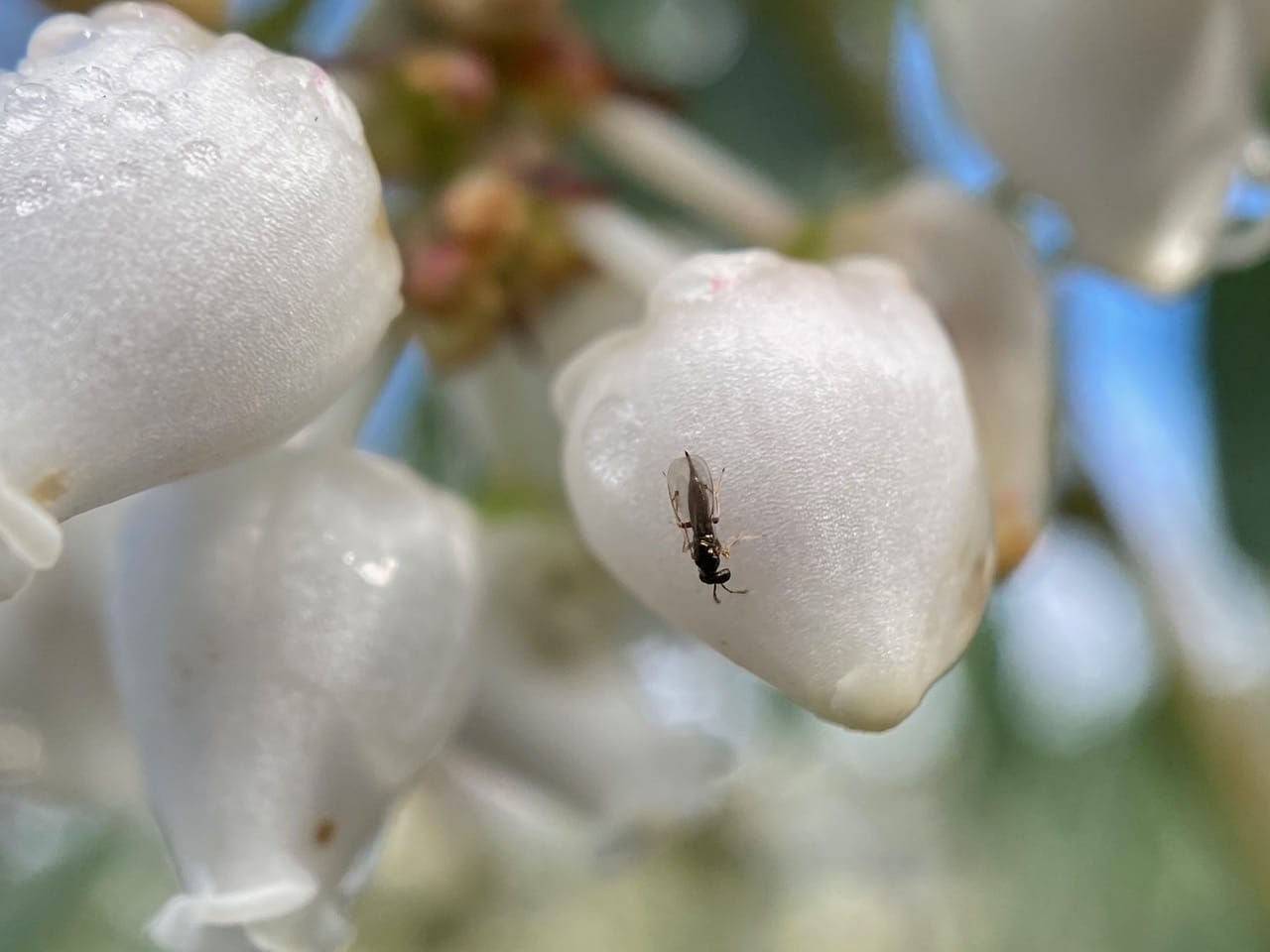
It is a female, with a sharp ovipositor extending from the tip of its abdomen. What is it doing here? Does it have a special relationship to manzanita?

12/31/24
Near the front gate of the garden, the Coast Silk-tassel, Garrya elliptica is already blooming. I stop to admire the long hanging chains of flowers (catkins) on this male plant.
The Coast Silk Tassel, Garrya elliptica (family Garryaceae) is an evergreen shrub or small tree. It is dioecious, meaning male and female flowers are borne on separate plants. Flowers appear in winter, male catkin-like clusters are yellowish to greenish then gray, 8-20 cm long (“silk tassels”), female flower clusters are shorter, 5-9 cm long.
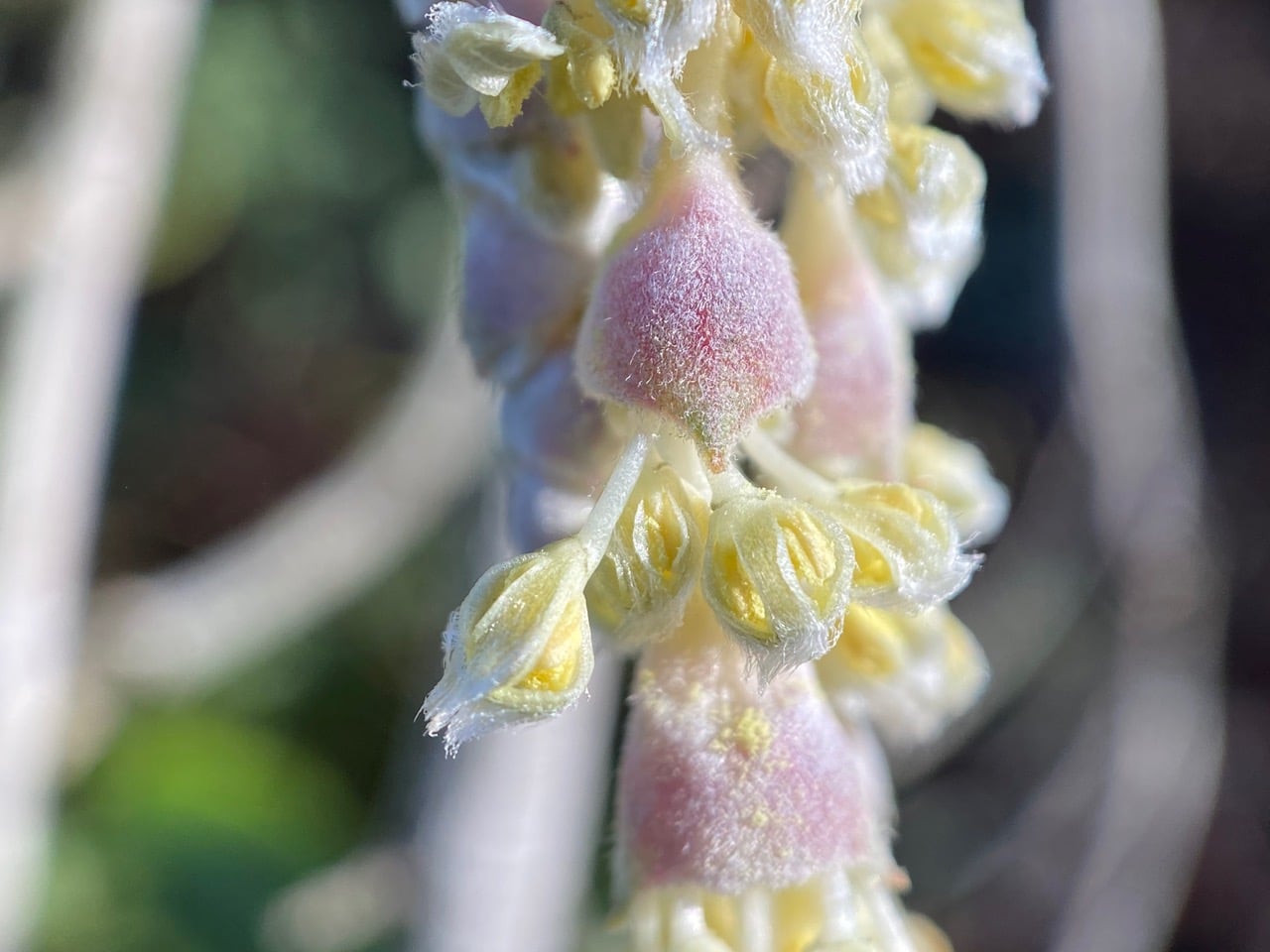
Close-up of the silky male catkins of the Coast Silk Tassel. Within each catkin, tiny male (staminate) flowers are clustered and subtended by two bracts that are fused and form a cup or bell-shaped structure. The flowers are highly reduced, lacking petals. These flowers are wind-pollinated. As the wind blows, pollen is shaken out of the exposed stamens. What a clever design, and so beautiful!
Coast Silk Tassel is an example of plants that are wind pollinated. About 12% of flowering plants and most conifers are wind pollinated. These plants do not waste energy on flower features that attract animal pollinators; instead, their flowers generally have these characteristics:
– Small, petalless, and unscented, with muted colors.
– No nectar
– Stamen (male flower part) and stigma (female pollen-receiving part) are exposed to air currents.
– Male flowers produce a great deal of pollen, which is very small, dry, and easily airborne.
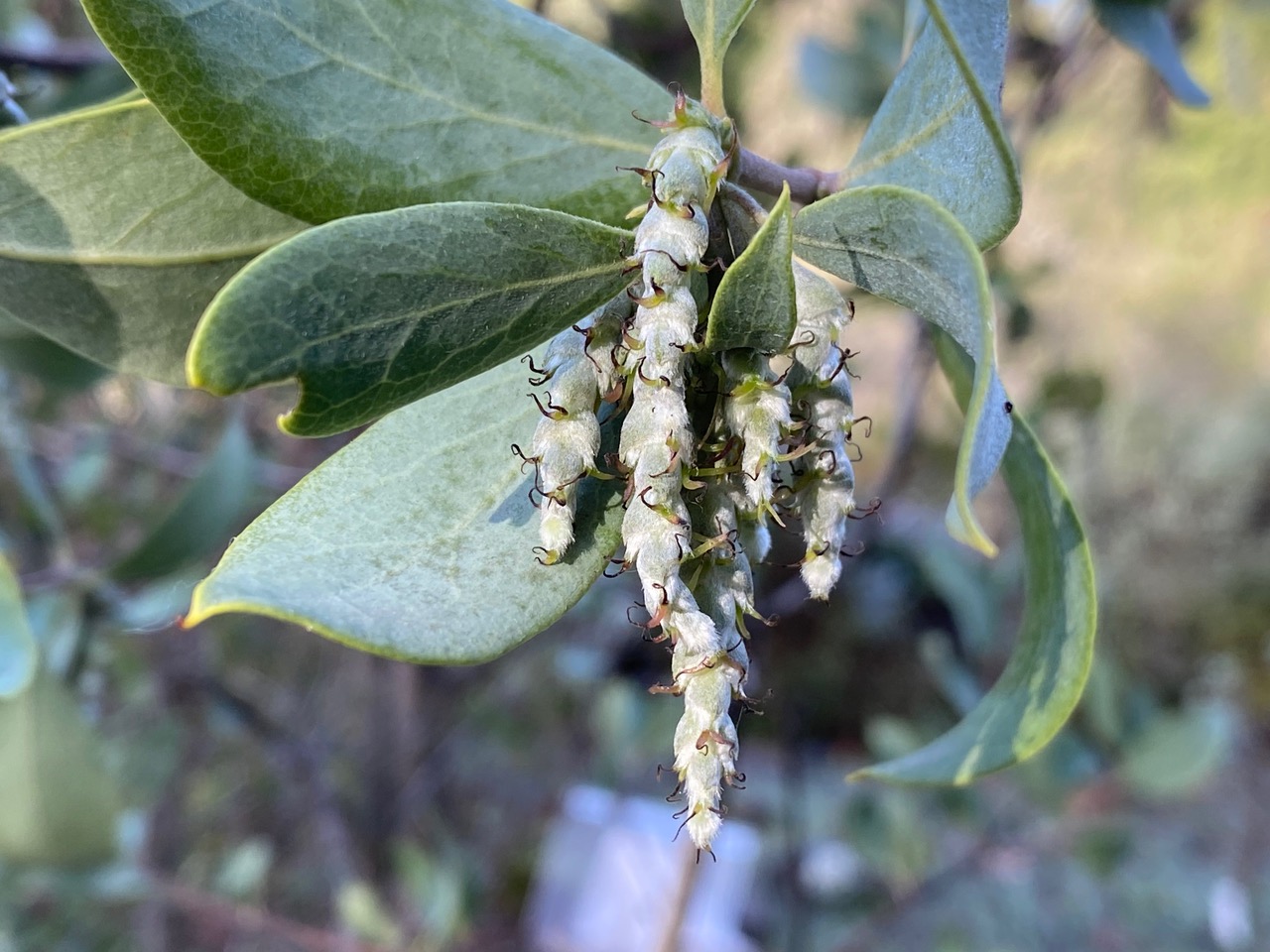
Not far away, a female Coast Silk-tassel is in bloom. Female catkins are shorter, about 3-4” long. Simple styles protrude from the bell-shaped cups of the flowers. The stigmas on the tips receive airborne pollen from male catkins.

The most common insects visiting the manzanita flowers today are the Bluebottle Flies, Calliphora sp. (family Calliphoridae). They are too large to enter the urn-shaped flowers, but are apparently content to scavenge for spilled nectar or pollen on the outside.

The Calliphoridae are variously known as blow flies, carrion flies, greenbottles, and bluebottles. Adults are usually brilliant with metallic sheen, often with blue, green, or black thoraces and abdomens. There are three cross-grooves on the thorax; calypters are well developed. Females visit carrion both for proteins and egg laying. The larvae that hatch feed on dead or necrotic tissue, passing through three instars before pupation. After the third instar, the larva leaves the corpse and burrows into the ground to pupate. Adult blow flies are occasional pollinators, being attracted to flowers with strong odors resembling rotting meat. The flies use nectar as a source of carbohydrates to fuel flight.

An unfamiliar hover fly is exploring a cluster of manzanita flowers.
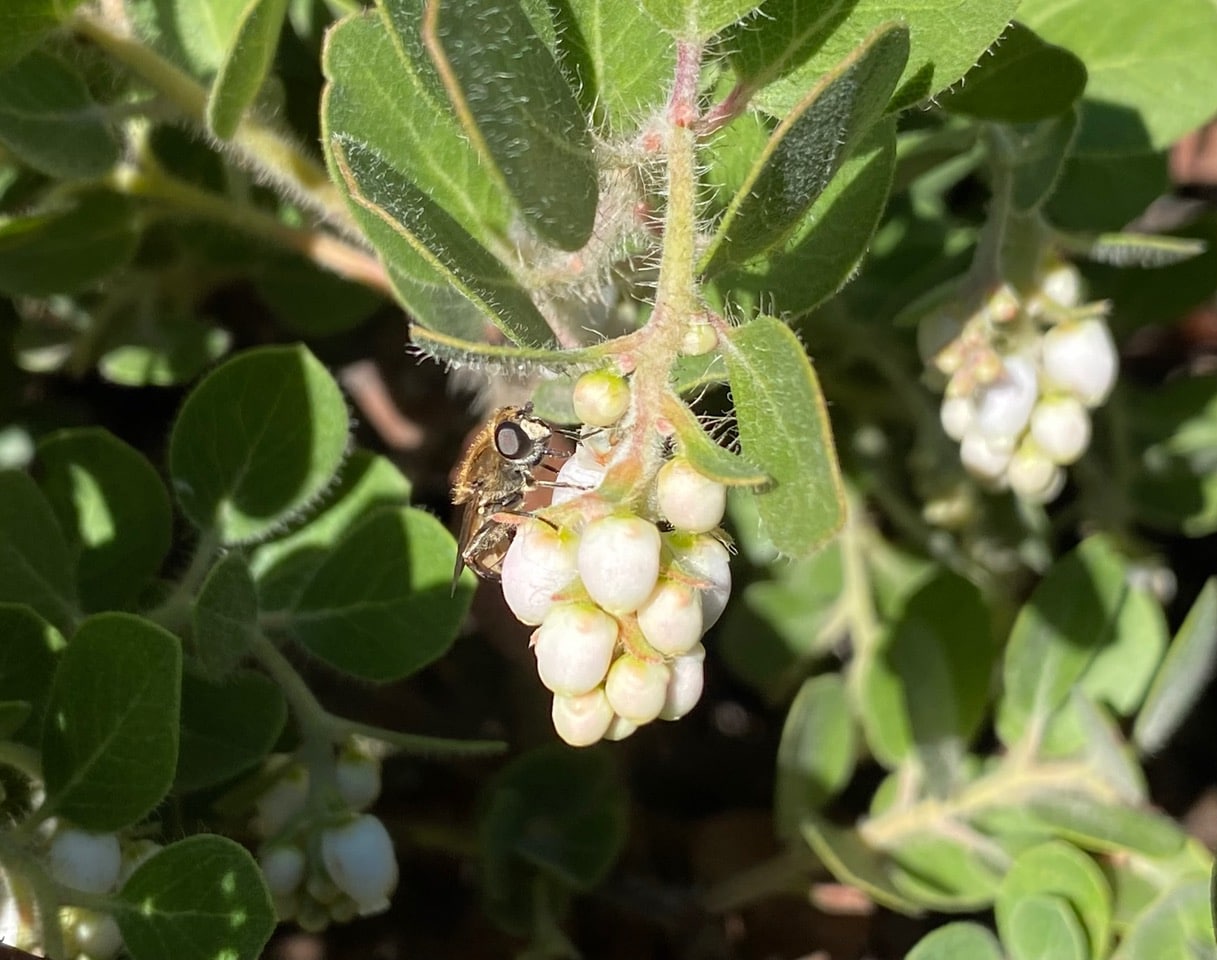
It has a beaked, white face. iNaturalist has identified it as a Common Sickleleg, Asemosyrphus polygrammus (family Syrphidae).
The hover fly is found in western North America. Appropriately, Polygrammus means “marked with many lines”, probably referring to the patterns on the thorax. The common name ‘sickle-leg’ probably refers to the bow-shaped tibia of the hind legs. Adults visit flowers for nectar and pollen. Larvae are rat-tail maggots. The maggots are most commonly found in dank and decaying environments such as compost, pond margins, and tree rot holes. The larvae feed on the decomposing material which is poor in oxygen but rich in organic matter. The “tails” are the siphons or breathing tubes that extend from their rear end to enable the larvae to breathe while submerged in the wet substrate. When mature, the larvae climb out to pupate on dry land. The larvae are important decomposers/recyclers and the adult flies are important pollinators.
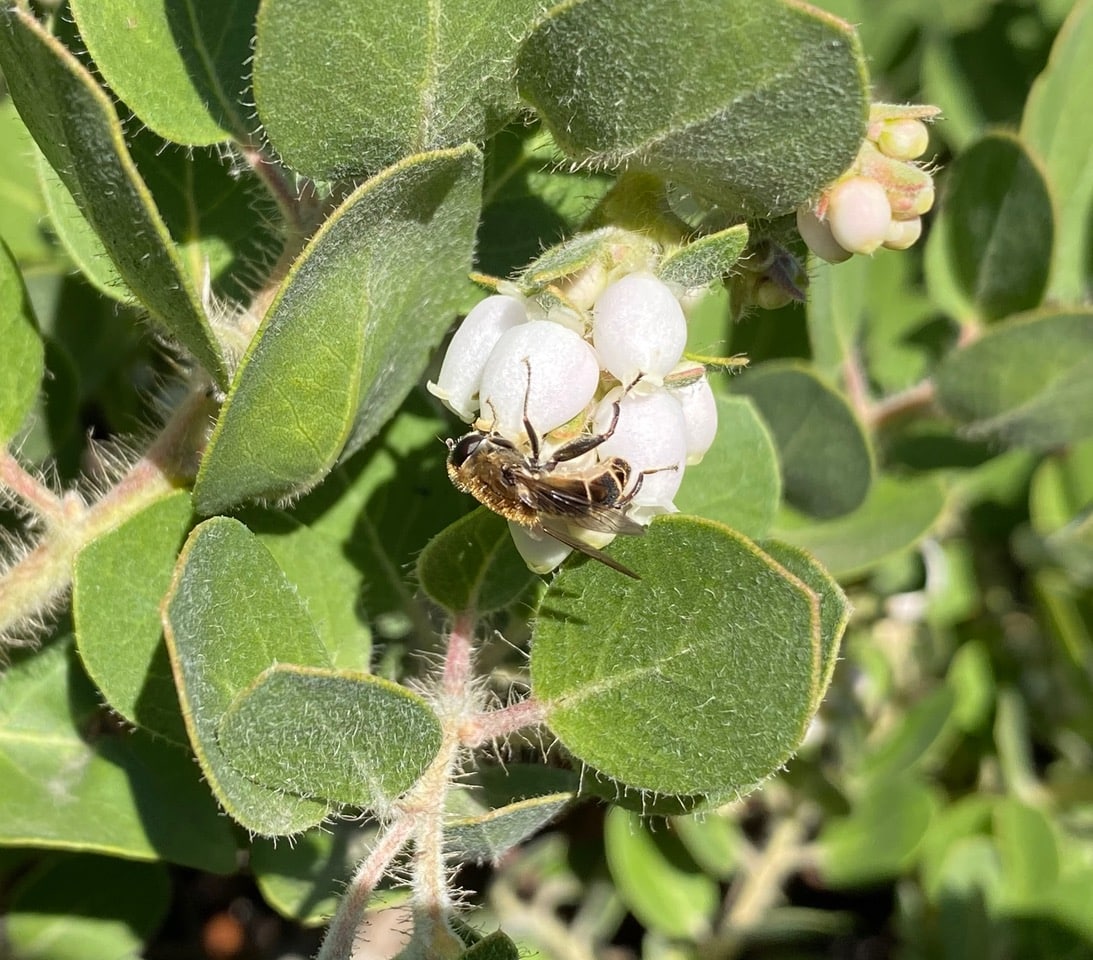
Ah, now we can see the bow-shaped tibia of the hind legs from which the fly gets its common name.

Voles are apparently active here – this runway has been worn deep into the lawn leading from a dense stand of prostrate manzanita.

About 10 feet away, the narrow runway ends in a dense stand of Oregon Grape.
The California Vole, Microtus californicus inhabits areas of broad-leaved chaparral, oak woodlands, and grasslands along the Pacific Coast of Baja California to central Oregon. It is also known as the “California meadow mouse”, a misnomer as this is not a mouse, but a species of vole, small rodents that are relatives of lemmings and hamsters. The California Vole has a short tail, compared to the mouse. California voles are semifossorial. Their microhabitat consists of burrows, grass runways, and earth tunnels where piles of grass cuttings and fresh vegetation, their primary food items are often found. Piles of feces are also found in the runways. Voles spend as little time exposed to the surface as possible. Underground tunnels are commonly used as are runways throughout grasslands. Unfortunately for the voles, the urine they use to communicate to each other is the way their diurnal predators track them. With their ability to see ultraviolet light, the raptors are able to see the florescent urine in the runways. There are a great number of vole predators, including coyotes, kestrels, hawks, weasels, owls, snakes, herons. Because of their rapid reproduction and periodic high population densities, these voles are a keystone prey species.
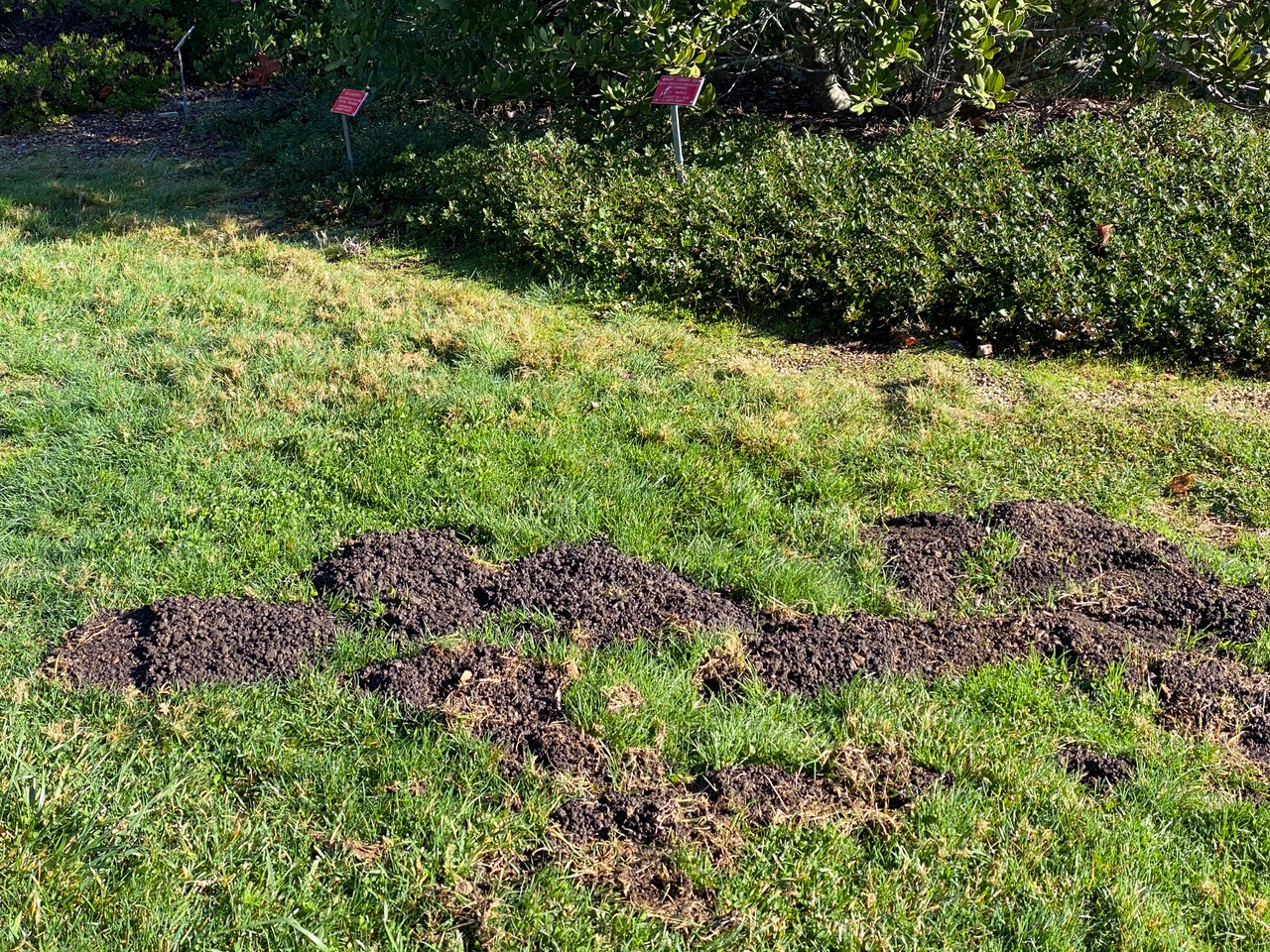
Gophers have obviously been very busy tunneling in the same lawn area. It is good to see that the garden provides habitat for local wildlif
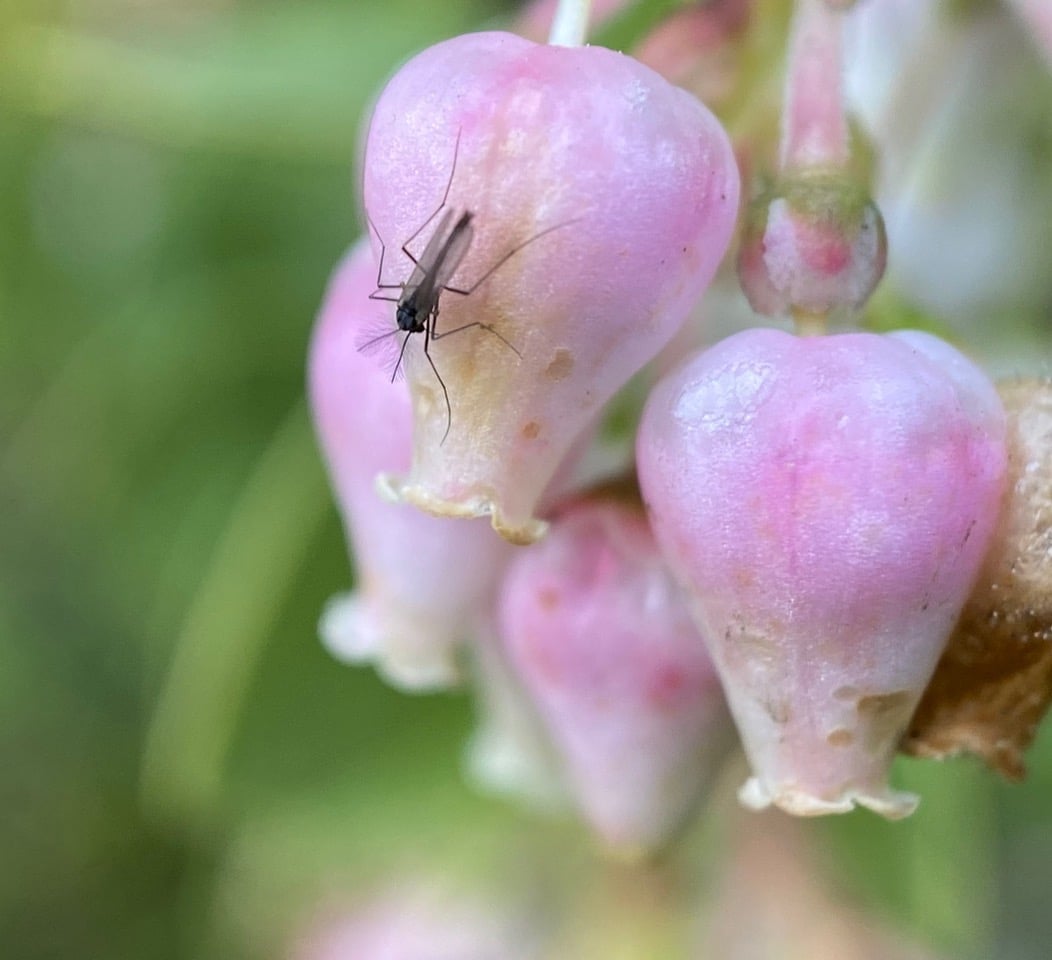
A tiny mosquito-like insect is moving around on a cluster of manzanita flowers. With the macro lens, I see that it has prominent bushy antennae. A male Non-biting Midge in the family Chironomidae? I am not sure I could recognize a female.
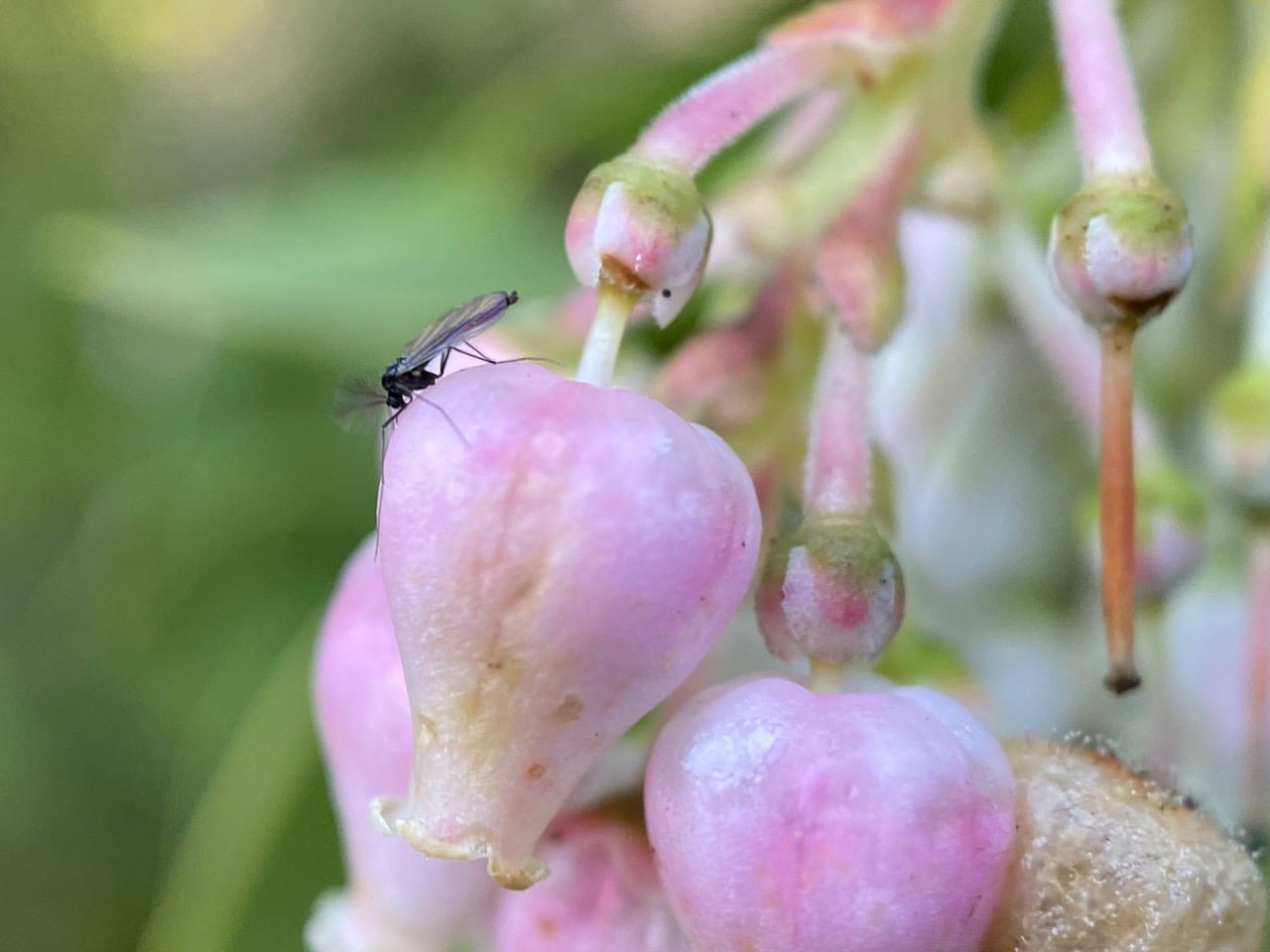
The Chironomidae is a large and diverse family of flies, with over 20,000 species known world-wide. Adult midges are small, most measuring 1-10 mm long, with narrow bodies and long legs. They resemble mosquitos, but do not bite. Males have long, feathery (plumose) antennae. Adults are short-lived. They feed on fly droppings, nectar, pollen, honeydew, and various sugar-rich materials. Larvae are mostly aquatic or semi-aquatic; most occur in freshwater habitats, a few occur in decaying matter, under bark, in moist ground, or tree holes. Larvae are mostly scavengers/detritivores. Collectively, they play a vital role in freshwater ecosystems as primary consumers. They harvest an enormous amount of energy from detritus and are important food items for fish, amphibians, birds, and predatory insects such as dragonflies and dance flies. Adult Chironomids can be pests when they emerge in large numbers, forming mating swarms over water or road surfaces.
