

Pollinator Post 1/22/25 (1)
As an asthmatic, I am resigned to let air quality dictate where and when I venture outdoors on a daily basis. It seems I am heading for higher elevations again this morning – to the Regional Parks Botanic Gardens. It’s a pleasure anyway, to visit this beautiful garden up in the Berkeley hills. Ever wonder how air pollution may affect our insect pollinators? A few months ago, a study reported that pollinators including bees, moths and butterflies experienced a 39% decline in foraging efficiency after being exposed to elevated air pollution levels.
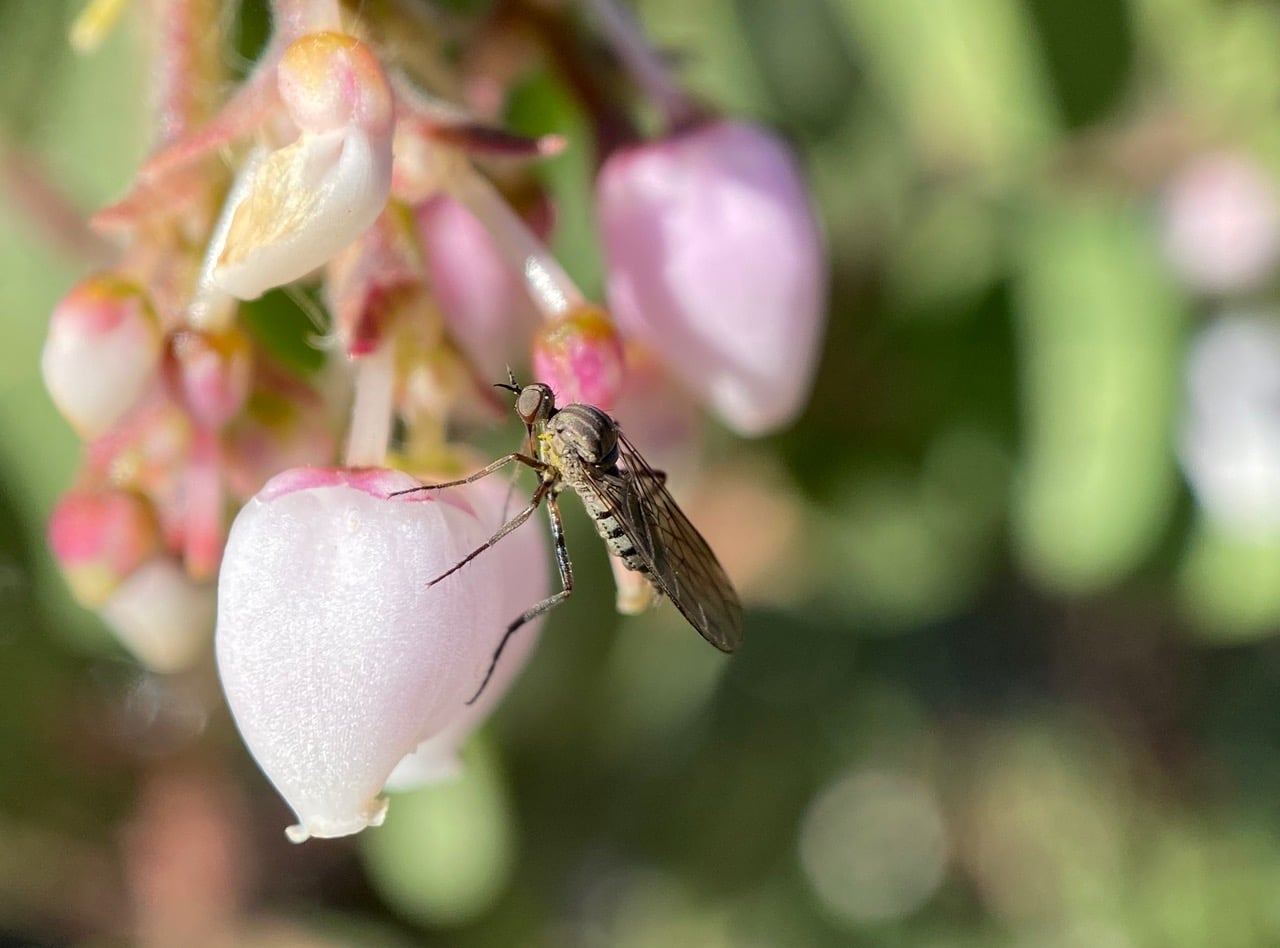
I focus on a little mosquito-like insect that has landed on a manzanita flower. Ooh, it has a long proboscis! A Hybotid Dance Fly, family Hybotidae?
The Hybotid Dance Flies belong to the superfamily Empidoidea and were formerly included in the Empididae as a subfamily. Empididae generally have a thick beak pointing down, while Hybotidae have a thinner beak, or a thick beak pointing forwards or diagonally. Some crucial wing venation further distinguishes the two families. Precious little is known about the life cycle and biology of Hybotids because they are not considered of economic consequence. Since their forelegs are generally not raptorial, I doubt if they’re predaceous like the Empidids. Some Hybotids are known to eat pollen. I have seen Hybotids visit flowers for nectar and pollen, notably on Soap Plant, Miner’s Lettuce, California Saxifrage, Wild Geranium, Hound’s Tongue and Buttercups, and I believe they may contribute to the pollination of these small wildflowers.
Why the name “dance fly”? This is derived from the mating swarms of males of many species. They gather in clouds over prominent objects, each individual seeming to bounce or “dance” in mid-air. Many other flies do this, notably midges, but the Empidids and the Hybotids got the moniker.

The insects zipping around the manzanitas buzzing noisily today are not limited to bumble bees. There’s a new kid on the block – the Pacific Digger Bees, Anthophora pacifica. About the size of an average worker bumble bee, robust in build, and fuzzy gray all over, they are fast and noisy fliers. Best described as frenetic, they are a nightmare to photograph. They are as numerous on the manzanitas today as the bumble bees.

Ah, what a pleasure to find a placid insect that is easy to photograph! A Bumblebee Catkin Fly, Brachypalpus alopex (family Syrphidae) is foraging on a cluster of manzanita flowers.
The Bumblebee Catkin Fly, Brachypalpus alopex is an uncommon species of hoverfly. Hoverflies get their names from the ability to remain motionless while in flight. They are often found around and on flowers, feeding on nectar and/or pollen. The larvae of the Bumblebee Catkin Fly are of the rat-tailed type, feeding on decaying sap under tree bark. Rat-tailed maggots are so named for having a long tail-like siphon on their abdomen that helps them breathe in liquid or semi-liquid environment.

The fly appears to have extruded a mustache-like structure from a central shaft on its face, separate from its antennae. Not sure what that is – I wish I could see it better. There is only one photo on iNaturalist that shows this feature. What is the structure used for?
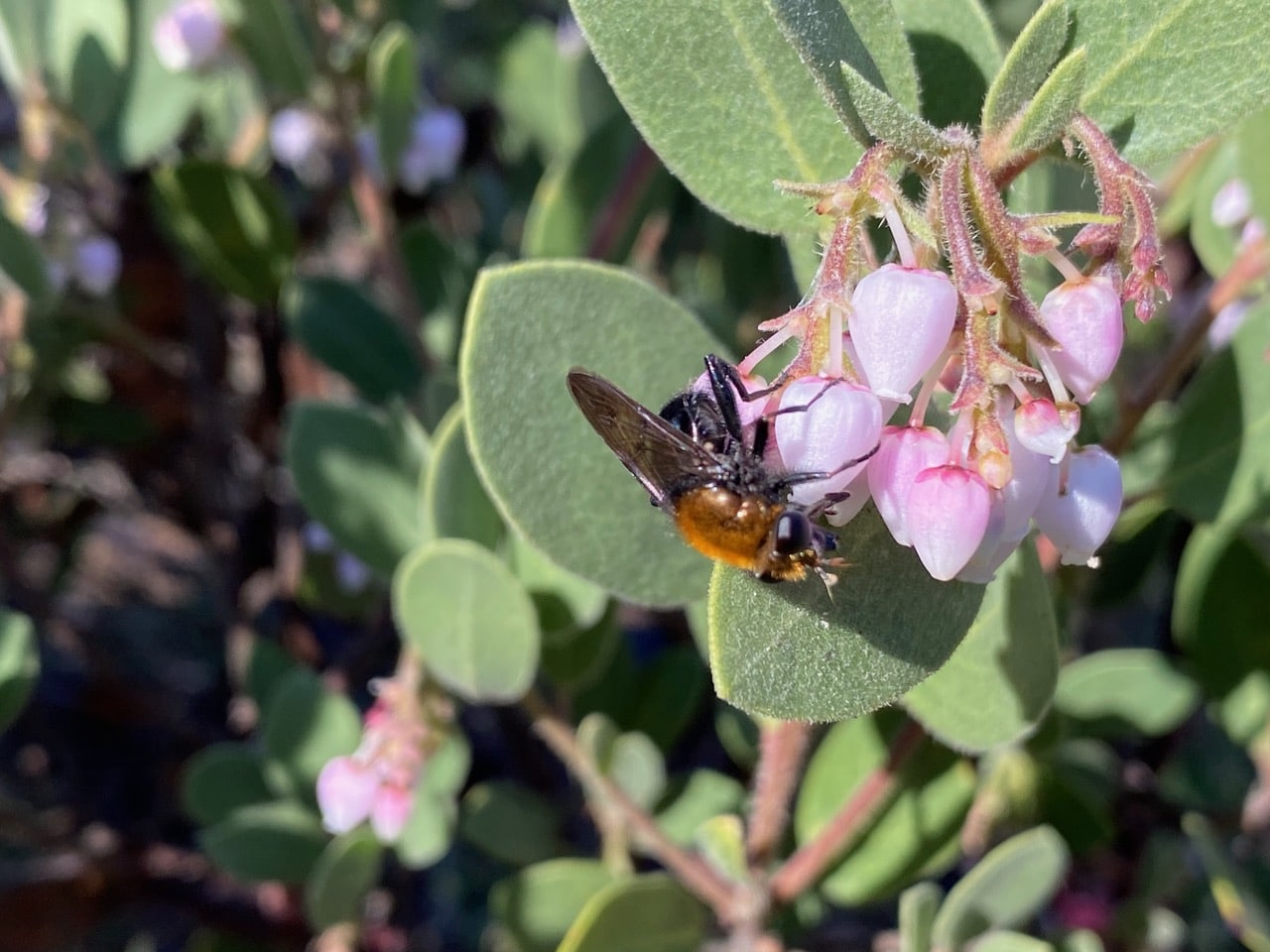
Here’s a view of the hoverfly showing its usual aristate antennae.
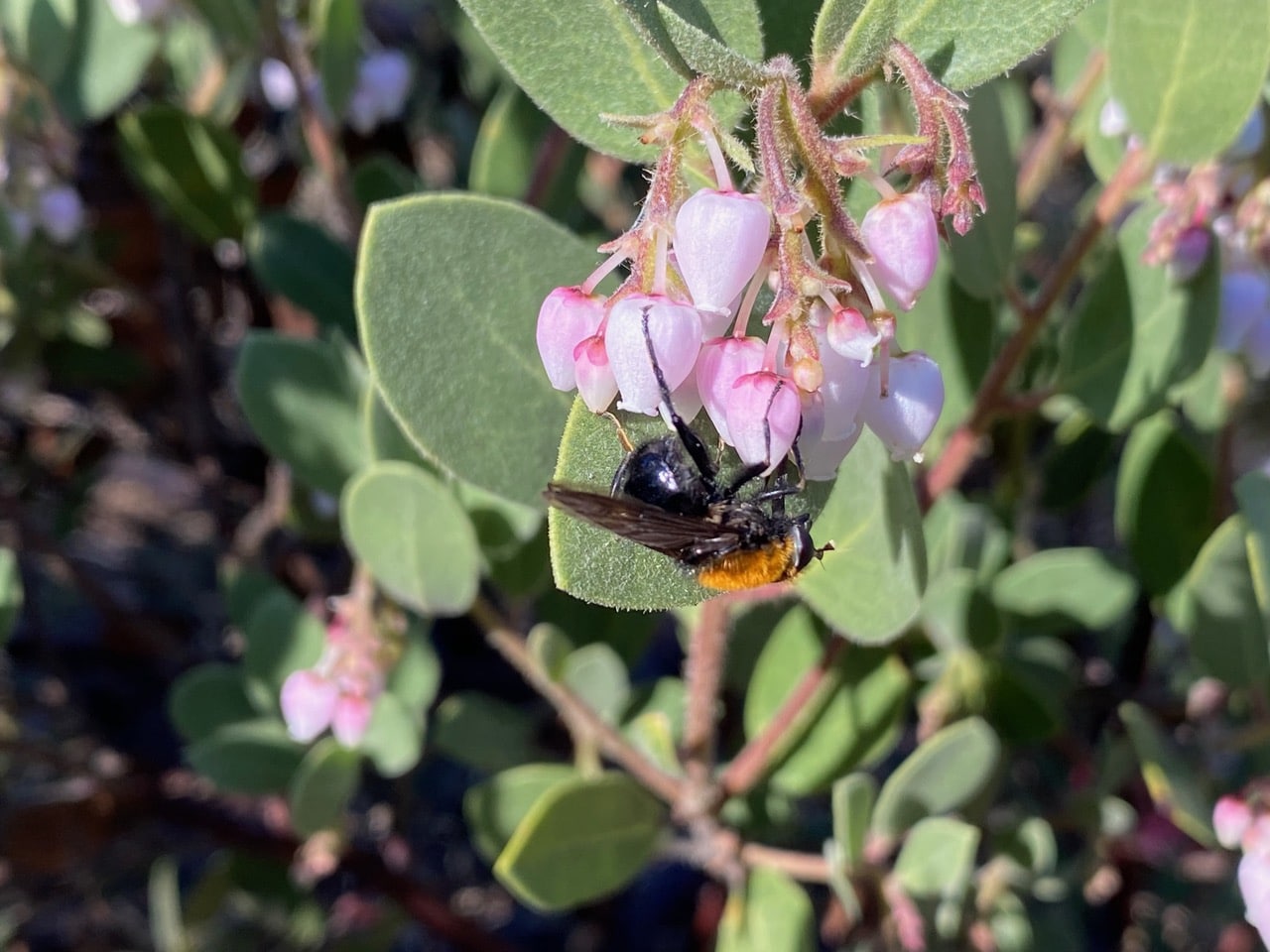
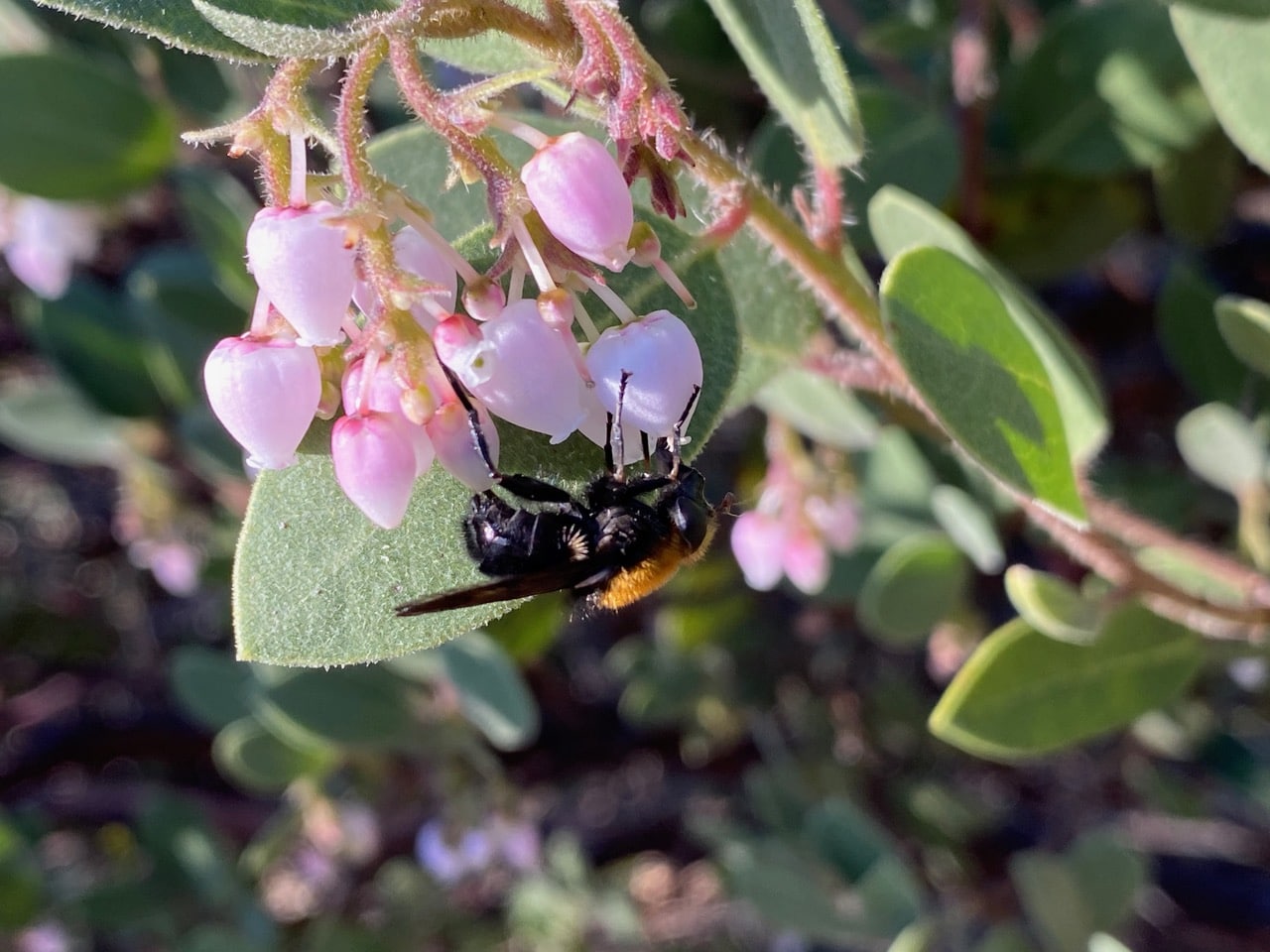
There is precious little information on this hoverfly species in the literature. What a mysterious creature!
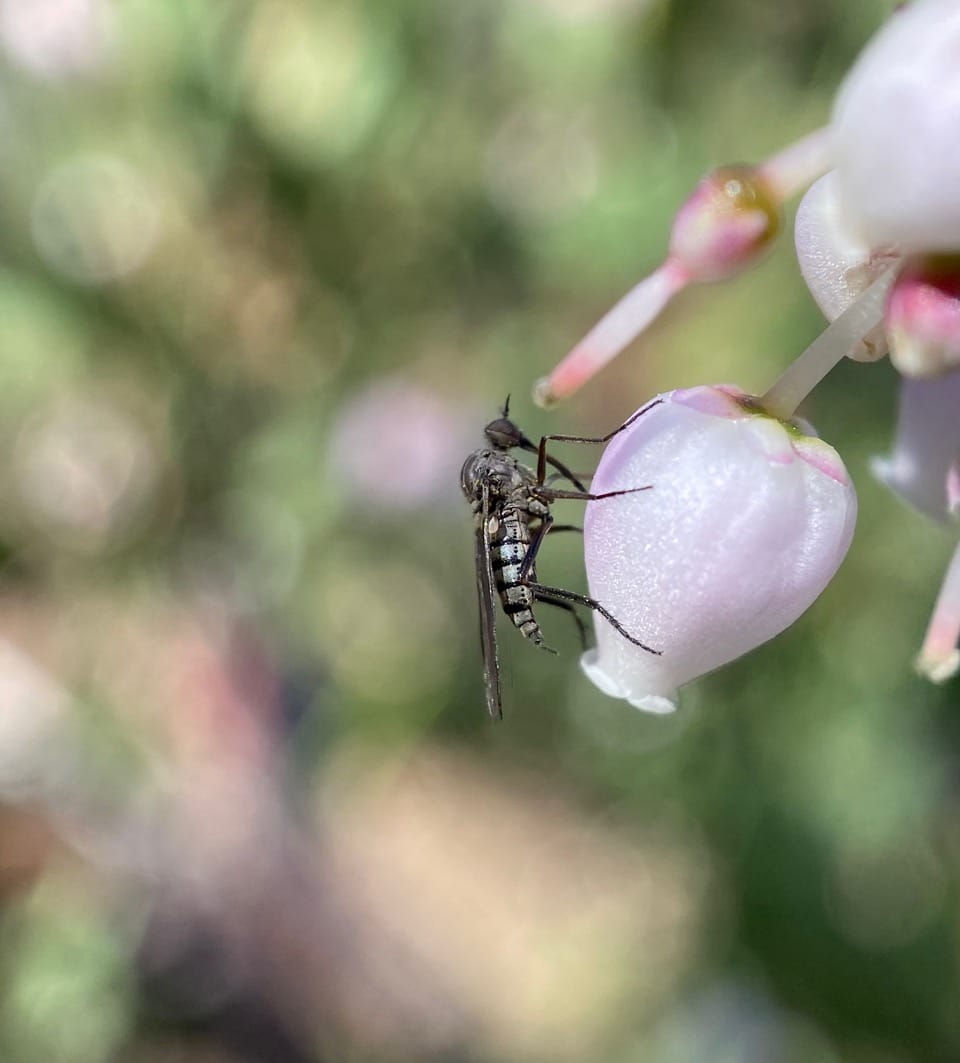
Ooh, another one of those Dance Flies! They are everywhere today.
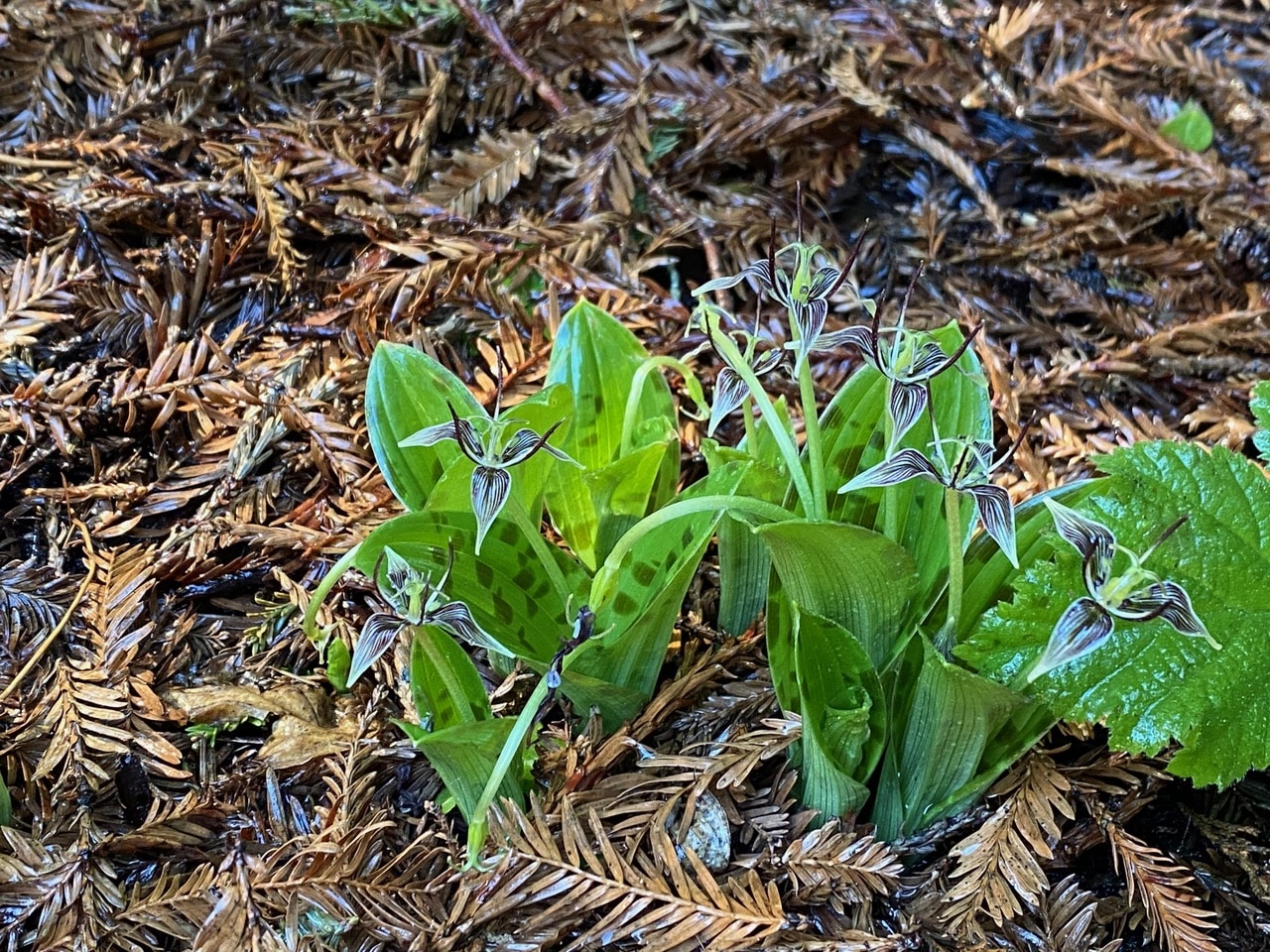
I make my way to the garden’s Redwood section to check for pollinators on the blooming Fetid Adder’s Tongue, Scoliopus bigelovii. When I reach the small clumps of the plant in the redwood understory, I realize that this is not the time to find fungus gnats on the flowers. A revolving sprinkler is on, and everything within its reach is soaking wet. New leaves of the Fetid Adder’s Tongue have popped up since I last visited, and there are more flowers as well.
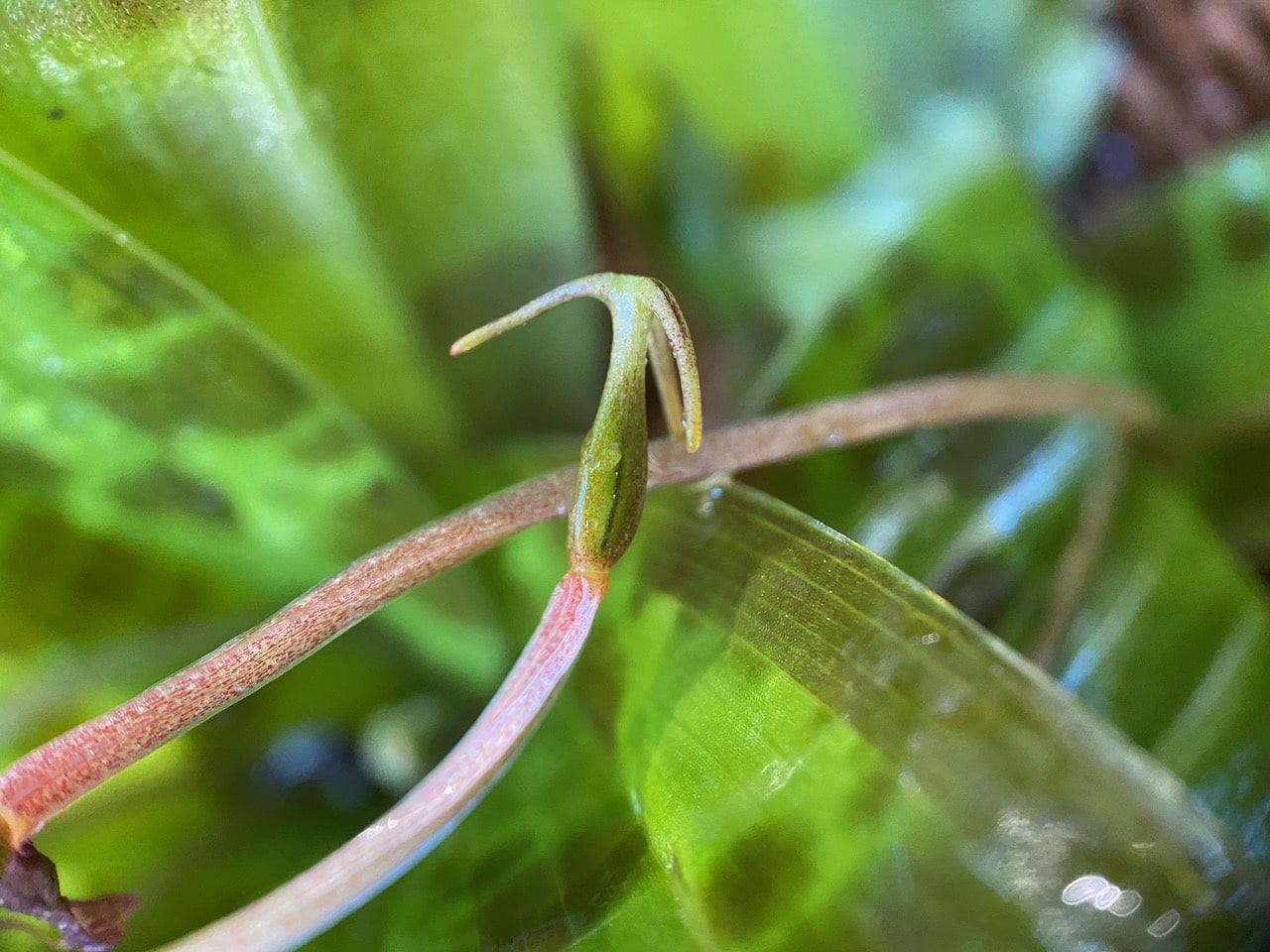
There are signs that the flowers have been pollinated. I find several developing fruits on the lengthening and bending flower stalks, their three-pronged style still intact even after the sepals and petals have dropped off.
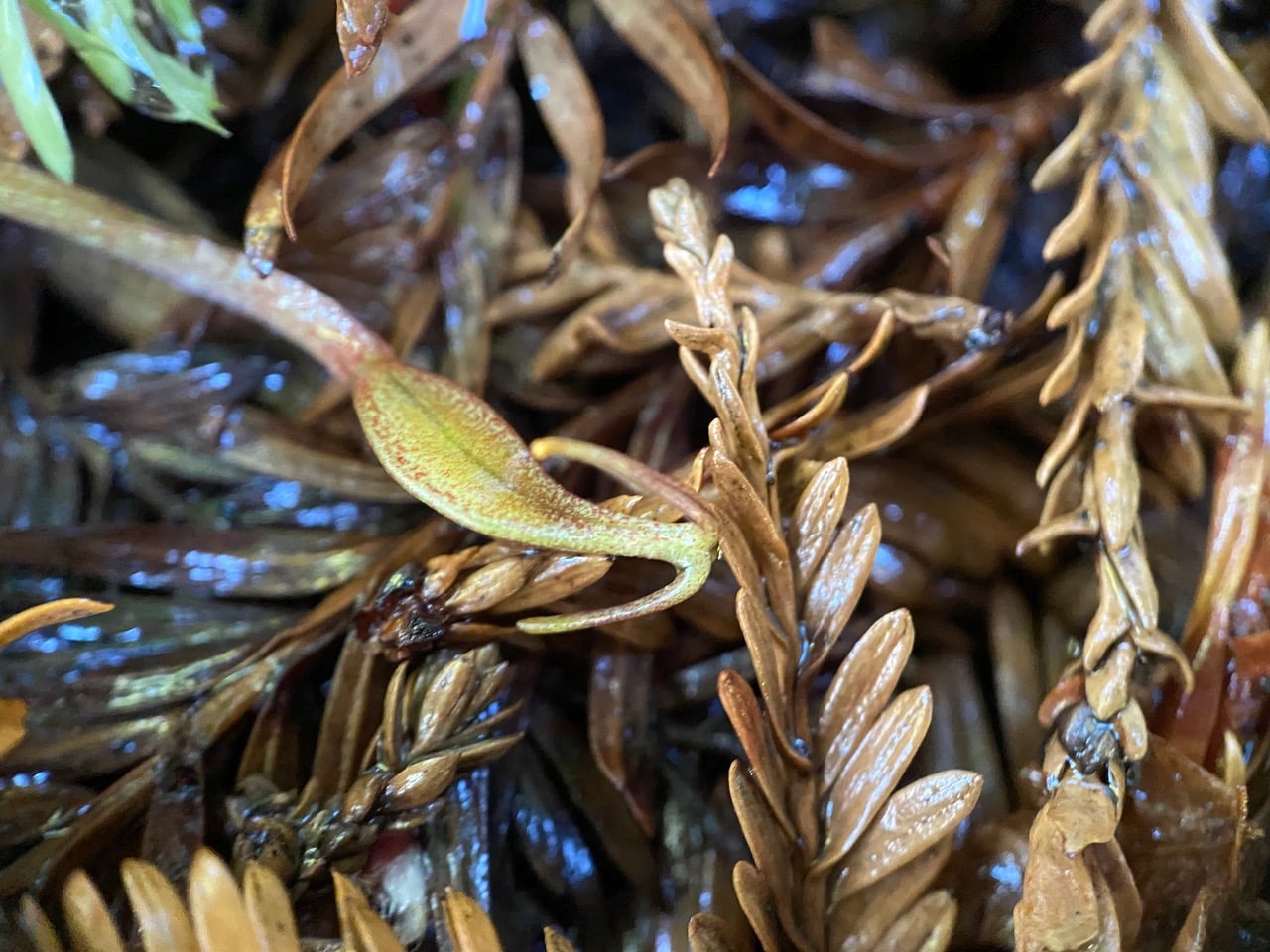
This maturing fruit has been lowered onto the duff. A friend of mine who has Fetid Adder’s Tongue in her garden told me that she has to compete with ants when she collects seeds for propagation.
The seeds of Fetid Adder’s Tongue have a fleshy part attached called an elaiosome that is rich in lipids and proteins. Ants can’t resist this nutritious snack. They carry the seeds away to their nests, eat the elaiosomes and discard the seeds. Left buried deep underground, safe from forest fires and hungry rodents, the seeds germinate to form new colonies on the forest floor. This mode of seed dispersal by ants is called myrmecochory.

Wet from the sprinkler, the Redwood Sorrel, Oxalis oregana is in bloom in the redwood forest floor.
The species grows from a scaly rhizome in cool, moist Douglas-fir and coastal redwood forests of the west coast. Being adapted to shady environments, Redwood Sorrel is capable of photosynthesis at low light levels. Higher intensity light can damage the sensitive leaves. As a protective measure, leaves fold downward within several minutes when struck by direct light, a process known as nyctinasty. But what insects pollinate the flowers that grow in such dim light? The question occurred to the students of the Pollination Ecology and Conservation Lab based in California State University East Bay in Hayward, CA. After they made observations in several locations in the Santa Cruz area, this is what they reported:
“We observed that many of the smaller bees seem to cling to the underside of redwood sorrel leaves, until a stray sunbeam illuminates their patch of forest. Warming up, they gracefully begin to stretch and awaken, eventually following the meandering paths of sunbeams across the forest floor as they drink nectar and collect pollen to provision their nests. In total, we found 14 different species of bees living in the understory of redwood forests… The bees include several genera (Andrena, Bombus, Ceratina, Lasioglossum, Nomad, and Osmia.)

A Hybotid Dance Fly (family Hybotidae) is perched on a manzanita flower.

The fly has chosen a flower that has a damaged corolla. Is it able to penetrate the thinned wall with its long proboscis to access the nectar within? This might be considered a form of “nectar robbing”, since the insect is not making contact with the reproductive parts of the flower, and thus not contributing to pollination,
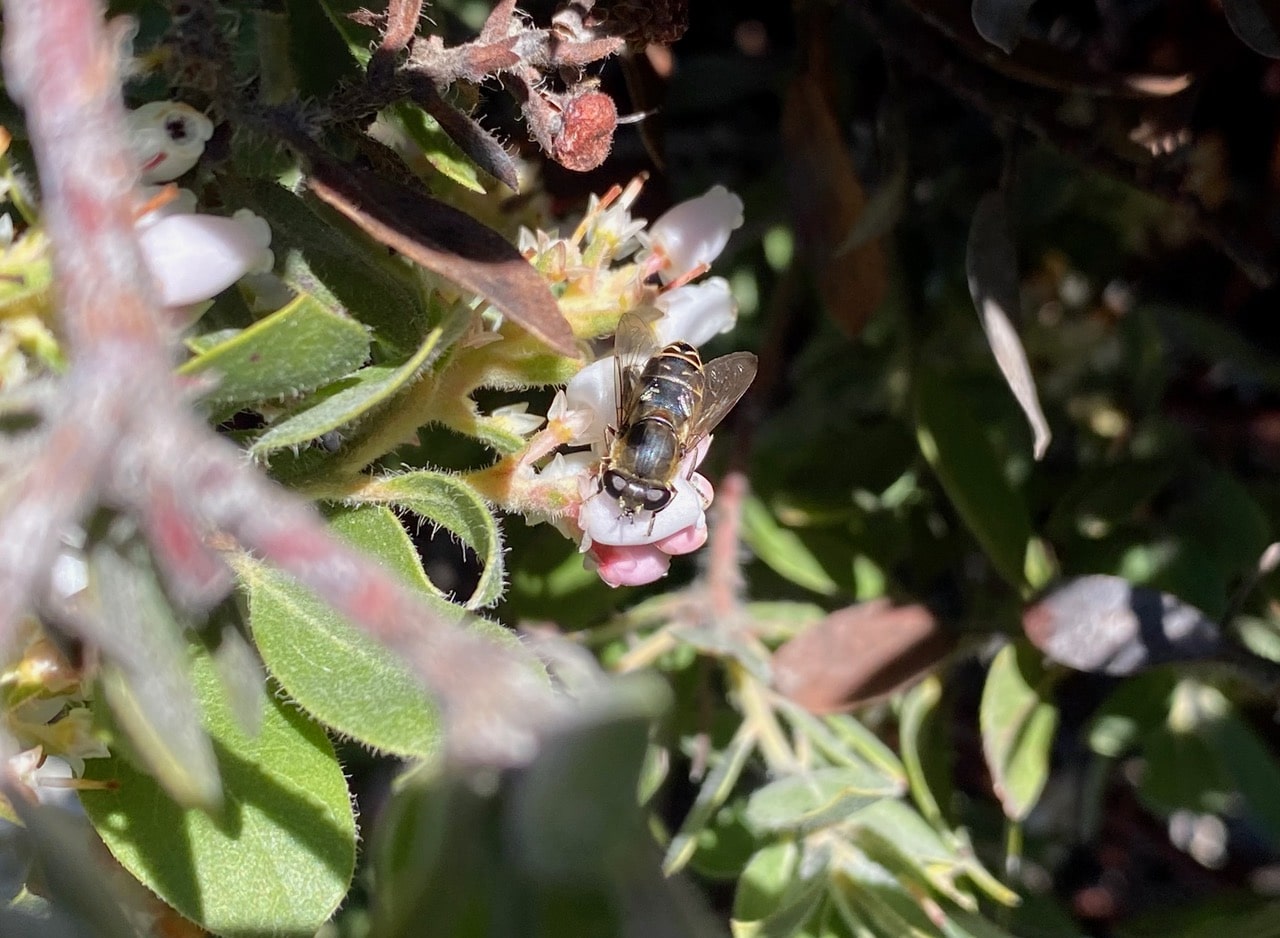
Hey, I know that hover fly! It’s the Common Sickleleg, Asemosyrphus polygrammus (family Syrphidae).
The hover fly is found in western North America. Appropriately, Polygrammus means “marked with many lines”, probably referring to the patterns on the thorax. The common name ‘sickle-leg’ probably refers to the bow-shaped tibia of the hind legs. Adults visit flowers for nectar and pollen. Larvae are rat-tail maggots. The maggots are most commonly found in dank and decaying environments such as compost, pond margins, and tree rot holes. The larvae feed on the decomposing material which is poor in oxygen but rich in organic matter. The “tails” are the siphons or breathing tubes that extend from their rear end to enable the larvae to breathe while submerged in the wet substrate. When mature, the larvae climb out to pupate on dry land. The larvae are important decomposers/recyclers and the adult flies are important pollinators.
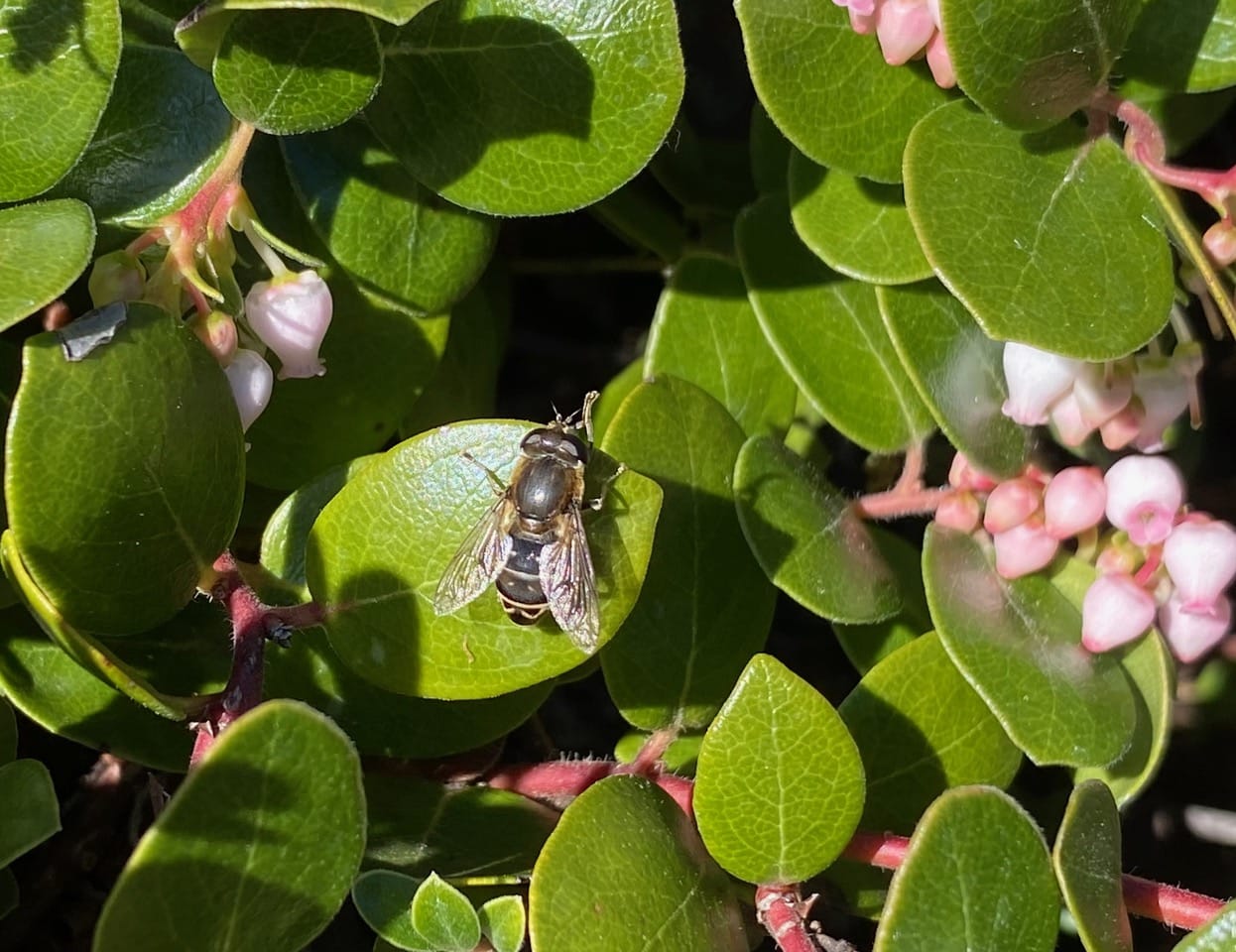
I come across many more Common Sicklelegs the rest of the morning. They are certainly “common” today!
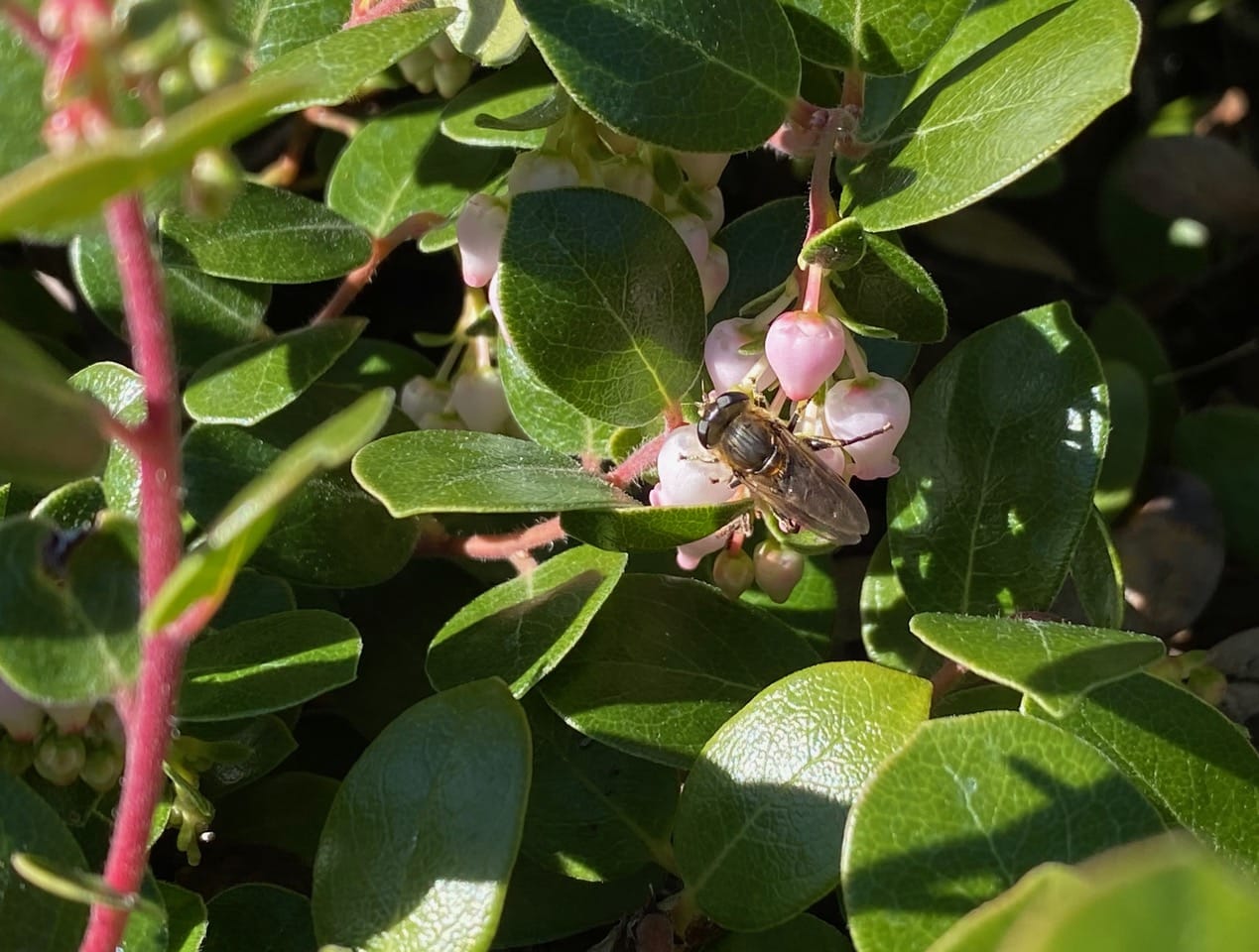
Too large to enter the manzanita flowers, the flies are probably scavenging for spilled nectar and pollen?
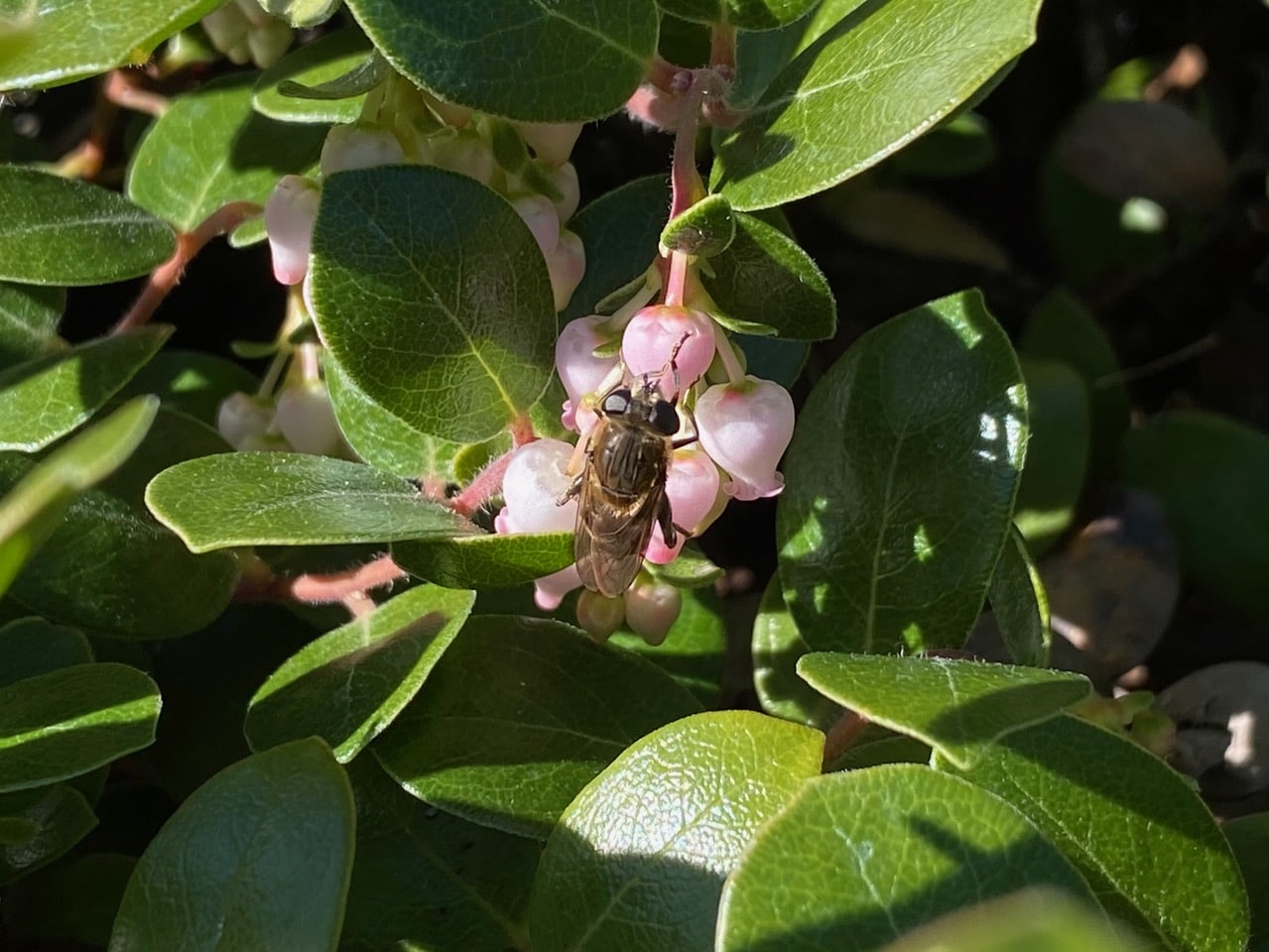
Note the subtle longitudinal stripes on the fly’s thorax. The specific epithet, Polygrammus meaning “marked with many lines”, probably refers to these fine lines.
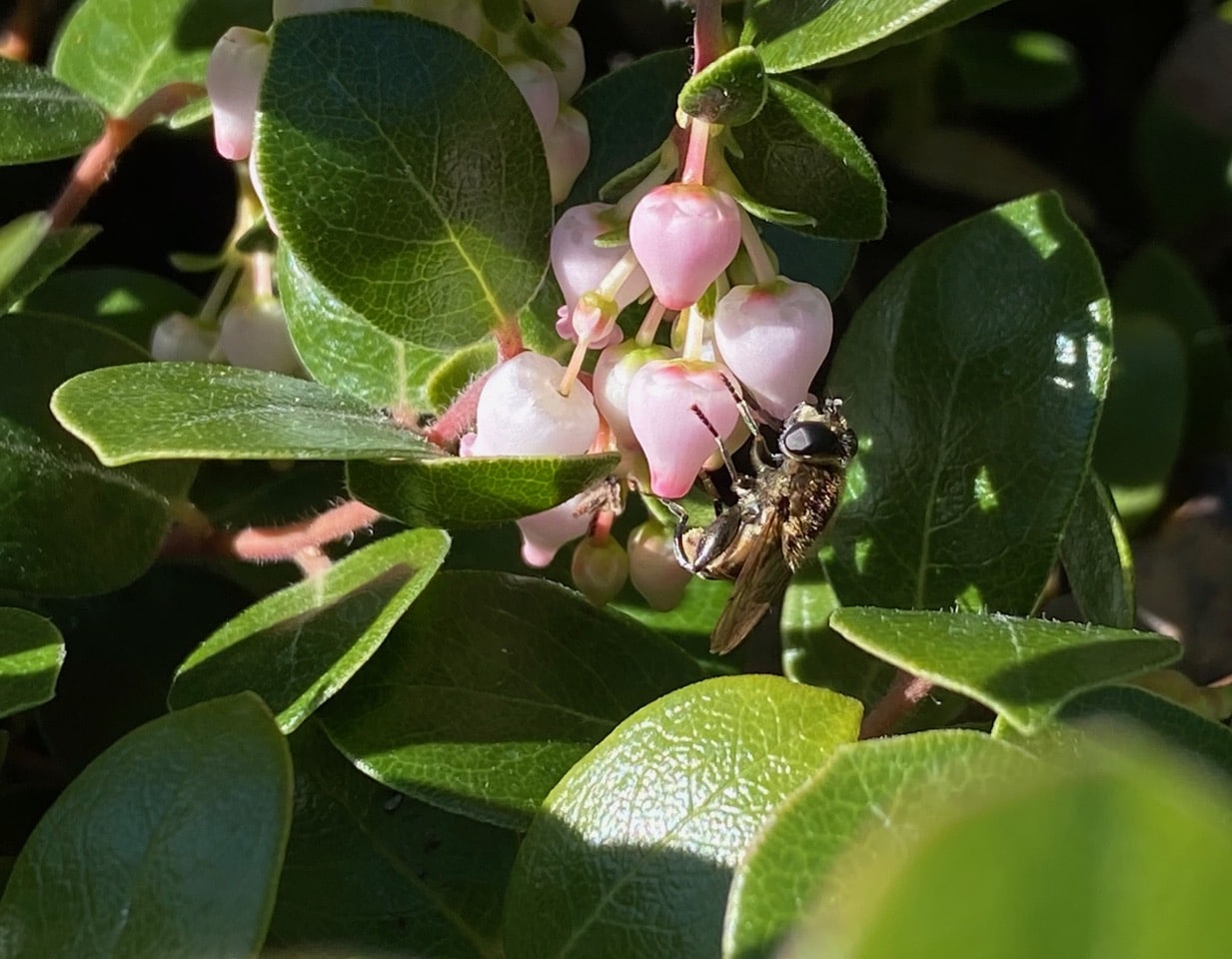
The short hairs on the fly’s thorax are lit up by the sun at certain angles. Note the bow-shaped tibia of the hind leg that gives the fly its common name of Sickleleg.
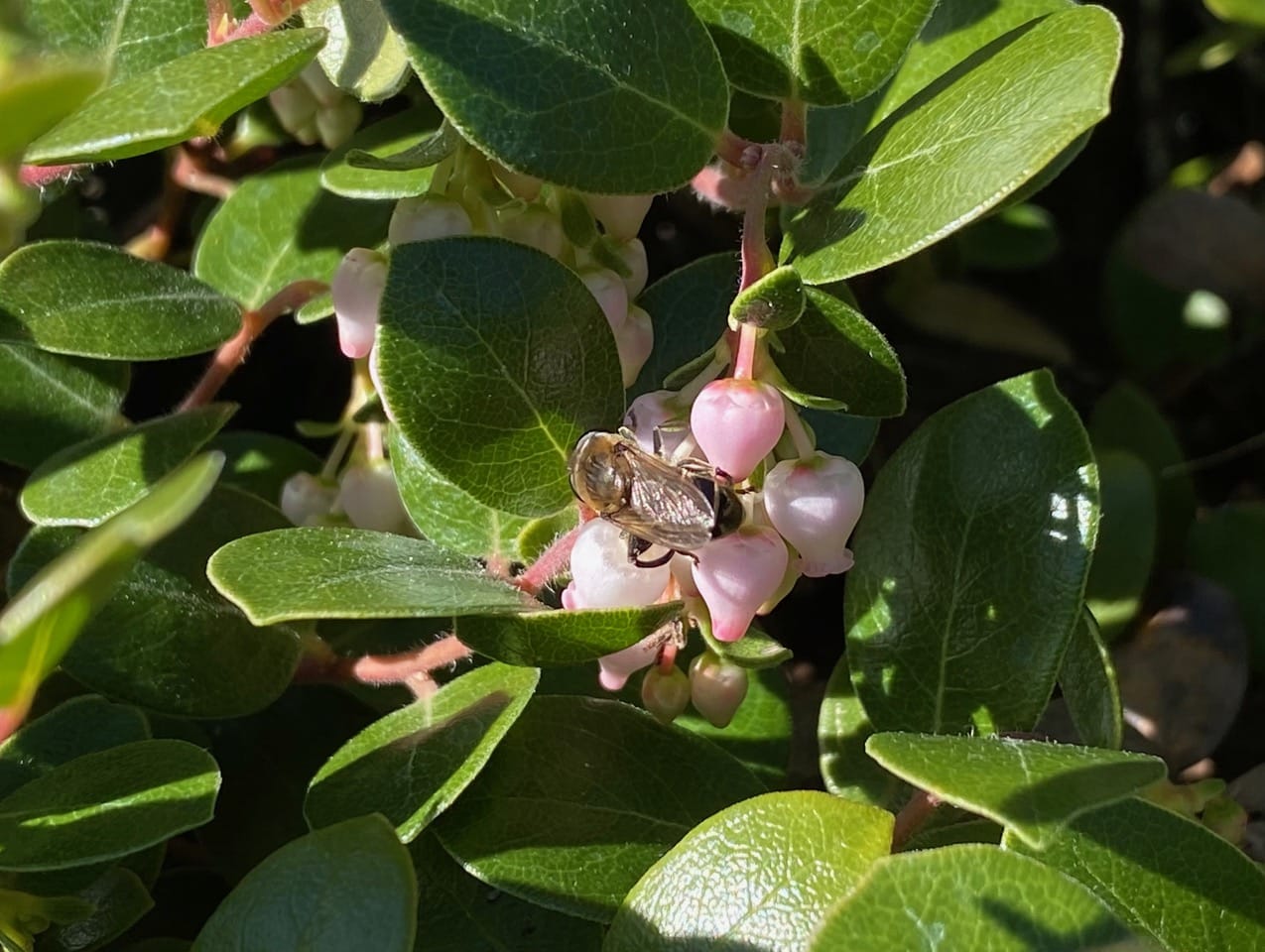
Another view of the bow-shaped tibia of the hind legs.

Another Hybotid Dance Fly?
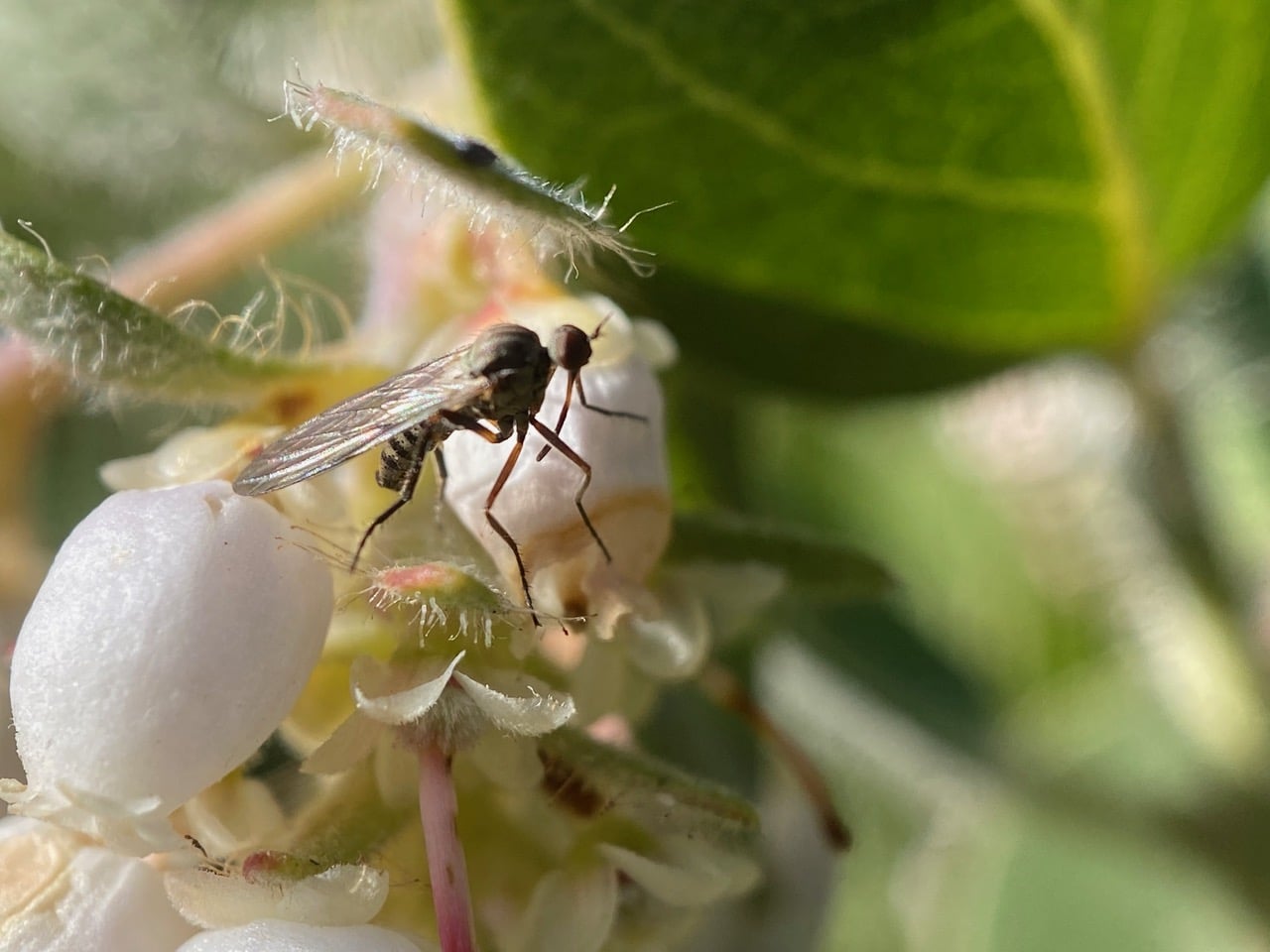
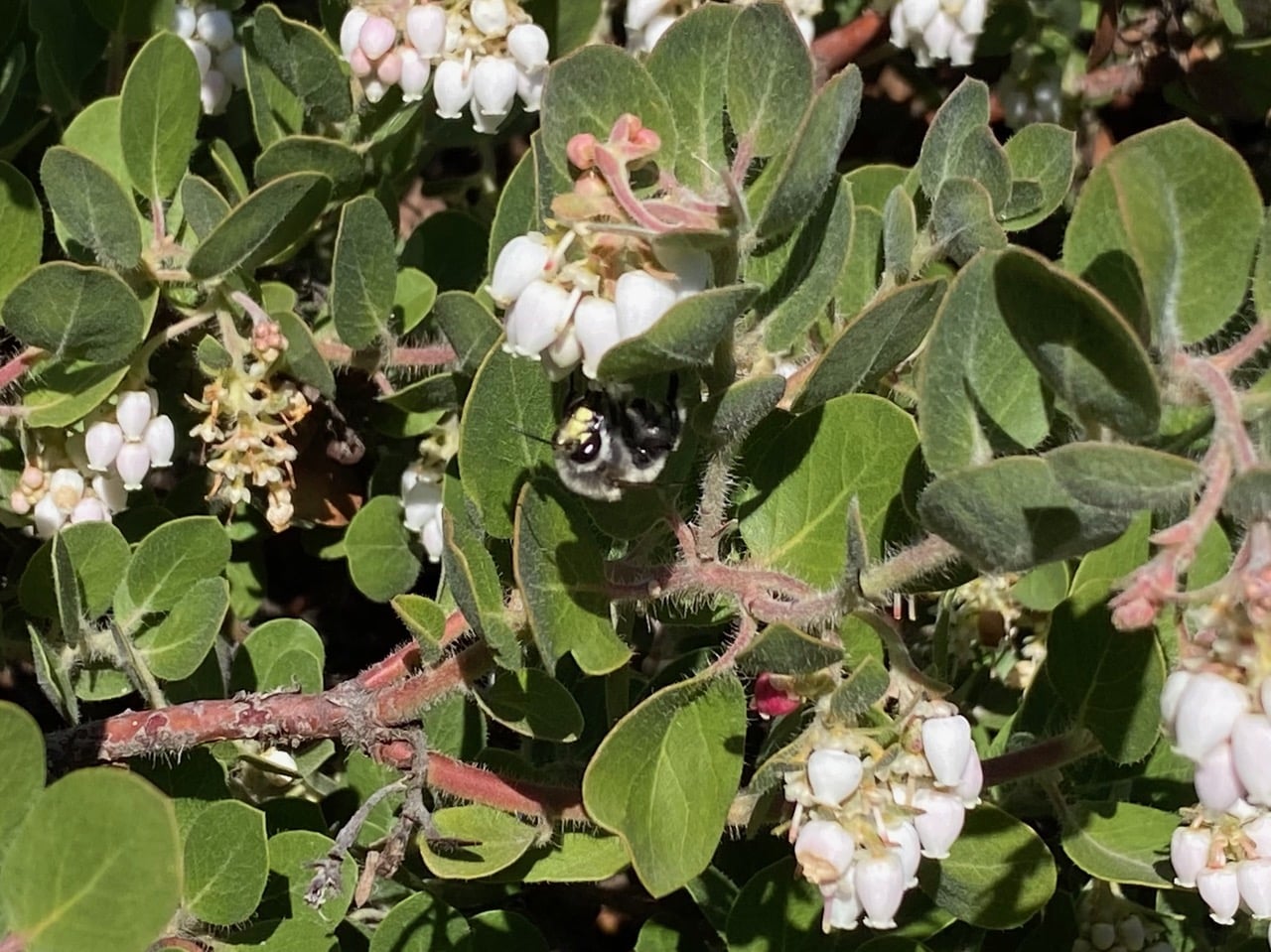
Hanging upside-down from a cluster of manzanita flowers, a male Pacific Digger Bee, Anthophora pacifica (family Apidae) is sticking its tongue into individual flowers to access nectar.
As their name implies, the Digger Bees nest in the ground, sometimes in huge aggregations. These fast and noisy flyers buzz around flowers, appearing to “hop” from flower to flower while foraging. The chubby, furry Digger Bees resemble the bumble bees in many ways, but are a lot noisier. They are a fearless, rowdy lot – fun to watch but a challenge to photograph. Male digger bees of many species have white or yellow integuments on their faces. Females have shaggy hairs on their back legs, used to carry pollen. Female Anthophora are capable of buzz pollination – i.e. they vibrate their wing muscles to shake pollen from the anthers of some flowers. Digger bees are generalist pollinators that visit an impressively wide range of plants. They are exceptionally effective pollinators and play an important role in maintaining wildflower diversity, in part because their long tongues allow them to pollinate deep-throated and tubular blossoms inaccessible to other bees.

Almost all of the Digger Bees I see today are males. Perhaps the females have yet to emerge? In most solitary bees, males usually emerge a few days before their sisters.
Female bees are able to determine the sex of their offspring by a system called haplodiploidy. Haplodiploidy is a sex-determination system whereby males develop from unfertilized eggs and are haploid, and females develop from fertilized eggs and are diploid. Female solitary bees tend to lay female eggs in the back of her burrow, and male eggs closer to the nest entrance. Since males develop faster, they can exit the burrow without disturbing their sisters. Male Digger Bees often hang around nest entrances, awaiting the emergence of a female for a chance to mate with her. When she appears, the males jump on her en masse, sometimes creating chaotic “mating balls”. It’s a boisterous affair!