

Pollinator Post 2/10/25
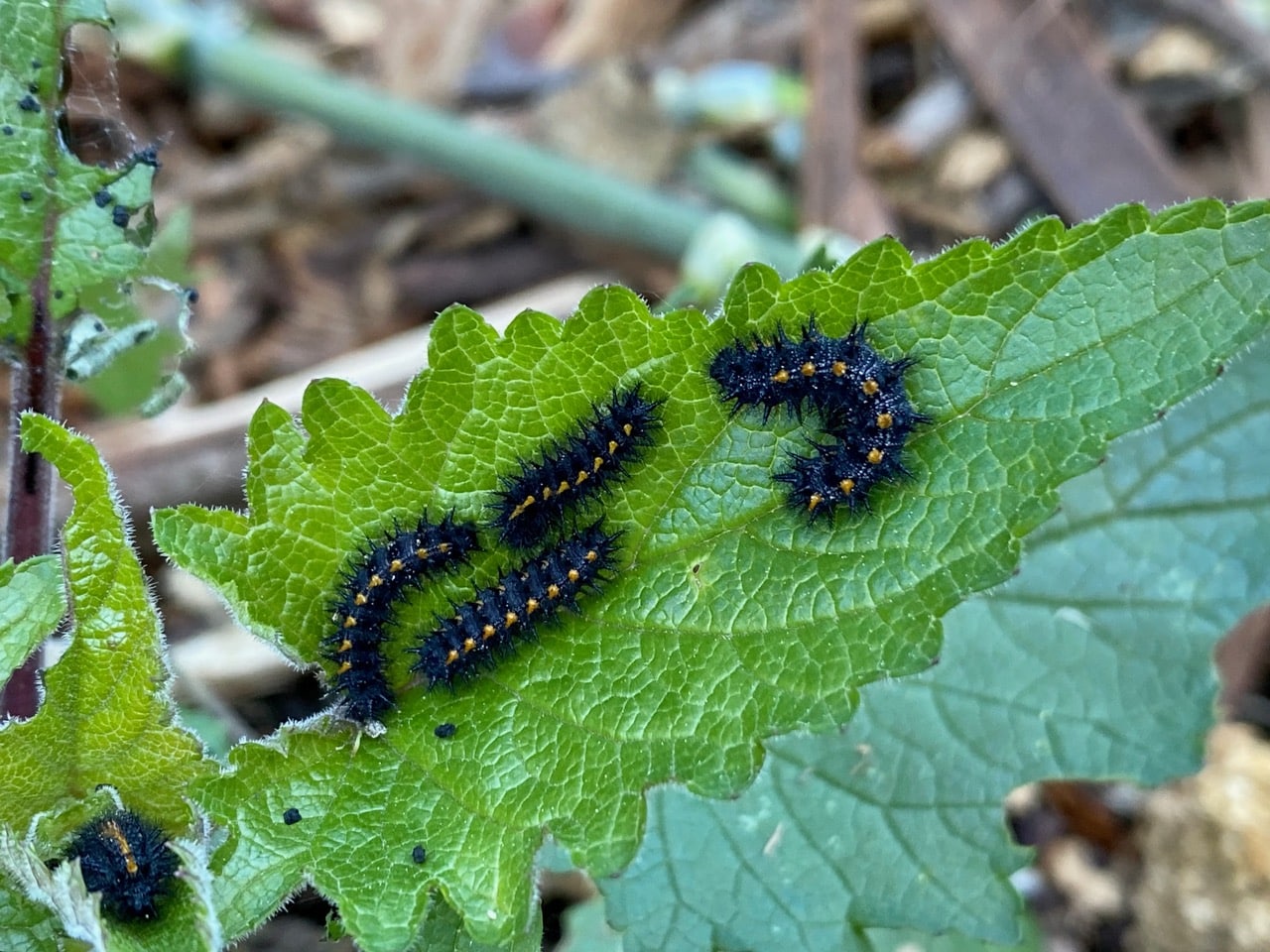
I have the privilege of visiting a large private property in the Claremont Hills in Berkeley this morning. The land has been kept predominantly wild, and naturally abounds in native plants.
Since the deer have been excluded from the property, the Bee Plant, Scrophularia californica has recovered in leaps and bounds, and now covers large isolated areas. I notice small caterpillars of the Variable Checkerspot butterfly on some of the fresh leaves. I have never seen these caterpillars so early in the year – in winter?! The species is known to overwinter as third or fourth instars. However, the larvae often re-emerge from diapause (insect version of hibernation) to feed in winter. Some may wake up and feed before re-entering dormancy.
The Variable Checkerspot, Euphydryas chalcedona (family Nymphalidae) is found across western North America. The butterfly occupies a wide range of habitats, including sagebrush flats, desert hills, prairies, open forests and alpine tundra. Males perch or patrol around larval host plants to encounter females. Eggs are laid in large groups on underside of leaves of host plants. Host plants include California Bee Plant, Scrophularia californica, and Sticky Monkeyflower, Diplacus aurantiacus. These plants provide the caterpillars with iridoid glycoside, a chemical that imparts unpalatable taste to birds, protecting the caterpillars from predators. Larvae feed in large, loose groups on the host plants. Individuals overwinter (enter diapause or hibernation) as third or fourth instar larvae in sheltered sites under bark or dead branches, in hollow stems and in rock crevices. Pupation begins in early to mid April and the adult flight season begins between mid-April and May and continues into June. The adults feed exclusively on nectar, and have a life span of about 15 days.

On a hillside overlooking an expansive view of San Francisco Bay, a wild grove of Pink-flowering Currant, Ribes sanguineum is in glorious bloom. I have never seen so many of these plants in one place! I stand in awe watching bees follow the sunbeam as it lights up one plant after another on this chilly morning. Most of the bees appear to be Pacific Digger Bees, Anthophora pacifica (family Apidae). They are a fast and noisy lot, a nightmare to photograph. They appear to be bouncing from one pendant inflorescence to another, laughing at my efforts.

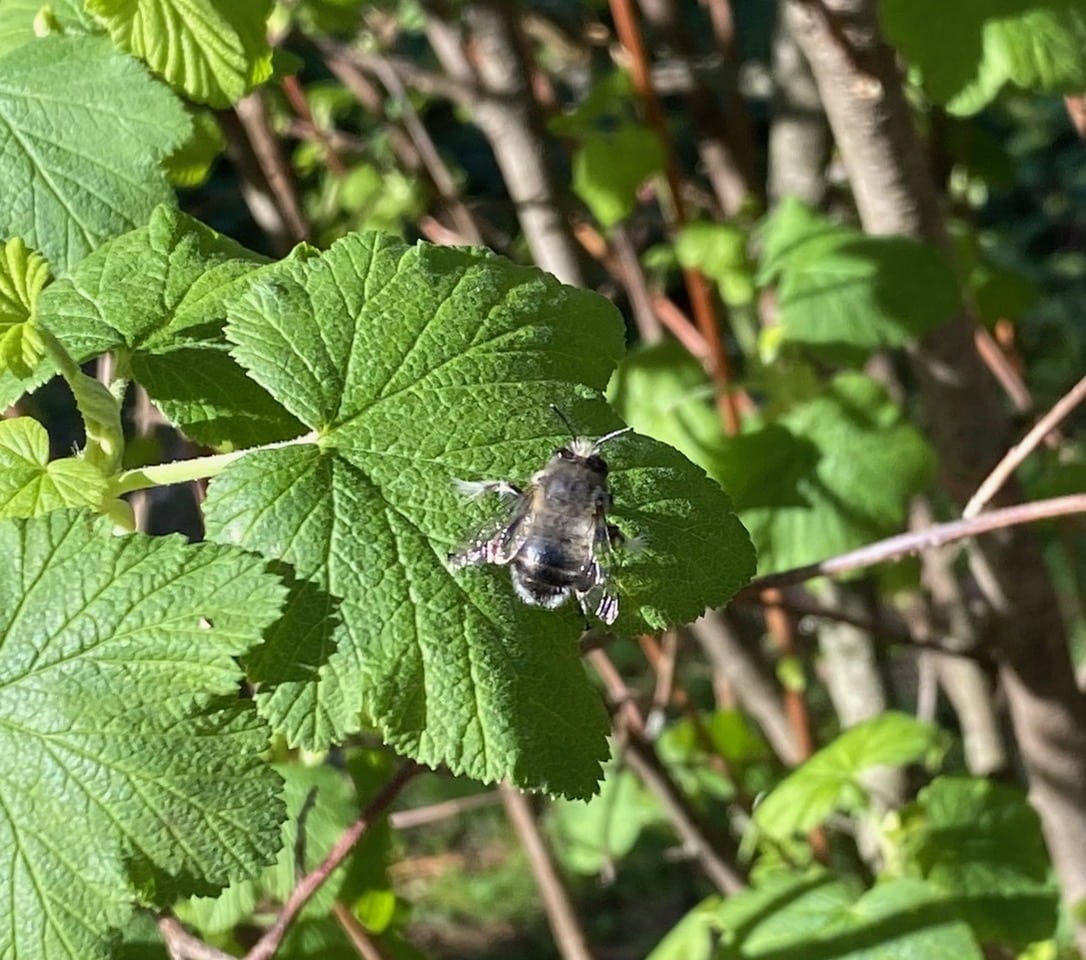


Suddenly one of the bees lands on a nearby Sonoma Sage and basks on a leaf facing the sun. It is a female Pacific Digger Bee, Anthophora pacifica (family Apidae). Note the white scopa (special pollen collecting hairs) on her hind leg. Males do not collect pollen to provision the nest, and do not have the scopae.
As their name implies, the Digger Bees nest in the ground, sometimes in huge aggregations. These fast and noisy flyers buzz around flowers, appearing to “hop” from flower to flower while foraging. The chubby, furry Digger Bees resemble the bumble bees in many ways, but are a lot noisier. They are a fearless, rowdy lot – fun to watch but a challenge to photograph. Male digger bees of many species have white or yellow integuments on their faces. Females have shaggy hairs on their back legs, used to carry pollen. Female Anthophora are capable of buzz pollination – i.e. they vibrate their wing muscles to shake pollen from the anthers of some flowers. Digger bees are generalist pollinators that visit an impressively wide range of plants. They are exceptionally effective pollinators and play an important role in maintaining wildflower diversity, in part because their long tongues allow them to pollinate deep-throated and tubular blossoms inaccessible to other bees.
Another bee lands on a Ribes leaf. Although it is a long shot, the tufts of long white hairs on its front legs are visible. The bee is obviously a male! To find out what those hairs are for, watch the video in the link below. (I trust that you are old enough to view this X-rated treat.) It is a clip taken from the PBS Nature program “My Garden of a Thousand Bees”, a British production. In the UK, the Anthophora are commonly referred to as Flower Bees.
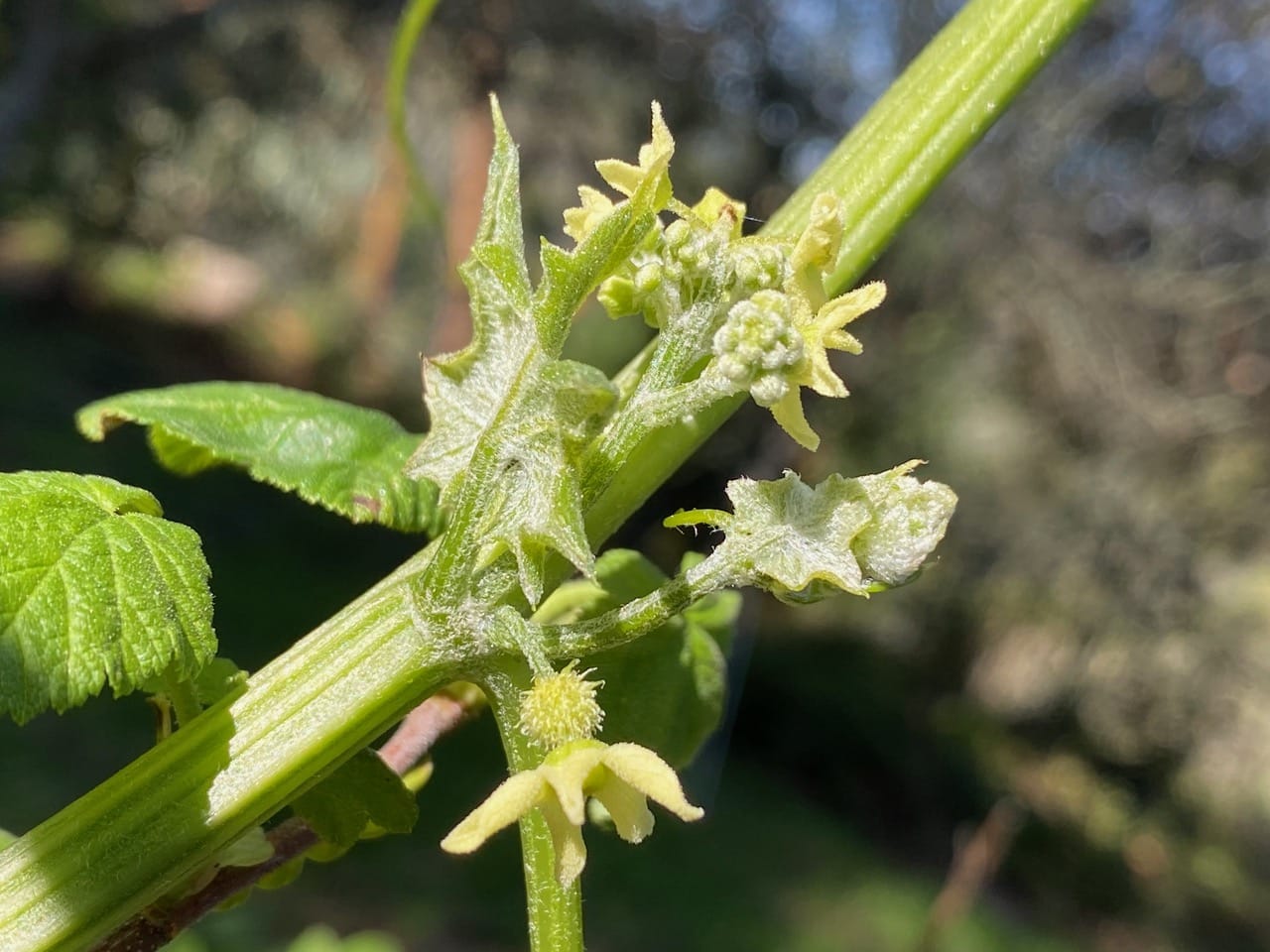
Young Wild Cucumber vines sprawl all over this property wherever the ground is not covered by other vegetation. All the ones in bloom I recognize as the California Manroot, Marah fabacea. Shown here is the close-up of a male flower.
The Wild Cucumber is monoecious, with separate male and female flowers borne on the same plant. Male flowers far outnumber the female flowers. The staminate (male) flowers are borne on vertical panicles arising from a leaf axil. The five yellowish-white petals are fused at the base to form a cup. The stamens are fused with the anthers twisted together in a mass to form a yellow center. The corolla is densely covered with short glandular hairs.
The solitary female flower emerges from the same leaf axil at the base of the male flowers. The female flower has an inferior ovary, from which the spiky fruit develops below the flower.
In the Marah, the female flowers apparently matures before the male flowers above them. Here’s a fresh female flower that has opened while the male flowers above it are still in buds. While the male and female flowers look similar at first glance, a close examination reveals that the greenish-yellow globular structure in the middle of the female flower is a bulbous stigma. When the female flower is freshly open, the stigma is moist, the better to capture any incoming pollen.
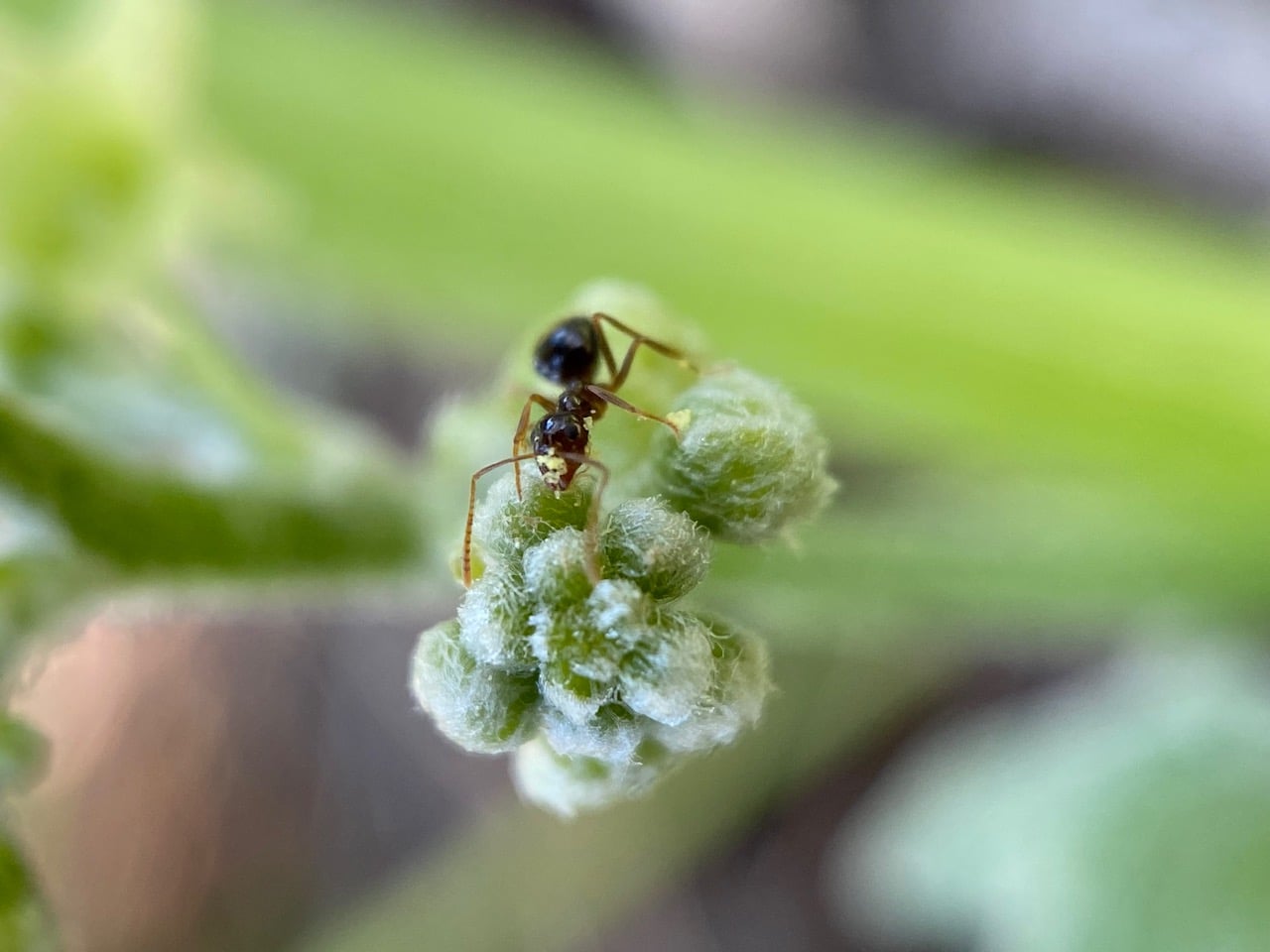
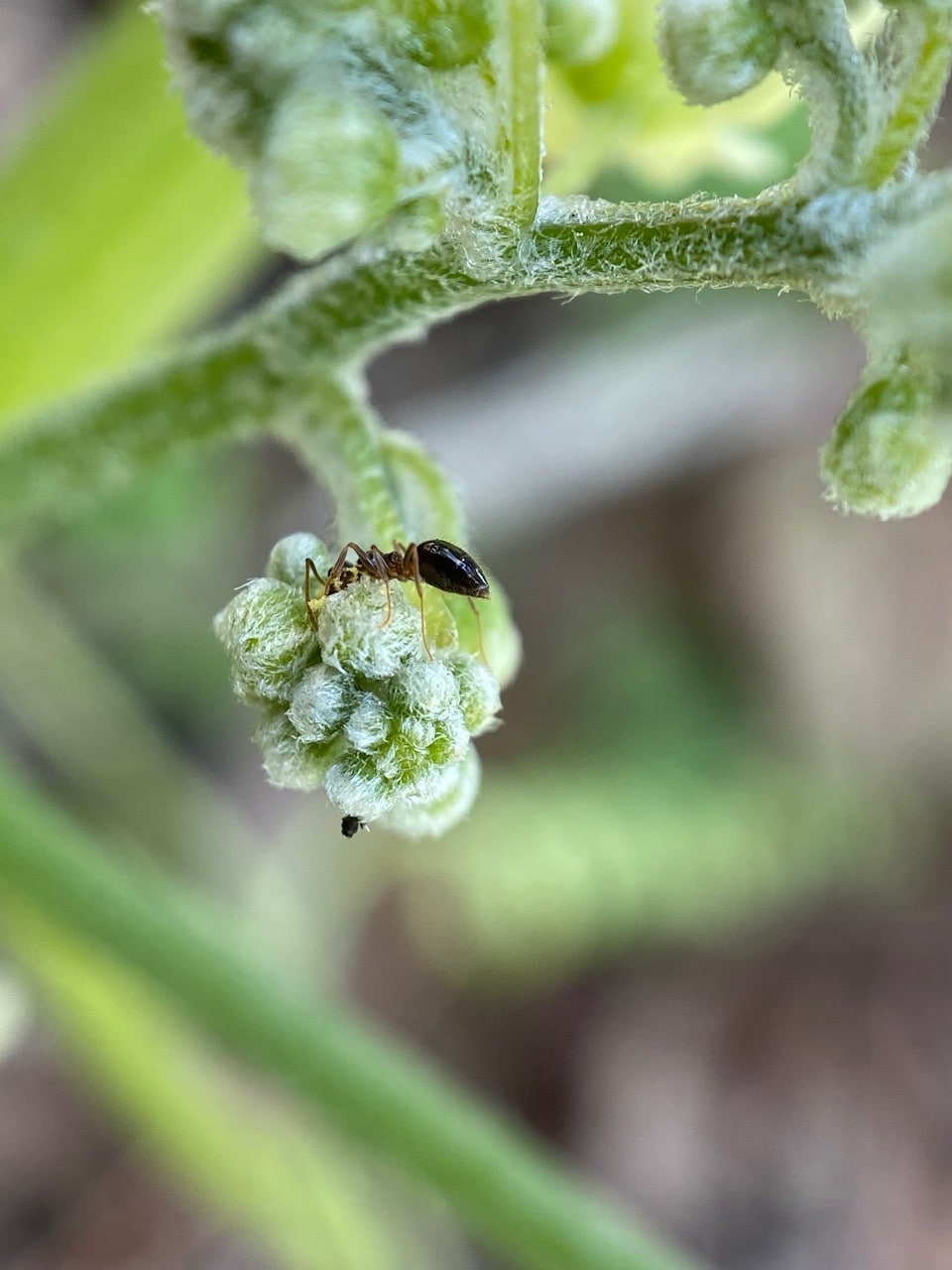
As I am examining the Marah flowers, I notice an American Winter Ant, Prenolepis imparis crawling unsteadily on a cluster of flower buds, its head smeared with yellow pollen. It has obviously been rummaging in a male flower.
The American Ant, Prenolepis imparis is a widespread North American ant. A dominant woodland species, it is most active during cool weather, when most other ant species are less likely to forage. This species is one of a few native ants capable of tolerating competition with the invasive Argentine Ant, Linepithema humile. They are also aggressive toward other ants and produce abdominal secretions that are lethal to Argentine Ants. Prenolepis imparis is a generalist omnivore. Foragers are known for tending to aphids or scale insects from which they consume excreted honeydew, aggregating on rotting fruit, and exploiting protein-rich sources such as dead worms. The colony enters estivation (a hibernation-like state) and becomes inactive above ground for the warmer months, during which time eggs are laid and brood are reared. Reproductives overwinter and emerge on the first warm day of spring for their nuptial flight.
Desperate to rid itself of the pollen, the ant is even rubbing its head between the fuzzy buds.
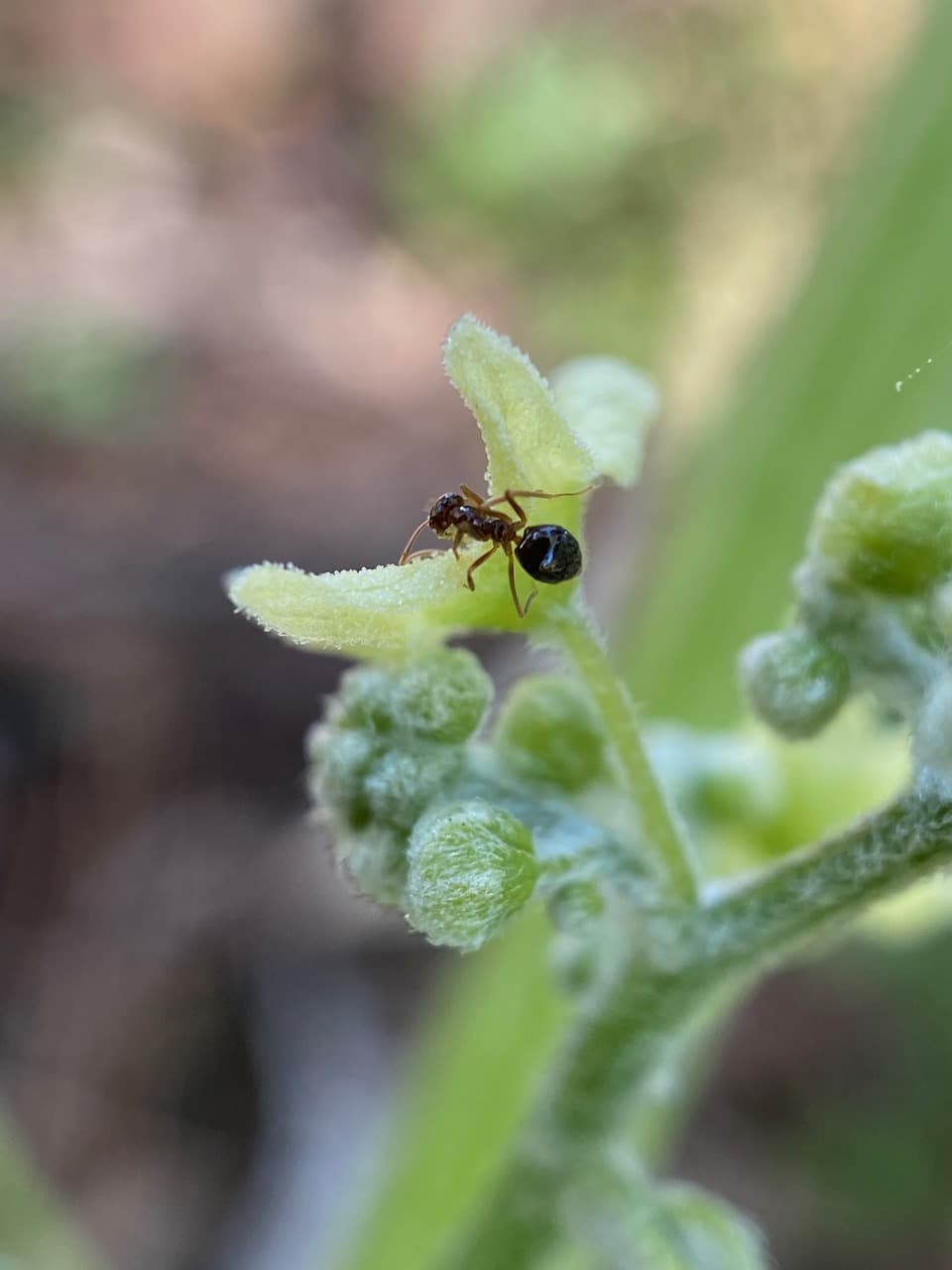
All cleaned up, the ant is soon climbing into another male flower.

The ant doesn’t seem able to resist the lure of Marah‘s nectar.
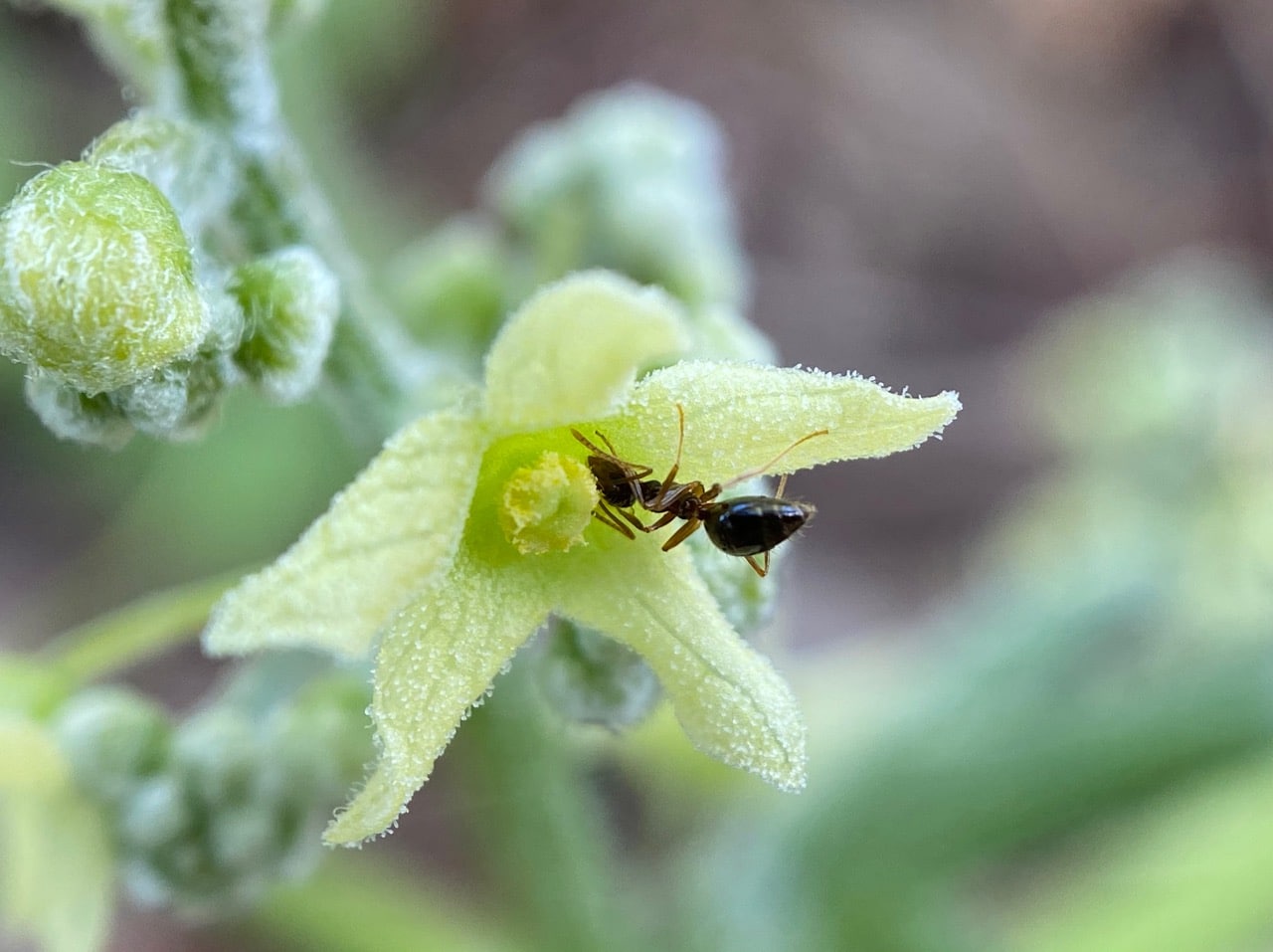
To reach the nectar at the base of the flower, the ant lowers its head to navigate the tight space between the fused stamens and the cupped corolla. Despite the caution, the process still results in a load of pollen adhering to its head – again!
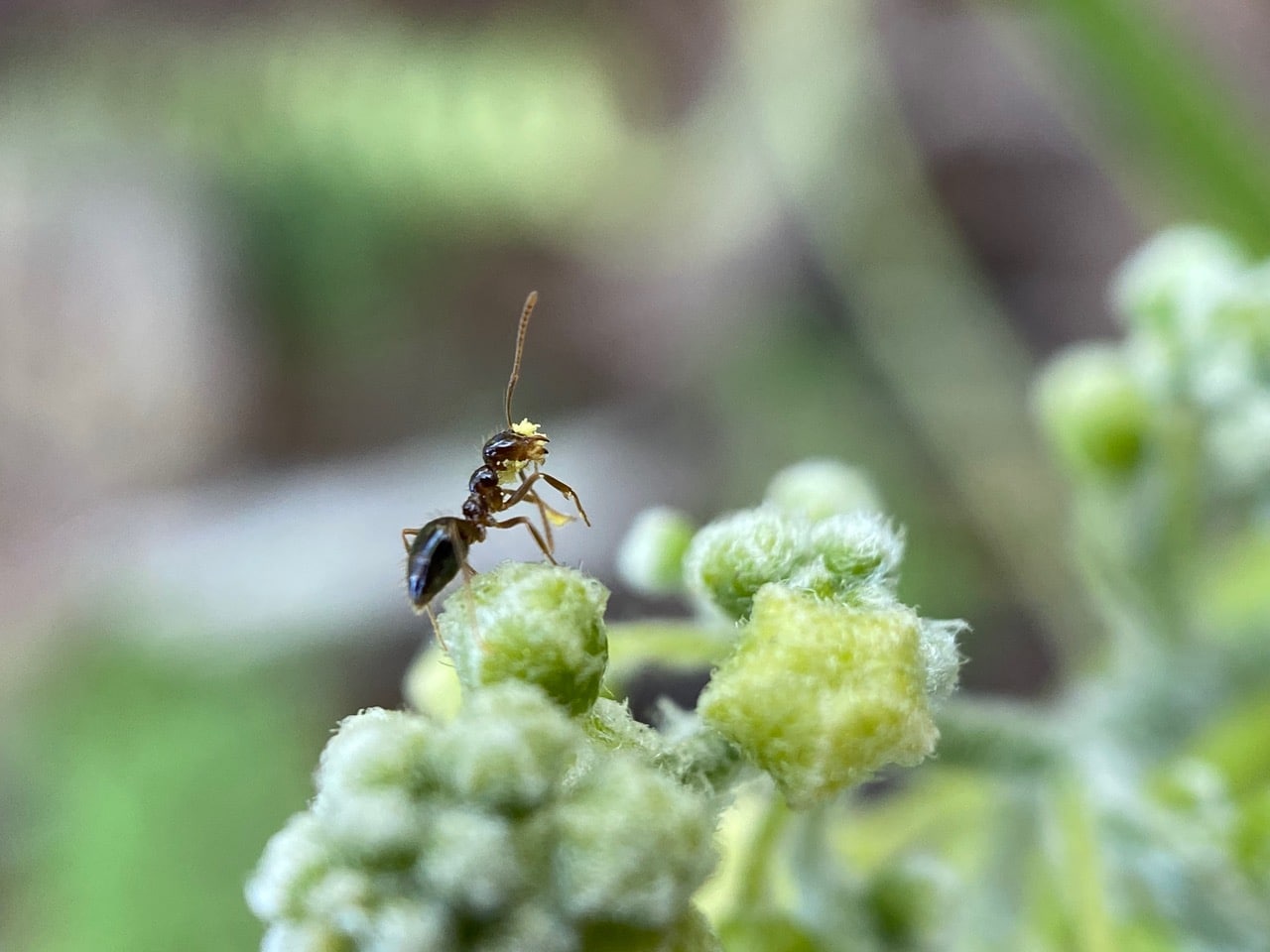
The agitated ant ends up on a cluster of fuzzy buds again trying to clean off the pollen. It doesn’t take much imagination to see how the pollen on the ant can be easily brushed off on the stigma of a female flower it next visits for nectar. I can stay here and watch this comedy repeat itself all day! The Marah flower has evolved such a perfect structure to facilitate the transfer of pollen by ants! The size fit between the flower and ant is uncanny. The sprawling habit of the plant eliminates the necessity for a winged pollinator. I wonder what other small critters might serve as pollinators for Marah.
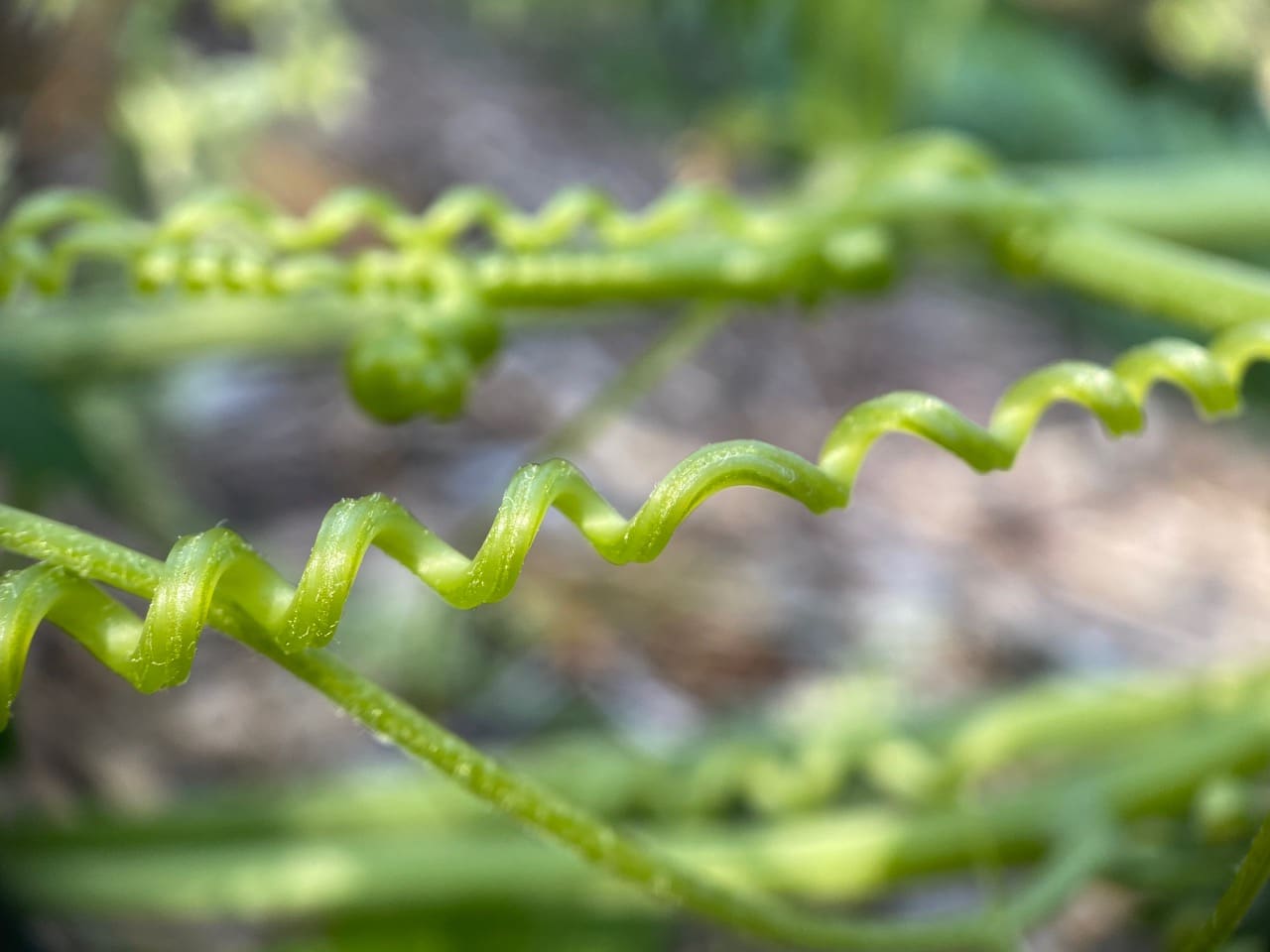
Ever wonder why there’s always a coiling reversal in the spring-like tendrils of the Wild Cucumber?
Long tendrils enable Marah to climb/trail over neighboring vegetation in order to reach sunlight. You can invariably find a straight section along a tendril coil where the coiling direction is reversed. Charles Darwin had noticed this behavior and coined it “perversion”. Scientists have actually studied the cucumber tendrils seriously and found some fascinating properties. Once a tendril curls around a support, it forms a counter-clockwise helix and clockwise helix with a straight section between the two. If the tendril is pulled, more turns are added to both helices to better grasp the support.