

Pollinator Post 3/3/25 (1)
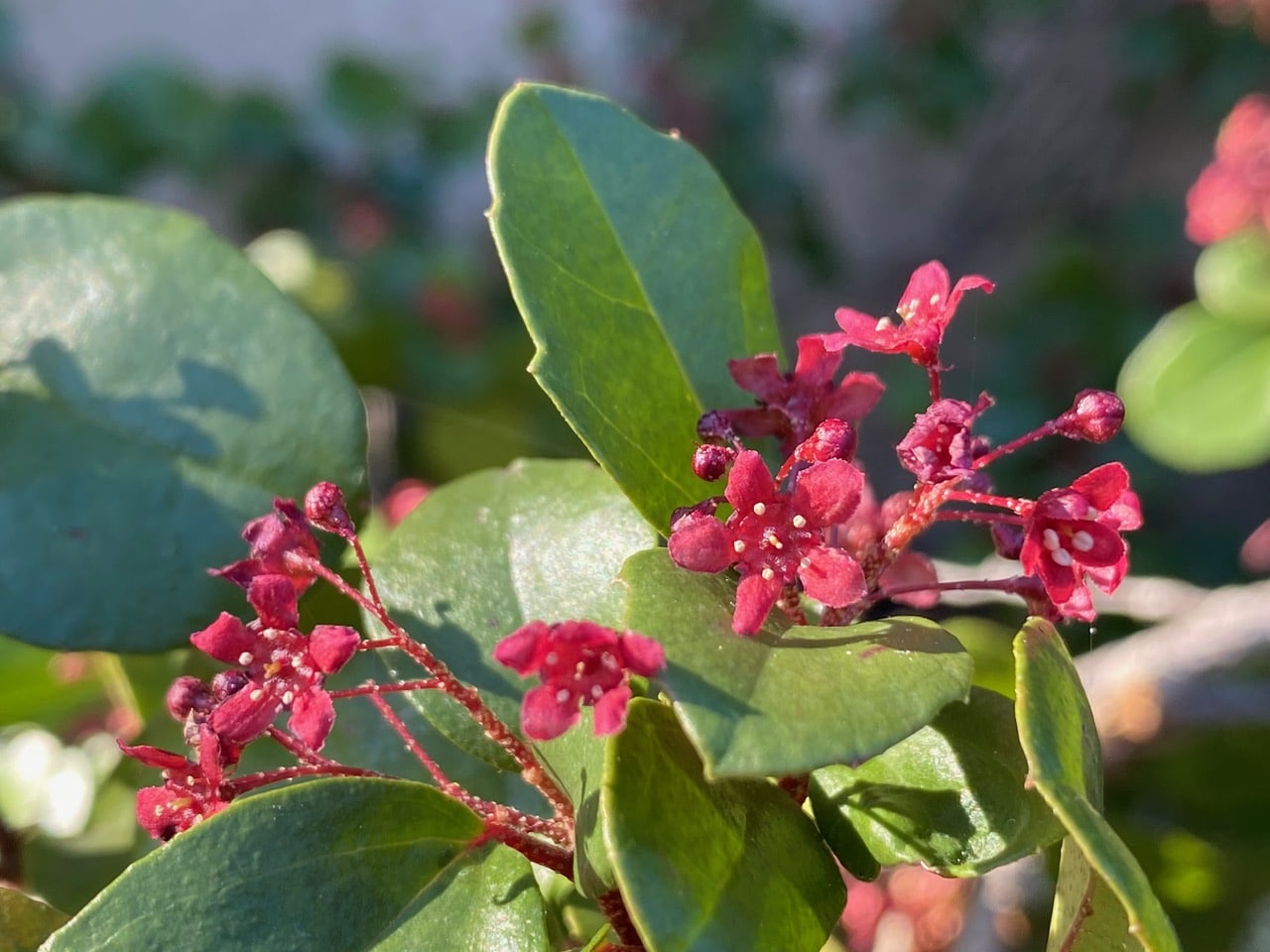
After a gloomy day of endless rain showers, I am happy to visit the Regional Parks Botanic Garden again. It is a cold but sunny morning, with temperatures in the mid 50s F.
Whenever I enter the garden, I like to stop by the modest shrub of Evergreen Currant, Ribes viburnifolium growing at the corner of the visitor center. The plant has been blooming for two months, and I have yet to find out who pollinates its tiny brick red flowers. As usual I hang around, waiting for a midge or other small insects to land.
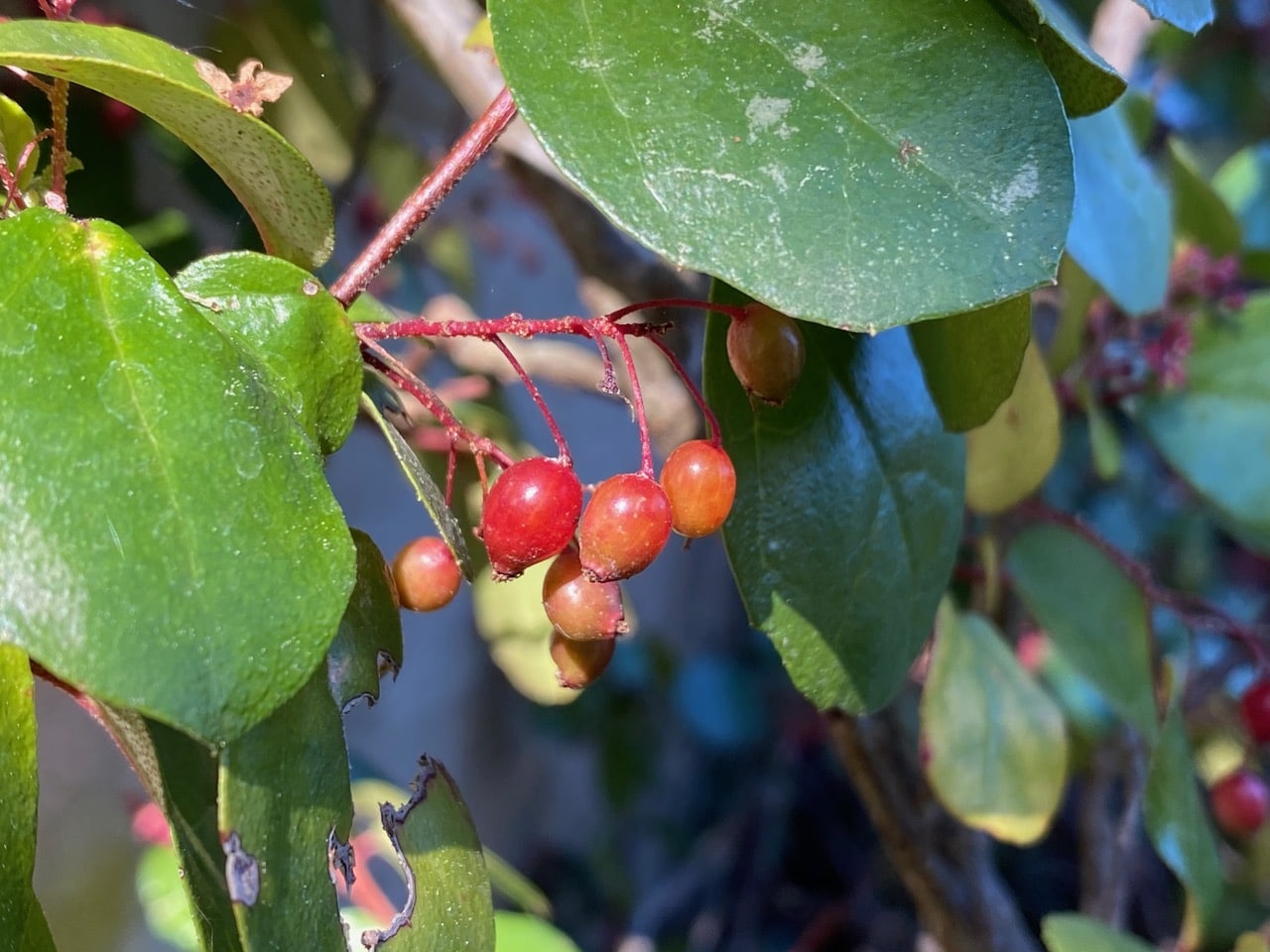
The sight of ripening berries on the plant makes my quest ever more frustrating and urgent. Have I already missed the pollinators again this year?
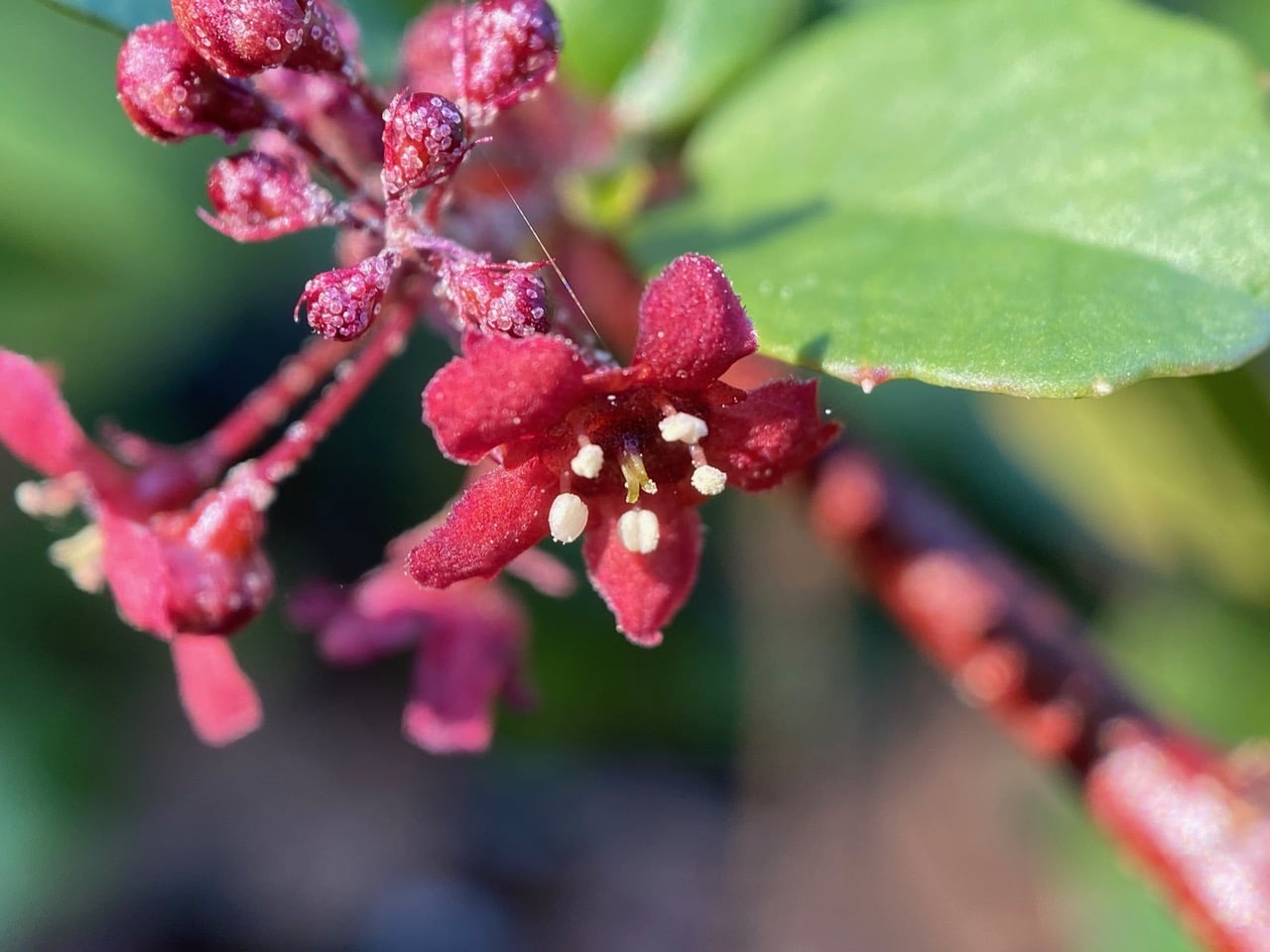
Photographing the flowers up close, I notice for the first time translucent sugar-like grains on the flower buds and pedicels. Are these glandular exudates commonly found on the underside of the leaves of the Evergreen Currant?
The Evergreen Currant, Ribes viburnifolium, or Catalina Perfume as it is sometimes known, is endemic to Santa Catalina island and Baja California. It is a 2-3 foot-tall evergreen perennial shrub with dark green, leathery leaves. After a rain the plant fills the air with a sweet citrus or piney scent. The fragrance derives from glands on the underside of the leaves that exude a sticky sap.

I spot an American Winter Ant walking along a stem. ANTS?! I haven’t considered them. Sure enough, as I scan the tiny flowers for them, I see several taking nectar from the flowers.
The American Ant, Prenolepis imparis is a widespread North American ant. A dominant woodland species, it is most active during cool weather, when most other ant species are less likely to forage. This species is one of a few native ants capable of tolerating competition with the invasive Argentine Ant, Linepithema humile. They are also aggressive toward other ants and produce abdominal secretions that are lethal to Argentine Ants. Prenolepis imparis is a generalist omnivore. Foragers are known for tending to aphids or scale insects from which they consume excreted honeydew, aggregating on rotting fruit, and exploiting protein-rich sources such as dead worms. The colony enters estivation (a hibernation-like state) and becomes inactive above ground for the warmer months, during which time eggs are laid and brood are reared. Reproductives overwinter and emerge on the first warm day of spring for their nuptial flight.
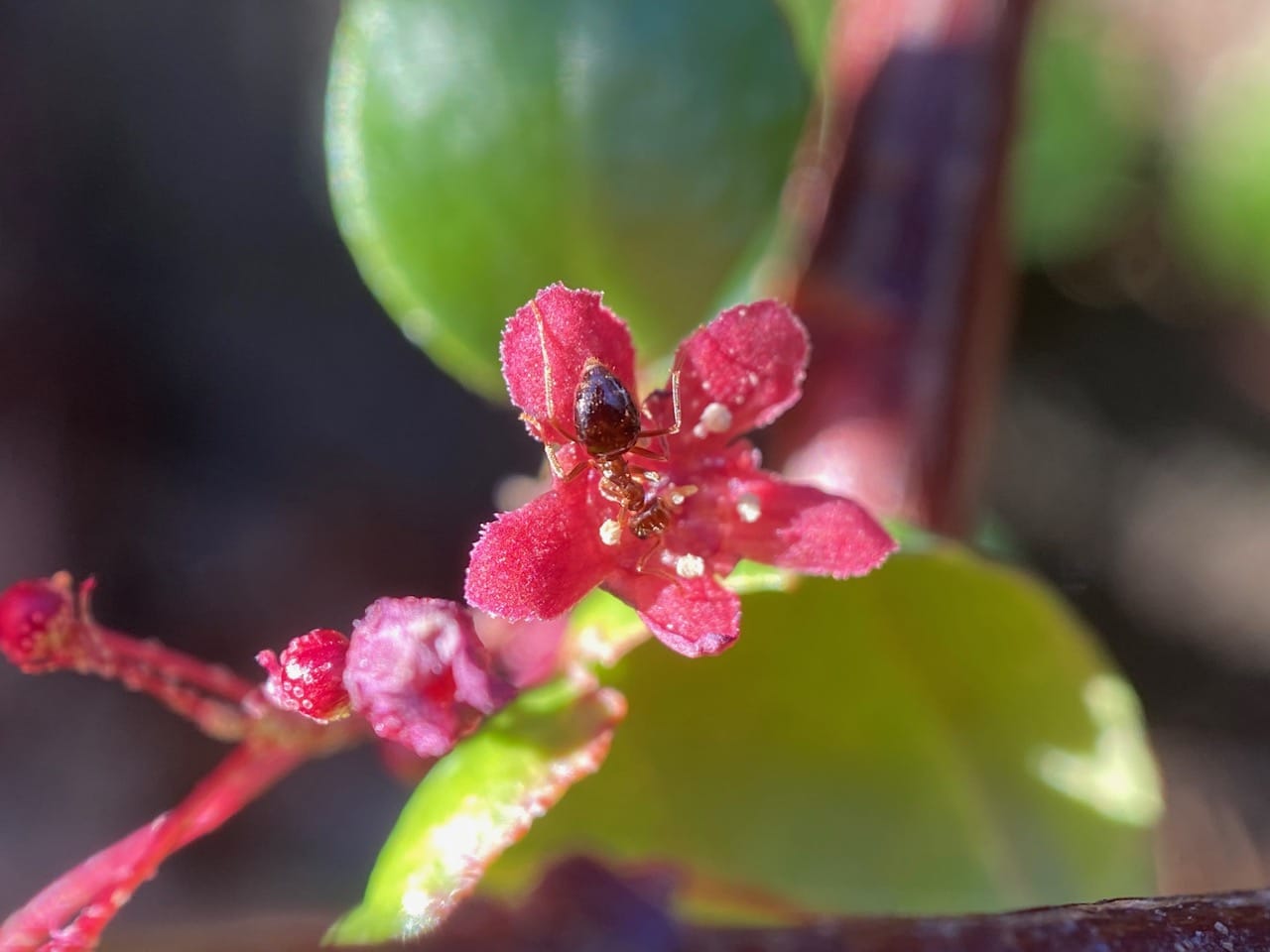
Both the flower and its visitor are lit up by the morning sun here.
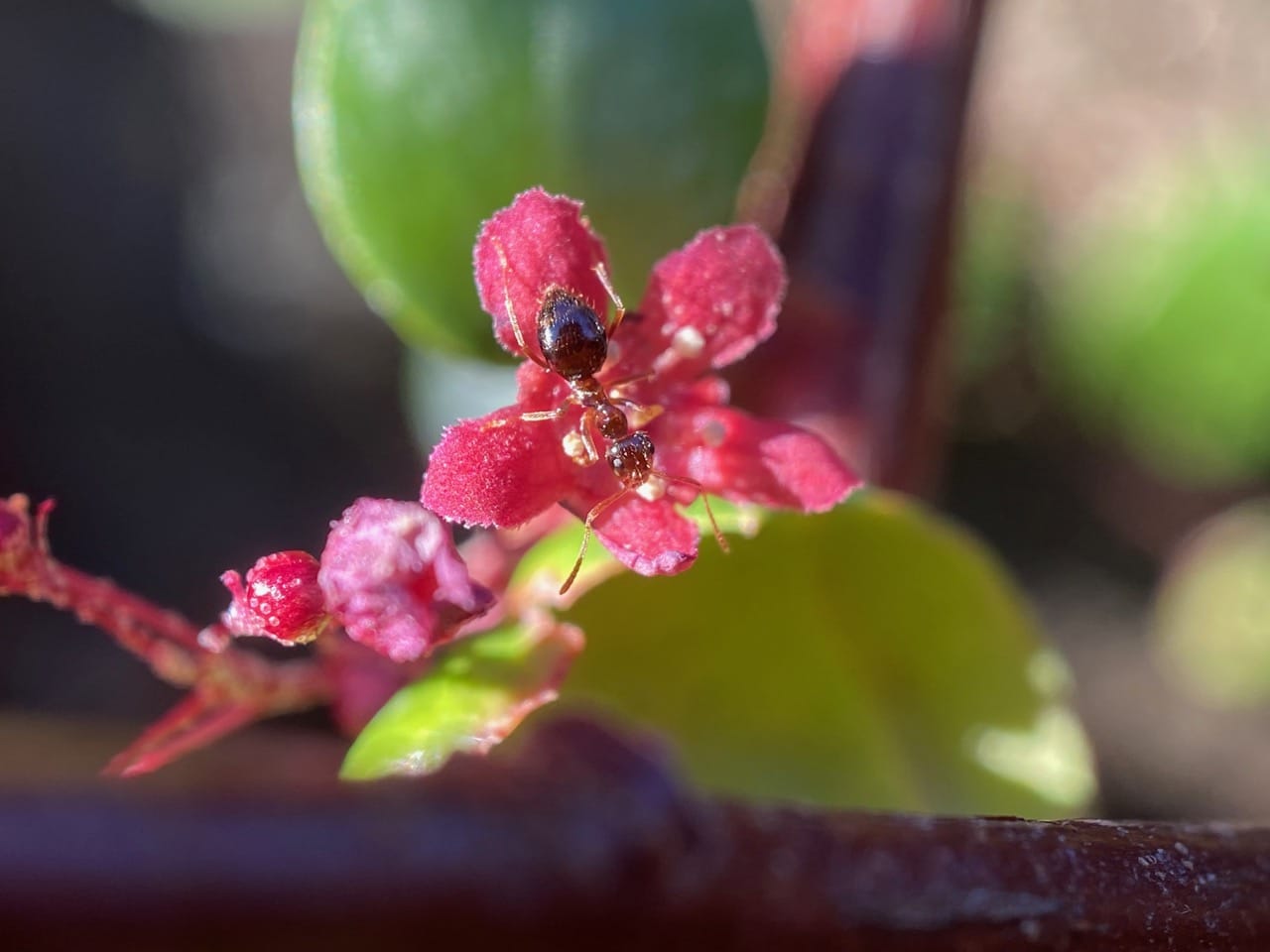
Since the plant grows in a shady spot, I have missed the ants all together.
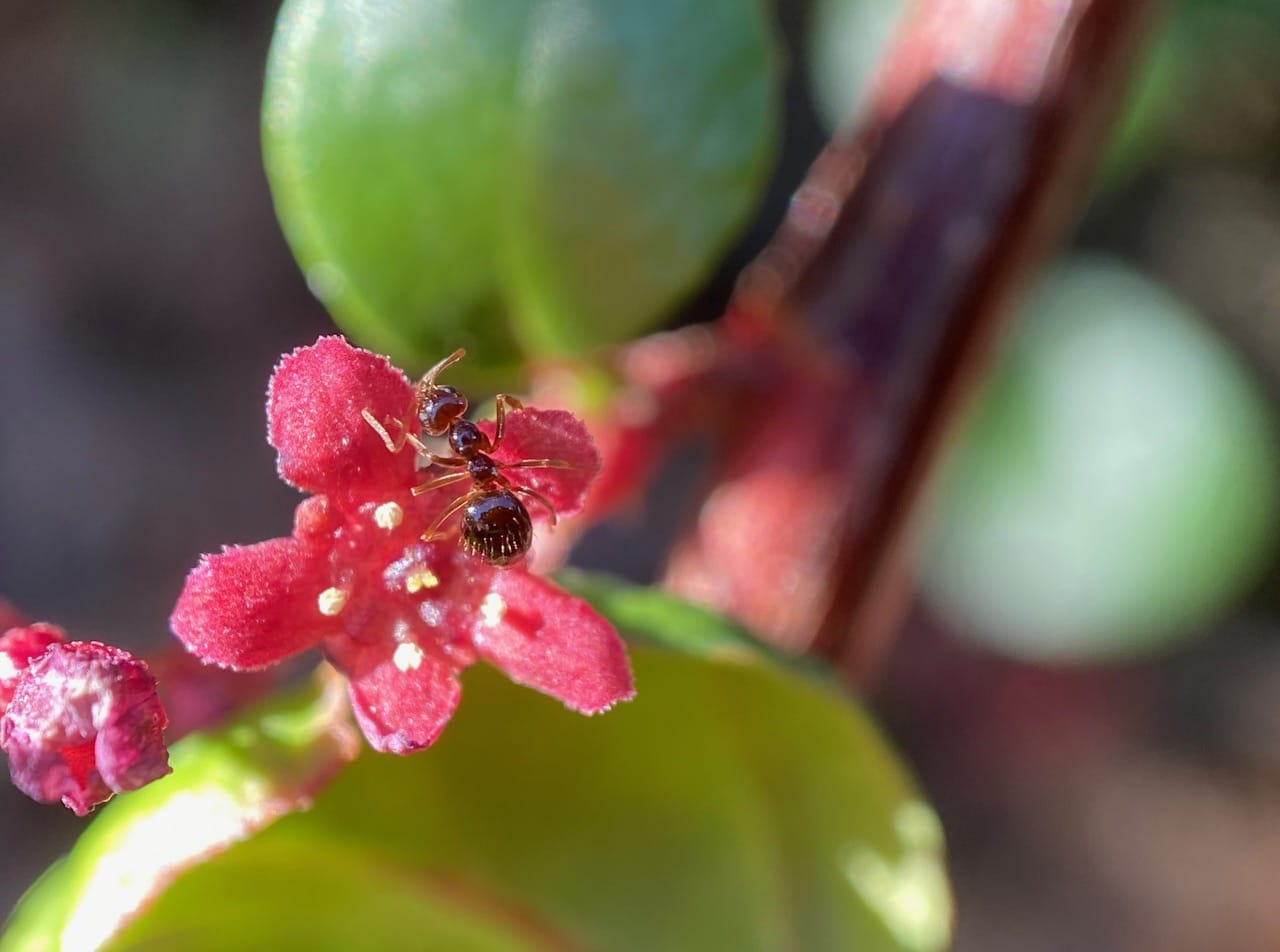
The sun lights up the hairs on the American Winter Ant’s abdomen in this angle. Surely those hairs could facilitate pollen transfer? Are the American Winter Ants, active through the cold months, the primary pollinators for the early blooming Evergreen Currant?
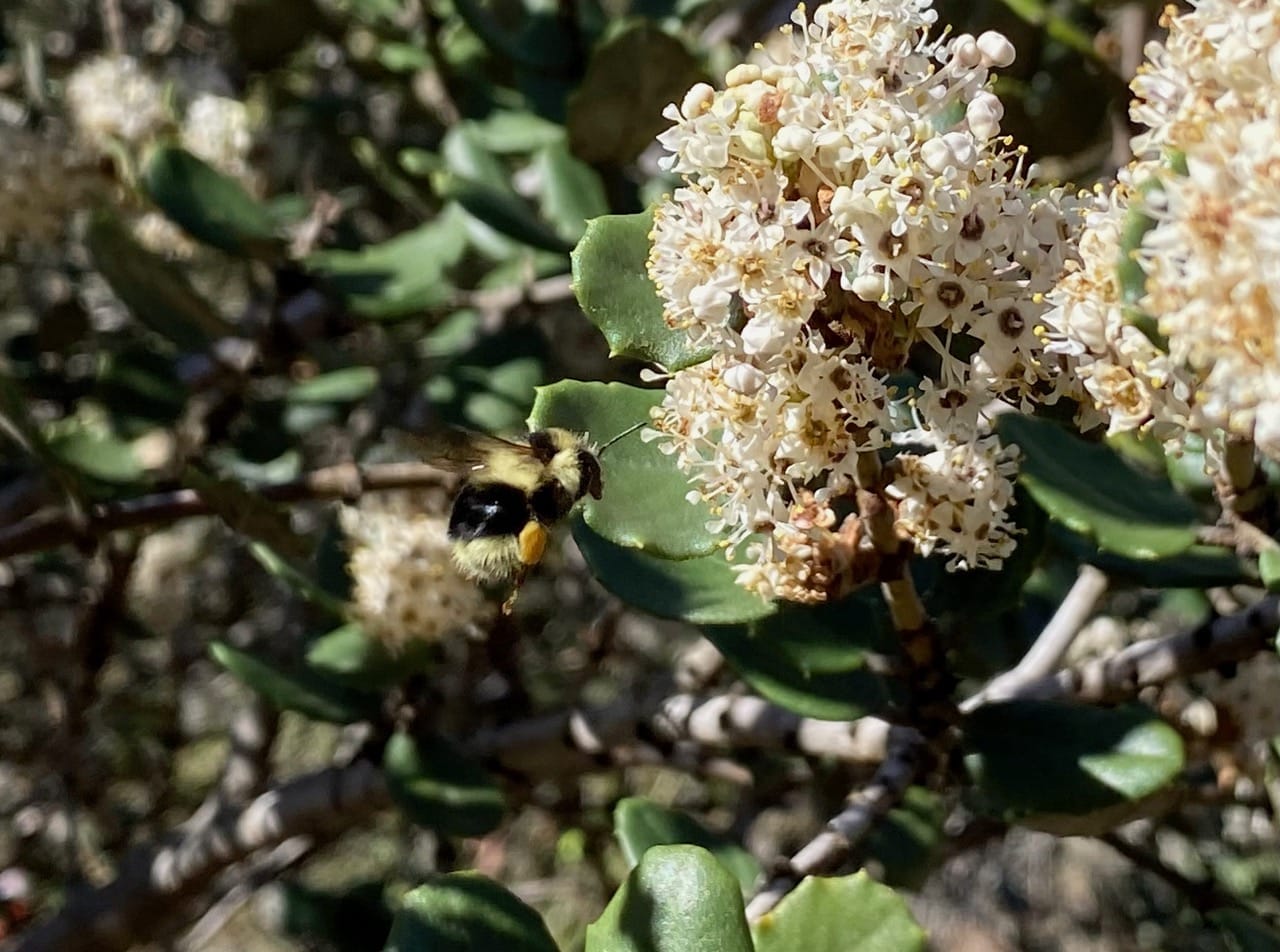
There is a constant hum of bees around the Buckbrush, Ceanothus cuneatus by the front gate. The plant is the domain of the Black-tailed Bumble Bees, Bombus melanopygus (family Apidae).
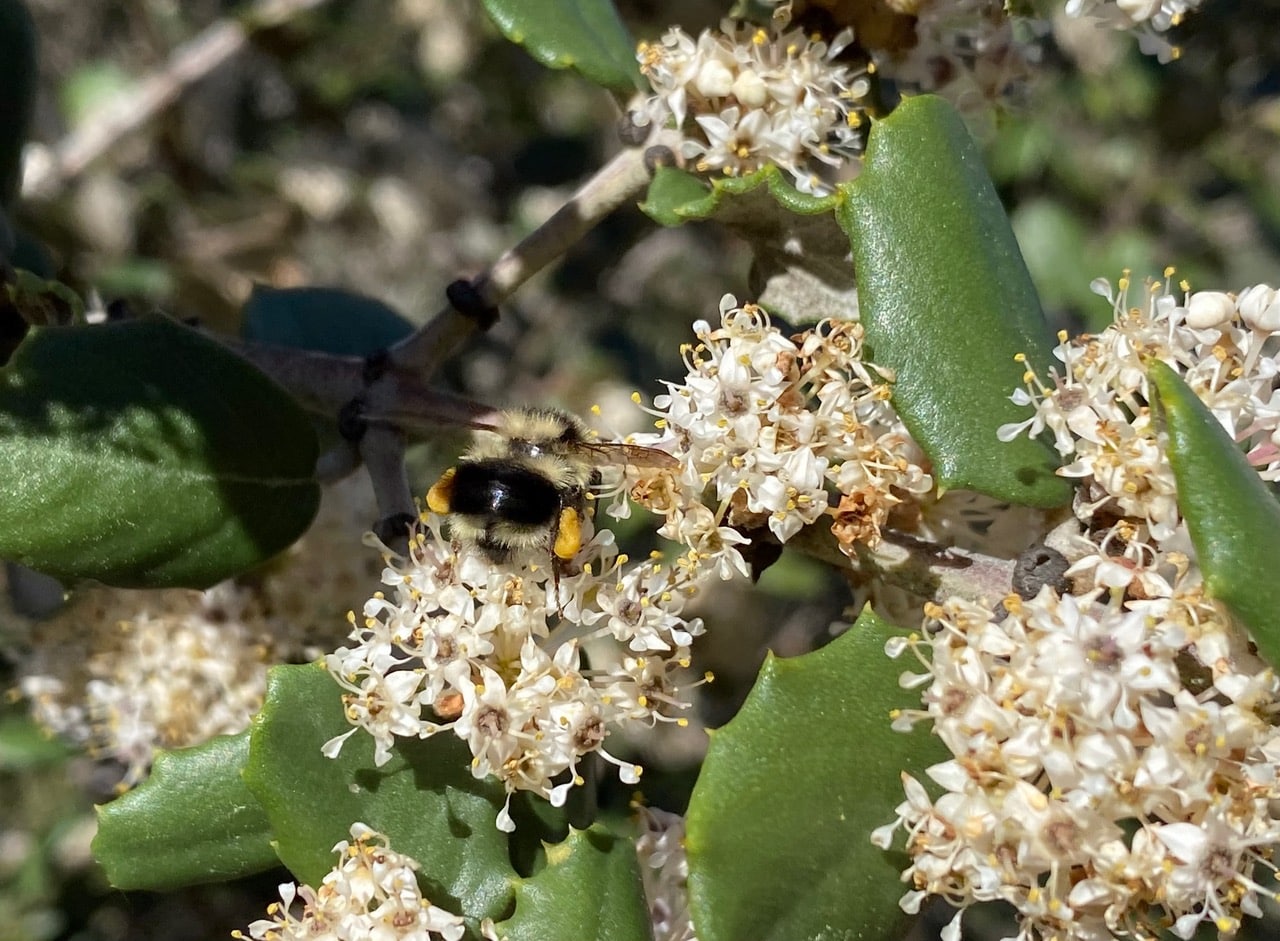
Small worker Black-tailed Bumble Bees forage tirelessly on the ceanothus flowers.

Ceanothus flowers are an excellent source of easily accessible nectar and pollen. The tightly clustered flowers are open-faced, and the stamens protrude beyond the corolla. The bumble bees gather what they need by quickly shimmying over the flower clusters.
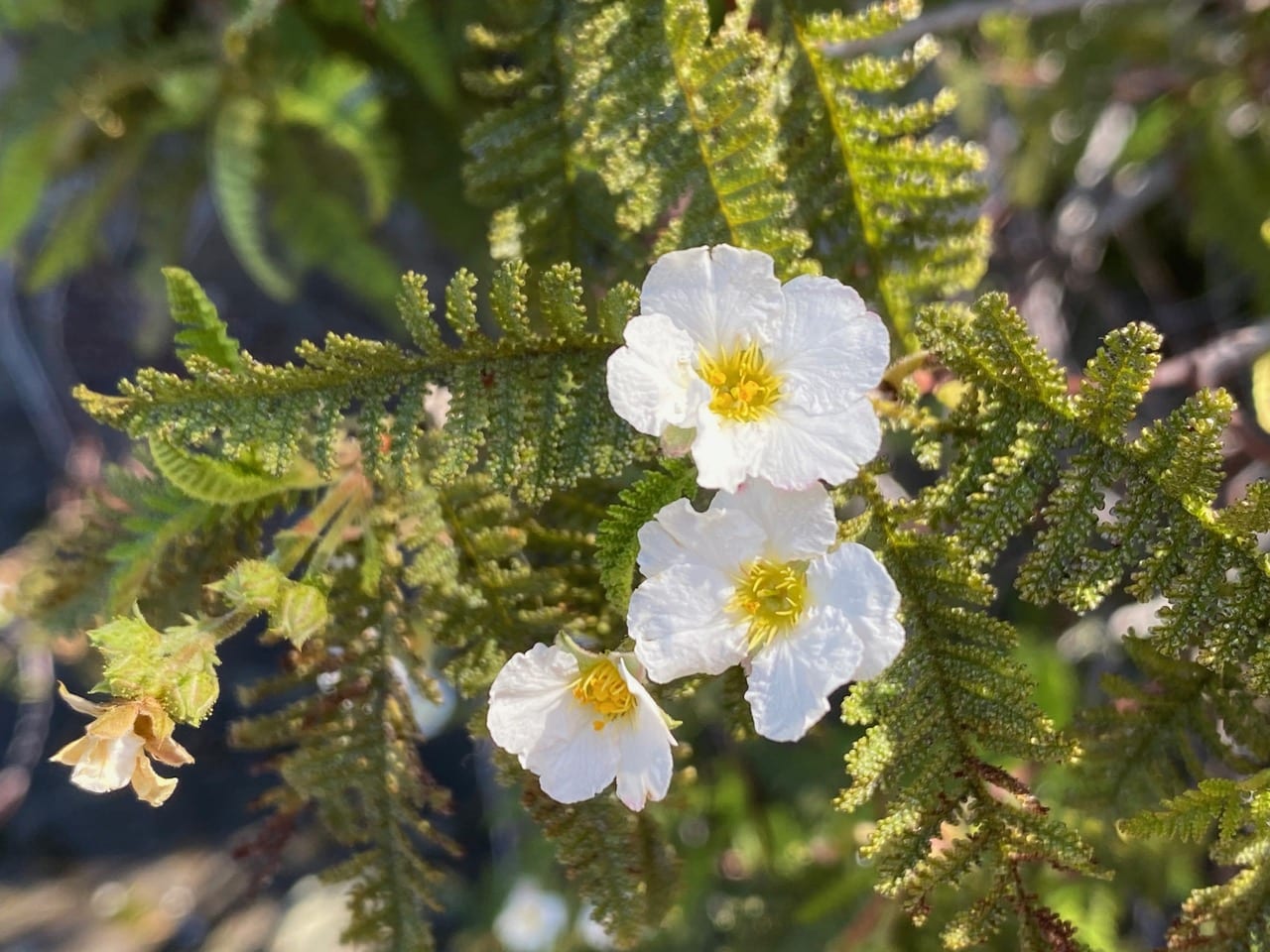
The Southern Mountain Misery, Chamaebatia australis has been blooming for a while, but so far I have seen few insects on the flowers.

Hey, a small black insect has just landed on a mountain misery flower. A wasp?
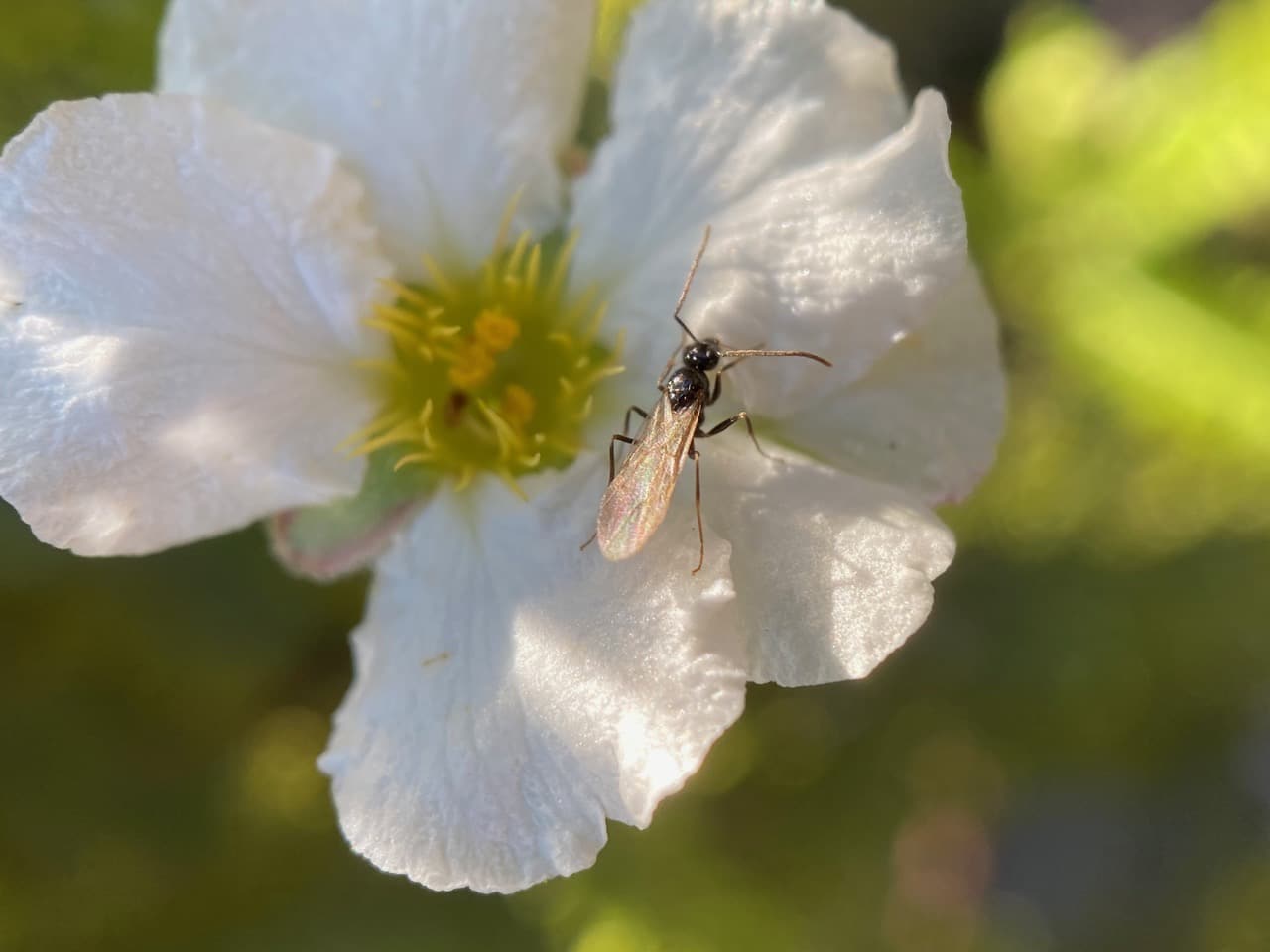
Hmm, something tells me it is not a wasp. It has geniculate (elbowed) antennae. Although some wasps do have elbowed antennae, they are mostly minute parasitoid Chalcid wasps. This has to be an ant or a bee. A male alate (winged reproductive) of the American Winter Ant? iNaturalist has since confirmed my suspicion. This must be an auspicious day for the ants to conduct a nuptial flight! I am surprised, as although it is a calm and sunny morning, it is still chilly out. I have to wear cut-off gloves to keep my hands warm enough for photography.
Nuptial flight is an important phase in the reproduction of most ant, termite, and some bee species. A mature ant colony seasonally produces winged virgin queens and males, called alates. In what is known as the haplo-diploidy sex determination system, unfertilized eggs develop into males, while fertilized eggs usually develop into wingless, sterile workers, but may develop into virgin queens if the larvae receive special nutrition. Young queens and males stay in their parent colony until conditions are right for the nuptial flight. The flight requires warm, rain-free and relatively windless weather, often after some rain. Different colonies of the same species often use environmental cues to synchronize the release of the alates so that they can mate with individuals from other nests, thereby avoiding inbreeding. The sudden take off of huge numbers of the ants all at once also serves to momentarily overwhelm their predators (birds, lizards, etc.) to ensure that a few alates will survive to establish new colonies.
During the nuptial flight, each virgin queen usually mates with several males. The sperm is stored in a special organ in her abdomen, the spermatheca, and lasts throughout her lifetime. Once the alates have mated, the role of the males is over, and they soon die. The mated queens quickly chew off their own wings and begin looking for a suitable site in which to nest and set up a new colony. She digs herself an underground chamber and lays her first few eggs, which she rears to adulthood. After the first workers appear, the queen’s role in the colony typically becomes one of exclusive egg-laying.
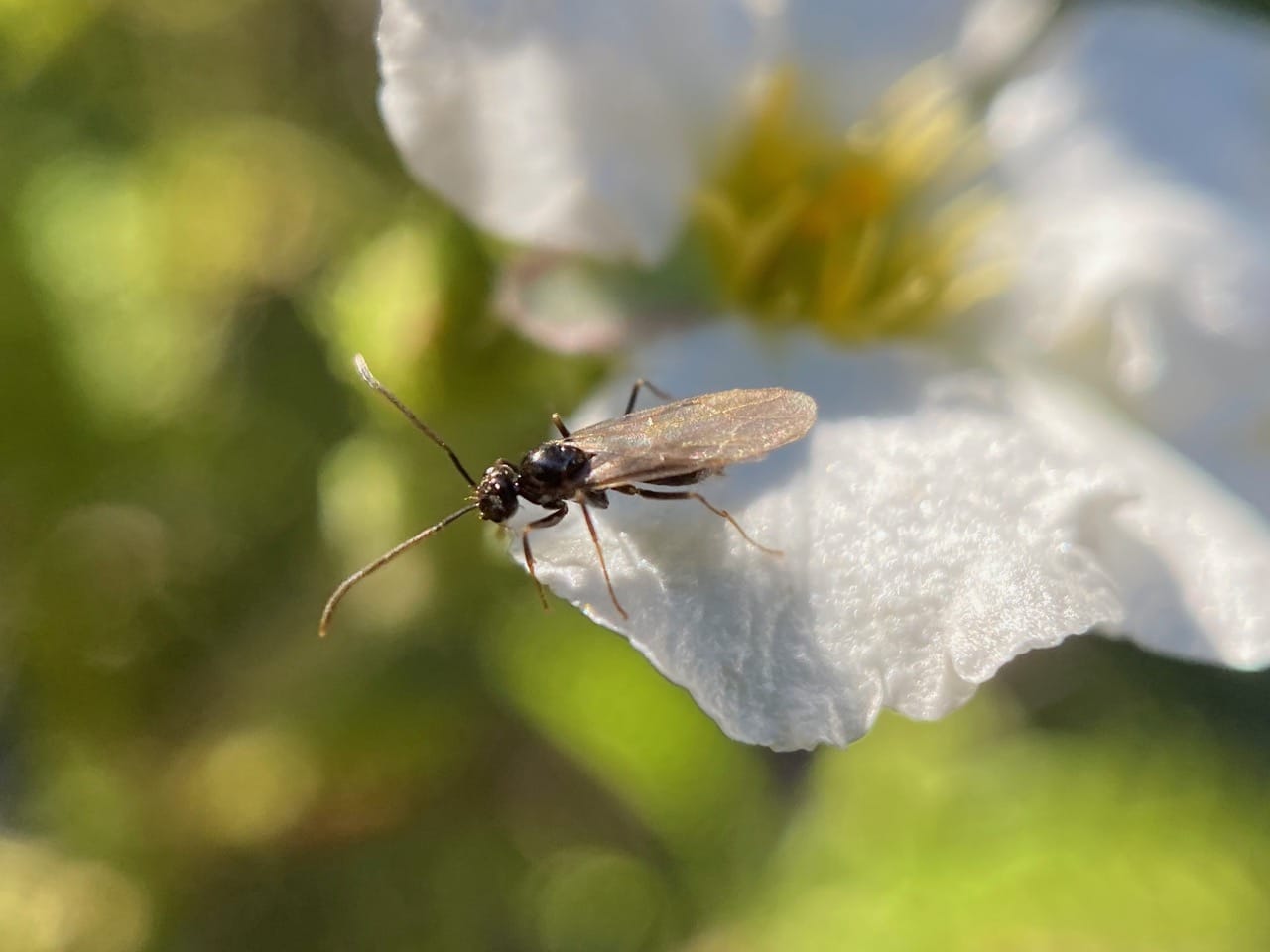
In the American Winter Ant, Prenolepis imparis, neither the male nor the female alates look like the workers at all. What’s more, the female alate (queen) is much larger than the male alate. She is honey-colored, while the male is black. The name imparis comes from the Latin word meaning “unequal”, referring to the startling size difference between the queen and the male.
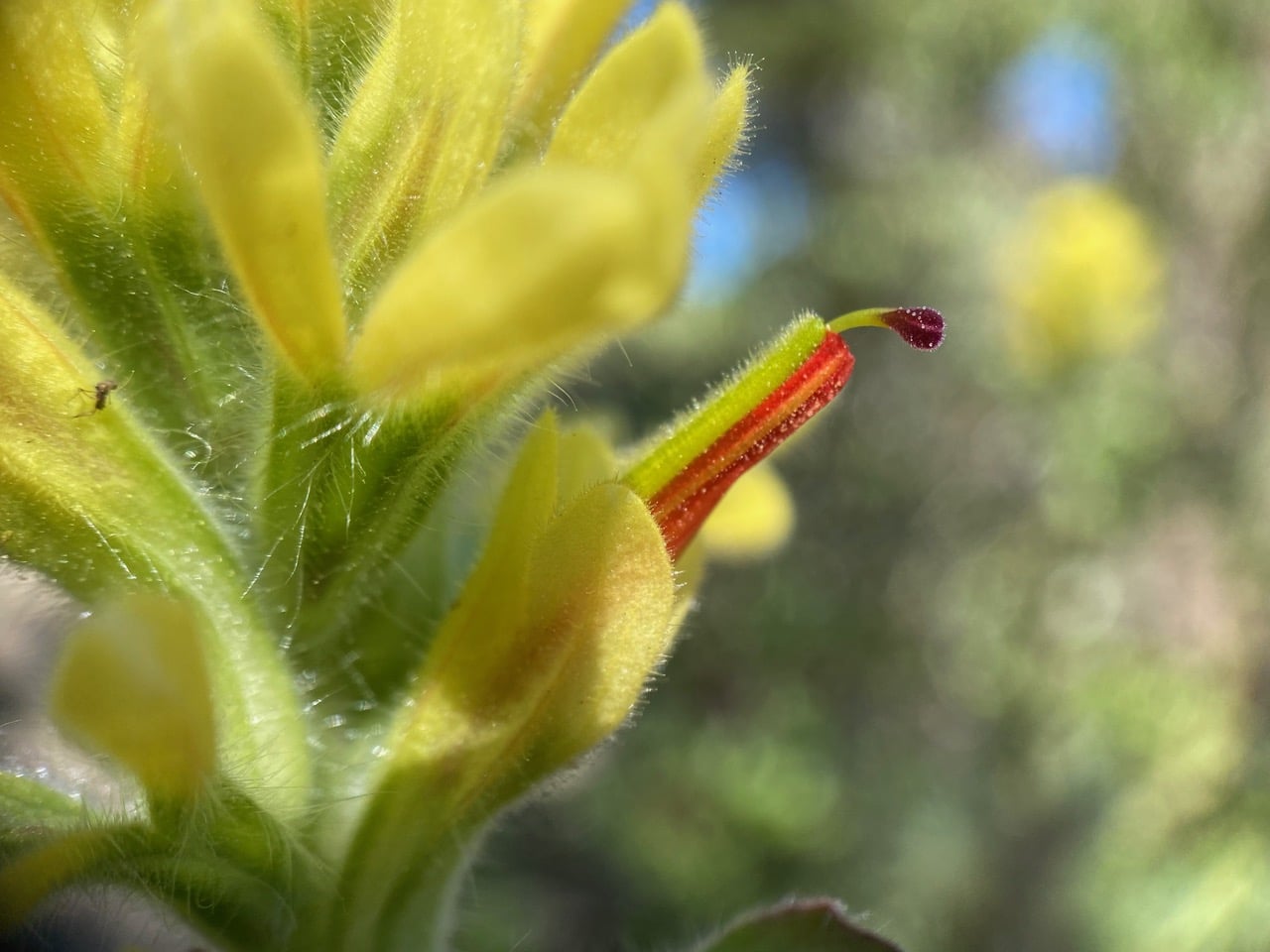
I stop by the yellow Coast Paintbrush, Castilleja affinis ssp. affinis that I have photographed on 2/27/25. The same flower that I have focused on has changed considerably – the unusual tubular corolla (comprising the upper green and lower red petals) have lengthened way beyond the yellow calyx. I think it is still not fully mature, as the velvety maroon stigma has yet to open up its two lobes. The flower has certainly made itself more conspicuous to the hummingbirds, its main pollinators. When a hummer probes the flower for nectar with its long, thin bill, its bill and head are likely to come away with pollen from the stamens located right behind the opening of the flower. The pollen may be rubbed off on the protruding stigma of the next flower the bird visits.

At the same manzanita where I photographed the Greater Bee Fly above, I encounter the same fly again. This time I don’t even bother with taking still pictures – I turn on the video right away.
Bombylius major, commonly known as the Greater Bee Fly is a parasitic bee mimic fly in the family Bombyliidae. It derives its name from its close resemblance to bumble bees. Its flight is quite distinctive – hovering in place to feed, and darting between locations. The species has long skinny legs and a long rigid proboscis held in front of the head. Bombylius major is easily distinguished from the other local species of Bombylius for having wings with dark leading edge, hyaline trailing edge with sharp dividing border. This feature is visible even as the fly is hovering. Adults visit flowers for nectar (and sometimes pollen) from a wide variety of plant families, excelling at small tubular flowers, and are considered good generalist pollinators. Often the pollen is transferred between flowers on the fly’s proboscis.
The bee fly larvae, however, have a sinister side. They are parasitoids of ground-nesting bees and wasps, including the brood of digger bees in the family Andrenidae. Egg deposition takes place by the female hovering above the entrance of a host nest, and throwing down her eggs using a flicking movement. The larvae then make their way into the host nest or attach themselves to the bees to be carried into the nest. There the fly larvae feed on the food provisions, as well as the young solitary bees.
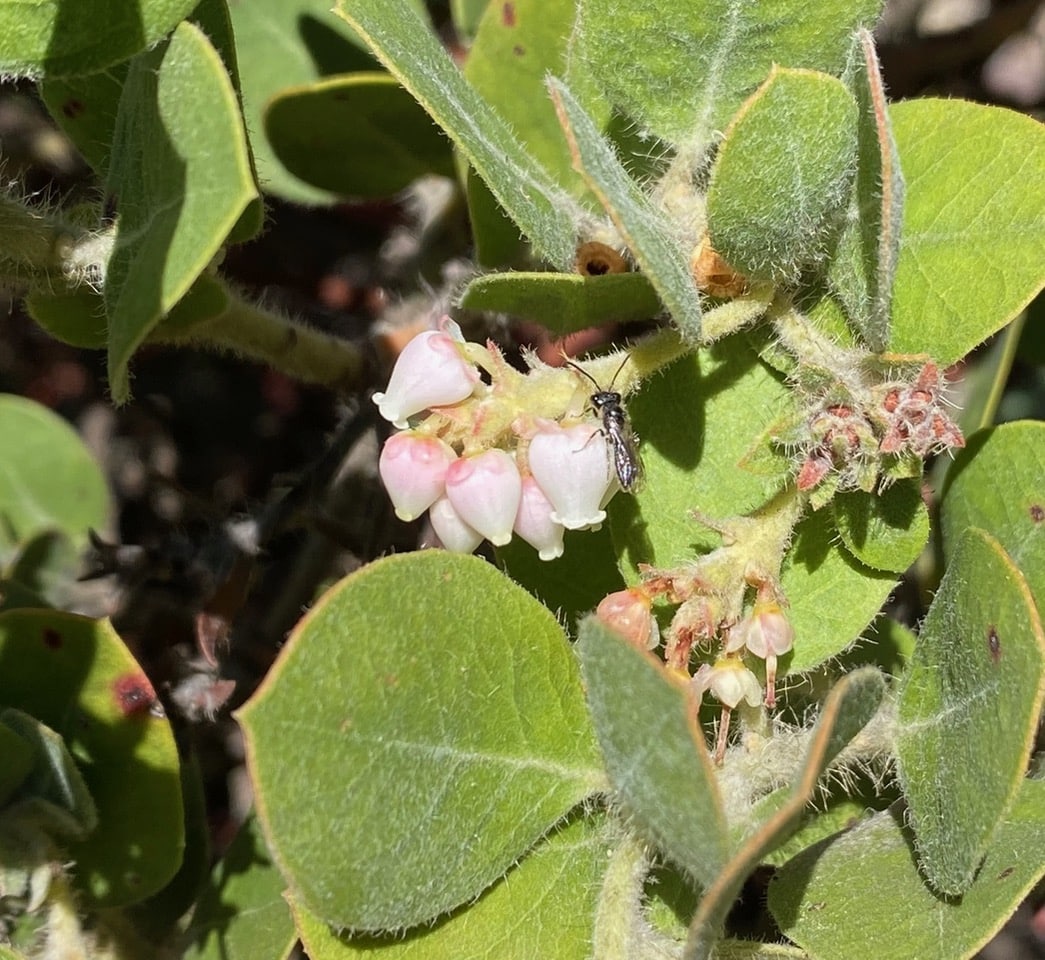
It seems I am seeing the same cast of characters again on this manzanita. The small black bees are less numerous today. They appear to be small enough to enter the small opening of the manzanita flowers. Why would these bees visit the manzanita flowers if they can’t access the goodies inside? The larger bees, such as the bumble bees (Bombus) and the digger bees (Anthophora) have long tongues that can reach the base of the flowers to sip nectar without entering the corolla. For pollen collection, the larger bees perform buzz pollination.
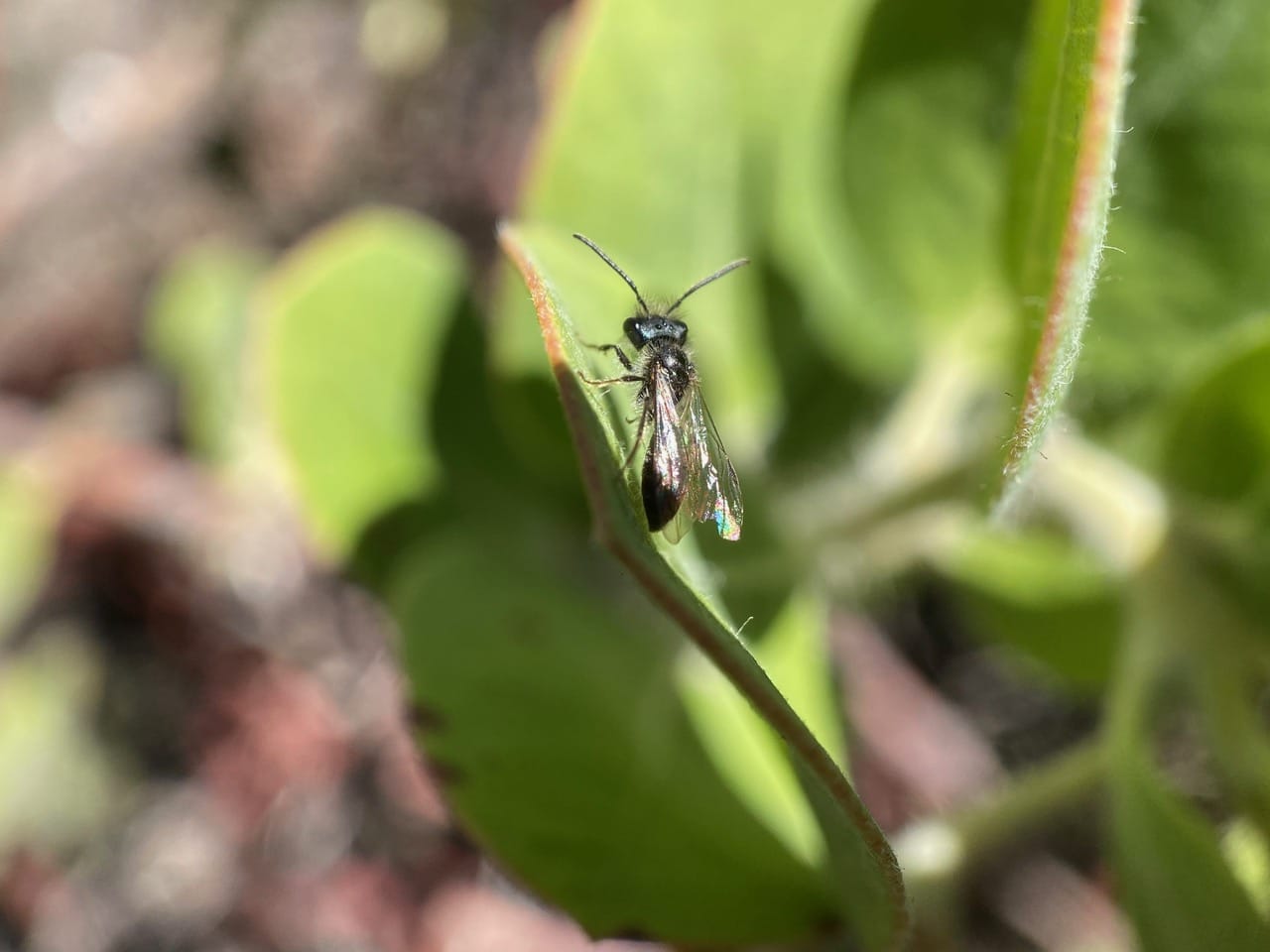
Hey, this little bee is actually staying put for a macro shot! A bee expert on iNaturalist has helped identify it as a Mining Bee in the genus Andrena (family Andrenidae). Yay!
Bees in the family Andrenidae, commonly called miner bees or mining bees, are solitary ground-nesters. Andrenids are fairly small bees, usually dark-colored, and often banded. They are identified by the dense bristles (scopae) at the bases of the legs and the shin-like sections (tibias) of the legs, as well as by certain creases and grooves on the face and head and by unique wing venation. Many Andrenids resemble wasps – slender with long abdomen.
Most andrenids are specialist pollinators whose life cycle is timed to correspond precisely to the blooming of specific flowers. Because of this, andrenids are some of the first bees to emerge in spring, and many are active in March and April, as they visit early spring wildflowers.
All Andrena species share a distinctive facial characteristic: facial depressions call fovea rest alongside the sutures under each antenna. The foveae are covered with hairs that are sometimes described as looking like “sideways eyebrows”. Another distinguishing Andrena trait is that females appear as if they carry pollen under their “armpits”. This is because they have propodeal corbiculae in the space between their thorax and abdomen.
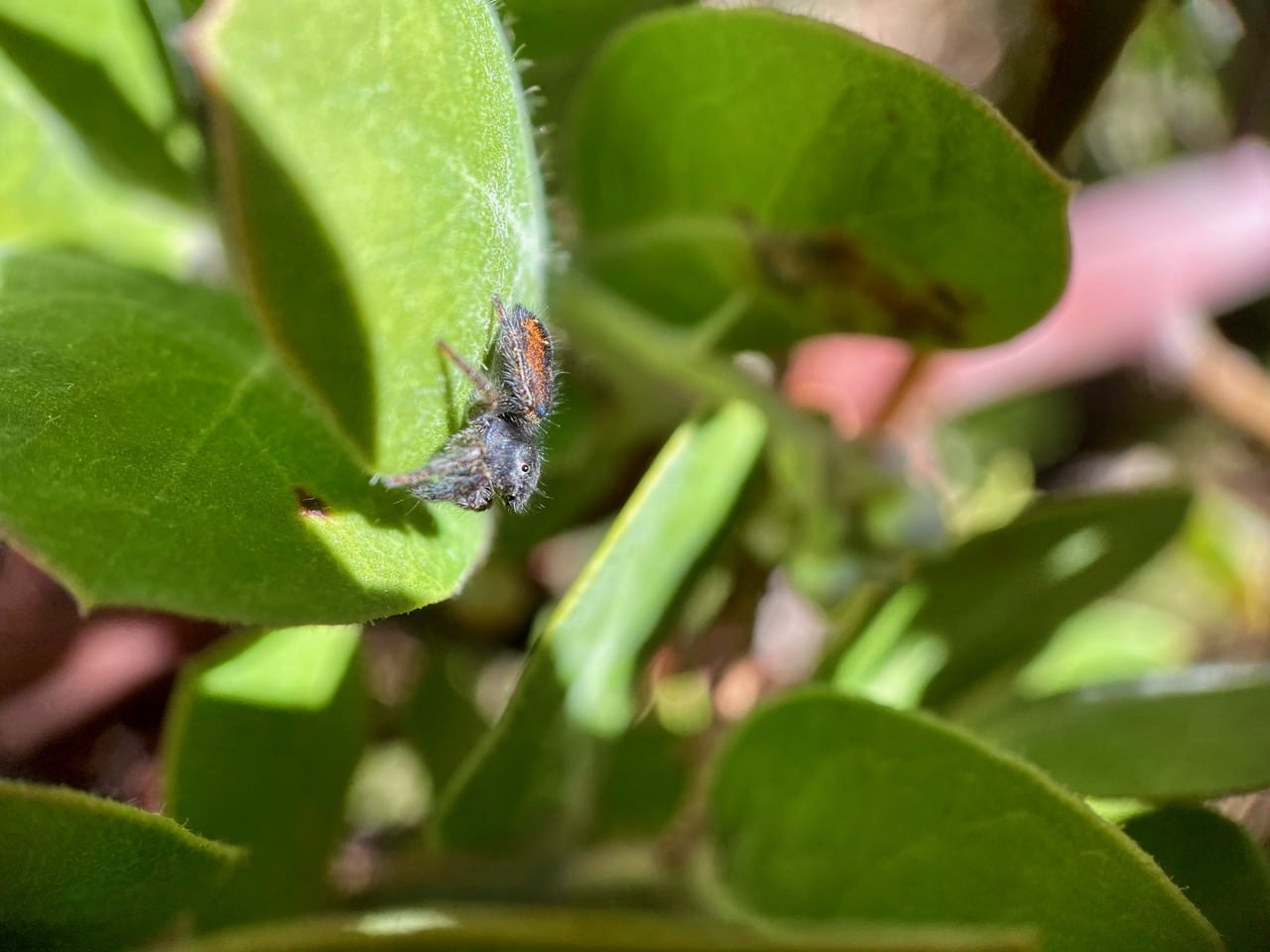
A female Johnson’s Jumping Spider, Phidippus johnsoni (family Salticidae) is hunting among the foliage of the manzanita.
Also known as the Red-backed Jumping Spider, the species is one of the largest and most commonly encountered jumping spiders in western North America. This individual is a female. Males have an all-red abdomen. Salticids are free-roaming hunters. They do not weave a web to catch prey. They stalk, then pounce on their prey. Just before jumping, the spider fastens a safety line to the substrate. It can leap 10-20 times their body length to capture prey. Their movement is achieved by rapid changes in hydraulic pressure of the blood. Muscular contractions force fluids into the hind legs, which cause them to extend extremely quickly.

The most obvious visitors to the manzanita flowers are the Pacific Digger Bees, Anthophora pacifica. Typically, digger bees have “Roman noses” or concave profiles. The yellow integuments (partially covered by hairs) on his face distinguish this individual as a male.
As their name implies, the Digger Bees nest in the ground, sometimes in huge aggregations. These fast and noisy flyers buzz around flowers, appearing to “hop” from flower to flower while foraging. The chubby, furry Digger Bees resemble the bumble bees in many ways, but are a lot noisier. They are a fearless, rowdy lot – fun to watch but a challenge to photograph. Male digger bees of many species have white or yellow integuments on their faces. Females have shaggy hairs on their back legs, used to carry pollen. Female Anthophora are capable of buzz pollination – i.e. they vibrate their wing muscles to shake pollen from the anthers of some flowers. Digger bees are generalist pollinators that visit an impressively wide range of plants. They are exceptionally effective pollinators and play an important role in maintaining wildflower diversity, in part because their long tongues allow them to pollinate deep-throated and tubular blossoms inaccessible to other bees.
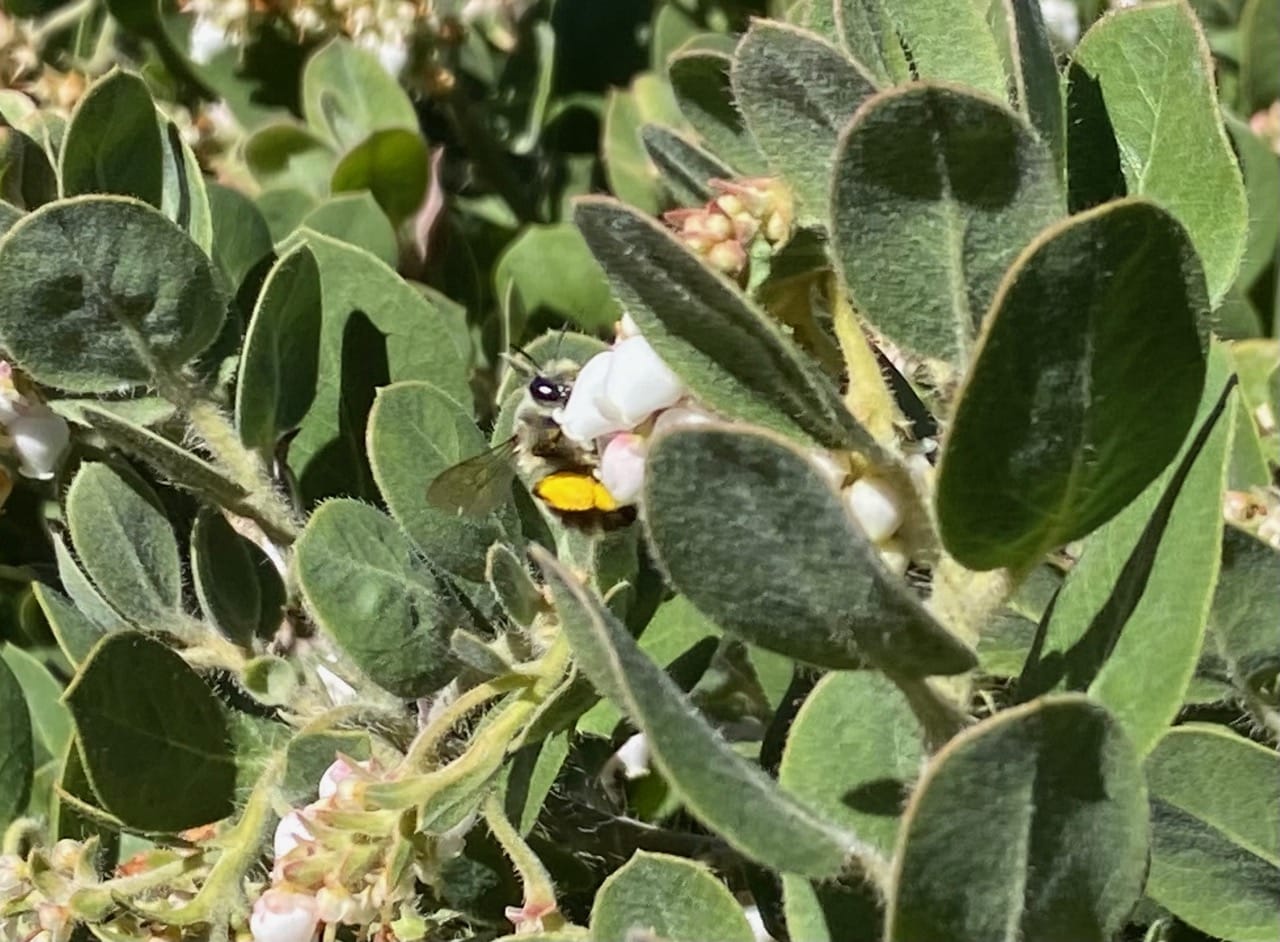
Hey, that’s a female Pacific Digger Bee with her scopae full of yellow pollen! In general, if you see pollen on a bee’s hind legs, you can be sure that it is a female. Male bees do not collect pollen to provision the nest, neither do they have the anatomical equipment for the job. There are exceptions where the females do not carry pollen on their hind legs. Female leafcutter bees (family Megachilidae), for example, transport pollen on the underside of their abdomen. Female Masked Bees (family Colletidae) transport pollen internally in their crop.

Ooh, somebody has been robbing nectar from these manzanita flowers! Somebody with strong enough mandibles to cut those gaping holes. Ants are small enough to get inside the flowers, so they are probably not responsible for these damages.
“Nectar robbing” occurs when bees create or reuse holes bitten through the base of a flower to extract pollen, and thus do not pollinate the flower in the ‘legitimate’ manner. Many species of bees, including bumble bees, carpenter bees, and some other bees, can rob nectar. Other animals that rob nectar include wasps, ants, beetles, and birds.

You can actually see the red anthers of manzanita flower through that big hole.
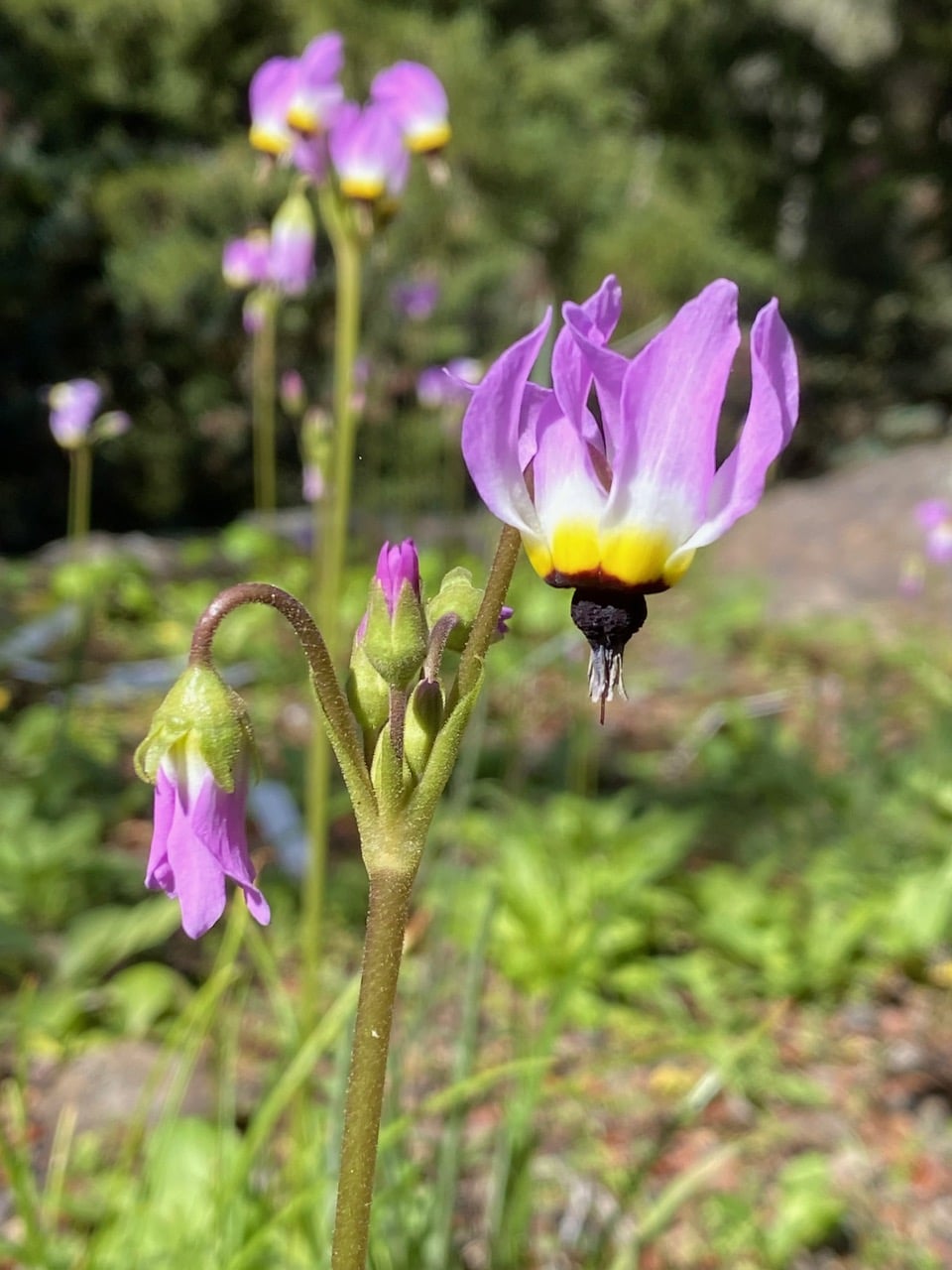
In a raised bed at the back of the garden, various species of the Shooting Stars (Primula sp.) are in bloom. I stand around a while, hoping to see a bumble bee or a digger bee come by to collect pollen.
The Shooting Star flower droops downward with petals reflexed, or bent back. Most of the petals are a lovely pink, but toward the base a fringe of white blends into yellow – colors most attractive to a bee’s eyes. A squiggly line of burgundy marks the spot where the petal bends. A conical purple column hangs below the petals. This is the anther cone, a fusion of the anthers where pollen is produced. Surrounded by the cone, and extending beyond is a thin, needle-like style with a stigma at the tip – the female portion of the flower.
Shooting star flowers do not produce nectar, but pollination is most often accomplished by bumble bees foraging for pollen, and using a specialized method called “buzz pollination”. A bumble bee arrives at the flower, grasps the anther cone with its feet and mandibles and hangs upside-down. It disengages its flight muscles from the wings, then vibrates the muscles at a specific frequency, causing the anthers to vibrate, showering pollen onto the bee’s belly. When the bee next visits another shooting star, the pollen on its belly may be rubbed off on the flower’s stigma. Pollination accomplished!
Honey bees do not have this special skill. Only native bees such as Bumble Bees, Digger Bees and a few others are able to buzz pollinate. Manzanitas, blueberries, cranberries, and plants in the Nightshade family such as tomatoes, eggplants and peppers also require buzz pollination.
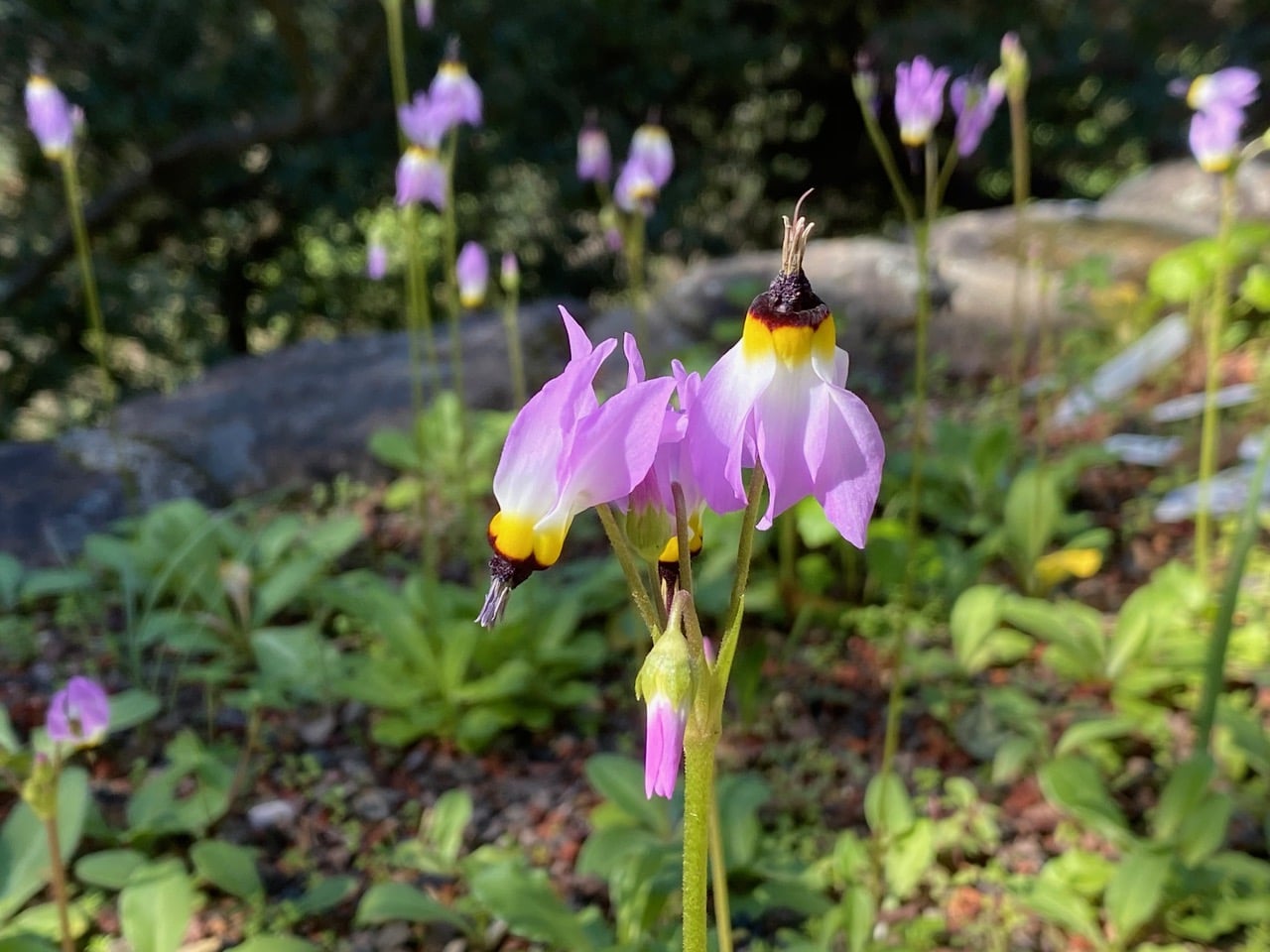
This Shooting Star is further along in maturation. One of the originally nodding flowers has straightened up its peduncle (flower stalk) to point skyward. It has probably been buzz pollinated – note the flared anther cone and the bent style. A fruit is probably developing under the petals at the end of the peduncle. The fruit is a many-seeded capsule. The capsules eventually dry and turn brown, opening at the top. The seeds are shaken out of the pods by the wind or passing animals.